




Abstract
ASTM D 5364 requires that the lowest ovalling frequency of a fiberglass reinforced plastic chimney liner shall not be less than 2 Hz. From engineering practices and numerical experiments, the authors find that the frequency calculated in accordance with ASTM D 5364 deviates considerably from results using finite element analysis (FEA). A modified equation has been proposed in this article to better evaluate the lowest ovalling frequency for FRP chimney liners.
Introduction
Environmental regulations continue to tighten the requirements for clean exhaust gas emissions from coal fired power plants. The result of this is the broader application of wet limestone scrubber technology. This event has driven greater demands for fiberglass reinforced plastic (FRP) used for chimney liners in concrete chimneys rising over 305 m (1000 ft) in height. Since the 1970s, FRP liners have proven their capability to provide a safe and reliable service life for the required conditions.
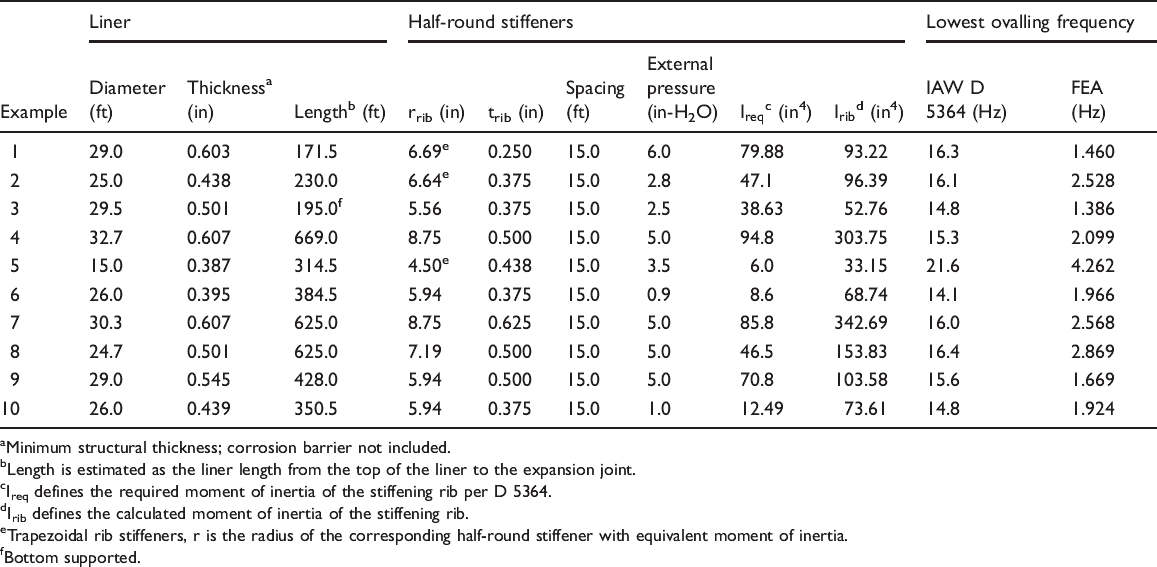
Practical examples of circumferentially stiffened FRP chimney liners.
Minimum structural thickness; corrosion barrier not included.
Length is estimated as the liner length from the top of the liner to the expansion joint.
Ireq defines the required moment of inertia of the stiffening rib per D 5364.
Irib defines the calculated moment of inertia of the stiffening rib.
Trapezoidal rib stiffeners, r is the radius of the corresponding half-round stiffener with equivalent moment of inertia.
Bottom supported.
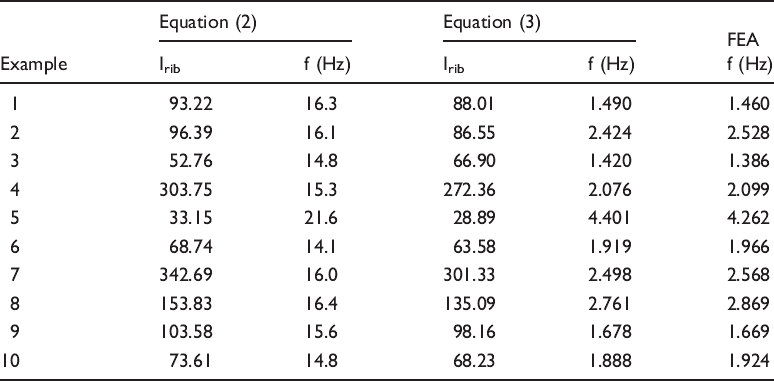
In Table 1, a good representation of common FRP chimney liners has been analyzed, with diameters ranging from 15.0 ft to 32.7 ft, structural thicknesses ranging from 0.387 in to 0.607 in, and lengths ranging from 171.5 ft to 669.0 ft. The lowest ovalling frequency for a stiffened chimney liner in accordance with ASTM D 5364 shows that adequate ring stiffeners have been designed for each chimney liner as the lowest ovalling frequency calculated with Equation 2 is well above the required 2 Hz. However, the frequency calculated in accordance with ASTM D 5364 deviates considerably from results using FEA. In the 3D FEA models, all liners and their stiffeners are meshed with 4-node shell elements. A modal analysis module using FEMAP NX NASTRAN was implemented to calculate the fundamental frequencies and the corresponding modal shapes. FEA reveals that the FRP chimney liners’ frequencies are significantly lower than ASTM D 5364 predicted. Five of the ten liners in Table 1 have lowest ovalling frequencies less than 2 Hz. In other words, FRP chimney liners designed in accordance with ASTM D 5364 does not guarantee satisfying the ovalling frequency requirement in all cases. This indicates that the existing equations alone are not adequate in estimating the lowest ovalling frequency for FRP chimney liners with circumferential stiffeners and the level of uncertainty may be greater than desirable.
Thin-Walled Cylindrical Shell Free Vibration Patterns
The problem of determining the vibration characteristics of cylindrical shells of finite length has been of interest to engineers and scientists for more than a century. Numerous theories
4
–
7
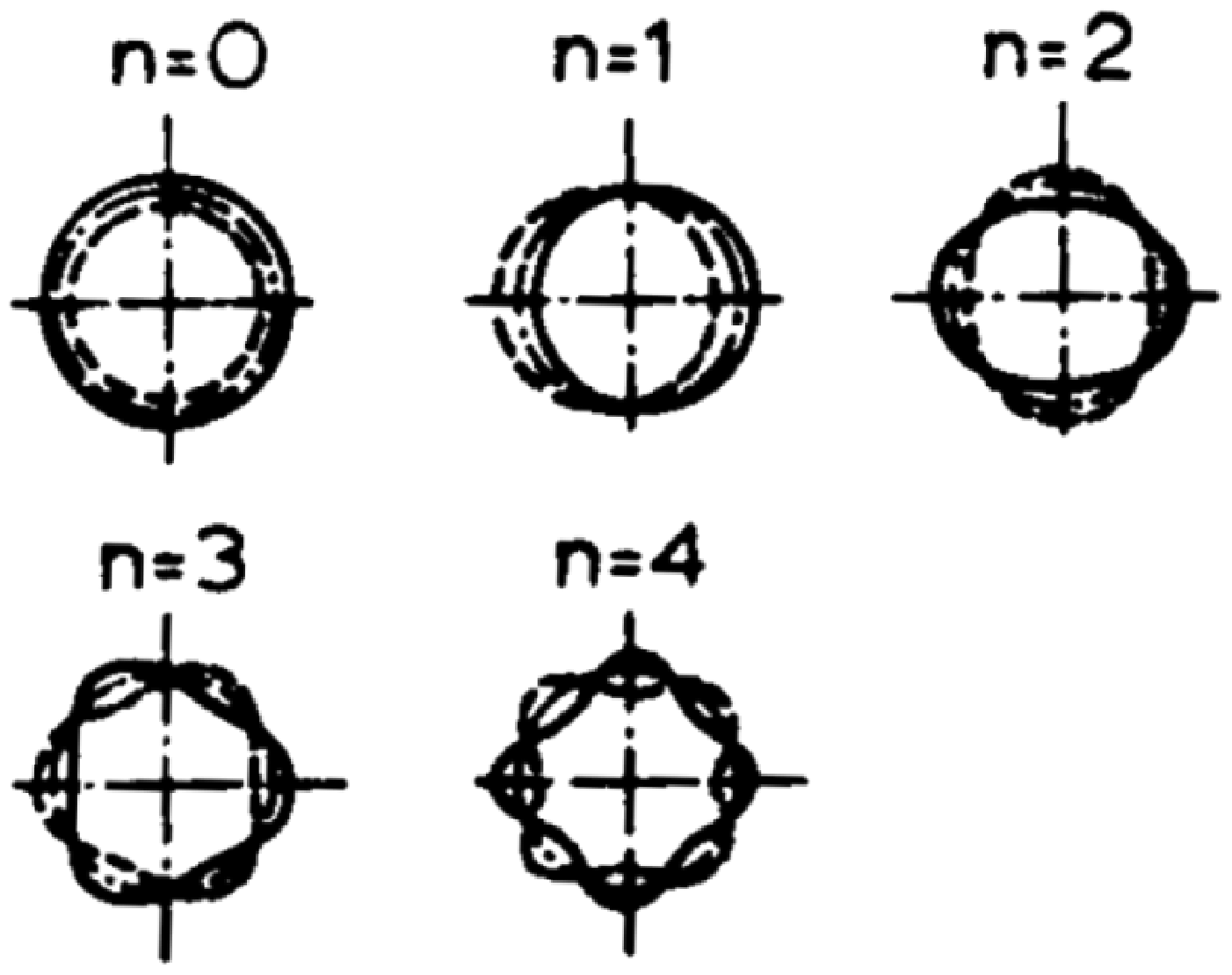
on the free vibration of thin cylindrical shells, including the effects of stiffeners, have been developed by different authors using analytical methods. For a finite length thin-walled cylindrical shell, typical circumferential modes are illustrated in Figure 1.
8
In Figure 1, n is the harmonic number and 2n equals the number of cross points in the radial displacement shape. Figure 1 shows three patterns of vibration modes. Mode n = 0 is referred to as a breathing mode in which the shell wall moves in and out uniformly. Mode n = 1 includes all the axial nodal patterns in which the liner vibrates as a beam while its cross-section remains circular. For modes n > 1, the liner deforms in the cross-sectional plane. These patterns are referred to as ovalling or ring modes. The relationship between the lowest ovalling frequency and the liner geometry will be further discussed in this article. The beam modes, which are not likely to be excited by the gas fluctuation, are not in the scope of this research.
The Frequency Equations
ASTM D 5364 recommends calculating the lowest ovalling frequency of an unstiffened liner as follows:
3
Circumferential nodal pattern.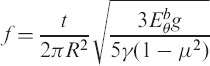
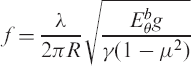
The approach of the above two equations is inherited from the assumption and simplification of the ASCE Standard “Design and Construction of Steel Chimney Liners”. 1 Although this was the best available information at the time, our research indicates a level of uncertainty in its implementation for FRP applications that may not have been understood at the time this approach was adopted in ASTM D 5364. For example, both equations are length independent. Neither equation considers the influence of boundary conditions, which is based on the assumption that the length-to-radius ratio, L/R, is very large, meaning that the boundary conditions influence is negligible. The ASCE Standard 1 indicates that the criteria for steel chimney liners to be independent of length is L/R > 70. A similar critical value is necessary for FRP chimney liners to define the scope of applicability of these equations. The dependency of the frequency on the stiffener size is not reflected in Equation (2). A prerequisite for applying this equation appropriately is that the rings must be very stiff so that they act as effective supports. ASTM D 5364 recommends that the ring stiffeners’ size shall be determined by the design external pressure, which is an independent factor for the dynamic properties of the liner. For FRP chimney liners, the sizing of ring stiffeners for the external pressure does not guarantee them to be adequate for the prerequisite of being effective supports.
In this article, 3D FEA modal analysis is conducted for FRP chimney liners with various sizes and stiffeners. By investigating the correlation among these factors, the authors aim at developing a model to better describe the dynamic properties of FRP chimney liners.
Critical Length-to-Radius Ratio
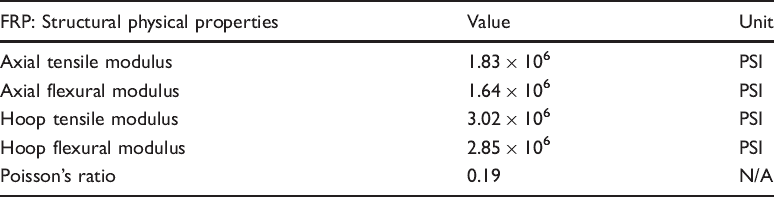
FRP structural physical properties.
For a short, unstiffened FRP chimney liner with both ends fixed, the following can be concluded from Figure 3:
Equation (2) is based on the assumption that the liner shell is simply supported or fixed at ring positions. For this assumption to be valid, the stiffeners must be rigid; The lowest ovalling frequency can be better estimated with Equation (2) by replacing the stiffener spacing-to-radius ratio with the liner length-to-radius ratio; For L/R > 70, all three methods yield approximately the same result, indicating that the influence from boundary conditions is negligible beyond this L/R ratio; The frequency stops reducing with the increasing of L/R ratio when L/R > 70. Therefore, the frequency is independent of length beyond this critical value. That means the ovalling frequency of a long liner approximately equals its unconstrained ovalling frequency, despites of the constraints on the ends.
Lowest Ovalling Frequency for a Stiffened Liner
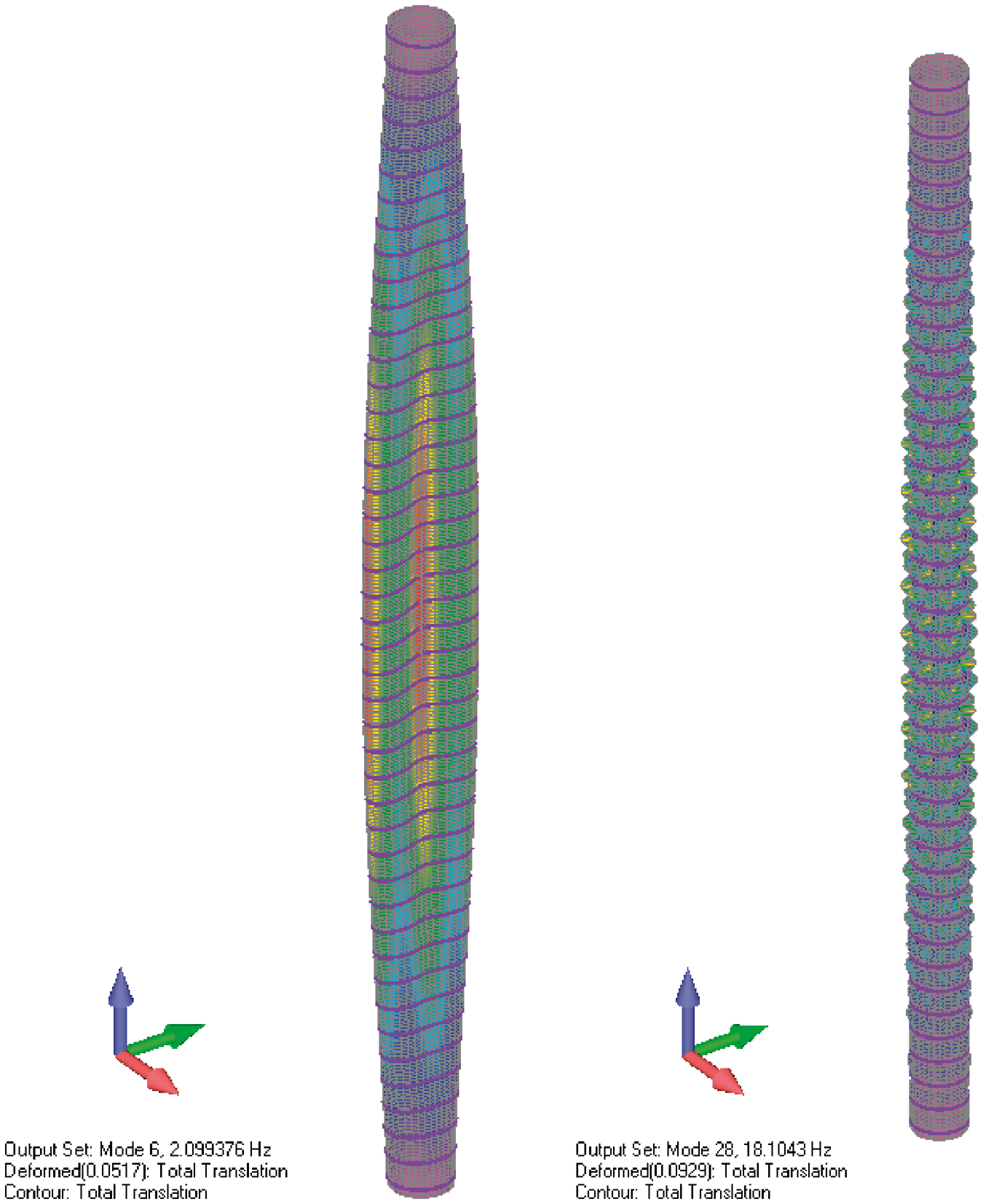
In the previous section, it has been revealed that the equation ASTM D 5364 recommends for calculating the lowest ovalling frequency of a stiffened liner is based on the assumption that the liner shell is simply supported or fixed at ring positions. However, FEA shows that a properly stiffened FRP chimney liner does not vibrate as such. In almost all cases, the stiffeners vibrate along with the liner shell. A typical example is shown in Figure 1(a), which models the chimney liner from Example 4 in Table 1. By numerical experimentation, it is found that the stiffness of ring ribs needs to be increased approximately 1000 times, as is shown in Figure 1(b), in order to make the ring stiffeners not vibrate with the liner shell at the lowest mode. Figure 1(b) shows that the lowest ovalling frequency of the unrealistically stiffened chimney liner calculated by FEA modal analysis (18.1 Hz) is of the same order of magnitude with that from Equation (2), which was calculated to be 15.3 Hz. The small discrepancy is believed to result from interpolating the frequency factor from Figure 3 in ASTM D 5364.
3
However, it is impractical in FRP engineering practice to design ring stiffeners so rigid. It is also not necessary to design such strong stiffeners. As can be seen in Figure 1(a) and Table 1, a lightly stiffened liner still satisfies the lowest ovalling frequency requirement despite the natural frequency deviating significantly from that calculated from Equation (2). Therefore, instead of studying the applicability scope of Equation (2), efforts have been focused on repatterning the frequency equation for lightly stiffened FRP liners.
Unstiffened FRP chimney liners with different L/R ratios.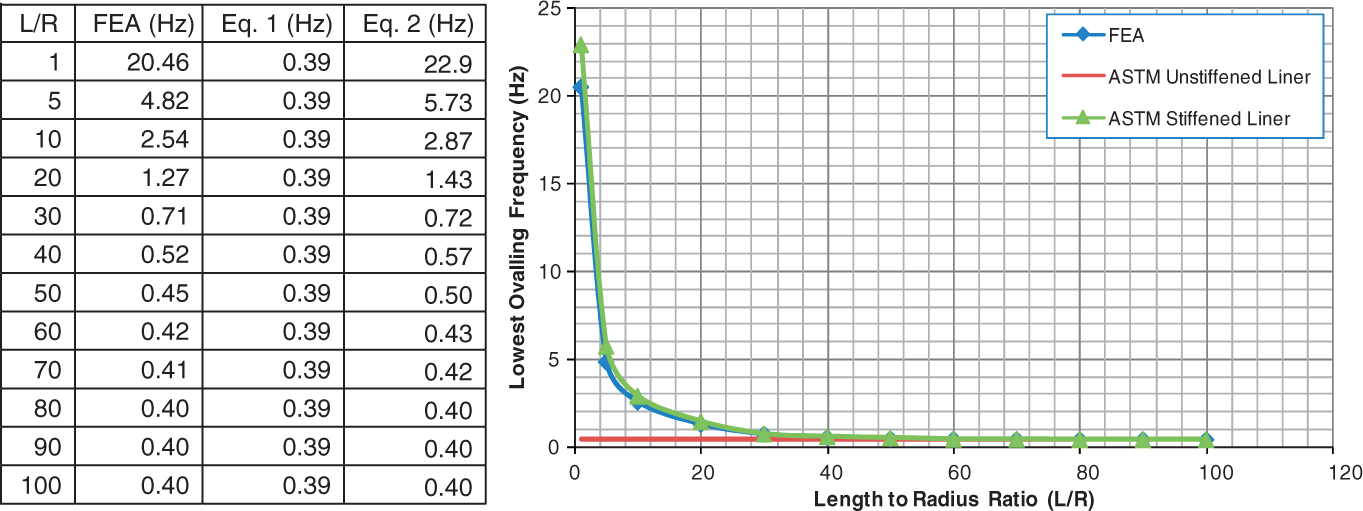
Parametric analysis of circumferentially stiffened FRP chimney liners.
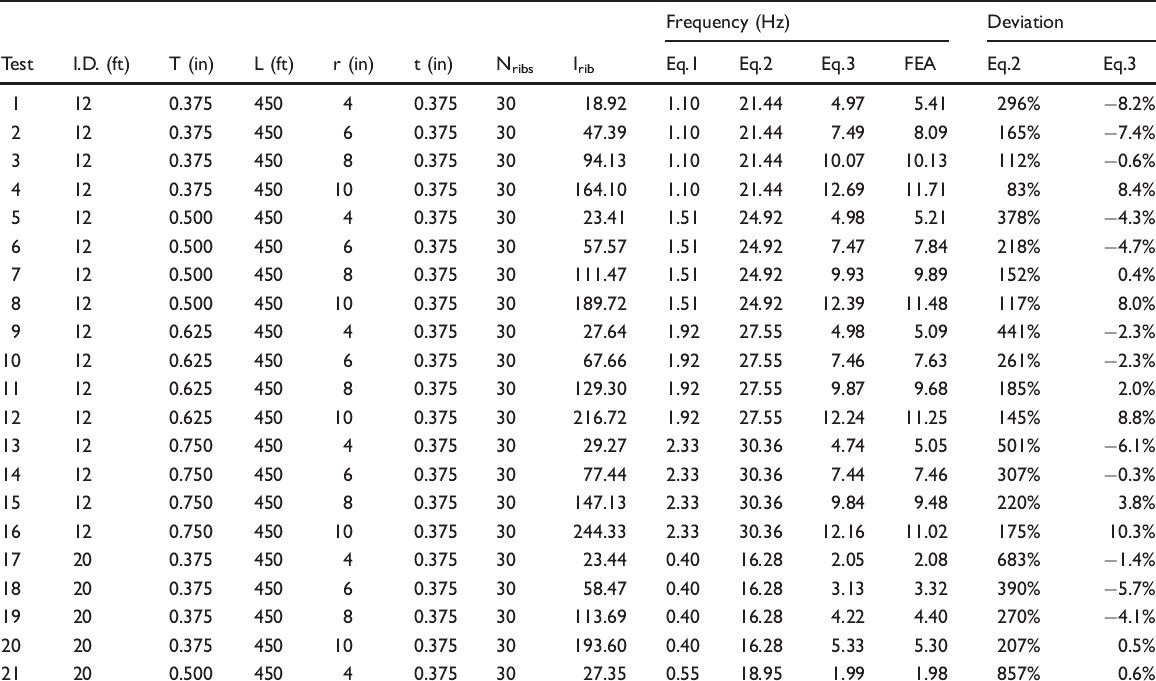
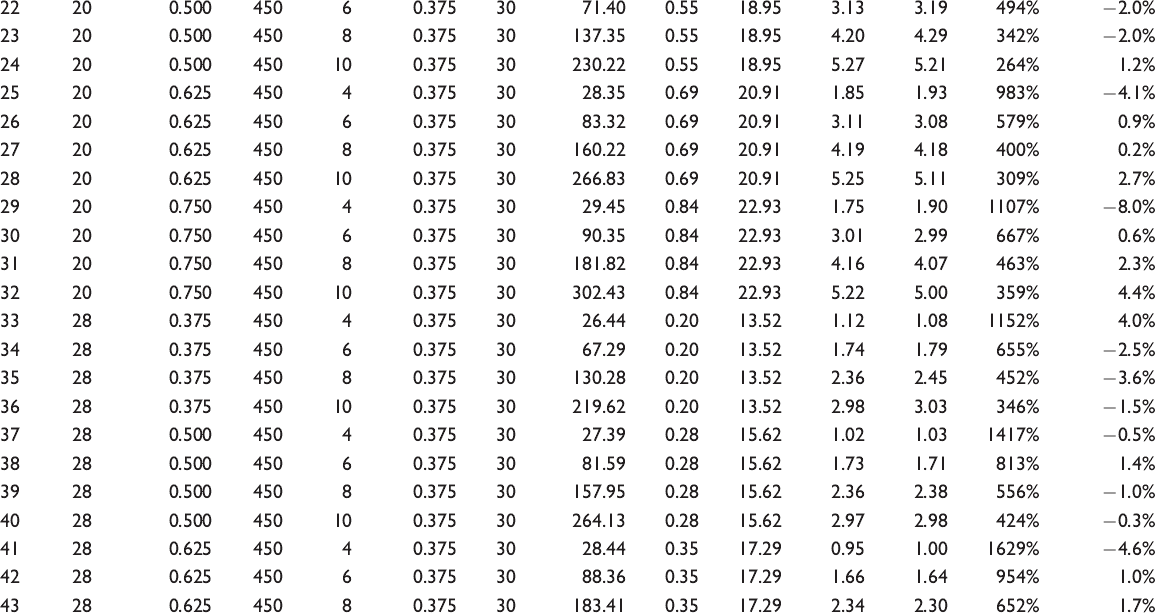
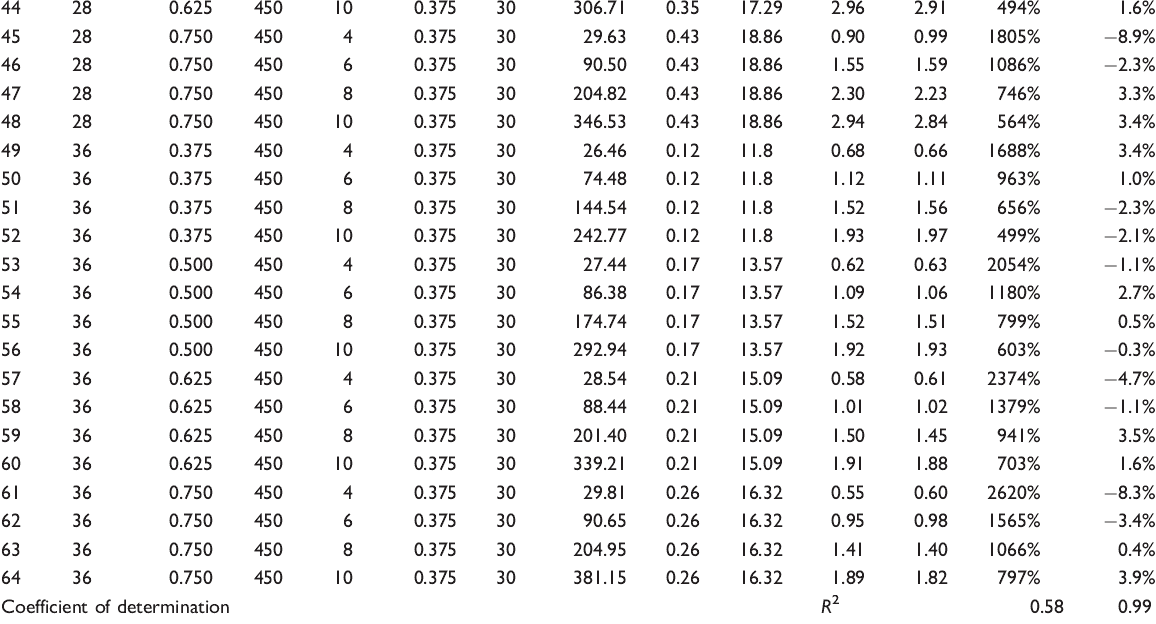
From this experimentation, the following equation is proposed and compared with the FEA results from 64 FRP chimney liner models with varying diameters and ring stiffener sizes. These cover the range of common liner diameters, shell thicknesses, and rib sizes.
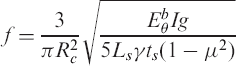
The lowest ovalling frequencies of 64 FRP chimney liner examples with different sizes and ring stiffeners have been calculated with Equations (1), (2), (3), and FEA. The results are listed in Table 3. The coefficients of determination are calculated for both Equations (2) and (3) to compare their performance. The R2 coefficient of determination is a statistical measure of how well the model approximates the real data points, which are the FEA results in this case. An R2 of 1.0 indicates that the model perfectly fits the real data. Equation (2) yields a coefficient of determination R2 = 0.58, which shows that it is not a proper model for a lightly stiffened FRP stiffened liner and can overestimate the frequency. Equation (3), with R2 = 0.99, matches the FEA results very well.
Application of Equation (3) in practical examples.
Conclusions
Ovalling due to gas turbulence is a design concern for FRP chimney liners. To avoid liner ovalling vibration which could lead to premature failure, ASTM D 5364 provides a lowest ovalling frequency requirement and two equations to predict the frequencies for unstiffened liners and stiffened liners. However, both equations are based on an idealized liner arrangement. Our engineering practices found that the lowest ovalling frequency prediction in accordance with ASTM D 5364 considerably deviates from the FEA modal analysis results. This article was aimed at investigating the discrepancy between the ASTM D 5364 equations and FEA and seeking a more reasonable model for predicting the ovalling frequency of FRP chimney liners. The findings of this article include:
The unstiffened liner frequency equation in ASTM D 5364 [Equation (1) in this article] is applicable for liners with no circumferential restraints. If an unstiffened liner is circumferentially restrained, Equation (1) is applicable only if the unrestrained length to radius ratio is larger than 70. Otherwise, Equation (2), after replacing the spacing with the unrestrained length, is recommended. Equation (2) is based on the assumption that the liner shell is simply supported or fixed at ring positions. For this assumption to be valid, the stiffeners must be rigid, which is not practical or economically feasible for FRP chimney liners in most cases. Equation (3) is proposed for estimating the lowest ovalling frequency of a stiffened FRP chimney liner. Parametric analyses show that this equation can approximate the FEA results well. In addition to the external pressure requirement, the ring stiffener shall be sized to ensure that the frequency calculated with Equation (3) is larger than 2 Hz.