




Abstract
Nano-Fe3O4 reinforced nitrile butadiene rubber (NBR) samples were prepared, and the distribution of nano-Fe3O4 particles was mensurated. Using the split Hopkinson pressure bar with an electronic temperature control device and the SHS4-VS1 dynamic fatigue tester, stress–strain curves of NBR/nano-Fe3O4 composites with different mass fractions of nano-Fe3O4 were measured at −30°C to 60°C and different strain rates (1 × 10⁻³/s to 3 × 10³/s). Based on the nonequilibrium thermodynamic theory, we analyzed the thermoviscoelastic constitutive of NBR/nano-Fe3O4 composites, got free energy expression of decoupling form between thermal effects and mechanical effects, and put forward a constitutive model which can describe one-dimensional compressive force at different temperatures and different strain rates.
INTRODUCTION
When using nitrile butadiene rubber (NBR) in high-speed and high-pressure sealing, surface of the material is exposed to unsteady (temperature change with speed) and uniform (temperature change with stress position) environment [1–4]. Because NBR/nano-Fe3O4 composites are hot rheological material, mechanical strain characteristics are affected significantly by loading stress and loading temperature [5–9]. Thus, research on temperature stress of NBR/nano-Fe3O4 composites belongs to the research area of thermoviscoelastic mechanics. Therefore, describing thermoviscoelastic constitutive relation of NBR/nano-Fe3O4 composites correctly and quantitatively is a necessary condition for structure analysis, especially for stress calculation when analyzing temperature change. In the recent years, with the improvement of experimental level, there have been great progresses in the research on material characteristic and mechanical properties of rubber using various techniques, such as split Hopkinson pressure bar (SHPB). A number of scholars have carried out interrelated researches and got some achievements. For example, Wang Baozhen and his team carried out researches on changes of stress and strain of CR rubber under different temperatures using SHPB [10]; Zhu-ping [11] revised the thermoviscoelastic theory through setting deformation condition. Aboudi [6] studied micromechanics-based thermoviscoelastic constitutive equations for rubber-like matrix composites at finite strains and gave its creep and relaxation behavior at room and elevated temperature. Holzapfel and Gasser [12] defined a viscoelastic model for fiber-reinforced composites at finite strains. Nguyen et al. [13] gave a thermoviscoelastic model for amorphous shape memory polymers: incorporating structural and stress relaxation. Meo et al. [14] analyzed a thermoviscoelastic model based on the generalization to large strain of the Poynting-Thomson rheological model. Drozdov and Dorfmann [15] studied the nonlinear viscoelastic response on natural rubber filled with various amounts of carbon black. Park and Schapery [16] described a viscoelastic constitutive model and the effects of strain level, strain rate, confining pressure, and temperature on stress and dilatation. However, data are still scarce about research on thermoviscoelastic constitutive model for analyzing temperature stress of NBR/nano-Fe3O4 composites with changing temperature. The NBR/nano-Fe3O4 composites we researched are mainly used in sealing, and their temperature and stress will change as speed and the oscillation amplitude change [17,18]. Thus, effectively conducting theoretical research and experimental analysis on stress relaxation and thermoviscoelastic properties of NBR/nano-Fe3O4 composites at different temperatures is important for understanding the mechanical characteristic and thermoviscoelastic constitutive model in unsteady and uniform environment [19–21].
On the basis of the given distribution of nano-Fe3O4 particles and the changes in the stress–strain conditions at different temperatures obtained from experiments, material properties of NBR/nano-Fe3O4 composites were analyzed. Also, mathematics model of free energy and constitutive model of one-dimensional compressive force were summarized and improved.
EXPERIMENTS
Preparation of Experimental Materials
In order not to affect physical and mechanical properties of NBR, we added nano-Fe3O4 particles in accordance with the original formula. The size of nano-Fe3O4 particles was 50–100 nm because they could be well distributed during compounding. NBR and all accessory ingredients were mixed in the XK-150 mixing machine at 50 ± 5°C for 13 min with a rotary speed of 30 r/min. The basic formulation was: unvulcanized NBR(N41) 420 ± 0.2 g; ZnO 20 g; sulfur 6 g; accelerant DM 4 g; stearic acid 4 g; and black carbon 160 g. Meanwhile, 8%, 10%, 12%, 14%, and 16% mass fraction of nano-Fe3O4 particles were added by contrasting with the mass of material used. After the completion of mixing, the mixed rubber was weighted. Mass difference between the mixed rubber and all material used should be in the range of ±1%, or the rubber must be remixed. Then, the specimens were put on a smooth and clean metal plate for 6 h before vulcanization. Last, the specimens were vulcanized in the Y33-50A plate vulcanizing press at 145.0 ± 0.5°C, 10 MPa for 30 min. According to experimental requirements, the specimen size was set as ϕ 24.5 × 8 mm2, as shown in Figure 1.
Specimens of stress–strain of NBR/nano-Fe3O4 composites.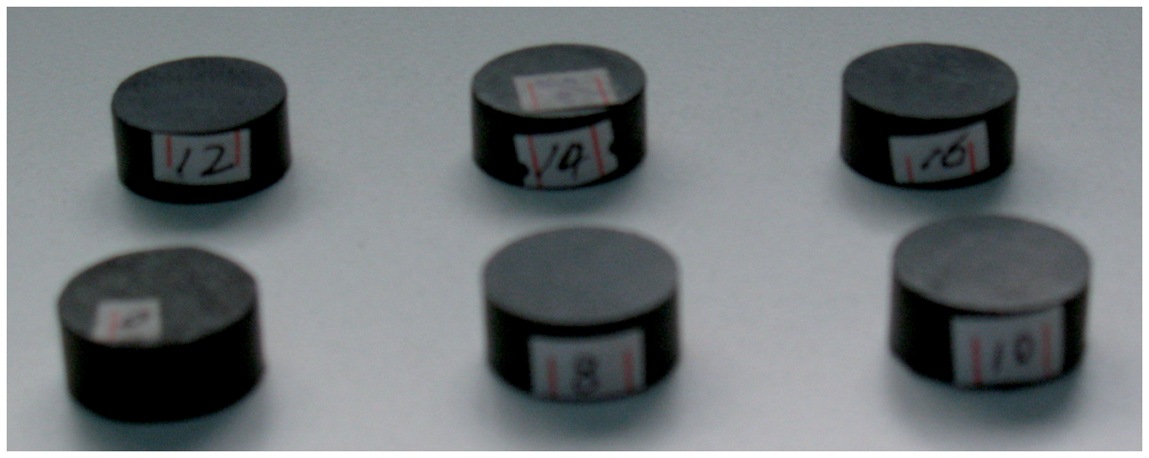
Experimental Methods
The influence on low impedance and low velocity of NBR is small after adding nano-Fe3O4 particles [10,11]. Thus, we selected the SHPB with electronic temperature control device for our experiment, as shown in Figure 2. Low-impedance aluminum and different incident wave shaping technologies were used at different strain rates in order to slow down rising edge of the wave. Data of incidence wave were collected by the strain gage attached to the incidence pole, while weak signals of the incidence wave were obtained by semiconductor strain gage which has high sensitivity. In this experiment, in order to reduce the influence of friction, a thin layer of lubricant was coated on the surface of samples. When controlling temperature, considering the low heat conductivity of NBR and there were small changes after adding nano-Fe3O4, dynamic impact should be conducted a few minutes after the temperature was stable, so as to achieve required test temperature. The ball was shot to hit the incidence pole with a certain speed to generate compression stress wave on the incidence pole. When the compression stress wave spread to the interface between the incidence pole and the specimen, a part of stress wave reflected back to the incidence pole, while the other part passed to the specimen and implemented impact load. With using the loading waveforms measured by the strain gage attached to the incidence pole, dynamic stress–strain relationship of the sample could be calculated using indirect method. Strain gage of the incidence pole was attached 400 mm away from the interface so that the influence of heat source on the strain gage could be smaller. The modulus of aluminum pole showed little change in the range −30°C to 60°C, thus the influence of temperature gradient field on spread of the wave could be ignored. During the experiment, we measured NBR/nano-Fe3O4 composites with the mass fraction of nano-Fe3O4 were 0%, 8%, 10%, 12%, and 14%.
Schematic of the SHPB system with temperature controller.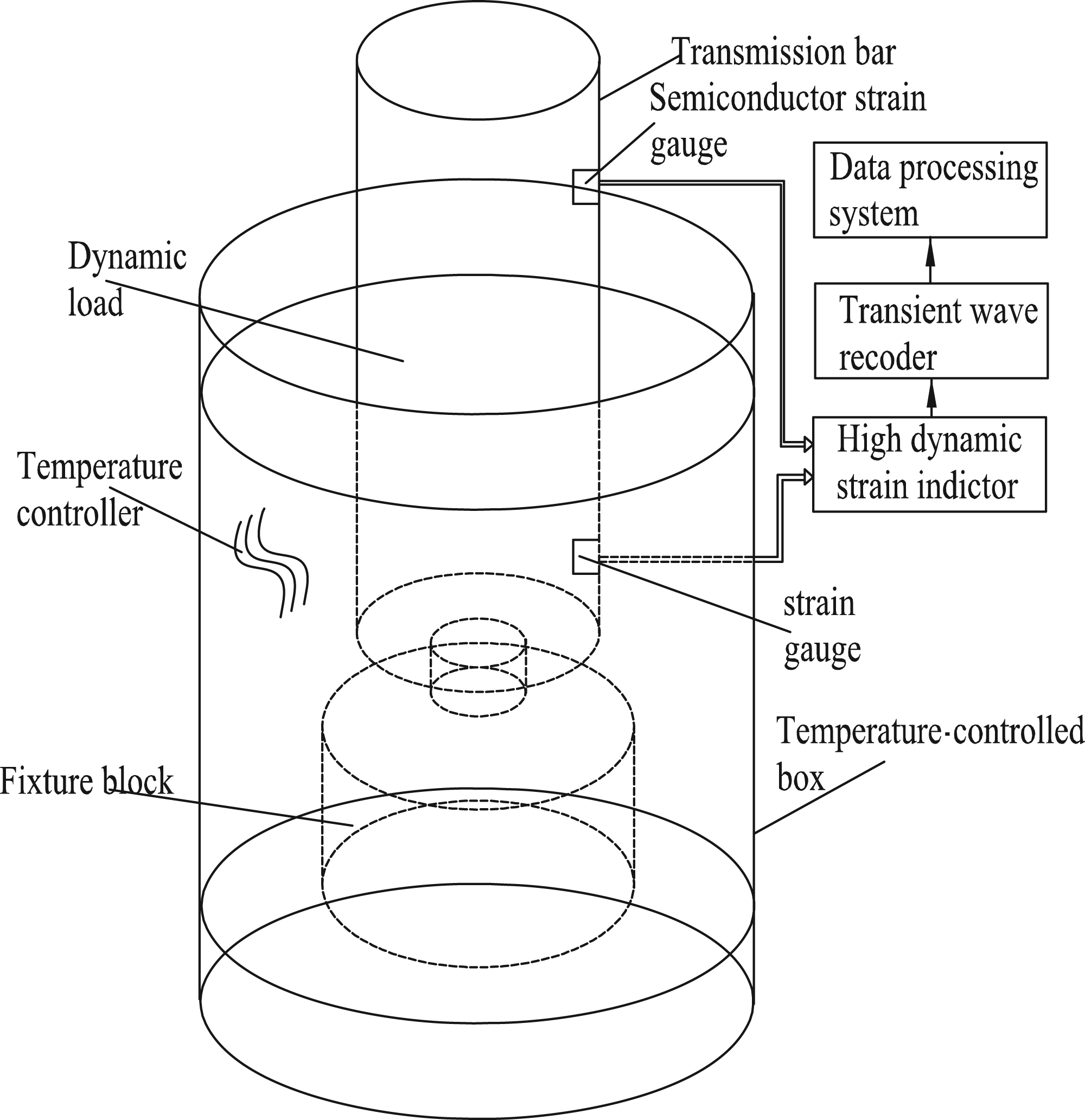
For comparison, a quasi-static test was carried out with 0.001/s strain rate. The performances of NBR/nano-Fe3O4 composites were tested by the new SHS4-VS1 dynamic fatigue tester under different temperatures (measurement accuracy of temperature ≤ ± 1°C). The appropriate temperature range was −30°C to 60°C.
Experimental Principle
Principle 1: The samples were fixed at the bottom of the warm box. The test was carried out at the temperature of - 30°C, - 15°C, 0°C, 15°C, 30°C, and 60°C. When inputting different value of loading waves, the whole incident wave was applied to the sample. Then, there were deformation and fracture on the sample under the action of pulse load. Parameters of dynamic mechanical performance of samples could be obtained using recorded waveform.
Principle 2: The quasi-static stress–strain diagram was obtained by putting the samples into SHS4-VS1 dynamic fatigue tester. Then, an analysis compared with experiment 1 was carried out based on the national rubber standards GB/T6031-1998.
RESULTS AND DISCUSSION
Distribution of Nano-Fe3O4 Particles
The distributed Fe-element mass fraction of NBR/nano-Fe3O4 composites.
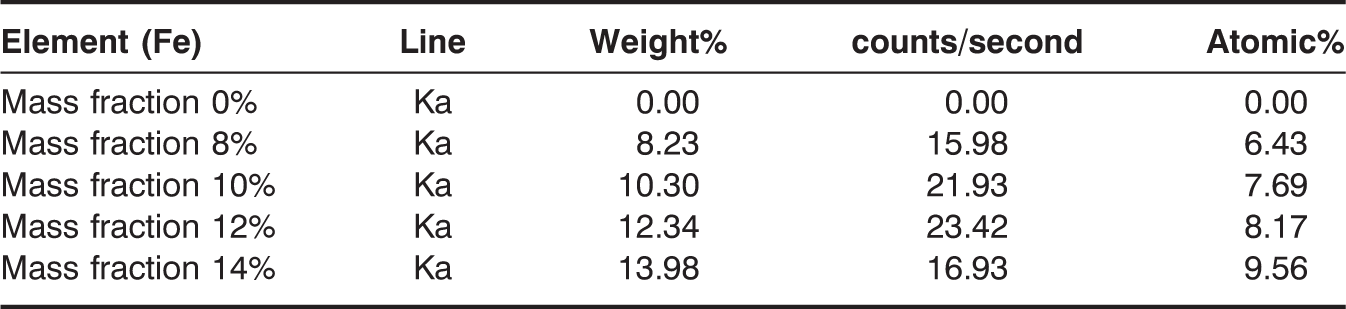
For further research, the microscopic surface texture and Fe distribution of surface of the composites, for which mass fraction of nano-Fe3O4 particles is 10%, as shown in Figure 3, are given in this study. We observed that the microscopic surface texture is smooth because nano-Fe3O4 particles fill surface defects of NBR, which represents that nano-Fe3O4 particles can better reinforce the NBR, as shown in Figure 3(a). Also, Fe distribution of surface of the composites is uniform in Figure 3(b). In terms of the overall effect, the mixing was relatively uniform.
The microscopic surface texture (a) and Fe distribution of surface (b) of the composites (mass fraction of nano-Fe3O4 particles 10%).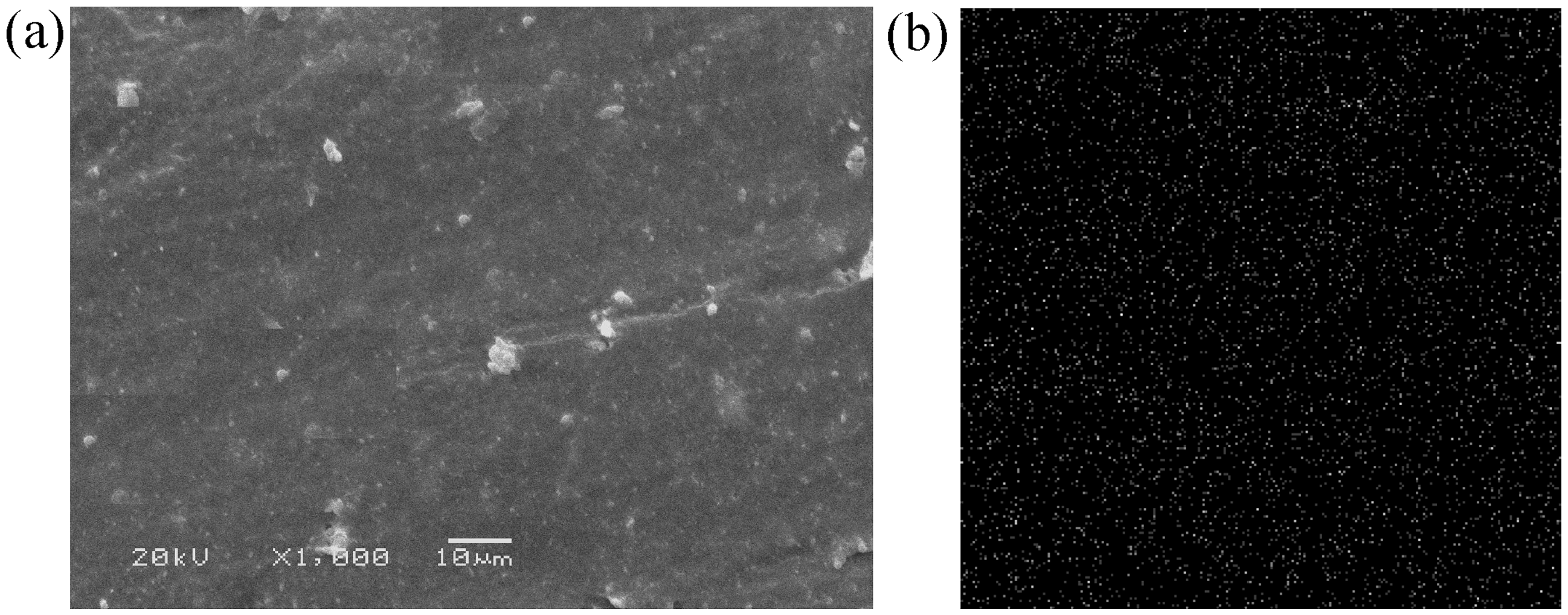
Analysis of the Results
Through comparative analysis, we got stress–strain curves of the NBR/nano-Fe3O4 composites with same mass fraction of nano-Fe3O4 at different temperatures. To make the comparison convenient, mass fraction of nano-Fe3O4 was all 10%, as shown in Figure 4. With increasing the temperature, yield strength, relaxation modulus, and flow stress increased slightly, whereas hardness decreased continuously, which clearly shows the effects of strain rate and temperature.
Stress–strain curves of different strain rates (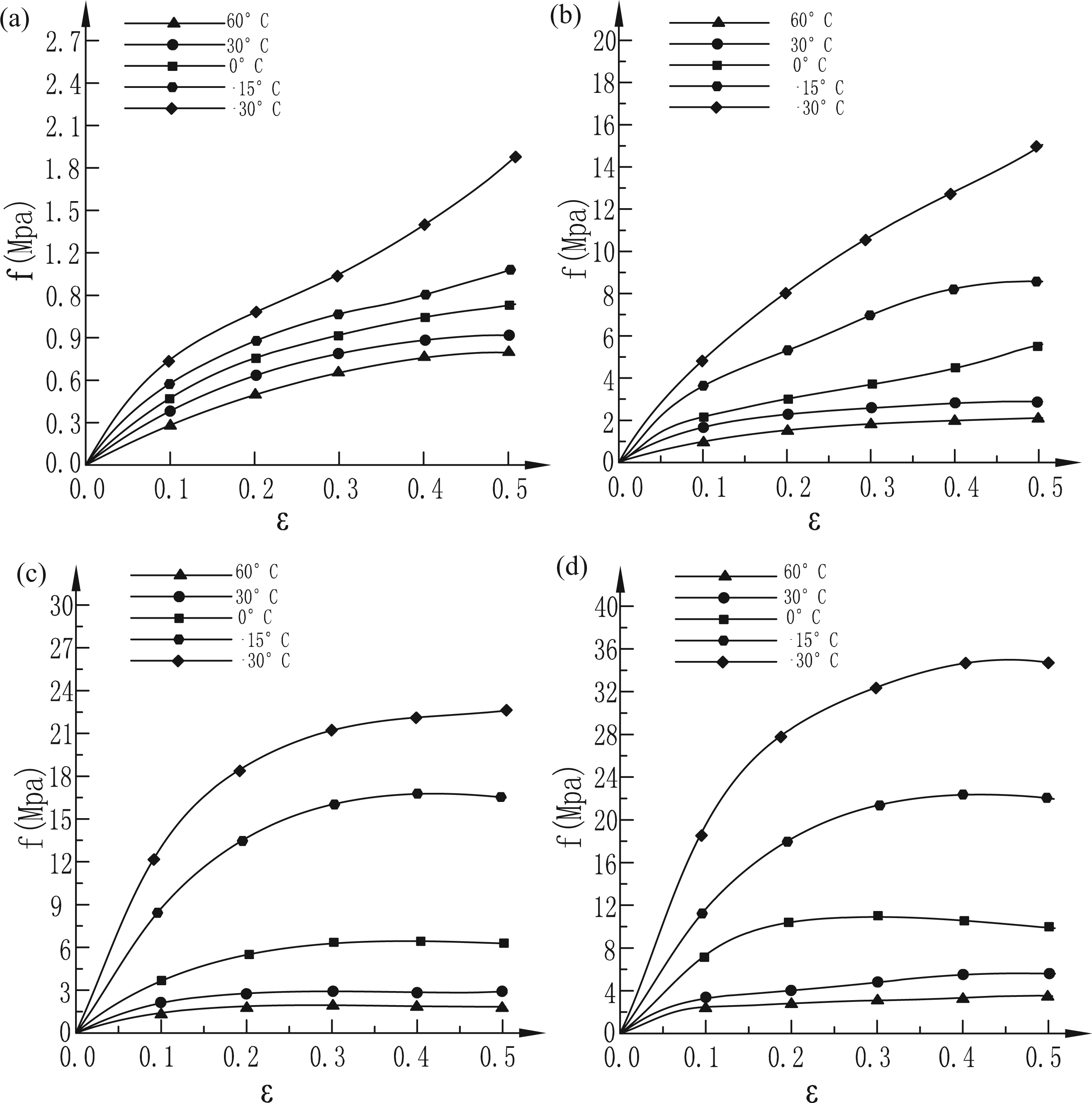
As shown in Figure 4, NBR/nano-Fe3O4 composites with same mass fraction of nano-Fe3O4 show different flow stresses at different temperatures. Changes are smaller from - 15°C to - 30°C in the stress–strain curves, which indicate that the glass transition temperature (Tg) would decrease in dynamic circumstances after the addition of nano-Fe3O4. When Tg is less than - 30°C, stress of same deformation and the hardness will be larger compared with conventional NBR, which illustrates that the performance of NBR is optimized after adding nano-Fe3O4. From Figure 4(a) and (b), we can observe that the quasi-static stress–strain curve maintains concave upward, whereas the dynamic stress–strain curve shows a smaller decline when the strain increases to a certain extent, as shown in Figure 4(c) and (d). This is because a considerable portion of energy is dissipated during the deformation process because of the nature of viscous dissipation of the material [12,14,19]. In adiabatic conditions, temperature of the material will rise when this part of dissipation is completely transformed into heat energy. Meanwhile, rise of temperature will cause changes in elastic modulus and viscosity coefficient [13,15]. The greater the strain rate, the more obvious the effects of thermal force coupling, which shows that there is a downward trend of the stress at high strain rate. There are also strain softening, and strong effects of temperature. But, as shown in Figure 4, the softening trend will slow down due to the addition of nano-Fe3O4, so that the rubber can stand greater stress changes when the temperature increases. It demonstrates that the addition of nano-Fe3O4 is in favor of heat output of the rubber, which improves thermal stability of NBR. Also, we can know that a greater stress will be required with the same strain when the strain rate increase.
Figure 5 gives the stress–strain curve of NBR with different mass fractions of nano-Fe3O4 at 15°C when the rubber has good stability. Clearly, with increasing the content of nano-Fe3O4, yield strength, relaxation modulus, flow stress, and hardness continuously increased and reached to the best at 12% mass fraction. Meanwhile, the temperature effect shows a weakening trend in the stress–strain curves. Because of the good energy storage ability of nano-Fe3O4 particles, changes of the properties of nano-Fe3O4 NBR are less at higher temperature.
Stress–strain curve of NBR with different mass fractions of nano- Fe3O4 at temperature 15°C and strain rate 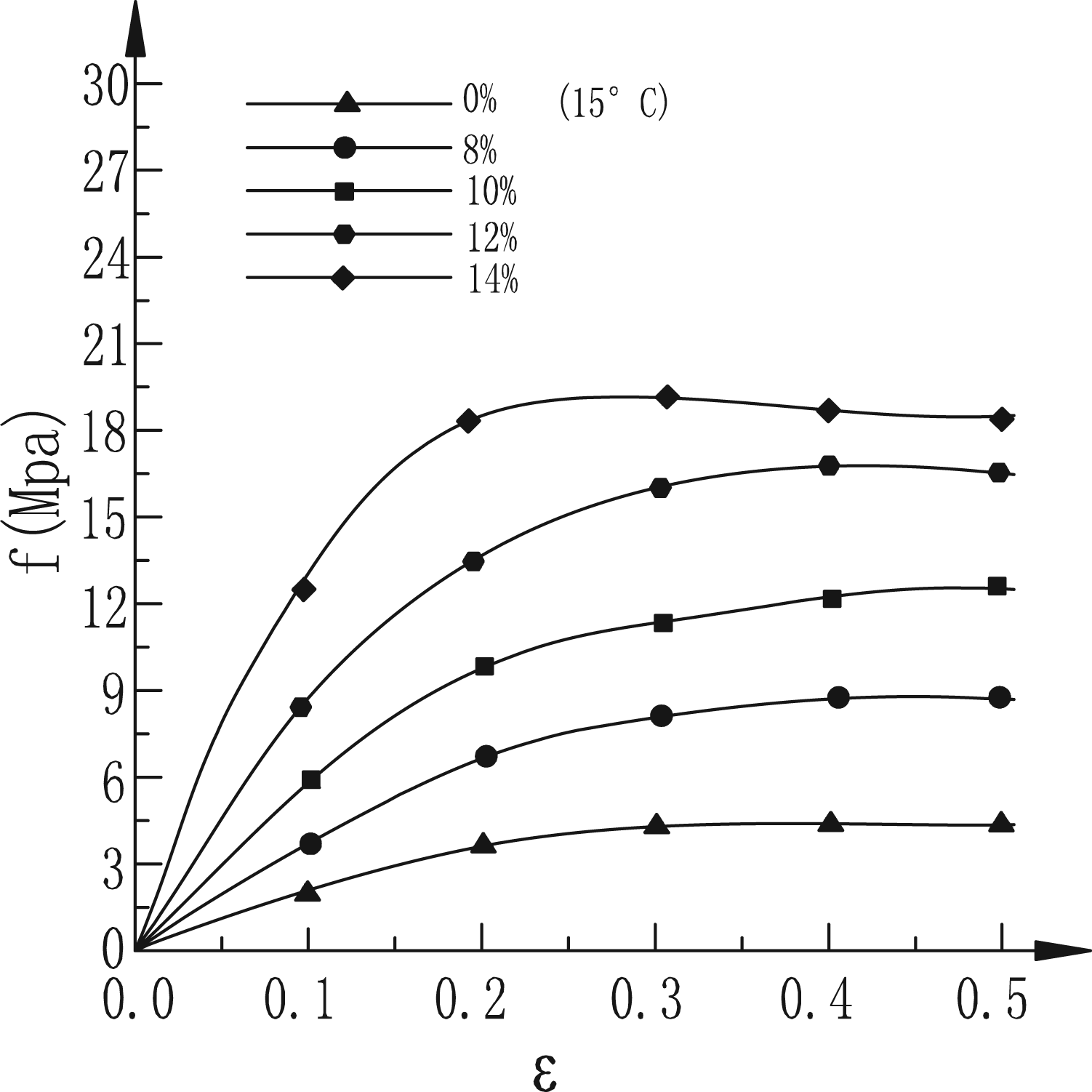
Mathematical Model of Free Energy
For the thermodynamic state of non-equilibrium, a group of internal variable δn (n = 1,…, N) are introduced corresponding to an equilibrium state of constrained state. This equilibrium state is called local accompanying state. To set (θ, ɛ, δ n ) as state variables of constraint equilibrium state, θ as absolute temperature, and ɛ as Valanis–Landel Lagrange strain. Then, the conjugate stress of u-phase can be decomposed into constrained equilibrium stress and viscous stress. In thermoviscoelastic constitutive theory, one of the most basic problems is the coupling relation between temperature history and strain history. Thus, in the following part, we will focus on coupling relation between stress f in constrained equilibrium state, temperature history, and strain history.
Because the Poisson’s ratio of rubber material is µ ≈ 0.5 and the rubber is almost incompressible, the deformation can be considered as constant volume deformation [6,14]. According to the basic thermodynamic relations, U is internal energy of unit mass, S the entropy of unit mass, and ψ Helmholtz free energy of unit mass. The relationship is as follows:


According to Boltzmann system and entropy theory:

By (1), (2), (3):


Clearly, during the deformation process, changes of f are mainly caused by changes of internal energy and entropy, while changes of the internal energy are irrespective to changes of temperature. But changes of entropy are proportional to changes of temperature. The internal energy of NBR/nano-Fe3O4 composites is greater than that of ordinary NBR, which make f bigger. When the temperature rises, changes of f are small, which is in line with experimental results.
Deformation Energy and the Corresponding Constitutive Model
Currently, widely used model to describe strain energy function of rubber material is Mooney and Revlin model. After the addition of volume constrained energy, a modified strain energy function can be obtained. In this article, a kind of Mooney–Revlin model with only two material constants was obtained using simplified strain energy function:

According to the almost incompressible nature of the material, stress–strain relationship under the condition of one-dimensional stress can be expressed in the form of deformation energy function as:

Considering the effects of static temperature and loading temperature, a simplified hyperelastic constitutive can be obtained by (6) and (7):

As for the linear thermoviscoelastic material, we used micromethods which assuming that there are N kind of molecular networks with different relaxation properties of NBR/nano-Fe3O4 composites. The viscous dissipation process of type n can be described by second-order tensor δn which is called the internal variable of type n. Deformation energy of this n kind of molecular networks can be drawn as follows:


By (5) and (10), the linear thermoviscoelastic constitutive relation can be expressed as:

As in (11), the relationship between strain energy function and strain rate can be derived by derivation.
In traditional ZWT model, there are two material constants chosen to carry out theoretical calculations. This ZWT model has been successfully applied to describe thermoviscoelastic behavior of various thermoplastic and thermoset polymer materials with the strain rates 10−4–103 [22].
For simplifying calculation, we set N = 1. That is, we described thermoviscoelastic behaviors at high strain rates using one molecular chain. For quasi-static condition, the hyperelastic constitutive model was used. Yang and Shim [23] investigated a constitutive model not involved with coordinates through simply adding hyperelastic model with thermoviscoelastic model. Here, we use a similar approach to sum up (8) and (11), assuming that strain rate is a constant. Then, we can get:

However, effects of temperature here are not obvious, and the rubber shows mainly hyperelastic properties. Effects of strain rate and temperature of high strain rate are mainly caused by the second item. Both the two kinds of effects are obvious and seasonal. This phase is caused by different mechanical statuses generated due to the impact of temperature and strain rate.
We only used the experimental results of NBR/nano-Fe3O4 composites with 10% mass fraction. According to Equations (5)–(12), values of stress–strain of four kinds of strain rate (0.001/s, 5 × 10²/s, 1.5 × 10³/s, and 3 × 10³/s) at different temperatures (- 30°C, 0°C, and 30°C) can be acquired. From Figure 6, we can see that experimental results are well in accord with the results of theoretical analysis. A conclusion can be drawn that the relationship between stress–strain and temperature can be well described using this kind of computational methods. However, when compared to experimental results of high strain rate at - 30°C, it was found difficult to obtain satisfactory results. From the above analysis, we know that this is because - 30°C is close to the glass transition temperature of NBR/nano-Fe3O4 composites. As the temperature increases, calculated results are close to experimental results, which illustrates that temperature has non-linear effects on the performance of material. When dynamic stress and deformation are smaller, the NBR/nano-Fe3O4 composites show better performance. Another conclusion can be drawn from Figure 6 that with different strain rates, sensitivities are different. With a smaller strain rate, error between experimental results and theoretical results is smaller. But with increasing the strain rate, error becomes larger, which indicates that the performance is not steady. Also, with high strain rate, the cave shows a downward trend when rising. This indicates that the performance of NBR/nano-Fe3O4 composites is gradually decreasing and the soft tendency is obvious.
Stress–strain curves of experiment and theory of different strain rate (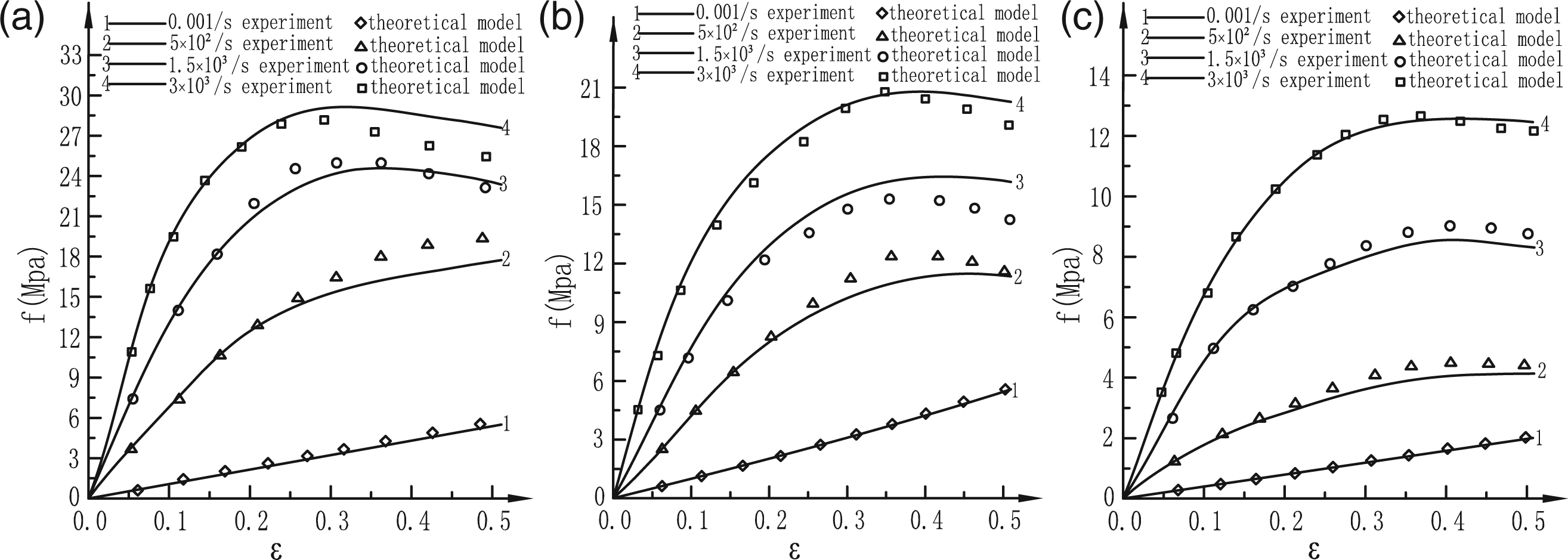
CONCLUSION
In this article, the distribution of nano-Fe3O4 particles was uniform. The dynamic load test on NBR/nano-Fe3O4 composites was carried out at −30°C to 60°C. The experimental results showed that as the temperature increases, yield strength, relaxation modulus, and flow stress increased, but the hardness decreased, which indicated that temperature and strain rate were sensitive. In dynamic conditions, the stress–strain curve at - 30°C showed a trend of changing into ‘glassy state.’ We also investigated the relationship between internal energy, entropy, and Helmholtz free energy after adding nano-Fe3O4 particles. The internal energy of NBR/nano-Fe3O4 composites was greater than ordinary NBR, causing larger stress f. When the temperature rises, changes of stress were smaller. Stress–strain curves of NBR/nano-Fe3O4 composites with different mass fractions of nano-Fe3O4 particles at 15°C were obtained in this experiment. The constitutive model presented according to strain energy function can accurately calculate the stress–strain relationship.
Footnotes
Figure 1 appear in color online 
ACKNOWLEDGMENTS
The authors thank the Natural Science Foundation of Gansu Province, China (No.: 3ZS051-A25-031), as well as Scientific and Technological Exchanges Project (No.: H20070021) of Wenzhou Science and Technology Bureau, China, for their financial support.