




Abstract
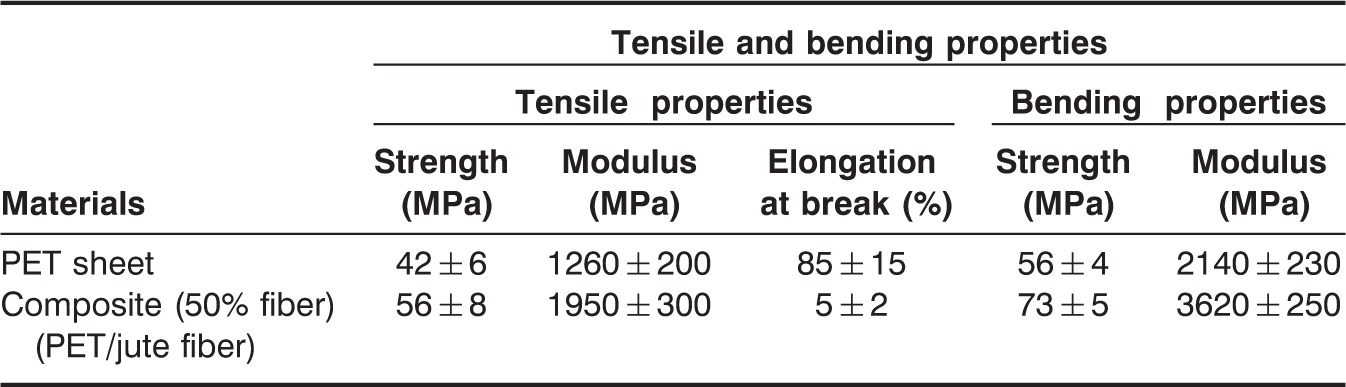
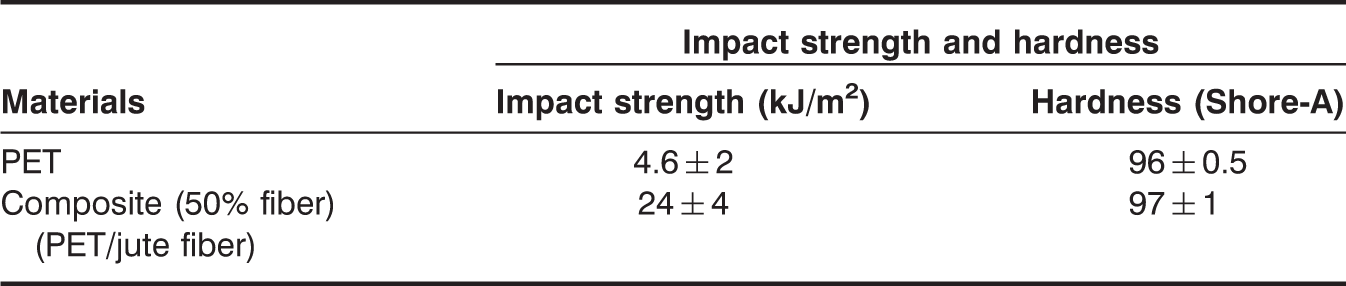
Jute fiber-reinforced polyethylene terephthalate (PET) matrix composite was prepared by compression molding. Tensile strength (TS), tensile modulus (TM), elongation at break (Eb%), bending strength (BS), bending modulus (BM), impact strength (IS), and hardness of the composites (50% fiber by weight) were found to be 56 MPa, 1950 MPa, 5%, 73 MPa, 3620 MPa, 24 kJ/m2, and 97 Shore-A, respectively. After 6 weeks of soil degradation, composites lost 28.5% and 24.6% of their original TS and BS, respectively. Interfacial characterization was performed by scanning electron microscope.
INTRODUCTION
Preserving the environment using natural raw materials has contributed to an increase in the interest on the development and use of biomaterials. Polymer composites derived from biomaterials have been studied since the middle of the past century. The automotive industry pioneers the development of biocomposites, also known as ‘green composites.’ Natural fiber composites are used in various applications, in components subjected from light to moderate loadings, in many cases substituting polymers or fiberglass composites. Typical applications include civil construction, furniture, packing, and mainly the automotive industry. Doors and lateral parts of vehicles have already been produced using natural fibers in association with phenol, polyester, or polypropylene (PP). Due to their large availability and low cost, jute, sisal, flax, coconut, and ramie are the most used reinforcing fibers. Basically, the fiber properties depend on the vegetal variety, crop conditions, and processing techniques. Jute fibers are quite promising for the development of composites due to their superior mechanical properties and availability [1–6]. Fiber-based composite materials have some advantages such as high stiffness, ease of installation, good processability, relatively good resistance to environmental agents, fatigue, etc. A good number of matrices and fibers with a wide range of properties are being used in processing composites. Natural fibers have low abrasion multi-functionality, low density, low cost, availability, high toughness, acceptable specific strength properties, good thermal properties, enhanced energy recovery, and biodegradability. Therefore, natural fibers have gained much interest among technologists and scientists for applications in civil, military, industrial, space craft, and biomedical sectors. Among all the natural fibers, jute appears to be the most useful, inexpensive, and commercially available fiber. Jute fiber contains 82–85% of holocellulose of which 58–63% is α-cellulose. In addition, it contains minor constituents such as fats and waxes, inorganic and nitrogenous matters, and traces of pigments like β-carotene and Xanthophylls. The main component of jute fiber is a hydrophilic gluten polymer consisting of a linear chain of 1,4-β-D-hydro glucose units. Jute fibers present some disadvantages such as high moisture sorption, poor dimensional stability, intrinsic polarity, low thermal resistance, anisotropic fiber resistance, and variability. A number of papers have been published on jute fibers where jute was used as a reinforcing agent in thermoplastics like polyethylene (PE) and PP [7–14]. In this investigation, polyethylene terephthalate (PET) is used as matrix material. PET is a low-cost and high-performance thermoplastic. It is widely used in packaging materials, fibers, and sheet due to good rigidity, hardness, abrasion resistance, solvent resistance, and electric insulation properties. PET is famous in the area of synthetic fibers and bottle production. PET has some drawbacks such as notch sensitivity, brittleness, and comparatively high melting points than that of PP or polyethylene [15–17]. This investigation involves measurment of the mechanical, degradation, and interfacial properties of jute fiber-reinforced PET matrix composites.
ExperimentaL
Materials
Hessian cloth (bleached commercial grade, Tossa Jute) was collected from Bangladesh Jute Research Institute (BJRI), Dhaka, Bangladesh. PET was purchased from Mitsuipet Company, Thailand.
Composite Preparation
Granules of PET were heat pressed and made into thin sheets (0.25–0.30 mm thickness) individually using Carver Laboratory (Carver, INC, USA Model 3856) press at 280°C. The PET sheet was cut into small pieces (15 × 12 cm2) and kept in the desiccators until composite fabrication. Jute fabrics were dried in an oven at 105°C to remove moisture and then cut into small pieces of dimensions 15 × 12 cm2. Composites were prepared by sandwiching four layers of jute fabrics (50% fiber by weight) between five layers of pre-weighted PET sheets and pressed at 280°C for 5 min between two steel plates under a pressure of 5 tons. Then, the composite containing steel mold was cooled to room temperature using another press (Carver, USA) and then cut to the desired size.
Mechanical Properties of the Composites
Tensile and bending properties of the composites were evaluated using the Hounsfield series S testing machine (UK) with a crosshead speed of 1 mm/s. The dimension of the test specimen was (ISO 14125): 60 × 15 × 2 mm3. Composite samples were cut to the required dimension using a band saw. Impact strength (IS) of the composites was measured using Impact tester (MT-3016, Pendulum type, Germany). Hardness was determined by HPE Shore-A Hardness Tester (model 60578, Germany).
Scanning Electron Microscopic Analysis
The fracture surface of the composites (after bending test) was studied using a JEOL 6400 SEM at an accelerating voltage of 10 keV. Scanning electron microscopic (SEM) specimens were sputter-coated with gold.
Soil Degradation Tests of the Composites
Composite samples were buried in soil (having at least 25% moisture) for different periods of time. After a certain period, samples were withdrawn carefully, washed with distilled water, dried at 105°C for 6 h, and kept at room temperature for 24 h; then, the mechanical properties were measured.
Results and discussion
Mechanical Properties of the Composite (Jute Fiber/PET)
Tensile and bending properties of PET and composite (50 wt% fiber).
Impact strength and hardness of PET and composite (50 wt% fiber).
Degradation Test of the Composite (Jute Fiber/PET) in Soil Medium
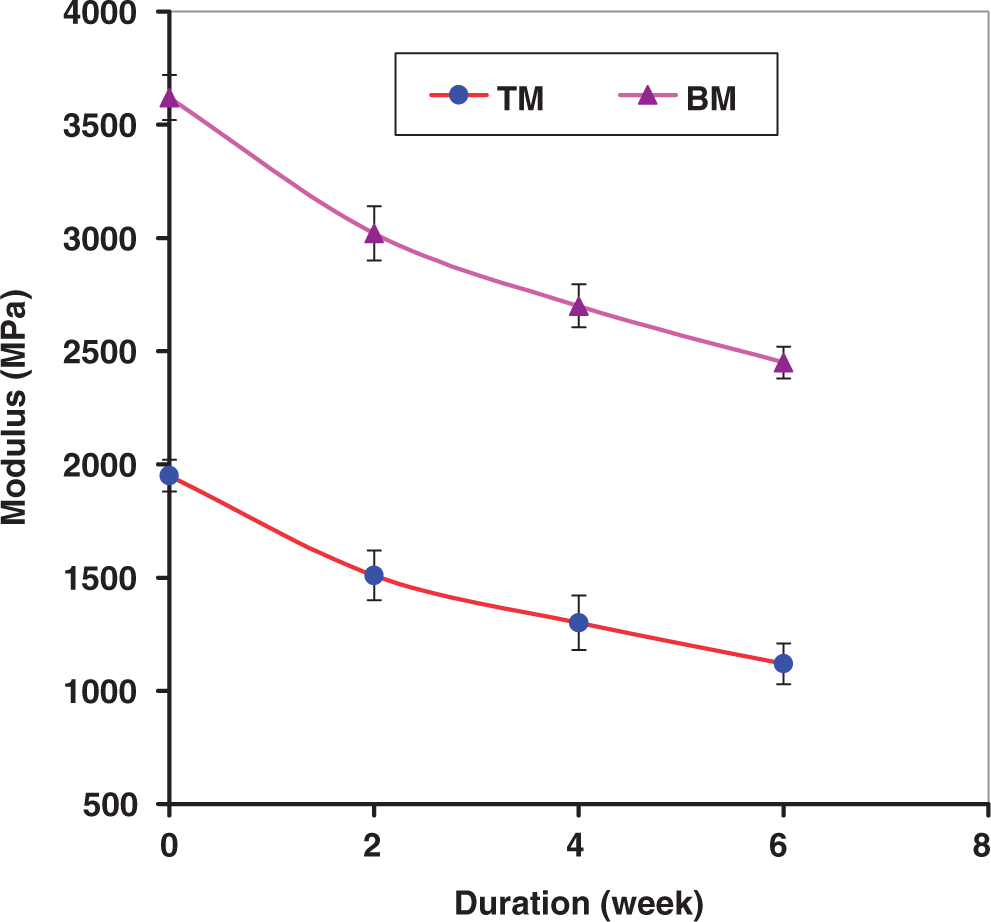
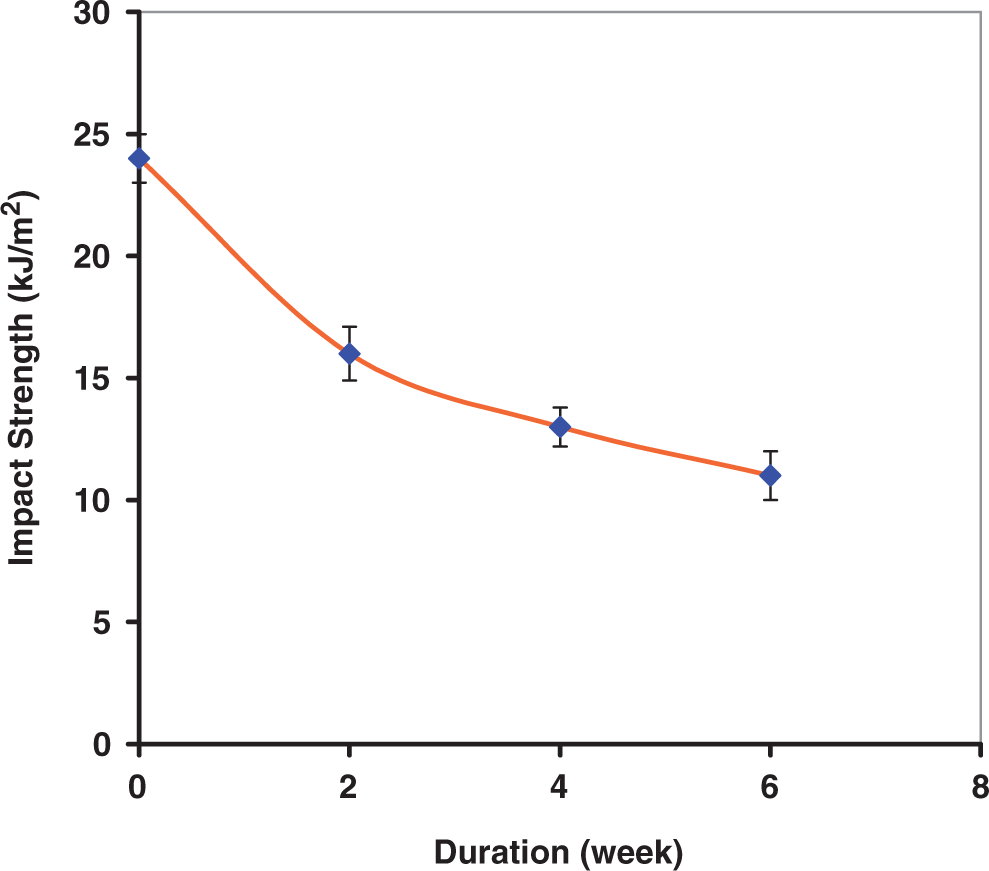
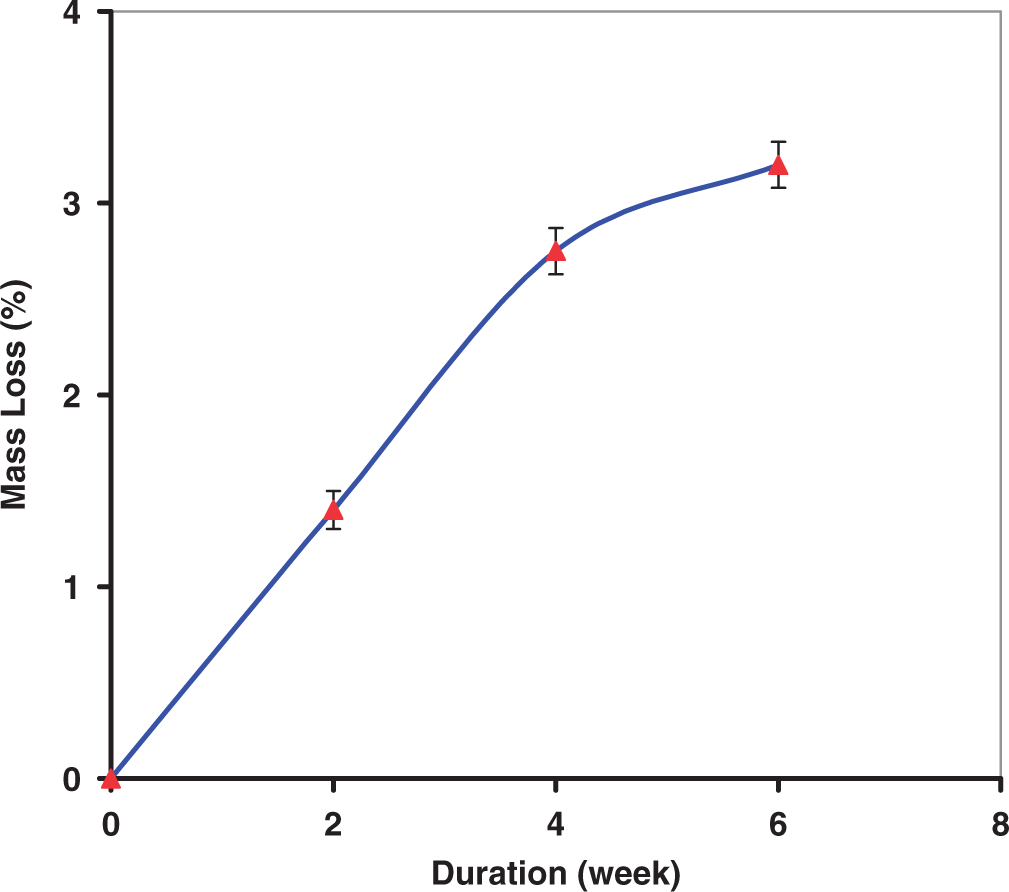
Degradation tests of the composites (50% fiber by weight) were performed in soil at ambient condition for up to 6 months. The results are depicted in Figures 1–3. Both TS and BS values decreased in a similar manner and the results are plotted against degradation time (Figure 1). It was found that after 6 months of soil degradation, composites lost 28.5% and 24.6% of their TS and BS, respectively. For example, the original TS and BS of the composites were 56 and 73 MPa, but after 6 months of degradation, TS and BS reached 40 and 55 MPa. Similarly, TM, BM, and IS decreased with time in a manner similar to TS and BS; the results are shown in Figures 2 and 3. TM, BM, and IS of composites were found to be 1950 MPa, 3620 MPa, and 24 kJ/m2, but after 6 months of degradation, the values reached 1120 MPa, 2450 MPa, and 11 kJ/m2, respectively. Initially, the loss of mechanical properties was higher, which then reached a plateau. It is clear that all the mechanical properties (TS, TM, BS, BM, and IS) of the composites slowly decreased over time, thus indicating its degradable nature. Jute is a degradable fiber which is mainly responsible for the loss of the mechanical properties [2]. After 6 months of degradation in soil, composites lost a minor fraction of the mass and the results are presented in Figure 4. It was found that the composites lost 3.6% of their mass in 6 months, which supports the partial loss of the mechanical properties of the composites as described. Jute is a natural biodegradable fiber of vegetable origin and this fiber is cellulose based which absorbs water within a couple of minutes, indicating its strong hydrophilic character. Cellulose has a strong tendency to degrade when buried in soil [14]. During soil degradation tests, moisture penetrates from the cutting edges of the composites to jute. Degradation of cellulose occurred in jute and as a result, the fiber–matrix adhesion became poor which attributed to the loss of the mechanical properties of the composites.
Degradation of tensile and BS of the composites (jute fiber/PET) during soil degradation tests. Degradation of tensile and bending moduli of the composites (jute fiber/PET) during soil degradation tests. Degradation of IS of the composites (jute fiber/PET) during soil degradation tests. Weight loss of the composites (jute fiber/PET) for soil degradation tests of the composite samples.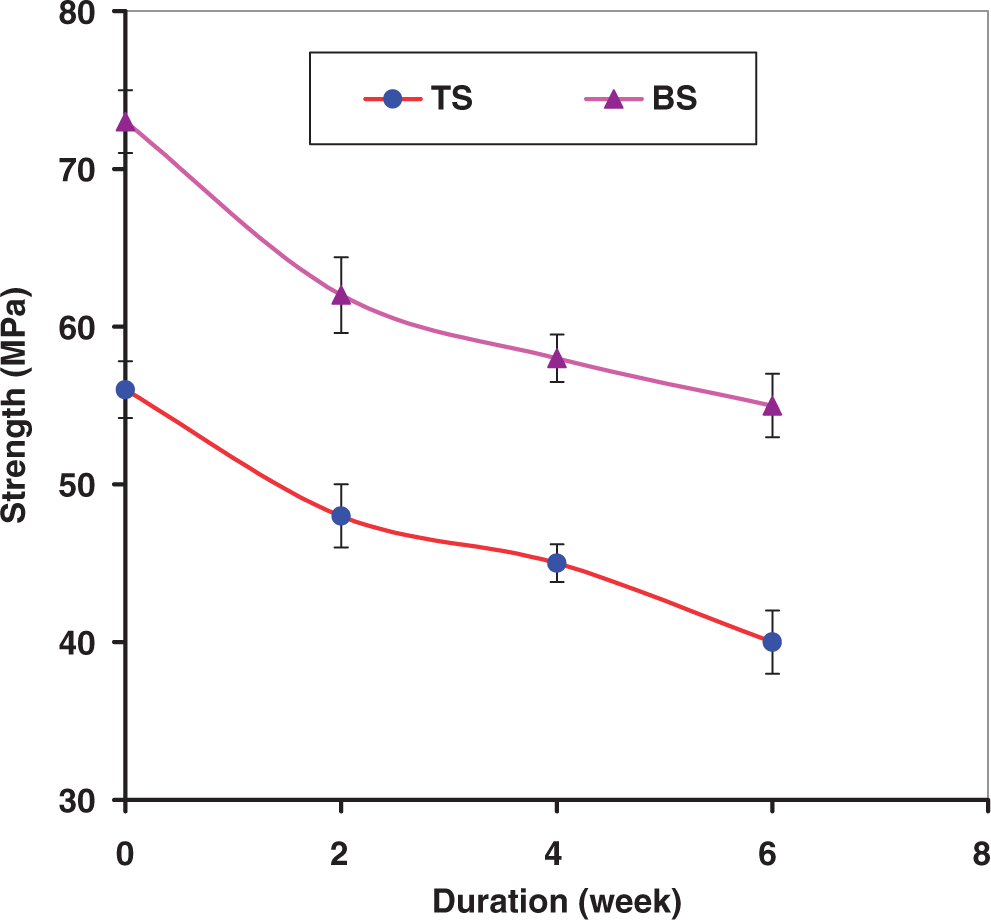
Scanning Electron Microscopic Analysis of the Composites
SEM studies were carried out to find out the fiber–matrix adhesion inside the composites. SEM images of the fracture sides of the jute fiber/PET composites (a) and 6 months degraded (b) in soil medium are presented in Figure 5. From Figure 5(a), it is clearly indicated that the jute fiber pull-out is quite higher but the bonding between jute and PET is quite promising though few gaps are evident in the composites. On the other hand, soil-degraded specimens (Figure 5(b)) showed that jute fibers became degraded and some gaps are clearly found. So, from this investigation, it is clear that the PET/jute fiber is a partially degradable composite but has good mechanical properties.
Fracture surface (a) of the PET/jute fiber composite and (b) after 6 weeks of degradation of the composite in soil medium.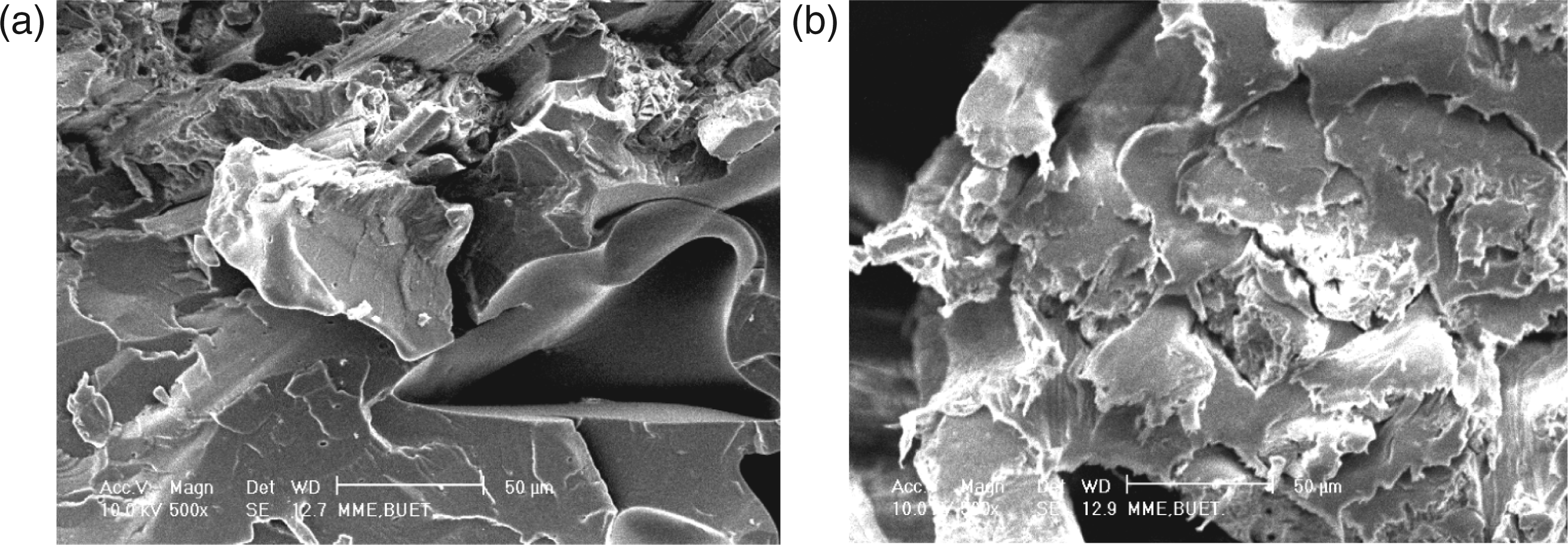
CONCLUSION
Jute fiber-reinforced PET matrix composite was prepared by using four layers of jute and five layers of PET sheets at 280°C and 5 ton pressure by compression molding. Mechanical properties of the matrix PET and the composites (PET/jute) were evaluated and it was found that the jute fiber-reinforced PET attributed significantly higher mechanical properties. Degradation tests of the composites were performed in soil medium. After 6 months of soil degradation, composites lost about one-fourth of their original strength. Composites lost their mass slowly in soil medium, thus indicating their semi-degradable characters attributed from jute. Fiber–matrix adhesion was found quite promising and proved by SEM.