



Abstract
Historically, educational leadership research has been dominated by Anglo-American perspectives, often neglecting the socio-cultural, political, and economic contexts that shape leadership practices. Recent decades have seen a significant increase in research from diverse geographical and societal contexts as a response to critical voices advocating for greater contextual sensitivity following calls to break free from the Anglo-American influence. The purpose of this conceptual paper is to critically explore what we know about how the educational leadership field has responded to these critics, also identifying significant gaps in our understanding which need to be addressed to further our understanding. We argue, while the increase in the number of publications from different localities constitutes a foundational step, advancing epistemic diversity is more critical than geographical diversification in liberating the educational leadership knowledge base from the Anglo-American hegemony. In so doing, we critically examine what we know about how the field has responded to calls for pluriversal perspectives, also identifying notable gaps in our understanding which hinder our ability to make an informed judgment about the progress made, specifically addressing who produces, applies, circulates, and is cited in knowledge. A research agenda is presented structured around four dimensions of epistemic inquiry, offering a roadmap for advancing inclusive theory, policy, and practice.
Keywords
Introduction
Contemporary educational leadership research can be traced back to the theory movement of the late 1950s. The theory movement in educational administration drew specifically on systems theory, which itself is rooted in the natural sciences. This theoretical orientation underpinned the movement's commitment to positivism and a hypothetico-deductive methodology. This approach marked a shift toward a rational technique of inquiry, distancing educational administration from the atheoretical knowledge of practitioner-researchers and aligning it with scientific management principles (Eacott, 2015). The movement's emphasis on objectivity, operational definitions, and systematic structure reflected a broader ambition to establish educational administration as a science. This positivist framing also contributed to the marginalization of alternative epistemologies, including critical, feminist, and sociological perspectives (Smyth, 1989). These later critiques challenged the assumptions of neutrality and objectivity embedded in systems theory, arguing instead for a more reflexive, contextually grounded understanding of educational leadership and administration. This revised framing foregrounds the epistemological and methodological commitments of the theory movement while acknowledging the critiques that have reshaped the field.
While the theory movement in educational administration has often been critiqued for its Anglo-American centrism and institutional isolation, it also has epistemological limitations. The movement's reliance on logical positivism and systems theory reflected a narrow conception of science that excluded normative, interpretive, and critical dimensions of educational inquiry (Bates, 1980, 1987). This epistemic orientation privileged objectivity, generalizability, and technical rationality, thereby marginalizing alternative paradigms that attend to context, values, and power. In so doing, methodological commitments of the theory movement have contributed to the reproduction of dominant knowledge regimes, constraining the field's capacity to engage with ontological and methodological pluralism, particularly approaches that foreground relationality, reflexivity, and situated practice (Riveros & Newton, 2016).
The Anglo-American concentration of the theory movement amplified its epistemological narrowness, reinforcing a monocultural view of educational leadership that has proven resistant to more inclusive and critical perspectives. The field's reliance on rationalist, individual-centric models has contributed to the sedimentation of dominant discourses that obscure the political, ideological and epistemological work these models perform. Rather than opening up the field to pluralistic inquiry, these models often reinforce managerialist logics and functionalist assumptions about leadership as a neutral, technical activity, abstracting away power, culture, and socio-historical context (Evans, 2022; Lumby, 2013). They serve to legitimize particular forms of knowledge and practice while marginalizing others, especially those rooted in critical, feminist, and democratic traditions (Blackmore, 2013). Hence, the epistemological closure of the theory movement is sustained not only through methodological commitments but also through the discursive practices that shape what counts as legitimate leadership.
These criticisms have advocated for a more inclusive and culturally sensitive knowledge base with multiplicity of voices and pluriversal perspectives from different geographies to attend to the varied influence of language, beliefs, values, religion and social organisation on leadership in education in different societies (Dorfman et al., 1997; Mertkan et al., 2017; Walker et al., 2012). The significance of attending to the unique socio-cultural, historic, and discursive contexts of different regions, and their implications for the conceptualizations, practice, and study of leadership, has been increasingly stressed (Miller, 2016; Szeto et al., 2015). A knowledge base characterized by closer attention to contextual sensitivity, multiplicity and pluriversal perspectives was acknowledged as crucial for fostering richer, more meaningful insights into educational leadership, which, by its very nature, is never divorced from “the powerful political, demographic and cultural influences at the local, regional, national and even global levels” (Dimmock and Tan, 2013: 1). This, critics argued, would free the knowledge base from the “Anglo-American axis of influence” (Sugrue, 2005: 3), move the field beyond ‘one-size-fits-all’ theories, and allow for better policy implementation, learning, and practice (Dimmock et al., 2021; Walker and Qian, 2012). This inquiry is especially timely given recent reflections in many scholarly outlets which have acknowledged the persistence of ‘blank spots’, or areas dominated by entrenched epistemologies within educational leadership scholarship, and have called for a shift from mere acknowledgment to transformative action in order to reconfigure scholarship practices and expand the field's epistemological traditions or dominant boundaries toward greater inclusivity and pluralism (Bainazarov et al., 2022, p. 811).
Considering this, this paper aims to critically examine what we know about how the educational leadership field has responded to this critique in the last two decades, also identifying gaps in our understanding which need to be addressed to further our understanding of educational leadership in diverse geographical contexts.
Field specific responses to calls to de-Anglo-Americanize the field: What we know
In recent decades, scholars in the field have begun to show increasing interest in examining the field from the perspective of knowledge production using different review methods and at three different levels of analysis – country-specific, regional and global (Author, 2024). Largely topographical in nature, the vast majority of these reviews explored, rather uncritically, the evolution of Educational Leadership and Management (EDLM) scholarship in specific geographies with a particular focus on quantifiable publication trends of volume, impact, research topics, and methods (e.g., Hallinger and Hammad, 2019). These studies have provided significant insights into growth patterns of research from different localities, indicating a notable rise in studies across various geographies at varied speed and time (e.g., Hallinger, 2020). Significant imbalances in publication volume between and within regions as well as between EDLM journals were documented (e.g., Castillo and Hallinger, 2018; Hallinger, 2018; Hallinger and Hammad, 2019). These were found to be influenced by socio-economic and socio-political conditions of societies (Author, 2017).
As desirable as it is to compare the results of these studies to reach a more comprehensive understanding of the geographic diversification within the field, this is often not possible due to variations in their inclusion criteria. While some reviews have solely focused on location, including studies conducted on EDLM in a specific context (e.g., Adams et al., 2023; Hallinger, 2019; Liu et al., 2025), others have focused on both the location where research was conducted and the knowledge producer, including studies conducted on EDLM in the society examined and those produced by scholars located in the society examined at the time of authorship regardless of its topic and context. The latter included studies on/from a specific society (e.g., Ahmed, 2023; Hallinger and Bryant, 2013a, 2013b, 2013c; Hallinger, 2020). This variation hinders the development of reliable comprehensive insights into changes in geographical diversification of locations (i.e., research context), in geographical diversification of knowledge producers or in local capacity building, particularly in the case of some Asian countries where highly productive scholars have relocated (e.g., Hallinger, Walker, and more lately Gümüş), moved temporarily (e.g., Harris), or hold dual affiliations (e.g., Hallinger, Thailand and South Africa).
Bibliometric studies attempting to map geographic diversification has revealed important insights into the geographical diversification in terms of the knowledge producer dimension based on author affiliation. Scholars from the United Kingdom, the United States, Canada, and Australia were highlighted to dominate the EDLM scholarship so much so that they still account for 83% of all documents published in English in the EDLM journals (Hallinger and Kovačević, 2019, 2021, 2022) even though contributions by scholars located outside the Anglo-American-European centres of EDLM scholars were found to increase considerably (Hallinger, 2019). These studies have improved our understanding of the geographic distribution of scholars in EDLM scholarship, highlighting the persistent Anglo-American dominance in the knowledge producer dimension. However, due to their nature, they, too, cannot reveal the geographic distribution of locations, and fail to expose the current state of the field or its growth trends in developing a scholarship that is empirically grounded in diverse localities. Scholars’ affiliation does not necessarily mean research focuses on the context in which the author(s) is located.
The intellectual structure of the field has also been explored along with the most influential works and most prolific authors by bibliometric reviews (Bainazarov et al., 2022; McGinity et al., 2022). Through citation and co-citation analyses, these reviews reveal the epistemic hegemony of Anglo-American spheres, with UK and USA dominating citation metrics both in terms of influential documents and prolific scholars while Anglo-American concepts, constructs and theories continue to exclusively shape the intellectual structure of the field (e.g., Hallinger and Kovačević, 2019). This resonates with the findings on Turkish EDLM scholarship, which was found to be largely based on Western theories and models of leadership (Bellibaş and Gümüş, 2019). A small number of scholars affiliated with non-Anglo-American institutions have also made it to the top of the charts (e.g., Hallinger, Harris, Walker; see Hallinger and Kovačević, 2019, 2021). All of those listed, however, were highly productive and influential scholars originally from Anglo-American contexts who have relocated to Asia. This is an indication that as the educational leadership field has evolved and the educational leadership knowledge base has matured, Anglo-American approaches to leadership have driven foundational theories and dominant conceptualizations while non-Anglo-American theories, concepts and conceptualizations were excluded (Bainazarov et al., 2022; Lopez, 2020). Some have argued this “leads to an over-statement of internationalisation” (McGinity et al., 2022: 220). This also could indicate that the scholarly work that represents the maturation of the field has also served to shape dominant discourses which remain embedded in a rationalist logic that aligns with the bureaucratic view of leadership critiqued by Smyth (1989) and Foster (1986). Watkins (1986) further argued that such models obscure the symbolic, dialectical, and power-laden dimensions of educational leadership.
While McGinity et al.'s criticism might have some standing, issues raised above hinder our ability to make informed judgements about progress in geographical diversification both in terms of research contexts and geographic locations of the knowledge producers. This signifies an important limitation because the strides made in geographical diversification lay essential groundwork for dismantling Anglo-American hegemony. As we elaborate below, existing gaps in understanding also constrain our capacity to assess epistemic diversity, the hallmark of a more pluralistic knowledge ecosystem and a crucial element of pluriversal possibilities.
Gaps in our understanding
Knowledge production and circulation are not neutral processes but are rather shaped by infrastructural asymmetries and geopolitical hierarchies embedded within the global scientific ecosystem. Epistemic hegemony refers to the dominance of particular knowledge systems often rooted in Anglo-American or Euro-centric, positivist traditions that marginalise alternative ways of knowing and delegitimise knowledge produced beyond these spheres. As R’boul (2022) argues, this hegemony is sustained through institutional practices such as editorial gatekeeping, linguistic dominance, and the privileging of Western epistemologies in global academic publishing. It results in what Santos (2018, p.118) describes as a devaluing of the “cognitive diversity of the world,” where Southern epistemologies are rendered invisible or inferior.
In contrast, epistemic diversity denotes the recognition and inclusion of multiple epistemological traditions, including those grounded in relational, spiritual, experiential, and community-based knowledge systems. Guilherme (2019) and R’boul (2022) advocate for an “ecology of knowledges” that resists monocultural epistemic frameworks and supports pluriversal approaches to knowledge production. This includes embracing intercultural and decolonial epistemologies that foreground situated, dialogic, and reflexive understandings of educational practice.
These entrenched asymmetries and hierarchies shape the production and circulation of knowledge through publishing and citation practices, and the gatekeeping activities of journal editors and reviewers. These hierarchies do not merely reflect geographical concentration but actively reproduce epistemic domination. As Bates (1989) argues, educational administration has historically functioned as a technology of control, systematically marginalising educational and cultural concerns in favour of bureaucratic rationality and managerial efficiency. This has led to the reproduction of dominant epistemologies that serve the interests of elite knowledge producers, often located in Anglo-American institutions, while excluding alternative ways of knowing rooted in different cultural and social contexts.
Epistemic diversity, therefore, must be understood as the inclusion of multiple epistemological traditions, not simply as a by-product of geographical diversification. As Gunter (2004) and Oplatka (2009) highlight, the field has long conflated geographical representation with epistemological plurality, overlooking the internal struggles within regions and the persistence of dominant paradigms across diverse locations. For example, functionalist and positivist approaches continue to shape educational leadership research even in underrepresented regions, undermining the potential for genuine epistemic pluralism.
To advance epistemic diversity, it is essential to interrogate the structures that sustain epistemic hegemony, such as editorial gatekeeping, citation practices, and the privileging of certain theoretical frameworks, rather than assuming that increased geographical representation will automatically lead to more inclusive knowledge production. The vast majority of leading journals in which scholars from diverse backgrounds are encouraged, in some cases even pressured, are published in Anglo-American spaces, are managed by Anglo-American scholars and have editorial boards of mainly Anglo-American scholars (Murphy and Zhu, 2012; Paasi, 2005). Editorial board composition plays a critical role in shaping what is published and cited. Boards composed predominantly of Anglo-American scholars are inclined to favor research aligned with Anglo-American perspectives (Faraldo-Cabana and Lamela, 2021; Goyanes and Demeter, 2020). In so doing, they establish a hegemonic hold on publishing practices “through successfully positioning their epistemic privilege and dominant worldview as the most legitimate and natural way to view the world” (Vaditya, 2018) and position Anglo-American reason as universal, devoid of context and applicable to all (Adams, 2021). This pressures non-Anglo-American scholars to conform to Anglo-American worldview, writing from an Anglo-American epistemic position (Pratt and de Vries, 2023), locating their work in Anglo-American discussions through citations directed toward Anglo-American publications to validate their work internationally (Ibrahim et al., 2024), or addressing issues of concern to the Anglo-American contexts (Mitchell et al., 2020). Through this tendency to be oriented towards Anglo-American scholarship for validation – extraversion as coined by Hountondji (1990) – Anglo-American domination is sustained. This underscores the critical role journal editors and editorial boards play in fostering or hindering epistemic diversity and shaping a scholarly discourse grounded in pluriversality (Ganter and Ortega, 2019).
It is important to clarify that references to ‘Anglo-American’ epistemic positions in this paper do not imply a singular or homogeneous epistemology. As Oplatka (2009) has shown, there is considerable epistemic diversity within Anglo-American contexts, including tensions between functionalist, critical, and post-structural paradigms. Similarly, research from underrepresented regions may be framed by dominant paradigms such as functionalism or positivism, which complicates assumptions about epistemic diversity based solely on geography. Therefore, when we refer to Anglo-American influence, we are pointing to the infrastructural and institutional dominance of scholars, journals, and publishing practices located in these regions, which often privilege certain epistemological frameworks. This distinction is crucial to avoid conflating geographical concentration with epistemological uniformity and to support a more nuanced understanding of how epistemic hegemony operates across and within regions.
Coupled with the tendency of scholars based in dominant academic spaces toward introversion, “a process whereby scholars are inwardly focused, suspicious of knowledge from sources external to their own country” (Collyer, 2016: 64), processes of extraversion create important inequalities in research impact as measured by citation counts. Citation analyses reveal that dominant countries, especially the United States and Western Europe, receive disproportionate scholarly attention, even when research from the typically underrepresented contexts is substantively similar (Gómez et al., 2022). This results in the marginalization of non-Anglo-American theories, concepts and methods (Chen, 2011; Hassink et al., 2019) and mediation of non-Anglo-American knowledge production through Anglo-American theories, concepts and methods even though they are “removed from the historical and sociological experiences” (Chatterjee, 2014: 2) of the contexts into which they are imported. They often include a division of intellectual labor where theory-building originates in Anglo-American settings, while non-Anglo-American contexts are relegated to the role of empirical testing (Carrozza and Benabdallah, 2022; Wemheuer-Vogelaar et al., 2016).
This signifies the importance of critically examining the processes that continuously reproduce Anglo-American influence in order to maximize capacities for dialogue between different forms of knowledge. Such scrutiny would help flatten epistemic hierarchies, create the necessary conditions for epistemic diversity, which is essential to dismantling universalist educational leadership narratives originated from Anglo-American contexts and create a knowledge base that reflects pluriversal perspectives (Hutton and Cappellini, 2022; Santos, 2014; Scauso, 2025).
Moving the educational leadership scholarship forward: A research agenda
While geographical diversification has increased (Hallinger & Kovacevic, 2019), there remains many possibilities for moving the field forward to dismantling epistemic hegemony, and advancing theoretical, conceptual and empirical advancement. Going beyond examining numerically the contributions from increasingly diverse regions, there remains space to critically examine the epistemic foundations of these contributions (Gómez et al., 2022; Pratt & de Vries, 2023), consequentially asking not just where knowledge is produced, but whose epistemologies are privileged, and the implications for the field as is, and as it could be.
An agenda for future research could helpfully examine knowledge producers, knowledge applied, knowledge circulated and cited, and knowledge solicited. As outlined in Table 1, an examination of knowledge producers could examine who is producing knowledge in the field, their epistemic locations, and the implications of editorial practices and functions in shaping inclusion and exclusion (Goyanes & Demeter, 2020). Examining how knowledge is applied is an invitation to consider the theories and concepts that are being used in scholarship and empirical work in the field, the extent to which non-Western epistemologies are being mobilized, or whether they are relegated to empirical case studies (Kong & Qian, 2019). How knowledge is circulated and cited is related to this, investigating how citation flows reflect epistemic hierarchies, and the mechanisms that serve to drive citational distortion (Gómez et al., 2022). Considering this, how knowledge is solicited invites an exploration of whose voices are included in empirical studies, as well as theoretical and conceptual development, and whether scholars from underrepresented regions are shaping the field's theoretical core, or simply contributing data.
Moving the educational leadership scholarship forward: A research agenda
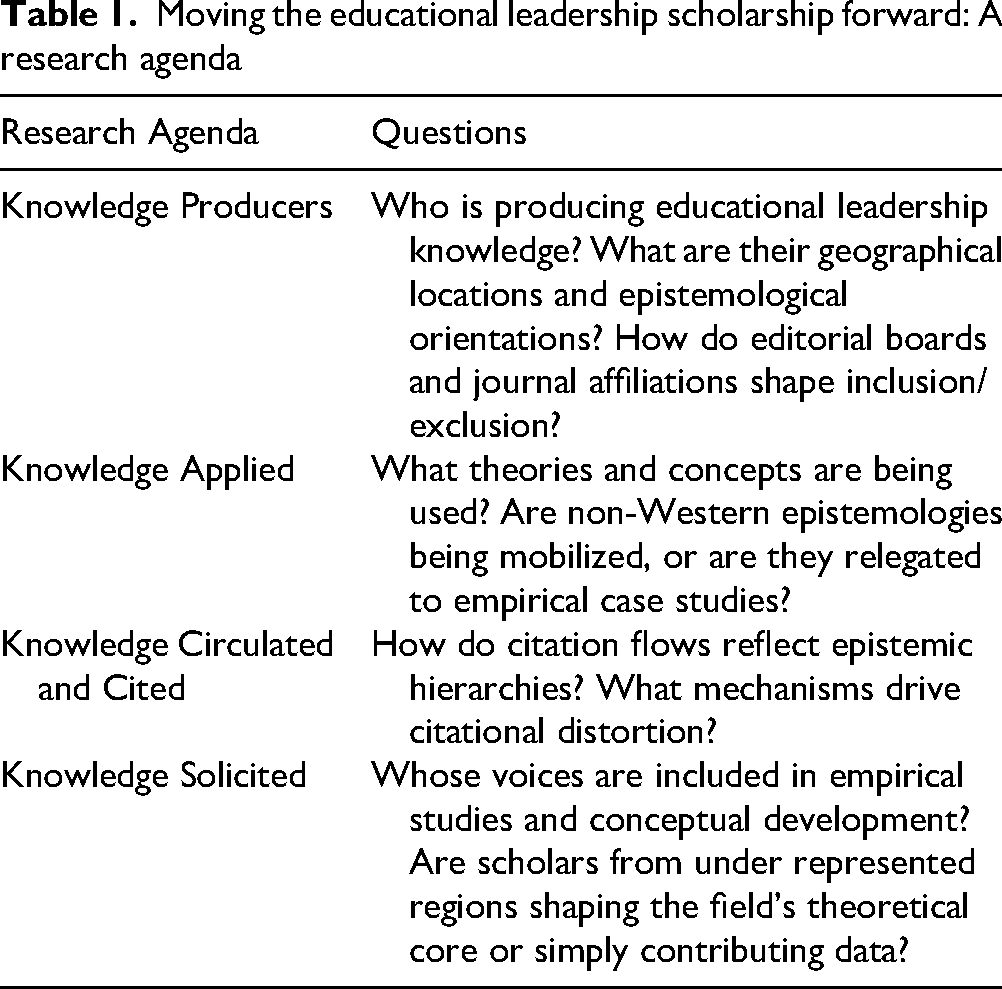
To advance epistemic diversity in the field of educational leadership, future research should interrogate how epistemic infrastructures, embodied in journals, conferences, universities, and funding bodies, shape knowledge flows and inclusion. Editorial gatekeeping remains a critical concern, with board composition influencing publication and citation patterns (Goyanes & Demeter, 2020; Pratt & de Vries, 2023). Scholars’ navigation of dual epistemic identities, balancing global norms with regional critique, warrants deeper exploration (Guzmán-Valenzuela et al., 2021). The role of mobility and access to global networks in shaping epistemic influence must also be examined (Jöns et al., 2017). Research should also explore how local epistemologies can be re-centered without reinforcing parochialism (Hountondji, 1990), and how comparative educational leadership can challenge entrenched hierarchies and foster pluriversal perspectives (Santos, 2014). Together, these directions aim to dismantle epistemic hegemony and cultivate a more inclusive, contextually grounded knowledge base for the field. This agenda informs more inclusive research policies, supports equitable funding and publishing practices, and encourages contextually grounded leadership models, ultimately enriching both theory and practice.
Conclusion
The educational leadership field stands at a critical juncture. While geographical diversification has expanded the field's reach, epistemic hegemony persists, sustained by infrastructural asymmetries, editorial gatekeeping, and citational distortion. As this paper has shown, the dominance of Anglo-American epistemologies continues to shape what is considered legitimate knowledge, often marginalizing critical, locally grounded perspectives from historically underrepresented regions.
To move the field forward, scholars must embrace a more radical agenda; one that prioritizes epistemic diversity over mere geographical representation. This entails rethinking who produces knowledge, what epistemologies are applied, and whose voices are heard. Drawing on frameworks from global health ethics (Pratt & de Vries, 2023) and critical scholarship on knowledge mobilities and epistemic injustice, we call for a pluriversal approach to educational leadership research, one that values multiple ways of knowing and being. The proposed research agenda proposes a roadmap for this. It is not simply about inclusion, but about reconfiguration of the field's intellectual structure, its publishing practices, and its conceptual and theoretical foundations. Only through such reconfiguration can educational leadership scholarship become truly global, equitable, and transformative.
Footnotes

Funding
The authors disclosed receipt of the following financial support for the research, authorship, and/or publication of this article: This work was supported by the Seed Fund for Basic Research 2024/25, University of Hong Kong (2401102968).
Declaration of conflicting interests
The authors declared no potential conflicts of interest with respect to the research, authorship, and/or publication of this article.