




Abstract
This article positions an interdependent approach to leadership that draws on the literature of well-known theorists and researchers and combines three effective leadership approaches into one. As a leader in Education for over 20 years, the author of this article chose transformational, distributed, and servant leadership approaches as they have been employed through years of working in and with senior and middle leadership in education. Throughout this time, the author developed an appreciation for their effectiveness within change development contexts and an intentional consciousness of how to apply them in practice. It is upon that intentional consciousness, that a new approach of leadership emerged, synthesising the complementary ideologies and analogous characteristics of the three leadership approaches together into a new approach to leadership–Trianalogous Leadership.
Introduction – leadership approach or approach to leadership?
Research is continuously developing within the field of leadership and leadership development due to global influences and generational differences. New leadership approaches are emerging and becoming ‘fashionable’, particularly toward the more moral and humanistic perspectives (Asbari, 2020; Hieker and Pringle, 2021; Northouse, 2021; Woods et al., 2023). Examples include authentic, ethical, spiritual, and inclusive leadership approaches (Northouse, 2021). However, as these new moral leadership approaches are emerging, long-standing educational leadership approaches such as transformational, distributed and servant leadership are evolving to be inclusive of such perspectives, whilst also maintaining their prominence and popularity in leadership research and scholarship (Bush, 2020; Northouse, 2021; Woods et al., 2023).
In this globally influenced, interconnected and unpredictable world today, confining yourself and being predictable as a leader will no longer be effective (Hieker and Pringle, 2021). It is important to make the connections both within us and between us. If we are able to utilise different leadership approaches synonymously and choose those that complement each other, then a singular approach is not confined to one leader themself and their approach, but more to do with the process that everyone is involved in and an approach to leadership.
This article discusses the three leadership approaches – transformational, distributed, servant – and their evolution, and synthesises their complementary ideologies and analogous characteristics, to create a potentially powerful, moral, and humanistic approach to leadership in education.
Transformational leadership
Transformational leadership has evolved significantly over time. Initially defined by Bass (1985) as leadership rooted in integrity, fairness, and high standards, it later developed into a morally driven approach that prioritises the wellbeing of followers and the collective good (Bass, 1995; Bass and Riggio, 2006). Northouse (2016, 2021) and Anderson (2017) further conceptualise it as an interactive process where leaders and followers mutually influence one another, making leadership accessible to all, subsequently promoting wellbeing, competence, and commitment (Woods et al., 2023).
Effective transformational leaders model high expectations and align individual values with organisational goals (Choudhary et al., 2013; Breevaart et al., 2014). This leadership style emphasises organisational commitment through the articulation of a clear vision, optimism, and empowerment (Stone et al., 2004). However, Bush (2020) warns that such leadership can be misused to impose personal values. To counter this, transformational leaders must understand and transparently share their own motives and values, fostering trust, and collaboration (Northouse, 2016; Anderson, 2017). Open dialogue and mutual understanding within teams are essential for success (Thomas-Hunt and Phillips, 2003), helping leaders overcome bias and build follower confidence (Schein, 2017).
This collaborative ethos supports distributed leadership, reinforcing transformational leadership as a dynamic and inclusive approach suited to today's evolving educational landscape (Youngs, 2017). Gronn (2002) highlights its collective nature, especially relevant in educational settings where accountability is key.
Distributed leadership
Distributed leadership, as theorised by Gronn (2000), emphasises conjoint agency – where leadership is a collective effort by interdependent members. This challenges traditional individual roles and highlights the importance of team-based leadership (Bush and Glover, 2012). Despite its popularity in education (Harris et al., 2022; Bush, 2023), distributed leadership risks being misinterpreted as delegation. True distributed leadership is participatory and emergent, not allocative. Woods et al. (2023) raise the critical question of how formal leaders can create conditions that support distributed leadership for community wellbeing and educational growth.
Spillane (2005), Diamond (2015), and Youngs (2017) shift the focus from individual leaders to leadership-as-practice, framing leadership as a shared, dynamic process, emphasising collaborative decision-making. Role rotation and shared leadership responsibilities can promote buy-in and motivation across teams, enabling collaborative responses to complex challenges (Northouse, 2021).
Collaboration is a practice of distributed leadership (Gronn, 2002). Northouse (2016) defines collaboration as problem-focused, risk-tolerant, and mutually supportive teamwork. Leithwood (2021) and Diamond (2015) advocate for building collaborative cultures and structuring organisations to support teamwork and for leaders to work with teams. Purposeful collaboration requires transparency, shared values, and regular dialogue (Bush and Glover, 2012). It should extend beyond meetings, fostering interdependence and sustainable success (Gronn, 2002; Morrison, 2013).
To embed distributed leadership, leaders must clarify roles and systems, promote trust, cultivate norms of honesty and respect through modelling (Leithwood, 2016; Harris, 2005), and most importantly, schedule time for professional dialogue (Bush and Glover, 2012). However, caution is needed to avoid superficial compliance (Cawsey et al., 2016). Servant leadership complements this approach, emphasising long-term transformation through genuine care, openness, and shared power (Greenleaf, 1977; Spears, 2004).
Servant leadership
Servant leadership centres on genuine care for individuals and rooted in Greenleaf's (1977) philosophy, it challenges traditional notions of power and authority, advocating for leaders who serve first. Servant leaders empower others by sharing power, placing others’ needs first, and fostering personal growth and wellbeing within communities (Greenleaf, 1977; Northouse, 2021).
Servant leadership uniquely positions altruism as its core and is an approach that is framed upon the behaviour of authentically caring for others (Northouse, 2016, 2021). Key attributes include integrity – acting truthfully and respectfully – and self-awareness, which is essential for modelling ethical behaviour and leading with authenticity (Russell, 2001; Russell and Stone, 2002; Taylor et al., 2007).
Stewardship plays a central role, encouraging transparency, and persuasion to serve others’ needs (Bier, 2021; Spears, 2004). Effective servant leadership demands consistency and long-term commitment. In education, servant leaders’ model desired behaviours, advocate professional goals, adhere to shared norms, and encourage active participation by inspiring mutual respect across stakeholders (Georgolopoulos et al., 2018; Leithwood, 2016). By doing what they say they will do, servant leaders can foster genuine collaboration and drive collective success through values-based leadership. This approach requires time to embed within educational cultures, as shared learning and cultural dynamics influence its success (Schein, 2017).
Developing such a culture can therefore be difficult, particularly through one type of leadership approach alone. Servant leadership aligns with transformational and distributed models by promoting shared power, collaboration, and collective vision. It positions people as the most valuable asset in organisations and supports long-term cultural development through joint action and agency (Bolman and Deal, 2013).
Summary
The three leadership approaches of transformational, distributed, and servant leadership have significant synergy, analogous features, and complementary ideologies (Stone et al., 2004; Taylor et al., 2007). Taylor et al. (2007) claimed that servant leadership, integral with distributed and transformational leadership, rests on the authenticity of leading by example and with the true value of empowering others. In contrast to each other, Northouse (2016; 2021) positions transformational leadership as a process, servant leadership as behavioural, whilst Spillane (2005) would position distributed leadership as being first and foremost about leadership practice. It is upon these differential notions of process, behaviour, and practice that interdependence is promoted.
Trianalogous leadership
Upon considering the interdependence of these three leadership approaches, the author promotes a new approach to leadership and has named it Trianalogous Leadership, capturing the analogous features of the three (tri) leadership approaches. This is depicted in Figure 1 below.
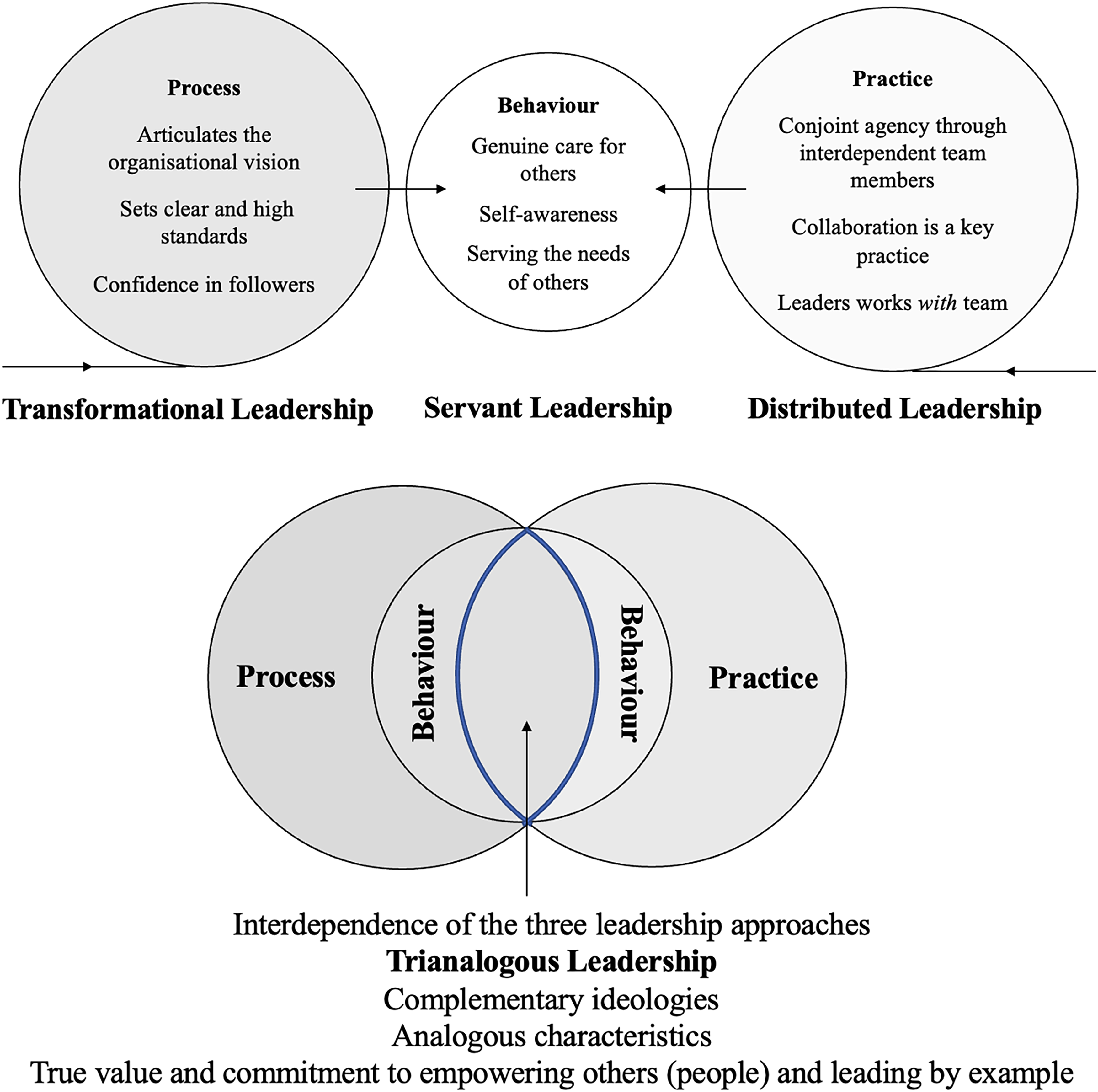
Trianalogous leadership – An interdependent approach to leadership.
As depicted in Figure 1 above, the key processes identified for transformational leadership include articulating the organisational vision, setting clear and high standards, and promoting confidence in followers to achieve the organisational objectives (Bass, 1985, 1995; Northouse, 2016; Stone et al., 2004; Taylor et al., 2007). The key practices identified for distributed leadership include: the promotion of conjoint agency through interdependent team members, collaboration, leaders specifically working with the team (Diamond, 2015; Gronn, 2000; Morrison, 2013; Spillane, 2005). The key behaviours identified for servant leadership include demonstrating genuine care for others, self-awareness, and a commitment to serving the needs of others (Greenleaf, 1977; Northouse, 2016; Russell, 2001; Russell and Stone, 2002; Spears, 2004; Stone et al., 2004; Taylor et al., 2007). The interdependent nature of this approach to leadership, acknowledges that leaders can promote a process through particular behaviours and practices at any one time. For example, in order to develop and articulate a collective vision, a leader can demonstrate confidence in followers by working with them to collaboratively create a vision together, genuinely caring about their input. Throughout the process, high standards can be modelled, demonstrating what is expected through serving the needs of others.
In summary, the combination and interdependence of the three leadership approaches – transformational, distributed, servant – aims to capture the effective features of each, so that they can combine into one approach to leadership for greater and more profound impact. Trianalogous Leadership demonstrates how the specific features of each leadership approach – Process, Practice, and Behaviour – combine to create a potentially powerful approach to leadership that is central to the moral and humanistic aspect of leadership. If we can utilise different leadership approaches synonymously and choose those that complement each other within one approach, then it is not about the leader themselves (and their leadership approach), but it is more to do with the approach to leadership that everyone is involved in collectively.
Footnotes
Acknowledgements
The authors wish to thank the support of colleagues at Newcastle University throughout the writing of this article.

Funding
The author received no financial support for the research, authorship, and/or publication of this article.
Declaration of conflicting interests
The author declared no potential conflicts of interest with respect to the research, authorship, and/or publication of this article.
Author biography
My role within the university is internally and externally facing. I work internally within the School of Education, Communication and Language Sciences (ECLS) as Senior Lecturer in Educational Leadership and Degree Programme Director (DPD) for MA Education: International Perspectives. I lead on three post-graduate modules within the academic year, of which all have very high international student numbers. These include Leadership and Strategic Management; Future of Educational Leadership and Practitioner Research; and Dissertation/Action Research Portfolio. Externally facing, I am the Co-Director of the Educational Leadership Centre (based in ECLS) focusing on the professional development of teachers and leaders nationally. I contribute as content writer, quality assurer for facilitators, lead moderator, and academic lead for the online assessment systems, for the National Professional Qualifications (NPQs) for school leaders, accredited by the Department for Education (DfE).
I hold an MSc in Leadership and Management in Education (Manchester Metropolitan University, UK), and completed my Ed.D (Educational Doctorate) in Educational Leadership with Western University, Ontario, Canada, in June 2018. Both my Masters and Doctoral qualifications were of extreme value to my professional experience, as I was able to apply my learning directly to my employment contexts. Topics of deep study included coaching as a cultural leadership style, effective, and efficient professional development evaluation processes, and interdependent leadership approaches and solutions to enhance team motivation through a period of rapid change management. This varied education, employment, and conscious reflection has allowed me to expand my understanding, application, and synthesis of educational practices.
Throughout my previous 12 years of international experience, I was blessed with career opportunities and progression, within the same organisation. The valuable experience I gained in England within the first few years of my career, as an Assistant Head leading Professional Development (PD) and ITT, allowed me to transition into my international career. I started at an IB International School in the United Arab Emirates (UAE) as a PE Teacher and Professional Development (PD) Leader, and I was then fortunate to move into a central PD Leader role, within the wider organisation's Education PD department, where I worked with over 50 schools (over 8500 teachers and leaders) in the UAE region, and with other schools globally. These schools spanned several curriculums and contexts, including American, British, Indian and IB curriculums, and schools that were mixed, all-girls, and all-boys contexts. I had the opportunity to visit and work in countries such as Jordan, Saudi Arabia, Kenya, Malaysia, Switzerland, Australia, and Canada.