



Abstract
It is increasingly difficult to retain and recruit primary school headteachers in England, as well as internationally. There is an urgent need to understand how to attract primary teachers to headship, and develop a pipeline of qualified headteacher candidates. This study explored motivation to ascend to school headship amongst primary teachers, and current and former heads, drawing upon motivation to lead (MTL) constructs. Qualitative interviews were conducted with early career teachers (n = 7), experienced teachers (n = 8), current headteachers (n = 10) and retired headteachers (n = 8). The study found that having autonomy and the ability to make an impact across a whole school community were motivating factors for headship at all career stages, whereas stereotypes of headteachers and the fear of exposure and failure in the role were demotivating. A sense of duty was a motivator for the current and retired heads. Re-balancing the personal rewards and challenges of headship is necessary to motivate more teachers to become headteachers.
Introduction
Primary schools in England (educating pupils aged 4 to 11) face pressures on multiple fronts, including budget constraints compounded by nation-wide cost of living rises (Lucas, Classick, Skipp et al., 2023), high-stakes targets for pupils’ national assessments set by the Department for Education (DfE) and Local Authorities (White, 2019), and regulatory inspections by Ofsted (the Office for Standards in Education) (Lynch and Worth, 2017; Tickle, 2017). Budget pressures affect schools’ ability to offer competitive salaries to attract and retain staff, and cost-saving measures in schools can intensify workload for staff, and negatively affect retention (Lucas et al., 2023). A lack of suitably qualified and skilled applicants, due to a diminishing pipeline of trainees, also makes recruitment of teachers challenging (Worth & Faulkner-Ellis, 2022).
These difficulties are reflected at leadership levels in primary schools, and problems in recruiting and retaining primary school headteachers in England have been widely reported (e.g. James et al., 2019; NAHT, 2021, 2022; NEU, 2018; Worth, De Lazzari, and Hillary, 2017). The National Association of Head Teachers (NAHT) found in its 2023 survey of 1890 school leaders (from middle leaders to head teachers), that the majority (57%) would not recommend school leadership as a career choice. In addition, 61% of assistant and deputy heads said they did not aspire to headship, and 51% of school leaders said they were considering leaving the profession within the next 3 years (not including retirement). There is also stark under-representation of teachers from minority ethnic backgrounds in leadership roles, compared to the wider teaching population, with only 7% of primary school headteachers from ethnic minority backgrounds in 2020 (DfE, 2022).
Although this study focuses on England, challenges facing headteachers are acknowledged in many countries, from Iceland (Lárusdóttir, 2007), to China (Xue and Bush, 2021) and the Caribbean (Moriah, 2018). Jerrim and Sims (2022) analysed data from over 40 countries, and found that increased accountability within schools was related to increased headteacher stress. The role of headteacher has evolved from one centred around pedagogical leadership to include a wide range of responsibilities, such as resource allocation, people management, administrative tasks (Lárusdóttir, 2007), financial management, compliance, and community relations (Glazzard and Stones, 2021). Poor performance in an Oftsed inspection can potentially result in a school being forced to become part of an academy trust and/or a headteacher losing their job (Lynch and Worth, 2017; Tickle, 2017). Headteachers suffering from burnout, leaving the profession, and even taking their own lives, have been reported in the media, as well as in the literature (Abel, 2019; Adams, 2015; Lynch and Worth, 2017).
Motivation to lead in primary teaching
The motivation to lead (MTL) framework offers potential insight into the process by which some primary teachers become heads. The MTL framework is defined by Chan and Drasgow (2001: 482) as ‘as an individual differences construct that affects a leader's or leader-to-be's decisions to assume leadership training, roles, and responsibilities and that affect his or her intensity of effort at leading and persistence as a leader’. The three factors underlying MTL are affective MTL (enjoyment of leading others and seeing oneself as a leader), social normative MTL (leading out of a sense of duty or responsibility), and non-calculative MTL (not calculating the benefits versus the personal costs of leadership) (Chan and Drasgow, 2001). Chan and Drasgow (2001) found that individuals high in affective MTL tend to value competition and achievement, whereas individuals high in social-normative MTL are motivated by obligation. Individuals high in non-calculative MTL are altruistic and do not expect rewards or privileges for leading. Increasing self-identity as a leader may reinforce the leader's MTL over time (Badura, Galvin, and Lee, 2022; London and Sherman, 2021). However, Badura et al. (2022) propose that further research is required to better understand the role of these motives (enjoyment, sense of duty and altruism) in the leader emergence process, and how they may influence decisions to pursue leadership differently over time, as an individual gains more experience leading and understands more clearly the associated rewards and costs.
The motives set out in MTL theory are supported by some existing studies on leadership in schools. Altruistic motives for becoming a headteacher were evident in the studies by Johnson et al. (2000), who found that headteachers were motivated by working with children and developing them as future citizens, and Guihen (2017), who reported that female deputy headteachers in secondary schools saw the ability of the headteacher to transform young people's lives. Towers (2020) found that headteachers from disadvantaged primary schools in London were motivated to stay in the job to help, and demonstrate social justice to, vulnerable pupils. Similarly, Hancock and Müller (2009) surveyed German and American teachers studying for leadership degrees, and found their prime motivators included a desire to make a difference in the lives of pupils. The study found that the ability to initiate change in an organisation, and the professional challenge that the role of school leadership would provide, were motivators too, which align with the affective components of MTL. The American students also prized the increase in salary of a school principal, in line with a calculative approach in MTL.
However, Hancock and Müller (2009) also found that both American and German teachers were nervous of litigation, bureaucracy, losing their jobs if they were not successful, and the distance they would have from children, as a school leader. MacBeath (2011) found that senior staff in England and Scotland felt discouraged from applying for headship due to the workload necessary to qualify as a head, the lack of a substantial pay rise between deputy head and head positions, and a perceived decrease in satisfaction upon being appointed as a headteacher. Guihen (2017) noted the dual and contradictory images of secondary headship, where alongside the capacity of head teachers to transform lives, the role was also seen as highly risky and stressful.
Whilst these previous studies have tended to focus on particular career stage groups, we respond to calls to better understand how motives for leadership change over time (Badura et al., 2022). We therefore focused on motivations to pursue headship across different career stages, encompassing the views of teachers who have not been heads, as well as current and former headteachers. The research questions guiding our investigation were; (a) what are the motivating and demotivating factors to pursue primary school headship? (b) how do motivations to pursue headship change as teachers move through their careers?
Materials and methods
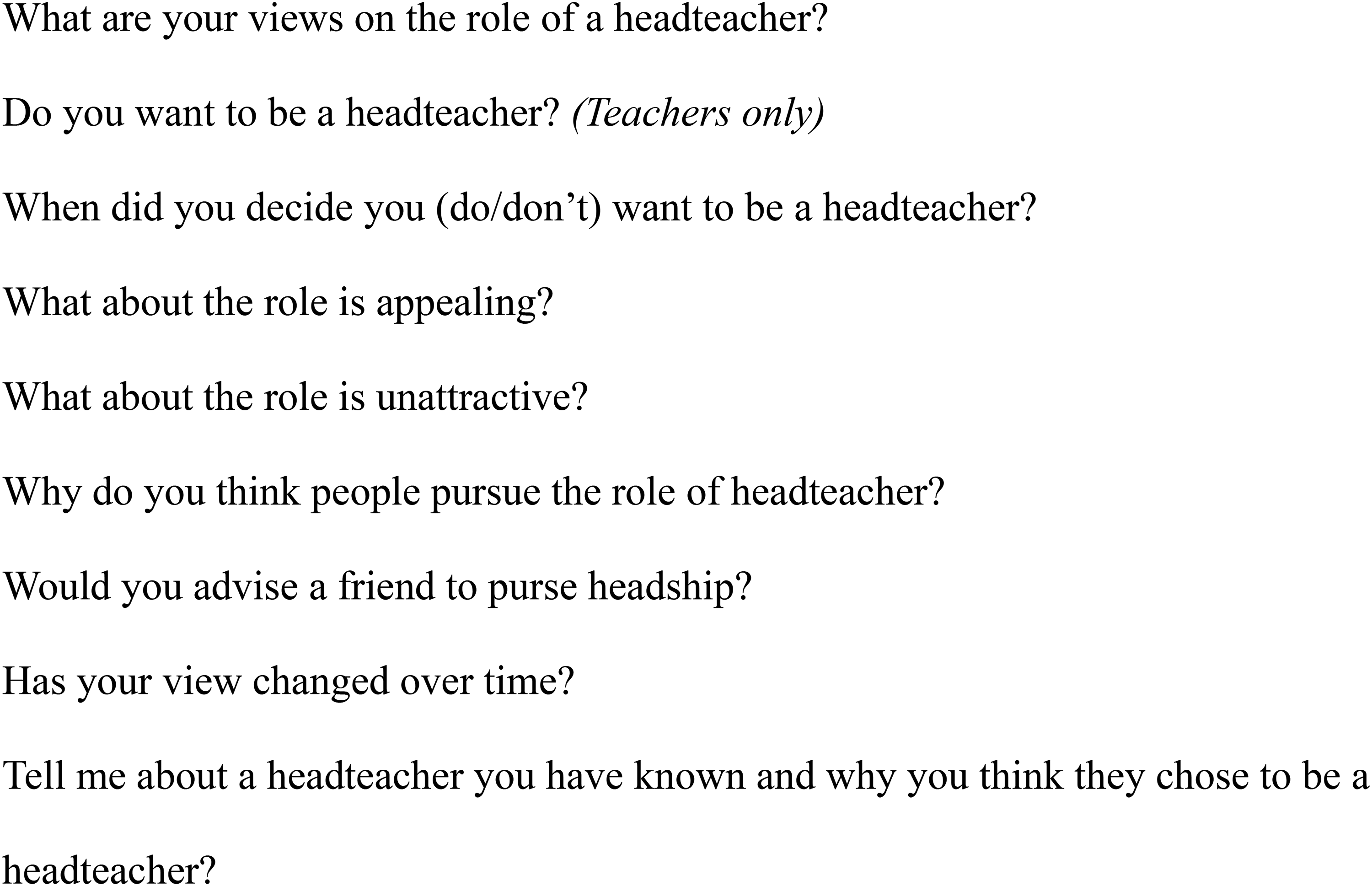
We employed a qualitative research design, utilising semi-structured interviews as the primary data collection method. This approach allowed for an in-depth exploration of motivations to pursue headship. Prior to the main study, a pilot test was conducted to validate the effectiveness of the interview guide, and feedback was used to clarify the wording of several questions. Example interview questions are shown in Figure 1.
Example interview questions.
Interviews were conducted both in-person and via video conferencing platforms, for participant convenience. The study population was current and former teachers and headteachers in local authority maintained, non-academy primary schools in the East of England. Schools in England are divided into those maintained by the local authority (including community schools which follow the national curriculum, as well as faith schools and other foundation and voluntary schools), and academy schools, which are independent from the local authority and managed by not-for-profit academy trusts (Types of school, n.d.). We focused on maintained schools as these form the majority (63%) of primary schools within England (DfE, 2021), and there is a long-established career path within these schools, from teacher to middle leader, to assistant/deputy head, and finally headteacher. Academy schools, in contrast, have different leadership models and paths to leadership, including CEOs of the multi-academy trust (MAT), and executive heads who may not come from an education background (Lynch and Worth, 2017).
We adopted a purposive sampling method, with the criteria based on career stage, defined as follows; early career primary teachers (those in the first 5 years of their career as a teacher), experienced primary teachers (those who have been in the career for more than 10 years), current primary headteachers, and retired primary headteachers.
Ethical approval was secured from the first author's University Ethics Committee in advance of data collection taking place, and the research was conducted in accordance with BERA guidelines (BERA, 2018). Informed consent was obtained prior to all interviews, by providing participants with an information sheet and asking them to sign a consent form, including giving permission to record the interviews.
The interviews were transcribed, and transcripts were analysed using thematic analysis, following the process outlined by Braun and Clarke (2006): (a) data familiarisation; (b) coding data to deductively and inductively defined codes; (c) collating codes into potential themes and sub-themes; (d) reviewing themes in relation to the coded extracts and entire data set; (e) defining and naming themes. A blended deductive and inductive approach was used, where deductive codes were generated from the literature (particularly the MTL framework, such as ‘rewards’, ‘duty’ and ‘image’), whilst inductive analysis allowed new codes to be generated from the data (such as ‘impact’ and ‘stereotypes’). This dual approach ensured a comprehensive analysis that was based in existing research and open to new insights (Kallio, Pietilä, Johnson et al. 2016).
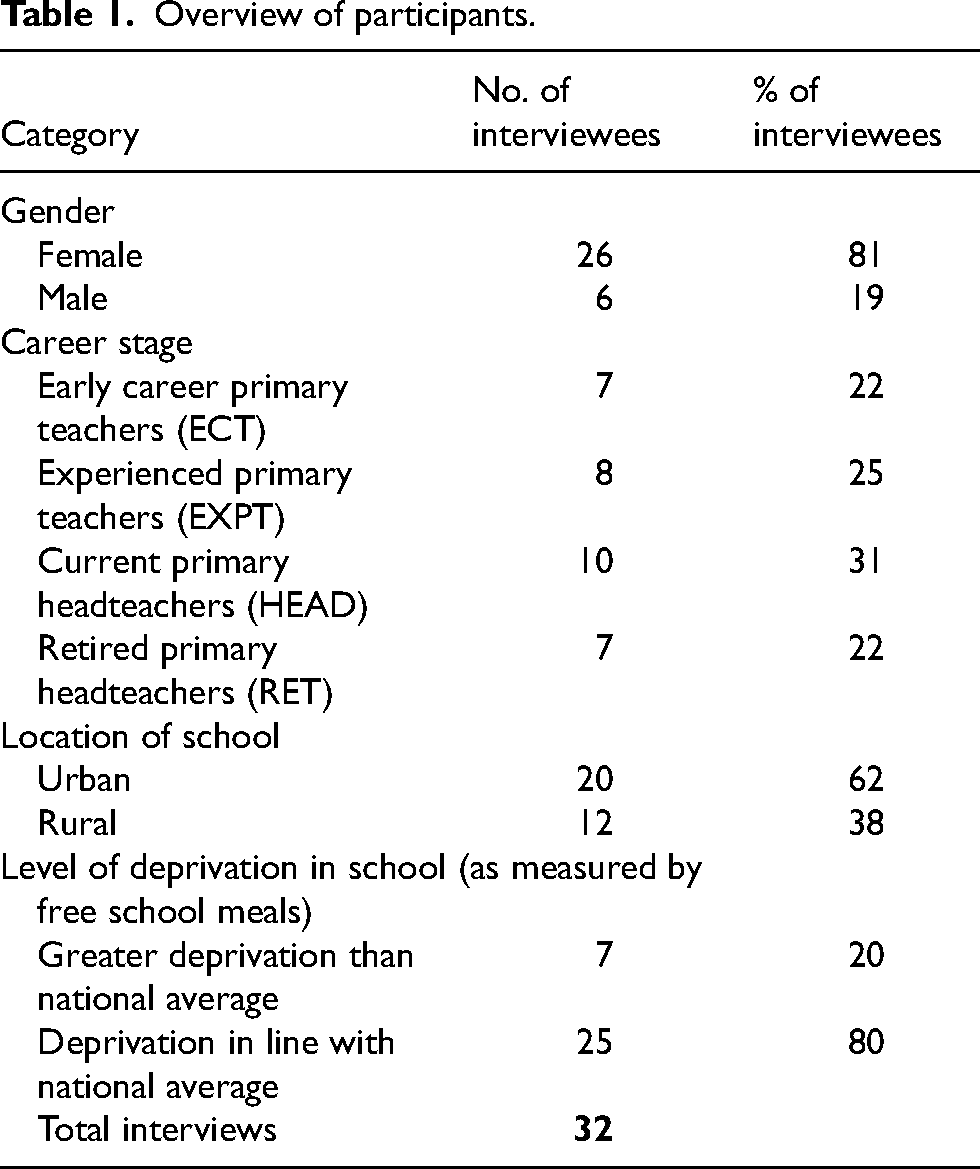
We conducted 32 interviews across all four career stages. The experienced teachers included those with leadership roles in the school, such as Subject Leader or Deputy Headteacher, in order to gain a range of perspectives on headship. The majority of participants were female, which reflects the disproportionate number of female teachers in primary schools (85%) (DfE, 2021). A breakdown of participants is presented in Table 1. Each interview lasted at least one hour. We have assigned codes to each of the career stage groups as follows; ECT (early career primary teachers), EXPT (experienced primary teachers), HEAD (current primary headteachers), RET (retired primary headteachers). These will be used when referring to participants in the ‘Results’ section.
Overview of participants.
Results
We will present here five areas identified by participants as motivating and demotivating factors to pursue headship; self-image and stereotypes of headteachers, duty, opportunities for impact, personal rewards, and challenges of the role. Self-image and stereotypes of headteachers are associated with affective MTL, for example how perceptions of headteachers affected whether an individual saw themselves as a leader. Duty is associated with social normative MTL, for example leading out of a sense of obligation. Opportunities for impact are associated with non-calculative MTL, for example an altruistic motive for leadership, based on benefiting others. Personal rewards and challenges are associated with calculative MTL, for example calculating the rewards versus the challenges of leadership, which was evident in contrast to non-calculative MTL. Quotes from each pool of coded interview data, sorted by career stage, have been selected here to illustrate each of the five areas.
Self-image and stereotypes of headteachers
Images of what a headteacher ‘should’ be were reported as a demotivating factor by participants at all career stages. For example, two retired heads noted, ‘you needed to be a man’ (RET6); ‘I didn’t want to apply […] I didn’t have the grey hair bun, in a neat suit’ (RET5). This was echoed by the current headteachers, who discussed how their clothes, personality, or upbringing meant they did not fit with the headteacher stereotype; ‘I do look at some of the other heads locally and they power dress, and I think that that's not me. And I have got an accent’ (HEAD8). Experienced teachers generally distanced themselves from headteachers; ‘a headteacher is somebody who wears a suit, wears pearls and the twin set […] I don’t see myself fitting into the niche of the headteacher’ (EXPT7). The early career teachers also had elevated views of headteachers; ‘it just seems like you have to be sort of superhuman… cool, calm, collected’ (ECT6). This suggests that stereotypes of headteachers begin forming at an early stage in a teacher's career.
Duty
For some retired and current heads, the decision to become a headteacher was motivated by a sense of duty: ‘If I did not step up to the plate, it was fairly clear that there was not going to be anybody else out there’ (RET5); ‘they asked me to be the acting head. And then by the time it came to the [substantive] appointment, I just thought, I’ve done too much here not to give it a go’ (HEAD9). Experienced and early career teachers both saw headship as ‘natural progression’ (EXPT8; ECT6; ECT7; ECT5) of their career, from classroom teaching, through management and leadership roles. For example ‘He's gone through the ranks of management and now feels the next step for him is to be a headteacher’ (EXPT8), and ‘If I was a deputy in a school and then the headteacher left […] I’d be probably much more likely to do that because it is a much more natural progression where you already are’ (ECT1).
Opportunities for impact
The potential impact a headteacher can have on a school community was a motivating factor for the retired and current heads, and the experienced teachers. For example ‘seeing how as a head you could make a difference to children, to a school’ (RET3); ‘I wanted a bigger impact on children. I love being able to just go in and then see the impact of that in their classroom’ (HEAD8); ‘you can make choices that will affect the children’ (EXPT4). Alongside this though, were concerns about the restrictions of headship, which actually limited the opportunities for impact: Teachers in class are dealing with the teaching and learning, the happy side of education. They get all the reward, the love, you know, and we get a lot of dross. (HEAD5) You’re leaving behind something that you went into the profession for [….] they don’t necessarily have that same contact with the actual teaching. (EXP1) Being a headteacher is quite removed from the teaching, and far less time with the children. So, it sort of loses out on my favourite things. (ECT4) I knew that the workload as a head was massive. When you’re young, you think, well, we’re invincible, we can manage this […] but a lot of the time your hands are tied on so many decisions and there are so many processes. (HEAD6)
Personal rewards
Participants saw potential personal rewards from headship as pay, status, and autonomy. Current heads most often mentioned personal rewards as a motivator, while retired heads least mentioned rewards. A third of the current heads mentioned pay as a motivating factor, for example HEAD4 commented, ‘The only way you could get more money was really to take on more responsibility’. However, for some current heads, the level of pay was a demotivating factor, for example HEAD10 stated ‘the pay is no good’, and over half of retired heads said that they thought the pay was insufficient to entice teachers to do the job.
Conflicting views on pay were also evident amongst the teacher groups. Some experienced teachers spoke critically about others becoming headteachers because they were ‘going for the money’ (EXPT2), whilst a third of early career teachers raised pay as a factor that would motivate them to become a headteacher, for example ‘it does make the role more attractive. I would like a higher salary than now’ (ECT2). However, two thirds of experienced teachers and nearly half of early career teachers felt that heads’ pay was not sufficient for the role, such as EXPT3, who noted, ‘[Heads are] totally underpaid’ and ECT4, who stated ‘it [pay] is not enough’.
Several of the retired heads noted that status was a motivator for them becoming a headteacher, believing that it showed others that they had desirable personal qualities, such as being ‘intelligent’, ‘quick-witted’ and ‘clever’ (RET5), and proved that they were a success; ‘I applied because it was local, and I wanted the local people to see that I was [a headteacher]’ (RET6). Status was also a motivating factor for current headteachers, and this group perceived the role as affirming their position as an educator, for example ‘You were a good teacher, therefore you went up the career ladder’ (HEAD7). A motivating factor in becoming a headteacher therefore was to prove that they were successful as a teacher.
Experienced teachers mentioned tangible status symbols as reasons they would like to become a head, for example ‘I’d love my own office’ (EXPT8). They also attributed these motives to others who had become heads; ‘I know heads that have done it because of the status’ (EXPT4). Three of the seven early career teachers mentioned status as a reason to pursue headship. This included both for the paraphernalia of leadership, for example having a ‘title’ (ECT6), similar to the experienced teachers, as well as to show that they were doing a good job and had ‘worked their way up’ (ECT1), similar to current heads.
Autonomy was the most motivating personal reward for retired heads, noted in terms of the ability to control what happened in the school, including approaches to teaching and behaviour management. For example, RET5 spoke passionately about their desire to become a head to ensure teachers did not shout at pupils: ‘I’d rather be honest and say this is who we are, if you want to shout at children, go somewhere else’. Current heads also mentioned autonomy as a motivator, particularly to manage their day and time: ‘I love my job. And the best thing is that I can come in and nobody can tell me what to do’ (HEAD2). Autonomy was a motivator for experienced teachers to consider headship too, and this group noted the ability to make operational decisions, such as ‘picking the right people’ (EXPT7). The benefits of autonomy in headship were noted by most of the early career teachers too, including ‘managing their own time’ (ECT3), and ‘making important decisions about how things are run’ (ECT4), which included both personal and school-level autonomy.
Challenges of the role
For the retired heads, seeing previous headteachers fail had driven them to do the job themselves. For example, RET2 noted: ‘I just saw it as an opportunity to say: OK, well, let me have a go at doing that – I think I can run this school a little bit better than you.’ The desire to do the role better than a predecessor was also evident in the current headteacher group. HEAD3 described: I had two heads very sadly went into emotional crisis, and I ended up doing a lot of work myself. So, [I thought] if I’m going to do the work and take the flak, I’ll go get the pay. With the headteacher that I worked for, you know, it was really sad to see it because I had so much respect for him. And I could just see he loved his job, but it got him in the end. I know that if you fail Ofsted, they can sack the head, but it's unlikely they’ll sack the deputies… I suppose being deputy, it's not my head on the block. So that kind of keeps me safe. (EXPT7)
Discussion
Having presented the five areas which were reported as motivating/demotivating for pursuing headship, we will discuss further their association with the MTL constructs, and how they changed throughout teachers’ career stages.
Early-career teachers
The early career teachers had elevated views of headteachers, and did not see themselves as fitting this headteacher stereotype. This indicates an affective component of MTL (Chan and Drasgow, 2001), which was not being met, based on current perceptions of headteachers. Early career teachers also viewed headship as involving more administrative and managerial tasks, and less teaching and contact with children, which was a demotivating factor, echoing the findings by Hancock and Müller (2009).
Early career teachers most commonly considered the personal rewards versus costs of headship, with a third of early career participants raising pay as a factor that would motivate them to become a headteacher, whilst around a third commenting that heads’ pay was not sufficient for the role. This potentially reflects a lack of clarity for early career teachers, both on the actual pay of headteachers, and the realities of the role. Most of the early career teachers saw the autonomy of headship as a benefit, at both personal and school-level. This aligns with the proposition by Badura et al. (2022) that influencing practices and decision-making in an organisation can be one of the personal benefits of leadership.
Experienced teachers
Like the early career teachers, experienced teachers held stereotypes about how a primary school headteacher should act and dress, their upbringing, and their socio-economic background. Teachers’ own self-image compared to this stereotype then demotivated some from becoming headteachers, as for the early career participants. The potential impact a headteacher could have on a school community was motivating for the experienced teachers.
This altruistic motivation to become a headteacher aligns with non-calculative MTL (Badura et al. 2022) and supports existing studies that suggest that teachers pursue advancement to help others (e.g. Guihen, 2017; Hancock and Müller, 2009; Kelkay and Mola, 2020; Towers, 2020).
In terms of personal benefits, experienced teachers mentioned tangible status symbols as reasons they would like to become a head, as well as autonomy, particularly in operational decisions, such as staff recruitment. At the same time, personal costs of headship served as demotivating factors. Experienced teachers valued working with others, as discussed by Hanna, Oostdam, Severiens, et al. (2019) and Barton (2011), and believed that heads were isolated from pupils and colleagues. The experienced teachers also believed that headteachers were exposed in holding ultimate accountability for what happened in the school, and spoke of headteachers whom had killed themselves after a poor inspection or negative story in the press (such as Abel, 2019; Adams, 2015). The majority of the experienced teachers (two thirds) felt that heads’ pay was not sufficient for the role, but at the same time the experienced teachers frowned upon heads who they felt were motivated by money. This indicates that social normative and altruistic motivations for headship were seen as more honourable than calculative motivations based on personal rewards.
Badura et al. (2022) note that evaluating whether leaders are blamed for failure is part of the process of determining potential personal costs of leadership. For many of the experienced teachers, the potential personal rewards of headship (status and autonomy) were outweighed by the potential costs (isolation and exposure). This echoes the caution from Chan and Drasgow (2001) that if the costs of leading are high relative to the benefits, people may not want to lead.
Current headteachers
Many of the current heads spoke about how they initially did not see themselves as a headteacher, but developed their self-image as a leader once they had taken on the headteacher role. In some cases, the decision to become a headteacher was motivated by a sense of duty, and by the desire to do the role better than a predecessor. This is in line with social normative MTL (Chan and Drasgow, 2001), and indicates the role of obligations towards the school community, and the education profession, in influencing those teachers who had decided to progress to headship. It also supports the proposal by Badura et al. (2022) and London and Sherman (2021) that increasing self-identity as a leader may reinforce the leader's MTL over time. Current headteachers perceived the role as affirming their position as an educator, and conferring status, as found by Martindell et al. (2021). The potential to have a positive impact on the school community was also a motivating factor, and mentioned by most of the current headteachers.
Out of all the career stage groups, current heads most often mentioned personal rewards as a motivator, and the autonomy to manage their day and time was the most valued of these rewards. Pay was divisive; a third of current heads saw pay as a motivating factor for them to become a headteacher, whilst other current heads saw the level of pay as a demotivator, in that it wasn’t sufficient considering the challenges of the role. In terms of these challenges, current heads particularly feared their failures being exposed in the media, or being sued if something went wrong, similar to the early career and experienced teachers.
Retired headteachers
As with the other career stage groups, stereotypical images of headteachers were a demotivating factor for the retired heads, but similar to the current headteachers, they had overcome these perceived ideals in their own leadership journey. Also like the current headteachers, some retired heads had been motivated to become a headteacher after seeing previous headteachers fail, by a sense of duty, and by the potential to have an impact on the school community.
Out of all the career stage groups, retired heads least mentioned personal rewards of headship as motivating factors. Over half of the retired heads said that they thought the pay was insufficient to entice teachers to do the job. Retired heads believed that headship demonstrated that they had desirable personal traits, which gave them status in the wider community, which was noted for its importance by Martindell et al. (2021). The perceived autonomy of a headteacher was the most valued personal reward of the role for the retired heads, but for this career stage group, autonomy was most important in terms of the ability to determine strategic school-wide approaches.
Conclusion
There were two common motivators to pursue headship across the career stage groups, specifically the perceived ability of a headteacher to have a positive impact across the school community (an altruistic motive, associated with non-calculative MTL) and the autonomy of a headteacher (a personal reward, associated with calculative MTL). There were also shared demotivators, particularly stereotypes of headteachers (compared to one's own self-image, and associated with affective MTL), and the potential for public exposure of failure (a personal challenge, and associated with calculative MTL). Pay (a personal reward, associated with calculative MTL) could be either a motivator or demotivator, depending on whether participants viewed it as equitable for what the job involved, and whether they believed it compared favourably to teachers’ pay. Overall, there was evidence of both non-calculative and calculative MTL across the career stage groups, with individuals balancing the personal rewards and costs of headship, as well as being influenced by more altruistic drivers. This echoes the findings by Guihen (2017), that women in deputy headteacher positions, and those who decided to pursue headship, held complex negative and positive views about the headteacher role.
The main difference across the career stage groups was in social normative MTL (based on a sense of duty and obligation), which was more evident amongst current and retired headteachers, than the early career and experienced teachers. The presence of this motivation may therefore play a crucial role in determining which teachers decide to pursue headship, despite appreciating the challenges inherent in the role.
Limitations and recommendations
This research was undertaken with teachers and leaders from primary schools in England, however, the shared challenges of school leadership in international contexts also make this research relevant for international audiences. Similarly, although we focused on maintained schools, the issues raised are likely relevant for academy schools, who still exist within the same DfE and Ofsted regulatory environment. Issues of isolation and exposure have the potential to be alleviated in MATs, where a school is part of an academy group, but further research is needed to determine whether this is felt by headteachers in practice, and how autonomy and impact are maintained within a MAT system.
Based on the findings of this research, and links to previous research on MTL constructs, we can make several recommendations for developing the pipeline of primary school headteachers. Firstly, calculative MTL should be added to the categories proposed by Chan and Drasgow (2001), in contrast to non-calculative MTL, to understand how teachers make decisions regarding pursuing headship. As calculative MTL was apparent at all career stages, there is a need to re-balance the personal benefits and costs of headship, to encourage more teachers to consider this a viable option. One of the most prominent perceived challenges for heads was the accountability and potential public exposure of failure. There are calls for more empathetic and constructive approaches to school evaluation and educational oversight, with Jerrim and Sims (2022) advocating for a more supportive and less adversarial Ofsted system, including re-evaluating the metrics by which schools and their leadership are judged. The recent announcement of the removal of one-word judgements from Ofsted reports (e.g. ‘outstanding’, ‘good’, ‘requires improvement’, ‘inadequate’) (DfE, 2024), is a first step towards this.
Appreciating both these calculative and non-calculative motives can help craft headteacher positions into more attractive roles for experienced teachers. The personal rewards of headship that are seen as valuable by teachers, particularly autonomy, as well as the ability for a headteacher to have an impact that benefits the whole school community, should be emphasised by recruiters for headteacher roles. Teachers are influenced by their interactions and experiences with the headteachers in their schools, and where headship is seen as isolating and unrewarding, teachers are less likely to pursue this as a career path. Earley (2020) notes the value of coaches and mentors in helping educational leaders reflect, and improve their self-awareness and decision-making skills, as well as in reducing isolation. Establishing professional development programmes and networks for headteachers, and other senior leaders, will be valuable to reassure these potential heads that they will be properly supported in the role.
Finally, the ability to see oneself as a leader (affective MTL) is important to activate the leadership self-schema. Increasing the visibility of the range of people in headteacher roles will combat stereotypes of headteachers and reassure potential heads that a specific background is not required to do the job (Hedges, 2022), and encourage more people to consider headship a viable career path. Enacting these recommendations will require action from not just schools, but also local authorities, the DfE, and Ofsted, to motivate more primary school teachers to pursue headship.
Footnotes
Declaration of conflicting interests
The authors declared no potential conflicts of interest with respect to the research, authorship, and/or publication of this article.
Funding
The authors received no financial support for the research, authorship, and/or publication of this article.

Author biographies