



Abstract

Introduction
Leaders must make decisions. More importantly, they must make the right decisions, often in complex situations where it is not clear or obvious what to do. Leadership in Higher Education (HE) is critical given the importance of education for individuals and society. As we emerge post-Covid, Vice-Chancellors (VCs) and Presidents face particularly tough decisions as HE is impacted by big challenges such as advances in technology, turbulence in international student markets and the continued rise of the ‘consumer’ student.
Ethics is a key to good decision-making. Most professions, industries or communities of practice develop codes of ethics or practice that seeks to regulate and guide behaviour and decision-making processes. These provide a rule-based approach to ethical decision-making, helping judge whether actions are right or wrong. An alternative perspective is to examine the character of the leader using ‘virtue ethics’ (MacIntyre, 2007). This approach seeks to develop appropriate virtues in leaders rather than judging their actions.
The aim of this paper is to look at the relevance of virtue ethics to senior executive-level HE leadership, though much will be relevant to leaders at faculty or department level. We provide a discussion of HE leadership, followed by a review of ethical approaches that can be used by senior leaders, including virtue ethics. We explore the application of virtue ethics to HE leadership and its value in decision-making. HE leaders can use virtue ethics to think about their own behaviours and decisions, as well as those of others in their organisations, or the HE system in general.
Leadership in HE
Senior leadership in HE, and specifically the role of the VC or President, has received much attention given the significant challenges and changes the sector faces (Amey, 2006; Black, 2015; Heffernan et al., 2021; Kezar and Holcombe, 2017; Spendlove, 2007). Prysor and Henley (2018) refer to such challenges as a ‘perfect storm’ and one which was exacerbated by the Covid pandemic. The rise of neoliberalism in the UK and many western nations has encouraged the global marketisation of education and the development of academic capitalism (Croucher and Lacy, 2022; Elmagrhi and Ntim, 2022; Jessop, 2018) alongside significant changes in sources of funding. We also see the rise of ‘Edutech’ (particularly since the pandemic) with the application of new technologies in teaching and learning, as well as in organisational management and communication.
The challenge facing senior leaders is to align academic goals more closely to these external forces of change (Croucher and Lacy, 2022), and the traditional administrative approach to the running of universities is having to adapt to a more commercial, managerial and customer-centric focus, calling for different leadership styles and skills. Universities experiencing such conditions need specific competencies in their leaders including strategic thinking; change capabilities; flexibility to respond to competing tensions; maintaining quality and managing fiscal and people resources. Models of HE leadership tend to be drawn from business models that emphasise specific competencies (Spendlove, 2007) and so we see applications such as ‘distributed leadership’ (Jones et al., 2012), ‘servant leadership’ (Stern, 2021); ‘collaboration and communicative listener’ (Peterson, 2018), ‘transformative leadership’ (Amey, 2006) and (in the context of schools) ‘authentic leadership’ (Wilson, 2014). Without doubt VCs and Presidents today need a range of qualities and approaches for, as Peterson (2018: pg 2) states: ‘a credible academic leader must also be able to influence, direct and guide peers, stimulate creativity of others, encourage risk-taking, and develop novel solutions’. Yet university senior leaders are still most often drawn from the academic body, often with a lack of leadership qualifications and background, via a system that encourages the ‘homology’ of the group and a cyclical appointment structure (Brabazon, 2021).
The purpose of our paper is to discuss HE leadership through an alternative lens to such business models. Virtue ethics has been applied to leadership studies Bai and Morris (2014) and in the context of education Wilson (2014) explores the close association between ethical behaviour and authentic leadership in schools. Authenticity is about the true self and such leaders are considered ‘trustworthy, genuine and consistent’ (Pendleton et al., 2020: pg. 18). Wilson (2014) advocates the relevance of the four moral virtues of: justice, care, harmony and courage and proposes a number of ways in which school leaders can develop moral and intellectual virtues, one of which is by building self-awareness and self-reflection ‘on personal narratives and life stories’ (pg. 492). We suggest that virtue ethics could similarly be applied to the work of VCs and university Presidents.
Ethical frameworks for leadership
Although some argue that ethics is about personal preference (Rachels and Rachels, 2007: Ch. 3), VCs and Presidents need a framework for ethical reasoning that provides more than an emotional response to the situation. One of the main ethical approaches is a rule-based (deontological) approach which assumes that an action is good if it conforms to previously prescribed duties, rules, guidelines or codes of practice (Rachels and Rachels, 2007). These rules have either been promulgated by the government or other bodies or developed by individuals and are based on reason (building on a foundational categorical imperative), or consensus opinion of the community or professional bodies. In some cases, the rules are derived using ethical approaches such as consequentialist arguments (maximising benefit and minimising harm) (Rachels and Rachels, 2007).
A rule-based approach does shape the ethical decision-making of HE leaders through codes of conduct or ethics (Braxton and Bray, 2012). There are many guidelines, concordats, ethical statements and regulations that exist to inform VCs what the right thing to do is across all aspects of HE. In addition, there can be unspoken (and often unconsidered) rules that drive leadership, often derived from strategic imperatives or ideologies including neoliberal managerialism (Connell, 2015).
This approach has benefits; it makes it clear what leaders should do. The rules are often sensible, resulting from debate and consultation. However, the application of a code of ethics approach to HE has been questioned with Moore (2006: pg. 427) asking ‘whether the commonplace corporate practice of implementing a code of ethics, with all its attendant issues, is appropriately transferable to the higher education sphere’.
Rule-based approaches to ethical reasoning, whilst important, have limitations. The legitimacy of the rules and guidelines is not always clear. A rule-based approach also encourages HE leaders to outsource their ethical thinking; they rely on the rules developed by others. Rule book reasoning also promotes compliance and ‘good enough’ behaviour. The formulation of a code of ethics in itself is insufficient for good outcomes and the manner it is implemented is critical (Moore, 2006: pg. 412).
In the current volatile environment, the greatest drawback of rule-based approaches is that rules do not tell HE leaders what to do in novel situations such as the recent Covid-19 pandemic, or when there is a conflict between rules. One solution is to ‘expand the rule book’, developing new guidelines or rules to cover grey areas. Hence, the inexorable growth in guidelines and regulations can be overwhelming and sometimes only give guidance after the event.
An alternative approach is principle-based ethics, as commonly applied in medicine (Beauchamp and Childress, 1994). Principles, such as putting the student at the centre of decision-making, can provide a compass for VCs and other leaders. However, as with rules they fail to give guidance when principles clash. These different approaches to ethical reasoning could be used to inform the decision-making of a VC or President. For example, the decision to open an overseas campus could be influenced by emotional considerations including personal aggrandisement, the rules and regulations of regulatory bodies, and strategic imperatives such as the desire to grow income and principles held by the university or leader.
Virtue ethics
An alternative ethical approach for HE leaders is that of ‘virtue ethics’, developed in the Western tradition by Aristotle and other Greek philosophers (Aristotle, 2009), which looks at the character of the individual (Rachels and Rachels, 2007). The key premise is that a ‘good’ person will behave appropriately and an individual should develop the virtues that enable them to do that. Bai and Morris (2014: pg. 175) espouse the importance of virtue ethics (in their case from an Eastern tradition) to leadership because it ‘emphasizes the virtue, or moral character, of the leaders who make decisions’. Virtue ethics is not only an approach to normative ethics for individuals (MacIntyre, 2007) but also a way for professions and organisations to think about the behaviours of their members (Oakley and Cocking, 2001; Pellegrino and Thomasma, 1993). Two key concepts in virtue ethics are telos and virtues.
Telos
A central consideration is to understand the ultimate end or moral purpose (telos) of an individual or profession. For example, the telos of the medical profession might be helping ‘people flourish by enabling them to optimise their health’ (George et al., 2022). The telos describes both the moral and functional purpose of the profession. A ‘good’ doctor is, therefore, one that does both the morally and practically right thing by enabling the flourishing of their patients through health.
There is little consensus as to the ultimate purpose of HE. Historically, writers such as Newman and Humboldt developed clear (if differing) views of what universities are for (Anderson, 2010). In the 1960s, the Robbins report gave a vision for UK HE (Robbins, 1963). However, in recent years, neoliberalism and marketisation have challenged the telos of HE (Santamaría, 2020), and different stakeholders in HE (government, students, parents and industry) have different views about what ‘universities are for’. There is a need to articulate a telos for HE in the 21st century.
This is not the place to develop an understanding of the telos of HE, except to say that such a telos should not just be a restatement of stakeholder objectives such as employability or equity, important though those are. It should describe how HE contributes to the flourishing of human society across different domains (VanderWeele, 2017) through the development and spreading of knowledge. HE leaders need to come together to describe the moral purpose of HE, which will give the sector direction. This will provide some protection from the pressures exerted by society or government who see HE in utilitarian terms as the solution to specific societal problems. Individual leaders should articulate the telos of their institution (which will be congruent with, but distinct from, the wider HE purpose).
Virtues
Discussion of telos of HE leads to consideration of the virtues needed by HE senior leaders to achieve their telos. Virtues are character traits that can be developed by practice and habit (MacIntyre, 2007), which lead to flourishing in life and work. In classical thinking, there are four cardinal virtues: applied wisdom, courage, temperance and justice (Plato, 2021: Book IV). However, no universal list of virtues exists and how they are valued will vary according to the nature of the society (MacIntyre, 2007). Virtues are not isolated traits, they work together rather than independently. For example, having courage without temperance is dangerous (MacIntyre, 2007). Additionally, the nature of virtue will vary by role or profession; courage is different for a doctor versus a soldier (Oakley and Cocking, 2001; Pellegrino and Thomasma, 1993). A further characteristic of virtues is that they can be viewed on a continuum with their optimum position between the extremes. Too much courage leads to rashness and too little to cowardice (Aristotle, 2009: 1107a33–1107b4).
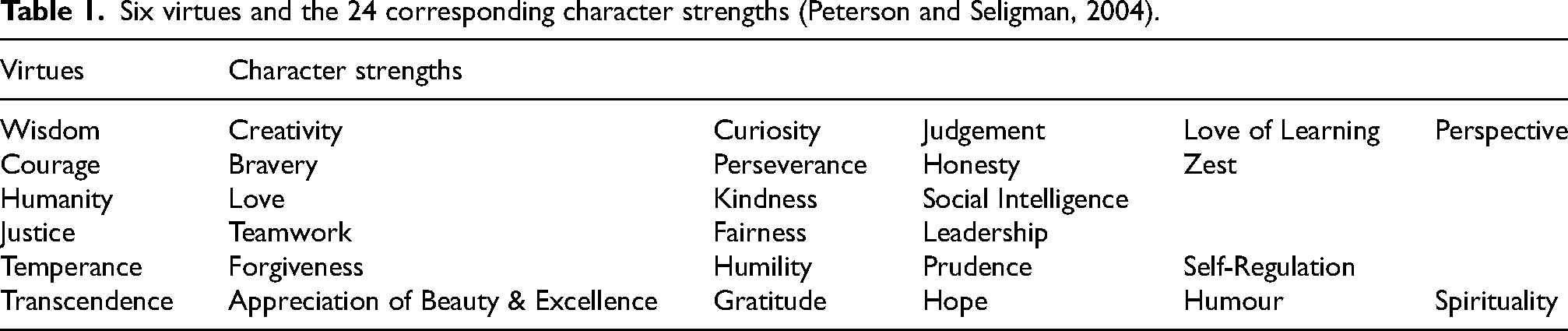
The discipline of Positive Psychology may be useful for leaders to develop virtues as it focuses on understanding and developing the positive side of the individual and their achievements, rather than what is wrong (Seligman and Csikszentmihalyi, 2014). Positive Psychology has adopted the concept of virtues in order to identify the strengths of the individual. Through this lens, 6 categories of virtues and 24 strengths (see Table 1) were identified based on a review of the literature followed by empirical research (Park et al., 2004; Peterson and Seligman, 2004). Although this has been criticised for not integrating the traditional understanding of virtue and having a biased cultural perspective (Banicki, 2014; Kinghorn, 2017), such approaches can support the HE leader to identify and explore areas for development to improve their decision-making as a leader.
Six virtues and the 24 corresponding character strengths (Peterson and Seligman, 2004).
How can the virtue ethics approach help HE leadership?
The application of virtue ethics can help university senior leaders in ethical decision-making. If we return to the example of opening an overseas campus, senior leadership of the university needs to consider how that would help them fulfil their telos. Senior leaders would then need to self-reflect and consider their telos and virtues (George, 2021; Wilson, 2014). Are they being sufficiently courageous in opening (or not) the campus? Are they being foolhardy? Are they showing sufficient humility and self-restraint and detachment from self-aggrandisement? The virtue of justice, which has been defined as ‘rendering what is due to others’ (Pellegrino and Thomasma, 1993: pg. 92), would ensure that senior leaders do consider what is due to all stakeholders involved in the process (including students, staff and the wider society in both countries) in terms of strategic goals and intended outcomes. They would need to consider their wisdom in balancing and orchestrating the virtues as well as the skills and resources that they control. In proposing the application of virtue ethics, we recognise that this approach is complementary to the previously discussed forms of ethical decision-making. The university leader would still need to follow regulatory processes, which will ensure that the scheme is competently run.
Virtue ethics can help HE leaders in ‘grey zones’. Most ethical conflicts happen when conventional ethical frameworks or arguments are in conflict, when different aspects of the issue are weighted differently, or when fast-changing circumstances are not covered by the rule book. Principles such as freedom of expression, giving people access to high-quality education and the opportunity to increase income can be in tension when considering whether to open a campus in a country where there is political pressure against free speech. The decision maker is often left with having to fall back on ‘gut’ or emotional feelings to make a decision. Virtue ethics would not tell the individual what to do in these grey zones but give them a mechanism to support decision-making, using the telos of HE as a guide and consideration of whether their virtues are appropriately played.
Virtue ethics promotes striving for high performance. Deontological or utilitarian approaches encourage behaviour that is ‘good enough’. If you follow the rules, or if you ensure that you do more good than harm, then you have satisfied these ethical frameworks. There is no call to do better. However, virtue ethics promotes one to do and be the best that one can (Pellegrino and Thomasma, 1993).
In summary, VCs and Presidents need ethical frameworks to make and reflect on decisions. We propose that virtue ethics provides such a framework that can complement rule or principle-based frameworks. A virtue ethics approach encourages senior leaders to identify the telos of their institution and develop their abilities of self-reflection in order to recognise, develop and orchestrate their own virtues. This will support and strengthen effective ethical decision-making.
Footnotes
Acknowledgements
The authors would like to thank Nigel Spinks and two anonymous reviewers for critical comments that have improved this paper.
Declaration of conflicting interests
The author(s) declared no potential conflicts of interest with respect to the research, authorship, and/or publication of this article.
Funding
The author(s) received no financial support for the research, authorship, and/or publication of this article.

Author biographies