




Abstract
The role of middle leaders in bringing about improvement in schools is well documented in the UK and abroad, with the ever-present demand for raising standards and achievement. At the same time, the benefits to individuals from receiving coaching or mentoring is also well documented. However, little is known about the benefit to those providing coaching. This article outlines some initial findings emerging from the first stage of a study exploring the benefits to middle leaders in secondary schools in England in their ability to recognise emotions having provided some coaching interventions to others. All participants were asked to complete an online emotional recognition test. After which a subset of the participants provided coaching to a member of staff from within the school for one academic term. After which participants resat the emotional recognition test. Most participants saw their ability to recognise emotions improve as a result of providing the coaching interventions. This is particularly important given existing literature that suggests due to the demands of the role, middle leaders have a deficit in their ability to recognise emotions, leading to a negative impact on those with whom they work.
Introduction
The application of coaching and mentoring and its benefits to those being coached or mentored are well documented. However, little exists on any benefits to the coach or mentor. Despite the Chartered Institute of Personnel and Development (CIPD) stating that most of the organisations surveyed said that they had adopted coaching and mentoring in order to support and improve their employees (CIPD, 2013). This article outlines some initial findings and discussion points emerging from the first stage of a project exploring whether by coaching others, middle leaders in secondary schools in England were able to improve their own emotional recognition. The objectives of the study are to consider whether coaching interventions had a positive impact on the levels of emotional recognition of the individual leading the coaching session.
Research by Lambert (2020) suggests that middle leaders have a deficit in their ability to recognise emotions compared to teachers and headteachers. It is not that middle leaders are unable to recognise emotions, more so that the role of the middle leader is split between task-orientated, often operationalised as transactional leadership tasks and people-orientated functions, transformational leadership tasks. This paper is not suggesting that this split is equal. Indeed, some middle leaders would spend a majority of their time undertaking people-orientated activities, while others, will spend most of their time on task-orientated tasks. This is an important caveat with all individuals falling in between these two extremes, thus the extent to which they recognise emotions will differ, Additionally, the various activities that individuals undertake are often intertwined, further highlighting the complexity of this topic. However, these two functions do require different aspects of the brain and as Kubit and Jack (2013) reports, individuals find it difficult to switch between these two elements, thus appearing disconnected from the work of the teachers whom they lead or appearing aloof. Gardner and Stough (2002) had also recognised, albeit with leaders in business settings, that individuals who spent more time on task-orientated activities demonstrated a negative correlation with their levels of emotional recognition. While Mansel and Einion (2019) found that nurse leaders had high levels of emotional recognition that they used effectively to mediate between the workforce and the organisation. However, the multiplicity of organisational factors negatively impacted their ability to operate in an emotionally intelligent manner.
It is important to note that Mayer et al. (2000) has suggested that emotional recognition (ER) is an elementary part of the ability emotional intelligence (EI) model. However, EI is just one facet of an individual's cognitive skills set, alongside personal (Gardner, 1983), social (Cantor and Kihlstrom, 1987) and practical (Sternberg et al., 1995) intelligence. For this paper, the definition of EI will focus on a set of abilities concerning (1) accurately perceiving and expressing emotion, (2) using emotion to facilitate cognitive activities, (3) understanding emotions and (4) managing emotions for both emotional and personal growth (Mayer and Salovey, 1997; Mayer, et al., 2001). The first of these four abilities, perceiving emotions, commonly referred to as ER denotes the ability to identify and interpret emotions in faces, pictures, voices and cultural objects – including the capability to recognise our own emotions.
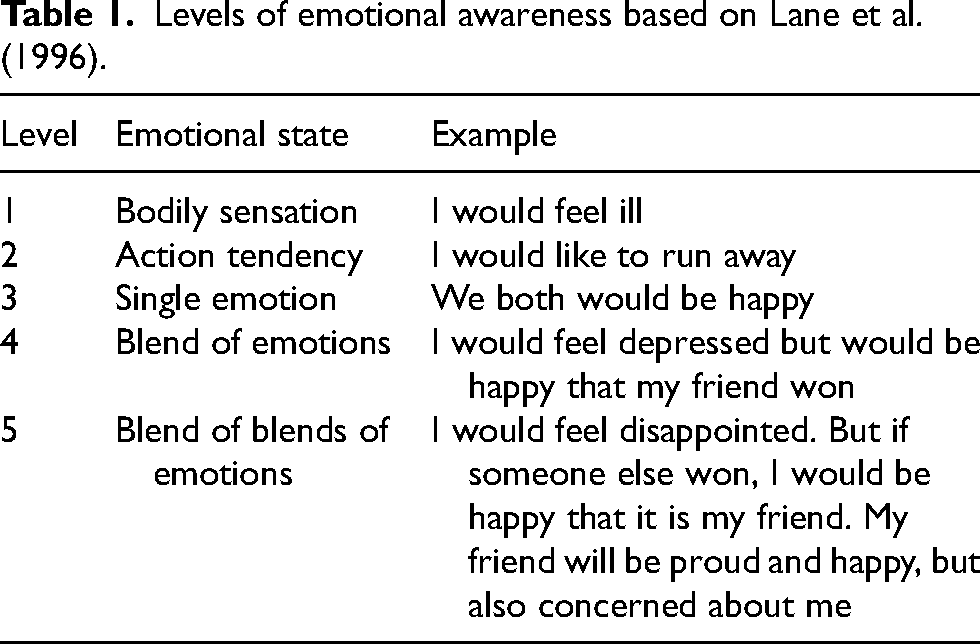
Subic-Wrana et al. (2011) conceptualised emotional recognition through the levels of emotional awareness (LEA) theory, which explains the disturbed processing of emotions based on a model of cognitive-emotional development through a series of levels (1–5). This is a development of Lane et al. (1996) model which applied this principle to the development of an individual to be aware of emotions. The change from a less to a more differentiated state of emotional awareness provides a more nuanced approach to emotional awareness. The range of emotions is summarised in Table 1.
Levels of emotional awareness based on Lane et al. (1996).
To help reduce the impact that this deficit in middle leaders’ ability to recognise emotions has, Lambert (2020) suggests that frequent coaching of others could help the brain switch between the two functional regions more easily. This would, it is hoped, result in middle leaders being able to recognise the emotions of those around them more easily, and subsequently better engagement with their staff. Neale et al. (2011) also advocate the use of coaching and mentoring to improve the emotional recognition of those providing coaching and mentoring support to others. They go on to state that this can invoke behaviour changes in the coach or mentor.
This is important because as Wakeman (2009) stated, there is little doubt that emotional recognition has a strong influence on the success or failure of a learning organisation. This is due to education being an emotionally dependent activity (Mortiboys, 2012). According to Cheese (2008) emotional recognition in leadership brings about the following organisational changes: (1) [leadership] talent generates higher levels of performance, which in turn attracts new talent into the organisation; and (2) talent drives improvements in quality innovation and satisfaction. Grobler and Diedericks (2008) note that without new talent and ideas organisations are doomed. Therefore, emotionally aware leaders can stimulate individuals to progress into leadership roles. This is particularly important because as Doneley et al. (2018) state, schools have no unified approach to succession planning and recruitment, because of their diverse and cross-sectoral nature. These issues create a void of individuals who want to be leaders within schools. Frearson (2003) suggested that this situation has been made worse by an ageing population, while Davies and Davies (2011) stated that the desire for a better work-life balance is also contributing to the lack of individuals seeking senior leadership. Both Gronn (2003) and Lynch et al. (2012) posit that leadership in education is greedy of an individual's time. While Gronn and Lucey (2006) state leadership occupies an ever-expanding space and requires sustained 24/7 levels of individual engagement.
The role of middle leadership schools
There has been a lot written about the development of senior leaders especially in relation to those aspiring to become a headteacher. Government policy has largely focussed on headteachers (Simkins, 2012). In comparison, middle leadership in schools has received less attention (Fitzgerald et al., 2006), particularly concerning the activities of middle leadership as opposed to it being a stepping stone to more senior leadership positions.
Existing literature has focussed on the development of middle leaders, through programmes such as the National Professional Qualification for Middle Leadership (Department for Education, 2013). Evaluations of such programmes by Simkins et al. (2009) have highlighted changes in leadership practices, changes that affect school outcomes and changes in teaching and learning processes and pupil outcomes. These factors while important do not consider the behaviours or traits that middle leaders need to be effective in delivering the changes that Simkins et al. (2009) noted.
The role middle leaders play in bringing about change and improvement in schools is well-recognised and the demands upon them to ‘raise standards’ is ever-present.
Wallace et al. (2011) explore the challenges of developing leadership capacity in educational settings and acknowledge initiatives in leadership development, which focus on the importance of accountability measures such as performance metrics. However, this focus on accountability could be conceptualised as a task-orientated activity and as such requires a different part of the brain to people-orientated activities which are commonly associated with education. Hence the focus in this article is on what one can do in order to try and achieve a greater balance between task- and people-orientated activities when the imperative is often for the task-orientated activities.
The place of coaching and mentoring in leadership development
Middle and senior leaders in education settings often see coaching and mentoring as important developmental activities (Allan, 2007; Hobson and Sharp, 2005; Rhodes and Brundrett, 2009). Boerema (2011) suggests that coaching and mentoring are components of the most popular approaches to leadership development. The differences between coaching and mentoring have been explored comprehensively in literature (see CUREE, 2005; Hobson and Sharp, 2005). Mentoring has historically placed an emphasis on the ‘wise and trusted guide, advisor or counsellor’ (Hobson and Sharp, 2005: 25). Holden outlines the role of mentoring in establishing and sustaining communities of practice involving ‘the accumulation of shared wisdom through ongoing critical conversations’ (Holden, 2002: 20). In contrast, coaching can be viewed as a more directive approach enabling the development of a specific aspect of a professional learner's practice (CUREE, 2005), focussing on improvements in performance (Tomlinson, 2004) with the coach as a critical friend (Wise and Jacobo, 2010).
However, whilst some see coaching as a subset of mentoring (Allan, 2007), the terms are often somewhat blurred in writing about school settings (see MacBeath, 2011; Pegg, 2000; Rogers, 2004 and Whitmore, 2002) so obscuring the contentious nature of coaching in the minds of many education professionals who prefer the broadness of the term mentoring to the narrower concerns of the coaching, particularly when associated with improving an individual's performance (Hobson and Sharp, 2005).
Thomas and Smith (2004) and Allan (2007) discuss the benefits of coaching and mentoring for staff within a school setting. In particular, they identify the following benefits:
Enhanced personal effectiveness (working smarter, not harder) Improved performance of students Encouragement of reflectivity and professional growth Improved understanding of how to motivate others Creating more effective teams Develops techniques for constructively challenging unhelpful behaviours, including negative and limiting beliefs Improves tolerance of adults and young people Enhances energy and job satisfaction Opens creative thinking pathways Enhances awareness of the setting of realistic goals for adults and others
As in this paper, Allan (2007) did not advocate one particular model of coaching or mentoring, instead leaving it up to individuals to determine the most appropriate approach to use based on their own unique situations.
There are various practical challenges associated with successful coaching and mentoring of leaders such as the time and financial resource demands (Hobson and Sharp, 2005), the requirement for mentors and coaches to be trained (Hobson and Sharp, 2005; Hoigaard and Mathisen, 2009) and whether the coaches or mentors should come from within or be outside of the organisations of the people they are working with (Ladegård, 2011; Wise and Jacobo, 2010), and the ethical and other dangers posed by the complexity of power relationships between co-workers, who might be both the line manager and the coach or mentor (Barnett, 2008; Johnson, 2008). There are important issues that individuals need to be mindful of, however, this is not the focus of this paper as these issues have been explored in the literature already.
Methodology
The objective of this paper was to examine the extent to which coaching others improved one's own ability to recognise emotions. The sampling unit were schools in England. Twenty-four individuals (n = 24) from a range of schools (primary and secondary) participated in an emotional recognition test (ERT). Participants were self-selecting through emails to schools based on a convenience sample (Plowright, 2011) and all were middle leaders. Defined as individuals who report to a member of the school's senior leadership team. An important point to note is that the number of respondents is small, 24. This was done deliberately to get a set of data from which to explore whether there are any differences in individuals’ ability to recognise emotion and whether a further larger study with a greater number of participants or a longer duration should be conducted. It is also worth noting that the findings of this study, at this stage, are not generalisable due to the limitations of sample size.
All participants completed the Geneva Emotion Recognition Test (GERT) to identify their baseline levels of ER. This particular test was used as it provides a larger number of emotions for participants to select from. The GERT test consists of 14 emotions (six positive and eight negative), portrayed by 10 actors (five men and five women) of different ages who depict these emotions in short audio-video clips (dynamic multimodal stimuli). Unlike other ERTs which commonly use either 5 (Scherer and Scherer, 2011), 7 (Matsumoto et al., 2000) or 10 (Bänziger et al., 2009) emotions, the GERT system uses 14 emotions affording greater flexibility in emotion choice than classical test theory. This reduces the chances of a consistency motif whereby a consistency propensity between participants is sought (Podsakoff et al., 2003).
Ward et al. (2009) found that an individual's ability to interact with society including the ability to infer and interpret another person's emotions is positively correlated with social skills, the ability to adjust to new or foreign cultures, effectiveness in the workplace and the quality of relationships that can be built. From the initial group of participants (n = 24), 10 volunteered to participate in coaching other staff within their schools (n1 = 10). Individuals were not directed as to whether the individual had to be someone they line-managed or another member of staff. The selection of the individual was entirely at the discretion of the participant. Individuals had to commit to meeting with their coachee, at least once a week, for a minimum of thirty minutes during the autumn term. Participants were provided with background information on various approaches to coaching they could use, but not directly to any particular approach. They were also advised to keep a coaching log in order to support them and the coachee in developing a meaningful dialogue during the coaching sessions.
At the end of the term, individuals were asked to retake the emotional recognition test to establish whether their ability to recognise emotions had improved.
Findings
Baseline levels of emotional recognition
All participants (n = 24) were asked to complete the initial emotional recognition assessment in order to obtain a baseline measurement. The average (mean) score of participants correctly identifying the emotions presented to them was 52.3% (sd. 8.52; t = 249; df = 11; confidence 47 to 58 at 95%).
Extracting the data of the individuals who would later go on to undertake the coaching (n1 = 10), their mean average score was 50.8% (sd 7.2) of emotions correctly identified, with a range from 41% to 63%.
Post coaching levels of emotional recognition
Having undertaken a period of coaching with a member of staff within their school individuals were retested using the same emotional recognition test.
The mean average results (n1 = 10; 6 males, 4 females) increased overall to 54.4% (sd 9.850) representing a modest increase of 3.8% for the group and an increase of 2.1% compared to the baseline cohort of 24.
Within the participant group who undertook the coaching, 40% of individuals registered either no improvement or a modest decline in their ability to recognise emotions (−2% to 0% change); whereas 60% of individuals recorded an increase in the number of correctly identified emotions (4% to 9% change). There was no significant difference between genders.
The Wilcoxon test was used to analyse the results. This is a nonparametric test designed to evaluate the difference between two treatments or conditions where the samples are correlated. In particular, it is suitable for evaluating the data from a repeated-measures design in a situation where the prerequisites for a dependent samples t-test are not met. So, for example, it is commonly used to evaluate the data from an experiment that looks at the ability of participants before and after they undergo a period of intensive training or intervention.
It is important to note that the test provides two components a W value and a Z value. If, on the other hand, the size of N is low, and particularly if it's below 10, only the W-value should be used to evaluate your hypothesis, as the Z value is not reliable. The test provided a value for W of 3. The critical value for W at n = 8, p < 0.05, is 3. The result is significant at p < 0.05. This means that 95% of the time, individuals will improve their scores as a result of coaching others, and there is a 5% chance that this will improvement will happen by chance.
It is important to note that if a subject's difference score is zero, as we found (20% of participants n = 2, did not register an improvement in their scores) then the test discards the individual from the analysis and reduces the sample size. Therefore while 10 participants engaged in the coaching and were retested, we found that 2 of them did not improve on their original score, so the Wilcoxon test removed them from the calculation reducing the sample size to 8.
These findings suggest that there was a modest improvement in middle leaders’ ability to recognise the emotions of others subsequent to providing coaching interventions. However, the caveat is that these results are not conclusive, but do provide some initial findings that warrant further investigation. The findings presented in this paper support Neale et al.’s (2011) work in so much as coaching and mentoring improves the emotional recognition of those delivering the interventions. Delivering coaching and mentoring interventions is not going to solve structural issues around the balance between task- and people-orientated activities (Yukl, 2008) and the expectations placed on middle leaders. However, it may go some way to supporting middle leaders to be able to switch between different types of activity more seamlessly thus reducing the risk of burnout from increased levels of workplace stress.
Implications for practice
McKinney et al. (2013) suggested that middle leaders are overloaded with work, undertrained and on the edge of burning out. It is the lack of training that Constable and McCormick (1987) note, suggesting that a majority of individuals entering management positions have little in the way of training. Turner and Bolam (1998) pointed out that middle leaders do have room for manoeuvre and will proactively conceptualise their role and not merely act as a conduit through which the decisions of the senior leadership team (SLT) will be communicated. At the same time, research by Brown et al. (2000) showed that middle leaders are unsatisfied with having to subordinate their vision in favour of that of senior staff members, and their departmental vision was often undervalued, and their professional judgment insufficiently recognised by senior managers, governors and external bodies.
Kubit and Jack (2013) state that it is possible to switch between networks and possible roles. However, they go on to suggest that leaders cannot simultaneously attend to these two distinct roles, hence conflicts are likely to arise if leaders get “stuck” in one role. The prolonged suppression of one of the networks and associated roles subsequently decreases an individual's ability to switch between the two networks. Some scholars have noted this trade-off.
For example, Yukl (2008) notes that “when leaders are preoccupied with responding to tasks, there is less time for people-oriented concerns such as being supportive and developing member skills” (p. 714).
Given the task-orientated nature of the middle leader role, it is unsurprising that their level of emotional recognition has diminished. However, Lambert (2020) points out that middle leaders’ ability to recognise emotion appears to increase again as they move into more relationship-orientated roles as senior leaders.
One possible solution would be differentiating the middle leadership role. For example, having a middle leadership role that is predominantly either task- or people-orientated. This would reduce the need to be constantly switching between two different cognitive states.
A more effective approach would be to train and develop leaders so that they possess a higher level of competency in enacting both the task and relationship leadership roles, resulting in a greater ability to switch between them. It is beyond the scope of this paper to explore all of the possible ways of achieving this, as these will be dependent on the institution and the context of the work that the individual is engaged in. However, this paper has suggested, albeit, through a small study, that coaching others could support coaches to increase their own level of emotional recognition. This is important, both for the leader who will be able to engage with their staff more effortlessly, as well as subordinates who will be more engaged with a middle leader who is potentially less aloof.
Conclusion
We recognise the limited generalisability of these preliminary findings and the limited impact that the coaching interventions have had, therefore caution is needed in the tentative nature of the conclusions at this preliminary stage. What these results do, is suggest that through this early stage study there was an increase in the ability to recognise emotions. What is now needed is a longer-term study with a wider group of participants to ascertain the effect size of this increase as well as ensure that it is sustainable.
However, while conceptualising the middle leadership role as either task- or people orientated is helpful, the reality is that leadership has both a relational component and an analytical component. Therefore, the greater the ability a leader has to switch between these two the more effective they will be as a leader.
The initial findings presented in this paper may well reflect the increasing complexity of the role of the middle leaders and the constantly changing role of leading and managing people in their teams. Going forward our research will seek to explore whether these findings are replicable on a larger scale, and will include follow up interviews with participants to determine whether there was any noticeable impact on their own professional practice.
However, the roles of middle leaders remain crucial in meeting the challenge of bringing about sustained improvements within schools so the findings discussed in this article have important implications for developing middle leaders in their current roles.
Footnotes
Declaration of conflicting interests
The author(s) declared no potential conflicts of interest with respect to the research, authorship, and/or publication of this article.
Funding
The author(s) received no financial support for the research, authorship, and/or publication of this article.
