




Abstract
In recent years a variety of trends have increased uncertainty over the future of the Higher Education (HE) sector. While these create challenges for all staff, they potentially impact most on non-academic staff, due to long standing misunderstanding and undervaluing of their roles and despite them representing almost half of all jobs within the sector. In this context, leaders’ abilities to manage emotions in the workplace appear to be at a premium. However emotionality remains under-explored both generally within HE and in non-academic contexts particularly. This article summarizes findings from research into the impact perceptions of managers’ abilities to display Emotional Intelligence (EI) has on the wellbeing, attitudes and performance of staff within the context of a professional services team in one English university. It found perceptions of managers’ EI could be a powerful influence on team members’ mental health, including stress and anxiety. Furthermore, when managers were viewed as being Emotionally Intelligent, staff reported this significantly impacted their motivation and could lead to tangible improvements in core areas of job performance, including commitment, flexibility and discretionary effort. It recommends Higher Education Institutions (HEIs) consider placing greater emphasis on developing understanding of EI throughout their workforce while also building capacity in its practice amongst current and prospective managers.
Introduction
HEIs in England currently face unprecedented uncertainty (Kuszynski, 2021). The last two decades have witnessed an ever-increasing drive towards competitiveness and efficiency through the emergence of new technologies, marketization and the government's pursuit of a Neo-Liberalist agenda (with its associated implications for both the focus of HEIs, their organization and funding)(Armano, 2021; Fredman and Doughney, 2012; Mahony and Weiner, 2019). In addition, the pandemic and Brexit present further challenges to the recruitment of international students and HEI's wider income (McKie, 2020; Morrison, 2021).
In response, many universities have sought to limit their liabilities, cutting jobs, freezing recruitment and generally expecting staff to achieve more with less (Greatrix, 2020; Husbands and Day, 2020). Such changes come at a cost, however, including negatively impacting the emotional wellbeing of managers and staff alike. Furthermore, for many staff, such measures run counter to the values which initially attracted them to HE and have contributed to their retention (e.g. security, collegiality and public service) (Regan and Graham, 2018).
Arguably, non-academic colleagues are particularly affected by these trends. Their roles comprise the numerous duties required to ensure the smooth running of universities and include non-academic professionals, managers, student welfare workers, administrators and auxiliary staff (HESA, 2021a). In 2019/20, these roles accounted for 47% of all UK HEI employees, representing almost 200,000 staff (HESA, 2021b). However such roles are frequently misunderstood and their contribution overlooked (Gibbs and Kharouf, 2020; Shelley, 2010; Whitchurch, 2018), potentially resulting in heightened levels of anxiety amongst those who perform them.
In this context, leaders’ abilities to manage emotions in the workplace appear to be at a premium. However this issue remains under-explored in UK HEIs in general and has largely been ignored within non-academic contexts particularly.
Contribution of this article
This article contributes to debates on EI by summarizing findings from research into its impact on professional services staff within one English HEI.
Unpacking emotional intelligence - review of relevant literature
Academic interest in managing emotion dates from the work of Thorndike (1920) and Spearman (1927), who sought to understand why some individuals were more adept at utilizing emotionality within social contexts. However, contemporary studies are commonly seen to stem from work by Payne (1985) and Gardner (1983) in the mid-1980s, the latter of whose concept of multiple intelligences has been particularly influential in EI's evolution. In the 1990s, Salovey and Mayer (eg 1990), Goleman (eg 1996) and Bar-On (eg 1997) developed thinking on EI further.
The last thirty years have since seen an explosion of interest in EI, with much written as to its potential value and impact on personal and professional performance. However despite [or indeed because of] this increasing evidence base, EI as a concept remains highly contested and “a uniquely controversial area of the social sciences” (McCleskey, 2014:76). For example Hatcher (2008) questions whether EI represents a genuinely, discreet competency which may be developed. Elsewhere writers such as Crawford (2009), Harding and Pribram (2004), Fineman (2008) have discussed the extent to which emotions are a reflection of inner self or influenced by social and cultural conventions, while Hargreaves (2008) has questioned how far EI is able to take into account cultural differences in expressing and managing emotions.
More broadly, Cherniss (2010) characterizes criticisms of EI as focusing on three key areas:
definitions and models of EI the measurement of EI the predictive value of EI for individual and organizational outcomes.
These are examined further below.
Definitions and models
Considerable debate has centred on the best way to define EI (McCleskey, 2014). Indeed, researchers such as Kaplan et al. (2010) reject the acceptance of any definition of EI as premature, while Locke (2005) notes most definitions are so all inclusive as to make the concept unintelligible.
Nevertheless, one common ‘working’ definition (which this article utilizes) positions EI as the ability to accurately diagnose and monitor both one's own feelings and those of others, before utilizing this information to guide one's thinking and actions to manage this relationship to a desired outcome (eg Dulewicz and Higgs, 2000; Goleman, 2007; Marembo and Chinyamurindi, 2018; Salovey and Mayer, 1990).
The focus for research into EI has also been wide ranging and potentially contradictory. However Siegling et al. (2015) helpfully suggests most studies fall into two board areas of interest, these being
Measuring EI
Debate over the measurement of EI has also focused on two principal areas.
Firstly, many studies rely on self-administered diagnostics, which are commonly viewed as susceptible to the faking of results (Grubb and McDaniel, 2007) and less reliable than researcher-administered assessments (Tiffin and Paton, 2020). Furthermore, such instruments vary markedly in their length and structure, and are criticized for lacking reliability and predictive value (Conte and Dean, 2006).
Secondly, many studies have been criticized for assuming an abundance or asset-based model for EI and falling to consider its potentially negative dimensions (Hargreaves, 2008). Notable exceptions exist, however. For instance Austin et al. (2007) identify potential correlations between EI traits and ‘dark’ leadership behaviours, while Lindebaum and Cartwright (2011) highlight how EI may be used to manipulate others to circumvent ethical concerns.
The predictive value of EI for individual and organizational outcomes
While considerable evidence exists concerning the potential impact of EI on individual and organization performance, some aspects remain contested, partly because of the issues considered above. Ashkanasy et al. (2002) for instance conclude that too often claims for the value of EI within the workplace are unsupported by robust empirical research.
Fineman (2004), amongst others, challenge the value of EI for leaders, noting examples of organizations which have enjoyed success despite having leaders seemingly lacking in EI. Conversely, Hargreaves (2008) suggests that focusing on a manager's EI in isolation distracts from other, potentially more significant drivers of effectiveness at the organizational level. Perhaps even more damningly, Antonakis et al. (2009:248) conclude their examination of two decades of research by noting either “EI researchers are using the wrong measures or the wrong methodology, or EI does not matter for leadership”.
In recent years, interest in EI and leadership has grown significantly in HE, alongside growing recognition of its significance (e.g. Bryman, 2009; Dulewicz and Higgs, 2003; Rantz, 2002; Scott et al., 2008). Nevertheless EI remains relatively underexplored in this sector, with studies completed commonly focusing on academic leaders (e.g. Parrish, 2015) or senior leaders in HE more generally (Scott et al., 2008; Yielder and Codling, 2004) rather than those specifically in professional services.
Methodology
This study adopted an interpretivist perspective to focus on three specific areas:
Team members’ views on the importance of their manager displaying EI during times of organizational change and challenge. Whether by being seen to display greater levels of EI, managers positively impact on their team's mental health. Whether by being perceived to display EI, managers affect their team's attitudes to work and associated job performance.
Quantitative and qualitative data was collected between May and June 2020 through an online self-completed questionnaire survey of members of one professional services team (n = 50) within one large post 1992 university. Philosophical debates which have sought to restrict the use of quantitative data to positivist studies have been criticized by Bryman (1984) amongst others, with Babones (2016) concluding that its use in interpretivist studies can produce findings which while mathematically less complicated, may produce “understandings that are substantively more interesting than those that result from positivist approaches” (Babones, 2016:10).
In total, 39 members of the team completed this questionnaire (15 of whom had line management responsibility), a response rate of 79%. SPSS was used to analyzed quantitative data through descriptive and inferential statistics. A thematic analysis strategy was applied to qualitative data which was collected through this survey. A comprehensive review of literature on EI within HE was also undertaken as part of this study.
The remainder of this article begins by exploring the concept of EI more broadly, before focusing further on the findings from this study, making connections with existing relevant research.
Findings
The impact of emotional intelligence on leaders in professional services
This section examines this study's principal findings and connects them directly with relevant published research, to highlight areas of commonality and difference.
Understanding emotional intelligence
Respondents were asked to summarize their understanding of EI in no more than 200 characters. Most respondents provided a definition of EI broadly consistent to that offered earlier in this paper, noting that EI involved greater awareness of one's own emotions (72%) and their subsequent management (64%). A majority also described EI as involving understanding others’ feelings (56%), although noticeably fewer explicitly identified the active management of others’ emotions [21%].
Dealing with challenge and change
Research suggests that while important in all contexts, EI is especially valuable during challenging times, helping managers and staff to cope with frustration, disappointment and stress (Goleman, 1998; Rahim and Psenicka, 1996; Robson and Bailey, 2009). This is clearly relevant for staff within HE, given the complex challenges, described above, which affect managers at all levels in the sector (Coco, 2011; Parrish, 2015).
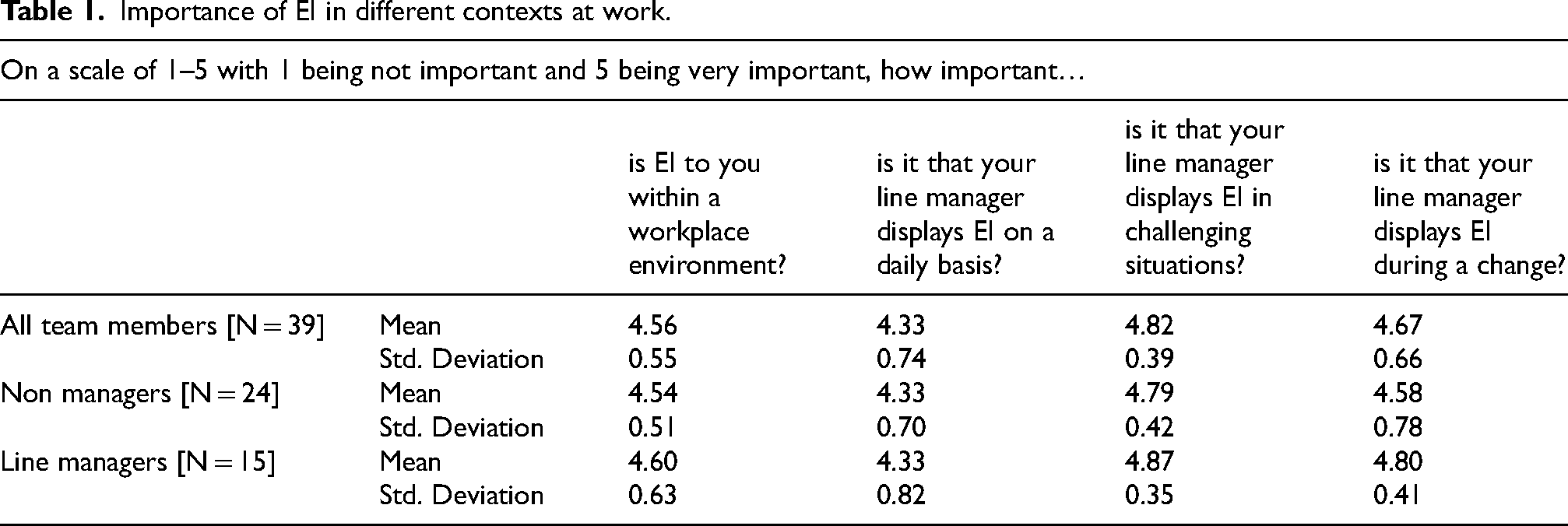
This study also found that while important in all contexts, staff place greater value on their manager's displaying EI during challenging situations and periods of change (Table 1).
Importance of EI in different contexts at work.
Supporting mental health
One possible explanation for team members’ valuing their manager displaying EI during such difficult times is its potential to manage and reduce negative emotional states. For instance Puertas-Molero et al. (2018) state EI can reduced levels of stress amongst staff, which may be elevated during challenging circumstances. Similarly Raz et al. (2014) highlight how EI can improve physical and mental well-being.
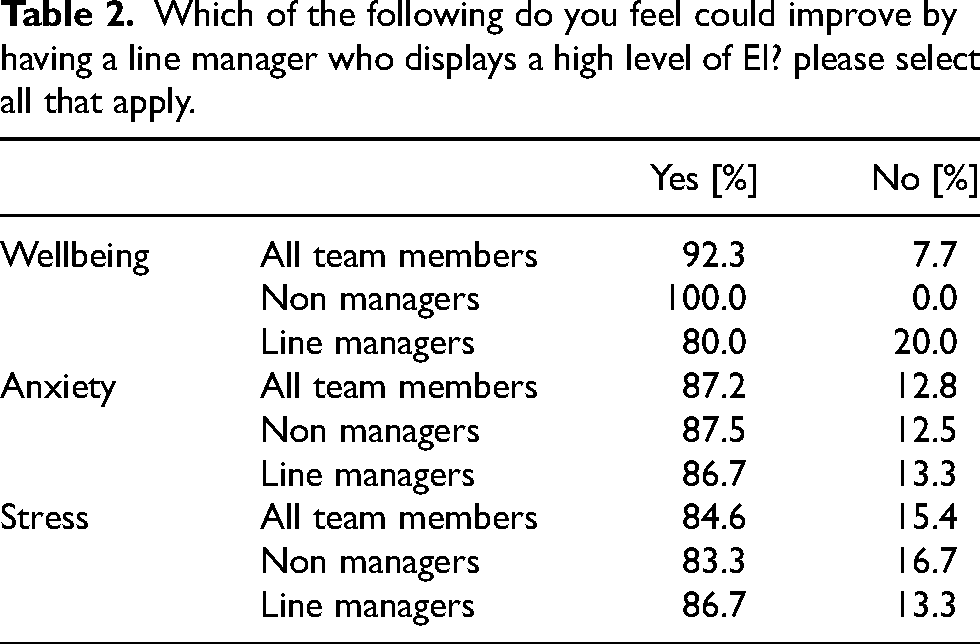
This study also found that by being perceived as emotionally intelligent, managers’ can positively impact team members’ emotional states in several key areas of mental health (table 2). Indeed 80–90% of respondents indicated that having a highly emotionally intelligent manager would improve their general emotional wellbeing, reduce their anxiety and impact levels of stress.
Which of the following do you feel could improve by having a line manager who displays a high level of EI? please select all that apply.
Impacts on staff performance
In addition to affecting attitudes, research has also found that by displaying EI, managers can demonstrably impact the actual performance of staff (although Wong et al. (2007) note many such studies are limited scope and come from outside of the HE sector). Perhaps most eye catchingly, Goleman et al. (2002) found displaying EI significantly enhances team performance and improves organizational results, accounting for up to 90% of variation in performance between managers. Other research has linked managers’ EI with team members’ job satisfaction, extra-role behaviour (Wong et al., 2007), job performance, well-being and turnover intention (Clarke and Mahadi, 2017), and emotional attachment to the organization (Jiao et al., 2021; Kaiser et al., 2008).
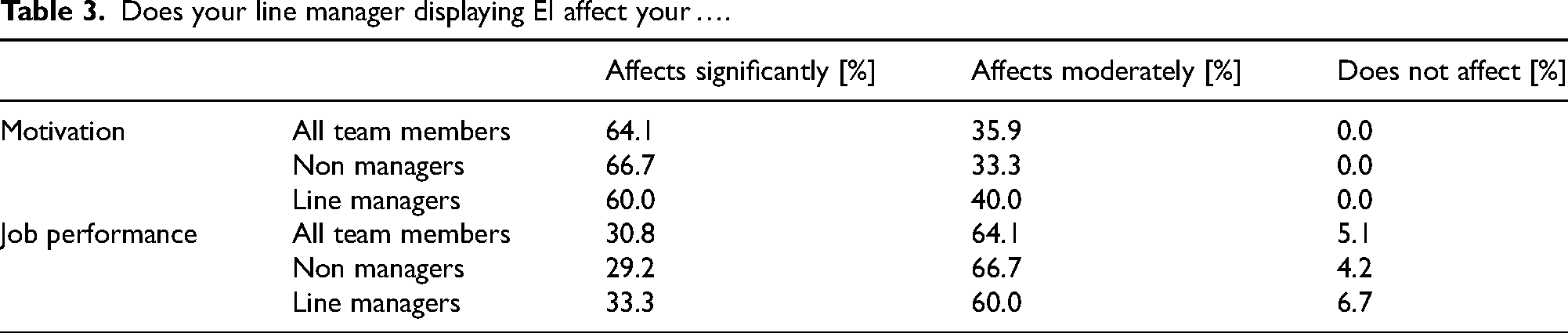
This study also found a link between managers’ displaying EI and the performance of their staff. Indeed all participants in this study stated that by displaying EI, their manager positively affected their level of motivation. Furthermore, 95% of respondents reported that this increased motivation translated into tangible improvements in their job performance (table 3).
Does your line manager displaying EI affect your ….
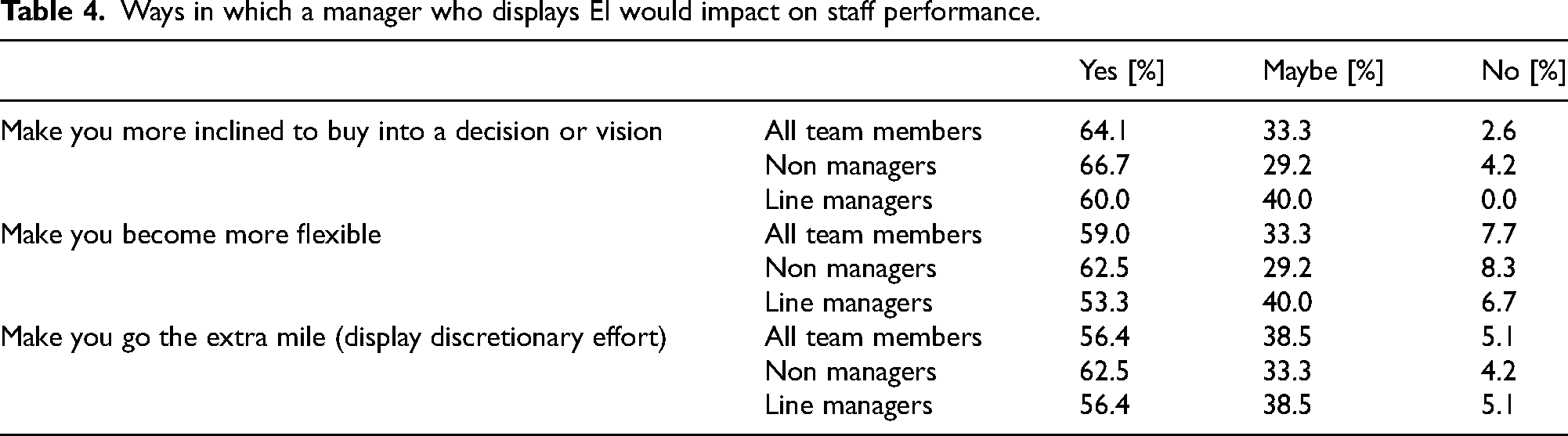
Respondents were also asked if they believed working for an emotionally intelligent manager would impact their professional behaviour in relation to buying-in to a decision or vision, demonstrating flexibility or exerting discretionary effort (table 4). In each instance, a majority of respondents stated having an Emotionally Intelligent manager would positively impact them, with fewer than one in ten respondents stating that their manager's EI would definitely not make a difference to their behaviour in this regard.
Ways in which a manager who displays EI would impact on staff performance.
Developing the emotional intelligence of managers
As noted above, little research has focused on EI amongst managers in HE. However it is noteworthy that this even limited literature identifies a relative absence of EI amongst many senior leaders in the sector, which is seen to stem from a lack of formal leadership development and a culture which commonly rewards academic or research excellence, rather than recognizable managerial expertise (Scott et al., 2008; Yielder and Codling, 2004).
Evidence from this study provides some support for this latter point, with only 3% of respondents agreeing that EI was sufficiently promoted within this university's staff development portfolio. However despite this, respondents were largely positive in how they perceived their own manager's level of emotional intelligence, with 86% of respondents stating their manager was either emotionally intelligent at all times or at the right moments.
Conclusion and recommendations
Despite receiving considerable attention over the last forty years, Emotional Intelligence remains contested with opinion particularly divided over its core concepts, characteristics, measurability and potential impacts. While acknowledging these challenges, it is nevertheless our view that an increasing body of evidence highlights the value EI can bring to organizational contexts, both generally but also more particularly during times of challenge and adversity.
It is therefore unfortunate that so little attention has focused on EI within the UK HEI sector, given the uncertainty and change generated by the plethora of national and global challenges it currently faces and within which the ability to manage emotionality is at a premium.
While limited in scale and scope, this study contributes to ongoing debates on Emotional Intelligence by demonstrating the important link between individuals’
This emphasis on
Footnotes
Declaration of conflicting interests
The author(s) declared no potential conflicts of interest with respect to the research, authorship, and/or publication of this article.
Funding
The author(s) received no financial support for the research, authorship, and/or publication of this article.

Author biographies