




Abstract
The aim of this research was to develop a grounded theory of educational leadership development, using generative dialogue (GD), as an approach to initiating and maintaining professional growth in school principals/vice principals in an urban school district in a relatively affluent region of Western Canada. In Wave I, GD interviews were conducted by a team of consultants, and anonymous data were voluntarily submitted to the research team (n = 37). In Wave II, confidential, one-on-one, audio-recorded virtual interviews were conducted with five participants. Data were transcribed and analysed using grounded theory. The grounded theory model integrated the findings from Wave I and Wave II. There were three final overarching themes: environment, relationships, and leadership. Professional growth was evident when a GD approach was used that emphasized both positive communication and self-reflection. Relationships were supported by a focus on safety and reflected honesty, which led to a positive school culture, while leadership was facilitated through supports and the supervisor role and led to improved accountability. In conclusion, GD serves a useful purpose for facilitating professional growth in educational leaders, but should be supplemented with other evidence-based approaches to meet school leaders’ broader professional development needs, and goals of school improvement. Applicability and limitations of the study are discussed.
Keywords
Introduction
Generative dialogue (GD) is a conversational approach in which partners let go of taking or defending a position, and instead attend to the flow of conversation, which, with reflection on underlying causes, rules, and assumptions, leads to new ways of thinking about problems and their solutions (Isaacs, 1999; Petta et al., 2019). Through simplified Socratic questioning (Knezic et al., 2010), GD enables participants to identify and work towards their professional growth by providing a structure and process for setting their own goals, recording ideas, and developing a plan to put them into practice. Specific questions include: ‘What have you done towards the achievement of your goals? What can we all learn from that? What will you do between now and our next meeting?’ (Townsend and Adams, 2010).
A substantial theoretical foundation exists for GD (Gunnlaugson, 2006; Scharmer, 2003), yet literature to support the application of GD to educational leadership is limited (Adams, 2016). Much of the literature that exists (e.g. Townsend and Adams, 2008) is problematic, as it lacks the ethical and methodological objectivity needed to determine the effectiveness of the approach, due to the authors essentially evaluating their own work. In addition, some are self-published and lack the rigour of a peer review process (Townsend, 2015; Townsend and Adams, 2009, 2010). Previous research by Chaseling et al. (2016, 2017) evaluated the implementation of GD in schools in Australia, which showed encouraging results regarding increased collaboration and trust. The current study is therefore timely and necessary as the first attempt to objectively evaluate the use of GD as applied to educational leadership in Canada, by a third party team of researchers who are uninvolved in the process they are evaluating, and to publish findings through a peer-reviewed process.
Like other recent approaches to school leadership growth (Adams and Townsend, 2014; Allen et al., 2015; Byrne-Jimenez and Orr, 2007; Salter and Gannon, 2015), GD is a form of peer-supported, in-situ, professional learning where school leaders can actively share their perspectives, experiences, and reflections and develop meaningful professional goals in a collegial and supportive environment. According to Townsend and Adams (2010), the process is as follows. ‘trusted’ school district leaders schedule regular on-site meetings with principals and vice-principals, for discussions regarding each administrator’s professional growth plan. Further meetings within the school take place as needed, focused on achieving agreed-upon goals. The professional growth plan of each administrator is a working document, referenced and shared at every meeting.
In this study, GD was explored as a professional growth process for school principals/vice principals within a Western Canadian school district. In Canada, ‘Today’s principals are viewed as champions of change and innovation and as leaders of teaching and learning, rather than solely administrators and managers’ (Alberta Teachers’ Association, 2014: 15). GD trained consultants with experience of school administration visited and interviewed principals and/or vice principals across the district. The intent was to provide a non-threatening, confidential, and reasonably independent means of enabling school leaders to share and reflect on key issues within their current practice.
There were three aims of the study. The first was to develop an understanding of the main priorities that principals/vice principals discussed during the GD interviews. The second was to evaluate the applicability of the GD approach to facilitating the professional growth of educational leaders. Finally, we aimed to evaluate the effectiveness of GD in school improvement.
Methodology
Participants
All principals/vice principals from the 47 schools in an urban school district in a relatively affluent region in Western Canada, who were engaged in GD as a professional growth process, were invited to participate anonymously in the study. In Wave I, a total of 37 data submissions were received, some of which included subsequent interviews from the same participant; approximately 20–30 unique participants responded. As submissions were anonymous, the precise number could not be determined. In Wave II, all principals/vice principals were invited to participate in confidential, one on one, virtual interviews, resulting in a sample of 5.
Procedure
Wave I
Research Ethics Board approval was obtained prior to commencing recruitment. Participants were recruited through verbal invitation, a hand-delivered information letter, and an email invitation. GD interviews were conducted by a team of trained consultants employed by the school district, who acted as GD facilitators, and took handwritten notes during each interview. These notes were not retained by the consultant, but were given directly to each participant at the end of the interview. Participants independently and voluntarily mailed in a copy of their interview notes to the research team anonymously, following completion of the interview. A stamped, addressed envelope was provided to each potential participant, and mailing in data constituted consent.
Wave II
Participants were invited to participate via email, by the research team. Interviews were conducted via telephone or videoconference, and were audio recorded and transcribed verbatim.
Data analysis
Wave I interview notes were transcribed and analysed using in NVIVO 11 using grounded theory (Glaser and Strauss, 1967). Wave II interviews were transcribed verbatim and analysed in NVIVO 12 using grounded theory. The themes of Wave I were integrated with the themes of Wave II to develop the final model. This approach minimized the preconceptions of the researcher, focusing instead on developing a conceptual model emerging from the views expressed by the participants. A rigorous process of triangulation was conducted by two researchers who independently conducted open coding, then collaboratively developed axial codes, and produced the final model.
Results
Wave I
The first wave of analysis resulted in the key themes of Centrality of Relationships; Challenges to Relationships; and Supports to Relationships. These key themes and sub-themes are presented as in Figure 1, and described in more detail below.
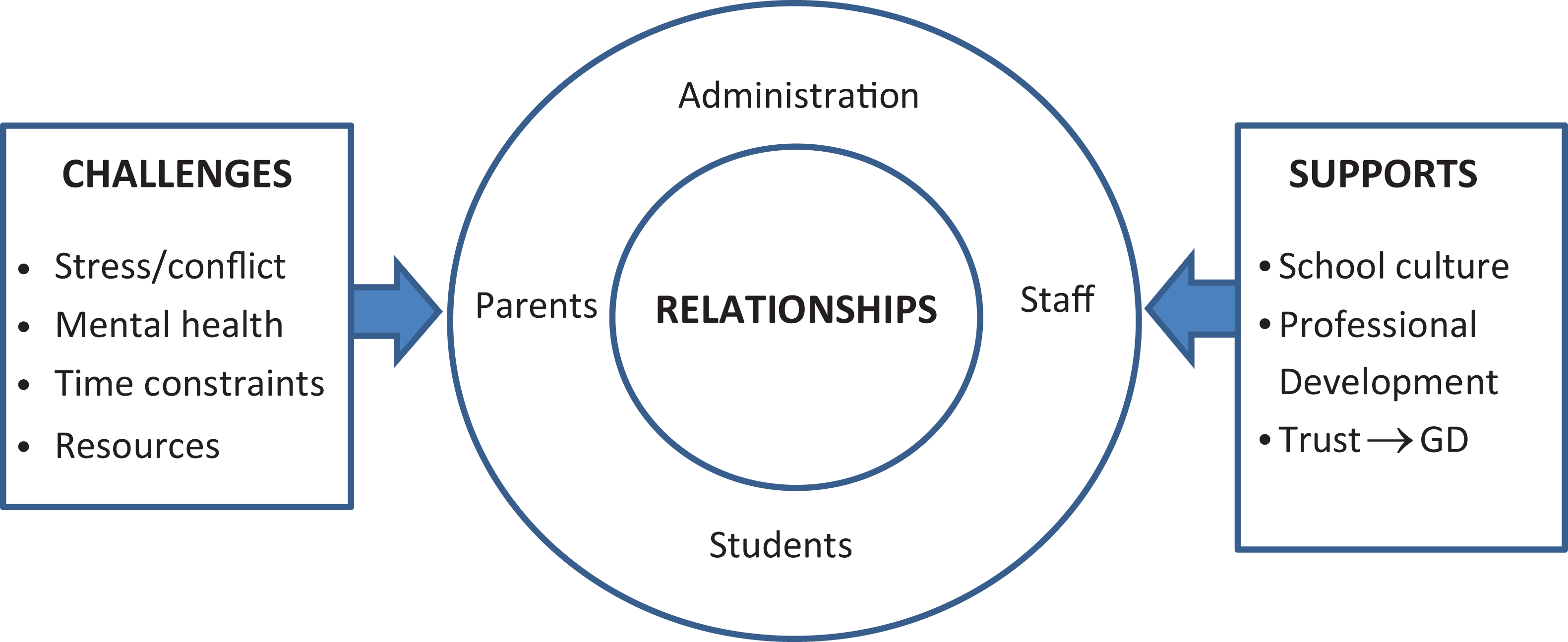
Grounded theory model showing the centrality of relationships for principals’ and vice principals’ professional growth.
Centrality of relationships
Relationships were the focus of many GD interviews, including building, fostering, and maintaining relationships between administration, staff, students, and parents. The management of expectations was important in these relationships, which were impacted by Challenges to Relationships and Supports to Relationships.
Challenges to relationships
Two types of challenges to relationship-building emerged from the interviews. The first concerned the complex aspects of relationships, including managing stress; as one participant, whose priorities included eating and sleeping, described it as being in ‘survival mode. Work-life balance and working a lot and not getting anywhere’ (T022).
A key source of stress was managing conflict with others, such as having difficult, but necessary conversations with colleagues or staff. For example: [There are] varying levels of skill in our staff [and the] pre-assumptions staff have about behavior. [Some] teachers [are] making blaming statements. [Even with] support staff with [an understanding of the] nuance of things assessing the moment, being flexible, [using appropriate] communication/body language. [The] personality of some gets in the way of a meaningful relationship with students/parents…quit trying to fix people around you. Look at your own self. What you can change. [This was a] tough conversation with [a] teacher, [we had] a meeting of parents. [The] teacher heard it, but [was] not taking it in. [It] was not a conversation, [because the teacher] felt she was in trouble with [the] principal. (T025)
A range of issues related to student mental health were identified, including anxiety, connecting vulnerable learners with supports, the need for trauma-informed approaches, and creating safety for students at school. Although small in number, some specific challenging school-based social situations for participants included interactions with students, social services, and police, as well as discipline issues.
The second type of challenge was related to the practicalities of leadership, reflecting the time constraints for principals/vice principals to spend on relationships. This is illustrated in the following quotation: [The] reduction in admin time for next year will be very difficult. [There is] not enough time. [This] makes it harder to foster change, e.g.: less time to team teach, harder to come through for staff. I want them to be able to count on me. I need to keep the Grade 9 piece going. [There is] more slipping back to old practice where I have less time to support, fewer conversations with teachers. Even keeping track of support just became another task to do. [There is] less time to discuss with [my] partner administrator. (T001)
Similarly, the challenge of insufficient resources to meet the needs of schools to support principals/vice principals in achieving their school improvement goals was irreconcilable through GD. For example, one may hope to address technology use, but without the technology and trained teachers, meeting this goal was impossible.
Supports to relationships
The school culture mattered to principals/vice principals. If there was a friendly environment, change management practices were more likely be supported. However, when relationships were cooler, those who might help administrators to champion change were less likely to engage. As one participant described: School reflects my values. Parents [and] staff [are] on board. If you build a good culture, a culture maintains itself. [A] sustainable culture – [that is] not just about me…[the] challenge at this school [is] maintaining the momentum, so it is not reliant on an individual or certain individuals. (T021). A closed group of people – keeping head down, eyes on shoes. Not a welcoming group of principals and vice principals as colleagues in supportive ways…Schools react as “the District” is telling us what to do – I want to move more to our schools claim as “us.” We are the district…How do we provide a way to have common values?…They have a better relationship with their school than district support. Us [means] our school, our silo. Them [means an] overarching, controlling organization…[there is] a pattern of disconnection…“Here is the direction of the District” – principals and vice principals don’t have ownership over [the] direction. More educational assistants provide other options to the teachers [suggesting] “Have you looked at collaborative teacher models, self-regulation?” Educating the principal to make it work…We are part of a team. The District. Schools are not an isolated building. (T008)
Another aspect of culture which was perceived as important in supporting relationships was the desire to make the school stand out, and to recognize the importance of aesthetics in the school environment, to convey the message of caring. This included goals like painting the library, and buying new furniture. This is well illustrated in the following quotation: This school is vibrant, attractive, cutting edge. “That’s one neat school.” [We have the] opportunity to do some neat things and interesting things with kids. Kids are ready to learn. Parents want tradition. With trust they could be more open to new ways, i.e.: tech, maximizing. [We have a] new, neat aesthetically pleasing school. Parents need to see that are receiving a good education. [The] school has been through a lot of change. Last year was a tough transition. (T0003)
A need was identified for more professional development, particularly by those who had moved into leadership from the classroom. New principals/vice principals sometimes felt inadequately prepared for the transition to their new role, as the following quotation illustrates: Question: Is there anything the District can do? My 5 burning questions [are that I] would appreciate new sessions for new [principals] – Cohorts like new [vice principals]. Invest more in leaders in schools. Maximize dollars to support [leaders] in school. Look for opportunities to talk and grow. (T005)
Although GD was the focus of the interviews, and the protocol included asking specifically about participants’ views of the process, commentary was absent in many of the transcripts. It is unclear why this occurred, although it may be related to the simplified form of Socratic questioning that was used, which did not require meta-cognition and reflections on the process of participants. While those who did comment on GD were positive about the process, they also demonstrated a lack of understanding of GD. From a methodological point of view, this was a result of the trade-off between the focus on engagement versus the collection of accurate data.
Wave II
Environment
The overarching theme of environment included numerous comments regarding the facilitation of professional growth through more intentional and thoughtful communication, as well as through the process of self reflection, which is integral to GD and coaching. One participant noted, ‘I’ve tried to be more diligent in my communication, I believe that people are much better informed about the day to day operation’ (Participant Int #5).
This went beyond the GD process, and impacted communication, leading to thinking more creatively and assertively within the school. One participant explained, ‘It helps us not to fall within a pattern of groupthink or of just taking and status quo or staying always in the same direction, but challenging that at times’ (Participant Int #2).
Self reflection was described as a new activity, as one participant stated, ‘You are deeply thinking about all the underlying reasons why you’re doing what you’re doing and how it’s shaping, you know, that your habits’ (Participant Int #4). Deeper self reflection was also observed in others who had participated in GD, for example, ‘I have a very skilled vice principal in this. So when I witness her using reflective questioning, I am aware of it. And so she has high impact in our staff’ (Participant Int #3).
This environment of improved communication and self reflection as the basis for professional growth was described as an important shift in the way that principals/vice principals connected: ‘Very rarely, in my experience as a principal until we got together with, until we started using generative dialogue more commonly in our district, would you actually sit down with another principal or another administrator and talk about what you are personally working on or what your personal professional development would be about?’ (Participant Int #5). As another participant described, ‘It’s been one of the most effective and authentic professional growth experiences in my career’ (Participant Int #1).
Relationships
Safety was an important aspect of what made the professional growth conversations successful, as illustrated by the following comment: It’s been very good from the professional sense that it’s it’s been very open and honest because it’s a safe conversation. I’m not being evaluated. I’m not being judged. It doesn’t have an impact on my career growth or development or reaching another level or how I perform, to my superintendent…It’s also very safe because it’s into my environment. I’m not going into somebody else’s environment. (Participant Int #1) I’ve had to be honest with myself. I’ve also had to be accountable to myself. And that’s been very demanding. One of my key words is honesty. And if I am honest about my intent with my goal of generative dialogue, then I’ve had to really stop and think about what I’m doing, why I’m doing it, how I’ve done that. Have I done that adequately? Is there more that I could learn? More I could do? And I found that it’s made me accountable to myself and helped me keep the standard that I’ve set for myself. (Participant Int #1)
Leadership
Unsurprisingly, Leadership was a central theme, and participants felt the professional growth process supported their visioning and direction in leading the school overall: I am both a generative dialogue [recipient and] facilitator for lack of a better word. I never really know what word to use, but facilitator and a recipient of the use of generative dialogue to guide my direction as a leader, and I found it to be both and extremely powerful. Because it’s a platform to, you know, to address the actual direction and leadership visioning that otherwise we don’t sit down and actually do…For me and my principal, because we’re both involved in it together. We work on the same goals and same directions. It has been very directly, positively impacted. So we set our course. We set our North Star so to speak and set the course of how we’re getting there. And so we’re actually very closely sticking to it, so very much positively influenced the direction and growth of the school. (Participant Int #4) We didn’t really have any sort of format of professional growth. And because this a confidential conversation, the form of evaluation was it was actually illegal. It was unprofessional, it was detrimental. It was unbelievably painful and hurtful for many, many people. And it really didn’t lead you into growth. It was more punishment oriented than, you know, you’re doing this really well. But have you thought about that? There wasn’t that approach. It looks like everybody got to take pot shots at you. And by the end of the process, you felt like. So exactly why did you do that? I thought I was going to make things better for a kid. So this is a far more professional approach. (Participant Int #1) There still needs to be in an organization an explicit understanding that you will have direct conversations with your supervisor about professional development and about professional development/performance development. And if I could anonymously say that – and I’ll reinforce that anonymous part there – it is convenient from a supervisor’s point of view to assume that everybody is off professionally developing themselves. So I have checked that box. There still needs to be dialogue between levels of the organization, between supervisor’s supervisor and supervised, that support both developed professional development and performance development to a certain degree…Just because everybody’s off having a professional development dialogue doesn’t mean that your supervisor shouldn’t be involved. My supervisor should know what I’m talking about. My supervisor should be curious about what I’m, I’m working on. My supervisor should have feedback for me as well. (Participant Int #5)
The key themes, process, and outcomes are reflected in the model displayed in Figure 2.
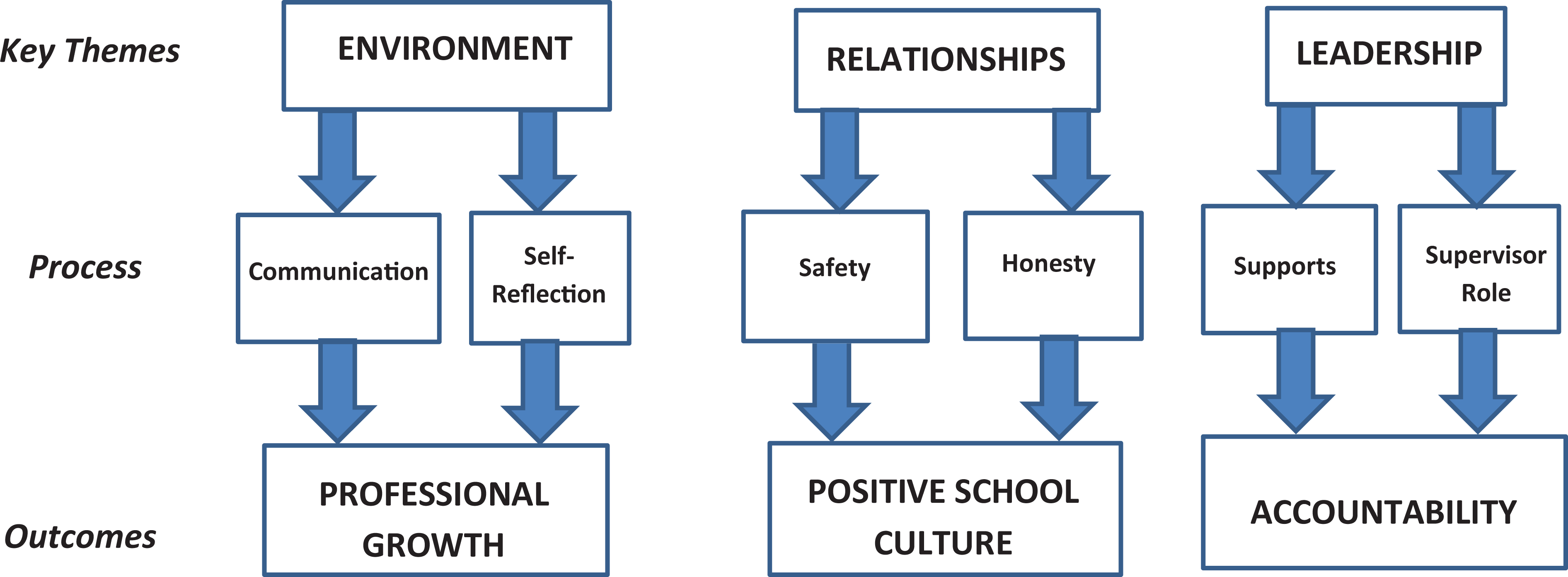
Grounded theory model showing the outcomes of professional growth, positive school culture, and accountability in relation to the key themes of environment, relationships, and leadership.
Discussion
The first aim of the study was to develop an understanding of the main priorities of principals/vice principals, emergent through the GD process. In both waves, the need for support in relationships with staff, students, and parents was an overarching theme. Priorities also included managing stress and conflict, addressing mental health issues in staff and students, managing time, accessing resources, and facilitating effective communication at all levels of the school.
Previous literature has shown that stressors for teachers are multi-faceted (Hartney, 2008), and there are numerous evidence-based approaches (see Hartney, 2016, for a consolidated stress management framework for teachers). For each type of stressor (individual or focused on the person, student-related, team-related, or task-related), there are both individual strategies that can be implemented by one person, such as classroom management), and non-violent crisis intervention skills to address disruptive students (Dicke et al., 2015; Jackson et al., 2013; Torem, 2000), and whole school strategies, such as pre-referral intervention teams (Lhospital and Gregory, 2009), and school-wide positive behaviour support (Ross and Horner, 2007).
GD, coaching, or mentoring could help identify the most appropriate strategy for each individual principals’/vice-principals’ situation. However, the mentor, coach, or GD leader would need to guide the principal/vice principal, making it a directive and therefore inconsistent with the intent of GD. Training on individual and/or whole school approaches could be offered to all principals/vice principals, allowing each principal/vice-principal to preserve the integrity of the GD approach as non-directive, and developmental.
Mental health issues were a key concern for some principals/vice principals, and affected their relationships with both staff and students, with gaps in knowledge causing considerable stress for principals/vice principals. Mental health literacy training (Kutcher et al., 2013) to raise the principals’/vice-principals’ levels of comfort addressing mental health issues within the school is out of the scope of GD.
The second aim of the study was to evaluate the applicability of the GD approach to facilitating the professional growth of educational leaders. Although there were few statements made by participants evaluating the GD process in the data, those that were there were positive. In addition, discussion in the consultation meetings reflected a positive attitude towards the GD process, particularly in giving participants space to explore issues that were important to them with an active listener. The low respondent rate makes it impossible to determine whether or not GD was a satisfactory approach to facilitating the professional growth of principals and vice principals. Further research is needed to address this aim.
The third aim of the study was to evaluate the effectiveness of GD in the school improvement process. Given the limited respondent rate, and the lack of direct data pertaining to school improvement and linkage to the use of GD, it was also unclear whether GD supported school improvement.
In this study, it was evident that there were links between self-reflection and GD. While an exploration of this connection was beyond the scope of this project, it would be beneficial to conduct further research with the purpose of identifying the structures within the GD process that prompt deeper reflection. Also needed is research to examine whether the interaction between the principals/vice principals could have been equally positive had GD not been the vehicle for their discussions. Although extensive current literature on GD is not available, a helpful model for understanding the approach is Salter and Gannon’s (2015) analysis of coaching and mentoring through six disciplines. There is significant overlap between GD, coaching and mentoring, and in this context, the aims are essentially the same. The model categorizes coaching and mentoring approaches across two dimensions: the first dimension is directive versus non-directive, while the second dimension is deficit versus developmental. A directive approach focuses on instruction as the means of professional development, while a non-directive approach focuses on facilitation. A deficit approach is not focusing on a weakness on the part of the person being coached or mentored; rather, professional development occurs through the mentor or coach sharing their greater past knowledge or experience to guide the coachee or mentee, who has less knowledge or experience. In contrast, a developmental approach assumes the professional skills required already exists within the coachee or mentee, so the approach is more mutual. GD fits within the non-directive, developmental quadrant. In order to evaluate whether GD, as a non-directive, developmental approach, is adequate for the professional development of principals/vice principals, it is clear that GD does not fully address the challenges they are facing, as reflected in the data. More directive, deficit-based approaches would better meet the knowledge gaps identified in the research. This is particularly important, given the changing role of school leaders (Humada-LudekeCarlos, 2013).
Conclusion
Given the scope of GD as a non-directive, developmental approach, it has the potential to meet some, but not all the professional growth needs expressed by principals/vice principals. Specifically, there are several directive, deficit-based training opportunities that would address the needs of principals/vice principals, particularly those who are new to administrative roles. While GD serves a useful purpose for facilitating professional growth in educational leaders, it should be supplemented with other evidence-based approaches to meet the broader goals of school improvement.
Footnotes
Acknowledgements
The research reported in this article was supported by funding from the Greater Victoria School District. We would like to thank James Hansen, District Principal of Leadership and Learning and Piet Langstraat, Superintendent of School at the Greater Victoria School District (now retired), Dr Pamela Richardson, Dr Doug Hamilton, Dr Deborah Zornes and Jenny Sigalet of Royal Roads University for their support of the prject, and Dr David Townsend and Dr Pamela Adams of the University of Lethbridge for their support of the generative dialogue process.
Declaration of conflicting interests
The author(s) declared the following potential conflicts of interest with respect to the research, authorship, and/or publication of this article: The views expressed in the submitted article are those of the authors and not an official position of the institutions or funder.
Funding
The author(s) disclosed receipt of the following financial support for the research, authorship, and/or publication of this article: This project was partially funded by the Greater Victoria School District.
