




Abstract
Introduction
Teacher leadership is considered as a contemporary and recent leadership model based on the significant role of teachers within a school's process for development and change (Hamilton, 2019; Harris and Jones, 2019; Wenner and Campbell, 2017). However, York-Barr and Duke (2004) have argued that the application and suitability of teacher leadership has been discussed over the last 20 years. Conceptually, through the practice of teacher leadership, school leadership today does not ‘rest on the shoulders’ of any individual (Hunzicker, 2012; Sinha and Hanuscin, 2017), for example, the school principal, but seeks to prioritise the role of teachers as change agents within the educational process (Lieberman et al., 2017). In this sense, the practice of teacher leadership can be applicable and feasible with effective support from principals who provide teachers with opportunities to lead and manage through collaborative efforts between teachers and principals for students’ academic betterment (Helterbran, 2010; Yusof et al., 2018). Hence, the emerging model of teacher leadership within the school leadership framework highlights the role of teachers as agents for innovation (Frost, 2012). Moreover, the process of empowering teachers can improve teachers’ competencies and professionalism (Cheng and Szeto, 2016; Crowther et al., 2009; Parlar et al., 2017), which are strongly related to their instructional tasks (Mangin and Stoelinga, 2008). Thus, it can be summarised that, beside the essential role of the school leader, teachers also play significant and critical roles in determining the effectiveness of a school (Cheung et al., 2018).
The utmost reason for practicing teacher leadership is focused on the significant role of teachers to improve their instructional strategies that have significant implications leading to student achievement (Goddard et al., 2000; Silva et al., 2000), thereby school's improvements and effectiveness (Cansoy and Parlar, 2018). Thus, teacher leadership concept has the capacity to retain teachers within the teaching profession (Katzenmeyer and Moller, 2009) while improving their effectiveness (Angelle and Teague, 2014; Karmani and Yunus, 2019). According to Liljenberg (2016), teacher leadership emerged due to the reluctance and refusal of school principals to interfere in teaching and instructional matters and to prefer to ‘hand over’ the instructional expertise to teachers. In this sense, Sahlberg (2013) added that teachers in Finland have an important role in the process of school development planning as the policy implementers and are actively involved in the formulation of the school curriculum. In this context, teacher leadership is hypothetically much easier to practise if the school's culture positively serves as a community that encourages and supports teachers’ collaboration and facilitates empowerment rather than as an organisation that prioritises structure and hierarchy (Mitchell and Sackney, 2011; Qanay et al., 2019). In fact, schools are expected to be more effective when their teacher leaders receive strong and pertinent support from the school leadership (Fairman and Mackenzie, 2012, 2015).
In Malaysian schools, through the Malaysian Educational Blueprint (MEB), which was introduced in 2013 until 2025, the ministry emphasises the role of teachers as ‘teacher leaders’ and ‘middle-layer leaders’ (Ministry of Education, 2013) to support school leadership practice. Through the practice of distributed and shared leadership, senior teachers and middle-layer leaders are empowered to assist school principals in ensuring the smooth administration of the school (Abu Bakar et al., 2015). To assist teachers, principals are recommended to organise school-based ‘in-house’ continuous professional development (CPD) to train teachers to become teacher leaders and coaches to junior and novice teachers (Ministry of Education, 2013). In the CPD course, content and guidance are delivered by senior teachers and principals as a part of network-based training to enhance teachers’ confidence in leading their own colleagues (Ministry of Education, 2013). Teachers who are rated as excellent in schools will also have attractive pathways and appointments as teacher leaders or middle-layer leaders within the school, district, state or federal levels (Ministry of Education, 2013); thus, their roles will change to become teacher leaders, subject specialists and master teachers. To enhance middle leaders’ and senior teachers’ leadership competencies, the ministry has organised a series of workshops and CPD courses with the aim of improving the leadership quality of middle-layer leaders, including heads of department and heads of panel (Ministry of Education, 2017). Known as The Leadership Course for Middle Leaders (LCML), it exposes aspiring teacher leaders to the knowledge and skills needed to improve their effective team leadership towards achieving excellence (Ministry of Education, 2017).
Theoretically, teacher leadership is considered a sub-element of a distributed and shared leadership approach model that gives more ‘authority’ to teachers through the strategic approach of ‘empowerment’, especially related to instruction, teaching and learning (Crawford, 2012; Hulpia and Devos, 2010; Liljenberg, 2016). With the presence of teacher leadership, principals' heavy workloads, pressures and responsibilities especially for instructional tasks, can be reduced and delegated to teachers (Hamilton, 2019; Mangin, 2007; Murphy, 2005). In addition, the practice of teacher leadership is capable of building and cultivating positive interactions and collaborations between teachers, which emphasise the value of cooperation, guidance, mentoring and collaborative activities (Ghamrawi, 2013; Hunzicker, 2017; Spillane and Camburn, 2006). Moreover, it is correspondingly capable of building a professional learning culture for teachers based on their real experiences and contexts (Wenner and Campbell, 2017) and, at the same time, creating a leadership pipeline for future school leaders (Gallagher and Thordarson, 2018).
Although teacher leadership is considered an evolving research topic in western school leadership literature, such as in Finland (Harju and Niemi, 2020), Sweden (Liljenberg, 2016) and the United States (Angelle and Teague, 2014; Hunzicker, 2012; Mangin, 2007; Wenner and Campbell, 2017), it remains under-researched in Malaysia and other Asian countries (Aliakbari and Sadeghi, 2014; Klinic, 2014; Wan et al., 2020). To date, researchers in Singapore (Hairon and Dimmock, 2012) and Hong Kong (Cheng and Szeto, 2016; Wan et al., 2020) have attempted to conduct studies on teacher leadership in schools. In Malaysia, several studies that examined teacher leadership practice within local contexts have been noted by Harun et al. (2016), Yaacob and Don (2018), Tahir et al. (2020) and Abu Bakar et al. (2015). The evidence, issues and challenges related to teacher leadership have been considered and addressed (Abu Bakar et al., 2015) and point to a novel element to be studied from a Malaysian perspective. This issue may stem from the views of Jackson et al. (2014) and Cheung et al. (2018), who have argued that the concept of teacher leadership still requires clarification, given the limited amount of research into teacher leadership that is available.
Furthermore, previous studies on teacher leadership, especially from a local perspective, merely employed teachers (novices or in-service teachers) as respondents to obtain feedback on the effective implementation of teacher leadership (Clark, 2017) from different school types and locations. However, studies on teacher leadership based on the principals’ points of view are considered to be limited despite the school principal retaining their essential role in determining a school's success (Mangin, 2007). In fact, principals are individuals who are answerable for supporting and providing guidance for teachers’ professionalism and development (Harju and Niemi, 2020; Lorentzen, 2020) as well as practising the delegation of shared and distributed leadership to all teachers (Cheng and Szeto, 2016). In this context, only a few studies have explored the interaction processes between principals and teacher leaders and the ways in which the school principals are able to influence the effectiveness of teacher leadership practice in schools. Therefore, this study was initiated to fill the gap in teacher leadership studies based on principals’ views based on three main elements: (a) principals’ knowledge of teacher leadership, (b) advocating teacher leadership practice, and (c) the obstacles faced by principals while implementing teacher leadership. This study also takes into account the views of Mangin (2007) and Lorentzen (2020) on the small number of studies that explore principals’ views and perspectives on how they guide, support and help teachers to become teacher leaders. Therefore, this study was conducted to answer three questions about teacher leadership practice, namely
Do secondary principals have knowledge about teacher leadership? What initiatives are provided by secondary principals in supporting teacher leadership practice? What are the challenges and obstacles faced by secondary principals to the practice of teacher leadership?
Specifically, this study was conducted in public secondary schools in order to understand secondary principals’ perspectives on teacher leadership, which is considered to be limited in terms of numbers of research conducted. To date, as mentioned above, there are only two studies by Mangin (2007) and Lorentzen (2020) who had explored practice of teacher leadership from the perspective of school principals. Therefore, this study is expected to provide detailed explanations of teacher leadership concepts, strategies and challenges based on the perspective of secondary principals as public school leaders in Malaysia.
Literature review
The Malaysian secondary school context
In Malaysia, until students complete their fifth year in secondary school, education is considered compulsory (Tai and Kareem, 2020). According to Tan (2012), the critical drive for secondary education in Malaysia aimed to produce a skilled and educated workforce to help it become an industrialised country by 2020. Secondary school students will be sitting two major public examinations: Penilaian Tahap 3 (PT3), which replaced the Penilaian Menengah Rendah (PMR), after secondary students completing their lower secondary level; another, Sijil Pelajaran Malaysia (SPM), after students complete their fourth and fifth form years of secondary education (Ministry of Education, Malaysia, 2006; Tan, 2012). Previously, in terms of students’ academic streaming, the ministry decided to strongly favour science and technical education, which later resulted in 60% of students enrolling in science and technical education and 40% in the arts stream (Ministry of Education, 2001).
In terms of secondary schools, there are six types of public secondary school: urban-located, rural-located, national religious secondary schools, fully residential schools, technical schools and vocational-based schools. Besides, there are another three types of schools: special needs secondary schools, arts schools and sport-based schools (Tan, 2012). These secondary schools are considered as ‘government schools’ whose funding and maintenance are fully administered by the Ministry of Education (Tai and Kareem, 2020). In order to ensure the smooth operation and administration of secondary schools, four senior assistants were appointed in every school with responsibilities for administration, student affairs, evening sessions and extra-curricular activities (Tan, 2012). In the administration of secondary schools, the senior assistant is supported by four subject chairs or heads of department who are appointed to lead the academic subjects categorised as science and mathematics, technical and vocational, social science and languages. Under these subject chairs or heads of department, there are around 10 heads of panel internally appointed by a school's academic committee. To fulfil the huge roles of teachers in schools, in 2017, the total number of teachers serving in public government schools was 424,128 (Ministry of Education, 2017). In schools, teachers have various roles and responsibilities which predominantly relate to instructional tasks and activities, assessment, extra-curricular activities, attending their CPD courses and engaging with parents and the community.
To enhance teachers’ role as middle leaders, the ministry has introduced the practice of distributed and shared leadership, which provides more senior teacher and senior assistant roles to support school leadership performance (Ministry of Education, 2013). Through this practice, middle-layer leaders, such as the middle management and senior assistants, are given a greater share of a school's decision making (Ministry of Education, 2013), which leads to a better model for school-based management (Abu Bakar et al., 2015). This initiative by the ministry provides greater opportunities for teachers in Malaysian schools, especially for secondary teachers, to become teacher leaders as a part of the transformational efforts and collaborative culture of schools (Yusof et al., 2018).
Definitions and concepts of teacher leadership
In general, teacher leadership is defined as the teachers’ ability and role in contributing to the development and improvement of school performance, especially aspects related to learning and teaching (Liljenberg, 2016). In this sense, Ross et al. (2011) have argued that teachers in schools have active roles in contributing to school development processes that extend beyond their routine tasks as classroom teachers. Wenner and Campbell (2017) define teacher leadership as a ‘hybrid teacher leadership’ practice when any individual teacher who is excellent within their instructional tasks is also capable of taking responsibility as a teacher leader outside the classroom context. However, Levenson (2014) critically argued that teacher leadership is defined as a developmental and collaborative process linked to a teacher's growth through distributed or shared leadership approaches.
In discussing the definition of teacher leadership, York-Barr and Duke (2004) affirm that teacher leadership is a process wherein teachers take a leadership role either individually or as a team to become capable of influencing other teachers, principals and even the school community. As teacher leaders, they are contributing their leadership talents towards the school's development, which ultimately improves student achievement. Furthermore, Fairman and MacKenzie (2012, 2015) defined teacher leadership as an effort undertaken by teachers, whether formally or informally appointed, to enhance their pedagogical and instructional capabilities and become capable of leading other individuals towards school improvement. In assessing the appropriateness of the existence of teacher leadership in schools, Muijs et al. (2013) explained that teacher leadership is a key aspect of current education trends that emphasise the agency-based aspects of the role of schools, principals and teachers in determining the academic as well as non-academic aspects of education in schools. In defining the concept of teacher leaders, Meirink et al. (2020) have defined teacher leaders as educators or teachers who have extensive experience and high levels of knowledge with the purpose of improving the quality of teaching.
The debate over the issue of formal appointment or the context of non-appointment within the teacher leadership model has been considered by many researchers (Stoelinga, 2008; Taylor et al., 2011) who explain that the concept of teacher leadership does not necessarily take into account the element of teachers’ formal or informal appointments (Katzenmeyer and Moller, 2009; ; York-Barr and Duke, 2004). Therefore, past views on teacher leadership must be related to the concept of authority, that is, teacher leaders must be teachers who hold positions such as head of a committee or head of a department within the school's hierarchical structure (Taylor et al., 2011) and should be further refined. Accordingly, the teacher leadership concept starts with a teacher leader's main role in influencing other teachers as well as collaborating with them through relevant approaches such as mentoring and coaching, aimed to reduce teacher isolation issues. DeHart (2011) concludes that the definition of teacher leadership refers to senior teachers who hold formal positions and always ensure that other teachers are practising their best strategies in teaching. In addition, teacher leaders are expected to guide and motivate other teachers and later produce a school landscape or culture which is conducive for learning and teaching. Finally, for researchers (Muijs and Harris, 2007; Lieberman and Miller, 2004; Muijs and Harris, 2006; Silva et al., 2000), teacher leadership needs to be defined within a broader framework that is related to the initiative and based on the same concept as the ‘teacher leader’, who is formally or informally appointed to share their best instructional knowledge to enhance their teaching competencies for the benefit of the student learning process.
Understanding the role of principals in teacher leadership
When discussing the role of principals in supporting teacher leadership, it is critical to understand that principals are school leaders who are ‘enabling’, supporting and guiding teachers in schools (Cheng and Szeto, 2016; Harju and Niemi, 2020; Mangin, 2007; York-Barr and Duke, 2004), correcting teachers’ mistakes as well as practising an ‘open door’ policy (Klar et al., 2016; Lorentzen, 2020). In fact, principals also frequently share ‘information’ on how to deal with troubled teachers (Matsumura et al., 2010). In addition, principals also play an important role in creating a collaborative, helpful, positive school culture between teachers and providing recognition for teacher leaders in schools (Cheng and Szeto, 2016; Mangin, 2007; Muijs and Harris, 2007). Through the teacher leadership concept, principals should be able to distribute and share their leadership responsibilities throughout all of a school's communities, especially teachers (Mangin, 2007; Murphy, 2005). However, Makohelle and Makhalemele (2020) argue that to succeed in teacher leadership practice, principals should insist on implementing shared leadership practices, that is sharing leadership between principals and teachers, facilitating teachers’ performance of their leadership responsibilities and de-prioritising certain procedures and hierarchical structures in schools, which can hinder the implementation of teacher leadership.
In addition, principals need to build positive interactions with appointed teacher leaders concerning their shared values, mission and vision, especially in relation to academic achievement (Crowther et al., 2009; Mangin, 2007; Mokhelle, 2016). In this sense, Crowther et al. (2009) further argued that teacher leadership practice needs to be supported to increase teacher innovation, motivate teachers in a critical condition and cultivate a climate of success for teachers. In this situation, principals also need to be smart in ‘resigning’, giving support, guiding teachers in decision making and becoming capable of identifying more appropriate leadership tasks for teachers to lead and influence their colleagues (Cheng and Szeto, 2016). In US schools, Mangin (2007) has studied principals’ knowledge of teacher leadership as well as how principals interact in promoting teacher leadership. The study found that principals who have knowledge of teacher leadership were found to have more frequent interactions compared to principals who lacked such knowledge. Knowledgeable principals also consider teachers as a ‘resource’ for the school development process, encourage interactions between teachers and teacher leaders and appreciate teacher leaders, as well as are capable of translating expectations into academic achievement. On the other hand, less knowledgeable principals were found to provide less support, less interaction and less encouragement and to engage in one-way communication with teacher leaders.
In Malaysia, Yusof et al. (2017) conducted a study on teacher leadership with 250 teachers from 25 primary schools with the objective of examining the support from the school administration personnel for teacher leadership practice. Teachers’ feedback mentioned that their principals have encouraged them by giving recognition and empowering them with the authority to become future school leaders, setting criteria for excellence, giving them assignments as leaders which are in-line with their expertise and workload and emphasising the culture of learning. Furthermore, a study on the role of principals in supporting the teacher leadership process has been researched by Cheng and Szeto (2016) based on the assessment of 20 novice teachers from Hong Kong schools. The findings conclude that there are two approaches that have been implemented, namely: (a) principals provide encouragement and support to teachers and (b) principals provide some leadership tasks to teachers. In addition, principals constantly evoke aspirations, communicate using clear goals and support individual innovation as well as evoking thinking skills.
Issues and challenges in teacher leadership
In implementing teacher leadership, previous researchers (Cheung et al., 2018; Wenner and Campbell, 2017) have argued the issues and challenges related to appointing teachers into leadership created teacher ambiguities and confused their understanding of the practical aspects of being teacher leaders (Leander and Osborne, 2008). Wenner and Campbell (2017) argued that four factors that challenged principals in supporting teacher leadership in schools are lack of time, unconducive relationships between teachers and school management, cultural factors and school structure, and personal characteristics of teachers. Based on the previous findings, barriers and challenges on teacher leadership can be classified into three themes. These are (a) barriers from teachers, (b) barriers from principals and (c) issues from a school's culture and structure.
Based on issues related to principals, it was found that there are principals who have little confidence in the role of teachers as teacher leaders (Kamaruzaman et al., 2020; Monjong and Fon, 2016; Ross et al., 2011). This situation may stem from the multiple and ambiguous issues related to the definitions of the concept of leadership (Cheung et al., 2018). In this sense, principals’ lack of confidence to support the teacher leadership approach is, indirectly, a challenge to the successful implementation of teacher leadership in schools. In addition, there are also principals who do not want to involve teachers in decision making (Tahir et al., 2020). As for Klinker et al. (2010), lack of resources and assistance given to teachers by principals also caused teachers to refuse to become teacher leaders. In fact, Friedman (2011) has mentioned the lack of principal support in providing assistance, authority and autonomy that makes teachers find it difficult or feel less empowered to perform their roles as teacher leaders in schools.
Studies have shown that there are still teachers who do not want to become teacher leaders (Muncey and Conley, 1999) although they were recruited to be teacher leaders in their schools. This is because some teachers lack the confidence to lead their fellow teachers, which makes the implementation of teacher leadership difficult to practise (Cheung et al., 2018; Klinker et al., 2010). As mentioned by Cheung et al. (2018), it is a common and accepted perception that, although teacher leaders were given their special roles to lead, colleagues always believed that they had the same level within the school hierarchy which resulted in tension. In addition, there are teacher leaders who spoke out on their difficulties in performing their responsibilities as teacher leaders (Brosky, 2011) because they did not have formal positions in schools (Angelle and Dehart, 2011). In addition, those school leaders who create a school culture that does not encourage teacher leadership have made teacher leadership difficult to implement (Durias, 2010; Flood and Angelle, 2017). The lack of a culture that supports the implementation of teacher leadership will definitely lead to teachers being reluctant or refusing to become teacher leaders (Abdul Shukor, 2012; Kamaruzaman et al., 2020). This is because some teachers and staff in the school have been accustomed to a concept of leadership that is attached to formal positions, which led to teachers who do not hold formal positions being less accepted as leaders by other teachers (Chew and Andrews, 2010; Friedman, 2011). In fact, the gap between senior teachers who are appointed teacher leaders compared to those leaders who are still within junior positions attracts a negative perception (Nolan and Palazzolo, 2011).
Among other issues that caused teachers to refuse to be appointed as teacher leaders in schools are related to the lack of time and teachers’ excessive workload (Durias, 2010; Hands, 2012; Kamaruzaman et al., 2020; Tahir et al., 2020). In this context, teachers are found to have heavy workloads that make it difficult for them to be teacher leaders in schools. In fact, accepting the burden of being a teacher leader will increase their workload. Thus, Margolis (2012) argues that the lack of allowances or payments received by teachers makes it difficult for them to accept responsibilities as teacher leaders. In addition, the lack of appreciation given to teacher leaders also causes teachers to refuse to accept such an appointment (Wenner and Campbell, 2017). Tahir et al. (2020) found that teachers who have negative attitudes are capable to challenge teacher leaders in performing their school's administrative tasks. In this sense, teachers who have negative attitudes portray their disobeying character, reluctant to receive extra workload, and provide their unwillingness to provide cooperation with teacher leaders. In addition, issues such as the lack of confidence to lead their fellow teachers as well as gaps between teacher leaders who may be appointed from relatively junior grades who find leading more senior teachers challenging discourage potential teacher leaders.
Methodology
The framework of this study
In guiding this qualitative research related to principals’ perspectives on teacher leadership practices, a conceptual framework has been developed as shown in Table 1. In this framework, the major construct is strongly associated with the practice of teacher leadership as perceived and evaluated by secondary principals. Thus, in exploring teacher leadership practice, three major elements are studied: understanding the concept of teacher leadership, strategies to support teacher leadership practices in schools and, lastly, the challenges, barriers and obstacles that principals face while practicing teacher leadership in their schools.
The study's conceptual framework.
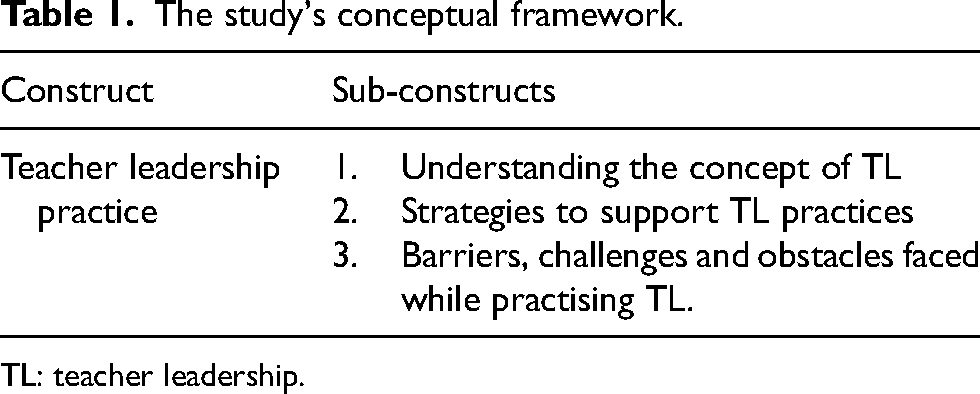
TL: teacher leadership.
In researching teacher leadership practices within the Malaysian secondary school context, the role of researchers in this study is to understand and appreciate the three major elements involved: understanding the concept, the strategies employed and the barriers, challenges and obstacles faced. Although the literature shows that past studies have considered three major elements, this study is using a grounded and inductive approach in which researchers try to understand principals’ experiences related to the practice of teacher leadership in their schools.
Design
Specifically, this qualitative study attempts to explore the knowledge, strategies and obstacles faced by principals in implementing teacher leadership in their respective schools. The design of the study uses the case study method to acquire a detailed picture of the behaviour of individuals or groups to understand the complexity within the actual school context (Creswell, 2007; Welman et al., 2005; Yin, 2014), which is difficult to explore in-depth (Flyvbjerg, 2011). This method provides clear, complete and adequate data (Liljenberg, 2016). A multiple case study was chosen because it is capable of giving a slightly different picture for each organisation (Stake, 2013), which involves various cultures and different types of schools. In all, 10 public secondary schools of various types were selected involving two major types: rural and urban public schools; a religious-based public secondary school and a fully residential school were also included. Indirectly, the diversity of school types was expected to provide a clearer picture and an in-depth understanding of the implementation of teacher leadership in Malaysia, which is expected to have different cultural aspects but with some similarities in structure and hierarchy.
Sampling
As mentioned, a total of 10 principals who lead four types of schools have been selected with the purpose of getting a clear understanding of the teacher leadership practice within their respective schools. For qualitative research (Cohen et al., 2010; Creswell, 2007; Miles and Huberman, 1994), the purposive sampling approach is considered an appropriate sampling strategy. Based on the age distribution, the selected principals range in age from 49 years to 56 years and have served for at least two years within their respective schools and so are not classified as novice principals. The rationale for selecting different types of school is based on the assumption that each school has a different culture or diversity (Gibson and Simon, 2019) when considering teacher leadership. Table 2 below shows the demographic characteristics of the principals involved.
Secondary principals’ demographics.
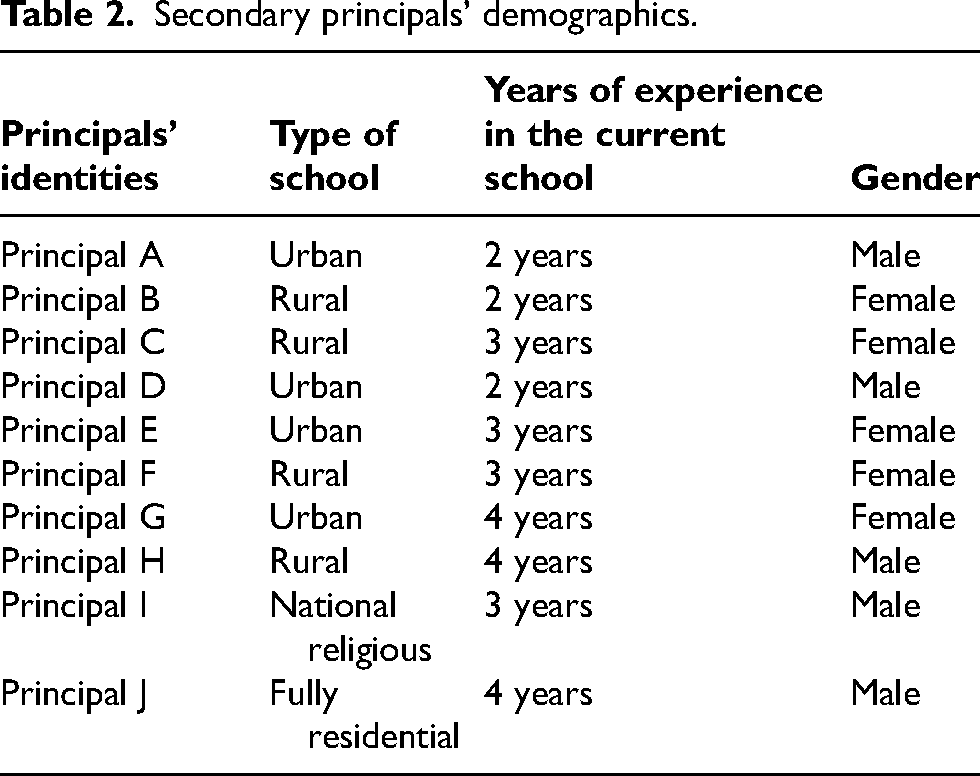
Based on principals’ academic qualifications, five principals are Master's degree holders, while five others are Bachelor's degree holders. In terms of experience as principals, three principals have served with their schools for at least two years, four have led their schools for three years and three have served in their particular schools for four years. In terms of gender, five principals are male and five females.
Instrumentation
This study used the interview method to obtain an overview of their implementation of teacher leadership in their respective schools. Interviews were chosen as the data collection approach since they are an appropriate method to report, reflect and evaluate the experience, feedback and values of the interviewee (Cohen et al., 2010; Heppner and Heppner, 2004). For that purpose, a semi-structured interview approach was employed for each individual interview. To interpret, understand and analyse the interview data, inductive methods were used considering the meaning of each word as a meaningful unit of analysis (Hatch, 2002).
Before proceeding with the interview sessions, the interview protocols were developed and adopted based on a study by Mangin (2007) as well as Wenner and Campbell (2017) who had previously researched the role of principals in supporting teacher leadership. One of the advantages of the interview as a data collection method is that it provided principals with an opportunity to share their experiences and to discuss and evaluate events or situations (Denscombe, 2010; Merriam, 1988) related to their position as school leaders in their respective schools. In general, the interview protocol used here has two parts: Part A comprising a principal's demographic data such as educational background and experience, and Part B concerning the knowledge, strategies and challenges What do you understand about teacher leadership? What is your interpretation of teacher leadership? What strategies do you use to encourage the implementation of teacher leadership in schools? What are the obstacles, challenges and issues that teachers face when implementing teacher leadership in schools?
Prior to the actual study, a pilot study was conducted with a secondary school principal not involved in the actual study. As a result, two items were discarded to prevent the interview session from taking a time frame of over an hour. In addition, some items were simplified to provide a better understanding during the interview sessions.
Interviewing and data analysis
A total of 12 hours of interview sessions with selected secondary principals took place in their office to avoid any disturbing and administrative disruptions during the interview session. Each interview session took about 50 minutes to an hour. Prior to the interview session, the researcher had applied for permission to record the interview session. After being granted permission, the researcher recorded the interview sessions. In addition, the researcher also provided sketch notes based on the principals’ answers to compare with the recordings (Cheng and Szeto, 2016). There are a few principals who were reluctant to record their sessions; therefore, the researcher only used the sketch notes of their answers. When asked the reason for their unwillingness to record the session, principals mentioned that it was related to their personal consent and discretion.
During the interview session with the principals, the researcher took six approaches suggested by Harvey (2011) to interview individuals who are considered elite and important. In this study, the school principal is treated as the significant individual within the school's structure and hierarchy. Therefore, several procedures have been followed: researchers do not (a) interfere with principals in giving their views, opinions or evaluations on the practice of teacher leadership, (b) will not re-ask items
Ethics in research
As this study obtained research data through interviews with 10 principals, ethical research procedures were established to protect the identities of the schools and principals who have provided their full support and cooperation. Therefore, the names of the schools as well as the names of the principals have been replaced with the code ‘School
Findings
In general, the discussion of the findings of the study is based on the interview data analysis concerning each principal's knowledge of teacher leadership, their strategies to encourage it and the obstacles encountered during its implementation.
Principals’ understanding of the concept of teacher leadership
Based on interviews with principals, the study found that some of the themes identified were related to a principal's knowledge of teacher leadership. The two main themes that were raised by the principals are (a) acting as an instructional expert and (b) being a ‘role model’ to other teachers, especially novices.
Instructional specialist
The majority of principals interviewed explained that teacher leadership is related to teachers who are considered experts with a wide experience. Thus, as senior teachers, they were given more authority to make decisions, implement innovations and determine the best methods of teaching and learning. Based on the perspectives and understanding of Principals A and C, they defined the concept of a teacher leader as an experienced senior teacher who is capable of leading other teachers, especially novices. Principal A gives an interpretation of teacher leadership. To me, teacher leadership is a process related to an experienced teacher who is capable to be a facilitator or mentor as well as a mentor to other teachers [and] who can be called [a] teacher leader. Actually, this character has indeed appeared in school but we sometimes did not notice it. In fact, these teacher leaders are always positive and open-minded in gaining experience and knowledge [and] in developing themselves (PA).
Principal C defines teacher leadership as a process of guidance as well as leadership implemented by teachers who are capable of guiding and leading other teachers. However, she did not explain whether the teacher leader must be a senior teacher or a middle teacher. My definition of teacher leadership as the process of leading or the process of influencing by a teacher leader who is able to guide or help other teachers to together improve professional practice and improve student achievement as well as in a small context, that is, to perform a task. In addition, [he
Role model to other teachers
In addition, the principals interviewed also explained that teacher leadership should be implemented by teacher leaders who are ‘role models’ to other teachers. The answer given by Principal B on teacher leadership is referring to experienced and skilled teachers who are capable of guiding and motivating other teachers, especially in matters of teaching and learning. Teacher leadership is a process of guidance and influence of senior teachers [sic.] who act as facilitators who can create a culture and learning opportunities that can help to improve teachers’ quality and professionalism (PB).
Principal D defines the concept of teacher leadership as a leadership process implemented by senior teachers who are the positive role models to other teachers. Accordingly, the characteristics of the suitable teachers are those who are always positive-minded, capable of providing guidance and assistance to other teachers, while also being proficient. My definition of teacher leadership is a teacher who is always positive-minded, experienced in teaching and learning, able to be a mentor … to other teachers, especially guiding new teachers. In addition, he is always open to progress in all aspects of knowledge and skills. Not to forget ICT and pedagogical skills which also have positive benefits to schools, all teachers and students (PD).
Principal E listed the criteria that are needed to be a role model as well as a teacher leader with the ability to guide other teachers. To me, a teacher leader is a teacher who has pedagogical knowledge and [is] willing to sacrifice time to provide teaching aids to students. Usually they are pro-active teachers and do not require any instructions from the administrator to do work and tasks. We as principals need to evaluate teachers whether they are leading or not through their willingness to sacrifice time in solving tasks or problems encountered (PE).
Based on the interpretation given by all 10 principals, in general, all principals that participated in this study have a deep and positive knowledge and understanding of teacher leadership in the context of their respective schools.
Teacher leadership implementation strategies
To answer the question which related to principals’ strategies in encouraging teacher leadership in schools, five themes emerged in exploring principals’ strategies and approaches in supporting and developing teacher leadership. The five themes are (a) involving more teachers as leaders, (b) providing opportunities to lead, (c) building leaders through mentor–mentee programmes, (d) adopting the open door policies and (e) developing teacher leaders.
Involve more teachers in leadership assignments
Principal J employed various approaches to strengthen the practice of teacher leadership such as involving teachers in administrative and leadership tasks. This is because the majority of the teachers in his school are experienced teachers. Therefore, as a school leader, he provides opportunities for teachers, especially senior teachers, to lead the school assignments, especially instructional assignments. In my school, to involve teachers as leaders, I give teachers the opportunity to be involved in administration and leadership aspects. I also give opportunities to teachers, especially senior and experienced teachers. I give them many opportunities, especially in the instructional field. They are knowledgeable and experienced. They have [lots] of talents and knowledge. It would be a pity if they were not given a chance. Of course, in the early stages, it was a bit awkward because they were just given a chance, soon they would have fun in leading their teams. In addition, if our planning fails, I do not quickly blame them. We [are] always looking for a solution (PJ).
Likewise, Principal F also provided many informal or ad hoc tasks to be led by her teachers. These tasks were meant for senior staff with wide experience within the teaching profession. Principal F acknowledged that a school leader alone cannot settle everything. Therefore, they need teachers to support and assist them. In order to get all tasks completed, I let my teachers lead some committees in order to provide them with a sense of responsibility and belonging. As a school principal, I can't settle everything by myself which later contributes to intense feelings and stressful experiences. I also need help and assistance from all my teachers. At the same time, I tried to be open to my teachers’ opinions and suggestions to improve the performance and achievement of their own tasks and committees. Based on this approach, I do notice some of them are good and effective leaders among their colleagues.
Provide teachers with the opportunity to lead their fellow teachers
In the interview, Principal B explains that she has planned many programmes in her school, which involve teachers; these will encourage and provide opportunities to practise teacher leadership. Instructional developmental programmes such as the ‘mentor–mentee’ programme, the ‘Learning Community’ programme and also the ‘Transformational Program 2017’ are examples that encourage teachers to get involved, which suited the school's mission of becoming a high-performing school. To achieve that goal, Principal B shared her views that she needs help and assistance from other teachers to lead and perform the assigned tasks. My school goal is to be a high performing school. To achieve this goal … we need teachers who are committed and dedicated. For that, we have designed several programmes such as mentors, [a] learning community and transformation programmes. All these programmes are meant for teachers so that they have the opportunity to lead, help and plan with other fellow teachers. In order to have the opportunity to lead the programme … there is a commitment and there is a responsibility for the programme that we both plan and implement. I can't do it alone. For example, the Learning Community Program serves to encourage teachers related to their assignments and expertise. In this case, I am quite open. I just need to meet the programme leader for discussion and idea generation (PB).
Developing teacher leaders through mentor–mentee programmes
Principal C has organised a mentor–mentee program to guide new teachers in the managing and handling of teachers’ duties. Her school holds professional discussions every month for teachers to share opinions and new ideas. This platform encourages the knowledge sharing culture among teachers. Additionally, Principal C encourages teachers to give talks or briefings not only to students, but also to other teachers as well as outside the school as a speaker. I give teachers in my school the opportunity to be leaders. I have designed the mentor-mentee concept. Through this programme, new teachers will be trained by senior teachers in handling tasks that emphasise their leadership qualities in school. In this programme, senior teachers can share … information and knowledge about many aspects they have gone through with new teachers. We call this concept a professional discussion session [where] teachers will share experiences and expertise between teachers. To make them more confident, I held a session where teachers would give talks and briefings as well as speakers in front of other teachers [sic.]. I do not want order and knowledge to only come from the principal or the school administration (PC).
The ‘open door’ policy
Principal I takes the attitude that an ‘open door’ policy is a successful teacher leadership practice in his school. He opined that, as a principal, he needs to play a role as a professional leader and exhibit a good leadership style. This is because, as a principal, he needs to be a role model to all his teacher leaders. In addition, he tries to accept and ‘be open’ to the teacher leaders’ weaknesses and mistakes when acting as advisors and mentors to colleagues. To build a teacher leadership culture, I practice the concept of open door policy [sic.]. I truly understand that teachers are given [little] opportunity to be leaders, except senior teachers. My concept is simple; all teachers in this school have potential and can be leaders even without a position in the school. Everyone can lead and even if he
Developing teacher leaders
Based on the interviews, three principals were found to provide opportunities for the nurturing of new teacher leaders in their respective schools. These three principals have the opinion that, through the concept of coaching leaders in schools, they can easily identify potential teachers to be leaders, starting with the role of teacher leaders until they are given training and exposure to formal positions, for example, position within a school's administrative structure. A principal shared experiences about the strategies he used in building successful leaders in their schools. I believe in the concept of successor leaders [sic.] starting with teacher leaders in the instructional field. Teacher leaders were given instructional-related tasks to guide, assist and evaluate other teachers, especially new teachers. Before appointing, we need to know and research their potential and backgrounds [and] whether they are qualified to be teacher leaders. For us, being a teacher leader is a huge responsibility. Therefore, not everyone [is] capable to be a leader. When we became leaders, we also guided, advised and even gave guidance to teacher leaders. I hope they will gain experience as future school leaders (PA).
Principal H thinks that the process of developing teacher leaders should also include teachers who have various talents, not only as future administrators, but also as ‘excellent teachers’ within the instructional field. In the context of my school, this team of back-up leaders has two categories: prospective administrators, i.e. interested teachers [who] will hold positions as school administrators in the future. The second is to fill the position of excellent teacher. The second group is those who have knowledge, experience and ability in the field of teaching and learning. We also support this second group of teachers and give them the opportunity to lead other teachers. Starting from the panatia position, later to GPMK or maybe as a ‘master’ teacher, we have traced their potential from the beginning so that they do not ‘sink’ just like that (PH).
Obstacles in the implementation of teacher leadership
When understanding the principals’ standpoints on teacher leadership practice, we also asked them about the obstacles and issues they have faced when implementing teacher leadership. From the interview process, two themes emerged: the reluctance of teachers to be appointed and the lack of confidence of teachers to lead.
Teachers’ refusal to be appointed
A majority of principals raised the issue of teachers’ refusal and reluctant attitudes to be appointed as teacher leaders although teachers that were being selected were indeed eligible from the standpoint of their principals. A majority of principals identified that the issue of workload caused teachers to refuse to become ‘informal’ teacher leaders without any appointment to the post. In my school, the majority of teachers refuse because of overload. Indeed, we know, if the teacher is good, everyone wants to appoint him
Principal D opined that the issue of staffing caused some teachers to refuse appointment as teacher leaders. This may stem from the perceptions that teacher leaders must be based on formal positions as well as appointments. Some teachers refuse because they think it is not easy to lead because they do not have a formal position. Therefore, if appointed, they think that they will have problems to lead other teachers, especially senior and experienced teachers. This is because they do not have a formal position and said that it is quite difficult to lead and order other fellow teachers due to staffing issues. We also do not want him
Principal F mentioned the challenges that she faced while selecting teachers to become teacher leaders. As you know, this school is a rural school which makes it sometimes difficult for me to select teachers that are ready to be leaders with other teachers. Many are reluctant and give [as a reason] their informal position which [makes it] difficult for them to execute. In addition, they also mentioned the heavy workload that they have to fulfil.
Lack of confidence to lead
There are also principals who share their perspectives that teachers reject because they lack the confidence to be a teacher leader. This issue arises among capable teachers who are still considered as junior or young teachers but who have shown good performance in their assigned tasks. In fact, they can be categorised as potential future leaders. There are also situations when teachers refused to be teacher leaders because they lack the confidence to lead other teachers, especially senior teachers. This issue arises among younger teachers as they have to bear the burden of mobilising more senior teachers. Even they themselves are not sure if they can bear the burden. As principals, we need to regularly motivate them so that they have the confidence to lead the school towards excellence (PC).
Principal E shared the view that there are some teachers who will refuse to be teacher leaders because some teachers preferred to have modest attributes. Although these types of teacher excelled in their given tasks, she does not like to direct or ask other teachers to complete a task. In my school, there are some teachers who excel in performing their duties but when I suggested for them to be teacher leaders, they refused. Among the reasons that [were] given is that they do not like to tell or ask other teachers what to do. The task completed is for self-satisfaction. Because they refuse, it is not easy for us to find a replacement (PE).
Principal A said that there are indeed problems in implementing teacher leadership in schools. In the interview, the principal said there was indeed a problem in implementing the leadership of the teachers he faced. Everywhere there are obstacles from the teachers. For example, many teachers refuse to be teacher leaders because they think they are not administrators. Maybe they find it difficult to lead (PA).
To summarise the findings related to teacher leadership practice based on secondary principals’ perspectives, Table 3 gives a comprehensive indication of the research findings based on the study's purposes.
Summary of the research findings.
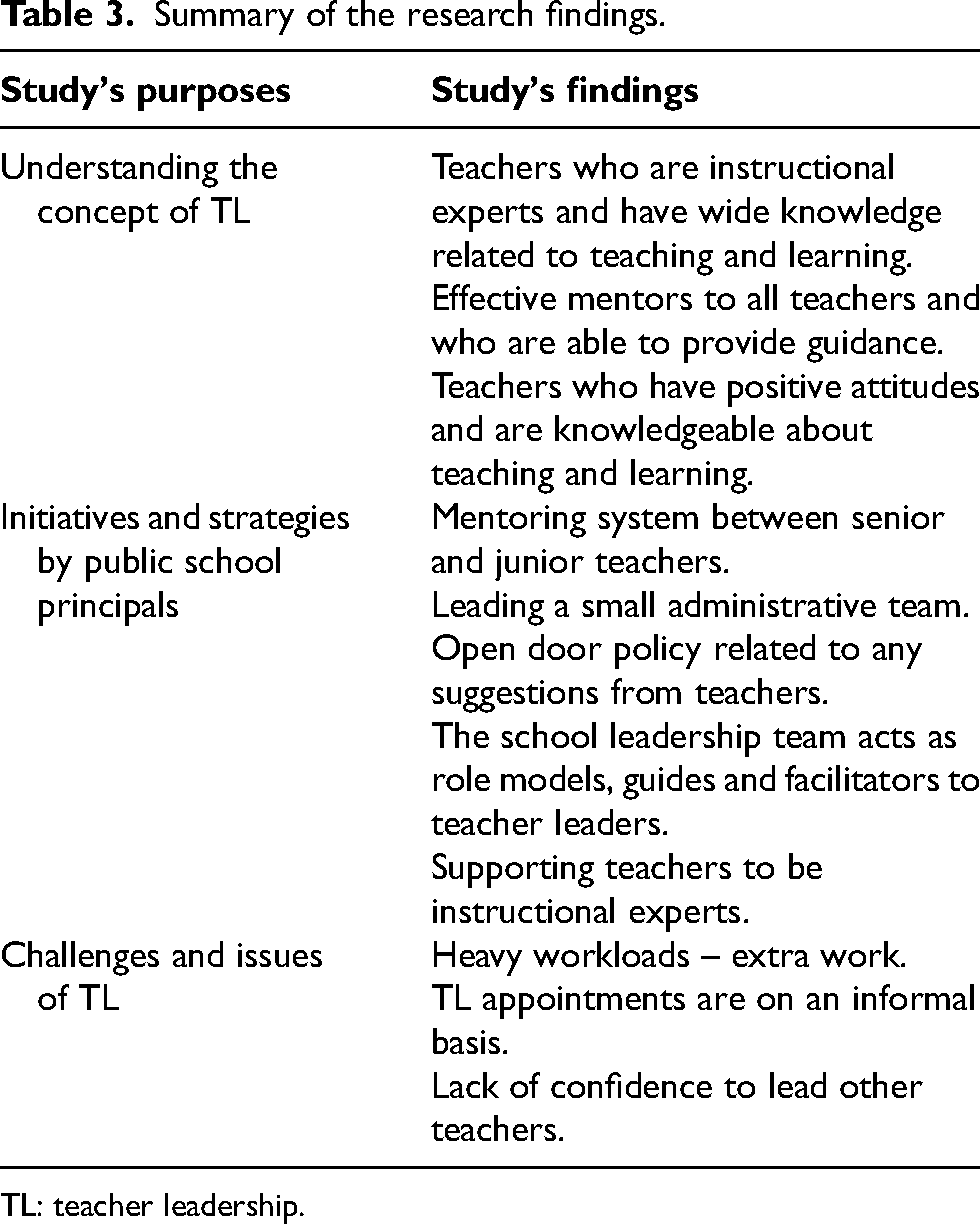
TL: teacher leadership.
Table 3 illustrates the overall findings of the study. First, principals’ understanding of the concept of teacher leadership shows that principals describe the concept of teacher leaders as teachers who have positive attitudes and are knowledgeable about teaching and learning matters. As teacher leaders, they must acquire wide knowledge of instructional tasks, which labels them as instructional experts. At the same time, teacher leaders are mentors to all teachers and have the capability to offer them guidance.
In terms of strategies employed by public secondary school principals, it is noted that principals have a strong tendency to use a mentoring approach between senior and junior teachers. Such efforts by principals need practice and encouragement. In order to provide initial experience for teacher leaders, they were asked to lead a small administrative team which provided them with exposure to the role of a teacher leader. At the same time, the school leadership team, which included the principal, deputy principals and the heads of instructional departments, also undertook their duties as effective mentors, role models and guides to all teachers who might wish to become teacher leaders. In addition, principals practised an ‘open door’ policy in which teachers are welcome to provide any suggestions for school improvement and effectiveness. As school leaders, secondary principals also provide their support in furtherance of teachers’ wishes to become instructional experts.
Lastly, in exploring the challenges and issues related to teacher leadership, principals listed three major reasons which highlighted teachers’ reluctance to become teacher leaders. First, teachers’ heavy workloads remained a powerful reason for not becoming teacher leaders. Second, principals also realised that providing teachers with an informal position can provide them with some legitimacy as teacher leaders in their schools. This helps to address the third reason: teachers’ lack of confidence in becoming teacher leaders since most teachers were trained to be teachers and educators and not school leaders.
Discussion
This study was conducted to evaluate principals’ roles as the most appropriate leaders for the implementation of teacher leadership in their respective schools. Therefore, principals’ knowledge and understanding of teacher leadership are perceived as imperative in influencing and supporting its implementation (Cheng and Szeto, 2016; Lorentzen, 2020; Mangin, 2007). In addition, how principals support teacher leadership is being studied in-depth as well as the obstacles and challenges faced by principals in implementing teacher leadership. This qualitative study used the principals’ views and evaluations, which redresses the balance compared to previous studies which only used a sample of teachers’ views.
Since principals play an essential and important role in implementing teacher leadership in schools, their knowledge is seen as very important in determining whether they are supportive towards the implementation of teacher leadership. Initially, we hypothetically assumed that if principals have limited knowledge of teacher leadership, the implementation of teacher leadership will be unsuccessful due to it receiving less support from principals (Mangin, 2007; Wenner and Campbell, 2017). In this study, principals are noted to have sufficient knowledge on teacher leadership based on their accurate and considered definitions of the concept of teacher leadership. From the principals’ perspectives, teacher leadership as a leadership process can be classified into two major themes: instructional experts and acting as role models to other teachers. First, teacher leadership is being considered for any teacher who has wide experience and knowledge within the teaching profession. Second, he/she is being given the authority by the school leadership to make decisions, implement innovations and determine the best methods of teaching and learning that can ultimately improve student academic achievement. In addition, the school principals explained the characteristics of a teacher leader as being a senior teacher who is experienced, positive-minded and able to be a mentor to other teachers. In fact, principals also hope that teacher leaders are open to improving knowledge and skills, especially about information and communication technology (ICT) as well as pedagogy that ultimately benefit the school community as a whole. However, the principals did not explain whether a novice teacher could be a teacher leader. These findings proved that principals have a relevant understanding of the concept of teacher leadership as well as its role in guiding, mentoring and sharing experiences and skills with other teachers, especially novice teachers. Thus, this study has similarities with the findings of a study by Mangin (2007), which emphasises the importance of all principals understanding the concept and having knowledge of teacher leadership. According to Mangin (2007), knowledge of teacher leadership is imperative because it will reflect the support and interaction provided by principals when establishing teacher leadership in schools.
Related to the principals’ understanding, their roles are seen as very significant in implementing teacher leadership in schools. They need to mobilise teacher leaders’ roles, provide support and implement teacher leadership strategies in their respective schools. The principals studied implemented five key strategies to mobilise and provide support which later were transformed into strategies to improve the implementation of teacher leadership. First, principals started the initiatives by enabling teachers to lead any small team and tasks in schools as well as to be leaders outside the learning and teaching fields. This includes administrative tasks although they do not have any formal positions within the school administrative hierarchy. This is because many senior teachers refuse to hold administrative positions although they are able to lead and have extensive experience in aspects of learning management and student development. In addition, principals provide guidance, motivation and support to teachers and even find a collaborative solution to any problems that arise. Second, principals also tried to encourage teachers to become leaders. As principals, they have planned several school development programmes that each requires a teacher as a leader. Through these programmes, teachers are given the opportunity to lead, assist and collaborate with other teachers to implement and achieve the goals of the planned programme. Through this method, teachers’ commitment and sense of belonging to the planned programme will increase due to having accountability and responsibility for it (Hulpia and Devos, 2010). Similarly, to achieve the school's vision and mission, principals need the assistance of teachers as intermediate or middle-layer leaders since the principal cannot achieve the school's vision, mission and direction alone without involvement from the entire school community.
Third, principals also mentioned the initiative of a mentor–mentee programme for teachers based on their ideas to inculcate a collaborative culture and cooperation between teachers, especially reducing the ‘generation gap issue’. This programme introduces senior teachers as mentors and leaders to more junior teachers. Through this positive platform, senior teachers will share the knowledge, information and skills that they gained as a result of extensive experience and instructional expertise. To principals, this professional learning and teacher development sessions allow teachers to exchange their views, knowledge and expertise. Principals also implemented an ‘open door’ policy/strategy that supports all teachers to become leaders, although they do not have a formal leadership position. Through this programme, teachers are also welcome to offer any suggestions or ideas and to share problems and solutions together with their school principals. Additionally, the school principals are the most significant role models and even a mentor and advisor to all teachers. Another strategy used by principals is to create systems conducive to supporting potential teacher leaders. Through this system, teachers who are potentially able to hold formal leadership positions will receive guidance, training and exposure as future teacher leaders. Using this effective system, principals and other school administrators will deliver advice and guidance to potential teacher leaders. In addition, the school leadership strongly encourages the development of teachers as instructional experts so that trained teachers will be excellent teachers, especially in terms of learning and teaching. Specifically, the findings of this study are in line with those of Cheng and Szeto (2016) in Hong Kong, which affirmed that principals should provide more encouragement and support to teachers, as well as provide some leadership tasks for them. In addition, principals should always evoke aspirations, communicate with clear goals and support individual innovation and thinking skills.
In exploring the obstacles, challenges and barriers to the implementation of teacher leadership, the views and opinions of principals were also captured during the interview sessions. Among the themes raised by the principals is the refusal of teachers to be appointed as teacher leaders as well as their lack of confidence in becoming teacher leaders. When talking about the reluctance of teachers, some issues have been raised by teachers as an excuse or reason to reject the informal appointment as teacher leaders. One imperative issue that is often raised is the teachers’ heavy workload, which already causes them trouble and stress. This is because becoming an informal leader in a school will definitely increase their heavy workloads, and at the same time, they have to lead, advise and guide other teachers, which makes them feel more burdened.
Issues related to the excessive workload of teachers causing talented teachers to refuse to become teacher leaders have been widely discussed by previous researchers (Durias, 2010; Hands, 2012; Tahir et al., 2020) from various education systems. As teachers in schools, they also have many responsibilities related to the instructional tasks that they need to complete, which can also prevent talented teachers from becoming teacher leaders. These tasks include student projects, their administrative workload and co-curricular activities, all of which cause them to have less time to help, guide and advise others (Harris and Muijs, 2005). In addition, informal appointment as a teacher leader is considered as one of the factors/reasons why teachers rejected the opportunity (Margolis, 2012). The second issue is teachers’ lack of confidence to lead other teachers. According to Torrance (2012), the lack of formal appointments as teacher leaders will indirectly reduce teachers’ interest in becoming teacher leaders because showing their willingness to become teacher leaders will increase their burden as teachers who already have heavy workloads.
Implications of the study
Specifically, this study has two main implications, namely its contribution to theory and to the practicality of supporting the implementation of teacher leadership in Malaysia.
Theoretical contribution
Through interviews with principals, theoretical implications are proposed for the development and training of teacher leaders, especially in secondary schools in Malaysia. These proposals are a summary of the study findings related to teacher leadership. First, it relates very much to the qualities required of suitable teacher leaders. Second, in tackling the issue of the appointment of teacher leaders, it is suggested that teacher leaders should begin by being assigned informal or small tasks or committees rather than formal appointments. Third, principals and other school administrators should evaluate the performance and suitability of candidates based on peer review evaluation. Fourth, it is believed that principals and school administrators should provide informal or school-based training before insisting that teacher leader candidates hold a formal position such as an instructional expert or a subject chair. Table 4, which has been referenced and adapted from the school heads' career stage model by Weindling (2000); this framework provides an overview of the four phases in the process of teacher leadership selection and informal training.
Suggested framework for teacher leadership selection and training.
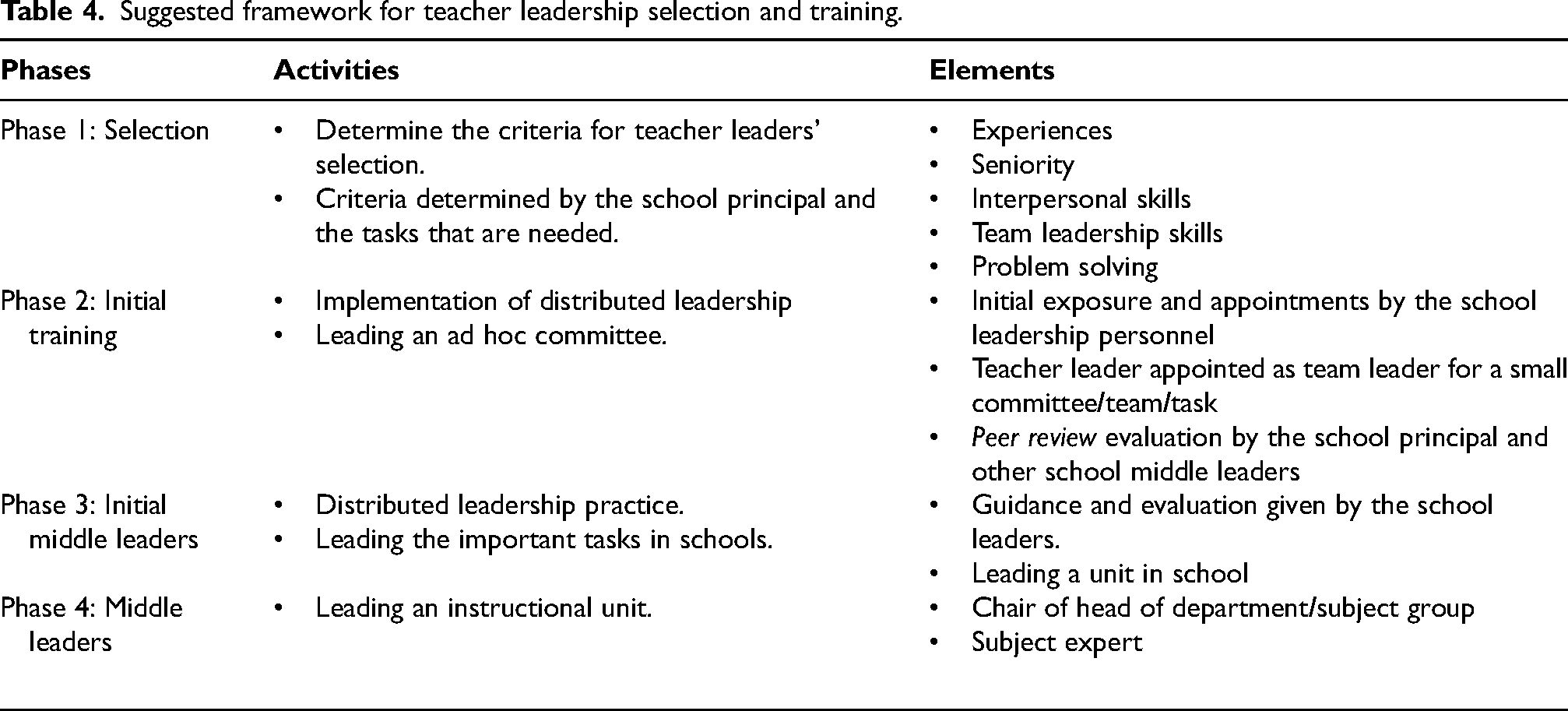
Theoretically, the framework encompassed a few elements in practicing teacher leadership in secondary schools: specifically, it has three main phases, namely the selection phase, the initial training phase and finally the phase concerning the potential future middle leaders in the school. In general, the implementation of teacher leadership begins with the first phase: the selection of suitable teachers to be appointed as prospective teacher leaders. In this phase, the principal needs to select the appropriate teachers as candidates to become future leaders known as teacher leaders. However, there may be some issue from teachers who refuse to become teacher leaders because of many possible factors such as time, confidence and workload. In addition, principals need to examine in-depth the characteristics of prospective teachers who could be appointed as teacher leaders. Among the elements that can be considered are experience, seniority, interpersonal skills, the skills of working in a team, being able to complete tasks within a given period and being able to lead their peers. All these elements
Upon the completion of the first phase, the principal will proceed with the second phase: the initial training phase. In this phase, the principal provides opportunities for teacher leaders to lead within small-scale, easy-to-complete, tasks and ad hoc assignments. Based on these assignments, the principal or school administrator can make an assessment of the teacher leader's ability to lead their fellow teachers. In this sense, principals need to implement distributed and shared leadership when conducting peer-review assessments of school leaders’ ability to lead their peers.
In the next phase: the initial training phase, teacher leaders can be classified as those who are prospective leaders who can be appointed internally to relatively important positions in the school. At this phase, a teacher leader is considered to be ready to become a leader on a relatively moderate scale such as the head/chair of a subject. Later, he/she will advance to the post of head of a subject department, which was formerly known as the senior subject teacher. Through this phase, as well as training, exposure and guidance are provided by the principal and school administrators to help further strengthen the leadership skills and credibility of the teacher leaders. In the final phase, the teacher leader will be appointed as, for example, a middle school leader after going through various phases of training and leadership selection.
Contribution to practicality
First, principals need to have knowledge of teacher leadership in schools. Therefore, exposure to the concept and implementation of teacher leadership should be given when the principal attends preparatory training, for example, when attending the National Professional Qualification for Educational Leaders (NPQEL) programme. For that, it is recommended that there be a syllabus as well as an initial module on how principals are able to develop teacher leadership while in school. This needs to be given significant attention by the Ministry of Education Malaysia, as the only institution in Malaysia that provides formal and informal training for school principals.
Secondly, as principals, they need to provide strong support for the implementation of teacher leadership. This is because, to transform and develop the school, the principal needs the help and assistance of teachers as intermediate leaders when implementing successful school change and transformation. In addition, principals need middle-layer leaders, such as teacher leaders, in relieving the burden and excessive work stress experienced by the principal. Therefore, it is recommended that the State Education Department provides continuous exposure to the implementation and concept of teacher leadership for principals or headteachers in the hope that they will be able to implement and develop teacher leadership in schools. Third, in providing practical suggestions on the implementation of teacher leadership, Tahir et al. (2020) also suggested that the issue of workload reduction should be taken seriously by principals in appointing teacher leaders. This is because many teachers have refused to become teacher leaders because of the excessive workload, which hinders the development of teachers to become effective teacher leaders. With internal appointments by the school, the difficulty of teacher leaders in leading fellow teachers is expected to be encountered.
Fourth, it is also recommended that formal positions such as head of subject (panatia) and head of subject department (senior subject teacher) need to undergo the initial training process as a teacher leader to facilitate their career development from the role of teacher leaders to formal appointments as the head of panatia or the head of an academic department. Fifth, through the process of career development of teacher leaders, there should be no overlapping issue of autonomy between the position of teacher leader and the head of a committee because the head of the committee is the teacher leader. Thus, the head of the panatia and the teacher leader are also the same individual. Therefore, the position head of panatia needs to be expanded from being the coordinator of the subject to acting as a reference expert, mentor and teacher advisor related to the subject taught.
Limitations, recommendations and conclusions
This study also admits its limitations. First, this study is a fully qualitative research study of the understanding of principals and how they establish and develop teacher leaders using their perceptions and views as the basis for data analysis. Therefore, the data is limited based on the principals’ assessment, perception and knowledge of teacher leadership, which may be limited. Therefore, it is recommended that this study should be developed using a sample from two groups: teachers and principals in order to obtain a complete and in-depth picture of the principals’ strategies in implementing teacher leadership.
Second, it is also recommended that future quantitative studies using a larger sample should be carried out to provide a more generalised view of the effectiveness of teacher leadership implementation in Malaysian schools. Third, the use of mixed methods could provide a detailed picture of the implementation, problems and effectiveness of teacher leadership in schools allowing the findings to be verified and used as a basis for comparison. Fourth, this study explores in-depth the implementation of teacher leadership by principals in secondary schools and may have different findings from other types of schools, for example, national schools, vocational colleges, technical secondary schools, private schools, national private schools or international private schools. Therefore, it is recommended to conduct future research using different locations or types of schools to get a clearer generalisation of principals’ strategies, issues and problems related to teacher leadership.
In conclusion, teacher leadership is a very important leadership approach, but research on its implementation and even the obstacles involved in producing teacher leaders is not an easy task. Indirectly, this study is able to show the implementation of teacher leadership from a perspective that has not been explored before, namely the principal's knowledge of teacher leadership, the factors why teachers do not want to be teacher leaders and the strategies that can be implemented by principals in creating teacher leadership in their respective schools. In summary, although this study takes data from interviews with selected principals from different types of schools, the findings do not suggest significant differences based on different types of schools.
Footnotes
Declaration of conflicting interests
The author(s) declared no potential conflicts of interest with respect to the research, authorship and/or publication of this article.
Funding
The author(s) disclosed receipt of the following financial support for the research, authorship and/or publication of this article: This study was supported by the Ministry of Higher Education Malaysia (MOHE) and Universiti Teknologi Malaysia (UTM) (Grant No. FRGS/1/2020/SSO/UTM/02/22; UTM Reference No: PY/2020/05256; R.J.130000.7853.5F289).

Author biographies