




Abstract
This paper employs the feminist educational leadership perspective to analyse the ecological context and its influence on the leadership experiences of school head teachers within a patriarchal cultural setting. Methodology: This paper forms part of a mixed methods study that included a quantitative random survey during the first research phase to determine the leadership styles of 350 secondary school head teachers across nine districts in the Punjab province of Pakistan using the Multifactor Leadership Questionnaire. This paper is based on the second research phase that analyses empirical data from semi structured interviews of a purposive-stratified sample of 14 head teachers, selected from among the 264 survey respondents, comprising of seven males and seven females. Bronfenbrenner’s ecological development theory is employed as an analytical framework for thematic analysis. Findings: The study reveals that females must navigate gender stereotypes in a society where they have to fight to establish authority, encounter misogynistic attitudes, rely upon familial support to begin their career, gain spiritual support from a higher power, face work-family conflicts all while practicing educational leadership with high motivation. On the other hand, males assume themselves to be natural leaders and appear to be spared from ecological challenges that impede their leadership journeys. Implications: The findings confirm the prevalence of gender stereotypes that position leadership within the masculine domain in a patriarchal context. The study proposes a complete restructuring of the socio-cultural framework to create a gender neutral society that provides equal educational and professional opportunities to all social members in order to maximize human capital development that is crucial for a country’s economic progress. The findings reflect several subtle and non-subtle socio-cultural challenges faced by female leaders around the world. Originality – This study contributes to enhancing the literature on gender and educational leadership in a patriarchal cultural context.
Keywords
Introduction
There has been an upsurge of a feminist movement in Pakistan. Historically, Pakistan’s culture has been characterized by patriarchy and masculinity (Hofstede, 1980), where gender roles are strictly defined and where women are often excluded and segregated from the public sphere towards a state of ‘purdah’ (veil) that limits the free movement of women in the society (Islam, 2004; Hakim and Aziz, 1998). The percentage of female population with some secondary education amounts to 26.7% as compared to 47.3% for males (UNDP, 2019), indicating limited educational opportunities for females.
Women in leadership may face multiple barriers in societies that portray leadership as a male-dominated sphere, in particular female educational leaders may have to deal with notions of sexism from male colleagues and may have to work much harder than men to be considered as equally competent (Coleman, 2000, 2001, 2003; Lyness and Heilman, 2006; Olsson and Walker, 2003). However, an era of restructuring of the Pakistani woman’s identity has begun, which demands the creation of safe and enabling spaces for women to be able to reach their highest potential, supporting United Nation’s sustainable development goal of ‘gender equality’ (UNDP, 2020). Every society must reflect on itself frequently to get rid of debilitating belief systems. This study is one step in that direction that adopts the feminist educational perspective to explore the ecological context surrounding educational leaders in the socially charged gender-oriented cultural context of Pakistan.
Literature review
Contextual influences
Evidence from studies suggests that leadership practices are culture-specific and may differ across national cultures (Branzei, 2002; Dorfman and House, 2004; Hofstede, 2001). Stephens (2012) insists that the entire nature of one’s research is, in fact, cultural, since culture is concerned with how individuals think, how they learn and what they do (p. 48). However, traditional Western studies have failed to incorporate cultural factors into their analysis of educational leadership (Dimmock, 2007). It is only a recent phenomenon that ‘context’ is being taken into consideration while studying the nature of school leadership which is essential because context may impede or facilitate a leader, not only in terms of how leaders practice leadership, but also in terms of how the society perceives leaders and how those perceptions in turn impact their leadership styles (Clarke and O’Donoghue, 2013; Hallinger, 2016)
In a cultural context where male leaders are perceived to be more competent than female leaders, males are more likely to be appointed to important leadership positions in higher educational institutions. Pakistan is a case in point where a study found that the leadership skills of decision-making, empowerment of employees and being a visionary are perceived to be associated with male leaders (Aziz et al., 2017). Another study found that women leaders in education in Pakistan believe that success in leadership in education is associated with masculine characteristics of ‘courage, boldness and aggression’ (Showunmi and Kaparou, 2017: 111). Such belief systems impact how female leaders may choose to practice leadership.
It is no wonder that culture also influences parenting styles which have been found to influence leadership style development, as Towler’s (2005) study of the relationship between the leader’s parental attachment style and transformational leadership suggests that one’s father’s parental control is negatively related to transformational leadership. ‘Antecedent life experiences’ have an impact on the effectiveness of educational leaders as proposed by Nash (2012) who investigated the relationship between previous life experiences of K-12 educational leaders and their performance as transformational leaders in USA.
Analytical framework
Bronfenbrenner’s (1994) ecological development theory is an ode to how the context influences an individual.
The theory positions the individual within the centre, being surrounded by five ecological subsystems which impact upon that individual, including the microsystem, mesosystem, exosystem, macrosystem and chronosystem as depicted in Figure 1.
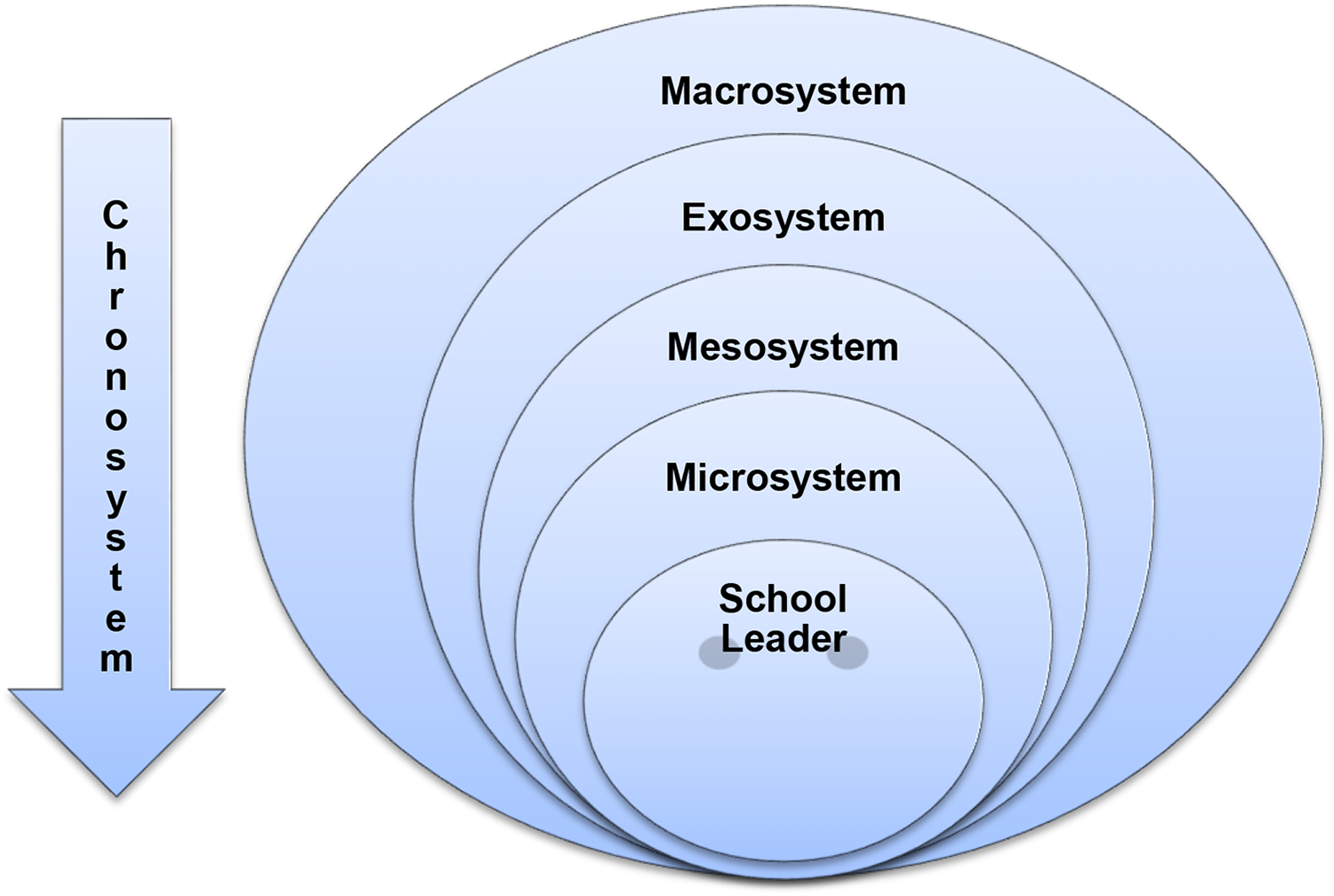
Ecological development theory to explore educational leadership experiences.
The microsystem being positioned closest to the individual, pertains to one’s personal relationships with significant others including family, relatives, coworkers, and so on. For an educational leader, the microsystem is important for the process of identity formation, as the leader ‘internalizes this identity through experiences and feedback from significant others’ (Ely et al., 2011 as cited in Patel and Buiting, 2013: 20).
The mesosystem refers to the linkages between significant others, and how those relations impact the individual. While, the exosystem refers to the impact of social structures such as government, economy, religion and mass media.
The macrosystem refers to the larger socio-political context or the dominant ‘culture’ prevalent within the society, exerting a uni-directional influence on other subsystems. For instance, if gender stereotypes are an important element of the macrosystem, then social role expectations will result in differences between the behaviours and attitudes of male leaders and female leaders (Weyer, 2007). Finally, the chronosystem refers to changes over time which impact upon the individual (Bronfenbrenner, 1995).
Employing the ecological approach to understand the leadership experiences of school head teachers enables the researcher to systematically unpick the various influences surrounding an educational leader (Skinner, 2012). Allen et al. (1998: 67) correctly states that, ‘the ecological approach inherently recognizes the complexity of our world, while simultaneously helping us understand it’.
Given the overarching patriarchal society, which still provides a backdrop for educational leaders in contemporary Pakistan, this study aims to investigate the differences in lived experiences of male and female secondary school head teachers. The study provides answers to the following research question: What is the significance of gender for defining the leadership experiences of secondary school head teachers in Pakistan?
Research methodology
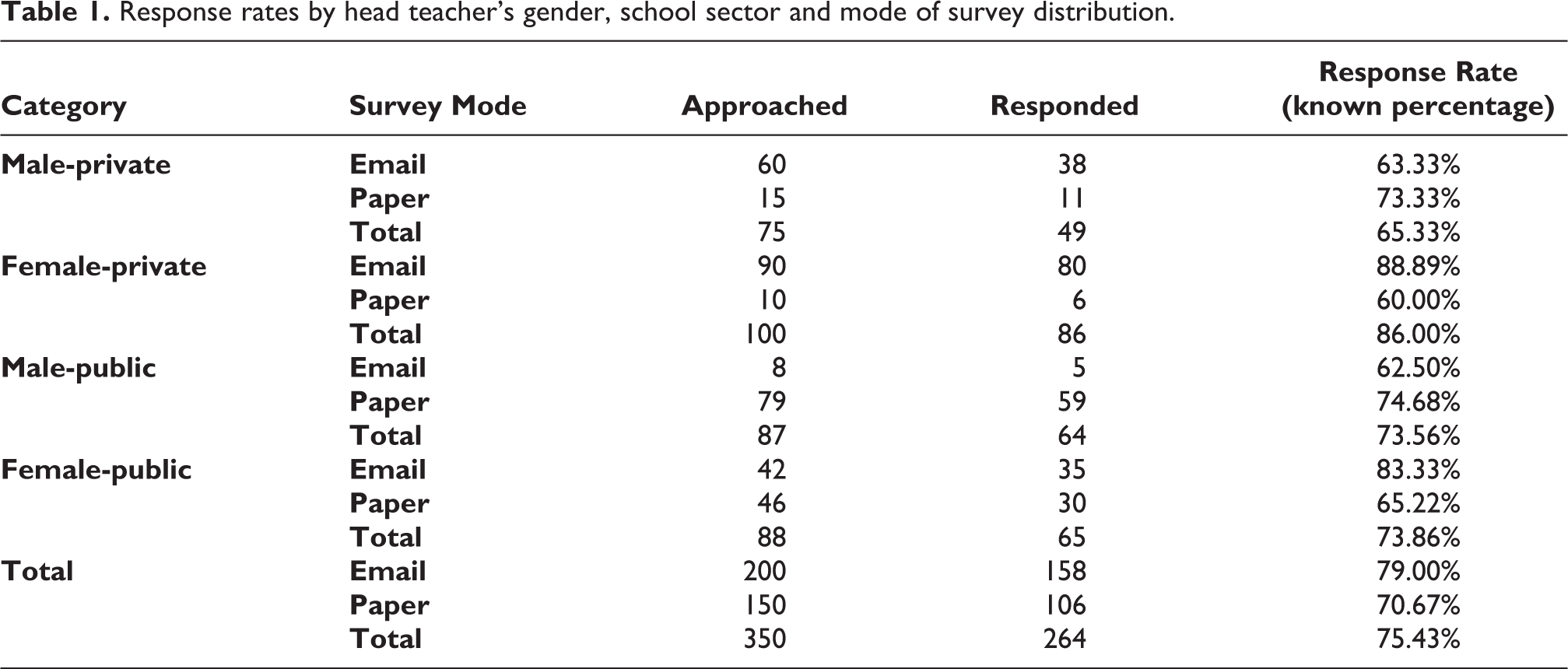
This paper presents findings from the qualitative research segment of a mixed methods study. A quantitative survey was conducted to determine the relationship between demographic factors including head teacher’s age, experience, gender, school sector, school locality, income status of student body and three leadership styles including transformational, transactional and passive-avoidant leadership. Out of 350 randomly selected secondary schools located across nine districts of the Punjab province, 264 head teachers responded to the Multifactor Leadership Questionnaire (Avolio and Bass, 2004). Punjab was selected for this study as the researcher hails from Punjab and could gain easier access to research participants.
Table 1 provides survey response rates.
Response rates by head teacher’s gender, school sector and mode of survey distribution.
Fourteen head teachers were purposively selected for semi-structured interviews from among the survey respondents. The interview sample was selected on the basis of the head teacher’s willingness to be interviewed, the leadership scores, at least a 3-year head teachership tenure, equal representation of males and females and of public and private schools, in addition to maintaining a fair representation of the nine districts and the head teacher’s availability to be interviewed during the fieldwork time frame. Table 2 provides the demographic characteristics of the interviewees.
Demographic characteristics of the interviewed head teachers.
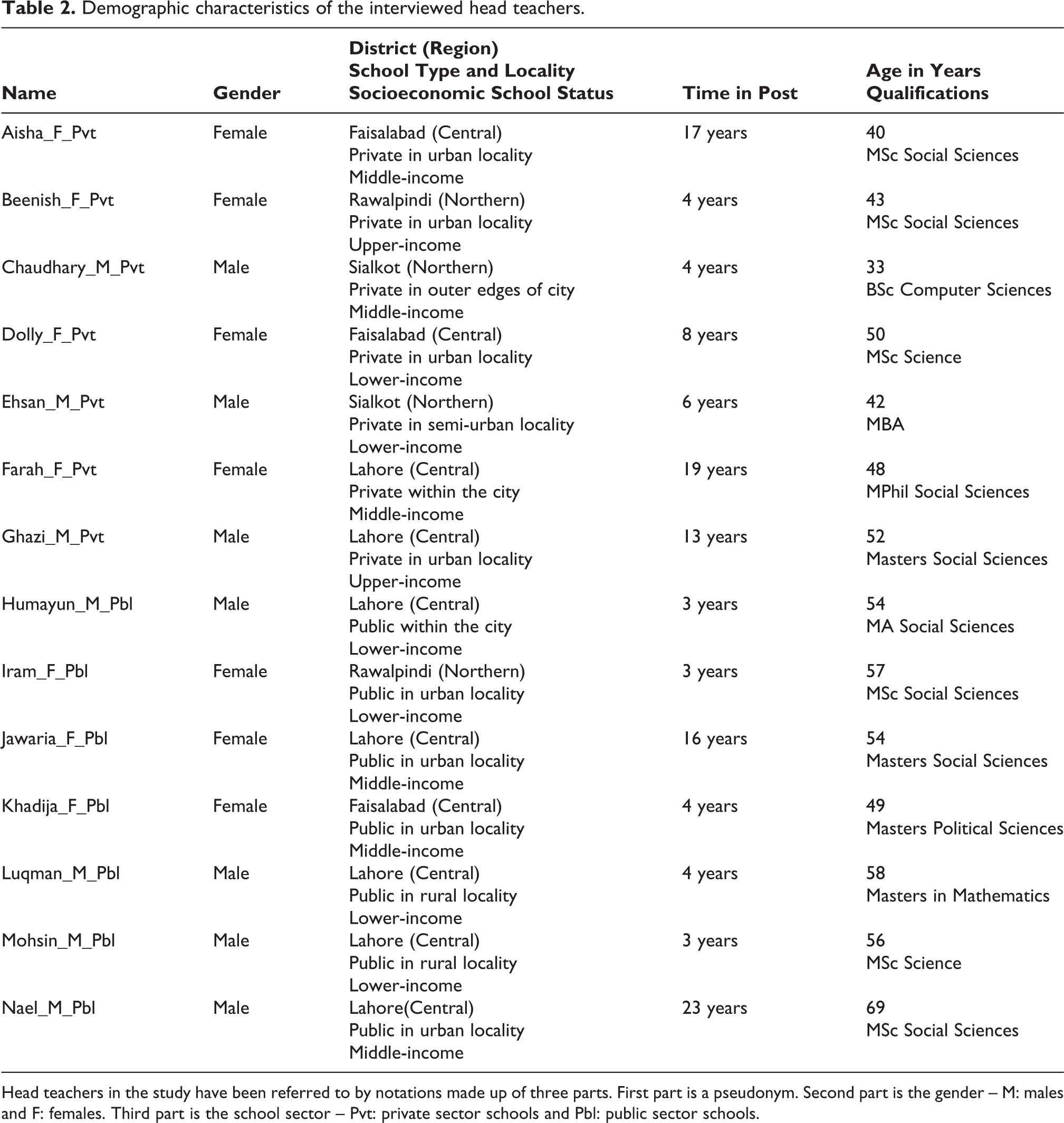
Head teachers in the study have been referred to by notations made up of three parts. First part is a pseudonym. Second part is the gender – M: males and F: females. Third part is the school sector – Pvt: private sector schools and Pbl: public sector schools.
The interviews were conducted within the head teachers’ school offices, during school hours, and they lasted for up to 2 hours. Ethical guidelines were followed and issues related to confidentiality and anonymity were addressed by using pseudonyms.
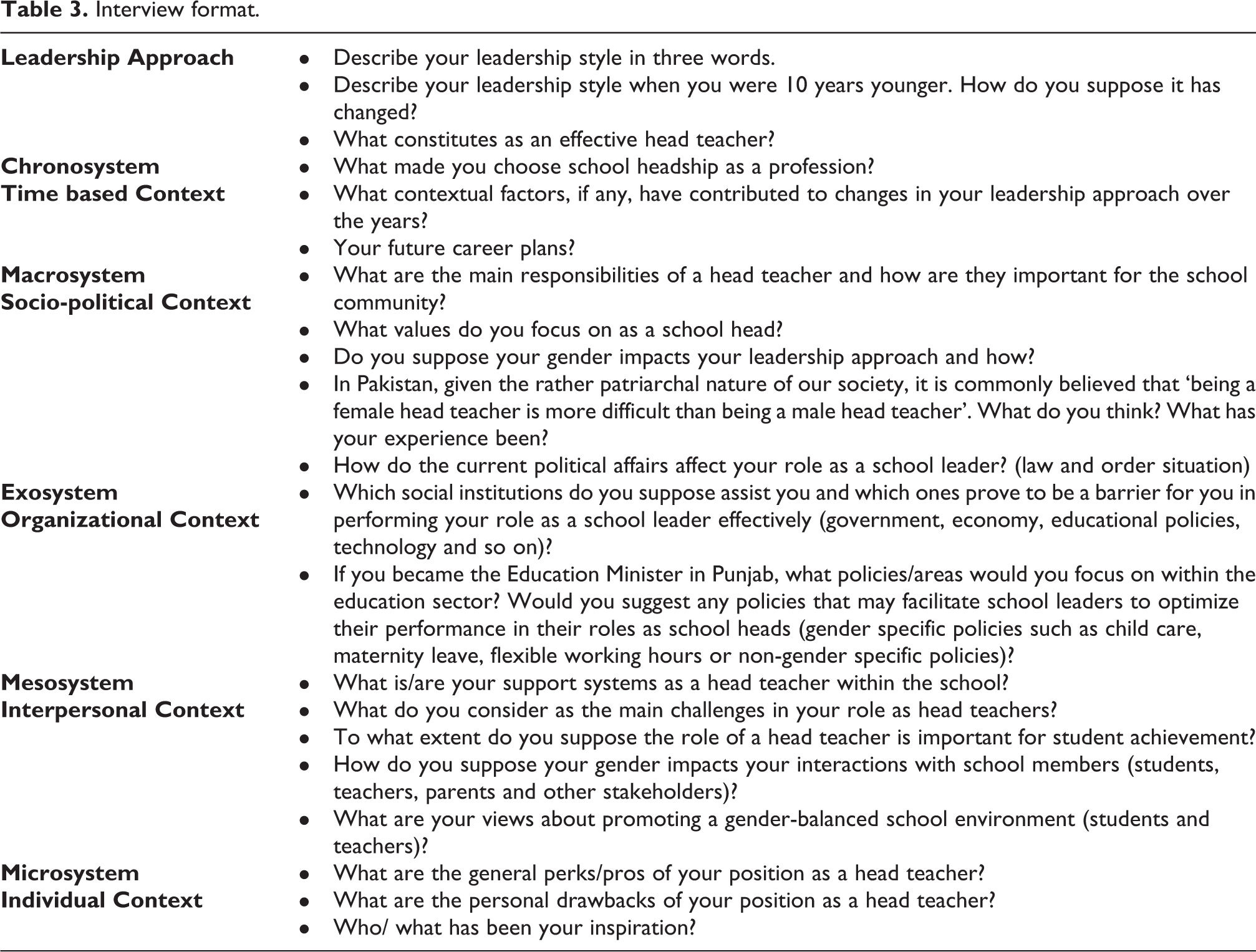
Bronfenbrenner’s ecological development theory classifies the context based on five ecological subsystems surrounding individuals. The interview questions were based on issues related to school leadership within each ecological subsystem. Table 3 provides the interview format.
Interview format.
Data analysis
The interview data was analysed by employing a combination of analytical methods. The thematic analysis technique (Braun and Clarke, 2006) was combined with an inductive analysis technique (Peus et al., 2015), in addition to applying Silverman’s (2006: 299) ‘appropriate tabulations’ technique which refers to simply counting the occurrences of each code across the entire data.
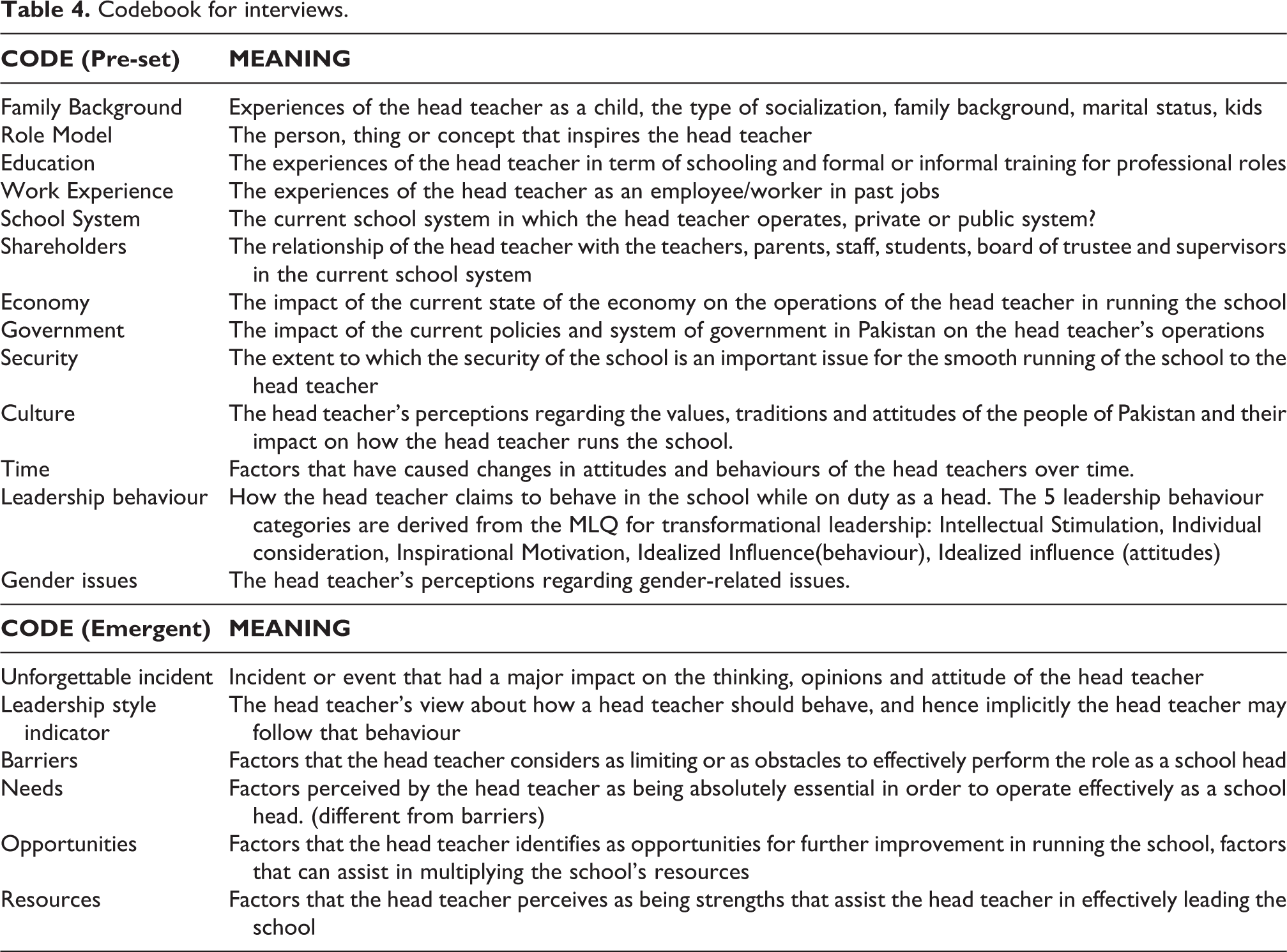
Firstly, thematic analysis was conducted across each individual head teacher’s interview, then it was conducted across the two school sectors and finally it was conducted across the two gender groups. During thematic analysis, phrases and words were highlighted corresponding to pre-set codes using NVivo. In addition, those phrases and words which could not be labelled under pre-set codes, however which appeared often in the data and were narrated by the interviewees with great detail and emphasis, were added to the list of emergent codes. Themes were then created based on patterns emerging from the codes. Table 4 provides the Codebook.
Codebook for interviews.
Research findings and discussion
This section presents interview findings that highlight the significant role played by gender in the leadership journeys of head teachers in this study. Interview quotes were selected based on their representation of gender-based differences.
Chronosystem
Confidence levels
Six females expressed confidence in their roles as head teachers; however, a prominent theme within the chronosystem was that all seven females had experienced low self-confidence in their abilities to perform effectively during the initial phase of their appointment as school heads.
The following quotations exemplify this theme: ‘Initial days were very difficult, I was not trained for this position and I was very young’ (Aisha_F_Pvt). ‘Well when I became the head teacher, I felt very motivated, but at the same time I was scared…heh…it was a big challenge…’ (Beenish_F_Pvt). ‘I was told in the beginning that I won’t be able to do anything…’ (Jawaria_F_Pbl).
Farah_F_Pvt recalled, ‘My gender was an issue when I first became a head teacher, as I was appointed at a public school for boys…in a very conservative society…I had to fight to establish my authority in front of influential parents…'
None of the male participants mentioned feeling ‘scared’ or being told that they won’t be able to do much; rather they expressed a sense of self-confidence from the beginning of being appointed. The acknowledgement of experiencing resistance towards establishing one’s authority as a school leader, the feeling of being inadequately trained or of being discouraged at the start of one’s leadership tenure, indicates a systematic difference in the perceptions of leadership ability according to gender. This finding implies that within a patriarchal society, when females become leaders, their leadership capability may be doubted, not only by themselves but by others as well, until they prove themselves to be effective. This finding corroborates with Coleman’s (2003, 2007) study of male and female head teachers in UK which identify gender-related challenges, especially for newly appointed female head teachers.
Macrosystem
Females leaders perceived as ineffective
An analysis of the macrosystem revealed strong sentiments regarding the perceptions of male colleagues about ineffective leadership capabilities of females as school leaders in Pakistan. The following quotations exemplify this theme.
Chaudhary_M_Pvt stated, Females, they do not want to delegate, they want to do everything themselves…this puts high pressure and reduces performance…I think because of the fact the females are not good at delegating, male leaders are better in the school…females have less exposure and lesser friends, they may not be too comfortable in interacting with others, and this can be a disadvantage for them…the core reason is that parents discriminate, they may not educate the daughters as much as boys. Women views are limited. Girls are getting fewer opportunities while males are self-dependent. A woman’s view is narrowed down, limited, so women think at small level, due to low exposure, males have made them dependent, males have suppressed them and females have not taken initiative. When females come into authority, they don’t know how to use it, they become controlling. I feel female heads, since they are females, need to prove something, because let us be honest, females are treated as second class citizens almost everywhere, so as a head they at times just don’t know how to handle the authority, they may become too aggressive and personal or they are too diplomatic, rather than coming straight on the issues. Women are weak, they try to control others, so they become rude in the process. If a female is a head, there are more problems, males are friendly. Our female heads are very corrupted, in fact I know a female EDO, who is not only corrupt, but she is physically corrupt as well. Women are more self-conscious as compared to men, this is because they are exposed to more restrictions in life, so when they are given a leadership position they don’t know how to handle it well.
Two out of seven male head teachers viewed female leaders positively. Mohsin_M_Pbl stated, ‘Female head teachers…their behaviour is good, professional interaction with them has been good, they are very helpful’.
Moreover, Nael_M_Pbl stated, Females are more sensitive than male head teachers. They are also more hard working than male head teachers…I have found that female head teachers are very good with school cleanliness, they have better work ethics, and their public dealing is much better. They dress well, and they have an overall good impact on students.
Spiritual approach
Even though the interviews did not contain questions related to spirituality or religion, the issue of spirituality as a guide for leadership emerged within interview responses of four female head teachers while discussing their values.
Aisha_F_Pvt stated, For my students and teachers, I focus on inculcating honesty within themselves, to have a firm belief in Allah, and to follow the basic rules of Islam which include performing your job with complete honesty and sincerity and to work hard.
References to spirituality were absent from interviews of males. This finding shows how women who find themselves in leadership positions within this society, may find direction and confidence in their roles not through effective leadership training nor through the society’s encouragement but rather through their belief in a higher force that helps them and guides them. This finding aligns with Showunmi and Kaparou’s (2017) study of women educational leaders from Pakistan who discuss their spiritual approach to leadership. In a society characterized by male privilege and the normalization of male leadership at the expense of females not being viewed as natural leaders, the belief in the aid of a higher power hence may become a female’s self-preservation strategy.
Mesosystem
Importance of familial support
Within the mesosystem, family support emerged as an important facilitator enabling females to perform their role as head teachers. Six females mentioned that their husband’s encouragement or mother’s assistance with childcare and household duties enabled them to acquire leadership positions and to perform their duties as head teachers. Beenish_F_Pvt stated, Well I got married at the age of 25…I have 3 kids…then I went to university and did my Masters…my mother was a housewife, so she was there for my kids, and my husband was okay with looking after the house. My husband is highly supportive, he pushed me to apply for this job…today I come here every day, I go home late in the evening, but my family, my in-laws and mother are all my main strength, to be able to focus on my work.
The high importance of family support for females to be able to successfully undertake school leadership roles was an emergent theme. In contrast, no male participant referred to familial support as being important. which highlights dependency on familial support as being a minimum requirement for a female to reach a point of self-actualization in this society, rather than her inner motivation or ambition enabling her to become a school leader (Maslak, 2008).
Microsystem
Sacrificing family life
Within the microsystem, females reported work-family conflicts associated with their profession, while males did not. Females mentioned missing out on family time as a personal disadvantage of being a head teacher.
For instance, Aisha_F_Pvt confided, ‘Personally the negative side of headship is that I have less time for my family, I have to work during the evening as well, these are uncertain conditions, they could be unplanned meetings…’
Khadija_F_Pbl revealed, ‘I have no maid, it becomes very difficult to take proper care of the house, since the school duties are so taxing and time consuming’. Iram_F_Pbl stated, ‘The daily work hours of a head are beyond the normal school hours, we have to think about the school 24/7, we can never switch off even when we are with family’. Jawaria_F_Pbl added, ‘I spent no time with my husband and children. No lunch, no breakfast, my house does suffer’.
This finding connects to the mesosystem, where without family support with household duties and child care, females are unable to become school heads in Pakistan. This reflects the prevalence of gender stereotypes that deem the primary role of women to be caretakers of the family, where women toil single-handedly towards performing the triple shifts of managing the house, children and leading a firm (Coleman, 2003). Eventually, the social system instils feelings of guilt and of not doing enough among females, while male leaders seem immune to such inner conflicts.
Higher respect
Five females reported high motivation associated with their role, ‘I work because this is something I love…you end up enjoying your role as a school head’ (Beenish_F_Pvt). ‘This is my third success institution…I never feel tired of my job’ (Jawaria_F_Pbl).
The issue of ‘respect’ also emerged naturally for females, who perceived their role of a school head as a source of respect within the community. Dolly_F_Pvt confessed, ‘the main benefit of being a head teacher is that people are in their limits, everyone respects you, everybody will be in his or her limits and they regard you and treat you with courtesy’. Farah_F_Pvt stated, ‘The main perk of being a head teacher is the title, nothing else; you gain a lot of respect’. Within the public sector, Khadija_F_Pbl suggested, ‘There is high ‘izzat’ (respect) in this profession, support from family and society…especially for females’.
Contrastingly, four males (Ghazi_M_Pvt, Ehsan_M_Pvt, Humayun_M_Pbl and Luqman_M_Pbl) indicated a low motivational level associated with their roles as head teachers. Ghazi_M_Pvt declared, ‘…a peon of the school has more going for him than me…I teach subjects, I enjoy being a teacher more than being a head’. Ehsan_M_Pvt said, ‘my basic motivation was learning as a head teacher, but now boredom has set in’.
Within the public sector, Humayun_M_Pbl mentioned, ‘I didn’t really wanted to be a head teacher after serving as an EDO’. Luqman_M_Pbl stated, ‘there are no perks of being a head teacher…none. I just have a good time while teaching maths’.
Only one male, Chaudhary_M_Pvt revealed, ‘…so it was a high investment initially to start this school, but now I have started to enjoy being the head of a school…after four years basically’.
The findings adequately demonstrate why a female may still want to strive to obtain a leadership position in a society that presents multiple barriers to female leaders. . When a female finally experiences respect in her role as a leader, after sacrificing her family life, feeling guilty for ignoring her socially defined primary duties, exposing herself to criticism about her capabilities and facing challenges to establish her authority, this experience becomes so uplifting that she is bound to describe it with words such as ‘I love’, ‘enjoying’, ‘never feel tired’ and so on.
In contrast, most males drew a pessimistic image of school leadership by using words such as ‘boredom’, ‘I didn’t really wanted’, ‘no perks’ and so on. It seems as if the struggle is what possibly adds to a feeling of accomplishment, which remains true for females but for males the lack of struggle is what potentially adds to their lack of motivation. The notion of respect or ‘izzat’ as a female head teacher in Pakistan also emerges in Showunmi and Kaparou’s (2017) study comparing women leaders in Pakistan, Malaysia and England. Shah (2010: 38) suggests that the concept of ‘izzat’ (respect) reflects ‘a powerful discourse that determines women leaders’ professional practices and roles in Pakistan’.
Sources of inspiration
One’s sources of inspiration reflect one’s true inner self. In regards to what inspires head teachers, females found inspiration from transformational male role models or from their fathers, while males referred to more varied sources of inspiration.
Aisha_F_Pvt stated, ‘I try to follow the footsteps of the Holy Prophet, also my inspiration has been Nelson Mandela, he fought for the country even in prison’.
Dolly_F_Pvt stated, ‘Hazrat Umer was a transformational leader, he really contributed to Islamic expansion, he said that a leader should be soft, empathetic and there should be no compromise on rules. He is my inspiration’.
Farah_F_Pvt stated, ‘My biggest inspiration is my father, he gave me a lot of confidence’.
Contrastingly,Ehsan_M_Pvt stated, ‘For me, my inspirations include my father, mother and a teacher’. Luqman_M_Pbl stated, ‘My mother was my inspiration’. Chaudhary_M_Pvt stated, ‘Quaid-e-Azam, Allama Iqbal, Imran Khan and motivational trainers inspire me’.
Mohsin_M_Pbl was inspired to fight poverty through education, while Ghazi_M_Pvt was inspired by his primary school head teacher from when he was a pupil.
The findings indicate that females may be more likely to locate effective leadership within the masculine domain in a patriarchal society (Blackmore, 2002; Shah, 2015, Northouse, 2010), rather than celebrating strong historical female leaders, which also confirms the findings from other leadership studies in Pakistan (Aziz et al., 2017; Showunmi and Kaparou, 2017). Moreover, the finding related to fathers often being considered as sources of inspiration, particularly for female participants, indicates that the father’s parental style may be a significant factor for leadership style development in patriarchal settings (Towler, 2005), however this requires further research.
Research implications and conclusion
The ecological approach reveals a gendered story of educational leadership in Pakistan, where the chronosystem, macrosystem, mesosystem and microsystem are infused with gender biases such that female school heads have to fight to establish authority, encounter misogynistic attitudes, rely upon familial support, gain spiritual strength from a higher power and face guilt for sacrificing family life. Contrariwise, male school heads appear to consider themselves as natural leaders, confidently criticizing a female’s leadership skills yet they are not motivated in their jobs. The study purports the importance of females as valuable human capital resources who should be nurtured to achieve greater heights rather than being suppressed by socio-cultural restrictions. This study highlights the need to consider culture when researching educational leadership, as well as some of the issues of gender equality in this emerging market country with a patriarchal history. It calls for further research to be conducted into the education, leadership training and support for women in education in similar cultural contexts.
Footnotes
Declaration of conflicting interests
The author(s) declared no potential conflicts of interest with respect to the research, authorship, and/or publication of this article.
Funding
The author(s) disclosed receipt of the following financial support for the research, authorship, and/or publication of this article: This work was supported by the Cambridge Commonwealth Trust and the SMUTS Memorial Fund.
