




Abstract
Black feminist theory often focuses on the experiences of adult Black women, with limited consideration given to Black girlhood; many in the field of Black girlhood studies call for a deeper theorization of Black feminist theory in relation to Black girlhood. I use an intersectional lens of race, gender, and age to argue that our current understanding of controlling images can benefit from more fully theorizing how Black girlhood becomes subject to systemic violence and dehumanization. Using ethnographic methods at a local 6th- to 12th-grade school, I demonstrate how the controlling images of Jezebel, Sapphire, and Matriarch in the making—an iteration of the Matriarch—distinctly impact Black girls. Moreover, I distinguish how age creates slippages in how these controlling images are experienced. These slippages occur mainly when school staff deny Black girls their age-appropriate sexual exploration and development, and instead allow sexual violence, framing them as angry corrupting influences on others in the school. Such girls are seen as in need of carceral control. I contribute to the literature on Black girlhood studies, Black feminist theory, and the expectations of adulthood among young Black girls in schools to showcase how Black girls vacillate between being seen as adults and as children, furthering negative controlling images placed onto them.
Black feminist scholars argue that Black women’s oppression at the intersection of race and gender similarly affects Black girls, with little consideration of the role of age (Collins 1990; Combahee River Collective 2014; Crenshaw 1991). In this article, I consider whether Black girls’ age is a crucial marker in discrimination against Black girls, particularly relating to controlling images. Patricia Hill Collins’s path-breaking work (1990) reveals a typology of several controlling images that represent harmful and consequential tropes about Black womanhood. Collins demonstrates that the controlling images of the Mammy (docile caretaker), Matriarch (domineering head of household), Jezebel (sexual deviant), Welfare Queen (lazy, exploitative mother), and Lady (middle-class, respectable lady) each frame Black women as social problems and seek to legitimate inequality, punishment, and material violence. bell hooks (2014) offers a similar analysis by highlighting how “specific images” of Blackness represented in the media strengthen and control the oppression of Black people and reinforce white supremacy. This early Black feminist scholarship typically focused on the lives of Black women (Collins 1990; Combahee River Collective 2014; Lorde 2020), whereas recently Black girlhood scholars have pushed the literature to think through the intersections of race, gender, and age toward deeper theorizing around Black girls’ lived experiences (R. N. Brown 2009; Evans-Winters 2017; Morris 2016; Ray 2022; Smith 2019).
For example, Ruth Nicole Brown’s (2009, 1) foundational work defines Black girlhood as “representations, memories, and lived experiences of being and becoming in a body marked as youthful, Black, and female.” Within this frame, Black girlhood scholars have examined Black girls’ marginalization and resistance in cities, schools, social media, homeless shelters, and beyond (Cox 2015; Ladner 1971; Morris 2016; Wade 2024) through the lens of Black feminist theory (K. Brown 2022; Halliday 2024; Wade 2024). But the growing field of Black girlhood studies still lacks a deeper theorization of how Black women’s and girls’ experiences converge and differ.
Schools are sites of education and care, but also engines of inequality and even harm (Baldridge 2018). Knowing that schools are sites for racialized gendering among adolescents (Ferguson 2000; Thorne 1993), I ask broadly: Do Black girls face the same controlling images as Black women, and if so, do they work in the same way? The existing literature might suggest that, due to the adultification process (Epstein, Blake, and González 2017; Ferguson 2000), whereby Black girls are typically evaluated as much older than they actually are, Black girls may experience the same controlling images in schools faced by adult Black women (Morris 2016). In contrast, in this article, I reveal that, while at times facing oppression similar to that of Black women vis-à-vis controlling images, Black girls also face critical differences in the application of controlling images because they are marked as youthful.
I ask the following questions: How do educators apply controlling images to young Black girls enrolled in urban schools? How do Black girls experience the intersections of race, gender, and age as they navigate schooling? I examine these questions through a three-year ethnographic study at a majority–minority 6th- through 12th-grade school in South Central Los Angeles. This study draws on more than 400 hours of participant observation in the field and 25 supplemental in-depth interviews in the school. I find that Black girls experience harm in schools based on iterations of three controlling images: the Jezebel, the Sapphire, and the Matriarch in the making—an iteration of the Matriarch that is used on young girls. In this article, I demonstrate that these controlling images, at times, mimic how they have traditionally been applied to Black women. However, my work also reveals that the social location of being underage produces unique and specific differences in Black girls’ experiences with each of these controlling images.
Ultimately, I argue that educators in majority–minority public schools deny Black girls access to girlhood through controlling images in three main ways: denying their vulnerability to sexual violence while dismissing their age-appropriate sexual exploration and development; framing them as angry and in need of social control; and framing them as a corrupting influence in the school.
Literature Review
Black Feminism and Controlling Images
Black feminist scholarship is invested in how both subjective and external interpretations of Black womanhood and girlhood shape the lives of Black women and girls (Luna and Laster Pirtle 2022). In considering how others perceive Black women, Black feminist scholars widely rely on the concept of controlling images to explain how harm to Black women and, to some extent, Black girls, is legitimated (Collins 1990; N. Jones 2009). Including Collins’s original archetypes, there is a broad range of scholarship on how controlling images, including the Matriarch, Jezebel, Sapphire, Welfare Queen, Mammy, Criminal, and Respectable Lady, police Black women’s and girl’s behavior (Collins 1990; Friedman and Hitchens 2022; Harris-Perry 2011; N. Jones 2009; Murphy 2024).
For example, the Matriarch reflects the pathologization of Black mothers as heads of households in the Black home; rather than a mother who is loving and caring, she is vilified as domineering, deviant, and a “bearer of incurable immorality” (Collins 1990; Roberts 1997, 8). Roberts (1997, 8) contends that the Matriarch controlling image reflects the belief that Black women “transfer a deviant lifestyle to their children that dooms each succeeding generation to a life of poverty, delinquency, and despair.” Reflecting the perception that Black women are the central, corrupting influence of the broader Black community, the image of the Matriarch creates the false yet popular narrative of Black women having control over Black men and children (hooks 2014; Sewell 2013).
Meanwhile, the Jezebel controlling image is derived from the assumption that Black enslaved women were “sexually aggressive,” deviant, and at fault for being raped by white men (Collins 1990, 81). Sexual violence continues to be justified post-emancipation under the Jezebel stereotype about Black women’s rapacious sexual appetites (Black Women’s Blueprint 2016; Emerson 2002; Harris-Perry 2011; Lomax 2018). Against these harmful tropes, Audre Lorde (2020) and other Black feminists (Lindsey and Johnson 2014) have pushed Black women to take control of their sexuality and use the erotic as a tool for liberation. It is not just adult women, but Black girls too experience the Jezebel controlling image when others punish and label them as sexually promiscuous (Morris 2016; Ray 2022; Wun 2016a). Given that a critical aspect of adolescent development is sexual exploration (Harden 2014; Schalet 2000; Tolman and McClelland 2011), it is worth examining how the Jezebel controlling image shapes Black girls’ constraints on sexual exploration during adolescent development.
Similarly, the trope of the “Sapphire” represents the angry Black woman characterized as “shrill, loud, argumentative, irrationally angry, and verbally abusive”; scholars understudy this controlling image because they assume the stereotype is true (Harris-Perry 2011, 48). Despite studies that confirm that Black women are not a particularly angry group and also do not self-identify as such (Walley-Jean 2009), people still perceive Black women as angry (Childs 2005; Harris-Perry 2011). Black women viewed as the Sapphire suffer significant social and economic consequences, such as being passed up for promotion in the workplace and labeled as aggressors (Harris-Perry 2011; T. Jones and Norwood 2017). Just like Black women, Black girls too are punished formally and informally in schools for ostensibly being irrationally angry and argumentative (Crenshaw, Ocen and Nanda 2015; Morris 2016; Wun 2016b). In line with Nikki Jones (2009), I find that the Sapphire controlling image not only frames Black girls as angry but also creates boundaries between “good” girls, who receive school support, and “angry” girls, who receive punishment. As demonstrated in the section above, studies show how controlling images work to frame Black women and girls as deviant social problems. What continues to be understudied is how Black girls being marked as youthful changes how the controlling images are shaped and applied to them. In this gap, a more complex understanding of how Black girls experience controlling images and the importance of age as an identity marker is gained.
Age, Race, and Gender in Schooling
Nikki Jones’s (2009) formative work highlights how Black girls navigate inner-city violence and controlling categories such as “good versus ghetto.” Her work suggests that Black girls have distinct controlling images they navigate because of their age, race, and gender. In her gendered counternarrative to Anderson’s (1999) work with Black men and boys who are understood as “street versus decent,” N. Jones (2009) shows that age is an important social location that Black girls must navigate in tandem with race and gender.
Age is a social construct that is given meaning through social actions, beliefs, and feelings (Laz 1998). People are expected to act their age based on an understanding of how someone at a given age should behave, highlighting the norms associated with age (Laz 1998). It is here, then, that adultification matters. Adultification is the process by which the behavioral norms of adult men and women are imposed on children, rather than recognizing that they are children and should be respected as such (Epstein, Blake, and González 2017). Adultification is far more pervasively used against Black children than against others. Scholarship on adultification shows that Black boys are seen as “not children” and therefore incapable of being taught (Ferguson 2000, 90). Black girls ages 10–14 face intense adultification compared with white girls (Epstein, Blake, and González 2017). Burton and Winn (2017), however, note that mistreatment of Black girls is not rooted in adultification. Rather, these harms are the result of dehumanization of Black girls. Similarly, others argue that current literature over-essentializes Black girls’ schooling experiences as adultification by universally applying Black women’s tropes to Black girls (Cox 2015; Ladner 1971; Smith 2019). Yet simultaneously, along with adultification, racist behavior and beliefs infantilize adult Black men and women, as seen when Black men are called “boys” and Black women become “girls” (Collins 1990). Given the histories of adultification and infantilization as central elements of racialized gendered oppression, what are the social realities of Black girls in schools? I complicate and build on the adultification literature by illuminating how Black girls oscillate between being seen as both adults and children, leading to their mistreatment.
Racism shapes Black students’ schooling experiences, as they are subject to higher rates of surveillance, harassment, and discipline, which hinders their learning and well-being (Ferguson 2000; McAdoo, Williams, and Howard 2025; Musto 2019; Rios 2011). Black girls often encounter schools as hostile institutions that subject them to gendered punishment (Ray 2022). Specifically, Black girls are often punished through informal practices that involve sending them out of the classroom, with no formal write-ups, for even nonviolent incidents such as talking back or perceived disobedience (Morris and Perry 2017; Shange 2019; Wun 2016a). Sometimes, their annoyance is justified because they are reacting to their mistreatment; however, instead of others recognizing Black girls’ annoyance as a reaction, Black girls are seen as the source of the problem, rather than the racism directed at them (Annamma et al. 2019; Morris 2016; Wun 2016b). Black girls are suspended six times more than white girls in the same age cohorts (Crenshaw, Ocen, and Nanda 2015). Many educators describe Black girls as incapable of having real futures (Shange 2019).
Studies show that middle school–age kids demonstrate intense and unstable emotional expressions, likely due to puberty changes and brain development associated with that stage of the life course (Rapee et al. 2019). Other studies indicate that schools play a crucial role in addressing the social and emotional learning needs of students through identity development, conflict management, social awareness, and relationship building (Zins and Elias 2007). Schools are central to supporting student growth, safety, and development (Atkins et al. 2017; Baldridge 2018), but what happens to Black girls whose experiences in school are shaped by the controlling images prevalent among educators? This article highlights how educators use controlling images, uniquely framed against Black girls, that harms them, and hinder their growth. Here, I examine the controlling images of the Jezebel, Sapphire, and Matriarch in the making and draw attention to the significance of age in our conceptualization of intersectional oppression.
Methods
Empirical Context
The orange and tan bricks of the large schoolhouse, Lloyd Garrison School (pseudonym), stand out at the end of the street in a neighborhood in South Central Los Angeles. The next street over is lined with mostly boarded-up and closed businesses. The school, which serves children in 6th through 12th grades, features a fence surrounding the external premises that separates it from the neighborhood. Lloyd Garrison School is a long-standing community institution. Founded in 1926, the institution has undergone a demographic shift from a predominantly white student body before desegregation to a majority Black student body in the 1970s and 1980s (Sides 2003), and now comprises mostly Black (43.4 percent) and Latinx (54.1 percent) students. While South Central Los Angeles has been a historic site of Black culture and life, studies show that Black families are leaving Los Angeles because of rising housing costs (Fry 2024). For this reason, Lloyd Garrison served as an ideal site—and perhaps one of the dwindling possible sites—in which to observe the experiences of Black girlhood in Los Angeles.
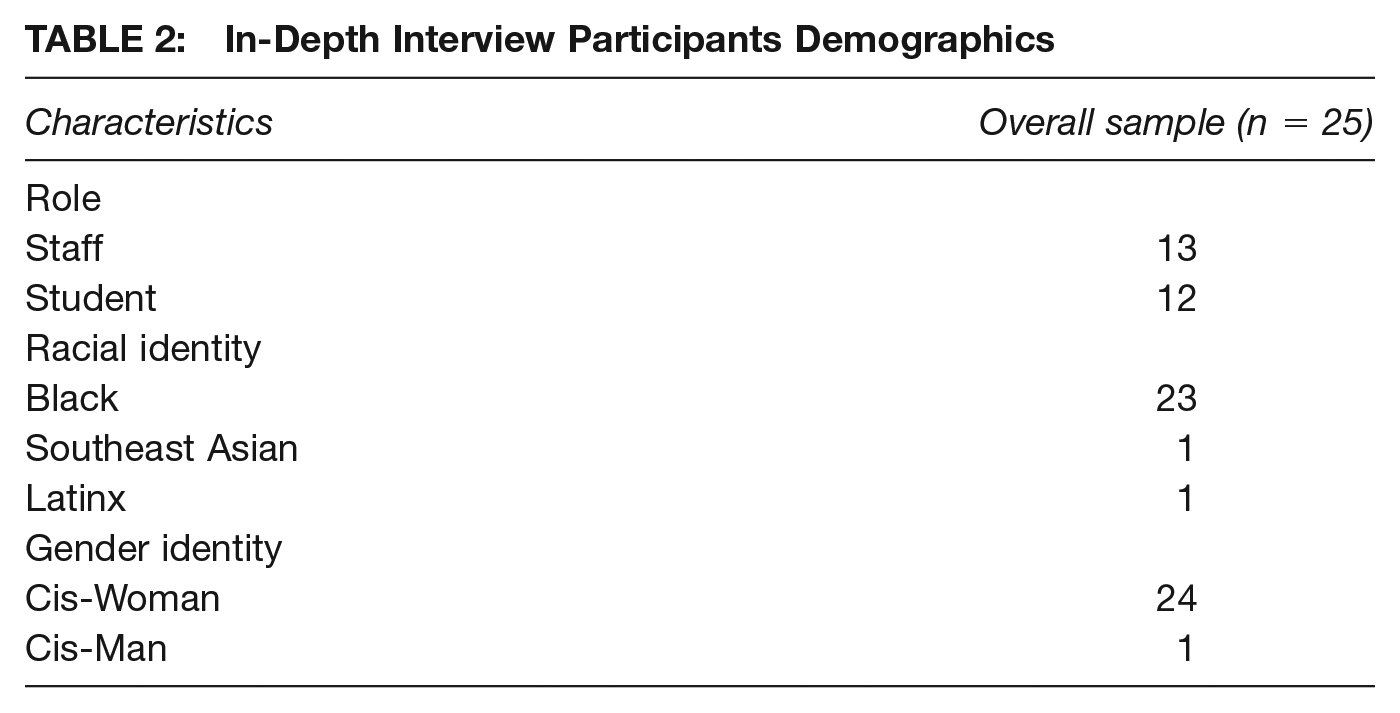
To understand how controlling images work to shape Black girls’ schooling lives, I conducted an ethnography and in-depth interviews at Lloyd Garrison School. The students come from low-income families, and 95.6 percent qualify for free or reduced lunch. Grades 6 through 8, on which my project is focused, serve students living in the neighborhood, with approximately 323 students. The faculty and staff at Lloyd Garrison are similar to the student population, with almost all being people of color. Many of the staff are Black. Although I note the demographic background of school staff in the racialized and gendered discrimination against Black girls (see Tables 1 and 2), in the interest of space, I do not make an argument in this article about the raced and gendered implications of educators’ behavior. In this article, I focus on the racialized gendering of Black girls as an institutional process within schools (Bonilla-Silva 1997; Duerst-Lahti 2005).
Ethnographic Participant List
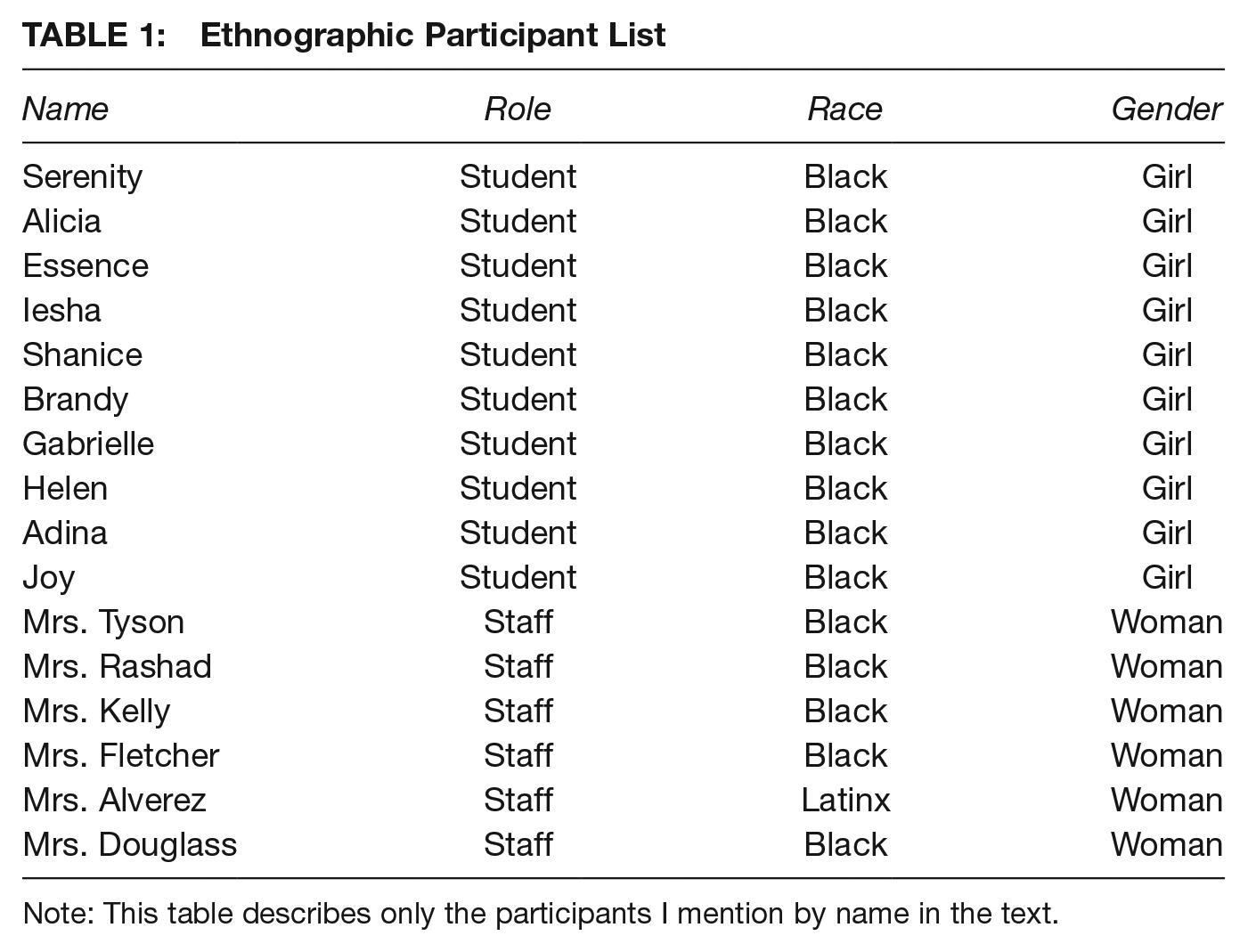
Note: This table describes only the participants I mention by name in the text.
In-Depth Interview Participants Demographics
Fieldwork
This study is based on 450 hours of fieldwork spread over three years of data collection between January 2021 and October 2024. I drafted field notes using a combination of handwritten field notes, typed notes on my phone, voice memos, and vignettes about my observations in the school. When I first entered the school, few clubs or organizations were available for middle-school students. Since then, the “girls’ group,” cheer, and dance team have been added as extracurriculars. Over three years, I observed five different weekly girls’ group cohorts, which I co-facilitated. Each girl’s group was composed of 10–15 girls, most of them Black. A school counselor created the girls’ group, and girls were selected based on the counselor’s discretion. The counselor reported selecting girls based on behavioral and academic needs. She wanted to target girls who were both struggling and succeeding socially or academically, to foster growth in those areas through the girls’ group. Although I was a co-facilitator of the group, I did not play a role in the selection process. From my observations, the group served as a safe space for Black girls in the school to participate in activities and discuss issues inside and outside the school.
I also observed the discipline and attendance office. In the discipline office, I gained access to check-in information and daily visitor log-in. In addition, I served as a teacher’s aide in the “career pathways in science” course. Table 1 lists the participants from the study, who are mentioned by pseudonym in the results section. This is not an exhaustive list of all the participants I encountered and observed throughout this project, but is intended to provide demographic information about the participants I describe in detail in the results.
As part of the project, I conducted 25 in-depth interviews with school members, including students, teachers, staff, and administrators. Twelve of the interviewees were girls from the girls’ group. I also interviewed the counselor who facilitated the girls’ group and five other counselors within the school. And I interviewed one administrator, four teachers, and two staff members. For anonymity’s sake, I am not naming the specific positions of the administrator and staff members. Of these 25 interviews, 22 interviewees identify as Black women or girls. One of the participants identified as a Black man, one as a Latinx woman, and another as an Indian woman (Table 2). The in-depth interviews were recorded and conducted both in person and via Zoom, depending on the availability or comfort of the participants. The interview instrument centered around challenges that Black girls face in schools, safe spaces, and policing.
I used an abductive approach to this study, constantly shifting my understanding between the theory and data to fully understand the empirical and theoretical contributions of this study (Tavory and Timmermans 2014). For data analysis, I cross-checked my observational field notes and interview data to validate my analysis of how controlling images are applied to Black girls in the school. Along with detailed field notes on how Black girls were treated by school staff, I conducted in-depth interviews in May 2022. In the in-depth interviews I used the patterns that arose surrounding the controlling images Black girls face to substantiate my observations in the school and vice versa. My interview and ethnographic data both framed the findings and provided insight into the codes and themes during the research process.
For this article, I entered the field with predetermined themes I was interested in, including policing in schools, gendered anti-Blackness, and safe spaces. Using abductive methods, I identified certain themes related to controlling images that emerged from my observation and interview data. I subsequently classified these observations into three controlling images: Jezebel, Sapphire, and Matriarch. Using these three categories of controlling images, I coded the interview data and field notes by hand. I learned from my observations and interviews that Black girls are mistreated in schools based on the controlling images of the Jezebel, Sapphire, and a youthful version of the Matriarch called the Matriarch in the making, which lead to Black girls being exposed to sexual harassment, being denied sexual exploration, experiencing increased scrutiny and control, and being defined as deviant.
Reflexive Statement
My positionality as a young, first-generation Black woman graduate student from a working-class background cannot be separated from my research. The many Black girls I encountered from my research all reminded me of someone, some place, or some instance in my own life, whether it involved me, my friends, sisters, cousins, mother, aunts, or ancestors. I felt the memories in the smiles, tiredness, frustration, and sometimes outright anger that I encountered within myself and others in the school while at my field site. Watching the mischaracterization and mistreatment of Black girls transported me through time to when I was their age, and similarly misunderstood and mistreated. When I first started this research project, I was a 22-year-old Black girl who grew up in Louisiana and spent my last four years at Howard University, a historically Black university (HBCU). Having thought my time at an HBCU healed the scars from the misogynoir 1 I faced during my elementary and secondary schooling, my field site was a reminder that some wounds never fully heal. Like the rain makes a broken bone ache, researching Black girlhood made those wounds from schooling reawaken.
Because I, too, was once a young Black girl, I understood how Black girls face controlling images and how they find ways to resist. My positionality helped in building rapport, gaining access, and building trust with respondents. My personal experiences positioned me, socially and epistemologically, next to Black girls, allowing me to center their experiences in this study. Given the demographics of the students and staff at the school, my positionality as a woman of color helped me avoid many obstacles that researchers face when entering a field site.
Results
The Jezebel: Penalizing Black Girls for Protecting Themselves
Black girls at Lloyd Garrison School, like Black girls around the United States, face over-sexualization because of their gender and race (Morris 2016; Ray 2022). I show in this section that, similar to Black women, Black girls are adultified and framed as responsible for their sexual assault. In addition, I illuminate that Black girls, because they are underage, are also deemed too young to explore their sexuality and thus are denied their autonomy over their sexual exploration, creating a culture of harm. Ultimately, I demonstrate that Black girls actually swing between being seen as children (too young) and as adults (too grown) in different situations, a phenomenon that is used to justify the Jezebel controlling image placed on them, and their subsequent mistreatment.
How teachers perceive Black girls’ sexualization differs from how Black girls view themselves. When I asked what challenges they believed Black girls faced in their school, many of the girls I interviewed first mentioned sexual harassment. These girls recalled “smack-ass Fridays,” a day when boys would grope girls in the school. That is, these Fridays are planned as a day when boys will sexually harass girls at the school, and the practice is widespread. Serenity explained how, one Friday, a girl repeatedly asked the boys to stop touching her, and they refused. Smack-ass Friday is just another reminder of the lack of autonomy that Black girls have over their bodies. The boys’ refusal to stop told the girls they could not reject unwanted touching. Furthermore, when they attempted to resist harassment, they exposed themselves to punishment. As Iesha, a sixth grader, explained, One thing that’s an issue Black girls face in school is when a boy is sexually harassing you, trying to touch your butt and touch on you and when we tell them to stop and they don’t stop . . . and then you get physical with them and start hitting on them. It is a problem.
Iesha noted that when Black girls reject unconsented touching, they are penalized by the educators, when it should be impermissible for boys to violate their physical boundaries. I observed that the punishment, besides having their sexual harassment ignored, often means being sent to the dean’s office or calling home. Although Iesha does not explicitly name a specific teacher who is part of this process, I observed how educators deny Black girls’ sexual harassment (below).
While working in the Dean’s office—also known as the discipline office—I sorted through student-filled incident reports that recorded issues they have at school. One of the reports detailed how a middle school–age girl at Lloyd Garrison is in a relationship with a 16-year-old high school student. The relationship began when she was 12 years old, and the boy refused to engage in sexual activity with the student until she turned 13. Once she was 13, the boy texted her, saying she is now “ready.” The report was made by the girl’s best friend, who was afraid that the 13-year-old girl was entering into an inappropriate relationship. I immediately brought the disturbing report to the attention of a staff member in the Dean’s office. I was then told that those things are the nature of having a 6th- to 12th-grade school where these different age groups have access to each other. Ms. Kelly, a Black woman staff member at Garrison who works primarily in the Dean’s office, explained that reports of sexual harassment often only give part of the story. She stated that “a lot of times, the girls provoke the boys. They start it, and when the boys retaliate by touching on them, they want to make a big deal and come to us about it.” Ms. Kelly here is adultifying Black girls; not only does she see the girls as overly sexualized and as sexual aggressors, but through such an understanding, she also denies the sexual harassment and assaults girls face in the school. From her perspective, Black girls are to blame for their abuse. She is perpetuating a “they wanted it” narrative applied to women who are victims of sexual assault. Adult acceptance of sexual harassment and sexual misconduct makes Black girls feel unprotected in their school. Specifically, Ms. Kelly, as a Black woman, is perpetuating the Jezebel controlling image of Black girls that the literature suggests she also faces.
Black girls are blamed for sexual violence inflicted on them, much like the well-documented experiences of Black women (Collins 1990). However, these dynamics of blaming the victim are further complicated because of the girls’ age and the reality that, as adolescents, the girls are also experiencing puberty and all the sexual and emotional developmental changes associated with puberty. The conversation quickly turned to boys during one of our girl group sessions in the 2022–2023 school year. The group of seventh-grade girls wanted to talk about relationships. Shanice took command, quoting Young Miami of the hip-hop group The City Girls, “my man my man my man. I love my man.” I questioned, “does your man know he is your man?” Her best friend, Brandy, quickly responded, “No, them boys don’t know her.” Amid the laughter, Gabrielle asked timidly, “What do you do when you like a boy, but you tell him that you don’t like him even though you do?” Afterward, the group is quickly redirected by Mrs. Tyson that although they may be interested in boys, school is their priority. I even echoed this sentiment, saying, “They don’t need to be thinking about boys. They are a distraction.” Later in reflection, I wrote, Can there be a space for Black girls that are safe for Black girls to explore their sexuality, to be interested in boys and not be victim of sexual violence and blamed for it? Can they be given the space to explore their sexuality and liking people? For my girls, is there a space where they can actually explore liking boys and have a boyfriend without constantly being redirected and told, like, oh, just focus on school, which is something that I find even I do at times in the group? And part of that could be because I know that schools and other spaces aren’t always safe for them to explore that. But like, how do we give them room to do that? Because they are of age where they are hitting puberty and are thinking about those things, rightfully so. How do we allow Black girls to think about those things and explore those things without being deemed a Jezebel?
2
Admittedly, even I curbed these girls’ attempts to talk about their sexuality and romantic feelings in this instance under the guise that they are too young to think about boys and should be focused on school. Yet I still can recognize that silencing reinforces the idea that these girls are too young, but also simultaneously too sexually agentic, and should not be thinking about boys. When Black girls are told not to be concerned with their sexuality, autonomy over their own pleasure and romantic agency is removed (Halliday 2024; Lorde 2020).
In addition, with the silencing of Black girls, coupled with the justification of sexual assault and subsequent punishment for resisting assault, the refusal to allow Black girls to talk about their sexuality creates a culture of harm against Black girls. Black girls are adultified in ways that deny their innocence and victimization and instead punish them for provoking Black boys’ attention. They are simultaneously infantilized when they express concerns about inappropriate behavior, yet they are also seen as grown-ups beyond their age when they express romantic feelings. Here, I use the term infantilization to highlight how, despite their behavior being a natural part of the life course for all children (regardless of race), Black girls are told they are too young to explore romantic feelings and connections (Harden 2014; Schalet 2000; Tolman and McClelland 2011). They are too young to have feelings for boys and to name sexual harassment correctly, but simultaneously acting “too grown” for putting themselves in situations to experience sexual contact. These two processes work in tandem to perpetuate the Jezebel controlling image of Black girls. The cycle opens Black girls up to both increased sexual harm and decreased opportunities for sexual exploration. For Black girls like Iesha, the only way to get out of sexual harassment is through fighting, which leads to even more punishment. Fighting is a punishable offense in school and, in my observations, often leads to detention and suspension. When Black girls are forced to use fighting to maintain their sexual autonomy, that agency comes at a price: punishment.
In all the scenarios described, Black girls are denied autonomy over their sexuality and pleasure. Here there is a unique distinction in how the Jezebel controlling image plays out for Black girls. Black girls and women both experience dehumanization through sexual violence that is justified through their perceived sexual deviance (Collins 1990; Harris-Perry 2011), as seen with “smack-ass Friday” and the denial of wrongdoing in the report by Mrs. Kelly. Black girls, however, experience a distinct added layer in this justification that is more than just “she wanted it” or “she’s promiscuous” because of how educators believe they should be acting at their age (Laz 1998). They experience penalization under the banner of being “too grown.” However, adolescence is a life stage where forming romantic attractions is healthy and a sign of human development. Thus, while the literature appropriately identifies the ways Black girls are seen as adults—adultification (Epstein, Blake, and González 2017; Ferguson 2000)—I also find that Black girls are unjustifiably seen as too young to engage in their own sexuality. Adultification and infantilization are simultaneously—if contradictorily—used as justification for their punishment, and even sexual assault. The adultification literature does not fully capture this dynamic in which the external perception of one’s age situationally shifts based on race and gender (Epstein, Blake, and González 2017). The paradoxical jump from “they are too young to think about sex” to “they are sexually promiscuous” or “too grown” highlights the incoherence in how Black girlhood is demonized. Black women do not face this accusation of being “too young” to engage in their sexuality, highlighting the unique ways the Jezebel controlling image is applied to Black girls.
The “Angry” Sapphire and Lack of Empathy for Black Girls
In addition to using the “Jezebel” label to justify the sexual abuse of Black girls and quell their sexual exploration, teachers and administration often leveraged the controlling image of the Sapphire (Harris-Perry 2011) to characterize Black girls as aggressive and combative. In my initial conversations with school staff, many spoke in a matter-of-fact way about Black girlhood as connected to aggressive and combative behavior, demonstrating the taken-for-granted and enduring stereotype of the Sapphire in the experiences of both Black women and girls (Harris-Perry 2011). This characterization framed not only how school staff viewed Black girls but also how Black girls experienced school. Like previous researchers, I find that Black girls face similar challenges to those of Black women framed under the Sapphire image, which justifies their mental health being ignored (West 1995). This denies them access to childhood by placing adult-level emotional regulation responsibilities on them (N. Jones 2021). Interestingly, I also find that Black girls’ position as children makes them susceptible to increased scrutiny under the guise of corrective control.
Black girls understood they are seen this way (Childs 2005; Walley-Jean 2009). Helen, a 13-year-old eighth-grade Black girl, admitted she is angry—but no school staff ever asked her why. If anyone did ask Helen, they would find out that she has lost both her mother and father and now lives with her grandparents. Her grandfather, her closest companion, underwent major heart surgery, and had a low chance of surviving. Her grandfather is also one of the few people who could pass down memories of her mother, who died when Helen was young. Helen shared with me that if she lost her grandfather, it also meant losing some of those memories and her last connections with her mother. The life burdens she bears would overwhelm most adults, yet she is given little grace. She has a lot to be mad about. Yet when Helen has angry outbursts at school, she is chastised for not controlling her anger.
Because of the endurance of the Sapphire image, Helen was viewed as an angry girl rather than one experiencing anger as a response to stress or trauma. Again, age plays a decisive role in how the Sapphire is read on Black girls. Helen stated that many teachers assume she is immature and incapable of learning or controlling her anger. Anticipating that she may be characterized as angry by educators, she felt compelled to rationalize her perceived anger and attitude by stating, “I can take it there, [but] I know how to control myself.” The assumptions that teachers have that she can’t control her anger, she stated, are assumptions made simply “because I am a Black girl”. Anger and irritability are reasonable human reactions, and increased emotionally charged reactions are standard for children this age (Rapee et al. 2019). Still, Black girls are not allowed access to these developmentally appropriate emotions without being characterized as a Sapphire. Black girls have to prove they can master self-control. Whereas in the previous section, where Black girls are described as concurrently adultified and infantilized, here, with the Sapphire label, Black girls are adultified and expected to regulate their emotions in ways that perhaps even adults cannot manage.
One afternoon, while walking from lunch to the girls’ group, we found the school implementing new rules. The school implemented “hard sweeps” of the hallways for 15 minutes before and after the bell. During this time, no students are allowed in the hallways, and anyone who is seen would be sent to the dean’s office. On our way up to the classroom, even I, the adult supervisor, am questioned about where I am going with the girls. While walking to our girls’ group, Mrs. Fletcher, a Black teacher, asked them where they are going. While Adina explained that they are going to the girls’ group, Joy, who has already told Mrs. Fletcher we are going to the girls’ group minutes before, yelled and cursed at Mrs. Fletcher. As Mrs. Tyson walked up behind us, Mrs. Fletcher declared, Mrs. Tyson you should know that some of your students are very respectful. I asked where they were going, Adina calmly and respectfully let me know you all were going to girls group, but Joy was very disrespectful and yelled.
Joy, who now looked visibly upset, explained to me that she did not mean to yell at Mrs. Fletcher, but she was having a bad day because the boys in PE kept picking on her and hitting her. She was also frustrated that Mrs. Fletcher had already asked her where they were going when she first got up the stairs, and she told her the girls’ group. Given how upset Joy was about the situation, I asked if she wanted to talk to Mrs. Fletcher, explain this to her, and apologize. Joy agreed. When we walked over to Mrs. Fletcher, she immediately blurted out in an overwhelmed voice, “I didn’t mean to curse at you like that. It’s just that I am already having a bad day, and I already told you we are going to the girls’ group.” Mrs. Fletcher interrupted, “I understand, but I have to know where you are all going, so I am going to keep asking.” The two went back and forth before Joy left, feeling that her apology was not received. Mrs. Fletcher ignored her frustration and refused to acknowledge how her own behavior could be perceived as harassment. I observed that Mrs. Fletcher is frequently involved in little spats with the Black girls at the school and seems to believe that Black girls need to be continuously surveilled to maintain order and control.
At first glance, it appears that Black girls are angry and have an attitude; therefore, they are often stereotyped as the Sapphires. However, girls like Joy are often reacting to their environment. Joy’s frustration with the harassment and surveillance she faced from other students and Mrs. Fletcher led to her “outburst.” Angry outbursts are developmentally appropriate for middle schoolers (Zins and Elias 2007). Yet Black girls are denied this age-appropriate behavior and instead are expected to remain calm to avoid being labeled “the angry Black girl.” As evidenced in the findings, these Black girls are dealing with circumstances that warrant their “attitude” or “anger,” but those circumstances are ignored. Helen and Joy are not “the angry Black girl”; they are dealing with trauma and stress from death, harassment, and surveillance. Just as Black women dealing with the Sapphire label experience the negation of their mental health concerns (West 1995), so do Black girls as they endure the same label. The adults in the school react with punishment instead of care. Lack of empathy for Black girls who face both personal trials and systemic oppression is a larger structural issue that oppresses Black women and girls across sectors (Wingfield 2019).
However, in the context of being young and in school, not only is Black girls’ emotional well-being ignored, but their perceived anger makes them targets of harassment and surveillance by adults at the school. The controlling image of “the angry Black girl” or the Sapphire morphs to fit any Black girl that an educator in the school seeks to reprimand. For instance, while walking from the girls’ group a few weeks later with Mrs. Tyson, we heard Mrs. Fletcher fussing at a student. She turned to us and said, “This one is always giving me an attitude.” When we looked up the staircase to see who she was talking about, we saw Adina. Mrs. Fletcher labeled Adina as having a bad attitude because she was walking on the wrong side of the staircase on her way to class. The same student she had praised for being respectful was now, a few weeks later, “always” disobedient and had a bad attitude for merely walking on the wrong side of the hallway. Mrs. Tyson and other staff often praised Adina for being a well-behaved leader. At Lloyd Garrison, the line between good and bad is thin, and the criteria for being labeled as the Sapphire constantly shift.
Black girls are denied access to girlhood because of the trope of Sapphire. Black girls like Helen and Joy are perceived as angry, having an attitude, and disrespectful, even though they are simply having an age-appropriate response to their life circumstances. Consistent with the life course, all children of this age are still developing their emotional management skills, and schools should aid, not hinder, students’ social and emotional learning needs (Zins and Elias 2007). These restrictions placed on Black girlhood stifle their ability to be children and dismiss the real-life mental health challenges the girls are facing. It prompts them to think that to be seen as acceptable, they must be hyper-aware of how their emotions are perceived. Without their humanity and girlhood recognized, Black girls are denied access to life and childhood.
Furthermore, Black girls face increased pressure related to the Sapphire image that is distinct from how the controlling image is applied to Black women. As children, their personal trials are overlooked. With traditional childhood often associated with joy and leisure, their hardships are minimized (Nordström 2024; Pellegrini and Smith 1998). As seen with Helen, no one considers what she faces at home. Black girls at the school face overworked and unsympathetic adults who do not consider the importance of having safe spaces in which they can develop autonomy and advocate for themselves. As Morris (2016) also found, any pushback, advocacy, or explanation of their action is met with accusations of being sassy, disobedient, angry, and even punishment. Where Black women who are seen as angry and irritable are penalized in the labor market (Harris-Perry 2011), Black girls’ particular location as children makes them susceptible to punishment and surveillance at school. Staff at Lloyd Garrison see it as their responsibility to “correct” or further harass students into submission to correct them from being sassy, angry, and irritable Black girls.
The Matriarch in the Making: “Domineering” Black Girls in the School
The controlling image of the Matriarch (Roberts 1997)—not to be confused with the Mammy (docile caretaker) (Collins 1990)—is posited as the masculinized mother figure. This image stereotypes Black women as domineering heads of households whose failures at femininity are the epicenter for the failures of the Black family (Sewell 2013). Framed as the antithesis of white femininity and the patriarchal family unit, the Matriarch image reflects assumptions that the Black mother is not a nurturer, but a corrupting influence on Black families. As described by Collins (1990) and Roberts (1997), the Matriarch is a controlling image specific to the domain of the family. At Lloyd Garrison, Black girls are similarly described as the source of the failures of the school and a corrupting influence on their peers. I find that school staff frame Black girls in ways that are similar to the Matriarch; however, Black girls’ positionality at Lloyd Garrison as underage, not mothers, and physically in school, situates them as not necessarily Matriarchs, but Matriarchs in the making. I conceive Black girls as the Matriarch in the making, or domineering Black girls, seemingly at fault for the failures of their peers and broadly the school. In the section that follows, I describe how school staff characterized one aspect of Black girls’ behavior, noting how this controlling image works and also the consequences of being deemed the Matriarch in the making.
The Matriarch in the making operates in ways similar to how the Matriarch works for Black women. However, Black girls’ age and location within a school mean their actions are typically about disrupting and “tainting” the school (instead of the family) with their pathology (hooks 2014; Sewell 2013). Such framings of Black girls as Matriarchs in the making often result in them being pushed out of school and, as seen in previous sections, justify sexual assault against them, deny their sexual exploration, and justify carceral control and harassment by staff.
Serenity and her group of friends are characterized as contributing to the ongoing fights and drama within the school. During the 2022–2023 academic year, the seventh grader was frequently mentioned in conversations with teachers and staff as someone who needed to be “handled.” Significantly, few staff members were willing to even deal with her. As a result, she could not join the girls’ group that year. With her constant referrals for intervention to the office, she did not return to the school the following year. Still, she remained an example with which the school administration described as “the root of the problem” within the school. Interestingly, Serenity knows she and other Black girls are characterized as the source of the problem. In an interview, she said she felt that Black girls are targeted at school because they are seen as “loud and ghetto” and deemed the issue in every situation, regardless of whether they are at fault or not.
One year after Serenity’s departure, in one of my debriefs, Mrs. Tyson, the girls’ group coordinator for the 2023–2024 school year, described the early issues the school is already facing weeks into the year, and stated that the problem remained “Serenity and them.” I immediately replied, “I thought she wasn’t at the school this year?” She replied, “She’s not, but you know, those girls who run with her.” I later realized that the girls she described as misbehaving are not friends with Serenity; some did not even attend school at the same time as her. It became clear that the “and them” associated with Serenity is just a placeholder for Black girls who are deemed a problem. In my observations, it is Black girls at Lloyd Garrison, and not Black boys or any Latinx students, who are cast as most problematic to school operations. In the eyes of Mrs. Tyson and many of the other educators, Serenity herself became a symbol of the disorder, loudness, fighting, disrespect, and sexual deviance that characterized Black girlhood and the core issue at Lloyd Garrison. Black girls’ representation as symbols for the core issues at the school illuminates how they are framed as Matriarchs in the making, or corrupting influences on their peers and the school.
Black girls who did not fit into those categories are the exceptions that Mrs. Tyson would describe as “different” and “not like the other girls.” The Serenity effect entrapped other Black girls at the school, relegating them to the role of Matriarchs in the making that the school has to handle. That Mrs. Tyson, a Black woman herself, pushed negative images of Black girls, should not be surprising; there is vast scholarship examining Black people perpetuating harm onto other Black people (Forman 2017; N. Jones 2018; Pattillo 2007).
Like Serenity before her, Alicia became a stand-in for The Matriarch in the making in the 2023–2024 school year. The seventh grader has a reputation for stirring up trouble among the students. She is a dark-skinned, queer, plus-sized student and is generally well liked by her peers. Mrs. Tyson believed that the great influence she seemed to have on other students is at the heart of her troublemaking. That school year, in particular, saw a significant uptick in fights that often stemmed from “he-said/she-said” drama. Alicia not only is labeled as a troublemaker herself but is also deemed responsible for the misbehavior of her peers. She is seen as a “leader,” but one who leads other students to mischief. However, while observing Mrs. Douglass’s “science career pathways” class, I observed that Alicia did not misbehave any more than her peers. In a class with a majority of Black and Latinx students, the class often lacked structure or management. Most of the students would often speak out of turn and walk freely around during instruction. Despite other students violating classroom rules, Alicia was singled out as the primary cause of trouble in the classroom and school. Because of the demonization of Alicia and the constant calling of her parent for misbehavior, her mother decided to remove her from the school. This abrupt removal meant that Alicia was out of school for a couple of weeks as they looked for another school for her to attend. When her mother tried to bring her back to Lloyd Garrison, the school administrators did not allow her to return, despite the school being her home school.
After several weeks without any in-class time, Alicia finally returned to Lloyd Garrison. Several weeks later, she was asked to leave by school administrators. She did not return. Serenity’s and Alicia’s pathologization as problem Black girls in school resulted in their being pushed out of the school. In their case, pushout remains a glaring issue that Black girls face in schools that deem them uneducable. Notably, their pushout is informal (Annamma et al. 2019; Shange 2019; Wun 2016b). They are not formally expelled but rather just advised to attend another school.
Another Black girl who became a symbol for the Matriarch in the making at Lloyd Garrison was Essence, a petite, high-spirited sixth grader depicted as having an attitude and stirring up other students. I was advised by the current dean, Mrs. Hughes, and counselor, Mrs. Tyson, to watch out for her. Essence was also in the “science careers pathways” course that I aided. Like most 12-year-olds in a classroom that lacks structure, she was known to have outbursts and talk during instruction, as did many of the students in this class. One key thing I did notice about Essence is that despite seeming off track in the course, she could answer every question the teacher had about the assignment. Essence was also part of the school’s dance team, and, as Mrs. Alvarez, a Latina staff member helping with the dance team, would say “Wait till you see her dance.” Essence’s vibrant dance skills matched her vibrant personality. Other staff members, like the Black restorative justice counselor, Mrs. Rashad, also noticed her talent in the arts, noting that she could have a career in acting. Unfortunately, Lloyd Garrison lacked the resources to help her hone her talents. Outside the dance team, there are no other clubs and organizations, such as theater and student council, for the students to join. To make matters worse, the school administration did not widely support the dance team; instead, they imposed extensive and unnecessary bureaucratic barriers in the 2023–2024 academic year that prohibited them from hiring a real dance instructor. Like Serenity and Alicia, Essence was pushed out of the school the next year. When I inquired about the reason for the pushout by staff, I was given little reason, just that “she had to go.” The girls’ premature departure from the school limited the ability to collect data on how they felt about being labeled the Matriarch in the making. It also speaks to the larger current climate for Black girls in schools, who are here one day and gone the next. The systematic violence against Black girls hindered even my capability to fully capture the extent to which these girls are aware of their characterization as a negative influence on the school.
While Essence was singled out as the source of the problem in the school for “acting out,” I suggested that the problem is actually the poor conditions and lack of resources at Lloyd Garrison. Essence was in a poorly structured classroom and attended a school that does not have many constructive outlets for students to participate in. Instead of efforts to provide the students with the necessary resources, the adults continued to frame Black girls as being the Matriarch in the making who needed to be handled. Here, controlling images are used to ignore structural issues within the school and blame the problem on Black girls. This individualizing of structural issues justifies the pushout and disappearance of Black girls like Essence and Alicia, who are unjustly deemed a problem.
For school staff, it is not the lack of resources or classroom management that is deemed the problem at the school; it is the Black girls. Like Black women, Black girls are labeled as the source and perpetrators of the problem of those in proximity (Roberts 1997); however, being in girlhood changes the context in which this image is imposed on them. Where Black women are framed as creating the problem of the Black family (Collins 1990), I argue that Black girls are framed as controlling entire groups of young people around them, leading to the overall dysfunctionality of the school, thus making them the Matriarchs in the making. Despite all students’ agency over their own behavior and its clear relationship to the missteps and lack of resources within the school, individual Black girls are still often the sole bearers of the issue. Consequently, they are frequently the sole point of intervention, as seen from school discipline to informal school pushout. This speaks to how, without addressing structural issues in urban schools, someone must bear the weight of responsibility. Here, it is Black girls.
Conclusion
Using the lived experiences of Black girls in schools, I found that Black girls are entrapped in school based on three controlling images that, at times, differ from what is known about these images from Black feminist sociologies. Specifically, their adolescence exposes them to greater levels of harm, surveillance, and control. First, the Jezebel image justifies sexual violence and denies sexual exploration for Black girls. Second, the Sapphire image subjects Black girls to adult-level emotional management while using their position as children to justify increased scrutiny and surveillance. Finally, Black girls are perceived as domineering, corrupting leaders, similar to the Matriarch, but their adolescence and their domain in the school make them Matriarchs in the making. My findings suggest that Black girlhood is a distinct life stage that necessitates analytical and theoretical precision within Black feminist frameworks, such as the concept of controlling images. However, this does not mean that Black feminist theory needs to be abandoned entirely for studying Black girls. It means that Black feminist theory can build upon itself by taking Black girls and Black girlhood seriously as an analytical tool to encompass the experiences of Black girls.
My findings on the Jezebel, Sapphire, and Matriarch in the making help fill the gap of tying Black feminist theory to Black girlhood studies. In line with previous literature that advocates for a focus on Black girls within Black feminist theory (Halliday 2024; Wade 2024), I use the analytical tool of controlling images to illustrate what this approach looks like in practice. This challenges education and Black feminist literature. First, adultification literature suggests that Black girls are treated as adults in schools (Epstein, Blake, and González 2017; Ferguson 2000), and this is used as justification for using Black feminist concepts that are created for women to study Black girls (Epstein, Blake, and González 2017; Morris 2016). My study builds on Ferguson’s (2000) conceptualization of adultification for Black boys and Epstein and colleagues’ (2017) understanding of adultification for Black girls. I demonstrate how adultification does not get at the entire experience of Black girls, because being underage does influence the ways controlling images are applied to them. Black girls in this study oscillate between being adultified and infantilized as justification for the application of controlling images.
Furthermore, controlling images are not useless in our study of Black girls; the specifics of Black girlhood (i.e., race, gender, and age) must be prioritized, not taking for granted what Black girls in schools can teach about oppression. Based on what scholars indicate about controlling images (Collins 1990), Black women (Harris-Perry 2011), and Black girls (Evans-Winters 2017), it is not surprising that Black girls in schools face oppression stemming from these controlling images. What is novel is how Black girls, being marked as youthful in schools, face increased scrutiny based on their perceived sexuality, attitude, and deviance. Black girlhood as a site at the intersection of race, gender, and age allows more precision in the theorization of controlling images by illuminating the unique application of these images based on age. Age has such an influence on Black girls’ treatment in schools that I identify a new application of the Matriarch controlling image as Matriarchs in the making. Where Black women are easily labeled the Matriarch, Black girls’ age complicates this application; thus, the Matriarch in the making becomes a more precise controlling image that accounts for Black girls’ pathologization in schools. Sociologically, this study benefits not only the study of Black girls but also that of Black women by moving toward a more nuanced conceptualization of controlling images that considers age. If age is ignored as an essential social location, it risks our not fully understanding how controlling images are applied to capture those they oppress—thus limiting our ability to fight oppression.
A limitation of this study is the restrictive scope of studying Black girls in the context of schools. Further research should examine how Black girls face controlling images outside of school. This will produce more knowledge on how Black girls face controlling images and how/whether this continues to diverge from our traditional conceptualization of Black feminism. Furthermore, this project grapples with how educators enact controlling images of Black girls in school. Given the school’s large Black population in staff and educators, further research should ask why these educators enact these controlling images onto Black girls despite facing similar images themselves. Finally, further research might examine how other racialized groups, such as Latina girls, experience similar and varying controlling images and how this expands a Black feminist understanding of controlling images.
The core of this project is a commitment that Black girls are important. Their experiences have significant potential to reveal insights into lived experiences at the intersection of race, gender, and age. They contribute to not only Black girlhood studies but also Black feminist theory. Following the Black feminist tradition of prioritizing lived experiences as knowledge production (Collins 1990), we must highlight the lived experiences of Black girls. Without an analysis of Black girls’ experiences, our analysis of oppression is left incomplete.
Footnotes
Author’s Note:
I am grateful to Jasmine D. Hill and Vilma Ortiz for their mentorship while working on this manuscript. I am also deeply appreciative to Alissa Bierria, Grace Hong, Uriel Serrano, Demetrius Murphy, Jarvis Benson, and the MERN working group for their extensive thoughts, comments, and feedback on this paper at its many different stages. I would like to express my overwhelming thanks to my participants for this project, especially the Black girls, for entrusting me with access to their lived experiences at school. This project was supported by the UCLA Center for the Study of Women|Streisand Center. Finally, I thank the anonymous reviewers for their feedback.

Notes
Pharren Miller (she/her) is a PhD candidate in the Sociology department at the University of California, Los Angeles. Her research interests include Black feminist theory, Black girlhood studies, education, carcerality, and abolition. She uses ethnographic observations, in-depth, and oral history interviews to examine the experiences of Black girls in schools. Ultimately, she explores if/how we can truly rebuild schooling to ensure Black girls’ needs are met through an abolitionist framework.