




Abstract
Drawing on gender structure and life course theories, this article examines how heterosexual couples “undo gender” in their work–family arrangements within the conservative context of Switzerland. Focusing on how gendered norms and expectations are challenged, we explore in a longitudinal analysis the influence of both partners’ gender ideologies on paid and unpaid work arrangements across family life stages. Using couple data from the Swiss Household Panel (2002–2020), we estimate pooled and fixed-effects linear probability models to analyze both between-couple and within-couple determinants in undoing gender. We find diversity in how gender is undone in paid and unpaid work arrangements across couples’ gender ideologies and family life stages: While gender ideologies consistently influence paid work arrangements, they affect unpaid work arrangements only for couples living with children. Strong egalitarian ideologies can overcome gendered norms and unsupportive institutions, especially when both partners share these beliefs. However, these ideologies only partially mitigate macro-level constraints. Still, a significant minority of couples challenge dominant norms, particularly in their paid work arrangements. Our findings highlight the need for policy reform to establish supportive institutions that empower couples to align their behaviors with their gender ideologies, paving the way for greater equality in the future.
Plain Language Summary
This article looks at how couples “undo gender” in their work–family arrangements in Switzerland, that is, whether couples adopt behaviors that lead to more equal and interchangeable economic and familial roles. Using data from the Swiss Household Panel (2002–2020), we explore how both partners’ beliefs on the best way to divide employment and family responsibilities for women and men (gender ideologies) affect how they organize paid and unpaid work at different stages of family life. We find that couples where both partners have strong egalitarian beliefs are the most likely to share paid and unpaid work more equally. While egalitarian gender ideologies influence paid work arrangements throughout family life stages, they only affect unpaid work arrangements for couples with children. Our findings highlight the need for policy changes to create supportive institutions that help couples align their behaviors with their gender ideologies, paving the way for greater equality in the future.
Keywords
When it comes to investigating gender inequalities, the division of paid and unpaid work within heterosexual couples 1 remains a central focus of sociological inquiry. In this article, we explore the interplay between couples’ gender ideologies and their work–family arrangements throughout the life course. To guide our analysis, we refer to the concept of “undoing gender,” as formulated by Deutsch (2007). This concept encompasses behaviors that lead to more equal and interchangeable economic and familial roles, ultimately fostering more egalitarian gender relations. In contrast, “doing gender” refers to behaviors in line with gendered stereotypes and norms, often rooted in essentialist beliefs about natural differences between women and men, thereby perpetuating gendered expectations. The “doing gender” theory (West and Zimmerman 1987) suggests that everyday interactions shape gendered expectations, but previous studies have often focused on behaviors reinforcing these expectations rather than challenging them. To address this, scholars (e.g., Butler 2004; Deutsch 2007; Risman 2009) emphasize the need to distinguish between doing and undoing gender.
Our central focus revolves around the influence of gender ideology in shaping couples’ work–family arrangements. Gender ideology refers to the attitudes individuals hold regarding the division of employment and family responsibilities in couples (Davis and Greenstein 2009). Anchored in a life course perspective, we analyze the gender ideologies of both partners jointly, exploring how they relate to couples’ arrangements of paid work and unpaid work (i.e., housework and childcare) across family life stages. Our primary aim is to reveal the extent to which couples’ gender ideologies contribute to undoing gender in Switzerland, a context characterized by traditional gender norms (Bornatici, Gauthier, and Le Goff 2020) and restricted family policies (Korpi, Ferrarini, and Englund 2013). This results in gendered work–family arrangements (Levy and Widmer 2013), with a majority of women, especially mothers, employed part time (Federal Statistical Office 2023).
We are interested in understanding how different configurations of gender ideologies within heterosexual couples shape work–family arrangements. Particularly, do shared endorsement of egalitarian gender ideologies act as a catalyst, mitigating the influence of a conservative context, such as the Swiss one? Additionally, does the effect of these ideologies vary depending on couples’ family life stages? Understanding how couples might undo gender is crucial, as undoing gender plays a key role in advancing social change and achieving a more egalitarian society (Deutsch 2007; Risman 2009).
This study contributes to the existing literature by empirically scrutinizing how heterosexual couples engage in undoing gender over the life course within Switzerland, a country with limited institutional support regarding gender equality. Our theoretical framework combining gender structure and life course theories helps us to understand change and continuity over biographical time around gendered behaviors. Using couple data from the Swiss Household Panel (SHP, 2022) covering almost 20 years (2002–2020), our research not only provides valuable insights into the Swiss context but also contributes to the broader understanding of gender dynamics within couples. The novelty of this contribution lies in the assessment of both partners’ joint gender ideologies on the couples’ paid and unpaid work arrangements across family life stages, recognizing that constraints differ as couples progress through these stages. By examining the complex interaction between couples’ gender ideologies and family life stages, we identify diversity in how gender is undone in both paid and unpaid work, thereby making a significant contribution to feminist scholarship. Furthermore, we use both cross-sectional and longitudinal analyses, enabling us to capture between-couple effects of gender ideologies, apprehending group differences, and within-couple effects, approaching causality.
Theoretical Framework and State of Research
From the Gender Structure. . .
In this article, we draw upon Risman’s (2018) gender structure theory and associate it with life course theory. Expanding upon foundational concepts from other scholars (e.g., Connell’s [1987] gender order; West and Zimmerman’s [1987] doing gender theory), gender structure theory offers a unifying lens to understand the dynamics through which gender, as a system of inequalities, is both shaped and perpetuated across individual, interactional, and macro levels. This theory acknowledges the interconnectedness among the three levels of analysis, emphasizing that shifts at any level have the potential to reverberate across the others. This framework proves insightful in unraveling the interplay between structural forces and agency: While gender is accomplished at the individual level, the macro and interactional levels exert constraints on individual agency without exercising absolute control. Furthermore, according to Risman (2018), individuals possess the capacity to challenge and transcend these gender constraints, potentially leading to transformative shifts in the overall gender structure (see also Zinn and Hofmeister 2022).
Risman’s (2018) framework invites us to consider cultural and material aspects present at each level of the gender structure while investigating couples’ work–family arrangements. Following previous work (Dominguez-Folgueras 2022; Scarborough and Risman 2017), at the macro level, work–family arrangements are influenced by work–family policies and institutional settings, such as the availability of affordable non-parental childcare solutions and flexible work arrangements (material aspects), as well as the prevailing gender norms (cultural aspect). At the interactional level, differences between the partners in social positions, socioeconomic resources, and workplace characteristics (material aspect) and expectations for women and men within families and workplaces (cultural aspect) come into play. At the individual level, factors such as gender ideology (cultural aspect) and socioeconomic resources (material aspect) also contribute to the work–family arrangements within couples. By examining cultural and material factors at each level, this framework provides a holistic perspective on how couples perform or challenge gendered expectations—in other words, how they do or undo gender—in their arrangements of paid and unpaid work.
. . . to the Life Course
While gender structure theory offers a comprehensive framework to study work–family arrangements of heterosexual couples, life course theory further enhances our understanding. It emphasizes the importance of adopting a couple perspective and considering different life domains when studying work–family arrangements. Moreover, it introduces a temporal dimension, including family life stages. We draw on the linked lives concept and the life course cube framework.
First, the principle of linked lives (Elder, Johnson, and Crosnoe 2003; Levy and Bühlmann 2016) highlights the interdependence of individuals’ lives with those of significant others. It is particularly valuable in understanding couples’ experiences because it acknowledges that couples function as a unit and must jointly navigate and find solutions to life events (Grunow and Lietzmann 2021). It enables us to better understand the interdependence of partners’ lives in shaping work–family arrangements and suggests focusing on the interactional level, to use Risman’s terminology. Hence, when examining the work–family arrangements of couples, the couple’s perspective becomes crucial.
Second, Bernardi, Huinink, and Settersten (2019) conceptualize the life course as a series of interconnected behavioral processes that span across three axes—levels of analysis, life domains, and time—depicted as the life course cube. First, like gender structure theory, the life course cube invites us to consider multiple levels of analysis and their interdependencies to analyze behaviors: Couple’s work–family arrangements are influenced by each partner’s life circumstances (individual level), their partner’s and children’s life circumstances (interactional level), and the broader context (macro level). Second, the life course cube further emphasizes the importance of analyzing the interplay between life domains, such as employment and family, expanding our comprehension of how couples’ work–family arrangements are shaped by their life circumstances in both domains. Third, it incorporates the temporal dimension, stressing that characteristics at each level of analysis and life domain evolve over time. This calls for consideration in terms of both biographical and historical time.
To capture biographical changes over time, we consider couples across the family life stages, delineated by the presence and ages of children in the household (e.g., pre-parenthood, preschool, school, post-school). Each stage entails different tasks and time investment in unpaid work, specific roles and statuses for the partners, as well as distinct cultural expectations (e.g., parental norms) and institutional settings (e.g., parental leave, childcare, school schedule). Shifts in the family situation, such as when a baby is born or when the youngest child enters school or leaves the nest, introduce new constraints and opportunities. Transitioning through these stages, couples become embedded in different social contexts (Levy and Bühlmann 2016) and may adjust their arrangements of paid and unpaid work, and, therefore, do or undo gender.
Gender Ideology and Couples’ Work–Family Arrangements
We use the notion of gender ideology to refer to an individual’s attitudes on the optimal division of paid work and family responsibilities for women and men, rooted in the concepts of separate spheres and inherent sex differences (Davis and Greenstein 2009; Frodermann, Hipp, and Bünning 2024). These attitudes can range from endorsing a clearly distinct division of labor, with men as breadwinners and women as caregivers, to advocating for an equal distribution of labor and shared responsibilities, where both women and men are viewed as equally earners and caregivers. In the former case, individuals are considered to hold traditional or essentialist gender ideologies, whereas in the latter they are considered to hold egalitarian gender ideologies. Recent research consistently demonstrates that gender ideologies are multidimensional, as supporting joint earning does not always align with supporting joint family responsibilities, and vice versa (Begall, Grunow, and Buchler 2023; Cotter, Hermsen, and Vanneman 2011; Grunow, Begall, and Buchler 2018; Knight and Brinton 2017; Scarborough, Sin, and Risman 2019).
Building on gender structure theory, Chatillon, Charles, and Bradley (2018) illustrate how gender ideologies exert influence across the three levels of analysis: While influencing one’s own expectations, behaviors, and choices at the individual level, gender ideologies also shape expectations concerning the behaviors of others at the interactional level. Moreover, these individual ideologies play a broader role as they contribute to shaping gender norms at the macro level, thereby defining the range of socially accepted attitudes and behaviors (see also Pfau-Effinger 1998). These prevailing norms then influence the development of social and family policies. Consequently, gender ideologies play a crucial role in upholding or challenging gendered expectations and institutions that perpetuate inequalities (Chatillon, Charles, and Bradley 2018).
Previous studies focusing on the individual level have generally shown significant associations between individuals’ gender ideology and their involvement in paid and unpaid work. Compared with women with traditional gender ideology, women holding egalitarian ideologies are more likely to be employed and work at a higher employment rate (Corrigall and Konrad 2007; Fortin 2005; Lietzmann and Frodermann 2023; Pollmann-Schult 2016; Steiber and Haas 2009, 2012); this is especially the case among mothers of young children (Schober 2013; Schober and Scott 2012; Uunk and Lersch 2019). Additionally, they tend to spend less time on housework (Carriero and Todesco 2018; Evertsson 2014). Men with egalitarian gender ideology are more involved in housework (Evertsson 2014) and childcare (Offer and Kaplan 2021; Van Gasse, Wood, and Verdonck 2023) than are men with traditional ideologies. No clear association between men’s gender ideology and their employment level has been found (Corrigall and Konrad 2007; Lietzmann and Frodermann 2023; Schober 2013).
Recent studies increasingly consider both partners’ gender ideologies when individuals live in couples. Most of them include partners’ gender ideologies as distinct independent variables in their models and find mixed results, with men’s ideologies not always relevant for women’s employment (Khoudja and Fleischmann 2018; Kuhn and Ravazzini 2018; Schober 2013; Schober and Scott 2012; Uunk and Lersch 2019), and women’s ideologies not always relevant for men’s share of housework and childcare (Evertsson 2014; Fetterolf and Rudman 2014; Nitsche and Grunow 2016; Valarino 2018; Valarino et al. 2018).
Grunow and Lietzmann (2021) demonstrate, however, that the partner’s gender ideology becomes relevant only when both partners’ ideologies are analyzed jointly in one independent variable. They find that traditional gender ideologies among both partners are related to lower female involvement in employment. Additional studies analyze both partners’ gender ideologies jointly and find stronger attitude–behavior associations when both partners’ ideologies align. Unsurprisingly, when both partners hold egalitarian ideologies, couples seem more likely to undo gender: Among first-time parents in Sweden, fathers are more inclined to adjust their involvement in employment when both partners hold strong egalitarian gender ideologies (Kaufman and Bernhardt 2015). Men’s share of childcare (Nitsche and Grunow 2018; Germany) and housework (Greenstein 1996; the United States) is largest when both partners hold egalitarian ideologies. To date, no studies have yet assessed how couples’ joint gender ideologies influence their arrangements of paid and unpaid work over the life course.
The Swiss Gender Structure
As stated earlier, we refer to gender structure theory and emphasize the interconnectedness of diverse levels. Before examining how individual characteristics at the couple/interactional level influence work–family arrangements, in this section we explore how material and cultural aspects at the macro level shape heterosexual couples’ work–family arrangements.
Switzerland has a hybrid welfare state, combining both liberal and conservative characteristics (Bonoli and Häusermann 2011). Swiss family policy is seen as conservative by some (Pfau-Effinger 2018) and liberal by others (Thévenon 2011). Switzerland features weak state support for dual-earner households, while its federalist structure hampers its reform capacity, as shown by the late development of women’s rights and its current restricted family policies (Bonoli and Häusermann 2011; Korpi, Ferrarini, and Englund 2013). Leave schemes at the federal level are “limited and gendered” (Valarino et al. 2018, 126): Although maternity leave was implemented in 2005 and lasts 14 weeks, fathers benefit from a 2-week leave only since 2021. The childcare infrastructure meant to support dual-earner parents, decided upon at the cantonal and municipal levels, remains insufficient (Zimmermann 2023) and is recognized as one of the most expensive in cross-national comparison (OECD 2022). Consequently, dual-earner parents often depend on assistance from relatives, primarily grandmothers, or navigate a complex combination of formal and informal childcare arrangements (Ryser and Heers 2023). Contrary to other conservative states that have expanded their support for dual-earner families since the mid-2000s (Pfau-Effinger 2018), in Switzerland couples’ work–family arrangements after becoming parents are still considered a private matter (Giudici and Widmer 2017). Additionally, tax policies continue to favor single-earner households (egalite.ch 2009).
Gender norms in Switzerland are more traditional than in other European contexts (Bornatici and Heers 2020) and can be characterized as “egalitarian essentialist” (Bornatici, Gauthier, and Le Goff 2020). Following Cotter, Hermsen, and Vanneman’s (2011) definition, egalitarian essentialists endorse gender equality (e.g., equality of chance) while recognizing innate gender differences, particularly in mothers’ role. For instance, the widespread support for women’s employment declines considerably for mothers of preschoolers (Bornatici, Gauthier, and Le Goff 2020), because the interruption or reduction of women’s employment is perceived as essential for the well-being of children. An asymmetry exists in expectations placed upon mothers and fathers: Involvement in childcare is viewed as contingent on family needs for mothers and professional responsibilities for fathers (Krüger and Levy 2001; Schwiter 2013). Mothers of young children face strong normative pressures that allocate them primarily to unpaid work (Kuhn and Ravazzini 2018). Furthermore, Zimmermann (2023) finds that, due to gendered norms, couples consider female and male employment and earnings differently, leading to nonrational economic decisions during the transition to parenthood and beyond.
Interestingly, while the female employment rate has steadily grown since the 1970s, narrowing the gap with men (Federal Statistical Office 2024c), this increase is linked to higher part-time work among women, especially mothers (Federal Statistical Office 2023). In 2022, Switzerland had the third-highest female employment rate in Europe, at 76.0 percent, and the second-highest rate of part-time employment among women, at 59.9 percent (Federal Statistical Office 2024b). Among couples living without children in 2022, both partners worked full-time in only 56.4 percent of cases. This drops to below 15 percent with young children (0–12 years) and to 19.8 percent with children ages 12–24 years (Federal Statistical Office 2024a). The combination of traditional gender norms (cultural aspect) and the lack of sufficient childcare infrastructure (material aspect) at the macro level places the burden of unpaid work primarily on women at the interactional level. As a result, women’s professional pursuits remain subordinate to their maternal role, whereas men still tend to pursue stable full-time career trajectories (Levy and Widmer 2013). Thus, occupational trajectories remain gendered, especially among parents of young children (Gauthier and Gianettoni 2013; Giudici and Gauthier 2013; Le Goff and Levy 2016). Overall, based on macro-level material and cultural factors and resulting work–family arrangements, we consider the Swiss context to be conservative regarding gender equality.
Hypotheses
Drawing from our theoretical framework, existing research, and the Swiss context, we formulate the following hypotheses. First, we expect that heterosexual couples are more likely to undo gender in their paid and unpaid work arrangements during family life stages with lower normative and institutional constraints and fewer unpaid work responsibilities (Hypothesis 1). Pre-child couples are expected to be the most likely to undo gender because they experience the fewest constraints, whereas couples with preschool children are expected to be the most likely to do gender because they face the most constraints. As children grow, couples face fewer constraints and are, therefore, more likely to undo gender in subsequent family life stages.
Second, relying on agency, each partner’s gender ideology might potentially reinforce or weaken the effects of the gender structure on couples’ work–family arrangements, particularly if the partners have strong and matching ideologies. Therefore, we expect that couples where both partners hold strong egalitarian gender ideologies are the most likely to undo gender both in their paid and in their unpaid work arrangements, followed by couples where only one partner has strong egalitarian gender ideology (Hypothesis 2). Couples where both partners hold weak egalitarian gender ideologies are the least likely to undo gender.
Third, we test the moderating effect of family life stages—a proxy for the normative and institutional constraints—on the relationship between couples’ gender ideologies and their paid and unpaid work arrangements. We expect that this relationship varies across family life stages (Hypothesis 3). Couples’ strong egalitarian gender ideologies may exert a significant influence on their work–family arrangements during family life stages with fewer constraints, but cease to be significant under more constraints, thereby highlighting the relevance of the macro level (Hypothesis 3a). Conversely, couples’ strong egalitarian gender ideologies may be significant when confronted with more constraints, but cease to be significant under fewer constraints, emphasizing the significance of the individual level (Hypothesis 3b).
Method
Data and Sample
This study uses data from the SHP (2022), a national longitudinal survey carried out every year since 1999 among a probability sample of households (Tillmann et al. 2022). Household- and individual-level data are gathered on life conditions and a range of attitudinal indicators, allowing us to observe couples over their life course. The SHP data are highly suitable for addressing our research questions due to the survey’s design: It is the sole general population panel survey in Switzerland that consistently incorporates inquiries about both partners’ gender ideologies and behaviors. To compensate for attrition, refreshment samples were added in 2004, 2013, and 2020 (Tillmann et al. 2022). Moreover, original household members forming new couples in new households are included in the sample.
For our analysis, we have used all waves that included information on gender ideology, collected annually from 2002 through 2011, and subsequently every 3 years (2014, 2017, 2020). Our sample consists of cohabiting heterosexual couples within the working-age range of 18–64 years. No other adults are cohabiting, apart from their children up to 30 years old. Our analysis focuses on couples for whom complete information is available across all relevant variables in at least one wave. Given the longitudinal design of the SHP, our sample includes multiple observations per couple, resulting in 16,072 couple-year observations nested within 4,879 unique couples. Couples’ observations vary, with 45.8 percent observed once, 33.2 percent 2–5 times, and 21.0 percent 6–13 times.
To test for bias due to the number of observations and sample attrition, we first estimated models using only the first observation per couple, and found consistent results. Second, we controlled for the total number of participations in the panel and the SHP sample from which the couple was drawn, finding consistent results (see Online Appendix A1). 2 However, couples with a higher number of participations in the SHP have a lower probability to undo gender both in paid and in unpaid work, while controlling for the SHP sample. This indicates that our sample is more conservative than the general population.
Measures
Dependent Variables
To capture the interplay among diverse levels of analyses as depicted by gender structure theory and the life course cube, we consider individual characteristics at the couple/interactional level. Our dependent variables divide heterosexual couples according to whether they do or undo gender in their paid and unpaid work arrangements. Behaviors that go against traditional gender norms in the Swiss context are categorized as undoing gender. To align with our theoretical framework, we dichotomized our dependent variables to focus on distinct and meaningful groups, rather than analyzing gradual differences in paid and unpaid work arrangements. Specifically, couples undoing gender are not distinguished between egalitarian and reverse traditional arrangements, just as couples doing gender are not distinguished between neotraditional and traditional arrangements. In each case, both types of arrangements either challenge or maintain gendered norms and expectations, and thus the gender structure. However, to assure that information lost by dichotomizing continuous measures does not affect the validity of our approach, we also analyze continuous measures of couples’ paid and unpaid work arrangements (Online Appendix A2). While our main findings remain stable, the continuous approach reveals greater significance of couple’s gender ideology.
We assess whether a couple is doing or undoing gender in its paid work arrangement based on each partner’s total weekly paid work hours, including main and ancillary activities. These hours were capped at 42, equivalent to a full-time week in Switzerland, to exclude distortions from exceptionally long hours, which is beyond our scope. Women exhibit greater variability in weekly work hours compared with men, whose hours are more uniform (women: median = 21 hours, interquartile range [IQR] = 29 hours; men: median = 42 hours, IQR = 2 hours). Based on the Swiss context, couples are categorized as doing gender (=0) when the male partner works more than 8 hours longer than his partner (i.e., 1 working day or 20 percent more), and as undoing gender (=1) when the female partner works more than 8 hours longer than her partner, or when the absolute difference between the partners is 8 hours or less.
The operationalization of the couple’s unpaid work arrangement requires a different approach due to the absence of a full-time equivalent in weekly hours spent on unpaid work. Moreover, when individual responses on weekly hours are unavailable, we use household-level information on the division of tasks. This is crucial for childcare because individual weekly hours are available only for 2020. To avoid measurement distortions, we rely solely on the division of tasks for childcare. First, we calculate the female share of housework using each partner’s weekly hours spent on housework, with implausibly high values recoded at 60 hours to eliminate outliers (Treas and Tai 2016). Women have more variation in their housework hours than men (women: median = 15 hours, IQR = 14 hours; men: median = 4 hours, IQR = 6 hours), though it is less pronounced than for paid work hours. Second, at the household level, one partner, which can vary across waves, reported who was mainly responsible for recurring housework (cooking, cleaning, shopping, washing) and childcare tasks (playing, taking kids to school, helping with homework). Using a scoring system (2 points for primary responsibility, 1 point each for shared responsibility, and 0 points for non-responsibility), we assign scores to each partner for each task. These scores are summed across tasks for each partner and used to calculate the female partner’s share of housework and childcare separately. Third, we calculate the overall female share of unpaid work as the average of the female share of housework and childcare. Finally, couples are categorized as doing gender (=0) when the female partner contributes more than 55 percent of the unpaid work, and as undoing gender (=1) when the female partner contributes less than 45 percent, or when the couple has a more balanced distribution, with the female partner contributing between 45 and 55 percent of the unpaid work. Considering the linked yet distinct implications, in sensitivity analyses we separately analyze undoing gender in housework and childcare (Nitsche and Grunow 2018; Pailhé, Solaz, and Stanfors 2021). Moreover, to compare couples’ paid and unpaid work arrangements, we developed a second paid work variable based on the female share of paid work, applying the 45–55 percent threshold (Online Appendix A3).
Independent Variables
The main independent variable is an indicator of the couple’s gender ideology. The SHP includes two items addressing gender ideology: (1) “A pre-school child suffers, if his or her mother works for pay,” measuring attitudes toward maternal employment, and (2) “To have a job is the best guarantee for a woman as for a man to be independent,” measuring attitudes toward women’s employment. There is no measure of attitudes toward unpaid work arrangement. For conceptual and statistical reasons (low scale reliability, Cronbach’s alphas <0.2), we decided not to build an index and chose the first item as the attitudinal predictor for our main analyses, reserving the second item for robustness checks (Online Appendix A4). By assessing the compatibility of motherhood and employment, the first item is particularly well suited to the Swiss context. This item has previously been used as a single indicator of gender ideology to analyze couples’ childcare arrangements (Nitsche and Grunow 2018). Our results for couples’ unpaid work arrangements should, however, be interpreted more carefully.
Although existing literature highlights the multidimensionality of gender ideologies (see above), we acknowledge that a singular or even dual-item approach cannot capture the complexity of gender ideologies in our case. Nevertheless, we contend that the rejection of the first item holds significance beyond merely reflecting the unidimensional egalitarian–traditional spectrum. While endorsing maternal employment indicates that the respondent is egalitarian in unidimensional ideologies, rejecting it aligns with traditional gender ideology as well as with the multidimensional ideologies of intensive mothering/parenting and egalitarian essentialism, which place mothers as primarily responsible for childcare due to essentialist beliefs (Grunow, Begall, and Buchler 2018).
In the SHP, the respondents indicated their level of agreement on an 11-point Likert-type scale (0–10). The item “A pre-school child suffers, if his or her mother works for pay” was reverse coded so that a high value indicates a high support for maternal employment, and thus egalitarian gender ideology. On the contrary, low values indicate low support for maternal employment and thus weak egalitarian ideologies (or traditional, intensive mothering/parenting, egalitarian essentialist ideologies). To measure gender ideology at the couple level, we first create a dummy variable that divides respondents into two groups, according to whether their score is 7 3 and above (=1, reflecting strong egalitarian ideology) or below (=0, reflecting weak egalitarian ideology). Couples are then coded into four mutually exclusive categories based on each partner’s gender ideology: (1) weak egalitarian couple where both partners have weak egalitarian ideologies; (2) ambivalent couple where only the man has strong egalitarian ideology; (3) ambivalent couple where only the woman has strong egalitarian ideology; and (4) strong egalitarian couple where both partners have strong egalitarian ideologies.
The other main independent variable is the couple’s family life stage, which relates to the biographical time dimension of the life course cube. Based on the age of the youngest child living in the household, if any, each couple was allocated to one of the six family life stages: (1) pre-child couple (childless couple where the woman is younger than 45 years); (2) preschool family (youngest child 0–4 years old); (3) school family (5–17 years); (4) post-school family (18–30 years); (5) post-children couple (out-of-nest children); and (6) childless couple (where the woman is 45 years old or more). This variable allows us to consider both the different constraints couples face at different life stages, which vary according to children’s age, and a possible age or cohort effect for the childless couples.
Control Variables
In accordance with the life course cube, to address the interplay among life domains, we control for the couple’s arrangement of unpaid work when the dependent variable is the couple’s arrangement of paid work, and conversely. Moreover, we control for the interview year to accommodate potential period effects and consider the historical time dimension of the life course cube. Indeed, the feasibility of undoing gender might differ over the years, given that our observation of couples spans almost 20 years. Furthermore, when including period fixed effects in within models, our estimates are also net of time trends. Previous studies also identified individual and household socioeconomic resources—labeled as material aspects in Risman’s gender structure theory—as relevant explanatory factors of the division of paid and unpaid work (e.g., Giudici and Widmer 2017; Nitsche and Grunow 2018). In the main analyses, we account for the relative socioeconomic resources of the partners. We, therefore, control for the couple’s educational level and the couple’s annual income. In each case, we create two categories: one indicating where the man has more socioeconomic resources, and the other indicating where the woman has more socioeconomic resources or both partners have about equal resources. Because respondents tend to avoid disclosing their income, we incorporated a third category specifically designed for couples with missing information regarding income. In sensitivity analyses, for models analyzing couples’ paid work arrangements we account for the absolute socioeconomic resources using each partner’s educational level separately, and the male partner annual income to assess the economic necessity argument. Finally, we control for external support received for unpaid work in models analyzing couples’ unpaid work arrangements (Online Appendix A5).
Analyses
The aim of our study is to shed light on the extent to which couples’ gender ideologies affect their paid and unpaid work arrangements, distinguishing between couples’ doing and undoing gender. We start by presenting descriptive statistics of our sample. Then, we assess the main associations of the couples’ family life stage (Hypothesis 1) and gender ideology (Hypothesis 2) on their paid and unpaid work arrangements, before analyzing their interaction “effect” 4 (Hypothesis 3). We perform two sets of multivariate analyses. To assess differences between couples and to account for behavioral changes over time within couples, we estimate, respectively, pooled and fixed-effects linear probability models (LPMs). Later, we refer to the resulting models as between-couple and within-couple models.
For binary outcomes, previous research has used both LPMs and logistic regressions, with both approaches having their strengths and weaknesses (Karlson and Jann 2023; Mood 2010). We opted for LPMs here because logistic models are unsuitable for fixed-effects analysis as they limit the analytical sample to cases with changes in the dependent variable. We conducted logistic models as robustness analyses finding consistent conclusions (Online Appendix A6).
Between-couple models allow us to uncover determinants of couples’ undoing gender in their paid and unpaid work arrangements, and, therefore, capture differences between groups. In these models, the standard errors are adjusted for the clustering of observations within couples. On the other hand, within-couple models allow us to grasp factors of change within couples, and thus aim at testing causal effects. By design, these models control time-constant characteristics that could potentially confound the relationships under study, such as individual, familial, and contextual backgrounds (Brüderl and Ludwig 2015). In all models, couples doing gender are the reference group.
Results
Descriptive Statistics
Table 1 presents the descriptive statistics of the analytical sample. In most observations, heterosexual couples do gender, especially in their unpaid work arrangements. Based on our operationalization, couples undo gender in their paid work arrangements in 34.7 percent of observations (32.6 percent, using the comparative variable based on the female share of paid work), and in their unpaid work arrangements in 19.9 percent of observations. When unpaid work is split over housework and childcare, the proportion of observations where couples undo gender is about the same for housework (19.2 percent) but increases for childcare (40.3 percent, with the sample limited to couples in the preschool and school family life stages). Whether in paid or unpaid work arrangements, the proportion of couples undoing gender increased continually during the observation period (Figure 1).
Descriptive Statistics, N = 16,072 Observations
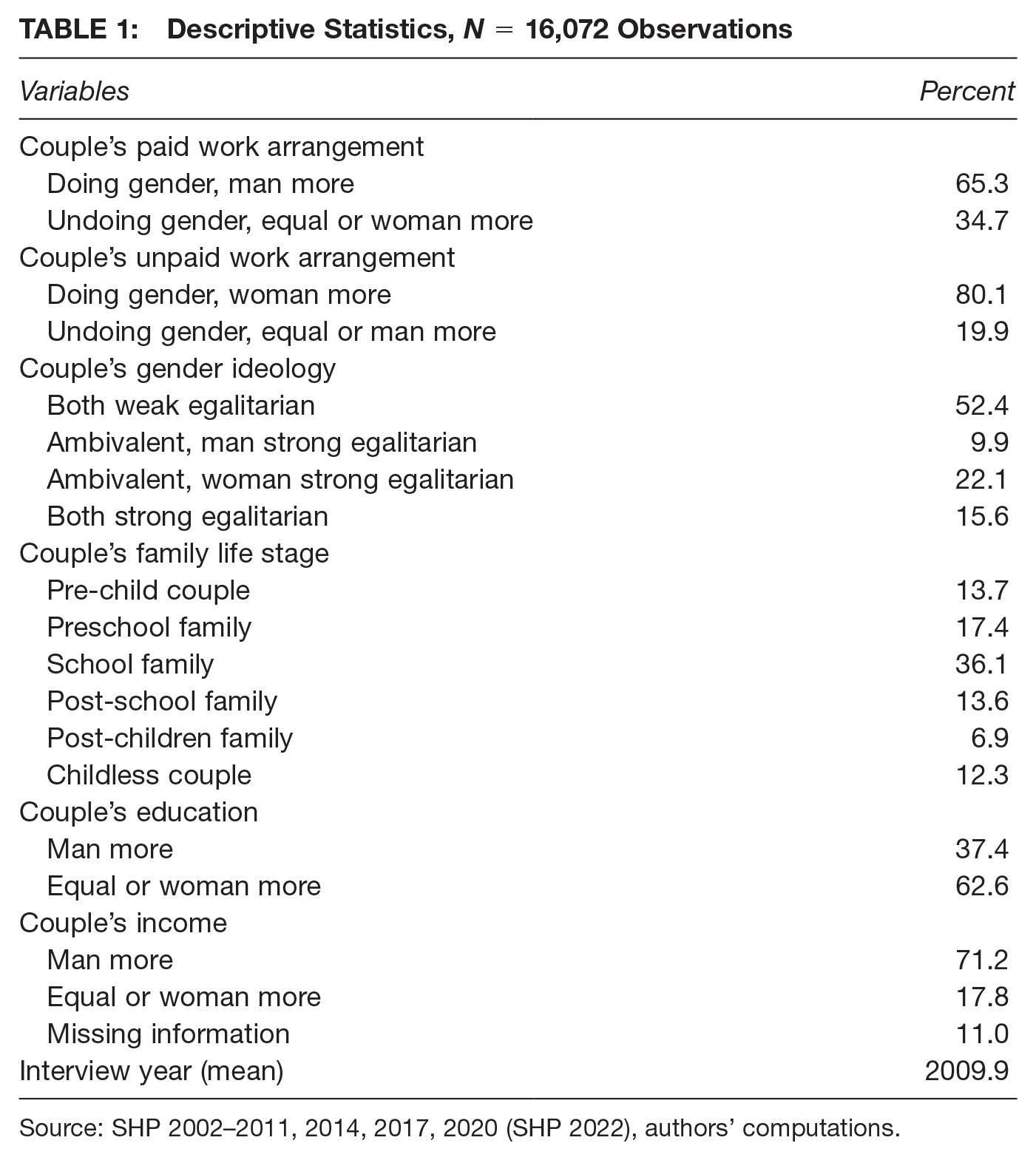
Source: SHP 2002–2011, 2014, 2017, 2020 (SHP 2022), authors’ computations.
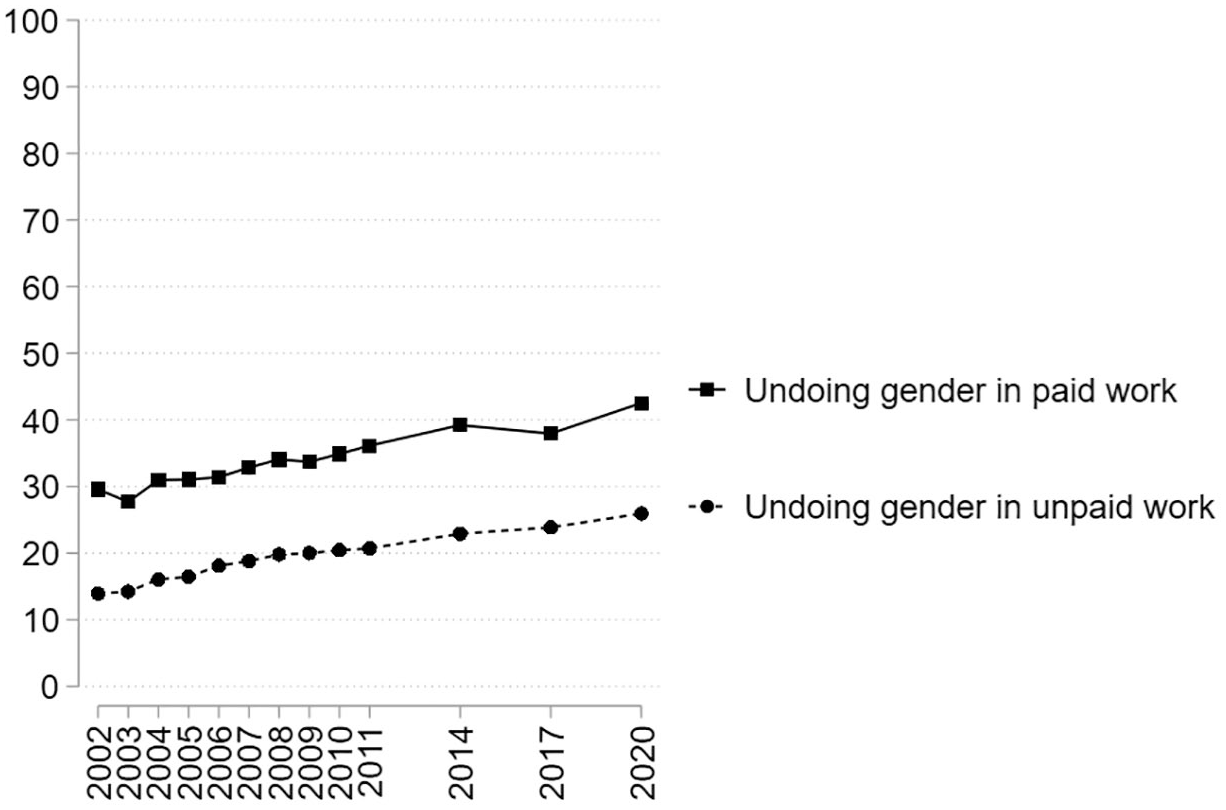
Proportion of Couples Undoing Gender in Their Paid and Unpaid Work Arrangements by Year
Regarding couples’ gender ideologies, in half of the observations, both partners have weak egalitarian attitudes toward maternal employment (Table 1). Observations with both partners holding strong egalitarian ideologies are less common (15.6 percent). Among couples with ambivalent ideologies, women most often have strong egalitarian ideologies. When observing couples’ gender ideologies over time, we see a decrease in the proportion of couples where both partners hold weak egalitarian ideologies and an increase in the proportion of couples where both partners have strong egalitarian ideologies (Figure 2).
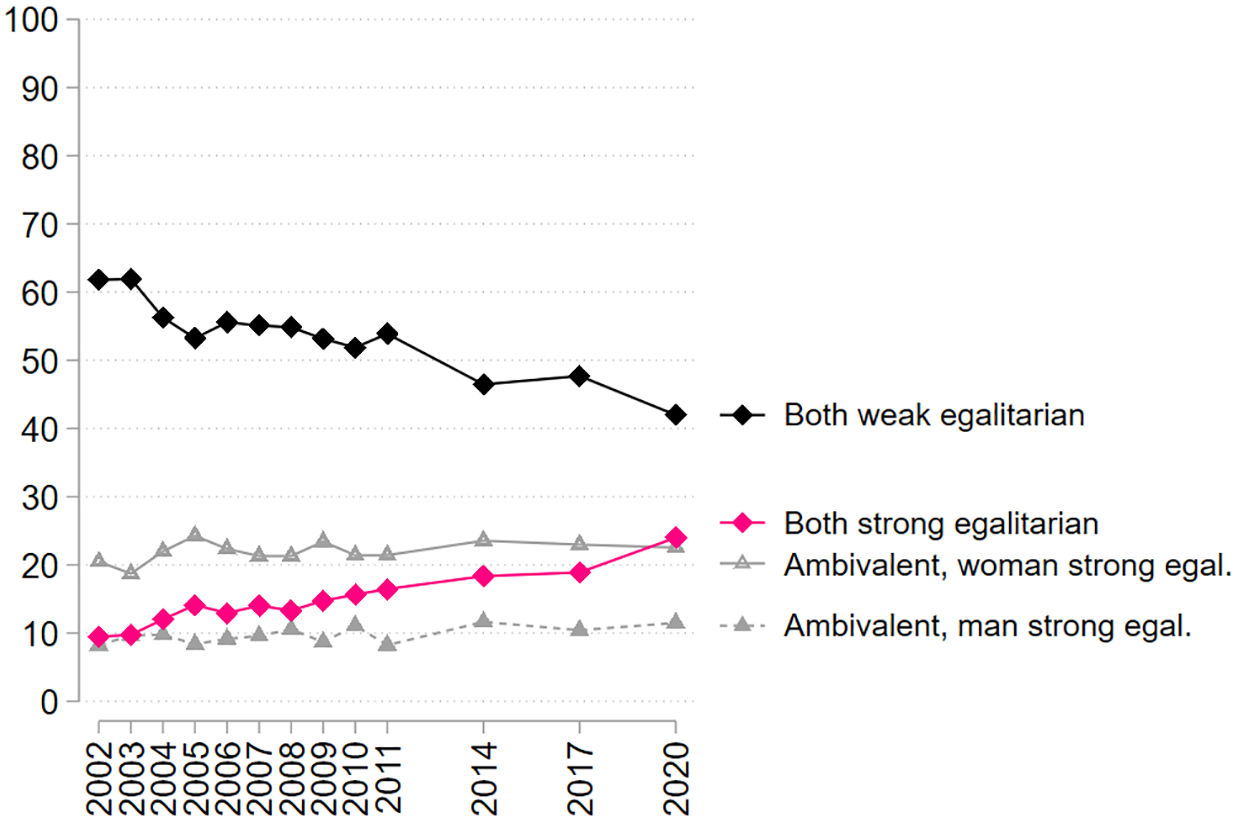
Proportion of Couples According to Their Joint Gender Ideology by Year
Family Life Stage: Main Association
To test Hypothesis 1, we first observe the relationship between the couples’ family life stage and their paid and unpaid work arrangements, net of gender ideologies and the control variables. Table 2 displays the outcomes of the between-couple and within-couple LPMs. Positive coefficients indicate higher probabilities of undoing gender, while negative coefficients indicate lower probabilities. Alongside the conventional results table, we include predictive margins graphs for a visual representation of the results. Moreover, these graphs allow for the comparison of statistically significant differences between all categories, not just relative to a reference category.
Probability of Undoing Gender in Paid and Unpaid Work in Switzerland (Linear Probability Models)

Source: SHP 2002–2011, 2014, 2017, 2020 (SHP 2022), authors’ computations.
Note: The coefficients present the difference in the probability of undoing gender occurring between the reference category and the respective category (or for a one-unit difference for continuous variables), holding all other variables constant. Standard errors are in parentheses. ref = reference.
p < 0.05. **p < 0.01. ***p < 0.001.
Deriving from the results of the between-couple models (Models 1 and 3 in Table 2), which compare different couples, Figure 3 presents the predicted probability of undoing gender in paid and unpaid work at each family life stage, controlling for other covariates. Regarding paid work, as hypothesized (Hypothesis 1), pre-child couples demonstrate the highest probability of undoing gender, followed by childless couples, which indicates an age effect. Couples with preschool-age children are the least likely to undo gender in paid work, while the probability of undoing gender increases across subsequent family life stages. For unpaid work, undoing gender is uncommon across all family life stages. As expected, pre-child couples have the highest probability of undoing gender in unpaid work and this probability decreases for preschool families. However, contrary to our expectations, this probability further decreases in subsequent family life stages. The between-couple results support Hypothesis 1 for paid work, while it is rejected for unpaid work.
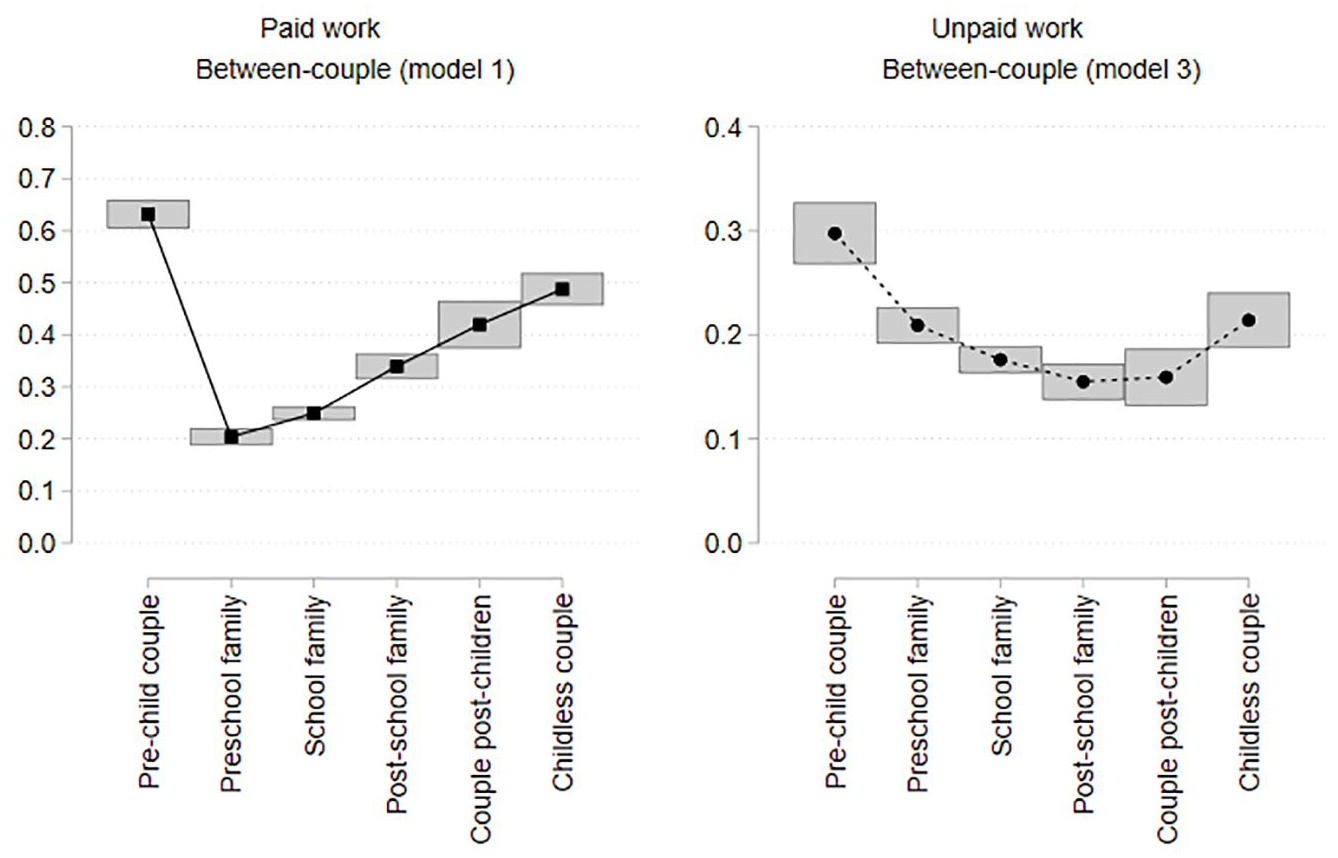
Predicted Probability of Undoing Gender by Family Life Stage, With 95 Percent Confidence Intervals (Truncated y-Axes)
We now turn to the within-couple models (Models 2 and 4 in Table 2), which indicate whether the results apply also to changes within couples and can, therefore, be considered as causal effects. The within-couple models confirm that becoming parents has a gendering effect on couples’ arrangements of paid and unpaid work, as pre-child couples are significantly more likely to undo gender. Once become parents, transitions from preschool families to school families are not statistically significant for both paid and unpaid work. This indicates an anchoring in gendered behaviors for couples with (young) children. The within models confirm that couples are more likely to undo gender once their children are adults (only for paid work) and have left the nest. The within-couple results partially support Hypothesis 1.
The sensitivity analyses validate our main findings (see the Online Appendix for more details). The results for paid work are stable across models. There is more instability regarding unpaid work, with some variations in significance, except for pre-child couples. However, the overall narrative remains consistent.
Couple’s Gender Ideology: Main Association
Our second variable of interest for these models is the couple’s gender ideology, assessed through the level of support for working mothers. To test Hypothesis 2, we assess the relationship between couples’ gender ideologies and their likelihood of undoing gender in paid and unpaid work, while controlling for the family life stage and socioeconomic characteristics of the couples. We find that couples’ gender ideologies are significantly related to their paid and unpaid work arrangements in between-couple models, when we compare couples with different gender ideology configurations (Models 1 and 3). However, we do not find statistical significance in within-couple models that would have indicated a causal relationship (Models 2 and 4).
As expected (Hypothesis 2), couples where both partners hold strong egalitarian gender ideologies have the highest probability of undoing gender in both their paid and unpaid work arrangements, whereas couples with weak egalitarian ideologies are among the least likely to undo gender (Figure 4). Interestingly, among ambivalent couples, only those where the female partner holds strong egalitarian gender ideology have a significantly higher probability of undoing gender in paid work than couples with weak egalitarian ideology. Conversely, the reverse pattern emerges for unpaid work: Only ambivalent couples where the male partner holds strong egalitarian gender ideology are significantly more likely to undo gender than couples with weak egalitarian ideologies. Our results, therefore, suggest that strong egalitarian gender ideology among the male partner promotes undoing gender in unpaid work, whereas strong egalitarian gender ideology among the female partner promotes undoing gender in paid work. Overall, Hypothesis 2 is partially supported, as ambivalent couples only partly follow the expected pattern.
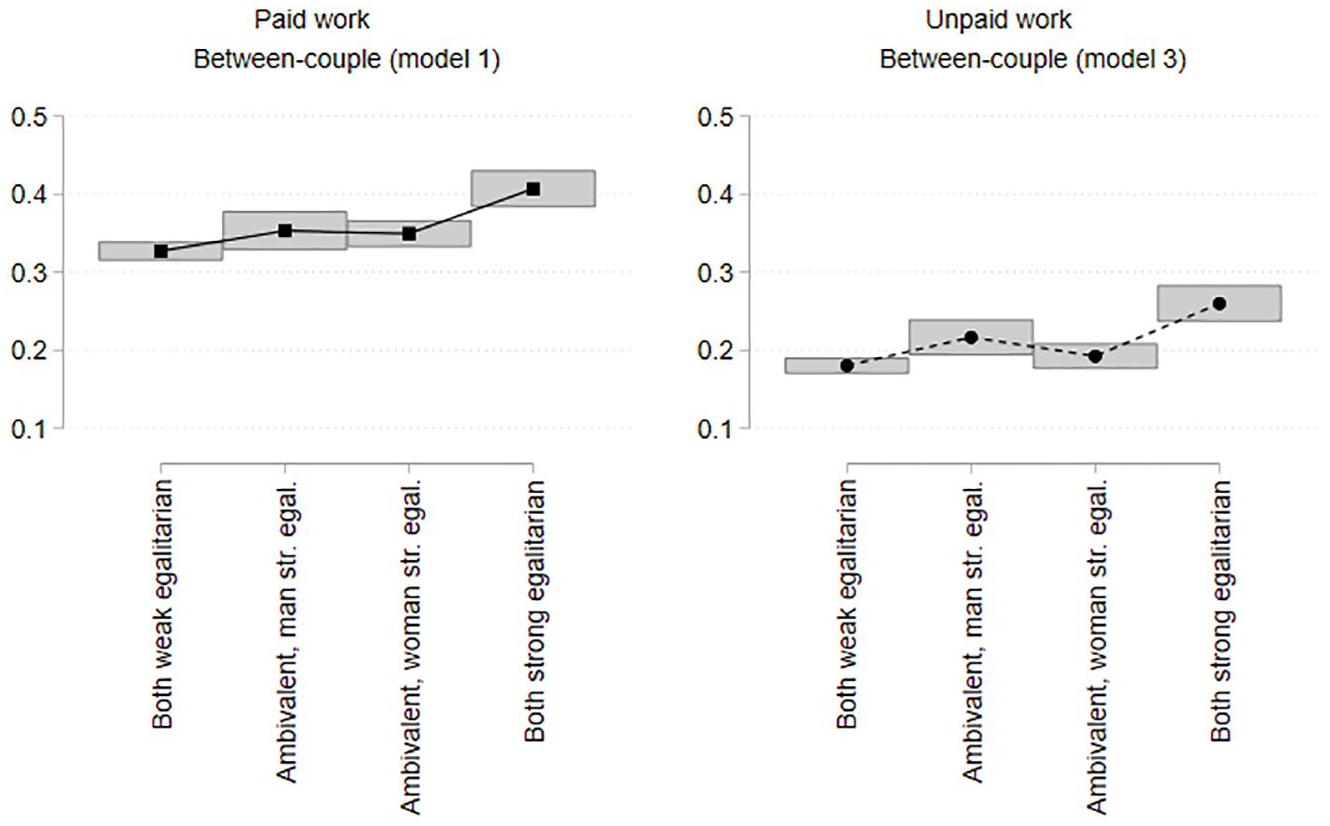
Predicted Probability of Undoing Gender by Couples’ Gender Ideology, With 95 Percent Confidence Intervals (Truncated y-Axes)
Consistency is observed across all sensitivity analyses for couples with strong egalitarian gender ideologies. For couples with ambivalent ideologies, most variations in significance resulted in gains of significance, strengthening Hypothesis 2. However, in a few cases (when using the comparative variable based on the female share of paid work [Online Appendix A3] and with the logistic model [Online Appendix A6]), ambivalent couples where the female partner holds strong egalitarian ideologies lose original significance for paid work, highlighting the need for cautious interpretation.
Couple’s Gender Ideology and Family Life Stage: Interaction Effect
Finally, to test Hypothesis 3, we examine whether the relationship between couples’ gender ideologies and their arrangements of paid and unpaid work observed in between-couple models is moderated by the couples’ family life stage. We, therefore, compute additional between-couple models, including an interaction between couple’s gender ideology and family life stage (Table 3). Given the complexity of interpreting coefficients in models including interactions, we rely on Figure 5 (first row) for the interpretation of results. For legibility, the figure highlights differences between couples with strong or weak egalitarian gender ideologies. Couples with ambivalent ideologies, positioned between these two groups and with mostly overlapping confidence intervals, were omitted.
Linear Probability Models Including the Interaction Between Couple’s Gender Ideology and Family Life Stage
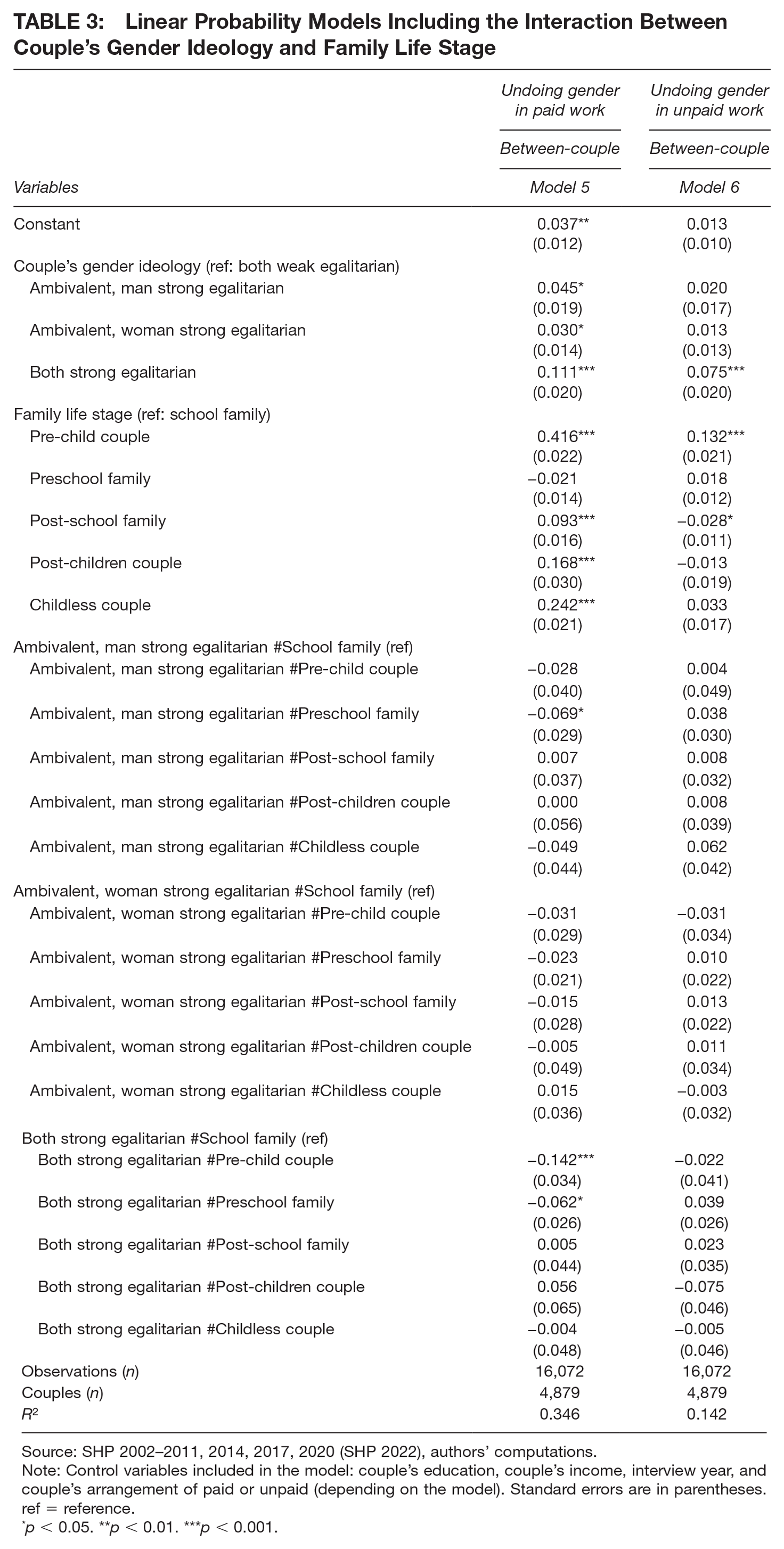
Source: SHP 2002–2011, 2014, 2017, 2020 (SHP 2022), authors’ computations.
Note: Control variables included in the model: couple’s education, couple’s income, interview year, and couple’s arrangement of paid or unpaid (depending on the model). Standard errors are in parentheses. ref = reference.
p < 0.05. **p < 0.01. ***p < 0.001.
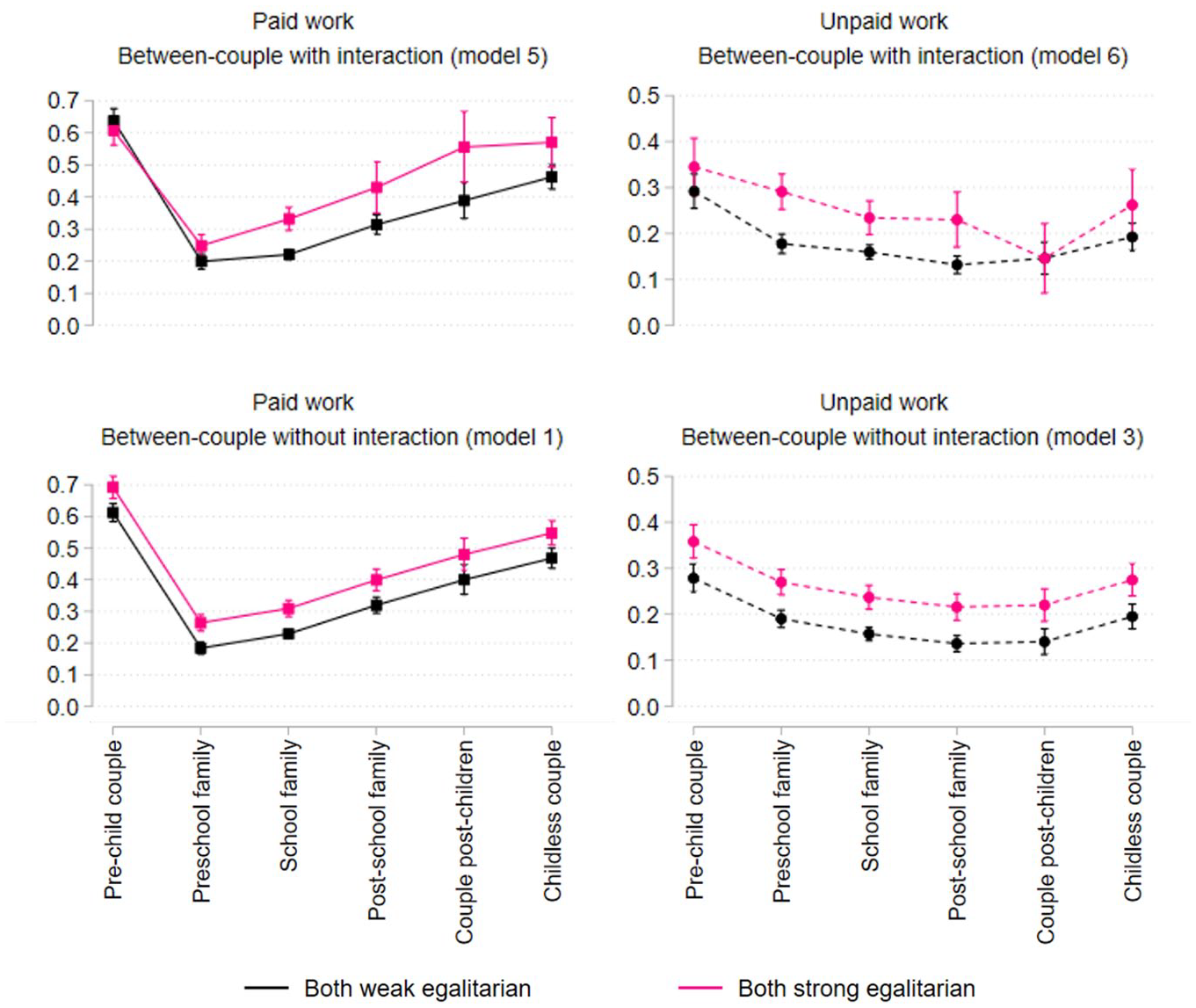
Predicted Probability of Undoing Gender by Couples’ Gender Ideology and Family Life Stage in Models With and Without Interactions, With 95 Percent Confidence Intervals (Truncated y-Axes)
Generally, we find no interaction effect between couples’ gender ideologies and their family life stages on the likelihood of undoing gender in paid work. While couples with strong egalitarian gender ideologies have mostly a higher probability to undo gender than couples with weak egalitarian ideologies, the confidence intervals overlap, except for couples with school-age children. We conclude that the influence of couples’ gender ideologies on paid work arrangements does not vary with family life stage. The main association between couples’ gender ideologies and their probability for undoing gender in paid work observed in Model 1 remains thus consistent across family life stages (Figure 5, second row).
However, for couples’ unpaid work arrangements, the results do reveal a significant interaction between couples’ gender ideologies and family life stages (Figure 5, first row). Across the family life stages, couples with strong egalitarian ideologies have a higher probability of undoing gender than couples with weak egalitarian ideologies. This is statistically significant when there are children in the household—for preschool, school, and post-school families. For pre-child couples, post-children couples, and childless couples, the interaction is not statistically significant, indicating that couple’s gender ideology does not matter at these stages.
Hypothesis 3 is thus rejected for paid work but finds support for unpaid work. Our results suggest that the relationship between couples’ gender ideologies and undoing gender is moderated by the family life stage only for unpaid work. Couples with children in the household appear more responsive to the effects of couples’ gender ideologies compared with childless couples. We thus find support for Hypothesis 3b and reject Hypothesis 3a.
Control Variables
The results of the control variables (Models 1–4, Table 2) provide further understanding on the processes and determinants of undoing gender among heterosexual couples. First, undoing gender in paid work is related to undoing gender in unpaid work, and vice versa. These results hold in within-couple models and underscore the interplay among life domains as described in the life course cube. Second, we find that material aspects also matter for undoing gender. Couples where the woman has an equal or higher education level or income than the man are more likely to undo gender in both paid and unpaid work. Moreover, sensitivity analyses for paid work (Online Appendix A5) indicate that higher education levels in women correlate with undoing gender, whereas higher education levels in men correlate with doing gender. We also find a negative association between men’s income and the probability of undoing gender in paid work, which supports the economic necessity argument.
Discussion
In this study, we examined the association between couples’ joint gender ideologies and their paid and unpaid work arrangements across family life stages. Using couple data from the SHP (2022) spanning almost 20 years, we shed light on how gender ideology correlates with concrete work–family arrangements in Switzerland, a conservative context regarding gender equality. We further investigated whether different attitude–behavior relationships emerged depending on the couples’ family life stage. We were particularly interested in analyzing whether paid and unpaid work arrangements of heterosexual couples conform to or challenge traditional gender norms—whether couples do or undo gender in their division of labor.
Following Risman’s (2018) gender structure theory, we analyzed couples’ likelihood of undoing gender within an unfavorable macro-level context in terms of both material and cultural aspects, including liberal–conservative family policies coupled with traditional gender norms. Using individual-level indicators at the couple/interactional level, our analyses focused on each partner’s gender ideology (cultural aspect), controlling for socioeconomic resources (material aspect). In addition to gender structure theory, life course theory prompted us to consider the temporal dimension to grasp how individual, interactional, and macro-level characteristics evolve over time. We focused on the couple’s family life stage because couples may adjust their arrangements of paid and unpaid work when transitioning from one family life stage to another, experiencing different material and cultural constraints.
Four main findings emerged from our study. First, we find that most couples do gender and adhere to prevalent traditional gender norms in the conservative context of Switzerland. However, despite the country’s egalitarian essentialist cultural logics and unfavorable family and tax policies for dual-earner households, a significant minority of couples challenge the dominant norms in their paid and unpaid work arrangements, a phenomenon that has become more prevalent over time.
Second, both between-couple and within-couple models indicate whether couples do or undo gender in their work–family arrangements varies by family life stage. Pre-child couples are the most likely to undo gender and challenge gender norms in both paid and unpaid work. As noted previously (Le Goff and Levy 2016), the transition to parenthood is associated with a decreased probability of undoing gender, highlighting the influence of unsupportive institutions and traditional gender norms. Yet the dynamics for paid and unpaid work differ. For paid work, a significant majority of pre-child couples undo gender. Parenthood introduces a strong gendering effect, with some recuperation as children age, though not to the original pre-parenthood level. For unpaid work, most couples already do gender before becoming parents. While parenthood exacerbates these traditional gendered arrangements, the patterns established during early parenthood tend to persist in later stages. Although habits may be self-reinforcing, there is no financial incentive to undo gender in unpaid work, unlike in paid work.
Third, based on the gender ideology item available to us, our between-couple models’ results indicate that couples’ gender ideologies matter for both paid and unpaid work arrangements, even when controlling for material aspects. However, we could only establish correlations, since no significant association was found in within-couple models, suggesting that changes in couples’ gender ideologies do not directly translate into changes in their arrangements. We investigated whether strong egalitarian ideologies espoused by one or both partners correlate with a higher probability of undoing gender, compared with couples where both partners hold weak egalitarian ideologies. Consistent with previous research in other contexts (Kaufman and Bernhardt 2015; Nitsche and Grunow 2018), we find stronger attitude–behavior associations when both partners’ ideologies align. Our analysis expands on this by examining couples across the life course and considering both paid and unpaid work simultaneously. Couples where both partners hold strong egalitarian ideologies are the most likely to undo gender in both work domains. Unilateral support for egalitarianism appears insufficient to undo gender, with two exceptions: Couples with ambivalent attitudes where women have strong egalitarian ideologies seem more likely to undo gender in paid work, and couples with ambivalent attitudes where men have strong egalitarian ideologies seem more likely to undo gender in unpaid work. Therefore, women’s gender ideology seems key for a more egalitarian division of paid work, and men’s gender ideology for a more egalitarian division of unpaid work. Both cases challenge the macro-cultural norms of maternalism, in the public sphere for women and in the private sphere for men. Conversely, it seems that strong egalitarian men cannot significantly influence women’s involvement in paid work, and strong egalitarian women cannot significantly influence men’s involvement in unpaid work.
Last, our findings reveal that the attitude–behavior relationship varies across family life stages for unpaid work arrangements but remains stable for paid work arrangements. Couples with strong egalitarian ideologies are consistently more likely to undo gender in paid work across all family life stages. In contrast, couples’ gender ideologies matter only for unpaid work when they live with children, regardless of their age (i.e., in preschool, school, and post-school families). At other family life stages, couples’ gender ideologies are not significantly related to unpaid work arrangements. This suggests that the increased domestic and caregiving responsibilities associated with having children make unpaid work more salient (and maybe rewarding), which may lead couples with strong egalitarian ideologies to actively discuss and adjust their arrangements, resulting in a greater involvement of men.
Limitations and Future Research
One notable limitation of this study is its reliance on a single item to measure gender ideology, stemming from constraints in the data at hand. Although this measure is well suited to the Swiss context, it focuses on maternal employment and does not capture attitudes toward unpaid work arrangements. Including measures of attitudes toward women’s and men’s involvement in both paid and unpaid work would provide a more comprehensive understanding of the dynamics between couples’ gender ideologies and behaviors. A promising avenue for future research would be to include a multidimensional indicator of gender ideology. Following Grunow, Begall, and Buchler’s (2018) study, this indicator should differentiate whether individuals consider earning and caring as joint or as separate gendered responsibilities, and whether these views center on personal choices or essentialist differences. Additionally, this study did not establish a causal relationship between couples’ gender ideologies and their likelihood to undo gender. To be able to identify causal effects of attitudes within couples, future research may narrow its focus to specific and pivotal life stage transitions, particularly the transition to parenthood. Furthermore, to provide a more comprehensive understanding of macro-level effects in Switzerland, future analyses could investigate the detailed impact of changes in public policies over the years. Finally, future research may also assess the stability and change of the couples’ attitude–behavior associations over time and across national contexts. A cross-national analysis could further test the macro-level dimensions of the gender structure.
Conclusion
By examining the complex interplay between couples’ gender ideologies and family life stages, this article sheds light on the diverse ways in which gender is undone in paid and unpaid work arrangements, making a significant contribution to feminist scholarship. This study has integrated life course theory with gender structure theory and reveals that the gender structure exerts varying constraints on heterosexual couples’ behaviors throughout the life course. The analysis of family life stages underscores the distinct influence of cultural and material macro-level factors on couples’ work–family arrangements: While prevailing gender norms shape arrangements for pre-child and childless couples, parents face constraints stemming from both gender norms and institutional factors. In line with previous research (e.g., Bühlmann, Elcheroth, and Tettamanti 2016; Pollmann-Schult 2016), we conclude that the parenthood effect on couples’ work–family arrangements is highly contingent upon institutional and cultural factors with repercussions for subsequent family life stages.
The analysis of couples’ gender ideologies further reveals that strong egalitarian ideologies can override traditional gender norms and unsupportive institutions, particularly when shared by both partners. However, while significant, individual-level gender ideologies have a limited impact on couples’ ability to undo gender in work–family arrangements in a conservative context. Consistent with gender structure theory, we hypothesize that in a more supportive institutional environment, gender ideologies would exert a greater influence and be more effective in challenging traditional gender norms.
Overall, the analyses of couples’ gender ideologies and family life stages suggest that leveraging the institutional context is a promising approach to fostering more egalitarian arrangements. We emphasize the need for policy reforms targeting primarily preschool families, to create supportive institutions and promote caring masculinities. By establishing conditions that enable diverse arrangements, institutions allow individuals to better align their behaviors with their gender ideologies. Given the interconnectedness of the three levels of the gender structure, this approach could create more opportunities for undoing gender, ultimately leading to transformative shifts in Switzerland’s overall gender structure.
Supplemental Material
sj-docx-1-gas-10.1177_08912432251317464 – Supplemental material for Beyond tradition? How Gender Ideology Impacts Employment and Family Arrangements in Swiss Couples
Supplemental material, sj-docx-1-gas-10.1177_08912432251317464 for Beyond tradition? How Gender Ideology Impacts Employment and Family Arrangements in Swiss Couples by Christina Bornatici and Isabelle Zinn in Gender & Society
Footnotes
Authors’ note:
This paper is the result of teamwork. The authorsboth outlined the paper, contributed to the first draft, discussed the results, and shaped the analysis. Christina Bornatici managed and analyzed the data and led the manuscript’s writing process, while ongoing discussions helped finalize the article. The authors thank their colleagues Jacques-Antoine Gauthier, Marieke Heers, Ursina Kuhn, and Jean-Marie Le Goff for useful discussions, their careful reading remarks on previous versions of this article. Additionally, Ana Fernandes provided valuable assistance with English.

Supplemental Material
Supplemental material for this article is available online.
Notes
Christina Bornatici is a PhD candidate in social sciences at the University of Lausanne and a researcher at FORS—Swiss Center of Expertise in the Social Sciences. Her research interests lie at the intersection of gender, paid and unpaid work, and social change, which she explores from a gender and a life course perspective. Additionally, she engages in reflections on research practices, particularly on gender measurement indicators.
Isabelle Zinn is a tenure-track professor at Bern University of Applied Sciences—Business School and a visiting professor at the University of Lausanne. Her research interests include ethnography and the sociology of work, particularly the relationship between life spheres, work–family arrangements, and resulting inequalities. Her work also appears in Research in the Sociology of Work, Gender, Work & Organization, and the Journal of Gender Studies.
References
Supplementary Material
Please find the following supplemental material available below.
For Open Access articles published under a Creative Commons License, all supplemental material carries the same license as the article it is associated with.
For non-Open Access articles published, all supplemental material carries a non-exclusive license, and permission requests for re-use of supplemental material or any part of supplemental material shall be sent directly to the copyright owner as specified in the copyright notice associated with the article.
