




Abstract
Feminist debates on how the state incorporates and reshapes feminist categories of violence reveal unintended consequences, such as the depoliticization of these ideas. Through a case study of the Feminicídio Law in Brazil, I examine feminist writings on feminicídio, following its state incorporation as a criminal category, to address the killing of women based on gendered reasons. Drawing on materialist feminist discourse analysis, I challenge the notion that institutionalization necessarily leads to depoliticization. Instead, I demonstrate how feminists have reframed the legal framework of feminicídio to strategically confront state initiatives, such as firearm ownership projects, by employing an individual criminal category against the state. I theorize this feminist reframing as a form of praxis, illustrating how feminists can mobilize categories after institutionalization for new political purposes and contexts. This reframing involves ongoing formulations by diverse activists, extending the category’s meanings beyond the state’s definition and embracing intersectional perspectives. While the reframing of feminicídio gained traction to challenge right-wing governments in Brazil, some radical formulations were marginalized. This analysis elucidates the conditions under which feminists evoke and reframe institutionalized ideas and highlights the challenges activists face in mobilizing their ideas.
We, Brazilian feminist women, black, indigenous, brown, white, quilombolas, peripheral, living with disabilities, lesbians, bisexuals, cis and trans; from the cities, the countryside, the waters and the forests; we, mothers, traditional midwives, precarious, hyper-exploited and unemployed workers, we rise up, in an act of revolt, against feminicídio in Brazil and demand its end.
In March 2021, a movement called Feminist Rising Against Feminicídio (Feminist Rising, hereafter) launched a collective manifesto to denounce the rise of lethal violence against women in Brazil. 2 Feminicídio broadly names the cases of lethal violence against those regarded as feminine and feminized (Fregoso 2023), and Brazil criminalized it in 2015. The Feminist Rising alliance, a national campaign formed by diverse movements, organizations, and unions, stated that the practice of feminicídio “has never been so blatant and extremist as it is now, in the government of Jair Bolsonaro.” By raising awareness and pointing out the increase of feminicídio cases in the country, the campaign emphasized the negligence of the state concerning violence against women during the far-right government of Jair Bolsonaro. This movement was forged six years after the Feminicídio Law (Law 13.104/2015) was approved in Brazil, revealing the ongoing politicization toward the category among Brazilian feminist communities following its state incorporation. The political mobilization around feminicídio after its criminalization included protests, petitions, and claims for more state resources for welfare projects, presenting a puzzle to narratives of depoliticization or co-optation of feminist ideas on violence after they have been incorporated by the state (Bumiller 2008; Halley et al. 2018).
Feminists have actively engaged with the state and its ideological disputes (Gramsci 1971; Hall et al. 1996) to politicize and bring attention to acts of violence that were previously not considered public concerns (Frazer and Hutchings 2020). In these disputes, studies have examined how feminist ideas on violence are implemented by noting an alignment with neoliberal agendas and conservative movements (Bernstein 2012; Bumiller 2008; Whittier 2018). Studies on the Global South have revealed a double-edged sword for women’s movements, as feminist politics through the state can strengthen mobilizations in the battle for democracy (Youssef 2023) and allow for new interpretations of the meanings of violence (García-Del Moral 2016; Wright 2006). Activists are thus particularly concerned about the outcomes of institutionalization for feminist projects (Ferree and Martin 1995), considering contemporary critiques on the depoliticization of feminism (Eschle and Maiguashca 2014) and the rise of anti-feminist discourses (Krizsán and Roggeband 2021). Given these contemporary apprehensions, feminist scholars have shown the need for more contextual approaches to theorizing feminist politics and the state (Lakkimsetti 2020; Orloff, Ray, and Savci 2016; Vijayakumar 2021), focusing on how different contexts shape feminist political dynamics and activism.
I answer their call by investigating feminist formulations around feminicídio after its institutionalization within different feminist communities in Brazil (Alvarez 1990; Carneiro 2003). I draw on Suzanne Staggenborg’s (1998) theorization of women’s movements as social movement communities to account for the ongoing convergence of formal organizations, political groups, and activists discussing feminicídio after its state incorporation. Initially, Brazilian feminists employed the term feminicídio as a frame to discuss lethal violence against women, focusing on the lack of a fair trial as legal actors employed patriarchal stereotypes to blame women and to address the need for a specific crime category to account for the killing of women (de Campos 2015). Brazil criminalized feminicídio in 2015 as a criminal category by increasing the penalty in homicide cases based on gendered reasons (Pasinato and de Ávila 2023). Because feminist debates on state incorporation and violence tend to present a tidy narrative for the decline and de-radicalization of these ideas through the alignment with conservative projects, it is puzzling to explain how a feminist rising against feminicídio developed after its criminalization.
In this paper, I explore how feminist formulations around feminicídio evolved after its institutionalization, following a rich feminist tradition and curiosity on how feminist ideas that are institutionalized may take diverse courses (see Fraser 1997 on recognition and redistribution; Menon 2004 on legal discourses; Ahmed 2012 on diversity; Nash 2018 on intersectionality; and Nelson and Zippel 2021 on implicit bias). Through materialist feminist discourse analysis (Naples 2013; Whittier 2016) of 92 documents published by activists in Brazilian feminist public outlets, I show how feminist communities reframed the legal framework of feminicídio to strategically challenge institutional understandings of lethal violence and agitate political mobilizations. I found two main ways in which Brazilian feminists reframed the feminicídio category politically: (1) to directly contest state projects such as the gun ownership project and the cut of resources for welfare projects and (2) to produce knowledge challenging official data on violence in order to expand the uses of the category focusing on cases often ignored by the state.
The reframing process relied on ongoing formulations by diverse communities, extending the category’s meanings beyond the state’s definition and embracing intersectional perspectives to include the higher victimization of Black women and the recognition of lesbians, trans women, and travesti 3 victims. While the reframing of feminicídio gained traction by employing the individual criminal category against the state, some radical formulations were marginalized in feminist writings (Ferree 2003). Black activists framed state violence against Black women as a form of feminicídio, but this radical formulation was not central to broader feminist claims. In this sense, my findings also show how different communities make specific aspects of the category more salient, revealing power relations within feminist movements (Roth 2007).
The feminist framing of feminicídio after the state incorporation reveals dynamic ways of facing an adverse scenario. Activists might narrow their ideas to influence public policies (Naples 2013) or modify them to resonate with political discursive opportunities (Ferree 2003), but they can also reframe these ideas following formal impacts. In the case of Brazil, a shift in the federal government—the rise of Jair Bolsonaro’s government—prompted feminists to reframe feminicídio as a category to challenge state projects and actions. Dynamics of reframing explain how feminists evoke and claim institutionalized ideas on their terms for new political goals. My analysis of the feminicídio case in Brazil poses theoretical contributions to our understanding of feminist dynamics considering the rise of a global right in Latin America (Blofield, Ewig, and Piscopo 2017; S. Corrêa and Kalil 2021) and elsewhere (Krizsán and Roggeband 2021). The feminicídio case joins a feminist call for research into the role of feminist ideas on violence in expanding not only the carceral state but also welfare projects (Sweet 2023) as feminists reframe ideas on violence for new claims. My findings explain how activists play a crucial role on the course of feminist ideas after institutionalization, leading to dynamic ways of monitoring how their ideas get taken by the state.
Feminist Ideas on Violence, State Incorporation, and Reframing Processes
The sociology of the state has emphasized the connections between knowledge production and the craft of the modern state (Foucault 1978; Scott 1998). Feminist knowledge has been mobilized to redesign state action, resulting in critiques of collusion with the carceral state (Bernstein 2012; Kim 2020) and other conservative projects (Farris 2017). Thus, feminist political struggles, successes, and failures against and within the state have pushed feminists to put energy into thinking about the state and gender dynamics (Halley et al. 2018; Haney 1996; Menon 2004; Morgan and Orloff 2017) while still being troubled by the dilemma of gender justice.
In the case of activism against violence, this question is still very present in feminist debates (Htun and Weldon 2017). First, there is the notorious gap between law on the books and actual state practices (Menjívar and Lakhani 2016), meaning that the adoption of specific policies is not translated into real change on the ground. Second, the colonial nature of the modern state shows how historical conditions shape the contingent relationship between gendered and racialized relations and state power, forging state categories that include some groups and simultaneously exclude others (Crenshaw 1991). These critiques support contemporary concerns over the possible depoliticization of feminist ideas and the decline of feminism as an emancipatory collective struggle (Eschle and Maiguashca 2014). Bearing these critiques in mind, I approach the incorporation of feminist frames on violence by the state not merely as dynamics of co-optation or the ending of powerful feminist projects, but as contextualized processes that develop through time–space with specific repercussions for feminist communities.
Studies that focus on the institutionalization of social movement ideas and frames also disclose how the local context and activists’ strategies shape dynamics of state incorporation. Nancy Whittier (2018), for example, shows that throughout different legal reforms, feminists mobilized or de-emphasized controversial goals, depending on the concrete case. Feminists’ strategies to mobilize specific frames and discourses instead of others are linked to their chances of influencing politics in a particular place and time, considering “the arrangements of power” in society (Ferree 2003, 339). However, activists can also frame against the odds. In Argentina, feminists recently expanded the Ni Una a Menos movement frame on gender violence to also encompass abortion rights, thereby raising a significant issue that had long been politically untouchable (Daby and Moseley 2022). Similarly, the same feminist frame might act as radical by challenging power relations in the local context while being resonant in the transnational sphere due to legal norms, as in the case of feminicídio in Mexico (García-Del Moral 2016). Framing processes reveal the articulation and diffusion of mobilizing ideas (Benford and Snow 2000) contingent on power relations that shape their outcomes (Ferree 2003). Feminist frames, therefore, are not stagnant but rather dynamic meaning-making processes that interact with legal frameworks (Pedriana 2006) and movement opponents (McCammon 2012). Changes in the movement or in the political context can provoke variations in framing processes, leading to multiple possibilities in the development of a movement’s ideas (Benford and Snow 2000).
The possibility of reframing issues might help to explain how feminists continue driving social changes after legal reforms. Reynolds’ (2022) study on Title IX of the U.S. Education Amendments of 1972, which prohibits sex discrimination in schools, shows a complex process in which this law came to address sexual harassment in education. Reynolds (2022) explains how new applications of this law arise within educational organizations through network ties between feminist students and lawyers. Activists can also influence ideas and categories beyond formal politics. By analyzing cultural battles on violence in Indian television, Packard (2022) highlights that whereas elite actors argue for punitive agendas, feminists resist this approach. Feminists recognize important changes they achieved through legal reforms in India but do not promote a carceral perspective on public debates (Packard 2022). Concerning feminist movements against rape in the United States, Baker and Bevacqua (2018) argue that the principal goal of the movement lies in how organizations have changed social norms and perceptions of gender and sexuality rather than legal reforms on the topic. These studies reveal a myriad of ways that feminist communities act in the aftermath of legal reforms and how, despite state incorporation, feminist ideas might still empower political projects and discussions.
Relying on these theorizations, I look at feminist formulations toward the feminicídio frame after its criminalization to explain how feminists mobilized an individual criminal category against state projects and expanded its uses. This case raises questions about how feminists continue to articulate and reframe their ideas on violence after institutionalization for new political purposes, highlighting the reconfiguration of feminist activism in contexts marked by the rise of anti-feminist discourses (Krizsán and Roggeband 2021).
The Context of the Criminalization of Feminicídio in Brazil
Brazil is well-known for its feminist-inspired legal reforms (Caldwell 2017). Concerning violence against women and girls, the country was the first in Latin America to implement Women’s Police Stations (Santos 2005) and has enacted progressive legislation on domestic violence that goes beyond simple punishment to include social services (Pasinato 2015). These legal reforms follow the historical concern of feminist movements around the topic of violence against women and girls and the high involvement of the women’s movement during re-democratization in the early 1990s (Alvarez 1990; Carneiro 2003).
The current high rates of violence against women and girls, including the killing of women, place Brazil as the fifth most deadly country for women (Cerqueira 2021). The exposure to violence is deeply shaped by the dynamics of race, class, and space (Schwartzman 2020). From 2007 to 2017, the homicide rate of non-Black women increased by 4.5 percent, while for Black women, it increased by 29.9 percent in the same period (Fórum Brasileiro de Segurança Pública 2019). Moreover, 7 of 10 women killed by a firearm are Black (Instituto Sou da Paz 2022). These numbers indicate higher victimization rates for Black women. In this scenario, the dynamics of urban violence resulting from the war on drugs (Borges 2019) and state violence (Alves 2018) are intertwined with patriarchal formations that place certain women at higher risk of experiencing violence (Wilding 2014). The increased illicit drug markets, police violence, and intracommunity violence have led Black women residing in poor urban areas known as favelas to face violent outcomes daily (Perry 2013).
In this context, Brazilian feminist communities, motivated by their counterparts in Mexico, started to use the term feminicídio to discuss the killing of women and the responses to the problem. Historically, Brazilian lawyers employed patriarchal legal arguments to reduce men’s punishments, claiming the lethal violence was motivated by love or the woman’s fault (Caulfield 2000). Traditional, conservative beliefs about heterosexual marriage have influenced state responses to the killing of women, as men were often not convicted due to the argument that they committed violence to “defend their honor” (M. Corrêa 1983). Feminists proposed that gender-based lethal violence could be legally recognized as feminicídio to acknowledge these deaths as linked to gender relations, leading to fair trials. They also claimed the need for a specific category to correctly account for this violence in statistics and public debates (de Campos 2015).
During the first term of Dilma Rousseff as president (2011–2015), the Brazilian Congress initiated a Parliamentary Inquiry Commission “to investigate the situation of violence against women in Brazil and complaints of omission by the public authorities.” The Commission, formed by feminist members of Congress and members of civil society, published its final report in 2013, comprising more than 1,000 pages (Brasil 2013). After conducting public hearings with feminist organizations and visiting state institutions, the report included suggestions from feminist movements. Among these suggestions was the creation of the criminal category of feminicídio in the country. The initial law project argued the need for a specific legal framework to address deaths linked to gender relations and cited other countries in the region as examples.
There are critical differences between feminicídio as a feminist movement frame and feminicídio as a state category (Pasinato and de Ávila 2023). In the case of the criminal category, the Feminicídio Law was approved in Congress after the term “female gender” was changed to “female sex” due to conservative politicians against “gender ideologies” claiming the need to emphasize sex instead of gender. The Law states that a homicide case is a feminicídio one when committed “against a person of the female sex, involving either domestic or family violence or discrimination against women” (Brasil 2015, paragraph II). Despite feminist commemorations and critiques of the legal reform, the Law still lacks standards for its application (Pamplona 2024).
Feminist critiques of the Feminicídio Law often draw on criminological debates that push against criminalization, considering the inefficacy of the criminal justice system to prevent violence, and its racist nature in Brazil (Flauzina 2016). This tension between carceral solutions and other responses to violence against women is a contentious issue among feminist communities in Brazil (Martins and Gauer 2020). Feminists understand that a new criminal category will not directly reduce violence against women (Flauzina 2016), and they still question the utility of criminalizing gender-based violence. However, from a feminist perspective, the main gain appears to be the official recognition that this type of violence exists and that women are not to blame (Linhares Basted 2021).
After the law was approved in 2015, Brazil saw the Worker’s Party’s fall and Jair Bolsonaro’s rise. Formal and grassroots organizations that collaborated with the state during the Worker’s Party era opposed the right-wing governments of Michel Temer and Bolsonaro (Pereira and Aguilar 2021; Perry 2020). Although the Feminicídio Law created only a minor change in the criminal code and did not include significant institutional changes, this legal reform provided feminists with a legible frame to discuss lethal violence. The ways in which activists mobilize their ideas after institutionalization are crucial to understanding the making and unmaking of public policies, helping to explain why certain laws “stick” and others do not (Paschel 2018, 189). The recent political shifts in the country and the rise of anti-feminist discourses raise questions about what institutionalization means for women’s movements: Does it mean a shift from collaboration with state actors to resistance? Does it mean the new context requires new frames or ways of mobilizing ideas?
Feminist Ideas in Context: Materialist Feminist Discourse Analysis
While several feminist scholars have theorized about materialism (e.g., Bhattacharya 2017; Lund 2023; Mies 1986), I specifically draw on D. E. Smith’s (1999) and Naples’s (2002, 2013) materialist approach to discourse analysis. Naples (2002) builds on D. E. Smith’s (1999) conception of materialism, which considers texts and discourses to be examples of the “local organization of consciousness” (D. E. Smith 1999, 134) and its associated power relations. Naples (2002, 2013, 135) further proposes a materialist feminist discourse analysis that pays attention to the “discursive formations and material structural practices” that might contribute to the delegitimizing and co-optation “of progressive movement claims.” Her methodological approach allows us to understand how activists might modify their claims and formulations within bounded discursive arenas. Accordingly, I draw on Naples (2002, 2013) to link feminist communities’ formulations with their political mobilizations. Instead of focusing on how culture, for example, shapes discourse, I examine how discourse is affected by practices and power relations within Brazilian feminist communities.
In this paper, I examine how feminist communities employ a category after state incorporation, considering the political context in place when they do so. Feminist studies often focus on how movements’ frames and ideas might lose their radical perspective, considering political arenas such as National Congresses, state commissions, and mainstream news media (Ferree 2003; Whittier 2016). These studies explain how feminists might develop and adapt their frames to impact formal political changes. My research design looks at discourses on a frame already institutionalized, opening an opportunity to remain critical of feminist spaces and what appears strategic or not in these communities after state incorporation. This study also contextualizes these discourses in the broader political formations that were taking place in Brazil after the criminalization of feminicídio.
To analyze feminist formulations after the state incorporation, I look at activists’ writings. Frame articulation involves the arrangement of ideas and formulations in a relatively unified and compelling fashion (Benford and Snow 2000). However, these formulations intersect with power relations in movements’ practices (Whittier 2016). In light of this, my methodological approach unpacks the conditions that led to the reframing of feminicídio, emphasizing the collaborative and meaning-making character of framing processes without forgetting the “structural inequalities within” these processes (Naples 2002, 244).
The decision to examine feminist documents is informed by Clare Hemmings’ (2011) work on how feminist written materials function as collective endeavors, linking feminist activism and praxis (Collins 2002; hooks 1991). These feminist formulations have the power to shape, inspire, and direct political mobilizations and claims. When feminists formulate and theorize ideas, they produce knowledge and ensure the continuity of feminist struggles, creating reasons and grievances for political mobilizations (Simmons 2014). Feminist writings are crucial in knitting ideas and engaging in framing dynamics. The data set assembled for this project assumes the centrality of feminist work and theorization in inspiring political mobilizations.
Assembling the Data Set
To investigate how Brazilian feminists mobilized the feminicídio category after the state incorporation, I analyzed relevant public feminist documents. By public, I mean documents available for anyone interested in feminist debates. By feminist, I mean written and published by feminist communities in Brazil. Given the Feminist Rising Against Feminicídio manifesto, I initially looked at organizations and movements that signed or circulated the manifesto, leading to over 250 groups. Then I narrowed the list to openly feminist groups based on my previous knowledge of the Brazilian feminist field. Finally, I limited the list to feminist groups with an official website and materials produced on the topic by feminist activists, and not those that only repost news media or secondary sources’ materials.
Because some feminist communities focus on labor or reproductive health, they did not have an in-depth engagement with the topic of feminicídio, nor did they produce materials on violence against women. This strategy helped to limit my search to documents produced by eight different feminist organizations involved in feminist mobilizations, capturing possible similarities but also differences in their formulations. My discourse analysis centers on the news media, essays, infographics, and reports produced and published by the following feminist websites: Ana Montenegro, 4 AzMina, 5 Portal Catarinas, 6 Instituto Patrícia Galvão, 7 Criola, 8 Géledes, 9 SOS Corpo, 10 and Themis. 11 While made available by specific organizations, the content published contains quotations and formulations of various feminist activists and scholars who are not direct members, disclosing the ongoing gathering and collaboration of the women’s movement in Brazil (Staggenborg 1998).
For this study, I collected documents published between April 2015—after the law was approved—until September 2023 using the search term feminicídio on their websites. Again, I narrowed my search to documents produced by feminist activists to assemble the final data set on feminist formulations regarding feminicídio. I read each document, and, for the analysis, I selected those that discussed feminicídio as a social problem. I did not include documents that were either too short or mentioned only a single case. The total sample was 92 documents (see Table 1).
Summary of Data Sources and Sample Size (N = 92)
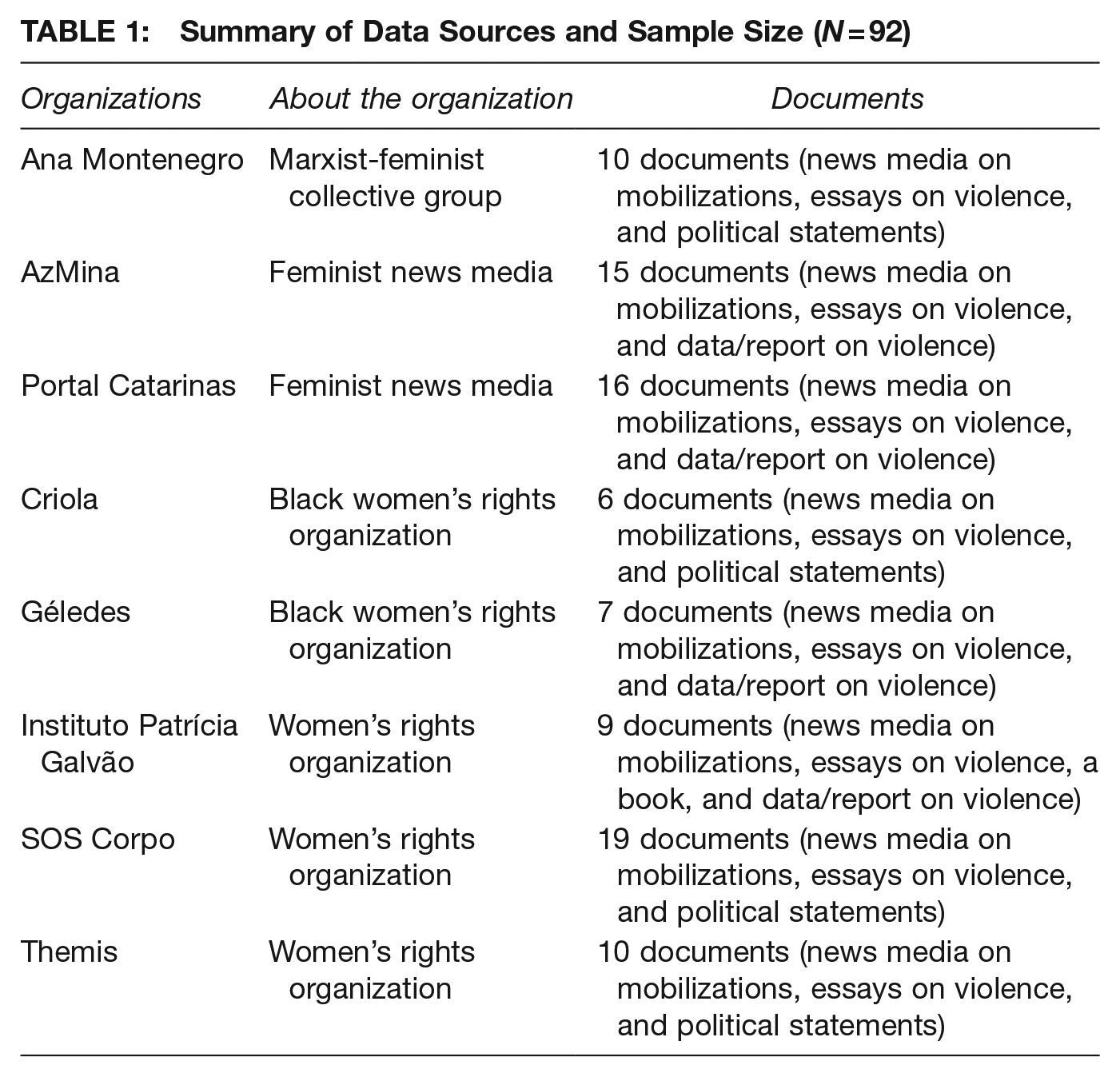
The data assembled here should not be taken as representative of all Brazilian feminist communities but rather as apprehending major public discursive patterns. By focusing on documents produced by major feminist organizations, I intended to capture feminist formulations that sustained the ongoing politicization of feminicídio in the country. The diversity of these organizations highlights the scope of feminicídio across feminist communities. Ana Montenegro is a national feminist political group that engages in local actions with other political groups. AzMina and Portal Catarinas were founded by feminist journalists in the 2010s. Criola was founded in 1992 and Géledes in 1988, both established by Black women activists and intellectuals. Instituto Patrícia Galvão, started in 2001 by journalists, became a significant organization focusing on women’s rights. SOS Corpo began as a civil society organization in the 1980s, and Themis started in the 1990s, focusing on the justice system. As their websites show, all organizations have connections and work with other feminist groups. Their formulations repeatedly relied on data and knowledge produced by various feminists in Brazil.
Given the richness of Brazilian feminist ideas, my sampling approach presents limitations. First, the sample does not cover organizations that do not have an online presence or groups that have recently emerged. Contemporary political mobilizations may involve temporary groups (Conway, Osterweil, and Thorburn 2018), which means that my analysis might not capture these ongoing formulations around feminicídio. Second, despite the variety of online documents such as reports and public letters, the website format naturally shapes how activists communicate their ideas.
After collecting and organizing the data, I coded the documents in several stages. I started with a far-reaching research question of how feminists formulated the feminicídio category. I paid attention to how the materials connected the concept of feminicídio to the Brazilian reality rather than to abstract definitions. Next, I identified simple, emergent themes such as “rise of cases,” “cut of resources,” and “data on violence.” I then re-coded using analytical codes, such as “state projects” and “knowledge development.” I proceeded with focused coding to examine the meanings of their formulations (Charmaz 2014). My focused coding led me to two main features of feminist mobilizations after state incorporation: first, the resistance to state projects and, second, the expansion of the category and knowledge production. Reviewing my memos and coding themes, I found differences in how activists make the category more salient. Black activists tend to reframe feminicídio more radically by including cases of state violence, but these formulations received less attention. By examining feminist formulations, I consider that the meaning-making of ideas across social movement communities is crucial for ongoing politicization and mobilization of frames.
Reframing Feminist Ideas: Resisting State Projects, Expanding the Category, and Multiple Feminisms
I present my findings in three main sections. The first section discusses the claims against right-wing government projects that feminist communities assembled after the legal reform through the feminicídio frame. They reframed feminicídio as a significant social problem to oppose new state projects such as Jair Bolsonaro’s proposal to facilitate access to guns. These feminist formulations also show claims for more state resources, emphasizing the current overlap of crime control and state-welfare vocabularies in feminist frames against violence (Sweet 2023). The second section explains how feminists expanded the frame to purposely discuss cases of violence often ignored by the state, embracing intersectional perspectives and denouncing the lack of data on these cases. Feminicídio appears as a frame to reckon with violence, applicable in various analyses and beyond a simple criminal definition (Fregoso 2023; Wright 2006). These two sections explain how activists have reframed feminicídio to target changes in the political landscape and expand the category beyond the state’s definition. This feminist reframing was shaped by diverse perspectives and formulations, disclosing the intellectual and intersectional work behind it.
In the last section, I draw out differences within the feminist reframing of feminicídio, revealing how the meaning-making of the category is embedded in power relations within the same movement (Roth 2007). I disclose how ongoing formulations by Black activists pushed the frame to be more radical, including cases of state violence. However, this formulation has not received much traction among the women’s movement and was not included in the Feminist Rising manifesto (March 2021), for example. These differences shed light on racial dynamics across feminist communities (Carneiro 2003) and how racialized feminist activists point out the overlap of different violent dynamics in their political mobilizations (White 1999).
Resisting Right-Wing Government Projects
Brazilian women’s movements have a rich history of collaboration. The national movement Feminist Rising Against Feminicídio launched in 2021 brought together diverse groups and perspectives. Their three-page manifesto claims that women are fighting “against a type of violence that has increased since the 2016 coup against the ex-president Dilma Rousseff.” The national manifesto states that the “culture of hate against women has never been so blatant and extreme,” and highlights feminicídio, along with racial violence and the COVID-19 pandemic, as a significant problem in the country, attributing these issues to the federal government’s failure and lack of interest to act. The construction of feminicídio as a national problem in the manifesto is linked to the rise of the right-wing government of Jair Bolsonaro, who was elected in 2018 but whose discourses and public support have received increased national attention since 2016.
To show the link between the killing of women as an unresolved problem and right-wing government projects, feminist communities have mobilized feminicídio to point out how right-wing political projects (1) put women at risk and (2) cut significant state resources to protect women. These two themes appeared in most feminist formulations I analyzed, revealing that feminists were already actively building these political priorities before the national manifesto was published. These formulations reveal how feminists have strategically articulated feminicídio to resist state projects since 2016, reframing the legal framework from an individual criminal category to denounce state projects.
First, feminist formulations mobilized feminicídio to attack Bolsonaro’s popular political project concerning the right of gun ownership. During the national elections, Bolsonaro promised his government would shift the gun policy in Brazil, making it easier for citizens to buy and own a gun legally. His government worked to advance law projects related to the topic in Congress, but feminists denounced it through the frame of feminicídio. As a political statement published by the feminist leftist group Ana Montenegro in 2019 states: “The flexibility of carrying guns will contribute to the increase of feminicídio cases” and “the project will boost the profits of the gun industry,” noting that “in January of this year, more than 100 cases of feminicídio were registered in Brazil” (March 6, 2019) and arguing that greater access to firearms would further increase these numbers.
Similarly, in 2020, another feminist video reposted by the organization SOS Corpo discusses how the project will allow for more guns inside the home, and this “means more domestic violence and feminicídios” (May 6, 2020). The news media article argues that “Today, 40% of women murdered at home are victims of firearms. If the Law Project 3723/2019 is approved, women will be even more vulnerable!” The same document asks people to email national politicians to delay the proposed gun law by claiming: “Let us fill email inboxes so they understand that #MoreGunsMoreFeminicídios.” The proposed law on guns, therefore, is discussed as a risk to women’s lives, and Brazilian feminist communities claim that the prevalence of weapons in society will put women at risk. While pro-gun campaigns in the U.S. context have mobilized the language of feminism as a way to empower women through gun ownership (Twine 2013), feminists in Brazil used the frame of feminicídio as a device to resist a pro-gun political project. The depiction of guns as contributing to feminicídios follows the critique of individual responses to violence, as in the essay published by AzMina:
The current government, however, instead of investing in collective and structural transformations, which prove to be truly protective of society, such as mechanisms for reducing inequality and social conflicts, and protecting the most victimized by violence, calls for the expansion of the legalized use of death as an individual instrument of conflict resolution. (January 6, 2019)
Following the critique of individual responses to violence, feminists mobilized feminicídio to denounce the government’s actions that cut crucial public resources for women. The Feminist Rising manifesto (March 2021) highlights cuts to the budget for social policies: “the government reduced the budget for the development of gender equality actions—executing less than 50% of the budget for 2020.” Feminists from the Black women’s organization Criola discussed feminicídio the loss of rights for Black women and the rise of violence connected to the shift in national politics initiated in 2016: “the political and economic coup that, with its anti-democratic and reactionary intentions” resulted in “the freezing of budget on education and health” (November 3, 2017). Likewise, Portal Catarinas notes that activists objected to the ending of public policies that facilitate homeownership and to the privatization of public services because such actions contributed to feminicidios. The cut to welfare was described as a possible reason for the rise of violence against women, and women’s organizations held the state accountable for not providing resources (March 9, 2019). In advancing the claims for more public resources through a criminal category, these statements show how feminist discourses on violence might serve to call for more health and education resources. In this sense, feminist political projects often entangle many hands of the state as feminists reframe their ideas for new claims.
Feminist communities also pushed back against the employment of feminicídio to promote legal changes focused on punishment. The organization Themis, which historically has worked on political rights and legal reforms, posted a statement in 2021 arguing that “the analysis of the legal proposals that make feminicídio an autonomous criminal type and increase the sentence” should stop because they do not constitute “an adequate criminal policy response and violate the principle of proportionality of penalties” (March 23, 2021). In an essay about other legal projects being discussed in the Congress which employ the term feminicídio, feminists interviewed by the organization AzMina claim that “some of these measures are the result of penal populism discourses, others are palliatives that alleviate the problem. Obviously, none of them can prevent and eradicate this epidemic of violence” (September 12, 2022).
By doing so, feminists reappropriate the frame of feminicídio to attack right-wing legal projects that rely on a carceral agenda. When discussing the measures that the right-wing government is taking, the organization Ana Montenegro highlights that “the anti-crime package from the Minister of Justice, Sergio Moro, does not present proposals to combat violence but rather to exterminate and incarcerate the black and poor population” (March 7, 2019). For feminists, feminicídio appears as a strategic frame to challenge state projects without necessarily requiring other legal criminal reforms. While the tensions between criminalization and other responses to address violence against women persist in the women’s movement, feminists can still be critical of carceral projects. These formulations show that when witnessing the rise of right-wing political projects in political fields, activists might strategically reframe an individual criminal category against state projects.
Dynamics of state incorporation rely “on the ways in which activists navigate their domestic political fields” after legal reforms (Paschel 2018, 189). Women’s movements in Latin America show that the ideological context impacts new goals and mobilizations (Alvarez 1990; Richards 2004). The reframing of a feminist idea after state incorporation might help an idea to be widely accepted by civil society and move beyond a simple law to include more robust claims. The reframing also happens through dynamics of knowledge development and the expansion of the category, as the next section illustrates.
Knowledge Development and Expanding the Category
The frame of feminicídio renders visible multiple forms of violence, according to many of the materials I analyzed. Whereas the legal framework offers a limited perspective on violence against the female sex, feminicídio has been mobilized by feminist communities as encompassing different violent practices and relations. While some institutionalization dynamics might restrict how feminist ideas are employed, Brazilian activists employed feminicídio beyond its legal formulation in multiple ways. All feminist communities in my sample acknowledge the lack of data on violence concerning certain groups, such as trans women and Black women, embracing intersectional perspectives. This approach also appears in the Feminist Rising manifesto (March 2021), which acknowledges the higher level of violence against Black women and the recognition of violence against trans and lesbian women. These formulations are critical for feminist knowledge production against domination and exploitation (Hemmings 2011) as they help activists reframe the term not only as a criminal act but as a way to reckon with violence collectively (Fregoso 2023).
The first way of producing knowledge on the topic was through data. Feminicídio appears as a critical analytical category to measure violence. As in other Latin American countries, activists are actively engaged in producing “counter data”—a practice that involves researching, recording, and remembering the lives of women lost to violence. This practice helps movements make the problem visible to wider civil society (D’Ignazio and Klein 2020) by providing empirical evidence. Most online documents analyzed included data and graphs on violence to draw attention to the problem. These documents also included long reports on violence produced by women’s organizations. The organization Patrícia Galvão developed a dossier on feminicídio in 2016, which included the perspectives of different feminists from multiple backgrounds, and data presented in various images and infographics. The data show how racism shapes higher rates of violence against Black women. The dossier questions the accuracy of official data sets on violence and suggests ways to better capture the circumstances of the killings. While feminicídio is an individualized criminal category in its institutional form, activists employed it as a frame to reckon with violence.
One effect of employing feminicídio to count and present data on violence across feminist communities was that it resulted in the expansion of the category to move beyond heterosexual violence. Portal Catarinas published data on the killing of trans women and travesti: “129 trans and travesti women were murdered in Brazil, 19 of which were in São Paulo; for government statistics, these deaths are invisible” (October 10, 2020). Other feminist documents also emphasized that trans women are victims of feminicídio, but their deaths are often ignored in official data. Similarly, an article published by AzMina in 2017 critiques how public policies tend to focus on heterosexual intimate relations to prevent violence, ignoring other dynamics: “Lesbophobia is not part of the public security agenda and we do not have indicators to calculate how many victims of feminicídio are lesbians” (May 31, 2017). Thus, feminicídio as a legal framework was used to expand and reframe the concept by emphasizing the killing of trans women, travestis, and lesbians.
The response to the pandemic by the government of Jair Bolsonaro also created a new context for the mobilization of feminicídio. Brazil showed that one of the highest rates of COVID-19 mortality was among pregnant women. The organization SOS Corpo wrote an essay in 2021 claiming the practice of feminicídio by the state during that period. They noted that the deaths of pregnant and postpartum women were “state feminicídio” because women’s reproductive health was ignored during the pandemic. The essay by SOS Corpo explained that “the number of maternal deaths more than doubled in the first three weeks of 2021 compared to last year’s weekly average” (May 27, 2021). Thus, activists’ formulations on feminicídio included the pandemic as a critical background for lethal violence against women.
Some feminists from the organization Criola also articulated that the data published by the state did not explain that Black women are the primary victims of homicide (November 25, 2020). They claimed the data collection was inadequate “due to the insufficiency of data disaggregated by race of women victims of violence” (November 25, 2020). Thus, activists call for better data on the topic. Similarly, Geledés 2017 published an essay on violence, articulating that “there is often incompatibility between databases” (October 30, 2017) because these databases do not account for racism in gender-based violence. These organizations are constantly scrutinizing the presentation of data on violence and pushing for more refined analyses of violence that account for complexities. But the government is not the only institution they push back against. A book about feminicídios (Prado and Sanematsu 2017) produced by the organization Patrícia Galvão in 2017 presents a critique of news media editorial content on gender-based lethal violence that lacks the perspective of women’s rights.
Activists’ efforts to expand the category reveal new purposes for the feminicídio frame, including challenging government reports on violence and mainstream news media. Thus, feminists moved beyond the legal framework to continue articulating the discourse around feminicídio. Such knowledge production highlights how feminist communities refused to accept the state definition and data on feminicídio. These expansive formulations around feminicídio became diffused across all feminist communities I analyzed, shaping their claims concerning data on violence. Yet such diffusion had its limitations. In the next section, I illustrate how radical formulations around feminicídio by Black organizations and activists were marginalized in feminist discussions.
Radical Formulations
The rise of women’s movements in Brazil is shaped by struggles for democratization, and like other movements there, they are marked by the tensions between white, middle-class feminism and an anti-racist feminism (Carneiro 2003; Gonzalez, Rios, and Lima 2020). In this context, when I analyzed and contrasted documents, I found radical formulations about state violence against women by Black women’s organizations and Black activists through the reframing of feminicídio. I consider their formulations radical because the implementation of their demands would lead to deeper change than just reallocation of state resources and welfare projects, for example.
Most documents in my sample emphasized and recognized that Black women are more likely to be victims of lethal violence. Across all feminist communities, racism was recognized as a major force that impacted the dynamics of violence and social inequality in Brazil. However, the emphasis on the link between state violence and the killing of women was more salient in documents published by Black women’s organizations or materials written by Black activists. For example, in 2016, the Black women’s organization Geledés argued that Black women face situations of violence created by state authorities (July 14, 2016). In 2017, in a publication about feminicídio distributed by the organization Patrícia Galvão, two Black activists discussed the case of Cláudia Silva Ferreira, a Black woman killed by police officers, and pointed out that “the Military Police of Rio de Janeiro is one of the institutions that kill the most in the country.” They see such state violence as form of feminicídio, in this case perpetrated by the police (Vieira and Nunes 2017).
The organization Criola explained that “the contexts of violence for white women are different compared to the contexts in which Black women face violence” (November 25, 2020). Geledés and Criola, the two Black women’s organizations in my sample, posted about a mobilization organized in 2017, resulting in a meeting with international organizations to discuss violence and feminicídios. In a post about the meeting in the Criola website, they claim that “despite the increase of legal reforms and public policies to prevent gender-based violence in Brazil, the tools and actions are not showing effectiveness to guarantee the well-being of Black women” (November 3, 2017). They again mentioned police violence as a problem. Thus, it is not just right-wing governments but instead the everyday work of the state that shapes Black women’s experiences of violence.
The organization SOS Corpo posted an essay written by the Black activist member Analba Brazão Teixeira titled “Racism Kills! Let us be radical in the anti-racist struggle.” In the essay, Teixeira explains that “the loss of social rights we are witnessing” will likely affect “people who are at the base of the pyramid of class, race and gender inequality, and these are Black women.” She continues that “the majority of women killed by the hands of the state are Black” (June 11, 2018). These formulations and mobilizations around state violence are critical, considering the diagnostic discussed by C. A. Smith (2016, 132) on the “absence of women’s stories” in public debates about police violence in Brazil. Formulations around feminicídio reveal the challenge of recognizing state violence—not only through the absence of resources as a type of gender-based violence.
It is critical to acknowledge that the national Feminist Rising Against Feminicídios manifesto published in 2021 and signed by 250 political groups does not mention cases of violence directly perpetrated by the Brazilian police, nor does it link feminicídio to state violence by the police. The manifesto calls for more state-welfare resources to protect women as well as an end to misogynist culture. Still, it does not demand the abolition of the military police institution in Brazil—a claim present in Black movements (see Ramos 2024). Thus, feminist organizations encompass multiple perspectives with similar goals but notable differences. By focusing on Black women’s experiences with state violence, Black communities highlight that state resources and welfare projects might not be sufficient to end feminicídios. The radical nature of their formulations also underscores the challenges of forming multiracial alliances.
Discussion and Conclusion
In feminist scholarship, the state incorporation of feminist ideas is often seen as co-optation, leading to the weakening of feminist claims. Moreover, feminist frames on violence are often assumed to align with conservative projects because they rely on the criminal justice system to be institutionalized. Given this background, it becomes challenging to envision how feminist ideas on violence could continue to support feminist claims outside the criminal system realm. By examining how feminicídio was discursively constructed and employed by feminists after the state incorporation, I show how feminist activists in Brazil reframed feminicídio to resist state projects and expanded the category to include transphobic violence and violence against Black women.
Ideas from social movements are rarely institutionalized exactly as envisioned by activists, but the ongoing contestation over their interpretation can happen before, during, and after they become codified into law. Feminists continue to shape the meanings of concepts that originate with them but take on different lives once incorporated in state policies. Dynamics of reframing can help to explain how ideas are taken up with different purposes by feminists, depending on the political context and how certain frames are mobilized for different political goals. In this case, feminists evoked the institutionalized concept of feminicídio and reframed it to articulate claims of redistributive justice based on the recognition of gendered violence. By doing so, they also claimed the state had misrecognized some cases of gendered violence and produced data about it. The elasticity of feminist formulations presented in the documents paints a clear picture of how broader reforms are invoked as the primary line of action against the problem of violence against women. This story showcases how feminists called for more public resources as crucial for protecting women from violence. Because the tensions between criminalization and other responses to address violence against women persist in Brazil and in other contexts, it remains key to understand the impacts of feminist frames on state responses to violence.
This paper builds on studies on the multiple lives of feminist ideas, considering the different organizations and settings in which they are employed and by whom (Ahmed 2012; Nash 2018; Nelson and Zippel 2021). Feminist reframing is crucial to understanding activism in a period where feminist ideas are easily co-opted or incorporated by state institutions. The ways Brazilian feminists continuously think about gender and violence as political categories are heavily impacted by the diversity of organizations and activists, leading to more intersectional perspectives around feminicídio. My theoretical discussion points out the need to contextualize feminist politics and examine internal differences and perspectives within feminist projects as they impact framing processes. In all of this rearticulation among feminists, though, Black feminist formulations on state violence and feminicídio are still marginalized. The call to end police violence, originating with Black women, is not central to various other Brazilian groups.
By analyzing the Brazilian case, I show how activists play a crucial role on the course of feminist frames after institutionalization. In the Latin American context, my paper reveals the tenacity of how civil societies might engage with the state (Chatterjee 2004; Daby and Moseley 2022). When feminists witness the rise of anti-feminist discourses in politics, they might strategically reframe already institutionalized ideas against other state initiatives. The ongoing mobilization of social movements after the implementation of legal changes can potentially lead to the restriction or better implementation of these policies (Paschel 2018). Feminists can continue redeveloping their ideas to challenge state incorporation. These findings lead to critical questions of how states and civil societies might respond to these ongoing feminist mobilizations. Future research should investigate the political alliances that feminist reframing can forge and how states react to innovative formulations of state categories.
Footnotes
Author’s note:
I am grateful for the mentorship of Judith Taylor, Hae Yeon Choo, Luisa Farah Schwartzman, and Alissa Trotz. This paper was also possible due to the feedback from Brody Trottier, Eduardo Cornelius, Firdaous Sbai, and Umaima Miraj. I extend my gratitude to the reviewers and editors for their thoughtful and generous suggestions. My sincere thanks to colleagues who offered feedback in presentations of this project: the graduate seminar Feminist Theory and Practice, taught by Anna Korteweg and Hae Yeon Choo; the 2022 Conference on New Directions in Law and Society; the 2023 Sociology Intersectional Salon at the University of Toronto; and the panel Global Perspectives on Law, Gender, and Power in Contemporary Times at the CSA Conference in 2024. This research was funded by the Social Sciences and Humanities Research Council of Canada (SSHRC) through the Insight Grant number 512019 and a Vanier Fellowship. Correspondence concerning this article should be addressed to Roberta S. Pamplona, Department of Sociology, University of Toronto, 700 University Avenue Unit 17100, Toronto, ON M5G 1Z5, Canada; e-mail:

1.
“Levante Feminista Contra o Feminicídio” in Portuguese. The public manifesto is available at https://www.change.org/p/supremo-tribunal-federal-nem-pense-em-me-matar?utm_source=share_petition&utm_medium=custom_url&recruited_by_id=934b2bf0-8358-11eb-aec7-cfd97bd9f990.
2.
The articulation to create the Feminist Rising was initiated by Vilma Reis, a sociologist and activist in Brazilian Black movements; Márcia Tiburi, a philosopher and artist; and Tania Palma, researcher and social worker, revealing the multiracial alliance.
3.
I employ the Portuguese term travesti as it follows the social movement’s nomenclature in Brazil.
Roberta S. Pamplona is a PhD candidate in Sociology with a collaborative degree in Women and Gender Studies at the University of Toronto. Her research interests rely on the intersection of feminist theory, gendered violence, law, and social movements. Her work on feminicídio also appears in Social Politics: International Studies in Gender, State & Society.