




Abstract
The 2013 Charter of Values in Québec proposed to ban “ostentatious” religious symbols in the public sphere; while ostensibly neutral, such bans harm women who identify as Muslim, hurting their sense of belonging. This article examines the emotional experiences of Canadian Muslim women and the emotion work they do to manage non-Muslims’ impressions of them in a context of rampant Islamophobia. To understand their experiences, I develop a concept called spatialized feelings—how emotions, relationally accomplished in intersectional hierarchies, are contingent on the spaces social actors occupy. My interviews and participant observation of Muslim women in Québec revealed that their feelings about self and belonging were spatialized. In spaces dominated by whiteness (work, school, in public), my participants felt different, due to experiences of exclusion. In spaces with other Muslims, participants felt connected, but belonging was complicated by intersectional identities. Although their engagement in emotion work indicated agency, emotion work reproduced raced and gendered bodies and spaces. With exclusionary politics on the rise across the Atlantic, targeted minorities will increasingly experience racialization in gendered ways in public spaces; spatialized feelings are at the core of understanding the consequences of these politics for belonging and emotion work.
On September 10, 2013, the ruling Parti Québécois proposed legislation to prevent religious minorities in Québec from wearing “ostentatious” religious symbols when working in government institutions. Although never passed into law, this Charter of Values was part of an ongoing attempt to restrict religious practice in response to immigrant and religious diversity (Laxer 2019). As in France, its justification emphasized laicité (state secularism) and gender equality (Laxer 2019).
The gendered and racialized effects of secular politics have been researched in Western Europe (Korteweg and Yurdakul 2014; Scott 2018) and Canada (Laxer, Reitz, and Stallone 2023), with attention to the ways (headscarf-wearing) women respond to discrimination and social exclusion (Kassir and Reitz 2016; Killian 2003; Laxer, Reitz, and Stallone 2023). Scholars note the importance of the state in solidifying social boundaries between national majority and Muslim minority groups (Korteweg and Yurdakul 2014; Laxer, Reitz, and Stallone 2023). Feminist scholars highlight colonial tropes in the discourse of secularism (Scott 2018), including assumptions that Muslim women must be saved from “backward” Islam (Abu-Lughod 2015; Farris 2017).
Despite the profound impact of secularist policies on headscarf-wearing Muslim women, little scholarship has probed the emotional consequences, including the emotion work racialized Muslim women do to manage their sense of self and belonging (i.e., their subjectivities) in a hostile context. Therefore, I ask: To what extent do such policies impact Muslim women’s identities, feelings about themselves, and sense of belonging in Canada? More specifically, I examine how university-educated Muslim women in Québec feel about their Muslimness and the headscarf, when their belonging to the nation is politically questioned. I develop a concept I call spatialized feelings to capture how feelings are contingent on the spaces social actors occupy. I show that feelings women have about their Muslim identity change as they interact with people in different spaces, such as the workplace, school, and mosque. Importantly, the spaces they occupy mediate how they feel about their belonging.
Data were collected in 2014, after the Québec government proposed the Charter of Values, so participants were viscerally aware the state was questioning their belonging because of their religion. I attended Friday prayer services at a Montreal university for 9 months to build rapport and recruit participants. Through snowball sampling techniques, I conducted in-depth interviews with 22 university-educated women identifying as Muslim. I conducted a focus group to validate preliminary data, leading to a total of 23 participants. I also attended two Halaqa sessions—a women’s-only group discussing religious materials.
This article proceeds as follows: I historicize secular politics in the Québec context and showcase how they are part of a larger trend of gendered racialization of Muslims post-9/11. Next, I turn to the scholarship on social boundaries and belonging, in which literature on headscarf bans is often situated, to demonstrate the impact of gendered racialization on feelings of belonging. To this, I add insights from feminist geographers to foreground the role of space in sociological understandings of emotional experiences and develop the concept of spatialized feelings. After explaining my methodology, I determine the ways emotions were spatialized by my participants. Overall, they felt alienated in primarily white spaces or spaces (discursively) organized by whiteness (see Ahmed 2007; Anderson 2015; Wingfield 2010), where interactions with non-Muslims reinforced their “difference.” In spaces with other Muslims, they felt connected, but belonging was complicated by racial, ethnic, and gender hierarchies. I examine how they engaged in emotion work to navigate social exclusion, drawing on insights from gender scholars to show how emotion work is racialized and gendered (Ispa-Landa and Thomas 2019; Kang 2003; Wingfield, 2010, 2021). I conclude that although Muslim women have agency in how they manage their emotions, their emotion work reproduces gendered and racialized bodies and spaces.
Gendered Racialization and Banning the Headscarf in Québec
In 2019, the Québec provincial government passed Bill 21, the first North American legislation to ban public employees, including lawyers, police officers, teachers, nurses, bus drivers, and other government employees, from wearing religious symbols in the workplace. Bill 21 is worded in a neutral way supposedly applying to all religious symbols. Although it could harm Jews, Sikh men, and Muslim men, its brunt is felt by headscarf-wearing Muslim women: To date, only members of this group have lost their jobs (Khan 2022). Fatemeh Anvari, for instance, made national news when she was fired from her elementary teaching position in December 2021 for continuing to wear her headscarf (Naqvi-Mohamed 2024).
Bill 21 is a culmination of a longstanding history in Québec politics to control immigrant-related diversity. From 2006 to 2008, in debates on reasonable accommodation, a “crisis in public perception” assumed that Muslims and other religious minorities unreasonably requested religious accommodation in public (Bouchard and Taylor 2008). The Québec government launched an inquiry, spearheaded by public scholars Gerard Bouchard and Charles Taylor. The report (Bouchard and Taylor 2008) indicated that an accommodation crisis existed in perception, not reality, and the moral panic dissipated. In 2007, the municipal government of Hérouxville, a small homogenous Québec town, created a code of conduct for immigrants to assimilate (Municipalité Hérouxville 2007). The Town Charter required faces to remain uncovered in public, except on Halloween.
In a precursor to Bill 21, in 2013, the provincial government proposed the Charter of Values, giving it the power to legally control what they saw as immigrant-related religious expression, banning public employees from wearing religious garments that “by their conspicuous nature, overtly indicate a religious affiliation” (Gouvernement du Québec 2013). Whereas the Charter was overtly preferential of Christian and Jewish expression (see Figure 1), Bill 21 used more neutrally coded language.
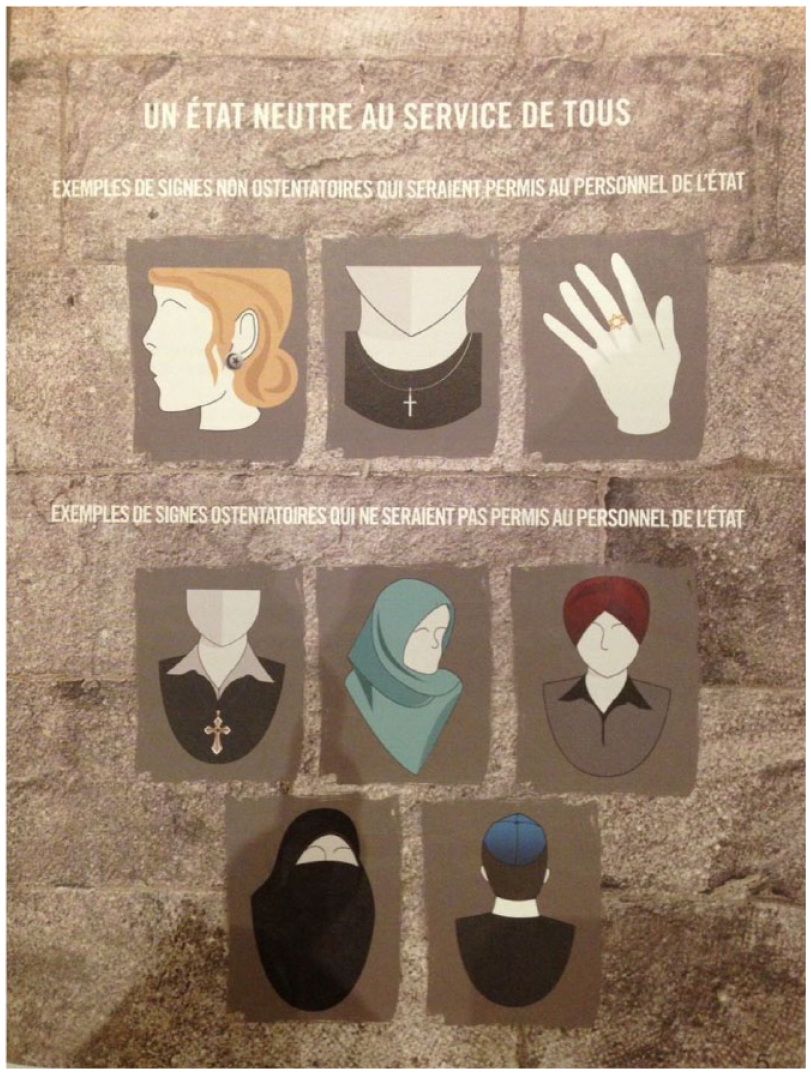
The Parti Québécois Advertised This Poster to Promote the Charter of Values, Which Outlines Which Symbols Would Be Permissible (or Not) to Wear at Work. It Is Promoted as an Ostensibly Egalitarian Approach to Regulate All Religious Symbols in the Name of Preserving Laicité
These moments in Québec politics discursively reinforce and are informed by Orientalist images marking Muslim women as Other. However, feminist discourse is not without blame in this marking of difference. As Mohanty (1988) explained, Western feminists tend to discursively produce a monolithic Third World woman: “The Muslim woman” is a “victim of male control under Islam” (Mohanty 1988) who needs saving (Abu-Lughod 2015). Jasmine Zine (2006, 240) conceptualized this as gendered Islamophobia: [F]orms of ethno-religious and racialized discrimination leveled at Muslim women . . . .proceed from historically contextualized negative stereotypes that inform individual and systemic forms of oppression . . . .[T]he discursive roots are historically entrenched within Orientalist representations that cast colonial Muslim women as backward, oppressed victims of misogynist societies.
These cultural tropes drive processes assigning racial meanings to Muslims (Selod 2019). The processes are not limited to physical features such as skin tone or hair, but include cultural traits such as language, clothing, and religious practices (Selod 2019). Furthermore, this form of racialization “is organized and guided by gender and has gendered consequences” (Selod 2019, 553).
As in Western Europe (Afshar 2012; Farris 2017; Korteweg and Yurdakul 2021; Scott 2018; Yuval-Davis 2012), postcolonial difference seeps into the discourse of secularism in Québec and contributes to gendered racism. The Charter of Values’ alleged purpose was to protect secularism and gender equality, but feminist scholars say that ostensibly egalitarian discourse can have the opposite effect. In a historical study, Scott (2018) argued that gender equality was not a fundamental aspect of secularism in its original conceptualization. In fact, gender inequality—specifically, the assignment of men to the public sphere and women to the private sphere—was integral to the separation of (masculine) state and (feminine) church. When secularism is more recently promoted as the gateway to gender equality, it actually serves as a “discursive operation of power” to morally discipline immigrant groups and maintain white Christian hegemony (Scott 2018, 4).
Spatialized Feelings
I bring together the literature on social boundaries and belonging and on emotions to offer the concept of spatialized feelings. The scholarship on boundaries and belonging highlights the role of the state and nationalist politics in processes of racialization and exclusion for Muslim women (Farris 2017; Korteweg and Yurdakul 2014; Sadeghi 2023). However, the emotion work performed by those targeted, who manage feelings of exclusion—because of state politics—is undertheorized. Feminist scholars have insightfully theorized the role of managing emotion and performing emotional labor in the workplace (Ispa-Landa and Thomas 2019; Kang 2003), untangling how emotion work is gendered (Hochschild 1983; Pierce 1995) and racialized (Green 2023; Mirchandani 2003; Wingfield, 2010, 2021). Yet research should further explore emotion work in other white spaces (Anderson 2015), such as public ones, a common site of racism for visible minorities. The concept of spatialized feelings builds on scholarship of racialized emotions (Bonilla-Silva 2019; Held 2015; Kim 2016) to suggest that space (both white and non-white) mediates feelings of belonging within a national context.
Boundaries, Belonging, and Feeling Excluded
A nation is composed of an “imagined community” socially constructed by members who perceive themselves part of that group (Anderson 1983). Symbolic and social boundary drawing processes occur within that conception of community, based on differentiating between “us” and “them” (Lamont and Molnár 2002). Symbolic boundaries are “conceptual distinctions made by social actors to categorize objects, people, practices” and thus “separate people into groups” (Lamont and Molnár 2002, 168). This group categorization, in turn, shapes ideas about who belongs to the nation. Through politics, policies, and discourse (Sadeghi 2023), these symbolic boundaries are transferred to social boundaries, leading to exclusion and racialization of out-group members (Lamont and Molnár 2002). For instance, nationalist politics clarify social boundaries between national majority members and minorities, heightening racialization of the latter and producing a form of “conditional belonging” (Sadeghi 2023), where full membership in citizenship is limited by racial othering and exclusion (Beaman 2017).
Discourses of gendered Islamophobia—a symbolic boundary—create social boundaries by racializing Muslim women and thus disciplining their belonging (Farris 2017; Mohanty 1988; Scott 2018). In Western Europe, Farris used femonationalism to refer to national rhetoric that advances racist politics by “touting gender equality” and framing Islam as a misogynistic religion (Farris 2017, 4). Referring to Hérouxville, Québec, Zine (2009, 158) argued the 2007 Town Charter created a collective “us” constructed against the anticitizen, in this case, a stereotypical image of a “Third World subaltern woman” who is oppressed and cannot make decisions for herself. In Canada more generally, Muslim women play “a critical role in unsettling and reconfiguring the boundaries of citizenship and belonging in the Canadian national imaginary” (Zine 2009, 146).
Proposed, debated, or enacted headscarf bans also impose racialized and gendered boundaries of belonging to the nation-state (Korteweg and Yurdakul 2014; Laxer 2019; Laxer, Reitz, and Stallone 2023). Korteweg and Yurdakul (2014, 3) comparatively analyzed how headscarves are debated in France, the Netherlands, and Germany, saying these debates “revisit, reaffirm, and potentially rearticulate the meaning of national belonging.” National narratives are “discursive formations,” “constructed ways of speaking that identify the contours of national belonging,” with serious productive consequences for shaping regulation (Korteweg and Yurdakul 2014, 4). Looking specifically at headscarf debates, they found that actors in each country generate boundaries of inclusion and exclusion, with headscarf-wearing women depicted as not belonging to the nation-state.
These exclusionary politics, informed by and reproducing discourses of gendered Islamophobia, impact how Muslim women feel about themselves and their belonging. In a cross-national study, Laxer, Reitz, and Stallone (2023) developed a multidimensional conception of social boundaries (cognitive, emotional, behavioral) to theorize the ways headscarf-wearing Muslim women respond to policy contexts in France, English Canada, and Québec. They found that these women encounter hostility and racism across contexts. In France, where the headscarf ban is perceived as legitimate, women comply with the law, at a deep emotional cost. They must choose between their faith and their career, making them feel uncomfortable and depressed (Laxer, Reitz, and Stallone 2023). National context, then, and the policies within it matter for feelings of belonging.
Tonkens (2012) used the concept of “citizenship regimes” to explain how national context matters for emotion. Citizenship regimes refer to the “institutional arrangements, rules and understandings that guide and shape current policy decisions and expenditures of states, problem definitions by states and citizens, and claims making by citizens” (Jenson and Phillips 2001, 72). Tonkens argued that these regimes shape feeling rules, by which she meant normative ideas about what is appropriate feeling in a situational context (Hochschild 1983). Hostile contexts that racialize minorities and immigrant groups will impact how they should feel about their belonging in that place. Duyvendak (2011) found the European model of nation-as-home fuels nostalgia for a “native” group—white, ethnically homogenous, and predominantly Christian—whose members argue they have the right to feel at home. In such a context, it is relatively easy to think racialized bodies will feel out of place (Combs 2022).
Québec’s nation-making, or citizenship regime, is based on preserving its minority nationhood as an ethnically distinct, Francophone province in Canada. Its nationhood is challenged by the Canadian majority, in which Québec constitutes a Francophone minority and by immigrants, to whom it represents the majority receiving society (Laxer, Carson, and Korteweg 2014). Trying to reconcile these differences is part of its ongoing nation-building project (Laxer, Carson, and Korteweg 2014). This involves fueling nostalgia for an imagined community based on Francophone and Christian roots and regulating immigrant-related diversity through principles of laicité, a nationally specific form of secularism. In the context of contentiously trying to preserve minority nationhood based on ethnic and national Québécois identity, immigrant and racialized minorities may feel out of place. In fact, following Bill 21, a 2022 Léger nationally representative study found that Muslim women, more than any other religious minority, felt alienated, unsafe, and hopeless about their ability to fulfill their aspirations (Lofaro 2022).
The scholarship on boundaries and belonging, in which research on headscarf bans is often situated, contributes to understanding how nation-state processes of gendered racialization negatively impact feelings of belonging. While illuminating, this work only scratches the surface of Muslim women’s feelings in a hostile context. Muslim women have agency (Mahmood 2001; Rinaldo 2014), including how they manage and express their emotions (Laxer, Reitz, and Stallone 2023) and how they present themselves in different spaces (Hussein 2023). Examining their emotional responses to exclusionary politics is a way of investigating this agency.
Laxer, Reitz, and Stallone (2023, 10) found that Muslim women in Canada respond to racialization by asserting their belonging through performances of appropriate femininity, for example, engaging in emotion work by making an “extra effort” to smile and act friendly. Hussein (2023, 7) conceptualized this effort as “performative visibility”—a form of political agency Muslim women use in their everyday lives to battle against Islamophobia, racism, and sexism, essentially representing their “investment in improving race relations.” Daily activism includes reframing, challenging, or showing ambivalence to negative misconceptions about Islam in shops, at workplaces, and at school (Hussein 2023). Despite these exceptions, the emotion work Muslim women perform to respond to “conditional belonging” and how these emotional experiences vary by space have yet to be fully explored.
Emotions, Emotion Work, and Space
Sociologists have insightfully theorized the way emotions are expressed and managed in the workplace (Hochschild 1983; Wingfield 2010, 2021). In early work in this vein, Hochschild (1983) coined the term emotional labor to describe how service workers expressed positive feelings to uplift customers’ spirits. This was a key part of their day-to-day work that required them to repress their negative emotions to the point of alienation and detachment from self. Other scholarship on emotional labor has shown that emotion work reproduces gender inequality (Pierce 1995). Feeling rules—norms around how one should feel—are gendered because acceptable emotional displays are different for different genders at work (Pierce 1995). For example, Pierce (1995) found that female litigators were penalized for expressing anger or aggression, whereas males were tolerated and even rewarded for these same emotions.
This scholarship has been criticized for missing how race shapes emotion management (Wingfield 2010, 2021). Wingfield (2010) argued that feeling rules are not just gendered, but also deeply racialized. Her study of workplace dynamics demonstrated how Black professionals are held to different emotional standards than whites. Because of their racial visibility, they repress feelings of anger and frustration when they encounter racial bias in the workplace and they act friendly to negate racist tropes. Meanwhile, white professionals are allowed to show anger in certain circumstances. This more recent research on emotion work indicates the value of intersectional analysis (Ispa-Landa and Thomas 2019; Kang 2003; Wingfield 2010, 2021). Emotions are frequently generated through interactions (Mills and Kleinman 1988; Shott 1979), and one’s raced, classed, and gendered social location often determines how these emotions are experienced, expressed, and managed. Black feminists are particularly attuned to how intersectionality shapes interactions and emotion (Collins 1990; Crenshaw 1991; Wingfield 2010, 2021). For example, Wingfield argued intersecting hierarchies of race and gender “inform the interactions where emotional labour takes place” (Wingfield 2021, 200–01), and how a Black female attorney engages in emotional labor may depend on whether the interaction involves white female colleagues, white male judges, or Black male clients.
My work contributes to how space impacts feelings and emotion work. Wingfield argued feeling rules are racialized in workplaces she referred to as “homogeneously white,” “predominantly white settings,” or structured around “white, middle-class norms” (Wingfield 2010, 251–53). Workplace spaces, in other words, become characterized by whiteness or elsewhere referred to as “white space” (Anderson 2015). Using these insights from critical race scholarship (Anderson 2015; Wingfield 2010), I use the term white spaces to refer to the processes, norms, and mechanisms that hierarchically structure and privilege whiteness. The scholarship on racialized emotions predominantly shows the emotional consequences of white space on feeling race and racism (Bonilla-Silva 2019; Held 2015; Kim 2016). But if interaction is a key mechanism in the way emotions are experienced and managed, how do emotions generated through interaction vary based on the spaces occupied, which can be white and/or non-white?
My concept of spatialized feelings refers to how feelings are contingent on the spaces that social actors occupy. I use Fu’s (2022) theorization of space for this concept. Space is defined by interactions, norms, and discursive knowledge that create complex networks of power in a designated area (Fu 2022). Interactions between social actors generate emotion, and these interactions are shaped by power-laden relationships embedded in intersectional hierarchies. In other words, race, class, and gender identities and hierarchies inform interactions between people. Moreover, discourses—such as Orientalism—shape interactions too. These interactions then generate emotional experiences that reproduce intersectional inequalities. Negatively racialized women, for instance, are often compelled to manage how they are feeling based on complicated gendered and racialized axes of power in different spaces.
Geographers are adept at conceptualizing the role of space in emotional experiences (Anderson and Smith 2001; Bondi, Davidson, and Smith 2007), including its role in feelings of belonging (Peterson 2023). They note that emotions are produced sociospatially, “in the interplay between and among people and environments” (Bondi, Davidson, and Smith 2005, 3). Spaces themselves have a particular “feel” to them, or what Peterson (2023) calls “atmospheres.” An atmosphere comprises the sights, smells, light and shadow, sounds, movement, activity, temperature, and décor of a space, and people can experience the same atmosphere differently depending on differences in power, history, and lived experience (Peterson 2023). For instance, racially privileged bodies are more likely to feel comfortable in spaces characterized by whiteness: To be comfortable is to be so at ease with one’s environment that it is hard to distinguish where one’s body ends and the world begins. One fits, and by fitting the surface of bodies disappears from view. White bodies are comfortable as they inhabit spaces that extend their shape. The bodies and spaces “point” towards each other, as a “point” that is not seen as it is also “the point” from which we see. In other words, whiteness may function as a form of public comfort by allowing bodies to extend into spaces that have already taken their shape. Those spaces are lived as comfortable as they allow bodies to fit in; the surfaces of social space are already impressed upon by the shape of such bodies. (Ahmed 2007, 158)
Doing ethnography in nighttime leisure spaces such as bars and nightclubs in Manchester’s Gay Village, Held (2015) found that non-white bodies became racialized through othering processes (staring) that made them feel uncomfortable in lesbian spaces. Her white respondents felt comfortable in predominantly white gay bars. Yet mixed-race, Black, and East Asian respondents felt discomfort, and some engaged in emotional labor. However, at the same time, racialized peoples experience a full spectrum of emotions, including joy (Tichavakunda 2022). Tichavakunda (2022) found that within supportive community and network spaces, Black students experience Black joy in higher educational institutions that are otherwise white.
To summarize, intersectional identities and hierarchies shape emotional experiences and these vary spatially. Space is defined by interactions between social actors and discursive knowledge, and these create complex networks of power (Fu 2022). White spaces tend to produce negative emotions for people of color (Bonilla-Silva 2019; Held 2015; Kim 2016), which at times, yields emotion work. Doing emotion work also reproduces raced, gendered, and classed bodies (Held 2015) and intersecting inequalities from a geographical perspective (Rodó-Zárate 2023). Yet, community spaces and networks within white spaces also elicit joy (Tichavakunda 2022) and comfort. Therefore, as I show, space mediates feelings of belonging. While citizenship regimes impact feeling rules (Tonkens 2012), many spaces such as work, school, public sites, and community spaces constitute citizenship regimes, and feelings of comfort and discomfort vary across them, captured by the term spatialized feelings.
Methods
This study was based on 22 individual, in-depth interviews, a focus group discussion, and 9 months of participant observation. The combined individual interviews and focus group brought a total of 23 participants. I collected data in 2014 in the aftermath of the 2013 Québec Charter of Values debate. Every Friday for 9 months (March–December 2014), I attended religious services organized by the Muslim Student Association (MSA) on a Montreal university campus. Religious services were gender-segregated, so I joined the women’s prayer space. Most attendees were doing undergraduate and graduate degrees; some were staff and faculty at the university, and others worked in nearby businesses. This site was where I mainly recruited participants.
I was visibly non-Muslim upon entering the field site. I did not wear a headscarf. I did not join in prayer, and I am a white woman. I sat at the back of the room with other women who did not pray and listened to the sermon. Some attendees questioned my presence. I introduced myself as a fellow student conducting research on Muslim women’s experiences. It was not unusual for a non-Muslim to enter this space, though. During the study period, several other non-Muslims walked in, curious about the space or wanting to learn more about Islam.
Over time, attendees got to know me and became used to my presence. I handed out recruitment flyers and asked if they would like to participate in the study or knew someone who would. I became friendly with some regular attendees, who invited me to Halaqa sessions where women discuss and interpret Islamic texts and materials. This form of ethnographic data collection allowed me to build rapport, and some attendees decided to participate in the study.
I recruited 22 participants for semistructured, in-depth individual interviews lasting 1 to 6 hours, for an average of 1.5 hours (see Table 1 for demographics). I interviewed women whom I met at religious services, through personal contacts, and using snowball sampling techniques. Most were students (n = 20) doing an undergraduate (n = 14) or graduate degree (n = 6) in a variety of disciplines at different universities in Montreal. Three were working but had graduated with a bachelor’s or master’s degree. The sample, therefore, captured the experiences of highly educated, younger adults.
Demographic Information
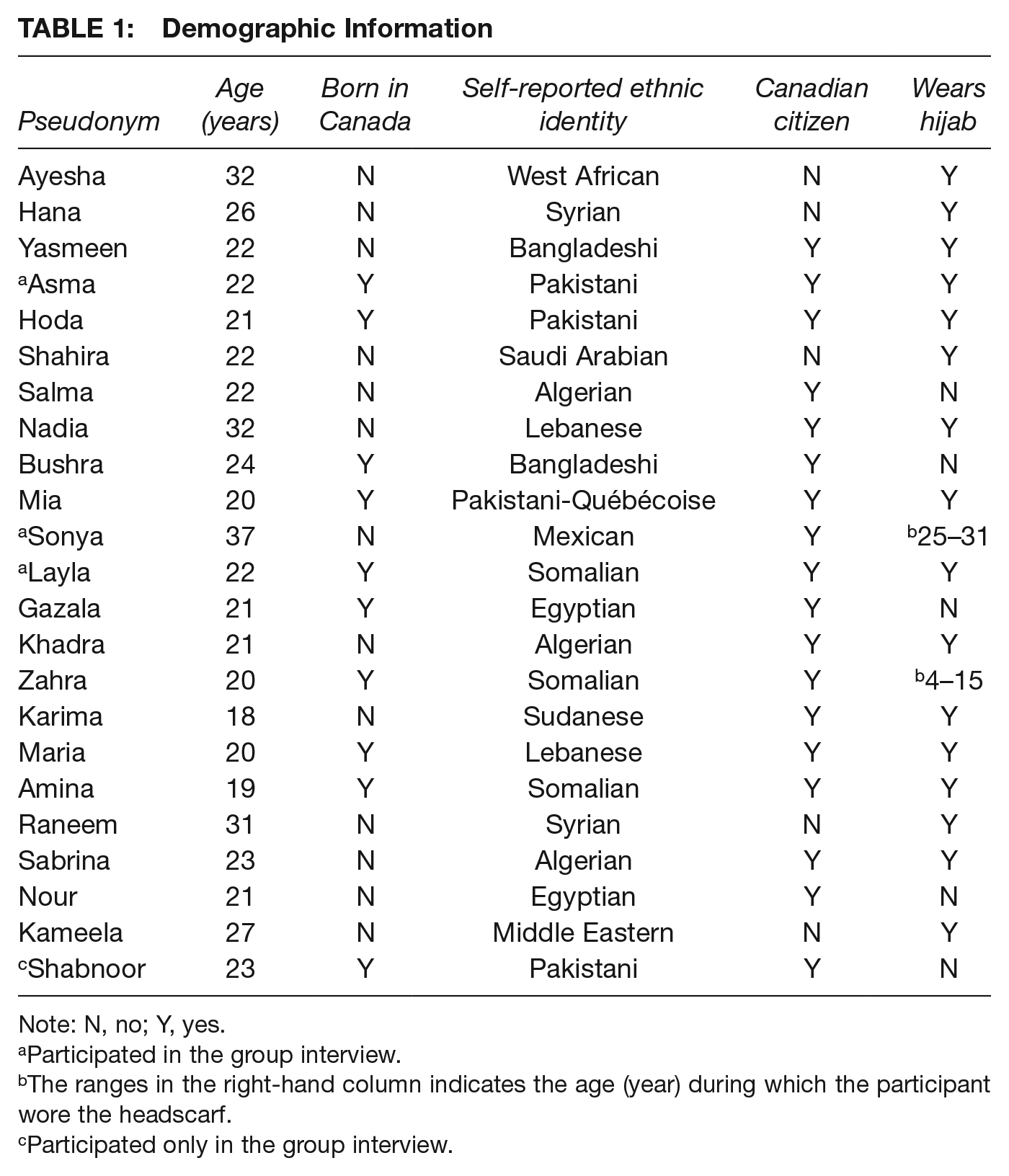
Note: N, no; Y, yes.
Participated in the group interview.
The ranges in the right-hand column indicates the age (year) during which the participant wore the headscarf.
Participated only in the group interview.
The religious space was ethnically diverse, and this was reflected in the sample. Participants self-identified as South Asian (n = 6), Middle Eastern (n = 6), North African (n = 6), West African (n = 1), East African (n = 3), and Mexican (n = 1). They identified as Black, Brown, white, or Middle Eastern. Most were born in or moved to Canada as children (n = 16); some were born elsewhere and moved to Canada as adults (n = 7). The former were an average age of 22 years, noticeably younger than the latter (mean, 30 years).
Most participants wore a headscarf (n = 16). Among those who did not (n = 7), two wore it for a time but decided to remove it, three wanted to wear it in the future, and one experimented with wearing it. Therefore, this study does not capture the experiences of women who choose not to wear it and are confident in their decision.
Following preliminary analysis of the individual interviews, I asked participants to join in a group interview. It took place during university finals, so only four were available to participate, three from the individual interviews and a fourth who was a friend of a participant. Two participants in the group discussion wore headscarves; two did not. The interactions and collective meaning-making around identity, emotion, and space proved insightful, despite low attendance.
Interviews were recorded and transcribed. Data were analyzed using MAXQDA software through several rounds of inductive coding that involved grouping and analyzing data thematically. After an initial process of open coding, I used focused codes to identify the types of emotions felt and how they were produced relationally in contextual spaces. I conducted a second round of focused coding to detect the ways participants managed their emotions.
As a white, non-Muslim woman, I was conscious of how participants would perceive my presence in the research process. At times, I sensed they were wary about the extent to which they could openly share with me. For instance, in one interview, a participant was hesitant to share her gendered experiences in Muslim prayer spaces, fearful—I assume—that I would stereotype her and conclude that Muslim women are oppressed. In these instances, I shared my own gendered experiences growing up in an Italian family and Catholic community. For the few participants who did not want to open up, I assumed “leaving truths unspoken may be understood as a kind of resistance to outsiders’ unwelcome intrusions” (DeVault 1995, 626).
At times, my outsider status was useful. Participants occasionally assumed I did not know anything about Islam or the Muslim community and explained their experiences in detail. They elaborated on common knowledge shared in the Muslim community and how they made meaning of it.
Reyes’ (2020) concept of ethnographic toolkit explains how researchers use different aspects of their social location strategically in qualitative research. In this vein, I drew on my multiple social positions as a woman, a non-Muslim, a first-generation student, a third-generation immigrant, and a member of the Anglophone minority in Québec to build rapport and facilitate the data collection process, in a way that relationally and situationally responded to the space I occupied and my conversations with participants.
In the next sections, I first examine how my participants felt in different spaces. Then I discuss how they expressed and managed their emotions with non-Muslims.
Feeling Different in White Spaces
I met Ayesha at a library on a university campus in Montreal. She was a doctoral student studying how computer users understand and react to software system updates. She came to Québec in 2008, during the reasonable accommodation debates, after completing her bachelor’s and master’s degree in the United States. Ayesha was born in France but moved to Mali—her parents’ homeland—during her childhood. I was surprised and exclaimed, “Oh cool, wow, you traveled a lot!” Ayesha used my reaction to express how she is often misunderstood:
I did. I don’t look like I have, traveled, or studied a lot but I have. I’ve done both.
What does that mean? It doesn’t look like I . . .
(looking uncomfortable) Uhh ya, I don’t know, I guess you know, I don’t know. People tend to not read me well.
Like other participants, Ayesha said being visibly Muslim (wearing a headscarf) in predominantly white spaces made her feel different. Throughout her life, interactions with non-Muslims suggested she was not perceived as highly educated or worldly, and she often felt out of place. Soon after immigrating to the United States, she found she was the target of co-workers’ stares and negative comments. The workplace was a space discursively characterized by white, middle-class norms (Wingfield 2010), and the interactions with co-workers in this space made Ayesha feel alienated. In contrast, she characterized her current employment on a research team in Québec with professors conducting research in hospitals as “very warm” with “cordial relations.” But whenever she had “to go out of that usual bubble,” such as interviewing doctors, she encountered surprise, as if they expected someone else after being in contact by email. Outside the “bubble,” discourses of Islamophobia informed relations—and consequently feelings—in the workplace.
On campus, Ayesha cited the faculty club as a potentially hostile space. “If I was to go in there,” she said, “I would not feel welcome. . . . . can see a little discomfort when I enter a place with looks and stuff like that.” Ayesha used words like discomfort and confusion to describe this space. However, in Muslim spaces—events organized by the MSA—she was part of “a little family” sharing “common values.” She felt understood. The faculty club and MSA meetings could potentially have taken place at the same location; it was not the physical boundaries that defined a space, but the power-laden relationships and norms that were made apparent through interaction (Fu 2022).
Like Ayesha, other participants—both those who did and did not wear headscarves—described feeling out of place, particularly in the workplace. Stories of harassment, staring, racial slurs, and discriminatory treatment were common. While working at a retail store in a suburb of Montreal, Asma, a 22-year-old woman of Pakistani descent who wore a headscarf, encountered three customers who refused to be served by her. Salma, who was 22 years old and of Algerian descent, described an interaction when a person at work discovered she was Muslim and asked why she did not wear a headscarf. She felt forced to simultaneously explain her reasons for not wearing it and counter the narrative that the headscarf symbolizes female oppression. Nadia, a 32-year-old woman of Lebanese origin, worked at a chocolate store and wore her headscarf for the first time on Valentine’s Day. She was fired days later because she made “too many mistakes” at the cash register. Yet “mistakes” were never an issue when she worked other busy holidays without her headscarf.
Public spaces, 1 such as the sidewalk, subway, or park, were affected by Islamophobic discourse, and this was especially pronounced during political debates on religion in the public sphere in Québec. My participants reported feeling pressure or were even fearful for their safety during the 2006 reasonable accommodation debates and the 2013 Charter of Values debate. In the former debate period, Mia, a 20-year-old headscarf-wearing woman whose mother was Québécoise and father was Pakistani, recalled being followed by a stranger who yelled, “The debate is for you, and we will see if you are here next week.” When the Charter of Values was proposed, she decided to take self-defense classes, and she took public transport only with someone else after her work shift. Sabrina, a 23-year-old headscarf-wearing woman of Algerian descent, tried a different approach—staying home to avoid strangers. These show the profound impact of gendered racialization and the work my participants did to feel secure. Other research confirms that bodies identified as Other use space strategically to gain a sense of comfort (Johnson 2017).
These experiences were noticeably different from immigrant participants’ experiences in their home countries. For instance, Sonya converted to Islam when she lived in Mexico, her home country, because she felt moved by Islam. When she adopted the headscarf in Mexico, she said bystanders would jovially ask her why she wore it, and she would comfortably respond in her mother tongue. When she met her husband, she moved to France soon after the government adopted the 2004 headscarf ban in schools. The negative treatment, including racial slurs, such as sal Arabe (dirty Arab) and jihadiste, or commands to retourne chez toi (go back to your country) made her cry every night. In Mexico, she was considered white. But in France, her slightly tinted skin and headscarf racialized her as Arab. She moved to Canada a year and a half later and was relieved to be in an ostensibly welcoming place. When the reasonable accommodation debates started, however, she was reminded of her experience in France. She made the difficult decision to remove her headscarf; she was tired of being targeted for her Muslim identity.
The hostile context of Québec—its citizenship regime (Tonkens 2012)—hampered participants’ feelings of national belonging. Secular politics, formulated on discourses of gendered Islamophobia in a post-9/11 context, and their interactions with non-Muslims, made participants feel different. Wearing the headscarf takes on different meanings depending on the location of the wearer (Read and Bartkowski 2000). Wearing it in France and Québec made Sonya feel excluded because the headscarf is associated with gender oppression and seen as a threat to national identity (Laxer 2019). Sonya’s case is exemplary of Tonkens’ (2012) argument that citizenship regimes shape feeling rules. The headscarf law in France and the reasonable accommodation debates in Québec communicated to Sonya that her identity precluded her from belonging. These politics legitimized citizens’ questioning of headscarf-wearing women’s belonging (Laxer, Reitz, and Stallone 2023).
Feelings Produced in Community Spaces
While in public, headscarf-wearing participants were delighted to encounter other women wearing headscarves. I noticed this when I was walking with Nadia to the university library for the interview. Nadia locked eyes with a fellow headscarf-wearing woman walking in the opposite direction. I saw the woman smile at her and give a slight nod. I could not see Nadia’s facial expression, but I could tell she reciprocated the gesture. Later in the interview, I asked Nadia how she felt when she saw a woman wearing a headscarf. She mentioned the encounter: “I don’t know if you noticed but when we were walking, we passed a hijabi. We both moved our heads, greeting each other and saying ‘hi.’ I know she’s Muslim and she knows I’m Muslim. I feel kind of a secret group but not so secret.” Even though Nadia did not know this woman, she felt connected because of the headscarf. The act of greeting brought comfort and solidarity. Other participants said they felt supported, not alone and not so different when they were surrounded by people like them. Nadia called this moment “a sisterhood of the travelling hijabs” playing on the title of the film, The Sisterhood of the Traveling Pants, to characterize the sense of solidarity she felt in the presence of another headscarf-wearing woman.
Feelings are generated sociospatially (Bondi, Davidson, and Smith 2005) and intersectionality matters in spatialized emotions (Held 2015; Rodó-Zárate 2023). In the previous section, I showed how public spaces are sites where headscarf-wearing Muslim women are harassed and ostracized. In Nadia’s case, the interaction with another headscarf-wearing woman produced a welcoming public space that elicited connection. Other participants similarly mentioned feelings of solidarity, community, and belonging. (Public) space, then, can be hostile, welcoming, or both and plays a mediating role between citizenship regimes and feelings of belonging.
Participants’ feelings of belonging in religious spaces were complicated by ethnic, sectarian, and racial identities, as well as different beliefs about gender and sexuality that (discursively) organize these spaces. Put simply, belonging in Muslim spaces was also contested in gendered and racialized ways. Some participants relayed stories of being told how to wear the headscarf properly, creating a gendered form of belonging. Others said the MSA made them feel excluded because of their race, producing racialized belonging. When I asked the focus group about their experiences wearing the headscarf in Muslim spaces, I heard the following:
It did happen to me. I don’t know if it’s because I don’t belong to any major culture.
It happens to everyone. It happens to me.
Even with yours? Cause you have the standard hijab.
People tell me your shoulders. . . .ou’re supposed to wear one dress . . . .
I remember I was told. I was wearing a denim skirt. Someone told me that you can’t. It’s not hijab. I said, it’s covering my body. Well, it doesn’t matter, it must be something non-Western.
Body sassing is the problem.
Yes, oh my God.
Yes.
(Everyone wanted to speak and got excited)
Body policing.
The hijab police. (laughs) A lot of people say that if you are not wearing hijab, you’re haram. Someone did tell my friend that you’re haram, you are going to go to hell. I’m like, what kind of sins are you doing inwards that we don’t know about? You’re judging this person. You don’t know what stage in their journey they are in.
Participants in the focus group had different ethnic backgrounds where cultural norms influenced how they practiced Islam. Layla was Somalian. Sonya was a Mexican convert to Islam. Asma and Shabnoor were Pakistani. In her interview, Sonya said she had a hard time fitting into Muslim spaces, because her ethnic background did not coincide with her Muslim identity, and she experienced gendered body policing of how she should dress in these spaces. Sonya lived in a remote region of Québec with only one Mosque, so Muslims of different backgrounds joined in prayer. In halaqa circles, she noticed how the headscarf was policed by different ethnocultural standards. One woman of North African Arab descent was insulted by how a South Asian woman wore her headscarf because it fit loosely around her head. These experiences were particularly painful for Sonya; before removing her headscarf, she felt she did not belong to the nation because she wore a headscarf. In Muslim spaces, she felt she did not belong because she did not have any ethnocultural capital tied to her religious identity. Sonya’s decision to remove the headscarf and pray at home was based on her need to be an individual, choosing how she presented herself to others.
In the focus group, Layla assured Sonya that this form of regulation happens to all women, regardless of ethnicity. Layla, who wore a “standard hijab” covering her hair, ears, part of her forehead and neck, also experienced “hijab policing.” Layla savvily used her religion as authority to rebut gendered body policing. She asked, “What sins are you doing inwards?” By asking this, she was implying God’s judgment is determined by a person’s character and actions, not her clothing choices. In male-dominated religious spaces, where men hold symbolic and material power, women may use space strategically to create bonds of sisterhood and make meaning of their own religious practices (Prickett 2015). Layla did so by using her religious knowledge to defend Sonya’s clothing choices.
The group interview itself provided a space where participants created sisterhood based on their shared gender and religious identities. Participants connected through their experiences of hijab policing. They understood how their gender affected their experiences in religious spaces (discursively) dominated by and organized for men. Participants were animated in the group discussion; they used their religious knowledge as authority to refute the gendered structures they had all been impacted by.
Space also influenced feelings about self and belonging for participants who did not wear a headscarf. Because non-headscarf-wearing participants had encountered judgment in religious spaces, they expressed apprehension about joining the MSA, saying most women belonging to it wore a headscarf. In their interviews, non-headscarf-wearing participants said it could be intimidating to enter those spaces. When I was at the MSA, I noticed Salma was often surrounded by headscarf-wearers. I asked her how this made her feel. She explained that her friends were supportive, but she recognized it could be intimidating for nonwearers to join the MSA. She said some women alternatively chose to join the Arab Student Association, where wearing a headscarf was not the norm. Other respondents, like Zahra, a 20-year-old who removed her headscarf at age 15, said trying to get involved in the MSA made her feel “really Black.” Having grown up in a Somali neighborhood near Toronto, Zahra felt that her Muslim identity never contradicted her racial identity. Entering the MSA, where the majority of Arab members had lighter skin, Zahra felt “awkward” and “out of place.” Feelings of belonging, then, are also racialized and gendered in Muslim spaces and determined spatially.
Doing Emotion Work
In this section, I move the discussion beyond how my participants felt as they moved across space to how they expressed their emotions with non-Muslims in public spaces. In other words, I examine their emotion work—the management of feeling, regulated by feelings rules that are gendered (Hochschild 1983; Pierce 1995) and racialized (Wingfield 2010).
Participants were conscious that wearing a headscarf made them visibly Muslim. They saw this as one of the purposes of wearing it—to represent the religion and community positively. However, this visibility played an important role in gendered racialization and pushed them to manage their emotions. Karima said: I am very careful about how I do things in public. I don’t have road rage and I think that has to do with the hijab. Without it, I would probably be a lot more vocal with the idiots I drive on the street with. Because I wear the hijab, I am very careful not to give a bad representation of my faith especially now there is so much incorrect information about it and because we are so visible. . . .When I think I represent a faith of 1.7 billion people, it terrifies me. I recently came to terms with this: Although it’s a 200-thread piece of scarf, it represents so much. You represent a faith. If I were to ever take it off, which I don’t plan to, it would be for that reason that I cannot bear the burden of representing Islam. (emphasis added)
Karima, an 18-year-old headscarf-wearing woman of Sudanese origin, consciously monitored and managed her emotions with non-Muslims to create a positive impression of the Muslim community. She did this emotion work because she was visibly Muslim and recognized that her religion was negatively racialized. When she moved to Montreal from a prairie province to do her undergraduate degree, she noticed there was more vocal opposition to the headscarf in Québec. Karima and others were more likely to hear comments from non-Muslims; they worked harder to mask their feelings and represent Islam positively.
When she was shopping at Canadian Tire, a large Canadian retail store, Karima said a Québécois couple was rude to her. A cashier noticed and tried to provide comfort by saying they were “prejudiced.” Karima explained how difficult it was to do emotion work in that moment: I would have gone up to them and given them a piece of my mind and got it off my chest, but because I was representing Islam, I bit my tongue and just smiled and took it in. I always think, if there was someone who stole my laptop and I had to run after them, I would hope that my hijab would fall off before I get to them. You always must be polite and try to give the best impression. . . .The very fact that Pauline Marois [Québec Premier] wanted to propose that Charter of Values shows that there was a strong constituency to support it and that terrifies me, so we have a lot of peer work ahead of us. It’ll probably take us decades to get over 9/11 and the war on terror and everything else. (emphasis added)
In this emotionally taxing work, Karima had to put on a performance to be the “best version of herself” to represent Islam positively in a hostile context. This involved suppressing her feelings of anger and frustration and remaining quiet, polite, and friendly. Hussein (2023) suggested that given their public and political visibility, Muslim women “do” politics in their everyday lives. Doing politics by negating dominant discourses requires lots of emotion work, exemplary of Hussein’s (2023) “performative visibility.” In this moment, Karima performed emotion work to persuade non-Muslim citizens that her identity as a Muslim was misrepresented. Karima communicated that she was a good citizen by being the best version of herself in public.
Sociologists note that feeling rules are racialized (Wingfield 2010) and gendered (Pierce 1995) in the workplace. Karima’s emotion work demonstrates that feeling rules are also gendered and racialized in public spaces. Of course, the consequences for managing emotions in public are different than in the workplace. At work, Karima could lose her job by showing anger. In public, possibly nothing would happen to her if she yelled back at the rude couple, or she could be at risk of further harassment or even assault. Kassir and Reitz (2016) argued that headscarf-wearing mothers in France who protest against headscarf regulations on school field trips are simply activating their “Frenchness,” but Karima activated her femininity by being docile and friendly, a phenomenon noted elsewhere (e.g., Laxer, Reitz, and Stallone 2023). Motivations for these different types of responses (confrontation vs. docility) are difficult to assess. Did her religious values motivate her to take a nonconfrontational approach? Was it her gender socialization? Nevertheless, Karima wanted to feel valued as a citizen in public spaces—that her belonging was no longer conditional on the gendered racialization of her religious self.
Following the proposed Charter of Values, some participants anticipated doing more emotion work with non-Muslims. Hana, a 26-year-old mother from Syria, attended an event at the MSA titled “Ethics and Spirituality” to learn how to manage her emotions with non-Muslims. I asked Hana why she attended. She explained: I was facing lots of pressure during the Charter. . . .ots of feelings. I felt that I needed help. I wanted to know how to act if someone asks me something. . . .The Muslim Student Association invited a [prominent community leader] to speak and this lecture was very useful. I needed to know how to react to people in an ethical way because sometimes you feel that you are afraid of doing something wrong against your religion.
Hana performed her religious identity by seeking advice on how to respond to non-Muslims. She wanted to manage her feelings in a way that aligned with her religious beliefs and values. Responding to non-Muslims in an ethical way is an agentic action. Still, both wearers and nonwearers of the headscarf recognized that women who wear the headscarf are taking on embodied responsibility by representing Islam. In the focus group, Shabnoor said headscarf-wearers are put on a “pedestal”; they need to be “perfect,” and “there should no flaw in the way they carry themselves.” The visibility that accompanies the responsibility of representing Islam could inform decisions not to wear the headscarf (Salma) or remove it (Sonya).
After many hostile interactions with non-Muslims, some participants said they became desensitized. Salma said some of her headscarf-wearing friends were “accustomed” to mistreatment. Layla, who participated in the focus group, said she was “immune” to what people thought of her. I asked her whether she was concerned about joining the workforce. She said she had “stopped caring,” especially since the Charter debates. She had been considering a career in medicine, but she recognized this might not be possible for her. She was still in school, so she tried not to think about having to choose between her career or her headscarf. Some of her friends had made this decision, at a significant emotional cost—a finding noted elsewhere (Laxer, Reitz, and Stallone 2023).
Years after the study, I met Layla again. She had graduated from physiology and was on the job market, applying for clinical laboratory positions. She said after a phone interview, one researcher wanted to meet her in person. At the meeting, the hiring professor said, “Oh, you didn’t sound Muslim on the phone.” Layla said she tried hard to be friendly and manage her emotions.
Discussion
Scholarship on the co-constituted gendered and racialized effects of headscarf bans is abundant in Western Europe (Kassir and Reitz 2016; Killian 2003; Korteweg and Yurdakul 2014) and developing in Canada (Laxer, Reitz, and Stallone 2023). Secular laws have deep emotional consequences, especially for Muslim women. This study links scholarship on social boundaries and belonging with work on emotion to theorize how Muslim women in Québec experience, express, and manage their emotions in different spaces. By developing the concept of spatialized feelings, I foreground the role of space in sociological understandings of emotion and emotion work. I argue that feelings are generated spatially through intersectional identities and hierarchies and these emotive processes reproduce intersectional inequalities. Like others (Ispa-Landa and Thomas 2019; Kang 2003; Wingfield 2010, 2021), I show the importance of intersectional analyses of emotions and emotion work, but add to these conversations through showing how these processes are spatialized.
Space is an area defined by interactions, norms and discourses (Fu 2022). Whiteness and gendered Islamophobia discursively organized space and, in turn, shaped interactions at work, school, and in public. In these white spaces, nonverbal (staring) and verbal (racial slurs, prejudicial comments) interactions with perceived non-Muslims made respondents feel uncomfortable and alienated. All participants reported these feelings in white spaces, regardless of age, race, ethnicity, citizenship status, or immigrant generation. Even if they had a white skin complexion or converted to Islam later in life, the headscarf became a cultural signifier that racialized their bodies in gendered ways, impacting their feelings about self and belonging.
While participants often felt uncomfortable in white spaces, interactions with other headscarf-wearing Muslim women in these spaces made participants feel connected because they shared mutual understanding of each other’s experiences. This connection in white space is what Nadia referred to as “being part of a secret group.” Feelings of solidarity did not always transfer as easily in Muslim spaces. These bonds were often complicated by other intersecting identities such as race, sect, and ethnicity that informed interactions. Participants reported feeling judged by competing ethnocultural standards of how to wear the headscarf “properly.” Non-headscarf-wearing women felt intimidated to enter Muslim spaces where the headscarf was dominant. Different discourses about the value of the headscarf shaped Muslims’ spaces and, in turn, feelings.
Tonkens (2012) argued that citizenship regimes shape feeling rules, and the study’s findings suggest that this holds for Québec. The Charter of Values debate created a hostile public space for headscarf-wearing women, hurting their sense of national belonging. Participants strategically navigated these spaces by taking self-defense classes, traveling with someone, or choosing to stay home more often to avoid strangers. These strategies were a way to gain comfort in public (Johnson 2017). Ahmed (2007, 162) noted that comfort is an emotion that comes from privilege, saying “spaces are inhabitable for some bodies and not others,” and discomfort arises when social inequalities become visible. Others have similarly found that feeling comfortable in a space is an indicator of belonging (Held 2015), while the reverse suggests nonbelonging.
Hostile public spaces also compelled headscarf-wearing Muslim women to manage their emotions. Participants often repressed feelings of anger and frustration and displayed friendliness to represent Islam positively to non-Muslims. This “performative visibility,” as an agentic way of doing politics (Hussein 2023), reproduced gendered and racialized bodies and spaces (Held 2015; Rodó-Zárate 2023). Playing up one’s “feminine qualities” creates a gendered body. Being friendly and acquiescent in an interaction with a hostile non-Muslim produces a racialized body. These intersecting inequalities have geographical (or spatial) implications, reinforcing what Rodó-Zárate (2023) referred to as “geometries of power.”
My findings also suggest that space mediates the effects of citizenship regimes on feelings of belonging. Within a citizenship regime, social actors occupy different spaces in their everyday lives—at home, the neighborhood, work, school, leisure activities, worship sites, and more. These spaces shape how these social actors feel about themselves and their belonging. Whether my participants felt comfortable and included or different and alienated depended on the space they were in.
Conclusion
Future research on emotion work should pay attention to religion, religious identity, and religious beliefs. Hana explained that the motivation for her emotion work was to practice Islam; in other words, being kind, patient, and friendly was part of her religious practice. Participants talked about emotion work as a way of “doing” their religion—or “performing their religious identity to become an authentic religious subject” (Avishai 2008, 413). The connection between emotion work, performing gender, and doing religion (for a heavily racialized group) needs to be examined further.
This research took place following the 2013 Charter of Values debate. With Bill 21 in place, feelings of belonging are arguably more compromised now. This possibility should be explored. In addition, I used a highly educated sample, but Muslim women’s engagement in emotion work may vary by class background and type of employment, especially following Bill 21. For instance, the Québec government instated a “grandfather clause” to ensure that headscarf-wearing Muslim women in public employment positions can keep their jobs if hired before Bill 21’s enactment on June 16, 2019, but new hires are not allowed. How does this two-tiered system impact how Muslim women feel about themselves and their belonging? How do these women feel about being unable to hire a fellow Muslim wearing headscarf?
Finally, as in Québec, there is a surge in exclusionary politics across the Atlantic that profoundly affects visible non-whites. The targets of far-right politics in Europe tend to be “immigrants,” especially those with a Muslim background. In Trump’s United States, culprits include racialized groups such as Blacks, Muslims (e.g., the Muslim ban), and Latinx populations, who need to be prevented from entering by “building a wall.” These politics embolden ordinary citizens to participate in racialized surveillance in gendered ways (Selod 2019), potentially making public spaces hostile, where feelings are implicated and emotion work is done. Spatialized feelings are at the crux of understanding these processes.
Footnotes
Author’s note:
I believe that producing knowledge is collaborative. A number of scholars have impacted my thinking, shaping the outcome of this article. The author thanks her supervisors, Anna Korteweg and Fidan Elcioglu, for their invaluable feedback and continued support. She thanks her mentors, Hae Yeon Choo and Tahseen Shams, and colleagues—Laila Omar, Maleeha Iqbal, Bastian Neuhauser, Fatima El Sayed, Cheery Attia, Shahab Saqib, Gökçe Yurdakul, and Schirin Amir-Moazami—for their engagement with previous drafts. She thanks the anonymous reviewers for their comments that undoubtedly improved the quality of the paper. She also thanks the editors for their mentorship and for making the process seamless. She thanks the participants, who shared their stories during a difficult time.

Notes
Jessica Stallone is a PhD candidate in sociology at the University of Toronto. Her research areas are in race, ethnicity and migration, the sociology of gender, political sociology, and aging. This article stems from her master’s thesis. Her current dissertation research explores nationalism in old-age homes in Québec. She has also published in Ethnic and Racial Studies.