



Abstract
Transgender people face multiple challenges to securing and maintaining parenting rights, yet most studies on trans parenthood focus exclusively on trans masculine people’s experiences and feature majority white samples. To address gendered and racialized gaps in knowledge, I conducted 54 semi-structured interviews with trans women in the United States, who parent or wish to parent, across race and class backgrounds. Using the intersectional frameworks of racialized transmisogyny and reproductive governance, I examine the barriers to parenting rights that trans women encounter in adoption and custody disputes. I find that judges and case workers use racist and anti-trans stereotypes when evaluating “parental fitness,” which (1) institutionalizes racialized transmisogyny in the law, (2) increases the regulatory power of legal institutions, and (3) reinforces dominant mothering ideologies. I also discuss how everyday people (i.e., partners and family members) co-construct the legal and symbolic meaning of motherhood, illustrating the centrality of trans reproduction to the policing of trans and other minoritized communities.
Plain Language Summary
Transgender people face multiple challenges to securing and maintaining parenting rights, yet people who study trans parenthood mostly talk to trans men and white people. To further our understanding of this topic, I spoke with 54 trans women in the United States, who parent or want to be parents in the future, across race and class backgrounds. My goal was to understand the barriers to parenting rights that trans women encounter in adoption and custody disputes and how that connects to larger patterns of inequality for trans people and other marginalized groups. I find that judges and case workers use racist and anti-trans stereotypes when evaluating “parental fitness” (the legal standard used in these cases). This sets a precedent for legal discrimination and creates more opportunities for the state to intervene in marginalized people’s everyday lives. Lastly, I discuss how judges, case workers, and everyday people (i.e., partners and family members) reinforce norms about what it means to be a “good mother,” and why that matters in terms of people being able to build the kinds of families they want.
Between one-quarter and one-half of trans adults living in the United States identify as parents (Grant et al. 2011; Xavier, Honnold, and Bradford 2007), and most trans people hope to have children (Riggs and Bartholomaeus 2020; Tornello and Bos 2017). Unfortunately, trans people face legal, cultural, and medical barriers that make it difficult to build the families they desire. These challenges include lack of support for fertility preservation (Lowik 2018; Reese 2019), heteronormative gender roles (Lampe, Carter, and Sumerau 2019), and discrimination in adoption and custody disputes (Farr and Goldberg 2018; Walls et al. 2019). Far from being isolated issues, these challenges reflect and reinforce the systematic regulation of minoritized communities. From abortion access to affordable childcare, racial, class, and gender hierarchies shape people’s ability to parent (Briggs 2018; Roberts 1997).
The distribution of parenting rights serves as an entry point into examining trans people’s lives across institutional contexts. This regulatory power over trans parents involves a mixture of state and non-state officials, from U.S. politicians, who have proposed more than 590 anti-trans bills in 2023 (Trans Legislation Tracker; https://translegislation.com), to partners, judges, and caseworkers, who can limit parenting rights by mobilizing and constructing “best interest of the child.” My research addresses two main gaps in the literature on trans parenting rights. First, most studies on trans parenthood focus exclusively on trans masculine people and feature majority-white samples (Agénor et al. 2021; Schilt and Lagos 2017; Stozer, Herman, and Hasenbush 2014), resulting in an incomplete understanding of the gendered, classed, and racialized dimensions of the U.S. legal system. Second, with several notable exceptions (e.g., cárdenas 2016; Lowik 2018), few scholars connect this legal discrimination to broader systems of anti-trans and racialized regulation.
To address these gaps, I conducted semi-structured interviews with 54 trans women across North America who are either current or prospective parents. My participants vary in terms of race, class, sexuality, and age—half the participants were women of color, and half were white—as well as a mix of adoptive and genetic parents. Using the intersectional frameworks of racialized transmisogyny (Krell 2017; Serano 2007) and reproductive governance (Morgan and Roberts 2012), I examine the following questions: (1) What legal barriers do trans women experience as they seek to secure and maintain parenting rights; (2) how do judges, caseworkers, and other actors (i.e., partners) mobilize/resist anti-trans stereotypes to either exacerbate or minimize these barriers; and (3) how do these processes vary by race and class? Although courts and adoption agencies purport to serve the well-being of trans women and their families, in practice, these institutions regulate minoritized families and maintain intersecting social inequalities. More specifically, anti-trans stereotypes reinforce the power of regulatory institutions, policing the legal and symbolic boundaries of motherhood and constructing motherhood as a white, cisgender category. This process of racialized reproductive governance links the regulation of trans communities in the United States to the marginalization of other demographic groups.
Transgender People and Parenting Rights
The challenges trans people encounter regarding their parental rights depend in part on both their pathway to parenthood and the timing of their transition. For nongenetic parents who wish to foster or adopt, anti-trans sentiments shape the construction of “parental fitness” (Brown and Rogers 2020). Those who transition after becoming a parent, meanwhile, might face custody threats, based on the idea that their transness inflicts harm on the child (Crozier 2012). Although trans women are more likely than trans men to have children (Wierckx et al. 2012), they are less likely to live with them due to conflict with ex-partners and persistent judicial discrimination (Minter and Daley 2003; Perez 2010; Walls et al. 2019; Xavier, Honnold, and Bradford 2007). Only 28 states in the United States explicitly bar discrimination based on gender identity, and 13 states have “religious freedom” clauses that permit legal discrimination (Movement Advancement Project 2023), alienating prospective parents who might otherwise pursue adoption (Tasker and Gato 2020).
Significant gaps exist in the study of trans people and parenting rights. Most studies overwhelmingly feature white participants and offer little analysis of trans women’s specific experiences (Schilt and Lagos 2017; Stozer, Herman, and Hasenbush 2014). Two-thirds of published articles on trans people’s sexual and reproductive health needs focus exclusively on trans masculine individuals, and all feature a majority white sample (Agénor et al. 2021). Studies that include trans participants across the gender spectrum often aggregate their results, not accounting for the specificity of trans women and trans feminine people’s experiences.
I use the frameworks of transmisogyny, transmisogynoir, and racialized transmisogyny (Krell 2017; Serano 2007) to understand how intersecting oppressions shape trans women’s ability to secure and maintain parenting rights. Transmisogyny argues that trans women’s oppression is distinct from but related to sexism and transphobia. For example, Serano (2007) uses the concept of double standards to note how some feminists condemn trans women for doing the same things that they tolerate or celebrate in cis women, such as expression of femininity. The terms transmisogynoir—based on the concept of misogynoir (Bailey 2010)—and racialized transmisogyny highlight the specific, multifaceted gender oppression faced by Black trans women and trans women of color, respectively. Not all trans women navigate the same challenges (Koyama 2020), and theorizing these differences is critical to understanding their experiences of parenthood and reproduction.
Parenting Rights as a Site Of Contesting Motherhood
The distribution of parenting rights involves many overlapping hierarchies, some addressed by anti-discrimination laws, though legal and social barriers persist. Not all parents have or desire a legal connection to their children (Collins 1990), but legal parentage does confer a range of rights and responsibilities, including custody and the ability to make religious, medical, educational, and legal decisions on behalf of one’s child (Crozier 2012). Each U.S. state provides guidelines for how to define the “best interest of the child,” and existing research examines the role of the state in regulating custody and adoption. When it comes to the state balancing its obligation to act in the best interest of children with its responsibility to respect the integrity of families, several doctrines protect disadvantaged parents. First, courts presume the interests of parents and children coincide until proven otherwise, requiring evidence for state involvement. Second, courts rule on parental fitness—capacity to care—before deciding whether the child would be better off in someone else’s custody (Appell and Boyer 1995).
Judges and caseworkers exercise their own discretion in determining the notoriously subjective legal standards of “parental fitness” and “best interest,” often relying on white, middle-class standards of parenting and heteronormative gender roles (Farr and Goldberg 2018; Reich 2005). At one convening of attorneys, mental health professionals, and child advocates to discuss the “best interest of the child,” these professionals agreed in fewer than 50 percent of cases and identified different factors shaping their decisions when they did agree (Appell and Boyer 1995). Thus, “the distinction between care and control logics can be blurry” (Fong 2020, 614). Both state and private adoption agencies participate in the regulation of family and parenthood through “the joint action of discrete, fragmented state and non-state entities” (Fong 2020, 613). Low-income families and families of color experience an especially high degree of state surveillance (Reich 2005). Due to racialized gender stereotypes and the structure of the U.S. child welfare system, Black mothers are disproportionately reported to Child Protective Services and receive the harshest parenting sanctions (Elliott and Reid 2019; Fong 2020; Roberts 2022).
Trans people are also caught in this racialized web of surveillance, particularly Black, Indigenous, and Latinx trans individuals, 38–43 percent of whom earn below the federal poverty line (James et al. 2016). Yet research on transgender parenting rights rarely acknowledges racialized surveillance (cárdenas 2016), and scholars who study the regulation of trans communities, such as Spade (2015) and Beauchamp (2018), do not examine parenting in much depth. My research examines what parenting reveals about the intensification of anti-trans politics in the United States and how anti-trans politics mutually reinforce other forms of racialized reproductive governance.
Regulating Motherhood as a Racist and Anti-Trans Practice
Competing ideologies of motherhood present women with an ever-increasing list of expectations, at the risk of being perceived as “bad mothers.” Friends and strangers reproach women for being too involved in their children’s lives or not involved enough (Hays 1996; Park 2018). Mothers receive an onslaught of real and perceived judgment for their parenting, resulting in a “hierarchy of mothers” (DiLapi 1989) that privileges certain women and stigmatizes others.
Reinforcing these dominant ideologies, politicians and the media portray low-income women and women of color as inherently bad mothers, without recognizing that the labor disproportionately carried out by women of color allows middle-class white women to spend time with their families (Glenn 1992). Racial pathologies depict women of color as hypersexual, overbearing, or insufficiently maternal (Briggs 2018; Dow 2019). Thus, women of color, and Black women in particular, are rarely recognized for their “inventive mothering practices” that deviate from dominant mothering ideologies (Gurusami 2019; Randles 2021).
In addition to these stereotypes, trans women experience false accusations of predatory behavior (Schilt and Westbrook 2015), pressure to disclose their trans identity (Bettcher 2007), and negative associations with sex work (Vidal-Ortiz 2009), all of which shape how judges and caseworkers interpret trans women’s parental fitness (Farr and Goldberg 2018). Julia Serano (2007, 24) writes that “as a [trans] woman, I am often confronted by people who insist that I am not, nor can I ever be, a ‘real woman’.” These stereotypes not only exclude trans women from the category of “woman” but also fortify the belief that there is a “right” way to be a woman. In other words, “by insisting that [a] trans person’s gender is ‘fake,’ [cisgender people] attempt to validate their own gender as ‘real’ or ‘natural’ (Serano 2007, 14). Racist and anti-trans stereotypes co-concurrently reify what Hamilton et al. (2019, 322) call hegemonic femininities, which are ‘cultural ideals of womanhood [that] serve to uphold all axes of oppression.’ They also serve to ‘justify’ inequalities” (Smedley and Smedley 2005).
To understand how these racist and anti-trans stereotypes fit into a larger system of racialized surveillance, I use the concept of reproductive governance, which anthropologists Morgan and Roberts (2012) developed to study population control in Latin America. Reproductive governance refers to how different “configurations of actors,” including state institutions, nonprofits, and social movements, work together to “produce, monitor, and control reproductive behaviors” (Morgan and Roberts 2012, 241). Morgan and Roberts (2012, 242) recognize power as diffuse, magnified by discourses or “moral regimes” that “govern behaviors, ethical judgments, and their public manifestations.” In short, moral regimes and regulatory institutions mutually reinforce one another. Scholars have invoked reproductive governance in many contexts, including men’s involvement in population control discourses (Balasubramanian 2018). The concept of reproductive governance allows us to examine the role of differently situated actors (i.e., judges, caseworkers, and partners) in regulating trans reproduction, as well as the role of anti-trans discourses in reinforcing these eugenic practices.
In How All Politics Became Reproductive Politics, Laura Briggs (2018) argues that seemingly disparate policy agendas—from welfare reform to immigration and policing—have the common goal of discouraging racialized groups from parenting. For example, proponents of restricting state benefits refer to Black women as “welfare queens” who have children to finance their “lavish” lifestyles, and they push long-acting contraceptives onto low-income Black teens to solve the “problem” of teenage pregnancy (Cassiman 2008; Roberts 1997). Meanwhile, advantaged white women are encouraged to reproduce through structural supports (i.e., tax credits) and cultural norms that conflate womanhood with childbearing (Damaske 2011).
I argue that by portraying trans women as dangerous—particularly to children—anti-trans policies reflect and reinforce this web of reproductive governance.
Methods
From August 2019 through May 2021, I conducted 54 semi-structured interviews with transgender women who either currently parent or want to be parents someday (See Table 1 for more information). I include prospective parents to avoid speaking only with women who have successfully achieved the status of parent, and ask questions about participants’ pathways to parenthood and how identities such as race and gender shaped their experiences. Initially, I conducted interviews at a mutually approved location of the participant’s choice. Once the pandemic began, I conducted interviews using video chat technologies (i.e., Zoom), which yield data similar to in-person interviews (Darwin 2020). Interviews typically lasted 60–90 minutes, and participants received a $30 gift card to a major retailer upon completion.
Demographic Proportions by Race and Parenting Status (N = 54)
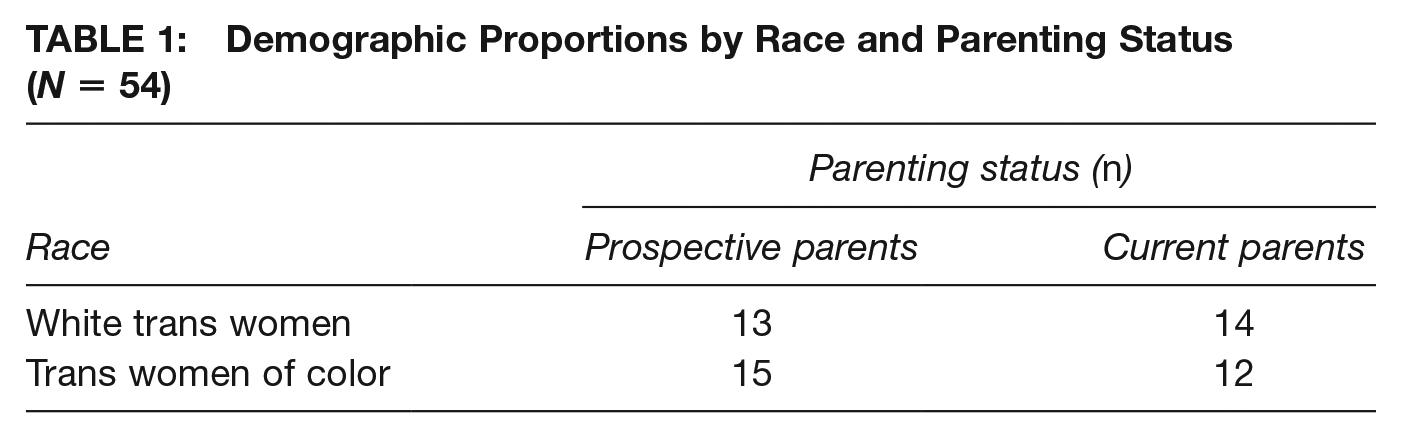
I used several recruitment strategies. First, I reached out to trans-led organizations and LGBTQ centers across the United States and asked that they share my recruitment materials with their membership. Using search engines and the expertise of my personal and professional networks, I sought out groups that were currently active, discussed parenthood, and/or had programming specifically for trans women. Second, I shared the call for participants on my personal Facebook and Twitter accounts, encouraging people in my networks to re-post. Eligible participants were parents or wanted to be parents, were over the age of 18, lived in North America, and self-identified as trans women, including nonbinary trans women and other trans feminine people; parents did not need to have a biological or legal connection to their children to participate. I used respondent-driven sampling 1 to intentionally recruit participants who identified as non-white or people of color. In consultation with the Institutional Review Board (IRB), I maintained their anonymity by using pseudonyms and removing identifying information from the transcripts and research manuscripts. I also deleted interview recordings one year after collection.
The current parents I interviewed had become parents through a mix of adoption, genetic parenthood, and queer kinship ties 2 (see Table 2 for more information). About half transitioned before having their first child, and the other half transitioned afterward. Both the current and prospective parents in my sample are diverse by class, race, sexuality, geography, and age. I view class as relational, meaning that while I collected the level of education and household income, I interpret a participant’s class based on the context of their circumstances. The median household income of my participants ($75,000–$89,999) slightly exceeds the median income of U.S. households (Shrider et al. 2021), partially explained by the concentration of participants in expensive cities (i.e., New York City or Washington, DC). Finally, age matters because as the political climate toward trans people shifts over time, so do the perceived (and actual) possibilities of trans parenthood.
Other Demographic Characteristics (N = 54)
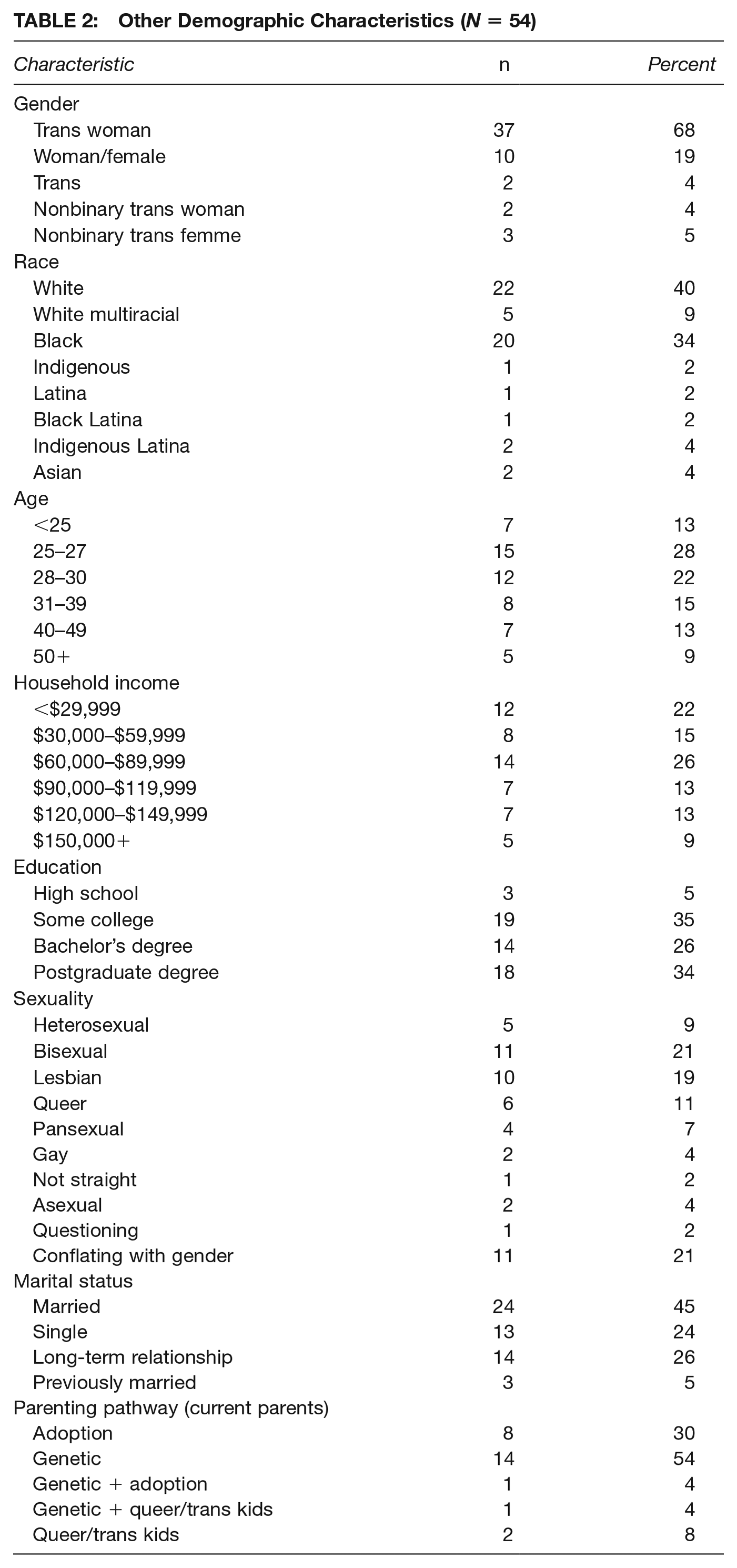
After transcribing interviews using recording and transcription software (Otter), I began a multi-stage data analysis process. First, I conducted line-by-line thematic coding using NVIVO 12, cataloging all meanings that emerge, not just those that supported my expectations. When I identified a new set of codes or changed the way I conceptualized a code, I re-coded previous interviews based on the most recent typology. Next, I used matrix coding to examine differences among groups and trends within groups (such as current vs. prospective parents, primary parenting designation, and race, including multiracial categories). In comparing the experiences of white trans women with those of trans women of color, similarities reveal the impacts of transmisogyny on parenting and reproduction, while differences show that trans women are not a monolithic group. For credibility, during interviews, I would summarize participants’ responses and provide them the opportunity to confirm my interpretations or offer clarification. To ensure dependability and confirmability, I worked closely with the IRB office to revise my study methods and interview protocols, and I spoke with trans colleagues (not in the study) to gauge whether my interpretations resonated with their expertise and lived experiences.
While I disclosed my identities as white and nonbinary in the recruitment documents, I cannot be certain how participants perceived me. After an interview, for example, a participant might raise her eyebrows and ask, “What brings you to this work?” I interpreted this question as commentary on my gender, on the border of transfemininity, and thus with an uncertain stake in this topic. Or she might ask whether I have kids of my own, another way of determining the extent of our shared experience. These real and perceived differences when it comes to race, gender, and parental status may make someone reluctant to share a particular experience or participate in the study. To deal with this, I allowed time to build rapport before the interview, used respondent-driven sampling, and developed a list of parenting resources for trans women that I circulated with my recruitment materials. By sharing this list, I hoped to mitigate the exploitative dynamic embedded in social research, particularly with trans communities (Tebbe and Budge 2016). I also explained to interested participants that my last decade of activism in the reproductive justice movement, particularly abortion funding, provides an entry point into my scholarly and political engagement with parenting, family, and reproduction.
Findings and Analysis
Navigating Different Pathways to Parenthood
While trans women become parents through a variety of pathways, including genetic parenthood, fostering, adoption, and step-parenthood, each option presents its own challenges.
Miriam, for example, is a white trans woman in her 60s, whose wife used Miriam’s banked genetic material to conceive and give birth to their first and only child. Despite her name being on the birth certificate, Miriam was told by the hospital that she needed to adopt her own genetic child. “They didn’t realize I was trans,” she recalls, “or that we used my genetic material.” The issue was swiftly resolved with the nurse, but Miriam’s experience speaks to the invisibility of trans mothers and the everyday ways motherhood is constructed and policed. To most people, mother = birthing parent and father = non-birthing parent, hence the hospital staff’s inability to recognize Miriam and her relationship with her child. The slippage between mother and cisgender woman, while unintentional (Miriam’s nurse quickly resolved the issue), can have substantive impacts on trans women’s ability to secure and maintain parenting rights.
Among participants who cannot have or do not want genetic children, adoption and fostering are the most desired alternatives. These pathways carry their own uncertainties. To foster or adopt, trans women must gain the approval of judges and caseworkers who evaluate parental fitness through their own social lenses. This process, many women claim, is harrowing but necessary to secure parenting rights. Other pathways, such as step-parenthood, fail to provide the structure that participants may desire in a parenting relationship. As Skyi, a Black woman in her 20s, explains:
The problem is when the other parent comes into play. Because even though I may be wanting to be a mother figure to that partner’s child, I know there are certain limitations that I can’t cross or boundaries I can’t set.
Some stepparents enjoy, and even seek out, less engaged parenting (Moore 2011), but Skyi wants to play a more active role in her future kids’ lives, “waking up every morning to see their faces.” She does not need to formally adopt children, but says it will help accomplish her parenting goals.
In their attempts to secure and maintain parenting rights, participants “do family” by “defining inclusion and exclusion criteria for family membership and assigning rights and obligations accordingly” (Acosta 2021, 2). For Miriam, being recognized as a mother provides legal protection should she and her wife divorce. Skyi, meanwhile, fears that step-motherhood would not fulfill her desired role. Parenting does not need to be competitive. Maria, a Latina and Indigenous woman in her 30s, plans to hire a surrogate, and she is not concerned about the surrogate’s relationship with her kids. “When my parents got divorced,” Maria tells me, “and my dad started dating, my mom said, ‘As long as she treats my kids well, I have no problems with her. I don’t see anything wrong with someone loving your child.’” Still, many people draw sharp distinctions between parent and non-parent, invoking questions resolved through courtrooms and adoption agencies.
Given its capacity to grant or revoke parenting rights, the law “distributes [both] security and vulnerability” (Spade 2015, 73). In other words, laws can protect, reducing institutional barriers, or can entrench existing inequalities, such as religious exemptions to anti-discrimination laws. Because family law is determined largely at the state level, participants’ location shapes their parenting journey. Josie, a nonbinary trans woman in their 20s, explains that their preferred pathway to parenthood depends on “where [they are] living at the time.” More advantaged participants can move to a state with greater protections if they so desire. Yet many legal scholars, trans studies scholars, and abolitionists question the ability of legal institutions to liberate minoritized groups, noting the role of these institutions in surveilling and criminalizing the very people they claim to protect (Davis et al. 2022; Spade 2015).
In the following sections, I discuss how transmisogyny and racialized transmisogyny structure trans women’s experiences of adoption and custody disputes. First, I argue that vague legal standards (i.e., “parental fitness”) allow judges and caseworkers to mobilize anti-trans stereotypes, increasing the regulatory power of state institutions. Anticipated discrimination also regulates the distribution of parenting rights by causing trans women to self-police their own behavior. Next, I show how anti-trans and racist ideologies mutually reinforce one another by legitimizing dominant mothering ideologies. Last, I discuss the role that partners and family members play in constructing the meaning of motherhood, either reifying or challenging this web of racialized reproductive governance.
How Anti-Trans Stereotypes Increase Regulatory Power
Participants anticipate various intersecting barriers when it comes to adoption and custody disputes, including matters related to their financial standing, queerness, transness, and disability status. Sometimes one of these layers feels more salient than the others. Angel, a white trans woman in her early 20s who lost several part-time jobs in the pandemic, zeroes in on her lack of wealth and education: “I don’t have a finished college degree. While I don’t think that makes me less qualified, an adoption center might think otherwise.”
Other times, these axes of real and potential discrimination seem inseparable from one another. Participants rarely use the terms transmisogyny or racialized transmisogyny to describe their experiences but are acutely aware of how others perceive the intersection of their identities. IO, a white trans woman in her 20s, describes the pressure of becoming a parent knowing that in the event of a custody dispute, the courts would likely favor her cisgender partner: “I’ve heard about cases where they rule against the transgender mother because she might have a psycho-pathological impact on the kids.” Fear of judicial discrimination provokes stress for transgender parents and may have other negative consequences (Haines, Ajayi, and Boyd 2014).
IO details stereotypes about trans women that impact how others perceive them as parents:
that we’re creepy pedophiles, mentally ill, or secretly gay men wearing makeup. . .there’s this meme [referring to trans women as] the 41 percent club—you know, the 41 percent of trans women who attempt suicide. It’s like if someone is trans, people assume they’re too mentally unstable to make their own decisions or raise their own kids.
Like IO, transfeminist bloggers Morgan Page (2015) and Madeline Stump (2021) discuss how the label “crazy trans woman” discredits them and justifies anti-trans violence. This stereotype draws on both the misogynist practice of gaslighting (Sweet 2019) and the medicalization of trans identity by medical, legal, and community gatekeepers (Garrison 2018; shuster 2021).
Navigating stigma on the basis of their gender, race, class, and other identities, some participants make an effort to emphasize the qualities associated with “good motherhood.” Whitney, a Black trans woman in her 20s, is in the process of adopting with her husband. “When we are presenting ourselves [to the caseworker],” Whitney tells me, “[we tell them] yes, we are married and are so eager and ready to have kids. We want to raise the baby with a lot of love, and for this baby to know the strong bonds of friendship and marriage.” Whitney’s strategy illustrates the concept of respectability politics, which involves altering appearance, speech, or behavior to conform with dominant expectations (Higginbotham 1993). Whether or not Whitney believes these things, she knows that the caseworker can deny her application, so she describes her interview as a “presentation” that requires intentional strategizing.
The use of stereotypes within and outside the courtroom, however, does not only impact individual trans women’s ability to access parenting rights. Anti-trans and racist stereotypes create new mechanisms of regulation by symbolically and legally constructing motherhood as a white, cisgender category. These stereotypes reinforce who counts as a mother according to dominant ideologies and also provoke increased surveillance of all parents and potential parents (not just transgender women). In other words, anyone not perceived to fulfill “ideal motherhood” has a greater risk of losing or failing to gain parental rights. In the following paragraphs, I examine these processes through the lenses of three anti-trans stereotypes: (1) trans women are dangerous, (2) trans women are deceptive, and (3) trans women are not “real women.”
By portraying trans women as dangerous, authorities intervene in participants’ lives under the guise of protection. Maggie, a white trans woman in her 50s, had been the sole provider for her two children when their other mother demanded full custody and outed Maggie to the judge. Maggie recalls the judge’s immediate prejudice against her as a trans woman: “When we went to court, it didn’t matter what crazy loony shit she did, I was always the bad person, not her. She was the normal one. I’m the thing you don’t want your kids around.” Not only did the judge label Maggie an unfit parent, but he reinforced this transmisogyny by making her “see therapists who were under orders to get the kids away from me and back with their [other] mom, with whom they didn’t have a relationship. . . one of the therapists even specialized in gay conversion therapy.” While Maggie has a devoted relationship with her children, who lived with her until they turned 18, she never acquired formal custody. In fact, she moved across state lines to avoid continued judicial harassment (to a jurisdiction where her kids could choose who they live with regardless of legal parenthood).
Maggie’s experience is not isolated; research shows that the state’s responsibility to promote the “best interest of the child” grants it coercive authority, which targets low-income families and families of color (Fong 2020; Reich 2005; Roberts 2022). By portraying Maggie as dangerous, however, this judge not only created a precedent to continue harassing Maggie but institutionalized the belief that trans women represent threats that require legal intervention. Such rulings reflect and reinforce other anti-trans and anti-queer legal attacks. For example, in March 2023, the state of Tennessee banned public drag performances based on the premise that they are “harmful to minors” (Tennessee General Assembly 2023), and so-called “bathroom bills” portray trans women as sexual predators (Schilt and Westbrook 2015).
Rather than viewing parenting rights as separate from these other legislative spheres, the framework of reproductive governance highlights the overlap between regulatory institutions. Reproductive governance also captures the overlap between legal and discursive regulation.
In other words, trans women’s perceived “danger” affects their ability to secure and maintain parenting rights. But it also contradicts the idea that mothers are nurturing and unconditionally loving toward their children (Hays 1996). According to Laila, an Asian trans woman, “the [myth] that trans women are pedophiles. . .makes it difficult for me to feel comfortable or safe being around any kids, let alone my own.” This stereotype conjures the impossibility of being both a trans woman and a mother, constructing motherhood as a distinctively cisgender category.
Another stereotype participants anticipate confronting in the courtroom claims that trans women “deceive” others by “hiding” their trans identity. Disclosing one’s trans identity is a personal choice structured by varying degrees of coercion (Billard 2019), and in the context of securing or maintaining their parenting rights, participants felt pressure to disclose their transness to judges and caseworkers. “Just tell them the truth,” Midge, who is Black and self-identifies as “middle class,” tells me. “Tell them every bit of your story,” Tristine, who is Black, advises. Whitney, who is also Black and middle class, agrees: “You’ve got to be open.” Participants fear that if authorities “discover” their transness later in the process, they would be accused of hiding their identity, casting doubt on their parental fitness. Their experiences represent a “double-bind,” where people either put themselves in harm’s way by coming out, or risk being “discovered” and thus accused of deception (Bettcher 2007). It does not surprise me that all three participants who mention coerced disclosure are also Black, given the portrayal of Black women as “wily” and willing to lie to authorities for personal gain (Bridges 2011)—another stereotype they may want to pre-emptively address to avoid discrimination.
According to Dean Spade (2015), increased surveillance in the U.S. legal system has institutionalized the myth of trans people as “deceptive.” In addition to testimony that may out someone as trans, courts routinely cross-check identity documents (which include hard-to-update gender markers) as part of its “War on Terror.” Spade argues that these so-called neutral security practices both criminalize transness and introduce gender classification systems in contexts that should not concern gender. In the case of parenting rights, gender identity and presentation should not matter when evaluating parental fitness; in fact, research has proven that transitioning does not harm one’s children (Stozer, Herman, and Hasenbush 2014). Yet participants feel obligated to continually account for their gender, highlighting the overt and unwritten ways that transmisogyny structures the legal system. While on an individual level, these coerced accounts of gender might neutralize anti-trans discrimination, they discursively mark trans women as “other” (if trans womanhood was an accepted form of difference, why should they need to say anything?). If “good mothers” embody virtuousness and set a moral example for their children (Elliott, Powell, and Brenton 2015), then trans women’s apparent deception also excludes them from the category of mother.
Last, trans women confront the stereotype that they are not “real women” and thus cannot hope to achieve the status of mother. For Kira, a working-class Asian trans woman in her 50s, anti-trans and racialized surveillance intersect in both her encounters with the state and her ability to claim motherhood. Kira first encountered the legal system at a hearing for her son, who faced criminal charges and awaited sentencing 2 weeks after our interview. “I never actually came out and said I was transgender,” Kira tells me, but her trans identity becomes a point of contention when her son’s lawyer asked how both Kira and her son’s other mother are genetically related to their child. Her trans identity again becomes salient when a probation officer conducts a family report, in which Kira tells him she “was a father first, and then became a mother.”
The criminalization of working-class, Asian, and immigrant youth creates a system of racial surveillance that extends to their mothers (Fong 2020; Hernández 2018; Magsaysay 2021).
In this sense, Kira’s experience of racial surveillance leads to probing questions about her trans identity, but the reverse is also true. I was struck, for example, by how often Kira describes herself as a “failed mother.” She means this in relation to her son’s criminalization, explaining how it represents a “black mark on [her] as a parent, of [her] not being good enough.” But the phrase “failed mother” also evokes the stereotype that trans women are not “real” women or mothers, positioning Kira as a possible “failure” on multiple dimensions. As a racialized trans person, Kira struggles to fulfill the arbitrary markers of “good motherhood.” Regardless of whether the involved officials harbor anti-trans sentiments, by questioning Kira about her trans identity, officials produce new gender discourses in relation to her son’s criminal proceedings. In other words, anti-trans surveillance results in more gender-talk, regulatory in that each mention of Kira’s gender becomes another possible site of “failure” or criminality.
Racialized Transmisogyny and the Regulation of Motherhood
In this section, I further develop the concept of racialized transmisogyny, highlighting its impact on the ability of trans women of color to access parenting rights and how the regulation of motherhood in one sphere (i.e., race) exacerbates the regulation of other spheres (i.e., gender).
One of my participants, Jane, confronts both anti-trans and anti-Black stereotypes as she and her husband attempt to adopt their foster son. Relating to her transness, Jane says that “people [court personnel, unspecified] judge you because they think we’re confused or mentally ill. . .they see you as a man, so they ask how you can be a mom to this child.” Moreover, as an unemployed Black woman, fired from her job in the service industry, Jane feels that lawyers and judges make assumptions about her based on this limited demographic context: “They’ll ask how you will raise this child and whether you are doing drugs. Because I’m sorry to say that [Black women] are associated with drugs and crime.”
Judges, tasked with representing the best interest of the child, might ask these questions to people of all racial and class backgrounds. To Jane, however, these questions reflect—and, I would argue, reinforce—the hysteria surrounding low-income Black mothers in this country (Cassiman 2008; Turner 2020). This “welfare queen” stereotype is one of many controlling images (Collins 1990) used as an interpretive lens when interacting with Black women, emphasizing certain qualities (i.e., Jane’s unemployment) and minimizing others (her husband’s sizeable income). Controlling images constitute a form of racialized transmisogyny, or in Jane’s case, transmisogynoir, resulting in an adoption process that has so far lasted three years. 3 These stereotypes cast doubt on Jane’s mothering skills, and their perceived impact on Jane’s adoption process suggests a slippage between dominant mothering ideologies and the legal category of “parental fitness” (the cultural meaning of motherhood can shape somebody’s legal claims).
Not only do adoption and custody disputes determine which groups of people can parent (with legal recognition), but they also regulate family structure. Midge, a Black trans woman in her 20s, has trouble adopting her son because her extended family’s financial support does not “count” toward her ability to provide for him. Such narrow standards of parental fitness stem from the belief that “family” refers primarily to parent–child dyads, independent from their extended kinship networks and communities (Collins 1990). Although Midge does not invoke race in this account, her experience is racialized in that reducing family to the parent–child dyad does not reflect the reality of many families of color (Moore 2011; Ross and Solinger 2017). The failure to recognize Midge’s family reinforces the ideology of the “standard North American family” (white, monogamous, heterosexual, middle class), and the application of this standard to regulate one demographic group legitimizes its application to any group.
Some judges and caseworkers also discriminate against trans women of color vis-à-vis their association with sex work (regardless of actual experiences). Skyi, a Black trans woman in her 20s, shares that “One of my biggest concerns is that people will dig into my past and hold it against me.” She believes her history of sex work will affect her ability to adopt children in the future. Another participant, Vickey, recalls how a character witness disclosed Vickey’s history of sex work to the caseworker. Vickey is a Black trans woman in her 40s and a single mother to her adoptive son. “They was telling them I was a bad person and doing illegal things,” Vickey explains, “but that was the old me. Fortunately, my caseworker was understanding when I told her my story. She didn’t agree with it, but she kind of understood.” Skyi’s and Vickey’s experiences expose the dangers of a system that allows judges and caseworkers such wide discretion to define parental fitness. With a different caseworker Vickey might not be living with her son, playing video games and ordering takeout, as they like to do together.
These practices affect trans women of color, in particular, for several reasons. First, trans women of color, facing disproportionate discrimination in the job market, are more likely than white trans women to participate in sex work (James et al. 2016). Second, people often ascribe the role of sex workers to trans women of color (Vidal-Ortiz 2009). For example, in 2014, one-third of Black trans women and one-quarter of Latina trans women were presumed by police officers to be sex workers, compared with 11 percent of white trans women (James et al. 2016). Imagining a conversation with her future caseworker, Skyi describes being stigmatized before disclosing her history of sex work. Seeing her, a Black trans woman, “they might say, ‘well, ma’am, how did you make it this far [in life], how did you get this [money]?’” The impact of racialized transmisogyny on the parenting journeys of trans women of color reflects both culture (i.e., racial–gender stereotypes) and political economy (i.e., racial stratification of labor). Racialized transmisogyny has a direct impact on cisgender women. For example, trans sports bans disproportionately subject Black and brown cis women to “suspicion-based tests” for being “insufficiently feminine” (National Women’s Law Center 2020).
How Non-State Actors Reinforce Moral Regimes
While judges and caseworkers use their discretion when interpreting legal standards, family members and partners also shape the process. They do so in two ways: through their actions in the legal system, and through their engagement in moral regimes (i.e., anti-trans discourses). For example, as previously discussed, Maggie, who is white, was denied custody by a hostile judge. According to Maggie, the judge had a particular fixation on her, trying to remove her kids from Maggie’s care even after their other mother stopped showing up to court. But without her former partner’s complaint, triggering the legal proceedings and interactions with Child Protective Services, Maggie would have never been vulnerable to the judge’s attacks. Maggie’s former partner’s prejudices and the judge’s prejudices mutually reinforce one another. Similarly, Katie Acosta (2021, 173) argues that homophobic partners can trigger judicial bias, leading queer parents to “[go] above and beyond to maintain amicable relations with their children’s other parents so as to not jeopardize parent–child relationships.”
Despite the pervasive stigma around sex and dating (Bettcher 2007; Serano 2007), most of the trans women I spoke with have devoted romantic partners who support their parenting journeys; many also have supportive families of choice and origin. These communities, however, do not always coincide with court and/or adoption proceedings. Maggie, for example, now co-parents with her wife, whom she met after being denied custody of her kids: “I’m so lucky that I thought I was imagining [my wife]. Life isn’t generally good to me, so I thought I’d imagined her.” But at the time of the custody dispute, she was a single parent and estranged from her family of origin; as a result, she had no one to provide testimony that might contradict Maggie’s former partner, who routinely disparaged Maggie in front of the judge. Faith, a Black trans woman in her 20s, did have such a support system. Faith and her partner adopted their son about two years before our interview. While she worried that being in a relationship with another woman would prevent her from adoption, “it turned out not to be as difficult as we thought. . .they must have talked to my nieces and nephews, who told them that we’re both family people.” Judges and caseworkers may ignore affirming testimony, but it can still provide an important counterpoint to anti-trans discourses.
Emily’s story illustrates how transmisogyny intersects with other power dynamics between her and her ex-wife, and how these interpersonal inequalities disadvantage her in court.
A white trans woman in her 30s, Emily transitioned in 2018, and within the span of a week, her (now) ex-wife took their two young kids and moved more than 4 hours away. Her family and friends chastised Emily for not pushing harder for shared custody, but Emily explains how several issues shaped her decision to acquiesce to her partner’s demands. First, she lacked the money to hire a lawyer; her ex-wife even tried bribing Emily for full custody:
She said, ‘I won’t ask for any child support if you’ll give me full custody of the kids’. . .[knowing that] I had nothing in savings and that being trans is expensive. I had to pay for transition-related care out of pocket.
Second, Emily feared that a full-blown custody battle could damage her relationship with her kids: “My goal, as sad as it sounds, is to live in a world where I am hardly talked about in my children’s home. Because I know that anytime I am mentioned it is negatively.” Emily does not currently live with her kids but anticipates that at least one will elect to live with her in the future. This possibility brings her hope. “I’ll never get to see their first bite of ice cream,” Emily explains, “but I can take them to their first Broadway show, which is something they’ll always remember.”
Unlike other participants, neither Emily nor her ex-wife entered a courtroom; the absence of proactive institutional support allows for interpersonal inequalities to dictate the distribution of parenting rights. Her ex-wife’s response, however, still promotes the regulation of trans reproduction. In their framework of reproductive governance, Morgan and Roberts (2012) describe how actors weaponize moral regimes (in this case, anti-trans discourses) to regulate the population. Thus, anyone who reinforces moral regimes also reinforces the overall system of reproductive governance. What message does it send when Emily comes out as trans, that her ex-wife moves their children 4 hours away, implying that they’re better off away from Emily simply because she has adopted a new name and wardrobe? Through moral regimes, everyday people uphold anti-trans stereotypes that other actors may then deploy across institutional contexts.
My findings speak to the importance of making the U.S. legal system more hospitable to trans people and other minoritized parents. They also highlight the inability of existing legal protections to support trans women and their families. Judges and caseworkers use racist and anti-trans stereotypes when evaluating “parental fitness,” which (1) institutionalizes transmisogyny and racialized transmisogyny in the law, (2) increases the regulatory power of legal institutions, and (3) constructs ideal motherhood as a white, cisgender category. When everyday people use anti-trans stereotypes, they also reinforce this system of reproductive governance. To support trans women and their families, we must decenter dominant ideologies of race, class, gender, and family. However, until we address other forms of state surveillance, trans women and other minoritized parents will remain at risk.
Conclusion
Although the U.S. family welfare system claims to promote the best interests of children and families, its activities regulate minoritized communities and reinforce existing hierarchies of motherhood (Briggs 2018; DiLapi 1989; Fong 2020; Roberts 1997). To understand trans women’s ability to secure and maintain parenting rights, I conducted 54 semi-structured interviews with a racially diverse group of trans women, both current and prospective parents. I find several explanations for why some trans women experience discrimination in adoption and custody disputes. Vague legal standards such as “parental fitness” allow judges and caseworkers to use transmisogynist and racist stereotypes to deny or limit trans women’s parenting rights. The mobilization of anti-trans stereotypes builds on infrastructures that already exist to regulate racialized communities. As moral regimes, these stereotypes shape participants’ experiences even without the active participation of judges and caseworkers. For example, while partners and family members can provide supportive testimony, hostile partners can limit participants’ parenting rights, either directly or indirectly, by reinforcing anti-trans discourses.
From a reproductive justice perspective, all people deserve the power to decide whether, when, and how they wish to parent (Ross and Solinger 2017). By using the concepts of transmisogyny and racialized transmisogyny to examine the intersections of race, class, and gender, this study addresses the lack of trans women and trans people of color in parenting scholarship, while offering the possibility of more targeted interventions to support trans women (Agénor et al. 2021; cárdenas 2016; Stozer, Herman, and Hasenbush 2014). Because family law varies across states, one limitation of this study is that the geographic samples are too small to examine the impact of particular policies and also do not speak to parenting rights outside the North American context. Another limitation of this sample is that it skews middle-class (with a median household income of $75,000–$89,999), so future research should include even greater class diversity. Researchers should also address how different constructions of race/gender/class and different structures for distributing parenting rights would impact the regulation of motherhood.
My findings demonstrate the unequivocal impact of transmisogynist stereotypes on trans women’s parenting journeys and the necessity of intersectional concepts, such as transmisogyny and racialized transmisogyny, to examine trans people’s experiences in other institutional contexts. In terms of family research, I show how anti-trans stereotypes reinforce dominant mothering ideologies, arguing that antagonism toward trans women legitimizes other social hierarchies that also punish perceived departure from “the norm.” Excluding trans women from motherhood research based on so-called “biological difference” (Serano 2007) fails to capture or explain these regulatory practices.
My research also contributes to the literatures on reproductive governance and anti-trans politics, inviting scholars from both communities to engage more deeply with one another. Although many authors have analyzed gender and motherhood as racialized categories and sites of surveillance (Boellstorff et al. 2014; Elliott and Reid 2019), current scholarship does not account for the scope of anti-trans discourses in the United States. My research shows the legal impact of anti-trans discourses that portray trans women as “unfit mothers,” whose perceived danger and deceitfulness provoke escalating forms of intervention to “protect children.” By examining how judges, caseworkers, and family members mobilize these stereotypes, I illustrate the centrality of trans reproduction to the policing of trans communities and theorize how anti-trans discourses increase the power of regulatory institutions in ways that harm other minoritized groups.
Some scholars worry that parenting represents the assimilation of trans people into mainstream society, producing the expectation that trans people should want to parent (Lampe, Carter, and Sumerau 2019; von Doussa, Power, and Riggs 2015). Most participants do work “within the system” as they navigate threats to their parenting rights. Their strategies, however, tell a story less about assimilation and more about surviving the everyday struggles of (racialized) transmisogyny. Like other marginalized parents (Mack 2021; Silliman et al. 2004), participants work within and outside the “family regulation system” to support their loved ones, reflecting what abolitionist feminists refer to as a both/and approach to social transformation: we must “look both inwards and outward, to meet both immediate demands and confront broad systems of injustice” (Davis et al. 2022). In other words, activists can fortify legal protections while also decentering the state as an arbiter of family structure.
Footnotes
Author’s note:
I thank Joya Misra, Naomi Gerstel, Chris Barcelos, Carla Pfeffer, and Paz Galupo for their support and invaluable feedback. Thank you to my participants, who, by supporting their families and communities, are creating a world where we all can thrive. Last, I am grateful to the anonymous reviewers and the editorial team of Gender & Society for their thoughtful engagement throughout this process. This work is supported by the American Sociological Association Doctoral Dissertation Research Improvement Grant, as well as the Graduate School and the Center for Research on Families at the University of Massachusetts Amherst.

Notes
Derek P. Siegel (they/them) is a PhD Candidate at the University of Massachusetts Amherst, whose work addresses race, class, and gender inequalities with a focus on reproduction, parenting, and family, and transgender people’s experiences in other institutional contexts (i.e., healthcare and the law).