




Abstract
When new parents divide paid and unpaid work, they may not benefit financially from their decisions. New mothers are more likely than new fathers to reduce paid working hours, even if they contribute as much or more to family income. To determine why they make economically inefficient decisions when they divide their labor, this study traces new parents’ financial decision-making. The study is based on 133 in-depth interviews with 54 parents (27 couples) residing in French-speaking Switzerland. Parents were interviewed once before and once or twice during the first 2 years after the birth of their first child. The study focuses on two financial decisions parents must make: about division of working hours and type of childcare. Parents did not calculate the real costs of their labor division; gender norms shaped their cost estimates. They underestimated costs consistent with norms that defined mothers as caregivers and fathers as providers and overestimated costs when fathers acted as caregivers and mothers acted as providers. Even when parents voiced opposition to gender norms, they rationalized gendered labor division as economically efficient and their decisions conformed to those norms. Because real costs of labor division deviated from estimated costs, researchers who conduct studies on parents’ financial decisions should account for that discrepancy.
Since the end of the twentieth century, the education level of women in Western countries has increased until it is equal to or higher than that of men. The gender pay gap has also slightly narrowed (Kunze 2018; Van Bavel, Schwartz, and Esteve 2018). Although adherence to gender norms that uphold mothers as primary caregivers and fathers as primary providers has declined (Scarborough, Sin, and Risman 2019; Seguino 2007), when heterosexual couples become parents, they still usually divide their labor unequally. Mothers shoulder most of the responsibility for childcare and domestic work and often reduce their salaried working hours. Fathers usually continue full-time employment. The unequal division of labor between parents contributes significantly to gender inequality by limiting the career opportunities available to mothers and increasing their risk of poverty, particularly after divorce and upon retirement (Abendroth, Huffman, and Treas 2014; Barnes 2015).
For the last 30 years, researchers have asked whether financial factors such as income difference and childcare costs shape parental decisions about how to divide their labor. Even if a mother has income equal to or higher than their spouse, she is usually the one to reduce her working hours after the birth of the first child, and to perform most household labor (Gafni and Siniver 2018; Kühhirt 2012; Schober 2013). Evidence on whether childcare cost is a factor in a mother’s decision to work shorter hours is mixed, but researchers have not identified a relationship between childcare costs and a father’s working hours (Akgündüz and Plantenga 2018). We need to know more about how couples make financial decisions about dividing up their working hours and choosing childcare. We also need to know why couples opt for gendered division of labor even when mothers contribute the same amount or more to family income.
In this study, conducted among French-speaking parents in Switzerland, I trace the financial decisions of 54 heterosexual cisgender women and men (27 couples) before and after the birth of their first child. Switzerland offers little support to families with young children. Public childcare for preschoolers is not readily available, and parental leave is short (Gromada and Richardson 2021). Most couples divide their labor by gender to balance childcare with paid work. Mothers mainly take responsibility for childcare and housework and work part-time; fathers usually work full-time and become the main financial providers (Federal Statistical Office [FSO] 2021a). Because, in Switzerland, new parents must decide how to divide paid work and family work and bear most of the costs of child raising, it is an ideal setting in which to analyze their financial decisions. These decisions provide valuable evidence on the persistence of gender inequality in heterosexual relationships at a time when gender norms are allegedly changing and the economic position of women has improved (Bühler and Heye 2005).
Financial Resources And The Division Of Labor Within Couples
Research on financial incentives and the division of labor among couples has usually focused on how a partner’s higher, lower, or equal income may factor into decisions about division of labor for paid and unpaid work, and the role childcare costs play in parents’ decision to rely on non-parental care or to care for their child themselves.
Researchers who argue that partners’ relative incomes influence the division of labor in a couple posit that each partner tries to negotiate their preferred division of labor. The partner who earns more (usually the man) has a stronger bargaining position, and can, therefore, negotiate to take on less unpaid work (Blau and Winkler 2018). Sociological researchers have extended this economic approach, arguing that gender plays a role in the labor market (where women commonly earn less than men) and also that gender norms influence a couple’s decisions (Bittman et al. 2003). One gender norm is the presumption that women are better suited to care for children and the home and men are better providers (Ridgeway 2011). Many sociological studies used this framework to ask whether partners’ relative incomes or gender norms offer more robust explanations for the division of labor in heterosexual couples (Grunow 2019; Gupta 2007). Studies on new parents have determined that for most parents, gender norms are more influential than earnings. Regardless of the women’s relative income before childbirth, the reduction in her working hours is usually greater, and she takes on more unpaid work after childbirth than her partner (Baxter, Hewitt, and Haynes 2008 [Australia]; Gafni and Siniver 2018 [Israel]; Kühhirt 2012 [Germany]; Schober 2013 [United Kingdom]; Wood, Kil, and Marynissen 2018 [Belgium]). Kühhirt (2012) and Wood, Kil, and Marynissen (2018) found that when a woman has more financial resources, labor may be distributed more equally between partners, but the other studies found that relative income was an insignificant factor in a couple’s division of labor. One exception to these results is an older study from the United States that found the relative income of partners, but not gender norms, was significant (Sanchez and Thomson 1997).
Scholarly research on the decisions parents make about childcare has focused on childcare costs as a factor in deciding whether to rely on non-family care or to reduce working hours to care for the child. While childcare costs do not affect fathers’ working hours, the results for mothers are mixed. Studies from liberal countries such as the United States or the United Kingdom found that as the price of childcare rises, the number of hours mothers spend doing paid work decreases (Akgündüz and Plantenga 2018; Del Boca 2015; Morrissey 2017). The effect of childcare costs on mothers’ employment is strongest for mothers with few resources. The more resources a mother has, the more her working decisions are also conditioned by gender norms (Ruppanner et al. 2021). In contrast, in more conservative European countries, such as Germany, Italy, or the Netherlands, studies found a weaker or no relationship between childcare costs and mothers’ employment (Akgündüz and Plantenga 2018). Similarly, a Swiss study found that women’s disposable income (her income after deducting childcare costs and taxes) does not affect her decision to work outside the home (Kuhn and Ravazzini 2018). These large-scale studies indicate that financial incentives have negligible effect on couples’ labor division but cannot explain why couples make decisions that do not benefit them financially.
Analyzing Couples’ Financial Decisions
To determine how new parents reach their financial decisions and explain why resources play such a small role in their division of labor, I took a new approach. I did not assume that parents make informed financial decisions and focused on the interactions between gender norms and financial incentives instead of assuming parents were influenced by one or the other.
Studies on financial incentives and parental division of labor assumed that couples track the costs of their decisions, but parents may make both calculated and uncalculated choices. When partners say they value “solidarity” and “sharing,” they may often not be calculating because “in the family, one does not count” (Bachmann 2010, 8). As a consequence, family work often has no price tag, and for wives’ housework often no hourly wage is calculated (Blackburn 1999). The same is true if grandmothers take care of grandchildren (Folk 1994). But even if couples do not calculate costs, decisions about family work remain financial decisions. Unpaid family work might be compensated indirectly as an allowance or as a household budget, or it may lead to loss of family income if paid work hours are reduced to devote time to unpaid work (Zelizer 2000).
Moreover, studies on within-household finances show that couples’ decisions about money intertwine with gender norms. “Her dollars” and “his dollars” are not equal; they do not carry same value and are often used in different ways (Lauer and Yodanis 2014; Nyman, Reinikainen, and Stocks 2013). Zelizer (1997) analyzed domestic transactions in detail at the beginning of the twentieth century and found that wives’ and husbands’ incomes were not fungible. Wives’ earnings were not considered “real money,” but were classed as less important, supplementary income, earmarked for housekeeping or, among more affluent families, frivolous expenses. Consequently, wives could not use their earnings the way husbands could. Wives had no power to control the couples’ economic resources or domestic arrangements and husbands allocated the pocket money.
As men’s role as breadwinner began to decline in the twentieth century, women gained more economic power and couples’ financial arrangements became more egalitarian. In European countries most couples are committed to sharing their resources equally. They either pool their money or, especially among high-earning couples, each partner manages their own money (Burgoyne 1990; Çineli 2022; Hu 2021; Nyman 1999). But the difference Zelizer (1997) highlighted between “her” money and “his” money persists. Research from the United Kingdom and the United States found that men’s incomes translated into power and control over money, for example, access to discretionary funds, more than women’s incomes did (Kenney 2006; Pahl 1990; Vogler, Lyonette, and Wiggins 2008). Women typically spend more of their own income on children’s clothing, childcare, or food than men do. Women’s actions often align with the female caregiver norm: They and their husbands may expect women’s money to be spent on family needs, limiting women’s ability to spend money on their personal needs (Anderson 2017 [Ukraine]; Nyman 1999 [Sweden]; Pahl 2005 [United Kingdom]).
Only a few studies, however, have sought to determine whether the lower value attributed to woman’s income influences a couple’s decisions to divide paid and unpaid work. An exception is a study by Tichenor (2005) that focused on female-provider families in the United States. Tichenor showed that despite the atypical income division, both partners downplayed her income to conform to gender norms. As a result, mothers did not use their higher income to negotiate a more equal labor division, but rather took on even more unpaid work.
I set out to determine how new parents reconcile the obligation to calculate the costs of their labor to sustain their family with the ideal of non-calculation within the family. I also examine how parents value each partner’s income and whether different valuations influence their decisions about how to divide labor.
Reconciling Paid Work And Family In Switzerland
Switzerland is a multilingual continental European country where German is the dominant language (62 percent), followed by French (23 percent) and Italian (8 percent; FSO 2022c). Switzerland’s direct democracy gives Swiss citizens a direct say on a broad range of issues, including policy on the family and gender equality. But the country’s direct democracy delayed the development of women’s rights: Swiss men did not grant Swiss women the right to vote at the federal level until 1971. Likewise, marriage law codifying gendered labor division within married couples remained in place until 1988 (Lloren 2019; Martin 2002).
Swiss family policy is still based largely on the financial provider and homemaker model. The provider’s salary is well protected: After retirement or in case of unemployment or disability, the provider’s previous income is secured well above subsistence level. But the state provides little support for parents who need to reconcile family and paid work and Switzerland spends less on new parents than most other states in the OECD (Organization for Economic Co-operation and Development; Bonoli and Kato 2004; Thévenon 2011). Paid maternal leave is only 14 weeks; a 2-week paternal leave was introduced in 2021 (FSO 2022e). The offer of professional childcare varies between the language regions. In the French-speaking regions, childcare is more subsidized and accessible than in the German- and Italian-speaking regions. But even in French-speaking regions, professional childcare is still poorly subsidized, expensive, and hard to find. The cost for professional childcare costs and the burden of joint taxation of married couples substantially reduces the benefits conferred by a second income (Bütler and Ruesch 2009; Stern et al. 2013).
Despite these extra burdens on two-income families, most parents are employed: 79 percent of mothers and 97 percent of fathers work outside the home. But four of five mothers work part-time (on average, half time), whereas 89 percent of fathers work full-time (FSO 2016). In addition to part-time employment, mothers shoulder two-thirds of the family’s unpaid work (FSO 2021b). When both parents are employed, care of preschool-age children is relegated to grandparents (40 percent), professional child carers (34 percent), and nonprofessional caregivers (20 percent; FSO 2021a).
Data And Methods
My research was based on in-depth interviews conducted during the study “Becoming Parents,” which began in 2005. Our team of seven researchers collected five sets of in-depth interviews. We interviewed parents three times between 2005 and 2008, and in 2018 and 2020. I analyzed the first three sets of interviews, which spanned a couple’s transition to parenthood, during which time most couples begin to divide labor unequally. The interviews were conducted (1) between the fifth and eighth month of pregnancy, (2) 4–5 months after childbirth, and (3) when the child was between 13 and 24 months old.
Participants were recruited through advertisements in newspapers and posted at medical facilities (e.g., gynecological practices). They first completed a questionnaire study (N = 232 couples) and then were asked if they were willing to “give a less structured interview.” Finally, 31 couples were interviewed. This longitudinal analysis is based on data from the 27 couples who were interviewed at least twice: 13 mothers and 12 fathers gave three interviews; 14 mothers and 15 fathers gave two interviews. Partners were interviewed separately. The 133 semi-structured interviews lasted between 30 minutes and 1.5 hours. All respondents lived in the French-speaking parts of Switzerland; interviews were conducted in French.
Interviewers relied on a structured interview guide for all interviews. Interviewers opened with a question about the parent’s current situation and asked about changes in division of labor due to pregnancy (first set of interviews) and childbirth (second and third set of interviews). The interviewer followed up with more detailed questions, asking how the couple lived their roles as parents and how they organized their professional and family life. The interviewer focused on tracing the process by which parents made decisions, the resources available to them, and any constraints (for details, see Le Goff and Levy 2011).
Transcripts were coded in three dimensions (money, work, and childcare) and then analyzed. I first documented each respondent’s statements about work, the childcare arrangement they anticipated before the child’s birth, and the arrangement they made after the birth. Next, I added context to the respondent’s statements by including information on their employment status, income, and access to childcare. Finally, I compared the statements of each partner in a couple to determine the congruence or divergence of their narratives in time and on each topic. To protect respondents’ privacy, I changed their names. I carried out the analysis on the original French data. Afterward, I translated the quotes from French into English.
Sample Characteristics
The questionnaires provided demographic information about participants. At the start of the study, participants’ ages ranged from 22 to 39 years (average, 30 years). By the third set of interviews, 24 of 27 couples had married. Most participants were well educated and middle class (see Table 1).
Characteristics of the Sample
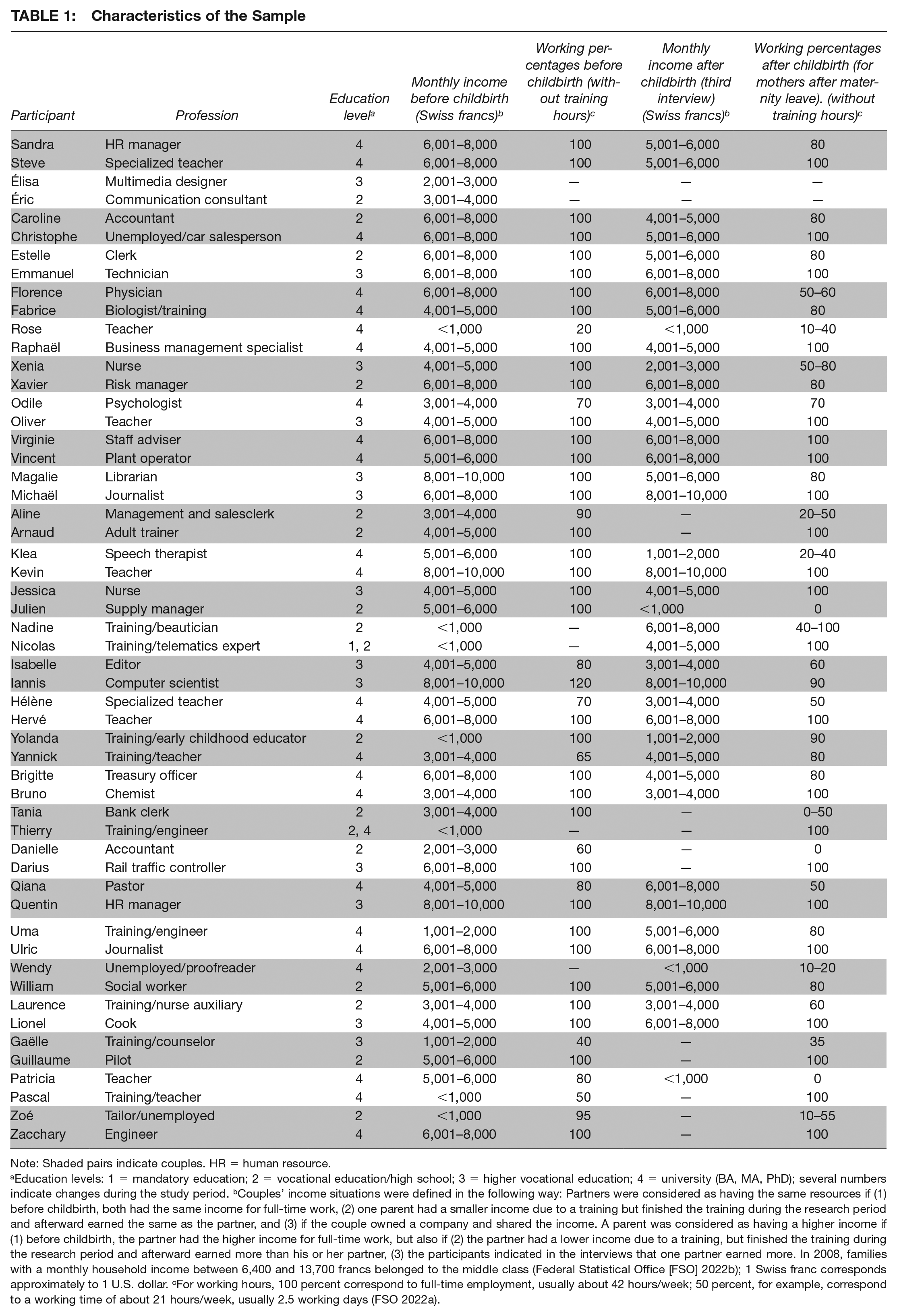
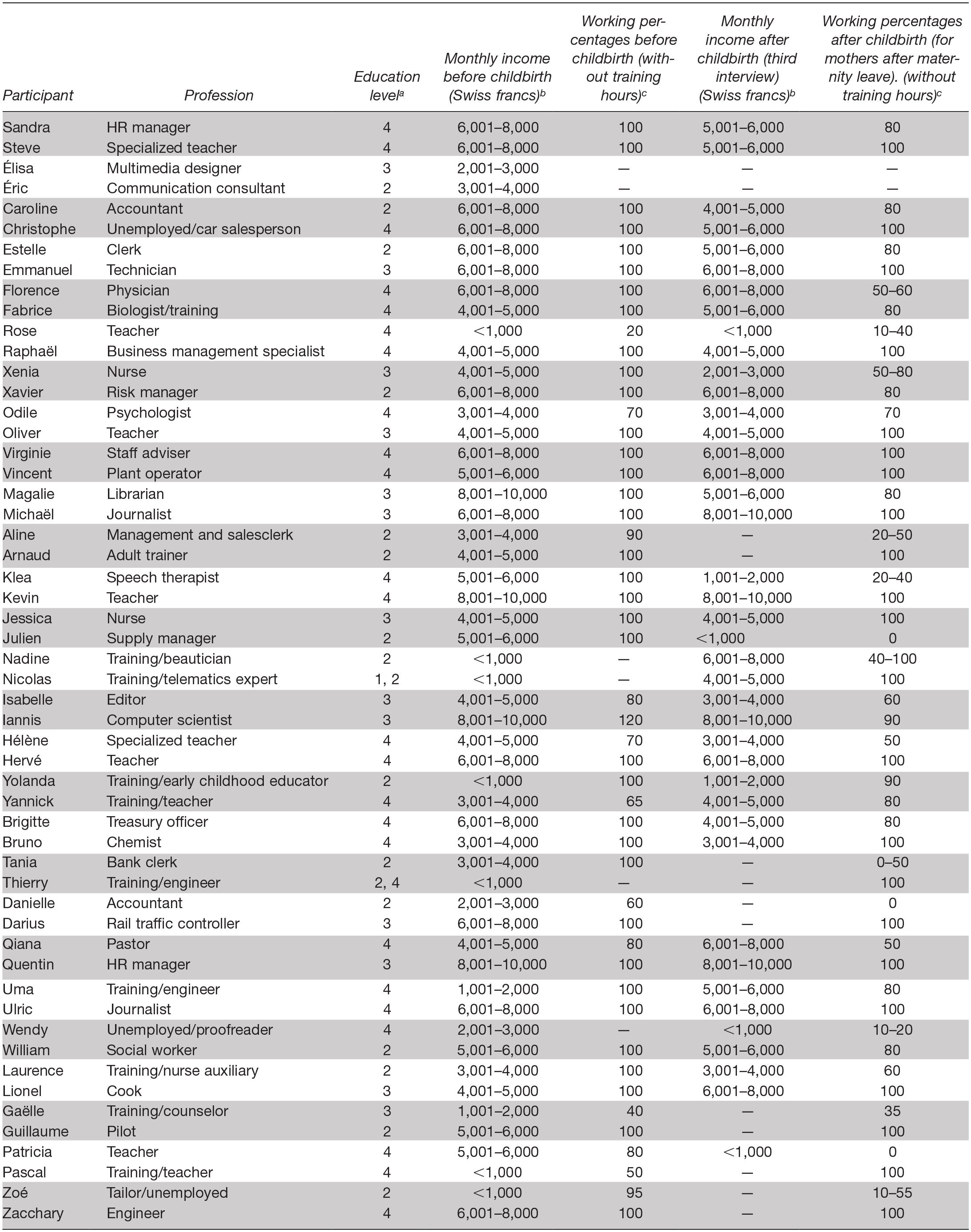
Note: Shaded pairs indicate couples. HR = human resource.
Education levels: 1 = mandatory education; 2 = vocational education/high school; 3 = higher vocational education; 4 = university (BA, MA, PhD); several numbers indicate changes during the study period. bCouples’ income situations were defined in the following way: Partners were considered as having the same resources if (1) before childbirth, both had the same income for full-time work, (2) one parent had a smaller income due to a training but finished the training during the research period and afterward earned the same as the partner, and (3) if the couple owned a company and shared the income. A parent was considered as having a higher income if (1) before childbirth, the partner had the higher income for full-time work, but also if (2) the partner had a lower income due to a training, but finished the training during the research period and afterward earned more than his or her partner, (3) the participants indicated in the interviews that one partner earned more. In 2008, families with a monthly household income between 6,400 and 13,700 francs belonged to the middle class (Federal Statistical Office [FSO] 2022b); 1 Swiss franc corresponds approximately to 1 U.S. dollar. cFor working hours, 100 percent correspond to full-time employment, usually about 42 hours/week; 50 percent, for example, correspond to a working time of about 21 hours/week, usually 2.5 working days (FSO 2022a).
After childbirth, 24 mothers and six fathers worked part-time or interrupted their professional activity. One couple divided childcare about equally and one father became a stay-at-home dad, but all other mothers became primary caregivers.
If both parents were employed, they relied on professional childcare, childminders, or relatives (usually grandmothers) to care for the child between half a day and 4 days a week. The cost of non-family childcare ranged from 5 percent to 20 percent of the parents’ joint income.
In the questionnaire, participants shared their views on gender norms. Only one father partially agreed with the statement “The man should provide for the financial needs of the household; the woman should take care of the home and children.” Except for that one participant, all parents disagreed or strongly disagreed with the statement.
Limitations
Before reporting the results, I highlight two limitations here. First, the study was limited by its inclusion of mainly middle-class, French-speaking families in Switzerland. In this relatively affluent population, partners have some latitude in making financial decisions, so results cannot be generalized to members of less privileged groups with less financial leeway. Second, the data were collected between 2005 and 2009. Since then, the employment rate for mothers has remained stable but their working hours have slightly increased while fathers’ share of the family’s unpaid work has also increased from 34 percent to 37 percent (FSO 2021b, 2022d). Such changes in couples’ labor division may impact the way parents estimate costs.
Findings
Do Parents Understand the Costs Associated With Their Choices to Divide Up Their Labor?
Parents knew they must support their families. All but one couple decided to have children when the father (or sometimes the mother) had a regular income. But none of the parents knew exactly how expensive it would be to raise a child or calculated the cost of dividing their labor.
Three parents made clear they were unaware of these costs in the interview. Zacchary and Zoé decided that he would work full-time, and she would stay at home after giving birth. Zacchary said “I have no idea how much it [having a child] costs” (Interview 1). Asked if he worried about not knowing these costs, Zacchary answered that if they could not make ends meet with his salary, many other families would also have financial problems: I have a pretty good salary, so at that [income] level, I would find it inconceivable if we couldn’t manage to raise a child, [if we couldn’t manage] there would be many people who can’t either . . . or at least a lot of people who are less well placed would have problems. (Interview 1)
Zacchary compared their situation with that of other families, instead of doing an exact calculation. Yannick and Yolanda enrolled their child 1.5 days a week in a public daycare center. Yannick said “I haven’t checked the rates, I don’t even know how it can weigh on the budget either” (Interview 2).
In Switzerland, parents must fend for themselves, combining childcare and paid work. They must both finance their arrangements and obtain necessary information on their own. Finding sufficient information, especially about childcare, is challenging. The childcare market is a complex mixture of public and private professional services and a formal and informal market. Parents had difficulty finding childcare solutions because there were too few professional child care providers. Emmanuel and Estelle struggled to place their child in a nursery. Emmanuel lamented, It’s quite hard here to find a place for childcare, which I think is a pity, and the costs . . . At the same time, we don’t have a solution. Well, at the [childcare] market they don’t help the people. I find that the information for young parents about childcare or anything else, it is practically nil. (Interview 1)
This lack of information may partially explain why parents knew little about the cost of dividing their labor.
Gendered Cost Estimates
To calculate the costs of their labor division, parents need to know how their income level (or the reduction of that income from remaining home with the child) influences the cost of childcare and their tax rate. No parent who was interviewed said they had performed such calculations. Only three respondents explicitly stated that they did not know what their division of labor cost them. When the others talked about their finances, they made incomplete cost estimates influenced by gender norms, which I refer to as “gendered cost estimates.” Gendered cost estimates are based on assumptions about both finances and gender norms, so they may not align with real costs. These gendered cost estimates influenced parents’ perceptions of the costs of childcare (non-family childcare, parental childcare, and care provided by grandparents) and of mother’s and father’s relative earnings.
Costs for Non-Family Childcare
After maternity leave, 20 of 27 couples relied on nurseries or childminders to care for their child. In particular, if they relied on a nursery, parents felt that care was too expensive. As Emmanuel said, “Paying as much for the care of a child, I think it should be more subsidized, so it’s clear that this creates troubles in the budget” (Interview 1).
Consistent with the gender norm that childcare is the mother’s responsibility, all but one of the mothers and two fathers who discussed childcare costs viewed these costs as the mothers’ obligation rather than a shared responsibility.
Mothers who saw childcare costs as their responsibility sometimes were not sure if their employment made financial sense. This was more often the case when they worked a small part-time job. Gaëlle, who worked about 15 hours per week, said “the daycare costs me 600 bucks” (600 Swiss francs ≈ 600 U.S. dollar) and added, I earn 1600 bucks a month, but sometimes I say to myself, but what an organization for this . . . well, it’s not . . . I mean financially speaking, there is no need that I work. If I wanted to stay at home, it wouldn’t make such a big difference. (Interview 3)
None of the mothers decided to reduce their working hours because of the cost of childcare. Even if they thought that their paid work was not financially worthwhile, they decided to keep their job because they feared monotony and isolation if they stayed at home. Nadine explained: If I work, even if we spend all the money I earn on a childminder or a cleaning lady, I don’t care. But, I want to have a touch of a social life, to have something to talk about when I come home in the evening, to be able to . . . to be able to do something else. (Interview 2)
If mothers considered childcare costs too high, they looked for a cheaper alternative, opting for informal care by acquaintances or grandparents instead of formal daycare.
Although parents criticized the high price of childcare, they did not try to spend less money on other child expenses. Instead, they focused on how the money they spent benefited the family. Hervé, for example, said “we’re going to buy a second car, so that I won’t be dependent on the bus schedule anymore . . . that will allow me, for example, to come home at noon” (Interview 1). Ulric and his wife were looking for a bigger apartment with more rooms. Ulric said “we don’t want to put him [the baby] in the corner of a room, he has a right to have his own space and that’s something we have . . . that we want to give priority to” (Interview 1). Rose associated spending money on the child with good parenting, commenting on her partner’s choice of car seat: He chose the best quality, the best safety, and not the cheapest one. These are small things showing me that his baby is important to him. For me as a woman this is very good, I tell myself that I have chosen the right dad for my children. (Interview 3)
Costs for Parental Childcare
When parents reduced their working hours to care for their child themselves, the financial cost was in reduced wages. For families with one child, the salary they gave was clearly more than childcare fees, even when they relied on professional childcare, the most expensive form of care. Although it was expensive to reduce the mother’s working hours, most parents (48/54) did not factor in that loss of income when mothers opted for part-time work. They either did not take a financial view of the mother’s paid work or, if they did take a financial perspective, they did not consider her reduction to part-time work as a loss of income. Instead, they compared the amount she earned while working reduced hours to the amount of money they would have had if she had stayed at home and not worked at all.
Hélène, for example, did not take a financial perspective on her paid work. When she explained that she would work fewer hours after childbirth, she did not calculate the monetary cost, but emphasized how important her job was to her: After [childbirth] I’ll work 50 percent. It was always clear that I want to have a world of my own, where I can get out of the family setting. And I like my work so much that I wouldn’t see myself stop working. (Interview 1)
Arnaud explicitly stated that he did not consider finances when he explained how he felt about his wife’s paid work: She doesn’t want to stop working [and] I wouldn’t agree that she is forcing herself to stop working when she wants to continue to do some activities . . . because it’s part of the things . . . for her it’s really a need, it’s not really a question of earning money, it’s really part of what . . . what fills her life. (Interview 3)
About half of parents considered the financial aspects of the mother’s paid work, typically calculating how much she earned when working part-time. Nadine explained that she worked 2 days a week “to earn money” and “get out of the house a bit” (Interview 3). Rose, who worked 1 day a week, said working makes her feel “useful” and allowed her to “earn some money for the family” (Interview 3). There were some exceptions in the sample: One father and five mothers who earned more than their partner factored in the loss of income when the mother cut her working hours to care for the child. Virginie said “I would also like to reduce to 80 percent, but since I have the higher salary, it hurts (laughs), it hurts a lot” (Interview 2).
Whereas foregone wages were rarely considered when mothers reduced their working hours, parents always considered the father’s reduced working hours as an income loss because for fathers’ work the reference was full-time employment. Jacques, who reduced his working hours by 10 percent, said “It’s a price that I pay, that I’m ready to pay . . . to pay to gain in quality of life. But this choice has an economic cost, so we really headed toward the solution that I work 90 percent” (Interview 1). Because most parents factored in loss of income for fathers’ part-time work but not for mothers’, they typically perceived parental care provided by fathers as expensive, and care provided by mothers as free.
Costs for Childcare Provided by Grandparents
To a lesser extent, parents relied on their own parents for childcare because they preferred family care or wanted to save money. Estelle said: When we saw the price of the nursery . . . it’s not cheap . . . so I asked my boyfriend, because his parents live five minutes away from us, if they would mind taking him [the baby] one day [per week], so he would go just three days to the nursery. His parents accepted. So financially we pay a little less, but it’s still a big budget for the nursery. (Interview 1)
If grandmothers cared for the child, parents did not calculate the price of this work, even though in exceptional cases grandmothers reduced their working hours (or retired) to provide care. Xavier’s mother, for example, retired to be available to care for her grandchildren: She [the grandmother] would let us both work 100 percent and then she would take care of it [the baby] every day if she could. That’s it. She retired two years ago in . . . in the idea of being able to take care of our children. (Interview 1)
After childbirth, the couple relied on Xavier’s mother and on a neighbor for childcare. Xavier said the couple opted for these informal childcare arrangements because they were the most convenient and cost-effective solutions: “The neighbor or my mom costs less anyway than an official childminder or the nursery” (Interview 2). While Xavier calculated that it would be cost-effective for him and his wife to have his mother care for the child, he did not factor in the cost of his mother reducing her working hours.
Cost estimates for care provided by grandfathers were less clear because so few parents asked grandfathers to provide regular childcare. Hélène, who had no relationship with her mother, asked her father, who worked a full-time job, if he would care for the child while she and her husband worked. Hervé, Hélène’s husband, said about that “It’s definitely convenient for us and it’s true that financially it’s the most economical solution” (Interview 1). But Hélène’s father refused because he would have had to reduce his working hours, which would have lowered his income: We had a whole explanation for this [the rejection of taking over childcare] . . . because he thought we were selfish, because he saw it [childcare] from a financial point of view. Finally, we were asking him to reduce his working time, so that we could maintain high working hours, although this was not the idea that was behind it. (Hervé, Interview 1)
Hélène’s father calculated the costs that would be incurred by reducing his working hours, but Hervé did not. Despite being confronted with the calculation and reproached by Hélène’s father for their alleged “selfishness,” Hervé did not understand Hélène’s father point of view. He said “The idea was to offer it [childcare] as a gift” (Interview 1). Hervé declared childcare a gift to the grandfather, ignoring the cost of his foregone wages.
This mismatch in the frames through which parents and grandfather viewed the cost of childcare was exceptional. All other respondents framed costs similarly, mainly ignoring the cost of childcare provided by mothers and grandmothers and calculating the costs of childcare provided by fathers or external helpers, and often deeming them (too) expensive.
Though parents tried to reduce the cost of childcare, their childcare choices were not based solely on money. Parents also valued the caregiver’s education, availability, and relationship with the child. (For more details on childcare choices related to grandparents, see Le Goff, Barbeiro, and Gossweiler 2011.)
Relative Earnings
Reduced working hours were also a major cost factor for the family. Working fewer hours put less strain on the family budget if the parent with lower income opted for part-time work. Mothers’ and fathers’ relative incomes played a role when they negotiated their working hours. In my analysis, I compared three income configurations: Before childbirth he earned more than she did; both parents earned the same; and she earned more than he did.
Twelve mothers-to-be earned less than their partners. In this situation, it was evident to most (21/24) parents-to-be that the mother would become the primary caregiver and the father the primary provider. For example, Quentin said, It was clear to my wife and me that she had a 50 percent [position] and that I . . . I would assume . . . I’m the one who earns the bigger salary, though, so I was the one who took over the role of the provider. (Interview 2)
After childbirth, lower earning mothers opted for part-time work or stayed at home. Their working hours were variable, depending on how much importance they placed on their work and on the additional income. Among higher earning fathers, working hours varied slightly. Eight opted for full-time work, usually because they worried that part-time work would reduce their career prospects. But four reduced their working hours by 10–20 percent to spend 1 day per week with their child.
In nine couples, both parents-to-be earned the same income before childbirth. In contrast to mothers who earned less than their partner, all but two equal-earning mothers-to-be anticipated an equal division of labor. Many took it for granted that unpaid work would be shared equally and saw no need to discuss this topic. Odile, a psychologist, explained: Odile: It [childcare] will really be completely shared. But it’s true we haven’t talked about it, because I think this is how it is. It goes without saying. Interviewer: It goes without saying that the current arrangement of equal sharing will continue? Odile: Yes, yes, absolutely. I’m not worried at all about this. (Interview 1)
All equal-earning mothers-to-be opted for a part-time position to spend time with the child and all but two wished that their partner would do the same.
Equal-earning fathers-to-be typically considered their partner to be responsible for most of the childcare, at least over the short term. Pascal held a temporary 50 percent contract as a teacher while his wife, also a teacher, worked 80 percent and earned most of the money. In this situation, it was clear to Pascal that he would seek a full-time position, because he thought this would increase his chances of getting hired. “I have more chances [to get a job] at 100 percent” (Interview 1), he said. He added that his wife would ideally continue working at a “very low percentage” to care for the child. Pascal did not object to equally sharing paid and unpaid work and said that he would like to reduce his working hours later.
Like Pascal, all but two equal-earning fathers-to-be considered part-time work, but postponed it to a later, unspecified date. The interview with Arnaud, an adult trainer who was looking for a new job, illustrated this ambivalence: Arnaud: I would rather work 80 percent and earn a little less but at the same time be 20 percent more present at least for the years when it matters greatly for the child. . . . Interviewer: Are you looking for something [a job] at 80 percent? Arnaud: Yes, I’ll negotiate. That is to say at the beginning I won’t say anything. If possible, we’ll see how it goes. It also depends on the kind of job, if the position allows it, well, I will reduce to 80 percent. (Interview 1)
When fathers postponed the decision to work part-time while mothers reduced their working hours, couples with initially equal resources became unequal after childbirth. The full-time working fathers became primary providers and the part-time working mothers became primary caregivers, although they had not anticipated this division of labor.
Paradoxically, initially equal-earning parents retrospectively explained their unequal division of labor in terms of relative resources, not in terms of gender norms. Pascal, who looked for a job as a teacher, found a full-time position 6 months after their child was born. His wife, who could not yet find a small part-time position, became a stay-at-home mother. When asked how they had divided their labor, Pascal said “It was not quite planned that way [that he would work full-time, and she would stay at home]. Ideally, I would be the first to reduce my [working] percentages a little if my wife would earn [money]” (Interview 2). Pascal’s explanation illustrates the paradox of his wife’s income. When she earned more, her earnings were not factored into the division of labor (he opted for a full-time job even though she earned more). But after childbirth, when she no longer had an income, he explained that his higher earnings accounted for the way they divided their labor. This reinterpretation of unequal resources as the cause of their labor division was usual among parents who had initially earned the same amount, even though the inequality was created by their own previous decisions. Unequal resources were either financial or based on time. When they were based on time, the parents agreed that the mother did more unpaid work because she worked part-time and was at home more.
Odile, for example, had anticipated an equal division of labor. She had negotiated a part-time position with her employer and was more often at home than her husband, who worked full-time. When asked how the couple organized childcare, she answered: We are completely interchangeable in our role, really. I trust my husband completely and since the beginning he sometimes knows even better how to handle a baby than I do. He’s very very much at ease, so there’s nothing to worry about. We split [childcare] fifty–fifty when he’s here. (Interview 2)
Odile did not focus on how they shared childcare overall, but on how they shared it when both parents were at home. Though the couple’s division of labor was more gendered than she had anticipated, she perceived that the division was equal because she expected her husband’s contribution to be equal when he was present.
Six of the mothers earned more than the fathers, but even in this situation fathers placed more weight on their incomes than on their partner’s income. Vincent, who earned less than his wife, described the couples’ labor division after childbirth: Work . . . here we have a big dilemma because my wife earns more than I do. So, it would rather be me who would tend to reduce my working time. That’s not what bothers me. I don’t mind [being] a stay-at-home dad. So, it’s the same [whether he is employed or stays at home], I will continue doing activities on the side, you see. But we don’t really know how we’ll organize [work and childcare]. It depends on how my company will work. If it [the company] worked a little bit, if it were to make us a little bit more money and if my wife reduced to 80 percent, well, I think my wife would reduce to 80 percent. (Interview 1)
Vincent described it as a dilemma that his wife earned more and expected he would have to reduce his working hours to take over childcare. In his description, he used neutral phrases such as “we have a big dilemma” and “it would rather be me . . .” to avoid describing his struggles because his wife earned more. Vincent’s reasoning was typical of lower earning fathers, who assumed that the parent who earns less should work part-time and do more unpaid work. These fathers described their lower income as temporary, and, after childbirth, these fathers focused on their careers. They worked full-time or opted for more training to improve their skills. Vincent worked full-time and devoted his spare time to developing his own company.
The biggest discrepancy between couples’ real financial situations and the father’s cost estimate was evident when the father was unemployed and the mother provided for the family. Although he had no job and no income, Christophe saw himself as the main financial provider: “My wife, she will work 80 [percent], maybe 60 [percent] and I’m gonna work 100 [percent], that’s for sure.” He justified this labor division with the following cost estimate: Now we enter a circle where we earn a lot of money which must be paid out to a childminder anyway, you see what I mean. The taxes, the childminder, that costs 1200 . . . 1000 to 1200 francs a month for full-time, plus the taxes that will increase if I earn 8000 francs. In the end we earn . . . 4000 and 6000 . . . the difference is not big if my wife works 60 percent and takes care of the little one an additional day [per week]. (Interview 2)
In his cost estimates, Christophe only considered elements that favored him as an earner and justified his partner’s reduced working hours (costs of childcare and increased taxes). He omitted elements that contradicted these gender norms. He ignored his partner’s higher earnings and did not calculate the cost savings if he, who said he was “bored” at home, replaced the childminder.
In contrast, women who earned more than their partner saw themselves as providers. Because the family depended on their income, they continued working many hours. Caroline, Christophe’s partner, explained, “We only have one job for the moment for both of us, so [a reduction of working hours] is not an option. In the beginning he will stay at home with the baby” (Interview 1).
When I compared Caroline’s interview with Christophe’s, it was clear they framed the situation differently. For Christophe, being unemployed meant looking for a job to become a provider. For Caroline, it meant Christophe took care of the baby. In the end, his framing prevailed. Caroline took over childcare and organized non-parental care for her working hours. Thirteen months after childbirth she explained, “He was looking for a job. He can’t be everywhere, and I think ‘baby baby’ this was not really his thing” (Interview 3). The only exception in the sample was Julien, who earned less than his wife. Julian said he did not like his job and decided to become a stay-at-home father while his wife worked full-time. But the rest of the higher earning mothers became primary financial providers and primary caregivers.
A comparison of these three income situations reveals that mothers with a higher relative income worked slightly more hours at their jobs than mothers who earned less than or the same as their partner. For fathers, the pattern was reversed: Of the fathers who earned more than their wife, four cut their working hours to care for their child. All but one lower or equal-earning father opted for full-time work or further education. Higher earning mothers had an economic incentive to sustain the family, but when higher earning fathers shortened their hours there was no financial incentive. (If the father earned more, financially it would make more sense for only the mother to opt for part-time work.) The decisions of higher earning fathers about reducing their working hours may have been influenced by their feelings about their status as financial providers. Higher earning fathers who opted for part-time work still earned more than their wives, so cutting their hours did not threaten their position as the main financial provider; this may have made the decision easier for them.
Discussion
In this article I traced financial decision-making in 27 mostly middle-class couples before and after the birth of their first child. Parents made financial decisions about work and childcare without knowing the financial cost of these decisions. Instead of calculating, parents estimated the costs of their labor division in alignment with gendered norms. Parents believed deviating from the norm that defined mothers as caregivers and fathers as providers would be more expensive, and they dismissed costs incurred by conforming to these norms. Parents thus considered non-family childcare and reduced working hours for the father to be costly. But most parents disregarded the loss of income caused by the mother’s decision to work less to care for her child. Many parents also deducted the fee for non-parental childcare from the mother’s and not from the couple’s joint income.
Although parents had not calculated the real costs of their division of labor, money did have a small effect on how they shared paid and unpaid work. Mothers who earned substantially more than their partners spent marginally more hours working outside the home than mothers who earned less than or the same as their partners. For fathers, the opposite could be observed: Some of the fathers who earned substantially more than their wives opted for part-time work to spend time with their children. This finding shows that the norm of fathers working full-time was declining, especially among fathers who remained primary providers despite their reduction in working hours.
Parents’ gendered cost estimates attributed less financial value to mothers’ paid work and childcare than to fathers’ paid work and childcare, even when both earned the same amount of money or she earned more. As a result, parents were unaware of how much money they lost by opting for a gendered labor division. Lack of awareness of the real costs of their gendered division of labor helps explain why parents make financially irrational decisions: They perceive them as rational.
Parents in my study estimated costs based on norms that defined mothers as caregivers and fathers as providers, even though they rejected these norms in their answers to questionnaires and in their interviews. This tension between egalitarian beliefs and adherence to gender norms mirrors those in Swiss society, where the movement toward gender equality coexists with the persistent financial devaluation and feminization of childcare. Switzerland, like many Western countries, has progressed toward gender equality over the last half century but has not attained it. Women are more educated than they once were and participate more often in the labor force, and society has repealed laws that codified gendered division of labor for married couples (Bühler and Heye 2005; Martin 2002). But, as in other neoliberal societies, these changes have been made within the framework of a pronounced discourse of individualism. These societies consider parents responsible for reconciling childcare and paid work, and the state is not expected to take the lead in implementing policies that mitigate gender norms (Schwiter 2013; Wilton 2017).
Within this discourse, typically female activities such as childcare are still undervalued (England 2010) or dismissed as financial contributions: Parental leave policy is restrictive; non-family care is poorly subsidized; and those who reduce their working hours to perform care work often are penalized with lower hourly wages and less social security, and are at higher risk of poverty (Gromada and Richardson 2021; Strub and Stutz 2004). In this study, parents adhered to the discourse of individualization despite verbally rejecting gender norms. In their cost estimates they consistently devalued the financial costs of care work, especially when performed by women.
Researchers who analyze the financial factors that may influence parental labor sharing should take into account my finding that perceived costs may not match real costs and should seek to determine whether actors know the real costs of their decisions. Ascertaining the difference between estimated and real costs will make conclusions about financial incentives more robust. The finding that parents were ignorant of the real costs of their division of labor prevented me from analyzing whether more accurate calculations changed parents’ financial decisions. I recommend that future researchers devise studies to determine whether more accurate calculations change parents’ financial decisions and shift the division of labor to a more equal footing.
Conclusion
Previous research sought to determine whether money or gender norms better explain couples’ gender division of labor. The analysis of new parents’ financial decisions revealed that they distinguished between her money and his money, attaching more social importance and financial value to the latter. This finding shows that neither money nor gender norms alone can explain a couple’s division of labor, but that both factors are intertwined, as money itself is gendered.
Gendered norms shaped parents’ financial decision-making, even though they verbally rejected these norms. As a result, mothers’ work was financially undervalued, revealing a gap between the parents’ egalitarian ideals and gendered behavior. To reduce this gap between ideals and behavior, new parents should be educated about the value of women’s work, as the gendered labor division may harm mothers who take the social risks of part-time work and fathers who have too little time to spend with their children.
Footnotes
Author’s note
Data collection for this publication has been supported by the National Centres of Competence in Research LIVES—Overcoming Vulnerability from a Life-Course Perspective (NCCR LIVES), funded by the Swiss National Science Foundation (grant number 51NF40–160590).

Regula Zimmermann is a PhD candidate at the University of Basel. She explores the reasons for parents’ unequal division of labor and its long-term consequences.