



Abstract
In contrast to the rich literature on the causes of the gender gap in workplace authority, relatively little is known about how the jobs and experiences of women and men compare once they have positions with authority. Using linked survey and administrative data of about 100,000 women and men working in Dutch organizations, I analyzed differences in job resources (earnings, autonomy, and nonroutine work) and strains (workplace harassment, work–nonwork interference, and job burnout) between women and men in positions of workplace authority. I find that women in authority report lower levels of job resources than men with authority jobs, and are more likely to report experiences of work-related strains. Crucially, women with authority jobs are the most likely of all gender/authority status groups to report experiencing sexual harassment, bullying, and intimidation at the workplace, and they have the highest probability of reporting job burnout symptoms. These findings suggest that women’s entry into authority positions alone is not sufficient for achieving gender equality.
Keywords
Despite decades of progress toward gender equality in the labor market, women remain underrepresented in positions of workplace authority and power (European Commission 2018; United Nations 2020). Gender and inequality scholars have long been interested in studying what drives men’s disproportionate representation in authority, and often suggest that gender stereotypes and gendered organizational structures and practices are key explanations (Acker 1990; Kanter 1977; Ridgeway 2001, 2014; R. A. Smith 2002). In contrast to the prolific literature on the causes of the gender gap in workplace authority, we know relatively little about how the jobs and experiences of women and men compare once they have positions with authority.
Theory and research on gender stratification often make the implicit assumption that gender inequality will disappear when women attain authority positions, referring to substantial financial and psychological rewards associated with authority as a “highly coveted workplace resource” (R. A. Smith 2002, 511). However, gender is a structure deeply embedded in society (Risman 1998, 2004). Thus, widely held cultural biases about women’s and men’s relative suitability for authority and gendered organizational features that drive women’s underrepresentation in authority in the first place are unlikely to disappear when women obtain authority. Indeed, studies have found that women managers are evaluated less positively than men managers, even though they are not less motivated or less effective (Eagly, Karau, and Makhijani 1995; Eagly et al. 1994; Eagly, Makhijani, and Klonsky 1992). In addition, women and men occupy different positions within the authority structure. Women have been found to be concentrated at low levels in chains of command (Elliott and Smith 2004; Reskin and Ross 1992). Occupying lower authority positions in the power structure could lead to differential experiences because of the lower compensation and higher levels of strains associated with these positions (Stojmenovska, Steinmetz, and Volker 2021).
In this article, I analyze differences in job resources and work-related strains between women and men in positions of workplace authority. Using linked survey and administrative data of about 100,000 women and men representative of the population of employees in the Netherlands, I evaluate reported levels of job resources (earnings, autonomy, and nonroutine work) and strains (workplace harassment and work–nonwork interference), and document how these might be related to gender differences in job burnout. One distinctive aspect of the Dutch context is that due to a strong cultural norm of “intensive mothering” (Hays 1998; van Engen et al. 2009), supported by an institutional setting offering extensive legal protection of part-time workers (Fouarge and Baaijens 2009), the rate of part-time work among women is comparatively high. The Netherlands has the highest share of employed women working part-time of all European Union (EU) countries (70 percent); for comparison, the EU average is 30 percent, and the percentage of women in part-time positions in the United States is about 20 percent (Eurostat 2020; Organisation for Economic Co-operation and Development [OECD] 2023). The dominant one-and-a-half earner model for families in the Netherlands represents a breeding ground for views on women as incompatible with authority positions where work devotion norms are particularly strong (Blair-Loy 2005). However, the findings here are likely to apply to other contexts. Widely shared cultural beliefs about women’s incompatibility with authority have been documented across countries (Bowen et al. 2007; Katila and Eriksson 2013; Kiaye and Singh 2013). The historical conditions that led to the gendering of authority jobs as men’s jobs, as well as trends of gender inequality in authority over time, are also comparable with those in other countries such as the United States (Kanter 1977; Pott-Buter and Tijdens 1998; Shams and Tomaskovic-Devey 2019; van der Lippe, van Doorne-Huiskes, and Blommaert 2014).
I find that women in authority report lower levels of job resources than do men in jobs with authority, and are more likely to report experiences of work-related strains. Crucially, women in jobs with authority are the most likely of all gender/authority status groups to report experiencing sexual harassment, bullying, and intimidation at the workplace, and have the highest probability of reporting job burnout symptoms. The relative location of men and women within the authority structure does not explain these findings; I document gender differences in resources and strains across the authority ladder, including top positions entailing the authority to make final decisions about organizational policies. These findings contradict the “add women and stir” approach and demonstrate that women’s entry into authority positions alone is not sufficient for achieving gender equality.
Gender and the Gendered Distribution of Authority
To understand how gender inequality in workplace authority is (re)produced, I use Risman’s (1998, 2004) conceptualization of gender as a structure operating at the individual, interactional, and institutional dimensions of society. Due to the gender binary dominant in most cultures, individuals tend to categorize each other as falling into one of two categories: women or men. This classification of gender into two distinct groups shapes inequality through the ascription and prescription of a set of socially meaningful, seemingly opposite characteristics and roles to women and men (Glick et al. 2004; Heilman 2012). Cognitive and social psychologists have demonstrated that both descriptive and prescriptive gender stereotypes (e.g., the belief that women are caring [descriptive] and should be caring [prescriptive]) influence the way individuals think and behave and are treated by others in daily interaction (Bobbitt-Zeher 2011; Burgess and Borgida 1999; Ellemers 2018).
Ridgeway and colleagues have argued that the status element of gender stereotypes is particularly relevant for explaining barriers to women achieving positions of authority and power in the workplace (Ridgeway 2001, 2014; Ridgeway and Correll 2004; Ridgeway, Korn, and Williams 2022). Status beliefs are widely held cultural beliefs about the social significance and general competence of individuals viewed as categorically distinct on the basis of gender and other categorizations such as race and class (Berger, Cohen, and Zelditch 1972). Empirical evidence indicates that gender status beliefs attribute greater status worthiness and competence to men than to women (Fiske et al. 2002; Ridgeway 2001, 2014). Expectation states theory argues that these beliefs result in a view of men as more compatible with authority than women, and that shapes social relations and evaluations of women and men at work (Ridgeway 2011). Consistent with these predictions, studies have documented, for example, negative evaluations by managers of women when they “take charge”—behavior associated with the highest performance for men (Correll et al. 2020).
At the institutional level, feminist scholarship drawing on the concept of “gendered organizations” (Acker 1990, 2006) or “the gender subtext of organizations” (D. E. Smith 1989) has argued that gender is also inscribed in organizational structures and practices. This body of literature contends that rather than being gender neutral, organizational hierarchies are dominated by men and a masculine ethic, and that jobs embody gendered assumptions about the ideal worker who will carry out job tasks. For many jobs, but especially high-status jobs such as authority jobs, the “ideal worker” is characterized as someone who prioritizes paid work above all other aspects of their lives (Blair-Loy 2005; Cha and Weeden 2014; Kanter 1977). This worker is usually a man. Women are seen as less suitable for authority positions than men because meeting the ideal worker standard is presumably less possible for them, in view of gendered cultural caregiving and breadwinner norms (Brumley 2014; J. Williams 2000). In the Netherlands, the “ideology of intensive mothering” (Hays 1998) has generally led individuals to prioritize men’s careers and women’s role in child rearing, resulting in the current dominant one-and-a-half earner model for families, with women working part-time and men working full-time (Merens and van den Brakel 2014; van Engen et al. 2009). Given widespread gender status beliefs that deem men more suitable for workplace authority than women and organizational features that are built on men as ideal workers, men should be disproportionately represented in positions of workplace authority to an extent that cannot be explained by gender differences in qualifications or relevant experience. Indeed, contrary to theoretical predictions from the human capital and status attainment approaches (Blau and Duncan 1967; Polachek 1985), reviews of the field conclude that women’s impediments to attaining workplace authority exist net of their qualifications like education and work experience (Longarela 2017; R. A. Smith 2002). In the following sections, I discuss how gender status beliefs and gendered organizational features that to a large extent drive the initial underrepresentation of women in authority are also likely to differentially affect women’s and men’s experiences once they have authority.
Gender Differences in Job Resources and Strains
Following Risman (2004), the main theoretical argument I make in this article is that because gender is a structure deeply embedded in society, gender differences will not disappear when women have authority. Reflecting on her finding that when forced into the social role of primary parent, men did not “mother” the same way that women do, Risman argues that placing women and men in similar structural conditions alone is insufficient for eliminating gender differences because gender continues to operate at the individual and interactional levels. Support for this argument comes from different bodies of research. For example, research documenting the “glass escalator” finds that being a gender minority in an occupation works differently for women and men: Whereas women hit a “glass ceiling,” white male tokens experience disproportionate career advantages in women-dominated occupations (C. L. Williams 2013; Wingfield 2009).
Similarly, women’s authority jobs may look different from men’s because when in authority, women continue to face different cultural expectations and an institutional environment that advantages men. The uneven distribution of job authority has been an important domain of sociological inquiry because authority is seen as a “highly coveted workplace resource” (R. A. Smith 2002, 511) associated with higher earnings and noneconomic rewards. However, scholars have argued that it is especially in men-dominated settings where women will be devalued and subjected to different rewards systems (Cohen and Huffman 2003; Reskin 1993). Reskin and Ross (1992) have similarly proposed that to the extent that women’s access to authority is obstructed by a desire to preserve men’s monopoly on organizational power (Acker 1990) rather than women’s deficient qualifications, even organizations that have granted authority to women will not reward them equitably for exercising it. Because empirical evidence supports the former more than the latter (R. A. Smith 2002), I expect women in authority to report lower levels of job resources than men in authority (Hypothesis 1).
The gender typing of jobs has also been associated with negative interpersonal experiences in the workplace, such as bullying and sexual harassment (Chamberlain et al. 2008; Stainback, Ratliff, and Roscigno 2011). According to expectation states theory, gender becomes especially salient in settings where gender stereotypes are linked to specific jobs, as is the case in jobs with authority (Ridgeway 2001; Ridgeway and Correll 2004). Social psychologists have proposed that because of the prescriptive nature of gender stereotypes, women in authority may experience hostile reactions from colleagues and clients (Berger, Cohen, and Zelditch 1972; Burgess and Borgida 1999; Eagly and Karau 2002). In a similar vein, feminist scholarship on gender and power contends that the increased presence of women in authority may be seen as a threat to men’s power; harassment may ensue from a desire to preserve the gender order and penalize inappropriate ways of “doing gender” (Berdahl 2007; Rudman et al. 2012; West and Zimmerman 1987).
The institutional context favoring individuals who prioritize work over other aspects of their lives may, in addition, result in women being more likely than men to experience work–nonwork interference. Because women are culturally seen as bearing the primary responsibility for homemaking and childcare, they continue to spend considerably more time than men on unpaid caring and housework activities (Begall and Grunow 2015; Hagqvist 2018; Hays 1998). This is at odds with work devotion norms found to be particularly strong in authority positions (Blair-Loy 2005; Cha and Weeden 2014). Overall, therefore, I expect that women in authority will be more likely than men in authority to report experiences of work-related strains (Hypothesis 2).
Potential differences in job resources and strains may result in different job burnout outcomes for women and men in authority. The Job Demands-Resources model is the most popular theoretical model on the antecedents of job burnout, a job strain conceptualized as a psychological response to chronic stressful work conditions, characterized by overwhelming exhaustion and feelings of cynicism and detachment from the job (Ganster and Schaubroeck 1991; Maslach, Schaufeli, and Leiter 2001). The main theoretical premise of this model is that job burnout arises as a result of the combined presence of job strains and the absence of job resources. Job strains of an interpersonal nature have been found to be a particularly important predictor of job burnout (Zapf et al. 2001). Because individuals in authority are likely to experience interpersonal strain—since their jobs involve supervising the work of others and imposing sanctions (Elliott and Smith 2004; R. A. Smith 2002)—scholars have hypothesized a relationship between having authority in the workplace and experiencing job burnout (Cordes and Dougherty 1993; Jackson and Schuler 1983). Provided that women in jobs with authority are more likely than men in authority to experience interpersonal strain and other work-related strains such as work–nonwork interference (see Hypothesis 2), while also having lower levels of job resources (see Hypothesis 1), I expect that women in authority will be more likely than men in authority to experience job burnout (Hypothesis 3).
The Role of Different Authority Positions
While jobs with authority have broadly been conceptualized as positions that confer some sort of power on the job occupant (Kanter 1977; Reskin and Padavic 1994), multiple dimensions of authority can be discerned. These are supervisory authority (whether an individual supervises anyone on the job), sanctioning authority (the ability to influence the pay or promotions of others), span of control (the number of people under direct supervision), decision-making (control over organizational policy decisions), and hierarchical authority (an individual’s formal location within the organizational hierarchy; for an overview, see R. A. Smith 2002). Women and men occupy different locations within the authority structure. Women in authority have been concentrated in positions with lower amounts of authority and decision-making that often involve people-oriented tasks (Adler 1994; Elliott and Smith 2004; Reskin and Ross 1992; Stojmenovska, Steinmetz, and Volker 2021).
Gender differences in type of authority position held are relevant for average differences in job resources and strains between women and men with authority. Higher level authority positions come with higher rewards. Stojmenovska, Steinmetz, and Volker (2021), for example, find that those in authority positions who manage human resources, where women are concentrated, earn only about 77 percent of the earnings of occupants of top positions entailing the authority to make final decisions about organizational policies, where men are concentrated. Different authority positions also likely involve different levels of job strains. For example, Reskin and Ross (1992) found that whereas low-level managers were expected to monitor subordinates closely, high-level managers reported having less frequent and intense interpersonal contact with subordinates. Individuals lower in chains of command may, therefore, be more likely to experience interpersonal strain and, by extension, job burnout. Although I cannot delineate exact mechanisms, in this article I am able to observe levels of job resources and strains for women and men in similar authority positions.
Method
I analyze data from the Dutch National Survey of Working Conditions, a large-scale cross-sectional survey of employees in the Netherlands, linked with administrative data from the Dutch population registers. Because both the survey and administrative data are collected and maintained by Statistics Netherlands (not publicly available; see Author’s Note), the survey respondents are identified with the same unique (anonymized) ID numbers that identify them in the administrative data containing records of the whole Dutch population. The initial matching success between the two data sources is, therefore, virtually 100 percent (only 21 of the more than 100,000 survey respondents were not matched with administrative data). Data from 2014 to 2016 were pooled to boost statistical power. 1
These data are unique in several aspects. They are very large and representative of the population of employees in the Netherlands. Observing more than 100,000 women and men working in Dutch organizations, I am able to study the jobs of larger numbers of individuals with authority and distinguish more dimensions of workplace authority than is commonly possible. The data also allow me to paint a comprehensive picture of experiences in these jobs, as they contain reports on different types of job resources and strains in respondents’ present jobs. From the initial sample of 107,418 respondents whose main activity at the time of the survey was working, I selected individuals aged 16 to 65 years (leading to an exclusion of less than 1 percent of the respondents). After listwise deletion of missing data on the relevant variables, I retained between 90 and 94 percent of the original sample. Given the varying number of valid responses per outcome, the analytic sample ranges between 64,598 (nonroutine work; not asked in 2015) and 101,317 individuals (workplace intimidation). Table A1 in the Online Appendix lists all sample restrictions.
An important limitation of this study is its use of cross-sectional data. Examining these issues with longitudinal data could shed more light on the theoretical mechanisms as well as better address issues of unobserved heterogeneity and reverse causality. In my analyses, I have attempted to deal with the former by including covariates of both authority and resources and strains such as educational attainment and industry. In addition, my findings are consistent with longitudinal evidence of highest rates of sexual harassment among women in authority in a nonrepresentative sample of 29- to 30-year-old women and men (McLaughlin, Uggen, and Blackstone 2012), and evidence on the relationship between job strains and resources and job burnout based on cross-lagged panel designs (Hakanen, Schaufeli, and Ahola 2008).
Measures
The measure of job authority used in the main analyses is a binary measure of supervisory authority indicating whether an individual supervises others on the job. The advantage of this measure, considered to be the most conservative possible, is that it precludes the possibility of overstating the gender authority gap due to restricting authority to higher level positions (Huffman 1995). To account for the different locations of women and men in the authority structure, I replicate the main analyses with two additional measures of authority. The first measure combines information on the proportion of supervisory tasks and the control over resources the authority position entails, distinguishing authority positions with (1) some supervisory tasks and mostly nonsupervisory tasks (little authority), (2) largely supervisory tasks with no control over resources, (3) largely supervisory tasks with authority to make personnel decisions such as giving a raise (sanctioning authority), and (4) largely supervisory tasks with authority to make organizational financial or strategic policy decisions such as those regarding the budget (decision-making authority). The second measure denotes the span of control—the number of people under direct supervision (one to four; five to nine; 10–19; and 20 or more).
I look at three types of job resources: earnings, autonomy, and nonroutine work. Job autonomy and nonroutine work encompass the time-related and conceptual element of control over one’s work, seen as the quintessential non-alienated labor and worker empowerment (Kohn 1976; Ross and Mirowsky 1992; Ross and Wright 1998). The former involves workers’ freedom to decide how and when to do their own work tasks (as opposed to these being determined by their supervisor or employer), and the latter entails the ability to engage in varied and creative work that involves cognitive input and learning new things (in contrast to repeatedly performing the same tasks). Job authority has been associated with greater levels of autonomy and nonroutine work because individuals in authority positions are responsible for making decisions and directing others, and at the same time are less likely to be under the supervision of others.
Respondents’ individual earnings are measured as hourly nominal earnings, calculated by dividing the total gross earnings (basic earnings, vacation payments, and bonuses) in the year of the survey by the total number of hours paid in income in that year. If someone holds more than one job, I limit the analysis to the highest-paying job. I log-transform the variable to address skew and adjust 2014 and 2015 earnings to 2016 earnings according to the Consumer Price Index. My measure of earnings is based on administrative tax records data, making it much less prone to error than the survey-based earnings estimates used in prior research that underestimate inequality through high levels of underestimates by high earners and overestimates by low earners (Kim and Tamborini 2014; Valet, Adriaans, and Liebig 2019). In addition, earnings in the Dutch registers are not top-coded; this is particularly important for correctly estimating earnings differences, given exceptionally high compensation among some individuals in authority, such as top managers (Kalleberg 2011).
Job autonomy and nonroutine work are index variables each based on averaged responses to six survey items, with higher scores indicating higher levels of autonomy and nonroutine work. The survey items measuring autonomy (Cronbach’s α = .79) inquire into whether respondents have the freedom to decide how and when to do their own work tasks (e.g., “Do you decide the order of your tasks?”). Nonroutine work is based on items (Cronbach’s α = .83) measuring respondents’ ability to engage in varied and creative work (e.g., “In my work I get time to develop new ideas.”). To capture different dimensions of negative interpersonal experiences, I look at respondents’ reports of sexual harassment, bullying, and intimidation in the workplace. The three measures of workplace harassment are binary variables denoting whether respondents have reported personally experiencing unwanted sexual attention, bullying, or intimidation by colleagues or clients in the past 12 months. The measure of work–nonwork interference is also a binary variable indicating whether respondents report missing or neglecting family activities because of work. 2 Table A2 in the Online Appendix provides summary statistics and an overview of the questions used to construct these variables.
The measure of job burnout is an adaptation of the emotional exhaustion component of Maslach and colleagues’ Job Burnout Inventory, the most widely used scale in studies of job burnout (Maslach and Jackson 1981; Maslach, Schaufeli, and Leiter 2001). Five questions formed a reliable scale (Cronbach’s α = .88). These are “I feel emotionally drained from my work”; “I feel used up at the end of the workday”; “I feel fatigued when I get up in the morning and have to face another day on the job”; “It requires a lot from me to work with people the whole day”; and “I feel completely drained from my work.” I first made an index averaging responses to these items and subsequently created a binary measure which takes the value 1 for respondents who on average have these symptoms more often than once a month, and 0 otherwise. As well as allowing me to distinguish a more meaningful high frequency of burnout symptoms, the binary measure is preferred because the scale has highly non-normal residuals (due to its skewed distribution), violating the assumptions of linear regression (Allison 1999; Berry 1993). The main conclusions are robust to different cut-off values.
Analytic Strategy
I estimate ordinary least squares models to study gender differences in earnings, autonomy, and nonroutine work, and linear probability models to analyze the binary outcomes (sexual harassment, bullying, intimidation, work–nonwork interference, and job burnout). Multivariate regression analysis is used to isolate the relationship between gender, authority, and job resources and strains. Women and men are concentrated in different industries and on average differ in terms of individual job-relevant characteristics such as years of work experience, both relevant for the job rewards and strains individuals are exposed to. I, therefore, control for educational attainment (coded as lower secondary education, higher secondary education, Bachelor, and Master), work experience (number of potential years of experience, calculated as age minus the average age of finishing the highest completed education the respondent has indicated), tenure (number of years the employee has worked for their current employer), household constellation (distinguishing between single without child[ren], single with child[ren], couple without child[ren], couple with child[ren], and other), industry (13 categories), and workplace size (number of employees). In the analyses of job burnout, instead of work experience I adjust for age, an important covariate of burnout that is too highly collinear with work experience to be included in the same model.
Results
The goal of this article is to compare levels of job resources and strains among women and men with workplace authority. For this purpose, I regressed each of my eight outcome variables on gender, authority status, and the interaction between gender and authority status as main predictors, with education, work experience (age in the model for job burnout), tenure, household constellation, industry, and workplace size as control variables. Using these models (coefficients displayed in Tables A3–A6 in the Online Appendix 3 ), I generated predicted scores for each resource and strain measure for women and men by authority status to assist in my comparisons. These are visualized as bar plots in Figure 1 (job resources), Figure 2 (negative interpersonal experiences), Figure 3 (work–nonwork interference), and Figure 4 (job burnout). Figures appear below where each is discussed in more detail.
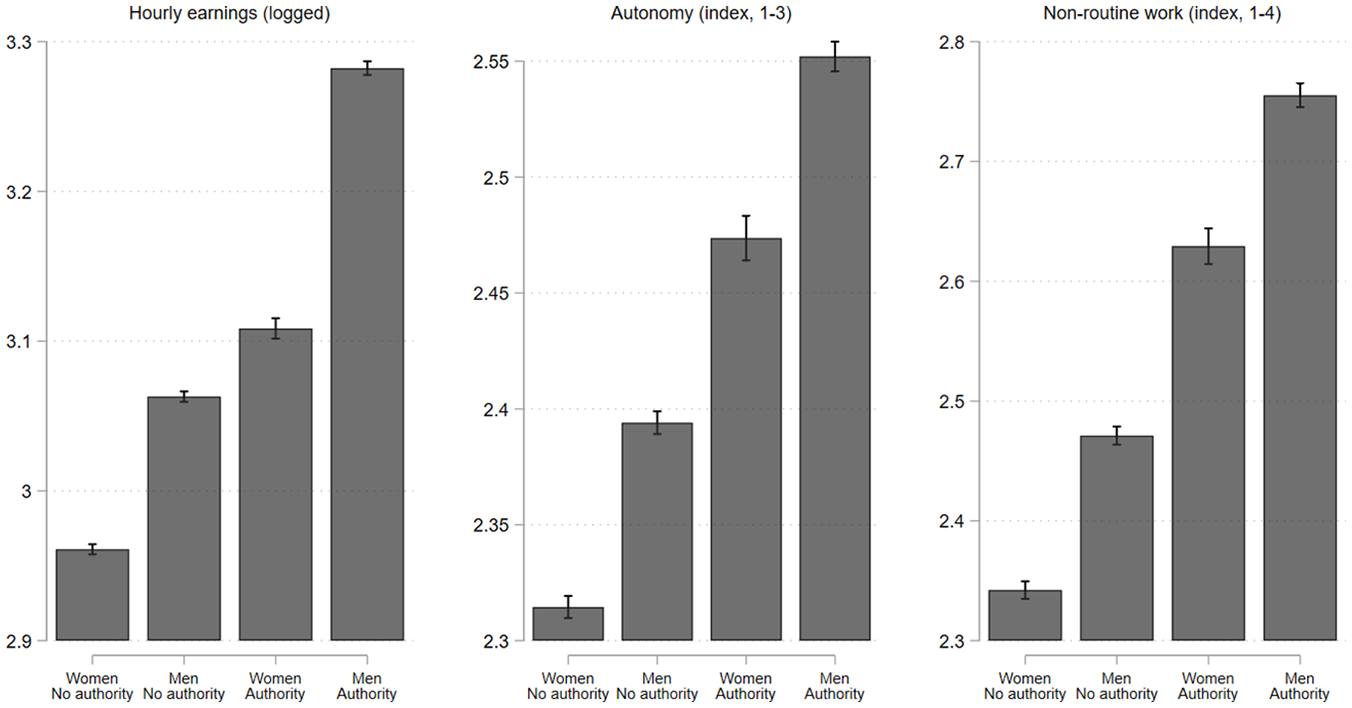
Predicted Scores From Regression Analyses: Job Resources
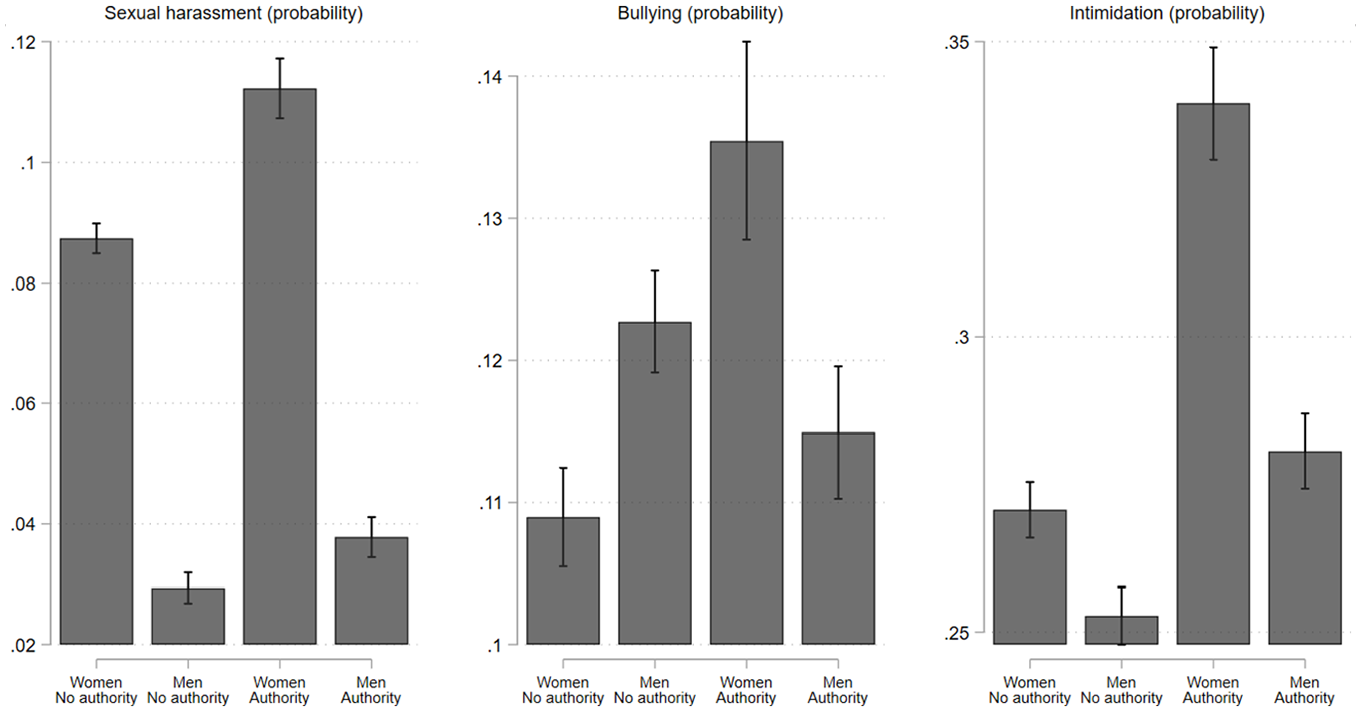
Predicted Scores From Regression Analyses: Negative Interpersonal Experiences
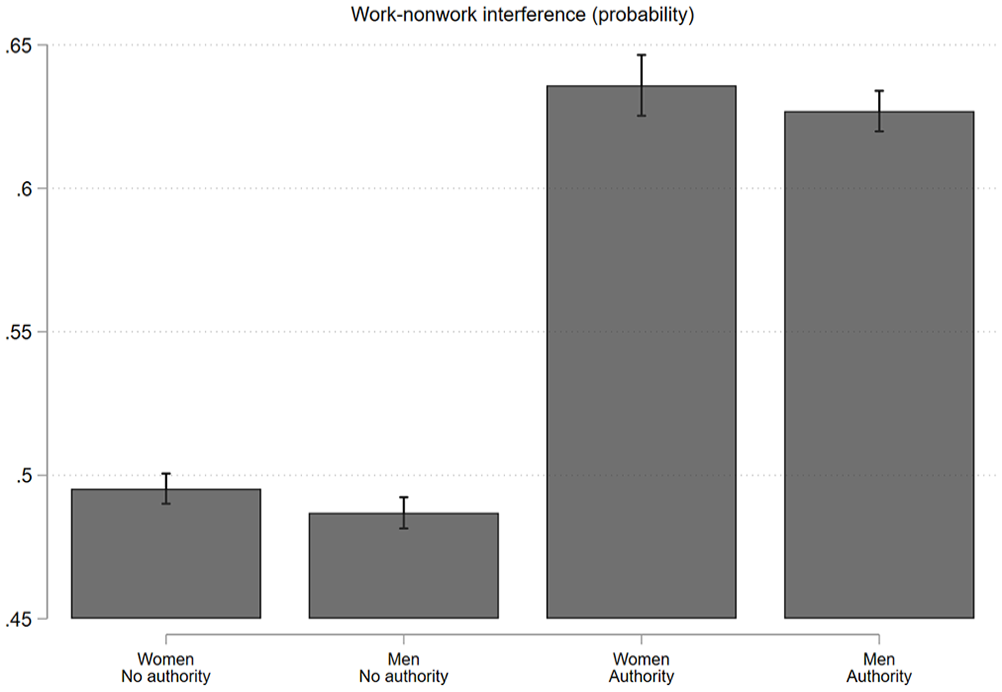
Predicted Scores From Regression Analyses: Work–Nonwork Interference
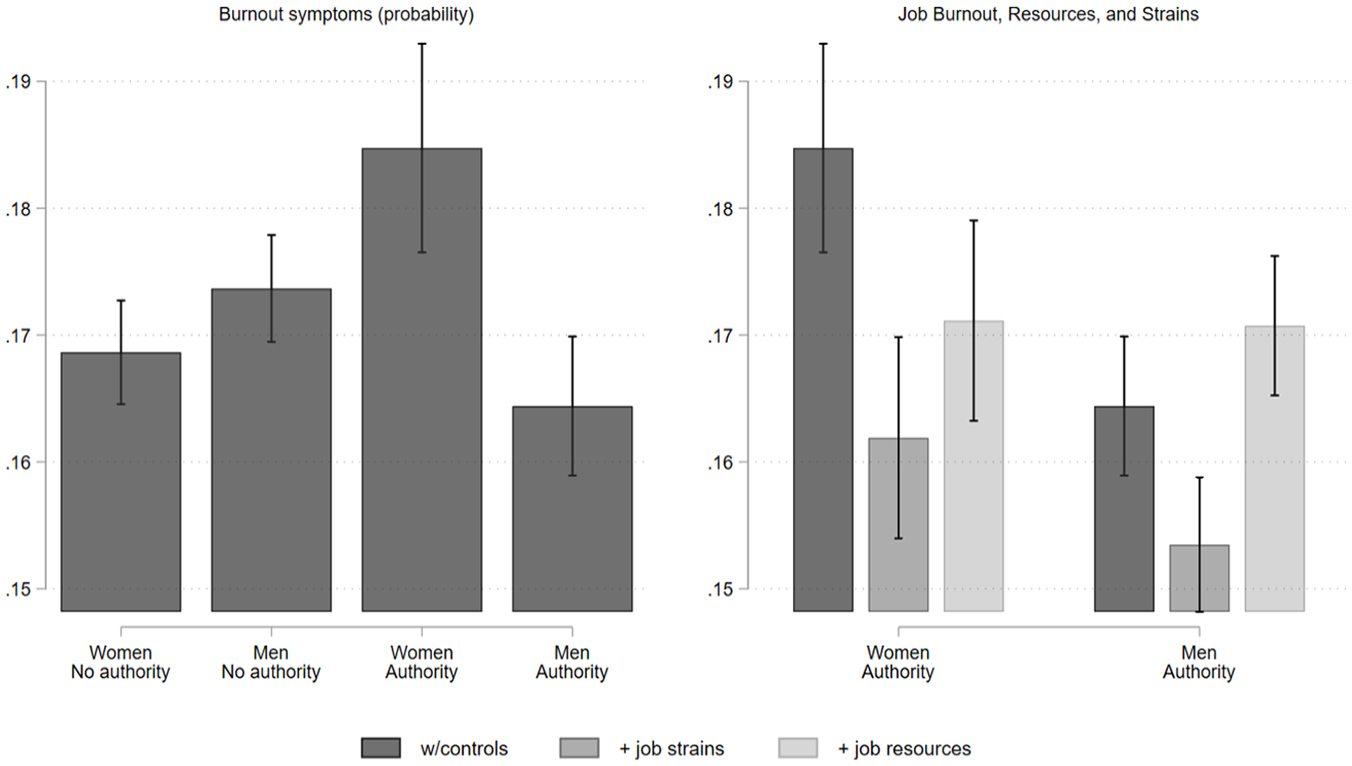
Predicted Scores From Regression Analyses: Job Burnout
My main focus of interest is the difference in either predicted levels of an outcome (e.g., earnings) or predicted probabilities (e.g., of experiencing sexual harassment) between women and men who have authority jobs. I, therefore, discuss absolute (average marginal effects) and relative differences between the predicted scores for women and men for each outcome. 4 While the comparison between women and men in authority is of primary interest, discussing how gender differences in resources and strains among individuals with authority compare with differences between women and men without authority is theoretically instructive because there are reasons to expect gender inequality to be even larger in authority positions. As discussed earlier, scholars have argued that women may be especially devalued in men-dominated settings, and that gender may be particularly salient in domains where gender stereotypes are linked to specific jobs, as is the case in jobs with authority (Cohen and Huffman 2003; Reskin 1993; Ridgeway 2001; Ridgeway and Correll 2004). For this reason, I keep women and men without authority in the model.
Lower Levels of Job Resources Among Women in Authority
Women in authority earn less and report lower levels of autonomy and nonroutine work than men with authority jobs (Figure 1). For a year of full-time employment (38 hours per week), women in authority earn on average about 8,400 euros less than men in authority (22.39 as opposed to 26.64 euros per hour), a substantively and statistically significant difference (p = .000). Average autonomy and nonroutine work levels of men in authority (2.55 autonomy, 2.76 nonroutine work) are also higher than those of women in authority (2.47 autonomy, 2.63 nonroutine work). These differences are statistically significant (p = .000 for both authority and nonroutine work) and of moderate size. As an illustration, the gender difference in autonomy is 0.08 standard deviations, which is comparable with the average difference in autonomy levels between individuals with lower and higher secondary education; the gender difference in nonroutine work of 0.11 standard deviations is comparable with the average difference in nonroutine work levels between individuals with higher secondary education and individuals with a Bachelor’s degree.
Women in positions without authority also earn less and report lower levels of autonomy and nonroutine work than men whose jobs do not entail authority, suggesting that women, as a whole, have fewer job resources. Net of covariates, the gender differences in autonomy and nonroutine work for individuals with authority are of comparable size with those among individuals without authority. The gender gap in earnings, however, is even larger among individuals in authority. Whereas women without authority earn about 90 percent of the earnings of men without authority, women with authority earn 84 percent of the earnings of men with authority. Overall, these findings provide support for Hypothesis 1, casting doubt on an important assumption made in much of research on gender stratification: that when women have authority, they will reap the rewards associated with these jobs to the same extent as men do. As the findings suggest, women seem to be subject to different reward systems, and even more so when in positions with authority.
Higher Probability of Experiencing Job Strains Among Women in Authority
Women’s and men’s experiences in authority are also not comparable with regard to the job strains they report. Women in authority have considerably higher probabilities of reporting the experience of workplace harassment in the preceding 12 months than men in authority (Figure 2). They are 7 percentage points more likely than men in authority to report having personally experienced sexual harassment, 2 percentage points more likely to have experienced bullying, and 6 percentage points more likely to report experiences of intimidation. All differences are statistically significant (p = .000 for all). Although women without authority are also more likely than men with jobs not entailing authority to report having experienced sexual harassment and intimidation at the workplace in the preceding 12 months, the gender difference in reporting these experiences is overall larger among individuals in workplace authority. Women without authority, for example, are 1.07 times more likely than men without authority to report having experienced intimidation at the workplace (women with authority are 1.21 times as likely as men with authority to report intimidation).
More generally, Figure 2 shows that women in authority have the highest probabilities of experiencing different forms of workplace harassment of all gender/authority status groups, net of educational attainment, work experience, tenure, household constellation, industry, and workplace size. In the case of bullying, men in authority positions are even less likely than men without authority to report experiencing this form of harassment at the workplace (p = .008). These analyses echo McLaughlin, Uggen, and Blackstone’s (2012) findings of highest rates of sexual harassment among women with workplace authority in a nonrepresentative sample of 29- to 30-year-old graduates from public schools in Minnesota, and extend these to show similar patterns for other forms of workplace harassment.
Women in authority positions are not more statistically likely to experience work–nonwork interference than men (Figure 3). The average gender difference in the probability of reporting the experience of work–nonwork interference among individuals in authority is comparable with the gender difference for individuals whose jobs do not entail authority. It is possible that I do not find more meaningful differences between women’s and men’s probabilities of experiencing work–nonwork interference because the average estimate obscures age-group differences in the relationship between gender and work–nonwork interference (Schieman, Glavin, and Milkie 2009).
Overall, these findings provide some support for Hypothesis 2. The finding of highest probabilities of workplace harassment among women in authority is consistent with feminist perspectives on gender and power that propose that due to the view on women as incompatible with authority, women with authority jobs may experience hostile reactions from colleagues and clients in attempts to restore the gender order. Thus, not only are women in authority subject to different rewards than men in authority, but they are also more likely to experience job strains.
Highest Probability of Job Burnout Among Women in Authority, Lowest Among Men in Authority
Although women and men in positions not entailing authority do not significantly differ in their average predicted probabilities of experiencing job burnout (p = .106), women with authority jobs are significantly more likely than men in authority to report experiencing burnout symptoms (Figure 4, left panel). Women in authority (18.5 percent) are 2 percentage points more likely than men in authority (16.4 percent) working in similar industries and with similar educational attainment and age to report experiencing job burnout (p = .000). 5 Overall, whereas women in authority have the highest average probability of reporting burnout symptoms, men with authority jobs have the lowest probability of experiencing burnout symptoms of all gender/authority status groups.
According to the Job Demands-Resources model of the antecedents of job burnout, burnout arises as a result of the combined presence of job strains and the absence of job resources, with stressors of interpersonal nature being of particular importance (Ganster and Schaubroeck 1991; Maslach, Schaufeli, and Leiter 2001). It is thus possible that the high probability of experiencing workplace harassment I document among women in authority, combined with having lower levels of resources, explains their high probability of experiencing job burnout. I cannot provide a test that addresses causality, but I am able to assess the probabilities of reporting burnout symptoms for women and men with similar levels of job resources and strains.
The right panel of Figure 4 shows what happens to the predicted scores for women and men in authority when job strains and resources are added as controls to the model. The first set of bars repeats the predictions from the left panel in the figure. The second set of bars visualizes predicted probabilities of reporting burnout symptoms based on a model that in addition to controlling for education, age, household constellation, industry, and workplace size adjusts for sexual harassment, bullying, intimidation, and work–nonwork interference. The third set of bars visualizes predicted scores based on models that additionally control for earnings and job autonomy. 6 The addition of controls for job strains meaningfully reduces women’s predicted probability of experiencing burnout symptoms. For similar probabilities of experiencing workplace harassment and work–nonwork interference, women in authority are not significantly more likely than men in authority to report experiencing job burnout (16.2 vs. 15.3 percent, p = .085). For similar levels of job resources and strains, the difference in reporting burnout symptoms between men and women in authority is nonexistent (17 percent for both). Altogether, thus, consistent with the Job Demands-Resources model, my findings point to the higher probabilities of experiencing job strains and lower levels of resources as potential explanations of the higher probability of experiencing job burnout among women in authority compared with men with authority jobs.
In studying the uneven distribution of job authority as a valuable job resource, next to discussing the association of authority jobs with higher economic rewards, scholars have also linked having authority at the workplace to substantial psychological rewards (see, for example, Jaffee 1989). My analyses of job burnout show that gender shapes psychological costs and rewards of having authority. The evidence in support of hypotheses 1, 2, and 3 altogether suggests that the “add women and stir” approach to studying stratification does not reflect women’s differential experiences in authority.
Accounting for Women’s and Men’s Relative Location Within the Structure of Authority
Are the average gender differences in job resources and strains I document a function of women’s and men’s concentration in certain types of authority positions, relative to others? For example, if workplace harassment directed at individuals in authority occurs especially in lower level positions that entail much more frequent and intense interpersonal contact (Cordes and Dougherty 1993), regardless of who occupies these positions, the concentration of women low in chains of command would explain their high probability of experiencing workplace harassment. If this is not the case, I expect to find gender differences in resources and strains within the same type of authority position. To study this question, I replicated the main analyses, replacing the binary authority measure with the measure distinguishing authority positions on the basis of the share of supervisory tasks and control over resources, and the measure of span of control, keeping all other variables the same as in the main analyses.
The results from these analyses appear in the Online Appendix (Figures A1–A8). Here I summarize the key findings and present one example: the analyses of earnings using the authority measure distinguishing positions with little authority, positions with mostly supervisory tasks but no control over resources, sanctioning authority, and decision-making authority (Figure 5). A general word of caution regarding these results is that due to smaller sample sizes per authority type, confidence intervals are in some cases rather large, rendering the results less reliable. The findings based on both the measure of type of authority and span of control suggest that gender differences in the type of authority position held do not fully explain lower levels of job resources and higher probabilities of experiencing job strains among women in authority compared with men with authority jobs. Men have higher levels of resources and are less likely than women in authority to experience job strains for all types of authority positions. For example, men earn substantively more than women both at the bottom of the authority ladder, in positions with little authority, and at the top of the authority hierarchy, in decision-making positions (Figure 5).
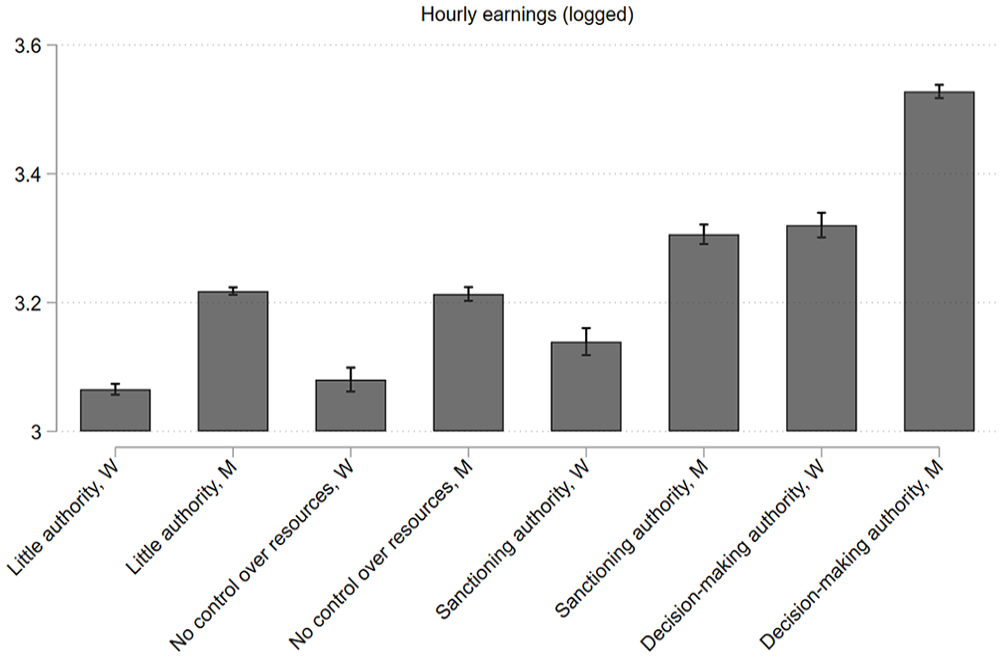
Predicted Scores From Regression Analyses With Type Authority: Earnings
Discussion
The underrepresentation of women in positions of workplace authority is well documented. Much of the literature studying the causes and consequences of the gender gap in authority has been motivated by the assumptions that, first, jobs with authority are good jobs, and second, that when women have authority, they will reap the rewards associated with these jobs to the same extent as men. Bygren and Gähler (2012, 795), for example, state that “[a]n equal gender distribution in authority in the workplace is important . . . because authority positions reward the individual with prestige, power, autonomy and status.” In this article, I question this assumption. Building on feminist sociological literature and the concept of gender as a social structure (Risman 2004), I argue that women’s and men’s experiences in authority are likely to be different because when women obtain authority positions, they continue facing different cultural expectations and an institutional environment that advantages men.
My analyses of reported job resources and strains of more than 100,000 women and men representative of the population of employees in the Netherlands show that women in authority have lower earnings and levels of autonomy and nonroutine work than men in authority, and are more likely—and the most likely of all gender/authority status groups—to report experiencing sexual harassment, bullying, and intimidation at the workplace. This study also provides novel evidence on the gendered experience of job burnout in authority, finding that women with authority jobs have the highest probability of reporting burnout symptoms. While gender differences in average levels of job resources and strains also exist among individuals without authority, these are often larger among those in authority. Women’s concentration in authority positions lower in the power structure does not explain the documented gender differences in resources and strains in authority.
Altogether, these findings support calls for better integration of feminist perspectives on gender and work into research on gender stratification (Acker 1990; Ferree and Hall 1996; Lengermann and Niebrugge-Brantley 1990). In writing about the gendered organization, Acker (1990, 139) states that “[c]ommon concepts in organizational thinking assume a disembodied and universal worker. This worker is actually a man; men’s . . . relationships to . . . paid work are subsumed in the image of the worker.” This study cautions against making the same assumption in research on gender stratification. Moving beyond the “add women and stir” approach as suggested in this article demonstrates how assuming a (white) male worker norm can lead to erroneous assumptions about work outcomes among those “deviating” from this norm. As long as women are seen as incompatible with holding authority at work, their experiences in jobs with authority are unlikely to be comparable with those of men.
Conclusion
Two further theoretical implications are worth noting. First, the finding that women’s and men’s relative location in the structure of authority does not explain average gender differences in resources and strains implies that the mechanisms subjecting women to different reward systems operate over and above their effects on the initial allocation of different types of authority positions to women. Second, the highest probabilities of experiencing workplace harassment and job burnout documented among women in authority could potentially suggest a mechanism that helps explain women’s underrepresentation in authority positions. Workplace harassment and job burnout have in the long term been associated with job absenteeism and higher turnover, and lower job satisfaction and productivity among those who stay on the job (Maslach, Schaufeli, and Leiter 2001; McLaughlin, Uggen, and Blackstone 2017; Pina and Gannon 2012). Descriptive evidence suggests that women are more likely than men to leave jobs with authority (Stojmenovska and England 2021). Experiences of workplace harassment and job burnout might be a reason for women dropping out of jobs with authority, feeding back into their underrepresentation in these jobs.
My findings have implications for social change. Various programs and policies have proliferated in the past decades, ranging from diversity trainings for workplaces to government legislation requiring a set quota of representation of women in corporate boards, to address the gender gap in authority and reduce gender inequality. This study has shown that hiring and promoting women to authority positions are not sufficient for dismantling gender inequality. To echo Risman (1998, 2004), achieving gender equality requires simultaneously attending to all levels of the gender structure.
Supplemental Material
sj-docx-1-gas-10.1177_08912432231159334 – Supplemental material for Gender Differences in Job Resources and Strains in Authority Positions
Supplemental material, sj-docx-1-gas-10.1177_08912432231159334 for Gender Differences in Job Resources and Strains in Authority Positions by Dragana Stojmenovska in Gender & Society
Footnotes
Author’s Note:
The replication package to this article is available at the author’s website ( ). The data used in this article are nonpublic microdata from Statistics Netherlands. These and other nonpublic microdata are under certain conditions accessible for statistical and scientific research. For more information, contact
Supplemental Material
Supplemental material for this article is available online.
Notes
Dragana Stojmenovska is a postdoctoral researcher at the Department of Sociology at the New York University. Her research focuses on gender inequality in the workplace. Her work has been published in journals such as American Sociological Review; Gender, Work & Organization; and Social Forces.
References
Supplementary Material
Please find the following supplemental material available below.
For Open Access articles published under a Creative Commons License, all supplemental material carries the same license as the article it is associated with.
For non-Open Access articles published, all supplemental material carries a non-exclusive license, and permission requests for re-use of supplemental material or any part of supplemental material shall be sent directly to the copyright owner as specified in the copyright notice associated with the article.
