




Abstract
Western stereotypes often characterize gender relations in Muslim-majority societies as uniformly traditional and patriarchal. Underlying this imagery is a unidimensional understanding of gender ideology as moving along a single traditional-to-egalitarian continuum. In this study, we interrogate these assumptions by exploring variability across and within Middle Eastern, North African, and South Asian (MENASA) societies in beliefs related to two regionally salient gender principles: women’s chastity and marital patriarchy. Data from a new online survey of Muslim Facebook users show substantial heterogeneity across and within six MENASA societies in support for these principles. These data also reveal a multidimensional structure, in that societies show different configurations of chastity and marital patriarchy beliefs, and each of these gender principles is influenced by respondents’ religious beliefs and gender status in different ways. Although religious absolutism predicts agreement with both gender principles, piety is associated with support for chastity but not for marital patriarchy. Results also show a clear gender divide in attitudes toward hierarchy in marriage but not with respect to chastity. Findings complicate broad-brush depictions of patriarchy in the region and corroborate previous research on the multidimensionality of gender beliefs and the multifaceted attitudinal influences of gender and religious beliefs.
Western stereotypes often contrast a conservative patriarchal “Islamland” against a progressive egalitarian West, a binary opposition long contested by feminist scholars of the region (Abu-Lughod 2015; Afary 2009; Badran 2009; Charrad 2011; Moghadam 2013). Reflected in this imagery is both an undifferentiated view of gender relations in Muslim-majority societies and a unidimensional understanding of gender ideology as something that advances along a single traditional-to-egalitarian continuum as economies modernize or as self-expressive value systems diffuse (Inglehart and Norris 2003; Jackson 1998).
In this study, we interrogate these assumptions based on a new online survey of Muslim men and women in six Middle Eastern, North African, and South Asian (MENASA) societies. Exploring the independent variation of two distinct ideological tenets—women’s chastity and marital patriarchy—allows us to go beyond unidimensional understandings of a single Islamic patriarchy while extending the global scope of research on the multidimensionality of gender beliefs. Although a growing body of comparative and historical scholarship theorizes gender ideology in multidimensional terms, the supporting empirical analyses have focused primarily on Western industrial societies (Charles and Grusky 2004; Cotter, Hermsen, and Vanneman 2011; Grunow, Begall, and Buchler 2018; Knight and Brinton 2017; Scarborough, Sin, and Risman 2019).
If gender attitudes cannot be characterized on a single continuum, it is especially important that researchers attend to attitudinal tenets that are culturally salient. Due to data limitations, most previous comparative studies of MENASA societies have been based on survey items developed to explore attitudinal variation in Europe and North America. While women’s rights to education, employment, and politics represent important attitudinal cleavages in Muslim-majority societies (Glas et al. 2019; Glas, Spierings, and Scheepers 2018; Price 2015), gender attitudes are also manifested in more culturally specific ways. In the present study, we draw upon new online data on more than 6,000 Muslim Facebook users in Algeria, Egypt, Pakistan, Tunisia, Turkey, and Palestine to explore beliefs about women’s chastity and marital patriarchy—two gender principles that are highly salient in the region but have received relatively little analytical attention. Because this survey also includes multiple indicators of religious piety and religious absolutism, it allows for a more nuanced analysis of how Muslim beliefs and practices relate to specific gender beliefs than is often possible with survey data.
Rather than a patriarchal monolith, MENASA societies are quite heterogeneous in the structure of their gender beliefs, just as they are heterogeneous in their gender structures more generally. We find evidence of multidimensionality in the independent variation of marital patriarchy and chastity beliefs across MENASA societies and in the distinct logics underlying these two attitudinal tenets, including how they are influenced by respondents’ gender status and religious beliefs. Multidimensionality is confirmed by latent class analysis, which identifies three cultural groups characterized by different configurations of chastity and marital patriarchy attitudes. Results complicate broad-brush depictions of patriarchy in the region and corroborate previous research on the multifaceted nature of gender beliefs and the complex attitudinal influences of gender status and Muslim faith.
Gender and religion in multidimensional perspective
Patterns of gender inequality vary widely across MENASA societies. This complexity is shown in Table 1, which presents some commonly referenced indicators of gender equality in education, employment, political life, and law, as well as measures of national economic development, for the six countries considered. These country profiles support two general observations. First, except for Tunisia and Pakistan (which rank high and low, respectively, on most measures), indicators of gender equality covary only modestly; countries that rank high on some measures rank low on others. Turkey, for example, shows by far the highest level of women’s employment, but the lowest percentage of women in local government. And although Egyptian women have essentially closed the gender gap in educational attainment, they show the weakest representation in parliament. This unevenness is consistent with previous research on the different forces driving gender (in)equality across institutional domains in Europe and North America (Charles and Grusky 2004; England 2010; Pettit and Hook 2009).
Indicators of Institutional Gender Status and Economic Development in Six Middle Eastern, North African, and South Asian Societies, 2018
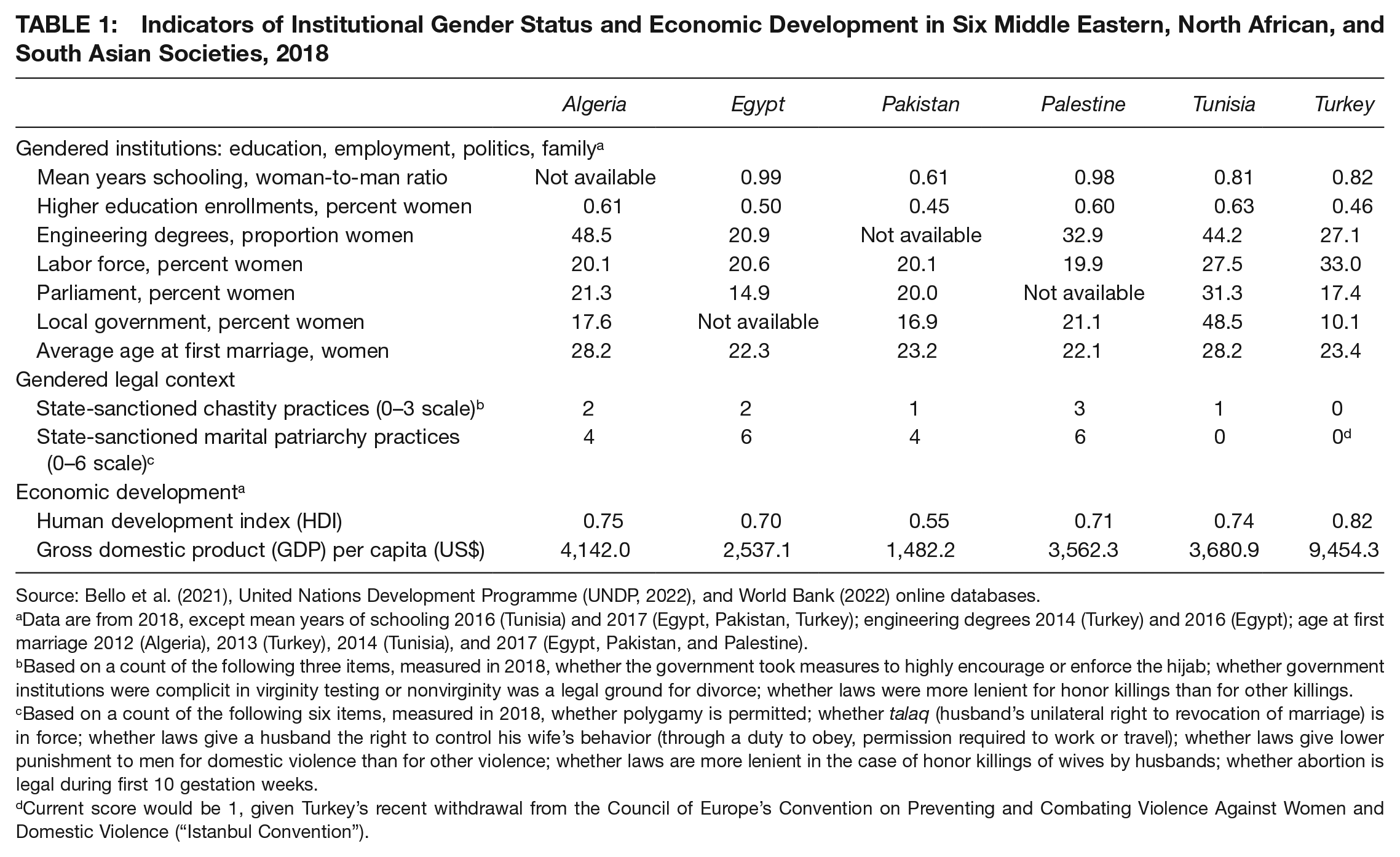
Source: Bello et al. (2021), United Nations Development Programme (UNDP, 2022), and World Bank (2022) online databases.
Data are from 2018, except mean years of schooling 2016 (Tunisia) and 2017 (Egypt, Pakistan, Turkey); engineering degrees 2014 (Turkey) and 2016 (Egypt); age at first marriage 2012 (Algeria), 2013 (Turkey), 2014 (Tunisia), and 2017 (Egypt, Pakistan, and Palestine).
Based on a count of the following three items, measured in 2018, whether the government took measures to highly encourage or enforce the hijab; whether government institutions were complicit in virginity testing or nonvirginity was a legal ground for divorce; whether laws were more lenient for honor killings than for other killings.
Based on a count of the following six items, measured in 2018, whether polygamy is permitted; whether talaq (husband’s unilateral right to revocation of marriage) is in force; whether laws give a husband the right to control his wife’s behavior (through a duty to obey, permission required to work or travel); whether laws give lower punishment to men for domestic violence than for other violence; whether laws are more lenient in the case of honor killings of wives by husbands; whether abortion is legal during first 10 gestation weeks.
Current score would be 1, given Turkey’s recent withdrawal from the Council of Europe’s Convention on Preventing and Combating Violence Against Women and Domestic Violence (“Istanbul Convention”).
Second, these country scores provide mixed support for theories linking socioeconomic modernization to gender-egalitarian change (Inglehart and Norris 2003; Jackson 1998). Table 1 shows that economic development is positively related to some, but not all, indicators of gender equity. Turkey and Pakistan, for example, are high and low outliers on economic development and rank high and low, respectively, on many of the gender equality measures considered here. But Turkey ranks below the less economically developed Tunisia on most indicators, and below the least economically developed Pakistan on women’s representation in politics. And as documented elsewhere, gender equality in prestigious science, technology, engineering, and math (STEM) fields is poorly predicted by economic development; most affluent Turkey here ranks near the bottom in women’s share of engineering degrees, and two of the three North African countries show more than twice the United States’ (approximately 20 percent) share of women among engineering graduates (Bello et al. 2021; see also Chow and Charles 2020; Dajani, Dhawan, and Awad 2020).
Previous research has documented a similar multidimensionality in attitudes about gender. For example, male primacy (support for institutionalized male dominance) and gender essentialism (belief in hardwired differences between women and men) have followed distinct trajectories in the industrial world, with the rise of liberal individualist principles associated with erosion of the former but not the latter (Breda et al. 2020; Charles and Bradley 2009; Charles and Grusky 2004). Knight and Brinton (2017) have likewise identified “varieties” of European egalitarianism, characterized by different combinations of traditional, essentialist, and liberal gender beliefs (see also Grunow, Begall, and Buchler 2018; Scarborough, Sin, and Risman 2019). Most survey analyses of gender in the Muslim world have considered variability on summary attitudinal scales or focused on specific attitudinal dimensions (Glas, Spierings, and Scheepers 2018; Price 2015; Read 2003; Rizzo, Meyer, and Ali 2002), although some recent work shows that different factors predict support for equality in different public-sphere domains (i.e., education vs. politics) and for different feminisms (Glas and Alexander 2020; Glas et al. 2019). Our study builds upon these disaggregated analyses.
A multidimensional conceptualization raises the stakes as to which attitudinal indicators to study. Comparative research on gender attitudes of Muslim-majority populations has been limited mostly to items included in large international surveys that were developed to interrogate gender issues salient in the West: household divisions of labor, maternal employment, and women’s rights in education, employment, and politics (e.g., Abdelhadi and England 2019; Glas et al. 2019; Inglehart and Norris 2003; Rizzo, Meyer, and Ali 2002). The “Private Lives–Public Politics” (PLPP) data, collected by authors Afary and Friedland, allow us to build on this research by exploring two additional ideological tenets central to MENASA gender relations.
The first, women’s chastity, relates to the social control of women’s bodies, including practices aimed at safeguarding young women’s marriageability. Although chastity may also be normative for unmarried Muslim men, young women are subject to much more intense social sanctioning. Norms of female chastity are highly salient in societies where women’s modesty is understood as a marker of Muslim cultural authenticity and where perceived impurity can be subject to severe social sanctions (L. Ahmed 2011; Charrad 2011; Ilkkaracan 2000; Mernissi 1987). Chastity and modesty practices are supported by essentialist beliefs in gender difference, specifically the idea that men possess a naturally aggressive sexuality, and that women have power to control men’s sexual access to their bodies, thus protecting their marriage prospects, the family honor, and the interests of the broader community (Eşsizoğlu et al. 2011; Shalhoub-Kevorkian 2005; Wild et al. 2015; Wynn 2016). While no current state laws explicitly mandate veiling or virginity in the six countries considered, girls and women are often closely monitored by family and community. Chastity norms are also enforced through state complicity or indifference to family control—for example, a groom’s family might use a government-required premarital “health check” as a pretense for confirming bridal virginity. Table 1 includes a summary measure of state-sanctioned chastity practices. 1
The second gender principle, marital patriarchy, pertains to male primacy within marriage, specifically beliefs about women’s subordinate position. Married women who are no longer under the guardianship of their family of origin are often subject to the power of their husbands—for example, through physical dominance and religiously authorized control of their employment, finances, and travel (S. Ahmed 2020; Goudarzi-Gereke 2018; Zaman 2020; see Table 1). Marital patriarchy, especially when sanctioned by state law or violence, is predicated upon the unequal status and unequal rights of husbands and wives in marriage. It thus rests upon the same blatantly anti-liberal understanding of gender relations that supports principles of public-sphere patriarchy, including the beliefs about men’s greater rights to employment, education, and political power that are well documented through Western surveys.
The principles of marital patriarchy and women’s chastity differ in the explicitness of their hierarchical logics. Whereas men’s rights to beat their wives and control their wives’ employment implies an undeniable hierarchy of social standing within marriage, norms of feminine modesty may be more plausibly interpreted through a “different but equal” lens, legitimized on the basis of essentialist beliefs about men’s and women’s different bodies and sexual essences—for example, men’s natural sexual aggression. This is an important distinction because forms of gender inequality that openly violate the liberal egalitarian ideals propagated by major world society institutions are often met with more significant opposition (Charles 2020; Pierotti 2013; Snyder 2006), whereas essentialist-based inequalities can exist quite comfortably alongside liberal principles, at least in the West (Breda et al. 2020; Charles and Grusky 2004; Cotter, Hermsen, and Vanneman 2011; Knight and Brinton 2017; Levanon and Grusky 2016).
Conceptualizing gender ideology in multidimensional terms allows a richer description of historical and cross-societal variation, as well as a clearer understanding of the causal processes driving variation on specific ideological tenets. For example, marital patriarchy beliefs and chastity beliefs may be influenced in different ways by gender status. Because women occupy the disadvantaged pole of patriarchal power relationships, it is likely that they will be less supportive of marital patriarchy than men, just as women are less supportive of public-sphere patriarchy (Glas et al. 2019; Glas, Spierings, and Scheepers 2018; Price 2015). But the same women who challenge explicit gender hierarchies may support gendered modesty practices as practical protective measures against male aggression or as symbols of Muslim cultural authenticity. This suggests that the gender gap in beliefs about women’s chastity will be more contextually contingent than the gender gap in marital patriarchy beliefs.
The relationship of the two gender-attitudinal tenets to religious beliefs may also be more complicated than generally appreciated. Comparative survey analyses show greater gender liberalism among secular than religious respondents, and greater gender traditionality among Muslim than non-Muslim respondents (Hadler and Symons 2018; Inglehart and Norris 2003; Price 2015, but see Seguino 2011). Beyond these general tendencies, we know that the same religious doctrine can support widely varying gender practices (Afary and Friedland 2022; Charrad 2001; Deeb and Harb 2013; Desai and Temsah 2014; Friedland et al. 2016; Read 2003) and that different dimensions of religiosity (e.g., behaviors, beliefs, belonging) can have different effects on support for gender equality in the Arab world (Glas, Spierings, and Scheepers 2018; Spierings 2019). It is not surprising, therefore, that gender regimes differ widely across Muslim-majority countries. Whereas some women have experienced increased autonomy and agency in their public and private lives, others have seen ideological backlashes in the form of political Islam and religious fundamentalism (Afary 2009; Badran 2009; Charrad 2011; Moghadam 2013; Tripp 2019).
To better understand this heterogeneity, we distinguish two aspects of religiosity. Piety refers to a rigorous adherence to religious practice and beliefs, and absolutism refers to belief in the complete moral authority of a revealed text, here the Quran, and the enforcement of its prescriptions and proscriptions through national laws. Pious persons may engage frequently and fervently in religious rituals but still accept the legitimacy of diverse beliefs and different interpretations of religious texts by others. Such a “pious liberal” might believe that it is up to God to punish transgressions in the afterlife and, therefore, oppose harsh absolutist laws that place this responsibility on the state or on others in this world. This suggests that the anti-liberal mindset supporting marital patriarchy will be shared by religiously absolutist Muslims but not necessarily by religiously pious Muslims.
A multidimensional conceptualization of gender ideology allows us to interrogate two types of complexity for this sample of Muslim Facebook users: cross-societal differences in the configuration of attitudes about women’s chastity and marital patriarchy, and differences across the two attitudinal tenets in their causes and correlates. We accordingly pose the following four questions:
How do beliefs about women’s chastity and marital patriarchy vary across and within the six societies?
How do religious beliefs and practices influence beliefs about women’s chastity and marital patriarchy?
Do piety and absolutism operate in different ways?
How does gender status influence beliefs about women’s chastity and marital patriarchy?
Is it possible to identify distinct “gender cultures”—groups of people with similar configurations of beliefs about women’s chastity and marital patriarchy? If so,
What defines these cultural groups (i.e., what do they believe)?
How are these groups distributed across the six societies?
What personal traits predict group membership?
Data and method
Data are taken from PLPP, a 2018 online survey conducted by Janet Afary and Roger Friedland that interrogates the intimate lives and gender beliefs of Facebook users in Algeria, Egypt, Pakistan, Palestine, Tunisia, and Turkey. 2 PLPP data are not yet publicly available. Gender and sexuality can be sensitive topics in Muslim-majority societies, so an anonymous online instrument may yield more accurate information than in-person interviews, phone surveys, or paper questionnaires (on strengths and weaknesses of Facebook surveys, see Pham, Rampazzo, and Rosenzweig 2019; Schneider and Harknett 2022). Respondents were recruited through Facebook banner advertisements (Online Appendix Figure A1), with survey instruments translated and back-translated into Arabic, Turkish, and Urdu languages by native speakers. The sample was limited to countries where Facebook recruitment advertisements could be placed. It comprises 6,592 men and women aged 19 years or older who identified as Muslim (approximately 93 percent of PLPP respondents) and who provided data on all of the relevant survey items. 3
The PLPP survey is meant to be representative of each society’s 2018 Facebook user population, not their general population. The share of the population that uses Facebook (i.e., the penetration rate) is close to 50 percent across the six countries, but with considerable variability. Pakistan, with a 16 percent penetration rate, is a low outlier; usage in the other five countries ranges from 41 percent (Egypt) to 63 percent (Tunisia). 4 Comparing gender, age, and educational distributions of our country samples with data on the overall Facebook user populations in the respective countries shows little difference by age, but an overrepresentation of women and non–college-educated persons, attributable to the PLPP’s intentional oversampling of these groups and higher completion rates of women respondents. To represent the six Facebook user populations, we constructed person weights using country-specific information on the educational, age, and gender distributions of Facebook users. Diverse sensitivity tests, presented in the Online Appendix, confirm the similarity of weighted and unweighted results.
To learn how Facebook users differ from the general population, we used nationally representative data on Facebook usage from the 2018 Arab Barometer (AB) survey, available for four of the six countries (see Online Appendix Table A1). 5 Comparing demographic characteristics of Muslim Facebook users with those of all Muslim AB respondents shows that Facebook users (like Internet users overall) are younger, more educated, more men, and less likely to be married than the corresponding general populations. 6 They also report lower levels of religiosity and less support for sharia law. The AB includes no measure of chastity norms, but does query beliefs about husbands’ decision-making authority with respect to divorce and family matters in general. On these beliefs, Facebook users differ relatively little from the general population, despite their different demographic traits.
PLPP respondents are assigned to countries based on their Facebook country, which is determined by the location setting on users’ Facebook profiles and the location histories of their connected devices. Cultural ties to Facebook countries appear strong; the available data indicate that 95 percent of respondents are born there and 92 percent are living there. 7 Among those living or born elsewhere, about 90 percent had at least one parent born in their Facebook country. Conclusions are unchanged in analyses that restrict the sample to respondents whose place of residence matches their Facebook country. 8
In short, we are able to compare gender beliefs of Muslim Facebook users who identify as cultural members of six Muslim-majority societies in the MENASA region. The youth and education of Facebook users, combined with their capacity to share attitudes and information online, make them potential opinion leaders and an important population to study.
Measures of Gender Attitudes
We measure beliefs about women’s chastity and marital patriarchy using four survey questions, two pertaining to the regulation of women’s bodies through modesty and chastity and two pertaining to men’s power over women in marriage. Translated into English, the items are as follows:
Women’s Chastity
Do you think women should wear the hijab?
Do you think a woman should be a virgin when she marries?
Marital Patriarchy
Do you think men should have the right to decide whether their wives work outside the home?
Do you think men have the right to beat their wives if other techniques of persuasion fail?
On three of the four items, respondents are given a choice of “yes,” “no,” and “not sure,” and we created binary variables distinguishing affirmative responses. On the employment item, two variants of the affirmative response and two variants of the negative response were offered, plus the “not sure” option. 9 To identify those who believe that a wife’s employment is ultimately the husband’s decision, we created a binary variable distinguishing the two affirmative responses from all others. “Not sure” responses amount to 9 percent on the “virgin” item, 11 percent on the “hijab” item, 6 percent on the “employment” item, and 8 percent on the “wife-beating” item; supplementary analyses show that conclusions are unchanged when these are grouped with affirmative responses (see Online Appendix, “Sensitivity Tests for Logistic Regression Models Predicting Muslim Gender Beliefs”).
Religious and Demographic Predictors
We distinguish two dimensions of religiosity: Religious piety refers to personal devotion to religious practice and beliefs; religious absolutism to belief in strict adherence to religious doctrine, enforced by state laws, with no room for interpretation. Each dimension is represented by two indicators. Piety is measured by observance of religious rituals, with those reporting that they pray at least once a day coded 1 on a daily prayer indicator and those reporting that they fast all the Ramadan month (unless religiously excused) coded 1 on a fasting indicator. Absolutism is measured with binary indicators of support for Islamic law and literal interpretation of the Quran. The first distinguishes those affirming that Islamic law should be the sole source of law. The second identifies those affirming that the Quran “is true in all ways, and to be read literally, word for word.” 10
Gender status is measured using a binary indicator that distinguishes respondents who identify as women. Those who report being formally married, employed (full or part time), attending some postsecondary school (including junior college), and living in a large metropolitan area (more than three million residents) are likewise identified using dummy indicators. Sunni Muslims, 84 percent of the sample, are distinguished from Shi’ites, who form small minority communities in these six societies. Age is measured in years. Because large numbers of respondents did not provide information on their own parental status or on their parents’ labor market activities while they were growing up, our models do not include these variables.
Analytic Approach
The data analysis proceeds in two steps. First, we compute a series of logistic regression models with fixed country effects to identify the personal traits that predict affirmative responses to each of the four gender-attitude items. We allow for multidimensionality by modeling each of the four attitudinal items separately, rather than aggregating them into a summary measure of gender traditionality. By comparing country effects and sociodemographic predictors across the four models, we can assess evidence for treating women’s chastity and marital patriarchy as distinct attitudinal dimensions. In supplementary analyses, we computed regressions without sample weights and separately by country and gender (Online Appendix). Removal of weights has no effect on key findings; interactions with country and gender are discussed with the results.
Second, we apply latent class analysis to identify groups of respondents with similar combinations of gender beliefs, or “gender cultures.” 11 Three discrete attitudinal groups are identified, with individual respondents then assigned a specific probability of belonging to each group, or “latent class.” To assess how well respondents’ personal traits predict class membership, we use the three-step approach advocated by Bakk, Tekle, and Vermunt (2013), regressing probabilities of membership on the same set of sociodemographic covariates used for the regression analyses.
Results
Proportions reporting agreement with each of the four gender-attitude items, broken down by gender and country, are displayed in panel A of Figure 1. Pooled proportions, both weighted and unweighted, are shown in the Online Appendix, Table A2. 12 Pooled results show strong support for chastity norms, with approximately 80 percent of the sample reporting that they favor virgin brides and the hijab. In practice, these norms affect young women most, especially those still under the guardianship of their birth families. Values on the marital patriarchy items suggest limits on the legitimacy of men’s control over married women, especially as concerns physical violence. Nearly half (45 percent) of the respondents agree that husbands should be the ultimate (or sole) decision maker on their wives’ employment, but far fewer (18 percent) support husbands’ right to beat their wives “if other techniques of persuasion fail” (Online Appendix, Table A2). 13
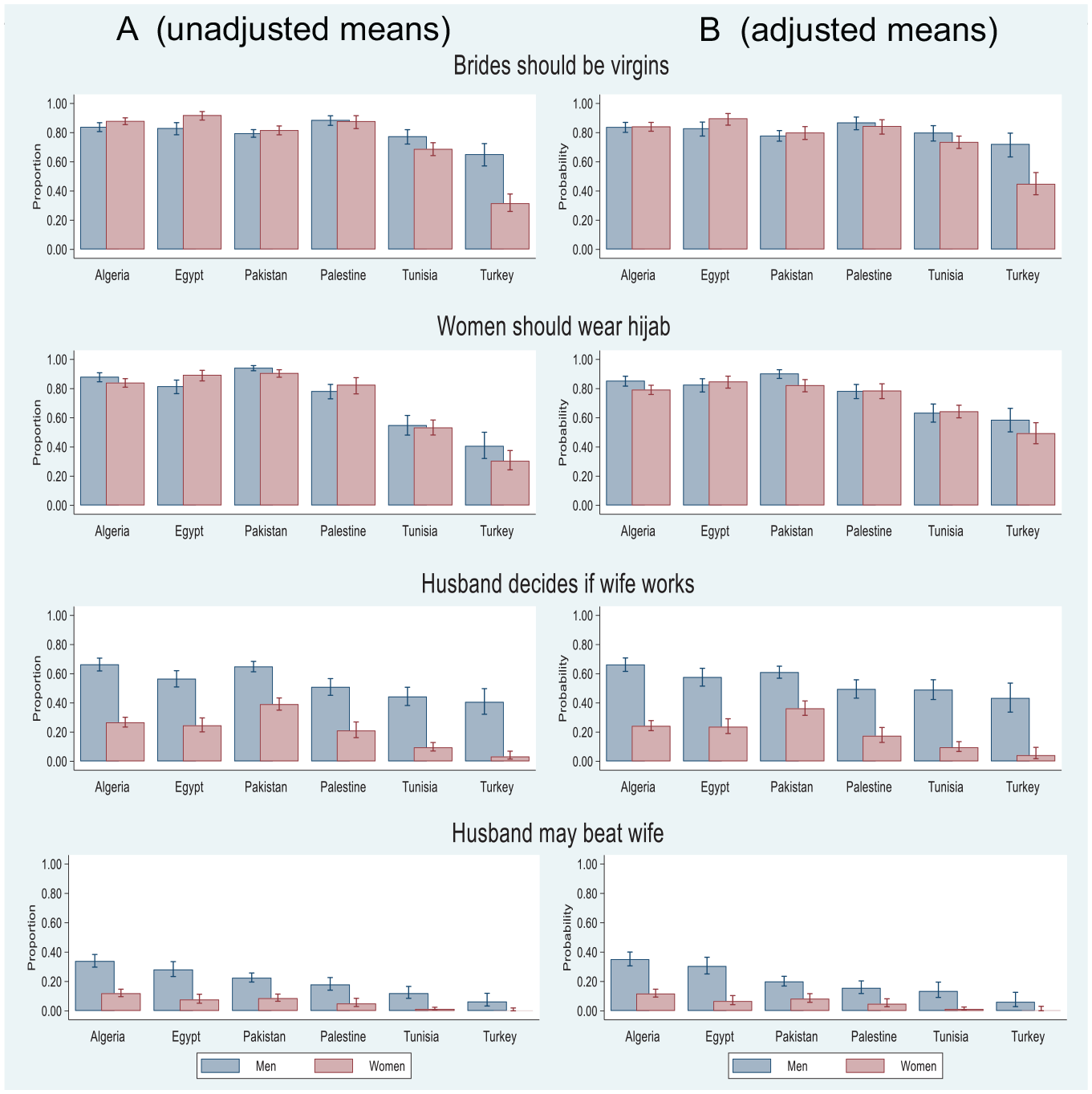
Gender Attitudes of Facebook Users, by Country and Gender
The first panel of Figure 1 provides preliminary evidence that these two attitudinal tenets follow distinct gender logics. While men are more likely than women to support marital patriarchy in all countries, gender differences on chastity norms are much smaller, and inconsistent in direction. Among both men and women, chastity is more widely supported than marital patriarchy. The relatively weak affirmation of husbands’ right to physically discipline their wives is at odds with Western stereotypes of an unrestrained Islamic patriarchy. Even in countries with the highest levels of religious absolutism and strongest support for marital patriarchy, most men decline to affirm husbands’ right to physical “persuasion” of their wives. Although social desirability bias is always a concern with culturally sensitive topics, this bias is likely less in an anonymous online survey. Because this issue is not typically interrogated in Western surveys, it is unclear how these views on domestic violence compare with those of men in the West.
How much do attitudes vary across the six societies? Unadjusted values in Figure 1 help address this first research question. Consistent with modernization arguments, it is in the most economically developed society (Turkey) where the most uniformly gender-egalitarian views are expressed, although the rank ordering of other countries depends on the specific attitudinal indicator considered (see also Online Appendix, Table A2). The most gender-conservative views are reported by Algerians, Egyptians, or Pakistanis, depending on the indicator. 14 It is also notable that Tunisia outperforms Turkey on many measures of institutional gender equality presented in Table 1.
Attitudinal variability across countries may be partly attributable to the different demographic and religious compositions of these six populations. Liberal attitudes in Turkey, for example, might reflect higher rates of college attendance or urban residence, or a lower prevalence of religious absolutism. Regression analysis allows us to gauge the contribution of these demographic factors to the observed cross-societal differences. The variability that remains may be attributable to unmeasured individual-level traits or to the sorts of broadly shared belief systems that grow out of distinctive collective experiences or historical political struggles.
What Predicts Gender Attitudes in MENASA Societies?
Descriptive statistics for the religious and demographic variables in our regression models reveal strong religious piety overall, with more than two-thirds reporting daily prayer and Ramadan fasting (Online Appendix, Table A3). Indicators of religious absolutism show more mixed support, with 86 percent favoring an absolutist reading of the Quran but only about a third favoring Islam as the sole source of national law (see also Afary and Friedland 2018). Other values describe a young, urban, and highly educated sample. Country means reveal substantial variability across the six societies, especially with respect to gender composition, religious traits, and college attendance.
Cross-societal differences in gender beliefs persist even after adjusting for differences in demographic composition. Panel B of Figure 1 shows the predicted probability of agreement with each survey item, calculated for a hypothetical man or woman with average values on all regression predictors. Turkey continues to show the lowest levels of agreement on both women’s chastity and marital patriarchy, whereas Algerian, Egyptian, and Pakistani respondents generally report strong support on both dimensions, and Palestinian respondents report views that are relatively moderate on marital patriarchy but among the most conservative on women’s chastity. Comparing the adjusted and unadjusted values in Figure 1 reveals some cross-societal convergence on the women’s chastity items, where bar heights for Tunisia and Turkey come closer to those for the other four countries. Adjusted and unadjusted values differ least with respect to wife beating; the legitimacy, or at least perceived legitimacy, of domestic violence appears to be weak in all six countries, even net of compositional differences. While chastity norms show a significant gender gap only in Turkey and only with respect to virgin brides, all six societies show sizable gender differences on the marital patriarchy items, with men more likely to agree.
Logistic regression results are presented in Table 2. Values give additive effects on the log-odds of agreement; their exponents give multiplicative effects on the odds of agreement. The model in the first column indicates, for example, that the odds of favoring virgin brides increase by 50 percent with daily prayer (exp(0.402) = 1.495) and decrease by 30 percent with urban residence (exp(−0.352) = 0.703). The percentage scores at the bottom of Table 2 reflect the power of our models to account for cross-societal variability in attitudes. Consistent with results in Figure 1, demographic and religious differences account for a much smaller share of cross-societal variability on domestic violence (7 percent) than on the other three items (51–58 percent).
Models Predicting Gender Beliefs of Muslim Facebook Users in Six Middle Eastern, North African, and South Asian Societies
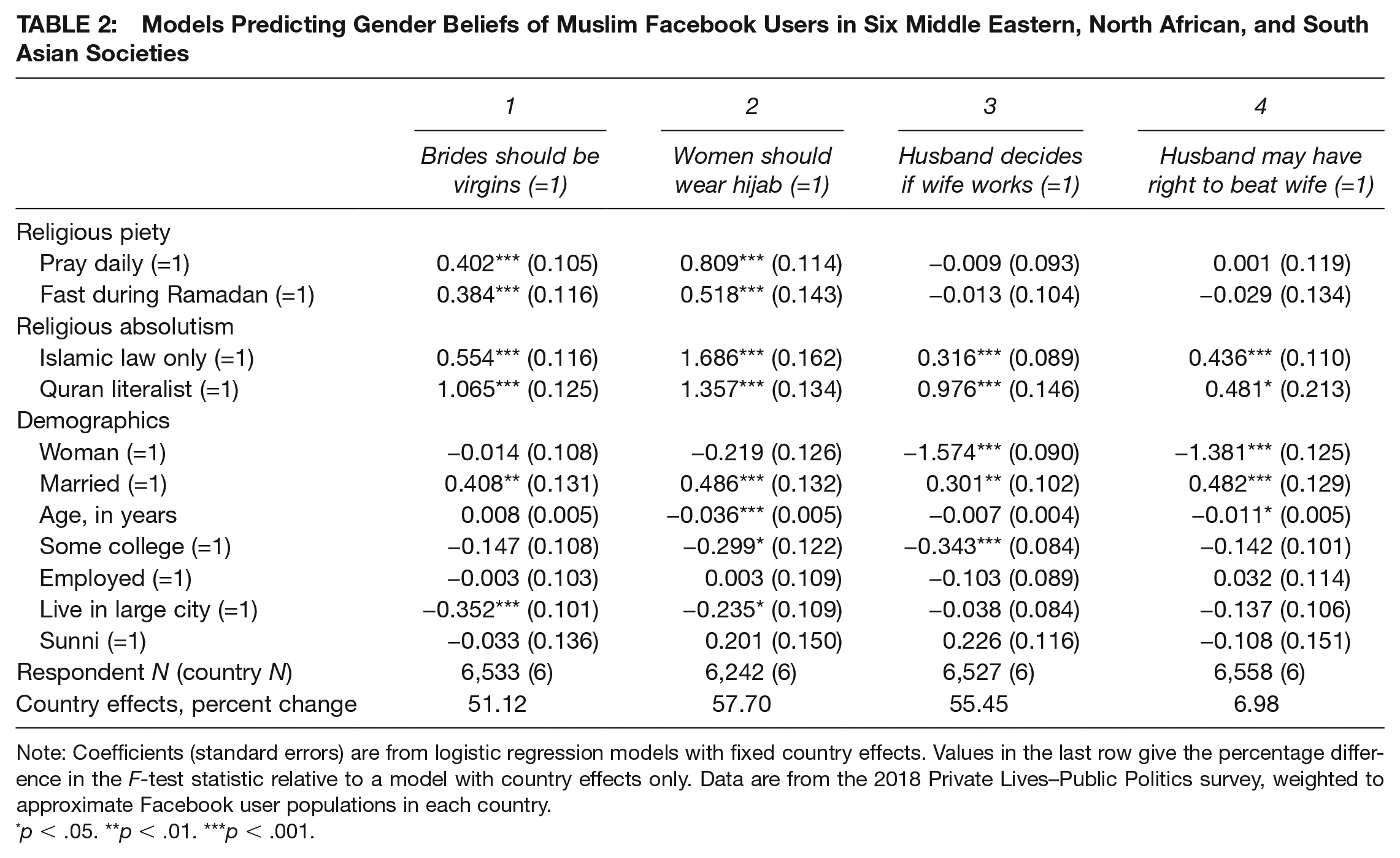
Note: Coefficients (standard errors) are from logistic regression models with fixed country effects. Values in the last row give the percentage difference in the F-test statistic relative to a model with country effects only. Data are from the 2018 Private Lives–Public Politics survey, weighted to approximate Facebook user populations in each country.
p < .05. **p < .01. ***p < .001.
Concerning our second set of research questions, on religious effects, the first four coefficients in each column of Table 2 reveal distinct effects of piety and absolutism. Specifically, they show that religious piety is unrelated to marital patriarchy beliefs but positively associated with support for women’s chastity. Respondents who express absolutist religious beliefs, by contrast, report significantly more support for both forms of gender conservatism. Quran literalists, for example, show nearly quadruple the odds of agreement on the hijab item (exp(1.357) = 3.885) and about 60 percent higher odds of agreement on the wife-beating item (exp(0.481) = 1.618).
In supplementary analyses, we computed models separately by country. Although these models have much less statistical power, they show the same general pattern of religious effects (Online Appendix). 15 One partial exception is Pakistan, where religious piety is unrelated to support for chastity norms. This difference requires further investigation, but given the high levels of religious absolutism reported by Pakistani respondents (Online Appendix, Table A3), it is possible that they understand chastity and the hijab as requirements of a national Muslim identity (Ansari 2009; Haqqani 2005). Pakistani nationalism is quite new, is centered around Islam, and is understood in contrast to the Indian Hindu majority from which Pakistan separated in 1947, with its very different gender performances. The causal logics of wife-beating attitudes also vary across countries, 16 perhaps because understandings of gender violence are influenced less by individual religious beliefs than by broader cultural environments, which differ by country. This would explain the small share of cross-societal variability explained by model 4 in Table 2.
Turning to the third research question, we find that effects of gender status also differ across the two attitudinal dimensions. Whereas women and men show similar overall propensities to support women’s chastity, we find a large gender gap in support for marital patriarchy. Men are nearly five times more likely than women to report that they favor husbands’ authority over their wives’ employment (exp(1.574 = 4.826), for example. It is possible that some women who reject male dominance in marriage may understand modesty as a source of empowerment and protection against sexual harassment and dishonor (MacLeod 1990; Zuhur 1992). Men, by contrast, may see chastity and marital patriarchy as part of an integral package that puts women under men’s control. In any case, the results suggest a clear gender divide when it comes to husbands’ authority in marriage, but not women’s chastity.
Single-country models also show a consistent tendency for women to be more opposed than men to marital patriarchy, while gender effects on chastity beliefs are more mixed across the six countries (Online Appendix). 17 This supports the argument that the gendering of chastity beliefs is more socioculturally contingent than the gendering of marital patriarchy beliefs.
Effects of education, urban residence, and marital status are similar to what has been observed in other contexts, with college attendees and big city residents expressing more liberal views and married people expressing more conservative views (Bolzendahl and Myers 2004; Charles 2020; Chatillon, Charles, and Bradley 2018). 18
Unlike in the West, we see no tendency for younger people to be more gender liberal; older respondents in fact express more liberal views on two of the four items (hijab and wife beating). It is possible that age and gender conservatism are positively related in the general population, which skews older than the Facebook users considered here. Formal employment shows no significant effects, and attitudes of Sunnis do not differ from those of other Muslims.
Some interesting differences are observed in supplementary models run separately by gender (Online Appendix, “Logistic Regression Models Predicting Muslim Gender Beliefs, by Gender”). Most notably, they show a stronger association between religious absolutism and marital patriarchy beliefs among men than women. In other words, among those who believe in strict adherence to Islamic doctrine, women are less likely than men to believe that this doctrine supports patriarchal practices (Afary and Friedland 2018). Religiously absolutist women are not, however, less likely than their male counterparts to support chastity norms. Marriage has a similar gender-specific effect on patriarchy (but not chastity) beliefs. A possible interpretation is that married women bear the negative consequences of uneven power relations, but may still appreciate the practical social imperative of women’s modesty.
Overall, regression results suggest that different sociocultural forces underlie attitudes toward women’s chastity and marital patriarchy and that religious absolutism may manifest differently among women and men. While gender and religious beliefs are consistent predictors of support for marital patriarchy, the factors influencing views about women’s chastity appear to be more uneven and socioculturally contingent.
Configurations of MENASA Gender Beliefs
We turn next to our fourth set of research questions, on how these attitudinal tenets relate to one another. Here, we ask whether positions on the four survey items cluster together in specific ways, beyond a simple tendency for people to give either gender-traditional or gender-liberal responses. Can we identify attitudinal classes (or “gender cultures”) composed of people with similar response patterns? And if so, do the women’s chastity and marital patriarchy dimensions emerge out of this clustering? Latent class analysis lets us address these questions inductively.
The first step is to determine how many distinct attitudinal groups (i.e., classes) are evident in the survey responses. Panel A of Table 3 shows goodness-of-fit statistics from a series of models that distinguish between one and four classes. Based on model fit and parsimony (measured by both Bayesian information criterion [BIC] and Akaike information criterion [AIC]), we find that a three-class solution fits the data best. This solution has the additional advantage of being substantively meaningful. As described below, the three classes are readily interpretable relative to the existing literature and our regression results.
Fit Statistics for Latent Class Models of Gender Beliefs in Six MENASA Countries, 2018
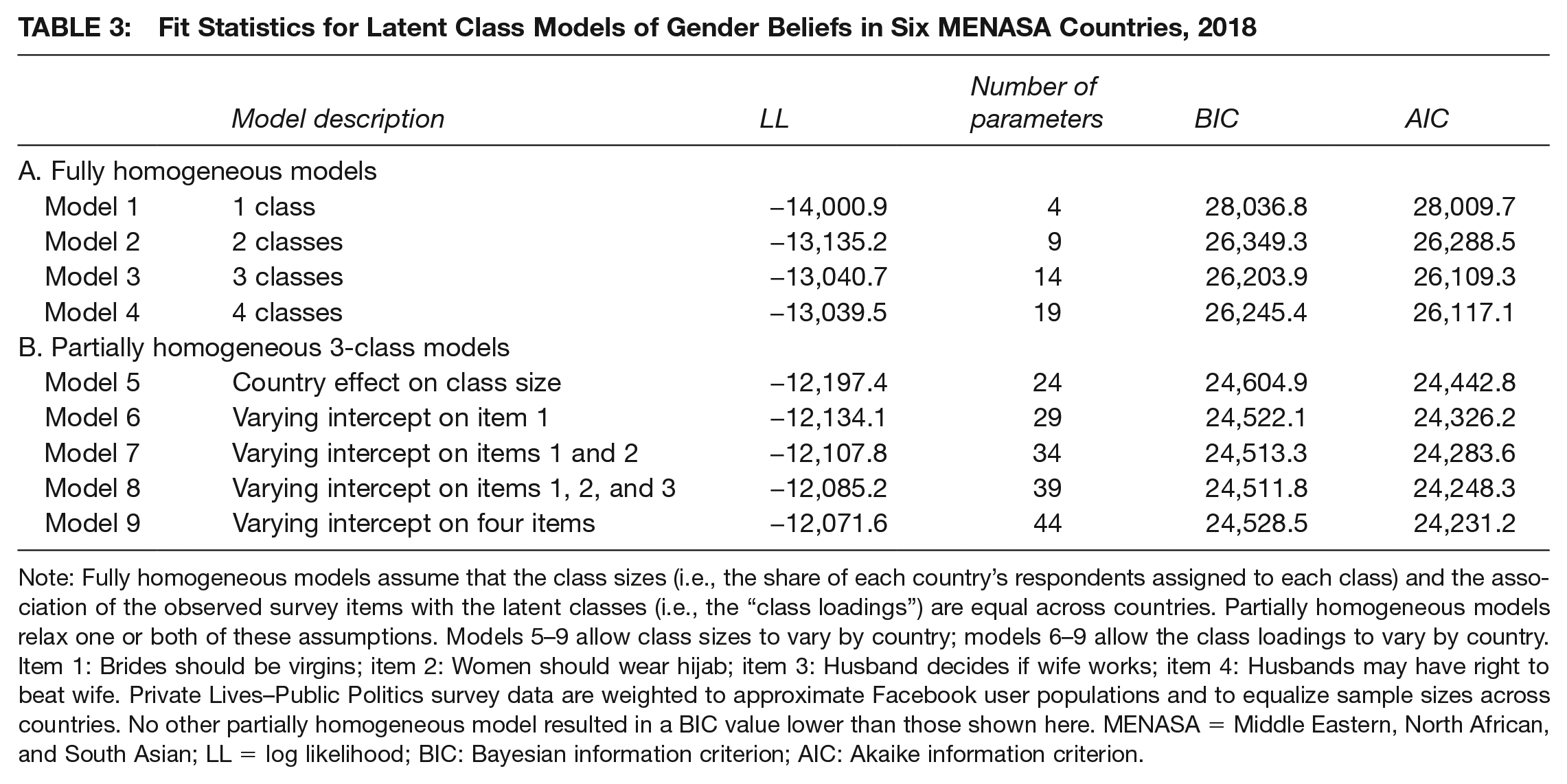
Note: Fully homogeneous models assume that the class sizes (i.e., the share of each country’s respondents assigned to each class) and the association of the observed survey items with the latent classes (i.e., the “class loadings”) are equal across countries. Partially homogeneous models relax one or both of these assumptions. Models 5–9 allow class sizes to vary by country; models 6–9 allow the class loadings to vary by country. Item 1: Brides should be virgins; item 2: Women should wear hijab; item 3: Husband decides if wife works; item 4: Husbands may have right to beat wife. Private Lives–Public Politics survey data are weighted to approximate Facebook user populations and to equalize sample sizes across countries. No other partially homogeneous model resulted in a BIC value lower than those shown here. MENASA = Middle Eastern, North African, and South Asian; LL = log likelihood; BIC: Bayesian information criterion; AIC: Akaike information criterion.
The baseline model assumes that the sizes of the groups (i.e., sample shares allocated to each class) are equal across the six countries, as are the associations of each survey item with each class (i.e., the class loadings). We relax these assumptions sequentially in panel B, choosing as optimal a “partially homogeneous” three-class model that allows countries to vary in the relative sizes of the three classes, and in the class loadings of the chastity, but not the marital patriarchy items (model 7). This means that the relative sizes of the three classes differ by country and that responses to the chastity items are more important determinants of class assignment in some countries than in others. Similar three-class solutions emerged in supplementary analyses that applied different sample weights (Online Appendix, “Sensitivity Tests for Latent Class Models of Gender Beliefs in Six MENASA Countries, 2018”). 19
The three attitudinal profiles are represented in Figure 2, where the four original survey items are arranged along the horizontal axis and the vertical axis gives the probability that class members express support for each item. Two distinct dimensions are again evident in the sense that each of the three classes represents a different combination of beliefs about women’s chastity and beliefs about marital patriarchy. The top line represents a class whose members report relatively high support for both; the bottom line represents persons who express low support for both; and the middle line represents high support for women’s chastity but low support for marital patriarchy. For heuristic purposes, we label those who express high support for both as traditionals, those who express low support for both as reformists, and those who show high support for women’s chastity but low support for marital patriarchy as chastity advocates.
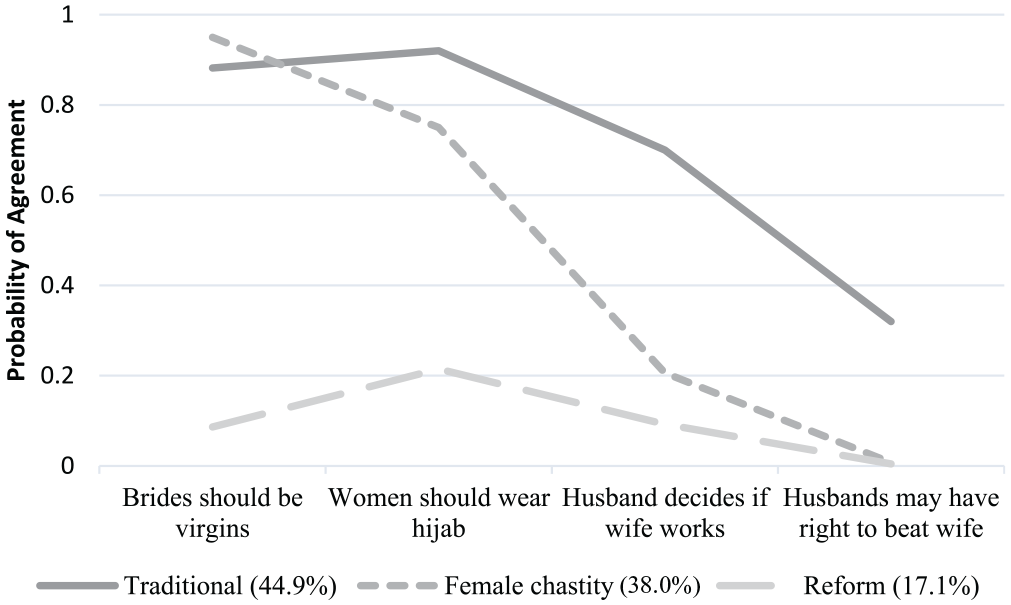
Ideological Profiles Identified Through Latent Class Analysis
Across the six countries, 45 percent of Muslim Facebook users report gender-conservative (traditional) views with respect to both women’s chastity and marital patriarchy. Another large group, the chastity class (38 percent), endorses chastity but not marital patriarchy. Members of the smallest group (17 percent), the reformists, reject both principles. We find no group whose members support marital patriarchy but not women’s chastity. A strong majority (about two-thirds) of even traditional class members report disapproval of wife beating, suggesting again that violence against women is viewed as much less legitimate than other forms of patriarchal power.
Figure 3 shows that the relative distribution of these three gender cultures varies a great deal across the six societies. Gender reformists are the largest group in Turkey, which is the only country where chastity norms are questioned by a clear majority. In Tunisia and among Palestinians, the chastity group is largest, reflecting widespread endorsement of women’s modesty norms but not marital patriarchy. In Pakistan, Egypt, and Algeria, the traditional group is largest, meaning that a majority of respondents report conservative views on both dimensions.
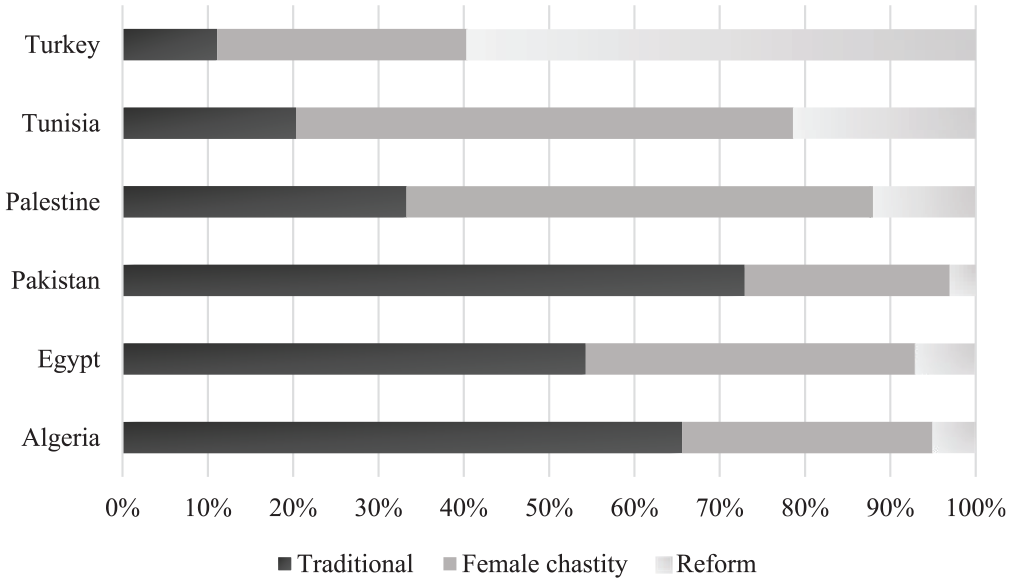
Distribution of Ideological Profiles Across Countries
These attitudinal differences are consonant with some aspects of these societies’ historical legacies and postcolonial experiences. In Turkey, the current conservative backlash under Erdoğan was preceded by a history of significant gender reform and public-sphere secularization. Ottoman women published women’s rights journals in the late nineteenth century and gained access to higher education as early as 1914. In modern Turkey, polygamy was banned and the franchise was secured in 1926, and women gained the right to work without their husband’s permission in 1990. Turkey’s 1980 military coup was followed by a state modernization project that included forced secularism and (increasingly contentious) bans on the hijab in public institutions (Ertürk 2006). In Tunisia, lesser support for marital patriarchy follows a long struggle for women’s rights, resulting in the abolition of polygamy in 1956, women’s right to divorce in 1956, and women’s suffrage in 1957 (Chekir 1996; Tripp 2019; Zayani 2015). The penetration of gender-liberal attitudes elsewhere may have been limited by strong kin-based patriarchal networks, and by the symbolic association of gender reforms with colonial rule or with the cultural norms and practices in Israel, where about 20 percent of our Palestinian respondents live (S. Ahmed 2020; Bennoune 1995; Charrad 2001; Goudarzi-Gereke 2018).
In a final analytical step, we ask how well membership in the three attitudinal classes is predicted by respondents’ personal traits, in particular by their gender status and religious beliefs. This question is addressed by analyzing the odds of membership in each gender-culture group relative to each other group (Bakk, Tekle, and Vermunt 2013). Table A4 of the Online Appendix shows regression coefficients for contrasts between different groups: traditional versus reformist in column 1, chastity versus reformists in column 2, and traditional versus chastity in column 3. 20 The religious and gender effects in these models validate our interpretation of the three latent classes as representing different combinations of beliefs about women’s chastity and beliefs about marital patriarchy. As in Table 2, religious piety and religious absolutism show distinct effects on the two attitudinal dimensions. Respondents who hold absolutist beliefs are significantly more likely to belong to the more conservative group in each of the three contrasts. But religious piety has less power to predict views about marital patriarchy, as is evident in the contrast between the traditional and chastity group members (Online Appendix, Table A4, column 3). Group membership is also influenced by gender. Although women are much less likely than men to belong to the gender-traditional group (which includes support for marital patriarchy), they do not differ from men in their odds of membership in the chastity group, relative to the reform group (column 2). The consonance between our latent class and regression analyses suggests that the same factors driving variation in beliefs of individual respondents also help sort people into cultural groups defined by different combinations of those beliefs.
While these results do suggest a sort of gender-attitudinal continuum—with chastity advocates located in between gender traditionals and gender egalitarians (“reformists”)—it is not a unidimensional continuum where attitudinal indicators move together up or down the scale (e.g., with low, medium, or high levels across indicators) in response to the same sets of demographic and cultural drivers. The “in between” group identified here is characterized by a qualitatively distinct configuration of attitudes produced through qualitatively distinct sociocultural mechanisms. These distinctions would be obscured if we focused strictly on the “amount” of gender egalitarianism.
Discussion
Gender beliefs in MENASA societies have not received the analytical attention they deserve, and we still know too little about attitudinal patterns in these societies. Most of what we do know is based on survey questions developed to study gender relations in Europe and North America. This study provides new insights into beliefs pertaining to women’s chastity and marital patriarchy, two central yet understudied components of MENASA gender culture. Results suggest that very different social logics underlie these two gender principles, with marital patriarchy beliefs strongly predicted by respondents’ gender status and religious beliefs, and chastity beliefs shaped by processes that are more uneven and contextually contingent.
Our analysis is motivated by two recent critiques of conventional wisdom. The first challenges unidimensional understandings of gender ideology (Charles and Bradley 2009; Knight and Brinton 2017; Scarborough, Sin, and Risman 2019) and the second challenges homogenizing depictions of Middle Eastern patriarchy (Abu-Lughod 2015; Alimahomed-Wilson 2020; Charrad 2011; Cooke 2008; van Es 2019). We address these critiques by attending to two forms of complexity: heterogeneity in the processes producing different gender beliefs (including the role of religious beliefs and gender status) and heterogeneity of gender beliefs within and across Muslim-majority populations.
Findings complicate common understandings of gender ideology as a unidimensional continuum. Multidimensionality is evident in regression results that show distinct processes driving beliefs about women’s chastity and marital patriarchy, and in a latent class analysis that shows a large group of men and women who support the former principle while rejecting the latter. Muslim religion, we also find, does not affect gender attitudes in uniform fashion. Piety is associated with support for women’s chastity but not for patriarchal control within marriage; absolutism is associated with stronger agreement with both principles. Gender effects also vary. Although women are much less likely than men to approve of marital patriarchy, we find no overall gender gap in chastity beliefs—in part because gender differences vary across national contexts.
The attitudinal profiles of these Muslim Facebook users are also difficult to reconcile with depictions of a monolithic Islamic patriarchy. Different mixtures of three distinct gender cultures are represented in each of the six countries considered. “Gender-reformists,” who question both marital patriarchy and chastity norms, make up the largest group in Turkey; gender-traditionalists, who endorse both principles, are the largest group in Algeria, Egypt, and Pakistan; the chastity group, which rejects marital patriarchy, is the largest in Tunisia and among Palestinians. The multidimensionality we find in these gender beliefs corresponds to the complex patterns of gender inequality that have been documented in public- and private-sphere institutions worldwide, including in the MENASA region (Table 1; Badran 2009; Charles 2000; Charles and Grusky 2004; Charrad 2001; Pettit and Hook 2009; Tripp 2019).
Conclusion
Future research might examine how attitudes about women’s chastity and marital patriarchy vary across and within Western societies. State laws giving men control over married women’s employment, finances, or reproduction have been on the books until relatively recently in some North American and European countries, and debates about husbands’ rights in abortion decisions are intensifying in some American states. Because attitudes toward private-sphere patriarchy are not interrogated in major international surveys, we know little about their distribution in the West.
Women’s chastity and marital patriarchy are but a partial list of regionally salient gender principles. Recent survey analyses have explored attitudes about family divisions of labor and women’s public-sphere participation in the Middle East and North Africa (Glas et al. 2019; Glas, Spierings, and Scheepers 2018; Price 2015), but other tenets of gender ideology remain unexamined. Beliefs about women’s and men’s occupationally relevant traits (e.g., analytical skills, communal vs. agentic orientation) could be a fruitful area for future study, given recent evidence that engineering-, computing-, and other mathematics-intensive fields tend to be more gender integrated in Muslim-majority contexts than elsewhere (Blank et al. 2022; Dajani, Dhawan, and Awad 2020; Moshfeghyeganeh and Hazari 2021).
Detailed case studies and comparison across a larger number of MENASA societies could also help illuminate the processes by which complex gender belief structures emerge, how they relate to sociopolitical contexts, and how they vary beyond the Muslim Facebook user population studied here. The existing literature identifies some macro-level influences for further study, including national, legal, and constitutional histories, colonial legacies, patterns of social activism, transnational legitimacy demands, kin-based network structures, and efforts by autocratic regimes to sideline religious extremists (Charrad 2001; Meyer 2010; Tripp 2019; Zayani 2015).
Social media networks such as Facebook are powerful tools for collection of culturally sensitive data, and the sociocultural influence of this electronically connected population should not be underestimated. Social media users, young people, and university students are important drivers of gender beliefs and popular culture in the Middle East and Africa (Charles 2020; Darhour and Dahlerup 2020; Zayani 2015), and the subjects of this study will likely play an outsize role in shaping regional gender beliefs and intimate practices in the coming years. Although attitudes do not always align with actions, espousal of gender-egalitarian ideals (even if insincere) can provide ideological leverage by legitimating rights claims and positioning local activists to promote nondiscriminatory standards of behavior (Moghadam 2013; Pierotti 2013; Snyder 2006).
In all six MENASA societies studied here, support for women’s chastity practices is much more broad-based than support for marital patriarchy. This pattern calls to mind the “different but equal” gender regimes found in the West, where inequalities attributed to innate gender differences (e.g., in dispositions and interests) encounter less resistance than those grounded in principles of male primacy (Charles and Bradley 2009; Levanon and Grusky 2016). While women’s acceptance of bridal virginity and head covering norms may depend on the local meanings and histories of these practices, women across the six surveyed countries report greater opposition than men to an explicit marital hierarchy that places them at the bottom. Western media, politicians, and public intellectuals frequently represent Islamic modesty dress, including the hijab, as evidence of women’s oppression and even their need to be liberated through foreign intervention. But less attention has been paid to private manifestations of patriarchal power, such as uneven decision-making power within marriage. Our findings suggest that it is the latter forms of gendered oppression that Muslim women most oppose and that are more likely to generate successful movements for change.
Supplemental Material
sj-docx-1-gas-10.1177_08912432221137909 – Supplemental material for Complicating Patriarchy: Gender Beliefs of Muslim Facebook Users in the Middle East, North Africa, and South Asia
Supplemental material, sj-docx-1-gas-10.1177_08912432221137909 for Complicating Patriarchy: Gender Beliefs of Muslim Facebook Users in the Middle East, North Africa, and South Asia by Maria Charles, Roger Friedland, Janet Afary and Rujun Yang in Gender & Society
Footnotes
Authors’ note:
We thank Jahan Ahmed, Sarp Kurgan, Eric Massie, Mesadet Sozmen, and Leila Zanouzi for country studies, Paolo Gardinali for support with online surveys, Maximilian Stiefel for assistance with data management and Facebook sample weighting, and anonymous Gender & Society reviewers for excellent comments and suggestions. Funding was provided by the Carsey-Wolf Center, the Collaborative Research Initiative Grant Program, and Mellichamp Chair funds at the University of California – Santa Barbara.

Supplemental Material
Supplemental material for this article is available online.
Notes
Maria Charles is professor of sociology at the University of California – Santa Barbara, where she is also the Area Director for Sex and Gender Research at the Broom Demography Center, and faculty affiliate of the Feminist Studies Department. Her research explores how gender-related beliefs, inequalities, and processes vary across national societies and demographic groups.
Roger Friedland is emeritus professor of religious studies and sociology at the University of California – Santa Barbara. His research explores the relation between gender, sexual practices, Islamic piety, and Islamism in Muslim-majority countries and to various forms of religiosity among university students in the United States. He also seeks to develop an institutional logics approach which draws on a nontheistic religious understanding of the nonphenomenal grounding of institutional practice.
Janet Afary holds the Mellichamp Chair in Global Religion & Modernity at the University of California – Santa Barbara, where she is a professor of religious studies and Director of the Iranian Studies Initiative. Her research explores courtship, sex and marriage in the Muslim world, and history and politics of gender and sexuality in the Middle East.
Rujun Yang is a PhD candidate in sociology and a graduate associate at the Broom Demography Center at the University of California – Santa Barbara. Her research explores varied aspects of gender beliefs, their causes, consequences, and variabilities within China and across societies.
References
Supplementary Material
Please find the following supplemental material available below.
For Open Access articles published under a Creative Commons License, all supplemental material carries the same license as the article it is associated with.
For non-Open Access articles published, all supplemental material carries a non-exclusive license, and permission requests for re-use of supplemental material or any part of supplemental material shall be sent directly to the copyright owner as specified in the copyright notice associated with the article.
