



Abstract
Invisible work is neither defined nor recognized as labor and is not compensated as such. Studies show that manifestations of invisible work at home flow into the marketplace. What is lacking is systematic conceptualization and measurement of invisible work in the labor market built upon women’s and men’s knowledge and experiences. In this study, I address this lacuna using mixed-method sequential analysis. Twelve group interviews of employed women and men of varied socioeconomic locations in Israel yielded diverse expressions of invisible practices in the workplace and their gendered meanings. Based on that knowledge, a typology of invisible work types was deduced, and an instrument was developed and distributed through a survey to a representative sample of the Israeli labor force (n = 964). Regression analyses revealed that women and other disadvantaged groups do more invisible work at work than men and more advantaged groups do, regardless of occupation and managerial position. Beyond that, there are varied relations between labor market position and performing invisible work, across different types of practices. The study develops a typology of invisible work as a heuristic device contributing to office housework theory. I argue that invisible work should be conceived as an integral part of the labor market that needs to be considered when studying gender inequality.
Keywords
In this study, I examine invisible work—which is neither defined nor recognized as labor and is not compensated as such—in the workplace from a gendered perspective (Acker 1990). Most studies in OECD (Organisation for Economic Co-Operation and Development) countries have focused on invisible work in the household (for a review, see Hatton 2017; Kaplan, Sabbah-Karkabi, and Herzog 2020). This is usually conceptualized as not only unpaid domestic labor, such as housework and childcare, but also the more unrecognized cognitive and emotional work (e.g., Aassve, Fuochi, and Mencarini 2014; Bianchi et al. 2012; Daminger 2019; Sullivan, Gershuny, and Robinson 2018). The large body of research shows that, despite some change, women still do much of the unpaid household labor, and such invisible work can be considered a major mechanism perpetuating gender inequality in the labor market and in society in general (Fraser 2016).
Despite an emphasis on paid work in the labor market, recent studies have also revealed the unpaid practices people perform in the workplace and how these are related to gender inequality in the labor market (Baines, Cunningham, and Shields 2017). These studies, which revealed that women perform more unpaid work than men, usually focus on a specific occupation or labor market sector, such as academic organizations (Babcock et al. 2017; El-Alayli, Hansen-Brown, and Ceynar 2018; Guarino and Borden 2017), engineering (Williams et al. 2016), and social services (Baines and Armstrong 2019; Baines, Cunningham, and Shields 2017). More systematic empirical research on the gender gap in the performance of invisible work in the workplace is necessary. Moreover, existing studies examine varied facets of such invisible work, reflected in such diverse concepts as emotional labor (Guy and Newman 2004; Wharton 2009), “academic moms” (El-Alayli, Hansen-Brown, and Ceynar 2018), organizational citizenship behavior (Heilman and Chen 2005), and unpaid work (Baines, Cunningham, and Shields 2017). Finally, most studies on the gender gap in the labor market focus on formal indicators (e.g., wages, work hours, occupations). Yet systematic measurement of invisible work is needed.
Williams’s theory of office housework frames several types of practices in the labor market as part of the precarious balance women are expected to strike between masculinity and femininity (Williams and Dempsey 2014; Williams et al. 2016). My research seeks to build upon this theory by proposing a typology of invisible work based on women’s and men’s experiences, connecting it to skill devaluation and the involuntary nature of invisible work. In short, this study offers a comprehensive theoretical, methodological, and empirical look at invisible work in the labor market.
I employ a mixed-method sequential analysis (Stewart et al. 2008) to further three aims. The first is to reveal, through group interviews of women and men from diverse socioeconomic locations, the diverse practices of invisible work in the labor market—workplace practices that are not part of the job definition and are unpaid—as well as how the participants interpret this work and how it affects their standing in the labor market (rather than defining invisible work at the outset). The second aim is methodological: to build a measurement of invisible work at work, based on women’s and men’s experiences. To further this aim, I used insights gleaned from the qualitative data to develop a quantitative measure targeted at identifying multiple aspects of invisible work in the labor market and assessing their prevalence. My third aim was to analyze the quantitative survey data to uncover relations between performing invisible work at work and gender, as well as other socioeconomic (ethnicity and education), labor market, and family life characteristics.
Invisible Work at Work
The concept of invisible work was coined in the feminist literature to explain various types of (mostly women’s) unpaid labor, which are, therefore, culturally and economically devalued in the capitalist culture (Daniels 1987; Hatton 2017). Hatton (2017) suggests three intersecting sociological mechanisms through which work becomes invisible. The sociocultural mechanism renders labor invisible through ideologies of gender, race, class, and age; the sociolegal mechanism renders it invisible by removing it from legal definitions of “employment”; and the sociospatial mechanism renders it invisible by physically segregating it from the socially constructed “workplace.” Common to these mechanisms is that, by obscuring the fact that work is being performed, they contribute to its economic devaluation.
Although most research focuses on invisible work at home, studies show that various manifestations of it flow into the labor market. As early as 1977, Kanter pointed out gender inequality in the performance of unpaid work associated with gender expectations in the domestic sphere. For example, the (woman) secretary’s role could be defined as “office wife” as, beyond formal definitions, she also had an informal and unrewarded variety of tasks similar to household chores. Likewise, women in other organizational positions were expected to fill the unofficial role of the team “mother.” According to Kanter (1977), the status of women is a direct projection of the power structures and opportunities on which organizational systems are based.
Joan Acker (1990, 2006) proposed another conception of organizational systems, seeing them as gendered structures in the first place, because gender, as well as class and race, is an integral part of organizational processes. Thus, perceptions of work, wages, skills, and the relationship between work and family are defined while promoting masculine perceptions. The concept of “job” as paid employment outside the home affects how housework, care, volunteering, and emotions are perceived as “non-work” and perpetuates their social invisibility.
Along similar lines, Williams and Dempsey (2014) developed the theory of office housework to explain gender inequality in the labor market. They framed it as part of the “tightrope” bias in organizations, whereby women are expected to strike a delicate balance between masculinity and femininity. They are expected to be helpful but not ambitious and to perform a disproportionate amount of unpaid tasks, from literal housework (cleaning up after a meeting) to administrative work (taking notes at meetings) to emotional labor (Hochschild 1983), such as the expectation that the woman on the team serve as peacemaker (Williams et al. 2016).
Emotional labor describes the process by which workers are expected to manage their feelings in accordance with employer-defined rules and guidelines (Hochschild 1983; Wharton 2009; Wharton and Erickson 1993). A part of emotional labor is caregiving, which is understood as gendered expectations of women and men and an informal aspect of interpersonal relationships at work (Wharton 2009). Performing extra emotional labor at one’s job, work that is associated with women, often goes unnoticed and uncounted in work evaluations, affording superficial recognition more than financial reward (El-Alayli, Hansen-Brown, and Ceynar 2018; England et al. 1994; Guy and Newman 2004).
Empirical studies show that women, much more than men, are expected to do a variety of tasks considered office housework (Babcock et al. 2017; Baines, Cunningham, and Shields 2017; El-Alayli, Hansen-Brown, and Ceynar 2018; Williams and Dempsey 2014). For example, women engineers, regardless of their accomplishments and formal position in the organization, were found to perform more “office housewife” practices than men and to be expected to do so (Williams et al. 2016). Similarly, Guarino and Borden (2017) found that women faculty performed more service than male faculty in academia, shouldering a disproportionate part of the burden of “taking care of the academic family.” Although rarely studied, doing invisible work in the labor market is also related to race and ethnicity (Ispa-Landa and Thomas 2019; Nagar-Ron 2014). Thus, Williams and colleagues (2016) found that engineers of color were much more likely than white men to report being assigned office housework.
Although invisible work has been comprehensively examined in the household, studies involving the labor market usually focus, theoretically and empirically, on a single aspect of invisible work, such that systematic conceptualization and measurement are lacking. Office housework theory has blazed the trail by revealing various types of such invisible work, but it is essential to delve into the mechanisms through which women are pushed to perform it. To address this challenge, I adopt Hatton’s (2017) conceptualization, which stresses the sociological mechanisms through which work becomes economically devalued and thus invisible.
The Israeli Context
Israel provides a compelling case to examine the concept of invisible work in the labor market. The country is characterized by relatively high income inequality, among the highest in the OECD (Swirski, Konor-Atias, and Lieberman 2020). This intersects with gender and ethnic inequality, the most crucial being between Israeli-Jews and Israeli-Palestinians, the latter making up 20 percent of the population (Israel Central Bureau of Statistics [ICBS] 2019).
Women’s participation rates in the Israeli labor force (particularly full-time employment) have increased since the 1970s and are high relative to other OECD countries (Mandel and Birgier 2016; OECD 2020). Rates are higher among Israeli-Jewish women than Israeli-Palestinian women (66.1 percent and 29.8 percent, respectively), although they have increased for the latter in the last two decades (ICBS 2020). Nonetheless, Israel followed the U.S. trend in the 1990s of a “stalled gender revolution” (England 2010; Mandel and Birgier 2016), evidenced by a persistent gender wage gap of around 30 percent in favor of men (Dagan-Buzaglo and Hasson 2020). Since the 1990s, there has been no change in the division of household labor or in gender perceptions, and gender inequality in unpaid household labor is prominent (Kaplan et al. 2020; Mandel and Birgier 2016). This is partly related to familialism and pro-natalism in Israeli society, which has characterized most classes and ethnic groups in Israel (Berkovitch 1997; Hashiloni-Dolev 2018).
Given the persistence of gender inequality at home and the gender wage gap in the labor market, it is of great relevance to examine how women and men from diverse socioeconomic groups define and understand invisible work in the labor market. I begin by presenting the first (qualitative) part of the study.
Revealing Invisible Work at Work: Qualitative Analysis
Method
The first part of the study entailed group interviews aimed at revealing how women and men experience and understand invisible work in the labor market. The chosen model is based on a qualitative interpretive methodology meant to deepen understanding of women’s and men’s life experiences and the meanings they give to the social world. Because this approach emphasizes a commitment to multiple perspectives on the social world (Hesse-Biber 2010), the research team interviewed individuals from diverse groups. The diversity allowed us to extract a range of practices and perceptions that arise from participants’ experience.
Group Interviews
Group interviews are relatively small discussion groups in which the interaction between participants revolves around a specific question (Wilkinson 2004). The collective and interactive character of such groups fosters knowledge creation. Participants influence each other in the dynamics of the group discussion, in their very presence, and in their reference to one another (Barbour 2007). This method contributes to seeing the social world as constructed, emphasizing the collective element rather than individualist knowledge, and taking into account the structural gendered context (Montell 1999).
Efforts were made to minimize the problematics of the group interview method. For instance, participants might refrain from expressing opinions if the topic is too personal or when other group members are coworkers or managers. Similarly, certain participants might dominate the discussion and influence its character (Krueger and Casey 2009). The interviewers thus focused on creating a dynamic of openness that would allow participants to feel confident enough to express different opinions. This was done, for example, by stating up-front that any response is acceptable and that it is perfectly fine to disagree with other participants, because the aim is to learn from each person’s experience. Moreover, the interviewer invited each participant to share his or her opinion and attempted to create as inclusive an atmosphere as possible.
Participants
The study included nine groups of women (including one pilot group; n = 63 women) and three groups of men (n = 15 men; for details, see Online Appendix Table A1). The groups varied in terms of occupation and job sector (e.g., teaching, social work, high tech, administration, research, marketing), education (from high school to college), ethnicity (while most were Jewish, one group included Israeli-Palestinian women and another mixed Israeli-Jewish and Israeli-Palestinian women), age range (30–65 years), and place of residence (from the north to the south of Israel, including large, medium, and small localities).
The interviews were organized through contacts with women from nongovernmental organizations and social, feminist, and governmental organizations, through Facebook pages, and through human resource managers in organizations. All individuals who were interested and able to participate were included in the group. As is customary (Mack et al. 2005), each group comprised four to 10 participants. All names of participants are pseudonyms.
The Research Process
The research team held several meetings to formulate an outline for the group interviews. The interview guide was then tested for suitability in a pilot group of women. The final protocol involved asking participants to write down their associations with the words “work–family” and verbally describe these associations. A group discussion was then held, with a focus on practices of unpaid work at home and in the labor market and the effects of performing these practices on participants’ sense of self-worth and fairness. Only after the discussion yielded a description of these activities did we bring to the group’s attention the concept of “invisible work.” We then asked about the influence of invisible work on promotion in the labor market.
The interviews, conducted January 2017–May 2018, were held in town hall, at the workplace, or in community centers. Each lasted approximately 2 hours. Interviews in 11 groups (10 of Israeli-Jews and one of a mixed group of Israeli-Jews and Israeli-Palestinians) were conducted in Hebrew, moderated by a qualitative researcher, an Israeli-Jewish woman with experience facilitating groups. One interview of Israeli-Palestinians was conducted in Arabic and moderated by a qualitative researcher, an Israeli-Palestinian woman with experience facilitating groups. Another researcher was present, as well as a research assistant who recorded the sessions and took notes.
After completion of all interviews, Atlas software was used for data analysis, mapping the practices and their meanings arising from the field. The research team did the coding together after reading the interview transcripts. Using a flexible coding process (Deterding and Waters 2021), we discussed the relevance of the themes and agreed on initial classifications, moving back and forth from data to interpretation several times.
Methodological Limitations
Despite attempts to interview as many diverse groups as possible, the groups were skewed in terms of educational and occupational level; more knowledge is needed from women and men with low levels of education and low labor market positions. Moreover, the study included only three groups with men, most of whom were in professional occupations. Interviews of men in lower-class positions or minority groups might yield different patterns.
Findings: The Multiple Facets of Invisible Work in the Labor Market
The interviewees delineated a wide range of practices they perform in their workplace which are not part of their job definition and for which they receive no payment. These practices can be grouped into four types of invisible work: invisible team work, invisible physical care work, invisible emotional labor, and invisible administrative work (see Figure 1).
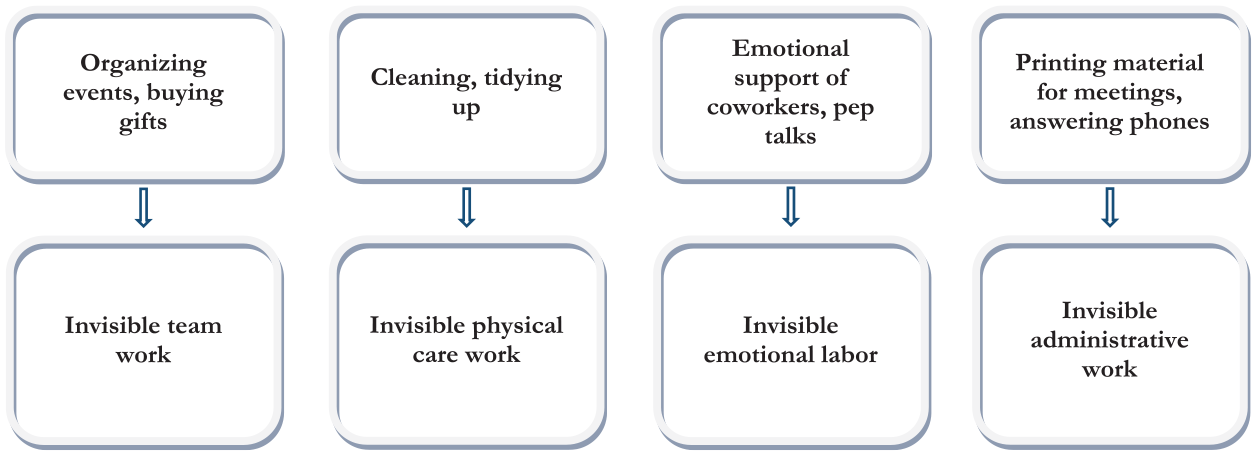
Types of Invisible Work Practices in the Workplace
Invisible Team Work
The first type of invisible work practices entails cultivating employee relations on the group level, maintaining a positive atmosphere, and organizing social events. Women interviewees, of varied occupations and all levels of the organizational hierarchy, reported cultivating the social life of their team or department without remuneration. They organized birthday celebrations for colleagues, bought gifts, and initiated social activities. Sara (48 years old, college educated, works in high tech) stated: We’re going to have a team lunch, I’m the only woman, and it turns out our manager has a birthday today . . . We all sit together for a weekly team lunch and no one thought that’s right, and he’s our manager and he’s such a big boss . . . I’m just in shock from the situation and I made sure we would have dessert, something . . . So this is a classic example.
Sylvie (59, college educated, public sector worker in professional managerial position) clearly elucidated upon the construction of such work as invisible actions women are expected to perform: Who collects the money for petty cash? . . . It’s always a woman. Is this by chance? Who goes to buy food or get birthday gifts at work? . . . It’s time consuming . . . it’s the kind of work that’s not in the job definition, there is no definition within the job of social responsibility for the team, for example . . . naturally we [speaking to the other women in the group] do it, but it never goes in the job definition that may also require special skills and also a reward. This is something that’s [considered] natural.
Sylvie describes how social responsibility for the team, which she believes requires specific skills, is assumed to be done by women because they do it “naturally.” Her narrative points to a sociocultural mechanism that devalues workers’ skills by naturalizing them (Hatton 2017).
In addition to interviewees who take on responsibility for the informal social life at the workplace, ostensibly voluntarily, other participants reported being explicitly asked to perform such tasks, even when not part of their job. Ruth (54, postsecondary education, purchasing manager at large organization) described an interaction with her senior manager: He said to me, “I heard you arranged a very beautiful wedding [for your son], I want you to do an event like the wedding [at work].” Now, it’s great because he tells you arranged a beautiful wedding, so it’s like he’s complimenting you, and you do organize the [work] event and it turns out to be beautiful and you get praised, and there are more and more events, all without payment.
Ruth relates how her boss expects her to organize a social event in the organization, because she does it so well (in her private life), even though this is not part of her job. This explicit request by her superior reveals not only the mechanism of devaluing women’s skills by naturalizing them, but also how Ruth is undervalued (“all without payment”) by being pushed to do such invisible work. Interestingly, when interviewed men were asked directly about the possibility of organizing social events at their workplace, they passed along responsibility to women. A representative response was made by Joel (35, graduate student, junior manager in large corporation): “For me, the responsibility is mine, but there is with me the HR [human resource] director, she’s doing this thing with me, it’s a task for her . . .”
These examples point to organizational expectations of women workers to take on tasks that cultivate relations and the climate in the workplace. Women are perceived as more suitable than men for these roles because of their “essential” characteristics as caring, motherly, and empathetic (Acker 1990). Moreover, some women interviewees found it difficult to say “no,” as Ruth explained: “You can’t refuse, you can’t even say you won’t [do it] or that you are currently in a busy period, because you’re expected to.”
Invisible Physical Care Work
A second type of revealed invisible work is a variety of practices that involve taking care of the organization’s physical environment. For example, women reported that they collect garbage at the end of the workday and transfer it to the main bin, wash dishes left in the sink, clean the lunch table, and order a regular supply of refreshments—all to create a pleasant physical environment in the workplace and not as part of their job definition.
Referring to invisible work in the household, Hatton (2017, 8) suggests that one mechanism through which such work is economically devalued (and hence is invisible) is its physical segregation from the socially constructed “workplace.” The interviews revealed that work becomes invisible in the labor market by blurring the boundaries between home and workplace, as being employed for pay lacks the social power to dissociate femininity from the private sphere. This is reflected in a group conversation between college-educated women holding professional jobs in the public sector, after Rinat (43, master’s degree) described collecting garbage and washing cups:
Can I ask? Inside you, doing such jobs. . ., [aren’t you] frustrated? Resentful? Doesn’t it upset you? . . .
Not at all, it’s like home.
There are, of course, cleaners here, etc.
Yes, well, I don’t start washing floors and dishes, but . . . it would be nice to come in. . . . So let’s say the cleaner was here until five in the evening, after that there was a support group and in the morning we come. Until the girl who helps us clean again . . . And all this, we live in this space so . . . it’s important, important to all of us.
While Miriam voices anger and frustration about doing such physical care work, Rinat does this because she treats the workplace as her home. The rationale for performing these practices at home and at work are the same—seeing them as important and her responsibility, thus her choice. However, other voices point to the gendered expectations exhibited in performing these practices. Calanit (52, master’s degree, teacher) stated, There’s kind of a feeling that, if you do invisible work at home, then at work we also do invisible work. I don’t think there’s a man who would agree to do a single thing without getting paid.
Along similar lines, women interviewees—including those holding professional or managerial positions—described how their bosses and colleagues expect them to make coffee and clean up. Haula (53, college educated, nurse) said, “sometimes they think we are the cleaners.” Her words reveal how this work is culturally and organizationally constructed as unskilled because such workers are purportedly doing what comes “naturally” (Hatton 2017). Tellingly, and contrary to emotional labor (see below), the interviewed men did not even mention this kind of physical care practice.
Invisible Emotional Labor
Another type of invisible work gleaned from the interviews entailed engagement in emotional labor practices: supporting, encouraging, and mentoring coworkers. This is distinct from invisible team work (attending to the social life of the workplace on the group level), because it refers mainly to caring for coworkers on an individual level. Elinor (58, lawyer, manager in the public sector) explained, I traveled abroad a lot for many years representing an investment fund . . . There, the Israelis I managed called me “Mom” even though some were older than me . . . I took care of all sorts of things. For example, if someone got sick, I made sure to call every morning, even though it wasn’t really my job, but I felt responsible. And more than I wanted to help, I wanted them to feel cared for.
The nickname “Mom” that Elinor earned inserts terms from the family domain into the organizational relationship, challenging the binary division of work and home. Indeed, these interviewees do not exclude emotions from the realm of labor relations. Instead, they identify with the empathetic and inclusive role embodied in the mother figure or caregiver within the organizational space (Baines and Armstrong 2019; Kanter 1977). Interestingly, the interviews show that emotional labor is done not only in care or service professions, where employees manage their emotions to comply with job requirements (Hatton 2017), but also in managerial and technical professional jobs, as is evident from Elinor’s words. Echoing Gilligan’s (1982) concept of ethics of care, Elinor (and other women interviewees) stressed the importance of taking responsibility for the “soft” emotional needs of coworkers—giving them advice, helping them with personal problems—because neglecting those needs would impair the daily functioning of the organization. They chose to do so even when this was time-consuming and not part of their formal job definition.
These findings regarding gendered emotional labor in the workplace are reinforced by the interviews of men. When managers in a large corporation, all with at least a college degree, were asked if they had pep talks with coworkers to support and encourage them, the following response was given: Adam (36, finance manager): Especially once you’re a manager, gradually you’re in charge of employees, so it’s only natural you become some kind of “pilgrimage center.” It happens, not explicitly, but it happens in the end. Interviewer: Would you call this example invisible work? [Answering together]: No, it’s part of the job.
Thus, the men interviewees framed such practices in terms of mentoring, responsibility, and commitment to the organization, and as part of their job. They saw them as visible practices.
Invisible Administrative Work
Finally, women interviewees pointed to administrative secretarial tasks they undertook that were not part of their job definition, such as preparing material for meetings, writing up meeting protocols, and other menial tasks such as answering phones and coordinating work meetings, For instance, Sammer (45, college educated, administrative position in local municipality) said she is required to perform various tasks not included in her official position: You do the work of the secretaries too. You also answer the phones, you schedule appointments, [you see] to refreshments, even flowers . . . When the manager comes, I sometimes make him [coffee].
In a discussion in another group of women, Abir (30, master’s degree, research coordinator in hospital) said, I work in research, okay? When a patient comes to our department, I have to register him so they can issue a prescription, and this prescription has to go to the pharmacy . . . It’s not my job to take the prescription to the pharmacy, but because I’m young, sweet and cute, I need to take this prescription and physically go to the pharmacy, even though it’s not required of the men. Even though I’m better than them [men].
Abir clearly recognizes gendered expectations to perform administrative practices which are not part of her job. This is despite her higher skills, thus devaluing her in relation to her male colleagues.
Gil (51, doctoral student, researcher at research institute) mentioned tasks like printing materials for the project he was involved in: But we still have control over the products, the products of labor . . . Now, if any unpleasant technical role comes up, you don’t need to do much, sometimes you just let it pass by and it will fall on some woman.
Gil’s words reveal similar gendered expectations in the organizational setup. He and his colleagues seem aware of the hidden norm that the “unpleasant technical” tasks he refers to—filing, coordinating between team members—is the role of women in the organization, regardless of their official job definition.
All the above statements suggest that the role of “office wife” (Kanter 1977), identified more than 40 years ago, remains relevant. These practices are organized around expectations that women provide administrative services to their colleagues regardless of their official position in the organization. While men produce, women are “naturally” being helpful. Moreover, women’s (sometimes better) skills are devalued by doing invisible work.
In sum, the experiences and perceptions of women and men that emerged from the group interviews revealed a variety of practices performed in the labor market that go unpaid and are not part of the official job definition. The data also point to the different gendered meanings of these practices. The interviews revealed how performing invisible work at work is related to the mechanism of devaluing women’s skills (Hatton 2017), as well as to informal organizational demands that women do these practices.
Estimating Invisible Work at Work: Quantitative Analysis
Method
Based on the group interviews, the research team formulated a quantitative measure of invisible work at work to assess the frequency of each type of invisible work and its relation to gender and other dimensions of inequality. Specifically, we designed a questionnaire that was administered to a representative sample of the Israeli labor force via a phone survey.
The Questionnaire
The research team built a table of indicators for each of the four types of invisible work that emerged in the interviews. After filling in the table with dozens of practices, activities, and expressions of invisible work gleaned from the interviews, we refined the themes and constructed questions to represent them. This procedure was repeated several times, with ongoing discussion between the researchers, until the pilot version of the questionnaire was complete.
After testing the questionnaire among 30 employed respondents (18 women and 12 men; ages 32–65 years) and adjusting as needed, it was used in a telephone survey conducted between May and October 2018. Israeli-Palestinians were surveyed in Arabic by individuals whose mother tongue is Arabic. The rest of the surveys were in Hebrew.
The Sample
The survey was conducted among a representative sample of those in the Israeli labor force ages 25 to 65. Participants were randomly selected from the country’s household database—a telephone database of the entire population (individuals), at a coverage level of more than 90 percent. In each sampled household, one person was asked the filter question: “Do you currently work for pay?” Israeli-Palestinian women were intentionally oversampled due to their low labor force participation. During the analysis, we adjusted calculations to reflect the relative weight of this group in the labor market population (as determined by the ICBS Social Survey 2016; ICBS 2016). The final sample included 964 participants, with a small majority of men (52.3 percent) and of college-educated participants (51.5 percent); with 85.1 percent Israeli-Jews and 14.9 percent Israeli-Palestinians; and with 34.0 percent parents of young children (to age 6 years) and 14.7 percent childless (for descriptive statistics, see Table 1).
Descriptive Statistics of the Quantitative Research Variables in the Sample, Israeli Labor Market Participants, 2018 (N = 964)
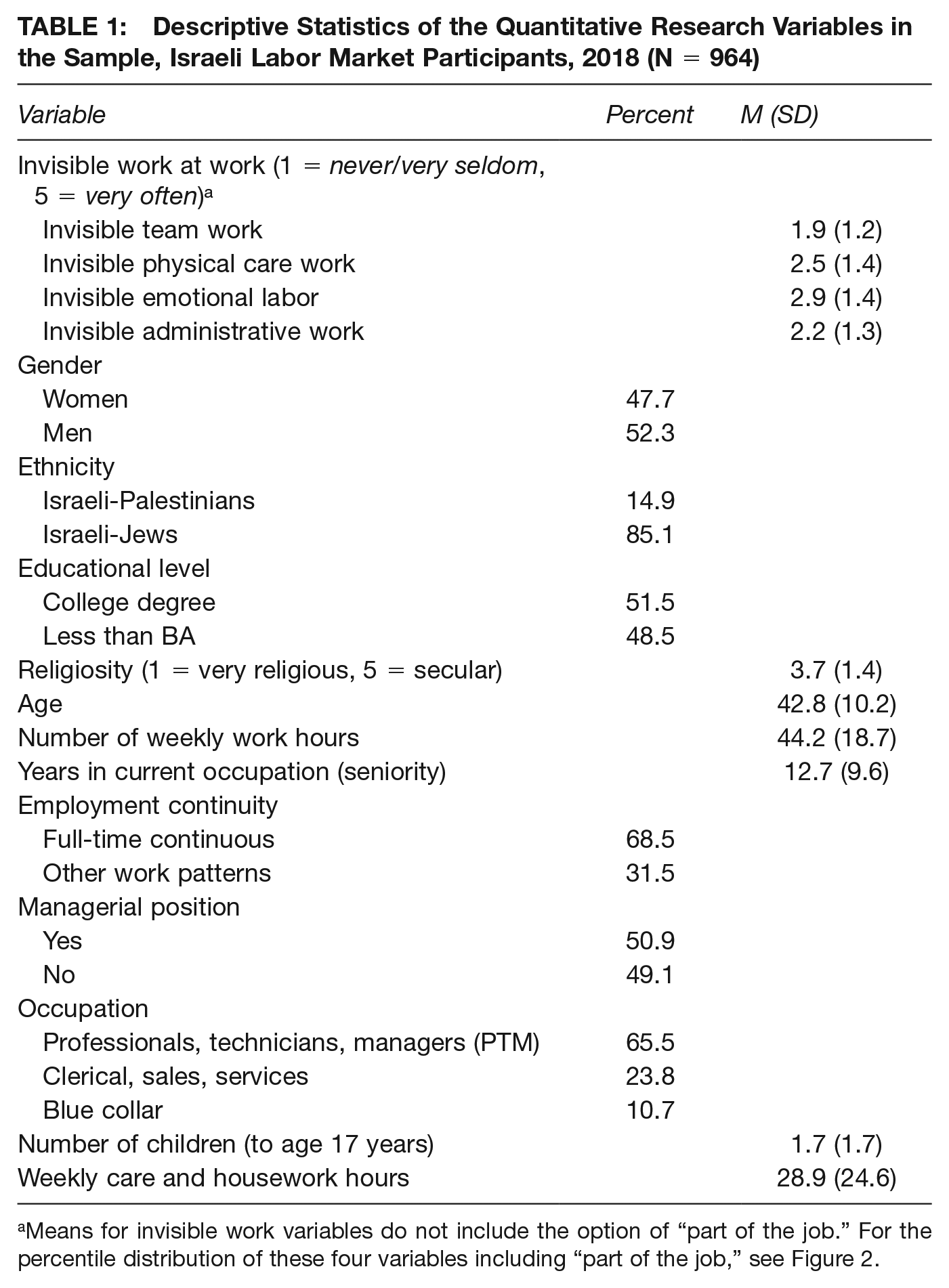
Means for invisible work variables do not include the option of “part of the job.” For the percentile distribution of these four variables including “part of the job,” see Figure 2.
Research Variables
Dependent variable
The dependent variable was invisible work at work, defined as practices outside the formal job definition performed in the workplace without pay. Based on the qualitative results of the interviews, we measured four types: invisible team work, invisible physical care work, invisible emotional labor, and invisible administrative work. To measure the level of performance of each type, we asked four close-ended questions using the following template: “We are asking about things people sometimes do at work, even though it’s not part of their job definition. During a normal work month, how often do you X even though it’s not part of your job definition,” where X = the following: (1) (team work) “help organize a social event for employees, collect money for a gift for someone at work, order refreshments, etc.”; (2) (physical care work) “clean or tidy up after a meeting or meal together at work”; (3) (emotional labor) “have a supportive or encouraging conversation with people at work”; and (4) (administrative work) “write up meeting notes, prepare material for a meeting, and organize all sorts of things at work.” 1 Possible responses fell along a 5-point scale: 1 = never or very seldom; 2 = seldom; 3 = occasionally; 4 = often; 5 = very often. During data analysis, we collapsed these into three categories: 1 = seldom/never (reference category); 2 = occasionally; 3 = often/very often; and added a fourth category (4 = part of the job). This last option was not explicitly mentioned during the survey; it was included in the data only when the respondent used this phrase to refer to practices perceived as part of their job.
Independent variables
We included three sets of independent variables based on the International Social Survey Program questionnaire (International Social Survey Programme 2016): socioeconomic, labor market, and family life characteristics.
Based on studies on inequality in Israeli society (Swirski, Konor-Atias, and Lieberman 2020), socioeconomic variables included gender (1 = women; 0 = men), ethnicity (Israeli-Jews = 0; Israeli-Palestinians = 1), education (college degree = 1; less than a BA = 0), religiosity (self-definition on a 5-point scale: 1 = very religious, ultra-Orthodox; 2 = religious; 3 = traditional–religious; 4 = traditional, not very religious; 5 = nonreligious, secular), and age (in years).
Based on studies of unpaid work and of gender inequality in the labor market (Mandel and Birgier 2016; Torre 2019; Yaish and Stier 2009), labor market variables included number of weekly paid work hours, including overtime; number of years in the current occupation (seniority) in all workplaces; employment continuity (continuous full-time work = 1; other work patterns = 0); and managerial position (yes = 1; no = 0). Current occupation was coded according to a uniform ICBS classification for 20112 and then divided into three categories (based on Yaish and Stier 2009): high white-collar occupations (reference category: professionals, technicians, managers; hereafter PTM), low white-collar occupations (clerks, office workers, salespeople, service workers), and all levels of blue-collar occupations (diverse manual positions in the labor market from the relatively high skilled to the low skilled), including specialists in agriculture, forestry, and fishing; industrial and construction workers; operators of facilities, machinery, and equipment; drivers; and unskilled workers.
Family life characteristics were the number of children ages 0 to 17 and the number of unpaid weekly hours dedicated to housework and care work at home.
Analytical Strategy
Descriptive statistics of each type of invisible work at work were calculated to examine prevalence. I used a chi-square test to check whether gender differences were statistically significant. I then ran a multivariate analysis to examine how socioeconomic, labor market, and family life characteristics are related to the level of performing invisible work at work. To include the category of “part of the job” (which has a different scale than other responses), I used a multinomial logistic regression model. For each type of practice, the model estimates the contribution of each independent variable to the log odds that someone performs the invisible work practices in their workplace at a certain level (occasionally, often/very often, part of the job) compared with seldom/never (reference category). To provide a meaningful understanding of results, I present the exponent coefficients, which denote the odds ratio for each coefficient (Long 1997). These regression analyses should be treated as descriptive regressions (Ginther and Pollak 2004) because they are not intended to evaluate causal relationships.
A sensitivity analysis, treating each dependent variable as a 5-point scale (and the “part of my job” category as missing) and using an OLS (ordinary least squares) regression model for each type of practice, yielded similar results (obtainable upon request). Because the category “part of the job” arose from the data, I present the findings from the multinomial regression model, which allows inclusion of this response in the multivariate analysis.
Findings
Invisible Work at Work: Descriptive Statistics
Figure 2 presents the distribution of the four types of invisible work by gender. Significant gender differences were found for invisible team work and invisible emotional labor. Both genders performed invisible team work practices somewhat, but women reported a greater monthly frequency: Thirty-five percent of the women performed it at least occasionally, compared with 28 percent of the men. Invisible emotional labor was the most common practice, with about a third of respondents reporting they engaged in it often/very often, although men reported performing this practice less than women did (resembling findings in the group interviews with men).
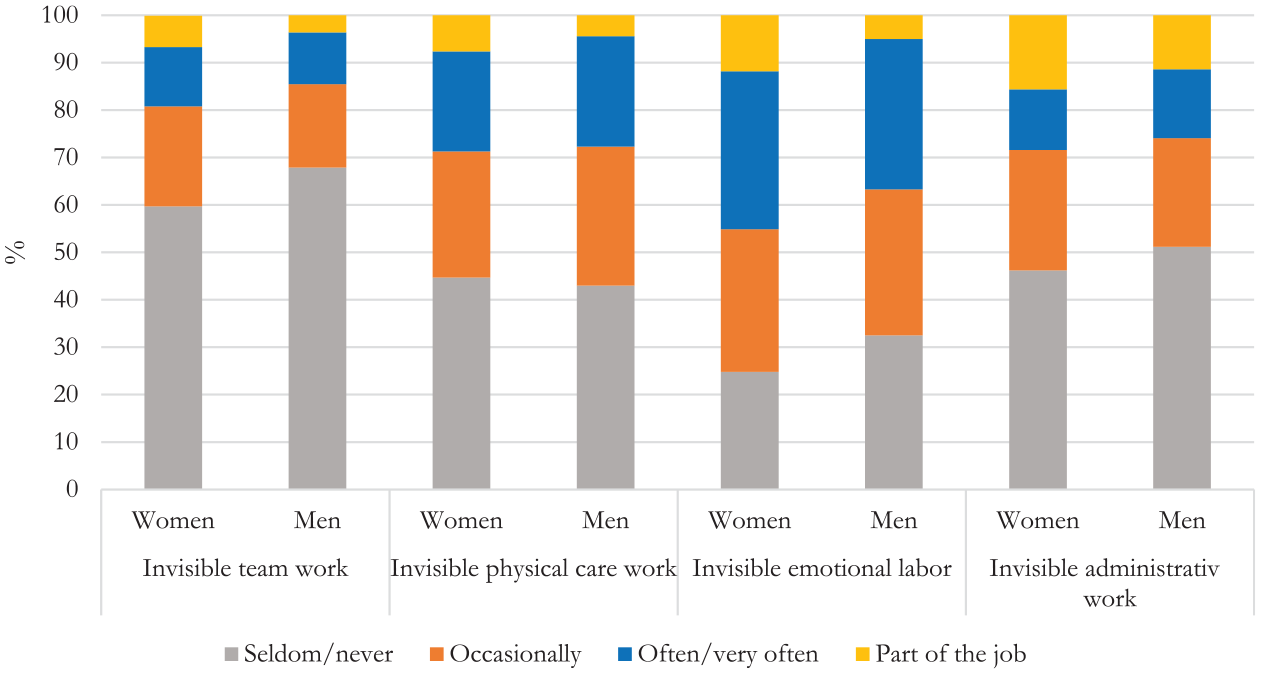
Frequency of Invisible Work Practices in the Workplace by Gender (Percent)
Gender differences were not found for the other two types of invisible work in the workplace. Approximately, 22 percent of participants stated they perform physical care work often/very often, while another 27 percent of the women and 29 percent of the men did it occasionally. Last, approximately 14 percent of participants indicated they perform invisible administrative work often/very often, and about 13 percent saw this as part of their job. Interestingly, women saw practices of team work and especially emotional labor as part of their job definition more than men did (12 vs. 5 percent, respectively, for the latter).
Invisible Work at Work: A Multivariate Analysis
I used a multivariate framework to examine relationships between socioeconomic, labor market, and family life characteristics, on one hand, and the frequency of doing invisible work at work, on the other hand. I estimated a multinomial regression model to explain the probability of performing each type of invisible work at different levels versus the probability of performing it seldom or never (Table 2). Figure 3 summarizes the socioeconomic, labor market, and family life characteristics that were found to increase performance of each type of invisible work (for full models, see Online Appendix Tables A2–A5).
Estimates of Multinomial Logistic Regression Models for Performing Invisible Work in the Workplace
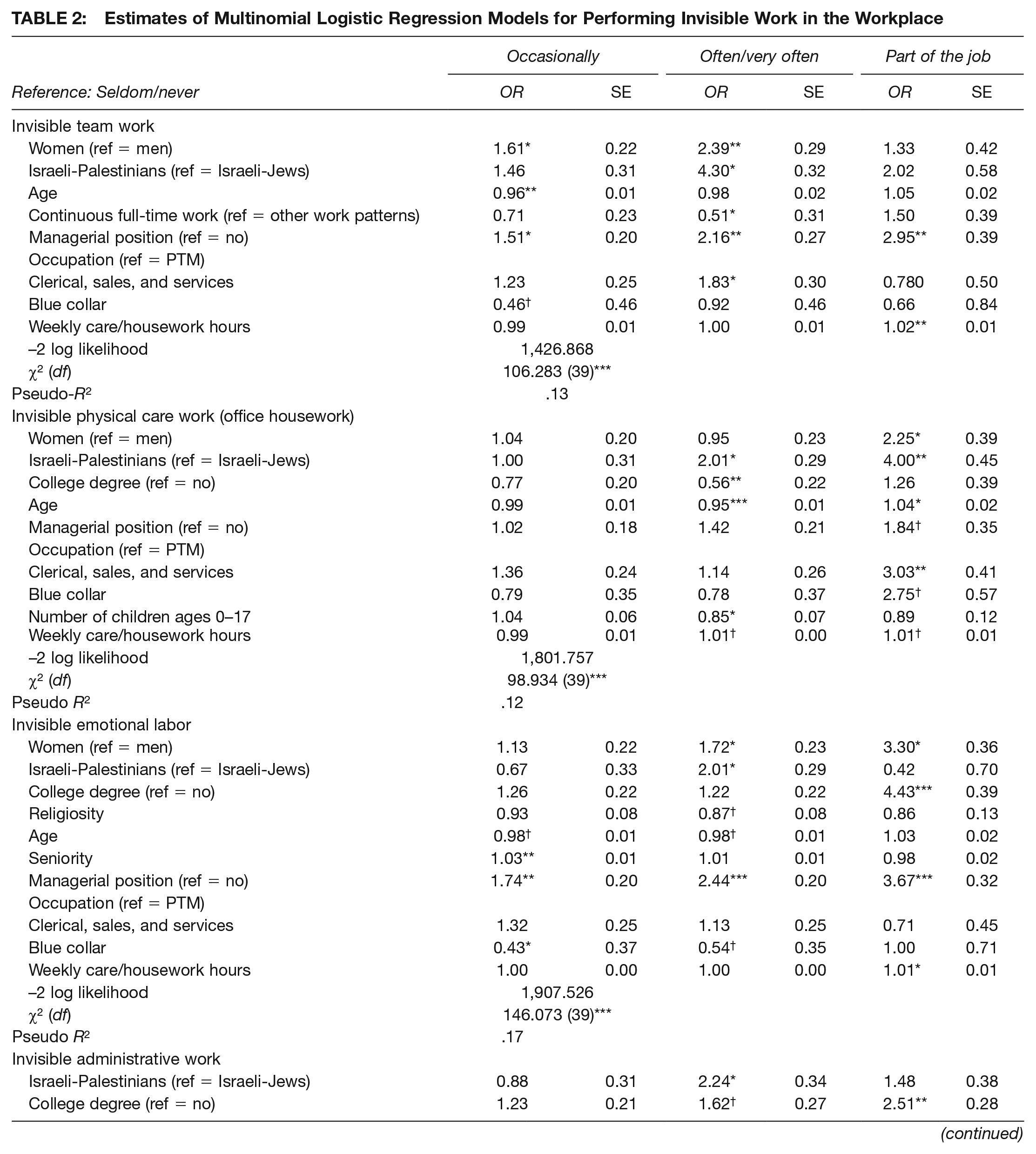
Note: Only variables with at least one statistically significant coefficient are presented. For full models, see Online Appendix Tables A2 to A5. OR = odds ratio; ref = reference; PTM = professionals, technicians, managers; df = degrees of freedom.
p < .10. *p < .05. **p < .01. ***p < .001.
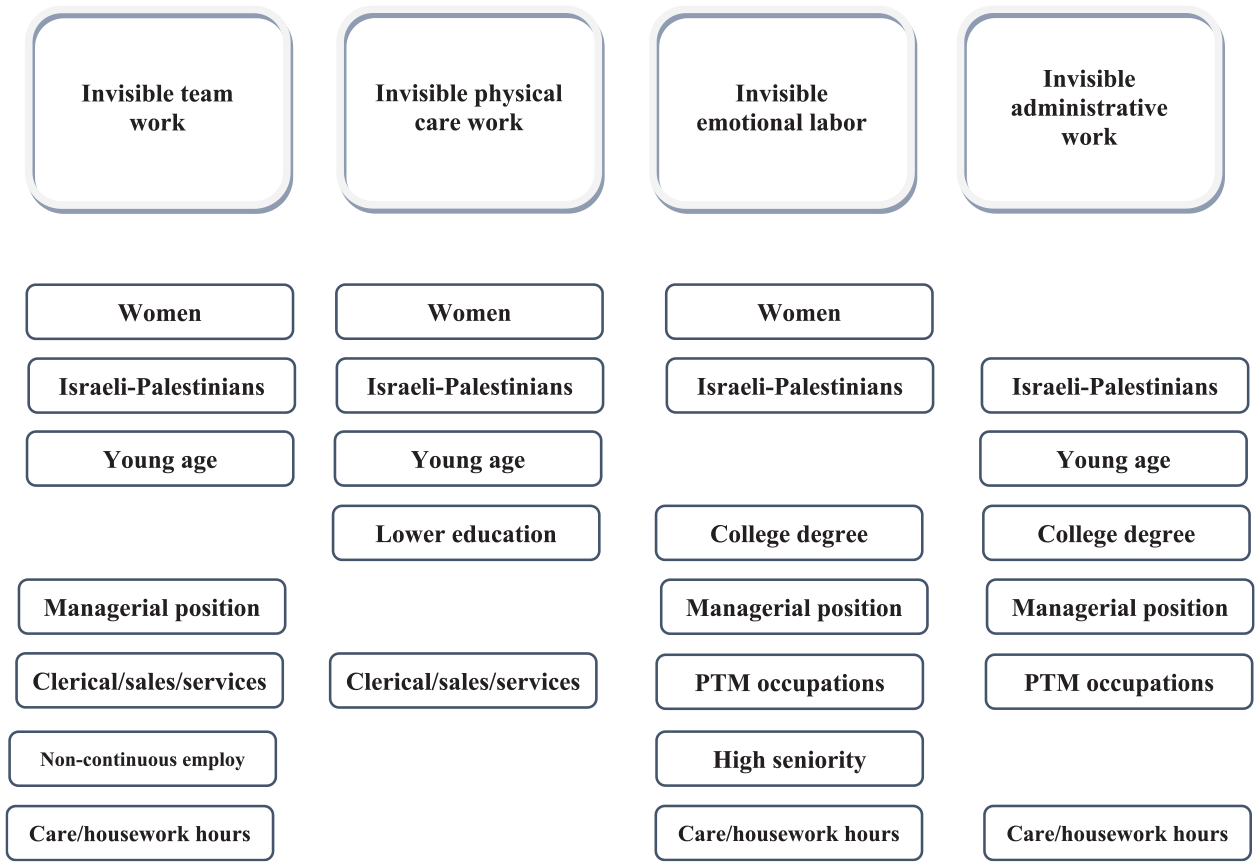
Socioeconomic, Labor Market, and Family Life Characteristics Related to Performing Types of Invisible Work at Work (Based on Table 2)
Regarding invisible team work, women had higher odds than men of performing these practices occasionally or often/very often compared with seldom/never. However, no gender differences were found in perceiving these practices as part of the job. Moreover, significant differences were found for ethnicity: Israeli-Palestinians reported performing these practices more than Israeli-Jews. In addition, younger workers stated they perform these practices more than their older colleagues did.
A mixed pattern emerged regarding labor market characteristics. On one hand, a managerial position was positively related to performance of invisible team work practices, and managers were more likely to perceive these practices as part of their job than individuals in nonmanagerial positions. It is possible that managers, regardless of gender, felt obliged to do these practices as part of their responsibility for their workers. On the other hand, continuous full-time employment was negatively related to performance of these practices, and those in low-level white-collar occupations (clerks, service workers) tended to spend more time performing such practices than those employed in PTM occupations.
An interesting finding emerged for family life characteristics: The total number of hours of unpaid work at home was positively related to perceiving these team work practices as part of the job. That is, the more time devoted to care/housework in the home, the greater the odds of perceiving responsibility for the informal social life of the workplace as part of one’s job.
With respect to invisible physical care work at work, women tended to see these practices as part of their job more than men, compared with performing them seldom/never. Israeli-Palestinians performed them more than Israeli-Jews. Those with a college degree did so less than workers without one, and younger employees did so more than older workers, but the latter had higher odds of seeing this as part of their job.
In terms of labor market characteristics, contrary to findings for invisible team work, variables that express high status (managerial position and continuous full-time employment) were unrelated to the practice of care for the physical environment. Similarly, there was a tendency of clerical and service employees to see these practices as part of their job, compared with employees in PTM occupations.
In short, the performance of such practices as cleaning and tidying the physical work environment was more common among employees in weakened positions (both in the labor market and in society): Israeli-Palestinians, young workers, and workers without a college degree. Women saw these practices as part of their job more than men, even when controlling for occupation, and so did clerical and service employees.
Invisible emotional labor at work was performed more by women than men, and the former were more likely to see these practices as part of the job. Israeli-Palestinians performed them more than Israeli-Jews, and workers with a college degree saw them as part of their job definition more than those with less education did. In terms of labor market characteristics, a managerial position was positively related to performing invisible emotional labor and to its perception as part of the job. This might be explained by professional training in techniques of emotion management and by greater resources to do such work (Wharton 2009). Seniority was also positively related to performance of these practices, while employment in a blue-collar occupation was negatively related. Regarding family characteristics, here, too, a positive relation was found between the number of hours of care and housework in the family and seeing invisible emotional labor practices as part of the job.
Finally, regarding performance of invisible administrative work, no significant gender differences were found (replicating the descriptive findings). This is somewhat surprising given the gendered pattern revealed in the interviews and requires further research. Again, Israeli-Palestinians and younger employees performed this practice more than did Israeli-Jews and older workers. However, those having a college degree saw these practices as part of their job more than those without a college education, and managerial positions increased the scope of performing these practices, and seeing them as part of the job. Those in blue-collar occupations were less likely to perform them than those in PTM occupations. Last, a positive relation was found between the number of hours dedicated to housework and carework at home and seeing administrative work at work as part of the job.
Discussion
Studies have shown how persistent gender inequality in the labor market in Israel (like other OECD countries) is manifested in wage gaps, occupational segregation, and gender-differentiated work patterns (Mandel and Birgier 2016; Torre 2019). The present study sheds more light on an important mechanism that reproduces gender inequality in the labor market in the current neoliberal political economy—namely, invisible work at work.
Analysis of both qualitative and quantitative data revealed that women—and to a certain extent men—perform diverse types of practices outside the formal definition of their job for which they receive no compensation. Based on group interviews, a typology of invisible work at work was deduced: (1) cultivating employee relations, maintaining a positive atmosphere, and organizing social events (invisible team work); (2) cleaning and taking care of the work environment (invisible physical care work); (3) supporting, encouraging, and mentoring coworkers (invisible emotional labor); and (4) preparing material for meetings and other secretarial tasks (invisible administrative work). The organization relies on the ongoing performance of many of these invisible practices (mainly emotional labor and adminstrative work) to function; otherwise, “the place will fall,” to quote a woman interviewee. The multivariate quantitative analysis revealed a gender gap in three of the four types (the exception being invisible administrative work). This is in keeping with findings on office housework in specific occupations (El-Alayli, Hansen-Brown, and Ceynar 2018; Guarino and Borden 2017; Williams et al. 2016). The multinomial regression analyses also revealed that invisible work relates not only to gender inequality, but also to ethnic inequality, as the minority group of Israeli-Palestinians was found to perform more invisible work practices than the majority group of Israeli-Jews. This supports the findings of a study of U.S. engineers revealing an intersection of gender and belonging to an ethnic minority group in performing office housework (Williams et al. 2016).
The contribution of this typology of invisible work at work to the theory of office household (Williams and Dempsey 2014; Williams et al. 2016) is threefold. First, it shows how diverse practices that (mostly) women do, without being recognized and compensated as labor, are part of the same gendered invisibility: work that keeps the organization going without rewarding those who do it. As the qualitative findings indicated, there is a prevailing gendered perception in the organizational world that women should do this work.
Second, the typology points to the diversity of types of invisible work. In a preliminary fashion, the quantitative findings suggest a possible hierarchy among invisible practices, particularly in terms of the labor market characteristics of those who tend to perform them. Invisible emotional labor and invisible administrative work were more common among those with more stable and privileged labor market positions, whereas invisible physical care work was usually associated with disadvantaged positions in the labor market and in society (Israeli-Palestinians and women). These differences go beyond the occupations of respondents. Mixed findings were revealed for invisible team work. More research is needed to yield a clearer picture of the hierarchy of invisible work types. Likewise, given the importance of the intersectionality approach in studying emotional and unpaid labor (Ispa-Landa and Thomas 2019; Nagar-Ron 2014), more attention could be given to the intersections between different axes of inequality and different types of invisible work.
Third, the revealed typology is related to the level of skill devaluation (Hatton 2017) and how it reflects organizational demands. According to Hatton (2017), the sociocultural mechanism renders work invisible by making it appear natural rather than attributable to individual effort and skills. This interacts with the sociolegal mechanism, which renders work invisible by coding it as “non-work,” and with the sociospatial mechanism, which physically segregates it from the socially constructed workplace. The interviews indicated that various agents in the organization, including senior and junior executives and colleagues, openly and covertly expect women to perform invisible work. Some women met these expectations not only out of identification with gendered expectations about care activities, but also (especially when the demand came from their boss) because they felt obligated. Moreover, an interesting contradiction was revealed, echoing the dual nature of emotional labor (Wharton 2009): While these emotional labor practices emerged as an axis of identity building, giving women a sense of meaning and confirmation of their unique contribution to the organization, the women received no monetary compensation for them and sometimes no recognition. Men, on the contrary, not only did fewer practices of invisible work but also perceived some (such as emotional labor) as visible. This suggests that while men are expected to become mentors and friends of colleagues and their seniors, women are expected to serve them. My findings suggest that femininity is an explicit or implicit requirement, and its nature interacts with the level of skill valuation. The more occupational skills are undervalued, the more a serving femininity has to be manifested to gain worth at the workplace. In this sense, invisible work at work becomes involuntary. Thus, the study contributes to Hatton’s (2017) conceptualization by exploring how the mechanisms generating skill undervaluation are related to the involuntary dimension of invisible work. This dimension stresses the importance of looking at gendered social expectations, implicit and explicit, beyond the explanation of “doing gender” (West and Zimmerman 1987).
In addition, the study revealed a subtle distinction between visible and invisible practices in the labor market. Following the well-established perception of gendering job descriptions and evaluations (Baines and Armstrong 2019; England et al. 1994; Hatton 2017; Heilman and Chen 2005), the blurred boundaries between visible and invisible work might be another mechanism explaining gender inequality in the contemporary labor market.
The concept of invisible work practices, as revealed here, also challenges the socially constructed division between private and public spheres (Herzog 1999), pointing to the complicated ways in which the sociospatial mechanism (Hatton 2017) works. The performance of invisible work at the workplace was related to doing invisible work at home. This may be explained by gendered power relations in both environments (Hobson 1990). This finding suggests that the distinction between private and public spheres is socially structured and acts as part of the mechanism preserving gender hierarchies and inequalities.
Conclusion
The study has both methodological and theoretical implications. First, it points to the importance of building measurements based on women’s and men’s knowledge, voices, and experiences to complement other measurements of gender inequality in the labor market. Relatedly, the study expands the theory of office housework as another explanation of the persistence of such gender inequality. Given that gender, class, and race are an integral part of organizational processes (Acker 2006), together with the relations among gender, ethnicity, and invisible work found in the study, future research should examine this phenomenon from both the intersectionality perspective and in a cross-national framework.
In sum, in this research, I show that, in the context of a neoliberal economy, gendered organizations produce another “exploitation” mechanism—invisible work practices not only at home, but also in the labor market, performed primarily by women but also by men. By viewing invisible work as an integral part of work organizations, an important question remains: How can we promote recognition, redistribution, and compensation (to borrow Fraser’s [2016] terms) that would make invisible work visible?
Supplemental Material
sj-docx-1-gas-10.1177_08912432221128544 – Supplemental material for “Just Let it Pass by and it will Fall on Some Woman”: Invisible Work in the Labor Market
Supplemental material, sj-docx-1-gas-10.1177_08912432221128544 for “Just Let it Pass by and it will Fall on Some Woman”: Invisible Work in the Labor Market by Amit Kaplan in Gender & Society
Footnotes
Author’S Note:
I thank the interviewees for sharing their thoughts and feelings and contributing extraordinary insights to the study. I also would like to express my deep gratitude to Prof. Hanna Herzog, Prof. Naomi Chazan, Dr. Talia Pfefferman, Hadass Ben Eliyahu, Ronna Brayer-Garb, Shimrit Slonim, and Gal Lipshitz of Shavot, The Center for the Advancement of Women in the Public Sphere (WIPS) at The Van Leer Jerusalem Institute, for their invaluable collaboration in researching this project. I am also grateful to Helene Hogri, my editor, for her important contribution. I thank Anat Oren, Karin Blanero, and Irit Adler, of the B.I. and Lucille Cohen Institute at Tel Aviv University for methodological assistance. Finally, I thank the Gender & Society editors and reviewers for their enlightening comments and suggestions. The study was funded by a research grant from The Ministry of Science, Technology and Space in Israel.
Supplemental Material
Supplemental material for this article is available online.
1.
It would be beneficial in future studies to expand this measure to include several questions per type of practice.
2.
The Israel Central Bureau of Statistics (ICBS) classification was chosen for two reasons: because it has been updated in accordance with developments in the Israeli economy since the 1990s, and because it is based on the International Standard Classification of Occupations (ISCO-08;  ) and, therefore, allows for international comparisons.
Amit Kaplan is a sociologist, a senior lecturer, and the Head of The Family Studies Master’s Program in the School of Government and Society, The Academic College of Tel Aviv-Yaffo. Her research interests include issues of family, work, gender, and welfare policy. Her research has appeared in journals such as Gender, Work & Organization, European Journal of Population, Culture, Health & Sexuality, Demographic Research, and Human Reproduction.
References
Supplementary Material
Please find the following supplemental material available below.
For Open Access articles published under a Creative Commons License, all supplemental material carries the same license as the article it is associated with.
For non-Open Access articles published, all supplemental material carries a non-exclusive license, and permission requests for re-use of supplemental material or any part of supplemental material shall be sent directly to the copyright owner as specified in the copyright notice associated with the article.
