




Abstract
This article problematizes claims of women’s empowerment in “masculine” sports through an exploration of women’s participation in mixed martial arts (MMA)—a combat sport colloquially referred to as “cage fighting.” MMA, perhaps more than any other sport, allows women athletes to challenge patriarchal beliefs about gender by demonstrating women’s capacity for physical violence and domination. But whereas investigations into MMA have produced important findings for studies of men and masculinities, there has been surprisingly little attention paid to women’s participation in this hypermasculine world. This article begins to fill this gap through an ethnographic account of this growing sport. Drawing from more than four years of ethnographic fieldwork and 40 semi-structured interviews with professional women’s MMA athletes, I show how the neoliberal–postfeminist culture of MMA undermines its empowerment potential by shaping gendered subjecthood in ways that are conducive to the maintenance of gender inequality. I conclude by discussing the implications of my findings for women’s empowerment in sport.
Research in the sociology of sport has illuminated the complex and often contradictory position of women athletes in patriarchal societies. Much of this research has centered around the perceived incongruity of femininity and athleticism—the so-called “female-athlete paradox”—that female athletes must negotiate in order to be intelligible as hetero-feminine women while participating in “masculine” sports (e.g., Ezzell 2009; George 2005; Krane et al. 2004; Macro, Viveiros, and Cipriano 2009; Mennesson 2000). Investigations into this paradox have revealed that women athletes in many sports engage in impression management strategies to maintain a feminine identity, such as the tendency for these women to “apologize” (Felshin 1974) for their athleticism by emphasizing their (white) hetero-femininity and demonstrating that they are “women first, athletes second” (Heywood and Dworkin 2003, 26). Such studies show how women athletes both challenge and reproduce patriarchal beliefs about gender through their participation in “masculine” sports.
Recent studies have shown, however, that this “female-athlete paradox” may be diminishing, as women today are afforded a greater ability to build musculature and develop athletic prowess than they were in the past (Hardy 2015; Washington and Economides 2016). The “heterosexy-fit” (Ezzell 2009) body seen in sports such as CrossFit (Nash 2018), for example, is now regarded as not only acceptable but even desirable (George 2005). The “unapologetic” behaviors observed in women’s rugby signal further change: Broad (2001) argues these women athletes’ “in your face” embrace of their athletic identities may even constitute a queer politics. This growing acceptance of diverse female bodies and feminine subjectivities has been encouraging to feminist observers, as women’s embrace of musculature and athletic identity has been celebrated as a challenge to the gender order that prescribes men to “do dominance” and women to “do submission” (Schilt and Westbrook 2009; West and Zimmerman 1987). Accordingly, female athletes have increasingly been viewed as symbols of women’s empowerment and even looked to as agents of feminist social change (Cooky and McDonald 2005; McClearen 2018).
In this article, I explored these topics with professional women athletes from the relatively new sport of mixed martial arts (MMA)—a combat sport colloquially referred to as “cage fighting.” MMA, perhaps more than any other sport, allows women athletes to challenge patriarchal beliefs about gender by demonstrating women’s capacity for physical violence and domination. But although investigations into MMA have produced important findings for studies of men and masculinities (e.g., Hirose and Pih 2010; Spencer 2012), there has been surprisingly little attention paid to women’s participation in this hypermasculine world. This article begins to fill this gap through an ethnographic account of this growing sport.
Contested Ideological Terrain
It is well-established in the gender and sport literature that sports are a site through which men construct masculinity (Connell 2013). Combat sports, in particular, have long been regarded as a male institution in which hegemonic masculine values of physical strength, toughness, and aggression are cultivated and embodied (Matthews 2016). Indeed, the notion that sports provide “dramatic symbolic proof” (Messner 1990, 204) of men’s “natural” superiority over women is well documented in the sociology of sport literature. Consequently, women athletes have been viewed as “contested ideological terrain” (Messner 1988) for contesting and reaffirming relations of gender and power (Halbert 1997; Mennesson 2000).
Scholars have argued that women athletes in many sports experience their woman-athlete subjectivities as paradoxical due to the competing demands of sport and (white) hetero-femininity—a phenomenon that has been described as the “female-athlete paradox” (Felshin 1974; Krane et al. 2004). Consequently, studies have shown that women athletes engage in impression management strategies to avoid the stigma of being labeled masculine or lesbian, such as the tendency for these athletes to “apologize” for their participation in “masculine” sports by downplaying their athleticism and emphasizing their (white) hetero-femininity (Felshin 1974). These behaviors have been observed in a wide range of women’s sports (e.g., Adams, Schmitke, and Franklin 2005; Blinde and Taub 1992; Davis-Delano, Pollock, and Vose 2009; Ezzell 2009; George 2005; Mennesson 2000), as women athletes who engage in these behaviors are rewarded psychologically, socially, and materially for cultivating physical and behavioral difference from men (McCaughey 1997).
Scholars have also found, however, that some women athletes resist this paradox by embracing their athleticism rather than “apologizing” for their participation in “masculine” sports (e.g., Broad 2001; Chase 2006; Hardy 2015; Macro, Viveiros, and Cipriano 2009). Women rugby players, for instance, have been shown to not only resist disciplinary processes of hetero-femininity (Chase 2006) but even engage in “unapologetic” behaviors that can be interpreted as queer resistance to a gendered social order (Broad 2001). Such behaviors have offered support for the hope that women’s sports can serve as a space of empowerment, as women athletes construct subjectivities that are “intelligible as feminine but work against the maintenance of male hegemony” (Channon and Phipps 2017, 27).
Yet neoliberal and postfeminist discourse in women’s sports complicates this empowerment narrative, as it pays lip service to feminist goals of political, social, and economic equity while failing to offer any political or social critique (Brice and Andrews 2019). Instead, neoliberal–postfeminist logics ensure that any existing inequities between genders are seen as the result of “natural” sexual difference and/or of individuals’ own choices (Banet-Weiser, Gill, and Rottenberg 2020). Slogans such as “Strong is the new sexy” and “Don’t be a do-nothing bitch” are framed and interpreted as counterhegemonic prescriptions for female bodies and feminine subjecthood, yet they still appeal to a hetero-patriarchal gaze and perpetuate neoliberal–postfeminist narratives of empowerment through choice, liberalism, and meritocracy (Cooky and McDonald 2005; McClearen 2018; Washington and Economides 2016). Through this framing, any such empowerment is individualized rather than extended to women as a group, and those who benefit most from such empowerment—white, hetero-feminine women—are those who already benefit from the interlocking systems of privilege provided by white supremacy and hetero-patriarchy (Collins 2000).
Studies of women’s and girls’ sports have shown the influence of this discourse in the construction of female athletes’ gendered selves, as well as in their understandings of empowerment (e.g., Cooky and McDonald 2005; Toffoletti and Thorpe 2018; Washington and Economides 2016). Cooky and McDonald (2005), for instance, showed how female athletes reproduce neoliberal narratives of freedom, choice, and opportunity in the construction of their feminine identities. Washington and Economides (2016) showed how women athletes’ postfeminist sensibilities (Gill 2007) shape their perceptions of empowerment and the presentation of their feminine selves. Toffoletti and Thorpe (2018) showed how women athletes are adopting new strategies for identity construction that capitalize on tropes of agentic postfeminist subjecthood, such as self-love and self-empowerment, to market themselves on social media. Such studies highlight the ideological workings of neoliberal and postfeminist discourse, both in the construction of these athletes’ identities and in recasting empowerment as an “individualized endeavor firmly located in the market” (Toffoletti and Thorpe 2018, 11).
Women’s Mixed Martial Arts
MMA is a combat sport that allows athletes to use a wide range of fighting techniques to seek victory by knockout, submission, referee intervention, or judges’ decision. Its athletes incorporate techniques from numerous martial arts disciplines while competing within the confines of a ring or cage (Spencer 2012). It is most commonly associated with the premier MMA organization—Ultimate Fighting Championship (UFC)—and is colloquially referred to as “cage fighting” or “ultimate fighting” by outside observers. Although women were prohibited from competing in the UFC until 2013, women now account for more than 15 percent of their total roster (UFC.com) and are featured in most MMA events throughout North America and across the world.
While women’s participation in sport has long been analyzed as a source of empowerment, women’s participation in martial arts and combat sports has been identified as being particularly transformative. Scholars have found that women’s participation in martial arts and combat sports holds the potential to subvert gender hierarchies, as it calls into question the nature of sexual difference and women’s perceived lack of physical power (Channon and Phipps 2017; Noel 2009). Women’s MMA (WMMA) athletes in particular have been viewed by scholars and media alike as exemplars of this empowerment process. Weaving (2014), for example, argued that WMMA athletes can counter beliefs that women are unable to engage in aggression or risk, and they are less physically capable than men. Mierzwinski, Velija, and Malcolm (2014, 74) argued similarly that, through the development and demonstration of physical strength and technique, such women are able to “challenge a traditional and fundamental pillar of male dominance.” The UFC has also capitalized on this empowerment discourse itself with marketing taglines such as “breaking barriers” and “women’s empowerment [with] a whole new look” (UFC.com).
It has been argued elsewhere, however, that the sport of MMA is embedded in a culture of neoliberalism, postfeminism, and hegemonic masculinity. Abramson and Modzelewski (2011), for example, argued that MMA participants subscribe to ideas of “meritocracy” that fail to recognize how social factors such as race, class, and gender mediate success in what has historically been a predominantly (white) male setting. Channon et al. (2018, 387) reported how women in the UFC perpetuate postfeminist ideas that frame feminism as a coercive practice that “constructs women as ‘weak victims,’ while the sexualized, powerful and ‘free’ body of the WMMA fighter becomes a symbol of women’s agency in a world which no longer needs feminist interventions.” Bowman (2020) demonstrated how MMA is aligned with hegemonic masculine discourse that can even be considered “toxic.” Coakley (2011, 79) even characterized MMA as “the epitome of neoliberal sport.”
McClearen (2021, 110), in her analysis of women in the UFC, argued that WMMA athletes must compete for attention in a neoliberal “economy of visibility” (Banet-Weiser 2015) that adopts [t]he meritocratic approach that if a fighter works hard enough at MMA and at self-promotion online, then they will prove themselves worthy of financial rewards. If visibility fails to materialize, neoliberal logics fault the individual fighter rather than the promotion, which in turn allows the UFC to refuse to promote its fighters without demonstrated fan engagement. Invisibility becomes a fighter’s challenge to overcome rather than a series of cultural and economic conditions that dictate where the light of visibility shines.
As McClearen (2021, 28) explained, however, within this economy of visibility, there is a “hierarchy of visibility” that privileges hegemonic masculinity and emphasized femininity over queerness, and whiteness over all other races. Such findings challenge the framing of MMA as a space of women’s empowerment and illustrate the need for further research.
Methodology
Research Methods
This study draws from multiple qualitative methods, including more than four years of ethnographic research on the sport of WMMA and 40 semi-structured interviews with professional WMMA athletes. This multi-site ethnography involved participant observation at an MMA academy that boasts one of the largest professional WMMA teams in the United States, qualitative content analysis of MMA media, and conversational interviews with WMMA athletes. The 40 semi-structured interviews all took place in person and were digitally audio-recorded, and transcribed. The interviews lasted between one and two hours and covered a wide range of topics, including the athletes’ conceptions of empowerment, their beliefs about masculinities and femininities, their experiences of gendered harassment, and their relationships with intimate partners.
After transcribing each interview, I used the qualitative data analysis software, ATLAS.ti, to conduct my analysis. Using an abductive analysis strategy, I merged deductive theoretical insights with inductive analysis techniques in a “continuous process of conjecturing” about my data (Tavory and Timmermans 2014; Timmermans and Tavory 2012, 172). Alongside this approach, I used flexible coding (Deterding and Waters 2021). I began by indexing transcripts with broad codes that connected to the concepts I originally sought to explore, such as “empowerment” and “femininity.” From there, I applied more specific codes, such as “personal responsibility” and “natural sexual difference.”
Positionality
I entered this project with intimate knowledge of the MMA community that was informed by more than a decade of experience in MMA as a student, competitor, and coach, as well as more than a decade of experience in Brazilian Jiu-Jitsu where I currently hold the rank of black belt. This “insider status” provided me valuable insight into the lives of MMA athletes as I designed my research and interview questions, and it afforded me access to a group of elite professional athletes to whom I might not otherwise have been able to gain access. As a white, heterosexual man studying a diverse group of women MMA athletes, however, I occupied the position of “insider-outsider” (Dwyer and Buckle 2009). I overcame this by establishing excellent rapport with the athletes, which I did by attending their fights and social gatherings, speaking with them through text and social media messages, and even training with them in various MMA and Brazilian Jiu-Jitsu academies. While I engage critically with their beliefs about gender, feminism, and social inequality, this analysis is intended to be read as a critique of the ideologies that shape these beliefs rather than a critique of any individual women themselves. Following the work of critical scholars who understand ideology to be a barrier to liberation, this work is intended to be a profeminist and antiracist project aimed at critiquing the ideologies that shape subjectivities in MMA and, increasingly, American society. In “talking back” to these ideologies, I hope to use my experience as an MMA subject to make visible the ways in which these ideologies serve to maintain social inequality.
Theoretical Framework
In theorizing my findings, I analyzed them through the lenses of neoliberalism (Harvey 2007), postfeminism (Gill 2007; McRobbie 2009), and “doing gender” theory (West and Zimmerman 1987). I understand neoliberalism as a political, economic, and social theory that proposes that human well-being can be best advanced by liberating individual entrepreneurial freedoms within an institutional framework characterized by strong private property rights, free markets, and free trade (Harvey 2007). According to Harvey (2007), since its inception, neoliberalism has come to dominate not just political and economic policy in the United States but, increasingly, human rationality and subjecthood throughout the world. As stated by Harvey (2007, 3), “Neoliberalism has, in short, become hegemonic as a mode of discourse. It has pervasive effects on ways of thought to the point where it has become incorporated into the common-sense way many of us interpret, live in, and understand the world.” Among its key tenets as a guiding principle for human action is its emphasis on individualism and personal responsibility over collective action and social welfare.
Alongside neoliberalism, postfeminism has increasingly become an object of feminist cultural critique over the last decade (Gill 2016). The term is used to capture the false sense that women are living in a post-sexist world, that any remaining inequities are the result of natural differences and/or of women’s own choices, and, therefore, that feminism is no longer necessary (Banet-Weiser, Gill, and Rottenberg 2020). Importantly, postfeminism includes the double entanglement of both feminist and antifeminist sentiments. According to McRobbie (2009), elements of feminism have been taken into account and, drawing on a vocabulary that includes such words as “empowerment” and “choice,” converted into a much more individualistic discourse and deployed as a substitute for feminism, in exchange for intelligibility as women, and the promise of freedom and independence. In addition, McRobbie (2009, 2) argued, “The young woman is offered a notional form of equality, concretised in education and employment, and through participation in consumer culture and civil society, in place of what a reinvented feminist politics might have to offer.”
West and Zimmerman’s (1987) “doing gender” theory conceives of gender as an ongoing, interactional accomplishment. Through this lens, gender is not a fixed property of the sexed body but rather a social process of constructing one’s identity in accordance with one’s sex category (West and Zimmerman 2009). Normative expectations for men and women maintain gender inequality by encouraging men to “do dominance” and women to “do submission” (Schilt and Westbrook 2009). Accordingly, feminist scholars have celebrated instances where individuals work to “undo” (Deutsch 2007; Risman 2009) or “redo” (West and Zimmerman 2009) gender by challenging the essentialism of gender as a fixed property of the sexed body.
Sample
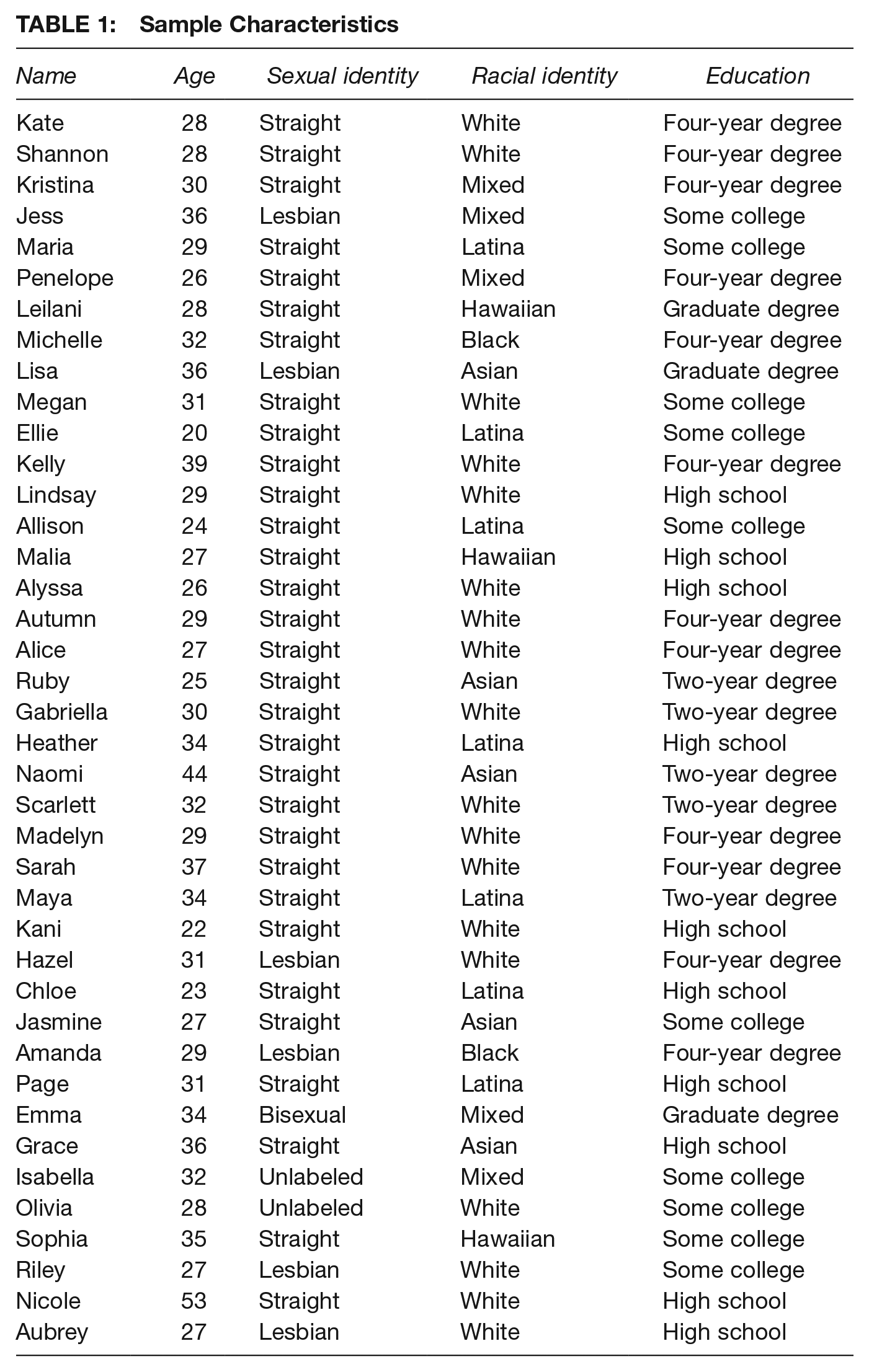
The present study was approved by the University of California, Riverside, Institutional Review Board, and participants were recruited through social media apps after reviewing a comprehensive list of WMMA athletes on the MMA athlete internet database, Tapology.com. Additional participants were recruited through snowball sampling methods until saturation was achieved. All participants were professional WMMA athletes with at least one professional fight on their record. Additional descriptive data of my sample are presented in Table 1. All the athletes’ names have been changed to provide confidentiality and anonymity.
Sample Characteristics
FINDINGS
Neoliberal–Postfeminist Subjects
WMMA athletes represent the quintessential neoliberal–postfeminist subjects. Their lives are characterized by a continuous process of self-discipline, -surveillance, and -cultivation, as well as a constant state of precarity in an entrepreneurial labor market that grants monopolistic power to the UFC and little to no bargaining power to the athletes who sustain it. Most of these athletes work full- or part-time jobs in addition to MMA—because they are unable to sustain themselves on income produced through MMA competition alone—and increasingly these athletes are supplementing their incomes with money earned through subscription-based websites, such as OnlyFans.com, by selling nude and/or semi-nude photos. Many of these athletes subscribe to postfeminist ideas of empowerment through choice, liberalism, and meritocracy—while being paid less than their male counterparts—and advocate conservative gender ideals, even while being celebrated for their own gender transgressions. To these athletes, individual success is privileged above all else, and little effort is made to distance themselves from the perception of them as self-interested, neoliberal entrepreneurs. Indeed, a common talking point among WMMA athletes is the repeated claim that MMA is a “selfish sport.” This talking point, in fact, presented itself many times throughout my interviews.
Fighting’s such a selfish sport. . .so selfish. I’ve put that before my relationships. That’s how selfish it is. (Maria, 29, Latina, straight) You have to be selfish. Fighting is a very selfish sport. (Kani, 22, white, straight) I think fighting is a very selfish sport. (Autumn, 28, white, straight)
While the word “selfish” typically carries negative connotations, WMMA athletes reclaim selfishness as an essential feature of their profession. This exempts them from feelings of shame or guilt as it reframes their own self-serving behaviors as requisite for success in a hypercompetitive sport. This also coincides with a lack of prosocial behaviors, more generally, and is compounded by a postfeminist sensibility (Gill 2007) that understands women to occupy an innate gendered disposition that is inherently hostile toward other women. This is evidenced by the common claim that WMMA athletes fight “harder” and “more emotionally,” and that, for them, the fight is more “personal” than it is for their male counterparts. The head coach of the WMMA team I observed—“The Mean Girls”—actually commodified this trope into a shirt, which he sells on his social media profiles, with the words, “The Broadfather,” on the front—an allusion to his role as the head coach of a professional WMMA team—and “Girls can’t get along anyway so they might as well fight each other for money,” on the back. Although the quotation is meant to be humorous, in fact it accurately reflects the social reality of the sport, in which there is a distinct lack of solidarity between the women entrepreneurs who occupy it.
It is important to emphasize, however, that this lack of solidarity is not innate to the athletes, themselves, but rather reflects the ideologies that govern the sport. Cultural hegemons such as longtime UFC supporter, Donald Trump, and UFC commentator and conservative podcast host, Joe Rogan, routinely promote neoliberal ideals of personal responsibility and individualism, and portray feminists and activists as misguided “social justice warriors,” influencing the perception of feminist efforts within the sport as unpopular and undesirable. Promoters such as UFC president, Dana White—a close friend of Trump and a two-time speaker at the Republican National Convention—further erode athlete solidarity by routinely matching up teammates against one another and lambasting any athletes who express reluctance to fight teammates as unserious. This all comes at a particular cost to women MMA athletes, who are both underpaid and underpromoted (see McClearen 2021) and are left without a political framework through which to interpret their unequal treatment.
Other postfeminist sentiments to which WMMA athletes subscribe were revealed through discussions of feminism throughout my interviews. Gill (2007) argued that because postfeminism includes the double entanglement of both feminist and antifeminist ideals, antifeminist talking points are common among young women who understand feminism to be a restrictive, coercive practice that is both undesirable and unnecessary in their daily lives. Many of the athletes I interviewed made efforts to distance themselves from feminists and “the feminist agenda,” despite not actually being asked any questions about feminism. For instance, when discussing WMMA as a site of empowerment, Alice (27, white, straight) clarified, “I wouldn’t call myself a feminist or anything. I don’t believe I am in most modern terminology.” When asked to elaborate, she continued, Like, with the military, I feel like if a woman can compete and do everything that a man can do without the test being changed, great, let her do whatever the job entails. But, if they have to change the test so that she can pass, I don’t like that. That doesn’t make me feel empowered. That makes me feel like they had to dumb it down for you. But some women want it dumbed down so that they can have the same status. And I’m not against us having the same status but earn it just like everyone else.
Kate (28, white, straight), a former member of the United States military, expressed similar sentiments, explaining, I don’t like feminists—the feminist agenda.. . .I don’t have to march and get crazy; I just do. I’ve never not been able to do whatever I wanted to do because of my gender, besides serving in an infantry role because at the time women weren’t allowed to. . .that’s not what I wanted to do anyway. I’m more of an empowerment type. And that goes for both genders. Do whatever you want. It’s super easy.
Some of the athletes explained that they were unsupportive of feminism because they felt women should have to “prove themselves,” reflecting Rottenberg’s (2018, 195) claim that the colonization of neoliberalism and postfeminism has produced a “very clear distinction between worthy ‘aspirational’ female subjects and the majority of female subjects who are deemed irredeemable due to their insufficient aspiration and thus ‘responsibilization.’” Others argued that their lack of support of feminism was due to their belief that women were not only not disadvantaged in society but were actually privileged.
I actually think that now, like currently, that it’s harder for white males than anybody. Women complain about not having this, not having that, and how it’s not fair and it’s so much harder to be a woman. There was a time, but I think now we’re finally to the point where women complain about it more than it’s actually really true. I mean if you get pulled over by a cop and I get pulled over by a cop and I start crying like, “I didn’t mean to! I’m sorry!” Who’s gonna’ get let off? It’s not gonna’ be you, it’s gonna’ be me. (Megan, 31, white, straight)
Such statements obscure the very real inequities that exist between and within genders, as well as between and within races, classes, and other social groups. Although neoliberal–postfeminist logics reduce any such inequities to the result of individual poor choices and/or a lack of hard work and investment in the self (Gill 2007), these logics are refuted by a wealth of sociological research that has long documented the ways in which such inequities have been shaped and maintained by social structures that privilege white, heterosexual men in particular. Such contradictions are an essential feature of neoliberal–postfeminist subjecthood, however (Banet-Weiser, Gill, and Rottenberg 2020), because neoliberal–postfeminist logics are unequipped to reconcile the discontinuity between a worldview that fails to recognize structural inequality and a material world that continues to be shaped by it. This subjecthood defines the prototypical WMMA athlete who, in their entrepreneurial pursuits in a white male-dominated sport, is often supportive of the very ideologies that maintain their unequal status.
Doing Both
The athletes in this study did gender (West and Zimmerman 1987) in ways that were highly relevant for the study of gender both within sport and beyond. Contrary to other studies that have found the competing demands of (white) hetero-femininity and athleticism to be a source of frustration and anxiety for women athletes (e.g., Adams, Schmitke, and Franklin 2005; Blinde and Taub 1992; Davis-Delano, Pollock, and Vose 2009; Felshin 1974; George 2005; Hardy 2015; Krane et al. 2004; Mennesson 2000), the athletes in this study saw the paradoxical nature of their woman-athlete subjectivities as a source of pride, supporting claims that the image of the sportswoman is becoming more complex and contradictory (Thorpe, Toffoletti, and Bruce 2017). When asked if these athletes had any trouble balancing these dual subjectivities, most of them stated that they did not. In fact, several of the athletes specifically cited the duality of these subjectivities as particularly “fun” or “exciting.” I like the duality of it. It makes life a little more exciting. (Ruby, 25, Asian, straight). It’s hot chicks being violent. There’s something about it—the clash of the feminine and masculine coming together. The masculine act of fighting but the femininity of beautiful women doing it. (Shannon, 28, white, straight)
This duality was also central to the way in which many athletes in this study chose to market themselves—particularly those who occupied the privileged position of white, heterosexual, and conventionally attractive—as their woman-athlete subjectivities were commodified into brand identities that highlighted the paradoxical nature of these dual subjectivities. These brand identities often consisted of nicknames such as “Sex and Violence” or “Pretty Badass,” and strategically positioned these women to capitalize on the perceived incongruity of their dual status as combat sports athletes and hetero-feminine women. For example, Scarlett (32, white, straight), who markets herself as a “lover and a fighter,” explained that her former career as a model aided in her ability to draw attention to herself.
I used to do modeling for a while and so I think that actually helped a lot with my entire career as an amateur because there wasn’t a lot of girly girls, then. It was very, very slim. And I think that helped a lot ‘cause people were like, “Oh, wow! She’s really girly, she does modeling, and she can fight.”
Similarly, Kani (22, white, straight), who markets herself as a “warrior princess,” explained that she sees herself as someone who can switch comfortably between doing masculinity and femininity, marking a shift from the “apologetic” behaviors that have been found in prior studies (Adams, Schmitke, and Franklin 2005; Blinde and Taub 1992; Davis-Delano, Pollock, and Vose 2009; Ezzell 2009; George 2005; Mennesson 2000) and signaling a new woman-athlete subject who is both self-aware and indifferent toward the competing demands of sport and society. She explained, “At home, I’m completely different than how I am in a fight. I want to be a good little housewife. But, when it comes down to handling business, I handle business.”
It is important to distinguish, however, that by “doing both,” WMMA athletes are neither “undoing” (Deutsch 2007; Risman 2009) nor “redoing” (West and Zimmerman 2009) gender by challenging its conception as an expression of a binary sex category; instead they are reproducing gender by marketing themselves as exceptional women who simply have the power to do “both.” This was also evident in a recent social media “empowerment” campaign in which WMMA athletes participated under the hashtag, #GetYouAGirlThatCanDoBoth. The campaign featured short videos of several high-profile WMMA athletes in their professional fight gear spliced together with videos of these same athletes in stereotypically feminine attire, such as dresses, high-heeled shoes, and makeup, as a means to emphasize the duality of their woman-athlete subjectivities. The hashtag #GetYouAGirlThatCanDoBoth implicitly refers to the ability to do “both” (masculine) combat sports violence and (white) hetero-femininity, and it appeals to a hetero-patriarchal gaze by encouraging the athletes’ followers to “get” women such as themselves. By “doing both,” however, WMMA athletes are able to capitalize on tropes of agentic postfeminist subjecthood to market themselves in ways that allow them to benefit from their association with both hegemonic masculinity and emphasized femininity—both of which are privileged in the “economy of visibility” (Banet-Weiser 2015) that athletes must navigate in order to advance their careers as WMMA athletes (McClearen 2021).
Importantly, such opportunities to market oneself in a way that capitalized on the perceived incongruity of combat sports talent and (white) hetero-femininity were not equally available to all the athletes who participated in this study—particularly the Black and queer athletes. For instance, Michelle (32, Black, straight), who was one of fewer than a handful of Black women in her organization at the time of our interview, explained, I think it’s a lot easier to see a Black woman as masculine, as opposed to any other race. And I think it’s because of our darker skin and hair texture and the stereotypes we have in America—like being loud and being aggressive. I feel like a lot of that plays into the femininity. . .like the lack of femininity. When it comes to fans and how I feel I’m marketed and stuff like that, I definitely feel like there’s a huge difference between me and other women in [my organization].
For Black women such as Michelle, their participation in the hypermasculine sport of MMA is viewed as less paradoxical and, thus, less exceptional than it is for white women, decreasing their value as a woman-athlete commodity in the eyes of their promoters. Amanda (29, Black, lesbian) expressed similar sentiments, citing the “politics” of the sport that limit the exposure of Black women athletes such as herself.
The women that aren’t the “poster girls” but are talented aren’t getting as much exposure and recognition as the ones that maybe their talent is subpar, but they have a pretty face and they’re cute and this and that. So, yeah, that hits home being in the sport and knowing that there’s a lot of politics to it. I know that there are certain females in the sport that get more recognition and more attention just based on how they look rather than how they perform. . .where someone like myself who has proven my talent kinda’ flies under the radar.
Although “doing both” may serve as a new strategy for women athletes to do gender while competing for attention in economies of visibility (Banet-Weiser 2015), its reliance on implicitly racialized and (hetero)sexualized performances of femininity disproportionately harms Black and queer women athletes such as Amanda and Michelle whose performances of femininity are viewed as existing outside of the (white, hetero-feminine) “poster girl” image that is most valued in the MMA industry (McClearen 2021). As such, “doing both” serves not as a means to challenge the hegemony of white hetero-femininity but rather as a means to maintain privilege for the white hetero-feminine athletes who embody it.
The Paradox of Neoliberal–Postfeminist Empowerment in “Masculine” Sports
Numerous scholars have discussed the “empowerment” potential of women’s participation in “masculine” sports (e.g., Broad 2001; Channon and Phipps 2017; Mennesson 2000; Messner 1988; Roth and Basow 2004; Velija, Mierzwinski, and Fortune 2013). Hope for this potential has rested on women athletes’ ability to “break barriers” to liberated female subjecthood by participating in activities that have traditionally been associated with male bodies and masculinities, and sport’s ability to “reduc[e] [the] physical power imbalances on which patriarchy is founded and reified” (Castelnuovo and Guthrie 1998, 13). But sex-segregated sports such as MMA may paradoxically reinforce patriarchal power, as they sustain conservative discourse that suggests “all women, even strong and athletic female athletes playing physical sports, require protection from competition against all men” (Burke 2019, 504). Further, neoliberal–postfeminist logics ensure that women athletes’ achievements are evaluated in the individualizing language of the dominant hegemony, such that it may actually undercut feminist goals of collective empowerment (Burke 2019; Fraser 2013). This paradox presented itself throughout my interviews.
To better understand whether the athletes in this study experienced MMA as a space of empowerment, I asked them whether they considered themselves empowered, and, if so, what that meant to them. While most of the athletes did consider themselves empowered, many of these athletes constructed their empowered status in relation to other women. For example, Autumn (29, white, straight) revealed that, for her, being empowered meant “doing stuff that other women would be afraid to do.” Similarly, Kristina (30, Mixed, straight) revealed that she considers herself empowered because she is more mentally and emotionally capable than “your average woman.” Others even included criticisms of women in their conceptions of empowerment, constructing their empowered status in relation to these women’s weaknesses.
I don’t need the same things I see other women need or lean on because I have my own strength. (Nicole, 53, white, straight) I’ve just known a lot of weak females. . .so I’m not on that spectrum. (Aubrey, 27, white, lesbian)
References to female weakness were also made when discussing women’s lack of participation in combat sports. For example, when asked why more women do not participate in combat sports, Kate (28, white, straight) explained, Because they’re pussies! It hurts, and it’s hard. There’s a mental factor.. . .Anybody can go in there and train Zumba. You go in there and you’re moving around and flailing your arms. But you start picking apart people and they fold. They’d rather just continue what they’re doing. They’d rather just have kids.
Other athletes cited “intimidation” as the main reason more women do not participate in combat sports, such as Madelyn (29, white, straight), who explained that “it takes a certain type of girl to stay with it.” References such as these to a “certain type of girl” were commonly used by the athletes to distinguish themselves from “regular” women, against whom they defined themselves as exceptional. For instance, Kani (22, white, straight) explained, “A girl like me and other girls who started at a young age, it’s all we’ve known. But, a regular female, they’re like, ‘I’ll never be able to do that.’”
These perceived shortcomings of “regular” women were also quickly reduced to biology, and further reflected essentialized postfeminist notions of “natural” sexual difference (Gill 2007). For example, Kelly (39, white, straight) explained, “In general, and I know this is stereotyping here but. . .I think women were designed to be softer. That’s why we carry children. And, so, I don’t think that every single woman has that aggression in her that needs an expression in that way.” Likewise, Allison (24, Latina, straight) explained, I think most girls just physically and mentally. . .I’m all for women—girl power all the way—but it’s not in our DNA to be physical or competitive necessarily. Even with animals, the females, for the most part, don’t hunt. They stay home, take care of the kids, and I think that’s just how it is in our DNA for whatever reason.
Leilani (28, Hawaiian, straight) expressed a similar sentiment in explaining how women were not “wired” for combat, as did Jasmine (27, Asian, straight) who explained that, “evolutionarily,” men were just more aggressive and better equipped to handle the rigors of combat sports. She continued, Of course, you get those outliers but, in general, fighting and being aggressive and getting hurt, biologically, is something that, in most species, the males do. You can do whatever you want but there’s still like that separation of the sexes where the woman is more likely to do this other thing and fighting is not that other thing.
These references to biology also presented themselves in conversations about the athletes’ ability to defend themselves against male violence. Although several scholars have engaged with McCaughey’s (1997) “physical feminism” theory in analyzing women’s combat sports (e.g., Channon and Phipps 2017; Quinney 2016; Velija, Mierzwinski, and Fortune 2013), offering support for the claim that through physical training, “what is usually taken for granted as a fact of nature—that a woman simply cannot physically challenge a man—is revealed as a social script which privileges men at the expense of women” (McCaughey 1997, 8), many of the athletes in this study did not actually think they were capable of physically defending themselves against men. For example, Leilani (28, Hawaiian, straight) explained, “Even though I’m a pro fighter. . .the reality of it is that I would totally be overpowered by a guy—even if he doesn’t have any training.” Similarly, Kani (22, white, straight) explained, I know I’m a badass, but in the female division. I’m sorry but if a man ran up on me, I’m going to do my 100 percent best to try to defend myself. . .but, there’s just a different strength between a man and a woman. . .there’s girls in my fights that can take my punches in the first minute and not go down; what do you think a man’s gonna do? I know I cannot beat up a man.
Some of the athletes cited their experiences grappling with men as “proof” that differences in male and female biology would leave them unequipped to deal with men’s physical size and strength. For example, Paige (31, Latina, straight) recalled instances of wrestling with her husband as evidence of the limits of female strength.
My husband’s a bigger man and we wrestle all the time and play-fight and I’ll put him in an armbar, for instance, and he will pick me up with that one arm and lift me straight in the air. And I’m like, “Oh, God, this doesn’t work.” Or, once he starts to use his strength, he’ll hold me down and I can’t move. . .and also my experiences in the gym with dudes that are bigger and stronger, it doesn’t matter how skilled they are. If they can hold me down, I’m not moving.
Similarly, Gabriella (30, white, straight) explained that, although she used to believe in men and women’s equality, training with men has revealed to her the differences in men and women’s physical abilities.
I used to be like “men and women are super equal” and thought that all growing up. My mom was a very strong woman—single mom, raised my sister and me, and we were both like, “I can do anything.” I still have that mentality a lot, but I’ve also been humbled a lot because I’ve trained with a man with a smaller structure than me in the same weight class and they hit so much harder than a woman. And I’ve felt those differences between the sexes and there are definitely physical differences between a man and a woman.
As Gabriella recalls her experiences training with male athletes, she depicts a journey from feminist naivete to the “enlightened” standpoint of a WMMA athlete who experiences the “reality” of sexual difference in her daily training. Statements like these are not unique to this sample of WMMA athletes but are rather reflective of those expressed by other WMMA athletes throughout MMA media. For example, when asked about what it’s like to train with her male teammates, a former UFC title challenger explained, I fully know that men are stronger than women—I’m not delusional, I’m not some feminist—even though I might be taller or weigh more than some of them, physically, I’m not as strong as them. But it makes me better because, if I can hold my own against guys who are stronger or bigger than me, then when I go into a cage with a female my own size or weighing a little less, they don’t feel half of what I’ve dealt with in the gym. (Helwani 2018, emphasis added)
Such statements highlight a clear difference between the experiences of WMMA athletes and those of the women’s self-defense students in McCaughey’s (1997) study; although WMMA athletes undoubtedly acquire impressive physical skills that leave them better equipped to defend themselves against male violence, because their training is not accompanied by the development of a feminist consciousness, these athletes are nevertheless unable to challenge patriarchal scripts of female vulnerability and male superiority. Rather, it seems, these athletes’ experiences of training with men only serve to concretize their beliefs in male superiority and allow them to justify gender inequality. Paradoxically, then, women’s participation in MMA may ironically serve to disempower them by reinforcing their beliefs in natural sexual difference and male superiority.
Conclusion
At the start of this research, I was intrigued by the narratives of empowerment surrounding women’s experiences in MMA. I had long believed martial arts and combat sports to be a source of liberation in my own life and I wondered whether women’s development of enhanced physical power could confer benefits in other aspects of their lives. It seemed logical that if women’s experiences in MMA could grant them the ability to better protect themselves against male violence—perhaps the most enduring feature of patriarchy—then this experience could serve as a source of liberation that would empower them to live a life of security, independence, and self-determination, and inspire others to do the same. Yet I also wondered, how could an arena that tolerates (and, indeed, promotes) a culture of misogyny, racism, homophobia, transphobia, and violence against women be a source of women’s empowerment? How could a space that privileges and celebrates the very sources of women’s oppression be the same space that leads to their undoing?
My research revealed that whatever transformation women experience as a result of their participation in MMA, it would be misguided to call it empowerment. Although these women unquestionably develop enhanced physical power that offers potential to challenge patriarchal beliefs about gender, because the process of acquiring this power is not accompanied by the development of a critical consciousness that makes visible the power structures that render women’s empowerment necessary, it nonetheless fails to fulfill its liberatory potential. Instead, the neoliberal–postfeminist culture of MMA encourages an ideology of antisociality that blinds WMMA athletes to structural inequality and allows them to construct a reality in which social change is unnecessary and undesirable. This stifles collective feminist action on behalf of WMMA athletes and encourages a climate of individualism and selfishness that disproportionately harms women as a group.
These athletes’ adherence to neoliberal and postfeminist logics is also not without material costs. There is a legitimate case to be made that MMA athletes, such as those in the UFC, are misclassified as independent contractors, leaving them without the benefits enjoyed by athletes in many other professional sports (Salminen 2017). It is well-documented that MMA athletes are also severely underpaid relative to athletes in other sports (McClearen 2021; Zidan 2021). Among the primary reasons for this disparity is the fact that unlike athletes in other major sports, athletes in MMA have thus far failed to collectively organize and therefore have no collective bargaining power (Hefner 2019; Zidan 2021). In 2018, when a WMMA athlete courageously initiated an effort to unionize the athletes in the UFC under the moniker “Project Spearhead,” she ultimately failed to garner enough support from her fellow fighters and was subsequently released from the promotion (McClearen 2021). This failed effort was a case study in the way in which neoliberal and postfeminist logics in MMA work against the athletes: Their ambitions to prove themselves exceptional stifle their ability to work together and ultimately result in their failure to achieve the standard of living that is enjoyed by their professional sports peers. This disproportionately harms women MMA athletes who are not only underpaid relative to athletes in other major sports but are also underpaid relative to their male MMA peers (McClearen 2021).
If martial arts and combat sports are to fulfill their potential as spaces of women’s empowerment, it will require their attention to the structures of capitalism, hetero-patriarchy, and white supremacy that constrain women’s lives. It will require their implementation of feminist principles and pedagogies rather than simply providing a space for women to learn how to punch and kick. It will require their decolonization from capitalist, hetero-patriarchal, and white supremacist logics and a recognition that women’s oppression has been a fundamentally social project. Only then may martial arts and combat sports fulfill their potential as spaces of women’s empowerment and combat sports athletes as allies in women’s liberation.
Footnotes
AUTHOR’S Note:
My sincerest gratitude to Jane Ward, Alfredo Mirandé, Victoria Reyes, Bruce Link, and Brandon Robinson for their continued help and support of my work.

Justen Hamilton is a PhD candidate in the Department of Sociology at the University of California, Riverside. His research is situated at the intersection of gender, sport, and ideology.