




Abstract
We analyze time use data of four East Asian societies and 12 Western countries between 1985 and 2016 to investigate the gender revolution in paid work, domestic work, and total work. The closing of gender gaps in paid work, domestic work, and total work time has stalled in the most recent decade in several countries. The magnitude of the gender gaps, cultural contexts, and welfare policies plays a key role in determining whether the gender revolution in the division of labor will stall or continue. Women undertake more total work than men across all societies: The gender gap ranges from 30 minutes to 2 hours a day. Our findings suggest that cultural norms interact with institutional contexts to affect the patterns of gender convergence in time use, and gender equality might settle at differing levels of egalitarianism across countries.
Across the globe, women do more unpaid domestic work than men, and men spend more time on paid work. This gender division of labor is both the cause and the consequence of persistent gender inequalities. Men accumulate more economic resources and spend more time building up their human capital through gainful employment than women do (Becker 1993; Kan 2014; Kan and Gershuny 2009). Understanding the trends and variations in the time that women and men spend on paid work and unpaid work across different societies is therefore key to devising policies to promote gender equality.
Time use researchers have argued that there have been a continual, albeit at different paces, convergence in women’s and men’s paid work and unpaid work time across different types of welfare regimes in advanced societies over last few decades (Altintas and Sullivan 2016; Kan, Sullivan, and Gershuny 2011; Sullivan, Gershuny, and Robinson 2018). At the same time, studies have reported that progress in gender equality in other domains of public and private spheres have slowed down or stalled in recent years (England 2010; England, Levine, and Mishel 2020). Recent cross-national time use research also finds that women and men have similar amounts of total work time (e.g., Sullivan, Gershuny, and Robinson 2018). Has the gender convergence in time use stalled or is it continuous? Do women and men really have an equal amount of total work? What are the roles of welfare policies and cultural contexts in trends of the gender division of labor? Past studies sought to answer these questions by using data and welfare policy typologies derived exclusively from Anglophone and European countries (e.g., Altintas and Sullivan 2016; Hook 2006, 2010; Kan, Sullivan, and Gershuny 2011; Sullivan, Gershuny, and Robinson 2018). What we have learned from past studies was hence based on theories, data, and assumptions derived from dominant Western cultural and historical backgrounds. We might have overlooked the significance of cultural and institutional factors and the possibility of alternative paths of gender constructions.
In this paper, we analyze time use data beyond the Western paradigm—from China, Japan, South Korea (hereafter Korea), and Taiwan—to revisit the gender revolution in paid work, unpaid work, and total work time. The East Asian societies mentioned above have experienced increases in education and job opportunities for women since the 1980s. They are also characterized by strong family ties and traditional gender ideologies. Our findings provide new insights into how cultural context may interact with institution and policy contexts to affect the pace and patterns of gender convergence in work time. By harmonizing and analyzing time diary data of working-age people in four East Asian countries (China, Japan, Korea, and Taiwan) and 12 Western countries (Austria, Canada, Denmark, Finland, France, Germany, Italy, the Netherlands, Norway, Spain, the United Kingdom, and the United States) from 1985 through 2016, we have found heterogeneity in gendered time use trends among East Asian societies and overwhelming evidence of stalled progress in the closing of gender gaps in paid work, unpaid work, and total work time across both East Asian and Western societies. The continuity of gender convergence in work time depends on the magnitude of the gender gaps, welfare policies, and cultural contexts. In particular, we have found that policies that depend on family ties and women’s traditional responsibility for care work hinder progress in gender equality. Furthermore, our findings are different from those of earlier studies and indicate that during the last three decades women have longer total work time than men across both East Asian and Western societies.
In what follows, we review relevant literature about welfare regimes in Western and East Asian societies, and gender and time use trends. We then present the hypotheses, followed by data and methods, findings, and conclusion.
Theoretical Background
Welfare Regimes in Western Countries
Existing research has classified welfare regimes in Western countries based on the state welfare provision, the level of social equity, and gender ideologies (e.g., Esping-Andersen 1990; Gauthier 1996; Sainsbury 1999). In non-interventionist Liberal regimes (the United Kingdom, the United States, and Canada), the state provides limited support toward the welfare of families and individuals. Social expenditure is relatively low, and welfare provision such as pensions and unemployment benefits depend on private insurance schemes. Women are expected to participate in labor market work as well as to fulfill the major domestic caring role. Childcare services are generally provided by the private market. In Conservative regimes (Austria, France, Germany, and the Netherlands), the state has a subsidiary role in the provision of social services and welfare. Social services are provided mainly through social insurance programs, which have joint contributions by the state and employers. A male breadwinner role and a female carer role are assumed in social policies, although there are also usually generous parental leave policies. In Social Democratic regimes (Denmark, Finland, and Norway), the state takes on an important role in offering services and benefits for the citizens. Social policies are devised to raise the employment rate of both women and men. High-quality public services for childcare and eldercare are provided. There are also fringe parental and paternal leave policies that aim to promote women’s participation in the labor market and a dual-earner model of the family. In Southern European regimes (Italy and Spain), social security systems are relatively less developed compared with other types of Western welfare regimes, and social policies are built on traditional family relations that reinforce gender inequalities. Childcare and eldercare rely on informal support provided by family networks.
Welfare Regimes in East Asian Societies
The welfare systems in China, Japan, Korea, and Taiwan were developed later than those of Western societies. Between the 1980s and the 2000s, the economy in the four East Asian countries were fast developing. Hence, these countries prioritized economic development over social policies (Choi 2012; Gough 2001; Holliday 2000; Y.-J. Lee and Ku 2007) and constrained the expansion and generosity of welfare systems (Jacobs 1998). In this period, the state invested relatively highly in health and education but provided relatively less in welfare, such as childcare and unemployment benefits.
The four East Asian regimes have both similarities and variations. As for common characteristics, the welfare systems are consistent with a Confucian ideology that emphasizes traditional gender responsibilities in the family (Sung and Pascall 2014). The traditional Confucian family model emphasizes strong family ties. Women are ascribed the caring and assisting role in the family. Men are expected to be the breadwinners and support the dependents in their households and extended families. These traditionally differentiated roles have resulted in a large gender gap in paid and unpaid activities in daily life (Brinton 2001; Cho 1998; S.-K. Kim 1997). Given its distinct communist history, political structure, and demographic policies, contemporary China stands apart from the other three East Asian societies, but the historical connection with the Confucian model remains strong (Raymo et al. 2015).
Yet in these East Asian countries, gender relations are changing. The female labor force participation rate has been climbing in all the East Asian countries except China, which has been characterized by a high level of female employment since the 1980s. Seventy-two percent of Chinese working-age women were in the labor market in the 1980s. Women’s labor market participation in China fell from as high as 77 percent for women ages 15 to 64 years in 2000 to 70 percent in 2010. In Japan, this rate grew from 54 percent in 1985 to 71 percent in 2018 for women ages 15 to 64 years. In Korea, the female labor force participation rate grew from 45 percent in 1985 to 59 percent in 2018 for women ages 15 to 64 years. In Taiwan, this rate rose from 44 percent in 1985 to 50 percent in 2010 (Organisation for Economic Co-operation and Development [OECD] 2021).
In the last three decades, the four East Asian countries have been transforming on different trajectories to deal with different social and demographic challenges. Among the East Asian societies in this study, Japan and Korea have a relatively longer history of welfare provision. Due to the strong emphasis on individual responsibilities for welfare in Japan and Korea, some scholars propose that the welfare regimes in these countries are similar to a non-interventionist Liberal model (Choi 2012). Japan has been suffering from economic downturns, soaring unemployment, and population aging since the 1990s. In Korea, the government worked closely with businesses and industries to develop the economy in the 1970s and the 1980s and endorsed a minimal welfare state. Like Japan, Korea has been encountering the problem of low birth rates and aging population. Since the 2010s, the Korean government has introduced a series of family policies such as paid parental leaves, subsidized childcare services, and flexible working to help women and men to balance work and life (E. J. Kim and Parish 2020). Public and social expenditure in Korea increased from five percent in 1990 to ten percent in 2012, but the figures were lower than the OECD average (OECD 2011; Sung and Pascall 2014). Yet some scholars have classified the welfare regimes in Korea and Japan as Conservative, given the fact that the governments in these countries work closely with businesses and corporations in providing social insurance and pension schemes; the result is a high degree of stratification among occupations and between the employed and the non-employed (Esping-Andersen 1990; Shizume, Kato, and Matsuda 2021). Another strand of research defines Korea and Japan as familialist countries like the Southern European regimes in Italy and Spain because of the strong emphasis on traditional family ties and social networks in their social policies (Estévez-Abe and Naldini 2016).
In Taiwan, the welfare system is market oriented, and minimal state support is assumed. There were no planned welfare policies for promoting gender equality or provide public care in Taiwan before the mid-1980s (Chiu and Wei 2011). Public preschool childcare was first introduced in 1986. Policies that promote gender equality in the labor market, such as flexible working hours and parental leave, were first introduced in 2001. Since 2010, the government has introduced several reforms in childcare provision, such as informal childcare subsidies and early childhood school vouchers (Chiu and Wei 2011).
In Korea, Japan, and Taiwan, the provision of welfare for care and family support has been increasing gradually in the last three decades. Yet public social expenditure in these three East Asian societies is still relatively low compared with Western countries (Estévez-Abe and Naldini 2016; Gauthier 2016; OECD 2011; Sung and Pascall 2014). For example, the total spending on family benefits (e.g., child allowances and income support during parental leave) in 2010 was the lowest in Korea, Japan, and Taiwan: The gross domestic product percentage contributed to family benefits was 0.43 in Taiwan, 0.90 in Korea, and 1.40 in Japan, compared with 2.65 in Scandinavian countries. But the figure in Southern European countries was also as low as 1.4 (Gauthier 2016; OECD 2011). In terms of family financial support spending, the figure was the lowest in Korea, followed by Japan, among OECD countries in 2010 (Gauthier 2016; OECD 2011).
China has a distinct socialist history. Before the 1980s, the state played a strong role in promoting gender equality in work and family. Since the 1980s, the state has led an economic reform effort and has retracted its role in mitigating women’s domestic responsibilities and enforcing gender equality in work (He and Zhou 2018; Ji et al. 2017). There has been a resurgence of the Confucian patriarchal traditions in the family and the workplace (Ji et al. 2017). The labor market participation rate of women has been declining and the gender wage gap has been increasing (Ji et al. 2017; Kan and He 2018). The economic reform in China has led to rapid economic development as well as serious social inequalities, especially between urban and rural areas. The family policies in China do not take gendered expectations in domestic labor and care into account (Ji et al. 2017). Consequently, women share the majority of domestic work and care (Ji et al. 2017; Kan and He 2018; Kan, He, and Wu 2021; Zhou, Kan, and He 2021).
In sum, welfare policies in the four East Asian societies have been developing and changing. They share common characteristics with the Western countries, as in the emphasis on family ties in the Southern European regimes. The East Asian societies share a Confucian ideology but are influenced by different political, population, and social factors. We analyze each of the East Asian societies separately rather than categorizing them into a single welfare regime cluster.
Gender, Time Use, and the Gender Revolution
Previous research has demonstrated a gradual convergence in women’s and men’s paid work time and unpaid work time in Western countries in the last four decades (for trends in European and Anglophone countries, see Altintas and Sullivan 2016; Kan, Sullivan, and Gershuny 2011; for the trend in the United States, see Bianchi et al. 2000; Sayer 2005; for the trend in Denmark, see Bonke and Jensen 2012). The convergence is largely a result of women doing more paid work and decreasing their unpaid workload. Men decrease their paid work and increase their unpaid work participation, but change in their contributions to different types of work is much smaller than the changes observed in women’s time use (England 2010; Kan, Sullivan, and Gershuny 2011).
Welfare policies influence the pace of gender convergence in paid and unpaid work. The pace of gender convergence in paid work and unpaid work time also varies according to welfare regimes (Kan, Sullivan, and Gershuny 2011) and social policies in relation to parental leave (Hook 2006, 2010).
The Gender Revolution Framework and the Multiple-Equilibrium Perspective
These findings are broadly consistent with the gender revolution framework that posits that gender equality in the division of labor will be achieved through two sequential stages (Goldscheider, Bernhardt, and Lappegård 2015). At the first stage, due to the expansion of higher education and increases in job opportunities, women increase their involvement in labor market work, and hence increase their paid work time and reduce their domestic work time. At the second stage, with broader diffusion of egalitarian gender ideology, men start participating more in domestic labor.
At the first stage of the gender revolution, women increase their labor market participation, and dual-earner families become more common. The departure from the traditional male-breadwinner/female-homemaker family model will lead to a diffusion of more egalitarian gender ideology in a society (Esping-Andersen and Billari 2015; Sullivan, Gershuny, and Robinson 2018). However, it will also cause conflicts in gender relations at home and will result in changes in family forms, including delayed marriages and fewer children (Lesthaeghe 2010; van De Kaa 2002; Zhou and Kan 2019).
Esping-Andersen and Billari (2015) propose the multiple-equilibrium perpective. They link the upheaval in family formation trends with diffusion of new gender norms, and postulate that more egalitarian gender relations will be adopted at home over time, as societies settle into a new equilibrium of gender-egalitarian family practices. However, societies may settle in varying levels of egalitarianism in gender expectations, depending on social norms and welfare policies. Having analyzed time use data from Denmark, the United Kingdom, and Spain, Esping-Andersen et al. (2013) suggest that gender relations have become egalitarian in both paid work and domestic work in Denmark; have remained gender traditional in Spain, with men being mainly responsible for paid work and women for domestic work; and have reached an “unstable equilibrium” in the United Kingdom, where traditional male-breadwinner families have declined but the domestic division of labor has remained gender unequal.
An underlying assumption of the gender revolution framework is that everyday family lives will shift toward more egalitarian gender practices. Women will do less housework and more paid work. Men will adapt to their new domestic role by taking on a more equal share of domestic work. Although the gender gap in domestic work is closing slowly, the changes focus mainly on non-routine, more gender-neutral types of domestic work, such as grocery shopping and gardening, rather than routine, traditionally feminine types of housework, such as cooking and cleaning (Altintas and Sullivan 2016; Kan, Sullivan, and Gershuny 2011). These findings imply that gender ideology plays a key role in the gender division of domestic labor and may impede progress in the closing of the gender gap in domestic work.
No studies so far have put East Asian time use trends into a comparative perspective to document the shifts in the gendered division of labor. This is an important omission because East Asian societies have long been characterized by a distinct pattern of family behaviors and gender attitudes. Attitudes toward the importance of women’s paid work compared with men’s remain considerably more conservative in China, Japan, and Korea than in other postindustrial European and Anglophone societies, including Southern European countries such as Italy and Spain (Inglehart et al. 2014). Moreover, East Asian societies score persistently low on gender equality (World Economic Forum 2020). The gap between women’s and men’s time spent on housework is large in Japan, Korea, China, and Taiwan (Hertog and Kan 2021; Kan and He 2018; Kan and Hertog 2017; Kan, Hertog, and Kolpashnikova 2019; Zhou, Kan, and He 2021).
Furthermore, research has highlighted stagnation in the progress toward more gender-egalitarian attitudes (e.g., see England 2010; England, Levine, and Mishel 2020; Knight and Brinton 2017 about the United States; see Y. Lee 2019 about Korea; see Piotrowski et al. 2019 about Japan). However, time use researchers report a more optimistic picture: There has been a continual decline in the proportion of women’s housework across welfare regimes in Western countries in the last four decades, although the pace of decline has slowed from the 2000s to 2010s (Altintas and Sullivan 2016; Sullivan, Gershuny, and Robinson 2018).
The gender revolution framework also overlooks the total work time of men and women. On the basis of qualitative interview findings on U.S. women, Hochschild (1989) suggests that increases in women’s involvement in paid work is coupled with a heavy workload in housework and care at home (a “second shift”), especially for mothers. Quantitative studies have different conclusions. Sayer (2005) examines paid work and domestic work time in the United States and reports that women have less free time than men. Other scholars, however, argue that men and women have roughly equal amounts of total work (Craig 2007; Sullivan, Gershuny, and Robinson 2018).
Hypotheses
In this study, we revisit progress and variations of the gender revolution in time use by analyzing time use data from 12 Western and four East Asian countries across the last three decades. In line with previous studies on gender and time use trends, we examine the gender convergence in paid work and unpaid domestic work time across different welfare regime clusters in Western countries. As the East Asian societies started developing their welfare policies later and may not cluster into a single category, we examine each of them separately.
We expect to find that:
Data and Methods
We analyze time diary data to examine women’s and men’s time spent on paid work, domestic work, and total work (the sum of paid work and domestic work). To make the data comparable, we harmonize East Asian time use data with data of European and Anglophone countries in the Multinational Time Use Study (MTUS) (Fisher and Gershuny 2016). 1 The East Asian data sources are the Beijing Social Life Surveys (1996, 2006, 2011, 2016 https://www.ruc.edu.cn/research-centers-and-institutes-en), the Chinese Time Use Survey (2008 http://www.stats.gov.cn/english/), the Japan Survey of Time Use and Leisure Activities (1991, 1996, 2001, 2006), the Korean Time Use Survey (1999, 2004, 2009, 2014 http://kostat.go.kr/portal/eng/index.action), the Taiwan Time Utilization Survey (1987, 1990, 1994), and the Taiwan Survey of Social Development Trends (2000, 2004 https://srda.sinica.edu.tw/index.php). The group of Western countries from MTUS include Austria, Canada, Germany, Denmark, Spain, Finland, France, Italy, Netherlands, Norway, the United Kingdom, and the United States.
The analytical sample contains women and men 20–59 years old. The numbers of observations from each country are listed in the Online Appendix Table A1. In some countries, respondents were asked to fill in one diary in one weekday and another one in one weekend day (e.g., Finland, Beijing, China, the United Kingdom). In some other countries, respondents were asked to fill in 7-day diaries (e.g., the Netherlands). There are other survey designs in other countries, such as filling in only one diary (e.g., Austria and Canada). In several surveys, weekend days are overrepresented in the samples. We applied weights in our descriptive and regression analysis to account for this uneven distribution of the days over a week.
Measures
Dependent Variables
The dependent variables are measured in minutes spent on paid work, unpaid domestic work (including housework, care activities, and shopping), and total work (paid work + unpaid domestic work).
Key Independent Variables
A key independent variable is the period of the survey. We created a three-level categorical variable for period (1 = 1985–1996, 2 = 1997–2007, 3 = 2008–2016). Because the East Asian time use surveys, which are a key focus of this study, started in 1987, surveys of Western countries before 1985 were dropped from the analysis.
Other key variables include gender (1 = woman, 0 = man) and country and welfare regimes. Following previous studies on the trends in gender convergence in paid work and unpaid work, we classify European and Anglophone countries according to their welfare regimes: Conservative (France, the Netherlands, Austria, and Germany), Southern European (Italy and Spain), Social Democratic (Norway, Denmark, and Finland), and Liberal regimes (Canada, the United Kingdom, and the United States). We examine East Asian societies individually (Beijing/China, Korea, Taiwan, and Japan) to identify any possible variations among these countries. 2
Control Variables
We control for employment status (1 = employed, 0 = non-employed) because we are interested in how the gender division of labor has progressed following the rise in women’s labor force participation. Another control variable is education, measured with three levels: 1 = less than higher secondary, 2 = higher secondary education, and 3 = above higher secondary education. We also create a dummy variable for whether people are living in a partnership (1 = living in a partnership, 0 = not living in a partnership). Age was coded as a continuous variable. We also controlled for whether the diary day was a weekday or a weekend because previous research showed considerable differences in time use by the weekday (Hertog et al. 2021; Kolpashnikova and Kan 2020).
Analytical Strategy
We first present descriptive statistics of paid work, unpaid work, and total work time by gender and country/welfare regime. We then use ordinary least squares (OLS) models to examine how the gender gaps in paid work, unpaid domestic work, and total work have changed over the periods.
Following previous time use research (e.g., Aguiar and Hurst 2007; Kan, Sullivan, and Gershuny 2011), the descriptive and OLS results are weighted using a day weight so that for each country-year, the ratio of weekdays to weekends is 5:2. In a number of the surveys, more than one diary were collected from the respondents. Robust standard errors are used to take account of multiple observations of individuals.
There are limitations to our research. To preserve a reasonable sample size for a comprehensive analysis, we have examined people of working age. To test gender convergence trends and the “second shift” arguments further, future research should focus on countries with a large sample size (e.g., Japan) and investigate subgroups of women and men, such as couples where the wife is an employed mother. Due to limitations in the current data, we have not examined routine and non-routine housework separately, whereas these two types of housework carry different gendered meanings (Altintas and Sullivan 2016; Kan, Sullivan, and Gershuny 2011). Furthermore, we have reported gender gaps in time use using data collected from individual respondents. Future research should investigate gender inequalities within partnership using couple-level data. Finally, the harmonized data used do not allow us to control for parental status, the number and age of children, and normal paid work hours, which are important factors to the gender division of labor and women’s total work time (e.g., Milkie, Raley, and Bianchi 2009). These are all important directions for future research.
Findings
Descriptive Results
Descriptive Statistics of the Data Sample
Table 1 presents the weighted mean values and standard deviation of daily paid work, domestic work, and total work time by gender and country. In all regions and countries, men spend more time on paid work than women, but the size of the gender gaps varies by countries and welfare regimes. Among the Western welfare regimes, the gender gap in paid work time is the smallest in Social Democratic countries (88.4 minutes per day), followed by Liberal countries (102.5 minutes per day), Conservative countries (143.1 minutes per day), and Southern European countries (149.7 minutes per day). Women in Social Democratic and Liberal countries spend more time on paid work than women in Conservative and Southern European countries, but men’s paid work time does not vary substantially across the welfare regimes. The gender gap in domestic work time mirrors that in paid work time. Women do more domestic work than men. The gender gap is the largest in Southern European countries (214.8 minutes per day), followed by Conservative countries (148.5 minutes per day), Liberal countries (111.6 minutes per day), and Social Democratic countries (94.6 minutes per day). In terms of total work time, there is no significant gender difference in Social Democratic countries. In Conservative and Liberal countries, women have slightly longer total work time than men. Women work substantially longer in Southern European countries (65 minutes a day).
Descriptive Statistics of Time Use in East Asian and Western Countries
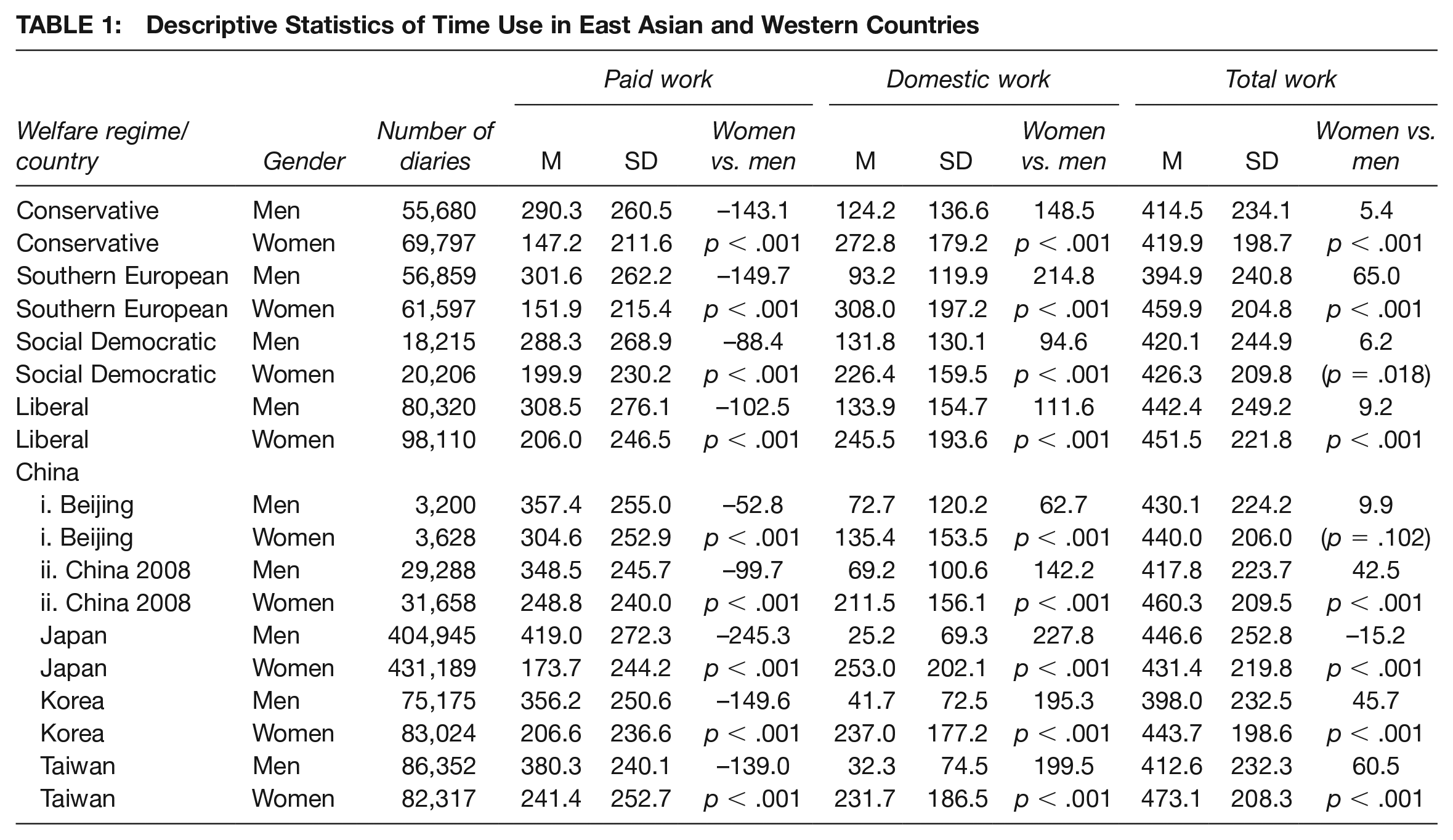
In the East Asian societies, men stand out with their longer time on paid work and much shorter time on domestic work than their counterparts in European and Anglophone countries. Men’s paid work time is about 1–2 hours longer per day in the East Asian societies than the Western ones and is the longest in Japan (419 minutes per day, compared with 308.5 minutes a day in Liberal countries). East Asian men also spend significantly less time on domestic work than men in the Western countries. The figures for China, Beijing, Japan, Korea, and Taiwan are respectively, 69.2, 72.7, 25.2, 41.7, and 32.3 minutes per day, compared with 133.9 minutes per day in Liberal countries. In the case of women’s paid work and unpaid work time, there are relatively modest differences between the East Asian and the Western countries, except that women in China, Beijing, and Taiwan have substantially longer paid work time (respectively 248.8, 304.6, and 241.4 minutes per day, compared with 206.0 minutes per day in Liberal countries).
The gender gap in paid work time is the largest in Japan (245.3 minutes per day), followed by Korea (149.6 minutes per day), Taiwan (139.0 minutes per day), China (99.7 minutes per day), and Beijing (52.8 minutes per day). The gender gaps in domestic work time are large in Japan, Korea, and Taiwan (respectively 227.8, 195.3, and 199.5 minutes per day), which are much larger than those in Liberal, Conservative, and Social Democratic countries, but are on par with that in Southern European countries (214.8 minutes per day). The gender gaps in domestic work time in China and Beijing are the narrowest among East Asian societies (142.2 and 62.7 minutes per day, respectively). In terms of total work, women work longer hours than men in China, Korea, and Taiwan (the gaps are 42.5, 45.7, and 60.5 minutes per day, respectively). Due to long paid work hours of men in Japan, Japanese men have longer total work time than women (the gap is 15.2 minutes per day). There is no significant gender difference in total work time in Beijing.
Comparison Across Countries/Regimes and Periods
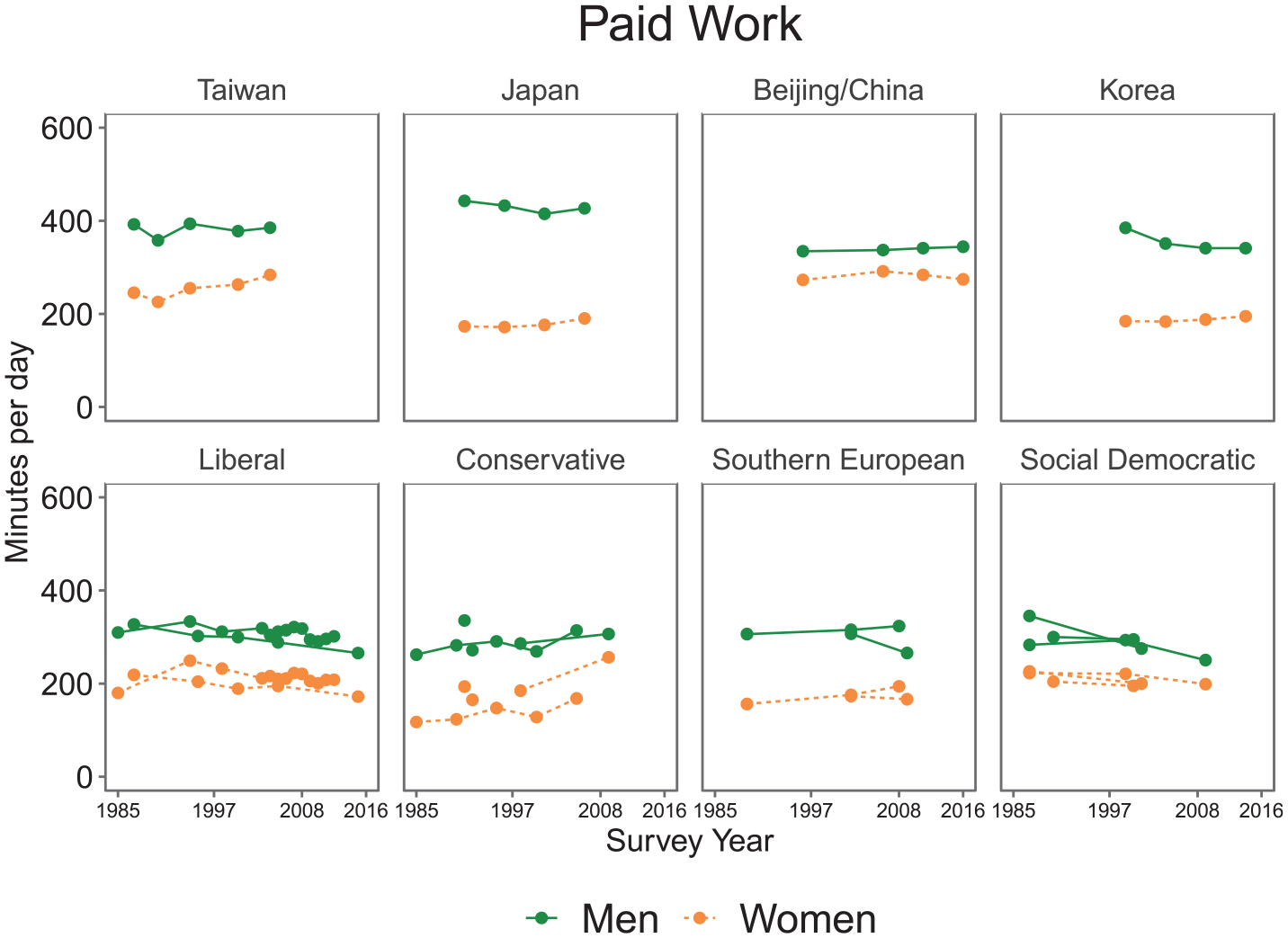
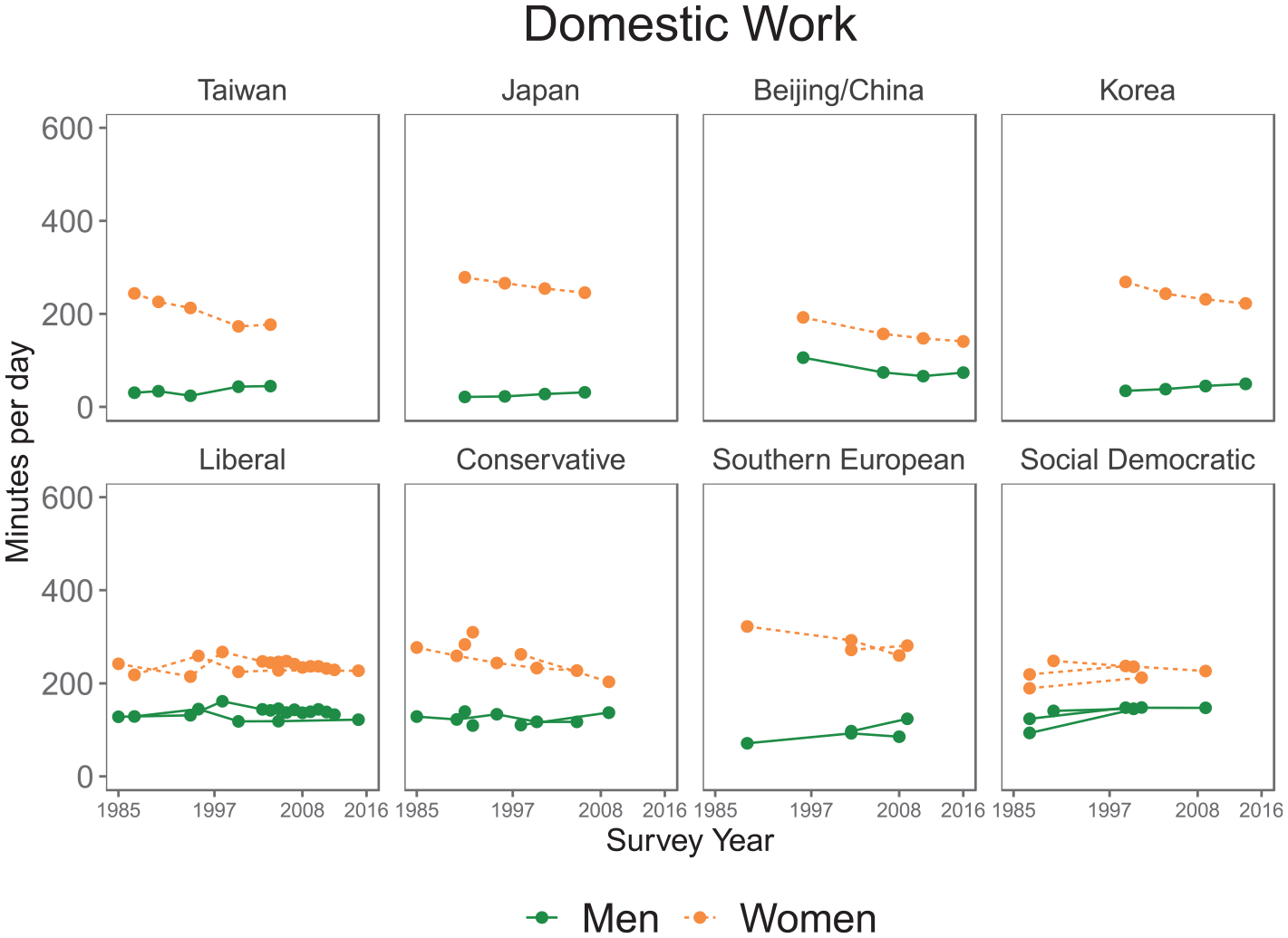
Figures 1 and 2 and Figure A1 in the Online Appendix present the summary of trends in women’s and men’s paid work, unpaid domestic work, and total work time. 3 Because Beijing is the capital in China and there is only one survey for China, we have grouped Beijing and China in the same graphs. Each dot in the graphs represents the figure derived from a survey.
Paid Work Time Use Trends in East Asian and Western Countries, 1985–2016
Domestic Work Time Use Trends in East Asian and Western Countries, 1985–2016
Whereas men have longer paid work time across the countries and periods, Figure 1 shows that the gender gap has been particularly large in Japan and Korea throughout the periods. Among the four East Asia countries, the gender gap in paid work time has been smaller in Taiwan and China/Beijing, and it appears to have shrunk over time in Taiwan. Among the Western countries, the gender gap in paid work time has been the smallest in Social Democratic countries, and it has been decreasing continuously over time. The gender gap has been the second smallest in Liberal countries and has remained persistent over time. The gender gap was of similar size in Conservative and Southern European countries before 1997, but has been decreasing since then in Conservative countries and has been persistently large in Southern European countries.
Figure 2 shows the trends in the gender gap in domestic work time. The gender gap in the Western countries has been the largest in Southern European countries, but the gap has been closing slightly over time. The gender gap in Conservative countries has been the second largest among the welfare regimes and has been closing gradually. The gap has been relatively smaller in Liberal and Social Democratic countries, though it appears to have been persistent, especially since 1997. East Asian men undertake far less unpaid domestic work, particularly in Taiwan, Korea, and Japan, than men in the Western countries. In addition, there has been little increase in their domestic work time throughout the periods. Women in Japan and Korea have the longest domestic work time among the East Asian societies. The gender gap in domestic work time has been substantial in Japan, Korea, and Taiwan, though it appears to have been declining gradually in Japan and Korea. In Beijing, the gender gap in domestic work time is relatively small but appears to have been persistent over time.
Women work longer hours than men in Taiwan, Beijing, Korea, and Southern European countries, although in Beijing the gap has been closed in the most recent year of observation. In Liberal, Conservative, and Social Democratic countries, men and women undertake similar amount of total work, and the direction of the gender gap has varied over time. In Japan, the gender gap in total work has been narrowed down, but men have longer total work time than women throughout the periods. See Figure A1 in the Online Appendix.
Multivariate Model Results
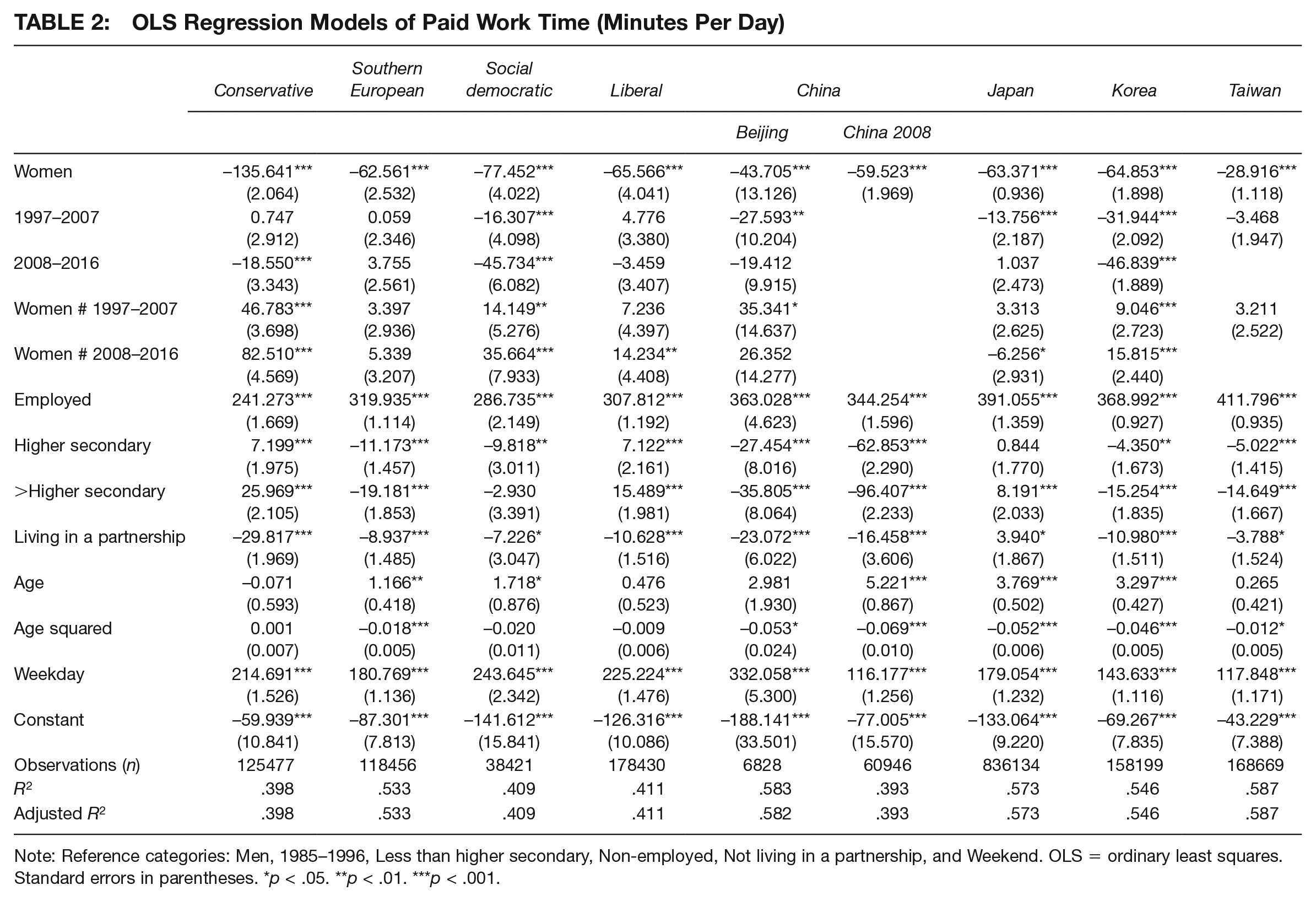
We investigate further how the gender gaps in time use have changed over time and across countries in multivariate models. Tables 2 and 3 present the OLS models on time spent on paid work and domestic work. The models for total work are in the Appendix Table A1. Our key variables of interest are gender and the interaction between gender and period, which show whether there is a gender gap in time use and whether the gap has changed over time.
OLS Regression Models of Paid Work Time (Minutes Per Day)
Note: Reference categories: Men, 1985–1996, Less than higher secondary, Non-employed, Not living in a partnership, and Weekend. OLS = ordinary least squares.
Standard errors in parentheses. *p < .05. **p < .01. ***p < .001.
OLS Regression Models of Domestic Work Time (Minutes Per Day)
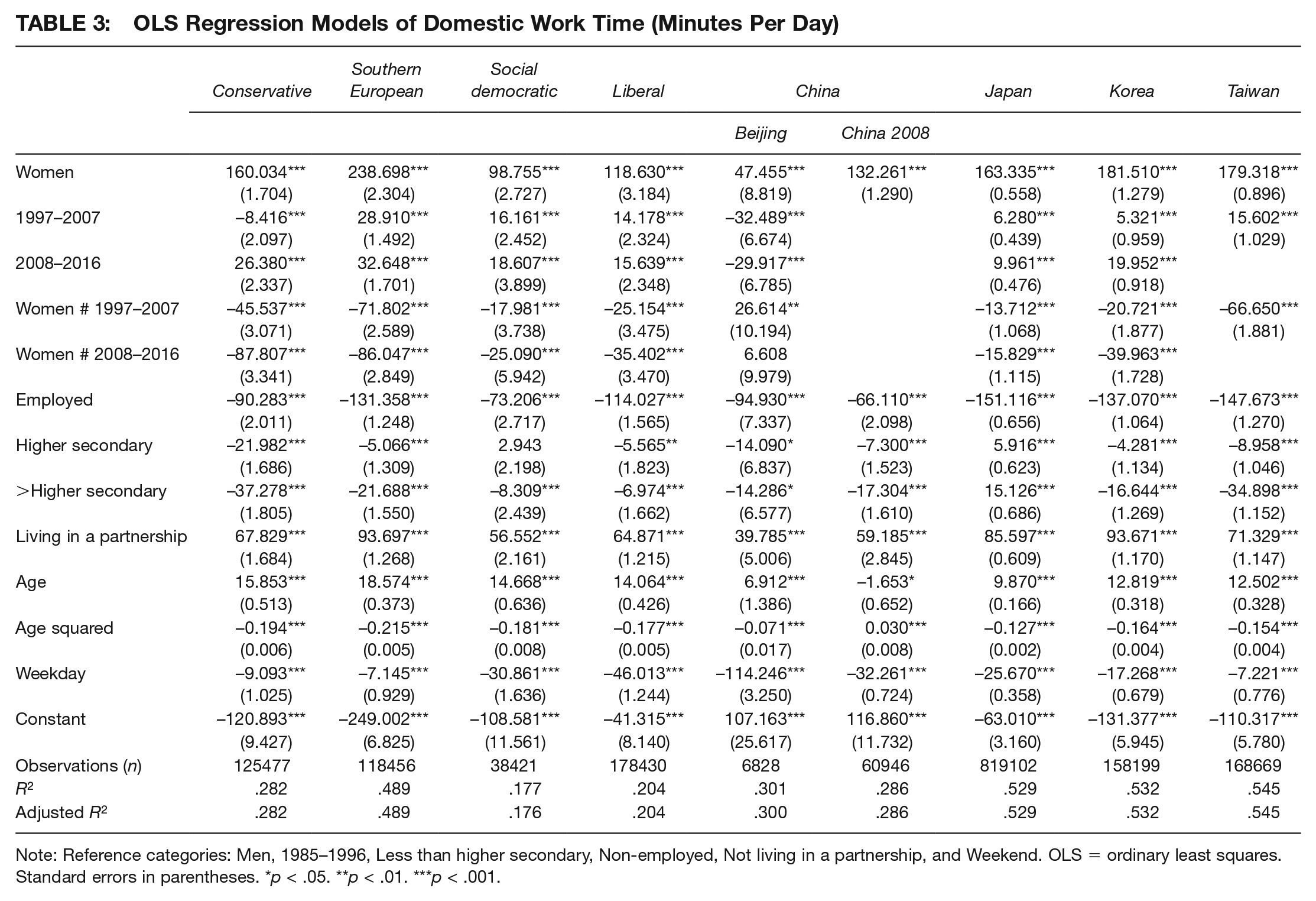
Note: Reference categories: Men, 1985–1996, Less than higher secondary, Non-employed, Not living in a partnership, and Weekend. OLS = ordinary least squares.
Standard errors in parentheses. *p < .05. **p < .01. ***p < .001.
Gender Convergence in Western Countries
As can be seen in Table 2, in all Western countries women spend less time on paid work. Taking all other variables into consideration, the gender gap in paid work was the largest in Conservative countries in 1985–1996 (135.6 minutes), followed by Social democratic countries (77.5 minutes), Liberal countries (65.6 minutes), and Southern European countries (62.6 minutes). However, the patterns and pace of the closing of the paid work time gap differ among the welfare regimes. Compared with 1985–1996, the gender gap was 46.8 minutes less in 1997–2007 and 82.5 minutes less in 2008–2016 in Conservative countries. In Social Democratic countries, compared with 1985–1996, the gap was 14.1 minutes less in 1997–2006 and 35.7 minutes less in 2007–2016, but there was no significant difference in the gender gaps in the latter two periods. In Liberal countries, the gender gap in paid work time remained unchanged in 1997–2007 but was 14.2 minutes less in 2008–2016; the gaps in the latter two periods are not significantly different. In Southern European countries, the gender gap has remained stable over the three periods.
Table 3 shows that in all Western countries, women spent significantly more time on domestic work than men (160.0 minutes in Conservative countries, 238.7 minutes in Southern European countries, 98.8 minutes in Social Democratic countries, and 118.6 minutes in Liberal countries) in 1985–1996. The gender gaps in domestic work time in 1997–2007 and 2008–2016 became significantly smaller than in 1985–1996 in all the four welfare regimes (respectively 45.5 minutes, 71.8 minutes, 18.0 minutes, and 25.2 minutes less in 1997–2007). However, only in Conservative countries, the gender gap continued to fall from 1997–2007 to 2008–2016. In the other three types of regimes, there is no significant difference in the gender gap in domestic work time between the latter two periods.
Women had longer total work time than men in all Western countries in 1985–1996. The gender gap in total work time was the biggest in Southern European countries (176.1 minutes), followed by Liberal countries (53.1 minutes), Conservative countries (24.4 minutes), and Social Democratic countries (53.1 minutes). The gender gap decreased in the earlier two periods in Southern European countries and Liberal countries (by 68.4 minutes and 17.9 minutes, respectively), but there was no further significant reduction from 1997–2006 to 2007–2016. In Conservative and Social Democratic countries, the gender gap in total work time was small in the beginning and had not decreased significantly in the latter two periods. Analyses can be seen in Online Appendix Table A2.
Gender Convergence in East Asian Societies
Table 2 also shows that women spend less time on paid work in all the East Asian societies. Taking all other variables into consideration, the gender gap in paid work was the largest in Korea and Japan in 1985–1996 (64.9 minutes and 63.4 minutes per day, respectively), followed by China (59.5 minutes), Beijing (43.7 minutes), and Taiwan (28.9 minutes). The patterns and pace of the closing of the gender gap in paid work differ among the East Asian societies. There is only one time point observation for China, and there are observations only for the first two periods in Taiwan. In Korea, the gender gap in paid work time had reduced only to a small extent by 9.05 minutes from 1985–1996 to 1997–2006 but had had no further reduction from 1997–2006 to 2007–2016. In Japan, the gender gap had increased by 6.26 minutes in the first two periods and remained stable since 1997–2006. In Beijing, the gap was reduced by 35.3 minutes in 1997–2006, but there was no significant reduction in 2007–2016. In Taiwan, there was no significant difference in the gender gap in paid work time between the first two periods.
As can be seen in Table 3, in all East Asian societies, women spent significantly more time on domestic work than men (181.5 minutes in Korea, 163.3 minutes in Japan, 179.3 minutes in Taiwan, 132.3 minutes in China, and 47.5 minutes in Beijing) in 1985–1996. The gender gaps in domestic work time in 1997–2007 became significantly smaller in Korea, Japan, Taiwan, but not in Beijing (respectively 20.7 minutes less, 13.7 minutes less, 66.7 minutes less, and 26.6 minutes more in 1997–2007). In Korea, the gender gap in domestic work continued to fall in 2008–2016, which was 40.0 minutes less than in 1985–1996. However, in Japan, the there is no significant difference in the gender gap in domestic work time between the latter two periods. In Beijing, the gender gap in domestic work remained stable since 1997–2007.
In 1985–1996, women had longer total work time than men in all East Asian societies except Beijing, where there was no significant gender difference in total work time. The gender gap was 116.7 minutes in Korea, 150.4 minutes in Taiwan, 101.5 minutes in Japan, and 72.7 minutes in China. However, in 1997–2007 and 2008–2016, the gender gap in Beijing had increased by 62.0 minutes and 33.0 minutes, respectively, compared with 1985–2006, though there is no significant difference in the values in the latter periods. In Taiwan, the gender gap in total work had closed by 63.4 minutes in 1997–2007. In Korea and Japan, the gender gap in total work had continued to decrease in the latter two periods (by 11.7 minutes and 24.1 minutes in Korea; 7.3 minutes and 25.2 minutes in Japan). See Online Appendix Table A2 for these analyses.
Discussion
Our findings do not support our first hypothesis, H1. In several countries (including Liberal, Social Democratic, and Southern European countries, Taiwan, and Japan), gender gaps in paid work and domestic work time had been reduced in the earlier two periods, but the convergence has stalled in the most recent period.
In contrast with some previous studies, we found supportive evidence for hypothesis H2. Women have longer total work time than men. The gender gap in total work time was substantial at 100–150 minutes per day in Japan, Korea, and Taiwan, and 180 minutes in Southern countries in 1985–1996. In Japan, Korea, and Taiwan, the gender gap in total work time has been reducing slowly over time (though we do not have data about Taiwan in 2010s). In the Southern European countries, the gender gap in total work decreased in the second period but has ceased to close since then. In Conservative countries and Social Democratic countries, the gender gap was relatively small at 1 hour or less per day in the beginning and has remained broadly stable over the three periods. The gender gap decreased in the second period in Liberal countries but did not fall further in other countries and periods. In Beijing, the gender gap was not significantly different from zero in the first period but had increased to about 1 hour since 1997–2006.
Our findings do not support hypothesis H3. There is no evidence to show that the pace of gender convergence in paid and unpaid work in the East Asian societies falls behind that of Western countries. The pace of gender convergence in Japan and Korea is similar to that in Southern European countries. In these countries, the gender gaps in paid work and domestic work are large. The closing of these gender gaps has been extremely slow in Japan and Korea and has been stalled in Southern European countries.
The pace of gender convergence in Beijing and Taiwan is similar to that in Liberal countries. In these countries, the gender gaps in paid work and unpaid work time are relatively small, and the closing of these gaps has stalled in the most recent period.
Finally, the findings support hypothesis H4. We found various patterns of the gender convergence in paid, unpaid, and total work time among the East Asian and Western societies. In Conservative countries, the gender gaps in paid and unpaid work time are both large, but the gap in total work is relatively small; the closing of the gender gaps in paid and unpaid work has been continuing. In Liberal and Social Democratic countries, Beijing, and Taiwan, the gender gaps in paid work, unpaid work, and total work time are relatively small, indicating stagnation in the progress of the gender division of labor. In Southern European countries, where the gender gaps are large in paid, unpaid, and total work, the closing of these gaps (especially in paid and total work) has been stagnant. In Japan and Korea, the gender gaps in paid and unpaid work time are large but the gap in total work time is relatively small; the gender convergence in paid and unpaid work time has been extremely slow and has even stalled.
Conclusion
This study is the first to bring East Asian data into international comparative time use research. By analyzing harmonized time use data from four East Asian and 12 Western countries between 1985 and 2016, we have revisited the gender revolution in paid work, unpaid work, and total work time. We have found heterogeneity in the pace of gender convergence in work time among both East Asian and Western societies. The patterns of convergence in Japan and Korea, which reveal extremely slow progress in gender equality, are similar to those of Southern European countries. Data from Beijing and Taiwan, characterized by smaller gaps in paid work and domestic work time but also stalled progress, are similar to those of Liberal countries. These findings cast doubt on the deterministic assumption of gender revolution framework: that increases in opportunities for women in the public sphere will necessarily bring gender equality into the domestic sphere. Our findings suggest that cultural norms interact with institutional contexts to affect the gender convergence in time use, and gender relations might settle at differing levels of egalitarianism (Esping-Andersen et al. 2013). Furthermore, policies relying on family ties and women’s traditional gender responsibility for care provision, as in the case of Japan, Korea, and Southern European countries, will hinder progress in gender equality.
The magnitude of the gender gaps, cultural factors, social norms, and policies plays an important role in determining whether the gender revolution in division of labor will stall or continue. In societies where the gender gaps in paid work, unpaid work, and total work time are relatively small (including the Liberal Social Democratic countries, Beijing, and Taiwan), the closing of these gaps has slowed down or stalled. In countries where the gender gaps in paid and unpaid work are large, some have shown a continuous convergence in paid and unpaid work time, but some have not. For example, in Conservative countries, where the gender gaps in paid and unpaid work time are both large, the gender convergence in work time has been continuing. In Japan and Korea, the gender gaps in paid and unpaid work time are large but the gender gap in total work time is relatively small because men have long work hours. However, the gender convergences in paid and unpaid work time have been extremely slow and have even stalled. In Southern European countries, the gender gaps are large in unpaid and total work, and the gender gaps in paid work and total work time have not decreased over the last three decades. These findings reveal that policies relying on families as a key source of care provision, including those of Southern European countries, Japan, and Korea, prevent women from increasing labor market work and reducing their share of domestic labor. In addition, the persistently long work hours in Japan and Korea have created barriers for men to committing time in domestic work.
Overall, by comparing different periods of gender convergence trends, we have found a more pessimistic picture of gender revolution than previous research has suggested (Altintas and Sullivan 2016; Kan, Sullivan, and Gershuny 2011; Sullivan, Gershuny, and Robinson 2018). There is overwhelming evidence of stalled progress in gender equality in the division of labor across both East Asian and Western societies, including the United Kingdom, the United States, Canada, Denmark, Finland, Norway, Italy, Spain, Taiwan, and Japan. The closing of gender gaps in paid work and domestic work time has stalled in the most recent decade in these countries.
Finally, our findings do not support earlier research (e.g., Craig 2007; Sullivan, Gershuny, and Robinson 2018) that argued that women and men have similar amount of total work. Past studies focused on the proportion but overlooked the absolute gender difference in total work time. Women undertake more total work than men over time and across countries, and the size of the gender gap is substantial, ranging between 30 minutes and 2 hours a day.
Overall, our findings call for policy makers to design policies more carefully to tackle the social norms about women’s domestic and caring responsibilities and maintain progress in gender equality in the division of labor.
Supplemental Material
sj-docx-1-gas-10.1177_08912432221079664 – Supplemental material for Revisiting the Gender Revolution: Time on Paid Work, Domestic Work, and Total Work in East Asian and Western Societies 1985–2016
Supplemental material, sj-docx-1-gas-10.1177_08912432221079664 for Revisiting the Gender Revolution: Time on Paid Work, Domestic Work, and Total Work in East Asian and Western Societies 1985–2016 by Man-Yee Kan, Muzhi Zhou, Kamila Kolpashnikova, Ekaterina Hertog, Shohei Yoda and Jiweon Jun in Gender & Society
Footnotes
Authors’ Note:
We thank the reviewers and editorial team for their generous and insightful feedback on this article. This project has received funding from the European Union’s Horizon 2020 research and innovation program under the European Research Council Consolidator Grant agreement No. 771736 (awardee: Man-Yee Kan), the Marie Sklodowska-Curie Grant agreement No. 892101 (awardee: Kamila Kolpashnikova), and the Economic and Social Research Council grant No. ES/S014098/1 (awardee: Man-Yee Kan).

Supplemental Material
Supplemental Material for this article is available online.
Notes
Man-Yee Kan is an associate professor of sociology, University of Oxford. Her research interests include gender inequalities in the family and the labor market, time use research, ethnicity, and migration. She has been awarded a European Research Council Consolidator Grant (2018–2024) for the project GenTime, which investigates gender inequalities in time use in East Asian and Western societies.
Muzhi Zhou is a postdoctoral researcher at the University of Oxford and an incoming assistant professor at the Urban Governance and Design Thrust, Hong Kong University of Science and Technology (Guangzhou). She studies how critical life events, such as marriage or childbirth, reshape people’s lives in Europe and East Asia, family formation patterns, and how children spend their time and its implications.
Kamila Kolpashnikova is a Marie Skłodowska-Curie Actions Individual Fellow at the Department of Sociology, University of Oxford. Their main research interests are aging societies, disparities in time use, and gender inequality in North American and East Asian societies. Dr. Kolpashnikova’s recent research featured in journals such as Work, Employment & Society, Asian Population Studies, PLoS One, and BMC Geriatrics.
Ekaterina Hertog’s research interests lie at the intersection of family sociology and digital sociology. She leads the ESRC-funded DomesticAI project that aims to scope new technologies’ potential to free up time now locked into unpaid domestic labor and measure how willing people are to introduce these technologies into their private lives. She is also a research fellow at the GenTime research project.
Shohei Yoda is a senior researcher at National Institute of Population and Social Security Research in Tokyo, Japan. His research interests cover marriage, divorce, fertility, and the well-being of single parents and their children. He is an investigator for the Japanese National Fertility Surveys and a member of the research project that produces Japan’s population projections.
Jiweon Jun is a senior research fellow at the Center for Transnational Migration and Social Inclusion, Graduate School of International Studies, Seoul National University. She specializes in empirical data collection and analysis on the issue of work–family balance, focusing on identifying the care burden of family caregivers and how care responsibilities are shared.
References
Supplementary Material
Please find the following supplemental material available below.
For Open Access articles published under a Creative Commons License, all supplemental material carries the same license as the article it is associated with.
For non-Open Access articles published, all supplemental material carries a non-exclusive license, and permission requests for re-use of supplemental material or any part of supplemental material shall be sent directly to the copyright owner as specified in the copyright notice associated with the article.
