



Abstract
Despite myths of color-blindness in the Netherlands, Black women are marginalized by mainstream expectations of racial and cultural homogeneity. I use Amsterdam Black Women as a case study to illustrate the lived experiences of women affected by this exclusion. In this space, women freely critique Dutch society through mundane moments of truth-telling, venting, and joking, which enable individual problems to rise to a community level. I explore how subtle configurations of Black feminist organizing can be key sites of healing, experimentation, and political engagement. This research complicates how we understand experiences of misogynoir when race consciousness is blended in a transnational context and how Amsterdam Black Women has made possible the refusal of Dutch norms that require members to accept their oppression silently and support false narratives of progressiveness and color-blindness.
Keywords
In the months following the murders of Breonna Taylor, Tony McDade, Ahmaud Arbery, Rayshard Brooks, and George Floyd, protests erupted around the world in solidarity with the U.S. movement for Black lives. In the Netherlands, tens of thousands protested in Amsterdam, the Hague, Rotterdam, Utrecht, Groningen, and Arnhem. While Dutch news coverage of these protests implied that police brutality was a problem unique to the United States, local protesters also chanted the names of Tomy Holten and Mitch Henriquez, a Black man and an Aruban man of color, respectively, who were murdered by Dutch police (Holligan 2020). The Dutch have been critiqued for having forgotten their colonial past, an “amnesia” of the physical, psychological, and spiritual violence committed against Black people for centuries that continues today (Bijl 2012). But despite this violence, the Netherlands refuses to discuss race and upholds the politics of color-blindness.
Alongside anti–police brutality protests, social movements and smaller scale efforts have been growing to oppose Dutch racism. The largest and most visible of these movements—Kick Out Zwarte Piet—protests the blackfaced caricature born of white colonial nostalgia. Activists use Piet as a vehicle to discuss systemic racism, the Dutch colonial past, present inequalities, and the silencing of racial minorities on these topics (Esajas 2014). Other initiatives address the exclusion of minority groups from mainstream spaces and discourse. For example, organizers fight for the labor market positions of Afro-Dutch people who are routinely barred from professional opportunities (New Urban Collective 2018). Dialogue about the history of Dutch slavery and colonization is encouraged because it is excluded from history, literature, and educational institutions (The Black Archives 2018). Students at the University of Amsterdam speak out against exclusionary policies to increase diversity and inclusion of the student body, faculty, and curriculum, and in institutional decisions (Afterlives of Slavery 2018). And guided museum and city tours confront the mainstream’s refusal to acknowledge Black narratives and contributions to Dutch history (Tosch 2018). This snapshot of anti-racist work spotlights protests against the routine and intentional erasure of Blackness in an insistently white society.
So how do people who are unfamiliar with this environment navigate the contradictions of living in a country deeply committed to the discrimination of racialized groups while simultaneously professing to be color-blind? This research investigates Black women’s lived experiences (Collins 2003) with racial abuse in the Netherlands and describes the subtle forms of organizing outside of activist spaces that are often overlooked in discussions about anti-racist work. To understand the impact Dutch society has on these women, I studied a social group called Amsterdam Black Women (ABW). I engaged with many women unfamiliar with Dutch culture—women who were neither born nor raised in the Netherlands and who largely identified as expatriates who had moved for professional or educational reasons. I observed how they found community and belonging among women with similar experiences being marginalized. ABW created a safe space, or a “physical, symbolic, and relational space to politicize and transform communities plagued by social alienation and highly destructive racial-gender ideologies that routinely constrict the political empowerment of their inhabitants” (Isoke 2013, 1). In ABW, women from all over the world were free to critique Dutch society through mundane moments of truth-telling, venting, and joking.
This research contributes to broader sociological understandings by exploring how gendered experiences are informed not only by race, nationality, and class but also by geographical location and personal biographies. I complicate Dutch understandings of global flows of race consciousness that have previously been described as prolonged knowledge transfers between the Dutch kingdom and its colonies through processes of colonialism and migration (Wekker 2016). These migration flows are no longer contained within the Dutch kingdom. As people and cultures move around the globe in increasing numbers, new identities are shaped and redefined. People’s understandings of race and ethnicity are placed within new contexts as they continue to make sense of their identities in new locations while the lingering effects of different colonial histories become mixed (McKittrick 2006). As a result, race consciousness developed outside of the Netherlands must be considered in discussions of anti-racist and Black feminist organizing because these outside views see Dutch culture, systems, and institutions with fresh eyes and, therefore, may be critical about structural and everyday manifestations of misogynoir 1 in new ways. I also examine how Black women’s experiences in Europe highlight additional mechanisms of oppression outside of a U.S. context (women’s “angle of vision on domination varies greatly” in a transnational context), which can, therefore, lead to different priorities, forms of imagination, and methods for organizing (Collins 2000, 231–32).
In this article, I briefly summarize the legacies of Dutch colonialism to demonstrate how white Dutch people prioritize themselves above Black people and people of color (POC). I theorize anti-Black color-blind racism and the use of race-neutral language as a mechanism to obstruct movement toward anti-racist action. I then place ABW within conversations of Black feminism and intersectionality in Europe to describe the need for “homeplaces” (hooks 1991) where women find safety, community, and healing through mutual understanding. Finally, I use the framework of otherwise (Raschig 2016) to explore how ABW fits into resistance efforts against white Dutch homogeneity as its members communicate the desire for new pathways to thrive.
Dutch Color-Blind Racism
For more than 200 years, from 1596 to 1829, the Netherlands moved over one million Africans in the slave trade to colonies in Curaçao, Suriname, Brazil, and North America to work on plantations under brutal conditions (Postma 1990). Only in 1828 did colonial law recognize enslaved people as human. The Dutch justified their enslavement, rape, violence, and oppression with pseudoscientific theories that assessed physical differences using measurements that created hierarchical classifications of character and intelligence (Afterlives of Slavery 2018). These classifications were used as evidence that Africans were inferior to Europeans and this perceived European superiority was discussed openly in public settings. In 1883, the International Colonial and Export Trade Exhibition in Amsterdam’s Museumplein put “primitive” racial Others on display, including Johannes Kojo, a young boy who was showcased in a fence-enclosed circus tent for white audiences to look at (Schuurmans 2013). At this time, because slavery took place in Dutch colonies and far from Dutch soil, most white Dutch people had only engaged abstractly with people of African descent. As a result, the pervasive, racist beliefs that Black people were inferior came to inform their interactions when residents of former slave colonies began migrating to the Netherlands (Essed 1991a).
After World War II, many Black people migrated either directly from Africa 2 or by way of Suriname, the Antilles, and Cape Verde (Blakely 2005). After Suriname gained its independence in 1975, almost 300,000 Surinamese migrated to the Netherlands through the late 1980s. And residents of the Dutch Antilles migrated, with roughly 144,000 living in the Netherlands in 2012 (Van Meeteren et al. 2013). These groups were perceived as aggressive, lazy, and resistant to Dutch culture (Essed 1991a; van Dijk 1984), in contrast to the white Dutch perception of themselves as “trustworthy, civilized, and ruled by reason and intelligence” (Esajas 2014, 99). Blackness and immigrant status were erased from their postcolonial context through the use of race-neutral language that did not require the explicit mention of these differences.
To give an example of this race neutrality, the Dutch government has linked minority “problems” to the embracing of foreign cultures and values (Siebers 2010). Black people are told that to be treated as equals in Dutch society, they cannot talk about differences, racial or otherwise. Through processes of assimilation, they are held to standards set forth by cultural citizenship where “emotions, feelings, norms and values, symbols and traditions define what can be expected of a Dutch citizen” (Duyvendak 2011, 92). This expectation puts pressure on migrant groups to assimilate to Dutch norms while erasing signs of being from elsewhere (Essed 1991b).
In addition to stripping migrant groups of their cultures, white Dutch people refer to themselves as autochtonen (“those who are from [the Netherlands]”) and racialized others regardless of nationality as allochtonen (“those who come from elsewhere”; Wekker 2016). This folk categorization is based on color, not country of origin, and despite professions of color-blindness, creates racial stratification by denying Black people the right to Dutchness, even if they were born and raised in the Netherlands (Essed 1991a). Whiteness is constructed as ordinary, so normaal 3 that it conveys a standard or goal (Wekker 2016). Preferences for cultural homogeneity (“masculine, white, and European clones”) exclude Black people from Dutch society through perceived misalignments around competency and cultural fit (Essed 2002, 2). This framing allows discrimination without needing to address race explicitly.
In the Netherlands today, Black people continue to be “excluded and marginalized in all sectors of society” (Essed 1991b, 6). They have lower rates of labor market participation, are institutionally kept out of higher education, are racially profiled by police, and receive harsher sentences than white people for similar crimes (Ersanilli 2007). They are discriminated against in the housing market and are routinely harassed while shopping or using public transportation (Essed 1991b). They also face higher risks of death correlated with a lower socioeconomic status (Bos et al. 2004).
Despite these data, there is a “forcefulness and even aggression” in the Dutch’s refusal to acknowledge race or racial discrimination (Wekker 2016, 1). But this insistence on color-blindness does not eliminate the ability to see color. Instead, it obscures the ability to see the effects of color (Lewis 2003). In this way, Dutch color-blindness allows people to claim that race has no impact on the material conditions of one’s life and that they are neither involved in nor accountable for the reproduction of inequalities (Bonilla-Silva 2006). Color-blindness allows “plausible deniability” for racist feelings and harmful policies (Krysan and Lewis 2004). In the Netherlands, color-blindness condemns resistance to racism by labeling it as racist, baseless, or misguided (Essed and Nimako 2006). In silencing Black people who openly confront racism, white people appoint themselves as authorities on what is or is not racist. This prioritizes white perspectives over those with lived experience of racial abuse (Essed 1991b). In other words, ignoring racial inequalities reproduces the very same racism that color-blindness claims does not exist.
Imagining otherwise in Black Feminist Spaces
In a direct contestation of color-blind ideologies, intersectionality has been used as an analytical tool to shed light on the lived experiences of people silenced at the intersections of race, gender, class (Crenshaw 1991), and nationality. Black women in white-dominated spaces experience “a continual battle against the denial of racism, against automatic in-group preference among whites, against constant impediments to their aspirations, against humiliations, against petty harassment, and against denigration of their cultures” (Essed 1991b, 10). Black feminism critiques Black women’s exclusion from mainstream feminist movements for being Black while also being overlooked by Black liberation movements for being women (Traylor 2005). Black feminism was founded on the belief that Black women are “inherently valuable” and are the only ones who care enough to work consistently toward their liberation from these oppressions (hooks 2014; Taylor 2017).
Black women from the United States have had centuries of knowledge from which to draw their understanding of structural racism: from living under conditions of slavery and segregation, family knowledge, and, more recently, exposure to Black studies and gender studies. In contrast, Black Dutch women began critiquing the racism in their lives much more recently due to “paternalistic dominant definitions” of race imparted to them by the Dutch education system (Essed 1991a, 209). Since the mid-1970s, Black, migrant, and refugee women in the Netherlands have critiqued their placement below the “normative and superior position” of white and male (Wekker and Lutz 2001, 63) and have contributed to a growing body of intersectional work. But in addition to local struggles, they have struggled on international stages to have their anti-colonial and anti-imperial resistance recognized because the intersectionality canon almost exclusively prioritizes North American perspectives. This makes it “difficult to name and take action on [their] particular racialised, gendered and classed experiences in a European context” (Emejulu and Sobande 2019, 4–5). Coupled with Europe’s depoliticization of race and its relation to power as an analytical dimension 4 (Essed and Nimako 2006), Black women have been erased from projects of intersectionality despite their knowledge production and contributions. Despite this, they continue to build spaces to analyze their lives and organize against the oppressions they face (Emejulu and Sobande 2019).
The continuation of Black feminist theorizing has become increasingly accessible to women around the world through the omnipresence of social media. Social networks have enhanced the visibility of numerous causes, lowered the cost of participation, and allowed individual participation to be effective in the collective (Van Stekelenburg, Roggeband, and Klandermans 2013). Counterpublics have been more accessible to organizers and movements have increasingly called for intersectional solutions to social problems (Jackson 2016). Through both online and offline activities, Black women with “otherworldly” motivations (Isoke 2013, 4) have organized from “homeplaces”—spaces where they are free to problematize society, affirm themselves, heal trauma, and find spiritual nourishment (hooks 1991).
Angela Davis insisted on the need for these spaces of truth-telling and healing in a 2016 interview. She said, “we have to begin the process of creating the society we want to inhabit now” (van Gelder 2016). This call to imagination represents an “impasse” (Raschig 2016) or site of “potentiality” (Zigon 2014) for participants who may not yet know how their societal critiques align with future justice (Cvetkovich 2012). It is this state of limbo, liminality, or what appears to be inactivity, where creativity inspires new methods to address social problems (Raschig 2016). This imagining of otherwise has been used to “name and frame political potentialities that are still emerging, to speculate possibilities beyond our dystopic present, [to] abolish the current order and living into radical transformations of worlds” (McTighe and Raschig 2019). Otherwise is “emergent,” “uncertain,” and “experimental” in its quest for social justice and health equity for groups who feel as if the world was designed against their survival and whose continued survival is by definition a “radical contestation of the social order” (Raschig 2016, 14).
In being forced to survive racism, Black women experience a drainage of energy that can lead to the breakdown of bodies (Coates 2015). Health care systems have denied Black women quality care, leaving them to diagnose, treat, and heal on their own (Ahmed 2014), leaving them vulnerable to conditions that increase their likelihood of health risks and premature death 5 (Putranto 2021). Rather than responding to this prejudice with defeat or detachment, an otherwise represents an active search for new configurations that conserve energy to combat this exhaustion. This refusal to go along with the belief that this reality is normal or fixed is radical in itself (Raschig 2016). “Homeplaces” are designed to deal with these adverse effects outside of established systems. They are sites of both self and community care that support the physical, emotional, mental, and spiritual health of their communities. As Audre Lorde (1988, 131) famously said, “caring for myself is not self-indulgence, it is self-preservation, and that is an act of political warfare.”
Method
Black feminists have expressed the importance of self-care as part of community organizing (Davis 2014; Lorde 1988) and ABW is an example where this work is being done in response to Dutch racism. The group was founded in 2015 by five expats of Jamaican, Haitian American, American, Bermudian, and Nigerian backgrounds and has since grown to more than 1,800 members. After moving to Amsterdam, the founders met organically and quickly became friends after discovering they had similar experiences feeling out of place in Dutch society as Black women. They realized the importance of having a support system to help navigate the unfamiliarity of the city and its unique manifestations of misogynoir. To make it easy for other Black women to connect with them, the founders created a page on Meetup.com that later moved to Facebook to accommodate the growing number of women who joined.
As a Black expat woman living in the Netherlands myself, I took a participative role in engaging with members and events rather than a purely observational one (Fine et al. 2003; Smith 1999). With permission from ABW’s founders to conduct research, I was able to attend members-only events and my presence did not challenge the safety of the Black and female-only space whose goal was to provide a reprieve from anti-Black racism. I could relate to members’ experiences and share my own without compromising group dynamics because of our shared identities. The space allowed authentic interactions because we did not have to alter ourselves or the ways in which we communicated for the white gaze.
I took a qualitative approach to understand the processes of meaning-making, healing, and resistance happening within ABW. I conducted a critical discourse analysis (van Leeuwen 2008) of Facebook posts to understand the conversations happening within ABW’s digital space. To supplement these data, I conducted interviews with ABW members and founders. What had living in the Netherlands been like for them? What motivated them to join ABW? What did their participation in group activities look like and what impact did these experiences have on their lives? I also conducted in-person participatory research to observe group dynamics directly. What did members talk about in person? Was ABW just a social project or was there political relevance to what was happening?
To conduct the digital analysis, I pulled all of the Facebook posts during a 2-month period for February and March 2018 (a total of 311 posts). I coded these by identifying topics in a bottom-up process and grouped them according to themes. More than 60 percent of posts were about being Black or celebrating Blackness (unsurprising, given the Dutch’s denial of race). The online space also functioned as a network for women to navigate the Netherlands in relation to salons, food, events, and culture. The themes in my sample included racism/colonialism, self-care, exercise/health, social events, politics, spirituality/religion, books/literature/writing, entrepreneurship, travel, hair/beauty, shopping, art, and style/fashion. This digital method was limited, however, in that it told only part of ABW’s story. Missing were more nuanced emotions, behaviors, and context of the lives of the women participating. For a more insightful analysis, I also wanted to observe in-person dialogues to understand the meaning taken from these interactions.
I conducted participatory research by attending ABW members-only events including book clubs, brunches, activist events, a film screening, a twerk class, a strategic planning meeting by ABW leadership, and I worked in the ABW co-working space with other members throughout my data collection period. During these gatherings, I listened to the women talk about mundane things—how their day was, how things were going at work, the funny thing their child said the other night, the cool new restaurant in Amsterdam-Oost.
One theme that came up many times in humorous but revealing discussions was the sameness of Dutch culture. One woman in a bright yellow dress said it was difficult for her to find clothes she liked because Dutch stores all carried the same dark clothing (“I feel like I’m complying with them when I don’t want to. The shops all have the same clothes but there’s still sunshine in me!”). On another day, another woman showed us screenshots of a recent Tinder match’s bio that read, “dark hair, dark eyes only.” She let out a belly laugh: “he’s tired of the same thing all the time too!”
I also conducted semi-structured interviews with 20 ABW members, including four of the group’s founders. To recruit, I posted about my research in the Facebook group and invited anyone who was interested in speaking with me about their experiences. I conducted interviews and participatory research in parallel, so as I got to know more women at events, I recruited in-person to diversify my sample in terms of nationality, sexuality, age, and time living in Amsterdam. We discussed Dutch culture, motivation for joining and participating in ABW, feelings of belonging, impacts on identity and society, and visions for the future. Allowing the women to narrate their lives and articulate ABW’s role in it was crucial in my understanding of the many commonalities across Black female experiences in the Netherlands. It also showed me the vast differences and how these differences affected perceptions of Dutch racism and the relevance of ABW in their lives.
Fourteen of my respondents had migrated to the Netherlands from the United States, France, Belgium, Ghana, the United Kingdom, Jamaica, and Bermuda. Six identified as Dutch or as being from a Dutch colony (three were born and/or raised in the Netherlands, two from Suriname, and one from Sint Maarten). I sought a mixed sample of Dutch women and those foreign to the Netherlands for insight on both perspectives, given differing views about race and experiences living versus migrating to the Netherlands. At the time of data collection, the women I interviewed ranged from 24 to 47 years old and had lived in the Netherlands for as little as 1 month to 27 years (for two of the Dutch women, their whole lives). Two respondents identified as lesbians and two as bisexual. The women were employed in a variety of industries and had varying educational levels, but more highly educated women and those from occupations that suggest a certain level of socioeconomic privilege are disproportionally represented. This highlights the large participation of expat women in ABW who were active at the time of research. For participant data, please refer to Table 1.
Participant Information
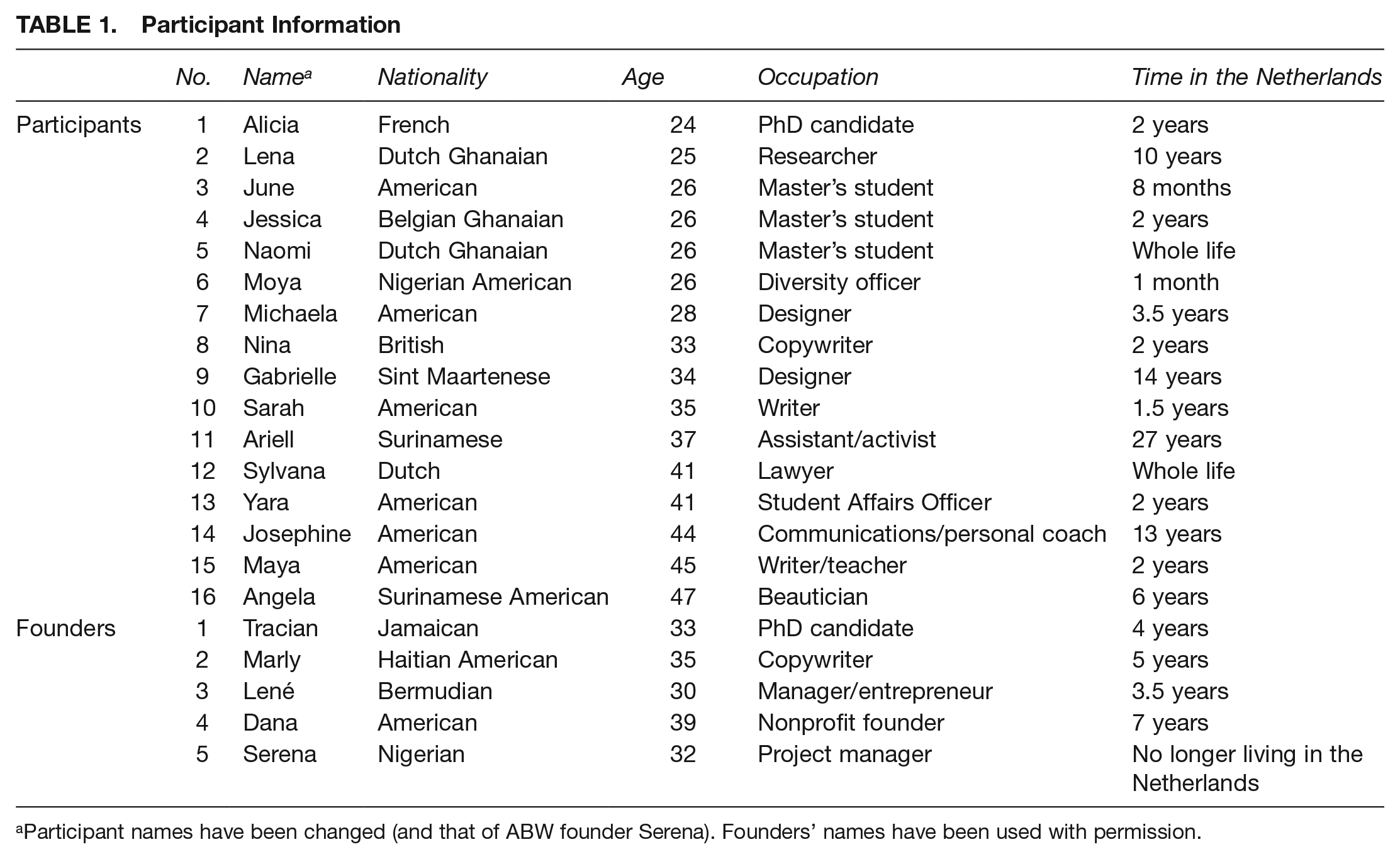
Participant names have been changed (and that of ABW founder Serena). Founders’ names have been used with permission.
I was initially curious about the ways the group was resisting oppressive racial and gendered structures, but the data I collected suggested that something much more subtle than outright resistance was happening. I engaged a range of literature on critical race theory, intersectionality, Dutch history, social movements, and more subtle forms of political action. My fidelity to grounded theory led me to understand that the impact of ABW was difficult to articulate with sociological frameworks alone, so I took an interdisciplinary approach. Given the immaterial potentiality of the interactions I observed, the anthropological framework of otherwise (Raschig 2016) gave me language to conceptualize what was happening and to describe the relevance of it despite its elusive nature.
I saw how members dealt with uncertainty in what was, for many, a new environment. I observed how they spoke of race and shared experiences about what it was like to be a Black woman in the Netherlands. Women found sympathy and support from others who acknowledged their problems as valid. They carved out a space where they could be rightfully angry, upset, sad, frustrated, or confused. As a “homeplace,” ABW was a space where women checked in to see how others were “really doing,” one respondent said. It was a place where they did not have to pretend to be doing well if they were not. This was a stark contrast to the performances of being “fine” in the white spaces members were accustomed to.
I came to understand what the conversations within ABW said about broader systems of power. Black women created space and community for themselves that responded to their needs, desires, and perspectives outside of the mainstream. ABW offered a space where women rejected the hierarchies of normaal that marginalized them and instead embraced new ways of relating to each other. Members imagined and embodied new ways of being without fully knowing what the impact could be in their lives.
Navigating Racism that’s “not like Anywhere Else”
Mainstream Dutch preferences for homogeneity, color-blind ideologies, and the refusal to reckon with the colonial past have created conditions that push Black women to the margins of society in a unique way. As one of the ABW’s founders described, “Dutch racism is not like anywhere else.” Conversations with ABW members uncovered explicit, sometimes violent stories about the discrimination they experienced in the Netherlands. But this analysis focuses on the smaller instances of everyday racism. In doing so, I hope to draw attention to the regularity in which Black women are Othered in Dutch society by challenging common beliefs that these experiences are minor and, therefore, undeserving of attention and critique.
Experiencing Dutch Racism
Although ABW members came together for happy hours, brunches, book clubs, and other events, both online and offline discussions were often about blatant forms of racism and microaggressions. Non-Dutch women focused on the ways that Dutch racism was different than the racism they experienced abroad. Members could not comfortably have such conversations in professional or social settings given how white those spaces were; so ABW became a place where women could “take their hair down” or “didn’t have to have armor on,” as respondents described it. Tracian, one of the group’s founders, stated the importance of feeling at ease as foundational: “We felt the need to have support, comradery, and ability to breathe easy around other people who knew what you were going through” (Amsterdam Black Women Meetup 2017).
According to respondents, a major aspect they found confronting was the “Dutch way” of doing things. Expats perceived this as the Dutch’s refusal to acknowledge non-Dutch ways of thinking or doing as valid. Michaela articulated, It’s something they call “the Dutch way” where they think that everything they do is right. You shouldn’t be an individual. Don’t do anything special, don’t step off the sidewalk. I had a situation once where I had a painter come over to give me a quote for [my apartment]. I decided to go through with it and he was like, “Oh great, I’ll go get the paint.” And I said, “What paint?” because I hadn’t told him a color. And he said, “Oh, everyone gets the same paint.” And to me that’s just so ridiculous that he would assume that I would get what everyone else gets.
Michaela allegorizes the imposition of a single, slightly off-white, paint color. There is an operating assumption that things in the Netherlands are done a certain way and this way aligns with mainstream values. There is a Dutch phrase, doe maar normaal, dan doe je al gek genoeg, which translates to be normal, since normal behavior is strange enough. This articulates the Dutch belief that preserving “normal” preserves order, and anything else would be chaotic (Coggins 2017). In preferring what is normaal, the Dutch mainstream eliminates other viewpoints and preferences from consideration, which makes it difficult for those with different perspectives to comfortably find a place in a society that does not encourage “stepping off the sidewalk.”
In addition to race, Black expat women were excluded because of their gender and nationality, 6 a reality that was exacerbated by being in overwhelmingly white middle-class spaces where the presence of Black people was uncommon given labor market discrimination that makes upward mobility difficult if not impossible for POC (Kloosterman, van der Leun, and Rath 1999). One of ABW’s founders, Dana, expressed how these intersecting identities affected her. She described social life in Amsterdam as “super cliquey,” where she was constantly reminded why she didn’t fit in with existing groups, which is typical for someone new to a city, but she described being Black and female as intensifying this experience. She felt alienated for being Black in white spaces and excluded in Dutch spaces for being foreign. Even when interacting with Black Dutch people, whom she assumed would relate to living in the Netherlands as Black, Dana felt out of place because many also avoided topics of race and subscribed to color-blind beliefs. 7 She described how she saw Black men getting around social politics and fitting in with white society in a way Black women “didn’t necessarily want to.” Black women were abandoned and left, in her words, “to fend for themselves.” They were left in a state of in-between where meaningful relationships were not made in white, Black, or other POC spaces, which left them in an “odd social limbo” that she felt others were experiencing but weren’t talking about or “finding a way to rise above.”
Over time, Black expat women felt incompatible with Dutch culture and unable to integrate into society fully, regardless of their ability to speak Dutch. In falling outside Dutch expectations of normaal, they felt simultaneously invisible and hypervisible (McTighe and Haywood 2017). Yara felt this hypervisibility when she was “gawked at” in grocery stores which made her feel “uncomfortable in [her] own skin.” ABW members found themselves even more of a minority in professional spaces than in social spaces, often saying the only other Black people they saw in the office were janitors. Moya remembered her first week of work vividly because one of her co-workers raked their fingers through her natural hair (ironically on a diversity and inclusion team). This was embarrassing for her because colleagues gathered around and stared. No one noticed the inappropriateness of the situation, which she said made her feel disrespected, like an animal at a zoo (reminiscent of Johannes Kojo). She said she felt her feelings didn’t matter in that moment and she wished her Dutch co-workers had been more aware of the way they singled her out because her skin color and hair texture were different. In contrast, Alicia recounted a time she was running late for lunch at work. When she arrived, her colleagues were already seated. As she walked up to the table, she heard one of her white co-workers tell the punchline of his joke: “Oh yes, because for us all Black people look alike!” Everyone at the table laughed. Alicia had just started an internship at the company and wasn’t sure anyone would stick up for her if she spoke up. She pretended not to have heard the joke, which made her feel vulnerable, angry, frustrated, and powerless.
Respondents told me that when they challenged their white colleagues for making racist jokes or remarks, they avoided discussions about race. “I don’t see color!” one of my respondents, Sarah, remembered her white Dutch co-worker saying. She said it was “exhausting and irritating to always have to have the conversation [about why that was problematic].” Respondents said when they pointed out harmful behaviors, they were told race didn’t exist or that they were being “ongezellig,” or unpleasant, which problematized the adverse reaction to racism rather than the racism itself. Even more “progressive” people who acknowledged racism as a problem in a general sense refused to think of themselves as capable of it and, if challenged, got defensive. Of course, in refusing to engage with Black perspectives on the topic, these white people asserted themselves as authorities and silenced Black people for challenging racism by attempting to manipulate their reality (Sweet 2019). In those moments, they reproduced the racism they claimed they were not capable of.
Because some forms of racism seemed so trivial, members of ABW often felt unsure of themselves for thinking something was amiss. Expat women took note of the inexplicable nuances of the racial gaslighting they experienced. And in trying to explain these hard-to-articulate situations, ABW members felt the need to prove that what happened to them was racist; they experienced a constant battle for empathy. To avoid the expenditure of energy in emotionally and psychologically unsafe environments, they often suppressed their opinions and pretended the racism they encountered was not that bad to avoid provoking difficult conversations with people who denied their experiences as valid. Others said their colleagues’ inability to listen, care, or at least attempt to “not be oppressive themselves,” as Jessica said, meant they could not engage beyond the minimal required civility, and as a result their friendships in the Netherlands remained superficial.
ABW uniquely addressed the exclusions Black expat women felt on the basis of race, gender, and nationality, which were further informed by class, by providing both online and offline spaces for community gatherings. The women found belonging that was so often denied to them by Dutch society. In Jessica’s words, There are no spaces for us [in the mainstream]. You can’t feel like you deserve to be someone or to be seen and what’s nice about ABW is that when women talk to each other they realize that everything is ok and that they are beautiful and that that’s enough.
In being a part of ABW, women felt freedom and a sense of well-being knowing they could speak their minds without fear of consequence. In being around other Black women, they circumvented the need to prove racism exists. This allowed them to, in their own words, “relax” and interact in “non-exhausting” ways that provided relief from the energy drainage they experienced in white spaces (Ahmed 2014; Coates 2015). In finding others at similar intersections of identities, members found common threads in their experiences and formed relationships that created alternatives to having to “fend for [themselves]” through acceptance, sisterhood, and trust. These pathways supported their emotional, mental, psychological, and spiritual health (hooks 1991).
A Micro-Society of Sense-Making and Refusal
Through globalization, Dutch race consciousness is being hybridized with international understandings of race as people with different colonial histories come together. My research highlights how expat Black women’s race consciousness, obtained from outside of the Netherlands, allowed them to identify microaggressions for what they were and provided the language to call out the racism they experienced. In seeing the Netherlands with fresh eyes, the women sparked conversations about race and more urgently identified the need for new ways to thrive. They refused their reality as “just the way things were” and challenged Dutch perspectives that may have been resigned to these realities, which has helped to complicate the way race is talked about in the Netherlands. Conversations in these spaces spread the hope that alternative ways to exist within the confines of global anti-Blackness were possible. This, alongside Dutch activists and anti-racist action, challenged the pervasiveness of Dutch racism.
An outcome of ABW bringing this global body of diverse women together is that they embodied the larger African diaspora and the vast ways Blackness is represented. Instead of homogenizing Black women, ABW held space for women of different cultures, nationalities, and experiences, and thus hosted a myriad of storytellers and understandings of Blackness. In a sense, ABW offered Amsterdam a multitude of paint colors (unlike Michaela’s painter) by acknowledging each one as important and by celebrating the uniqueness and variety of options. One of the ways the group accommodated this larger color palette was in its intentional representation of Blackness less often seen and heard. In book clubs, for example, the books read were often from lesser known authors who wrote about Black experiences outside of American or Western perspectives. In this way, members pushed back against a society that bombarded them with images of whiteness while they embraced the diversity of Blackness. Naomi, one of my Dutch respondents, talked about how not seeing herself represented in mainstream news, advertising, or pop culture added to insecurities about her beauty and potential. She feared not being pretty enough, feared being seen as incompetent, feared discrimination, and feared not being accepted compared with the white women she saw celebrated constantly as the standard of beauty. She said racism provided only a single story and that being exposed to diverse representations of Black women in ABW helped her to identify herself within a larger narrative.
Marly, one of ABW’s founders, described the group’s resistance to the Dutch’s insistence on whiteness: There’s cognitive dissonance between the larger society that we live in and this micro-society we’re creating. We aren’t seen the way we want to be seen and we want to have a presence. Blackness as a culture is hard to see and hard to access [in Amsterdam], and we’re creating culture through ABW. But it’s still its own bubble, its own microcosm, or micro-society within this larger space.
Within this microcosm, women had a safe space to talk about their lives and, in doing so, found continuities in their experiences being Black in the Netherlands. They routinely used this adversity to narrate personal biographies and they related to others even when their experiences differed. Through dialogue, they prioritized their own viewpoints as an important part of the ongoing collective development of race consciousness. In this ABW micro-society, women asserted that they “mattered” and deserved to thrive despite a society that refused them pathways to do so. By listening to others express that this type of abuse was not normal, members became more aware of the prevalence and unfairness of racism when in the past it might have been overlooked or diminished in severity.
Women identified why they felt negatively about past interactions and found ways to explain situations that had been previously difficult to articulate. Language to describe the subtleties of prejudice in a Dutch context was developed through the collective sharing of experiences and ABW members made each other more aware. Tracian explained how this race consciousness developed over time: What we learn with each other is how to explain how complex race is [in the Netherlands]. And when you talk to each other, it’s like, “This is what’s happening.” “Oh THIS is what’s happening!” “No, this is what’s happening!” It’s hard to articulate. You realize it’s not enough to transfer ideas about how race works in the United States for example. It’s really about trying to understand these little things that you’re like, “This is bothering me and I don’t know why.” And then you learn and learn and learn with each other how to explain it.
The diverse perspectives of the diaspora were drawn upon alongside those of Dutch women in a process of hybridization. They challenged normative expectations about what it meant to exist in Dutch society as it currently was.
Sylvana, born and raised in the Netherlands, talked about learning to identify instances of racism by participating in conversations in ABW, which gave her confidence to stand up for herself outside of the space. She described coming to the realization that Black women have the right to stand up for themselves when people made racist or sexist comments. She explained that she was now more vocal in these instances, and although she felt insecure about speaking up sometimes, she knew these microaggressions were not part of her imagination but because of misogynoir. She told me how unfair it was that society tried to deny her the ability to express her feelings, and that it was empowering to speak up and claim her right to do so. Her participation in ABW taught her that it’s OK to challenge the racism she encountered, and added that it was sad that we live in a world where she had to defend herself at all. Sarah, another ABW member, told me, “I think you get conditioned to think that your reality is normal. And it doesn’t have to be.” In explicitly stating that Dutch racism was something that “doesn’t have to be,” Sarah invoked this idea of otherwise. ABW created a micro-society that embraced the collective identity of Blackness and invited others into this community, refusing a society that told them their identities do not and should not exist.
ABW was a creative solution to legitimizing the concerns of its members. It bridged limited coping mechanisms with “novel political modalities” (Raschig 2016, 27). And regardless of visibility, we can explore how the private realm of ABW and the public mainstream are not discrete. Recognizing the fluidity in which Black women pass between ABW and mainstream Dutch society (like Sylvana) is key to understanding the exterior impact the group has on Amsterdam, which may offer additional clues about the social and political relevance of otherwise.
Discussion and Conclusion
ABW is experimenting with the precarious sovereignty that its founders and members have carefully constructed for themselves (Emejulu and van der Scheer 2022, 15–16). It refuses the violent framings of Blackness as “inferior, marginal, or Other” and has adopted a politics of hope that “[subverts] the arbitrariness of the current social order . . . a revolutionary and collective act of becoming” (Emejulu and van der Scheer 2022, 7). ABW created the conditions where Black women could better thrive in the Netherlands by offering new ways of seeking information, of relating, of surviving, and of resisting. Members helped each other navigate challenges and prevented others from experiencing similar suffering unsupported. ABW offered a space that made possible the refusal of Dutch norms that required its members to accept their oppression silently and support false narratives of unity, progressiveness, and color-blindness.
When Black women from all over the world collectively experienced the lasting effects of Dutch colonialism, their histories mixed with those of the Dutch. This blending of pasts, presents, and futures signals the globalizing effects of citizen mobility and the transfer of gendered race consciousness. Understandings of race evolved as ABW members discussed, identified, and explained their lived experiences as they found others invested in this process as well. Identifying instances of racism as a pathology rather than simply “the way things were” suggested that other forms were possible. ABW was a microcosm, a world Black women wished existed in mainstream society, one where they had voices that were acknowledged, understood, and validated. The urgent and natural ways in which the women spoke about race articulated the racial abuse and exclusion from mainstream society that motivated discussions to understand the mechanisms at play. By investigating personal experiences and sharing them with others, women built the frameworks necessary to understand the oppression they faced. ABW mobilized to solve social problems the Dutch mainstream is busy denying. The group refutes the myth of color-blindness by demonstrating the necessity of safe spaces for Black women. In ABW, individual problems were interpreted not as reductively subjective, but as a larger social reality that allowed grievances to transcend to a community level. Members imagined a world in which they were treated as equals. This imagining in itself was political because speaking critically about mainstream structures and institutions, dealing with related emotions, and returning to the world postprocessing are acts of resistance (Raschig 2016).
ABW underscores the dialogue happening through, over, and around the limitations of national boundaries as women from the diaspora come together to make sense of their shared situatedness in Dutch spaces. This research expands Black feminist theories by attending to the ways ABW members’ personal biographies, geographic context, and migration informed the way they experienced their identities as Black women in a Dutch context. It explores how race consciousness developed outside of the Netherlands is interacting with Dutch race consciousness in new ways to complicate how we understand the experience of misogynoir and the resulting grassroots efforts pushing for a more liberated world.
Similar initiatives born of the unique combination of geographic, cultural, and temporal contexts should be understood in their own right and not in reaction to other movements (Emejulu and McGregor 2019, 138). The depoliticization of race in a European context and the uniqueness of Dutch racism highlight additional mechanisms of oppression that ABW members have had to navigate. Subtle forms of political engagement bring attention to these additional mechanisms outside a U.S. context and unveil different priorities, forms of imagination, and methods for organizing in response to them (Collins 2000). In appreciating the mechanisms ABW has created that allow its members to better thrive, we can pay more attention to what the interconnectedness of Black women’s experiences are to find new ways to relate to each other. This could provide answers to how we can more collectively attend to many different histories as we continue to move toward liberation (Collins 2000, 231–32) because misogynoir does not stop at U.S. or Dutch borders.
ABW is pushing for minority visibility, inclusion, accountability, and justice but is only a single star in a constellation of social organizing opposing racism in the Netherlands. I hope that in recognizing initiatives like it, we can celebrate and encourage the emergent, experimental, and insistent nature of Black feminist political engagement. Subtle configurations of political engagement similar to those of ABW exist globally to resist racism, sexism, classism, homophobia, transphobia, ableism, fatphobia, and ageism, and should also be considered in broader political and social movement discourse. Groups such as ABW challenge the violence happening in the blind spots (or more accurately, the willfully ignored parts) of society. Despite the continued racial trauma that its members face, ABW’s Black feminist efforts incorporate community care not only to help its members survive but also to envision pathways for them to remain unbroken. This self-preservation is crucial in creating the conditions that allow further organizing and activism. Studying the impact of this would allow us to more quickly support grassroots, seemingly apolitical organizing in support of an otherwise world—a world in which we might not know the names of Breonna Taylor, George Floyd, or Tomy Holten for the reasons we do today.
Footnotes
Author’s Note
I thank the founders of Amsterdam Black Women, who openly invited my research and constantly made me feel at home. Thank you for creating the group and for speaking with me about its evolution. To the women I spoke with during research: Thank you for your time, your openness, and your experiences. Keep being brilliant, hilarious, and fabulously you. To my mentor, Pamela J. Prickett, who guided me tirelessly through numerous rewrites, thank you for challenging me to do my best work. Thank you to the anonymous Gender & Society reviewers, whose feedback was invaluable. And thank you to the wonderful Black women whose names I used to anonymize my participants.

Notes
Ariana Rose received her master’s degree in sociology with a focus on social problems and policy from the University of Amsterdam. Her research interests are about race, gender, health, and well-being. She is the founder of Studio in Between, a research and social impact design space in Amsterdam.