




Abstract
This feminist analysis focuses on sexual harassment within a specific category of jobs known as display work, where primarily women’s bodies are commodified and sold to consumers, and often through the conduits of powerful male industry leaders. Using qualitative content analysis methods to analyze 88 subjective, first-person narratives of harassment from 70 models working within the fashion business, I describe how the commodification of bodies interacts with the particular features of the modeling industry—the premium placed on youth, ambiguous industry demands, and the presence of kingmakers—to produce an environment in which opportunities for sexual harassment can proliferate. All these factors impose extreme worker vulnerability costs on predominantly women and ultimately contribute to maintaining gender-based, hierarchical power differentials between men wielding authority within the industry and these models over time.
Sexual harassment in the United States has emerged as one of the defining features of hostile workplace environments within which mostly women have had to contend (McDonald 2012; McDonald and Charlesworth 2016; McLaughlin, Uggen, and Blackstone 2017). Simply put, sexual harassment is “the unwanted imposition of sexual requirements in the context of a relationship of unequal power” (MacKinnon 1979, 1). Depending on the exact nature of the definition, approximately 25–60 percent of all American workers have indicated that they have been victims of sexual harassment (Feldblum and Lipnic 2016). 1 The effects of such abuse are numerous, including employment-related harm, such as increased absenteeism and turnover, lower levels of productivity, and decreased job satisfaction; in addition, negative mental and physical health effects, such as depression and post-traumatic stress disorder, can also occur (Fitzgerald et al. 1997; McDonald 2012).
Although the #MeToo movement has brought increased public attention to this issue most recently, scholarly work on sexual harassment has a long history and has continued apace over multiple decades. Much empirical research has explored sexual harassment by relationship dyads, such as supervisor–employee or employee–employee interactions, within specific organizations (Alvinius and Holmberg 2019; Icenogle et al. 2002). Other scholarship on such dyads has examined how clients perpetrate harassment on workers in particular occupations, such as in the medical or sales fields (Lu-Ming 2013; Williams, de Seriere, and Boddington 1999). Rather than focus more narrowly on these types of perpetrator–victim interactions, in this feminist analysis I unpack how sexual harassment is facilitated within a specific category of jobs: display work. Many types of display work involve women who are compensated for showing their bodies in a variety of ways to male, end-user consumers. In other cases, display workers sell goods to both men and women, but sometimes must interact with authoritative men who dominate major aspects of the business in which they are employed. This is true in the case of fashion, where women’s bodily displays as models are controlled mostly by men in the industry. With this as background, I explore how the commodification of bodies in the display work of modeling and certain contextual features of the fashion industry interact to perpetuate gender-based, hierarchical power differentials between men holding positions of authority in the business and those women employed as models in the field.
In doing so, I analyze models’ subjective narratives of sexual harassment submitted anonymously to an Instagram social media campaign designed to raise public awareness of this issue. It is an innovative and important data source from which to collect sexual harassment experiences because victims are often afraid to come forward and tell their stories for fear of retaliation or, worse, not being believed (McDonald 2012). In addition, sexual harassment frequently occurs in private, and to the extent that it is handled legally or organizationally at all, is often not a matter of public record (Crowley in press). This analysis is therefore fundamental to our understanding of how sexual harassment operates from the vantage point of its victims in contemporary society.
Display Work And The Commodification Of Women’s Bodies
Over the past several decades, scholars have developed numerous theories to explain sexual harassment, all of which revolve around the intersection of gender and power. More specifically, some have pointed to biologically based aggression among men (Berdahl 2007), organizational environments controlled by men (Gutek, Cohen, and Konrad 1990), the pervasiveness of societal sexist relationships (MacKinnon 1979), work-related chains of command where men occupy the top positions (O’Hare and O’Donohue 1998), and gendered socialization processes that privilege men as all contributing to sexual harassment (Blackstone, Uggen, and McLaughlin 2009). As described earlier, much of the empirical work that employs these theories explores sexual harassment within potentially exploitative dyadic relationships across a variety of employment settings.
More recent feminist analyses, however, have moved this scholarship forward by describing how women’s bodies function in specific employment settings to influence the dynamics of sexual harassment. One type of employment—display work—pertains to the visual offering of the human form, or bodily capital, for an audience’s consumption in exchange for wages (Wacquant 2004). As such, display work involves the commodification of the body as a site for investment and purchase (Mears and Connell 2016). Display work can include photos, videos, or live performances of the body, and consumers pay for the opportunities to watch these bodies across these venues. Unlike other jobs where appearance is one component of what workers are marketing—such as the retail and service sectors where self-presentation is a highly valued part of commercial transactions—physical appearance is the primary service offered for sale in display work (Mears and Connell 2016). Display workers can include athletes, dancers, strippers, and, most importantly for this discussion, fashion models.
Critically for this analysis, most display work such as modeling involves the sexualization of the body, and particularly women’s bodies. Butler (1993) has argued that bodies are discursively produced within a context of compulsive heterosexuality, with femininity imposed onto bodies as a result of gender-based power dynamics. Within the context of display work, even though sex itself might not be explicitly for sale, the commodification of women’s bodies produces opportunities for men to nonetheless sexualize the individuals whom they are purchasing to view or with whom they are interacting as other industry players. There is, in other words, an implied sexuality in the display work of modeling, where women are sexually objectified and men are the active subjects who sexualize them (Mears 2008). Put another way, models become display work objects and are treated as such by multiple types of male industry players.
Contextual Features Of The Modeling Industry
Display work within the modeling business does not exist in isolation; instead, it interacts with industry features that are governed by the rules of the specific economic system within which it is situated as well. More precisely, modeling is an occupation that operates within the cultural economy, sometimes also known as the creative economy, whereby consumers buy products primarily for their aesthetic value (Stokes 2015). Many types of goods and services fall under this rubric, including film, television, and music (Mears 2011). Like these other goods and services, the creation of fashion is overwhelmingly about form over utility. This is in direct contrast to the manufacturing economy, whereby goods are produced directly for their utility and consumption, such as cars, furniture, and other household items.
Over the past several decades, innovators in the cultural economy space have introduced and celebrated new ideas about the concept of work (McRobbie 2002). One of these central ideas is the process of individualization, whereby workers are “freed” from the ties of family, community, and demanding supervisors in order to pursue their own personal dreams of creativity (Banks and Milestone 2011; Bauman 2001). In this new economic paradigm, the purported possibilities for individual happiness and self-actualization among workers are seemingly boundless. Individualization signals to young workers particularly that they can escape the monotony of eight-hour jobs and domesticity and instead aspire for careers promising vast opportunities for upward mobility.
The process of individualization within the cultural economy, however, also comes at a cost (McRobbie 2002). Industries within the cultural economy often lack formal, operational rules and instead function according to informal norms of conducting business. Notably, these informal processes or features can serve to disadvantage women workers, especially with respect to sexual harassment. Indeed, in multiple cultural economy industries, scholars have found that factors such as the vulnerability of contingent work, an emphasis on individual performance, and the power of informal networks in providing jobs all serve to make sexual harassment more likely and even “normalized” (Christopherson 2011; Eikhof and Warhurst 2013; Gill 2002). This is similar to the research that has been produced on some service occupations, whereby women employed in the retail and hospitality industries frequently experience harassment as part of their jobs in catering to male customers (Good and Cooper 2016).
Modeling exhibits both the advantages and disadvantages of working within the cultural economy. Undoubtedly in terms of the advantages, modeling as a form of display work within the cultural economy is an extremely exciting and autonomous occupation that provides its workforce with a high degree of stimulation (Neff, Wissinger, and Zukin 2005). Typically models will be scouted (or discovered) and then signed by a specific agency that represents or “sells” them to clients. Agency representatives or bookers then send the models on casting appointments to meet clients who might want to hire them. When models go to casting appointments, they arrive with their “books” (photo portfolios) and composite cards that contain their best photos, name, agency, and body measurements (Mears and Finlay 2005). Often clients including designers will take photos of them, and then request that they put on specific outfits and walk back and forth in front of all of the individuals responsible for making hiring decisions (Entwistle and Mears 2013). Alternatively, models may go directly to meet with individual photographers for test shoots, to take additional photos for their books, or to be photographed with the assistance of stylists and makeup artists for particular sales campaigns. As part of their entire careers, then, models have the potential to interact with interesting and even famous people, receive professional makeovers before being photographed, and even receive free clothes from certain jobs.
However, there are also disadvantages to working in the cultural economy’s modeling industry. More specifically, three of its contextual characteristics have the potential to enable sexual harassment. To begin, the industry values youth. Indeed, the majority of models work between the ages of 13 and 25 years, and the average duration of a modeling career is 5 years (Mears 2011, 12; 95). Because the industry is seen as hyper-glamorous, and every so often a handful of models reach superstar status, there is an enormous oversupply of mostly young girls who aspire to take a chance on this career. Agencies are aware of this, and “drop” models all of the time who are seen as underperforming or in some way causing “trouble.” In many ways, then, models’ relative youth can diminish their power relative to older veterans in the industry—mostly men—who are responsible for supervising their professional development (Neff, Wissinger, and Zukin 2005).
The next feature relates to ambiguous industry demands that are placed upon models (Mears 2008, 2011). Ambiguous industry demands are simply vague instructions given to models that can produce an abusive working environment when they go out on casting appointments or meet with photographers. These instructions usually take one of two forms. In some cases, industry leaders regularly claim that “everyone else is doing it” to justify their demands on models. In these situations, models simply lack a reference point of acceptable behavior within the industry, which can lead to harassment. In other cases, industry professionals who are predominantly men use the vague terms of “art” or “high fashion” to define what they are looking for from models regarding how to act, pose, and otherwise respond to direction. Here, the lines are often blurred between art and sexual exploitation. Overall, these two factors generate an environment of asymmetric information, with models having less knowledge about what is appropriate in a particular work setting and therefore holding less power than other authoritative operators—mostly men—in the industry.
The final feature of the modeling business is the presence of “kingmakers,” or those individuals with perceived substantial power in the industry to make or break careers. For models, the kingmakers are the set of highly regarded scouts, agents, stylists, photographers, and designers who are well known, well established, and well connected (Entwistle 2002); they also are predominantly men. If models establish positive relationships with these kingmakers, they can potentially increase their chances of “making it big.” Models deploy a variety of techniques toward this end. For example, models learn to “turn on the charm” and use “strategic friendliness” with kingmakers at the right moments so that they can maximize the likelihood that they will be perceived as the proper fit for the job (Neff, Wissinger, and Zukin 2005). Models also view socializing, including going to agency-sponsored events and parties, as a key means by which to meet their own personal kingmakers and beat the odds to have a successful career in the industry (Entwistle 2002; Entwistle and Wissinger 2006; Wissinger 2009). In doing so, however, models often find themselves holding less power on the job as they attempt to be deferential to the different kingmakers who move in and out of their work lives.
In sum, mapping out how the commodification of bodies involved in display work interacts with these industry features to shape models’ experiences of sexual harassment is the critical goal of this analysis. I focus on the words of the models themselves as they describe their experiences with this type of abuse. In providing the details of these events in response to an Instagram social media campaign to raise awareness on the issue, these models not only highlighted their personal pain, but also sought to reclaim power from those who sexually harassed them.
Methods
The data for this analysis are subjective, first-person narratives of sexual harassment collected by supermodel and social justice activist Cameron Russell. She published them on her publicly available Instagram account in October 2017; at that point in time, Russell had approximately 88,900 Instagram followers (@cameronrussell). 2 Russell’s efforts to collect sexual harassment stories began the day after she posted supportive thoughts about the International Day of the Girl Child (October 11, 2017), which promotes girls’ empowerment on a global scale. After this post, a fellow model sent Russell her personal story of being assaulted by a photographer when she was only 15 years old. Russell shared this anonymous experience on October 12, 2017 on Instagram and encouraged other models and those working in the industry to come forward and send her their own experiences of sexual harassment. In return, she promised to publicize their anonymous stories on her own Instagram account. After her call to action, Russell fulfilled her promise and published the stories from 78 individuals that she received during October 12–14, 2017. 3 She protected their identities by removing the submitters’ names and alleged perpetrators’ names, as well as other identifying characteristics. She also added the hashtag #MyJobShouldNotIncludeAbuse to each anonymous story to make them more readily searchable on Instagram. 4 Overall, then, Russell created an innovative, powerful, and unique data set of sexually harassment experiences in the fashion industry. In my analysis here, I used and studied the posted narratives directly from Russell’s Instagram account.
To interpret these data, I began by downloading the narratives from the 78 individuals that were submitted and posted. Of these initial 78 individuals, eight were excluded because they were from photographers (six), a showroom assistant (one), and a makeup artist (one). This produced a final sample of 70 models, four of whom were men. Of these 70, 12 provided multiple experiences of harassment by different perpetrators at various points in their careers. Counting each of these separately generated a total of 88 unique narratives of harassment by these 70 models. Like most all other qualitative datasets, the sample is nonrandom; however, the data still can tell us about the important and rich lived experiences of the models who have been exposed to sexual harassment.
I analyzed the data using qualitative content analysis methods primarily with a directed or deductive approach (Hsieh and Shannon 2005). This is useful when theory has offered initial themes that are likely to be found in the data and the current project is designed to add evidence or modifications to this theoretical knowledge. First, I read and reread all their narratives, paying particular attention to how they described the commodification of their bodies in each case of sexual harassment. I then coded the data with respect to the industry’s contextual environment around these cases using the software program NVivo 12 Pro by QSR International. More specifically, I coded themes related to the premium placed on youth, ambiguous industry demands, and/or the presence of kingmakers. In describing the narratives presented below, I use actual quotations from the models as they discussed their subjective, lived experiences with sexual harassment. In the presentation of the findings, I also assigned all of the anonymous models their own fictitious names in order to more effectively tell their stories.
Last, establishing the trustworthiness of the data is an essential part of using qualitative methods (Denzin and Lincoln 2011; Elo et al. 2014). Four central trustworthiness criteria are the following: credibility, transferability, dependability, and confirmability. With respect to this study, there are both limitations and strengths with respect to trustworthiness. First, credibility means that those who are studied are depicted accurately, an issue that has emerged in other studies using Instagram accounts for data (Johansson, Johansson, and Andersson 2018). Because a third party collected the data on a confidential basis (Russell), I could not have the participants clarify their ideas, which would have been ideal. Second, transferability is the ability of the findings to be extended to other settings and individuals. Many factors influence the transferability of this study, which again have arisen in similar ways with other scholarship using Instagram data (Berard and Smith 2019; Johansson, Johansson, and Andersson 2018). Some issues in this study are the unknowable motivations and constraints of the participants providing their stories and the period of data collection when the topic of sexual harassment was high on the public agenda that might be unmatched going forward. Third, the data are dependable when they are stable over diverse times and settings; I employed the code–recode method using NVivo 12 Pro to improve the accuracy of the findings. Finally, the data must ideally exhibit the characteristic of confirmability, meaning that they should interpreted as objectively as possible. On this point, I relied on a reflexive journal during the analysis to constantly be aware of my own biases as I interpreted the narratives.
Sexual Harassment In The Modeling Industry
In this study, those working in the cultural economy’s modeling industry experienced multiple forms of sexual harassment, ranging from verbal abuse to violent physical assault. The interaction between the commodification of bodies involved in display work and the three features of the modeling business—including the premium placed on youth, ambiguous industry demands, and the presence of kingmakers—each served to promote the conditions under which sexual harassment took place. All these features led to extreme worker vulnerability costs for mostly women and functioned to sustain gender-based, hierarchical power differentials between the models and the predominantly men working within the industry. Table 1 lists each model by assigned name, gender, number of unique harassment narratives submitted, and each perpetrator’s gender and occupation. As Table 1 illustrates, the overwhelming majority of victims were women, and the overwhelming majority of perpetrators were men. In addition, most of the perpetrators were photographers by occupation.
Models by Assigned Name, Gender, Number of Harassment Narratives by Different Perpetrators Provided, and Each Perpetrator’s Gender and Occupation
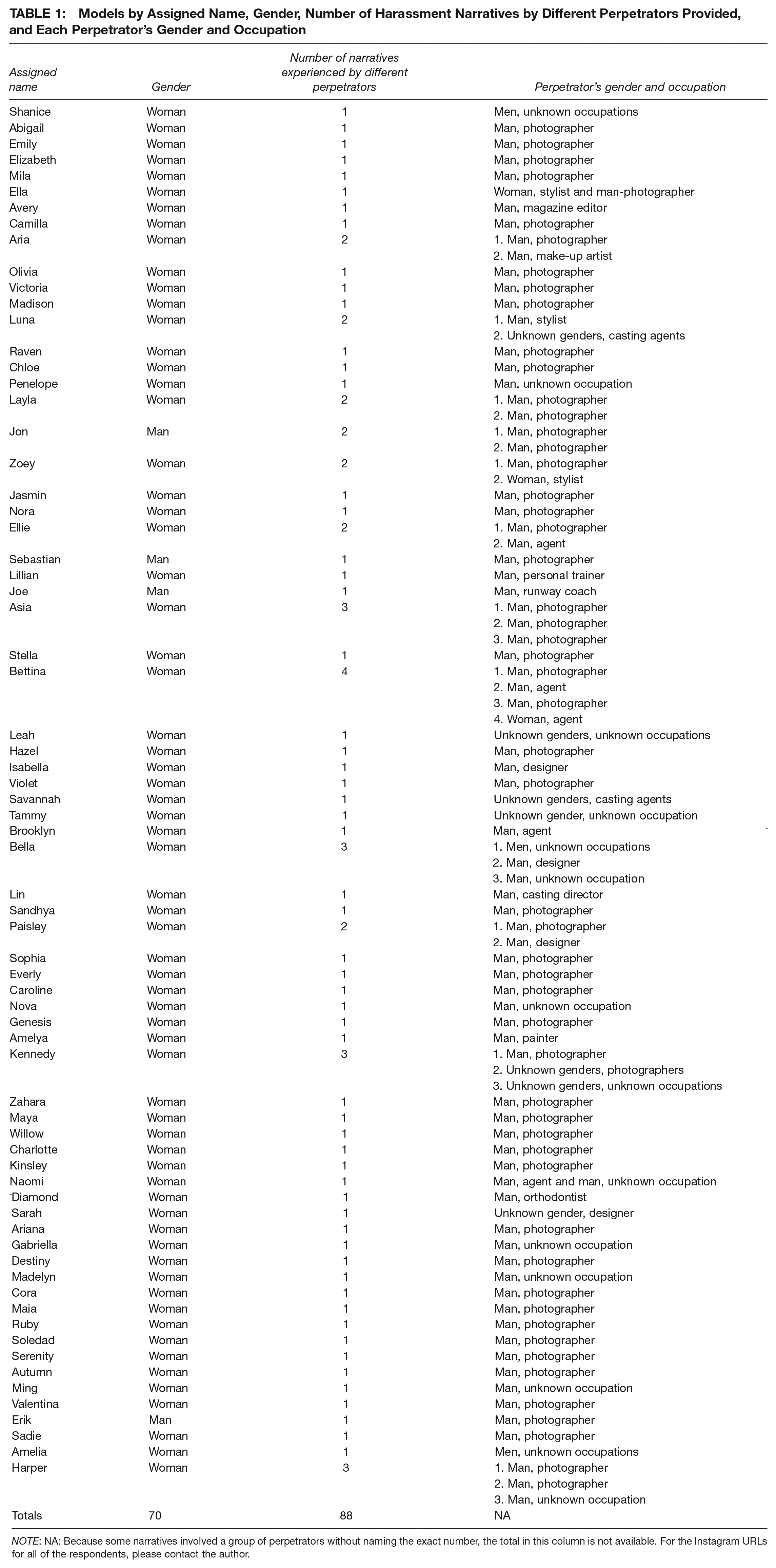
NOTE: NA: Because some narratives involved a group of perpetrators without naming the exact number, the total in this column is not available. For the Instagram URLs for all of the respondents, please contact the author.
The Premium Placed on Youth
The contextual feature of the modeling industry’s premium placed on youth was evident among models in this study; this emphasis on youth interacted with the inherent commodification of predominantly women involved in display work to produce sexual harassing behaviors from perpetrators. Modeling is a young person’s occupation, and the industry tends to expel those who have “aged out” of the profession (Mears 2008; Rodgers et al. 2017). This means that the industry leaders—mostly men—have more exploitative control over these women as display workers because the power differential is intensified due to this wide age gap.
This was apparent first when the models discussed instances of verbal abuse and reported being “spoken to” as display work objects rather than as individuals deserving of respectful and equal communication. As one example, Penelope was only 15 years old when she began to work on a music video shoot. 5 She reported that while she was getting ready, she was talking to the stylist about her modeling career goals, while the male photographer lingered in the background. At one point, the photographer “cut me off and told me, ‘I think you need a good shag!’” Penelope declared that she was horrified at the remark because she was a “child. He was a man with a family.” The verbal harassment of underage models also took the form of direct threats. Brooklyn reported a terrifying incident that happened to her as a young, teenage model. 6 After her agency representatives sent her to work outside of the country, they hired a local male manager to bring her to casting appointments. What happened to her next horrified her.
One manager in Japan once told me he had a huge dick while he was driving me to a casting. I [was] 15 or 16 and wearing a short skirt and reading a book, so I immediately [tightly closed] my legs and started staring [out] the window. Then I lied to myself—he must've said something else and the accent got in the way. Then he told me in a very aggressive tone that he also had [a] gun.
Brooklyn understood the nature of the manager’s last comments to be a threat. However, she was nearing the end of her contract so she “never mentioned it to anyone because I felt responsible for wearing the skirt.”
Sometimes this harassment of underage models took the form of men with high levels of authority in the industry demanding nudity or inappropriate clothes on the job site. In this way, industry leaders treated models as display work objects “to be disrobed,” or have their clothes removed in some way. Mila was only 16 years old when she went for a test shoot in London. 7 At first, the photographer, a man, asked her to wear hot pants and different tops for the session. Mila reported, “I was 16 at the time and obviously so naïve—[pause] I did it.” However, at the end of the day, as Mila began putting on her regular street clothes, the photographer asked her if he could shoot her “for a personal project, and that he would only send the photos to me (not the agency).” He then told her “to get undressed because he wanted to shoot me naked. Yes, I did it. Do I regret it? Every day.” Mila remarked that the worst part was that she “never saw these naked photos,” so she did not know what happened to them.
Similarly, Camilla was only 17 years old when she went to New York City to do a test shoot alone with a male photographer. 8 Everything was moving along well with the session until the photographer made a new demand.
[The photographer] basically [forced] me to take my clothes off and get in the shower so he [could] take photos. I was terrified and didn't know what to do, so I just did it.—[pause] I feel like it is my fault because I did it. He took advantage of me in many ways.
In telling her story, Camilla was very angry. Looking back on her experience, she insisted that “this [behavior] should NOT be normalized. It is unacceptable.” She also remarked that she was especially concerned about “other young people going through these [same] situations.”
Underage models also described horrifying incidents of sexual assault in great detail, reinforcing the idea that male industry leaders like them “young” because they are less likely to speak up even when confronted with extreme harassment (Simmerson 2013). In these cases, men “acted upon” models as display work objects. Sophia recounted that at age 14, her harassment began when the male photographer with whom she was working started asking uncomfortable questions “like if I was a virgin or if I had performed certain sexual activities, and I would laugh it off just thinking it was weird.” 9 Her hope that the photographer was just odd or eccentric, however, was far off the mark as the shoot progressed and he asked her to change clothes.
When I changed into the second look, he forced me to change in front of him and he proceeded to rub oil on my legs. He saw I was wearing Calvin Klein underwear and insisted on shooting me in them. I was 14 and he was aware of this. He kept making me uncomfortable saying things like, “Oh my God, you’re so sexy” and “You make me want to go to jail.”. . . I stayed at the shoot because I was too scared to leave and he forcefully kissed me at the end.
While Sophia at the age of 14 had to experience unwanted touching and kissing, Naomi, at age 16, faced multiple sexual assaults while working in the industry. 10 In one case, everything seemed fine as a man from her agency along with his friend, another man, invited her to a nightclub in Paris where she was working on a job. As the night wore on, however, they started to make sexual advances; Naomi told them no immediately because “it was clear they wanted a [threesome].” However, the two men climbed into her taxicab as she attempted to leave the nightclub and continued their aggression toward her to the point where “[one man] put his hand up my skirt while the other man put my fingers in his mouth.” She described herself as “terrified” by the encounter. Sexual assaults like those experienced by Sophia and Naomi all included feelings of being both debilitated and controlled by older and more powerful men in the industry. In other words, when the age gaps are so wide, power differentials become intensified and inexorably linked to sexually harassing behaviors.
Ambiguous Industry Demands
The modeling business’s feature of ambiguous industry demands played out in many ways and was intertwined with the commodification of predominantly women’s bodies in display work to produce sexually harassing behaviors by perpetrators. Ambiguous industry demands took two forms. First, primarily men in the industry used extremely vague language to imply that “everyone else is doing it” when pressuring models to pose or act in certain ways, with models lacking a reference point for acceptable behavior. Second, mostly men made arguments based on producing “art” or “high fashion” as the sole justification behind their requests of models, which often blurred the lines into exploitation. Unlike in some industries where newcomers receive instructions in terms of how to perform their jobs, in modeling there is no formal industry socialization process whereby models learn largely agreed-upon and transparent rules of the game (Taormina 1997). Instead, these two ambiguous industry demands come across to models as potentially plausible but, in the end, are abusive. Ultimately, this means that these industry leaders hold significant power over models as more vulnerable display workers who remain unaware of the business’s murky and ever-changing operating procedures.
Sometimes, this sexual harassment emerged in the form of verbal abuse when models were “spoken to” as display work objects as opposed to communicators capable of equal individual agency. Caroline described an incident when she went to a shoot in New York City and the male “photographer quickly began talking about how he always has sex with the models that he shoots and gave me unwanted details of some of his sexual encounters,” with the implication being that she would engage in the same activities. 11 When he became aware that she was disgusted by his comments, he ridiculed her body, telling her that she “was fat and that no agency would ever want to sign me.” He then laughed at her and told her that he would photoshop her to appear thinner. When Caroline started to cry, he mocked her by saying, “Welcome to the industry.”
Ariana, another model, faced similar pressures.
12
When she was 20 years old, she was working with a male photographer in conjunction with an entire fashion team. The photographer kept pressuring her to drink, [or] then knock at my [hotel] door at night or ask me to drop by his room to look at the shots from the day. He got pushier until the last day of the shoot. The makeup artist said: “Can you just sleep with him so we can all get a break? Everyone else does!” When we got back, my agency asked me, “Why [was I] so rude?” I told them what happened and they said, “Just don't make us lose him as a client.”
Ariana resisted his advances and the abuse from the makeup artist who had encouraged her to have sex with him because “everyone else does.” This ambiguous norm of what “everyone else does,” though, undoubtedly was used as a weapon to try to force her compliance.
Ambiguous industry demands also emerged in the form of requests for nudity or inappropriate clothing. Here, industry leaders attempted “to disrobe” models as display work objects. Zoey was a model who experienced this kind of pressure in multiple venues.
13
In one instance, Zoey reported that when she was just starting out in her career, she tried to shoot sexier images for her book. However, she objected when a stylist—who notably was a woman—asked her to put on fully sheer lingerie for a shoot. After Zoey declined to wear the lingerie, the stylist started to question her about “how I expected to work in the industry if I wasn't comfortable” with clothing like that. According to the stylist, important clients would be requesting that she do this all the time and that she needed to be compliant in order to meet industry requirements. This example is exceptional in that it demonstrates that although most perpetrators are men, women also can engage in sexually harassing behaviors (Douglass, D’Aguanno, and Jones 2020). In this case, Zoey stood her ground against the “everyone else is doing it” ambiguous industry demand and put together another outfit that was less revealing and ultimately acceptable to her clients.
On another occasion, a male photographer bullied Zoey with respect to taking off her clothes in the name of “art.” Once . . . a photographer . . . asked me to get into the bathtub naked or in my underwear so he could photograph my long hair floating [in] the water. He promised only my face would be in the shot. I said I wasn’t comfortable and he kept pushing to try the shot because of how beautiful and “high fashion” it would be. I tried to get out of it by saying I was on my period. He said he didn’t mind.
As noted earlier, “high fashion” was a term that was used interchangeably with “art” as a way to make harassing requests in a more industry-acceptable way. In another case, a model named Kinsley reported working with a male photographer when she was 18. 14 The shoot required that she wear lingerie, which she at the time had no problem donning. Soon after the shoot started, however, the photographer requested that she remove her top. Although she was a little uncomfortable, she complied. After additional shots, the photographer then asked that she take off her underwear, which she declined. He continued to demand it, and when she kept refusing, he declared that “I clearly didn’t understand art and obviously didn’t care how the photos would turn out, and that this shoot was a waste of his time.”
Ambiguous industry demands also created an environment that led to sexual assault; these involved circumstances where models were “acted upon” as display work objects. Sebastian, one of only a few male models in this study, described the type of harassment he experienced as coming from multiple sources, including photographers, casting people, and even his own agent. 15 Sebastian’s case demonstrates that although it is not common, men, too, can be victims of sexual harassment (Scarduzio, Wehlage, and Lueken 2018). In the specific situation Sebastian described in detail, the male photographer with whom he was working wanted him to be partially aroused in his skimpy briefs to get the silhouette that he desired for his photo. When Sebastian excused himself to make that happen, the photographer insisted that he just “do it right there,” without the benefit of privacy. Sebastian was extremely uncomfortable but followed the photographer’s instructions. Later, the photographer insisted that he touch Sebastian himself in order to obtain the desired image. When Sebastian replied that he was uneasy with that, the photographer replied “that all the other straight guys he shoots were fine with it and I couldn't be so closed-minded if I wanted to work in the industry.” Cast in these terms of “everyone else is doing it,” Sebastian felt that he, too, had to comply and thus did so.
Charlotte described the same type of pressure to conform to ambiguous industry demands as did Sebastian, and likewise experienced sexual assault. 16 After moving to New York City, Charlotte went to a test shoot with a male photographer to create more professional photos for her book. She was told to bring a nude thong and black heels for the session. Once she was there, the photographer “kept asking me to take my top off—that it was high fashion.” Used this way, “high fashion” was simply another way of describing the production of “art” as an ambiguous industry demand. After Charlotte refused to comply, the photographer climbed on top of her.
He told me it was the only way he could get the shot he wanted. I was 19 and new to the industry. Society hadn’t equipped me with the tools to scream, “NO! GET OFF ME” so instead, I squirmed under him trying to be “sexy.” Suddenly I realized I was pinned down and he was gyrating on me and groaning. I was terrified.
Charlotte declared that after this incident, her memory went blank and to this day, she has no recollection of how she physically got out of his studio. These two forms of ambiguous industry demands—claims that “everyone else is doing it” with models lacking a reference point of acceptable behavior, and calls for “art/high fashion,” which can result in exploitation—both served to sustain power differentials between the models and male industry leaders, thereby leading to sexually harassing behaviors.
The Presence of Kingmakers
The contextual feature of the modeling industry involving the presence of kingmakers also intersected with the commodification of women’s bodies in display work to generate sexually harassing behaviors from perpetrators in multiple forms. As discussed earlier, models often had a strong desire to please these men who could potentially launch their careers and, like many other workers in similar situations, tried to be receptive to their needs and requests whenever possible (Bennett and Bridgstock 2015; Hesmondhalgh and Baker 2008; Mears and Finlay 2005; Pierce 1995). Here again, however, these dynamics created wide power differentials between the mostly male industry leaders and the models as display workers with whom they interacted.
In practice, this harassment meant that models first had to deal with verbal abuse or being “spoken to” as display work objects rather than addressed as equal, autonomous beings. One model named Layla described a situation where she was booked to work with one of her “dream photographers.” 17 She initially thought this male photographer genuinely believed in her as a model—despite the fact that he verbally harassed her with inappropriate comments during their first meeting. At that time, she indicated that she overlooked his words because “I thought he would be my big break and that his words were harmless.” However, after the shoot was over, the photographer tried to get her to “stay with him” and his friend, clearly implying his desire for a sexual relationship. When she rejected him, “his colors completely changed. He went from being so warm and positive to ice cold. [He made me] feel like I was the one who had done something wrong by not wanting to sleep with him.”
Jon, another of the small number of male models in this study, and who started his career later than normal at age 18, also experienced verbal harassment from a kingmaker. 18 While he was working in London, he began to receive messages from a well-known male photographer. Jon “really admired his work and was flattered that he was interested in working [with] me.” However, circumstances changed when “after discussing a possible shoot with him, he gradually became very ‘heavy,’ suggesting that I come and stay with him in New York and that I could be his ‘muse.’” At first, Jon dealt with these advances using subtle, negative replies. After receiving these mild rejections, however, the photographer became more aggressive. “The conversation then became a lot more sexual (from his side) . . . [implying] as a reward [for nude photos that] he would put me on the cover of his upcoming book.” Even though Jon declined his advances, with the photographer’s status as a kingmaker, he potentially acted this way toward any aspiring model.
The pressure to appease kingmakers within this industry’s contextual environment also made models susceptible to demands for nudity or inappropriate clothing during their time on the job. In these cases, this meant that industry leaders attempted “to disrobe” models as display work objects. Maya described an instance where she felt that a well-known male photographer forced her into posing naked. 19 At the time, she was new to the industry and she sensed that her “career could end in minutes if he decided to tell people I was not a good model to work with.” In the end, he intimidated her into complying and insisted that “nothing would happen” because he did not intend to publish the photos. In another case, Ruby reported that it was difficult to find photographers with whom to work because she was shorter on average than most models at 5 feet, 4 inches tall. 20 When a popular, male photographer agreed to work with her, therefore, she was excited about the opportunity. Soon after they began the session, however, he asked her to “take off my clothes for lingerie shots.” Ruby did not know how to respond at first, but agreed to have the photos taken because of her perceived limited career opportunities. Afterwards, however, she worried about his potential harmful interactions with other models. She concluded, “This photographer is also well known and has shot with girls such as [redacted]. I have no idea what he's done to other girls or how he hasn't been caught.”
The desire to please kingmakers in the business also led to sexual assault, with models’ bodies being “acted upon” as display work objects. Models often confronted circumstances where they wanted to work with kingmakers but were fearful of what these industry leaders might ask of them. Stella described a situation where she met a well-known male photographer for drinks. 21 She did not think anything bad would happen, even after he invited her to his friend’s apartment where he said “a bunch of people” were supposed to be gathering for a party. When she arrived, no one was there but him. Soon after, he started to make sexual advances. Stella recalled saying “Stop. I have a boyfriend [and] if you go any further, I will leave.” Nevertheless, because “he was a famous photographer and put me under the spell of him being able to ‘make my career,’” Stella stayed longer, hoping that his behavior would change. At one point during the night, he assaulted her by feeling “me up.” At that point, Stella finally left.
In another case, Sandhya’s kingmaker was a well-known male photographer. 22 Sandhya’s bookers informed her that he was thinking of including her on the cover of a well-known magazine. They instructed her to be “friendly and easy to work with.” With this information, Sandhya went to his studio on the weekend where she was promised that one of her representatives would be there. That never happened.
My booker never showed up. After talking about the shoot, [the photographer] asked me to change into my underwear and said he needed to shoot me lying down on a blanket. Minutes after lying down, he was on top of me and grinding himself against my hips while shooting. He touched my [behind], breasts, and would not stop.
In an environment where kingmakers have extreme power over individuals’ careers, models like Stella and Sandhya often faced the dehumanizing experience of sexual assault as they attempted to achieve success in the industry; the kingmakers’ power was simply overwhelming and therefore propelled sexually harassing behaviors.
Conclusion
In this feminist analysis I explain how sexual harassment emerges within a specific category of jobs: display work. I used an innovative and compelling source of data—Instagram posts—that reflected both the authenticity and precarity of models experiencing abuse in the fashion industry. I identified how the commodification of women’s bodies in the modeling business interacted with its contextual environment to create and recreate the conditions under which sexual harassment can proliferate (Conor, Gill, and Taylor 2015; Jones and Pringle 2015). Overall, the intersection of the commodification of bodies through display work with various industry features led to extreme worker vulnerability costs for mostly women and, over time, contributed to sustaining gender-based, hierarchical power differentials between men as leaders in the industry and these models as more vulnerably situated industry participants.
Sexual harassment in the modeling industry operated in the following way. Women’s commodified bodies led to opportunities for verbal abuse where authoritative men in the industry felt free to speak to them as display work objects, asked them to be nude or wear inappropriate clothes on the set such that they were disrobed as display work objects, and sometimes assaulted them when they were acted upon as display work objects. This treatment as objects functioned together with three contextual features of the modeling industry—men preying on the innocence and ambition of underage girls due to the premium placed on youth, ambiguous industry demands, and the presence of kingmakers—to promote an environment where sexual harassment ran rampant.
This study, of course, is not without its limitations. This sample was composed of individual models who submitted their narratives of harassment to Cameron Russell’s Instagram account in 2017. Future research should attempt to collect data more systematically from a wide variety of sources to see whether their experiences match those presented here. In addition, these findings are drawn from one specific industry within the cultural economy: display work in the form of modeling. Analyses going forward should examine other industries where the commodification of the body is central to see whether the contextual features of the premium placed on youth, ambiguous industry demands, and the presence of kingmakers each contributes to a climate where sexual harassment can fester. Hennekam and Bennet’s (2017) research on cultural economy industries in the Netherlands produced some of these same themes, but most respondents spoke about sexual harassment in general terms and not about their own personal experiences. Accordingly, one area of great scholarly importance is collecting individual-level data regarding sexual harassment.
Nevertheless, this study has important implications for our theoretical understanding of sexual harassment. Display work in the occupation of modeling takes place within the larger cultural economy. Most industries within the cultural economy such as acting, filmmaking, music, and the like operate under a “high-risk, high-reward structure.” This means that individuals working in these fields take a series of gambles with their professional lives to achieve rare, breakout levels of success. In addition, and in the present study, edginess—or operating against traditional, acceptable behavior in the workplace—appeared to be a significant characteristic of the cultural economy’s modeling industry. In this way, sexual harassment is not so much offensive conduct that takes place on the job, nor even the normalization of this offensive conduct as has been documented by other studies, but rather an implicit endorsement of it. Industries operating within the cultural economy, thus, throw out the old playbook of acceptable sexual behavior among workers and introduce a new one with no explicit rules. Yet not every participant agrees with this lack of rules. My findings document strong endorsement by powerful male industry leaders who were the perpetrators of sexual harassment and equally strong rejection among the models who were mostly women and the victims of sexual harassment. Future research on sexual harassment in industries located within the cultural economy should focus on the ways in which these behaviors are viewed as simply edgy rather than abusive across all participants, or whether, as is the case here, divergent perspectives are correlated with gender and power.
Footnotes
Author’s note:
I thank Roy Katzman, Rob Vincent, Ellen Braitman, Sarah McMahon, M.B. Crowley, Patricia Sheffield, and Fabiana LoPiccolo-Stewart for their research assistance and comments on this manuscript. The Jerome G. Rose Excellence in Teaching Award provided financial assistance to support this project.

Notes
Jocelyn Elise Crowley is a Professor of Public Policy at Rutgers, The State University of New Jersey. Her research focuses on the American family and work. Notable books include The Politics of Child Support in America and Gray Divorce: What We Lose and Gain from Mid-Life Splits.