



Abstract
We examine the role flexible working has for gender equality during the pandemic, focusing on arrangements that give workers control over when and where they work. We use a survey of dual-earning working parents in the United Kingdom during the peak of the first lockdown, namely, between mid-May and mid-June 2020. Results show that in most households in our survey, mothers were mainly responsible for housework and child care tasks both before and during the lockdown period, although this proportion has slightly declined during the pandemic. In households where fathers worked from home during the pandemic, respondents were less likely to say that mothers were the ones solely or mostly responsible for housework and child care. Fathers who worked from home were more likely to say that they were doing more housework and child care during the lockdown period than they were before. Finally, we explore what we expect to happen in the postpandemic times in relation to flexible working and gender equality. The large expansion of flexible working we expect to happen may help reduce some of the gender inequalities that have exacerbated during the pandemic, but only if we reflect on and change our existing work cultures and gender norms.
Has COVID-19 proved to be a great leveler in terms of unequal division of unpaid work among heterosexual couples? Evidence from across the globe shows that fathers have been more involved in child care than before the pandemic started (Andrew et al. 2020; Chung, Seo, et al. 2020; Hipp and Bünning 2020; Petts, Carlson, and Pepin 2020; Yerkes et al. 2020; Zamarro, Perez-Arce, and Prados 2020). However, there are also concerns that couples may revert back to a more traditional division of labor—“moving back to the 1950s” (Chung 2020b; Summers 2020). Women have taken on the larger brunt of the additional housework, child care, and homeschooling brought on by the pandemic and lockdown, impeding their ability to take part in the labor market (Benzeval et al. 2020; Collins et al. 2020; Hipp and Bünning 2020; McKinsey & Company 2020; Petts, Carlson, and Pepin 2020). In addition, women, especially young women, were disproportionately impacted by the sharp rise in unemployment and economic downturns compared with men in the United Kingdom (Costa Dias, Joyce, and Keiller 2020). These trends lead to serious concerns about how COVID-19 will affect gender equality, especially in how the pandemic may undo decades of progress made.
In this study, we examine the role flexible working has for gender equality during the pandemic, focusing on arrangements that give workers control over when and where they work. To do this, we ran a survey of UK working parents in the peak of the first lockdown, between mid-May and mid-June. During lockdown periods, workers were asked or required by the government to work from home to keep infection rates down. This provided us with a unique natural experimental setting to investigate how flexible working can shape heterosexual couple’s division of housework. 1
Background
Flexible Working and Division of Housework before the Pandemic
Previous studies show that flexible working can enable workers to take a larger role in housework and child care (Carlson, Petts, and Pepin 2020a; Kim 2020; Kurowska 2020; Lott 2019; Noonan, Estes, and Glass 2007). Flexible working provides workers with the flexibility and control over the temporal and physical boundaries between their work and nonwork domains, allowing workers to adapt work to fit around family demands (Chung and van der Lippe 2020; Clark 2000). However, this relationship varies largely across gender lines. Women use, and are expected to use, the flexibility in their work to meet the household and family demands (Hilbrecht et al. 2008; Kurowska 2020; Radcliffe and Cassell 2015; Sullivan and Lewis 2001). Scholars further argue that flexible working enables the exploitation of women both at home and in the labor market (Silver 1993; Sullivan and Lewis 2001), because it enables women to carry out paid work (Chung and van der Horst 2018) without reducing their unpaid work hours or intensity. Men on the other hand, rather than increasing their housework or child care hours, tend to work longer (overtime) hours when working flexibly (Chung and van der Horst 2020; Kim 2020; Lott and Chung 2016). This difference is largely attributable to prevailing gender norms, where men are regarded as the breadwinners and women as caregivers (Curtice et al. 2019; Knight and Brinton 2017). Flexible working does little to disrupt gender-normative assumptions or the power dynamics within households that determine who should be responsible for housework and child care. Rather, flexible working can allow heterosexual couples to continue to “do gender” (Clawson and Gerstel 2014; West and Zimmerman 1987) and maintain or increase the traditional division of labor within households (Chung and van der Lippe 2020).
Yet the application of these gender theories may have limited predictive power in the context of the COVID-19 pandemic. The large-scale use of homeworking during the pandemic, and the way it was introduced, have changed the perception of workers and managers toward flexible working. Together with an increased child care demand of parents during lockdown, we expect flexible working to have stimulated a more equitable distribution of housework and child care.
COVID-19 in the United Kingdom
As of January 25, 2021, the United Kingdom has one of the highest number of deaths per capita (1,438/million) and positive cases (53,570/million population) among the larger industrialized countries (worldometer.info 2 ). The first full-scale lockdown lasted from March until July 2020, when the public was instructed to stay at home except for essential travel for food, medical issues, and work only for those who cannot work from home. All nonessential retail shops, restaurants, and other hospitality sectors were also shut during this period. The lockdown included full closures of schools and child care facilities and a move to online home-learning, with the exception of child care for key workers such as those working in the health and social care, retail, and transport sectors, and essential government workers. From June 1, schools were reopened but limited to three groups: Reception, Year 1, and Year 6. Nurseries and other child care facilities for preschool children were allowed to open from this time. Schools were open in September 2020, yet many closed shortly after, due to incidence of positive cases. Although a second four-week national lockdown was in place in November of 2020, schools and child care facilities were open during this time. As of January 5, 2021, the United Kingdom is under its third national lockdown which is expected to last until Easter. All schools were closed until the 8th of March, except for children of critical key workers. Nurseries and early-years child care settings remained open.
Data
To understand the changes in the nature of flexible working and how it relates to division of housework and child care, as well as future preferences, we conducted a survey of workers from across the United Kingdom in the middle of the first lockdown. The “Working from Home during the COVID-19 Lockdown” survey aimed to capture paid and unpaid working practices of dual-earner couples (both full- and part-time) with younger children (under 18 years). We first gathered data using the online survey panel Prolific Academic to gain access to 560 respondents. These data were supplemented with data collected through social media channels such as Twitter, Facebook, and targeted partner organizations that distributed the survey through their internal links/mailing list, resulting in our total sample of 1,160 cases. Limiting the sample to heterosexual cohabitating parents of children under 18 years, where both partners were working before the COVID-19 pandemic, resulted in a total of 692 cases. Because the data include detailed information about both the respondents and their partners, alongside information about the division of housework, child care, and income between the couple, we are able to look at how 692 couples have divided unpaid work during the first COVID-19 lockdown in the United Kingdom.
Results
Flexible Working during the Pandemic
It has been well established that because of the lockdown measures, more workers work from home. Based on the Office for National Statistics’ (ONS) UK Survey of workers, 47 percent of all workers were working from home in April 2020, 86 percent of whom did so as a result of the pandemic (ONS 2020). Interestingly, the rise in homeworking during the pandemic was higher for women than for men. Although more men worked from home before the pandemic in the United Kingdom, according to official statistics, slightly more women (48 percent) than men (46 percent) were working from home during the pandemic (ONS 2020). Our findings echo these trends. Sixty-four percent of all respondents noted that the female partner in the household was working from home (almost) exclusively during the lockdown, whereas only 52 percent of respondents said the male partners was doing this. This suggests that employers may have relaxed their assumptions of women’s ability and willingness to carry out work when working from home (see also Chung 2019b), enabling more women, especially mothers, to have more access to homeworking. In fact, we found that of those who were working from home during the pandemic, 90 percent agreed that their managers were supportive of homeworking, a sharp rise from the 50 percent who believed this was the case before the pandemic (Chung, Seo, et al. 2020).
The change in workplace culture toward flexible working can also be evidenced by the shifting perception of the “flexibility stigma”—the negative perception toward workers who work flexibly for family purposes (Munsch, Ridgeway, and Williams 2014; Williams, Blair-Loy, and Berdahl 2013). Men may further face a “femininity stigma,” since flexible working for care purposes makes men deviate away from both the ideal worker image and the male breadwinner image (Rudman and Mescher 2013). Flexibility stigma was prevalent in the United Kingdom before the pandemic, with almost one-third of the population believing that flexible working leads to a negative impact on one’s career (Chung 2020a; Curtice et al. 2019). However, in our survey, we found that only 8 percent of working parents surveyed felt this way (Chung, Seo, et al. 2020).
Flexible Working and Division of Housework during the Pandemic
Figure 1 shows that more than half of all the respondents (both men and women) agree that mothers carried out “more” or “all” of most household and child care tasks asked in our survey, namely, cooking, cleaning/laundry, routine and nonroutine child care, and education/homeschooling (Chung, Birkett, et al. 2020; Chung, Seo, et al. 2020). The only exception to this was household repairs (do it yourself [DIY] tasks). However, in all cases we see a small decline in the proportion of people who responded that was the case during the pandemic compared to before—with the biggest decline found in cooking (8 percent decrease) and cleaning (10 percent decrease).
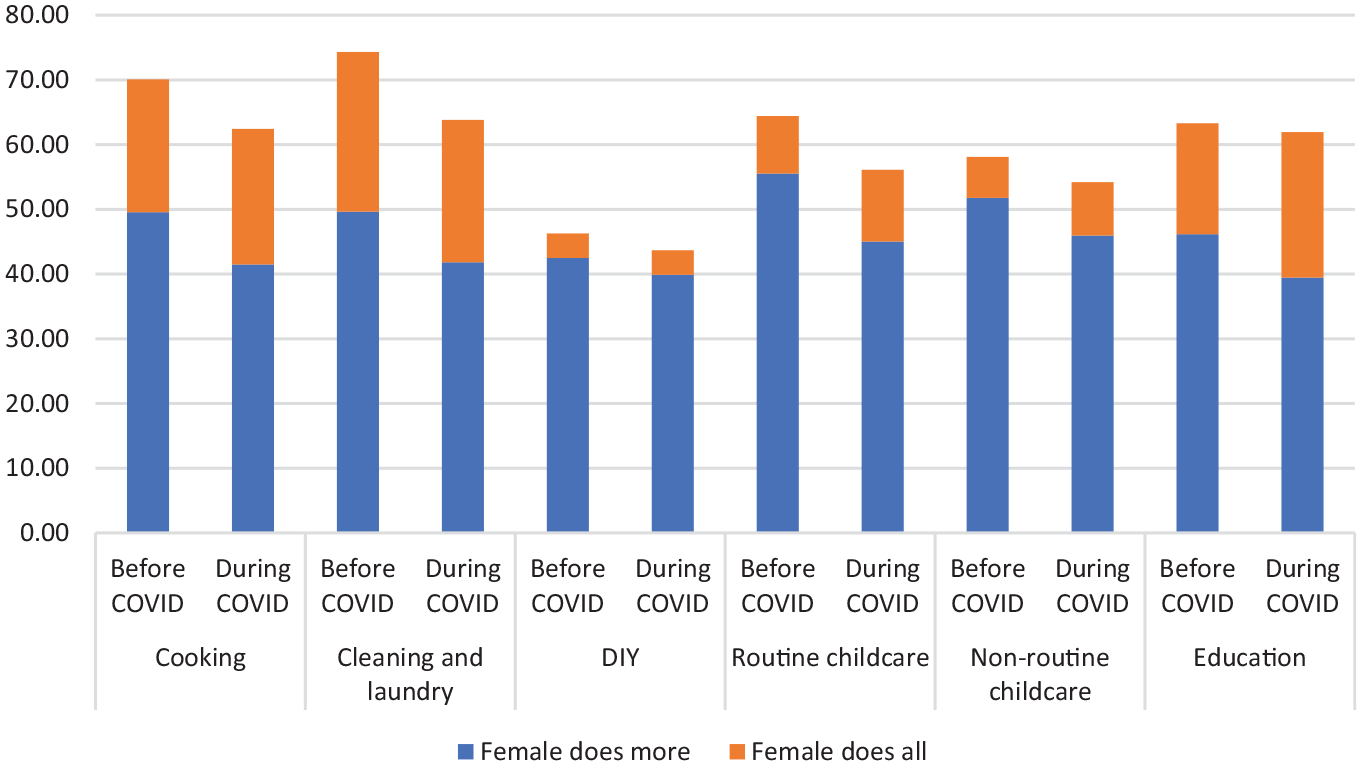
The Division of Housework and Child Care among Heterosexual Couples with Children before and during the COVID-19 Lockdown
Next, we examined whether father’s homeworking shapes this division. In Figure 2, we compare the division of housework and child care between households where fathers were mostly going in to work, to households where fathers were working from home exclusively or almost exclusively. We found that in the latter group, mothers were less likely to be solely or mainly responsible for all of the six housework and child care tasks we examined. t-test results confirm this, at a 5 percent significance level, except for DIY tasks. This result mirrors the evidence found in other countries such as the United States and Germany (Carlson, Petts, and Pepin 2020b; Hipp and Bünning 2020; Prados and Zamarro 2020).
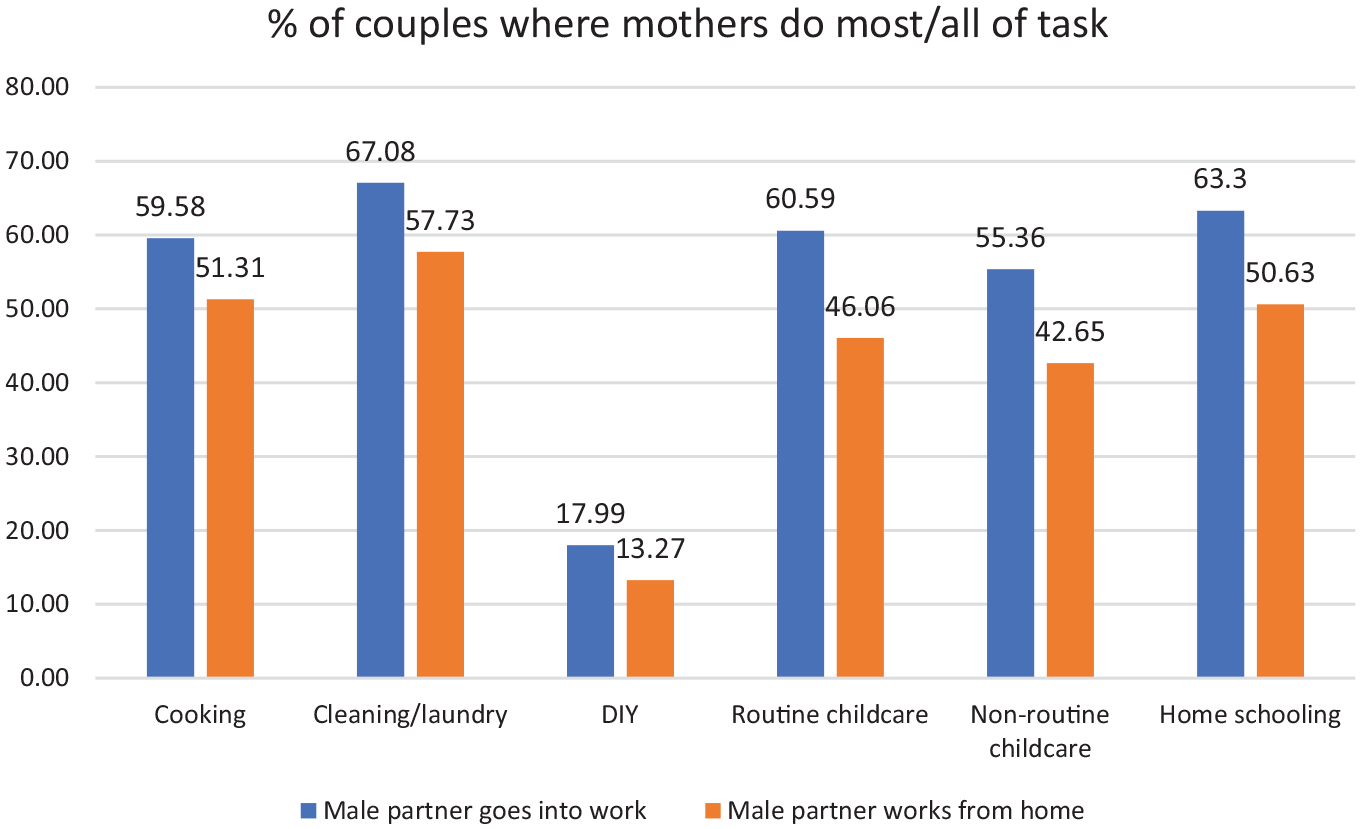
The Division of Housework and Child Care among Heterosexual with Children during the COVID-19 Lockdown for Fathers Who Work from Home vs. Fathers Who Go in to Work
What is more, fathers who were working from home (compared with those going in to work) were also more likely to say that they were doing more child care than they were in prepandemic times (for similar evidence in the United States, see Carlson, Petts, and Pepin 2020b), particularly for routine child care and homeschooling (Chung, Birkett, et al. 2020). It is worth noting that during prepandemic times, UK fathers generally did not spend much time carrying out routine child care (Wishart, Dunatchik, and Speight 2019), with less than half of all fathers reporting doing any routine child care during a weekday, according to the 2015 UK Time Use Survey (Walthery and Chung 2021). However, routine child care and homeschooling were two areas where parents experienced increased demand for their time during the pandemic (Benzeval et al. 2020; Chung, Birkett, et al. 2020; Morris 2020). Thus, on one hand, parents’, especially fathers’, homeworking during the pandemic may have enabled couples to juggle these increased demands between them, possibly ensuring that mothers were also able to continue to work during the lockdown periods. However, there is also evidence that mothers who worked from home during the pandemic also increased the amount of housework and child care they perform (Benzeval et al. 2020; Carlson, Petts, and Pepin 2020b; Chung, Birkett, et al. 2020; Hipp and Bünning 2020). Given that men and women had very different starting points in terms of their time spent on unpaid work prepandemic, the increase in housework and (even more so) child care done by these women is likely to have had a significant negative impact on their capacity to work, many having to multitask work with child care (Andrew et al. 2020).
Flexible Working and Gender Equality in the Future
In sum, our data show that the sharp rise in number of workers working from home, especially that of fathers, may have enabled a more equitable distribution of unpaid work among heterosexual dual-earning couples. This, in turn, may have helped ease the increased demand of care and housework responsibilities that households, particularly women, faced. Based on this, what do we expect to happen in terms of flexible working and gender equality in the future? First, we expect that there will be a surge of interest and demand for flexible working from workers. For example, three-quarters of all parents in our survey responded that they would like to work flexibly to spend more time with children in the future (Chung, Seo, et al. 2020). In a U.S. study, 98 percent of those surveyed replied that they would like the option to work remotely in the future (Buffer 2020). There are also signs of change in managers’ perception toward flexible working. Managers are more supportive of flexible working (CIPD 2020; CMI 2020; Forbes et al. 2020), and many companies plan to continue large-scale homeworking into the future (Jack 2020). We know from previous studies (Chung and Van der Horst 2018; Fuller and Hirsh 2018; Van der Lippe, Van Breeschoten, and Van Hek 2018) that flexible working can help women reduce their likelihood of dropping out of the labor market or moving into part-time jobs after childbirth, helping them stay in higher-paid lucrative jobs. Much of the gender pay gap and other gender inequalities in the labor markets can be attributed to the fact that women are likely to drop out of the labor market and move into part-time jobs, which are generally low-paid and without many opportunities for career progression, after childbirth (Costa Dias, Joyce, and Parodi 2018). Thus, the expansion of flexible working opportunities for all workers would be a very welcome step in the right direction in tackling some of the gender inequalities caused by the pandemic, by enabling more women to enter or stay in the labor market. Expanding flexible working for all workers can also help remove some of the existing stigma against flexible working, and the career penalty attached to it, by making it a norm rather than exception (see also van der Lippe and Lippényi 2020). Changes in the perception toward flexible working may also help fathers fight the “femininity stigma” (Rudman and Mescher 2013), enabling them to take up flexible working for care purposes. This can then lead to a more equal division of unpaid work, as we have seen during the pandemic, which can further help reduce gender inequality in the labor market.
However, this expansion of flexible working may also lead to unintended negative outcomes for gender inequality and workers’ well-being, if done without reflecting on our existing work culture and gender norms. Flexible working alone does not sufficiently disrupt the gender-normative views of who is responsible for breadwinning and who is responsible for housework and caregiving. Family policies that support the involvement of fathers in child care, especially during the early years of a child’s life, such as ear-marked parental leaves for fathers, are crucial to change societal norms around gender roles. In addition, in many countries, such as the United States and United Kingdom, the current working culture is that of a masculine ideal worker norm (Acker 1990; Berdahl et al. 2018). In this culture, long working hours are considered to be a sign of performance, commitment, and motivation of workers. In such contexts, flexible working and its blurring of boundaries between work and family life can lead to an encroachment of work on other spheres of life (Glass and Noonan 2016; Lott and Chung 2016) and increase competition among workers, where workers end up working everywhere and all the time (Mazmanian, Orlikowski, and Yates 2013; Messenger et al. 2017). This may especially be the case with the rise of insecurity we are seeing and likely to see in the near future because of the economic shocks felt across societies due to the pandemic (Chung and van Oorschot 2011), possibly amplified in countries where workers’ bargaining positions are weak (Chung 2018, 2019a). In such scenarios, women may be left more vulnerable given their limited capacity to expand their paid working hours and intensity. This is attributable to women’s already existing demands of unpaid work compared with those of men (Chung and van der Horst 2020; Lott and Chung 2016) and their weak bargaining positions both at the workplace and at home (Acker 1990; Hochschild and Machung 1989). This may exacerbate the existing gender gap in labor markets.
To tackle this issue, we need changes in our labor laws to better protect workers when work–family boundaries no longer become clear, so that the rise in flexible working does not lead to further exploitation of, or unhealthy levels of competition among, workers. For example, the new EU regulation on right to disconnect can be a good example of this (https://www.europarl.europa.eu/doceo/document/TA-9-2021-0021_EN.html#:~:text=The%20purpose%20of%20the%20right,%2C%20including%20work%2Dlife%20balance.&text=(13)%20Pursuant%20to%20Directive%202003,the%20organisation%20of%20working%20time). We also need to be able to provide policies that meet some of the demands of parents who show a keen interest in changing their working patterns as a result of having spent more time with their children and family over the pandemic period, and would like to continue to do so. Enabling more flexible working is one way, but there needs to be a serious consideration of tackling the long hours work culture through reforms such as the introduction of a four-day week (Coote, Harper, and Stirling 2021; Pang 2020; Stronge and Harper 2019). This is especially true if we are serious about undoing some of the harm caused by the pandemic to gender inequality (Kurtz 2021; United Nations 2020). This pandemic has provided us with a period for reflection on what we value as individuals, as families, and society in terms of work, including the value of unpaid work. Such crisis should not be wasted by going back to “old norms” once the pandemic is over.
Footnotes
Authors’ Note:
A part of this research was made possible through the ESRC (Economic and Social Research Council) Future Research Leaders’ award (Grant ES/K009699/1), based at the University of Kent, and through the ESRC Impact Acceleration Funding from the University of Kent and the University of Birmingham. The authors thank the editors for their encouragement in writing this piece, and their constructive and useful feedback on this article.
Notes
Dr. Heejung Chung is Reader in Sociology and Social Policy, School of Social Policy, Sociology, and Social Research, Division of Law, Society, and Social Justice, University of Kent. She was the Principle Investigator of the ESRC funded project Work Autonomy, Flexibility and Work-life balance, which aims to examine the role of flexible working on a number of outcomes, including workers’ well-being and gender equality.
Dr. Holly Birkett is Lecturer in Organisational Studies, Birmingham Business School, University of Birmingham. She is the Co-Director of the project Equal Parenting which aims to improve the use of family friendly policies in the UK and encouraging equality in the workplace.
Dr. Sarah Forbes is Lecturer in Marketing, Birmingham Business School, University of Birmingham. She is the Co-Director of the project Equal Parenting which aims to improve the use of family friendly policies in the UK and encouraging equality in the workplace.
Hyojin Seo is a PhD Candidate in Social Policy, School of Social Policy, Sociology, and Social Research, Division of Law, Society, and Social Justice, University of Kent. Her interests are in gender equality, labour market insecurity and precarity and the role of family policies in explaining its cross-national variance.