




Abstract
Gender differences have been observed regarding many political and social issues, yet we lack comprehensive evidence on differences in perceptions on a wide range of security issues increasingly important to voters: military threats, criminality, and terrorism. Previous research suggests that when women are highly politically mobilized, as they are in Sweden, gender differences in political opinion are large. On the other hand, Swedish politicians have worked hard to reduce gender stereotypical thinking. This prompts the question: Are there gender differences in attitudes on security issues in Sweden, and if so, in what ways do the attitudes differ? This study is based on comprehensive data from focus groups and a large-scale survey. The results show that women were more prone to respond with an “ethic of care,” across security issues. Women were more inclined to understand security problems as structural, explained by macho culture, segregation, and injustice. Women tend to support preventive measures that provide individuals with opportunities to choose “the right path,” such as education and economic investment in deprived areas. When asked about national security, women believe more in diplomacy and dialogue. In general, women are less inclined to support various repressive solutions.
Sweden is one of the most gender-equal countries on earth and tends to score high on various equality indexes. 1 The government also states that women and men must have the same power to shape society and their own lives (Government Offices of Sweden 2019). Moreover, the Swedish educational system aims, at all levels of the curriculum, to work actively against stereotypical gendered thinking. For example, the curriculum for preschool requests that children “regardless of gender, obtain the same opportunities to try and develop skills and interests without limitations of stereotype gender patterns and gender roles” (Skolverket 2019). Another expression of the Swedish government’s focus on gender equality is adopting the label of “the first feminist government in the world” as well as the decision to make gender equality a central priority in decision making and resource allocation, both nationally and internationally. Security is a prioritized issue in this regard (Government Offices of Sweden 2019). One expression of the Swedish determination to overcome inequality between women and men was the launch of a feminist foreign policy in October 2014. Guided by the three Rs—rights, representation, and resources—feminist foreign policy promotes gender equality across the world (Government Offices of Sweden/Ministry for Foreign Affairs 2018, 6).
Previous research suggests that when a country becomes more economically developed, and women become more mobilized politically, men and women more often diverge on political issues (Eichenberg 2019, 12–15). Eichenberg (2019, 37–38) found that political empowerment of women (high level of education and a high level of political representation) correlated strongly with diverging opinion on war among women and men. Reviewing previous research, Eichenberg (2019, 12–13) attributes differences in opinion to women’s access to higher education and their experiences entering the labor market, both fairly recent. The political mobilization of women can also affect policy, with research showing that when in power, women tend to be more “dovish” than their male counterparts (Bendix and Jeong 2020; Moore and Dolan 2012). A study by Chattopadhyay and Duflo (2004) on women governing Village Councils in West Bengal and Rajasthan in India found that the women in power tended to invest more in the type of infrastructure that women in the regions needed the most. Thus, when in power, women might favor preferences different from those of men, and even tend to favor the needs of their own gender.
Research findings suggest that, in general, there is a gender gap in a number of political opinions, with women being more supportive of an “ethic of care” (Conover 1988; Gilligan 1982). Women also tend to be less supportive of “hawkish” measures in foreign policy, particularly regarding use of military force (Brooks and Valentino 2011; Eichenberg 2003; Eichenberg and Read 2016; Feinstein 2017), and tend to prioritize preventive measures in dealing with crime (Rhine, Smithey, and Haynes 1994; Shapiro and Mahajan 1986).
Against this background, we identify the following paradox: On one hand, Swedish women are highly politically mobilized, and gender differences can be expected to be large. On the other hand, Sweden has taken strong measures to reduce gender stereotypes and gender inequality, and that might be expected to minimize differences in opinions between men and women. This prompts our research question: Are there gender differences in attitudes on security issues in Sweden, and if so, in what ways do the attitudes differ?
The major contribution of this study is thus to explore potential gender differences in a state that works actively to counteract such differences. Second, this article contributes to research on the gender gap by broadening the approach from economics and welfare to foreign policy and, above all, the use of military force. Because the division between internal and external security is less relevant now than in the past, our study includes a wide range of security issues: military threats, criminality, and terrorism. This broad range of security issues has risen recently in political importance in Sweden, after the terrorist attack committed in central Stockholm in 2017. The public debate on military security has also widened, focusing on defense spending, NATO membership, and the feminist foreign policy launched by the social democratic government in 2014. In this research, we investigate gender differences on a broad range of security issues, including how central security concerns should be handled.
We also contribute to the research literature with a comprehensive empirical inquiry that includes both a large focus group survey and a large-scale survey of Swedish citizens. Previous research has used primarily quantitative data, and we include focus group discussions to illustrate the statistical evidence. We used the focus groups to learn what were the appropriate questions for the survey, and they also provide valuable insights into our respondents’ reasoning on security. Focus groups enable deliberations among a group of people, allowing them to express themselves in their own words and facilitating deeper thinking on complex political issues.
In this article, we show that there are major gender differences in terms of perceptions of both external and internal security issues. Even though men and women in many cases agree on major concerns and solutions, they also diverge substantially. Women tend to look at problems as structural rather than individual. Compared with men, women are also more inclined to favor preventive rather than repressive measures, and to display more concern for the “weak and vulnerable.”
Gendered Ethics
Considerable attention within the field of political science has been devoted to research on the gender gap in attitudes (Conover 1988; Haider-Markel and Vieux 2008; Hatemi, Medland, and Eavens 2009; Herrick 2018; Kaufmann and Petrocik 1999; McCue and Gopoian 2000) between women’s and men’s political preferences and voting behavior. Although the gender gap is small in empirical terms, its existence is established on a wide range of public policy issues (Hurwitz and Smithey 1998). Gender differences in attitudes are found on issues such as voting (Bedyna and Lake 1994; Gilens 1988; Pomper 1975), support of the military (Conover and Sapiro 1993; Shapiro and Mahajan 1986; Smith 1984), crime and punishment (Hurwitz and Smithey 1998), public welfare spending (Mueller 1998; Rhine, Smithey, and Haynes 1994; Stoper 1989; Thomas 1994), and foreign policy preferences (Togeby 1994). Many studies have shown that the gender gap in public opinion is largest and most robust over time with regard to foreign policy and support for the use of force (Brooks and Valentino 2011; Burris 2008; Eichenberg 2003; Feinstein 2017; Lizotte 2019).
There are a variety of explanations for a gender gap on opinions about security. One predominant theory on why women and men differ in views on security is the “ethics of care” perspective. This interpretative lens was developed in reaction to Kohlberg’s theory of moral development. Kohlberg (1981) explains behavior and decision with human morality and justice (Brabeck 1983, 278; Kohlberg 1981). Gilligan criticized Kohlberg’s theory for what she perceived as male-centric assumptions. Gilligan (1982) suggested that women and men have different types of moral reasoning. According to Gilligan, women’s responses to moral issues tend to conform to an ethic of care, which, at its core, is built around a concern for protecting the vulnerable. This perspective presumes that society is an interdependent and interconnected web of personal relationships. In this ethic, moral behavior is about actively nurturing and protecting others as well as building relationships (Gilligan 1982). As presented by Gilligan, the ethic of care “rests on the premise of nonviolence”: “While an ethic of justice proceeds from the premise of equality—that everyone should be treated the same—an ethic of care rests on the premise of nonviolence—that no one should be hurt” (1982, 174). The ethic of care is based on a holistic approach to understanding society, viewing human beings as interrelated. The ethic of care uses a structural understanding of society, taking serious factors such as inequality as a cause of violence (Gilligan 1982, 100, 174). Applied to security issues, the ethic of care promotes preventative policies rather than meeting violence with more violence (Held 2010). Applied to terrorism, an ethic of care involves seeking to better understand those who turn to violence and investigating how governmental and economic policies contribute to radicalization, to prevent new recruits to terrorist groups (Held 2010, 122). Preventive measures such as better education and equal treatment are considered preferable to violent law enforcement (Held 2010, 127). Applied to military policy, an ethic of care promotes noninterventionism and the respect for international law (Held 2010).
While analyzing the data, we also pay attention to the potential impact of age. Because Gilligan (1982) and others (e.g., Brody 1990) who have analyzed the ethic of care attribute the different moral voices of men and women to gendered socialization, rather than to biology, the era during which the respondents grew up might influence their opinions. Whereas girls are socialized to feel connection and concern for others, boys’ socialization tends to emphasize separation, independence, and autonomy (Hurwitz and Smithey 1998). Ruddick (1983, 479) uses her notions of “maternal thinking” and “preservative love” to argue that daughters learn from their mothers to care for others, making women more prone to pacifism than to militarism, and more likely to care for anyone at risk.
In an experiment analyzing gender differences in Swedish children’s opinions on a range of foreign policy issues, Bjereld (2001) finds little evidence of any gender gap. This suggests that gender differences might be attributable to differences in socialization after early childhood. Women tend to express greater sympathy for the disadvantaged, favoring larger public expenditures for social welfare, education, and health care (Burt 1986; Rhine, Smithey, and Haynes 1994; Shapiro and Mahajan 1986; Stoper 1989). Women are more supportive of government efforts to protect racial and ethnical minorities (Rhine, Smithey, and Haynes 1994). A couple of studies have also found that women emphasize the importance of crime prevention more than men do (Rhine, Smithey, and Haynes 1994; Shapiro and Mahajan 1986). Lizotte, Eichenberg, and Stoll (2020) demonstrate a higher level of support for gender equality in US foreign policy among women (although other individual characteristics also mattered) and suggest that this is correlated with women’s stronger support for universalist values, social justice, and equality. Lamare (1989) demonstrates that women in New Zealand were more worried about war and more critical of militaristic and pro-nuclear policies than men. Young women stood out in particular.
In conclusion, on the basis of previous research, we expect that if a gender gap in attitudes exists, women will display more attitudes that mirror an “ethic of care” than will men, on internal and external security issues. Furthermore, we expect that if Swedish public opinion is divided along gender lines, young women are likely to stand out as the most liberal and supportive of an “ethic of care,” given that among young people, women are more prone to embrace leftist political orientation (Sveriges Television 2020) and to identify as a “feminist” (Landehag 2018), both of which are likely to lead to opinions in line with an “ethic of care.”
Methodology
This article builds on the results from a comprehensive study we carried out on Swedish citizens’ views on an array of security policy issues and their solutions. The study involves both focus groups and a survey. Focus groups are useful in combination with quantitative studies because they provide greater understanding, color, and depth to quantitative studies (Morrison 1998). We used the results of the focus groups to create appropriate questions for the survey.
In presenting the results, we use quotations from the focus group discussions to provide illustrations and “flesh and blood” to the statistical evidence. The survey was constructed based on conversations during eight focus group discussions, with an average of seven respondents at each one. The respondents in the focus groups were carefully selected to include a diversity of the Swedish population. Four groups were conducted on October 23 and 24, 2017 (with young women, older women, young men, older men) and four groups were conducted on December 5 and 6, 2017 (young women, young men, older women, and older men). The “young” groups consist of individuals 19–44 years old, and the “older” groups of individuals 45 years and older. The youngest participant was 19 and the oldest 77 years old. The focus groups were held online using a chat program provided and administered by a research agency that also employed a moderator for each discussion. A predefined set of security-related issues (military threats, criminality, and terrorism) were discussed. The questions (see Appendix 1) were provided to the moderator by the researchers. The moderator had relative freedom in how and in what order the questions were posed. The average length of the discussions was 70 minutes.
The questions in the web survey were derived inductively from the focus group study. We registered people’s primary concerns and favored solutions, and then selected these when we constructed the survey.
In the survey, every respondent was instructed to choose five causes and five solutions to each security issue. The options were presented randomly to the participants. In “Results,” we first present the five most common answers chosen by self-identified men and self-identified women, and then present the largest differences in opinions between men and women. To test for significant differences between men and women, we conducted t-tests that are presented in the tables. Because participants could choose five answers, the total adds up to more than 100 percent. We also present differences between men and women of different ages in the text, and the full details are provided in an online appendix. Unfortunately, because the focus groups and the survey were carried out for another project, we do not have variables pertaining to political ideology and so cannot test to see whether some of the differences between men’s and women’s opinions on security issues are related to their general political ideology.
The data were collected in collaboration with Kantar/SIFO, a public opinion and marketing research company. A web panel with more than 100,000 randomly selected Swedish Internet users was created, including people from 16 years of age and older. All panelists were recruited through nationally representative telephone interviews or through postal surveys. There was no opportunity for self-recruitment. Participants are gradually replaced in order to prevent participants from participating in many surveys, thus becoming experts, and the panel is filled with new respondents (Kantar/Sifo 2020). The survey was then conducted as a web survey. The data for the survey were collected during two weeks in February 2018. Three thousand seventy-eight respondents filled in our questionnaire. Forty-eight percent of the respondents were men (N = 1,486) and fifty-two percent (N = 1,592) were women, similar to the Swedish population as a whole. Their age distribution is displayed in Table 1.
Age (years) and gender distribution of respondents
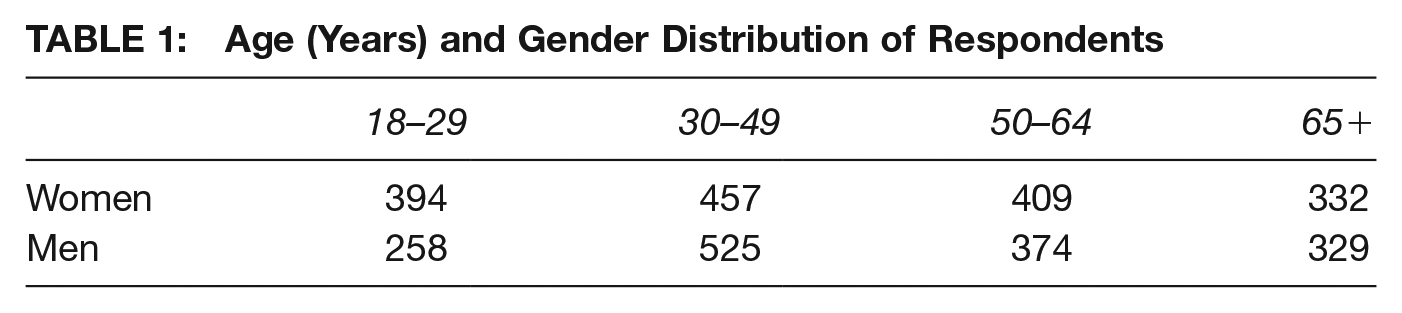
Although no major security-related events occurred in Sweden during the period of study, a terrorist attack in Stockholm conducted by an asylum seeker a few months before the focus groups might have influenced security perceptions (BBC News 2018). Soon before the focus groups were held, Sweden held its largest military practice in two decades. Finally, discussions on #metoo that emerged in 2017 might also have provoked greater attention to security issues within gender relations among the respondents.
Analysis and Results
Focus Group Conceptualizations of Threats
As explained above, we began this study with focus groups, during which the respondents were asked to express their anxieties and suggestions for resolutions. We then observed what men and women brought up as security problems and solutions, and how they spoke about security. The respondents were initially encouraged to express freely what they perceived as threats and challenges related to security. Both men and women in all groups brought a large number of concerns and suggested a broad range of remedies.
A few differences in particular struck us at the first, exploratory, stage of the research process. We found that women seemed more prone to link security threats to personal safety, whereas men were more inclined to associate security with military threats to state and society. 2 Young women in particular took their point of departure from personal safety. They reflected on fears of going to musical concerts, airports, or larger cities, due to the risk of terror acts and sexual harassment. Several respondents argued that this fear led to a relative lack of joy in everyday life. A young woman described how she worries about large crowds and spending time outside. Another young woman stated that “the thought has crossed my mind when I’m out running, I feel more insecure in general, against my will. But I try not to think of it and try to go on living as I’m used to.” She added that she does not wish “hate to triumph,” but that she nevertheless always had a feeling of the need to “being on guard and follow my gut feeling.” Another third one concurred: “I agree on the thing about jogging, I really do not dare going out in the darkness of autumn. Absolutely not by myself.”
Older women also expressed concerns about personal safety and of terrorism. Security for female respondents seems to be clearly linked to personal safety and freedom, to the possibility of not worrying about being harassed or attacked at night. One older woman mentioned “being able to spend time out in society, for example, going to the cinema or to a theater or a restaurant at night, returning home safely and securely.” Another older woman shared this feeling: “One feels more insecurity in society. In particular in the evenings and during nighttime.” Although some men also expressed concerns about both women’s safety and terrorist attacks, men appeared more concerned about cyberattacks and traditional military threats.
After the initial, unrestrained, discussions, we invited respondents to elaborate on perceived problems and solutions to military threats, crime, and terrorism. We extracted 13–15 recurrent responses in each category about crime, terrorism, and military threats. We included these responses in our survey to establish the degree to which the observations from the focus groups were representative of the survey sample and whether potential gender differences can be identified.
The analysis has been structured in accordance with the three issues of military threats, criminality, and terrorism. Gender differences as well as similarities are highlighted below. Once we finished the quantitative analyses, the focus groups were again consulted to illustrate in detail how reasoning differed among men and women.
Survey Data Analysis: Military Threats to Sweden’s Security
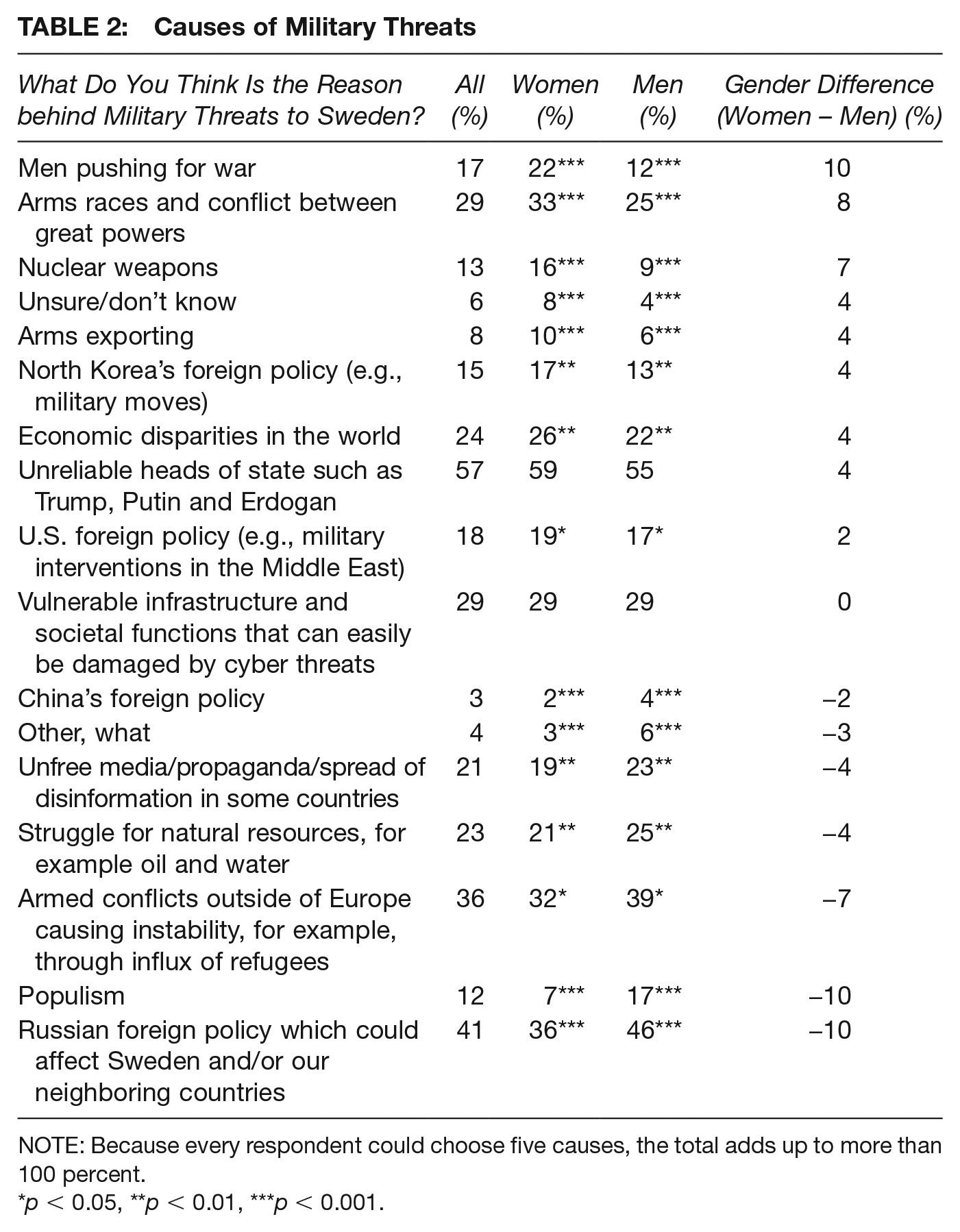
Respondents were asked to choose five causes for the military threats to Sweden’s security. Men’s and women’s answers converged in their perception of causes (Table 2). Among both women and men, “Unreliable heads of state such as Trump, Putin, Erdogan” ranked first, and “Russian foreign policy which could affect Sweden and/or our neighboring countries” ranked second in security threats to Sweden. Whereas “arms races and conflict between great powers” ranked third among women, it ranked fifth among men. “Armed conflicts outside of Europe causing instability, for example through influx of refugees” received the third largest share of responses among men, and the fourth largest among women.
Causes of military threats
NOTE: Because every respondent could choose five causes, the total adds up to more than 100 percent.
p < 0.05, **p < 0.01, *** p< 0.001
There are some noticeable differences with regard to threat perceptions first noted in the focus groups and confirmed in the quantitative data analysis. Men were more prone than women to worry about populism and Russia, whereas women were more prone than men to worry about men pushing for war. The focus on Russia indicates that men are more likely to envisage an antagonistic threat, an evil “with a face,” a traditional “enemy,” whereas women tend to identify threats of a more structural kind, that cannot be reduced to any particular power or actor. One older male focus group respondent demonstrated the focus on Russia, stating “The Russians present the biggest threat.”
Women in turn were more inclined to focus on “faceless” phenomena that cannot be linked to any specific state or group, such as men pushing for war, great powers causing arms races that can spiral out of control, and nuclear conflicts. A younger woman gave voice to the results of the survey, saying: “I unfortunately believe that arms races can lead to ‘unintended wars.’ I read a bit about that and it feels very plausible that rearmament can lead to someone getting overly excited and in essence firing a bullet.” The idea that men push for wars was also expressed already during focus groups. An older woman, for example, considered “the male ego and determination to be the biggest and most powerful.”
The survey also revealed some interesting age-related differences, briefly presented here (for details, see Tables A1–A2 in the online appendix). The belief that men push for war was more influential among young women: 27 percent of women ages 18–29 years replied that men push for war, whereas only 17 percent of women 65 years and above replied the same. Young women were also more prone than older women to identify structural causes to military threats and to blame U.S. foreign policy for causing military threats, while being less inclined to highlight Russian foreign policy (Table A1 in the online appendix). There were fewer differences between young and older men (Table A2 in the online appendix). One item was an exception: Older people were more likely to perceive Russia as a threat, probably reflecting their experiences during the Cold War era (Tables A1 and A2 in the online appendix).
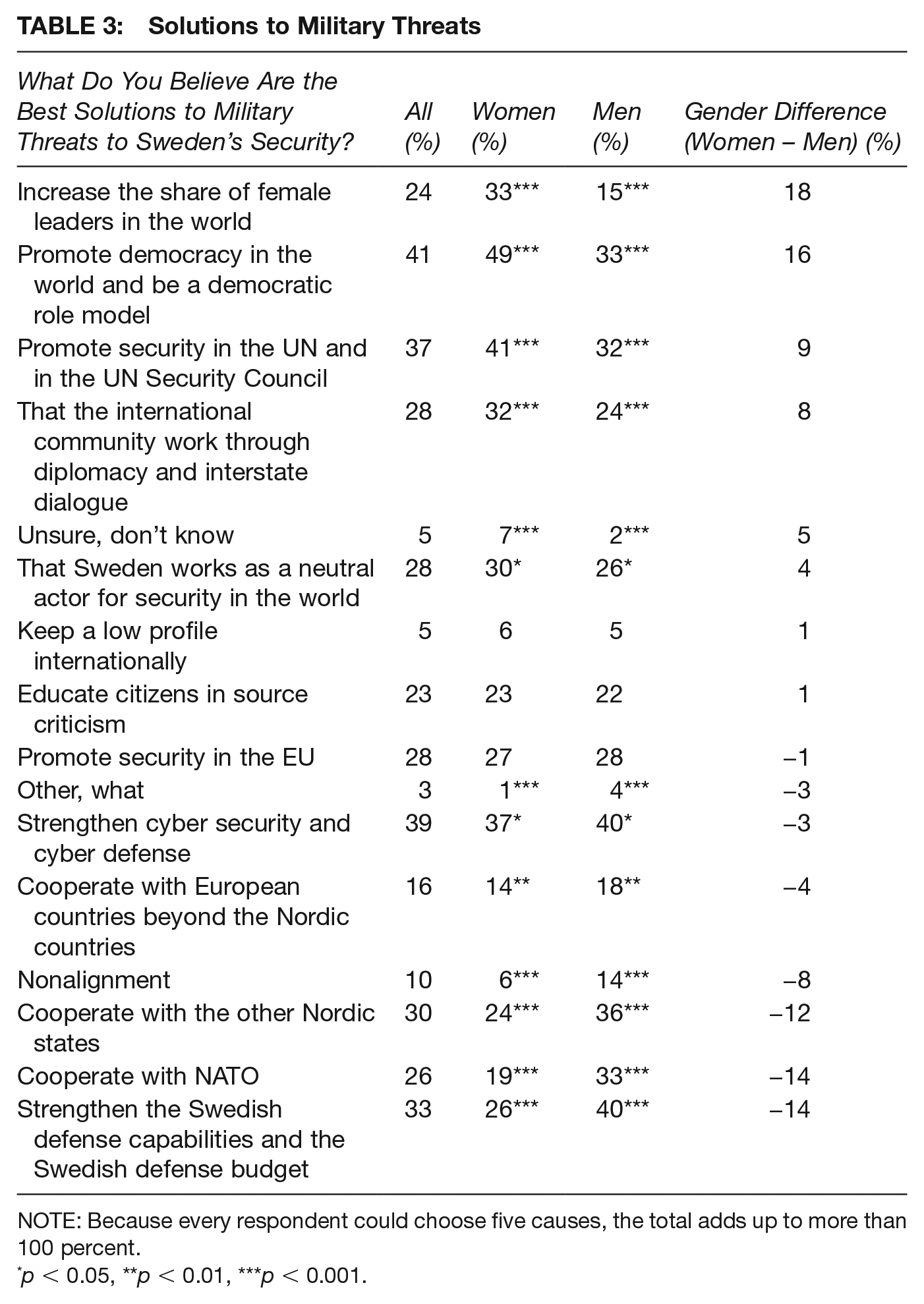
When asked about solutions to military threats to Sweden’s security, there were some important gender differences (Table 3). Among the female respondents, to “work globally for democracy and be a democratic role model” was chosen by the largest share of respondents (49 percent), whereas only a third of men chose this option. Indeed, this answer ranked as the fourth most popular answer among men. Instead, among men, the top responses were “strengthen the Swedish defense capabilities and the Swedish defense budget” and “strengthen cyber security and cyber defense” (40 percent each among male respondents). Among women, these options were less popular: The first was chosen by only 26 percent of female respondents (thus being the seventh most popular choice), whereas the second was chosen by 37 percent (thereby ranking third among women).
Solutions to Military Threats
NOTE: Because every respondent could choose five causes, the total adds up to more than 100 percent.
p < 0.05, ** p< 0.01, *** p < 0.001
Above all, women were more inclined to focus on the empowerment of women, by promoting an increase of female leadership in the world. While 33 percent of the women supported an increase of female leadership in the world, only 15 percent of the men did so. Women were also clearly more prone to emphasize the need for democracy, promoting security through the United Nations, diplomacy, and dialogue. Men, in turn, referred to military measures to a higher degree, promoting an increase of the defense budget and military cooperation with NATO and other Nordic countries.
There were also some age-related differences, presented in the online appendix. Young women were more in favor of promoting female leadership, with two-fifths of women ages 18–29 years responding that increasing the share of women leaders in the world would be an appropriate solution to military threats; only a quarter of women 65 years and older agreed. The women 65 and older also displayed a higher tendency to favor increased defense spending (Table A3 in the online appendix). Similarly, young men were much less prone than older men to favor increased defense spending (Table A4 in the online appendix).
In sum, we can see a tendency in the statistical material, illustrated by quotes from the focus groups, which indicates that women are more likely to see security issues as related to structure, including male dominance and lack of female representation and to desire more focus on dialogue, democracy, and the UN to solve security issues. Men appeared to support more repressive measures, including focusing on the Russian threat, increased defense spending, and cooperation with NATO and other states. These results suggest that women are more likely to report an ethic of care, while men are more inclined to favor military responses. This tendency was particularly strong among young women.
Crime
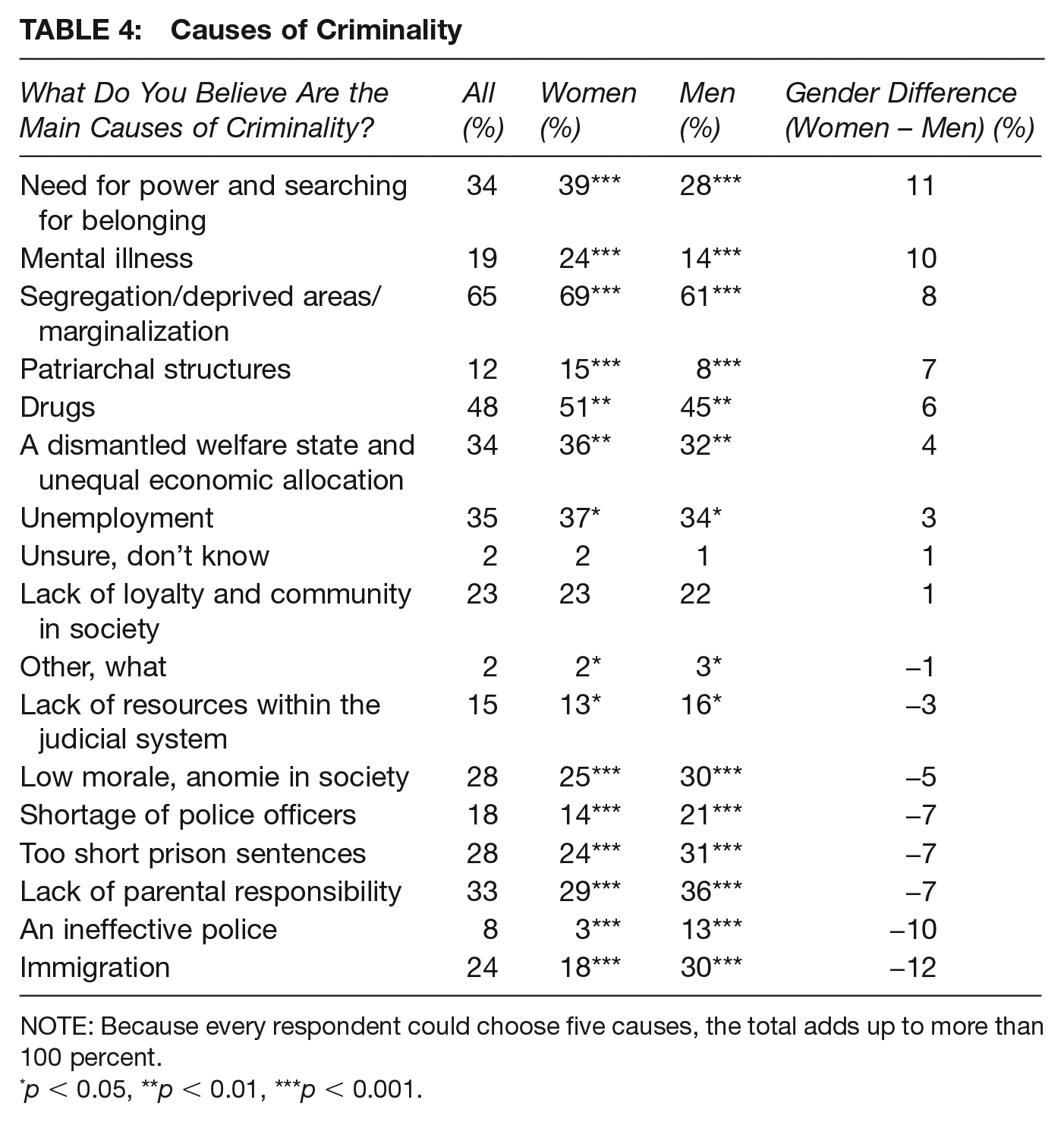
Men and women listed the same two top underlying causes for crime: “segregation/deprived areas/marginalization” and “drugs.” There were also some important differences. While “need for power and searching for belonging” was the third most common answer among women, among men, “lack of parental responsibility” was the third most common answer (Table 4).
Causes of criminality
NOTE: Because every respondent could choose five causes, the total adds up to more than 100 percent.
p < 0.05, **p < 0.01, *** p < 0.001
Men were more likely to view criminality as stemming from antagonistic threats and individual shortcomings, with reference to migration, inadequate parents, immorality, and ineffective police officers, both in focus groups and with the survey data. An older man was one of many male respondents expanding on the perceived relationship between immigration and criminality: “I worry about the uncontrolled immigration. The country can’t handle the large numbers that have come. Criminality is spreading and the expenses are increasing.” Many men also discussed a lack of police presence and inefficient police work, as a younger man described: “The criminality worries me a lot. A lot of bad stuff is happening out there that the police do not have the resources to investigate. Even smaller crimes affects the subject very much but where the police does not have the time to help.”
In contrast, women were more likely to bring up issues such as mental illness, segregation, and patriarchy as causes for criminality. One older focus group respondent provided an array of structural reasons for criminality. She mentioned “segregation, alienation, poverty, drugs and alcohol.” A younger woman also highlighted societal factors: “A lot probably depends on societal factors such as alienation, patriarchal structures, class et cetera.” Women were more likely to use structural explanations, whereas men were more likely to stress personal responsibility (including the responsibility of parents) to explain criminal behavior.
Again, there were also age-related differences. The tendency to favor structural explanations was particularly strong among the youngest women (Table A5 in online appendix). At the same time, young men were also more prone to highlight unemployment (as were elderly men), alongside segregation. Young men were also less prone than older men to blame immigration and lacking parental responsibility (Table A6 in online appendix).
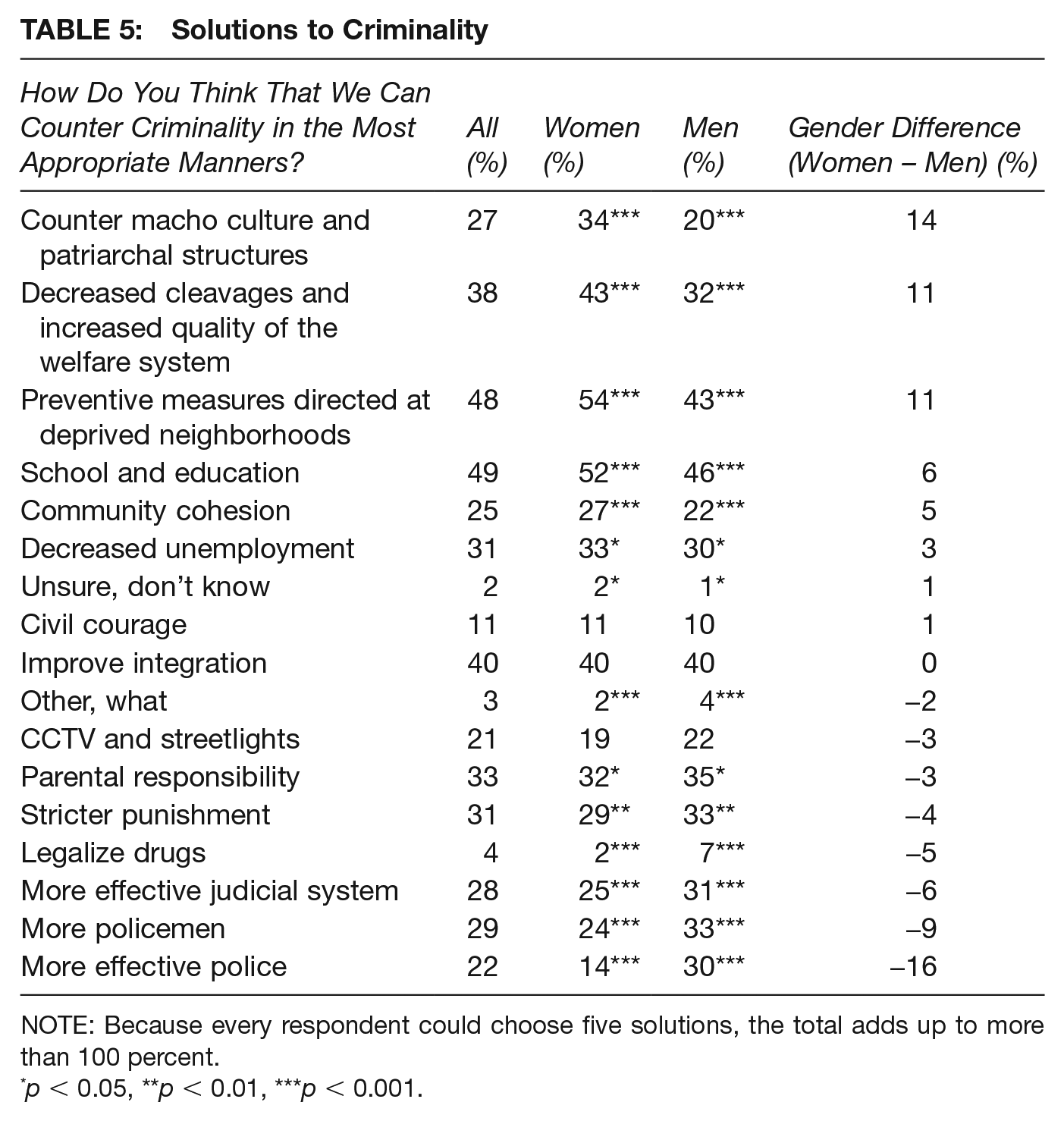
Still, with regard to solutions, there were important similarities regarding the most commonly stated responses. Although “school and education” was the most often chosen response among men, it ranked second among women. Moreover, while “preventive measures directed at deprived neighborhoods” was the response chosen by the largest share of women, it ranked second among men. Furthermore, among both men and women, “better integration” was the third most popular response. Nonetheless, there were also some significant differences, with men tending to stress repressive measures to a greater extent than women, as displayed in Table 5.
Solutions to criminality
NOTE: Because every respondent could choose five solutions, the total adds up to more than 100 percent.
p < 0.05, **p < 0.01, *** p< 0.001
Even though both men and women approved of preventive measures, men were more likely to be “tough on crime,” focusing on repressive measures such as strengthening the police and tougher sentences. Some examples from the focus groups include a younger man talking about what he sees as possible solutions to criminality: “Surveillance. And CONSIDERABLY harder sentences against ‘small’ as well as bigger crimes.” Men also talked more about the need for effective police officers. Another younger man said, “More policemen in general is really needed.” A third one agreed: “More visible policemen.”
Women were more focused on preventive efforts. This included countering macho culture and patriarchal structures, increasing preventive measures in problematic suburbs, and decreasing cleavages in distribution of incomes, and strengthening the welfare state, schools, and the educational system. A younger woman provided an example of such thinking: “Something I have thought about is how we can reach the suburbs in society. I am mostly thinking about the problem with gangs here in Gothenburg, a lot starts among the young people in the suburbs. To educate them and support them during their time in elementary school could maybe help prevent them end up wrong in life. That way they won’t present a security risk to society.” Multiple women in the focus groups brought up and expanded on the need to change destructive societal norms of masculinity: “It is also about educating children and teenagers. We above all need to deal with the macho culture and boys’ behaviors that is encouraged from when they are toddlers.”
There were also age-related differences. Young women in particular favored structural solutions, emphasizing the importance of education and strengthening of the welfare state (Table A7 in online appendix). Older women were more inclined to suggest preventive measures directed at deprived neighborhoods, which might mirror a concern with issues of failed integration of migrants. They also favored closed-circuit television to a greater extent than young women (Table A7 in online appendix). Young men, in turn, were more prone to favor education, increased community cohesion, and decreased unemployment. Young men were also the only group in which a sizeable proportion suggested legalizing drugs (Table A8 in online appendix).
In sum, although both men and women stressed preventive measures, women were more inclined to see criminality as related to societal structures (e.g., patriarchal structures, segregation), whereas men were more likely to blame the individual (e.g., failure of parenting and/or blaming immigrants). Men were more likely to call for more repressive solutions (harsher sentences and greater police presence), whereas women more often applied an ethic of care.
Terrorism
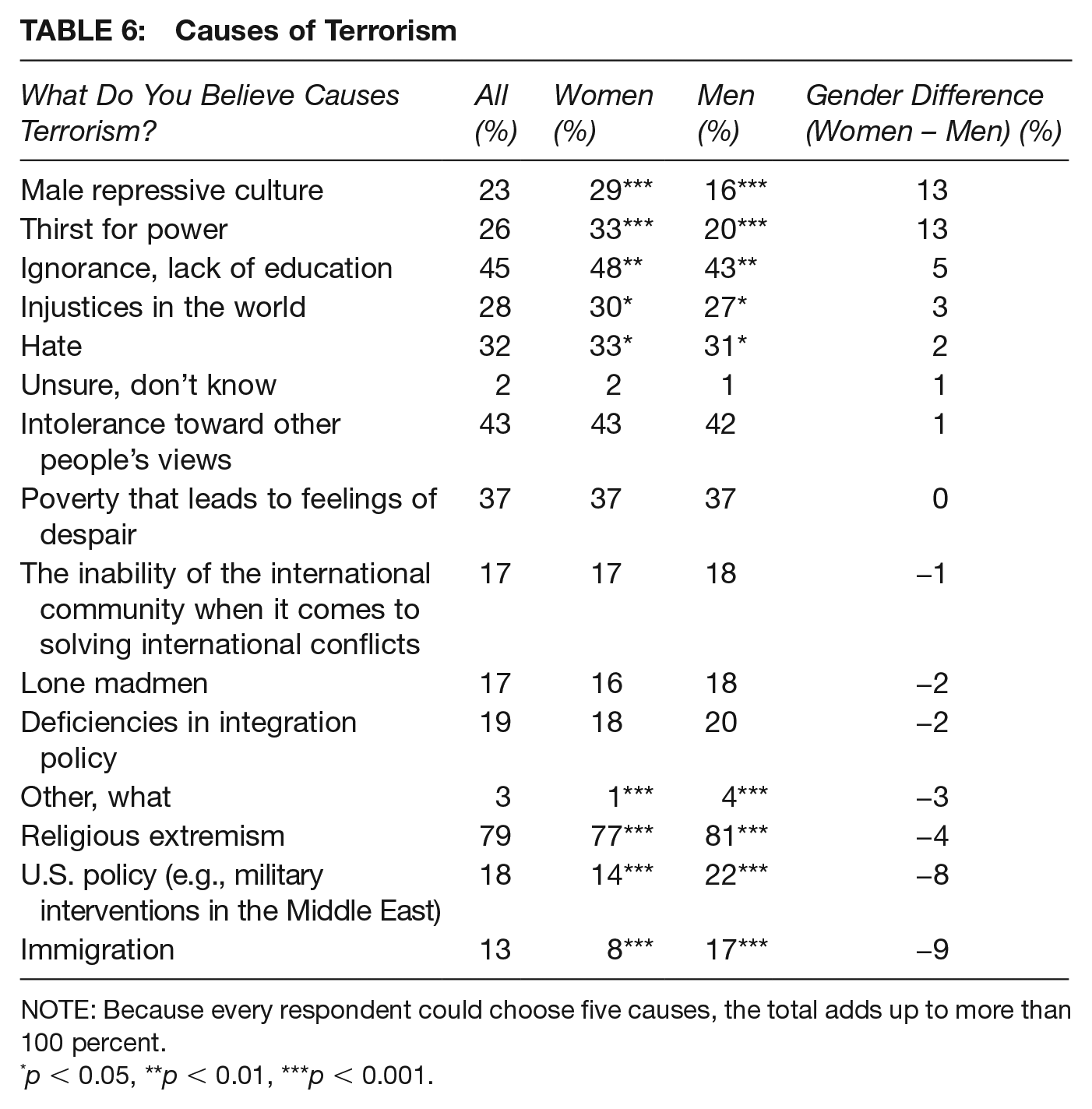
Male and female respondents denoted similar top causes to terrorism. In fact, the top four explanations were the same among men and women: “religious extremism,” “ignorance, lack of education,” “intolerance toward other people’s views,” and “poverty that leads to feelings of despair.” However, when analyzing all responses, there were substantial divergences as displayed in Table 6.
Causes of terrorism
NOTE: Because every respondent could choose five causes, the total adds up to more than 100 percent.
p < 0.05, **p < 0.01, *** p < 0.001
In line with the results on crime, more men than women tended to see terrorism as stemming from clearly defined actors. Women, on the other hand, to a higher degree highlighted structural circumstances such as male repressive culture, alienation, and segregation. This was visible also in the focus groups, with several female respondents highlighting structural factors such as “power, envy, religion” (an older woman); “religion, extreme views, thirst for power” (another older woman); “thirst for power, hatred, alienation. . .” (a younger woman). A younger male respondent, on the other hand, talked about who he perceived behind the threat: “I think we need to look over what people we let into this country and not. I think that the number of incidents such as the terror attack in Stockholm will increase if we don’t limit immigration.” Other men told us they perceived the United States had provoked terrorism and radicalization. An older man argued “We would probably have less terrorism if the U.S. had not invaded countries in the Middle East.”
There were also age-related differences. Young women stood out as being somewhat more prone than older women to highlight structural causes such as injustice in the world, deficiencies in integration policy, lack of education. Young women were also less inclined than older women to blame religious extremism, and were more prone to blame U.S. policy as a cause for terrorism (Table A9 in online appendix). Similar age-related tendencies are seen between younger and older men (Table A10 in online appendix).
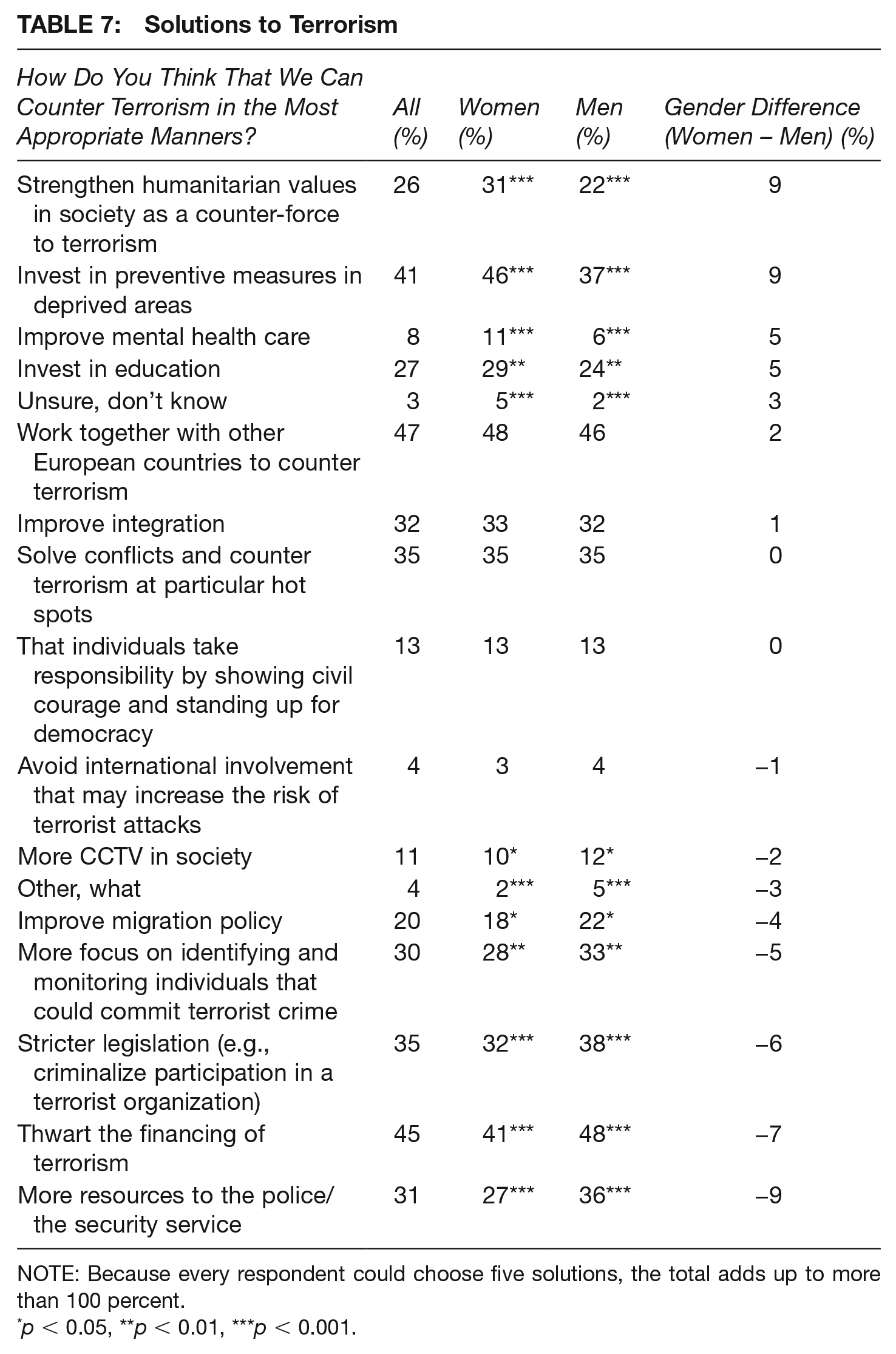
Finally, we found both similarities and differences in regard to possible solutions to terrorism. Both men and women favored cooperation: “work together with other European countries to counter terrorism,” was the first response among women, while it was the second most popular response among men. However, while “thwart the financing of terrorism” was the top answer among men, it was only the fourth most popular response among women. “Invest in preventive measures in deprived areas” was the second most popular choice among women, whereas it was the fourth most popular choice among men, for whom “stricter legislation” was slightly more popular.
As shown in Table 7, men are more focused than women on increased funds to the police and the secret service, strengthening of laws, and surveillance of potential terrorists. A younger man argued for “more money for those that investigate, and more money toward monitoring ‘unsafe’ [people].” Another young man noted that “lone maniacs, like at Drottninggatan, I do not think that we can ever successfully get rid of. However, attacks like 9/11 might be possible to avoid through more surveillance and mapping of terrorism.” A third younger man further argued for “not having entirely open doors to uncontrolled migration” and having “tougher punishment.”
Solutions to terrorism
NOTE: Because every respondent could choose five solutions, the total adds up to more than 100 per cent.
p<0.05, **p<0.01, *** p<0.001
In contrast, women were more inclined to favor strategies of compassion and shared humanity, preventive measures in deprived areas, strengthening of education, mental care, and efforts at social integration. This was also reflected in the focus groups. For instance, a younger woman noted that to counter terrorism, society should “[h]elp everyone to enter society through work, education, accommodation, et cetera,” while another younger woman noted that society should “[i]ntegrate and not separate. Ensure that young men do not end up in situations where they are lonely and do not have any other role models, show attention and encourage to activities.” An older woman further noted that “we cannot lose the people that immigrate, it isn’t enough to just receive [people]. They need to work, learn the language and get a chance to provide for themselves. There are too many [people] that end up outside [society] and then criminality and terrorism can be attractive. The municipalities have a massive responsibility here.”
Again, there were also age-related differences. The youngest women were more inclined to highlight “dovish” solutions, including the strengthening of humanitarian values and solving conflicts at particular hot spots (what is usually called a “root cause” approach). They placed more emphasis on preventive measures such as education, integration, and improvement of mental care (Table A11 in online appendix). Young men were also more inclined than older men to favor preventive measures (Table A12 in online appendix).
In sum, men tended to focus more on antagonistic threats, identifying concrete actors ranging from migrants and religious extremists to the United States, whereas women are more prone to opinions that are more left-wing, highlighting structural reasons for terrorism. As with crime, women applied an ethic of care more than the male respondents when proposing solutions to terrorism.
Conclusion
The results indicate that despite (relative) equality and a comprehensive political drive against gender stereotypes, Swedish women and men continue to partially diverge on the causes and solutions they envision for security problems. These findings support previous research that emphasizes women’s engagement in politics creates gender gaps in various policy attitudes. Our research shows significant convergence as to the respondents’ five major perceptions of threat, but also finds differences with regard to respondents’ favored solutions to security problems in three different policy areas. The findings support previous research on the existence of a gender gap. Whereas most previous research has focused on a narrow range of security issues, such as perceptions of war (Eichenberg 2019, 37) or use of military force (e.g., Eichenberg 2003; Feinstein 2017; Lizotte 2019), in this article we provide evidence of a gender gap in attitudes about security in a broader sense. The findings indicate that an ethic of care influences how Swedish women perceive security issues. Support of an ethic of care has been identified as follows, in accordance with Gilligan (1982) and other works presented in the section on previous research.
Women are more concerned than men with structural problems or threats that reflect care for human lives as well as an understanding of individuals who commit crime/terrorist deeds. For example, women were more prone to express worries that great powers cause arms races and that men push for war, that criminality stems from structural causes such as patriarchy and the dismantling of the welfare state, and that terrorism originates from lack of education, segregation, and injustice. Women were less willing to focus blame on individuals or particular groups. Women were also more supportive of preventive measures that provide individuals with opportunities to choose “the right path,” such as improved schooling and investment in preventive measures in deprived areas. When applied to national security—beliefs in diplomacy, dialogue, the United Nations—women expressed more support for a nonviolent approach, such as measures that reflect care for human lives and the well-being of people rather than military solutions. Women were less supportive of repressive solutions such as harsh sentences or strengthening surveillance of potential terrorists. Women were also more prone to focus on dialogue and cooperation, such as promotion of democracy and security through the United Nations.
Below we discuss possible explanations for differences between men and women and suggest directions for further research. Perhaps women fear risk of personal violence to their own bodies more than do men. In the focus groups discussions, women were more inclined to associate “security” with personal safety. This anxiety may stem from media coverage of crimes committed against women (e.g., Eriksson and Damon Dastary 2015). Women may also be more concerned with their personal safety because they are taught from childhood to be cautious about potential bodily harm from strangers. If this were an explanation for their answers, however, we would see women identify concrete actors as their antagonists, and focus on how they could be stopped or punished. Yet the survey did not show this. On the contrary, women were more likely to see threats as faceless, structural factors, and were less inclined than men to focus on punishments or restrictions.
Another possible explanation for these gender differences is occupational segregation. Significantly more women than men have an experience of employment within health care and education in Sweden (Andersson 2019; SCB 2017), and this could contribute to explaining their emphasis on structural causes of crime and their preference for preventive measures such as improved schooling. Of course, the causality here is not clear. It could be that women choose these professions because they hold the values we have identified here.
Additionally, women continue to hold primary responsibility for child rearing. The experience of becoming a mother and (often) being a primary caretaker for children could contribute to generating a particular understanding of and care for disadvantaged youth. The gender gap in attitudes might also be attributable to differences in socialization. The tendencies of women to deviate from men in their opinions on security might vary over the life course. Bjereld (2001) did not identify any differences in views on foreign policy issues among very young children. A gender gap might thus develop later, on the basis of experiences during youth or early adulthood. Growing political awareness of sexual inequality, domestically as well as globally, might also contribute to compassion for the weak and suffering. Indeed, we expected that if there was a gender gap, it would be the largest among young women and our results confirm this. Young women were particularly prone to highlight structural causes, favor preventive solutions, and support humanitarian values. Moreover, young women were more supportive of the ideas that men push for wars and that more female leadership is needed to alleviate military threats. The emphasis on female leadership is reflected in the governmental strategy of a feminist foreign policy. Young women thus seem to contribute to widening the gender gap.
Young men also favored structural causes and preventive solutions to a higher degree than older men, and were more inclined to blame U.S. foreign policy as a cause of terrorism. Both young men and young women were significantly less worried about Russia as a threat than were older people, likely because there were too young to have personal experiences from the Cold War, when the Soviet Union was widely seen as a major threat. Thus, to some degree, the gender gap between men and women overlaps with a generational gap.
Future research is needed to explore generational differences. Our findings indicate that young women have the most liberal values; if this tendency is sustained as they age, it may change policy more toward an “ethic of care” within the population at large. On the other hand, a widening gender gap might lead to political conflict in the future, with men and women increasingly diverging in their views on security. Our findings indicate that feminist political solutions can generate strong negative feelings among some. A number of respondents did not select the fixed alternatives, but expressed their views in their own words. A review of these answers illustrates heated feelings. When asked about causes of military threats, a few respondents answered “foreign minister Margot Wallström” (who crafted and held major responsibility for the feminist foreign policy), “women,” “women driving war,” and “feminism.” Asked about solutions, a few respondents answered “fewer female leaders,” and one suggested “fire foreign minister Margot Wallström.” We do not know whether these respondents were men or women, but the answers indicate that a gender gap on security issues could instigate intense political conflict. Furthermore, the occurrence of such reactions suggests that the Swedish activism in support of women’s security, including the feminist foreign policy, might have contributed to increasing the gender gap in attitudes on security. Future research needs to establish whether this is the case.
A limitation of this study is that we did not investigate political ideology. There could be potential links between ideology and views on security that merit examination in future research. There has been an increase in left-wing mobilization of women in most developed countries (Shorrocks 2018) in recent years, and this could affect security and foreign policy preferences (Togeby 1994, 375). Women embracing feminist values more than men could also contribute to the explanation for gender differences in attitudes on security.
Furthermore, attitudes about security, pacifism, and militarism are socially constructed. Future research needs to deepen our knowledge on gendered attitudes toward security issues further, perhaps by examining links between individuals’ self-categorizations as masculine and feminine and their level of anxiety.
In summary, this research does establish significant differences between men’s and women’s attitudes toward threat perceptions and favored solutions to political issues in the “security sector.” Our results provide a comprehensive view not only of separate policy domains but of the security sphere at large. We demonstrate that gender preferences are stable across policy domains, which further strengthens the notion of a gender gap in attitudes toward security issues, with interesting implications for future policy in this arena.
Supplemental Material
Online_appendix – Supplemental material for Gendered Views in a Feminist State: Swedish Opinions on Crime, Terrorism, and National Security
Supplemental material, Online_appendix for Gendered Views in a Feminist State: Swedish Opinions on Crime, Terrorism, and National Security by Charlotte Wagnsson, Eva-Karin Olsson and Isabella Nilsen in Gender & Society
Footnotes
Appendix 1. Interview Guide for Focus Group Discussions

Notes
References
Supplementary Material
Please find the following supplemental material available below.
For Open Access articles published under a Creative Commons License, all supplemental material carries the same license as the article it is associated with.
For non-Open Access articles published, all supplemental material carries a non-exclusive license, and permission requests for re-use of supplemental material or any part of supplemental material shall be sent directly to the copyright owner as specified in the copyright notice associated with the article.
