




Abstract
Public debates depict Arabs as opposed to gender equality because of Islam. However, there may be substantial numbers of Arab Muslims who do support feminist issues and who do so while being highly attached to Islam. This study explains why certain Arabs support feminism while remaining strongly religious (“Muslim feminists”). We propose that some Arab citizens are more likely to subvert patriarchal norms, especially in societies that construct Islam and feminism as more compatible. Empirically, we apply three-level multinomial analyses to 51 Arab Barometer and World Values Surveys, which include 57,000 Arab Muslims. Our results show that one in four Arab Muslims supports Muslim feminism—far more than those who support a more secularist version of feminism. Employed women, single people, people who distrust institutions, and more highly educated people support Muslim feminism more than do others—especially in societies that construct feminism and Islam as less contradictory, such as those with strong feminist movements. The presumption that Islam and feminism are necessarily opposed may hinder feminism. A more effective way to boost gender equality in the Arab region may be to embolden emancipatory religious interpretations.
Western public debates often portray Arabs as categorically opposed to gender equality and women’s empowerment because of Islam (Abu-Lughod 1998; Moghadam 2013). Inadvertently lending credibility to these Orientalist views, most existing large-scale studies focus on how Muslims, on average, support gender equality less than non-Muslims do (e.g., Inglehart and Norris 2003; Lussier and Fish 2016; Price 2015). Even if that is the case, there may still be substantial numbers of Arab Muslims who do support gender equality and women’s empowerment (which we refer to here as “feminism”) and who do so while personally identifying as strongly religious and highly attached to Islam (Glas and Spierings 2019). As of yet, no large-scale study exists that aims to explain this “support for Muslim feminism,” even though doing so could help swap simplistic Orientalist depictions of the Arab region for nuanced insights into the unlikely allies of feminism.
The present study aims to fill this lacuna and ascertain whether certain Arab citizens support feminism while remaining highly attached to Islam (“Muslim feminists”) and, if so, to identify explanatory factors. We develop a framework that emphasizes Muslims’ agency and heterogeneity within the Arab region. Our sociological (Elder 1994; Rinaldo 2014; Sewell 1992) framework proposes that certain Arab citizens are more likely to support women’s rights because they are more inclined or better equipped to agentically subvert dominant patriarchal norms (Zion-Waldoks 2015). However, whether Arab citizens support feminism while remaining highly attached to Islam probably depends on whether specific societal narratives portray Islam and feminism as contradictory (Charrad 2011; Mir-Hosseini 2006). The present study focuses on how individual characteristics and societal factors simultaneously shape support for Muslim feminism in the Arab region.
Conceptualizing Muslim Feminism
Before we turn to the rest of our study, we need to clarify a few terms. First, we use “feminism” not to refer to activism or feminist self-identification but as shorthand for “support for gender equality and women’s empowerment.” 1 We thus do not a priori define what issues should be supported, and to what extent, for Arab Muslims to be considered feminists. Instead, we view “feminism” as a multidimensional, context-dependent process. So we apply a more inductive approach (latent class analyses; see “Methods”) in which “feminists” may, for instance, support women’s educational rights more strongly than their political rights. However, to be clear, citizens who oppose women’s economic, political, social, and educational rights are not considered feminists.
To define “Muslim feminism,” we build on insights from qualitative studies and adapt them to public opinion research. Scholars have used the language of “Muslim feminism” to describe a wide range of phenomena, from activists involved in formal Muslim feminist movements to Arab citizens who supported women’s education during the fights for independence to women who support female political representation in Islamist systems (e.g., Abu-Lughod 1998; Badran 2005; Halverson and Way 2011; Mernissi 1993). Although a complete overview of the variety of Muslim feminisms is beyond the scope of this paper (but may be found in Glas and Spierings [2019]), we incorporate this definitional diversity by using “Muslim feminism” broadly and inclusively: We consider Arab citizens who combine support for women’s rights with strong personal attachment to Islam to be “Muslim feminists.” Our Muslim feminists may thus, for instance, be active in movements or not, and they may support Sharia law or not. 2 What is key is that Muslim feminists personally identify as highly religious. Such a broad conceptualization has the advantage that it does not a priori exclude manifestations of Muslim feminisms identified in the qualitative literature, and it leaves it up to Arab citizens themselves to subscribe both to religion and feminist ideas in any way that makes sense in their context.
We define “secularist feminism” as shorthand for people who are relatively weakly attached to religion while supporting women’s rights. We use “secularist” instead of “secular” to emphasize that this does not refer to the separation between religion and politics or the absence of Sharia law but rather to personally identifying as less religious. This study focuses on Muslims, as religion may have different meanings to (Christian) minorities and atheists. Given that our sample is all Muslims, our “secularist feminists” identify as Muslim, if not strongly, and so are not necessarily completely detached from religion. Rather, “secularists” are relatively less attached to religion than is common in the Arab region.
Finally, although this article’s theoretical focus is what explains people’s adherence to Muslim feminism rather than secularist feminism, it is important to point out that Muslim and secularist feminism are not completely separate categories; one may flow into the other (Badran 2011; Rinaldo 2014). For instance, particular Arab citizens may at one time have combined support for feminism with strong religiosity but later shifted over to secularist feminism. Likewise, the relationship between Muslim and secularist feminism may differ between countries. Of course, these are partly empirical questions, and we return to them in the second part of this article.
A Context-Dependent Agency Framework
Existing quantitative studies portray the Arab region as a homogenous bloc where people oppose gender equality because of patriarchal religious socialization (Inglehart and Norris 2003; Lussier and Fish 2016). This focus on univocal and linear socialization portrays Muslims as solely passive beings who unquestioningly internalize patriarchal norms to which they are exposed (Glas, Spierings, and Scheepers 2018). We veer away from these Orientalist depictions by studying how Islam may be combined with support for women’s rights using a framework that centers (1) Muslims’ agency and (2) the heterogeneity within the region (Alexander and Parhizkari 2018; Spierings, Smits, and Verloo 2009; also see Said 1978).
Our framework starts with Arab Muslims’ agency. We suggest that instead of exclusively accepting dominant patriarchal interpretations of Islam, Arab Muslims may diverge by deciding for themselves what gender and religion mean (Elder 1994; Rinaldo 2014). We focus on how people who are embedded in patriarchal structures may exercise agency by subverting mainstream patriarchal norms, for instance, to promote their (gendered) interests (Mir-Hosseini 2006; Moghissi 2011; Nyhagen 2017). Whether Arab Muslims actualize their ability to exercise agency to deviate from dominant patriarchal norms likely depends on their preferences and abilities (Read and Bartkowski 2000). The lines along which agency manifests itself are developed further below.
We also contextualize agency. We show that the Arab region is heterogeneous. Because the meanings people attach to the world are socially constructed and culturally entrenched, societal differences across the region help shape how citizens interpret and connect religiosity and women’s rights (Elder 1994; Geertz 1973; Sewell 1992). Actors in the region tend to link women’s rights to Western neo-imperialism, thereby suggesting that feminism is antithetical to Islam and Arab identity (e.g., Badran 2011; Charrad 2011; Moghadam 2002). Still, the strength and indisputability of such social narratives will differ between the varying systems of meaning in different Arab societies. Below, we deduce what circumstances cement and which undercut oppositions between Islamic religiosity and feminism, and study how well our predictions explain whether citizens embedded in these societies support Muslim feminism.
Individual Agency to Support Feminism
Who is more inclined to subvert dominant patriarchal currents in the Arab region? Perhaps the most obvious answer would be Arab women. Women are marginalized by patriarchal societies, whereas men benefit from an order that allots them, among other things, greater legal rights and freedom of movement (Lussier and Fish 2016; Moghadam 2002). Pervasive patriarchal institutions that treat men as authoritative agents and women as childlike dependents can consequently be expected to fuel exercising agency among the latter; for instance, Arab women are the ones more likely to participate in feminist movements that reinterpret holy texts in more emancipatory ways (e.g., “Collectif 95 Maghreb-Egalité,” “Quranic Interpetation by Women,” and “Women Living under Muslim Laws”) (DeVriese 2008; Glas and Spierings 2019; Moghadam 2014; United Nations Development Programme 2006). Assuming that women have more to gain from agentic deviations, we thus expect that women are more likely to support feminism than men (hypothesis 1). Note that as we are also unaware of any existing (large-scale) studies that offer explanations regarding “ordinary” Arab citizens’ support for Muslim versus secularist feminism, we have no strong theoretical reason to a priori assume differences between women and men in the ratio of Muslim feminism to secularist feminism. However, we empirically explore later whether individual differences exist.
Other Arab Muslims also have something to gain from resisting patriarchal norms. First, because these norms champion family roles, with men as providers and women as nurturers, unmarried people, without family responsibilities, have more reason to support women’s rights (Abu-Lughod 1998; Ahmed 1992; Mostafa 2005). Although most existing work focuses on how single Arab women are infantilized as girls, several studies have also described single men’s frustration with not meeting provider norms (Treacher 2003). Thus, both unmarried men and women are expected to be more willing to deviate from patriarchal norms. Additionally, unmarried people, particularly women, may also be better able to exercise agency, given that they are less “restricted” by significant others in making their own life decisions (Johnson 2007). Altogether, we expect that single people are more likely to support feminism than married people (hypothesis 2).
For similar reasons, feminism is probably in the interest of employed women but not necessarily employed men. Employed men fit the provider role assigned by patriarchal norms, whereas employed women transgress such norms (Mostafa 2005). Employed women are subject to social sanctions, which vary from discrimination or harassment at work to the questioning of their honor (Gallant and Pounder 2008). Therefore, employed women are expected to have more to gain from feminism. Additionally, employed women may be better equipped to exercise agency because their financial resources may increase their decision-making power in the household (Moghadam 2014). Moreover, employed women may encounter more and differing viewpoints in their workplaces, increasing their awareness of the diversity of stances available. We expect that employed women are more likely to support feminism than non-employed women and men (hypothesis 3).
In addition to those who have individual interests in equality, Arab Muslims who are critical of the status quo more generally may also be more inclined to swerve from mainstream patriarchal norms. Those who are less trusting of established formal institutions may think more critically and thus be better equipped to exercise the agency required to resist patriarchal norms (Norris 1999). Arab citizens with lower trust in state institutions may be wary of institutions’ patriarchal aspects. In the Arab region in particular, state and gender are connected, as exemplified by Arab Spring protestors simultaneously demanding political change and gender equality. There are also continuing debates on family law, morality police, and stipulating women’s rights in constitutions (Al-Ali 2012; Charrad and Zarrugh 2014; Treacher 2003). As Charrad (2011, p. 422) notes more generally, “alternatively framed as symbols of the nation, as markers of cultural authenticity, or as new citizens, women—or rather, the symbolic ‘woman’—have occupied center stage in the crafting of national identities and in state efforts to further political and economic agendas.” Those who trust these gendered institutions less, then, may not only be better able to exercise agency but also more inclined to deviate from patriarchal norms specifically. Thus, institutional distrust is expected to be positively related to support for feminism (hypothesis 4).
Finally, more highly educated people may be better equipped to deviate from mainstream social norms. Education fosters people’s cognitive skills to think critically and independently, which may increase their ability to subvert dominant norms (Alexander and Welzel 2011; Moghadam 2013). By fostering literacy, education increases access to knowledge and decreases dependence on others for information. For instance, better-educated Arab women have been shown to have greater knowledge and influence over their reproduction and marriage contracts (Roudi-Fahimi and Moghadam 2006). Highly educated people may also be exposed to more emancipatory or diverse social norms in schools or broader social circles, which increases their awareness of the diversity of views on women’s rights and thus their ability to adopt a divergent stance (Shamaileh 2016). We expect that education increases support for feminism (hypothesis 5).
Societal Narratives on Islam and Feminism
The second step in our framework focuses on how societal circumstances influence support for Muslim feminism. Particularly, we focus on how societies solidify or temper narratives that feminism is a form of Western neo-imperialism and is necessarily in conflict with an Islamic identity (Abu-Lughod 1998; Ahmed 1992). Societies that construct women’s rights and Islamic-Arab identity as necessarily contradictory are expected to limit spaces for emancipatory religious interpretations and to discourage feminism in general and Muslim feminism specifically. On the other hand, Arab citizens living in societies that portray feminism and Islam as less contradictory have greater freedom to decide the meanings of both Islam and feminism, opening opportunities for feminism and Muslim feminism in particular (Elder 1994; Geertz 1973; Sewell 1992).
We predict that Muslim feminism is relatively higher in some societies than others. We compare Muslim feminism with secularist feminism (e.g., feminist ideas among less religious Muslims) across different countries. We do not imply that Muslim feminists’ egalitarian beliefs cannot develop into secularist feminism. Indeed, societal constructions may fuel crossovers between Muslim and secularist feminism, and people may change their beliefs throughout their life cycle. Although Muslim feminism is also expected to be more present in societies that do not create a narrative that presupposes a contradiction between Islamic-Arabness and women’s rights, secularist feminism may be lower or higher (or remain equal). Citizens may, “given the choice,” rather combine feminism with strong attachment to Islam because they value the religion that brings them strength and guidance and structures social life (i.e., lower secularist feminism). However, Arab citizens may also use opportunities that feminism in general is less vilified (i.e., higher secularist feminism). We theorize that secularist feminism is relatively increased less than Muslim feminism, although we empirically explore absolute rates later.
Arab societies where women are more empowered are societies that may undercut social constructions of Islam as solely opposed to feminism. In these societies, local women can be seen as embodied examples of the combination of Islamic-Arabness and women’s empowerment. This gives Arab Muslims cases to explicitly draw on, or at least cases that imply the possibility of combining Arab-Muslim identity with feminism (Salime 2008). We expect the prevalence of female politicians may be particularly influential, because politicians occupy highly visible and powerful positions (Alexander 2015). As politics and religion tend to be connected in the region, the prevalence of female parliamentarians further erodes necessary oppositions between women’s empowerment and religiosity (Mir-Hosseini 2006). Even though some female politicians may belong to conservative parties or hold office to fulfill gender quota requirements, their presence in Arab parliaments will increase symbolic representation, signaling that Arab women too can be empowered as employed political leaders (Alexander 2012, 2015). If these counterfactuals to narratives that Islam opposes feminism are perceived as such by Arab citizens, support for feminism is expected to be more easily combined with strong attachment to Islam. Countries with lower female political representation feature fewer Muslim feminist role models, and so more strongly push citizens who support women’s right toward secularist feminism as Islam and feminism are socially constructed to be unequivocally opposed. So we expect that female political representation increases support for Muslim feminism more than secularist feminism (hypothesis 6).
Arab societies with stronger feminist movements are predicted to fuel Muslim feminism for similar reasons. When local Arab activists visibly stand up for women’s rights, they show that feminism does not oppose Islamic religiosity (Moghadam 2013). Also, some feminist movements in the region explicitly connect religion with feminism, by arguing that religious texts can be interpreted to support feminist issues, tying Islamic religiosity with feminism more explicitly (DeVriese 2008; United Nations Development Programme 2006). In countries with strong feminist movements, Arab citizens who support feminism can draw on such movements to justify their support for women’s rights in conjunction with a strong Islamic identity (Salime 2008). In societies with weak movements or women’s movements co-opted by governments, such Muslim feminist signals are less visible or seen as simply another arm of the government (Htun and Weldon 2012). We thus expect that strong feminist movements increase support for Muslim feminism over secularist feminism (hypothesis 7).
Societies with greater freedom of expression are expected to create more opportunities for diverse views and thus weaken the belief in a necessary opposition between religion and women’s rights. If Arab Muslims can come across varying religious interpretations, they are more aware that there is not one (conservative) interpretation of Islam but multiple possibilities to choose from. Islam can then be interpreted in more diverse ways, including more emancipatory ones. If countries do not censor diverse views on women’s rights, narratives that feminism is spread only by Western neo-imperialists can be undercut by examples of the diversity of feminist ideas and those who voice them. For example, during the Arab Spring, local Arab women used social media to mobilize others to support feminism using religious arguments (Khalil 2014). In short, women’s rights are expected to be seen as less unilaterally opposed to religiosity in societies in which citizens can find diverse views, and this allows feminists to more easily combine feminism with strong attachment to Islam. Freedom of expression increases support for Muslim feminism more than for secularist feminism (hypothesis 8).
The constructed opposition between Arab-Islamic identity and Western feminism may also sting more in certain societies than others. If publics are more strongly averse to “the West,” adversaries of feminism may use this to their advantage and more strongly and frequently argue that feminism is a notion for and of Western unbelievers (Blaydes and Linzer 2012). Regardless of personal feelings toward the West, connecting women’s rights to religiosity can be expected to be more difficult in countries with more anti-Western ideologies (Rizzo, Abdel-Latif, and Meyer 2007; Spierings 2014).
We are not arguing that anti-Western ideology is interchangeable with strong religious attachment. Rather, contextual anti-Western value climates are expected to affect the ease with which citizens can connect feminism and religion. In strongly anti-Western societies, accusations of feminism as Western are thus expected to be more prevalent and more influential, fortifying views that Arabness and feminism are necessarily opposed, and thereby decreasing possibilities for Muslim feminism. Therefore, we propose that anti-Western value climates increase secularist feminism over Muslim feminism (hypothesis 9).
It could alternatively be argued that anti-Westernism strengthens support for Muslim feminism, because it creates an impetus to frame feminism in a culturally legitimate way. This is an empirical question that we tackle later. For now, we propose that anti-Westernism increases secularist feminism because we focus on general publics’ value climates. Even if anti-Western ideology causes feminist movements to frame their claims in religious terms, such claims may not be successful if the West is perceived to be the enemy.
Who Perceives Societal Narratives?
This section connects the previous arguments on which individuals support feminism and which contexts foster support for Muslim feminism over secularist feminism. It thus delves into which citizens in particular use societal openings and which citizens do so less. The argument departs from the realization that not all Arab Muslims may be equally receptive to variations in socially constructed oppositions between feminism and Islam. Because societies are hardly homogeneous wholes, the extent to which varying groups perceive and capitalize on counters to narratives that Islam contradicts women’s rights may differ. This implies that societal circumstances affect support for Muslim feminism to varying degrees across different groups. Here, we focus on absolute support for Muslim feminism (because of technical reasons described in online Appendix A).
Arab Muslims who are more likely to exercise agentic divergences from patriarchal norms can be expected to be more attuned to (counters to) societal narratives on feminism and religion than others. The assumption here is that feminist issues are more important or central to individuals who have more to gain from or are better equipped to support feminism. For instance, feminism is expected to be more salient, serious, and significant to women than to men (Burn, Aboud, and Moyles 2000; Rhodebeck 1996). Assuming their greater interest in the matter, women may be more perceptive of or receptive to social constructions of feminist issues and how they relate to religiosity. Those constructions may simply pass by Muslims for whom feminist issues are less salient or noteworthy, weakening their impact.
For instance, in contexts with greater freedom of expression, women may be more focused on and willing to look for and exploit divergent views on feminism and how religiosity can accompany them (Shamaileh 2016). Women especially are thus expected to become more knowledgeable on the diversity of religious interpretations and feminist stances and consequently have more Muslim feminist cases to draw on. However, men have fewer interests in explicitly studying diverse and emancipatory religious interpretations, so they are expected to use opportunities to encounter divergent views less. Therefore, freedom of expression is expected to fuel Muslim feminism among women more strongly than among men. Likewise, men may be less aware of the existence or arguments of feminist movements in favor of emancipatory religious interpretations, be less likely to connect female politicians to Arab women’s empowerment, and be less swept by narratives that feminism is Western, because they take less explicit interest in feminist issues anyway.
Altogether, if we assume that feminist views are more salient among Arab Muslims who have more to gain from gender equality and women’s empowerment, these citizens may be more attuned to societal (counters of) narratives that Islam contradicts feminism. This leads us to expect that these societal signals are recognized and turned to their advantage more by (employed) women, single people, those who distrust institutions, and more highly educated people—and thus especially open up possibilities to combine feminism with strong religious attachment among those groups. In other words, higher female political representation rates, stronger feminist movements, greater freedom of expression, and fewer anti-Western value climates increase the support for Muslim feminism among women, single people, employed women, people who distrust institutions, and more highly educated people more strongly than that of others (hypothesis 10) (Figure 1).
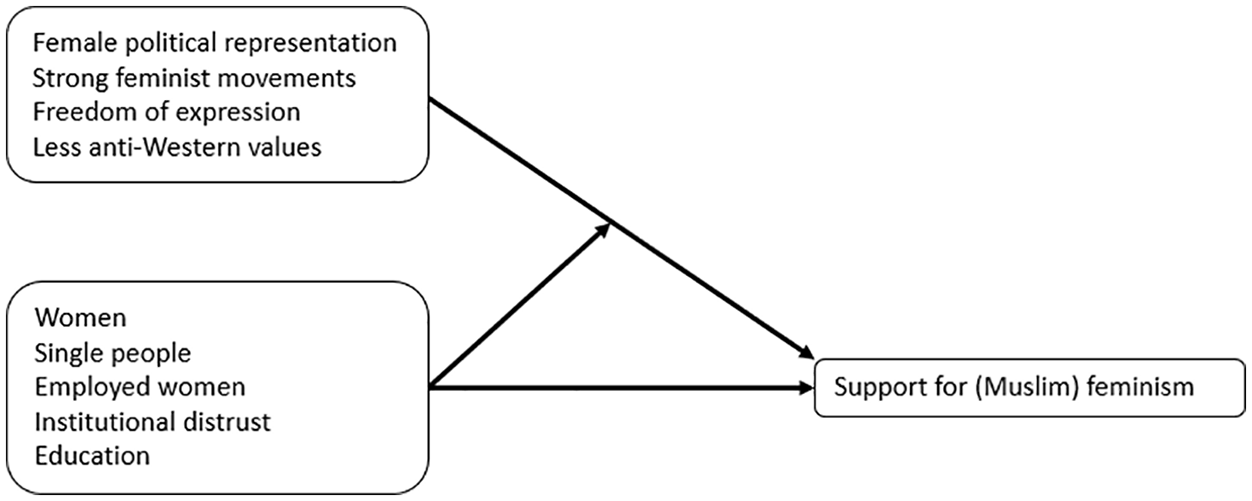
Conceptual Overview of Hypotheses
Methods
We synchronized data from the four existing waves of the Arab Barometer (AB) and the three most recent waves of the World Values Survey (WVS). 3 These data include 51 surveys (country-years) that cover 15 Arab countries (Algeria, Bahrain, Egypt, Iraq, Jordan, Kuwait, Lebanon, Libya, Morocco, Palestine, Qatar, Saudi Arabia, Sudan, Tunisia, and Yemen) between 2001 and 2016. As mentioned, we excluded non-Muslims because religiosity probably has different meanings for religious minorities in these countries. Our measurements are summarized in Table 1 below (see Appendix B for full description).
Summary of All Variables (N = 57,635)
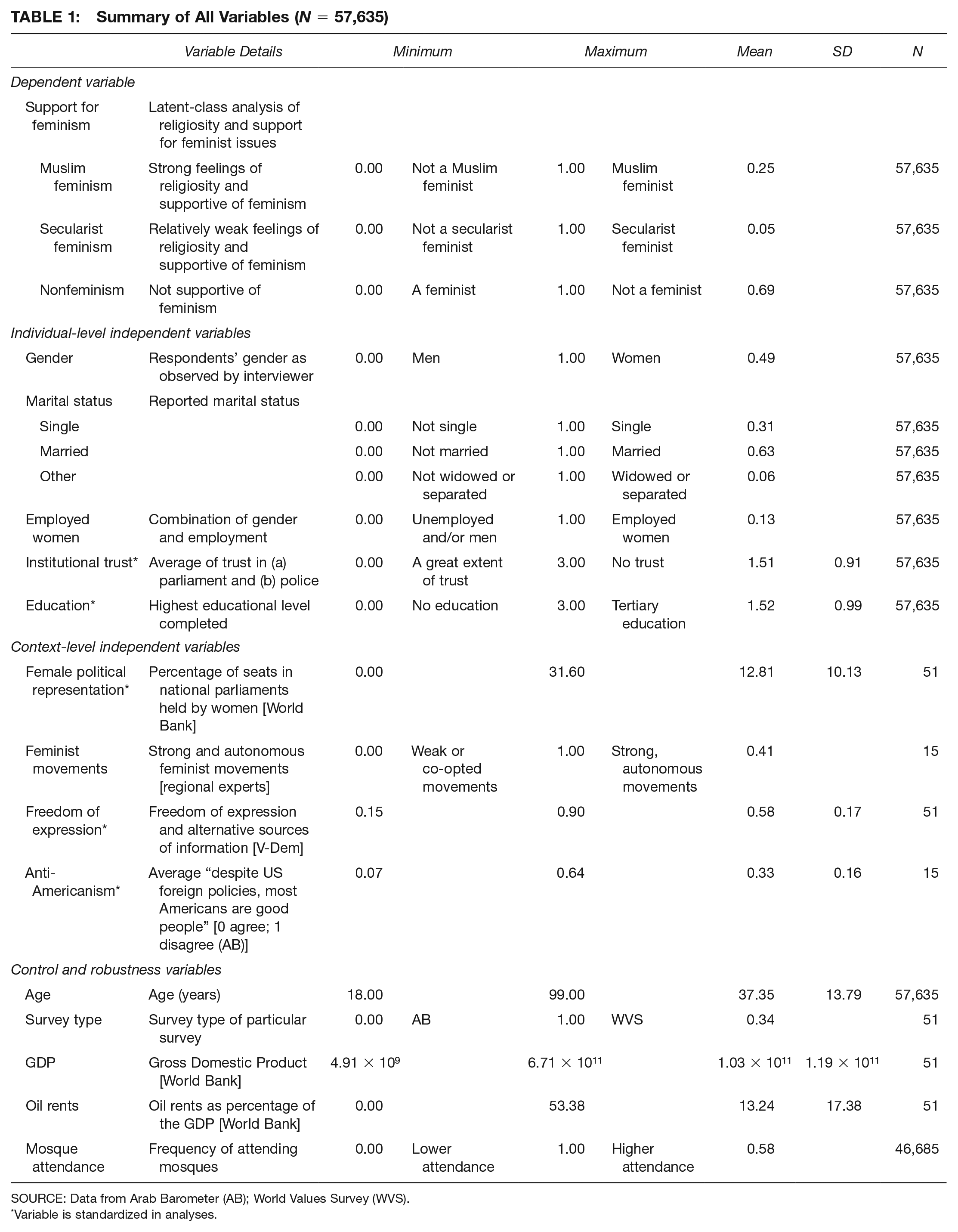
SOURCE: Data from Arab Barometer (AB); World Values Survey (WVS).
Variable is standardized in analyses.
Support for Muslim and Secularist Feminism
To operationalize our dependent variable, we use latent class analyses (LCAs) on seven items on gender equality and women’s empowerment in education, employment, and politics and four items on attachment to religion. In short, these analyses fit our purpose because they assign respondents into groups (“classes”) based on how they answered a set of questions—in this case on feminism and religiosity. These analyses tell us, for instance, which respondents are highly likely to strongly support feminism while being highly religious (“Muslim feminists”) and who supports feminism while being relatively weakly religious (“secularist feminists”) (for details, see Blaydes and Linzer 2012; Glas and Spierings 2019).
Importantly, LCA does not require preset (arbitrary) cut-off points. Actors are central, rather than items, and the models are more inductive than deductive. Substantively, this means that we circumvent having to decide a priori what “feminism” entails for the region and where Muslim feminism ends and secularist feminism begins. Rather, those questions are answered using respondents’ own judgments on different aspects of gender equality and women’s rights and their religious attachment, from which the LCA deduces grouped patterns.
Our model and all items can be found in the online Appendix, Table A1. The model shows that 25.4 percent of our sample supports Muslim feminism, 5.2 percent supports secularist feminism, and 69.3 percent do not support feminism. 4 We distinguish among these three categories in our dependent variable for analytical purposes, although, as stated above, crossovers between these categories are certainly not impossible.
Analytic Strategy and Robustness Tests
To analyze our data, we use three-level multinomial models because our dependent variable consists of three categories, and our respondents are nested in surveys (country-years) in countries (ICCcountry, nonfeminists = 0.03; ICCsurvey, nonfeminists = 0.06; ICCcountry, secularist feminists = 0.002; ICCsurvey, secularist feminists = 0.13). We also conducted five robustness tests (see the online Appendix, Table A2). By and large, our main results hold across all sensitivity tests, but if they diverge, we mention so in the text.
Results
Descriptive Analyses
To what extent do Arab publics support gender equality and women’s rights? Figure 2 shows the percentage of each country’s public that supports Muslim feminism, secularist feminism, or neither. The results first show that, across our sample, most citizens do not support feminism (almost 70 percent). Simultaneously, however, more than one in four Arab Muslims does support feminism. Also, feminists are five times more likely to be strongly attached to Islam than to sway from religion. Together, these results rebuke claims from public debates that feminism is completely foreign to the Arab region and that Islamic religiosity necessarily opposes gender equality and women’s rights (Abu-Lughod 1998; Moghadam 2013).
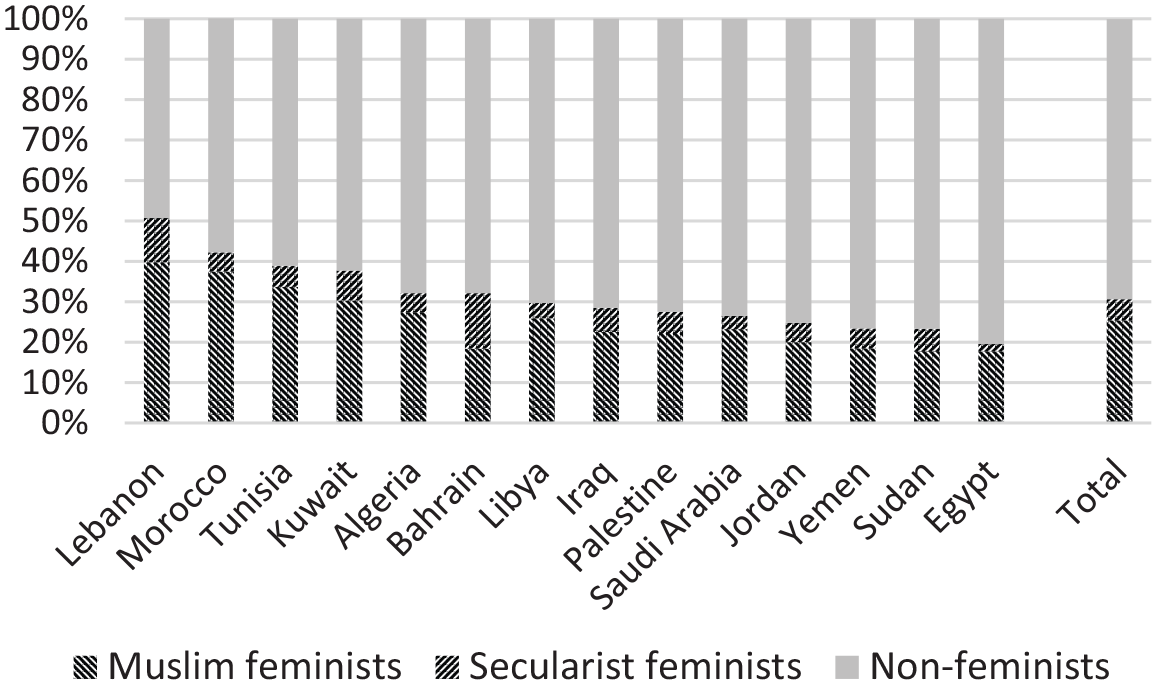
Support for Feminism per Country
Simultaneously, support for feminism differs markedly among countries in the region. For instance, the results show that in Lebanon, support for feminism is 1.5 times higher than in Egypt, and support for Muslim feminism is twice as large in Lebanon. Additionally, while there are more Muslim feminists than secularist feminists in all countries, the ratio between the two differs, which supports our expectation that the relationship between Muslim and secularist feminism differs across countries. For example, in Bahrain secularist feminism is almost as common as Muslim feminism, whereas Moroccan feminists are about six times more likely to be Muslim feminists than secularist feminists. 5 Support for Muslim or secularist feminism is structured by the country in which people live.
Explanatory Analyses: Who Supports Feminism?
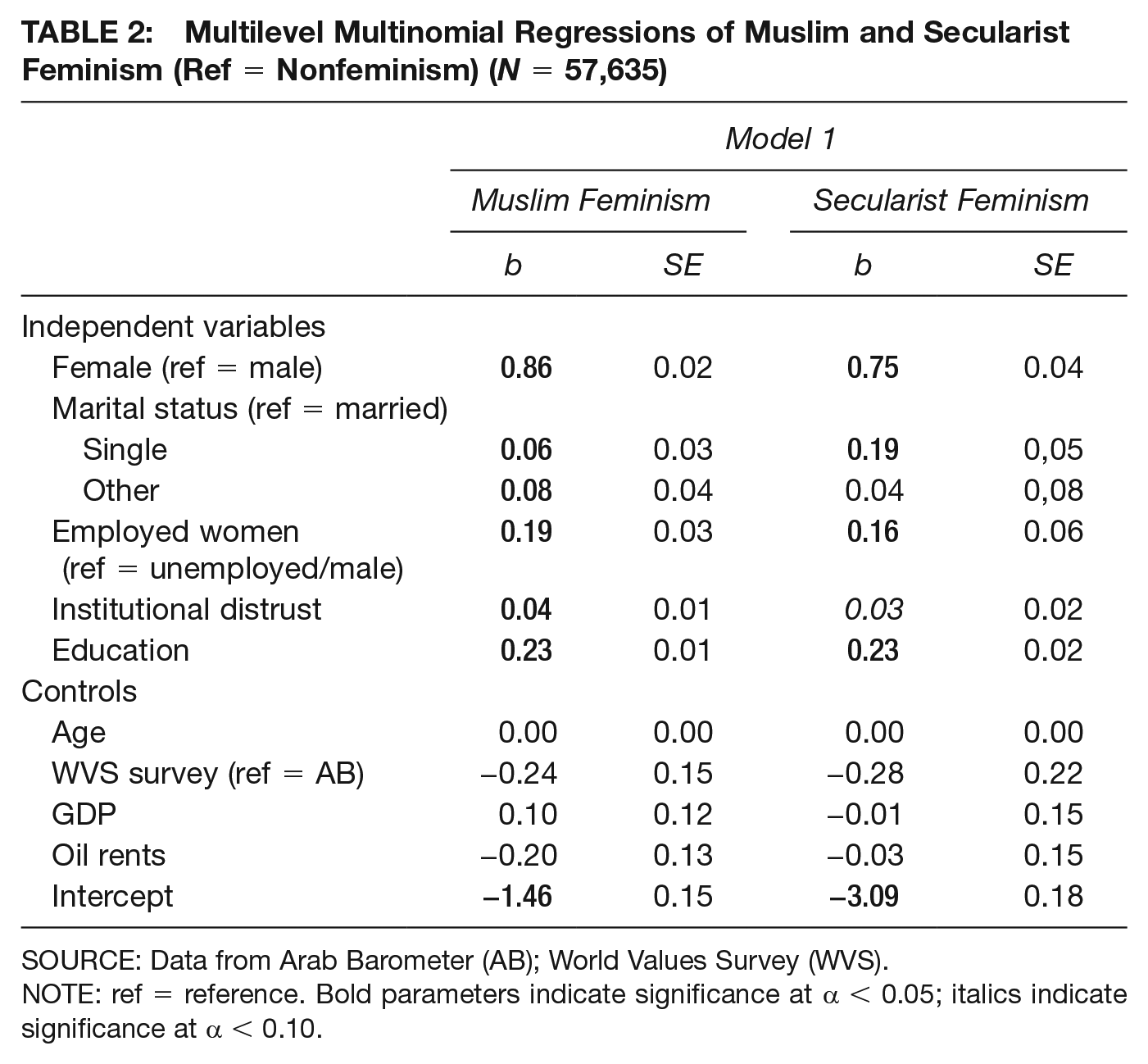
Can our context-dependent agency framework help explain these differences in support for feminism? We start with individual differences, estimated by a three-level multinomial model that uses non-feminism as the reference category (Table 2).
Multilevel Multinomial Regressions of Muslim and Secularist Feminism (Ref = Nonfeminism) (N = 57,635)
SOURCE: Data from Arab Barometer (AB); World Values Survey (WVS).
NOTE: ref = reference. Bold parameters indicate significance at α < 0.05; italics indicate significance at α < 0.10.
Generally, our individual-level independent variables relate to support for feminism as expected. For instance, women are significantly more likely than men to support Muslim feminism over non-feminism and to support secularist feminism over non-feminism. Gender is also (quite strongly) related to support for (Muslim) feminism in absolute terms: Women are more likely than men to support Muslim and secularist feminism (see the online Appendix, Figure A1). Similarly, single people, employed women, 6 and more highly educated people are more likely to support Muslim and secularist feminism. These results support hypotheses 1, 2, 3, and 5; Arab Muslims who are more inclined or better equipped to exercise agency are more likely to deviate from patriarchal norms.
Interestingly, however, the effect of institutional distrust on secularist feminism is negligible (see the online Appendix, Figure A1), 7 and, because it is a direct individual-level effect, it is nonsignificant relative to nonfeminism (see Table 2). Hypothesis 4 is thus accepted only for Muslim feminism. This result may show that Arab citizens who distrust institutions object to the specific interpretations of Islam institutions implement (Charrad 2011; Norris 1999). If citizens take issue in particular with institutions’ conservative versions of Islam, it makes sense that institutional distrust accompanies Muslim feminism rather than secularist feminism.
Explanatory Analyses: Muslim Feminism versus Secularist Feminism
When do people adopt Muslim feminism over secularist feminism? The models in Table 3 include the context-level independent variables and use Muslim feminism as the reference category. We see that women are not only more likely to support Muslim feminism than men, but also to opt for Muslim feminism over secularist feminism. This may be because of women’s general greater attachment to religiosity, which may lead them to find ways to combine religiosity with feminism (Nyhagen 2017; Rinaldo 2014). Additionally, Arab women may be more aware than men of the existence of emancipatory religious interpretations, providing them with greater flexibility in combining religiosity and feminism. Second, single people are more likely to support secularist than Muslim feminism compared with married people. This may be because of single people not fitting the religiously inspired family roles, which may simultaneously drive them toward feminism and away from religiosity—an option that may be more alluring or accessible to them, given that they are less influenced by marital partners (Abu-Lughod 1998; Ahmed 1992; Johnson 2007).
Multilevel Multinomial Models of Nonfeminism and Secularist Feminism (ref = Muslim Feminism)
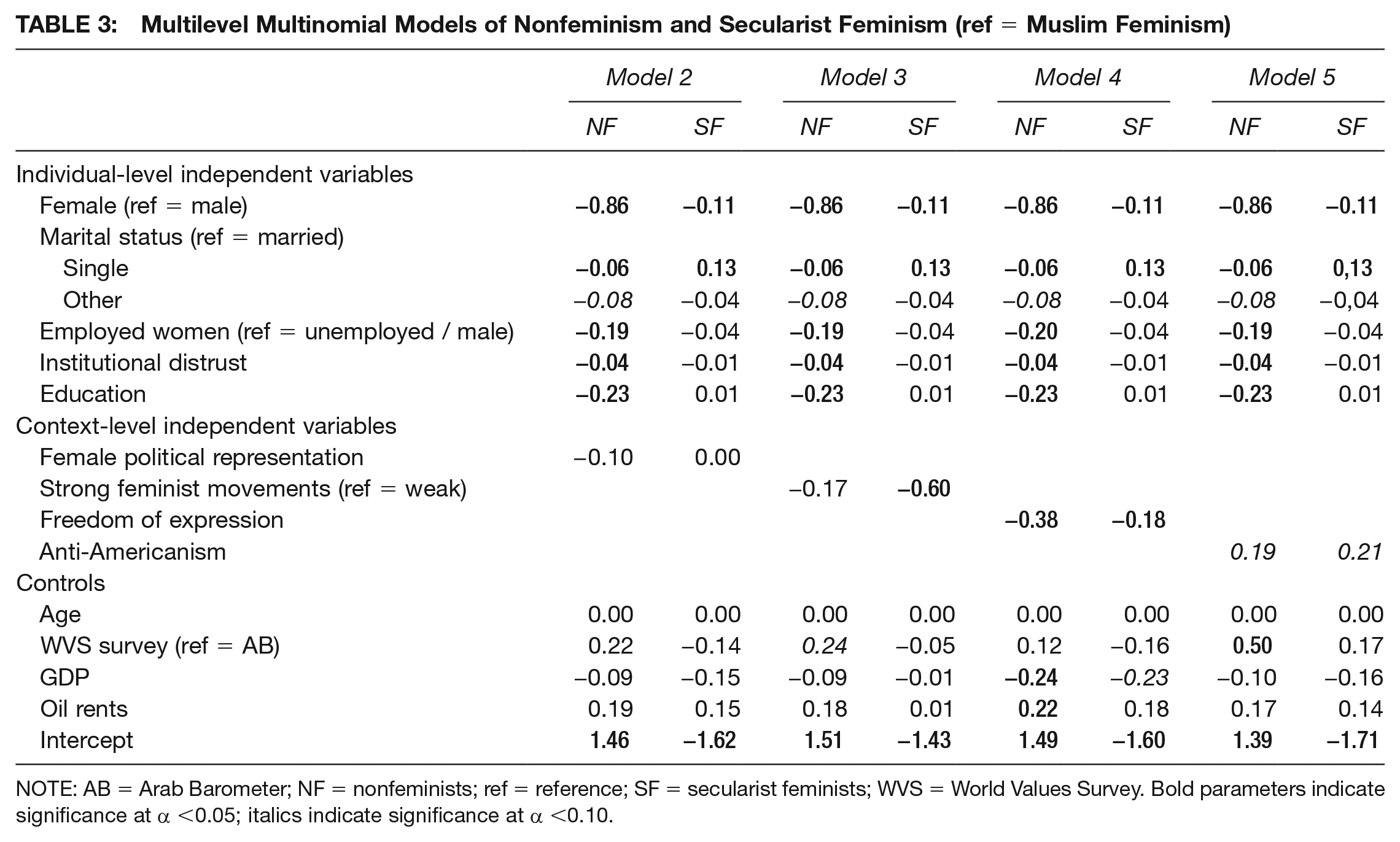
NOTE: AB = Arab Barometer; NF = nonfeminists; ref = reference; SF = secularist feminists; WVS = World Values Survey. Bold parameters indicate significance at α <0.05; italics indicate significance at α <0.10.
Moving to the main research question—how contexts influence the adoption of Muslim compared with secularist feminism—our models show, first, that female political representation does not matter. Contrary to hypothesis 6, contexts with more female parliamentarians do not show significantly more citizens adopting Muslim over secularist feminism. Women in important political positions do not (yet) seem to counter narratives that Arab-Islamic identity opposes feminism.
Our other expectations about which societies show more Muslim than secularist feminism are supported. In Arab societies with strong, autonomous feminist movements, Muslim feminism is supported more than secularist feminism, compared with societies with weak or co-opted movements. Likewise, freedom of expression fuels Muslim feminism over secularist feminism. Finally, more anti-American societies inhibit Muslim feminism more than secularist feminism. The latter is interesting, given the theoretical possibility that anti-Westernism also could have buttressed the necessity for culturally legitimate feminism and thus fueled Muslim feminism. However, our data do not support this possibility; rather, our findings support our hypothesis 9 that Muslim feminism is inhibited compared with secularist feminism. Altogether, these findings confirm hypotheses 7, 8, and 9. What is more, societal narratives seem quite powerful in shaping opportunities for Muslims to combine feminism with strong attachment to Islam, in the sense that they affect many and diverse groups (see the online Appendix, Table A2).
These relative differences between societies are driven mainly by absolute differences in Muslim feminism (see the online Appendix, Figure A2). Stronger feminist movements, higher freedom of expression, and lower anti-Americanism increase the likelihood that citizens support Muslim feminism, rather than strongly decrease support for secularist feminism. It seems that when Arab societies less unilaterally contradict Islamic-Arabness to feminism, Muslims use this space to combine feminist views with strong attachment to Islam in particular.
Explanatory Analyses: Who Uses Societal Openings to Support Muslim Feminism?
Still, the extent to which groups perceive and capitalize on these counters to narratives that Islam opposes feminism may differ. In other words, societies may affect support for Muslim feminism to different degrees for varying groups. Table 4 summarizes the results of three-level multinomial models that include cross-level moderation terms (full models are in the online Appendix, Tables A3 through A6). First, the effects of female political representation rates on Muslim feminism do not significantly differ among groups (see also the online Appendix, Table A2), so all our hypotheses on female parliamentarians affecting Arab citizens’ support for Muslim feminism are rejected.
Summary of Moderated Multilevel Multinomial Models of Nonfeminism and Secularist Feminism (Ref = Muslim Feminism) (N = 57,635)
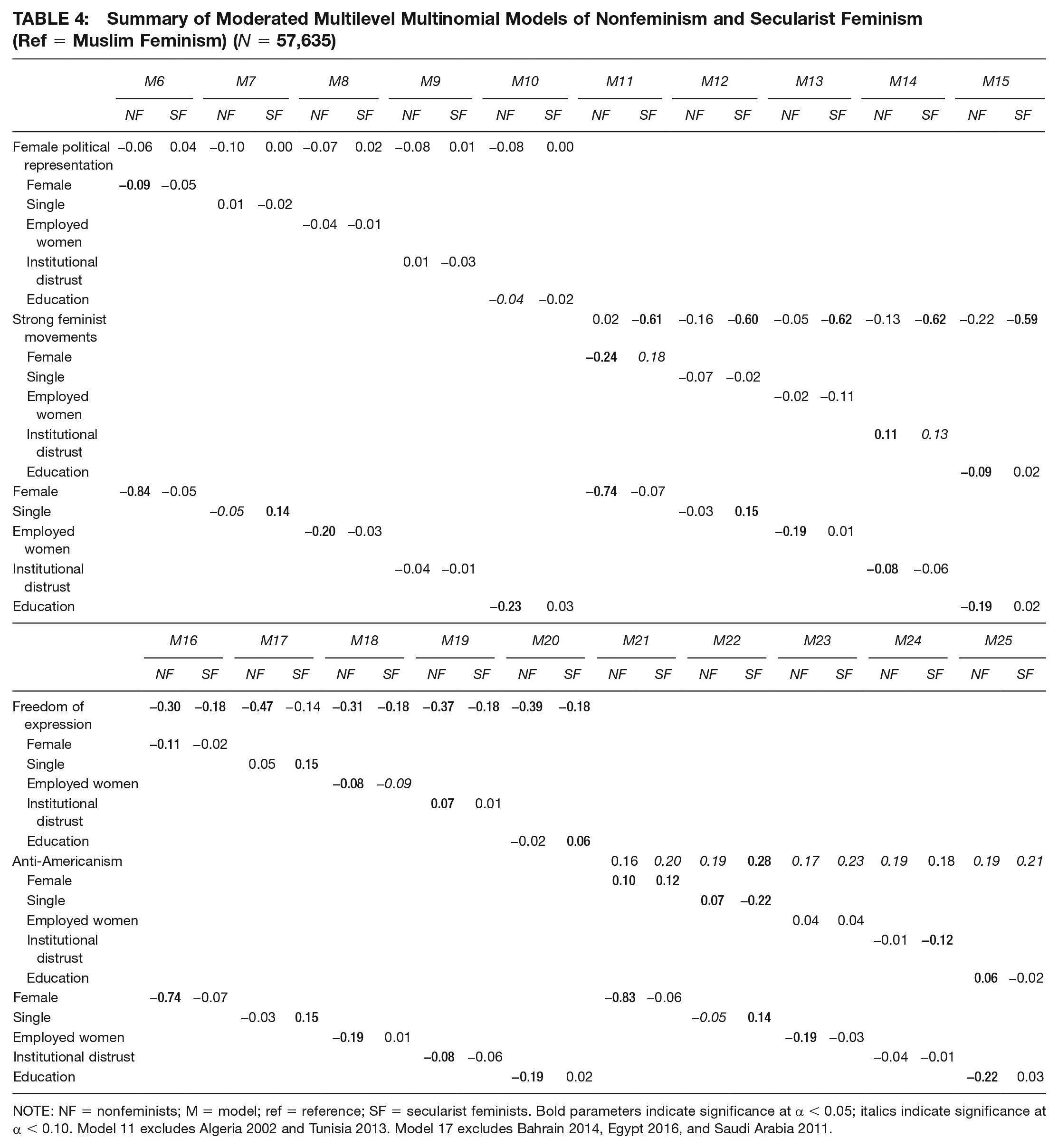
NOTE: NF = nonfeminists; M = model; ref = reference; SF = secularist feminists. Bold parameters indicate significance at α < 0.05; italics indicate significance at α < 0.10. Model 11 excludes Algeria 2002 and Tunisia 2013. Model 17 excludes Bahrain 2014, Egypt 2016, and Saudi Arabia 2011.
Feminist movements, freedom of expression, and anti-Americanism do seem to relate to Muslim feminism differently for various groups. However, first, we should note that some caution is warranted because some (less than half) of our moderation terms do not reach statistical significance. Still, almost all cases—13 of 15—do show the same pattern concerning which groups are affected more and which less, and these patterns do hold with sensitivity checks.
Broadly, our results imply that societal narratives on feminism and Islam especially affect individuals who are more likely to support feminism (see also the online Appendix, Table A7). 8 Contexts more strongly affect the support for Muslim feminism of Arab citizens who are more likely to resist patriarchal norms than of others (Figure 3 has longer dark bars than light bars). 9 For example, in societies with stronger feminist movements, women especially are more likely to support Muslim feminism (Figure 4). Similarly, women’s support for Muslim feminism is inhibited by anti-Americanism more so than men’s (see the online Appendix, Figure A3). So, women seem more attuned to societal narratives on feminism opposing religiosity and to signals that undercut this narrative. Although, in contrast, institutional distrust weakens the impact of societal narratives on feminism and Islam, the same strengthening effect generally holds for single people, employed women, and more highly educated people. These results are generally in line with hypothesis 10. Arab Muslims who are better able to support feminism or have more to gain from supporting feminism seem to be more attuned to (counters to) societal narratives on religion and feminism.
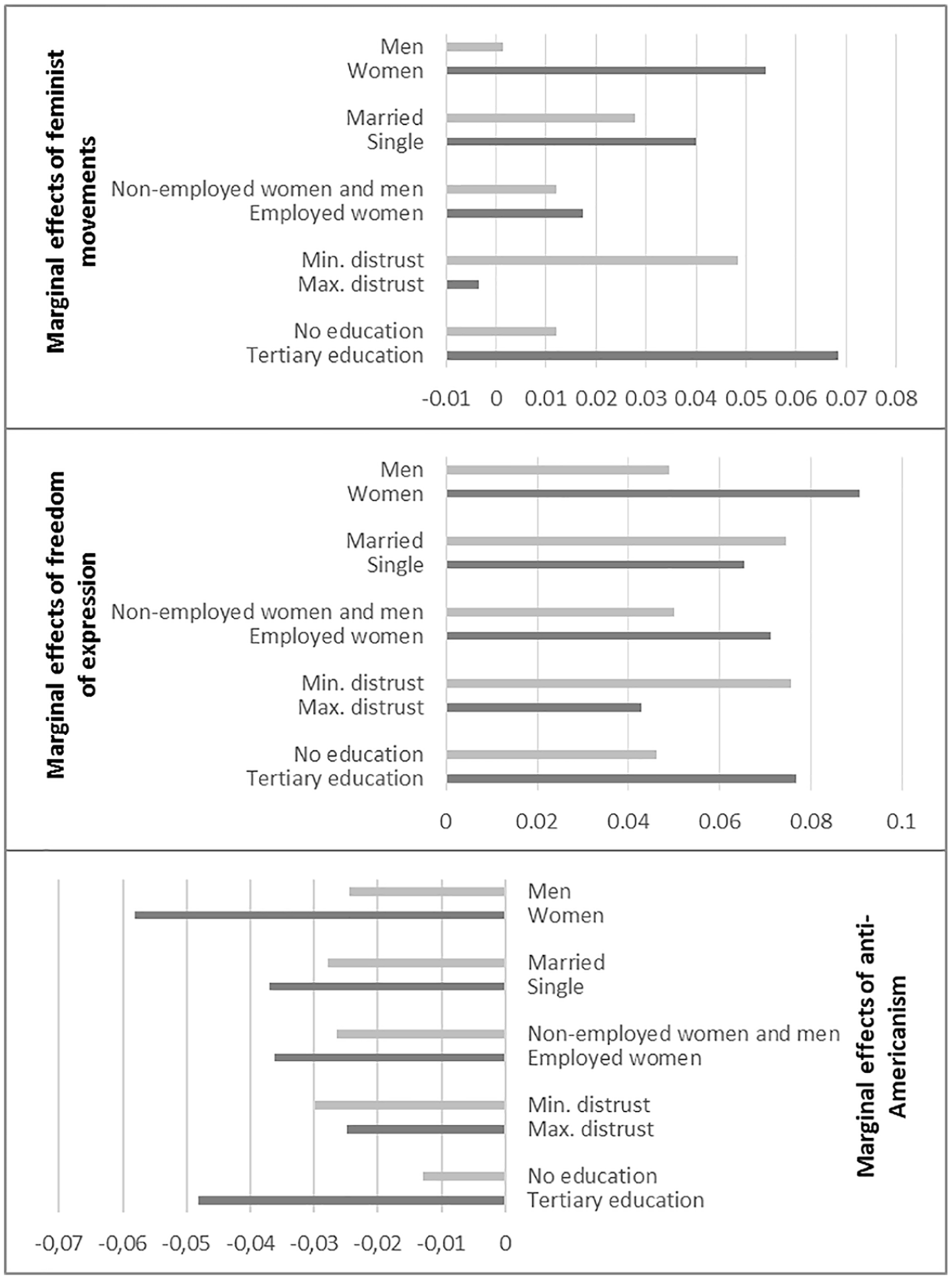
Marginal Effects of Contextual Variables on Muslim Feminism for Various Groups
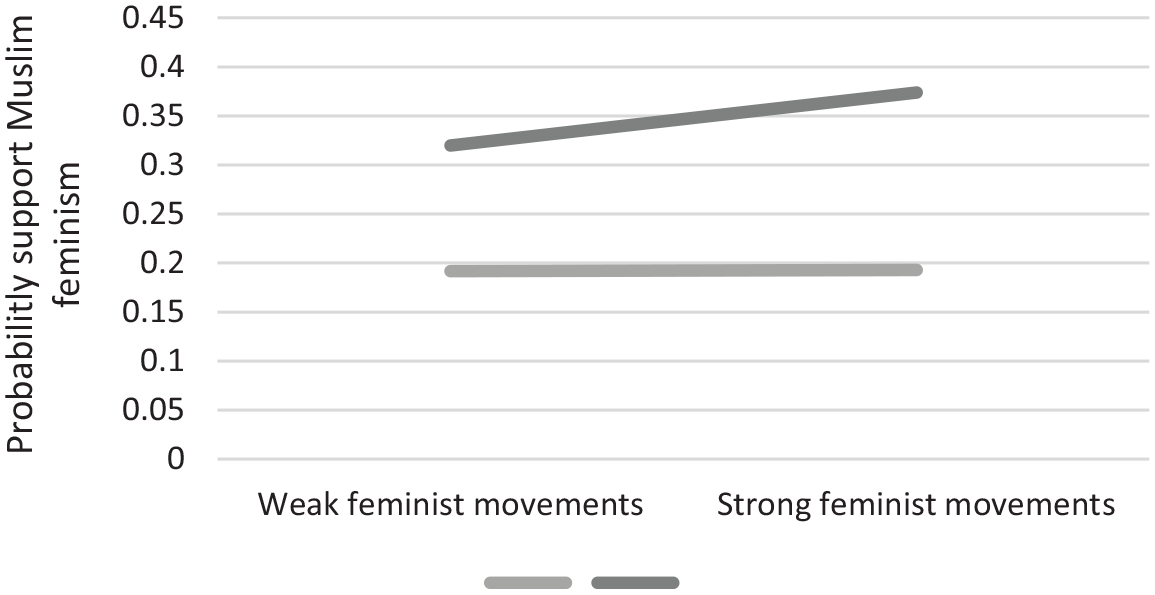
Relations between Feminist Movements and Support for Muslim Feminism per Gender
Finally, we note that especially Muslim feminism rather than secularist feminism is affected. In the cases where contexts affect secularist feminism for various groups differently, the patterns are similar to those of Muslim feminism. Arab citizens who are more likely to resist patriarchal norms tend to be more strongly affected (see the online Appendix, Figure A5). However, for secularist feminism differences are smaller, and more often no real differences are found. Altogether, societal narratives that cement oppositions between Islam and feminism seem far more suited to explaining when Arab Muslims support feminism while remaining strongly attached to Islam than when they support feminism while detached from Islam (Figure 5).
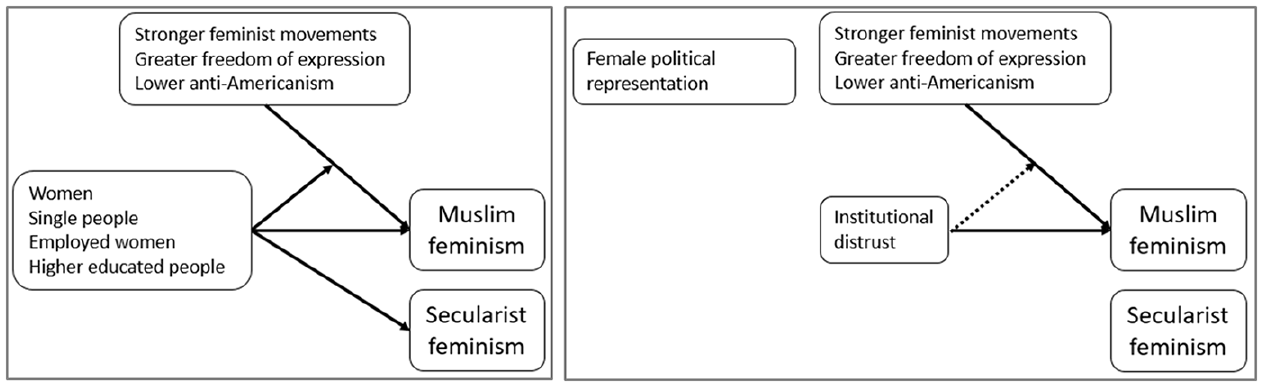
Summary of Supported Hypotheses (Left) and Rejected Hypotheses (Right)
Conclusion
Public debates portray the Arab region as a homogeneous bloc where Islam socializes passive citizens to oppose gender equality and women’s empowerment (Abu-Lughod 1998; Moghadam 2013). Inadvertently paralleling such Orientalist discourses, existing large-scale public opinion studies tend to focus on Muslims’ lower support for women’s rights than non-Muslims’ (e.g., Alexander and Welzel 2011; Inglehart and Norris 2003; Lussier and Fish 2016). The present study veers away from Orientalism by focusing on Arab citizens’ agency and the heterogeneity of the region to explain which Arab Muslims support women’s rights and whether they do so while remaining highly attached to Islam (“Muslim feminism”) (Alexander and Parhizkari 2018; Said 1978). We develop and test a framework that proposes that Arab Muslims are not solely passively socialized into patriarchal interpretations of Islam, but can also agentically subvert “malestream Islam” and support feminism (Glas, Spierings, and Scheepers 2018; Rinaldo 2014; Zion-Waldoks 2015). Simultaneously, we suggest that societal narratives that post a contradiction between Islam and feminism influence whether citizens combine feminism with strong attachment to Islam (Ahmed 1992; Badran 2011; Charrad 2011; Moghadam 2002).
To test our expectations, we synchronized 51 surveys from the Arab Barometer and World Values Survey that cover over 50,000 Arab Muslims in 15 countries between 2001 and 2016. Latent class analyses show that some Arab citizens do subvert dominantly patriarchal religious interpretations; one in four Arab Muslims supports feminism while being strongly attached to Islam. Muslim feminism is far more common than secularist feminism, which is supported only by 1 in 20 Arab Muslims. Further supporting our framework, societal embeddedness also matters, as support for women’s rights as well as the ratio between Muslim feminism and secularist feminism (supporting feminism while being relatively weakly attached to Islam) differ markedly among countries in the region.
To explain these patterns, we conducted three-level multinomial analyses. We have two main findings. First, we show that, on average, (employed) women, single people, people who distrust institutions, and more highly educated people support feminism more than do others. What is more, rather than being passive victims, Arab Muslim women seem to be the greatest potential agents of change in the region, in the sense that their support for (Muslim) feminism is far higher than men’s. More broadly, these results show that Arab citizens can deviate from dominant patriarchal norms and do so when they are more inclined or better equipped to exercise agency.
Second, the extent to which societies cement or undercut narratives that Islam contradicts feminism affects support for Muslim feminism. For instance, in societies with strong feminist movements, especially Muslim feminism, rather than secularist feminism, is more often supported than in societies without strong feminist movements. Additionally, our results tentatively suggest that is true more for those most likely to support feminism in particular. For example, women, rather than men, are especially more likely to support Muslim feminism in Arab societies with stronger feminist movements. In line with our focus on heterogeneity within the region and context-dependency, we find that support for Muslim feminism is shaped by how Islam and feminism are constructed by the particular Arab society in which citizens are embedded.
Our results also show two main deviations from these general patterns. First, whereas Arab citizens who are more likely to support feminism are more strongly affected by societal narratives, those who distrust institutions are affected less strongly. This may signify that institutional distrust also implies distrust of societal narratives on Islam and feminism—be they emancipatory or patriarchal—thereby weakening their impact. Second, while societies with stronger feminist movements, greater freedom of expression, and lower anti-Americanism fuel Muslim feminism over secularist feminism, female political representation rates do not. This null finding may signify that female politicians’ symbolic representation is undercut by their substantive stances as, in some countries, female politicians mainly belong to conservative Islamist parties (Al-Anani 2012). It may take feminist women’s representation to matter. However, because female political representation has increased only fairly recently in the region and countering societal narratives takes time, it may be too soon to draw conclusions.
We want to note that our framework has proved far more useful in understanding Muslim feminism than secularist feminism. Although this is perhaps not unexpected, as Muslim feminism was our main focus, secularist feminism in the Arab region thus remains badly understood. Both our analysis and most existing qualitative studies focus on Muslim feminism. Future studies should thus not focus solely on Muslim feminism but also prioritize the question of what drives secularist feminism in the Arab region. More specifically, qualitative scholars could study whether countries with historical legacies of strong Muslim feminist movements differ from countries in which secularist feminist movements have been more popular.
Still, to our knowledge, the present study is the first quantitative work ever to explain why Arab Muslims support feminism while remaining strongly religious. Doing so rebukes simple Orientalist depictions of Arab citizens as unilaterally opposed to gender equality and women’s empowerment because of Islam. In fact, the results of this study demonstrate that such portrayals of Islam as necessarily contradictory to feminism may weaken the possibility of Muslim feminism. Support for feminist mobilization must incorporate the evidence that many Arabs do not view Islam and feminism as contradictory. Emboldening diverse and emancipatory interpretations of Islam may prove very fruitful to boost feminism in the Arab region.
Supplemental Material
10533.AC_appendices_final – Supplemental material for Explaining Support for Muslim Feminism in the Arab Middle East and North Africa
Supplemental material, 10533.AC_appendices_final for Explaining Support for Muslim Feminism in the Arab Middle East and North Africa by Saskia Glas and Amy Alexander in Gender & Society
Footnotes
Authors’ Note:
This project was funded by NWO (406-16-517). We thank three anonymous reviewers and the participants of the University of Gothenburg’s Politics & Gender Workshop, the University of Gothenburg’s Spring Event on Survey Methodology, and the European Conference on Politics and Gender for their useful feedback.

Notes
Saskia Glas is a PhD candidate in sociology at Radboud Social and Cultural Research, Radboud University (the Netherlands). The project, funded by the NWO, focuses on religion, support for gender equality, and Muslim feminism in Arab countries. Her research interests include sociopolitical attitudes, political structures, gender equality, and migration.
Amy C. Alexander (Ph.D.) is an Associate Professor in the Department of Political Science at the University of Gothenburg and a member of the Quality of Government Institute’s Collegium. Her research focuses on the sources of gender equality and its effects on political representation, social values, democratization and governance across the globe. She has published on this in several peer reviewed journals such as International Organization, Comparative Politics, Politics and Gender and Politics, Groups and Identities.
References
Supplementary Material
Please find the following supplemental material available below.
For Open Access articles published under a Creative Commons License, all supplemental material carries the same license as the article it is associated with.
For non-Open Access articles published, all supplemental material carries a non-exclusive license, and permission requests for re-use of supplemental material or any part of supplemental material shall be sent directly to the copyright owner as specified in the copyright notice associated with the article.
