




Abstract
Despite assurances by the Thai government that it has prioritized extensive economic improvements that will enhance people’s wellbeing, significant limitations exist within the Thai economy. Notably, Thailand has struggled to achieve sustained upward national growth while providing adequate social safety nets for working classes, which have contributed to the normalization of precarious work within the labor market. Drawing on ethnographic research conducted in Bangkok among long-term residents and newly arrived domestic migrants, this article explores how weakening macroeconomic trends map onto diverse individuals’ livelihood interpretations, strategies, and practices and the ways in which indices such as class, education, or occupation influence people’s perceptions of reduced social safety nets and state protectionism. While previous studies have addressed insecurities within weakening markets, research in the Thai context has not traditionally considered how uneven development, the precarious nature of work, and limited social protectionism cut across diverse people working in both formal and informal sectors.
Introduction
The day usually starts around 5:00 am, which involves cleaning the kitchen, cooking breakfast, starting laundry, dusting the house, tending to the garden, and preparing other things the family may need. While the work can be tiring, Chantana takes pride in what she does, having migrated to Bangkok from the Isaan or northeast region of Thailand around 2010 and started work as a caregiver. 1 Since that time, she has worked with a few families grappling with end-of-life care for a loved one. Given the changing demographics of Thailand and its emergence as a complete-aged society—along with children’s expanding work responsibilities and their own labor migration—families increasingly rely upon caregivers like Chantana to assist with daily living, household tasks, healthcare, and emotional support.
Though the woman for whom Chantana was hired to care had passed away from a prolonged battle with cancer a few months prior to our conversations, she stayed with the family to care for the widowed husband, a generally healthy octogenarian, which means she no longer needs to wake in the middle of the night to tender care or stay at the hospital for days at a time to assist with chemotherapy treatments. Of course, the reduced work comes with reduced compensation. As such, Chantana takes advantage of down time and earns extra money by selling vegetables at the local market that she grows around the house. It was here we discussed the nature of work, issues confronting laborers, and governmental systems of support.
For my work, I go through a recruitment center. Families contact the agency and request services. If we agree to the terms, I’ll work for them. And since I’ve gone through the agency, there are some protections. I get so many days off, overtime, and money for food. If I didn’t go through the agency, I don’t know what type of protections I would have. It can be hard to find a job otherwise.
The state doesn’t provide protections for those that might not work through an agency?
No. Nothing substantial. I’m not sure you would get any type of protection. If you’re [an international] migrant, it can be worse. You might get paid half of what Thais make. For this work, I get paid enough. I can buy food and other things, even save some money. I won’t go hungry. But migrants, they have it harder. They might not have enough to buy healthy food and will eat a cup of noodles or buy hard rice. I’ve seen them picking food off the trees and plants that grow in the area. . . There’s no welfare for people that don’t make enough. The government might help during a natural disaster, but otherwise you make ends meet. Moreover, if the police catch you begging, you can get arrested. [She continued] Poorer people can suffer a lot in this country. Just try going to the doctor. You have to find a good one and afford their services. The same with housing. Everything is expensive in Bangkok. If the government is not going to protect us or enforce minimum wages, they need to at least lower costs. This way we could afford other things. In addition, many of us have family back home. We could send more to them and help, since there’s not always a lot of work [in the Isaan]. Or we could send our kids to better schools or support them in college. My kids are at least grown and working in Bangkok. I’m mostly saving for retirement now.
Are you in the system [Thai Social Security]?
Maybe ten years ago, though I stopped contributing. I’ll get some of that back when I retire, but it won’t be enough. For example, I think if you’re sixty years old, you get 600 baht a month from the government [approximately 19.00 USD]. Or 700 baht if you’re seventy years old. They might double that for someone who is disabled, but it would never cover someone’s expenses. . .. And while I get some protections through the agency, there are no benefits once retired. 2
As seen here, Chantana’s experiences encapsulate much of what troubles Thai development and has placed workers in vulnerable positions: labor precarity, limited compensation, rural underdevelopment, diminished social protectionism, and uncertain economies, all of which undermine people’s abilities to create resilient and stable livelihoods. Government offices have recognized such limitations and assert that recent National Economic and Social Development Plans will correct development shortcomings (see NESDB 2017; National Economic and Social Development Council [NESDC] 2023; National Strategy Secretariat Office [NSSO] 2018; United Nations Development Programme [UNDP] 2007). These plans detail efforts to improve uneven distributions of infrastructure between rural and urban spaces, expand social protectionism, provide equitable access to technology and education, and create accessible pathways for diverse populations to enter skilled labor markets.
Despite assurances by the government that it has prioritized extensive and accessible economic improvements and will enhance people’s wellbeing and human capital, as noted by Chiengkul (2019, 1690) Thailand continues to follow “a similar development trajectory to that of the past few decades” and retains previous limitations in its domestic economies. This includes a continued reliance on exploitable labor, industrial and technological imports, and an unsustainable depletion of natural resources, which has helped create a national economy that attained economic growth despite negative externalities, though with limited options for future upgrading (Chiengkul 2019). Additionally, constrained domestic investments in education, healthcare, infrastructure, and advanced manufacturing have weakened economic prospects and seen an increase of precarious work (e.g., Glassman 2020; Kelly et al. 2012; Satitniramai 2020; NESDB 2017; World Bank, 2023a).
It is within this context that we seek to contribute to our understanding of how people adjust their livelihoods under such macroeconomic conditions and the normalization of precarious work. Building from the call for more “local fine-grained ethnographic research into the context-specific social, affective, and political outcomes of new policy formulations” (Radcliffe 2015, 868), this article draws from ethnographic research conducted in the Bangkok metropolitan region (BMR) among long-term residents and newly arrived domestic migrants to explore how weakening macroeconomic trends map onto diverse individuals’ livelihood interpretations, strategies, and practices and the ways in which indices such as class, education, or occupation influence people’s perceptions of reduced social safety nets and state protectionism within labor markets.
While previous work on livelihood adjustments have attended to insecurities within weakening markets, in the Thai context research has not typically considered the ways in which labor precarity, contracted social safety nets, and sociocultural differences coalesce to influence diverse groups’ livelihood portfolios. Our analysis foregrounds how uneven development, the precarious nature of work, and limited social protectionism cut across diverse people (working and middle classes) that work in both formal and informal sectors. As such, we believe this contribution adds to our understanding of the importance of social protectionism across class and status differences, how diverse individuals cope with the uncertainties and ambiguities embedded within the national economy, and the normalization of precarious work. Additionally, ethnographic findings raise important implications for government agencies that should provide stability and support for people seeking to find work under such conditions.
Outline
This article is divided into five main sections. First, we explore research in fields such as anthropology, sociology, and economics that has addressed the rise of precarious work. Here, we discuss issues surrounding vulnerability within labor markets and uncertain livelihoods, which allow for nuanced ways of considering the recomposition of labor within “formal” and “informal” work. Second, we address the Thai government’s uneven attempts to improve people’s living standards and economic opportunities through modernization and development schemes. Specific attention is directed to the series of financial crises, political instabilities, and global events that have weakened economic prospects in recent decades and partially account for the increased informalization of work, precarity within the labor market, and reduced social protection policies. Building from critical political economic scholarship, we also note the importance of Thai political regimes that seek to enhance employers’ authority for workplace control. Third, we detail the ethnographic methods and sampling procedures used in this study, which draw from periods of ethnographic research conducted among long-term residents and domestic migrants in the BMR. Fourth, we present analysis of the ethnographic data, which highlight the ways in which respondents’ sociocultural differences influenced their interpretation of limited social safety nets and the precarious nature of work. This section also demonstrates how respondents deployed diverse practices and strategies to mitigate the instabilities of labor markets, disparities between rural and urban spaces, and insufficiencies within the Thai economy. Lastly, we consider the significance of this work, limitations of the study, and the ways that the ethnographic data presented contribute to our understanding of how livelihood adjustments are shaped by indices of sociocultural difference and the broad importance of social safety nets within people’s livelihoods.
Considerations on Precarity and Informality
Sociocultural analysis of precarity, vulnerability, and uncertainty has increased in theoretical depth as scholars have considered how political economic transformations initiated by modern capitalism weaken institutional supports previously offered in welfare states (e.g., de Vries and Kapoor 2024; Endo 2014; Sen 2000; Staupe-Delgado and Villarreal 2023; Susser 2021). As global capital operates within neoliberal relations and becomes mediated by a country’s domestic political processes, research has noted reduced labor protections, weakened unionization, downward pressures on compensation, and entrenched economic inequalities (e.g., Hewison 2016; Kalleberg et al. 2022; Satitniramai 2020; Tappe and Nguyen 2019). The integration of national economies into global economic systems can produce a series of politico-economic crises, notably within emerging economies, which often receive structural adjustments and pressures to deregulate labor relations as correctives (Susser 2021). Further, such policies often reduce government expenditures and erode states’ abilities to provide socioeconomic protectionism from varying risks and vulnerabilities such as unemployment, illness, or poverty. Yet, research has also pointed to the ways in which particular regimes of power within states may shape national employment relations to advance the interests of capital and employers and, in so doing, marginalize labor and diminish mobilization capacities of working classes (Brown 2016, 208; see also Chang 2009). The results have been prioritizing capital and the creation of precarious work that “is uncertain, unstable, and insecure and in which employees bear the risks of work (as opposed to businesses or the government) [and where] workers receive limited social benefits and statutory entitlements” (Kalleberg et al. 2022, 2).
The structural precariousness of reduced social security systems and transformations in labor markets create dynamic forms of uncertainty as people strategize to stabilize livelihoods in the immediate and long-term. Analyzing the poor working class in Brazil, de L’Estoile (2014) employs concepts of relative and radical uncertainty to frame sugarcane workers’ anxieties about the future, recognizing how opportunities available at any given moment are made possible and constrained by the material and symbolic conditions of life. Here, relative uncertainty (expectations on possible outcomes in a situation, made possible by one’s social world and personal relationships nurtured over time) contrasts with radical uncertainty (areas of life that are principally beyond one’s control or influence) (de L’Estoile 2014, S66). Attention turns toward understanding how poorer communities—or the precariat (Standing 2011)—contend with events outside their control, while also drawing upon their own experiences, forms of capital, and social worlds in response to immediate and distant pressures (Campbell 2016; Johnson and Gilligan 2021; Porst and Sakdapolrak 2018).
Building from these considerations, scholars in fields such as anthropology and human geography have explored the tensions between a precarious present and an unrealized future (Boccagni 2017; Bunnell et al. 2018; Johnson 2020). As individuals seek stable livelihoods that unfold within vulnerable economic contexts, past experiences, and current circumstances interrelate to shape understandings of the possibilities and probabilities of success in future-oriented livelihood strategies (e.g., Appadurai 2004). Individuals and families draw from material and symbolic resources, past experiences, and future goals to contend with labor informalities or economic insecurities. While individuals’ access to diverse resources and capital influence possibilities within livelihood adjustment or diversification, research also notes the importance of the broader politico-economic environment where coping efforts are deployed. For example, Amorós, et al. (2019) employ multilevel data across fifty-one countries to illustrate the ways in which political economic uncertainties within states lead to higher rates of “necessity-based entrepreneurship.” In effect, state fragility—or the degree to which governments struggle to fulfil core functions or provide social protectionism—incentivize reactive adjustments in individual livelihoods to minimize risks and improve socioeconomic stability.
Additionally, Krohn-Hansen (2022) examines contradictory conditions within the Dominican Republic when economic growth occurs simultaneous with stagnant wages, high poverty rates, and worker vulnerability. In this case, macroeconomic conditions demonstrate degrees of improvement, but “jobless growth” exhibits flat or decreasing employment, making it difficult for people to find decent-paying, secure employment. Krohn-Hansen expands precarity “to include a range of different insecure conditions with their associated material-social forms and subjectivities” (2022, 22). Precarity encompasses varying types of economic uncertainty associated with unemployment, underemployment, informal work, or reactive entrepreneurialism. Further, other forms of insecurity (such as infrastructural deficiencies, congested urban spaces, reduced investments in education, or limited access to food) become central in understanding people’s efforts to work and live under those conditions. Similarly, Staupe-Delgado and Villarreal (2023, 235) highlight how informal workers in Colombia made high-risk decisions to alter livelihood strategies during the coronavirus pandemic—a crisis that exacerbated deteriorating economic conditions and produced new sociopolitical uncertainties.
While vulnerabilities and instabilities have been shown to diminish opportunity, displace workers, or distress families, caution should be taken in universalizing responses to precarious work. As noted by Leung and Cossu (2019, 278), precarity should be scrutinized against specific sociocultural and economic histories, including people’s perceptions of labor. For instance, although individuals and families may enter informal work due to labor market dysfunctionality or reductions in formal employment, some voluntarily leave formal sectors in favor of informal ones, particularly as they seek to escape low-pay, inflexible working hours, little autonomy, or few benefits (Staupe-Delgado and Villarreal 2023). Additionally, clear binary distinctions between formal and informal become blurred. Informal labor becomes formalized through increased regulations, taxes, and compliance, while informalization within formal sectors sees businesses outsourcing labor, advancing short-term contracts, reducing benefits, restricting unionization, and promoting flexibilization within employment relationships (see also Brown 2016; Chang 2009; Chen 2007). Ultimately, dynamic motivations may exist in the deployment of strategies to mitigate broader uncertainties in diverse economic sectors. As seen below, Thai economic histories, political crises, and reduced social protectionism manifest within livelihood portfolios and efforts to find stability. Additionally, sociocultural differences such as occupation or education influence, in diverse ways, the perceptions of and responses to labor precarity.
Historical Foundations of Precarious Labor and Informality in Thailand
Efforts to improve people’s livelihoods and expand economic opportunities throughout Thailand emerged under the 1950s state-led modernization schemes of Field Marshal Sarit Thanarat. The primary focus of development was to reduce poverty and increase welfare in rural spaces, which had an ancillary, yet intended, benefit of legitimizing the government’s rule over rural communities outside the Bangkok central polity (Wyatt 2003, 266–74). Under this framework, development became linked to state-building endeavors, such as the expansion of highways, bridges, rural electrification, dams, water and sewer systems, and technical infrastructure, which were meant to transform the political economy and increase nation-state integration. Despite achieving long periods of moderate growth starting in the 1960s, the benefits of modernization remained clustered around Bangkok. Poverty and inequality characterized regions outside the capital city, which comparatively received lower investment in infrastructural development and lagged progress made in the central region (Bello et al., 1998; Warr 2020). 3
Seeking to mimic the successes of East Asian developmental states such as South Korea and Taiwan, Thailand adopted policies on export promotion and prioritized state intervention within macroeconomic planning to attract foreign investment while still protecting domestic industries from outside corporate actors (e.g., Doner 2009). The demand for exported manufactured goods and services such as tourism led to one of Thailand’s fastest growing periods, “and the country was included by the World Bank among the “miracle” economies of East Asia” (Glassman 2004, 152). The combination of state-managerial roles in the economy, independent market forces, and organic expansion ushered in a decade-long economic boom and positioned the Thai economy as one of the world’s fastest growing. From the late-1980s to 1996, the Thai economy recorded real annual growth rates up to 13.2 percent, eventually leveling around 9 percent (Phongpaichit 1997). Poverty by households declined by 27.9 percent or an average of 3.5 percent per year (Warr 2020, 45). While poverty remained higher in rural areas and the northeast region and contributed to rural-urban migration into Bangkok, at aggregate levels the Thai government achieved impressive economic growth and significantly reduced national poverty (though in the process deepened urban biases within its development).
Policy makers, investors, and scholars argued such successes would allow Thailand to continue investments in economic restructuring, education, skills development, technology upgrades, and research and innovation, thereby bringing stability to the overall economy and expanding pathways into highly skilled work (e.g., Korwatanasakul 2023). However, the Asian Financial Crisis (AFC) in 1997 introduced marked socioeconomic and political instability. Economic growth slowed considerably, and foreign direct investment declined in the years following the AFC and has since struggled to regain consistent investments. As seen in Figure 1, while foreign direct investment as a percentage of gross domestic product showed modest gains prior to the economic expansion of the 1990s, in the decades following the AFC foreign investment has been erratic.
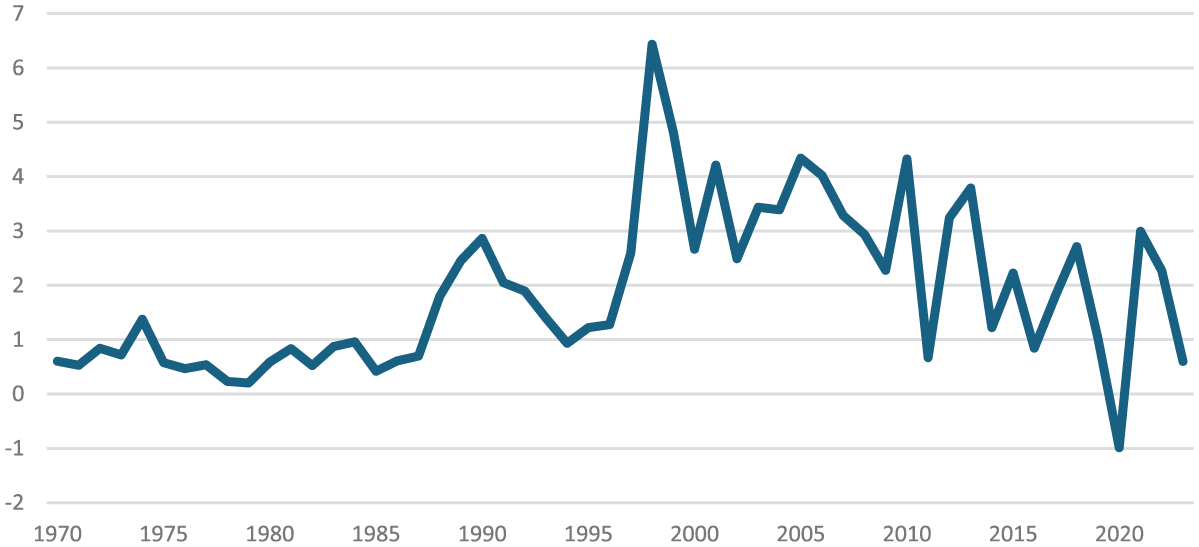
Thailand’s foreign direct investment (net inflows as a percentage of GDP) from 1970 to 2023.
Though the Thai economy rebounded to pre-crisis levels approximately a decade after the AFC, weak economic performance in the 2000s has led to declining investments in rural infrastructure development, technological growth, education, and social protection. Key events that have contributed to weaker markets include a series of government coups d’état, prolonged political instabilities, the 2008 Global Financial Crisis, and the coronavirus pandemic (for more information see Ferrara 2015; Hewison 2008; Kongkirati 2024; Kunpeuk, et al. 2022; Lee and Ofreneo 2014; Sopranzetti 2018; Walker 2010). While their causes differ and an examination of each exceeds the scope of this article, all have negatively impacted economic conditions in Thailand (Ariyapruchya, et al. 2020; Rogers 2010; World Bank 2021a). As seen in Table 1, macroeconomic trends indicate worsening conditions along certain metrics. GDP has averaged 3.61 percent and recent data show a decline to 1.9 percent, where growth has mainly been supported by private consumption and service sector activities such as tourism. Further, “manufacturing production and export of goods contracted by 3.2 and 1.7 percent, respectively” (Bank of Thailand 2023, 2). Weakening economic performance is correlated with individuals’ wealth and nonfinancial wealth being outstripped by mounting debt levels. As a result, families have increasingly relied upon migrant remittances to buoy household economies.
Macroeconomic Conditions in Thailand Over a 22-year Period (Gross Domestic Product, Wealth and Nonfinancial Wealth, Debts, and Remittances Received by Household).
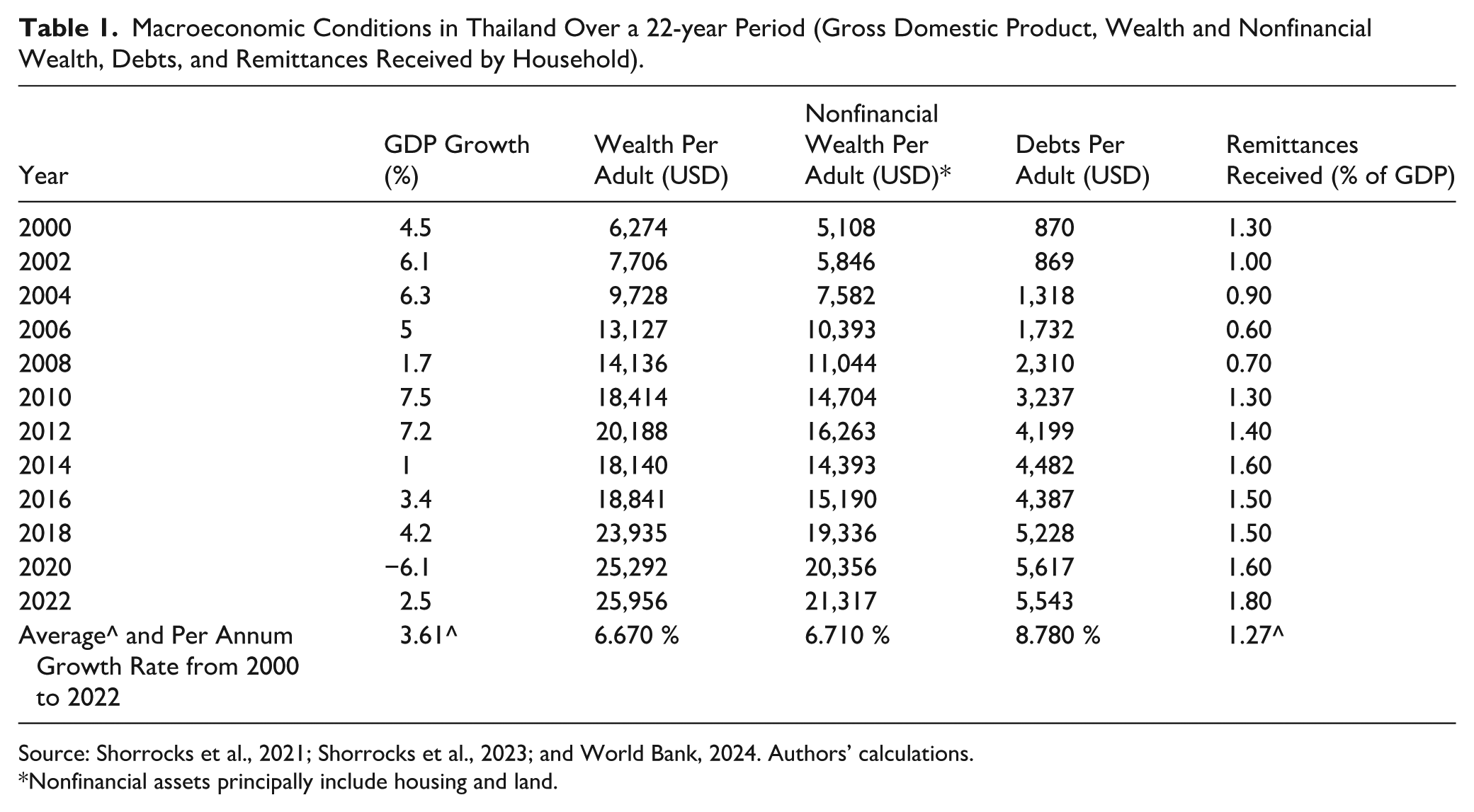
Source: Shorrocks et al., 2021; Shorrocks et al., 2023; and World Bank, 2024. Authors’ calculations.
Nonfinancial assets principally include housing and land.
Further, in the decades following the AFC, individuals have confronted widespread precarity in labor markets, along with a concurrent diminishment of social safety nets or protection schemes (Cook and Pincus 2014). Though increased regulations and enforcement in areas such as agriculture or domestic care have improved some labor standards, Thailand trails other countries’ investments in social protection (Chalamwong and Meepien 2012; International Labor Organization [ILO] 2022; Poonsab et al. 2019; World Bank 2021b, 2023c). Research in fields such as anthropology, political science, and sociology has drawn attention to the ways in which the economic pressures stemming from the AFC have encouraged political regimes in Thailand to advance policies or ignore employment protections with the aim of creating a persistently “flexible” labor force demanded by investors and employers (e.g., Hewison and Tularak 2013; Suttawet and Bamber 2018). The recomposition of labor into one that is flexible for capital accumulation has negatively impacted both Thai working classes as well as millions of migrants from Cambodia, Myanmar, and Laos who are often bonded to their employers and face pervasive social and institutional discrimination. 4
Despite assertions by the Thai government that the National Economic and Social Development Plans have sought to improve socioeconomic indicators and expand protectionism for working classes, since the late 1990s most political parties have promoted neoliberal policies in response to the AFC (Suttawet and Bamber 2018, 544). As noted by Brown (2016, 211), statist, liberal, and pluto-populist forces have all used state powers to secure conditions that support capitalist accumulation and strong workplace control, while militating against collective bargaining and policies that strengthen workers’ positions. As considered below, diminished social protection and precarious work complicate livelihoods and entrepreneurial activities, and a complex assortment of motivations and pressures may exist as people navigate and make sense of changing work conditions. Ethnographic data highlight the ways in which individuals adjust their livelihoods to mitigate or blunt labor market insecurities, particularly as the state has reduced social protectionism due to political economic crises and the prioritization of capital.
Notes on Ethnographic Methods
This article is based on ethnographic research conducted in the BMR. The material presented here primarily focuses on data collected from periods of fieldwork between 2019 and 2022. However, understandings of livelihood strategies, migration, and perceptions of urban precarity discussed also draw on intermittent fieldwork conducted in the BMR starting in 2009. As such, a broad array of ethnographic data informs the analysis presented.
Ethnographic methods used over this time included unstructured and semistructured interviews, participant observation, and socioeconomic surveys. Semi-structured and unstructured interviews were conducted with residents of Bangkok and domestic migrants. 5 Interviews focused on how individuals understood socioeconomic instabilities and labor uncertainties in the BMR as well as remittance management. Interviews have also been conducted with agrarian families located in periurban spaces 6 of the Bang Bo district, with considerations given to how families used labor migration, remittances, and economic diversification to cope with urban expansion. Interviews were conducted in public and private spaces, including, for example, houses, office buildings, restaurants, street stalls, markets, and taxis.
Purposive and chain-referral sampling were used to locate sample populations with diverse characteristics, backgrounds, and experiences. Efforts were made to identify a range of individuals who held varying types of employment and had diverse social markers (e.g., age, gender, class, education). Due to sampling networks, most respondents were located in the districts of Bang Bo, Bang Khae, Phaya Thai, and Ratchathewi. Interviews were conducted in Thai or English, and fieldnotes were kept throughout the research project. Interviews were transcribed shortly after the field season ended and all qualitative data were analyzed through thematic coding and content analysis in NVivo Plus.
Lastly, while not presented here, semistructured interviews were conducted with government officials and nongovernmental organizations (NGOs) to understand the socioeconomic and political changes occurring within Thailand’s political economy—including the challenges faced by individuals and families in the BMR. Government officials were in the Ministry of Labor and the Bang Bo Agricultural Administrative Office, and NGOs worked in the spaces of development, labor rights, and migrant advocacy. All research conducted was approved by university and college Institutional Review Boards.
Ethnographic Findings and Considerations
Ethnographic data highlight the diverse ways that people respond to economic conditions and labor markets, including the common use of rural-urban migration. Despite the Thai government’s assertions that it has advanced policies for widespread and inclusive improvements, “progress in rectifying inequality and promoting social justice has been rather slow [and] dimensions of inequality continue to provide policy challenges” (NESDB 2017, 18 [see also NESDC 2023, 86]). Families and individuals interviewed recognized the persistent realities of uneven government investments in areas such as infrastructure or labor support and used a variety of livelihood strategies to find work, security, and well-being. For example, agrarian families located along the urban fringe of the BMR experienced labor precarities as others might. Local and regional work outside agriculture was often tenuous, and that lack of dependability produced degrees of anxiety. However, agrarian families faced uncertain futures in primary sector production as the state prioritized transitioning from agriculture to industrial and postindustrial economies. Most recently, this has been seen in policies that focus on “S-curve” industries such as health tourism, smart devices, biochemicals, and aviation.
Government policies have also promoted biotechnologies within agriculture. Yet, most families interviewed within Bangkok’s peri-urban spaces lacked the resources, capital, land, or tenure-rights necessary to upgrade family farming or small-scale operations. As such, the diminishment of primary sector economies in policy, the various impacts of urbanization and reduced land availability, and the weakened state insurance systems for crop production, resulted in families regularly engaging with multilocal economic systems (see also [Author]). While sitting on the open-air, elevated deck of Sanun’s house that was used for lightly processing crops grown on the margins of his rice fields, he considered such changes. “Kids don’t really want to do this work. The sun’s hot. It’s hard work. And it’s difficult to make a living. Other jobs pay more and I want what’s best for my children. I certainly don’t want them to work in a factory either. I used to, and I would stand on my feet for 12-hour days. Right now, they work in an office. It keeps them busy, but they can help with expenses and hire people during the harvest.”
Money that might come from family members working in a factory, a school, a bank, and so on, could buoy households if droughts, floods, or pollution negatively impacted agricultural outputs. Additionally, given the upheavals of urban labor markets during financial crises, families often held plots of land as insurance against future job loss. That is, one could return home to farm should urban opportunities close. This combination of farm incomes and diversified off-farm livelihoods have allowed agrarian families to persist across generations under structural constraints within the economy and the state’s failure to support upgrading small-scale or subsistence farming.
When considering class, poor urban and agrarian families prominently relied upon diversified sources of income and employment types. As reflected in macroeconomic data, among the lowest income households throughout Thailand (the first to third deciles), wages, farming, social assistance, and remittances constitute most family income (World Bank 2023a, 11). Moving up from the fourth to tenth decile, wages represent an increasing portion of household income with a concurrent decline in social assistance and farming. However, remittances remain an active, if smaller, part of upper income household economies (World Bank 2023a). Diverse families interviewed noted the importance of migration as short-term adaptation strategies as well as long-term options for improved living standards. In effect, whether individuals were working class or affluent, migration provided avenues to increase familial capital and upwardly integrate into Thai sociocultural hierarchies.
Those migrating to Bangkok commonly discussed the lack of options in origin provinces and wage differentials. For example, “the average income in Bangkok, which has the country’s highest regional GDP per capita, was more than 6.5 times that of the northeast [Isaan] region, which has the lowest GDP per capita. The concentration of economic growth in Bangkok has amplified regional disparities” and created out-migration incentives for those in provinces ignored by overarching state development (World Bank 2023b). In this extended excerpt, Wipawan, who had moved to Bangkok when her mother relocated to the city so she could attend university, drew attention to the unevenness of development and the ways it can constrain people’s options.
I don’t fully live here in Bangkok, or only Monday to Friday. On the weekends, I go back to my home province [Nakhon Ratchasima]. I have to come here to work. There’s much more compared to life back home, and it’s not even that far [she exclaims]. Life there is full of farming, and they’ve been doing that for ages. . . I like it there, but the governor in our province hasn’t developed the area much.
What does it mean being developed?
Maybe it’s money. If you work in Bangkok, you’ll have a higher salary than back home. This means that some of the best talent is going to leave their provinces and try to make it here. So, those provinces don’t get the best talent. In addition, another thing is infrastructure and how people see the city. . . If your province is relatively close to Bangkok, then why develop those areas? If you need something, just come here. That’s what the government probably thinks. The government might spend money on developing Chiang Mai or Phuket to have them serve as the center for the northern and southern regions. But my province is close to Bangkok, relatively. They don’t care that much about it.
You mentioned people’s views of Bangkok.
Well, for example, we have a family business back home, selling glasses. When my dad was alive, he was an optician. A long time ago, people would come in and buy glasses, and older generations still do. But younger generations don’t come to our shop. They say, “Oh, you can go to Bangkok and have more fashionable glasses.” Even if we reduce our prices by 20 or 30 percent, they might think the glasses are fake. . .. My uncle has a similar business here in Bangkok and we have the same inventory. Back home people will look at the price and say it’s too high. The same price in Bangkok, they’ll say it’s too cheap. People are willing to pay more because it’s associated with the city.
Here, Wipawan interrelates several themes. Despite finding greater opportunities in the capital, a slight frustration infused her views on the country’s uneven infrastructural growth. The longstanding dominance of Bangkok in governmental planning was central to her decision to pursue an undergraduate degree and relocate to find work. Not only had the Thai government directed most of its investments into the BMR and, in the process, limited the availability of desirable employment in outside provinces, but the collective Thai imagination had elevated life, work, and goods obtained in the capital as somehow better than if secured elsewhere, thereby mixing urban biases in state political economies with cultural beliefs on the import of Bangkok. While respondents raised points on the ways in which Bangkok had lost some evocative power in the collective conscious (e.g., pollution, noise, overcrowding, petty crime, traffic, and the hurriedness of life), for most the socioeconomic benefits of staying in or moving to the city outweighed the negatives.
When compared to employment in culturally defined “undeveloped” or “rural” provinces, those in Bangkok were generally more attractive. Wages were higher and jobs had advancement opportunities, particularly for those with advanced degrees. Graduates from university and those that had migrated to take prominent positions in public and private sectors, discussed the anticipated benefits of working in Bangkok: social advancement, improved lifestyles, occupational prestige, and the like. The expanded possibilities freed people to trace the differences between their current circumstances and where they could be in the future. During a conversation with Jirayu, who had driven up to three hours each weekend to finish his degree in Bangkok, he noted ancillary benefits of transferring to an office in the capital.
Since high school, I knew I wanted to do this. Finance is viewed as a secure line of work. You could work for the government or in the private sector, and I didn’t want to do that. . . I applied for jobs in the provincial office and got one. In addition, since government jobs are safe, I thought I should stick with this. I eventually was able to transfer to an office here in Bangkok. That’s helped a lot. You have access to different information and learn about LTFs [long-term financial investments] that you might not know about if you’re in smaller, provincial offices. I can use this for myself, yes, but people I know can benefit from that knowledge as well.
Others echoed similar sentiments. Despite the negatives of Bangkok life, the earning potentials, opportunities for advancement, and access to different types of sociocultural capital incentivized people to in-migrate or stay. While virtually everyone noted that they earned more in Bangkok compared to one’s origin province or under hypotheticals of leaving the city due to the frustrations of urban life, those with undergraduate and graduate degrees were better positioned to access more resources and improve their lives over time. These ethnographic data align with research that considers the importance of education and occupation as contributors to inequality. While disparity between groups has declined in some measures from 2000 to 2021 (e.g., by age or gender), gaps in education and occupation account for more than 50 percent of Thailand’s income inequality (World Bank 2023a, 33–4). Further, returns on college education “benefit wealthier Thai households more than poorer ones [and]. . . returns to high-skilled occupations were more than 17 times higher at the upper end of the income distribution than for the poorest groups, suggesting that high-skilled occupations contribute to the persistence of inequality” (World Bank 2023a).
Research focused on reducing such disparities notes that families using migration as an economic strategizing behavior can accrue various gains, including greater access to socioeconomic capital and diverse labor opportunities (e.g., Boccagni 2017; de Haas et al. 2020; Kelly 2011; Porst and Sakdapolrak 2018). As noted, migrating to Bangkok created pathways for improved livelihoods among poor and affluent families. Wages received working in Bangkok allowed individuals to transfer money home to support family, send children to school, buy land or expand agrarian holdings, invest in a business, and other positive outcomes. However, many lower-income families could be placed in a double bind. That is, some families in origin provinces worked in vulnerable economic sectors (due to regional instabilities created through uneven development as well as the labor dynamics of sectors such as agriculture or service economies) and family members relocating to Bangkok engaged with precarious work (e.g., domestic labor, street vendors, or taxi drivers).
In these instances, class dynamics saw poorer families more commonly working within informal sectors, thereby exposing individuals and families to vulnerabilities due to reduced legal rights, unsafe and unregulated working conditions, reduced pay, constrained unionization efforts, among others. One afternoon talking with Pranee, who had migrated to Bangkok to find better pay to help support her sister who was involved in a car accident that left her disabled and killed her aunt, she reflected on the conditions of work and life in Bangkok. Work certainly was tiring, but leaving her children back home also weighed on her.
Before I used to work in a factory that did ceramic and wood products. That was back in Lamphun. I mostly worked in the part that made furniture, but I would also shape some of the items we would fire. I made minimum wage, which wasn’t enough for us even then. After the accident, that’s when I came to Bangkok. I worked in another factory doing similar things. That one provided housing and you shared a room with three other people. You basically had a place to sleep. . . no kitchen or bathroom, just a room with a few beds.
Was that hard?
They were very strict. You might only get a one-hour break in a day’s work. By the end, you would be exhausted. The harder thing was being away from my children. There wasn’t any support for kids at the factory. Where would they go? I had to leave them with my parents. They would get joy from having them around. Having them here would be too expensive and split our finances. . . my parents and family in Lamphun and my kids here. Most of us do this [referencing the common separation of parents and children in migrating families]. Now I’m selling food. I try to send back at least a few thousand baht each month, but with what I make that’s difficult. I try to work as much as I can. Though sometimes I only get a booth a couple of days a week. A booth might be available because someone didn’t show up, but they don’t always tell me. Obviously having a booth is better. More people buy from them than from those with carts. I just wish people were nicer. . .. There isn’t anyone I can go to for help or to have the booths assigned more fairly.
Importantly, Pranee experienced precarity in multiple jobs, with formal employment also subject to vulnerabilities. As seen in the literature, informalization of formal economies results in short-term contracts, part-time positions, outsourced labor, reduced benefits, or other types of flexibilities favoring employers. Returning to Chantana’s story from the opening, agency-supplied labor subcontractors arranged her positions. As governments and businesses seek to attract investors and financial capital, economic competition prioritizes short-term contracts, using recruitment agencies, hiring domestic and international migrant workers, and numerous other practices that bring greater levels of flexibility for employers and their ability to hire and fire at will, yet bring conditions of informality and precarity for workers (Bylander 2024; Chang 2009; Hewison and Kalleberg 2013). Though these practices are not new in Thailand, the economic changes following the AFC introduced pressures within labor markets that incentivized companies to advance employment flexibility, limit unionization activities, reduce responsibilities owed to workers, and demand long hours of laborious work (Brown 2016; Hewison and Tularak 2013). Given the ways, precarity infuses to varying degrees formal and informal work, the erosion of social protection policies worries researchers and practitioners. Poorer families face vulnerabilities from reduced social safety nets, governmental regulations may exclude those employed in informal sectors, and state agencies may purposefully avoid enforcement of workplace regulations to sustain “flexible” workforces.
This erosion of social protectionism factored into some considerations on the types of jobs pursued. While most respondents that lacked higher education degrees generally moved within informal economies, those with college backgrounds had other options. Having lived through financial crises, seeing the turmoil of economic contractions, or knowing the limited safety nets available during such moments, some left the private sector for government employment. For example, while earnings could exceed 300,000 baht ($8,500 USD) per month in private sector work as an accountant, engineer, or perhaps a finance specialist, similar work within state-enterprises such as the Electricity Generating Authority of Thailand might earn 60,000 baht ($1,700 USD) per month. Despite the wide income differentials, many argued that government work is shielded from economic downturns, has greater security, and provides better work–life balance. The high-stress, high-reward nature of private sector jobs or business entrepreneurialism was attractive for some, but the lack of security and limited social protections incentivized others to avoid those options.
As neoliberalism has been mediated by Thailand’s domestic political processes and resulted in reduced securities, weakened protections, and increased competition, some that grew up surrounded by uncertainties, instabilities, or the devaluation of labor such as farming viewed these economic landscapes as normal. In considering the broader contours of work in Southeast Asia, Tappe and Nguyen (2019, 4) note that “precarity in this region has long been perceived as a political reality to be engaged with rather than a loss of (imagined) security to grieve about.” Privatization and flexible labor policies advanced by the International Monetary Fund following the AFC were at times discussed among respondents as freeing themselves to pursue livelihoods that older generations would not imagine (e.g., changing one’s career or stitching together part-time, contract work). During an interview with Somchai, several of these themes were touched upon. While his degree was in the arts and he had opened a studio to teach children, he also worked in areas as diverse as real estate, day trading, and e-commerce. On a drive to a festival in Ayutthaya (the former capital of the Siamese Kingdom), he described the conditions of his work.
This kind of work isn’t for everyone. It partly depends on whether you can make enough. If you can’t, you find a full-time job. Some people might already have a job, but it doesn’t pay well. So, you need to find extra work. And others might want the challenge. I like it, and I’ve always done this work. My parents worried early on, but they stopped after they saw I was doing okay. [When asked about challenging times, he continued.] There is seasonality in the work, and you might not have jobs every month. You have to save and cut back on spending. I do that a lot. I remember in 1998, it was hard for people. A lot of jobs went away [after the AFC]. I was fortunate, to a degree, since the children I taught came from wealthy families. They still sent their kids to school and that shielded me. But as a freelancer, you look for the next thing, and need to be comfortable with downturns. It’s natural to always look for areas where you can make money. I just know that. . . I don’t stress.
While some exhibited preferences for secure government employment, others, like Somchai, sought to chart their own entrepreneurial paths: creating businesses, avoiding management restrictions, and experiencing diverse forms of work (aspirations commonly associated with younger generations). Of course, the process of changing jobs or establishing private enterprises was not always discussed as an exploration of what might be possible, but as a necessity to make ends meet and provide for one’s family, many of whom remained in an origin province.
As seen here, people’s efforts to earn a living, find stability, and construct a desirable life were pursued through varying economic engagements and shaped by indices such as class, education, and occupation. While policies advanced by the Thai government (e.g., NESDB 2017; NESDC 2023) have claimed a range of improvements, most interviewed argued that the state has failed to live up to its promises. As a result, individuals had to mitigate labor market instabilities, uneven infrastructural expansion, and insufficiencies within the Thai economy and build a life of value and purpose, often with diminished support from the state.
Of course, despite the socioeconomic differences that characterized those interviewed, the majority framed their livelihood aspirations within ideas of obtaining “enough.” Though subjective, most sought a decent life and one grounded in moral relationships. This included not only finding stable work to have enough to live on, certainly, but also sharing their knowledge and helping others, starting a business in home provinces, sending children to school, supporting elderly parents, and the like. As noted during an interview with Ratana, “before my father passed away, I would keep part of my wages and send some to him. It wouldn’t be a lot, but enough for him to buy food or donate to the local village.” The moral frameworks held by Thais become rendered in these individual actions. As it stands, similar moral responsibilities for improving people’s lives by the government have arguably fallen short.
Discussion and Conclusion
The varying crises in Thailand have been contributing to precarious work and uncertain labor markets for cross-sections of the population, which has been compounded by the government’s inabilities to strengthen domestic economies and improve people’s lives across different metrics. For individuals, diminished social protectionism, labor informality, and urban biases shape people’s livelihood decisions, risk-assessments, and entrepreneurial activities. For the government, macroeconomic trends and statistical data highlight weak performance in creating inclusive growth, investing in educational opportunities, facilitating people’s entry into higher-skilled occupations, and providing sufficient social protection policies.
Ethnographic data presented here represent a slice of diversity seen in Thai society and the ways in which people attempt to build reliable, resilient livelihoods. The heterogeneity of sample populations (e.g., agriculturalists, taxi drivers, bankers, maids, teachers, food stall vendors, accountants, and so on) demonstrate strategies used to mitigate the political economic changes that have unfolded within Thailand, the long-standing impacts of varying political economic crises on labor uncertainty, and the persistent lack of robust social protectionism. Respondents have strategically used rural-urban migration to access new types of capital and diversify household economies, pursued higher education to widen employment options, found more prestigious work in Bangkok compared to provincial offices, exited private sector economies to lower risk, obtained safer government employment, sent remittances back home to support family or start a business, and so on. As such, dynamic entanglements occur between livelihood strategies and instabilities within labor markets and reduced social safety nets, which cut across different classes working in traditionally defined formal and informal sectors.
Caution should be taken when extending the findings of this study given the nonprobability sampling strategies employed and the granular elements of the ethnographic data. Future research could explicitly investigate how sociocultural markers such as ethnicity or gender influence perceptions of precarious work and the best strategies to deploy when building resilient livelihoods. Additionally, research for this article was conducted prior to the coronavirus pandemic. As such, respondents’ interpretations of livelihood strategies reflect conditions of uncertainty and precarity associated with financial crises and government policies on economic growth and social protectionism prior to the pandemic. Of course, as noted above, Thailand’s macroeconomic conditions reveal persistent problems in achieving reliable and inclusive growth. The coronavirus pandemic and its associated economic contractions have likely only aggravated the situation and created new types of vulnerabilities. Further research specifically addressing recent changes in labor markets and economic growth may underscore the inadequacies of currently existing social protection policies and their ability to support people during extreme political economic shocks.
Still, these findings contribute to our understanding of the importance of social protectionism across class and status differences, as well as the varied ways individuals and families cope with uncertainties within the national economy. Additionally, this work has broader implications by drawing attention to how increased vulnerabilities experienced by individuals may also limit aggregate socioeconomic improvements in the national economy. For example, while educational obtainment and advanced degrees show strong correlations with expanded employment options and higher earning potentials, the assumption that education neatly translates into economic growth is challenged (Michel 2015). Research has shown that access to different types of social and cultural capital obtained through education better positions those entering labor markets (e.g., Montenegro and Patrinos 2014; Patel-Campillo and Salas García 2022; Thapa and Izawa 2024). However, ethnographic data draw attention to the ways that diminished social protectionism can influence livelihood decisions and dissuade some from entering private sector employment or pursuing opportunistic entrepreneurialism. Despite cultivating different types of capital associated with advanced education, some respondents sought safer forms of work due to instabilities within the labor market, even if that work experienced diminished, though reliable, economic potential.
This underscores the need for strengthened social safety nets and enhanced worker protections. Whether the Thai government underinvests in social protectionism due to limited abilities worsened by weakening economies or the prioritization of capital and business interests over those of workers, this creates vulnerable working conditions and as seen above can result in risk adverse behaviors. By expanding social protection policies, the state may incentivize entrepreneurial entry into high-value sectors. While many respondents pursued necessity-based or reactive entrepreneurship due to poverty, underemployment, or uncertainty, governments must provide stable socioeconomic conditions for opportunity-based entrepreneurship, which more likely results in profit, growth, and innovation at individual and societal levels (see Amorós, et al. 2019). Of course, this requires government to substantively strengthen workers’ positions in the work-effort bargain (Brown 2016; Chang 2009).
Expanding social safety nets would also work in tandem with government goals to expand accessibility in education, 7 improve educational outcomes, and enhance skills development that align with future trajectories in business and technology (e.g., Intarakumnerd 2020). Reformed education systems that increase enrollment and students’ exposures to diverse ideologies, content, and practices (Lao 2020) become fundamental for working class and agrarian families to enter higher-skilled occupations. Though educational access accrues disproportionate benefits to wealthy families, as educational improvements coalesce with other reforms (e.g., inclusive admission policies, conditional cash transfers, or reduced cronyism in labor market hiring practices), intergenerational disparities based on education may lessen. Ultimately, these approaches recognize the pragmatic and existential needs of people and how meeting those needs translate into societal benefits. Under such conditions, government efforts may improve labor at national levels and provide complementary types of support as people pursue diverse livelihood strategies from a more stable foundation.
Footnotes

Funding
The authors disclosed receipt of the following financial support for the research, authorship, and/or publication of this article: Ethnographic research was supported through grants provided by Santa Clara University, Missouri State University, and Georgia Gwinnett College.
Declaration of Conflicting Interests
The authors declared no potential conflicts of interest with respect to the research, authorship, and/or publication of this article.