




Abstract
The Anthropocene calls for collaboration between heterogeneous actors and knowledge about indisputable planetary boundaries and environmental cha(lle)nges. One dimension of such collaboration is interdisciplinary efforts, where anthropology’s potential contributions often fall under the radar. Based on a field study and ten semi-structured interviews, this article reassesses environmental anthropology as a collaborative companion in knowledge-making. Introducing the notion of balancing acts, it reveals how environmental anthropological fieldwork navigates elements of expansion triggered by the Anthropocene in knowledge-making processes, and how this fieldwork balances diverse knowledge forms, modes of inquiry, and venues of actions (fields), thereby contributing to knowledge-making of the complexities of this “epoch.”
Keywords
Why It Makes Sense to Make Sense of Fieldwork Methodologies in Environmental Anthropology (Introduction)
Environmental anthropological fieldwork draws attention to ways of knowing in the Anthropocene (Schnegg, O’Brian, and Sievert 2021). Specifically, by immersing in everyday life, environmental anthropological fieldwork unravels a contextual understanding of different worlds, experiences, and society-environmental relations (Barnes et al. 2013; Bubandt, Andersen, and Cypher 2022; Elixhauser et al. 2024). This knowledge includes the grasp of a range of imbalances in human-environmental relations, from those between ecological knowledge held by indigenous communities and environmental policies, to those reflected through the mismatch of environmental perceptions and practices (often referred to as the intention-behavior gap), to global imbalances whereby climate risks disproportionately impact countries and people in the Global South, to name a few.
The subfield of environmental anthropology has shifted attention from merely understanding to finding solutions (Kopnina and Shoreman-Ouimet 2013; Moore 2015) for environmental challenges. Simultaneously, the Anthropocene—marked by the recognition of “planetary boundaries” (Rockström 2010), environmental change, and the interconnectedness of societies and natures—calls for collaboration among the natural sciences, social sciences, and humanities (Haraway et al. 2015). This call is echoed by the increasing awareness of the need for societal knowledge and interdisciplinary collaborative (field-) research efforts (Bogusz 2022a; Bubandt et al. 2022). And yet, in praxis, environmental anthropological research is often still perceived as merely “a cherry on top” (Elixhauser et al. 2024, 3) or an “annex” (to use one of my interlocutors’ words) to other research projects. Research in this field is often reduced to a mediator role between local communities and scientists, or to supplying “illustrative quotes” from locals (Elixhauser et al. 2024). Additionally, when integrated, misconceptions about anthropological methodologies remain common, and anthropology is sometimes not considered “serious scholarship” (Hastrup, Münster, Tsing et al. 2022, 389).
In this article, I align with other authors (e.g., Barnes et al. 2013; Elixhauser et al. 2024; Singleton et al. 2023) in arguing that environmental anthropology should be repositioned beyond its “cherry-on-top” role in knowledge-making and recognized as a collaborative companion for the natural sciences in times of environmental change, when planetary boundaries are being contravened. Grounded in the perspectives of environmental anthropologists, this study aims to explore how they address the challenges and complexities of the Anthropocene through fieldwork. Based on empirical insights, I propose that anthropological fieldwork conjoins several balancing acts important for ways of knowing in the Anthropocene. Balancing acts signal that environmental anthropological fieldwork maneuvers diverse and sometimes contradictory elements, requiring either reconciliation or the acceptance of tension between them. Sometimes these acts achieve an equilibrium; sometimes they involve paying different amounts of attention to certain elements. Additionally, the notion of balancing acts reflects the need for sensibility, motion (as well as stillness), and continuous adjustment (think about what it means to balance on one leg), all of which are relevant to anthropological fieldwork and for ways of knowing (in) the Anthropocene.
Environmental anthropologists attend to discussing, reflecting, and writing on their fieldwork methodologies. This article complements such undertakings by providing a meta-perspective on representations of environmental anthropological fieldwork methodologies. Drawing on a field study and ten semi-structured interviews, this meta-perspective is based on fresh empirical data that spans projects and individuals. Needless to say, I do not seek a representative picture of environmental fieldwork methodologies, nor claim holism. Instead, by framing ways of knowing in environmental anthropology as balancing acts, I revisit the debate about environmental anthropology’s contribution to knowledge-making in the Anthropocene. I proceed with five sections. In section one, I trace the contours of the development of environmental anthropology as a subdiscipline indicating transformations within approaches dealing with human-environmental relations. In section two, which is couched in environmental anthropological literature, I draw attention to the facets of knowledge-making in the Anthropocene that are expanding in scope. These facets foreshadow how environmental anthropological fieldwork embraces balancing acts. Before bringing the heuristic of balancing acts into dialogue with my empirical material in section four, section three provides an overview of the methods and analysis applied. In section five, I conclude by discussing the study’s key findings and further avenues for research.
A Brief History of Environmental Anthropology
Environmental anthropology, dealing with human–environmental relations, gained popularity at the beginning of the 1990s 1 when, during the Rio Earth Summit 1992, the Task Force on the Environment (1991–1995) was launched. This led to the emergence of a new section within the American Anthropological Association: the Anthropology & Environment Society (Townsend 2019). Though the 1990s marked an inflection point in the field, anthropological approaches dealing with human–environmental relations can be traced back to the early days of anthropology as a discipline (Figure 1). Topics, theories, and approaches dealing with human-environmental relations have shifted throughout time, with new avenues being explored in response to the shortcomings of former approaches (Brondízio, Adams, and Fiorini 2017).
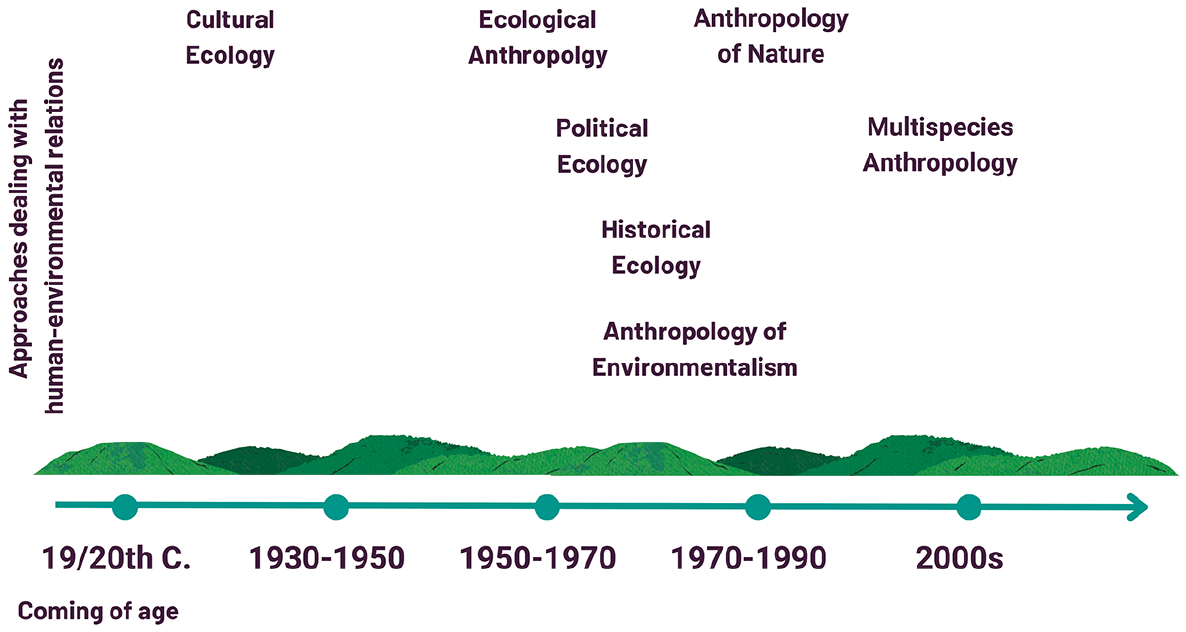
Timeline environmental anthropology, own representation based on Brondízio et al. 2017.
One of the foundational approaches to studying human–environmental relations was cultural ecology. Coming of age in the 1920s–1950s (Brondízio et al. 2017), cultural ecology studied how human interactions with the environment influenced cultural change (Steward 1937, 1972/1955), primarily through a mode of adaptation. The organizing units of analysis in cultural ecology were “cultural areas” (Brondízio et al. 2017).
Distancing itself from the emphasis on culture, ecological anthropology arose during the mid-1960s. As Andrew Vayda and Roy Rappaport (1968) and others 2 envisioned, ecological anthropology incorporates ecology and systems analysis approaches, emphasizing the connection of human communities with resource flows, materials, and energy (Brondízio et al. 2017). “Culture” as the organizing unit of analysis was replaced by the “ecological population” 3 (Rappaport 1971, 238) and “ecosystems” (Geertz 1963).
Relating to global neo-liberalization, political ecology emerged in the 1970s. Coined by Eric Wolf, political ecology aimed to explain the interdependence of human-environment processes with political economy and power structures (Brondízio et al. 2017). Thus, the unit of analysis moved away from cultures and systems to competing alliances over resources (Little 1999), insinuating the finiteness of resources and planetary boundaries.
In the 1970s and 1980s, historical ecology was introduced by scholars such as Bennett (1976) and Netting (1981), fostering ongoing discussions on resource management and global change, as seen in the works of Crumley (1994) and Balée (1998, 2006). Historical ecology linked archaeology and anthropology with sustainability discourse and established landscapes as a unit of analysis (Brondízio et al. 2017).
In the 1970s, the anthropology of environmentalism also took root, flourishing between the 1980s and 1990s. With the pioneering studies of anthropologists Mary Douglas (Douglas and Wildavsky 1983), Luther Gerlach, Virginia Hine (Gerlach 1991; Gerlach and Hine 1973), and more recently Kay Milton (1999, 2002), environmental movements and environmentalism as a cultural phenomenon became established units of analysis in anthropology and brought ethical and political dimensions of environmental change into play.
The early 1990s saw the development of the anthropology of nature, followed by multispecies anthropology later that decade. Grounded in the post-structuralism movement, both have advocated a more “symmetrical anthropology” (Latour 1993) distancing itself from common dichotomies such as nature/culture, human/non-human, and modern/primitive, while embracing dialogue and reflexiveness (e.g., Descola 2013; Descola and Palsson 1996; Ellen 1996; Latour 1993; Strathern 1981, 2000). Multispecies anthropology, for example, parts ways with the idea that non-humans are reduced to sources, symbols, or food for humans (e.g., Kirksey and Helmreich 2010), heeding the sociality of non-human life forms (Tsing 2013).
In sum, environmental anthropology is a diverse collection of perspectives, methodologies, and areas of inquiry. Throughout time, the scale of analysis of local phenomena was enlarged by global aspects and the focus on culture and humans as units of analysis were expanded to include non-humans. With the introduction of the notion of the Anthropocene, environmental anthropologists deepened their discussions on how knowledge-making needs to be transformed.
Anthropogenic Twists in Environmental Anthropology
In 2000, Paul Crutzen and Eugene Stoermer designated the Anthropocene a historical epoch. While their notion of the Anthropocene was widely criticized, it was also celebrated as a concept that connects natural and social scientists and thereby paves the way for collaboration. More recently, anthropologists have framed it as “a problem that is pulling anthropologists into new forms of noticing and analysis” (Mathews 2020, 77), including collaboration transcending anthropology (Fortun 2021; Hastrup and Hastrup 2015; Mathews 2020), “parts of the world” (Hastrup and Hastrup 2015, 2), and experimentation (Bogusz 2022a; Mathews 2020; Tsing, Mathews, and Bubandt 2019).
This section examines how the Anthropocene transforms knowledge-making processes. It draws on insights from anthropological literature to underscore the facets of knowledge-making in environmental anthropology that are expanding in scope.
Expanding Knowledge Dimensions
In the Anthropocene, uncertainty expands; it is an endemic feature (McGowan 2023). In an age of ecological degradation, climate change, and socio-political upheaval, uncertainty subsumes different scales. On a local scale, communities, be they human or non-human, grapple with the immediate implications of these changes, such as shifting agricultural practices, the extinction of endemic species, and the impacts of sea-level rise on coastal habitats and species. On a global scale, the effects of rising temperatures, biodiversity loss, and extreme weather events challenge existing socio-economic structures and create socio-ecological crises. On a planetary scale, we are confronted with the “unforeseeable consequences of global climate change” affecting both human and non-human lives (Asdal and Huse 2023, 12). At first glance, distinguishing between global and planetary scales does not appear straightforward. I follow Chakrabarty, who emphasizes a “growing divergence in our consciousness between the global—a singularly human story—and the planetary, a perspective to which humans are incidental” (Chakrabarty 2021, 67). By underlining that the globe in the notion globalization “is not the same as the word globe in the expression global warming” (Chakrabarty 2021, 71), he makes us aware that the planetary scale crisscrosses Earth and cultural systems; humans are not at its center. This is a perspective Fortun took up in her work (2021).
In light of these uncertainties manifesting on different scales, scholars have begun recognizing the need for a more proactive approach to anthropological research. First, long before the notion of the Anthropocene gained popularity, Kopnina and Shoreman-Ouimet (2013) noted that anthropology needs to move toward solution-oriented knowledge to adapt to these shifting conditions. Second, this orientation toward solution-oriented knowledge has compelled scholars to rethink knowledge creation's ethical and political dimensions in an uncertain world (Mathews 2020). Third, the uncertainty around the dimensions of socio-ecology underscores the necessity for collaboration across disciplines. Hastrup and Hastrup argue that collaboration is not only beneficial but imperative, calling for a redefinition of established concepts and practices that have traditionally underpinned knowledge creation, such as societal structures and subjective experiences (Hastrup 2018; Hastrup and Hastrup 2015).
In other words, the Anthropocene requires anthropologists to expand the range of actors involved in knowledge-making. This includes collaboration between disciplines, science, and society (Bubandt et al. 2022; Fortun 2021; Hastrup 2018; Hastrup and Hastrup 2015; Mathews 2020), and engagement with non-human entities (Kohn 2013; Kirksey and Helmreich 2010; Mathews 2018; Mathews 2020). Collectively, environmental anthropologists highlight that the complexities of the Anthropocene call for concerted efforts among diverse professionals and laypeople alike to understand and address the pressing issues facing our planet.
Furthermore, the need to engage with non-human entities is becoming significant. As Gisela Welz notes: “Anthropology that once was called ‘the human science’ is on its way to become a more-than-human concern” (2021, 38), gaining even more relevance since the environmental crises is a multispecies crisis (Bubandt et al. 2022). This transformation resonates with the need to reinforce the interconnectedness of human and non-human experiences in the Anthropocene by exploring how the lives of organisms influence—and are influenced by—political, economic, and cultural dynamics 4 (Kirksey and Helmreich 2010).
Another critical facet among environmental anthropologists in the Anthropocene is the examination of temporalities, which demands an assessment of expanding time scales. The speed of ecological change has rendered historical knowledge increasingly inadequate: Ecosystems are transforming so swiftly that the past offers little guidance for the future (Mathews 2020). Yet, engaging with the legacies of past actions is vital, as their irreversible impact shapes current and future conditions for the planet and all life forms (Tsing 2013, 2021). This engagement triggers critical reflections on present choices (Ingold 2015) and their ethical and political relation to the future (Mathews 2020). As Hastrup and Hastrup (2015, 2) articulate, we must grapple “with what is to become of the Earth”, highlighting anticipation as an important element to consider.
Additionally, Fortun posits that the Anthropocene invokes “new relationships between the empirical and the political” (2021, 15). She challenges scholars to consider not only what exists but also what should exist (Fortun 2021). In this context, fieldwork transcends mere observation; it evolves into a site of ethical engagement. This engagement seeks to address contemporary challenges while considering long-term geological processes, influenced by short-term, day-to-day actions. The gap between long-term processes and short-term actions underscores the urgency of joining forces to confront the challenges of the Anthropocene and brings questions of “collectivity and responsibility” (Moore 2015, 27) into play. This intertwining of urgency and collectivity calls attention to normativity: “Multiplying our understandings of possible pasts and futures, and of who might be helped or hurt by these futures, makes the Anthropocene political” (Mathews 2018, 387).
Expanding Modes of Inquiry
Tsing et al. (2019) suggest that the Anthropocene demands anthropological research grounded in “observation and thought experiments” (196), pinpointing the importance of innovative frameworks for understanding a complex and uncertain world. Not only different time scales but also modes of inquiry must therefore be considered. This drive for reevaluation resonates with the philosophical insights John Dewey developed as early as 1929, when he distinguished between two forms of experience pertinent to knowledge: The first, “experience as empirical,” refers to the honest reporting of actual conditions and outcomes derived from trial-and-error situations (Dewey 1984/1929, 65). The second, “experience as experimental,” (ibid.) emphasizes a deeper understanding of the underlying conditions and their consequences, and that uncertainties demand experimental modes of inquiry. This approach has been boosted by debates about knowledge-making in the Anthropocene, thereby expanding the understanding of what it means to observe. For example, navigating uncertainties and addressing socio-ecological issues prompts environmental anthropologists to engage in what Tsing (2013) terms “critical description.” This approach is critical “because it asks urgent questions” and descriptive “because it extends and disciplines curiosity about life” (Tsing 2013, 28).
To navigate these urgent questions, anthropologists must cultivate the ability to observe beyond mere human interactions. This entails engaging with the ecological world—from the morphology of trees (Mathews 2022) to the movement of waves (Helmreich 2023). Put differently, “[t]he Anthropocene is a wakeup call urging us to reinvent observational, analytical attention to intertwined human-and-nonhuman histories” (Tsing et al. 2019, 188). As Tsing et al. point out, anthropology provides “critical attention to specificity, context, and difference” (2019, 196) and thus reveals problems embedded at local, global, and planetary scales. Anthropological fieldwork must therefore extend “beyond surface-level observations, exploring the interplay between culture, society, and the environment” (Elixhauser et al. 2024, 5).
But the buck doesn’t stop there. The Anthropocene invites anthropologists to recognize their role not just as observers but as active collaborators to the discourse and practices surrounding environmental crises. In particular, since the impacts of environmental destruction are experienced on unequal terms, collaborative modes of inquiry during fieldwork are needed to work toward more equitable solutions. For example, collaborations with other scientific disciplines and civil society allow for a richer understanding of the interconnectedness of cultural practices and planetary dynamics (Mathews 2020). Especially in the context of collaborative or cross-disciplinary fieldwork, immersion through observation and experimentation fosters “a temporary suspension of all certainties” (Hastrup 2017, 331). Bieler et al introduce the concept of “epistemic partners” in collaborative efforts, emphasizing the importance of being open “to confront, discuss, and transform the challenges and contingencies of epistemic practices” (2021, 91). This openness involves grappling with unexpected insights that illuminate the limitations of previous knowledge (Hastrup 2017). As Matthew suggests, the provisionality of observations invites a process of unlearning, where “[d]escriptions and classifications are always partial, both grasping and failing to grasp the world” (Mathews 2018, 408).
Expanding Fields
As discussed above, the contemporary challenges of the Anthropocene are fundamentally reshaping the epistemic landscape of anthropological fieldwork, propelling researchers into new and diverse fields of inquiry. As anthropologists confront the pressing challenges of ecological degradation and social crises, they are compelled to expand their methodological, interdisciplinary, and ethical frameworks while considering the sociality of non-human life forms (Tsing 2013). As a result, the fields they explore are becoming increasingly complex, reflecting the multifaceted nature of contemporary human-environment interactions.
This complexity is further demonstrated by the spatial expansion of these fields. Crucially, the impacts of the Anthropocene are not only ecological but also social and political (Tsing et al. 2019), with uncertainties arising from these dimensions manifesting on multiple scales—local, global, and planetary. The Anthropocene elevates the interplay of local and global realities while dispersing “people, materials, and ideas [. . .] in unprecedented ways” (Hastrup and Hastrup 2015, 10). Local phenomena, once viewed in isolation, now resonate with broader planetary consequences. For instance, the notion of a “patchy Anthropocene” (Tsing et al. 2019) has shown that patches of human activity, reflected through local activities and ways of living, often have geological—and therefore planetary—significance. Further complicating this spatial narrative, scholars argue for a reorientation of ethnography and cultural analysis that transcends traditional global frameworks, advocating for a “planetary” perspective that accounts for the intensive “cross-scale and system interaction” shaping our world (Fortun 2021, 19). While this obliges anthropology to adapt and broaden its scope, reflecting the diverse contexts in which social life manifests, it is at the same time important to embrace anthropology’s strength to “stay with the site” (Swanson 2022, 367) and explore the specificity of places.
The Anthropocene also broadens the arenas in which anthropologists do fieldwork. The ocean, traditionally considered a distant and separate entity, has emerged as a new arena for anthropological inquiry, prompting scholars to literally dive into it (e.g., Bubandt 2022; Helmreich 2022; Rodineliussen 2024). As anthropologists engage with marine realms, they blur the boundaries between terrestrial and marine, cultivating new spheres of inquiry that challenge conventional disciplinary limits. Altogether, anthropologists alert us to how the Anthropocene complexifies knowledge-making processes, requiring exploration across actors, times, and scales.
Methods
To investigate how environmental anthropologists navigate the challenges and complexities of the Anthropocene through their fieldwork, I combine semi-structured interviews with a field study.
Semi-Structured Interviews
The semi-structured interviews allow a discussion of individual insights of anthropologists regarding their fieldwork practices and the challenges they encounter. By asking open-ended questions, I can capture the ways environmental anthropologists interpret the complexities of human-environment interactions within the context of the Anthropocene. I conducted semi-structured interviews with ten anthropologists studying human–environmental relations. Interviewees included six postdocs, three professors, and one early-career researcher. The early-career researcher stood in for a professor who was unable to give an interview. The interviewees came from Germany, the United States, and the United Kingdom, a fact that may have influenced the results, as the disciplinary cultures in anthropology can vary greatly. I opted to focus my interviews on researchers who possess diverse fieldwork experiences across various contexts. Before the interviews, information on data protection was sent to the participants, and informed consent was collected. The semi-structured interviews were conducted online and physically between May and September 2022, varying from 61 to 129 minutes in length. For the transcriptions of the interviews, I applied the expanded transcription rules by Dresing and Pehl (2018).
Field Study
Furthermore, I was able to engage in the everyday practices of environmental anthropologists through fieldwork at a research institute in central Europe. In addition to the semi-structured interviews, this field study allowed a deeper exploration of thought processes and practical challenges of conducting fieldwork in the Anthropocene. I selected an institute that is prominent, internationally recognized, and specializes in human-environment relations. During my stay, I learned about fieldwork methodologies by following project meetings and lunch breaks. I also experienced fieldwork through joint reflection with my interlocutors, realized in group discussions and a discussion fueled by the COLLAB game. 5 Such fieldwork experiences produce “interpretative knowledge relationally with those studied rather than searching to reveal information that is unambiguously present prior to the researcher’s intervention” (Deeb and Marcus 2011, 51). My status as an early career researcher might have nurtured an approachable dynamic with my interlocutors. They may have perceived me as less authoritative and more as a fellow learner, which could have led to more authentic exchanges. My engagements resulted in transcriptions and field notes.
Analysis
All transcripts and fieldnotes were coded using MAXQDA 2022 (VERBI Software 2021). The coding process of the transcriptions was inspired by grounded theory methodology. For my analysis, I drew on Juliette Corbin’s (2011) recent publications emphasizing the researcher’s reflexivity and utilized Charmaz’s reflexive grounded theory methodology (2013) for inductive coding. I followed open coding, conceptual clarification, and (partly) theoretical coding. In line with core grounded theory principles, I searched for provisional interlinkages between concepts (Timonen, Foley, and Conlon 2018). By applying the principle of “constant comparison,” searching for those interlinkages bolstered the identification of balancing acts inherent to environmental anthropological fieldwork methodologies (ibid.).
While the analysis of the two different types of material was done separately, this article synthesizes the results. All of the names in this article are pseudonyms. The quotations of the empirical material have been edited to improve readability while retaining the meaning.
Results
This section brings the expanding facets of the Anthropocene, discussed in section 2, into dialogue with my empirical material and demonstrates how environmental anthropologists navigate the complexities of the Anthropocene through a series of balancing acts (Figure 2).
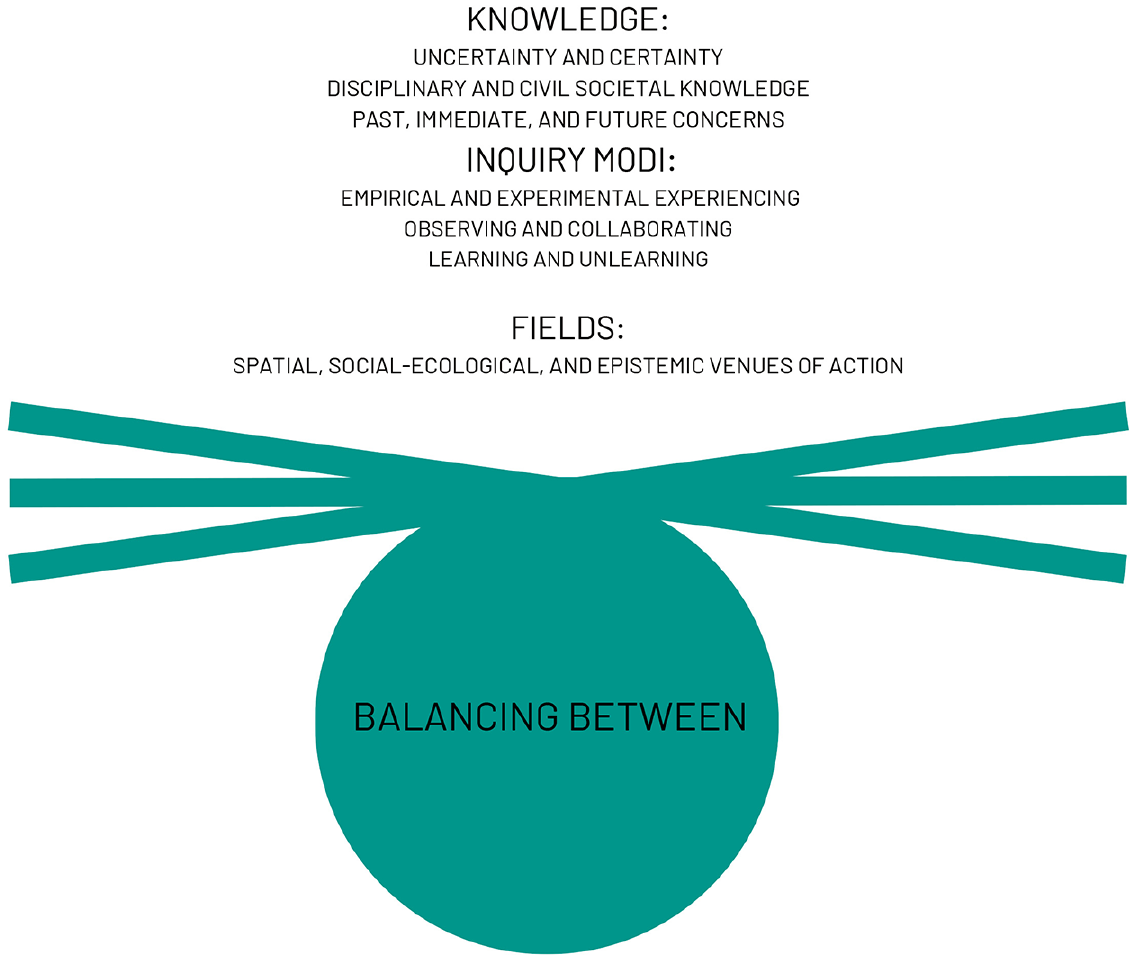
Balancing acts.
Balancing Knowledge
Environmental anthropological fieldwork makes use of and foregrounds different types of knowledge.
Balancing Uncertainty and Certainty
One of the key challenges of the Anthropocene is the rise of uncertainties that extend across local, global, and planetary scales. In response to this complexity, environmental anthropological fieldwork seeks to balance between embracing uncertainties and seeking certainties. Uncertainty has a dual role. It is simultaneously a generator for knowledge-making and a problem in times of crisis when societal transformation is needed (Bogusz 2022b). Among some of the uncertainties motivating environmental anthropologists to explore and transform them into certainties are questions such as: How do people deal with challenges posed by the ocean crises in their daily lives? How do people affected by climate change-induced events perceive related global discourses? How do cultural beliefs and practices shape human-environmental relations? Uncertainty around these and other questions triggers anthropologists to figure out and learn social practices and ways of living. As one environmental anthropologist elaborates: You know, you go and live with people, you learn about their lives almost like you’re growing up in a society and figuring out how to do things and how things work there. So, in a way, there’s an interesting thing with anthropology, that it’s the sort of expertise that is founded on a lack of expertise. Really (laughs) you actually start doing research and you don’t know what you’re doing ‘cause you're kind of in a strange situation that you don’t understand. And [. . .] sometimes it’s considered a bit of a problem if you almost know too much because then you don’t go through that process of very self-consciously kind of figuring things out. And you probably are not able to see your own assumptions.
In contrast, certainty, in the shape of the known and the familiar, including assumptions from deductive approaches, may hinder learning processes in environmental anthropological knowledge-making. This hindrance arises from the misleading impression of certainty that sometimes contradicts actual lived realities and experiences, as another environmental anthropologist pins down: With one’s own, one always has the danger of knowing why it is like that, which is often a great illusion and therefore dangerous.
To avoid (false) certainty, an “amateur” (Ingold 2021, 153) or “novice” (Pálsson 1994, 902) perspective, characterized by inexperience, becomes essential. Environmental anthropological fieldwork, in other words, relies on “a deliberate alienation from the world under study to understand it as it cannot understand itself” (Hastrup 2004, 468).
As stipulated earlier, uncertainty becomes problematic in times of environmental change when planetary boundaries must be recognized. Treating uncertainty as an object of inquiry is therefore essential. As an intended object of inquiry, the unknown presupposes the field researcher to exert oneself, as one anthropologist elaborates: “So I explicitly search for what I don’t know, for surprises.”
This echoes Strathern’s idea of fieldwork being “a method for ‘finding’ the unlooked for” (1999, 3). As an unintended object of inquiry, the unknown finds the researcher through action, immersion, and reflexiveness: There is a particular direction and then HOW you do it is not just an execution of a plan, but a situated performance. So, I went there to find out everything about water, and then I was like, ha! people don’t talk about water very much (laughing). And then, of course, you identify certain strands that are locally relevant. And then you focus on those and try to really find [them] out.
Letting go of pre-formulated research questions derived in the disciplinary setting therefore becomes important and attunes us to the potential of inductive approaches in research about human-environmental relations. In the field, you simply see that other discussions are much more urgent than one has just worked out here at home in the office on the computer.
This discrepancy recalls the binary relationship of the natural-scientific “lab-field border” (Kohler 2002, 478), underscoring the need to balance different epistemological places during environmental anthropological fieldwork.
Balancing Disciplinary and Civil Society Knowledge
As discussed earlier, the Anthropocene triggers an expansion of the range of actors involved in knowledge-making. In response, environmental anthropology balances disciplinary and civil societal knowledge and practices in the context of planetary boundaries and environmental change. On one side stands the framework of disciplinary knowledge, which structures ways of knowing in environmental anthropological fieldwork and integrates global discourses concerning human-environmental relations. On the other side, environmental anthropological ways of knowing lean on everyday knowledge from civil society, uncovering underlying cultural and social assumptions to meaning-making and responding to environmental changes (Lövbrand et al. 2015). These distinct forms of knowledge sometimes clash, necessitating environmental anthropologists to balance and reconcile their integration during fieldwork. One environmental anthropologist describes this challenge: And when I focus on my topic, which I initially entered the field with, then I don’t meet this demand: That I really incorporate the concerns or discourses of the local people as well, which, in my opinion, should currently be a topic in the environmental sector. We have our ideas about climate change and its effects. But what the actual lived reality looks like, you only see that on-site.
In the field, civil society emerges as a disrupter of certainties worked out in the office. Or more optimistically framed, civil society is a wellspring of inspiration from which research questions, problems, and mysteries can be derived (Ibrahim and Rödder 2022). In this sense, the objects of investigation guide the process of observation by “tell[ing] how to observe” (Ingold 2019, 666), redirecting and reshaping the knowledge-making journey, and providing a reality check of “science-based solutions” for environmental problems in specific contexts (Maxwell, Hubbel, and Eisenhauer 2019, 103). Consequently, immersion in the field calls for engaging with “situated globality” (Aykut, Rödder, and Braun 2024, 17) and mirrors how globality and the local can conflict with each other (Burawoy 2001). This discrepancy foreshadows that “multilayered complexities of local human experience” and “the generalities and abstractions of measurement in the global” (Crate 2011, 176) often do not align.
Such a detachment has serious implications for policymaking. Take, for example, conservation. The question of “[w]ho is conservation for, and what community gets to decide?” (Singleton and Gillette 2023, 88) yields varied responses contingent upon the inclusivity of diverse knowledge forms. Depending on the knowledge forms included, policymaking may favor “authoritative fields of power” (Moore 2015, 28) or, on the contrary, align with perceptions (Elixhauser et al. 2024) and “characterizations of life and change” (Moore 2015, 28) of those people who are affected by the consequences of policies. Through balancing disciplinary knowledge and global policy narratives with the perspectives from civil society, environmental anthropological fieldwork extends pathways for environmental policymaking, aligning with the perspectives of affected people. It thereby “harness[es] the critical potential of the Anthropocene” (Lövbrand et al. 2015, 212) such that it might contribute to “community driven approaches that can inform sustainable solutions” (Elixhauser et al. 2024, 4). Moreover, environmental anthropological fieldwork has the potential to challenge, disrupt, and provoke reevaluations of existing certainties. It leads to the generation of “uncomfortable knowledge” (Rayner 2012, 107) and might inspire “clumsy solutions” (Thompson 2008) that surpass “mainstream discourses” about environmental change and planetary boundaries.
By approaching the world as a pluriverse (James 2012/1909) rather than a unified reality, embracing “ontological anarchism” (Viveiros de Castro 2019, 296), and expanding its “epistemological community” (Singleton and Gillette 2023, 87), environmental anthropological fieldwork provides insights into the “wickedness” of problems (Rittel and Webber 1973) such as climate change and biodiversity loss. In this way, it contributes to a more holistic approach to knowledge-making in the Anthropocene than other disciplines could accomplish alone.
Balancing Past, Immediate, and Future Concerns
A holistic approach of “life and change” (Moore 2015, 28) relies on “situated knowledge,” a term coined by Donna Haraway in 1988. This notion accentuates the partiality and context-specific quality of any knowledge. Concentrating on situated knowledge challenges the conventional notion of knowledge as unbiased and neutral. Environmental anthropological fieldwork conjoins past, immediate, and future concerns. In attending to these concerns, “balance” here denotes “equilibrium.”
One aspect environmental anthropologists aim to understand is the historical situatedness of their fields. Understanding the history of a field is essential for grasping its distinct character. Put simply, you can’t understand this [/a] field without its history [. . .].
Environmental anthropologists often read historical reports before going to the field. For example, they might read about the history of nature conservation in the fieldwork locality, the history of environmental movements, or the history of specific human–environmental interactions. Drawing on my empirical material, I found the historical context of a field is typically most intensively studied before and after fieldwork. During fieldwork, it tends to recede into the background: I come back with so much material and then I have time to let it go through my head, to read something again, for example to contextualize it again historically, an opportunity to think about things and get things clearer for myself. This is often difficult during field research because you’re so busy with appointments, with conversations, with just being open and not processing.
Immediate concerns are another aspect environmental anthropologists try to understand: For me it was much about learning about that rhythm of the tides and then I knew, okay, now all the fishers will come, hopefully [. . .]. They [the fishermen] were fishing at night, but then during the day they were too tired. So, there I had to find my routine. Well it didn’t really turn out to be a routine, I think it stayed improvisation until the end because it was kind of chasing after them or just trying to encounter them for an interview or something before they are out again for fishing. But yeah, it’s a lot about observing rhythms and then choosing which ones you want to follow.
Understanding immediate concerns through social-ecological situatedness as a performative act foregrounds the importance of more-than-human agency, which creates additional complexity through the “rhythming” of fieldwork practices. This arises as an “interplay of forces, materialities, temporalities, collaborations, and intellectual ambitions” (Hastrup, Flora, and Andersen 2022, 296) requiring a balance between following the rhythms of the object of inquiry and serving envisioned fieldwork practices.
Additionally, and as stressed by my interlocutors, exploring how communities envision the future becomes important in environmental fieldwork in the Anthropocene, echoing the desirability of impactful anthropological research concerning debates and knowledge about planetary boundaries and environmental change. To grapple “with what is to become of the Earth” (Hastrup and Hastrup 2015, 2) through fieldwork is, however, demanding: Many people can’t really relate to such future projections right now, because it’s still not very clear how things will turn out, and also, due to the mindset of many people, they don’t engage strongly with possible future scenarios.
A way to address those imaginations is to draw upon past and present concerns and engage in thought experiments about the future: If I do not understand the history of this locality, then I cannot understand current dynamics, nor can I comprehend what will be needed in the future. So, it’s about this complex understanding.
In short, balancing between different time scales allows anthropologists to explore relationships between what was, “what is[,] and what needs to be” (Fortun 2021, 15) and thereby contributes to a “comprehensive understanding of how environmental issues unfold and impact societies” (Elixhauser et al. 2024, 5).
Balancing Inquiring
Environmental anthropological fieldwork balances different modes of inquiry, primarily utilizing participant observation and conversations, two “classical methods of anthropological fieldwork” (Bubandt et al. 2022, 6).
Empirical Experiencing and Experimental Experiencing
The Anthropocene acts as a call to action, prompting environmental anthropologists to rethink their observational and analytical focus (Tsing et al. 2019), as they navigate their fields by balancing two forms of experiencing: “empirical experiencing” and “experimental experiencing” (Dewey 1984/1929, 65). Firstly, empirical experiencing refers to immersion into the environment in the present moment, often guided by intuition, uncertain hunches, and trial and error situations: And I felt when one thing didn’t work out, and that was very similar to what people experienced, another thing opened up because it was so rich and in roots and strands and lines of light everywhere [. . .] it was always too much or too many interesting things. But at least it was sort of possible to go off to different things. But the question really, there was time to be at ease with spending a lot of time with unknown outcomes [. . .]. Because where do we invest time, you know, where do we focus on? Because in the beginning, we don’t know whether that’s going to be something that helps us. And we have an intuition that we’ll learn something about this from that person or in this place or in that event, but we don’t know. And sometimes it turns out it doesn’t work. And sometimes it does.
This quotation underscores the uncertainty linked to environmental anthropological inquiry. It reflects debates about the messiness of fieldwork (e.g., Billo and Hiemstra 2013) while accentuating the importance of inductive approaches. Immersion in human-environmental fields through an inductive lens might indeed be overwhelming, but such an approach also has a productive function: It triggers the exploration of blind spots that are overlooked by deductive approaches.
Secondly, by selecting aspects to explore while continuously adapting and reassessing, environmental anthropologists utilize experimental experiencing, which is deeply rooted in cognitive processing, which facilitates learning and understanding. This concept resonated with one environmental anthropologist, as she talked about a revealing moment in her fieldwork journey: The women who did this didn’t attach any specific meaning to it. They always said, ‘Yes, that’s how it's done.’ So, these are classic cases that leave ethnologists perplexed. ‘We’ve always done it that way. It’s just how it's done.’ And then, one day, one of them said: ‘This is EXTREMELY important. You will never understand it if you don’t participate. Now, please help already.’ And then I thought: NOW (laughing) I get it. . . This was a completely new key for my understanding, that PARTICIPATION, or embodying it again, is actually the way to understand this.
By balancing “empirical experiencing” and “experimental experiencing,” environmental anthropology could reveal more subtle aspects of experiences with environmental changes than are prominent in public discourses. How biodiversity decline is experienced, for example, could involve a vague recognition of something absent (Ghaly 2022) that is challenging to articulate, illustrating “lived experiences that are difficult for outsiders to capture” (Baillergeau and Duyvendak 2016, 407). Environmental anthropologists might adopt an insider perspective during their exploration. At the same time, they also remain outsiders.
Observing and Collaborating
This duality echoes that the Anthropocene challenges environmental anthropologists to view themselves as more than passive observers. Instead, it illustrates the importance of balancing observation and collaboration as two important modes of inquiry. To borrow two terms from Norbert Elias’ figurational sociology (2007/1987), observation involves a certain degree of detachment, whereas collaboration is linked with involvement. These two opposing dimensions of inquiry need to be negotiated during fieldwork. Historically, anthropological fieldwork has relied heavily on observation as a mode of inquiry. At the same time, fieldwork has never been possible without collaboration. As environmental anthropology shifts toward integrating civil societal knowledge, it elevates consciousness about the inquiry mode of collaborating: It is important to work with the people, so to speak WITH the flow and not against it, instead of going there, applying his theory to it, and treating them as objects, which I find quite unacceptable. And I think the good thing about ethnographic research is that we can really get a WHOLE different perspective on the world if we engage with it.
Approaching fieldwork in such a way resonates with Ingold’s description of fieldwork as a way of study “with people, not to make studies of them” (2017, 23) and open up “transepistemic arenas,” a term proposed by Karin Knorr-Cetina (1982, 117). Credibility in transepistemic arenas feeds itself “from what is transmitted between agents, scientific and non-scientific” (ibid.). Additionally, the focus on “working with people” might reflect the denial of giving “the researcher the a priori primacy of interpretation over social phenomena” (Niewöhner 2016, 8), fostering knowledge-making aiming to balance disciplinary and civil societal knowledge forms. And yet, environmental anthropological fieldwork that moves toward a more collaborative mode of inquiry, brings about the challenge of deciding how much attention should be given to observation on the one hand, and collaboration on the other:
“But the thing is that at some points we disappoint people we work with. In my case, that’s the social movement. As I was telling you in the last meeting we had. So the leader of this movement once told me, okay, don’t leave your research on a shelf in a library, because they will forget about what you did or who we are, and how things are going on here. But I still don’t know. Maybe once I [have] finished, I don’t know how to put that in the service of change.”
“Mhm.”
“Or how to help them without getting too much involved and not crossing this line.”
The anthropologist must balance their own needs (such as obtaining research outputs and establishing a career in a field they find engaging and valuable) with the needs and expectations of their interlocutors (Singleton and Gillette 2023) and their commitment to creating solution-oriented knowledge, for example making the concerns of an environmental movement heard.
Learning and Unlearning
The Anthropocene prominently underscores the challenge that knowledge and observations are inherently tentative, “both grasping and failing to grasp the world” (Mathews 2018, 408). Balancing between learning and unlearning is therefore another important mode of inquiry, one which takes place in social participation processes, that is, “communities of practice” (Wenger 1999): To me, the most important thing has always been I am there to learn from people. I am the learner. I am not the knower, I am the learner. That’s maybe a pretty healthy approach for any field researcher, at least in anthropology. Really important, because you’re in your field to learn and not to already know things yourself. Otherwise, you wouldn’t be doing research.
The emphasis on the absence of specific knowledge at the beginning of the research process is here framed as essential and again attunes us to the potential of being at ease in taking an amateur or novice position during fieldwork (Ingold 2021; Pálsson 1994), especially at the beginning of the process. While “the unknown” can serve as an epistemic orientation, as I have stipulated earlier, it simultaneously acts as a learning generator.
Intriguingly, knowledge generation is not only a learning process. It is also one of “emptying out, which is a process of something becoming nothing” (Selmeczi, Choi, and Strausz 2020, 26). The avenue toward knowing is a perplexing process of opening up new ways of relating: I think that moments of surprise are always an enrichment. Because they actually leave a path that you have thought out beforehand or a path of thought that you have imagined beforehand. And in a way, they also provoke you.
To engage in this process of unlearning “you need to be willing to challenge your own assumptions and also to be able to put aside your own views and assumptions,” one interviewee claimed. In other words, knowledge generation also involves unlearning, thereby referring not only to the reflexivity of the environmental anthropological fieldwork inquiry but also to the openness to revision (Bogusz 2022b), a trait that becomes more important in times of increasing uncertainty and environmental cha(lle)nges. Unlearning can not only break down silos between knowledge forms and disciplines, but also allow a critical examination of dominant narratives and assumptions concerning environmental issues.
Relatedly, a provisional character is inherent to all balancing acts of inquiry. Present experiences are always uncertain (Dewey 1984/1929): Because I guess it’s not just, you know, we wrote down what we saw and that's it. But just going back, you know, it's a springboard for more insights that can open up like years later sometimes.
Fieldwork is thus always embedded in action-thinking-based entanglements. Relating to past fieldwork experiences fosters the re-assembly of such experiences in new ways and constellations from a certain vantage point removed in time and space, highlighting the desirability of environmental anthropological fieldwork to provide empirical material on human-environmental relations that can be used long-term and thereby help to detect “changes over time” (Elixhauser et al. 2024, 5). Fieldnotes are one tool to inscribe such experiences. Another is the body: One of the COLLAB Game’s participants stressed the importance of incorporated knowledge when she picked up the question card “How do you document your research process?”: [. . .] and it’s best stored here (pointing at head). Not only here (pointing at head), but everywhere (pointing from head to toe).
Balancing Fields
In line with the pragmatist claim that knowing is associated with being “inside the natural and social scene” (Dewey 1984/1929, 157), knowledge generation through anthropological fieldwork is intertwined with the notion of “being there” (e.g., Borneman and Hammodi 2009; Helmreich 2022) of being in the “field.” But what or who is this field? In what follows, I suggest that the “field” manifests itself in spatial, social-ecological, and epistemic venues of action. The field cannot manifest itself by either/or; it is an entanglement of all these manifestations (Figure 3). While researchers might take distinctly spatial, epistemic, or social-ecological aspects as starting points for fieldmaking, fieldmaking itself is processual and often balances these aspects in a certain manner.
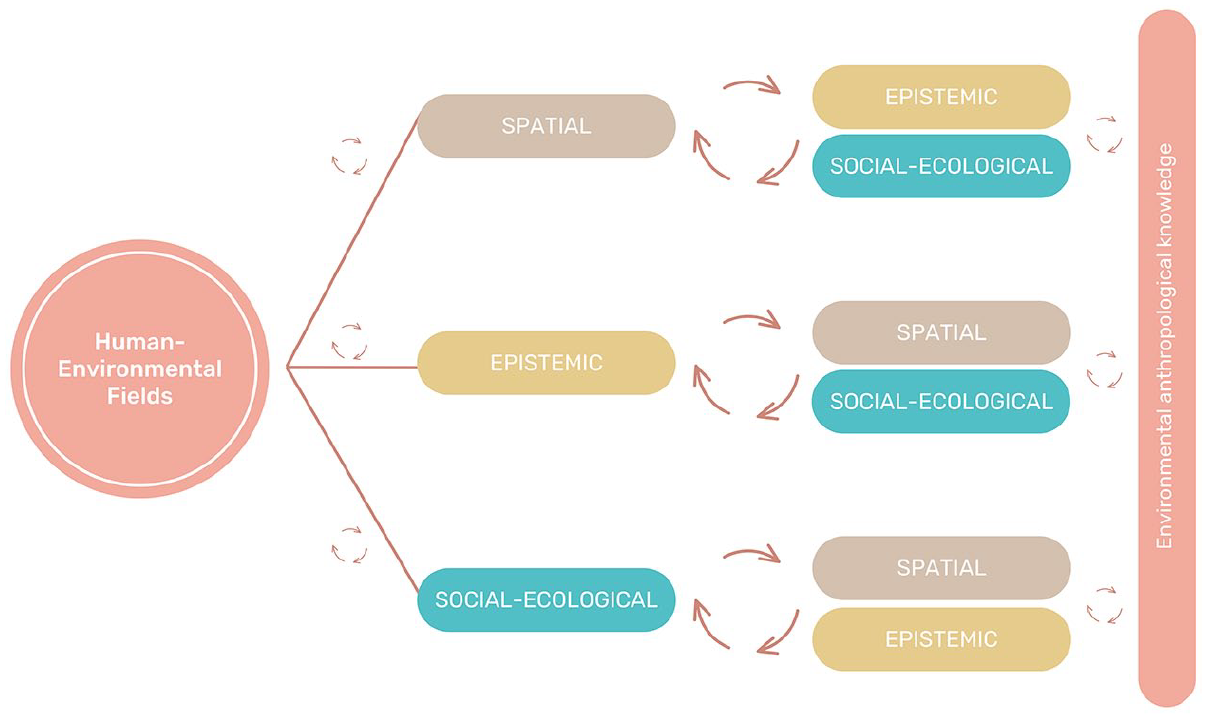
Human–environmental fields: spatial, epistemic, and social-ecological orientations.
Spatial Orientations as a Starting Point for Fieldmaking
Uncertainties in the Anthropocene manifest on multiple scales, urging environmental anthropologists to bear in mind local, global and planetary spaces. Generally, the spatial component is one starting point for determining environmental anthropological fields. When asked how the field in their research is defined, some interlocutors placed the spatial dimension, from which the field unfolds, at the center of attention: We didn’t really limit it [the field], so we just simply say the Arctic.
On one pole, the spatial component can be an enabling aspect for a knowledge generation process contingent on the size of the spatial field and its possibilities of engaging with the social and epistemic dimensions. The spatial dimension of the field can, on the other pole, be a delimiting component for knowledge generation processes, as the following quote illuminates: I mean to some extent when I was doing my doctoral research, I could say, okay, this is an island where I’m doing fieldwork and it’s about this island. And that’s MY field. I think in some ways that was actually a problem when I was doing fieldwork because it constrained a little bit what I did. There were all sorts of things that I was kind of interested in, but I could have probably done better fieldwork if I’d seen the field extending beyond the island.
While defining the field based on spatial dimensions constrains the (socio-political) scope and relevance of environmental anthropology, the spatial component opens up a range of possibilities of engagement. The importance of the application to a regional context is also mirrored in the fact that most of the environmental anthropologists I talked to refer to their field in the following way: “my xxx field,” where “xxx” is a placeholder for the name of the country: for example, “my Tanzanian field.” By “stay[ing] with the site” (Swanson 2022, 348), environmental anthropological fieldwork contributes to “tracking changes over time” (Elixhauser et al. 2024, 5) in a localized context. And yet, as global environmental issues and the relation between global and local concerns become more pertinent, “the ‘place’ of science,” the field, “is not just [defined] by the physical setting in which it unfolds” (Geissler and Kelly 2016, 801). To understand “socio-historical contexts” and “how environmental issues unfold and impact societies” (Elixhauser et al. 2024, 5), spatial venues of action need to be balanced with socio-ecological and epistemic orientations.
Social-Ecological Orientations as a Starting Point for Fieldmaking
As indicated by the term socio-ecological, the Anthropocene presents a challenge for environmental anthropologists to include non-human life forms during their fieldwork. During a group discussion as part of my fieldwork, one of the questions I asked caused some irritation. When I asked “where does your field begin and where does it end?” a senior researcher commented the following: I mean, how you phrase the question with “where” says the field is a local thing, right? A spatial field. And that is definitely the case too, that sometimes you are in a place and you really feel the place and that’s where the field is. But obviously, it’s also a field of relations.
This passage evokes the interlinkage of embodied experience, spaces, and knowledge generation and also points to social actions as a starting point for fieldmaking. In a second step, the localization of such social-ecological settings points to the spatial dimension. Subsequently, fields can be described as “the different venues of action,” to borrow a term one environmental anthropologist introduced to me when talking about fields. Who or what belongs to the field as a “venue of action” only becomes apparent in the course of the research process, recalling empirical experience as a modus of inquiry to construct fields: Yes, what is a field? In ethnology, I think, the field is everything that belongs to the sphere in which I try to answer certain questions WITH PEOPLE with whom I work, with my interlocutors. Everything that belongs to it. [. . .] I didn’t know in advance what exactly belonged to the field. Then, as time went on, it became clear what belonged to it [. . .]. In the end, the holy mountain also belonged to it. And that was not so clear to me before.
This interviewee’s statement echoes Kirsten Hastrup (2007), who claimed that in the age of globalization, the unknown in anthropological fieldwork is “no longer geographically but socially and historically defined” (789). Doing fieldwork with people shifts fieldmaking away from spatial constraints. As social interactions are dynamic, the spatial field, which serves as the “venue of action,” can change whenever the actors in the venue of action move or expand, mirroring practices of “follow[ing] the people” and/or “follow[ing] the thing” (Marcus 1995, 106f.). In short, in a time of increased mobility, there is no such thing as a bounded object of inquiry (Appadurai 1991) or temporal stability (Tsing 2000).
Moreover, the making of “venues of action,” that is, fieldmaking, depends not only on social relationships but especially on the continuity and robustness of those social relationships: When you go there for the first time, everyone looks at you strangely. “What does he want there? He’s a stranger,” and so on. When you come the second or third time, they say: “Ah, you’re back. That’s nice that you came back!” and so on. [. . .] Especially coming back is an important activity. [. . .] I mean field research is a social relationship.
The importance of the continuity of social relationships stresses that fields are not pre-existing entities but actively created. Sustaining these relationships is essential for conducting longitudinal research and thereby tracking changes in the Anthropocene (Elixhauser et al. 2024).
Epistemic Orientations as a Starting Point for Fieldmaking
Lastly, another starting point for fieldmaking are epistemic orientations, echoing that fields in the Anthropocene “become scaled to particular questions and concerns” (Hastrup 2018, 328). Fieldmaking through epistemic orientations takes place when utilizing an experimental mode of inquiry during the process of “singling out what matters, and what must therefore be understood” (Hastrup 2018). To stimulate this process, one might ask: What reaches down there from all this global Anthropocene discourse? How do they perceive it? [. . .] Oh, suddenly CLIMATE CHANGE is a topic. But all sorts of things are included under that which wouldn’t fit for us at all. So, floods or tsunamis suddenly became part of climate change. And over time, it became clear to me: Climate change was simply another word for a spiritual catastrophe that swept over the people, to which religious conflicts also belonged.
Strikingly, local activities and ways of living do not only matter geologically (Tsing et al. 2019), geological processes also matter locally. While not aiming to produce general statements, by relating localized concerns to broader (globalized) issues, environmental anthropological research is far from “parochial” (Hastrup, Münster, Tsing et al. 2022, 381).
While the spatial component often serves as a reference to describe when and where the field starts or ends, it is not explanatory for fieldmaking from epistemic orientations. Another aspect might be when experiences are not worthy of annotating for the sake of knowledge generation, and instead serve as a reference for when fieldmaking stops: Well, when I was basically flying out from Atqasuk, that’s when it felt like this is it now [..] And one indicator for me is: “When do I stop feeling obliged to write field notes?” (Laughs).
In short, approaching environmental anthropological fields as venues of action that balance spatial, socio-ecological, and epistemic orientations embraces not only the transitional and everchanging character of human–environmental fields but the relationality of doing environmental anthropological fieldwork.
Discussion
Environmental anthropological literature accentuates facets of knowledge-making that, in the Anthropocene, are expanding in scope. Not only are local, global, and planetary uncertainties intensifying as a consequence of the far-reaching implications of environmental cha(lle)nges, the time scales environmental anthropologists engage with are also being augmented by the future and their anticipation of it. Consequently, “new relationships between the empirical and the political, between what is and what needs to be” (Fortun 2021, 15) have emerged and are raising questions about “collectivity and responsibility” (Moore 2015, 27). These dynamics are sparking solution-oriented knowledge and an expansion of the range of actors involved in knowledge-making. Grappling with these complexities through environmental anthropological fieldwork is demanding and complex.
In my analysis of the representations of environmental anthropological fieldwork, which is captured in my empirical material obtained through interviews and field research, I have used the notion of “balancing acts” to reflect on the complexities of knowledge-making in the Anthropocene. I do so by grounding the complexities of “new forms of noticing and analysis” (Mathews 2020, 77) in the current literature and bringing them into dialogue with fresh, empirical material.
First, the analysis reveals that environmental anthropologists balance between diverse knowledge systems: academic theories, global discourses, and the realities faced by communities (both human and non-human). These knowledge systems often clash, as local concerns in situ vary from public and academic discourses about environmental cha(lle)nges that represent established certainties. By interrogating established certainties in global and academic discourses, environmental anthropology creates uncertainty about established certainties. Thereby, it unlocks the potential for “uncomfortable knowledge” that troubles “universal claims about the world” (Tsing et al. 2019, 187) but aligns with perspectives of people affected by environmental challenges. At the same time, considering the need for interdisciplinary research, this uncomfortable knowledge might complicate such work, as it demands a “temporary suspension” (Hastrup 2017, 331) of disciplinary certainties. Additionally, local concerns must be balanced with their past and future facets. My analysis uncovered how environmental anthropologists engage in thought experiments to balance those timescales. And yet, the challenge remains to capture how communities envision the future through environmental fieldwork, revealing the difficulty environmental anthropology faces in meeting its own expectation to “grapple with what is to become of the Earth” (Hastrup and Hastrup 2015, 2). As the uncertainty surrounding future developments causes many interlocutors to hesitate in engaging with future projections, it may require environmental anthropologists to adapt and expand upon their traditional methodological toolkits.
Second, my analysis pinpoints three different modes of inquiry that can be framed as balancing acts that environmental anthropologists embrace during fieldwork. Alongside balancing between empirical experiencing and experimental experiencing and learning and unlearning, balancing between observing and collaborating emerges as particularly relevant and demanding. The commitment of environmental anthropologists to address socially and ecologically relevant topics and move toward more solution-oriented knowledge (Kopnina and Shoreman-Ouimet 2013) is reflected in an increased focus on collaborative modes of inquiry. Deciding how much attention should be given to observation on the one hand, and collaboration on the other, evolves as a main challenge not only during fieldwork but also after. How this context-specific knowledge derived from fieldwork can be put “in the service of change” (in the words of one of my interlocutors) is a question that perplexes researchers and raises questions of “collectivity and responsibility” (Moore 2015, 27). It shows the responsibility researchers ascribe to themselves concerning transformation, turning fieldwork into a space for ethical engagement. This desire to create transformative solutions might complicate relationships with interlocutors, especially when environmental anthropologists cannot live up to the expectations that interlocutors attach to their research.
Third, environmental anthropological inquiry takes place in venues of action (fields) that balance spatial, social-ecological, and epistemic dimensions. Engaging with specific locations, staying “with the site” (Swanson 2022, 367), allows environmental anthropologist to gain insights into environmental issues and their societal impacts through a lens “from below” (Bollig and Krause 2023, 9) or “within” (Ingold 2019, 660). Embracing fieldmaking through social-ecological orientations enables the understanding of the socio-historical context and dynamics of environmental issues. Finally, engaging with fieldmaking through an epistemic lens that relies on experimental inquiry facilitates the application of insights to global contexts, positioning knowledge derived from environmental anthropological fieldwork far from the merely “parochial” (Hastrup, Münster, Tsing et al. 2022, 381).
The analysis of environmental anthropological fieldwork through the analytical lens of balancing acts encourages us to ask several as yet unanswered questions concerning knowledge-making in the Anthropocene:
How can environmental anthropologists engage with anticipation and future imaginaries through fieldwork?
How can uncomfortable knowledge and the questioning of established certainties be made productive and thereby function as a generator for collaborative endeavors rather than an obstacle?
How can context-specific knowledge derived from fieldwork be put “in the service of change?”
Notably, the balancing acts presented in this article only offer a provisional account of what environmental anthropological fieldwork might entail in times when planetary boundaries are being breached and environmental cha(lle)nges are intensifying. First, it is important to note that the interviewees and interlocutors in this study may have an interest in promoting the value of environmental anthropology in addressing Anthropocene challenges, which could influence their perspectives. Second, as my analysis was focused on fieldwork representations, the findings do not evaluate how those representations are translated into practice. To this end, a comparative study of environmental anthropological fieldwork practices in situ could help. However, the balancing acts (Figure 2) presented in this article do offer a valuable tool to describe ways of knowing in environmental anthropological fieldwork.
In short, by balancing different knowledge forms, modes of inquiry, and venues of action during fieldwork, environmental anthropological fieldwork is a good candidate for reaching a counterbalance within discourses and policy processes still dominated by the perspectives of the natural sciences (Barnes et al. 2013). In the end, knowledge generation at a time of environmental cha(lle)nges requires anthropologists to balance ways of knowing between heterogeneous actors, environments, and cultural contexts (Bogusz 2022a)—be they in inter- and trans-disciplinary research settings, international agenda settings, local grassroots initiatives, or “diverse species assemblages” (Haraway 2015, 159).
Footnotes
Acknowledgements
First and foremost, my heartfelt thanks go out to all my interlocutors—thank you for sharing your experiences and insights with me! I am also immensely grateful to Tanja Bogusz, Kirsa Gunkel, and Karla Groth for their comments, support, and encouragement along the writing journey. Additionally, I like to thank the editors and anonymous reviewers for their helpful comments and suggestions.
Declaration of Conflicting Interests
The author declared no potential conflicts of interest with respect to the research, authorship, and/or publication of this article.
Funding
The author(s) disclosed receipt of the following financial support for the research, authorship, and/or publication of this article: Research for this article was conducted with financial support from the German Research Foundation as part of the project “Experiencing Nature and Society. A Multi-sited Inquiry into Marine and Ethnographic Field Sciences” (grant number BO 3268/4-1).
