




Abstract
This article explores the contradictions and political possibilities of creating a “safe space” using “family” as an organizational concept in a contemporary public art project in Tunisia. Amidst the backdrop of foreign development funding for the arts flowing into Tunisia and a global contemporary art scene where “patriarchal structures” are taken as antithetical to collaborative practices, family has been an intuitive and meaningful mode of organizing artistic projects in Tunisia, particularly as it relates to fostering safe spaces for queer youth. As opposed to “participation,” “commoning,” and other institutionally supported art concepts, family is not a concept widely exhibited. In relation to tendencies toward “sensible” approaches to the political efficacy of contemporary art, the artistic practice of making family points to a “nonsensible” politics of aesthetics, where the aesthetic is better understood not as the location of politics but as a quality of feeling that enables spaces of political possibility.
When Anna, co-director of the CATALYST International Light Art Project, suggested to the “catalyst family,” as many called it, that “we,” as I was a member, should plan a workshop where everyone invites their parents, the response was overwhelmingly one of horror. The family of CATALYST, a contemporary public arts biennial set in a Medina, the name for the old city centers in Tunisia, consisted of over one hundred volunteers, most of them university students in their mid and early twenties. In response to Anna’s suggestion, many of the young volunteers threatened to leave the project.
The project itself, encouraged by the directors and enthusiastically accepted by the many volunteers, described itself as a “family,” in English or “ᶜayla,” in Arabic. 1 Many of those involved, following common practice in Tunisia, referred to each other, whether related or not, in familial terms such as father, daughter, brother, and so on. With such a strong affinity to the grammar of family, it indeed seemed an appropriate space for the inclusion of biological relatives. While Anna quickly accepted the desires of the volunteers and cancelled plans to host a family workshop, she was initially confounded by the negative response. German in origin, she admitted that she thought the idea would be well received because of the way that most of the volunteers often praised the importance of family and because, more than with any other project she has worked on, she had witnessed instances of parents eager to help.
At this, members of the CATALYST family told her she did not understand them. Not everyone’s parents were as accepting as Bilel’s, the other co-director of the project whose parents often came to help prepare communal meals for the volunteers and artists. The project’s volunteers pointed out that they would not be able to express themselves if their parents were there. Many of the young volunteers, men, women, and nonconforming, argued that if their parents were there, they could not smoke cigarettes, dress like they do, speak like they do, flirt like they do, and in general, as one volunteer pointed out, she could not “nḥis rūḥī mirtāḥa,” in which she then translated to English as “be myself,” but if translated literally means “feel myself comfortable.” With a large proportion of volunteers still living with their parents, even those in their late twenties and early thirties, there was an overwhelming interest in keeping the CATALYST family a family free space. 2
This resistance to including family might simply be dismissed as the product of a generational gap or youth rebellion; an interest among these young volunteers in creating a space away from their more conservative elders (or siblings) where they could, in line with Abu-Lughod’s (1990) analysis of Bedouin youth, pursue forms of sexuality popularized in media or otherwise explore substances and intimacies that would, to their parents’ generation, appear unsavory. Certainly, to a degree this was true. Digitally fluent, volunteers engaged with global ideas and trends around style and sexuality that they experienced regularly through television, films, and social media. Also, some families did disapprove of their children’s participation in CATALYST, and many more likely would have disapproved had they known (assuming they wanted to know) about the flirting and cigarettes, and more occasionally, the sex and drugs. However, as I detail below, the interest amoung volunteer in keeping the CATALYST family free of family was not simply a rejection of their families, or a sign that their families did not support their choices. Many volunteers greatly cherished, cared for, and respected their families. Likewise, families generally supported their children’s participation in the CATALYST project. Instead, these exclusions encapsulate an uneasy tension within the contemporary situation within Tunisian society where, in what Donzelot (1997) named as the familial regimes of the state, the family, through its historical formation, its weight as a political discourse, and its centrality within a model of economic development, has positioned limits, socially and legally, to certain forms of intimacy, sexuality, and expressions of the self. For many of the volunteers, the CATALYST family was not merely an extension of their own families nor entirely distinct from them, but rather an art project that, among other things, simultaneously unsettled and celebrated the notion of family. Pointing toward the relationship between politics and aesthetics (Rancière 2010) and the way local aesthetics opens upon local sensibilities (Thompson 2006), in this article I argue that CATALYST was a project where participants let art and the pursuit of jaw, an aesthetic concept of fun and beauty, instead of state and international political and economic interests, guide the possibilities of care, love, and intimacy in the family and create a space for volunteers to feel themselves comfortable.
Artistic Beginnings
CATALYST is a biennial contemporary light art project and festival in an old Medina, a historic medieval city located in the center of many of the country’s contemporary cities and their suburbs. CATALYST focuses on contemporary light art, art that uses light (or its absence) as a medium or concept (see Figure 1). Tunisia witnessed the emergence of a thriving contemporary public arts movement in the wake of the 2011 thawra, or revolution, which overthrew an authoritarian regime that consisted of two dictators, Habib Bourguiba and Zine El Abidine Ben Ali, who ruled back-to-back since independence from France in 1956. The thawra ushered in various legal shifts concerning the formation of civil society organizations, the acceptance of foreign funding, access to public space, and expanded freedoms of expression, all of which have helped make way for an expansion of contemporary public art practices. While public art projects have arisen throughout the country, old Medinas have been one of the major centers for the movement. CATALYST, one of dozens of major art projects found in Medinas throughout the country, was started in 2016, renewed for its second edition in 2018, and was poised for a third edition in 2020 but was delayed due to the COVID pandemic. Since the pandemic, from 2022, CATALYST has turned toward smaller punctual productions. The 2016 and 2018 editions of CATALYST attracted an audience of around 15,000 and 18,000 respectively, each featuring twenty-four and fifty-six installations by different artists or artist collectives from around the world, and all produced through the work of over one hundred volunteers. While for each year the festival only lasted a few days in September, the project was months in the making, with planning starting up to a year in advance.
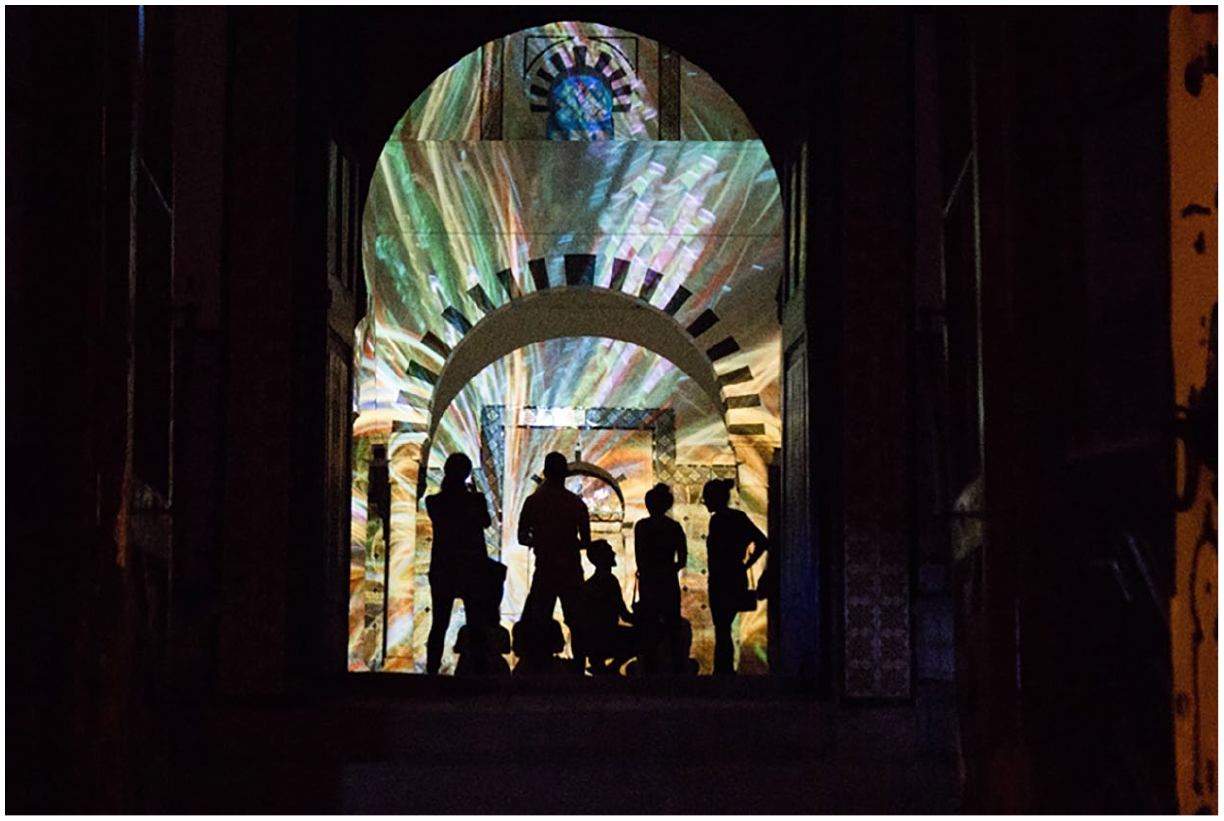
CATALYST Art Installation. Photo Credit: Brahim Guedich—2018.
Joining the Family—a Method
I witnessed the 2016 edition during its four days of exhibition but was not involved in its production. For the 2018 edition, I participated in the full process from January with initial planning, to November the same year with report writing and evaluation. I also participated in the 2023 edition, which, in the wake of the COVID pandemic happened on a much smaller scale than the first two editions. Initially, I joined the project by offering to help write grants in exchange for research access, through which I conducted numerous surveys and interviews with volunteers, curators, artists, the directors, institutional donors, and various audience members who attended the festival. After the first few months, while still handling grants, I moved to working as one of the curators, working in tandem with another curator to facilitate the work of eight international artists and a team of around twenty volunteers.
Through this process, I was drawn into the intimacy of the project’s family. I formed close relationships with various volunteers, curators, and artists throughout the process. Many of these relationships exceeded the context of the project and even continue to this day. I was introduced to the broader social networks, friend groups, and families of my co-volunteers. I lived with, formed romantic relationships with, and attended parties, weddings, and funerals of the friends and family I met through the project.
Considering the sensitive nature of elements of this article, I have altered the names, shifted details, and amalgamated identities out of curtesy for informants and out of an abundance of caution. While I have worked to ensure that the knowledge I write honors the aspirations of my informants, I do so as an anthropologist, artist, and curator from the United States with “a privilege to speak” about issues that they, for now, cannot (Hopkins 2020).
Relation to the Contemporary Art World
The directors of CATALYST, Bilel and Anna, insisted that it be labeled a contemporary art project instead of an art festival because the exhibition stage of “festivities” only took up four days of a project that lasted almost a year. For the 2018 edition, the project was launched in January featuring monthly, weekly, and eventually daily workshops up until the exhibition of artistic works at the start of September. During these eight months, dozens of workshops were arranged, first among volunteers, and then, starting in July, among artists. Workshops spanned in topic, but mostly focused on developing a vocabulary for talking and thinking about light art and training volunteers in the various aspects of putting on a large international art festival. Between large workshops, which took place monthly, there were also numerous meetings and training sessions. A “core team,” of about twenty dedicated volunteers, me included, met at least weekly throughout the process to plan and organize the project. Eventually, we came to calling the core team the “curatorial team,” as we shifted from overall organization and planning to artistic production. While the four days of exhibition acted as an imagined end goal during the whole project, the amount of time and labor committed to the production process demonstrates that the goal was not only about artistic exhibition. It was also about the process of getting there; the coming together of a community articulated as a family.
In calling CATALYST a project and focusing on its organization as a family, CATALYST related to trends in the practice of public arts globally toward “social horizons” (Bourriaud 2002) and to what various scholars have named “participatory art” (Bishop 2012), “social practice” (Jackson 2011), “collaborative art” (Kester 2011), and “new genre public art” (Lacy 1995), where art practice has shifted form aesthetic outcomes to social ones. More recently, literature has called attention to a decades old trend toward an “organizational turn” (Holm and Beyes 2022) or “organizational aesthetics” (Lütticken 2023), where the way an art project is organized has become as important as aesthetic outcomes and, in many cases, the intended aesthetic outcome. Organizational concepts, such as “community,” “collaboration,” “participation,” and “horizontal decision making,” that “subtend and transcend” art practices (18), are being exhibited in the artistic process of projects being undertaken globally. As Holm and Beyes (2022, 234–235) have argued, this focus acts as a “critical social commentary” that challenges dominant capitalist frameworks and societal inequalities.
The organizational concepts cited above are without a doubt globally ubiquitous in contemporary art practice today and have often been utilized in Tunisia’s art scene. However, as the use of family during CATALYST demonstrates, these concepts are far from the only or the most important organizational concepts in play in Tunisia. This is rather significant, as the use of family to organize the project might stand out in relation to concepts such as horizontal decision-making. Family is often, as is the case in Tunisia, a patriarchal and hierarchical mode of relation, privileging the authority and rights of elders and men. “Patriarchy” itself, has long been treated as a bad word within contemporary art networks, even positioned on the level of “colonialism,” and “capitalism” as antithetical to the aims of the recent edition of the influential art festival Documenta 15. 3
So then, how did an art project, very much engaged with broader contemporary art trends toward social horizons, end up using an organizational concept seemingly contrary to these trends? To a degree, while interest in participation and horizontal decision-making occupy conversations around contemporary art, many projects that cite these interests may end up being rather vertical and, as Bishop (2004) points out, exclusive. Whether this is unintentional or contrived, sustaining an art project always involves a bit of sleight-of-hand necessary for securing funding, appealing to audiences, and conforming to expectations, what has been referred to elsewhere as a process in the arts of “staying in the game” (Malachowski 2022). In practice, projects might employ methods that, while necessary to get work done and often meaningful to those involved, if more apparent, might unsettle broader publics and imperil institutional support and funding. These types of sleight-of-hand are likely an inevitable condition of art practices dependent upon institutional funding; however, as opposed to all-to-universalizing theories of art, both contemporary art’s political efficacy and its aesthetic specificity are largely rooted in their specific historical contexts, and in certain contexts (and hands), such as Tunisia, as opposed to others, such as Germany, more sleight is necessary to gain notice and secure funding, which in these cases flows into Tunisia from mainly Europe and North America (with all the instrumentalization this entails) and never the other way around. This is not to say that an art project like CATALYST never employed or benefited from concepts such as participation or horizontal decision-making, but that the stakes of art have been different in Tunisia and other forms of doing art, such as making family, have been more intuitive and promising in the pursuit of some sort of enduring and meaningful outcome. Despite this promise, art projects across Tunisia have received a plethora of funding and support from foreign sources to pursue projects on everything from building democratic participation to reinvigorating the commons, but as far as I know, never to create a family. 4
Considering the role of family as an organizational concept for the CATALYST project, also opens broader consideration of the political efficacy of contemporary arts specific to its historical and social context. Assumed in much of the literature dealing with arts and politics, from Rancière’s (2004) influential “Politics of Aesthetics,” to McLagan and McKee’s (2012) book on “Sensible Politics,” is an emphasis on the political role of art as bringing issues aesthetically into public debate, making visible the invisible, giving voice to the voiceless, or otherwise reorienting how people and places are made sensible within a public realm of political deliberation. While elements of the CATALYST family found a visual outcome, for example, in a short documentary film produced to screen on YouTube by a local radio station, volunteers generally concealed the self-reported “queer” nature of their participation to the general public (and especially their families). Far from taking this obfuscation and exclusion as antipolitical, or even antidemocratic, as Bishop (2004) would have it, it is helpful to point to a broad range of literature that explores political possibilities beyond the simple act of making something sensible, including on the political efficacy of modalities of concealment (El-Hibri 2021) and nonvisual “counter-publics” (Warner 2002). As various scholars have argued over the years, the visual is largely endemic to Western-European capitalist and colonial histories and faces various pitfalls within the postcolonial context (Asad 1993; Auerbach 2004; Mitchell 1989; Said 1978; Vaneigem 2001). Anthropologist have widely critiqued the prioritization of the visual-aesthetic within politics in various global contexts, arguing that politics often unfold through poetic, devotional, affective, performative, or other nonsensible forms, and often in relation to authoritative modes of visuality (Caton et al. 2014; Furani 2018; Hirschkind 2006; Mahmood 2005; Mazzarella 2003; Srinivas 2001).
Building upon this work and presenting the theoretical argument of this article, instead of approaching the political efficacy of CATALYST through either the exhibition of a familial mode of organization or the exhibition of the art works into some sort of realm of political participation, I look at how the pursuit of an aesthetic outcome opened up a mode of making family in a historical and social context of Tunisia, in which kinship, like in other Arab national contexts (Joseph 1999a, 2008), is already political, rooted within colonial and decolonial histories of national, social, and religious formation. The political here, aesthetics aside, relates to the status of individuals within society, their rights vis-à-vis the states, where, how, and when they can act and be, and efforts to renegotiate and live this status otherwise. In exploring this use of family, I hope to open a broader consideration of the possibilities for the political efficacy of art, while emphasizing that unequal relations of power underlay the global circulation of organizational concepts within contemporary art, so that which promises liberation for art communities in the North Atlantic, may simply be another source of funding elsewhere.
Idiomatic Kinship and the Chosen Family
Using “Family” or ᶜāyila, in Tunisian Arabic, as well as specific familial terms to describe the community of volunteers for the CATALYST project, is a common practice in Tunisia. In daily life, people often articulate group dynamics in terms of a family and refer to unrelated individuals through familial designations. However, its use for CATALYST was especially pronounced. The directors of the project and many volunteers emphasized during meetings that the project was and should be called a family. Even on the website and in interviews with the media, “family” or “ᶜāyila” were terms repeated to describe the community of participants. 5 Volunteers including curators and artists, mostly Tunisian but some foreign as well, would often use familial designation with each other, referring to each other as parents, children, uncles, or even husband and wife, all of which helped to elaborate on the nature of the relationship between different people.
While the specific familial terms participants used to relate to each other did not necessarily follow a fixed pattern and varied from one person to another and from one use to another, they generally tended to reinforce patriarchal structures, granting privileges to maturity and maleness, and were linked to specific duties, obligations, and roles within the labor distribution of the project. The directors, unsurprisingly, were likened to parents or grandparents. Within the studio I helped curate, the other curator and I were often described as parents by the volunteers. When my tandem curator and I had a disagreement with each other over management of the production process, some of the volunteers described the situation as if we were two bickering parents with all the children stuck in the middle, not knowing whose side to take. One volunteer even compared it to when his parents got a divorce and were always arguing. He felt an obligation to intercede and make things right between us.
At other times and with more variance, familial terms seemed to be applied to someone based upon their mannerisms or way of interacting with others in accordance to understandings of family dynamics. One volunteer who eventually ended up presenting an art piece for the festival, was sometimes referred to as baba, meaning father. Another volunteer explained that they called him baba because he was like a father who was approachable, patient, and caring. In another instance, a Tunisian volunteer began to refer to a foreign visiting artists’ wife as ukhtī, meaning “my sister,” after they developed a close friendship and began to spend more time together. Another volunteer began referring to me as rājlī, meaning here “my husband,” as we developed a friendship after we started sharing cigarettes during breaks. 6
While the employment of familial terms seemed to reflect patriarchal hierarchy in the organization of labor, it also appeared to call upon obligations and a duty to provide ḥub (affection) and lahwa (care). Thus, while me and my tandem curator’s authority was interpreted as parental, our “children,” the volunteers, took it upon themselves to care for our relationship as actual children of bickering parents might. Likewise, me gaining a cigarette wife reflected an intimacy around the sharing of a costly essential resource for taking breaks to de-stress during the long hours of mentally and physically demanding work. Work itself was also articulated in terms of affection and care. When assigning duties and tasks, the directors and curators employed the term “care,” in English or “itlaha b” in Tunisian Arabic. 7 Volunteers were asked to please “care for” a particular task or person. These examples help demonstrate a mutually constitutive relationship in the deployment of familial terms along patriarchal lines, obligations and duties, and affection and care. In undertaking the duty and obligation of work distributed within in a hierarchy, one is also expected to give and expecting to receive affection and care.
These types of employments of familial designation for people unrelated are termed by Joseph (1997) as “idiomatic [patriarchal] kinship,” where in the Arab political context both kin and nonkin are incorporated into “familial boundaries, moralities and modes of operation,” in a process understood as “continuous, rather than disruptive of familial boundaries and life” (79). Idiomatic kinship helps organize society economically, politically, and morally through the proliferation of familial relations of care and obligation. Joseph (2011) has argued that family idioms are often at the center of political tension around social and economic rights through a process of “Political familism,” which, “refers to the deployment of family institutions, ideologies, idioms (idiomatic kinship), practices, and relationships by citizens to activate their demands in relation to the state and by state actors to mobilize practical and moral grounds for governance based on a civic myth of kinship and public discourse that privileges family” (150). As such, in the context of Arab states, as is the case in Tunisia, citizenship and various rights (as well as notions of the self) are more “relational” than “individual,” so that individual access to privileges, state services, and political representation is legally and constitutionally mediated through kin and community belonging (Joseph 2005, 2008, 2011), and family and kin networks are positioned as key economic safety nets for individuals (Joseph 1999b). 8 Here, the family and kinship are positioned discursively prior to the state and as a domain in which the state reserves the responsibility to protect and legally regulate. However, as noted by Joseph (2011), family is also a site of political agency insofar as communities renegotiate kin belonging to resist state control over its membership. Whether in its regulation by the state, or among communities to resist the state, idiomatic kinship and its continuity across social boundaries is an important element of political process and the relation between rights and the state.
While the use of familial terms among volunteers seemed to uncritically support state aligned patriarchal kinship, some volunteers claimed a queer identity, reflected through use of familial terms, such as switching genders, through choices of self-expression, and through choice of intimate relations with other volunteers which would not have been easily accepted by their families. Consideration of queer identity has not been widely covered in literature on Arab families, whereas literature on queerness in Arab countries has generally overlooked the role of the family (see Merabet 2014). Literature on “queer kinship” points to a similar political tension around family specifically as it plays out on the level of sexuality, where the formation of kin networks among queer, lesbian, and gay individuals aside from a state-authorized biological, normative, and specifically patriarchal family, work to mediate and claim political and economic rights exclusive to the biological family (Butler 2022; Weston 1997). However, some caution is necessary in employing scholarship on queer kinship based upon Euro-American examples because the politics of sexuality has long been used to legitimize (neo)colonial domination in the region (Baazaoui 2023; Massad 2008). 9 Accordingly, while many of the volunteers in CATALYST were well-versed on global discourses around queerness which certainly played into their understandings of a comfortable self, they might express some reservations in identifying with the difficult relationship that gay/lesbian communities have with their own families in San Francisco that Weston (1997) described, where a gay identity might be understood as conceptually exterior to the “cultural domain of the family” (43).
Following Bradway and Elizabeth (2022), I will point to the limits in this case of an “anti-social thesis,” in queer scholarship, where queerness is taken as a negating force to the family, and the need to consider how queer desire might make use of and reinforce the family as a category, even in its patriarchal form. However, my goal here is not to work out a theory of queer kinship in the Middle East and North Africa and whether it is “continuous” with the family, as suggested through Joseph’s work, or outside the domain of the family, as implied in Weston’s work, although it is a topic with little scholarly attention. Instead, I aim to show the ways that familial terms were used during CATALYST and the types of intimacy this made possible, and to suggest that, following literature on idiomatic kinship and queer chosen families, that this is an inherently political endeavor in that it worked to create different intimate possibilities beside the legal biological family. I use “beside” here with the intention of offering up a more nuanced, but not yet strictly defined term to promote future discussion on queer kinship in the Arab political context. To support this argument, I now turn toward the history of the formation of the family in Tunisia in which the family became the political basis of the state, and then I will show how the CATALYST family oriented itself in relation to this history.
Family Formations
The misunderstanding between the directors and the volunteers over the plausibility of a family inclusive workshop was not simply the result of a generational gap, and certainly not born out of ignorance, but rather the ramification of a long wrought-out historical process of cultural essentialization for which all participants, including the directors, visiting artists, volunteers, and even me, assumed at one point or another. “Family is everything in Tunisia,” is what Amina, a volunteer, told a featured artist from the United States as she guided him around the Medina while describing the history of the old medieval city, describing its residents, both past and present, and leading him to the early 19th century barracks where he would soon be installing his art. As in Amina’s pronouncement, the importance of family is widely acknowledged within Tunisia, often with a sense of timelessness, and this importance is a quality that many eagerly projected to the broader world. However, it is also a quality taken out of the context of its history, for the family in Tunisia, as with other postcolonial states (Stoler 1995), is a formation with a history; one wrought out of a decolonial struggle and a subsequent journey toward industrialization and development in the neocolonial era. The family is everything in Tunisia, not simply as an essential and innate quality of the Tunisian culture, but because it was made to be everything, for better or worse, as the nation negotiated and homogenized its identity and character, claimed its right to sovereignty within a world composed of nations, and struggled to take control over its own productive capacities. The image of the family in media, discourses about it, and its legalization casted it as an institution in need of state intervention, regulation, and protection for securing sovereignty and economic development. The family was cast and constitutionally reaffirmed as the basic unit of society and its innerworkings, including gender dynamics, sexuality, class, race (colorism), intimacy, desire, and love, became discursive sites of legislation.
While the modern Tunisian family, as a state institute, began to take shape legally after independence from France in 1956, the groundwork for its postcolonial reformation began several decades before, best encapsulated in the work of the early reformer Tahar Haddad. In his 1930 publication, “Muslim Women in Law and Society,” responding to broader debates, Haddad argued that there was no Islamic basis for secluding women, and that women’s access to civic life and education, specifically as they are the key figures in the education of children, were necessary for securing Tunisian identity in the face of colonization, fostering a healthy and productive population, and competing economically with the West (Ḥaddād, Husni, and Newman 2007). Haddad’s ideas found legal legitimacy after independence from France in 1956 in the statesmanship of Habib Bourguiba, Tunisia’s first democratically elected prime minster and soon to be “president for life.” Even before the ratification of a new constitution, for which family instead of the individual would be named the barer of rights, Habib Bourguiba moved to limit religious authority over matters of family and enacted through decree the Code of Personal Status, a series of laws that outlawed practices of polygamy, forced marriages and divorces, child marriages, and expanded equal rights for men and women in divorce and child custody (Perkins 2004). These actions firmly cemented the family and its inner workings under the exclusive sovereignty of the state. Bourguiba, like Tahar Haddad before him, argued that the reason that Arab-Islamic civilization trailed the West in economy and industry was because of the status of women, and that their liberation and education was necessary for educating a generation that could drive industrialization (Bourguiba 1965; Johnson 2018). This combination of a Muslim ethics and women’s vulnerability, as in other Arab States, helped establish the family as a natural category, the very basis of the state, in need of perpetual state intervention and protection (Agrama 2012; Kallander 2021; Yacoubi 2016).
Accompanying these legal reforms to the family, in subsequent decades the Tunisian government under Bourguiba launched an expansive family planning initiative that made contraceptives widely available and legalized abortion for some women in 1964 and then for most women in 1973. While the expansion of family planning programs responded to fears of unsustainable population growth, the programs also aimed to enforce (sometimes even with forced sterilizations for women with many children) a new national model of a nuclear family structure (Maffi 2017), where the ideal family composed of a man and wife, both educated, and with just two or three children, was more equipped to produce a productive and consumptive population necessary for securing modernity and progress (Johnson 2018; Mills 2007). In the face of growing global economic precarity, and a state not yet able to offer broad forms of social welfare, the nuclear family, with strong kinship ties, also promised greater resilience in times of strife and offered a much-needed social safety-net (Camilleri 1967).
While the family was being made legally and structurally in line with economic imperatives, so too were the cultural identity and characteristics of the family being discursively homogenized. This framework of the economically essential nuclear family has subsequently influenced and shaped the intimate dynamics of the family, including gender, sexuality, and love, which while not wholly legally regulated, took shape within a larger state sanctioned discourse of the family, in which certain expressions, dress, and behaviors were accused of threatening the sanctity of the family, and by extension, the state (Chekir 1996; Kallander 2018). In such terms, Tunisia’s reformation of the family aligns with what Donzelot (1977) described as the “familial regime,” in the history of modern states in which the interests of the family were made to align with the interest of the state. Considering 19th century France, Donzelot explained how this alignment valorized the practices of the bourgeois family, that of the new political elite, as the state itself moved toward a function of cultivating a healthy, productive, and reproductive population. Similarly in Tunisia, while historically (and still) exhibiting an untold diversity of cultural traditions and familial forms, the image of the nuclear family, its desires, practices, and sexuality, were drawn largely from baldī traditions. baldī, meaning “urbanite,” in the Tunisian Arabic dialect, and often compared to European bourgeois society, references an elite class that occupied urban centers and dominated rural economies prior to the influx of rural communities into the cities during the colonial period. In securing their status, the baldī maintained prejudiced cultural practices delineating themselves from the barraniyya rural communities, and secured their economic control over them. Such prejudices included ideals of piety, profession, marriage traditions, seclusion of women relatives, eating habits, and colorism (Hejaiej 1996). Especially important were practices of hasab wa nasab, nobility and lineage/kinship which regulated marriage, inheritance, and various practices of exclusion aimed at preserving the good quality of the family (Ferchiou 1992). In the postcolonial period, while hasab wa nasab has waned in austerity, with the valorization of the baldī family as the Tunisian family, its use, as described to me by some of the volunteers of CATALYST, remains an important element in determining how their families negotiate and evaluate familial and romantic relationships, right down to forms of masculinity and femininity, and the tone of one’s skin.
While the discourses and images of the Tunisian family and its form is hardly uncontested, certain practices inherited from historical baldī segregation prejudices and reinforced through media, law, urban planning, continue to pervade day-to-day family practices. This is also true within the CATALYST family, that in many ways utilizes and reinforces baldī sensibilities and even prejudices, especially as a project in an old Medina, the historic seat of the ruling baldī. Yet, even while reinforcing some aspects of the baldī family, it was also a place from which volunteers could renegotiate this family through the production of art, and the forms of love, care, and intimacy this production made possible.
dārna (Our House)
The CATALYST family was homeless when it joined in matrimony and relied on the generosity of programs and public institutes for places to live, love, and work. For the first months we resided between the small office of the Creatives Association, the parent association of CATALYST. For larger workshops we used the courtyard of Dar Qadim, an old palace managed by a historic music school. The Association of Public Arts, one of the oldest public art associations in Tunisia had offered us unlimited use of their own Dar Bahia, a spacious and beautiful 18th century palace with marble floors, tiled walls, Roman columns, and a central fountain. While many of the core members of the team admired the beauty and convenience of Dar Bahia or one of the numerous other houses offered to us, our patriarch, Bilel, argued that to forge our own identity we needed our own place, and he posed the question: “How can we be a family without our own dār?”
After months of searching and negotiations, we eventually found a dār. It was an old and modest home with crumbling walls, battered marble columns, and an open courtyard of uneven and cracked marble tiles (Figure 2). Through a series of workshops, we collectively agreed to call it “dārna,” meaning “our home/house.”
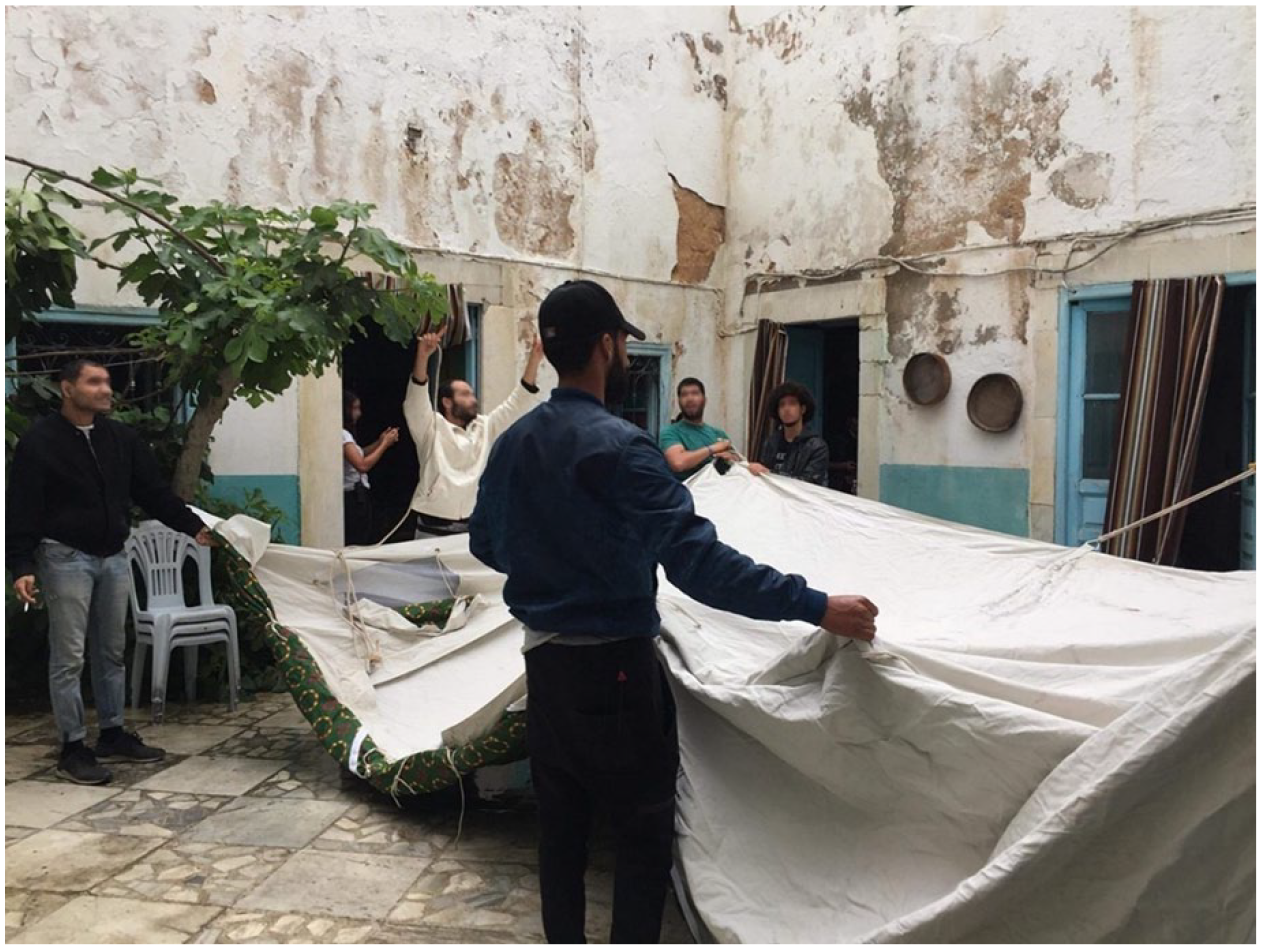
First workshop at Darna—2018.
dārna was not as prestigious as Dar Bahia, Dar Qadim, or any of the other grand pedigreed palaces of the Medina where we had previously sought refuge. The courtyard only contained two old battered Roman columns, there were no elaborately carved false ceilings, and only one of its few rooms had tiled walls. In addition, many of the walls had begun to buckle and lean to the side, the product of an additional floor the neighbor was adding to their house. The weight was so great it was pushing dārna over into the alleyway on the opposite side. Despite its short comings, it was our dār and over the next months, we settled in, patching and painting walls, repairing floors, and building furniture. Some of the work was done by local skilled artisans, such as the refurbishment of the courtyard floor, but much of the work we did ourselves. We built tables, benches, and shelves that rearticulated rooms in the house into workshops, studios, storage rooms, meeting places, offices, and bedrooms (Figure 3). Meanwhile, other volunteers began to populate rooms with equipment, tools, appliances, food, laughter, and smiles (Figure 4).
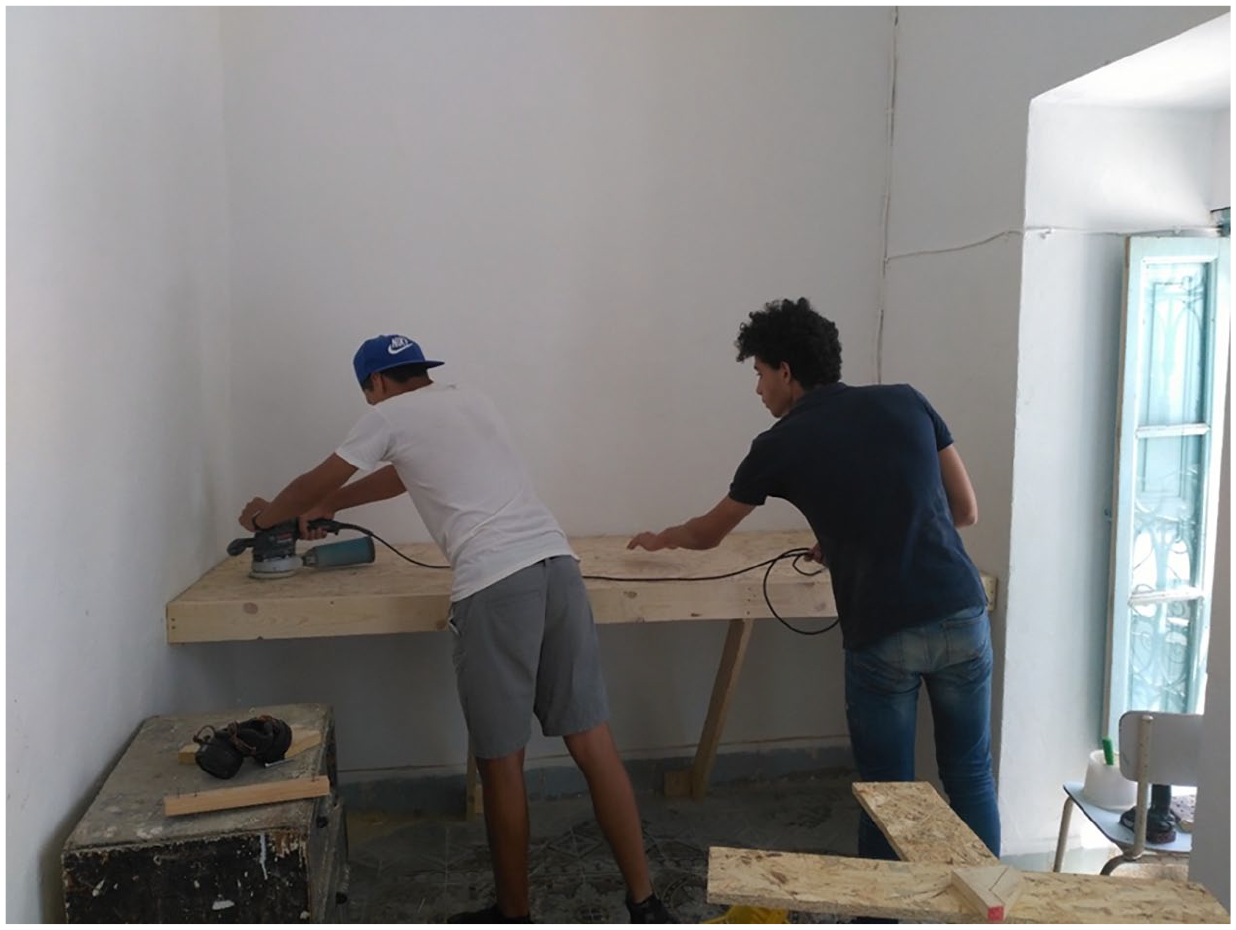
Building a work bench for Darna—2018.
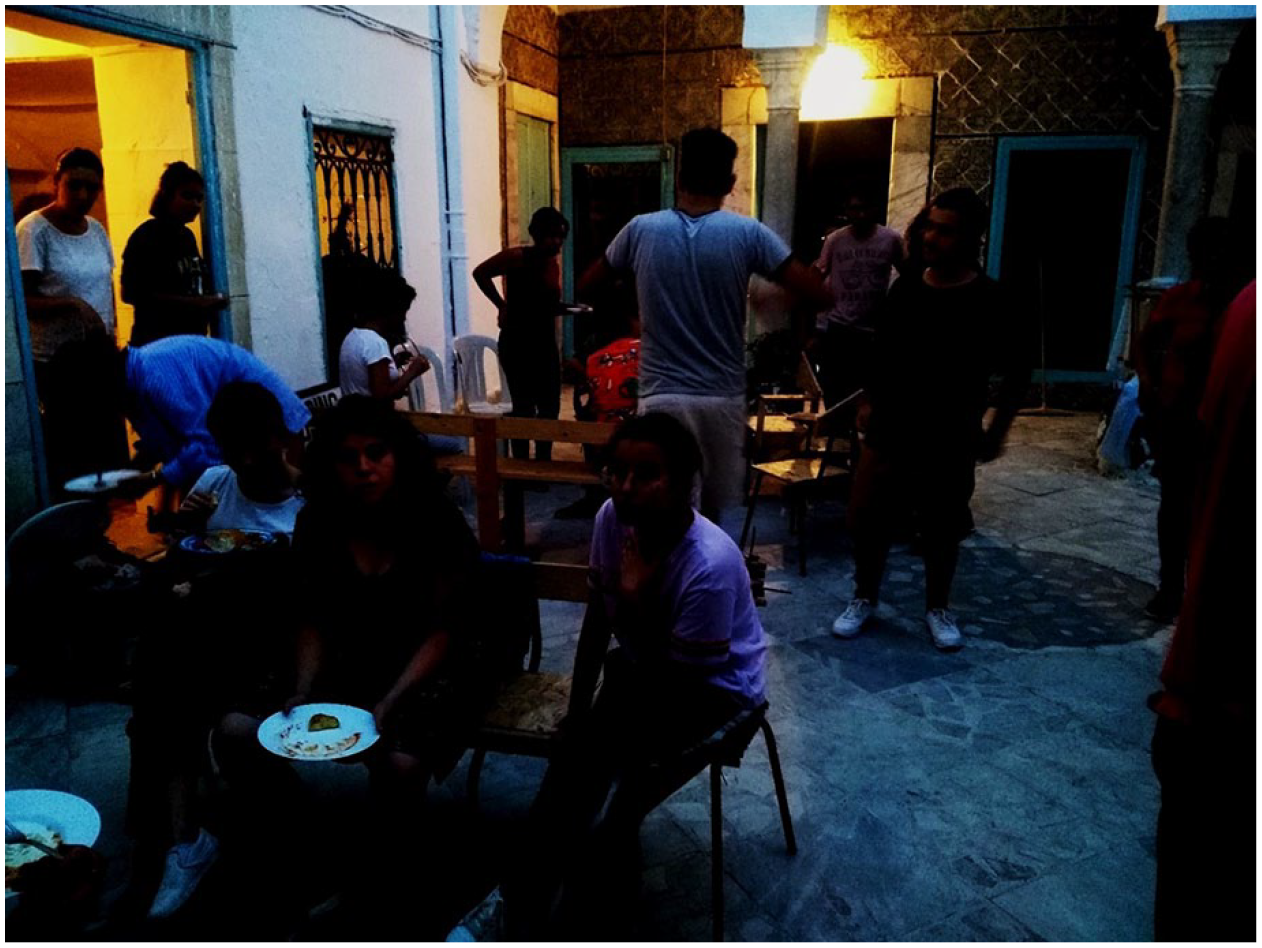
Family dinner at Darna—2018.
In the social geography of the Medina, the house is a sanctuary for the family. While its architectural features and design vary in style and opulence, most houses use a similar layout to regulate movement and guarantee the privacy between those members who were part of the family and those who were not. The front doors of dārna were large and rectangular, with a smaller door which could be opened separately, embedded in the center. According to my friend, a Tunisian anthropologist, the smaller embedded door functioned, among other things, to force men to crouch when entering the house so as to avert their gaze into the interior and give time for the women to cover themselves. Beyond dārna’s front door was an entry hall running perpendicular from the door into the interior of the house. A typical design for Medina houses, this entry hallway, called a sqīfa, prevented any passerby from seeing directly into the interior of the house. It also acted as a place for guests to wait for their hosts to prepare themselves. Like other houses, dārna’s entry hall opens directly into the central courtyard. In the layout of the house, as typical of Medina houses, all of the various rooms open onto the central courtyard. Some houses contain a second or even third story which sometimes features an overhanging balcony that can extend all around the courtyard. dārna features a balcony on just one wall of the courtyard supported by two ancient marble columns. The balcony is on the side of the entry hall so that when you enter the house courtyard from the sqīfa you are shaded from the sun or rain. On the opposite side under the balcony from the entry hall is a stairway leading to the second floor, another feature regulating social movement.
In accordance with its architecture, the CATALYST family sought to regulate movement through dārna. Only family members were allowed into the house, unaccompanied. When guests arrived, they were asked to wait in the sqīfa until their host came to greet them, or their permission to enter was confirmed. The regulation of movement in Darna was presented in terms of safety and security of the family. The main justification for this was the need to protect the plethora of expensive electronic equipment stored in the house. This included projectors, speakers, sound systems, media units, electronic materials, and the many personal computers brought by the family members for work. An expensive investment for individuals and their biological families, laptops were reason enough for most family members to help regulate movement. However, just as important, if not strictly articulated, was the need for dārna to be a sanctuary for the family to be a family and for that family to feel comfortable while undertaking the work of putting together an international art festival.
Because I’m a Lesbian
Late one night after work had wrapped up at dārna and before heading to bed, I went to get a tea with Emna, a young volunteer working with me in the Light and Space Studio. Emna lived a short taxi ride from the Medina. After dark, much of the Medina, an economically marginalized community, becomes the domain of men, and women commonly face harassment and undesired advances. Because I was a man that lived in the Medina, was familiar with the narrow winding roads and dead ends, and had a good relationship with many of the local youth, I had become one of the people that many of the young women volunteers, many from better off neighborhoods in the suburbs, asked to walk with to find transport home on the edges of the Medina. This night, Emna and I had planned to stop at a café at the edge of the Medina before she jumped into a taxi for the short ride home. As we were leaving, we were accompanied by Hamza, a young man of around eighteen years old from the Medina volunteering with CATALYST and who had a crush on Emna. At the café, Emna began showing us photos of all the girls she follows on social media that she thinks are “hot.” Hamza became visibly angry at this and harshly accused Emna of acting like a lesbian, at which Emna responded, “that’s because I am.”
Unsettled, Hamza went home soon after, and Emna and I walked down along the edge of the Medina looking for a taxi. As we did, she explained to me that unfortunately there are too many men like Hamza around. She mentioned that it was a bit surprising that he would be involved with CATALYST, but he was still young, so perhaps he would come around. In any case, she was happy that for the most part, she didn’t have to worry about expressing herself at dārna. It had people that were understanding and accepting of her.
Emna joined CATALYST in the summer, just a couple months before the festival opening. She showed up for the first time during a workshop where I and the other eleven curators presented the themes, history, and collections of artists for each of the six curator studios. With around forty artists expected for the 2018 edition, we split the artists into six studios. Each studio, was led by two curators and covered a specific theme of light art, roughly divided based on historical movements within the field of light art.
The workshop was also a competition for volunteers and through that competition Amina and I, as tandem curators for one of the Studios, won Emna and around ten other new volunteers for the project. Amina and I had put together a power point presentation, where we briefly covered the history of the light and space movement in the United States and introduced the portfolios of the eight artists in our studio. Why Emna and the other volunteers came to us had to do a lot with the style of artists in the studio, but also with the styles of Amina and myself. Emna later admitted that we had felt to her like the “queerest” of the groups. She pointed out Amina’s died hair, cut short and swept to the side and she described me as the tall “flamboyant” American with a colorful outfit and personality.
As I became friends with Emna, I also learned more about her queerness. She described herself to me as bisexual, boyish, and samra, which in Tunisian Arabic refers to people with very dark, but not black skin color. Being bisexual and boyish was something she generally kept to herself. Being samra was something she had simply learned to accept through the accusations of others. She said she often felt ashamed of her desires and of her appearance, particularly because of her family.
Walking through the Medina one evening while preparing the site for art installations, she told me about her aunts, who when visiting with her mom would talk openly in front of her about her dark skin. They would say, “she’s very pretty, but too bad she’s samra,” eluding to the supposed difficultly that being dark skinned has on the ability for a woman to marry someone of wealth and status. Her aunts would blame her mother for marrying beneath her to someone of a rural background. Despite being her father’s daughter, Emna explained that even her father did not want her. Her parents divorced when she was young. Her father started another family, leaving her and her two brothers to live with their mother. When she was growing up, she explained that she would act and dress boyish to try to attract his attention, although it never seemed to work. She lamented to me that had she been born a boy, and if she was not so dark, her father would want to see her more and she wouldn’t be so much at the mercy of her aunts.
Emna explained that she had reached a sort of truce with her mother, who she was living with. She described her as “conservative” for her beliefs and the fact that she was wearing a hijab. Emna explained that her mother did not approve of her lifestyle choices, friends, tattoos, and piercings, and often fought with her over them. Nonetheless, they were still living together and caring for each other. Her mother was giving her a masrūf, a daily allowance, and she was helping her mother, who was often ill, with cooking, cleaning, and caring for her brother, who was disabled.
In CATALYST, in dārna, Emna found another family that accepted her in a different way. While the existential dependency of monetary survival was absent, Emna expressed a duty to the CATALYST family, nonetheless. To care for Darna and the family it houses, we had collectively worked out a system of daily cleaning and chores divided among the different curatorial studios. Duties such as cleaning the bathroom or helping to prepare and serve dinner fell upon different studios on a rotating schedule. Emna was always very devoted to showing up and helping with these chores. She also went beyond these basic obligations, taking on additional tasks on her own to help with the well-being of the family and the function of the project. She spent weeks working on a commuting partner system so that volunteers, especially the women, could avoid having to travel alone to and from Darna through the Medina and across the city.
Emna described a link to the commitment she showed to the project and what the project offered to her. She felt comfortable about who she was, her sexuality, her skin-tone, and her life choices in a way unavailable to her with her family. While feeling accepted by the CATALYST family, she also worked to contribute to it, investing time and energy into it as she might in relation to her mother and brother. She expressed care and concern about her adopted CATALYST family, going out of her way to make sure they were safe. In response, many of the volunteers expressed deep gratitude for the care that Emna gave them and often called her bintī, my daughter. In cultivating these exchanges of care, duty, and obligation that helped Emna and others feel comfortable, were also made possible through maintaining certain elements of the very family they sought to exclude, not to mention the need to exclude the general public, and especially local young men. While the project made efforts to include many of the local youth in an area once a center of baldī wealth, but since abandoned to poor rural immigration, most were excluded for fear of theft, harassment, conservative sensibilities, and closed-mindedness. The occurrence of mostly better-off suburban youth coming to a Medina, playing upon baldī domestic traditions through a cultural project, and setting parameters for the inclusion of local youth is not without its irony. 10 This topic warrants broader attention, elsewhere. For now, my purpose here is point to the importance of familial dynamics and how volunteers interacted with the CATALYST family beside their biological ones.
Care, Labor, and Jaw
On a cold and rainy Winter Day in 2023, I met up with my friend Safa at the café where she worked. Safa had volunteered for the 2022 post-COVID mini-edition of CATALYST, and over coffees we chatted about her experience with the festival. When I asked her what she liked about the project, she gave the exact same answer I had received from volunteers of both the 2016 and 2018 editions. She enjoyed the jaw.
jaw, has a specific meaning in Tunisian Arabic. My friends and interlocutors often translated jaw as meaning “fun.” In formal Arabic, and in many other dialects, jaw means “weather” or “atmosphere.” The Tunisian use of the word retains an essence of this meaning, in that the fun of jaw is also about being in a good atmosphere. I have also heard jaw translated as “a beautiful fun,” which is perhaps more accurate in drawing together the affective sense of the word with its aesthetic sense. 11 jaw is about having fun in beautiful spaces. It comes from enjoying the company of others. It is something you catch from others. It is something you feel. For Safa, her experience of jaw came from the family she created through CATALYST, from spending summer nights in the old Medina amongst its beautiful architecture, and from working with artists to create interesting installations in this beautiful place. Overwhelmingly in surveys, both volunteers and audience members during the 2018 edition cited jaw as the element they enjoyed most about the project. Volunteers noted that they could feel the jaw when the audience came and enjoyed the art, and conversely, when the art was bad and the audience didn’t enjoy it, the lack of jaw was palpable. Volunteers, curators, artists, and visitors all had their specific interest, philosophies, and political desires and certainly employed various terms and language endemic to contemporary art practice to evaluate the aesthetic quality of CATALYST. However, jaw was without a doubt one of the main aesthetic categories in which people experienced and evaluated the project.
As a volunteer-based project, with little tangible rewards for participation, jaw and the various elements that went into its production played an important role in putting on an art festival that the directors claimed would have cost upward of half a million euros to pull off in Europe. For CATALYST, the cost, at least from the perspective of a budget, was zero. Certainly, costs were incurred in terms of airplane tickets purchased, food bought, and housing secured. However, such expenses were covered by participants individually (or by their families) or otherwise donated in kind. Dozens of volunteers committed countless hours of labor over a period of up to ten months without compensation. Except for a handful of artists paid for through grants, most artists covered their own trip and were willing to bring hundreds of thousands of euros/dollars’ worth of equipment for the festival. Local residents, organizations, and businesses in the Medina supported the project with donations of housing, electricity, food, and other various resources.
Based almost entirely on volunteers and nonmonetary contributions, the deployment of family, familial relationships, and familial obligation during CATALYST makes sense. Very literally, tasks were framed as “itlha b,” meaning “to care for,” as parents care for children. If an artist faced a meltdown, two volunteers got in a fight, or local children sabotaged an art site, members of the project would be sought who might “care for” the issue. When asked what the most important part of being part of the CATALYST family, one volunteer responded, “Being there for others.” Another volunteer responded, “barsha ḥab,” lots of love. While to a degree, familial obligations were being instrumentalized to produce art without monetary compensation, we can equally say that the production of art, and more specifically the making of jaw, created opportunities for familial intimacy. Considering the experience of Emna and other volunteers, this family was not entirely limited by a familial organization bound to the political economy of the state and shaped by structures around social standing in a competitive and precarious economy. Instead, it was a space for people to share moments with others free from some of the chains of hasab wa nasab; to be intimate with people despite questions of origin, class, sexuality, and skin color; to feel cared for and loved despite one’s own conforming or nonconforming self; and to pursue love otherwise deemed unrealistic. Of course, the CATALYST family was not always perfect in this regard and questions around class, social difference, and threat undeniably limited participation in this safe space. Nonetheless, it was an attempt made possible, in part, through an emergence of a postrevolution contemporary public art scene, and, as pointed out to me by friends and colleagues, mirrored by similar projects that have unfolded across Tunisia.
While the CATALYST model of the family presented an image rather different from the Tunisian nuclear baldī family, this does not mean that the CATALYST family was in opposition to volunteers’ biological families, and even though volunteers were often critical of their own families, I think it is rather telling that families were rather supportive of the CATALYST family. Ultimately, it is the very model of the Tunisian nuclear family and its modes of support and care that made the CATALYST family possible. For youth to volunteer, most depended upon the support of their family, who gave them allowances, food to eat, and a place to live. Of the parents of volunteers I talked with, they explained that they supported their children in participating because it offered them experience, maybe a chance to travel internationally, an opportunity to help people, or merely a reason not to sit around the house doing nothing all summer. Some volunteers reported that their parents even wanted to get involved because of the way they saw a project like CATALYST doing good in society. I imagine that if many of the volunteers’ families knew more about what they were doing, they would likely have disapproved. At the same time, however, I observed a willing ignorance on the side of volunteers’ families about what was happening at dārna. My friend Nour’s mother, for example, explained that she did not want to know what her daughter was doing there, so long as she respected her family at home, noting that she too was once a young woman who struggled against the regime of her parents. That is to say that, even though the CATALYST family was a family free space, even at times critical of that family and its limits to comfort, it was also a project made possible because of the love, care, and willing support that families gave to their children so that their children might forge a more comfortable life, society, and future for themselves.
Familial Endings. . .
In Summer 2023, I approached Bilel, co-director of CATALYST, to receive feedback about my project on the use of family as a concept of organization and to discuss the ethics and safety of publishing a paper that would reveal the participation of queer youths in the project. Bilel was excited that I was focusing on the idea of family and endorsed my plan to publish on the role of CATALYST in providing what he called a “safe space.” He suggested, additionally, that I participate in the current summer mini-edition of CATALYST. While far reduced in size and scope from the 2018 edition, he suggested it would be prudent to update my research and consider how the project had evolved.
When I returned the following week to join the project, it became immediately clear to me that “family” was no longer a term widely utilized to conceptualize the community of volunteers and artists. Instead, the directors and other participants were mostly using the term community. While the term “community” was also purposefully used in 2018 alongside family, I was surprised that the use of family had significantly diminished. I did hear people talk about the project as a family in passing conversation and I often heard people employ familial terms idiomatically (calling each other daughter or brother, for example), but this was not as a conceptual framework and far from the extent that it was employed in 2018. Meanwhile, another term had worked itself into conversations about the project, its organization, and its community, for which I had not previously encountered in 2018. The term on everyone’s lips this edition was, “the commons.” The term commons was an integral component of this edition through a small amount of funding CATALYST received from the German Green Party’s political foundation, the Heinrich Böll Stiftung (HBS).
Commons is also a term overwhelmingly being employed globally within contemporary art discourse today. In recent years the commons has occupied the schedules of contemporary art conferences, projects, and festivals, celebrated even as a term with decolonial potential as exemplified by the recent Documenta 15. 12 Considering that the term commons has gained traction in contemporary art communities globally, it is to be expected that CATALYST, an international art project, would engage with the concept. It does seem significant to note, however, that despite a strong association with decolonization and perspectives from the south, in this instance the impetus for the use of the commons came specifically through the availability of German development funding seeking out projects addressing the commons. This, however, is a conversation for another time. Here, I would simply like to draw attention to the diminishment of the use of the term family, a significantly meaningful term politically, economically, and socially in Tunisia, in concert to the expansion of the term commons, which, besides a few tenuous efforts to root it in an equivalent term in Arabic (I have seen several attempts—al mushᶜāt, ārdh ᶜlā ash-shīāᶜ, majlis ᶜamūm, and shārik fī) and awkward attempts to root it as a precolonial tradition in urban and rural Tunisia, it is historically and discursively tied to economic formation of land use endemic to European history (De Moor 2012), and even, as De Moor argues, central to the history of the “emancipation of the individual” from family ties in Western Europe (2017, 4).
Theorical work on the politics of art calls attention to arts capacity to reframe the relationship between sense and common sense, make the invisible visible, and create new fictions out of old, in so far as politics is understood as the intervention into passive consensus (Rancière 2010). The fact that the rather queer family of CATALYST, sought to evade the notice of the public, and especially their parents and older relatives, suggests that reframing sense and making the invisible visible is not the only way art becomes politically effective. Instead of dismissing these efforts as apolitical, I might turn to what Sofian Merabet has called “queer spaces.” For Merabet, it is specifically because these spaces are noticeable by the gay community and its allies and unnoticed by most, that give them the potential to elide and breakdown Lebanese sectarian politics. In the same way, it is largely that the components of the CATALYST family go largely unnoticed that create the possibility for young Tunisians to dwell in a space where they can elide certain inhibitions on sexuality and sustain forms of care and love through jaw, a beautiful fun. At the very least, such a practice calls for a reexamination of the relationship between art and politics. In the same line of thought, it is significant that within the global discourses, networks, and financial infrastructures of contemporary art that the concept of commons would overtake the concept of family as a grammar of organization for the project. The reason for this might be evident in the shock that a self-described German “commoning” artist at Documenta 15 expressed when I explained the significance of the idea of family in some Tunisian art projects. The artist exclaimed, “that seems rather problematic and patriarchal.” To her credit, certainly, a practice of making commons, often incorporating notions of horizontal and democratic decision-making, is more palatable in most contemporary art communities than the practice of making family, which incorporates patriarchal gender and age hierarchies. Perhaps, in this light, it is just a matter of time before CATALYST’S explicit use of family becomes too problematic for the field of contemporary art and its financial benefactors, anyways. In any case, I suspect that the young volunteers involved with CATALYST will be seeking a safe space in family regardless to whether the project officially drops a familial vocabulary for the new vocabulary of the commons. Indeed, it might be better to let the CATALYST family to thrive unnoticed by (but with the continued financial support of) those that might take offense of their lifestyle choices, be it parents, a homophobic state, a well-meaning German development institute, or quixotic elements in a global contemporary art scene.
Footnotes
Acknowledgements
I would like to acknowledge Dr. Suad Joseph, my Ph.D. supervisor, whose unwavering support over the years made this paper and the research behind it possible. I am deeply thankful to Dr. Tory Brykalski, Dr. Caroline McKusick, Dr. Muneeza Rizvi, and the other participants of the Suad Joseph Seminar who have carefully reviewed and offered suggestions for revisions to this paper. I would like to thank Dr. Timon Beyes for his support of my research and his incisive feedback on this paper. My gratitude extends to the anonymous reviewers and editors at the Journal of Contemporary Ethnography for their critical review and guidance in preparing this paper for publication. Finally, I am especially thankful to the members of the Catalyst Family, who welcomed me and shared their aspirations, care, and love.
Declaration of Conflicting Interests
The author declared no potential conflicts of interest with respect to the research, authorship, and/or publication of this article.
Funding
The author(s) disclosed receipt of the following financial support for the research, authorship, and/or publication of this article: I did receive some financial support during research for this article from the UNESCO Netmed youth program and from the US Embassy in Tunisia’s Public Affairs Small Grants program.
