




Abstract
There is an increased need to acquire a more holistic and situated understanding of how and why experiences unfold during real-life situations, especially during research focused on identifying nuanced and dynamic phenomena such as trust. Trust researchers need to revisit and expand their methodological toolkit with immersive qualitative methods for the researching of lived experiences of abstract, intimate, and dynamic experiences. In this article, we discuss two ethnographical approaches to qualitative trust research—autoethnography and at-home ethnography. We illustrate this discussion through two case vignettes from our studies of nuanced and dynamic organizational relationships in which we as researchers were also positioned as a part of the data. We apply philosophical principles connected to reflexivity and provide examples of the researcher as a subject during the study of unfolding vulnerabilities of the field and the researcher.
Keywords
Introduction
Trust in organizational settings is seen as a multifaceted, paradoxical, complex, and penultimately dynamic phenomenon characterized by reciprocity and mutuality (e.g., Möllering 2001; Myer, Davis, and Shoorman 1995; Korsgaard, Brower, and Lester 2015), and it is a part of the balance of social practices and routines which are historically embedded in organizations (Gustafssonet al. 2021). Trust is both a necessary requirement for maintaining cohesive teams and as a multidimensional and powerful phenomenon experienced by a functioning team (Brower et al. 2009; Kujala, Lehtimäki, and Pučetaitė 2016). Studying phenomena such as trust in organizational work settings is a timely issue due to the current challenges the four dimensions of volatility, uncertainty, complexity, and ambiguity bring to the atmosphere of current work and business environments. Trust, like organizations, is an ambidextrous and dynamic construct (Korsgaard et al. 2018), with trust and distrust traditionally postulated as opposite ends of a single continuum (Bigley and Pearce 1998; Shoorman, Mayer, and Davis 2007), and therefore, conceptualized as separate, but related, constructs by scholars such as Lewicki, McAllister and Bies (1998) and Bijlsma-Frankema, Sitkin, and Weibel (2015).
In professional work settings, trust between team-based organizational workers has been named as a pivotal driver of collaborative efforts, positive job performance, and decision-making (Zaheer, McEvily, and Perrone 1999; Swärd 2016; Sjögren et al. 2018). Project level co-workers identify crucial elements of trust as an expected, benevolent elements which are embodied through multiple competencies, including collaboration and professional actions at work, and trustworthiness is an expected conduct during knowledge-based teamwork (Buch and Andersen 2015; Swärd 2016). Trust is, thus, determined to be a necessary and expected aspect for professional teamwork and in advancing both inter- and intraorganizational cooperation.
While the study of trust in organizations has advanced in the last decades (e.g., Korsgaard et al. 2018; Schilke, Reimann, and Cook 2021), the scope of trust research has deepened to the examination of the dynamic nuances in daily life within multiple contexts. As a result, the call for methodological redirection to match the advancing complexity of trust studies has been identified, particularly the requirement for the expansion and redirection of qualitative approaches (e.g., Tomaszewski et al. 2020) to deepen the academic understandings of this messy subject and the ensuing study of unfolding and sensitive topics (Lyon, Möllering, and Saunders 2015; Schilke et al. 2021). Qualitatively positioned research (e.g., Eriksson and Kovalainen 2016) produces a situated and holistically framed understanding of how and why there are fluctuations of trust during emerging and unfolding situations (e.g., Korsgaard et al. 2018). Research of this nature would ideally incorporate a longitudinal and processual, real-time examination of the navigation of preexisting, working related trust dynamics (van der Werff and Buckley 2017; Gustafsson et al. 2021) to capture and illustrate the unfolding dynamics as on-going and interactive processes (Einola and Alvesson 2019) over time (Korsgaard et al. 2018). The research of subtle gradients of phenomena such as trust, therefore, are examined regarding both the contextual and temporal elements.
In this article, we expand the qualitative, methodological toolkit for trust researchers through an examination and discourse related to the advantages and pitfalls of performing research of trust and of ensuing abstract, intimate, and dynamic topics (that we, henceforth, conceptually combine and refer to as trust research). We examine two, less commonly utilized ethnographic approaches, autoethnography and at-home ethnography, and provide examples of their application to trust research. We argue that not only should trust research include ethnography as a method, but that the incorporation of the voice of the researchers through autoethnographic methods and the expansion of the sites of research to include contexts which are familiar through at-home ethnography, can provide rich research results if approached in a scholarly, reflective and reflexive manner (Alvesson 2009, 8–14; Järventie-Thesleff, Longemann, Piekkari, and Tienari 2016). We place our attention on how these two methods can be used successfully during trust research to create competent and complementary research data, and we discuss how these data forms are then incorporated into the analysis by using examples from our own research to inform on the inclusion of a researcher’s own lived experiences and reflections as complementary research data. This inclusion of the researcher’s identity and accompanying insights breaks with prescriptions to field research neutrality and tendencies to erase the researcher from the research (Anteby 2013; Adams, Holman, and Ellis 2021). However, Anteby (2013) and others (e.g., Adams et al. 2021; Alvesson 2009; Järventie-Thesleff et al. 2015; McCollum 2018) argue that the inclusion of the unveiled researcher self is epistemologically sound and thus allows for the creation of strong theoretical insights with reference to the collected data.
This article describes two cases from the field as vignettes which focus on mistrust and the use of autoethnographic and at-home ethnographic methods as approaches during our research. While there is a long history of insider/outsider status of researchers (Järventie-Thesleff et al. 2016), few conceptual studies have focused on how the role of the trust researcher spans boundaries and includes a role as an organizational insider, providing an endogenous voice to the research data. In our independent research as organizational insiders, we have accepted researcher propinquity to both the site and to the participants during our examinations of trust in organizations in which we (authors KL and PK) were employed in and simultaneously performed independent research. This span across multiple boundaries (Järventie-Thesleff et al. 2016)—from academic researcher to organizational member—required new methods to understand and practice ethnography. Thus, we pose the following research question, centered on our interest to advance methodological approaches when studying nuanced phenomena in organizations: “How can autoethnography and at-home ethnography be applied to advance scholarship in mis/trust research?”
This article is divided into four sections. In the next section, we review ethnography, autoethnography, and at-home ethnography and provide a brief overview of the complexity of researcher identity when researching one’s own environment and/or self. This section also includes a discussion of researcher reflexivity. Section three contains the methodology used for our research. The is followed by two case vignettes from our fieldwork, related to the loss of trust from two different vantage points, and evaluations of these cases and the ethnographic methods used during the research. We follow this discussion with a conclusion and avenues for future research.
Theory
Ethnography
Ethnography (e.g., Davies 2002; van Maanen 2011; Eriksson and Kovalainen 2016, 149–63) as both a method and a methodology which brings an in-depth fieldwork approach and in turn produces rich accounts at the crossroads of social reality and theory (Voyer and Trondman 2017). Not to be considered as synonymous with qualitative inquiry (Ingold 2014; McAllum 2018), ethnography is a form of engaged scholarship (McAllum 2018) which is a rigorous, longitudinal, context-sensitive, and is an attentive documentary research method focusing on ethically exploring and examining living narratives of human experience (Lapadat 2017) as multilayered and nuanced events unfold (van Maanen 2011; Tomaszewski et al. 2022).
Rooted in anthropology, ethnography was initially a fieldwork report of a distanced observation focused on a group of faraway, exotic people and their lifeworlds; the cultural descriptions of these previously unknown people were reported in an effortless and prose like manner (van Maanen 2011, 1). Ethnography has evolved over time to be interactive (van Maanen 2011), critical (Vandenberg and Hall 2011, van Maanen 2011, 127–30), and practiced with reflexivity (Revsbæk and Tanggaard 2015). Ethnography has, however, long been burdened with wary preconceived notions of its critics in matters related to trust, legitimacy of data and data collection methods, and the privacy of the informants (e.g., Ruth 2015; Russell and Barley 2020).
The emphasis on the experiential nature of ethnographic fieldwork is central to the vital role of bodily cognitions generated by everyday practices and their reflection in the processes of knowledge formation by the researcher in all stages of fieldwork (Aromaa and Tiili 2018). While ethnography can be superficially summarized as extended fieldwork, the time the ethnographer spends in the field has a uniqueness only after exiting the field; Ingold (2014) argues that participant observation would be a more appropriate term for ethnography, as the act of researcher presence is a disturbance to the status quo of the natural environment. This realization that the researcher is not invisible and is unobtrusive while performing fieldwork to those who are natural members of the field is an important one; the researcher presence modifies the natural environment for the participants purely through their presence.
Autoethnography
Autoethnography is defined as an ethnographic statement that connects the ethnographer into the produced text in an autobiographical manner (Learmonth and Humphreys 2016) and is described as the strongest form of observation (Fingerroos and Jouhki 2018). Autoethnography as a concept largely refers to both the method and the product of researching as well as the act of the researcher reflexively assessing the personal, lived experiences related to the research fieldwork, and the inter-relationship of these elements to the examined culture (Ellis 2004; Ellis, Adams, and Bochner 2011). Further extending the description, autoethnography is described as the art and science of representing one’s life in relation to cultural expectations, beliefs, and practices (Adams and Herrmann 2023); it is a dialogic, exploratory inspection of the relationship between self, culture, and others. According to Adams et al. (2021), the concept of autoethnography consists of three characteristics or activities: “auto” (self); “ethno” (culture), and “graphy” (representation/writing/story). To be defined as an “autoethnography,” the outcome of research should include all three of these characteristics (Adams et al. 2021).
The practice of reflexivity is at the core of autoethnographic research (Ellis et al. 2011), as the socio-cultural interpretation of the relationship between self and society distinguishes autoethnography from other forms of writing of the self, such as autobiographies and memoirs (Rannikko and Rannikko 2021). Adams and Herrmann (2023), define a competent autoethnography as an outcome of the narrative’s verisimilitude which is built through the author’s emotional integrity, as ethnographic knowledge is formed through embodied knowledge and empathy. Through autoethnography, the researcher aims to bring to consciousness issues that arise during encounters between experiencers; these events may be difficult to find expressions for, or even consist of situations for which no verbal equivalents can be found (Aromaa and Tiili 2018). Adams and Herrmann (2023) continue, specifying that a good autoethnographer focuses their research efforts on either one event or experience, or on several experiences around the same topic or theme. Autoethnography is a suitable method when studying delicate and traumatic topics (Berry 2012) including the loss of trust in institutional settings (Kosonen and Ikonen 2022).
Autoethnography as a method involves a significant vulnerability of the author and of the encountered others during the research. While the autoethnographer addresses their own experiences, the method acquires reflection and relation to the culture and society where those experiences take place. The method of autoethnography calls for a revealing of the natural self, as analytic researchers, but includes the responsibility to protect the researcher and those who are participants in the research. Narratives in which researcher tell of their lived experiences will naturally include and expose others in their lives (Ellis 2007; Lapadat 2017). This closeness to the data and subjects of study leads to the ethical dilemma of ethnographic research, how to protect the “others” of the study. Tolich (2010) cautioned researchers who adopt autoethnographic methods to not betray colleagues, friends, and family through the portrayal of them in personal narratives. However, cautious ethnographers may be in anonymizing those they study, the participants and informants can potentially identify themselves; this in turn may result in feelings of shame (Murphy and Dingwall 2007; Ellis 1995).
At-Home Ethnography
At-home ethnography is a form of organizational ethnography (Järventie-Thesleff et al. 2016; Delucchi 2018) which incorporates the researcher-author in the dual role as auto-ethnographical observer within a “cultural setting to which s/he has a ‘natural access’ and in which s/he is an active participant, more or less on equal terms with other participants” (Alvesson 2009, 159); in other words, the full-member status as a worker is blended with that of the researcher. This full and active participant status of the researcher distinguishes the difference between at-home ethnography and participant observation; in participant observation the researcher maintains an outsider status, visits the site, and participates at various levels of intensity and time (Eriksson and Kovalainen 2016, 156–7), while the at-home ethnographer is working and researching simultaneously.
As the researcher and the participants are not strangers, and the researcher is a natural part of the environment, there is a risk that the researcher is only regarded as a natural part of the sometimes-messy environment; this duality of researcher/worker role may lead to coworkers/research subjects intrinsically viewing the researcher only as a coworker, thus precluding the dual role of the researcher/coworker (Järventie-Thesleff et al. 2016). Additionally, the previously formed relationships between the researcher and the participants take on a legacy status of familiarity with embedded assumptions from the pre-research time, but this legacy status may also influence the social relationships, patterns of, and trust both during and post-research. When the researcher is embedded in the researched field, previous relationships and associated cognitions are carried into the research by the researcher, and vis-à-vis, by the informants toward the researcher. At-home ethnography also differs from ethnography in that the researcher does not plan an exit from the field per se, as they may need to return to work in their own pre-research position within the organization (Alvesson 2009). At-home ethnography has been performed by scholars examining a wide net of phenomena they have had full and natural member status to, such as nursing (Abdulrehman 2015), installation of irrigation systems (Delvecchio 2018), and private and public institutions (Järventie-Thesleff et al. 2016).
The at-home ethnographical researcher is a native and natural insider investigating the familiar, and there is a temporal and spatial notion to the researcher’s identity (Järventie-Thesleff et al. 2016; Kirkebæk Johansson Gosovic 2018), with the researcher role realized as a duality of full organizational member and gig worker in the research field (see Gustafsson et al. 2021). As the at-home ethnographer is both the one who is studying the phenomena and is a member of the studied phenomena, data are gathered from both perspectives. During at-home ethnography, the researcher does not manipulate the studied environment but remains as a natural member of the institutional group and simultaneously examines the unfolding of events as they occur from the unique vantagepoint (Devecchio 2018) of duality as the researcher is simultaneously both an insider and an outsider. The role of the researcher is one of duality, and the researcher identity is primarily viewed by other organizational members as a coworker and possibly as a researcher from a different organization. This presents a delicate balance not only between the researcher and the informants, and as such requires active reflexivity and reflection by the researcher as to their own role in the field and the motives of their research (Kirkebæk Johansson Gosovic 2018). Authorship is formed as a combination of observations of the self, the others, and the empirical findings.
Closeness and Trust Status During Research
Whereas the ethnographer observes an alien culture as a full outsider, auto-ethnographers and at-home ethnographers study familiar phenomena, and quite often place focus on their “own people” (Learmonth and Humphreys 2016) and themselves. Due to this familiarity, the researcher has a predetermined level of trust which is legacy to their status in the organization, based on historical points along the professional pathway. When the person who has been known in one role assumes a parallel role of being a researcher in addition to the legacy role within the organization, this is a change for not only the researcher but also for the co-workers, too. This parallel role brings in a bifurcated vulnerability for both the researcher and the participants, and although vulnerability is enacted as a willingness to take risks as a core element of trust (Myer et al. 1995), the researcher who researches their own familiar places and people must acknowledge that there are a plethora of dualities involved; in the role of the researcher/co-worker, the researched site is also equivalent to their own workplace, and the informants are also co-workers. This dually grounded status may be fragile due to the expansion of accepted roles and obligations to two institutions; the status be easily breached at any of the intersecting tension points in the nexus of primary influence, as in Figure 1.
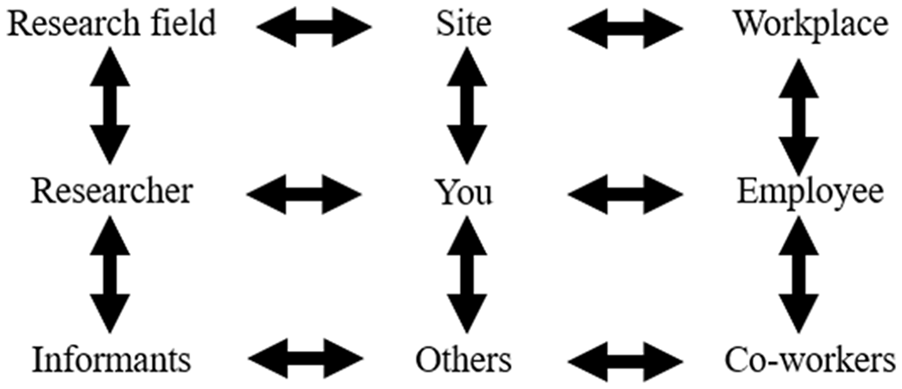
Nexus of Primary Influence During Autoethnography/At-Home Ethnography.
Prior trust research has found that there are recognizable events (momentums) which are meaningful to the turns trust development takes (e.g., Ikonen 2013), such as high vulnerability, high-stakes situations such as in organizational crisis or severe breach of trust toward the organization (Li 2012; Möllering 2014). Therefore, it is important to identify possible emerging distrust. Distrust is often expressed with emotions and suspiciousness builds on itself, intensifying the spiral of the vicious circle (Ikonen et al. 2016). Distrust easily permeates through daily social interaction into an organization and can be a source of tension due to cultural issues (Hofstede, Hofstede, and Minkov 2010; Kujala et al. 2016). The upward motion of trust development may be described as calm and sedate spillover, whereas backward motion appears more intensive, producing a negative spillover effect.
Methodology
We adopted an exploratory, qualitative ethnographic approach to collect and examine the data. The data presented in this article were collected in Finland, during a 2-year timeframe, and occurred prior to the COVID-19 pandemic. The data stem from two separate, independent research projects that authors one and two performed while working on their PhD dissertations; both researchers were long-term employees in settings separate from academia. The dissertation works were not commissioned by the employers but were performed as independent work, with the researchers holding dual roles of worker and researcher; they were both site native insiders. Both researchers performed their research in addition to their own working duties; no reporting of the findings was required by either workplace. One researcher worked in an R&D and the other in a higher education institution. The researchers did not work together or discuss their research until after it had been completed; the third author was a PhD supervisor for authors one and two.
Data collection included two field dairies per researcher (total four diaries): a more formal and traditional field diary and a second reflexive and analytical diary to aid in the reflection of self in a familiar field. This second diary was a recording of assumptions and biases, and to document preknowledge of the field and participants. Dated, iterative entries were made into the diaries, as they were read and re-read. The new entries included new insights or researcher questions to themselves related to the occurrences. If the pages were discussed with, for example, a PhD supervisor, this notation was also made. Thus, these two diary types capture complimentary social understandings of the events from emic and etic perspectives (Eriksson and Kovalainen 2016, 149–63). Additional data take the form of semiformal interviews, photographs, and transcribed discussions. For this article, we brought together the findings from the two separate, qualitative studies to compare and evaluate not only the extracted data from larger cases but also additionally synthesize the auto- and at-home ethnographic methods utilized during data collection. The vignettes presented in this article occurred naturally during the research and were not part of either researcher’s projects yet were recorded in respective diary entries. One of the reported cases happened to the first author, and the other happened to the second author; both cases occurred as extraneous cases to primary research projects.
To analyze the events, we performed multiple rounds of interpretive analysis to come to the most plausible results (Mantere and Ketokivi 2013; Ketokivi, Mantere, and Cornelissen 2017). We analyzed our works separately and then together to identify where and how differences and similarities occurred. We adopted a hermeneutic approach to the analysis, to examine the iterations of findings as the events unfolded, in a cyclical manner in tandem with our documentation. The analysis was continued as a type of (double) hermeneutics (Alvesson 2009; Pitard 2016), and we constructed explanations through abductive logic and reasoning (Ketokivi et al. 2013) to understand the studied phenomena. We considered the phenomena to be twofold: how mistrust can be studied incorporating researcher voice in the data, as well as the mistrust itself.
Ethics and Data Ownership During Ethnography
As site access is natural in its nature, the researcher must be prepared with the knowledge and sensitivity that ethical issues may arise (Lapadat 2017). The key feature of ethics during ethnography is the protection of self and others while presenting the findings as transparently as possible, as the researcher, too, is vulnerable during the research (Lapadat 2017). By telling our experiences of lived lives in doing an at-home ethnography, we naturally include and expose the others of our lives as researchers and participants in the narratives which are told (Ellis 2007; Lapadat 2017), thus, co-workers or other third parties can also play a role in trust violations, and conversely, in trust repair since trust breaches and violations rarely occur in a vacuum and the broader audience is often indirectly influenced by the violation (Gillespie et al. 2021). The emphasis on the experiential nature of ethnographic fieldwork refers to the idea of the vital role of bodily cognitions generated by everyday practices and their reflection in the processes of knowledge formation (Aromaa and Tiili 2018).
Russell and Barley (2020) argue that the establishment of trust and obtaining informed consent from unequal partners during ethnography presents an ethical dilemma related to power relations. The researcher, and in the case of the researcher studying one’s own or even oneself, challenges the questions related to data ownership and the needs and rights of the research subjects and the researcher as an informant and participant to the research (Russell and Barley 2020). We openly performed our research as organizational insiders.
Authority and Quality in Ethnography
The validity of qualitative research is not defined through controls based on positivist assumptions, and “researchers make these discriminations do not pertain entirely to the internal coherence, elegance, or plausibility of the account itself, but often refer to the relationship between the account and something external to it—the phenomena which the account is about” (Maxwell 1992). The authority and credibility of the produced ethnographic, narrative text is assessed via four attributes of the work: the authenticity, plausibility, criticality, and overall integrity of the work are used to produce an assessment (Golden-Biddle and Locke 1993; Whittemore, Chase, and Mandle 2001; Davies 2002, 225–8; Loh 2013). This assessment is made by both the author(s) and by the readers. The highest authority of text is that the reader experiences it as being a true and living text, and the text allows the reader to have the vicarious experience of being in a similar situation and thereby understand the feelings and perceptions of the participants in the study (Loh 2013). Therefore, to establish verisimilitude in a study, the study must be assessed as plausible to the readers of the study (Loh 2013).
Analysis of the Familiar and Simultaneously Unfamiliar Site
Traditional ethnography involves starting off with unfamilairity and outsiderness; with at-home ethnography, there is the familiar—it just must be identified and recognized, assessed for understanding. This can be explained as the identification of the known, the visible, and then setting it aside followed by a new search for the known and visible, and then in turn setting this new finding aside. The accompanied bracketing follows a manner of identifying the visible, through the collection of materials, to their assessment, and then finding oneself in a “new” state with increased knowledge and assumptions. Then, the cycle is repeated again and again. Eventually, the invisible will start to take shape and appear to the researcher, and this is then analyzed. The invisible may come in many forms, and the researcher will piece the invisible threads together to make a new understanding.
While researching in a familiar environment, as is the case in this article, the researcher has two agency roles during which her focus is different: worker and researcher (Aarnikoivu 2016). We describe this switching of roles through the metaphor of wearing two different hats, and while wearing one or the other, the focus and attentive being would be different. While traditional ethnography involves starting off with everything being unfamiliar, even a foreign land and foreign peoples; with autoethnography and at-home ethnography, there is starting point of being embedded in the familiar—albeit it centered on one’s own agency and potentially a site with which there is a connection as one’s own, where one belongs. This agency and the connections to the site must be identified and recognized, assessed for understanding to prevent bias and position the researcher as a plausible observer and researcher.
We as researchers looked beyond the scope of our own social practices (Schatzki 2001), agency, and learnings of trust during previous fieldwork and study. As there were many things going on at once, including our reflexive analysis of the self in addition to the situations, there was a lot to process. We figuratively stepped back to observe and reflect; as researchers, we were continually aware of the potential pivots in the relevance of the points of interest. Something that seemed obvious may have had deeper roots and mysteries to it, and something we had not noticed before became clearer. In addition to the analysis of data, we also had to analyze ourselves and our research diaries as sources of data. As our ethnographic research situated us within a duality of identity and space—being simultaneous researchers and one of the researched—we performed phenomenological reflexivity, thus separating our roles and our focus into two levels (Table 1). We also discussed sensitive findings with a trusted insider and our academic supervisors to decrease any potential biases in our participation and interpretations, as we were also a part of the “problem and solution” as active members of the work and research communities.
Two Attributes to the Most Active Researcher Roles. Adapted from Räsänen and Mäntylä (2001) and van Manen (2014) by AUTHOR.
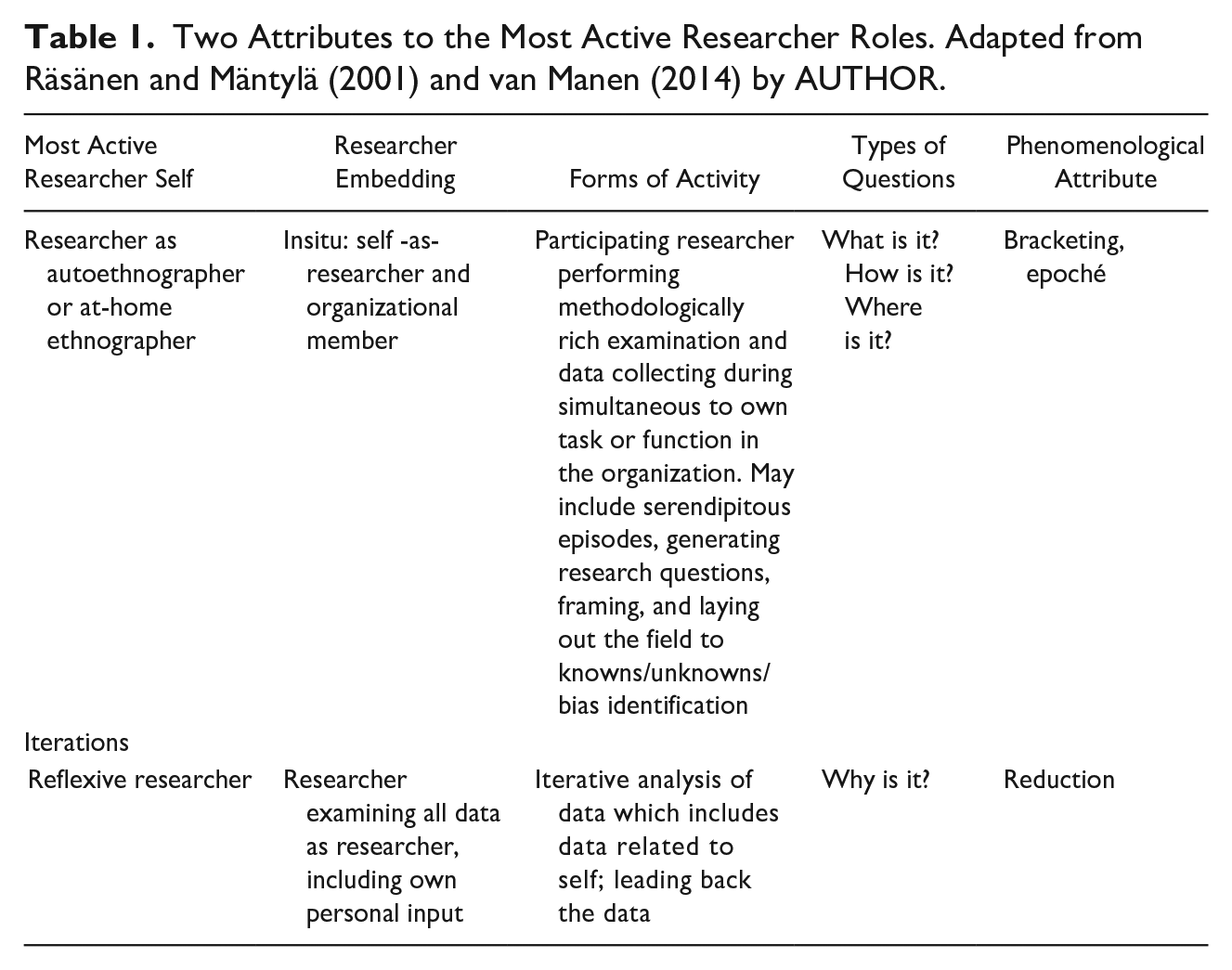
The active researcher self is present in two major ways, as the at-home ethnographer and as a reflexive researcher. These bring more active methods of engagement, either participatory when active in the field, or as an analyst, iteratively scrutinizing and examining the findings. Note that as these states are also iterative, there is a sliding back and forth between the stages of active self.
The initial mode of research design is philosophical and is a state of epoché, the bracketing (van Manen 2014, 239). During this mode, the known and taken-for-granted is set aside and “bracketed” so that its existence is acknowledged, yet the search for the invisible and further meaning becomes more focal (van Manen 2014, 215). This is the attempt to remove the known, to question to accepted, to set it aside. This is a time to assess what is taken for granted and to expose one’s insiderness to the researcher side of oneself, to bring objectivity (Aarnikoivu 2016) and leads to the phenomena itself (van Manen 2014, 215). Bracketing brings the visible empirical materials to a fundamental base of what the research is examining, how the field is exists, and why the field is as it is—thus determining the trinity of historic origins, present state, and potential future(s) of the studied phenomena, other words: the big picture (Alvesson and Sjöldberg 2009) or the acknowledged status quo. Bracketing sets the stage from where the research can begin, with the familiar identified. Reduction, from re-ducer—a leading back (van Manen 2014, 215)—is seen as an analytical part of the “next more,” the new knowledge; the mode of query as to why a phenomena IS. This involves unpacking the phenomena in an iterative, hermeneutical manner to obtain insight (van Manen 2014, 215–7). We used this method as a platform for finding elements of invisible for review and analysis to eventually make them (more) visible.
Findings
In this section, we present two case vignettes presented throughout the findings. We present the vignettes as quintessential examples, thus allowing for actions in context to be explored and to provide a less personal and less threatening way of exploring sensitive topics (e.g., Barter and Renold 1999; Pitard 2016). We use vignettes to not only allow actions in context to be explored to clarify people’s judgments but also to provide a less personal and less threatening way of exploring sensitive topics. Pitard (2016) characterizes vignettes as either fictional, assimilated, or authentic situations for presentation and examination in social research. The method of reporting descriptive vignettes can be used as a narrative form of presenting research findings (Erickson 2012) as a verbal illustration of the phenomenon; in the reported case vignettes, actual diary entries are presented from actual, lived events within the realm of research projects and are reported using narrative styles which are common in ethnographic work (van Maanen 2011). These vignettes allow for the voice of the researcher to tell about the events and to actively reflect on the events.
One of the vignettes is a case written with an autoethnographic lens (case 1), and the other is using an at-home ethnography lens (case 2). Both of these vignettes center on episodes of mistrust which occurred during the work/research days of the researchers. In case 1, the researcher is the one who mistrusts; in case 2, the researcher’s co-worker is experiences mistrust and is mistrusted. In these vignettes, the researcher’s experiences are incorporated into the ethnography. The vignettes are a reflexive tool, providing the researcher room to recognize and reveal the story of the lived events (Huber 2024; Thanem and Knights 2019); the role of the researcher is one of a problematizing narrator (Ellis et al. 2011; Huber 2024). These narrative vignettes include researcher reflection related to the cases. In the main body of the discussion, we review the findings related to the vignettes, and reflect on our use of autoethnography and at-home ethnography to research sensitive subjects, such as the breaches of trust we experienced. Both cases are written to evoke emotions and reciprocity in the reader, to take the reader into the middle of events and to create a sense of identification or understanding on an emotional level.
Both field researchers (KL, PK) were employed in the site contexts where they performed organizational research, so effectively performing at-home ethnography, and autoethnography through congruence with the criteria. From a position of within the field, one researcher examined discursive leadership in a higher education organization during a financial crisis (Kosonen 2022; Kosonen et al. 2022) and the other researcher examined the social practices of a large multinational corporation’s new product development team during complex innovation (Leppälä 2022). In case 1, the researcher was working at an educational institution as a long-time insider in a teaching position when something odd started to happen around her and was researching the same site. In case 2, the researcher was working in a high-tech environment, leading a software program. She, too, had a long-term insider status and served as a researcher and a worker. Both researchers kept an active field diary to record their results, the at-home ethnographer’s diary was complimented with photographs from the site. Both researchers discussed their findings with a trusted senior academic, and the at-home ethnographer also discussed findings with a neutral member of the R&D organization. Both cases occurred in Finland, a country with a culture of high trust.
Vignette 1: Autoethnography
The autoethnographic case is moderately short, including the actors and the researcher. The researcher was working in an academic institution, and thus was a natural member of the field when she started to do research for her PhD. The research was openly known about, and was independent from the workplace, that is not assigned or reportable to the employer. She writes: I had been working in a workplace I liked very much for a few years. It was a very lively and active community, as is the case with work communities in this sector. The people who choose or end up in my profession are often very open, interact a lot and it is a job where personality plays an important role. The workplace tended to discuss things a lot and loudly. I adapted well to the common habits. I was young when I joined the workplace. I had experience in other workplaces, but not for many years. Because of my inexperience, I thought that in that work community everyone was equally open and involved in discussions in an equal way and that there would be no hidden discussions. For this reason, the following events were a great surprise and ultimately a shock to me. For several days I had been wondering about the silence around me when I came to work. Colleagues who normally came up to me with a cheerful greeting would pass by and avoid my gaze. I wondered what was going on. I don’t understand. During a class I’m teaching, I received a message from the director of the center to come to his office immediately. He tells me in a slightly sad voice that one of the teachers in my own program has filed a health and safety report against me. He has collected “evidence” that I am poisoning the atmosphere of the entire work community. Months of coping, endless meetings of various assemblies, mandated visits to a psychologist for evaluation, and shunned colleagues ensue. I am living a nightmare. I still do not understand what is going on.
Adding temporality to the events, the autoethnographer places self, site, and situation into context: Two months later. Finally, it turned out that the colleague who had made the report had decided to smoke me out of the workplace. He had called all my colleagues and told them I had spoken ill of them. Gathered his “evidence,” which was completely irrelevant. The person who orchestrated this had done the same thing several times before, successfully, but he didn’t get me fired. Nor did anything come of the whole episode for him, as he is a lawyer and the whole organization fears legal consequences if he is punished in any way for such actions. The only explanation the bully gave for his actions to get me fired was that I sound aggressive when I walk down the school corridors in high heels. He didn’t like that. So, my “crime” was walking too loudly.
Using quotations for words in the text relays, the disbelief of the researcher and functions to slant the reader to the side of the autoethnographer. The colleague is presented in predominantly vague terms, yet as a serial accuser and having legal training. The author continues to bring the story more toward herself and the building of outcome: My relations with my colleagues were restored. When the truth finally came out, several colleagues came to me whispering that they shouldn’t have believed what the bully said about me and should have stood up for me, but they didn’t have the courage. A workplace that I thought was open and collaborative was full of secrets, fear, and hidden conversations. This also broke my trust in the community as a whole and its ability to intervene in the actions of one individual. My superiors apologized to me. But the wound of such a chase and abuse of power still remains with me. My trust in the whistleblower was lost completely, but the bigger wound was that I could not trust my superiors to take my side. Similarly, my trust in the organization was broken because they were driven more by fear than fairness in dealing with the matter. As I reached for help, a lawyer from my union told me that similar situations are unfortunately common in educational institutions. He said that without knowing my background, he could have guessed what I was calling about. How sick are our work communities?
The story continues at a point four years later, for a drastic form or closure; quitting the job and moving to another. While the accuser remains behind, the effects of the mistrust transfer to the new place of employment and in the creation of professional self and identity: I was offered a job at a rival institution; it is very easy for me to leave. A fresh start. No more fearing this person attacking me again. No more fear of not being heard. I read that victims of bullying and abuse often explain themselves a lot because their voices and truths have been ignored in the past. I find myself doing this a lot and being very careful about everything I do and say in the workplace. I don’t trust the people around me. I am still trapped in a situation that happened years ago. What really broke has not been fixed. So, it’s time for me to move on in life to another community.
The breach of trust toward the employer organization led to a result that the person wanted to leave the organization when the opportunity arose. Apologies from superiors did not repair this loss of trust since the community did not make sure that this could not happen again. In the first vignette, there was a loss of trust which led to changes in the team, professional shunning, and learning for the senior leadership. The events related to this vignette were not widely discussed, nor were there any sincere efforts made to rejuvenate trust. The researcher’s hopeless feeling is conveyed in the text and in the inability to discuss with others at the workplace about the invalidity of the coworker’s claims,
Vignette 2: At-Home Ethnography
The at-home ethnography case presents a longer and more descriptive account in the introduction, including both the site, the actors, orientation to researcher’s timeline, and the self. This inclusion of co-worker realization also relays relationships and interactions which have formed over time. The at-home ethnographer not only led the program but also bent to the whims of the coworker, Jim, to keep the program moving. As they sat together, the leader-follower relationship was challenged by continual contact. The researcher’s PhD research was also a part of the equation, although fully controlled by the researcher: Jim was my desk partner, we sat side by side. We mostly worked silently on our own tasks, but occasionally we would talk about the project and project goals or joke around. Rarely, we would talk about non-work-related things, and I was always surprised when Jim told something personal; it was not his style. Jim’s papers would ooze onto my side of the table, and I would push them back, declaring a border emergency. While I had art posters up to add color to the drab environment, Jim had a postcard of a shark circling a diving cage. Jim looked angry most of the time, but I do not think he was—he could be quite friendly, but even when he laughed, he looked moderately angry. Jim was self-admittedly not an easy person to work with, as he was extremely sure of his knowledge. When Jim heard I was interviewing other coworkers for my dissertation, he repeatedly begged me to interview him; I refused. After his daily rant, he would often tell me to “put that into your paper”; he meant my dissertation. I realized that he knew I was studying something but that was the limit. I would tell him that all he said could end up in field notes to which he laughed and asked me where my pen was, not realizing that I would write down our encounters right after they happened when he had left for a cigarette. Jim was suspicious of others, even going so far as to go to the tax office and use the on-line service to find out our co-workers’ yearly salary. He told me he knows how much I make, and nonplussed I told him I know how much I make, too. He laughed, and then proceeded to tell me how much money our different site managers earned the previous year and what this meant in terms of monthly pay. He listed the people he did not want to work with and told me who he thought would not want to work with him. At times, I felt like a therapist. We had weekly team meetings via a web program. We had a regular weekly hour reserved to discuss the program. In many ways, this was a more elaborate and infrequent scrum meeting; we would discuss progress, problems, successes, and next steps. As the meetings occurred pre-COVID-19, there was no video connection, just the audible voices over the mostly-working dial-in connection. The teleconferencing software we used included a chat feature for communicating to everyone or as private messages. The international meetings had two engineering managers, and approximately 10 people attended the weekly calls. During one call, Carlos and Luis used the chat feature, but they accidentally sent a message that was meant only to be seen by the two of them to everyone; the chat message appeared on the screen for all to see and it said: “I do not trust Jim.” After a round of apologies and red faces, the meeting continued but the group was never the same after that moment.
The resolution included both the author and the coworker. In the end, the author also lost trust in her own relationship with a coworker, deciding on the maintenance of the program—professional identity won over an effort toward coworker solidarity. This also suggests that the breaks in trust which occur outside of the self are easier to surpass, as the focus remains on the tasks that must be performed as a part of work: I tried to talk about it with Jim, even saying we could do it as an interview he so coveted. He refused, saying that if this is how he is viewed, then he is not going to do anything anymore. With that, he stopped doing anything that resembled work. He looked angrier than he usually did. I tried many tactics to get him back on track—even bluntly telling him that we were here to do the work tasks we were assigned—but he refuted this idea with sarcastic, self-depreciating remarks. He said it appeared that he does not know what he is doing anyway, and maybe “those clowns” can get cracking. I did not know how to help him. I told Jim that we are paid to work, and all else is optional. I had to keep the program going.
Researcher Dyadic Relationships and Trust
We found that autoethnography (e.g., Adams and Herrman 2023) and at-home ethnography (e.g., Järventie-Thesleff et al. 2016) provided research opportunities to provide unique insights and opportunities for following, recording, and analyzing trust fluctuations and distrust in mutually established work relationships both as the events unfolded and as active participant members of the researched organization. In the presented vignettes, interpersonal trust and reciprocal distrust are evidenced and interlinked with trust at three levels: individual, group, and cultural. Emotions, expectations, and intentional reciprocations (Kujala et al. 2016) were identified in the vignettes by both researchers; however, the researcher centering was different for both researchers even though they were researching places to which they were natural members, as their roles and stances related to the research field were different in the cases.
With at-home ethnography, the elements of autoethnography are incorporated, and the additional voices and stories are more the focus of the author; the self-as-researcher-participant is subdued yet exists. At-home ethnography vignettes include a building of the story with descriptions of the workplace and the researcher’s role within the organization to ground the reader to the site and build an understanding of the unfolding events. The addition of the self as either autoethnographic and/or additional natural insider status distinguished between further notions of the levels of trust, as we did not interpret the descriptions as mutual distrust, as it was impossible to identify a situation where the parties shared the same given level of trust that affects their dyadic relationship (cf. Korsgaard et al. 2015). We focused on deepening our understanding of the dynamics of mutual distrust. To get a more complete picture of the dyadic trust, we additionally analyzed the data as descriptions of the events from the perspective of the self as a researcher through the vignettes, which included our own experiences. The vignettes are less about asymmetric trust, where each party has a different level of trust and this difference has consequences for the dyad, where one party’s trust affects the other party’s trust (Korsgaard et al. 2015); the addition of our voice adds depth to the vignettes and to the understanding of the events as additional data points.
Agency in Autoethnography and At-Home Ethnography
The application of autoethnographic data to at-home ethnographic trust research provided “an inward gaze” of the ethnographic eye (Denzin 1997) as we studied ourselves in relation to others in the familiar field. Further, we found that autoethnographic data was well suited for studying difficult, delicate, and traumatic topics (Berry 2012) such as in these situations we studied and experienced; being a researcher in a familiar field brought a continuum to work and worklife and presented in the research case vignettes, and as such, an ethnographical approach allowed for the deepening of our interpretation of the subtle nuances which were found in trust breaches. Through our reflexive analysis of both cases, we found that the roots to the mistrust and the actions that followed were related to resistance by the individuals (gossip coworker and angry coworker) to perceived questioning of their authority.
We practiced reflexivity (Alvesson and Sköldberg 2009) to position themselves within the research to examine the incorporation of their own voice into the data and its analysis. Reflexivity is divided into two types: personal reflexivity and epistemological reflexivity, which together promote a holistic and realistic view to connect the self and all aspects of the research (Cromby and Nightingale 1999; Pitard 2016). While personal reflexivity promotes an inward view for the researcher to examine their understanding of the world and the effects of previously lived experiences may have on the research, this form of reflexivity is also addressing the often-nascent attitudes, biases, and values (Anteby 2013; Pitard 2016) of one’s authentic self. Epistemological reflexivity, in turn, requires researcher assessments related to their innate epistemological assumptions, and identification of how these innate assumptions may and can influence aspects of the research design at any stage (Pitard 2016). Through the examination of the two forms of reflexivity, the researcher provides a greater epistemological rigor, validity to the research design, and provides a transparency to the entire research process (Cromby and Nightingale 1999; Pitard 2016).
The researcher brought objectivity to themselves as they expose their insider status through a (double) hermeneutical, reflective cycle of bracketing throughout the research process (Aarnikoivu 2016; van Manen 2014, 215–7). This (double) hermeneutical cycle (Alvesson and Sköldberg 2009) of reflexive iterations provides the research materials with additional forms of scrutiny and the interpretive openness (Pitard 2016; van Manen 2005, 237–51) with findings of the research evolve from the collected materials. This cyclical assessment accounts for not only the newly collected empirical materials but also combines the self with the data; in this way, the researcher’s personal experiences are documented as a part of the account as an autoethnographic narrative (Järventie-Thesleff et al. 2016), and resultingly, the researcher’s experiences are incorporated into the analysis and are reported in a narrative voice (Ellis et al. 2011).
Additionally, we were aware of the emotional impact these two forms of research may elucidate (Mazzetti 2016). As the sites within which we researched were familiar, we were able to reflect on the self as a worker, but as the researcher that was more novel in relation to the site and to personal agency. By regarding the familiar site and actors as an unfolding experience, we experienced the familiar organizational workplace in ways we had not recognized as separate before. This reflexive examination of the self, thus, required more awareness and definition. The analytical phase of the research in which the new knowledge as to why a phenomenon IS remains the focus. This phase involves unpacking the phenomena in an iterative, hermeneutical manner; not by reducing the data, but by obtaining insight an outsider may lack (van Manen 2014, 215–7).
During the analytic discussions with participants, this probing and sense discovery lead to enlightenment—or at least opened the door to a new avenue of thought, as well, we were aware of our changing selves and the limits of our understanding (Zahavi 2007). This, in turn, led to the need to perform reflective and reflexive self-arrangement during the iterative phases of research; we needed to examine how these exercises regard our agency as researchers, the relationships to the site, and to the participants. These reflections and notions were captured in research diary field notes and photographs.
Conclusions
In this article, we have presented two cases of the study of mistrust as vignettes to highlight the use of autoethnographic and at-home ethnographic methodologies; the data used in their creation were captured during research fieldwork where we, as researchers, were full members of the field we were investigating. Both cases incorporate autoethnographic and at-home ethnographic approaches in the collection and reporting of the data. The data for both case vignettes were gathered during larger research projects; these recorded occurrences were unplanned, unfolding events and reported in two different styles (e.g., van Manen 2005). The key purpose of the report in the form of autoethnography is to evoke emotions in the reader, to take the reader into the middle of events, and to create a sense of identification or understanding on an emotional level.
The study deepens our understanding of the dynamics of studying trust development, showing how actors, including the embedded researchers, describe, feel, and experience nuances in the trust and distrust loops (Černe et al. 2014). The development of mutual distrust is dynamic and self-reinforcing in nature, as is distrust in general. This dynamic can be described as a loop of reciprocal distrust (Černe et al. 2014) and a vicious circle of distrust development (Ikonen 2013). As Korsgaard et al. (2015) have pointed out, trust at the dyadic level should be viewed from different perspectives. In this article, the most theoretically interesting phenomenon among the three approaches to dyadic trust (Korsgaard et al. 2015) turned out to be reciprocal trust, where both parties have a certain level of trust that has important implications for the dyad; the researcher was one of the parties in both vignettes.
Throughout the research, from initiation to closure, we the researchers examined unfolding events in environments familiar to us, further deepening authenticity of our ethnography, while simultaneously and consciously removing an outsider identity (Alvesson 2009, 159) to our researcher status and naturally bringing in the voice of the researcher into the data. We found that in the research of trust—and in this case mistrust—the active researcher self is present in the data through two primary forms, as the autoethnographer/at-home ethnographer, and as a reflexive researcher with active and longitudinal membership tie to the studied site and its participants.
We found that the preknowledge that the researcher has to the field and to the participants, and they to the researcher, provides a unique status to the insider-researcher; the researcher spends little time familiarizing with the field yet conversely spends more time reflexively approaching the data and assessing for a previous bias. This is different from traditional ethnography in which the researcher is situated in an unfamiliar environment with strangers. We both noted that we documented the feeling that we, as researchers, were scanning the environment all the time in addition to our normal work–life routines; this scanning increased feelings of situational alertness as Alvesson (2009, 163) described. These forms of research bring in active methods of engagement, either as participatory and natural activity in the field, or as a vacillating analyst who is mentally scrutinizing and examining the findings through a lens of self as well as of researcher with the others. Note that as these states are iterative in nature, there is a sliding back and forth between the stages of active self.
If we research the rich aspects of unfolding social life within complex nexuses, we must embrace a research method that acknowledges and accommodates emotions, mess, chaos, and uncertainty to the best of its/our ability (Adams et al. 2015). In this article, we reported and discussed two separate, yet similar, ethnographic traditions of autoethnography and at-home ethnography, and proposed their use during longitudinal trust research in organizations. We provided examples as case vignettes; these vignettes examine and report naturally occurring episodes in organizations; the autoethnographic and at-home ethnographic approaches provided analytically intimate examinations of two sensitive episodes of reciprocal distrust by using the voice of the situated researcher as part of the collected data. The participatory nature of both at-home ethnography and autoethnography during trust research allows for comprehensive, experience-based observations that include emotion, empathy, and embodied knowledge; the documented, iterative rounds of reflexivity performed by the researcher add to the depth of understanding not only the researched field but also deepens the researcher’s natural, legacy connections to the research site and its participants. This privileged status provides a fine-grained lens and tacit understanding to the nature of the examined events, such as cases of mistrust. These observed and lived experiences, when acknowledged and reflexively managed as research data, are sourced from the position of the full and historical embeddedness in the researcher and the context, bringing deeper value to the empirical observations.
Autoethnography, along with other social science methods, shares the assumption that a societal understanding can be gained from studying the experience of its members. However, autoethnography dramatically distinguishes itself from other objectivist or qualitative social science methods by blurring the boundary between the researcher and the researched (Chang 2021); this is further blurred during at-home ethnography. Transcending the conceptual distinction between researcher subjectivity and participant objectivity, autoethnographic researchers recognise their individual experiences as a valuable source for societal understanding because they are members of cultural communities and have the least restrictions to accessing their own experiences and related sociocultural contexts. Therefore, they use their individual experiences to understand the entanglement of the personal and the social (Chang 2021) within the studied temporal context.
Contributions
With this article, we make three contributions to trust research. First, we provide a theoretical contribution to trust research by suggesting the use of autoethnographic and/or at-home ethnographic research methods to the research design complemented with reflective and reflexive methods to examine and report rich, symbiotic insights to the research data. While examining familiar sites as an embedded participant and researcher may not always be possible, the addition of the researcher’s reflective and reflexive voice is possible during qualitative research and should be exploited with consideration to the research data and goals of the research. Through the adoption of autoethnographic and at-home ethnographic research methods, the multilevel nature and tacit nuances of phenomena such as trust become apparent. We therefore suggest that these two ethnographic approaches support and catalyze the examination of abstract, intimate, and dynamic topics with the addition of the researcher voice. Our second contribution is to broaden the literature related to reciprocal mistrust during times of organizational uncertainty with the case vignettes and their researcher-intensive analysis. Third, we provide a contextual contribution for the use of autoethnography and at-home ethnography as methodologies in trust research; we described how autoethnography and at-home ethnography have been used as plausible ethnographical research methods during trust research, acknowledging the strengths and weaknesses for both.
We found that autoethnography and at-home ethnography provided a strong methodological choice for exploring unfolding situations related to trust and within one’s own workplace environments. Although the feature that distinguishes autoethnography and at-home ethnography is the line of vision, we found that this line of vision deepened the understanding of sensitive subjects when the researcher voice is included in the research process and in the analysis and results. In autoethnography, the gaze of the researcher is directed within the researcher and interpreted in relation to others, whereas in at-home ethnography, the researcher primarily directs their gaze extrinsically toward the surrounding community yet includes an element of self as a participant. Pitard (2016) discusses the multilayered considerations the researcher is engaged iteratively throughout the research process. Autoethnography and at-home ethnography practitioners have multiple layers of identity: researcher, informant, and study context natural member (Aarnikoivu 2016) These roles exist throughout the research process, through immersive data gathering, as well as through the methods of interpretive analysis (Ellis et al. 2011; Pitard 2016).
We suggest that trust researchers continue to explore the opportunities of including their own voices in their qualitative research data. We found it to be a surprising and fruitful method, agreeing with other scholars (e.g., Einola and Alvesson 2019; Järventie-Thesleff et al. 2016). We recommend that further research be carried out with fitting ethnographical approaches included in the research design, thus including accounts of the researcher’s voice to a richer view or deeper insights into the investigated phenomenon. By creating a research report which combines the elements of precognition, situational and temporal nuances, learnings, and insights of the researcher with descriptions of the lived and experienced environment, reflection, and reflexivity, it may be possible for the researcher to produce a more detailed and deeper examination of the explored field. We utilize vignettes (Huber 2024; Thanem and Knight 2019) to record and document experienced and ambiguous occurrences during our research; we did this to allow for the later analysis of the events, which we grappled with as they were unfolding; we experienced a detached form of closeness to our workplace and to ourselves. Additionally, we contemplate if an insider or familiar researcher will increase the comfort of those in the studied area; a comparative analysis of subjects interacting with strangers as researchers as opposed to familiar researchers—and the authenticity of subject agency and reactivity—would be interesting to explore.
Autoethnography and at-home ethnography provide a plurality to qualitative research data, and the appropriate inclusion of these methods enriches the entirety of the chosen study design—from the methodology, data analysis, to the narrative reporting—and advances modern and nuanced trust research. Trust, trust breaches, mistrust, and reciprocal distrust provide varying settings for qualitative, autoethnographic/at-home ethnographic, research in real-life organizational contexts ripe for study with qualitative methodologies.
Footnotes
Declaration of Conflicting Interests
The author(s) declared no potential conflicts of interest with respect to the research, authorship, and/or publication of this article.
Funding
The author(s) disclosed receipt of the following financial support for the research, authorship, and/or publication of this article: The work by Kristina Leppälä was supported by the Strategic Research Council, Academy of Finland through the project entitled Circular Economy Catalysts: From Innovation to Business Ecosystems (CICAT2025) (grant ID 320209/346627) and the Foundation for Economic Education, Leading Regenerative Circular Economy (LEADSUS). Authors Mirjami Ikonen and Päivi Kosonen did not receive financial support for this article.
