




Abstract
This unique autoethnographical perspective on senior police officer (re)socialization offers a vital insight into the challenges for genuine police reform.
This article explores how socialization impacts upon senior police officers in England and perpetuates organizational cultures. We explore the hitherto recondite world of the senior police manager by examining how a superintendent is (re)socialized to conform with a prevailing culture after returning from a two-and-a-half-year secondment. Analytic autoethnography situates first-hand experience within an academic framework. We find that Van Maanen’s motivational factors of punishment-centered supervision, keeping a low profile, narrow perceptions of “real” police work, and conflicting role demands still persist. This suppresses alternative leadership styles, contradicts policing’s espoused progressive philosophies, and leads to “leadership theatre”—where the impression of control and effectiveness outweighs delivery.
Introduction
The number of meetings is just crazy. I dial into six a day!. . .The challenge is to get through the agenda in the time. People are clearly under pressure and have no time between to do much that’s meaningful. . .It very much feels like Emperor’s New Clothes. Everyone sees it and feels it but no-one shouts up.
As I, the first author, re-read my journal, this early entry represents my feelings of disorientation. I had returned to operational police leadership, following a two-and-a-half-year secondment to the College of Policing (the College), the professional body for the police in England and Wales. I was a superintendent and in the top 2% of seniority in policing, expected to work autonomously, introducing my own protocols to deliver the executive team’s strategic requirements (College of Policing 2016). I had barely returned to the role but already felt demoralized and disempowered. I wanted to add value to a police service that appeared to have progressed in my absence. It now championed staff well-being and endorsed transparency, diverse thinking, and supportive leadership. Parity between the College teaching and police leaders’ advocated values reassured me. However, I was agitated by espoused values and basic underlying cultural assumptions that appeared anything but congruent (Schein 1992). Determined to remain true to my preferred leadership style, honed while away leading the national Senior Leadership Development Program, I found that organizational culture was (re)socializing me to conform to familiar, outmoded established norms—and remarkably quickly.
This article documents approximately three months (March–June 2020) when I was recalled from my secondment to support my force with their response to an emerging, global pandemic, confirmed by the World Health Organization on March 11, 2020. COVID-19 created significant uncertainty for policing and the National Police Coordination Centre (NPoCC) coordinated their response. NPoCC disseminated government advice, provided a single point of contact for national stakeholders and established guidance frameworks. This provided synergy while allowing forty-three regional chief constables to remain largely autonomous. I was part of a newly-established twenty-four-hour superintendent cadre. Our responsibility was maintaining business continuity if large numbers of personnel were simultaneously absent. We monitored overall staffing levels in our force and could move resources to prioritize mission-critical functions. This was probably the first time in generations that chief officers were seriously concerned about their ability to maintain public order, respond to emergency calls, manage major incidents, and staff a minimum firearms contingency. It was an atypical policing situation but, arguably, has the research advantage of people under pressure tending to exhibit more habitual, authentic behavior (Smeets et al. 2019; Yu 2016).
Police organizational cultures are already well documented, and police socialization is also well researched. However, extant knowledge predominantly focuses on early-stage careers which may be due to Van Maanen’s (1975, 207) description of a “‘breaking-in’ period” being the most persuasive. He specifically acknowledges that police socialization occurs at every level, but alludes to difficulty in discerning continuous processes, particularly in later service. However, despite widespread academic interest and Direct Entry superintendents citing adjustment to the organizational culture as a particular pressure (Campbell and Colover 2020), research into senior leader socialization remains conspicuously absent. My intention was merely to return to my substantive role and do my job. After just three days of feeling the personal impact of the (re)socialization processes, I began documenting my experiences in a daily journal. This was for my own reflection with no plans or expectation that it would be developed. Upon completion of my recall, I had amassed a book of contemporaneous field notes. I now use the information to blend my autobiographical account with academia, to produce an autoethnographical article.
This article provides an abridged summary of what is already known about police culture and socialization and the different perspective that autoethnography can add. It considers ethical conflicts associated with established academic governance guidance having to flex to enable retrospective personal experience writing styles. It goes on to the autoethnography itself, providing a firsthand account of the structure, methods, and sequence that secured my compliance and conformity. This article has significant importance for the academic literature on police leadership. It also has practical relevance by developing understanding of how socialization processes might impede senior managers’ latitude to apply more diverse leadership styles that better align with contemporary policing demands.
Policing Cultures
Traditional police culture research primarily emphasizes negative stereotypes (e.g., Banton 1964; Manning 1997; Rubinstein 1973). More contemporary writers find partial support for enduring cultural inhibitors such as conservatism, narrow political outlook and hierarchy (e.g., Myhill andBradford 2013; Reiner 2010, 2015, 2016; Skolnick 2008) emanating mostly from conventional ethnographic studies with sample groups almost exclusively drawn from uniform, frontline officers. This risks misrepresenting the diversity of the modern UK police service which includes managers and 38% police staff (Home Office 2023). Underrepresentation lends weight to depictions of a monolithic police culture being over-simplistic (Caveney et al. 2019; van Hulst 2013). Nonetheless, literature consistently concludes that police cultures are not evolving quickly enough to respond to modern demands (Ingram, Terrill, and Paoline et al 2018; Keesman 2023; Loftus 2010).
Senior officers’ impact on perpetuating organizational culture is not well understood. However, their collective identity corresponds with the sector’s cultural values. Davis and Silvestri (2020, 101) summarized the ideal police leader identity as “based on notions of hegemonic masculinity, which emphasize assumptions of physical strength, heterosexuality, individualism and competitiveness, and marginalise displays of femininity as ‘weakness’ or ‘inferior’.” They attributed slow progress in increasing diversity of thought to the bad experiences of those not conforming to the cultural mold. Failure to recognize this could account for efforts to increase recruitment quotas being subtly counteracted. From 2007 to 2020, Black, Asian, and minority ethnic officers were almost twice as likely to resign, and more than three times as likely to be dismissed as their White counterparts (House of Commons Home Affairs Committee 2021). If it is accepted that senior managers are critical for innovation (Hoch 2013; Prajogo and Ahmed 2006), then understanding how they appear to be ineffective at overcoming cultural inertia is crucial.
External stakeholders repeatedly call for leadership reform (e.g., College of Policing 2015; Sheehy 1993; Winsor 2012). The service has responded, and the Association of Police and Crime Commissioners and National Police Chiefs’ Council, (2016, 8) jointly endorse “a culture that values difference and diversity and which empowers individuals. . .and the encouragement of reflection and innovation.” Despite diverse thinking and openness being routinely espoused in force statements, there is evidence of chief constables using their autonomy to resist change. For example, Winsor’s independent review into police pay and conditions suggested that leadership diversity could be improved if a sixth of all superintendents were recruited through direct entry (Winsor 2012). Two thirds of chief constables elected to ignore this recommendation from the Home Office commissioned report (Campbell and Colover 2020). Those forces that engaged recruited a tiny fraction of their superintendents externally. After swift decline into effective obscurity, the Direct Entry scheme was officially “paused” (College of Policing 2022a).
Reasons for such inertia in the context of a collective commitment to change are not entirely clear. Cockcroft (2014) described casual approaches to organizational development, and Campeau (2015, 2017) alluded to sense-making (Weick 1995) as a mechanism for justifying the avoidance of change. Of note, Campeau described an interrelation between language and power whereby senior police managers resisted true reform by communicating institutional myths. Their findings provided an insightful glimpse into an environment where espoused stance and behavior habitually conflict. Ellemers, De Gilder, and Haslam et al. (2004) offered an explanation for cultural inertia by suggesting that prolonged exposure to mission-focused environments would inevitably shape identity and distract from broader leadership responsibility. Although not fully confirmed in literature, there are suggestions that mission-focus percolates through all ranks (Grothoff 2011; Haake, Rantatalo, and Lindberg et al. 2017). This could explain why operationally focused senior police officers are ill-equipped to deliver transformational corporate change. The College of Policing (2016) has tried to develop leadership styles by publishing the Competency and Values Framework. Its behavioral statements set the standard for modern leadership selection. However, there is evidence of resistance to broadening skillsets, with some chief officers even describing leadership behavior that sits outside of traditional operational command to be an “unrealistic wish list” (HMICS and HMICFRS 2019, 32).
Scrutiny and pressure on the service to adapt and modernize are greater than ever. In recent years, UK policing has been beset by controversy, including widespread concerns over misconduct, serving officers convicted for rape and murder, vetting failures and continued reports of misogyny, racism, and sexism (Independent Office for Police Conduct [IOPC] 2022; HMICFRS 2022; Police Foundation 2022). These concerns culminated in the publication of Baroness Casey’s (2023) excoriating report into standards of behavior and internal culture of the Metropolitan Police Service. However, organizational cultures seem to subjugate commitments to reform. Researchers’ disproportionate emphasis on early stage and lower ranking officers ignores a critical section of the workforce. Senior leaders set the tone, expectation and, arguably, the values of the service. They routinely espouse positive rhetoric that commits to change. How this translates into attitudes and behaviors amongst the senior ranks is largely untested in the literature, leaving a fundamental gap in knowledge. This article offers a rare and detailed autoethnographic account, providing insights into how (re)socialization of senior police officers may be perpetuating cultural inertia.
Autoethnographic Writing Style
It was never intended that these experiences would become part of a research endeavor and, as such, can be classed as a “retrospective autoethnography.” However, as I began to consider and process this period of time, I was drawn to the role that autoethnography could play in the sense-making of these experiences.
Ellis et al. (2011) described autoethnography as an approach to “describe and systematically analyze (graphy) personal experience (auto) in order to understand cultural experience (ethno). . . and treats research as a political, socially-just and socially-conscious act” (para.1). Autoethnography is important and relevant for three reasons. First, it provides unconventional access to seemingly impenetrable areas. Boyle and Parry’s (2007) portrayal of autoethnography as a means of introducing the otherwise unsaid resonated with the authors. They described it shining a light on “situations that otherwise remain shrouded in secrecy, or are considered ‘untouchable’ by serious organizational researchers” (189). The domination of lower ranking participants in extant police socialization research implies that senior officers might be such an inaccessible group. Second, Poulos (2021, 35) eloquently summed up autoethnographies’ power to “evoke, provoke and stoke the fires of being and are often intended to spark action, change minds and hearts (persuade) offer some sort of moral or speak to insights and lessons that transform our collective thinking.” Senior officers must understand the interrelation between their own habitual behavior and the persistent culture they are seeking to address. They not only need to comprehend the internal, cultural baseline, but acknowledge, confront, and embrace their part in it (Xenikou 2022). Third, autoethnography is conspicuous by its absence in existing police socialization and culture research methodology. Although this approach brings challenges and ethical dilemmas, as discussed below, we argue as others have in this journal, for “methodological risk-taking,” particularly when the topic under examination is so under-researched (Tsolidis 2024). This article’s important complementary role, provides balance, and adds a degree of richness to the subject.
There are many types of autoethnography. Sparkes (2020) identified fifteen in a non-exhaustive list, including black feminist (Griffin 2012), collaborative (Chang 2012), performative (Spry 2011), and psychoanalytic (Garratt 2014). Some articulate emotions and are categorized as evocative (Ellis 1997). This article is situated within a more analytical autoethnographical framework (Anderson 2006). Contextualizing existing theory within lived experience associates analytic autoethnography with what many would recognize as traditional qualitative research. This is considered most appropriate as it can be situated within extensive police-specific organizational culture and socialization research (Charman, 2017). Wakeman (2014, 708) described analytic autoethnography as “not so much a method of self-investigation, but a technique of social investigation conducted through the self.” This corresponds with the five key features of analytic autoethnography listed by Anderson (2006, 378) as (1) complete member researcher status, (2) analytic reflexivity, (3) narrative visibility of the researcher’s self, (4) dialog with informants beyond the self, and (5) commitment to theoretical analysis.
Moving from a narrative description of a personal, subjective experience to one that contextualizes and elucidates organizational norms and culture (Adams and Herrmann 2020) is notoriously challenging and a source of some criticism (Delamont 2009; Holt 2003). The shift from autobiography to research involves data being read, analyzed, and re-read (Chang 2022). The co-author’s role was an active participant in that iterative process, questioning, contesting, and challenging inevitable biases and subjectivity (Tullis Owen et al. 2008) as shall be discussed in more detail in the next section. The risk of this generating some collaborative elements is accepted to facilitate overall enhanced academic rigor (Lapadat 2017; Le Roux 2016; Rinehart and Earl 2016).
Ethics
In its attempt to be ethical, social science has adopted many of natural sciences’ principles. Such ideology may be well-intentioned but rigid application of structured rules could be less relevant to ethnographic research (Ferdinand et al. 2007). This article epitomizes a number of autoethnography’s ethical dilemmas. It circumvents normal procedural ethics protocols, particularly with regard to gaining prior informed consent. Some maintain that autoethnography should not be a special case (Tolich 2010). Conversely, others suggest that disproportionate emphasis on procedural ethics misses the point of autoethnography’s role in introducing the normally unsaid into research by making use of historical, often emotive and even controversial lived experience (Dauphinee 2010; Rambo 2007). Mesner (2016) used relationships between victim and abuser to illustrate how unrealistic securing advance or even retrospective consent can be. More extreme examples of the need for autoethnography to circumvent procedural ethics include experience of holocaust survival (Ellis and Rawicki 2013) or endemic prejudice (Edwards 2017; Griffin 2012). No direct comparisons are implied between a professional UK policing environment and such prejudice and tyranny. However, just where the threshold sits to justify shifting from standardized procedural ethics is unclear.
Although autoethnography is a personal journey, this account is typical of other work in referring to colleagues. Even those who question the practicality of prescriptive ethics application still wrestle with how their rights can be properly considered (Denshire 2014; Stahlke Wall 2016; Tullis 2022). As mentioned above, this was a retrospective autoethnography meaning that informed consent and ethical approval were never sought. We argue that, had it been secured, the research benefits of fully immersive autoethnographical study would have been compromised. We have also accepted the guidance that research ethics review is not always necessary “if there was no research project, no prospective data collection, and no intention to perform research at the time the experiences/interactions occur” (Loughborough University, n.d., Retrospective Autoethnography section). That perception is not intended be a consequentialist abdication of responsibility and ethical dilemmas have been rigorously considered while writing this article. We advocate that the “ethics in practice” approach we have applied can be both legitimate and more appropriate than procedurally based ethical guidelines (Guillemin and Gillam 2004). The second author’s role was fundamental and, like others who have conducted retrospective organizational autoethnographies, acted as a sounding board, challenging, verifying, and questioning in order to preserve the integrity of the research (Edwards 2021). Specifically, carefully considered measures have been taken to preserve confidentiality. Gender neutral language is used, and identifiable roles are not detailed. The term “executive” normally applies to chief officers but has been extended to include chief superintendents and major department heads, increasing their number. “Peer” includes superintendents, chief inspectors, and managers of similar responsibility, significantly increasing that pool. This reduces likelihood of identification, albeit blurring some intricate hierarchical dynamics as an unintended consequence. We have anonymized the force but recognize the relative ease of identifying it if individuals are named. I, the first author, am willing and robust enough to stand up and be counted if recognized. However, my motivation is based more on the importance of highlighting persistent senior police leadership cultures and how socialization plays its part in perpetuating them, than it is about academic recognition. We have, therefore, added a further layer to protect others from being identified and first author writes under a pseudonym. This allows the autoethnography to follow wider ethnographic principles in seeking to shine a light on prevailing socialization practices, and avoids it being interpreted as a single force critique.
This debate is neither resolved nor new. By implication, Van Maanen (1984, 407) tacitly endorsed departure from overly restrictive consent-based ethics practice when describing Holdaway’s (1983) “covert participant observation.” He described it as helping to “destroy those tired, old fieldwork maxims that equate the presence of trust, affection, and sentimental ties between the researcher and researched, to the production of faithful, accurate description.” We rely on such police specific precedents to support our argument for a pragmatic, ethics in practice approach.
Findings
My journey follows a roughly chronological and sequential path from anticipation to divestiture, to learning how to become accepted. Techniques that secured compliance and appeared to be cultural socialization factors are discussed. I complete my journey by reflecting on what I had been (re)socialized into and which leadership qualities are most valued within the police service.
Anticipatory Socialization: Countdown to Recall
The first stage of my (re)socialization was anticipatory (Merton 1949/1968). This relates to assimilating thoughts and behaviors to prepare to be accepted into a new role.
18/03/20—(Twelve Days Before Officially Starting)
It is five days into my coastal holiday, and my wife and I are enjoying a cliff top walk. We are treated to the unusual sight of a pod of dolphins leaping through the surf. Respite from COVID-19’s dominance of the news is welcome before my line manager rings. Intrusion into annual leave was rare at the College, something more reminiscent of being an operational superintendent. My boss gave me the heads up that our CEO had written to chief constables offering to support requests for police secondees to be temporarily recalled, if they satisfied him that forces had reached “mission-critical” status. Reassurance that there is little, if any evidence to support mission-critical situations is nice to hear, but not particularly comforting. Just a degree of probability is enough to trigger unsettling feelings.
22/03/20—(Eight Days Before Officially Starting)
I am in home now but still on leave. I receive a personal WhatsApp message from a peer in force. “. . .I was. . .thinking about whether we could steal you back in force [LAUGHING EMOJI]. I. . .could do with another pair of hands. . .putting in a bid tomorrow for an extra SLT member but thought may be worth head hunting [THUMBS UP EMOJI].” I think back to my time in force and recall the expectation that leaders can demonstrate their preparedness. I interpret the emojis as slightly awkward politeness, intended to engender compliance (Skovholt, Grønning, and Kankaanranta et al. 2014). I respond, explaining the “mission-critical” criterion. They confirm that this is nowhere near met. It still feels like a done deal. My immediate thoughts are less about practicalities of preparing for my recall and more that clarifying the CEO’s offer will be interpreted as defiance.
23/03/20—(Seven Days Before Officially Starting)
I am still on leave. A voicemail from a College director, followed by a call from another manager tell me the force officially want me to return. I feel conflicted. It is my substantive post and an unprecedented situation—but it feels premature, somehow disproportionate when so little is happening. I yearn for the pragmatism I would become accustomed to. Collective surprise that no-one from my force had formally discussed it reinforces feelings of dissociation from my new role. I have not moved yet but begin to miss being treated as an equal, a human with professional and personal ambitions and contributions and anticipate becoming a slotted in resource, there to perform a role.
24/03/20—(Six Days Before Officially Starting)
It is 07:30 am. My holiday lie in is rudely interrupted by my landline. A member of the force executive jolts me from my slumber with criticism that my hitherto obsolete force mobile was switched off. I am not quite sure why this stands out as being so impactful. Disapproval was subtle and not representative of the conversation’s overall friendly and sociable tone. The unexpected abruptness is the starkest reminder yet of the difference between operational police culture and the College’s. I am hastily reminded of the tacit but, oh so familiar, hierarchy. Hurried pleasantries quickly move onto the role and a need to start quickly, even before my leave is complete. They do neither inquire, nor presumably care about any personal or professional impact. I ask to delay my start for a week to provide time to transition properly. The friendly tone changes. A firm, “I need to stress, this is a national emergency,” confirms that this was never really a two-way discussion. I feel a sense of loss. It is not so much the flagrant disregard for any personal commitments in favor of my employer’s short-notice schedule, more the loss of the College’s supportive environment. This brief exchange, preoccupied by excessive mission focus, increases my anxiety about returning. Maybe getting back into my old organization would initiate better feelings.
Divestiture
My fellow recalled colleagues and I attend a (re)induction day that combined Cooper-Thomas and Anderson’s (2006) straightforward task, role, and performance learning domain with communicating expectations. This second stage of my (re)socialization was the only overtly formal element (Van Maanen and Schein 1979).
26/03/20—The Welcome—(Four Days Before Officially Starting)
I dutifully prorogue my leave to attend my (re)induction. Specialists update us on latest guidance regarding superintendent authorities. Working alongside familiar, friendly faces feels good. More than that, it is an investment in us, to make our lives easier, to prepare and support us. Maybe my hesitance about returning is misplaced. The job has not fundamentally changed, and it is one that I enjoyed. After several hours of professional input, we travel across town to meet a member of the executive for our formal welcome and briefing. I record the following in my journal.
This meeting was straight into task and role. The style was more officious but with a friendly gloss. There were definitely no niceties. . .This was a [person] on a mission, clearly busy. Emphasis was on task, meetings, plans, structures. [I challenge the necessity for physical presence], at a time where advice is very clear that people should work from home unless they “absolutely have to be at work.” The rationale was not forthcoming and I was met with what can only be described as a dirty look and “It’s leadership, you need to be able to step into the room.” The ulterior message was clearly “shut up, do as you’re told and don’t question.”. . .I did not push it further. . .Our role was described as providing intrusive supervision, operational “grip” and understanding the detail. My internal reaction was one of disappointment that little had changed, apprehension that I was already being pushed to compromise my values. . .and disempowered. . .This meeting left me feeling cynical. . .being able to demonstrate heroic leadership was the order of the day.
Miller and Jablin (1991) attributed testing limits to information seeking at the early stages of socialization. It tends to be exercised sparingly. I can understand why. Experiencing immediate disregard and dismissal of what I considered to be a rational, evidence-based question feels besmirching. Being so prescriptive about what constitutes “proper” leadership seems deliberately condescending, derisory, and suppressive, particularly as I lead the national Senior Leadership Development Program. Indifference toward the personal health of their senior leaders leaves me unclear. Is this merely misplaced machismo, or an extension of what Branch (2021) described as using the dispensability of police officers as a socialization tactic, to normalize exposure to harm? Whatever the motivation, these senior managers do not endorse the leadership approach taught at the College. They demand a top down, setting of standards and outlining of expectations with little room for negotiation. The domineering tone serves its purpose and I acquiesce to the hierarchy. The meeting’s dismissive style is akin to the desocialization techniques described by Conti (2009); exerting authority to sully existing values they consider incompatible with the new role. It is not a good feeling and instrumental in my shift me to a more observational standpoint. Tang et al. (2014) described this position as having lower social cost. My tractability serves its purpose by reinforcing the pecking order, but effectively makes me redundant in terms of being able to offer counsel. My journal continues. . .
We then moved into a more detailed briefing by [peer]. There was a myriad of plans, documents and files to negotiate. The force approach is clearly to provide reassurance via lots of detail. The interesting element of this meeting was how many times [they] said “I’m just the messenger” in response to. . .[collective] incredulity
I quickly realize that senior colleagues, already living and breathing the pandemic planning feel similar frustrations about the urgency and proportionality of the response. Their demeanor is almost one of desperation, and they are clearly under immense pressure. Contingencies that ensure business continuity if a high volume of staff were to simultaneously report sick feel prudent. Nonetheless, the scale of the process-driven response and apparent obsession with leaders at all levels demonstrating “grip” unsettles and disorientates me.
Moving from the brash, dictatorial manner of the executive to the friendly counterpart offers consolation that we were in it together. Expressions of shared frustration seem tactical, using peer status to curry favor. The forbidding glare of a boss displeased and the sympathetic, embracing style of the colleague both seem intent on eliciting compliance from a skeptical audience. The diametrically opposing styles are equally impactful, but their combination increases potency. Conti’s (2009) application of Braithwaite’s (1989) theory of reintegrative shaming toward criminals is particularly apt. My experience feels reminiscent of a 1970s, clichéd bad cop, good cop interview. The senior figure embracing the role of bad cop through their almost sinister tone and highly prescriptive standards, before the peer offers a more assuaging and persuasive manner. Both are just as authoritarian in their expectation and both demand conformity (Montani, Maoret, and Dufour et al. 2019). I find it interesting to observe how willing my peers are to articulate a plan that they overtly describe as disproportionate, while persuading us to implement it.
After an encouraging start, my structured induction has deteriorated. My reticence about the value of my new role is amplified. The authoritarian and cajoling elements of my induction each appear more skewed toward the divestiture than the investiture end of Van Maanen and Schein’s (1979) socialization spectrum. This refers to the extent to which socialization is intended to build upon existing talents, skills, and characteristics (investiture) or whether it treats the new starter as a clean slate upon which to build a “desirable” organizational member. Both approaches from the executive and my colleagues appear calculated to strip any notion of original contribution from outsiders.
(Re)learning the New Role: “Freedom is Slavery”
I choose this emotive subheading for my return to the organization and third stage of my (re)socialization quite deliberately. The three-word motto for the dystopian state of Oceana from the book 1984 sums up my feelings of confusion when faced with a police service, awash with contradictions. Understanding it requires Doublethink, defined as needing “to know and not to know. . .to use logic against logic. . .and, above all, to apply the same process to the process itself. . .” (Orwell 1949, 32). This prophetic work predates Festinger’s (1957) research on cognitive dissonance, something I experience from day one.
30/03/20—(Day One)
Welcoming phone calls from executive members serve as a gentle, friendly introduction. Three bosses take the time to come and say hello, with no agenda. Peers demonstrate computer systems and explain processes. The day quickly goes downhill. I am only a couple of hours in and one of the executive confirms some of my earlier concerns. Asking for time to handover before returning had been received negatively by the person who had rung me on my leave and they had reported back. This reaction is not as surprising as it maybe should have been. Affective (symbiotic) commitment is highly valued in policing (Parsons, Kautt, and Coupe et al. 2011). Yahaya and Ebrahim (2016) argued that authoritarian leadership environments often require followers to exhibit a commitment façade. I recognize the need to overtly pledge allegiance, even though I do not fully buy into what was being asked of me. As I draft an apologetic email to redeem myself to the wider executive, it reminds me of just how psychologically unsafe a space I was re-entering (Edmondson 1999). Just asking was a lapse in judgment, caused by my prolonged absence and now feels insubordinate. Exposure to a different organizational culture, where alternative norms of discussion, candor, and mutual respect has dulled my guile. I feel annoyed with myself for dropping my guard. Just how much it has marked my card is reinforced later. A second executive suggests that I should “put on a front” as reactions to being recalled are being watched. These are loaded conversations. Well-intentioned but thinly veiled warnings are followed up with “you know the way it works.” The frustrating reality is, I do.
A College of Policing (2015) review found that command and control leadership is overused and often extends into everyday police line management. Graham et al. (2019) reported this to be especially so when leaders are under operational pressure. I feel the effects of that now. Everyone else seems to have defaulted to command and control and alternative styles are unwelcome and actively discouraged. I remain keen to demonstrate how supportive leadership and operational pressure are not mutually exclusive. I speak about the benefits of we senior leaders removing blockages for more junior managers, and trusting them to do their job. Half-hearted acknowledgment of this honorable principle is quickly supplanted by explanations that my role is more about “doing the detail” and checking others have too. My slightly removed position allows me to see how an inherent climate of mistrust is addressed through micromanagement. My journal entry from day one summarizes the early pressure I feel to conform to the prevailing style.
This manipulation to [secure] allegiance was very effective. I cannot believe how quickly I have forsaken my values to conform to a culture.
01-02/04/20 (Days Three and & Four)
I confide in a trusted executive member and explain that publicly holding people to account does not sit comfortably with me. They reassure me that I have complete latitude to apply my own leadership style. They seem sincere and express agreement with my assertion that scrutinizing people’s work is disempowering but appear unable to grasp my suggested different approach. They seem satisfied that a friendly demeanor somehow validates micromanagement. “Bring something different to the leadership party—providing it is an approved version of the authoritarian norm” feels particularly Orwellian. Advice that I risked “punishment” if I operated outside the tight “detail” parameters removes any ambiguity.
Discipline in policing is softer than when I first joined. Polite requests have replaced direct orders. This seems to have created confusion. The 1984 theme seems particularly apt and leaders appear to have learnt the art of Newspeak (Orwell 1949). Sanctions for not conforming are alluded to but never owned and are always the domain of others. I never experience nor observe any enforcement action—it is not needed. The well-intentioned mentorship feels like serial rather than disjunctive socialization, intended to help me reacclimatize to the politics (Cooper-Thomas and Anderson 2006; Simosi 2010; Van Maanen and Schein 1979). I am still at the beginning of my (re)socialization journey. My cognitive dissonance is a result of reluctant but obedient behavior change, through forced compliance, but my attitudes have yet to catch up (Hinojosa et al. 2017).
Hard Work as a Compliance Mechanism
This stage of my (re)socialization journey blends two elements. First, I get to observe Lupu and Rokka’s (2021) description of bosses using leaders’ time as a control mechanism. Second, I begin to understand how culturally important it is for me appear busy.
I remember working long hours before my secondment but just how busy people are, still surprises me. A major part of my job is chairing three resourcing meetings a day. Understanding the management logic of dynamically reacting to major staff abstractions during a pandemic is easy enough, but the current context challenges me. Preemptive measures of blanket leave cancellation, postponing all but essential training and not a single case of COVID-19 combine to provide more staff availability than I have ever known. Lockdown has removed commitments to major sporting events and night time economy policing. Crime and calls for service are substantially down too. Mandating that thirty senior managers dial into three resourcing meetings a day to discuss non-existent resourcing pressures feels absurd. I find enforcing attendance difficult because I recognize the impact it has on their broader capacity. My fallow role exacerbates feelings of personal guilt. No one seems to have time to question it. They are all too busy dealing with a pandemic. The fact that there are currently more staff than you could shake a stick at with massively reduced demand appears immaterial. Despite my bafflement, I dutifully chair four pandemic-related meetings a day and dial into three more before an eighth is added. It is easier to conform than push back.
The importance of industriousness becomes clear when an executive member visits. They ask me outright how busy I am. It is not framed as a test. I candidly but diplomatically explain that, other than service meetings, there is very little meaningful work while staffing levels remain high. It provokes an unexpected, albeit delayed reaction. The next day, my journal recounts.
07/04/20 (Day Nine)
[A peer] laughed at me today telling me to brace myself for a deluge of work from [members of the executive] after I identified. . .that there wasn’t a lot to do yet.
“You know what will happen now?” they quip rhetorically, before heading off to deal with their own busy schedule. Sure enough, within the hour, I receive an email from a different executive detailing a number of tasks unrelated to my role. Their support team later check I have received it. I recorded the reaction in my journal as,
micro-management on speed!
I have to check other senior managers are doing their jobs. I ask peers for updates regarding their non-COVID-related thematic responsibilities for me to feed back. Inefficiency aside, I contemplate how this relates to warnings about being punished for not playing the game. I conclude that I need to remind myself of what to say, when and to whom. Reid (2015) found that “busy-ness” has become a defining factor of modern professional identity, and Gershuny (2005) described overt demonstrations of “busy-ness” as a “badge of honour” to establish workplace status. Increasing my workload does not feel like an equal division of labor. The task is superfluous. Instead, I am drawn to Reid’s (2015) association between “busy-ness” and identity, with sanctions imposed for non-compliance. Although frustrated, I deliver as requested and without question. I am thanked and told the work is useful, but the friendliness does little to mask what I perceive to be a control mechanism, reinforcing my subservient position (Weeks 2011). Others proactively use the “must be seen to be busy” ethos to their advantage, as hard work through discretionary effort seems to be the very definition of leadership competence. I record numerous examples in my journal.
08/04 (Day Ten)
I had a text call from [executive] at 23.00 putting me on notice that [they were] passing some work to me as [they have] been going since first thing and just hit the wall. I had a phone call from [peer] at midnight to say [they were] just finishing for the day [and explained what they had been doing]. I can’t believe how hard these people work. [Executive] had said [another executive] is obsessed with making sure everyone works really hard, all the time.
09/04 (Day Eleven)
I took calls from [peer] at 20.30 who offered to brief me on the new set up after 21.15. I declined and told [them] to relax, and [executive] at 20.00 who told me [they were] going to do emails. . .It seems to be an ingrained and very unhealthy ethos.
My latest email from the executive is 2:39 am. I am on nights so unaffected, but others should finish at 4:00 pm. Research from Alexander and Charman (2024) concurs with my experience, that overwork is now an embedded feature of police leadership. Despite the launch of the National Police Well-being Service in 2019, I routinely witness contradictory behavior not only being tolerated but expected. Other evidence suggests that working excessive hours in senior policing is cultural. A Police Superintendents’ Association survey indicates members collectively work 50% longer than the average working week (Griffiths 2020). In addition, 91% of superintendents have on-call commitments with 28% doing so on rest days (Boag-Munroe 2022). High workload can lead to “presenteeism” with two-thirds of respondents attributing poor work/life balance to low morale. Tolerance for these conditions appears high and only nine of England and Wales’ 1,350 superintending ranks voluntarily resigned in 2021/2022 (Home Office 2022).
As I reflect on this (re)socialization experience, I think of Silvestri’s (2017) description of how “time” reinforces the masculine ethos in policing. My peer group is a mix of genders and, although more challenging for some (Alexander and Charman, 2024), expectations of excessive workload apply to all. Have I learnt a valuable lesson? Possibly, but none of this is a real surprise. Deep down, the tactics are familiar. My temporary return has allowed me to explore being more authentic, but even the most subtle departure from established norms is beginning to take its toll.
The Metamorphosis: “Grip” to Gain Acceptance
Van Maanen’s (1975) third stage of socialization is metamorphosis. This relates to coping mechanisms and strategies enabling new members to continue with the job, to assimilate the organizational culture and, importantly, to be perceived to be functioning according to the normative beliefs and attitudes of the group. I now recognize myself conforming to organizational expectations. I make the necessary changes keeping protestations in my head. Probably the most observable example is my application of masculine leadership behavior. I recognize it on day twenty-four when I dial into a table top exercise to test bronze commanders’ plans. I do not chair it and my presence is largely peripheral. Macho language dominates. Despite being a mixed group, all leaders demonstrate what Rief and Clinkinbeard (2020) describe as their “fit” within the gendered environment of policing. One executive uses the word “grip” five times, providing glimpses into their leadership identity (Gee 2014). Discussion of “command protocols” is reverential. Hierarchy is king, even superseding obsession with planning and process. We are reassured that an ineffective call-out procedure, where staff habitually refuse to respond would be addressed by an executive member. They will make the call themselves to send a clear message. Critical discourse analysis contends that such bellicose language is an unconscious, but deliberate mechanism which reinforces a masculine culture and maintains power differentials (Fairclough 2013; van Dijk 2018). I relate to that. This may be a telephone conference, but I can almost smell the testosterone and visualize the collective puffing of chests. Neither everyone uses such explicitly masculine language but nor do they challenge it or the underpinning sentiments. I now understand what Davis and Silvestri (2020) meant by hegemonic masculinity, emphasis on physical strength, and competitiveness in police leadership culture. Although femininity is never overtly denounced as inferior, the absence of feminine perspectives from men or women seems to be a reaction to implicit expectations. The collective message is consistent—“grip” is the order of the day. I ponder “grip’s” effectiveness. Why does no-one (including me) question why police officers will only turn out at a time of national emergency if ordered by a very senior officer? Where is their discretionary effort and sense of duty? Wholesale resistance to being called out contradicts my perception of a highly committed workforce. Maybe, just maybe, the investment in operational “grip” was serving to demotivate rather than encourage.
Watching busy professionals being held to account for their preparedness for extreme contingencies that are unlikely to materialize gives me a slightly smug feeling. I am not proud of that sentiment. I am applying moralistic judgments to others who are merely doing what I now realize I have now done many times in other meetings. It is somehow different for me though; I only do it out of compulsion and micromanagement does not represent the real “me.” I wonder just how much of it is the real “them.” Do they really subscribe to “grip,” or is it learned behavior and compliance in action? My advancing metamorphosis to the reluctant but compliant micromanager suggests it may be the latter, at least for some.
A less direct form of “grip” is role-modeled for me every nightshift. The executive have finished their working day so I am trusted to chair “my” 9:00 pm resourcing meeting without their attendance. As part of the top 2% of organizational leadership, chairing a meeting should not be beyond me. It is welcome relief. I can be more authentic, supportive, even relax my “grip.” It is always followed by a call, pitched as checking in to see whether any issues need executive intervention—they never do. Meeting participants update me on how they are competently getting on with their jobs. No one ever escalates anything. Should that need ever arise, I am the force-level arbiter and can move resources. If there is a truly exceptional situation such as having to approach another force for mutual aid, I can contact the executive by exception. Suffice to say, we never get close to that position. Still, we have three meetings a day to confirm it, and I always give my nightly update. Providing I can cascade the detail up the chain to demonstrate my “grip,” all is well with the world. I now feel much more at ease playing the “grip” game.
As I become more complacent in my metamorphosis, negative elements of organizational culture occasionally rear their head and jar with me. Journal entries include two, separate third party disclosures.
30/04 (Day Thirty-Two)
Chat with [executive], also clearly feeling the pressure. [They] said [the regime] was a nightmare. How everything has to be done now. People are clearly under intolerable levels of pressure that is not reasonable, deserved, justified nor sustainable. Chat with [peer] who said climate was unhealthy, that [different peer] had nearly had a breakdown and [they’d] had two [peers] come to [them] in tears due to pressure.
These are not isolated examples. The following day, I meet two other peers for the first time in almost three years. Both describe suffering earlier breakdowns due to workload and cite a bullying regime. Is this the dark side of over-reliance on “grip” as a motivational strategy? I have never considered myself to be a bully, but I do not anticipate that my peers or bosses do either. That said, I cannot disregard my contribution. I chair so many meetings that I consider to be of little value. Mandatory attendance can only add to stress levels. Despite conflict with my espoused values, compliance with the “grip” regime means I now feel more comfortable and relaxed in my leadership role, and less perturbed by its effect it on others.
Acceptance and Belonging as Control Measures
My leadership values generally correspond with those espoused by the organization to external audiences. However, attempts to be supportive, empowering, open to challenge, and prioritize well-being have been exhausting. Conforming to the style the executive actually expect of me increases my sense of belonging. This corresponds with Baumeister and Leary’s (1995, 497) assertion that belonging is a “fundamental human motivation.” Self-Determination Theory (SDT) similarly includes relatedness as a basic psychological need (Deci and Ryan 1985). Subtle manipulation of belonging and/or relatedness is beginning to shift from stick to carrot. Bosses’ earlier frustration is replaced with mutual respect, less task focus, even idle banter. I really enjoy this degree of qualified acceptance. I know that I am not considered one of the “in-group” as I am left to my own devices too much (Efferson, Lalive, and Fehr et al. 2008). Reduced scrutiny allows me to tread water, just servicing the machine until my release. I ponder any association between SDT’s continuum from extrinsic to intrinsic motivation and my (re)socialization experience. The initial punishment and now reward approach is situated at the extrinsic end of the motivation spectrum (Ryan and Deci 2017) and is considered less effective. It is not that external pressure does not motivate. I can attest to its impact. Despite its efficacy, extrinsic motivation is fragile and requires constant maintenance (Deci 1971; Van den Broeck et al. 2021). Once the punishment/reward stimulus is removed then so is the motivation. As micromanagement on me decreases, the casualty is my force-related discretionary effort. My core function is so superfluous that I fill time between meetings by completing College work, without any scrutiny or expectation from managers there. Complying gets me more accepted than productivity so I do not rock the boat by talking about new-fangled, supportive leadership styles, I am “gripping” people in meetings and I look occupied. Cooper-Thomas and Anderson (2006) included such internal stability as a socialization success indicator.
Although I do not feel like I have secured full membership to the senior police manager, exclusive club just yet (Silvestri 2003), my compliance seems to be enough to be signed back in as a guest. Even qualified acceptance makes coming to work more enjoyable. I am sleeping better, and attitude compromise may be following my behavior change (McGrath 2017). I can now be more open with my bosses without expecting adverse reactions and “doing of rank” has reduced (Davis 2020, 450). Paradoxically, buying into the micromanagement ethos somehow makes the force feel less hierarchical than a few weeks ago which reduces my self-doubt and stress. I still do not like micromanaging people, but I do enjoy the enhanced sense of belonging when I do. I may be coming to the end of what Conroy and O’Leary-Kelly (2014) describe as a liminal interval, by shedding my old work identity and (re)adopting the new.
My acceptance means that, providing I remain deferential to the prevailing hierarchy, my counsel is at least considered where previously it was unceremoniously dismissed. Ever the optimist, I seize this opportunity. I suggest that, now that we had established and repeatedly tested the process, we could reduce the number of daily resourcing meetings. Once again, I propose more supportive chairing. I should not need to ask. The level of responsibility for this decision theoretically sits with the silver commander, that is, me (College of Policing 2022b). Nonetheless, I know where the real power sits. The response is recorded in my journal.
01/05 (Day Thirty-Three)
[Executive] refused to reduce the number of. . . [resourcing] meetings and wanted to keep them at three a day. . .[they] said [they] saw silver’s role as getting into the detail. . .then holding bronzes to account. When that was done, it could be supportive.
I smile to myself. Am I the only one that can see the irony? I have almost developed an affection for being overruled but getting permission to be supportive once I have micromanaged. However, when stakes are higher, feelings of relative powerlessness still jolt me. The next meeting is the most uncomfortable I have to chair during my entire recall. Its purpose is to scrutinize how leaders are managing sickness absence. I receive my familiar “do the detail” briefing. I struggle to reconcile holding senior leaders to account for ensuring sickness absences are genuine—but I still chair the meeting. I remain, of course, under the ever-watchful gaze of the attendant executive member. Tacit but well understood presumptions of leadership ineffectiveness unless people demonstrate otherwise leads managers to openly discuss confidential health information in front of, in my view, an unduly large audience. Some embrace the opportunity to demonstrate “grip,” but many do not. A lot only participate when necessary. Emphasis is on getting staff back to work. Any mention of support for the sick or injured is restricted to stimulating earlier return. The meeting feels strained. I later reflect on whether the collective unease could be due to the higher number of police staff managers present. Maybe they are more affected by the cultural requirement to suppress expression of feminine perspectives or more supportive attitudes (Davis and Silvestri 2020). Maybe the police officers are equally troubled? Either way, neither they, nor I call it out. We comply. Had I been in any doubt, a peer rings me immediately after to say they too had felt really awkward. Interestingly, they direct no criticism toward me. They seem entirely conversant with the “my meeting” pretense and ask me to privately escalate concerns about respect and confidentiality to the executive. This shakes me quite a bit. A senior colleague does not feel psychologically safe enough to raise their misgivings in a meeting I chaired, but asks me to do so to preserve their reputation. Van Maanen (1975) described the epitome of police organizational culture as the need to “lay low.” I now contemplate whether the tactic might have transcended the decades and permeates all ranks. I have even less excuse for not challenging the inappropriateness during the meeting which worries me. I have been working at a national level to develop senior leaders, encouraging them to disrupt the negative elements of police culture yet here I am, actively sustaining it. Am I lying low? Are others? My journal records how a more junior staff member discusses their disapproval with me, also blaming the executive.
02/05 (Day Thirty-Four)
[Junior staff member] is still complaining about the meeting yesterday. It seems that everyone can see it but we all conform.
In one of the starkest contrasts of my (re)socialization experience, there is a noticeable divide. “Inner circle” executives, present at the meeting, appear dispassionate, failing to recognize the “out-group’s” reservations. They effuse compliments regarding senior leaders’ meticulous knowledge of their extended teams’ personal health problems. Cultural norms seem more innate for them. Deeming my high level of scrutiny a great success, they ask for the meeting to become a regular fixture. I tactfully highlight some concerns. Assurances to accept the feedback feel disingenuous, as subsequent meetings’ format and attendance are identical. I expect this. I do not question the cursory response to my gentle push back and my deference puts no strain our relationship. The next meeting is on my day off so chaired by another cadre member. I have done my bit and barely give it a thought.
As Carminati and Héliot (2022) found, approval of my peers and bosses seems to have played a pivotal and powerful role in overcoming my identity conflict. I now realize that I had mistakenly interpreted formal socialization processes to be the domain of explicit and structured inductions. The more understated but omnipresent executive at every meeting, combined with their regular briefings has directed my behavior and is influencing my thinking. It is more formal, sequential, and collective than I realized (Van Maanen and Schein 1979). I am beginning buy into the collective leadership identity and shared mission, both of which Filstad (2022) associates with creating a sense of belonging in policing.
What Have I become?
As my (re)socialization journey is completing, I reflect on what I have become. More importantly, I explain how I perceive it to represent current attitudes in policing and why I feel it is important to tell my story.
I am surprised at just how much disparity there is between operational superintendent and College secondee. Sure, the roles are different, but I never expected my identity to be challenged in the way that it has. What really stands out is just how insular the service’s organizational cultures remain and how resistant they are to outside influence. I had occupied that space for twenty-seven years before moving to the College. I was undoubtedly socialized to the College’s way of thinking but I never noticed it happen. Their narrative was easier to assimilate. It was positive, optimistic and about seeking improvement. Leaders were supportive and trusting. (Re)socialization to operational policing is different. It is harsh, enforced, almost brutal, and much easier to observe in action. I recognize the “damage” to my identity (Charman and Tyson, 2023) with my preferred, supportive leadership style ousted in favor of anachronistic and authoritarian approaches. I am now a link in a hierarchical chain, a messenger, assigning jobs to people similarly disempowered to sway from prescribed action. I check, validate and feedback. Tasks are delegated, and delegated in big numbers—but true responsibility never is. That always seems to be passed up to the next rank, never quite finding its true home. Delegating tasks is a key function of leadership. However, I experience prescriptive task allocation being massively overdone which undermines my agency and accountability. It is embedded as an accepted norm which results in leaders having to micromanage even more. I observe little, if any, evidence of attempts to break this authoritarian cycle. Other managers and I routinely work at lower levels of responsibility than our pay grade (DeChurch et al. 2010). This should, arguably, make lives easier, but the climate is one of constant pressure. Dai, Yii Tang, and De Meuse et al. (2011) suggested that suppressed rank structures can never be properly resourced. Liu, Liang, and Chen et al.’s (2021) association between authoritarian leadership and displacement of responsibility may be what enabled me to adopt a “no longer my problem” attitude toward “my” earlier sickness absence meeting. In reality, my bosses’ micromanagement means none of it was ever really my problem. I concede that I might just be gaining comfort through upward abdication of responsibility.
“Leadership Theatre”
Internal stability and external representation are two socialization success factors (Cooper-Thomas and Anderson 2006). However, they encapsulate a clash between established organizational cultures and espoused values that contribute to my personal conflict. External representation is positive, progressive, and optimistic. Internal stability is contradictory and delivered through task-focused and micromanaging leadership, with almost dogmatic stifling of diversity of thought. Some senior colleagues recognize and acknowledge this in private, but only when referring to others and they take no ownership. The most adept can morph into artful spin doctors, promoting their effectiveness in a way that is appropriate to their audience. I observe this extending beyond individuals and see it sanctioned as force-wide, expected practice. Policies, procedures, and meetings are structured to facilitate demonstrations of individual leadership prowess. I am constantly intrigued by how evidence-based outcomes seem less important than appearing to be in control. I record my favorite example in my journal.
06/04 (Day Eight)
[Peer received a call from executive prior to the resourcing meeting] to let [them] know that [they] would be asking a question. . .that [peer] might not know the answer to. . .[executive] did not want [peer] to be embarrassed and [wanted to allow them] time to find out. This is clearly more a game where people demonstrate their knowledge and “grip” more than it is a meeting to share information.
This instance is not representative as most of the orchestration is unspoken but implicitly understood. This behavior could be explained by well-established psychological theory such as strategic self-presentation (Jones and Pittman 1982) or self-discrepancy theory (Higgins 1987). Goffman’s (1959) work on impression management appears most relevant, particularly with reference to individuals putting on a performance to portray the optimum version of themselves. Despite similarities, this is not individual behavior. I witness coordinated, collective, and systemic choreography. I can best describe it as “leadership theatre.” Leadership becomes theatre when leaders and followers mutually and tacitly accept that the impression of control and effectiveness is as, if not more, important than actual delivery. Written protocols, meeting structures, long hours, sometimes just masculine rhetoric can all provide reassurance, even if their actual impact is highly questionable. I observe it as a continuum. It is common as a supplementary flourish to everyday management practice. At the other end of the spectrum, it can be accepted as a solution in its own right. In these cases, “leadership theatre” is a standalone, eloquent, but superficial means of obfuscating ineffectual responses to more complex challenges.
“Inner circle” members appear most proficient in the art of “leadership theatre.” Exponents produce multiple documents, supported by a good measure of grandiloquence, for their boss to add gloss before it glides through the ranks. Those less able but willing to play the “leadership theatre” game appear frequently in the “in-group.” The less predisposed tend to be sidelined. Marginalized leaders display resignation toward their “out-group” status, as illustrated in a later journal entry.
One thing that really stood out. . .today is the prevalence of “in-groups” and “out-groups.” The promotion process is making the delineation very clear. [Peer] has self-deselected after deciding [they do not] “fit.”
24/05 (Day Fifty-Six)
Our seemingly innocuous, conversation is so important to my understanding of why “leadership theatre” might be inhibiting police reform. This person appears to be a prime promotion candidate, impressing me with their achievements and how they have developed since I last saw them. Research supports their view that they must become more like their senior managers who promote in their own, homogeneous image (Hales 2017; Van Hoye and Turban 2015). Their plan to “fit” better by emulating the “inner circle” (Goldberg et al. 2016) is a result of senior mentors’ advice. Their preparation will be less about values, experience, and achievements and more about profile and presentation. They have effectively adopted guidance to do “leadership theatre” better.
I observe “leadership theatre” in overdrive in response to a pandemic that is not yet well understood. The ever-increasing meetings, command structures and reporting mechanisms are disproportionate at best. A permanent operation is introduced to utilize the current glut of staff. The perverse logic of scheduling its associated daily briefings around three emergency resourcing meetings fazes no-one. Resultant workload increases and intensive micromanagement further undermine espoused commitments. My force, like many others, has invested heavily in promoting the benefits of well-being, describing it as their top priority (reference available but omitted to preserve anonymity). Consequently, the response from an executive after I disclose concerns that a peer is working unhealthily long hours surprises me.
02/05 (Day Thirty-Four)
[They] agreed then said “But I think [they] like it” . . .then went on to tell me how many hours [they] work and how [force] has a long-hours culture
The “fake it until you make it” ethos of “leadership theatre” appears to be more successful in delivering the former than the latter. Even in this context, the force’s application for a national award for creating the right well-being environment was successful.
“Leadership theatre” appears to be an excusatory mechanism in a climate of low psychological safety where vacillation is denounced. I consider how it might relate to Van Maanen’s (1975) motivational factors. Policing has to negotiate public and media criticism, often when trying to resolve “wicked problems” (Rittel and Webber 1973). Could “leadership theatre’s” defensive function simply be an institution-level manifestation of lying low in the face of perceived public hostility?
My Exit
Almost two months into my recall, I am buoyed by reading a recommendation that our cadre could be scaled back but hear nothing official. I am neither included in, nor privy to any deliberations and not asked for my opinion. I would have said, it makes absolute sense. Even though the pandemic threat remains unchanged, we never had a meaningful role. Things begin to wind down and my I record a profound switch in attitudes.
19/05 (Day Fifty-One)
I’ve noticed a definite shift in interest. [Executive] usually rings after the 21.00 meeting but. . .I’ve had no contact. [Executive] wasn’t at [Police Station] when I arrived and [Peer] said [they had] been away all afternoon. . .everything seems and feels more relaxed and we’re left alone. It’s almost as if we were some sort of new toy that people are now bored of and casting aside.
Feelings of irrelevance are reinforced on my days off when no-one updates me on whether we are being released. The lack of courtesy is reminiscent of not being approached before my recall. I ring a peer to establish if I need to turn up for work as a suggested finish date was the following day. Although slightly delayed, they confirm it is now official. Reducing the cadre provides some validation for my judgment, but it is never acknowledged. I am not told and never ask, but not being invited to the lessons learnt feedback exercise confirms my “out-group” status for me. My last shift is operationally as uneventful as the first. As I leave for the final time, it is as if my recall never happened.
I had conformed enough to make my working life comfortable. Becoming a full member of the “in-group” would have required significantly more “leadership theatre” on my part. As I look back on my career, that is precisely the tactic I used to achieve the level of superintendent. I performed for those who were able to award coveted temporary and permanent promotions, waxing lyrical about organizationally espoused values, but I really invested in demonstrating how I prioritized “grip.” I enhanced my reputation before promotion processes by presenting to chief officers, police and crime commissioners, other forces, and the inspectorate. According to Cooper-Thomas and Andersen (2006), positively representing an organization to an external audience is the ultimate success for socialization. Consequently, depictions of changing police cultures that originate from within the service should be treated with caution. They may just be “leadership theatre” in action.
Limitations and Recommendations for Further Research
Autoethnographies are personal accounts that present transferability challenges. Despite believing that improvement can only come from challenging negative elements of the status quo, I remain conflicted, even disloyal by contravening police solidarity protocols (Reiner 2010). I acknowledge that this, and decades of exposure to a masculine culture, may have influenced my selection of analytic autoethnography. Had I been prepared to show more vulnerability, then a more evocative approach could have offered a slightly different autoethnographical perspective. The emerging pandemic introduced unique policing challenges (Home Affairs Select Committee 2020), and findings from this study may not be equally applicable at other times. My swift (re)socialization will inevitably be affected by prior experience. I am not the first senior officer to report the influence on police culture to newcomers but comparable, candid accounts are extremely rare. I can directly relate to Young’s (1993) experience of being the outsider superintendent, and the decades between further reinforce cultural inertia in policing. Further study, for example using Direct Entry scheme participants, would be useful to establish whether senior officers with no prior policing exposure are socialized in the same way. Additional research is required to establish whether “leadership theatre” is a concept in its own right, and to distill its underpinning constituent parts.
Final Reflections
Academics report police cultures’ endurance and the service repeatedly proclaims it is progressing. My experience suggests that, nearly fifty years on, factors that Van Maanen (1975) found to metamorphize patrol officers are alive and well and may impact on managers. Table 1 summarizes comparisons between Van Maanen’s motivational factors and my (re)socialization experience.
Correspondence Between Van Maanen’s Factors and Senior Leader (Re)socialization.
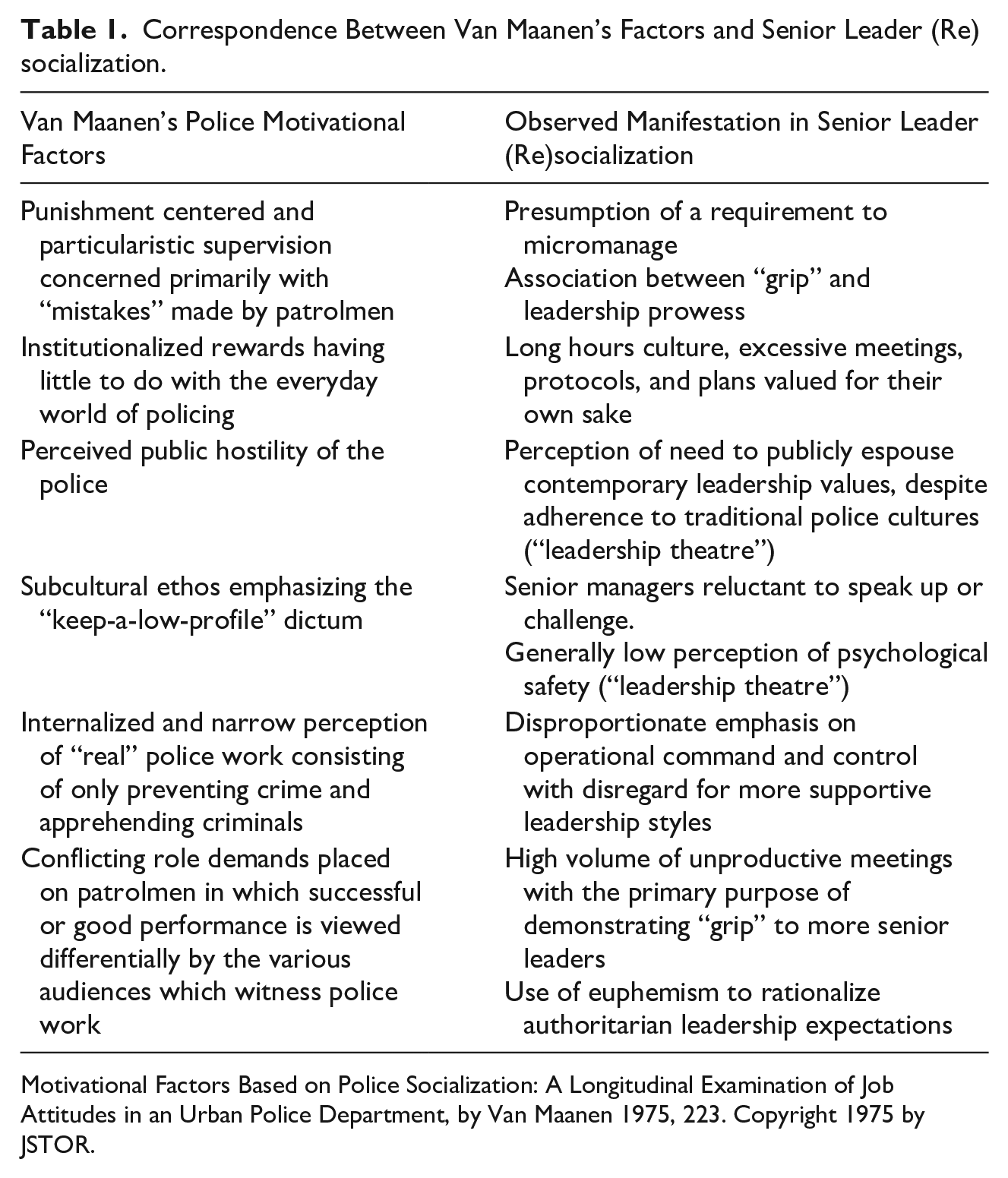
Motivational Factors Based on Police Socialization: A Longitudinal Examination of Job Attitudes in an Urban Police Department, by Van Maanen 1975, 223. Copyright 1975 by JSTOR.
Anachronistic, hierarchical leadership behaviors such as saluting and standing for senior managers are slowly being confined to history. Police leaders now routinely endorse supportive and forward-looking philosophies that champion evidence-based practice, inclusion, well-being, and embracing different perspectives. My (re)socialization journey suggests that much of this progressive journey is “leadership theatre.” It presents a respectable veneer of modernization and openness to change that masks stubbornly enduring cultures, sustained by potent socialization processes at every level.
An “only cops understand cops” mindset offers some insight into why cultural inhibitors including punishment-centered supervision, command and control leadership and masculine language are preserved. This was evident in 2012 when Sir Thomas Winsor was selected as the first ever Her Majesty’s Chief Inspector of Constabulary from a non-policing background. The then chair of the Police Federation summed up the workforce’s hostility to an external appointment. After stressing the need for “a deep and profound understanding of policing,” he offered a sarcastic welcome of “We hope his experience of policing serves him well” (McKeever 2012 as cited in Travis 2012). Despite this deliberate government attempt to introduce alternative perspectives, all previous and subsequent HM Chief Inspectors have been former chief constables, and other key non-operational roles such as College of Policing CEOs, deputies, and directors of Senior Command Courses have, without exception, been police officers (College of Policing n.d.; HMICFRS 2024). Holders of these most influential, pseudo-independent national positions set standards, select and train senior leaders, and then inspect them on their effectiveness. If their professional success has been built on long careers of demonstrating “fit” within the culture they are charged with changing, then my (re)socialization into the old-school regime was probably inevitable.
My autoethnography is as much about my bewilderment, watching colleagues compromise their espoused values, to conform and seek favor as it is about me finding myself doing precisely the same. It would be easy for me to blame a faceless executive for setting the tone for a torpid culture. I quickly succumbed to (re)socialization techniques, meeting executive, and peer expectations rather than being true to my authentic leadership style. As much as I like to protest that I am somehow different, maybe I am more similar to the old guard establishment than I care to acknowledge. Many others, at all levels, appeared to feel similar vulnerabilities and pressure to conform as me, but we all capitulated, proactively maintaining cultures we disapproved of.
It would be wrong to infer that my description of micromanaging and disempowering regimes means that people were impolite, abrupt, or even unfriendly. Those encounters were very rare, and the vast proportion of my engagement with professional colleagues was affable and good natured. As I note in the very last entry of my journal when referring to two “inner circle” members of the executive team who I consider to be fundamentally nice, decent people, working hard to do a good job in difficult circumstances.
Neither bang the table, both are very personable. . .These two seem to epitomise my view that [the force] do authoritarian leadership with a cheery smile.
Footnotes
Declaration of Conflicting Interests
The authors declared no potential conflicts of interest with respect to the research, authorship, and/or publication of this article.
Funding
The authors received no financial support for the research, authorship, and/or publication of this article.
