




Abstract
As the COVID-19 pandemic and subsequent social distancing measures have rendered online communication a “new normal” in the post-pandemic era, the production and consumption of internet memes have also emerged as a significant communicative paradigm in this context. However, academic discourses on internet-mediated meme-ing have tended to focus on socially oriented macro-perspectives with a pursuit of positivistic objectivity, leaving the experiential and subjective aspects of “everyday internet-mediated meme-ing” vis-à-vis individuals in a lifeworld less explored. To address this gap, this study uses structured vignette analysis (SVA) coupled with individual-oriented phenomenological reflexivity to elaborate on how internet-mediated meme-ing reveals itself as a meaningful lived experience for a “solitary conscious self” in the overall context of social distancing. It seeks to demonstrate the phenomenological applicability of the SVA as an autoethnographic method as well as highlight the individual-oriented phenomenological substantiality of meme-ing that involves self-other relations in social distancing.
Introduction
The popularity of internet memes as a phenomenon of modern digital culture (Vitiuk et al. 2020) has been analyzed by many scholars (e.g., Denisova 2019; de Saint Laurent, Glăveanu, and Literat 2022; Grundlingh 2018; Shifman 2014) in light of their socio-political, linguistic, and communicative values. In this respect, internet memes have been understood as a new form of digital artifacts for political communication, a value-laden expressive repertoire, a means of identity-building, an internet language, and a shared social phenomenon (Literat 2021).
As a social phenomenon, the online production and consumption of internet memes, namely internet-mediated meme-ing (hereafter “meme-ing”), can be examined through human experiences with the assumption that social forces and relationships shape humans (Chang 2022), creating a relational subjectivity in the recognition of others and a self that discovers voice through the relationships involved (Gannon 2022). Meme-ing may also assume various forms and be perceived, imagined, anticipated, or recollected from different perspectives (Zahavi 2019) with subjective experiences of life (Pitard 2019). However, most epistemological approaches adopted by meme scholars underscore a comparatively naturalistic third-person description (Moran 2017) highlighting the “conceptual distinction between researcher subjectivity and participant objectivity” (Chang 2022, 53). They see “internet memes” as a distant analytical sample. Thus far, the naturalistic-oriented objectivity espoused by some social science research may be conceptualized as a rhetorical posture adopted within a written text, and this stance is marked by a set of rhetorical conventions that involve the suppression and omission of specific details to project an air of neutrality and objectivity (Ellis 2009; Gannon 2022). Such a tendency privileges objectivity stemming from the positivistic paradigm (Creswell and Creswell 2018) and might have overlooked the value of meme scholars’ personal experiences as sources in understanding meme-ing as a phenomenon. Meme scholars are fully engaged with the participatory digital culture and have fewer restrictions to access their own experiences and related socio-cultural contexts (Chang 2022). Thus, a phenomenological understanding is needed for the process through which meme-ing has become a shared social phenomenon based on the personal experiential richness of individuals’ everyday lives.
As the post-pandemic social distancing context has enhanced the role of meme-ing in producing and exchanging symbolic expressions, I conducted an empirical autoethnographic investigation through a phenomenological lens to explore the experiences of meme-ing with its embodied and relational significances for a solitary self in a confined residence in Finland from April 2021 through to April 2022. Within my online communication contexts, this study mainly focuses on my memetic interaction with friends and my romantic partner in China through the use of WeChat (微信), one of the most popular social apps in China (Thomala 2022), as well as my followers on Jike (即刻), a niche Chinese interest-based online community. The structured vignette analysis (SVA) has been adopted as the autoethnographic method with which to foreground my unique perspective as a single Chinese male living in Finland who faces challenges returning to China. These challenges are due to current Chinese epidemic prevention policies. Using eight autoethnographic vignettes,
1
I aim to present my phenomenological self-reflexivity on the meaning-making journey of meme-ing, placing myself within the online social context to answer the central research question:
How is “meme-ing” revealing itself as a meaningful lived experience to a solitary conscious self with social needs when facing social distancing?
This research question has personal implications as it may help me to understand my self-positionality in various meme-related contexts, including as a friend in a friendship, a romantic partner in a sadomasochistic relationship, and a netizen with an academic background in an online community. With a reflexive self-monitoring of my biases, beliefs, feelings, and experiences impacted by the dynamics of meme-ing, I seek to offer a “critical mode of affirmation” (Adams, Jones, and Ellis 2022, 5) to resist ontological attempts asserting the singularity of truth in human experience as an analytical unit in social phenomena.
Nevertheless, this research does not seek to diminish the contributions of previous scholars in meme studies but rather intends to provide a new exploratory perspective in the area researched. Using an autoethnographic approach, instead of an objectivity-oriented one, does not claim that I may produce better research than those who use other methods, but rather that I may conduct different research (Adams et al. 2022) highlighting distinctive ontological and epistemological aspects of personal experience by including those perspectives in my work.
The article is structured as follows: there is a literature review of meme-ing, autoethnography, and their phenomenological reliance, followed by a presentation of the SVA, the sampling criteria and collecting method of data, as well as the analytical procedure. In “Findings and Discussions,” I provide a detailed phenomenological analysis with three of my autoethnographic vignettes as examples concerning my first personal meaning-making journey of meme-ing. Lastly, I discuss the results in “Conclusion.”
Defining Internet Memes
Coined by Richard Dawkins in 1976, the term “meme” refers to a “new replicator, a noun conveying the idea of cultural transmission, or a unit of imitation” (Dawkins 1989, 192). This unit ranges from a simple or concrete expression, joke, mannerism, or catchphrase to a complicated or abstract idea, ideology or faith, and it composes the eternity of human culture by “imitation” (Dawkins 1989, 192). This term has evolved from the Dawkinsian definition and now primarily refers to user-generated multimodal online media forms, such as images, pictures, sounds, texts, videos, emojis, and GIFs, that are shared, (re)produced, remixed, and re-semiotized by internet users through social media platforms (Jenkins, Ford, and Green 2013; Vitiuk et al. 2020). With the centrality of human-involved and human-driven reproduction and dissemination of memetic media elements, the term “internet memes” that are based on the Dawkinsian ground of genetic replication have emerged in cyberspace with user participation, viral circulation, and formal variation as its distinctive features (Leiser 2019; Shifman 2014).
Meme-ing as an Analytical Unit of Phenomenology
In today’s digital culture, meme-ing has become a new and specific expressive mode of communication (Shifman 2014) with the digitalization of memes allowing for information and ideology-sharing, as well as open and horizontal communication (Huntington 2016; Vitiuk et al. 2020). This phenomenon has arisen from people’s primitive desires for communication, entertainment, and distraction from monotony and life problems, creating a new relational basis rooted in the “affectability” of meme-ing (Jenkins 2014, 448) for social symbolic production and exchange among digitalized individuals (Smith and Linker 2021).
As both an expressive mode and a phenomenon, meme-ing can illustrate a virtual reality that can be seen as a relational structure extending via the circulation of internet memes across media and viewers (Jenkins 2014). Though the memetic forms, contents, stances, contexts, and the audience may differ in their actualizations, meme-ing as an expressive mode crosses them all, enabling the audience to see snapshots of life for life-likeness (Jenkins 2014). Such a mode contains a relational capacity to affect individuals and be affected, activated, and energized in encounters with others (Deleuze 1988; Jenkins 2014).
In the process of meme-ing, felt affections result from actualizations of the memetic mode, from individuals’ embodied experiences of orienting according to this mode (Jenkins 2014). As an expressive mode of communication, meme-ing carries a holistic repertoire that is replete with embodied interactive experiences with which meme prosumers may orient themselves to their perceptions and cognitions of the lifeworld they are inhabiting. Thus, the orienting process of embodied experiences in meme-ing can be considered an analytical unit of phenomenology whose essence is to study lived experience in a lifeworld (Husserl 1970) lived by a person, and to describe the orientation of him/herself to lived experience (Van Manen 1990). As Stoller (1997) stresses how cinema screens provide the means for viewers to understand and perceive a lifeworld through a phenomenological reduction, Provencher (2014) asserts that similar phenomenological reductions are also necessary to understand meme-ing. As such, studying meme-ing as a phenomenon permits researchers a phenomenological lens with which to consider personal bodily experiences. This means that the “memer” and “memes” are not independently examined as they are methodically interconnected, but engaging through embodied manners within a lifeworld (Jenkins 2014).
Applicability of Autoethnography as a Phenomenological Tool
As a qualitative method that has been widely used for describing, recording, conceptualizing, and analyzing first-person experiences, autoethnography contains three inherent components. The “auto” stands for “self,” the “ethno” culture, and the “graphy” signifies writing a representation or story. It encourages researchers to speak from the heart about existential crises and transformational experiences (Anderson 2006). Despite facing controversies about its objectivity and self-indulgence (Chang 2007), autoethnography still functions as a useful tool enabling researchers to probe into personal experiences on a meaningful, accessible, and evocative ground (Ellis, Adams, and Bochner 2011). Harding (2015) and Gorichanaz (2017) also stress that research communities usually operate from a particular standpoint or “bias” that is impossible to overcome, and it is deceptive to ignore such a standpoint under the guise of disinterested neutrality and objectivity. Embracing this standpoint helps to reveal previously hidden phenomena and biases (Gorichanaz 2017). As assumptions of neutrality and objectivity have increasingly become unattainable requirements for, and unrealistic expectations of, conventional social scientific research, acknowledging researcher positionality is progressively encouraged in social sciences to challenge oppressive cultural beliefs, norms, and practices, producing new knowledge concerning their phenomenological lifeworld (everyday reality) (Adams et al. 2022; Berry 2022).
While scientific methods excel at precisely defining matters, most entities studied in human and social sciences possess an inherently vague and morphological essence, which Zahavi (2019) calls an “essential vagueness” (43). Thus, adopting naturalistic methods that aim for mathematical precision to study phenomena in the lived experience may lead to only approximative classifications and descriptions of these entities (Zahavi 2019). Heidegger (1993) argues that scientific rigor cannot be equated with mathematical precision and it is wrong to assume that domains without mathematical exactitude are less valuable or less real. Similarly, for Husserl (1969), it is dangerous to be dazzled solely by the “absolute norm” of being “true” and “real,” which is typically constituted by the methodology and ideals of the exact sciences. Instead, we should be guided by that which is given to us in its purity in our experience, without the accidental properties of the given that are often extracted by a third-person scientific perspective (Zahavi 2019). This is because our experiential world has its own criteria of validity and truth, which do not require the approval of science, although scientific findings do not necessarily conflict with our everyday experiences (Moran 2000; Zahavi 2019). Furthermore, our experiential subjectivity and scientific objectivity may coexist because, within a phenomenological framework, the worlds of experience and science are the same world appearing in two different ways (Husserl 1982; Strasser 1963). After all, “any objectivity, explanation, understanding, and theoretical modelling presupposes the first-person perspective as its precondition” (Zahavi 2019, 53). Consequently, an applicable method in a phenomenological inquiry is to follow what happens to us, what we see with our own eyes, what we feel with our own bodies, what we experience at a pre-reflective experiential stage at the moment, and not to follow our prejudices and preconceptions (Husserl 1965).
Autoethnography is not inherently phenomenological, but its in-depth descriptive account can produce real-world knowledge that originates from first-person experience (Husserl 1970) and is experienced by the person at the center of the experience (Pitard 2019). It is self-focused, subjective-centered, and context-conscious (Brisini and Simmons 2022), and shares a relevant epistemological ground with phenomenology. This connection underscores the idea that personal experience is viewed as something that happens to the individual, is consciously reacted to in the moment, and is subjectively interpreted (Pitard 2019).
Method and Data
Pitard’s SVA as an Autoethnographic Method in Phenomenological Inquiries
Vignettes were first used by Alexander and Becker (1978) to elicit people’s responses to a hypothetical scenario, which could be a photograph (Lanza and Carifio 1992) or a short story (Finch 1987). It is commonly used in social sciences to explore people’s perceptions of a complicated situation and to navigate social problems and prejudicial decision-making (Cheah and Koay 2022; Reedy and King 2019).
Jayne Pitard (2016) expanded the concept of a vignette and developed a six-step autoethnographic framework called SVA to analyze vignettes that she experienced as an Australian teacher in Timor-Leste in 2013. The SVA enables researchers to uncover multiple layers of personal awareness through self-writing in the form of layered accounts. 2 For Pitard (2016), a vignette is created using a written anecdote “to tell something noteworthy or important about life” (Van Manen 2014, 250), giving voice to the unconscious, profound, and phatic sensations experienced by autoethnographers during their phenomenological reductions (Pitard 2019).
While the anecdote allows researchers to express the lived experience in immersivity with its trance-like state of writing (Pitard 2019), it is still too personal for readers to penetrate the pre-reflective substrates of our lived experience to discover the ontological core of our being (Van Manen 2014). Therefore, autoethnographers should reflect on and analyze their innermost stimulating moments, described as their vignettes in anecdotes, to connect the personal to the cultural (Pitard 2019). By doing so, autoethnographers can provoke understanding from readers with their innermost feelings, transporting them to the experienced moment of truth of the researcher with a logically presentable and extractive voice (Pitard 2019). In Pitard’s example (2016), her SVA’s six-step framework enables her to reflect on and analyze her innermost cross-cultural teaching experience as a vignette. The six steps include the following: (1) context, (2) anecdote, (3) emotional responses, (4) reflexivity, (5) strategies developed, and (6) conclusive comments on layers.
Context
Context is crucial to understanding processes, time-dependent changes, and emergent patterns (Dervin 2003). It plays a vital role in the negotiation of truth and the shaping of data (Pitard 2016). By considering the context relevant to each vignette, readers can gain insight into the researcher’s evolving perspective over time (Pitard 2016).
Anecdote
Narrative anecdotes allow researchers to revisit the pre-reflective experiential impact as a reminder of the conditions experienced before conscious reflection, restoring contact with the lived experience (Van Manen 2014). To gather narrative data and edit experiential accounts into exemplary anecdotes, Van Manen (2014) proposes a set of guidelines stressing that an anecdote should be short and simple, describe a single incident, begin close to the center of the experiential moment, include significant details and quotes about what has been said and done, end after the climax of the described incident, and finish with a punchy line (252).
Emotional response
As a subjective, involuntary, and unconscious experience, emotional response refers to an immediate physiological and emotional response experienced by the researcher as existential experiences unfold (Pitard 2016). This response helps the researcher recall noteworthy emotional details during shifts in their cultural understanding.
Reflexivity
Reflexivity is a continuous process of internal dialogue and critical self-evaluation regarding a researcher’s positionality, which can impact the research process and its outcome (Berger 2015). In autoethnographic studies, reality may be in a constant state of flux as it is observed with this internal dialogue beginning when the researcher experiences something (Pitard 2016). The practice of reflexivity involves being attentive to this internal dialogue and learning to control it (Pitard 2016). According to Berger (2015), researchers can achieve this by focusing on self-knowledge and sensitivity, gaining a better understanding of their self-positionality in the process of knowledge creation, mindfully monitoring the impact of biases, beliefs, and personal experience, and maintaining a balance between the personal and the universal.
Strategies developed
Pitard (2016) used this specific layer account in the autoethnographic study of herself as a teacher in a cross-cultural teaching process in 2013. It was based on her reflexivity and recorded her change of approach when interacting with her students to better accommodate the cultural differences prevalent at the time.
Conclusive comments on layers
According to Pitard (2016), a holistic integration of different layer accounts provides a concise summary of the effects of the studied experience and the development of the researchers’ understanding of the experience they have lived.
In summary, while other autoethnographic methods have faced criticism for being excessively subjective, overly descriptive, and filled with esoteric jargon (Adams et al. 2022), the SVA maintains an academically presentable reflexive voice (Pitard 2019), rather than an introspective self-indulgence distancing readers from the researcher’s experiential presentation and interaction (Chang 2007). Its hermeneutic kernel allows researchers to achieve a high level of self-awareness, externalize, and articulate their innermost experiences in qualitative research (Benjamin 2014).
My Own SVA-Based on Pitard’s Perspective
As a phenomenological inquiry is an open-ended and demanding process that allows for further modifications upon new evidence (Zahavi 2019), Pitard’s SVA cannot be viewed as a fixed framework, but rather as an experience-dependent instrument that enables different researchers to modify its layer accounts based on their own experiences, interests, and professional practices (Pitard 2019). Therefore, in this article, I propose my own SVA framework based on Pitard’s perspective as a research method.
In my SVA, I have chosen to omit the layer account of “strategies developed” as I believe it is unnecessary for my focus on my sense-making journey of meme-ing. Instead, I have retained the other five in my SVA framework: context, anecdote, emotional response, reflexivity, and conclusive comments on layers.
Using WeChat and Jike as Data Sources
WeChat is considered one of China’s most popular social apps. It has a limited global reach but enjoys high domestic popularity (Harwit 2016), boasting nearly 1.3 billion active users as of the first quarter of 2022 (Iqbal 2022). It is often referred to as a Chinese “Swiss Army Knife” social app (Clover 2016), as it combines features of WhatsApp, Facebook, Twitter, PayPal, and Apple Pay into one platform, offering instant text, voice, image, and video communication among users.
Jike is a niche interest-based Chinese online information-sharing community that supports both iOS and Android platforms (Liu 2020). It also offers social functionality, allowing users to follow information, events, and other users they like, and to post multimodal user-generated media content for public comment (Liu 2020).
As a solitary Chinese living in Finland during the COVID-19 pandemic, I mainly used these two apps to engage with my friends, relatives, and intimate partners in China, satisfying my social communication needs through memetic interaction.
Sampling Criteria for Anecdotal Moments in My Memetic Interaction Vignettes
I established a set of criteria for defining the anecdotal moments of my memetic interaction, and these criteria include the following:
(1) They should be pre-reflexive experiential incidents.
(2) They should involve the act of meme-ing with internet memes.
(3) They should have significant concrete details.
(4) They should provoke my immediate physiological, emotional, and/or bodily responses. 3
(5) They should have a mnemonic impact when recalled.
Method and Process of Data Collection
To capture the pre-reflective experience of meme-ing, I took screenshots of my memetic interactions on WeChat and Jike whenever they stirred up emotional or bodily responses. This data collection occurred between April 2021 and April 2022. These screenshots functioned as visual journal entries, providing the physical evidence that could help me recall critical experiences (Chang 2022; Pitard 2019), and capturing “snapshots” of the moments that impacted me the most (Muncey 2010).
To immerse myself in these experiences, I entered a “trance-like state” (Pitard 2019), allowing me to revisit the exact point of the experiential impact and better understand my reflexivity. To aid in this process, I wrote notes in Chinese on each visual journal entry. This created a repertoire of eight written vignettes as my autoethnographic data for my SVA.
Relational Ethics in Autoethnography
This autoethnographic study is focused on my personal experiences and sense-making journey of meme-ing, but these experiences did not happen “in a relational vacuum” (Chang 2022, 61). Given the interactive nature of meme-ing, addressing the relational ethics that arise from involving others is important. To this end, I followed the examples of Chang (2022) and Cutler (2023), by informing all implicated others of my research purpose, data collection and analytical procedures, and data management plan. During my writing, I was mindful of anonymization to protect the privacy of those involved, preventing any potential impact of self-disclosure on their personal or professional lives. The use of screenshots involving others for analysis and presentation in this paper was given with prior informed consent from those involved.
Analytical Procedure
I conducted a two-phased analysis, as shown in Figure 1, of my vignettes on meme-ing. The first phase involved re-familiarizing myself with my self-indulgent descriptive notes on my vignettes and categorizing them into four scholarly presentable layer accounts: context, anecdote, emotional responses, and reflexivity for each vignette. This process helped me revisit the pre-reflective moment of each experience in its purity, a stage of epoché (Husserl 1970), by suspending my preconceived judgments, habits of thought, prejudices, and theoretical assumptions through bracketing or phenomenological reduction (Pitard 2019; Van Manen 2014). The goal was to return to the experience itself (Zahavi 2019) and perform a philosophical technique called eidetic variation 4 (Husserl 1977a) using imaginative contemplation to vary the experiences and strip away their accidental features. Through this process, I identified an array of keywords that were highlighted in a bold italic style in the “Reflexivity” section that concluded the invariable properties of my first-person meme-ing experiences in each vignette.
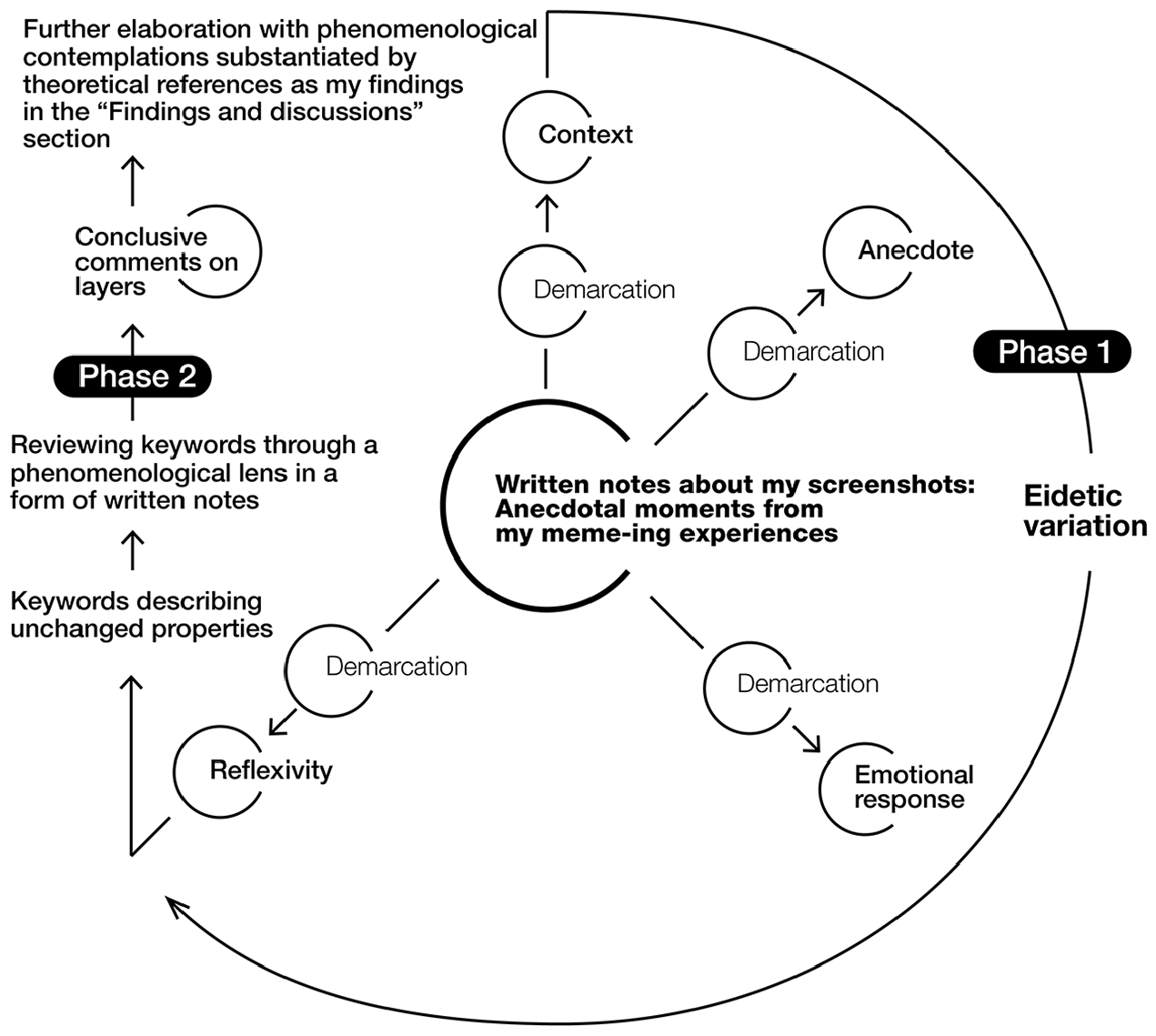
A two-phased procedure.
In the second phase, I used a phenomenological lens to briefly review these keywords and the four preceding layer accounts in each vignette. The phenomenological lens allowed me to reflect on the keywords employing phenomenological theories and thoughts. It helped me to reveal the essential structure of meme-ing as a lived experience for myself and develop my own understanding of the phenomenology of meme-ing. I then documented my brief reviews in the fifth layer account called “conclusive comments on layers” in each vignette and further elaborated them as a whole with phenomenological contemplations substantiated by theoretical references as my findings in the “Findings and discussions” section.
Findings and Discussions
Meme-ing reveals itself as a lived experience in terms of an internet-mediated manner of expressive engagement that can actualize an embodied act of self-presenting face-work and a mutually engaged and negotiated relational coupling in sharing and exchanging social, cultural, political, and emotional meanings between self-aware subjects via producing, disseminating, receiving, and reacting to internet memes within a latent intersubjective and intercorporeal reciprocity.
Meme-ing as an Embodied Act of Self-Presenting Face-Work and a Mutually Engaged and Negotiated Relational Coupling
As popular cultural artifacts, internet memes aim not to trigger human aesthetic appreciation but rather to mimic life in an unconventional way (Kariko and Anasih 2019). Life in the digital realm can take on diverse forms, as individuals may project identities and characteristics distinct from their real-world personas. However, this does not imply that their digital self-construction lacks authenticity (Deumert 2014). Individuals possess intricate and varied personalities. Producing and consuming internet memes allow them to express their uniqueness and connectivity by personifying the contents, forms, and stances of internet memes as embodied memetic lexicons of the digital self (Kariko and Anasih 2019). Figures 2 and 3 demonstrate my meme-ing experience and its vignette as examples of an embodied self-presentation.
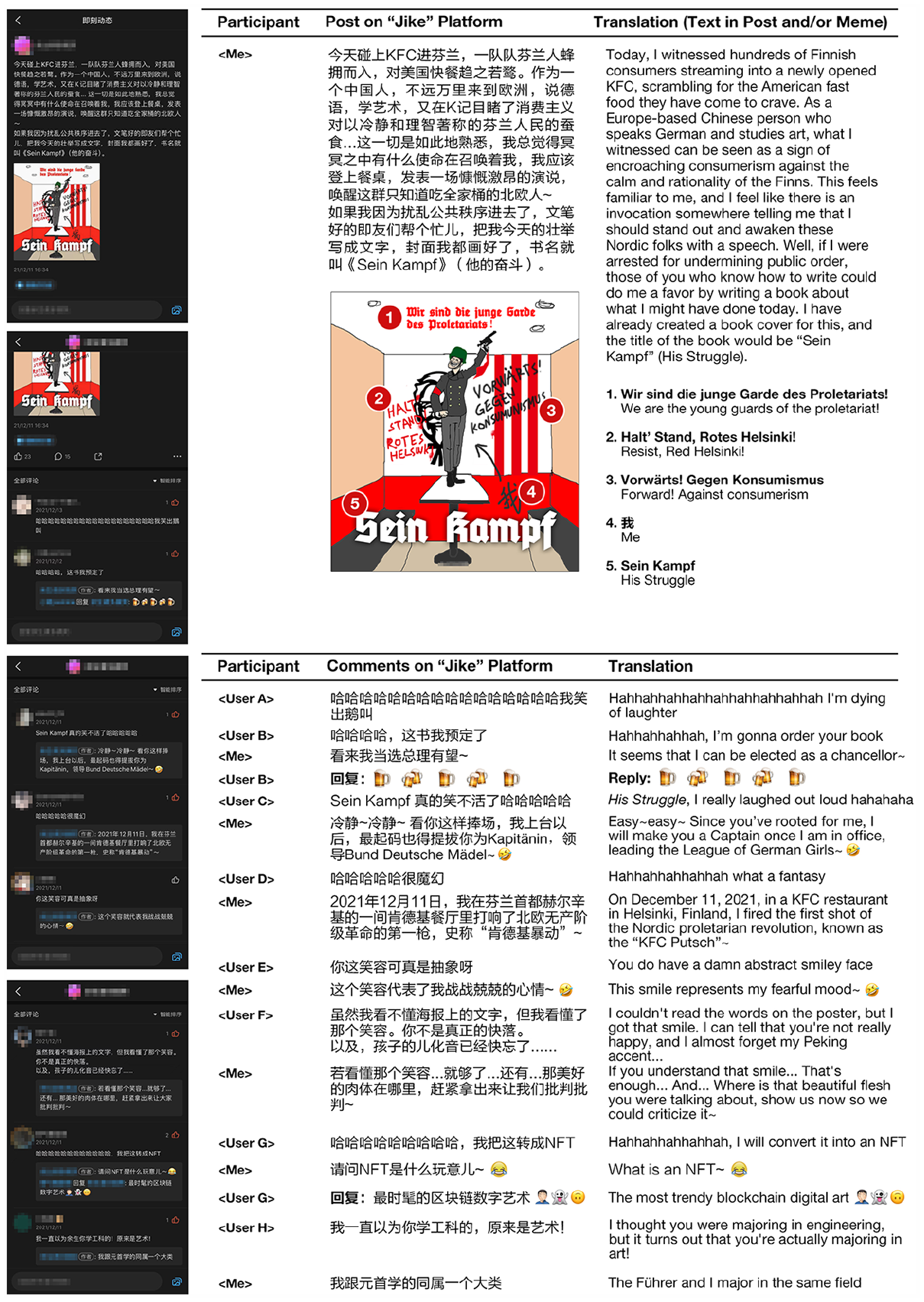
Screenshots and transcription of my meme creation experience on Jike.
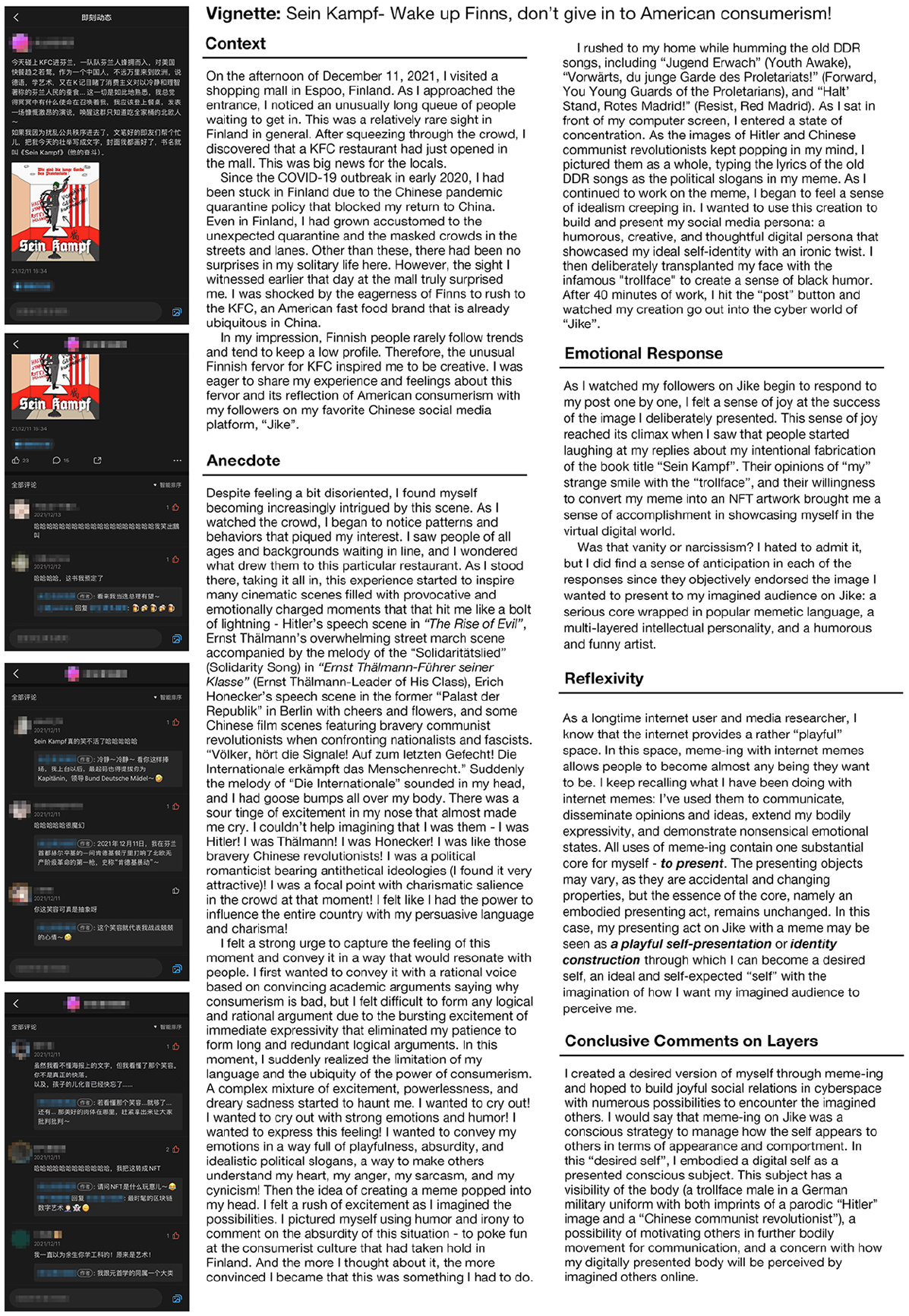
The vignette of my meme creation experience on Jike.
Internet memes serve as a shared collective language, but meme-ing also represents a single individual’s embodied expression (Petrova 2021). Through meme-ing, one can convey ideas, personal experiences, and even worldviews, allowing others to glimpse one’s individuality beyond mere appearance (Cavarero 2005). In Figures 2 and 3, readers can see that I created a meme featuring myself with my ideological thoughts that are transformed into the form of multimodal linguistic clownery (Bakhtin 1984). By doing so, I creatively utilized a variety of modes (image, text, color, font) beyond linguistic texts to construct a memetic self-presentation used for meme-ing at will. Essentially, I aimed to demonstrate to my Jike followers that I am a witty, stylish, ideologically aware, and culturally enriched artist. In this context, the centrality of my embodied presentation focused on the concept of my face. This presentation process can be conceptualized as akin to the face-work defined by Goffman (1967). The term “face” encompasses not just its literal interpretation but also represents a constructed image of oneself defined by socially sanctioned qualities (Dolezal 2017). More precisely, my “face” denotes the self-image I purposefully project when engaging with fellow individuals (Dolezal 2017).
In Figure 2, the linguistic responses of my Jike followers provide validation for this meme-ing experience as an embodied self-presentation. Notably, their laughter and attention directed toward the “Trollface” smile are key indicators of this self-presenting context. The preexisting visual and cultural signs (the Trollface, the Wehrmacht uniform, the “Schaftstiefelgrotesk” typeface, and the altered title of Mein Kampf) and forms of speech (German political slogans in referential, emotive, and conative tones) were playfully remixed, creating new self-voices and meanings to reflect a carnivalesque mood (Deumert 2014). Moreover, the carnivalesque mood may reflect a taste of the grotesque realism (Deumert 2014, 37) which is considered the language of the marketplace (Bakhtin 1984, 154), challenging the prevailing social norm in a specific cultural realm where this topic may be taboo (Deumert 2014). In this grotesque realism, the multimodal attribute of meme-ing enables the grotesque to move beyond the market language to a visual depiction of my creatively modified and presented grotesque body (Bakhtin 1984, 317). The memetic image in Figure 2 highlights the embodied carnality of the grotesque body via its visible body gestures (smiling, standing, and arm-raising) and sexuality (male). With these two grounds, my meme-ing experience can reveal itself as an embodied act of self-presenting face-work.
The purpose of my embodied face-work on Jike aimed to establish an ideal synchrony between what I passively “gave off” and what I actively intended to “give” to strangers via the mimeticized body imagery in online interactions. Within this dynamic, a latent intersubjective connection may emerge, wherein my feeling could be empathetically felt and my seeing could be perceptively seen.
However, the aforementioned process underwent a reversal and intensification when I received and reacted to internet memes from unfamiliar individuals. In this context, I assumed a passive role as a perceiver, encountering a memetic interaction. Simultaneously, I adopted a reflexive position as a respondent, utilizing my bodily actions informed by my historical, social-cultural, and political underpinnings to assert my immediate presence and engage with these unknown others.
Figure 4 illustrates a memetic interaction, wherein I established a “point of contact” by presenting snapshots of my immediate life moments through the embodied presentation. This presentation, in turn, “inspired” and “elicited” a bodily response from User A, who actively engaged in meme-ing a vodka-themed meme as a direct response to my original post, demonstrating User A’s recognition and empathetic connection to my vodka picture. Moreover, it reflects the “signifyingness of the irreducible otherness of others” (Diprose 2017, 28). This otherness derives from the fact that we are not entirely transparent to ourselves and we are often not in conscious control of much of what our body communicates (Dolezal 2017). In this case, when User A’s bodily presence to me was incarnated as a vodka meme and an array of visual-electronically displayed texts on an online social platform, there has always been certain aspect of his embodied memetic presence that may escape his thematic control due to his inherent inner idiosyncrasies and the “ambiguity of the body” (Diprose 2017, 27) with the unknowability and unique value arising from his sharing of cultural and emotional meanings. The unknowability and unique value then provoked my desire to keep engaging with User A. Yet, the shared meanings derived from User A’s presence extended beyond the explicit content of his meme and texts, encompassing likewise my own historical experiences and socio-cultural context.
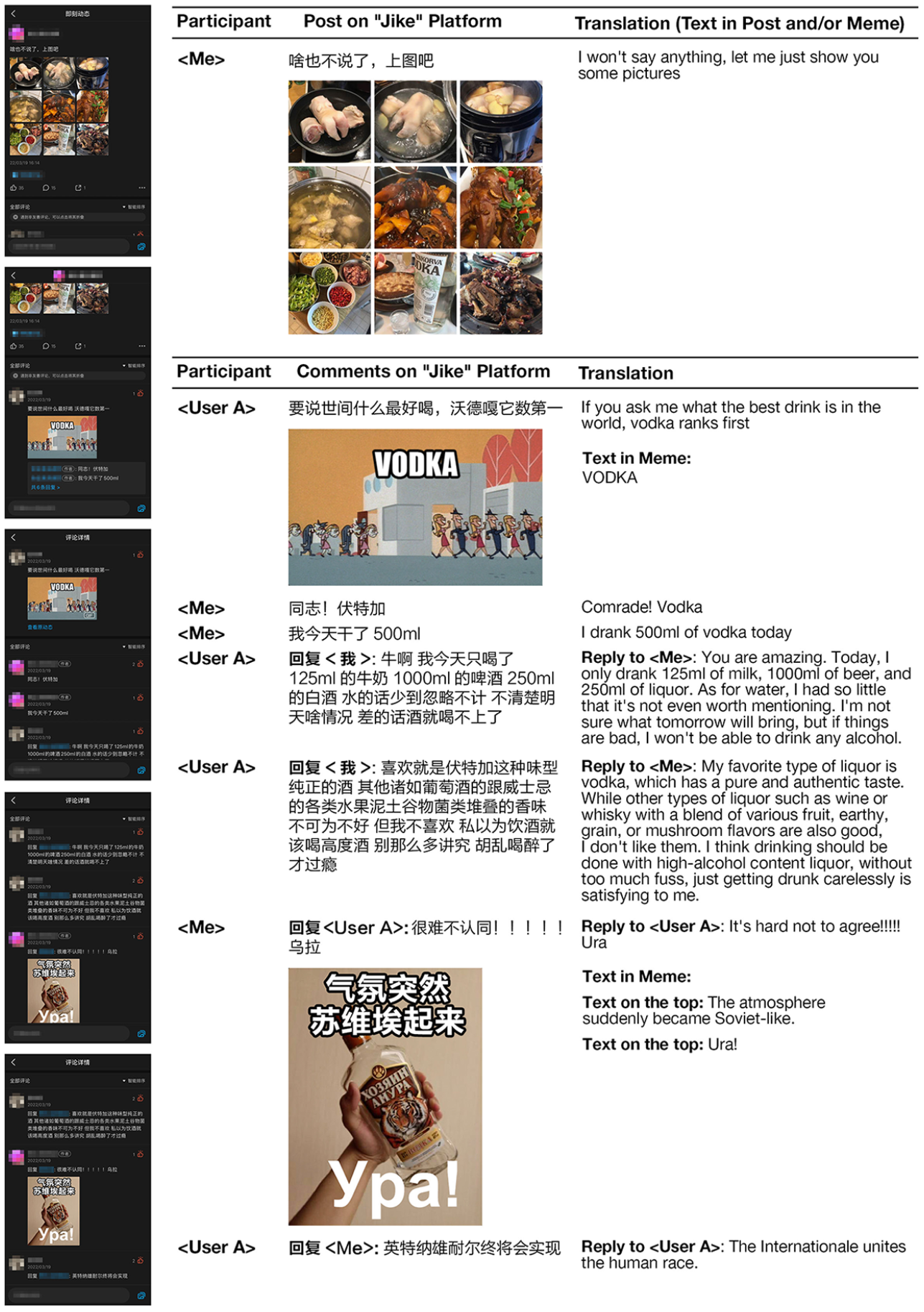
Screenshots and transcription of my meme consumption experience on Jike.
In Figure 5, my anecdote illustrates how my historical and socio-cultural experiences shaped my perception and reaction to the vodka meme and User A. Receiving User A’s vodka meme immediately triggered various associations related to User A’s memetic presence, including body language, ideology, personality, and lifestyle. What started as a mere appreciation for vodka evolved into an endorsement of Soviet socialism, transforming User A’s memetic presence from an anonymous internet user into a warm, generous, and sincere “comrade” driven by universal love. These qualities were not inherent in the vodka meme or User A, nor were they merely products of my imagination imposed on the world without origins. Instead, they were ideas brought to life from existing socio-political imaginary worlds (Merleau-Ponty 1968), shaping my corporeal–spatial–temporal expression of meaning through socio-political values and ideas that we collectively signify and experience (Diprose 2017).
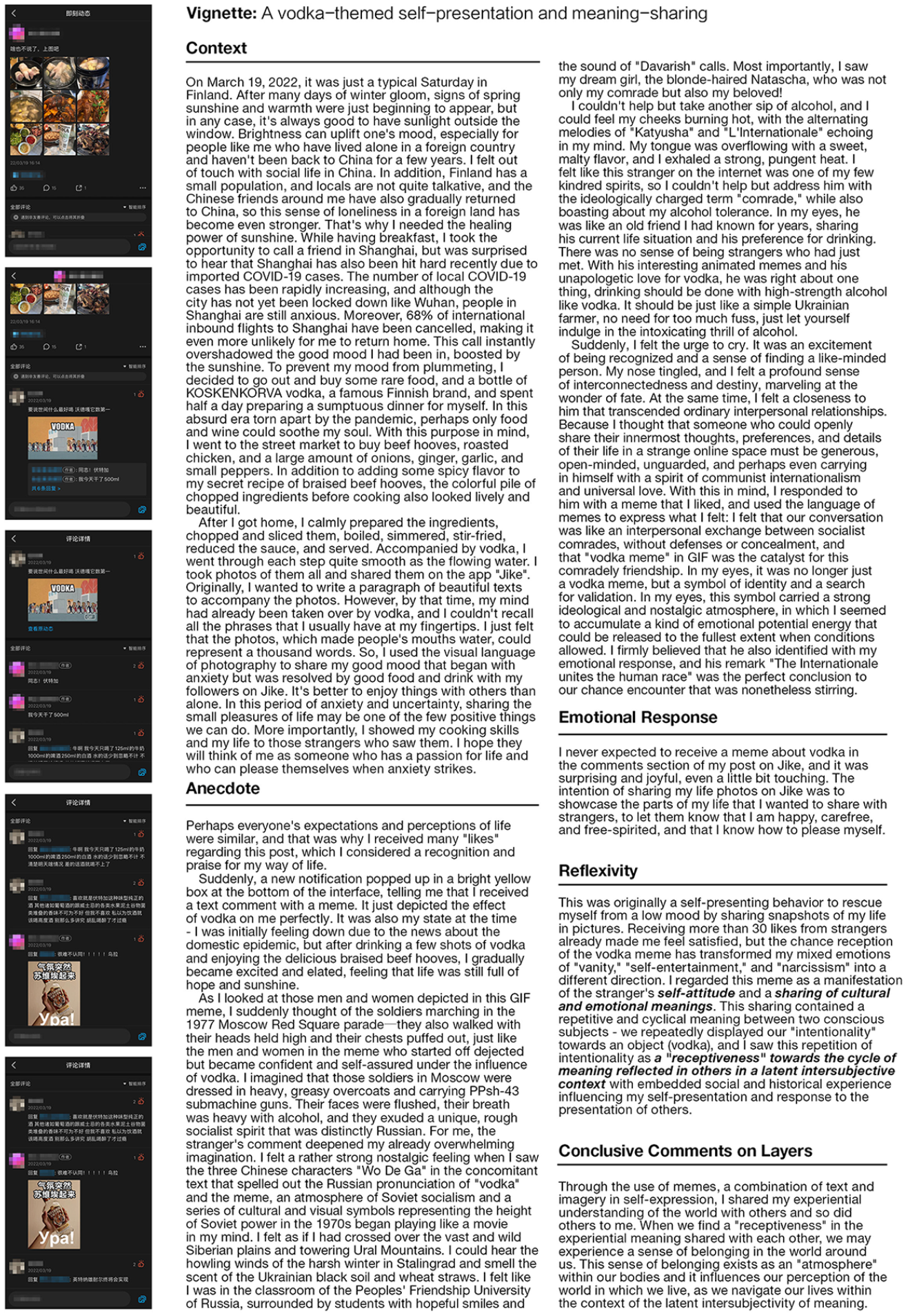
The vignette of my meme consumption experience on Jike.
Likewise, User A’s perception of my otherness as a stranger was revealed through my linguistic and memetic response to his vodka meme and other comments. This manifestation prompted User A’s immediate embodiment of meaning, influenced by his historical and socio-cultural trajectories, as he continued to interact with me through his responsive action. Consequently, we engaged in a reciprocal relational coupling, characterized by a negotiated receptiveness to circulating meanings embodied in others through the memetic presence and an outward orientation where one’s history did not dictate the world but shaped how one responded to and influenced others (Diprose 2017).
Meme-ing as Latent Intersubjective and Intercorporeal Reciprocity
Figures 6 and 7 illustrate how a meaning-loaded meme-ing experience can establish an intersubjective relationship in an accidental context. For Dolezal (2017), intersubjectivity is a relational medium involving communication and the relation between self-aware subjects. In this case, before I memed, I, as an individual subject, recognized the existence of another (Miss A); thus, I had lived in a prior intersubjectivity (Taipale 2014, 74). The interactive structure of my meme-ing experience also implies the existence of others in this world, suggesting that each perceptual experience connects to potential anonymous co-perceivers (Ratcliffe 2007).
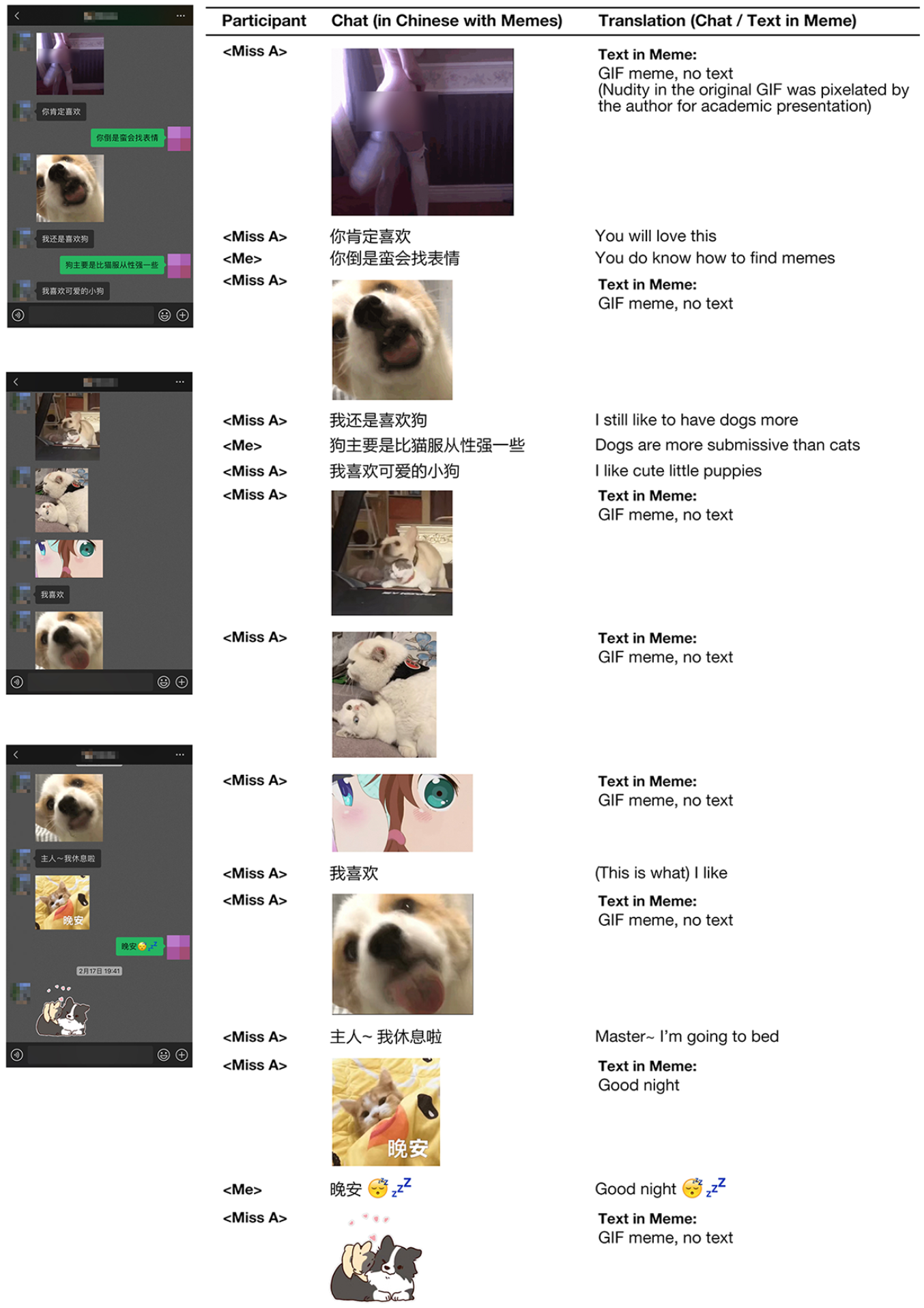
Screenshots and transcription of my meme-ing experience with Miss A on WeChat.
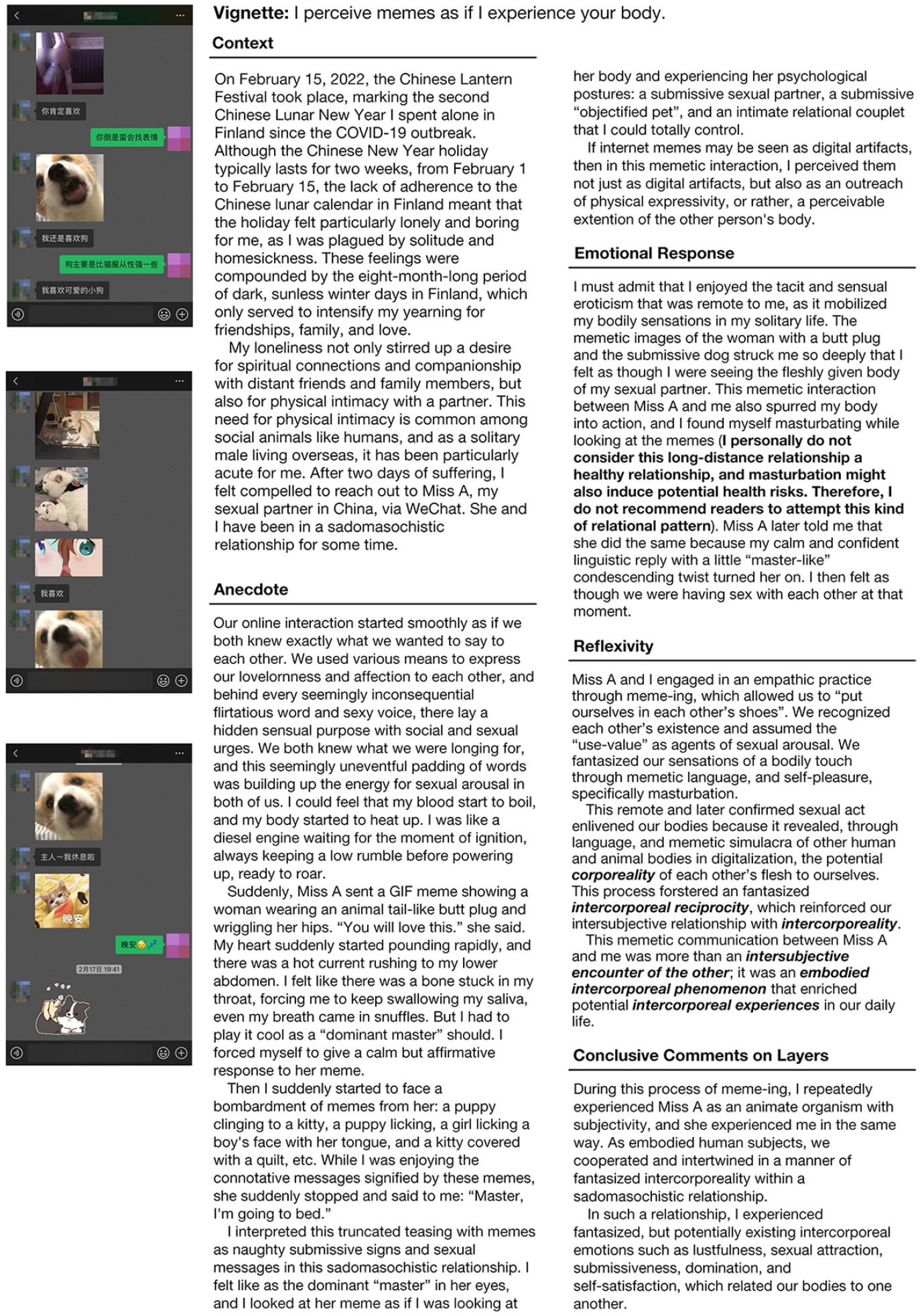
The vignette of my meme-ing experience with Miss A on WeChat.
The meme-ing experience demonstrated in Figure 6 echoes the twofold nature of encountering others. First, I encounter others as animate organisms, as psychophysical objects in the world (Husserl 1977b). Meanwhile, I acknowledge and experience them as subjects for this world (Husserl 1977b). Similarly, others also experience me as a subject in the same world I experience (Dolezal 2017). Thus, the lifeworld locates itself in the way members of social groups (cultures and/or linguistic communities) structure the world into objects (Beyer 2022).
According to Beyer (2022), intersubjectivity occurs through empathetic acts; thus, intersubjective experience is an empathetic experience. In other words, it occurs when we consciously attribute intentional actions to other subjects and place ourselves in their shoes. For example, Figure 6 shows that Miss A “placed herself in my shoes” by sending me a sexy meme for sexual seduction, along with the statement “You will love this.” In response, I acknowledged her empathetic ascription by replying “You do know how to find memes.” At that moment, she saw me as a partner with sexual needs and social willingness, recognizing me as a conscious subject and perceiving me as appropriate for her sexual arousal as well as her experience of sensual pleasure and emotional intimacy.
My response in Figure 6 and my masturbatory act, mentioned in Figure 7, indicate that I have also apprehended her in a similar way. My masturbatory act can illuminate an intersubjective use-value as it was an immediate bodily response to Miss A’s bodily act, driven by an empathic attunement (Husserl 1977b). This attunement causes a phenomenal pairing (Dolezal 2017), wherein the sense of one body is intrinsically bound to the sense of another person’s body as the same (Ratcliffe 2007). Within this memetic interaction, we were in a lifeworld where we shared the same intersubjective context and language, and meme-ing as linguistic conduct was intersubjectively effective for us (Etelämäki 2016).
The intersubjective aspect of language becomes evident in our interpretation of meme meanings, which hinges on a shared cultural backdrop (Kariko and Anasih 2019). In this cultural context, the memetic lexicon that pertains to our first-person experiences evolves through our reciprocal engagement in a collective socio-historical tradition. Furthermore, our behavior as subjects (I) can be influenced by the reciprocal participation of others (Miss A), who share the same meaning as ourselves (Schütz 1953).
In Moran’s (2017) account, the body is a convergence site for our sensorial channels, wherein the senses are tuned and transformed by the body’s diverse corporeal movements, gestures, and overall integrity. Different senses may overlap, and Merleau-Ponty (1964) used this property of overlapping to define flesh. He speaks of the flesh of the world (Merleau-Ponty 1964) and the flesh of things (Merleau-Ponty 1968) to demonstrate the reciprocity and communality between the lived body and the multisensorial world, to whose properties our senses are finely tuned (Moran 2017). The flesh of the world embodied in sensuousness mirrors our embodied flesh, suggesting that the availability of the world to perception and human perceptual systems is correlated with human subjects, who are part of this world and are also perceived (Moran 2017). My meme-ing experience depicted in Figures 6 and 7 likewise shows such intercorporeal reciprocity constructed in the form of sadomasochism in this multisensorial world.
The body presented in this meme-ing experience possesses a twofold nature. For one, my romantic partner Miss A on WeChat has an undeniable physical presence. I know her and I am aware of her existence in reality, and her memetic presence also implies an actual location, gravity, and embeddedness (Moran 2017) of her lived body in my perceptual domain, which likewise reveals my lived body. Moreover, during our interaction, she used a meme featuring sexually oriented nudity and a series of animal and cartoon memes as an extended form of bodily expressivity, an avatar to present her own lived body. This lived body presents itself in a peculiar way, as an imagination, a fantasy, an erotic reverie, a “calling to mind” referring to “all appresentations which are not direct perception of something bodily given in the flesh” (Moran 2017, 285), and a form of presence in the absence (Bachelard 1971).
In Figure 7, I used the term “memetic simulacra” to refer to all the bodies presented (human and animal) in this meme-ing experience because of their absence in the flesh. However, these simulacra did activate, as defined by Moran (2017), my subjective exploration regarding the lived body of Miss A through mindful focusing, concentrating, and imagining of bodily action. Such a subjective exploration refers to an intercorporeal phenomenon wherein a lived body interacts through meme-ing with another lived body in the overall context of intersubjectivity (Moran 2017). Furthermore, the subjective exploration of the memetic simulacra caused, as I wrote in my vignette, a behavior of phone sex masturbation in which I was the dominant and Miss A was my submissive controlled object. This embodiment of a sexual experience as intercorporeality suggests that such an embodied act is not a private affair, but “is always already mediated by our continual interaction with other human and nonhuman bodies” (Moran 2017, 286). As Sartre (1995) emphasizes, the caress brings alive the other’s lived body for me and for the others, and in my case, Miss A’s body came to appear and was experienced by my body as a lived flesh, and vice versa.
Conclusion
Using autoethnography to interpret meme-ing as a first-person lived experience through a phenomenological lens, this article not only illuminates the applicability of a specific autoethnographic method as a phenomenological tool in externalizing a subjective meme-ing experience in an academically presentable way but also reveals the existential significance of meme-ing as a considerable part of the structure of human sociality. This involvement in meme-ing includes embodied self-presenting face-work, mutually engaged and negotiated relational coupling, latent intersubjectivity, and intercorporeality in a solitary and confined environment under the overall context of a controlled society.
The SVA coupled with the Husserlian eidetic variation has enabled me to externalize my intentional act and suspend preconceived judgments and prejudices. It involves stripping away the accidental properties of meme-ing from its discursive, communicative, cultural, political, and semiotic positionalities whenever the meme-ing experience happens to me, thereby experiencing what is given to me in its purity and revealing its unchanged properties in my first-person experience.
The property of meme-ing as an embodied self-presenting face-work and mutually engaged relational coupling illuminates the agential context of the lifeworld where consciousness and self-other relations are possible. The property of meme-ing as a latent intersubjective and intercorporeal reciprocity depicts a complex layer of embodied responsivity, expressivity, and communication supporting our intentional relations to others through intersubjectivity and sociality. Both properties involve communication and relations between self-aware subjects. In this way, even when people, such as myself, have located themselves in social distancing overseas, in which other animated organisms in their cultural field (in my case, China) have become homogenized and remote biological entities with whom they may not initiate actual physical contact, they may still use meme-ing as a form of the shared vocabulary of our body idioms (Dolezal 2020) to establish possible intercorporeal communication on a potential intersubjective basis. Thus, the presentational, relational, intersubjective, and intercorporeal properties of meme-ing may enact empathic reciprocity enabling the mutual transfer of feeling, emotion, and even kinship between self-aware subjects with agency stemming from the needs of sociality. In this context, the phenomenology of meme-ing involves encountering and interacting with other intercorporeal beings through internet memes, creating a reciprocal relational assemblage that reveals each other as lived bodies in an intersubjective world.
However, as an autoethnographic inquiry in phenomenology with few cases, using the structured vignette analysis with the Husserlian eidetic variation is context-dependent. This article does not claim an infallible source of insight about meme-ing in general nor does it seek to reach a statistical generalization, which has long been mistaken as an important objective of qualitative inquiries in a positivist paradigm (Gorichanaz 2017). The Husserlian eidetic variation is a demanding and open-ended process, and the insights streaming from it always possess a certain provisionality and presumptiveness, remaining open for further modification based on new contexts and evidence (Zahavi 2019). Single-case research seeks to challenge the positivist-rooted generalization of a singularity of truth by striving for an analytical generalization (Yin 2014), and an epistemological transferability to other specific cases and contexts on a case-by-case basis (Maxwell 2005). Thus, according to Gorichanaz (2017), it provides an accessible manner to study new contexts, as well as a point of entry to document a particular context and epistemological idiosyncrasies that may not have emerged in group studies.
Footnotes
Declaration of Conflicting Interests
The author declared no potential conflicts of interest with respect to the research, authorship, and/or publication of this article.
Funding
The author received no financial support for the research, authorship, and/or publication of this article.
Statement of Data Transparency
Other than the data presented in the main text as examples with the informed consent from certain involved human participants of this paper, other data, not granted the right to be publicly shared by the remaining human participants, have been stored on an online archive. Access to these data is only meant for editors and reviewers. They can be found at:  .
.
Informed Consent
All examples of screenshots involving other human participants used for analysis and presentation in this paper have been given by the involved others with their prior informed consent.