




Abstract
I analyze racism in Sydney’s gay sauna scene through decolonial scholarship. In Sydney, there are three gay saunas; each of them caters to specific races and is decorated accordingly. Sauna 1 is popular among Asian men and their admirers and has an Oriental-like style. Sauna 2 is popular among white and non-Asian men and has a minimalist style featuring photographs of white, cisgender and muscular men. Sauna 3 is mostly visited by white and Middle Eastern straight-acting men and its décor does not reference race. Both patrons and venue owners are aware of the race dynamics in Sydney’s gay scene and actively reproduce them in the patronage of venues and organization and décor of space. I conclude that Sydney’s gay sauna scene is articulated by a combination of colonial understandings of race and Australian multicultural policies that privilege white and Anglo populations while avoiding explicit references to race.
Introduction
Along one of the main streets of Sydney’s downtown is a wood and crystal door inconspicuous to the untrained eye. Inside, translucent crystals refract light across the red walls. The entrance leads to a narrow staircase accompanied by different signs: “This is a male-only Sex on Premises Venue. If you have a problem with that, turn around now!” and another: “Carrying drugs? We’ll call the police, and you’ll be banned for life!” Closed-circuit video cameras are mounted in the corners of the ceiling. Once upstairs, the glass-protected cashier faces a Chinese-style wood door with two small Chinese lionheads as handles. After paying the entrance fee ($15–25), the staff provides guests with a red towel and a rubber band with a key and a metallic plate number attached to it. The Chinese-style doors are just for decoration and the red metal door next to them buzzes, waiting to be pushed. Once inside, there are 250 mid-sized lockers in a very small room with a wooden bench in the corner. Several men are changing and eyeing each other. Not many words fill the air that is instead flooded with a selection of pop music.
Leaving the locker area, there is a long corridor that ends in a dimly-lit room with some open showers, a jacuzzi, a dry sauna and a steam bath. Towel-clad and naked men are sitting on a bench and walking from one side to another or taking the stairs to the upper floors with mazes and individual rooms. Looking upwards from the lower floor, the line of sight is crossed by ornamental latticework. Outside the sun is blazing, but inside, the venue is dim and, in some areas, completely dark. Light mostly comes from small, red-tinted bulbs and from small screens broadcasting a varied selection of gay pornography. In the lounge, more wood latticework panels separate one area from another. The décor includes red lamps (considered auspicious in some East Asian cultures), a stone-carved Buddha head, and some bamboo blinds to give some areas a bit more privacy. The wallpaper is printed in the same patterns of the latticework on a dark red background, and the air smells of incense. Although this sauna does not advertise itself as Asian-only, but rather as welcoming to all races, sizes and ages, patrons and gay men identify it as such.
In contrast with Sauna 1, the interior décor of Sauna 2 is industrial and minimalist. Here, instead of the auspicious red color so abundant in Sauna 1, black panels cover both walls and lockers alike. On the upper floor are pictures of semi-nude and naked men: they are young, white, muscular, and cisgender. In the maze located on the ground floor, instead of photographs there are paintings, but with similar motifs: young, white, muscular, and cisgender men with round butts and unrealistically large penises in kinky positions or having sex. Sauna 2 does not advertise itself as a venue for a specific race, body type or age group, but its decorations and social network advertisements show the kind of bodies they consider attractive. The cacophony of pop and techno music coming through the speakers suddenly goes silent for a few seconds between the end of one song and the beginning of the next; the silence reveals the murmur of barefoot steps, whispers and moaning.
Sauna 3 is not an exclusively gay venue: from Monday to Saturday operates as a swingers club for heterosexuals and Sundays as a male-only venue. Mike, one of the staff members, had just finished his shift and was sitting at the bar hanging out with other patrons when I met him. I asked about the venue and “the best times” to visit it. Mike said,
Weekdays around lunch time it’s a very busy time. They [patrons] have a life and are married but come here to have sex with other men. They say this is a swingers club, or they say they come here to meet other women, or that they didn’t know that most patrons are men, but that’s a lie! Hahahaha!! 90% of the clients are men and trannies. Very few women come.
His words and loud laughter resonated in the almost empty space. Mike, a 40-year-old Vietnamese–Australian man who was large and bald, was covered in red towels. His overall appearance rather resembled that of a monk blessed with the gift of omniscience in Sauna 3, knowing the patrons and their lives outside the venue. This impression may not be that far from reality since he has been working in Sauna 3 for several years now and has learned the patterns, the most common visitors, and the busiest times. He has seen patrons dress and undress many times and has witnessed the transformations each of them goes through within its walls.
Located in an industrial area in Western Sydney, Sauna 3 is an enormous warehouse comprising three floors. On the ground floor are lockers that offer little privacy and are contiguous to the jacuzzi, sauna, and steam room. Together with the entrance, these are the only well-lit areas of the venue. In front of the locker room is a bar, some velvet couches, and a big screen playing Hollywood movies. This section is lit only by strobe lights and a disco ball that refracts blue, red, and green light. The second and third floors are mazes with small cubicles featuring slings and metal cages. There, the only sources of light are screens displaying old pornography and the green-lit signs identifying emergency exits. Apart from a bar on the third floor with some iconic drawings of homoerotic art by Tom of Finland, there are no other decorations in this place.
Perhaps due to its location in Western Sydney, Sauna 3 caters to clients of diverse racial backgrounds. Sydney’s population is highly divided along the lines of race and socioeconomic level that often run parallel (Simic 2008). Although in my visit most clients were white, Mike said, “we have many races coming here: there are whites, Asians, Afghans and Indians.” In Sauna 3 the category of age is more important than race since most clients are “mature.” Because of the limited operating hours for male-only clientele and its location, Sauna 3 is less known by Asian gay men in Sydney and, therefore, holds less relevance in this manuscript. The fact that Sauna 3 caters to both a heterosexual and sexually diverse clientele on different days is part of what drives the overall neutral décor, but overall, it is apparent that the décor of the saunas in Sydney signals to patrons what races they cater to.
Academic Studies of Gay Saunas and Bathhouses
Gay saunas and bathhouses have been studied by a range of academic disciplines.Many studies of gay saunas come from public health and medicine and deal with the potential for transmission of sexually transmitted infections (STIs) and condom use (e.g. Li, Holroyd, and Lau 2015). Hammers (2009) points out a male bias in sauna scholarship and the subsequent gap in studies of female–female interactions in bathhouses. Earlier scholarship on North-Atlantic gay saunas commonly explored the atmosphere of dimly-lit rooms and isolation from the outside world, relevant because same-sex intercourse was often illegal and police raids were common (Delph 1978; Styles 1979; Tattelman 1997, 1999). Despite hopes that gay saunas could eliminate some of the class and race markers in society, as early research proposed (Delph 1978; Tattelman 1997, 1999), contemporary scholarship has showed the contrary. For instance, in his study of the gay sauna scene in Bangkok, Nikos Dacanay (2011) analyzes the scene as articulated by ideas of social class and ethnicity: the Babylon Sauna—once called the world’s best gay sauna—attracted mostly white-skinned Asians and foreigners, while less prestigious venues catered to lower socioeconomic levels, darker skin tones and local men (see also Yang 2022).
A smaller body of scholarship has studied the impact of race in gay saunas and vanishing racial differences. Ridge, Hee, and Minichiello’s (1999) Melbourne-focused research found that interracial sexual intercourse was possible and facilitated in gay saunas, but it remained secluded because the white men they studied preferred to avoid publicly relating to gay Asian men, aware of the social hierarchies in the gay community but also in the larger Australian society. Likewise, Santos and Pereira (2016) found that the Brazilian saunas where male sex work happens are organized through ideas of race and color: few Black customers and sex workers visit them, aware of the overwhelming racial hierarchies in Brazilian society. White patrons whom they interviewed mentioned the disgust produced by interacting with Black sex workers, and sex workers dismissed any potential client whose skin tone was darker than theirs.
Gay saunas in Sydney in the early 2020s operate following and reinforcing colonial categories of race and Australian multiculturalism. Sauna 1 caters mostly to Asian patrons and their admirers; Sauna 2 caters to white and other non-Asian men, and Sauna 3, located in a highly ethnically diverse area of Sydney, caters to a mixed race clientele of mostly White and older men. Sydneysiders are acutely aware that the gay sauna scene in Sydney is racialized and learn to navigate it depending on what they are looking for but also paying close attention to their own race, anticipating that they will be desired or rejected first and foremost according to how they are perceived as racial beings. Business owners are aware of this situation as well and design the spaces to attract certain clientele, but they are not just following the money; some sauna owners, particularly those of Sauna 1, are concerned about ameliorating the racist dynamics in the Sydney gay sauna scene.
Although gay Asian men can access any venue, they perceive Sauna 1 as more welcoming and avoid other saunas. This confirms Hage’s (2000) and Ang’s (2001) argument about Australian multiculturalism: that it is a strategy through which the white-majority Australian nation separates itself from the atrocities committed during the British colonization of the island—especially towards Aboriginal peoples—and the racist policies that limited migrant intake to Anglos, Celtics, and Western Europeans until the mid-1950s, but that extends the colonial-era racial structures to contemporary society. Decolonial scholarship precisely argues that the strength of the myth of postcoloniality relies on the fact that, despite change in administration (from colonial settlements to nation-states), the structures governing nations and societies preserve the ideas and practices of colonial times, especially the prevalence of race and capitalism (Grosfoguel 2011).
The notion of neoliberal multiculturalism has also sparked a heated debate in South America, where the Aymara sociologist Silvia Rivera-Cusicanqui’s pioneering notion of the permitted Indian in a workshop (Hale 2004) explains how the Bolivian state allowed Indians certain expressions of their culture that were beneficial to the state while violently suppressing any criticism from the Indians, giving them a “conditional inclusion” in Bolivian society only where their presence was beneficial to the country’s multicultural aspirations (Rivera-Cusicanqui 2012, 97). Seet and Zhao’s (2021) study of multiculturalism in Australia similarly shows how Australia is constructed as a white nation not only from within, but also from outside, supported by globalized and racialized neoliberalism, a construction that has an important impact on Chinese migrants’ living in Australia.
Architecture and Design
The décor and architectural features of gay bathhouses have attracted some scholarly attention. In the case of Western bathhouses from the late nineteenth century, features like isolation from the outside world enabled patrons to engage in male-male interactions “without limits or prohibitions” (Andrews and Holmes 2007; Tattelman 1997, 394, 1999). Physical isolation including noise and light separation also provides sauna patrons with a “timeless” experience (Tattelman 1999, 404). Regarding the latter, Tattelman (1997, 1999) and Andrews and Holmes (2007) propose that darkness or dimly-lit rooms create an atmosphere that patrons interpret as welcoming of anonymous sexual encounters. Holmes, O’Byrne, and Gastaldo (2007) propose understanding the “discourses [. . .] of those spaces and the practices that occur within them” and ask, “what sort of becomings can architecture/design engender?” (274). To address these questions, they propose that spaces are a product of architectural design as much as of community and cultural practices.
More recent scholarship repositions the relevance of architecture and spatial features in gay saunas. For instance, Jaspal and Papaloukas (2021) state that the socio-spatial structure of the saunas drives users’ practices and behaviors or attracts a specific clientele—similar to what Slavin (2004) conceptualizes as social space. In his study of the architectural layout of South Korean and Taiwanese gay saunas, Shawn Suyong Yi (2021) concludes that the type of encounters in specific places within the venues are determined by the cultures and their practices; the spaces do not solely define the type of activities happening there, because the agency of people in the spaces can change the rules.
A Phantasmagoric Elsewhere
In their research on gay saunas in Sydney from the 1960s to the 1980s, Prior and Cusack (2009) analyze how décor created an ambience in the saunas and how it impacted patrons. Some saunas sought to emulate ancient Greek and Roman bath traditions by displaying Roman columns and busts. Some visitors interpreted this as a return to the homoerotic traditions of such cultures. Speaking of another venue, they describe how the cave-like decoration was interpreted by patrons as a “subterranean world, [. . .] A picturesque vision, partly figurative, partly woven from the most intrigued arabesques, an irresistibly seductive atmosphere suggestive of the harems and a Thousand and One Nights” (89). The design these saunas emulated provided patrons with an escape from their lives and to a “phantasmagoric elsewhere” (Eribon 2004, 20). Eribon proposes that among gay men, the idea of a “‘phantasmagoric’ elsewhere” has a powerful grip because it is imagined as a welcoming environment that “offer[s] the possibility of realizing your hopes and dreams.”
Research studying the décor of gay saunas points to what could seem an obsession to relate them with orientalist tropes. A clear example of this is the aforementioned Babylon in Bangkok that combines several unrelated cultures including “traditional Thai architecture, Egyptian statues and Mediterranean furnishing” (Dacanay 2011, 107). Together, these elements create the image of a timeless and welcoming place for relaxation that invokes foreigners’ fantasies of the Orient. Richters (2007, 282) notes that through architectural design and by avoiding obtrusions of the outside worlds, saunas create “a space out of time.” Business owners carefully design the venues to give patrons such theatrical experiences. The Orientalist tropes in saunas provide patrons an atmosphere understood as relaxing and sexually inviting, an association that builds on the larger history of the Orient as a place of unbounded sexuality: “Within Western fantasies of the ‘Orient’ lies the potential for unexpected eruptions of sex between men” (Boone 2014, xviii). With orientalist motifs and names, these saunas convey to visitors that “baths are sites of eroticism and pleasure that try to appear timeless and separate from the world [where] behaviour is isolated” (Tattelman 1999, 71).
European imaginations, facilitated by colonial encounters, historically considered the Orient as exuberant and open to sexual exchange: “erotic culture, both soft- and hard-core porn, returns regularly to stereotypes inherited from the colonial era” (Aldrich 2003, 400); the European imagination has fixated on the Oriental past as a space of erotic freedom and experimentation. Joseph Boone (2014) describes how European travelers were attracted to the longstanding tradition of male hammams (bathhouses) in Southwest Asia and North Africa (SWANA). 1 Hammams have been instrumental in cementing these imaginations; the combination of towel-clad or naked men, physical contact, and steam in an enclosed space unreachable by the feminine gaze made hammams the de rigeur space for male–male interaction in Western imaginings (Poole 2022). The décor of Sauna 1 in Sydney is clearly organized with reference to this Orientalist imagination of a homoerotic other, with the latticework, bamboo, red doors and lamps, and Buddha statues. Through such architectural signaling, it both attracts Asian patrons who experience it as something familiar and provides non-Asian patrons an Orientalist experience.
Decolonial Understandings of Race
Understanding the relationship between race, sexuality, and the architecture of the gay sauna can be enriched by examining these through the lens of the Latin American decolonial school’s view on race. This school proposes that the colonization of what is now called the Americas in the late fifteenth and early sixteenth centuries had a world-wide impact. For decolonial scholarship, modernity and coloniality are intertwined from their inception (Grosfoguel 2011). It would have been impossible for modernity to exist and develop the way it did without coloniality, for the latter provided the idea of race and facilitated the establishment of slavery and the subsequent accumulation of wealth by certain countries and races (Quijano 2000). Race is central to modernity/coloniality because it was used to justify the colonization of societies deemed primitive since biological differences were understood along a timeline of progression (Quijano 2007). As the Peruvian sociologists Anibal Quijano (2000, 534) puts it, “race and racial identity were established as instruments of basic social classification.” The first racial category was Indian, a pejorative nomination reserved for the American inhabitants, but other categories like Blacks and Asians soon followed suit (Quijano 2007).
Quijano (2000, 2007, 2019) developed the concept of “coloniality,” differentiating it from colonialism. Coloniality is “the most general form of domination in the world today once colonialism as an explicit political order was destroyed” (2007, 170). The colonial era structures did not end with the independence of the colonies; they still organize the independent states, nurturing the myth of a postcolonial world that ipso facto denies the need for decolonization (Grosfoguel 2002, 2011). Ramon Grosfoguel (2011) uses the idea of “colonial situations” to refer to the “cultural, political, sexual and economic oppression/exploitation of subordinate racialized/ethnic groups by dominant racial/ethnic groups with or without the existence of colonial administrations.”
This understanding of race is instrumental for apprehending the connections between European colonial invasions and the fantasies of the Orient comprising male–male encounters that fascinated European travelers (Aldrich 2003; Boone 2014). According to Aldrich, these fantasies cannot be explained without European invasions of other continents and the subsequent objectification of its inhabitants. The idea of race and the colonization of non-Europeans was necessary for these imaginations to cement in European’s minds. The decolonial approach helps understand that although colonialism finished in most of the world in the past century, society in general, and sexual fantasies in particular, are still governed by colonial understandings of race. Similarly, in present-day Sydney, the sauna patrons are organized by colonial ideas of race and Australian multiculturalism and the venues facilitate these imaginings. Although the White Australia policy—that limited immigration to Australians to white North western Europeans with a clear preference for Anglos—ended in the mid-1970s, Australian society in its multicultural form, treats racially and culturally diverse backgrounds following the coloniality of power/race (Hage 2000; Quijano 2000).
Methodology
As a non-traditional research setting, gay saunas have specific methodological guidelines (Lloyd et al. 2020). Despite being an insider in the sauna scene (Westhaver 2006), I kept visits to saunas and interactions therein exclusively professional (see also Kulick, 1995).
This manuscript is part of a broader research project that commenced in early 2020. I interviewed a total of 21 middle-class men, consisting of four Australian-born and 17 Mainland Chinese participants, with ages ranging from 25 to 42 years. Among the participants, 13 had completed postgraduate studies, while the remaining 8 had completed their undergraduate qualifications or were currently enrolled at university. Of all the participants, 15 were employed on a full-time basis, while the other 6 were full-time students. Eight held student or work visas, seven were permanent residents, and six were Australian citizens. These details provide a snapshot of the participants’ demographic characteristics and are useful for contextualizing the findings of this study.
Fieldwork spanned from early 2021 to late 2022 with a hiatus between March and December 2021 due to COVID-19 concerns and restrictions. I visited Sauna 1 seven times; Sauna 2 four times and Sauna 3 once with visits lasting five hours each. I visited the saunas at different times hoping to observe a range of patrons. In the morning, Sauna 1 attracts predominantly elder white patrons and, towards noon, the place is active with young and middle-aged office workers who quickly come and go during their lunch hours, leaving afternoons relatively quiet; weekend afternoons are the most popular time among younger Asian men mostly. Throughout the afternoon, patrons enter and leave the venue; managers reported about 250 patrons at peak hours. Sauna 2 has a different crowd mostly comprised of white men of varied ages. One of the few Asian men visiting this place mentioned that it is convenient for him because he lives near Sydney’s gayborhood, where Sauna 2 is located. Sauna 3, which operates as a swingers club during weekdays and during Sundays as a male-only venue, is frequented by mature men from diverse racial backgrounds but the majority are white men. Mike, the staff member mentioned in the introduction, told me that most clients visit Sauna 3 between Monday and Friday during their lunch break, around noon. This research was approved by my university’s ethics committee. I provided participants the Participant Information and Consent Form which requested verbal consent only (Wynn and Israel 2018). To preserve the privacy of consenting research participants, I have allocated Mandarin pseudonyms to Mainland Chinese and English pseudonyms to Chinese Australian participants.
In early 2022, I attended a sauna etiquette workshop at Sauna 1, which was organized by the state health council and promoted on their website for public attendance. The event drew predominantly Asian patrons, with only a few White Australians. This suggests that Sauna 1 is a popular venue among Asian men who may have joined the event because of Sauna 1’s favorable reputation in their community. Similarly, in visiting venues where I encountered research participants, such as Sauna 1, the rationale for choosing Sauna 1 was linked to its significance as a social space for Asian men. For instance, during the interviews, Luo and Ezra expressed disapproval of the competitive atmosphere among Asian visitors in Sauna 1 but still preferred
visiting it and “competing” with other Asians rather than potentially experiencing invisibility, or even racism, at Sauna 2. This account sheds light on Sauna 1’s importance as a social space for Asian men wherein they are less exposed to racial harassment.
I advertised this research through Blued, Grindr, and Jack’d, three of the most popular dating apps in Sydney’s gay scene (see Figures 1–3).
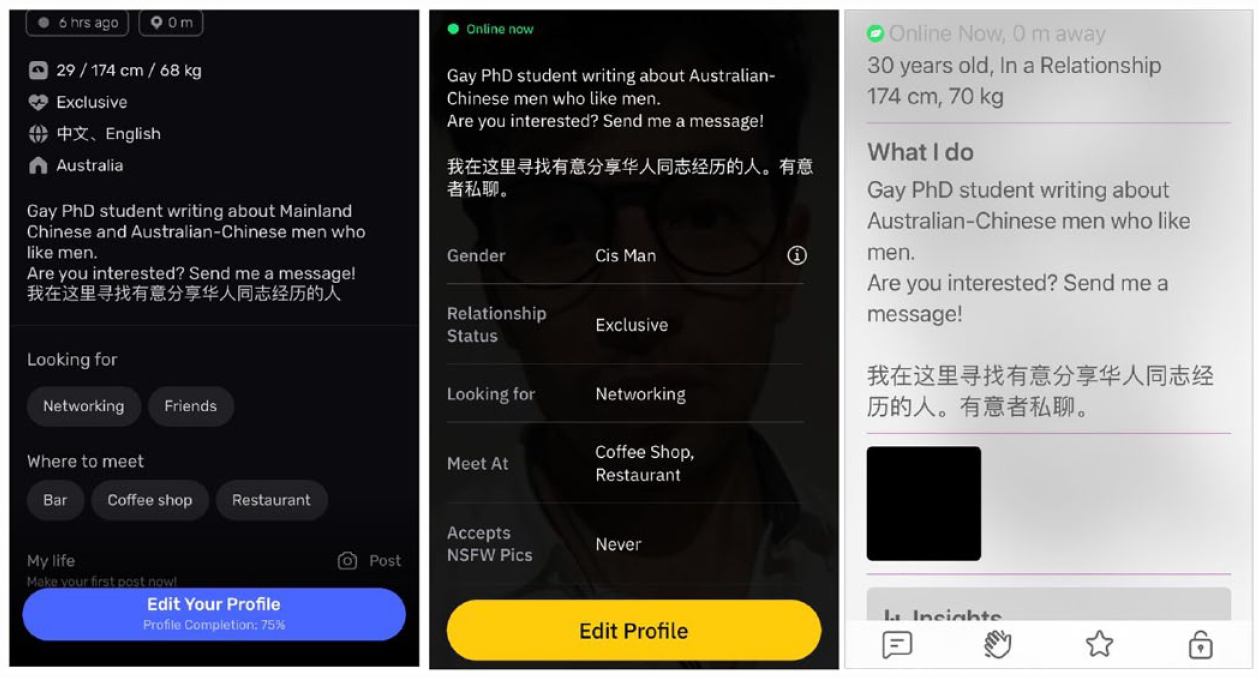
Screenshots of my research profiles in Blued, Grindr and Jack’d.
I did not set out to recruit sauna patrons as research participants, but did approach venue owners, managers, and employees to invite them to participate in the research. I engaged in short conversations with some patrons, some of whom later became research participants after they enquired about the research, and here I describe conversations with them and with research participants.
A Brief History of Gay Saunas in Sydney
In his Gay Sydney: A History, Gary Wotherspoon (2016) mentions the existence of Turkish bathhouses that catered to a male-only clientele and that facilitated male–male encounters until the late 1970s. Along with urban renovation, gay-oriented saunas became more relevant —the first gay sauna opened in 1968—displacing other venues. A central point in Wotherspoon’s analysis of bathhouses is socioeconomic level and he dedicates little to no space to describing the racial and ethnic backgrounds of users. Similarly, the research of Prior (2008) and Prior and Cusack (2008, 2009), among the few that study the evolution of the gay sauna scene in Sydney, deals with socioeconomic factors but pays little attention to racial identity. In the early 1970s, the existence of gay venues relied on “the unofficial tolerance of the authorities, and the efforts of proprietors to keep them out of the view of planning authorities by masking their visibility” (Prior 2008, 345). Later, when local laws changed, saunas in Sydney were created ex profeso for male–male interaction.
In 2020, there were four gay saunas in Sydney. With the hardships brought by the COVID-19 pandemic and the subsequent health restrictions Sydney faced, Sauna 4 closed down, leaving the Harbour City, widely considered one of the gay capitals of the world, with only three saunas. Rumor has it that Sauna 4 will soon reopen, something that will certainly change the dynamics analyzed in this manuscript.
In Saunas I’m Either Invisible or I’m Camouflaged
Ezra is a 35-year-old Chinese-born Australian. Attending an all-white school in Sydney’s Northern beaches, Ezra soon became aware of his racial difference vis-à-vis his Anglo schoolmates: “the more I desired them, the more I realized I’m not like them.” When he started university, “I joined one of the queer groups at uni and found out that some of the groups that were fighting for acceptance didn’t accept me.” After joining Sydney’s gay sauna scene, Ezra noticed that it is structured by race: Sauna 1 is for Asians and their admirers, and Sauna 2 is for Whites and other non-Asians. He had enough experience as a gay Chinese–Australian man to know that his Asian-ness could be either fetishized or despised by Anglo-Australians, his most desired partners.
Ezra experienced being Asian in the gay saunas, and in the larger gay scene, as an ill-fitting label. The category felt imposed by others rather than chosen, and infused with the racial stereotypes and fantasies of dominant white Society. In Ezra’s words:
I’m Australian in mind and Asian in body. For example, I don’t really follow Chinese traditions: family is not very important to me. I’m more like the ‘Who-gives-a-shit?’ Aussie. I’m not saying that being Asian is bad. It’s just that my mind is more Western, but guys don’t give me the opportunity to show them that I’m Australian.
Similarly, 32-year-old Ethan, an Australian-born Chinese man, defined himself as “technically Australian” because he only speaks English and does not follow Chinese traditions. “I am too white to be Chinese and I don’t actively engage in Chinese traditions.” Despite being born and raised in Australia, in the darkness of the saunas, where few words are exchanged and is all about the looks, it is difficult for Ethan and Ezra to express their “Australianness”; their bodies are read as Asian and, therefore, stereotyped (cf. Ayres 2008). Both Ezra and Ethan were acutely aware of their racial otherness in Sydney saunas, using the term “Australian” as synonymous with “Anglo” in a way that reflects not their actual nationality (since both are Australian) but rather the hegemonic construction of Australia as a white nation (Hage 2000).
Thinking about his experiences in gay saunas in Sydney, Ezra mentioned:
When I go to Sauna 2, I am the only person who looks like me and is not attractive. When I go to Sauna 1, where everyone looks like me, there is too much competition: there are too many Asians for the few whites there. I have to decide which place I will visit because I am either invisible or I am camouflaged.
Ezra’s account, in common with Ayres’ (2008) and Chuang’s (1999) autobiographical writings, shows the extent of whiteness and colonial understandings of race among gay Asian men in Sydney: They are only considered valuable if they are deemed attractive by their Caucasian counterparts. In a rationale that is reminiscent of Franz Fanon’s (2008) analysis of colonial structures, Caucasian men operate as the validators of Asians and any other non-Caucasians, their attractiveness and desirability, and their potentiality as partners, as Ezra’s account further exemplifies:
Once in Sauna 1, I liked an Asian guy, but then he chose the white guy and I automatically thought ‘of course he is picking him: he is white’; but then there was another Asian guy and I thought that I would be picked up but found that the guy preferred another Asian guy.
Ezra found that desire in the sauna operates along the lines of race (preference for the white man over him) but also along the lines of homonormativity (preferring another man with more cisgender, masculine and desirable characteristics than him).
Race and multiculturalism are central to Sydney’s gay sauna scene not only because the venues are organized following racial classifications but also because patrons measure their value in relation to white men. For instance, Luo mentioned that:
In Sauna 1 there are white guys who like Asians. Some of them are handsome, muscular and have big dicks. They are very attractive and have a lot of possibilities: they can decide who they want to have sex with. The guys who like them [the muscular and handsome whites] have to outperform others and show their availability.
The hierarchy in the gay saunas that celebrates body types is highly racialized. Ezra’s, and many other research participants’, value in the colonial scene of the gay saunas in Sydney, or in the gay scene in general, is crossed by their racial appearances that are not seen as mere physical characteristics, but as defining features traversing them totally. Similar to Santos and Pereira’s (2016, 148) conclusion that “the racial relations that exist in saunas reproduce the color hierarchies in Brazilian society,” the Sydney gay sauna scene is segregated by race, a segregation deemed innocuous under the excuse of Australian multiculturalism.
What?! What Decoration?
Although the design of Sauna 1 overtly seeks to emulate an Oriental atmosphere through the combination of East Asian motifs, many of its patrons did not even notice this. For example, when I asked 31-year-old Wen what he thought about Sauna 1’s décor, Wen’s immediate response was, “What? What decoration?” to which I clarified: “At the entrance there is a big red Chinese-style door, and inside there is a Buddha head, red lanterns and some bamboo blinds.” Still a bit confused, Wen replied:
Ah! you mean in the lounge? I’ve never paid attention to them. I guess when I go to that place it is after having sex, so I really don’t pay attention to the decoration. I guess the owners put it there because they wanted to give a good image of the business, but I think clients don’t really pay attention to these things, they go there to have sex. Who pays attention to that?
For Wen, the sauna’s decor was not related to the type of users it attracts or repels; it was irrelevant because the main purpose of the saunas is to have sex, make friends or chill, not to appreciate or pay attention to the architecture and décor. Luo, when asked, mentioned that he felt the décor was “familiar” to him. Unsure about the rationale behind the design, Luo suggested that “Perhaps the owners are just following a business strategy.”
In an interview with Sauna 1’s owners, they stated that since their opening in 2001 they had actively pursued an aesthetic to attract Asian clientele. “We hated how Asian men were treated in other venues. [Other venues] were just welcoming of white, hot, and young guys.” When they established Sauna 1, therefore, they envisioned it as a “nice, warm and comfortable place for people to feel safe,” where people would be treated well irrespective of their physical characteristics. As time passed, they obtained more objects to make the place feel more Asian. In the latest stage, they incorporated the red lanterns and painted the walls red. The décor has been well received by patrons and it is a process where the involvement with the community and the design influence together continuously: “we embraced the Asian elements because they embraced us,” stated one of the owners. Rather than regarding the décor as Orientalist and fetishizing, it became clear that the owners actively pursued this style and sought to attract Asian clientele following concerns about racism in Sydney and hoping to fill a void in the market. Some patrons regarded the décor as unexceptionable, mundane, to the extent that it was barely noticeable to some, while others appreciated the effort that makes feel Sauna 1 more familiar.
It’s Kinda Racist, but That’s How It Works: Online Reviews About Gay Saunas
Another valuable source of information about the gay sauna scene in Sydney is online user reviews. These reviews are not only relevant for this research but also for patrons themselves who ascertain whether to visit a place following such reviews. One user described Sauna 1 as follows: “If you’re brown, this place is not really for you. Just save your money or you’ll just hanging around for nothing. People here are after either oriental Asian or White.” And another: “This joint is good for desperate old farts and mostly Asians!” Apart from stating that Sauna 1 is only, or mostly, visited by specific demographics, reviews also reveal how some patrons see both elders and Asian men: “The crowd was mainly very OLD GUYS or Asian boys. The older sometimes didn’t understand ‘no thanks’ and the Asian boys kept following me around & staring.” Interestingly, Sauna 1 owners shared an anecdote where an elder white man left the sauna bothered by the number of Asian patrons: “This is not Sydney, this is Ho Chi Minh City!” Apart from the concerns about the number of Asian patrons, this client was also bothered that none of them was interested in him: “And they are all sticky!” “Sticky rice” is a phrase commonly used in the gay scene to describe Asian men who are only sexually attracted to other Asian men.
In the case of Sauna 2, the reviews emphasized the different clientele in comparison to Sauna 1: “5 stars and great vibe, less ASAINS [sic].” Reviews about the now extinct Sauna 4 highlighted the kind of partners one may find, but in doing so they also tell what partners one may not find: “You will find hot Aussie, Latino and Lebo [i.e., Lebanese or Arab] guys there. Brazilian guys are also hitting the place and they are hot!!!” An anonymous blog post summarizes Sydney’s gay sauna scene: “[Sauna 4] is the one most popular with young hotties. If you like mature men, try Sauna 2, and if Asians is your thing, go directly to Sauna 1 and skip both.” 2 These reviews impact potential visitors.
An example of this is Wen who mentioned that one of the reasons he does not visit Sauna 2 is because he found reviews saying that this place is mostly for Westerners and therefore decided that he would not risk going there: “The last thing I want to do is to go to one of those places, spend 20-30 bucks and not have a good time.” In comparison, when I asked Wen why he does not visit Sauna 3, Wen took his phone to check the location and adduced that is too far for him: two hours driving back and forth from his house. Although he works in Western Sydney and could drive to work and then visit the place during his lunchtime, as many people do for Sauna 1, he thought it would be too complicated and demanding and the outcome may not be the best for him. He lamented this because he likes men from different racial backgrounds.
Together with the research participants, Wen’s comments show that Sydney’s gay sauna scene is organized mostly through the category of race and, to a lesser extent, age. Men choose one sauna over the other because they expect to find or seek to avoid certain races. Asian men visit or avoid places not only because they know which races they are likely to encounter but also, equally importantly, because they anticipate how their own perceived racial identity will be received.
In contrast to Asian men, the online reviews show that white men can visit any venue without much consideration of their race. Whites feel welcome in all three saunas, reinforcing Australian multiculturalism where whiteness figures as neutral and unmarked and racial difference is managed and contained by Anglo populations and for their use and enjoyment, and that at the same time overlooks Australia’s racist past and the impact of the category of race in the contemporary society (Ang 2001; Hage 2000). Hage argues that multiculturalism is an exhibitory practice in which nations exhibit themselves through the control and display of otherness. The current state of Sydney’s gay sauna scene embodies the “power of the exhibitor/collector.” Asian men are allowed in Sydney’s gay scene under certain (controlled) circumstances. If they visit places where they are not actively welcome, they may encounter racism expressed in either verbal or physical abuse, or simply by being automatically discarded as potential sexual partners because of their race. Through this strategy, multiculturalism in Australia creates a “space of fantasy of total power” (2000, 162) where the other is completely subjected to the desires of their controllers and has no will on their own. Although it would be impossible to deny the capacity of Asian men to visit whichever venue they prefer, their movement and possibilities are constrained by a combination of Australian multiculturalism and the coloniality of race that articulate Sydney’s gay sauna scene.
One example of this is Wen, who not only visits Sauna 1 because there are Asian patrons, whom he likes, but also because Sauna 1’s patrons like Asians and therefore he has less risk of encountering rejection or racist behavior. In Sauna 1, his race is an asset and not a liability. An Asian man I briefly met during one of his visits mentioned visiting Sauna 1 because it is:
. . .more friendly. In Sauna 1 there is a community, and you won’t get frowned upon by staff or guys here. Sauna 1 is a place to have sex, but you can also make friends; Sauna 2 is just for bang! You don’t know anyone, and you don’t make friends.
Both patrons prefer visiting Sauna 1 because they are certain to find less racism, making the venue seem more friendly. Sauna 1 was envisioned by their owners as a venue where gay Asian men could feel safe since they were mistreated in other venues. At the same time, it serves for the containment of racial differences representative of Australian multiculturalism: those who like Asian men visit Sauna 1; those who do not, avoid it; a clear example of racial segregation in multicultural Australia that does not explicitly mention race despite being articulated by it.
A Vietnamese man who frequented Sauna 1 told me, “It’s kinda racist, but that’s how it works” to explain and justify the racial dynamics permeating the gay sauna scene in Sydney. Indeed, that is how it works. Sauna 1 and Sauna 2 are in contiguous neighborhoods (15 minutes walking or 10 minutes driving from each other and 5–15 minutes apart from George Street, one of the main arteries in downtown Sydney) and have similar fees, facilities, and daily promotions. If anything, Sauna 2 is in Oxford Street—the heart of Sydney’s gayborhood—and is a somewhat convenient place to spend the night after clubbing. During my visits from Saturday to Sunday, Sauna 2 was very crowded while there was barely anyone in Sauna 1.
Bathhouses Reproducing the Structures Prevalent in Society
Gay saunas exist because of a constant influx of men requesting their services, especially in big cities. Fully embedded in capitalist circuits, the gay community is white-oriented. “Whiteness is precisely powerful because it is everywhere and nowhere in particular” (Han 2007, 53) and saunas cannot escape these capitalist dynamics (Bersani 1987). Holmes, O’Byrne, and Gastaldo (2007, 275) propose that gay bathhouses “appear to be disconnected from society at large, but they are not.” In fact, as Richters (2007, 277) mentions, Sex on Premises Venues (SOPVs) owe much of their practices to “general patterns of social interaction and negotiation.” Racist practices in these venues exist, Wen argues, because there is “a supply and demand” that not only needs these places, but the racist dynamics, to exist. For Wen, these race-structured venues do not create the racist dynamics as such, but rather provide the race-fixated Sydney gay community a strategy to meet desired partners, and to be desirable for certain partners without being catalogued as racist. Wen is not complaining about the racist dynamics of Sydney’s gay sauna scene, but instead is using them to his favor: He visits Sauna 1 because is the place where he feels most at ease and has less chance of race-based rejection.
Tattelman’s (1997, 1999) depictions of gay saunas are quite romantic: He considers it is possible to achieve a horizontal comradery; saunas “link otherwise unrelated bodies” (1999, 77). Despite his awareness of Bersani’s critique of gay saunas, Tattelman (1999) proposes that body interactions facilitate friendships and social bonds. However, saunas and the interactions therein do not exist independently from reality nor do they escape the structures of society as Tattelman (1999) hopes. My data and analysis support Leo Bersani’s (1987) argument:
Anyone who has ever spent one night in a gay bathhouse knows that it is (or was) one of the most ruthlessly ranked, hierarchized and competitive environments imaginable. Your looks, muscles, hair distribution, size of cock and shape of ass determined exactly how happy you were going to be during those few hours, and rejection, generally accompanied by two or three words at most, could be swift and brutal, with none of the civilizing hypocrisies with which we get rid of undesirables in the outside world. (1987, 207)
In Sydney, this brutal rejection and rigid hierarchy is structured by race and, to a lesser extent age, and colonial-borne racial imaginations are written into the very design of the spaces.
Saunas Reproducing the Colonial Understandings of Race
Considering how race operates in gay saunas, 32-year-old Ethan mentioned not going to the saunas alone because he would find difficult to “guarantee a good outcome and it would be a waste of time.” On the contrary, he only visits saunas if he already has a sexual partner and they lack a place to meet or are not willing to invite their partner to their home. Perhaps Ethan’s disinterest to visit Sauna 1 stems from the dislike he has towards other Asians, or because he does not want to be perceived as one more Asian, or “camouflaged” to use Ezra’s words.
Luo,35 years old, seldom visits Sauna 1 because he is aware that his brown skin, his height, and his facial features are not considered attractive; they do not match the imaginations associated with Chinese men. He anticipates that people desire a “tiny or muscular Asian who is servile and submissive” and therefore will not find him attractive. “Asians like fair-skinned Asians and Whites too. Since I am dark-skinned, these guys don’t like me.” Luo’s interpretation of East Asian men preference to meeting fair-skinned Asians rather than their dark-skinned counterparts resonates with Dredge Byung-chu Kang’s (2017) and Yo-Hsin Yang’s (2022) findings. Luo’s attendance to these places is not only influenced by his race (Asian) but also by the characteristics associated to his race that he does not fulfill.
Before the pandemic, Luo visited the now-extinct Sauna 4 a couple times. He did not meet anyone “because I’m Asian and that place is just for young white guys. They didn’t like me. They didn’t even look at me.” Despite his experiences, Luo does not relate these experiences to racism: “It is common that Asians like Asians only and the same goes for whites. Maybe one out of five or ten guys, just one is willing to try a different race.” Although Sauna 4 is now extinct, I also heard about it from a Malay man:
I went to that place twice. The first time it sucked. Nobody touched me because I am Asian. The next time a friend paid my entrance fee and the same thing happened: nobody touched me nor looked at me. When my friend told them that I have a big dick, those guys who rejected or ignored me came back. Now it was me who rejected them.
We can see how Asian as a colonial racial category comprises certain physical and personality characteristics that must be fulfilled. When such characteristics are not fulfilled, men are not considered attractive. This category, therefore, reduces men to their physical traits invalidating their specific individuality.
Ridge, Hee, and Minichiello (1999) argued that saunas may facilitate interracial sexual encounters. However, they also note that these interactions rarely leave the saunas and find expression in the outside world. My ethnographic data show how saunas reproduce the colonial understandings of race not only because they are organized by race but also because they limit or discourage certain races to access certain venues. For instance, Sauna 2 does not explicitly mention that Asians are not welcome, but in its advertising and the images inside, no Asian men are represented. Additionally, patrons generally identify this place as not welcoming Asians, something that is expressed in online reviews, and consequently few Asian men show up. When they do, they are aware that their race may be a liability, therefore, reducing their chances to meet other men. These dynamics reflect Australian multiculturalism (Ang 2001; Hage 2000) for they ignore the relevance of race as a constitutive category of contemporary society and continue white men’s privilege to visit either venue because their race is not considered a liability in the saunas.
Conclusions
Previous scholarship by Asian–Australians (Ayres 2008; Bao 2013; Caluya 2008; Chuang 1999) has highlighted the importance of race in Sydney’s gay scene. In this manuscript, I have proposed that Sydney’s gay sauna scene is articulated by a combination of colonial understandings of race and Australian multiculturalism. The first refers to the continuation of the colonial-era racial structures and the second to the primacy of white Anglo populations and the denial of race as a relevant category in contemporary society. This approach links racial understandings in the context of the ongoing white-majority settler colonialism in Australia. Since the arrival of British sailors in the late eighteenth century, Australia has been imagined as a racially secure enclave where it was possible to keep undesirable populations, and their perceived pollution and dirt, away (Walker 2005). To achieve this aim, the British colonial administration and, from 1904 onwards, the Australian Confederation have enforced laws that allowed only certain races to enter the island (Cushman 1984; Fitzgerald 2007; Kuo 2013; Prince 2018).
Ezra and Ethan are Australian citizens, but Australians and Chinese Australians alike usually categorize them as Chinese or Asian. Colonial racial categories reduce them to their appearances and, in the darkness of whisper-filled saunas, they exist as Asians. They strategically navigate saunas through racial categories: Ezra visits Sauna 1 where there is a lot of competition to meet white men or by visiting Sauna 2 where there are less Asian men, but where his race is his biggest liability. Ezra and Ethan strive to prove they are “Australian” as opposed to Asian, yet despair of being able to convince others of this. In contrast, Wen appreciates the race-structured dynamics, using them to his advantage. He visits Sauna 1 because he wants to meet other Asian or brown skinned men, but also, because in Sauna 1 his Chineseness is an asset, he has more chances of meeting partners from diverse racial backgrounds who are interested in him. In contrast, Wen avoids Sauna 2 because, having read negative reviews, he fears a negative outcome. He knows that he will be excluded from opportunities for casual sex because of his race. Although at the time of this research, Sauna 4 was closed; two Asian men stated that it was a place for young white men and reported that when they visited, they did not meet anyone because their race was despised by other patrons. They never returned.
Following Holmes, O’Byrne, and Gastaldo (2007), I have proposed that gay saunas in Sydney are not just created by a specific design—as if such design were innocuous—but by the practices that such spaces facilitate, not just in terms of same-sex encounters, but in terms of colonial racial understandings and Australian multiculturalism. They permit, echoing Rivera-Cusicanqui’s notion, Asian men in certain places while actively excluding them from others. As 27-year-old Liao mentioned, “Asians are expected to take whatever is given to them and say ‘Thank you’.” Drawing on Yi’s (2021) argument, that encounters in specific places are “circumscribed by the boundaries of the agreed-upon norms, rules, or rituals of the cultural space” (14), I described how Sydney’s gay sauna scene is structured by race. The saunas follow certain norms and rituals thoughtfully crafted by business owners, and the patrons willingly reproduce them because they are convenient for them in certain situations. These venues reproduce colonial understandings of race and the privilege granted by Australian multiculturalism while at the same time providing a safe space for patrons to meet like-minded people. Nevertheless, it is important to avoid romanticizing these venues because, as Ridge, Hee, and Minichiello (1999) argue, while these places may allow interracial sexual encounters, these encounters rarely leave these premises aware of the sexual hierarchies in the wider society. Therefore, rather than unsettling racist dynamics, these places reinforce them.
The décor in these venues is designed along racial lines, intending to attract certain market segments by simultaneously signaling the kinds of racial encounters patrons can hope for but also communicating welcome to patrons of Asian descent. Sauna 2’s décor, depictions of naked and semi-naked men, not only reproduce the cisgender and masculine ideas of what constitutes sexual and physical desirability but also convey the race of desirability, by equating it to whiteness. Online reviews are an important source of information for gay Asian men. They check the reviews to ascertain the potential outcome of their visits. Some of them refrain from visiting Sauna 2 because of the negative comments about Asian men and prefer visiting Sauna 1 instead.
The gay sauna scene in Sydney is a small-scale representation of the Australian multiculturalism Ghassan Hage (2000, 2002) and Ien Ang (2001) have analyzed. Hage proposes that the policy of multiculturalism in Australia, established in the mid-1970s, is a white fantasy. For Hage, whiteness is “a fantasy position of cultural dominance born out of the history of European expansion” (2000, 20). The multicultural policy that replaced the aggressive White Australia policy (1901–1975), which only permitted white Europeans to migrate to Australia, preserves the idea that Anglo-Australians have the right to decide who comes and stays in Australia, and under what conditions (cf. Tascon 2004). Multiculturalism is used by the Australian government to control non-Anglo populations, making them innocuous to the larger white society while preserving white control. Multiculturalism is promoted by the Australian government if it can be useful to and controlled by the Anglo-society if it can provide more options to Anglo settlers.
Extrapolating the analysis of multiculturalism to Sydney’s gay sauna scene, we can see that it is structured following a similar rationale. Asian men’s access to Sauna 2 is limited not because the venue actively denies them entrance, but because their bodies are very different to what Sauna 2 depicts as sexually desirable and because their chances of finding rejection are higher than in Sauna 1. In contrast, white and other non-Asian men can visit any venue without considerably reducing their chances of meeting other men. While Asian men visit venues influenced by the fact that patrons will like them, other non-Asian men do so pursuing the possibility of meeting men from different racial backgrounds, or do not consider that their race is an overwhelming factor that will limit their chances of meeting other men. Australian multiculturalism allows these dynamics to exist and denies the racism in them. Race is not the only factor in a community so obsessed with the looks and appearances as the gay community, but it is of utmost importance for the dynamics of Sydney’s male-male scene.
Footnotes
Acknowledgements
My sincere thanks to the research participants who shared their stories with me, to Sauna 1 owners who agreed to be interviewed, to Professor L.L. Wynn, from the Department of Anthropology at Macquarie University for her guidance and support in this research project and to the anonymous reviewer whose comments improved this article.
Declaration of Conflicting Interests
The author declared no potential conflicts of interest with respect to the research, authorship, and/or publication of this article.
Funding
The author received financial support from Macquarie University (#20201862) for the research, authorship, and/or publication of this article.
