




Abstract
This study explores the multiple and distinct cultures of oilfield masculinity uncovered during an embedded ethnographic study of masculinities onboard a remote UK offshore drilling platform. Oilmen revealed shifting interpretations for how risky and dangerous oil work “should be done.” Changes led to the construction of three distinct masculine cultures intertwined with positive safety behaviors and one culture intertwined with negative risky behaviors. Tracing the trajectory of Connell’s hegemonic masculinity theory, no singular “hegemonic” or dominant masculinity existed in the oilfield. Also, unlike some existing oilfield research, masculine reformations and subsequent divisions and associations between local cultures were triggered by factors independent from shifts in workplace policies. Rather, and linking with emerging research exploring “manhood acts”; oilmen consciously reformulated their masculine identities, embodying self-awareness and self-reflection for reimagining processes, and themselves recognized each industrial identity as unique and capable of cultural support or resistance. Perspectives of growth for “hegemonic” masculinities theory are presented, alongside suggestions for further examination of masculinities in understudied male-dominated workplaces, to further expand the “manhood acts” research perspective.
Keywords
Introduction
The occupations attached to oil and gas extraction operations together represent a highly mobile and global industry (Filteau 2014; Lewis, Porter, and Shrimptom 1988). This research examines men’s masculinities linked to oilfield labor in the UK North Sea (UKNS). UKNS oilfields have a long history of association with hypermasculinity. Oilmen interviewed gave historical accounts of fighting, competitive strength displays, risky one-upmanship contests and the subordinating of less “tough” men with labels of femininity. Practices were in the past normative for the oilfield; a workplace located in a harsh and isolated environment. Existing research in high-risk, male-dominated workplaces has documented similar ingrained masculine attitudes, but now often highlights rapid “reformative” shifts from historical motifs. Despite this, trends for studies in male-dominated occupations of oilfields (Diffee 2012; Filteau 2014, 2015), coal-mining (Abrahamsson and Somerville 2007), and military contexts (Barrett 1996, Duncanson 2015) commonly suggest a capacity for masculinities to change (or resist change) is a collectively subscribed experience that is still linked to the presence of a single dominant “occupational” masculine identity. Conceptualizing shifts in congruence with the above thinking interlinks with R.W. Connell’s theory of hegemonic masculinity (HM); the theoretical lens through which many empirical data examining masculinities within the high-risk industry is interpreted (Connell 2005, 2009; Messerschmidt 2018, 2019). There exist few examples where masculine shifts within male-dominated and high-risk workplaces—with a history of masculine stereotyping—evolve as complex fragmentary occurrences. However, this is the perspective adopted by some emerging “manhood acts” discourse, which this study acknowledges and builds upon (Eastman 2012; Ezzell 2012, Sumerau 2012). This research documents complex and fragmented masculine reformations through the lens of an embedded oilfield ethnography; exploring the interlinked concepts of shifting oilfield norms, labor and identity.
Research in Male-Dominated, High-Risk Industrial Workplaces
For much masculinities research in male-dominated, high-risk industrial locales, scholars often begin by locating and defining the “hegemonic masculinity” in these workplaces (i.e., the most subscribed, normative, and time-honored masculinity). Some scholars demonstrate how this HM remains robust. Others develop an evidence-base for how this identity changes to become “softer” and less descriptive of Connell’s “hegemonic” configurations—that retain local dominance through the subordination of femininity and marginalized male identities (Connell 2005). This paradigm is often packaged as a “reformative” masculine recombination linked to a specific event, policy change, or technological shift.
Abrahamsson and Johansson (2006) explored changing masculinities attached to deep coal-mining operations in Northern Sweden. They argued that fossil-picking and extraction practices were often characterized by “macho-masculinity” (2006, 673). While scholars highlight shifting and multiple identities in modern extraction practices, they reveal a dominant “local hegemonic masculinity” (673) built around historic workplace machismo. A study by Ely and Meyerson (2010) also explored masculine practices, this time within oilfield extraction operations during the year 2000. Scholars uncovered a historically embedded and negative masculine culture that perceived oilfield work as “men’s” work (4). The authors posit that dangerous workplaces (in particular oilfields) are governed by local norms that prompt men to “do [their] gender” (5) in ways traditionally defined by “conventional masculine scripts” of acting “tough” (6), risk-taking, emotional detachment, and rejection for so-called “soft” “feminine” behaviors. They suggest the oilfield, and wider male-dominated workplaces are historically ruled by a singular form of HM to which most men subscribe. However, Ely and Meyerson claim engrained cultural masculinity may be rapidly “undone” when organizations forcibly outlaw such local behaviors. They argue that as organizational cultures can equip males to both “do and undo gender” (3), gender—as men’s masculinities—are conditionally enacted in ways dependent on the goals institutions push men to adopt.
Despite the encouraging nature of Ely and Meyerson’s findings, scholars adopt the controversial stance of defining all behaviors not uniformly associated with Connell’s negative connotations of hegemonic men as an “undoing” of masculinity (Ely and Meyerson 2010, 14). This suggests that “to be masculine” is dependent upon specific performances of practices. Connell (2005) argues HM is the dominant practice of western, middle class and heterosexual men. She also defines HM-linked behaviors as mostly negative. However, Connell maintains men who do not conform to these practices retain their masculinity. They simply perform their masculinities in non-hegemonic ways incongruent with hegemonic labeling. Conversely, Ely and Meyerson label any deviation from local and negative stereotypes of HM as a forfeiting of male identity. Ely and Meyerson conceptualize dangerous workplaces as governed by a singular culture of masculinity to which men strive to accommodate as a normative and locally accepted dominant labor identity.
Several further examples of similar thinking exist. The research includes Filteau’s studies of onshore-based American natural resource workers that, like Ely and Meyerson, conceptualizes local institutional and geographical masculine identities as singular, and able to be collectively reformulated by shifts in local governance and policies (Filteau 2014, 2015). Similarly, Ashcraft (2005) and Wasserman, Dayan, and Ben-Ari (2018) both focus on examining masculinities within traditionally male-dominated aviation contexts. While studies approach notions of multiple masculinities (as Upgraded and Integrated masculinities, respectively), research concludes by positioning Connell’s theory of HM as explaining the dominance of an overriding masculine culture of behaviors within risky occupations. More extreme generalizations can be found going further back in time. Barrett’s (1996) oft-cited study of US navy men positions the global contingent of an entire military division to be governed by three defining notions of masculinity. Collectively, these motifs conform to Connell’s hegemonic definition due to their classification as linked to (mostly) negative practices and propensity toward construction in ways that concurrently avoid and problematize femininity (Barrett 1996). Such findings are largely replicated by Hinojosa (2010), who similarly suggested male US army, navy, marine, and aviation operators naturally formulate masculine hierarchies that prioritize a singular “hegemonic” (189) identity defined via risk-taking, endurance, and strength, while subordinating any behaviors or motifs that resist these descriptors.
The above studies suggest that high-risk, male-dominated, and traditionally stereotyped locales of labor are largely governed by a singular dominant form of masculinity. Some studies claim this identity can become rapidly reformulated to new normative masculinity associated with safe, “softer” and “more careful” masculine notions when forced to do so. In most cases, such change is linked to restrictive shifts in workplace policies. However, this thinking may be reductive, suggesting workplace masculinities represent a singular predictable phenomenon.
In contrast to the HM-led, structured-multiple-masculinities perspective, recent scholarship focuses on examining “manhood acts” as a locus of understanding the social construction of multiple local-level masculinities, and how such gender constructs underpin dynamics of intermale domination configurations and deference from HM (Schrock and Schwalbe 2009). Within this tradition, well-defined examples of men’s multiple-masculinities negotiations exist. For example, a fascinating study by Ezzell (2012) explores the ways in which men undertaking a drug treatment program reformulate and revisit masculine construction processes to realize four distinct motifs of identity work. Identities represent unique forms of masculinity, however, not all processes are congruent with Connell’s structure of a single dominant HM. Instead, sensemaking allows men to perform contextually revered notions of “manhood” in a local space where multiple constructs interact and engage in conditional power exchange, in complex and contradictory ways. Also of relevance is Eastman (2012)’s work; exploring notions of U.S. Southern masculine stereotypes. Eastman presents an engaging outline of the dichotomic perception of Southern men as both “quintessential exemplars of American manhood” (1) and—co-occurring—“[stereotyped] as backwards and deviant” (1). Notably—and contrasting with structured masculinities—notions, findings highlight multiple cultures of masculinity that both perform and resist “hegemonic-like” practices of subordination and domination as hallmarks of fulfilling different—yet locally cooccurring—notions of masculine identity. The study paints a complex picture of men negotiating fragmentary and—at times—shifting understandings of masculinities, as these play out contextually in local space and overlap and exchange with the defining “manhood acts” of other males, in patterns that both reinforce—and reject—some “hegemonic” stereotyping. A study by Sumerau (2012) employs the “manhood acts” perspective to examine the compensatory “masculine acts” of gay Christian men. Interestingly, Sumerau’s analysis demonstrates three key—locally intersecting—construction motifs for masculinities, including notions of parental stewardship, control and rationality, and attaching notions of Christianity to the formation and practice of relationships. While Sumerau highlights labels of subordination as functionally categorizing these males, men are also shown to employ “hegemonic” practices and sensemaking to elevate and justify their notions of masculinity, and importantly to reframe identities as dominant and capable of concurrently rejecting and resisting “status-quo” societal manhood notions through complex processes of reimagining and attaching nontraditional markers of male–male subordination. Studies provide an important, alternative perspective to HM theory. However, considering collectively this scholarship, no current studies explore oilfields and other high-risk locales of labor.
The following section describes the research methodology and research context. Then follows highlights of men discussing their masculinities and processes of masculine change in the oilfield. Penultimately, opposite to the HM perspective, and in contribution to the “manhood acts” perspective, men’s notions of identity are clarified into four distinct cultures of masculinity; none of which are hegemonic. There is then a discussion of findings that suggests some salient updates to grow existing theory. Perspectives on masculinities that should benefit future research are also presented.
Method
This study represents an ethnography of the Point Delta (a pseudonym) oil and gas drilling platform: a mid-water UK dual oil and gas installation in the Scottish UK North Sea. I travelled by helicopter to Point Delta and lived and “worked” (completing occasional small tasks) alongside drill crews as they drilled a well in the winter North Sea. I spent fifteen days on Point Delta, split into two research trips: one lasting eight days in December 2017, and one lasting seven days in January 2018. I conducted 35 semi-structured interviews with drilling-crew oilmen, each attached to one of five North Sea drilling crews. Workers were between the ages of 21 and 60. They were employed in a spread of drilling roles offshore. Many had previously worked on international platforms, often in diverse locations: South America, Thailand, and others. Oilmen came from different class backgrounds, primarily most were working class, and some had college, vocational, and university educations. Some came from other professional careers such as football. The UK offshore oilfields are very male-dominated, in my time offshore I encountered only three women. One worked in an administrative role, one was a cleaner, and one was a chef. In my discussions with oilmen, it was made clear the focus was to understand men and masculinities specific to the UK North Sea. Conversations focused on this geography and topic. Interviews lasted at least an hour—some vastly exceeding this. I asked workers directly about their masculinities: what does it mean to be an oilman working in the North Sea and what does masculinity mean to you? I spent time clarifying my questions around masculinities to ensure oilmen understood what they were being asked. I asked oilmen how their notions of what it means to be a man were constructed, and if/how what it means to be “an oilman” had changed. I also asked how and why any changes discussed by oilmen occurred, how this made oilmen feel, and how any changes shaped their thinking and behaviors on the platform.
Oilfield ethnography was coupled with additional interviews onshore. I spent a year based at the head office of the organization: “DrillMech” (a pseudonym), which owns the drilling stake of Point Delta. During mid-2016 to early 2017, I conducted eight interviews with workers onshore, about their time offshore. This provided balancing perspectives to offshore ethnography; drawing out historical perspectives that could be used to clarify and elaborate themes from the active worksite. At DrillMech, I undertook all certifications and training to travel offshore. Training consisted of MIST (Minimum Industry Standard Training) and BOISET (Basic Offshore Safety Induction and Emergency Training). This included escape drills from a submerged helicopter shell, a lifeboat launch in a local harbor, firefighting, basic helicopter knowledge and safety drills, platform escape and water survival drills, and classroom exams and equipment handing training. The training allowed me to walk around the drilling platform largely unsupervised and to shadow oilmen laboring at will. Upon return, all qualitative interview data collected was carefully transcribed by myself and then imported into the software program NVivo. Data were coded using Braun and Clarke’s six-stage framework (Braun and Clarke 2015). Coding was completed for different experiences and events. Cross-coding at different analytical- and temporal-levels revealed shifts in local identity and practices, and highlighted the factors underpinning these. Multilevel thematic analysis is appropriate for ethnography; many levels of coding were completed for different experiences and events, which resulted in a large arrangement of coding and node classifications. First, cross-coding of information at different analytical- and temporal-levels was used to develop a rich tapestry of the shifts in local identity and behavioral practices, and to examine factors underpinning these. As analysis progressed, markers in the data were developed to link emerging thematic findings relating to men and masculinities, perceptions of past and present oilfield identity, and masculine transformation motifs. The network of themes then underwent several additional passes of coding to clarify findings and demonstrate replicability across oilmen’s narratives. Finally, themes were refined further and cross-compared to draw out variances across the themes of workplace behaviors, masculinities, and transformation and change (Clarke, Braun, and Hayfield 2015). Approach is congruent with ethnography studies exploring similar subject matter (Clarke and Braun 2019; Garfinkel, 2005; Kim 2009; Terry and Braun 2011).
Point Delta and the Offshore Oilfield
The helicopter journey offshore was an adventure. I arrived at the heliport in the early hours of a weekday morning. I donned my survival suit, complete with bulky emergency breathing apparatus, GPS locator, and other equipment—and boarded a small H175 transport chopper, with a sparse crew of regular oilmen. Once granted liftoff clearance, the helicopter rapidly climbed high into the early morning sky; into cloud, and wound its way over the North Sea; into the distance, toward a seemingly infinite expanse of water. After a little over an hour, the neon blinking lights of a distant structure came into view far below. The H175 swung around; buffered by the high winds, and eventually descended rapidly to land on the hexagonal—brightly lit—helicopter landing pad; located on the roof of the production package of the drilling platform. Figure 1 provides a visual of this.
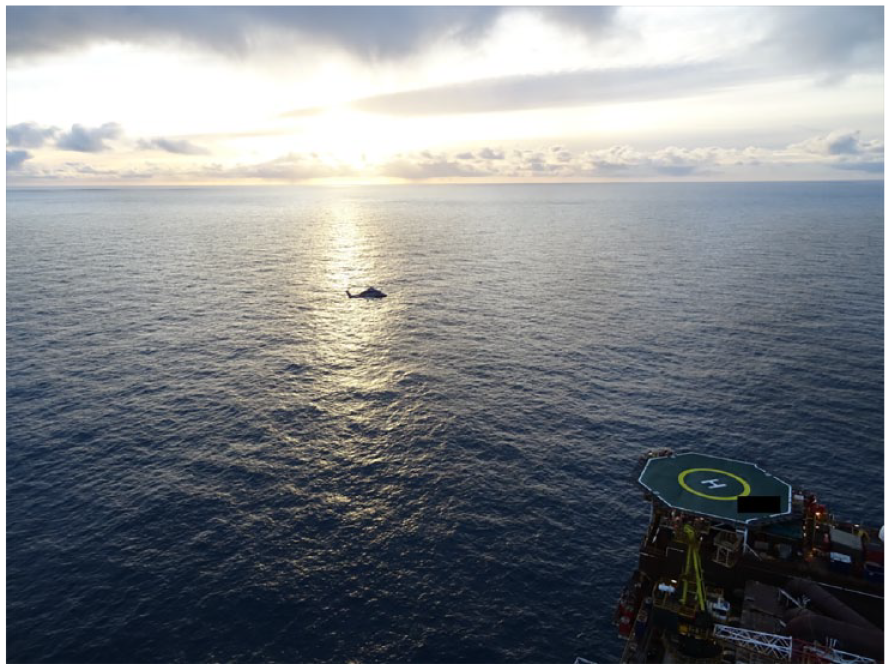
Photograph of an H175 Helicopter Landing on Point Delta.
Point Delta is a unique environment and the isolated and distanced nature are salient. Oilmen highlighted on numerous occasions comparisons of location on the platform to “a prison” or “Alcatraz” with “no escape.” When I touched down on Point Delta—one snowy and cold December morning—these factors were also immediately clear to me. Upon arrival, after first getting my bearings, I immediately began to explore the structure and converse with oilmen I encountered; introducing myself and explaining my purpose for being offshore. What struck me the most was the distance from land; in all directions at any one time, all that could be seen was sea expanse and a single emergency vessel that rotated around the platform at distance. Figures 2 and 3 show the view from the top of the drilling platform scaffolding, highlighting the isolate nature of the installation, and a view of the production “package” of Point Delta, with the helipad near the top left, respectively.
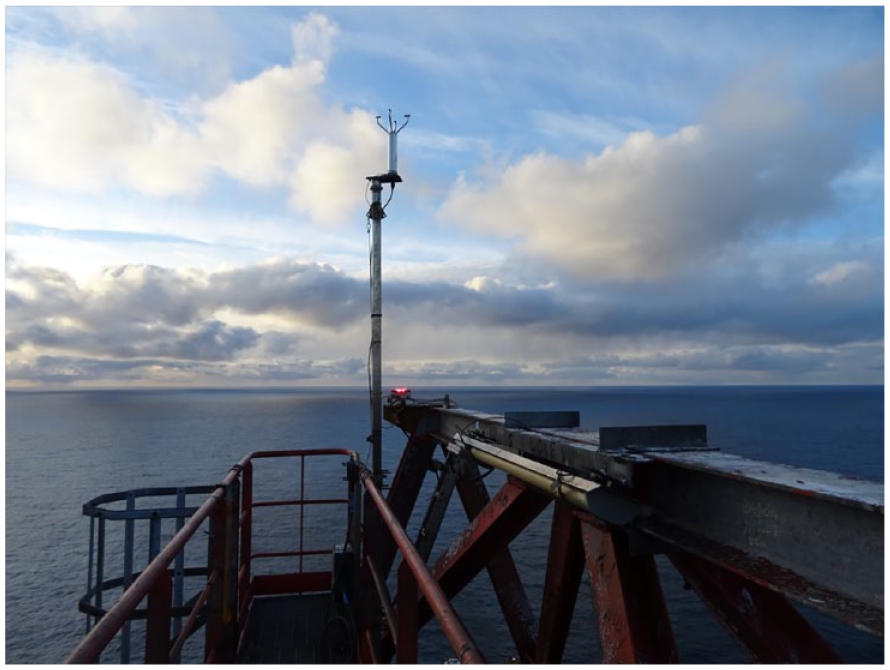
Viewing the Isolation of the Platform, from the Top of the Drilling Derrick.
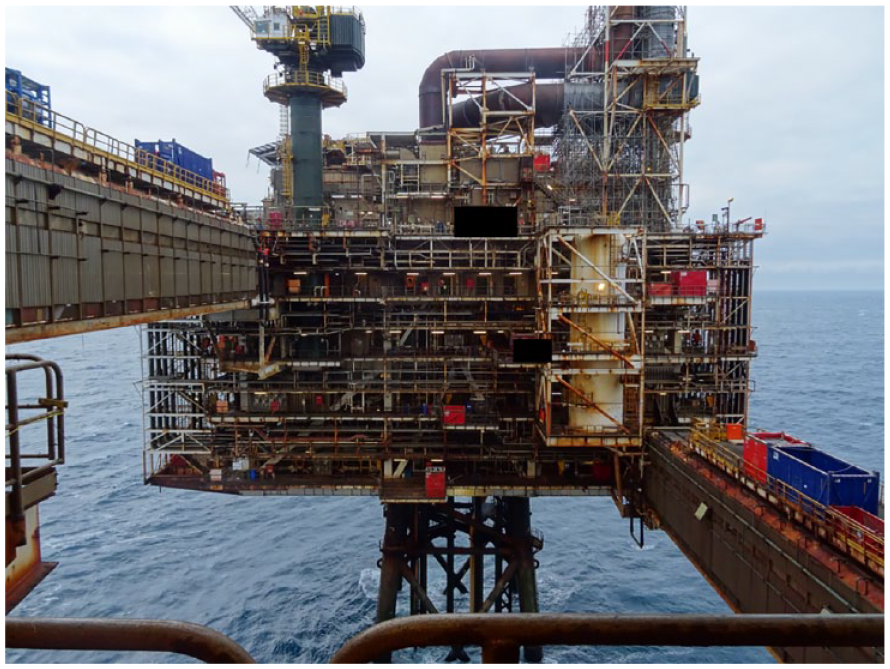
Photograph of the Site of Study: The Production Platform.
Additional to the remoteness of the platform was the compact nature of the worksite. Oilmen lived and worked in close quarters; sleeping two to a cabin and associating in small public areas such as the galley, the recreational rooms (one of these was the only area where Wi-Fi was available), and the small gymnasium. Oilmen spoke often of the natural anxieties of living and working “on a bomb,” highlighting the constant presence of danger due to the platform drilling for, and producing oil and gas: “It’s just so risky here. Well, we’re staying on a bomb. . .it could blow up. . .there’s always that” / “You’re on a platform, you’re on a sitting time bomb. . ..” As I began to traverse around the platform with more freedom and fluidity, it remained in my mind that I was not only in the workplace of the oil workers that I interviewed, but I was also in their “adopted home” for their duration offshore.
It is important to discuss researcher’s positionality in relation to the place and the people. While offshore, I got on well with oilmen, and was accepted. Part of this was down to the lengthy training I had completed to be allowed offshore, but factors such as my own gender (male) and social location cannot be discounted. Oilmen commented that I was a “first case” of someone being allowed into the active work-site who was not active drilling crew and was travelling for research versus labor purposes. Oilfields are not typically segregated by “traditional class” as with some locales. Oilmen voiced judging individuals on a “case-by-case” basis; whether they show willing, can be trusted, and engage with oilfield work and culture. Offshore I completed some small tasks. I accepted offers to experience some aspects of offshore life, such as climbing to the top of the drilling tower. Engagement in these practices enhanced my acceptance and oilmen’s propensity to speak openly with me; workers acknowledged I was “ready to get stuck-in.” Drillers were interesting in my university education, but equally interested in some jobs I had done before first going to university, for example, a past manual labor role. They were also interested in my training routines for sport (I am a swimmer) and the time I spent in the platform gym. Finally, oilmen did—at times—ask me about my upbringing which I spoke about honestly. The combination of these factors, and my honest and open discussion regarding personal questions, helped integration and acceptance and facilitated the large volume of interview and observation data I collected offshore.
Voices from the Oilfield
Oilmen first painted to me a detailed picture of “The Tiger Heyday.” Narratives unpacked a singular normative offshore culture of masculinity where most men were deemed “North Sea Tigers.” Tigers ruled the oilfield from the 1970s to the 1990s. Culture depicted a unique, concentrated hypermasculinity; men fighting, engaging in strength displays, competing for who could take and perform the most risk, and downplaying dangers of working in a high-risk, remote, hydrocarbons drilling environment.
Tiger culture draws parallels with existing studies of men and masculinities in high-risk locales of labor. For example, parallels are evident with Collinson’s (1999) research highlighting oil workers’ resistance to organizational safety surveillance practices. Themes of risk, horseplay, machismo, and fearlessness reflect the historic “Cowboy” Texan oilfield culture discussed by (Lewis et al. 1988). Similarly, risk performances to exhibit workplace masculinity compare to Miller’s gendered notions of “Frontier” archetypes in Alberta, Canada (Miller 2004), and labor archetypes uncovered by Murphy et al. (2021) in wider Canadian oilfield contexts.
Jim (all names are pseudonyms, to ensure anonymity) was one of the offshore oilmen who discussed Tiger masculinity in the UKNS. He was a drilling supervisor who had worked offshore for 39 years and was approaching retirement. We spoke in his office; located at the very top of Point Delta’s drilling platform. He said:
Ah yeah, I mean when I first started in 1979 it was all North Sea Tigers. I mean, when I first came off and you raised a safety concern. . .oh my god. . .you just had to shut up. . .it was taboo. . . [. . .] Yeah, a lot of the guys then. . .you know, it was all a lot of all that macho nonsense. . .very macho. . ..
I later spoke with Tim, a lead well driller. We conversed in the drilling floor control room—as he and others were engaged in heavy drilling operations. I asked him about the masculinity offshore, and to explain this to me in his own words. Tim said:
Drilling masculinity. . .I think in the early days. . .you came offshore into drilling areas and it was all wild and things like that. . .we were all pretty wild in them days, you just got things done. The main thing was to get the job done. There was a macho thing then. . .. It was just the way that it was, all rough and ready. You drank hard, you partied hard when you went home, and then you came back, but that was the old days. . .I started in 1980 and it was definitely like that then. [. . .] Back then you just had to have a strong back and get on with it. Be strong. Back then there was no politics involved. If you were strong you could do it and you got RB [RB refers to Required Back. Typically, new workers work two trips to establish if offshore life is “for them.” The opposite of RB is NRB which stands for Not Required Back]. Those were the North Sea Tigers. They came on, did the job and had a good drink on the way home. . .then just did it all again.
So far, Jim and Tim’s narratives reveal hallmarks of typically attributed hegemonic descriptors as “Tiger masculinity.” Namely, motifs of masculine strength, resilience, and propensity for risk-taking.
John, a maintenance superintendent I spoke with onshore, also gave an account of Tigers. His narrative expands linkages between Tiger masculinity and risk-taking, and complements comments from Jim and Tim:
You hear the stories about the older guys, The Tigers. [. . .] You speak to someone who has been in for twenty, thirty years. Those guys will tell you that maybe they’ve ridden up and down the Derrick [A drilling derrick is a tower constructed from cross-beam steel. It supports and lifts drilling pipe into the drilling well. The height of the derrick varies per platform but is typically 160-200 feet above platform level] to go up and down the monkey boards [A monkey board is a platform—without safety rails—positioned high up in the derrick from which access to top-level drilling pipes is made possible] which is basically complete suicide. Why somebody would want to do that and show off. I just do not know. But, you hear stories of this. The guys then, they wanted to show off, show they were tough individuals. The guys will jump eighty to ninety feet in the air off the drill-pipe without a harness. If you fall from that you’re not going to survive. These things used to go on. Or, the guys would slide down the pipe, like a fireman’s pole from the drill area.
Figure 4 provides context for John’s narrative. Photo depicts the drill pipes he refers to Tigers sliding down, “like a fireman’s pole.” Scaffolding “monkey-boards” are visible in the distant topmost section, above the two floodlights.
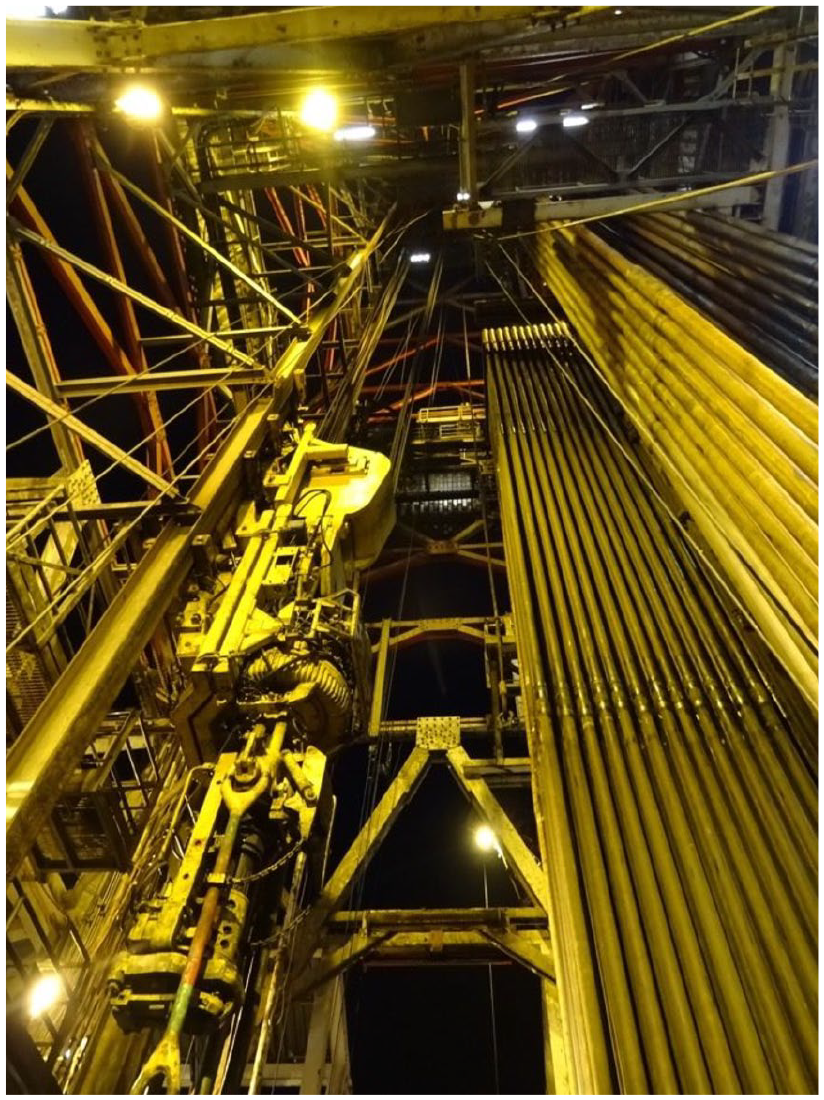
Stacked Drill-Pipe on the Drilling Floor of Point Delta.
George (occupation anonymized) had also worked offshore during the Tiger heyday:
If you’re asking me about The Tigers, another thing was showing how strong you were. We would be on the rig floor, and you’ve seen the rig floor. The well bay is away down there [approximately forty meters down]. So, the supervisors used to ask you to carry what they call a low-torque valve up the stairs, and this thing must weigh about sixty kilos.
George discussed how reluctances to engage in strength displays encouraged negative feminine typing. When George suggested a safer, and less strenuous way to maneuver equipment, he was immediately subordinated. However, it was another narrative from George that best exampled the normative oilfield masculinity of Tigers as hegemonic. George continued:
So, you asked if engaging in safety was accepted by The Tigers? What I was going to say to you was that. . ..
George paused here. It appeared he was thinking about whether to use this example or not. After a few seconds, he continued:
. . .. Well. . .. My sexuality was questioned. When you go to a job as a roughneck [A semi-trained drilling assistant responsible for directly handling drilling tools] or whatever, you’re working with drilling mud. They had recently introduced in the early 1990s these barrier creams for your hands and your face. Then [referring to later on in time] they had the cream for cleaning your hands, and they had the cream for aftercare [this refers to a cream that is used following skin contact with drilling fluids]. I remember being challenged by a welder—a Tiger. He asked me if I was gay. I mean, he actually asked me if I was gay! Just because I used the hand cream, to protect myself. Now, that’s what it was like. You’ve also no idea about this mud. In the early days, they used diesel-based mud. It just burned your skin on contact. . .and these people, they just got covered in it. There was a guy who got contact dermatosis because he was not using the protective creams. His skin was so bad we couldn’t even get him onshore to work. Basically, he couldn’t touch anything, his hands were that bad. That gives you a great example of what it was like at that time. God’s honor, I was standing at the top of the staircase, and I had a routine downstairs. The pre-shift brief I was into the locker room putting on the creams. . .all right up my arms, and that’s why it’s important you’re looking at this masculinity thing. Why did that guy still choose not to use the creams, keep himself safe? The products were there. But it was stigmatizing to use them, seen as feminine. . .or gay. . .I mean, just by using the creams to keep you safe!
George’s experiences reveal Tigers viewed safety engagement as inverse to acceptable masculine identity. Tigers reacted to contradictions of their masculine code by painting nonconforming oilmen with labels inverse to Tiger norms: delicate, feminine, careful, and in need of protection. Narratives support a hegemonic identity categorization and the presence of associated “masculine” practices that Connell (2005) flags as typical of HM. However, despite such stories, and the difficult position oilmen face being “stuck” offshore in a male-dominated locale involving naturally risky labor, all offshore oilmen I encountered on Point Delta maintained that the previously hegemonic Tiger culture was “now dead,” “mostly phased out,” and “done with offshore.” Drill-crew regularly referred to Tigers in a negative, historic context as “dinosaurs” who were “ill-fitting for the modern oilfield”—labeling these men as out of touch with a changing world and people. The suggestion was that any remaining oilfield Tigers now found themselves subordinated, as opposed to their masculinities and defining behaviors retaining a hegemonic position, either as locally dominant or as the most revered local masculinity offshore.
Within oilmen’s narratives, the Piper Alpha oilfield disaster was highlighted as the most significant event influencing shifts in local masculine norms (Piper Alpha was a North Sea oil and gas production platform that exploded on the 6th of July 1988. In total, 167 workers died, with 61 surviving. It is the worst offshore disaster recorded). Back on Point Delta, Jim—the offshore drilling supervisor I spoke with earlier, said of this sea change:
Tigers? . . . I think now that’s a thing of the past to be truthful with you. . .never even really hear that phrase anymore. Nick, I’ve never seen it [offshore] for years and years. . .and even some of the ones who were like that to start. . .most of the remaining ones have changed because they had to, because the industry has changed towards safety. [. . .] . . .offshore life has changed big time. . .it was the safety focus that changed things. It became a different era. . .from back in eighty-six when the Piper blew up. A lot of big changes then. That mentality of The Tigers became a thing of the past. I think it’s all to do with guys like me coming up through the ranks, who really took on safety. I mean a lot of the guys we had above us were idiots, risk-takers, definitely. . .you get to a certain level and you realize the that guys who are above you are not that great. . .and you think well. . .if I ever get promoted to this level I will never be like that. . .and I never have been, and not just me. . .loads of boys who are like me who are at supervisory level.
John, the maintenance superintendent I spoke with onshore, at DrillMech, also shared his view, supporting the offshore oilfield narratives of others. He said:
In terms of a single event that has moved the industry on, it’s been the Piper Alpha Incident. This impacted how we do our work offshore and manage our work towards risk. We’re all ultimately responsible for the safety outcomes. You know when somebody else is doing something wrong and you should have the savvy to challenge this. You’re doing the guys a favor at the end of the day. 100%
Oilmen’s voices highlighted the Piper Alpha disaster as a nexus of change. Narratives suggest the behaviors resplendent of a past, singular negative HM have largely been eradicated from the oilfield. The salient is that oilmen recognize the futility of this past “hegemonic” Tiger subscription as risking their physicality, and labor ability. Oilmen’s propensity toward masculine reformations was highlighted as increased awareness—a realization—for what could go wrong in the oilfield, and how catastrophic and long-lasting such consequences could be. Oilmen framed this as a “wake-up” call that led to a renewed confidence to “speak-up” about safety. This coupled with increased institutional safety focus supported a culture shift. Identities interlinked with risk—The Tigers—saw their masculine “pro-risk” currency devalued. Conversely, identities congruent with a safety saw a rise in acceptance for these masculinities. The change allowed oilmen previously operating in complicit support of The Tigers—so as not to encourage hegemonic subordination of their so-called “softer” identities—to now authentically perform masculinities aligned with safety, free from the threat of subordination. This destabilized any lingering influence of Tiger culture and encouraged new—varied—masculinities to be openly displayed; provided these identities were performed in congruence with new safety values. While previously tough and risky performances operated as desirable social currency under Tiger hegemonic rule, the Piper Alpha disaster reformulated the social field upon which institutional masculinities played out. However, such reformative cultural transformation was not immediate, as others have suggested (Ely and Meyerson 2010; Filteau 2014, 2015). Instead, oilmen recognized a gradual decay in the ability of lingering Tigers to exert subordination.
While Piper Alpha was a catalyst for a cultural shift offshore, other factors also contributed to identity reformations. Increased technological advances in oilfield drilling were an additional motif uncovered. Oilmen suggested newer generation drilling platforms had increased automation of drilling tools previously requiring heavy manual labor. This was attributed by some to suggest a lack of requirement for “hard,” “strong,” and “masculine” bodywork in the contemporary oilfield, and thus lead to a decay in the trend for such physical masculinities. This point interlinks with George’s historical narrative: facing subordination for refusing to carry a heavy value. Similar perspectives of change have been highlighted by recent studies of men and masculinities at work (e.g., Abrahamsson and Johansson 2020).
One of the most detailed explanations of oilfield technological changes influencing identity came from Alan, an instrument technician. I asked Alan about changing relationships between masculinity, physical strength, and drilling labor. Specifically, I enquired if oilmen were required to have a specific level of muscularity and strength. He replied:
Nah [no]. Not anymore. Drilling used to all be. . .well. . .it was all tough guys. . .the phrase: throwing tongs. . .. Look, I showed you the drilling floor earlier, took you around. . . [Alan sweeps his hand around to encompass the surroundings]. You know there’s not much of that heavy manual work going on anymore. Whereas in the past, that work. . .you needed to have a lot of strength. . .physical strength to do the job. I don’t think anybody now in the drill-crew thinks that they’re big tough guys or anything like that.
Alan’s narrative links technical automation to reduced masculine motifs of embodied physical strength. This was a theme supported by others as contributing to changing local identities: Hamish, a roustabout (an oilman primarily engaged with manual labor on the drilling floor), said: “The work is not about being hard or strong. Yes, it’s dangerous but there is a lot of technology, a lot of automation on the [Drill] floor now.” Another oilman; Derrick said: “[Now] physical strength is not so important, at least here [on Point Delta] it’s semiautomated, strength requirements are less than they used to be.” Further insight came from Jacob: a senior drilling supervisor who had worked offshore for more than 20 years. Like George, he revealed strength was prioritized on the historic drilling floor, but this had now decayed due to increases in technology. We conversed on a gangway overlooking the drilling area within the platform. He said:
That macho impression of big strong guys on the drilling floor is gone now, we’ve moved away from that. That’s the impression people probably get from the boys who go to the gym all the time. . .honestly. You get guys who go to the gym. . .drilling boys, and they’re probably more macho than anybody because they’re doing that bodybuilding stuff. . .but on a daily basis, on the job, I haven’t seen that macho stuff for years on the drill floor. It might go on. . .but I’ve never seen it. . .I really think it’s long-gone, definitely, big time. You know why? There is too much technical ability needed nowadays, it’s all automated. You come up to the drill floor and look at that – it’s like the space-ship Enterprise! It’s technical stuff. [. . .] So the macho stuff. . .nobody cares if you can lift a big weight or swing tongs around. . ..
At this point, findings suggest the Point Delta oilfield is dominated by a singular new notion of masculinity intertwined with safety. This is the position some existing industrial research adopts (Ely and Meyerson 2010; Filteau 2014, 2015). However, Jim’s last narrative mentioning multiple masculinities prompted me to dig deeper during my ethnography. I asked the 35 offshore oilmen I interviewed openly what their oilfield masculinity meant to them, and if they felt workers on Point Delta subscribed to a collectively dominant ideal of oilman identity/masculinity. I wanted to understand whether the oilfield and all it encompassed: industrial culture, seemingly collective understandings of safety, associated policies and collaborative teamwork—truly underpinned the formulation of a collectively-subscribed masculine “oilfield” identity. I wanted to know what this culture looked like, how it presented as local practices, and how membership or rejection was achieved. I was also curious to understand—if such a collective culture could be established—how this masculinity could be upheld as non-hegemonic in Connell’s most recent theoretical sense. That is, defined by the absence of subordination of femininity, and not necessarily simply the most locally dominant and accepted identity that men subscribe to (Connell 2005; Messerschmidt 2018, 2019).
Interestingly, most oilmen told me that, for a time, dominant oilfield masculinity had existed that focused on upholding safety. However, almost all oilmen acknowledged that continued safety pressures led to a decay in the legitimacy of this identity. Instead, and like the reformulation of the historically dominant Tiger hegemony, constantly increasing safety pressures led workers to develop new oilfield identities predicated on nuanced and personal ways of enacting what it means to be an oilman offshore. Identity notions were complex and, while often appearing outwardly (as explained by oilmen) to be separate from safety, these understandings were often inexorably interlinked. When I discussed this theme with Jim, and asked him what his masculinity meant to him, his narrative provided one of the fullest explanations of changing and multiple masculinities offshore:
Well. It was safety. For me now, masculinity really means looking after my family. Yes, looking after my family. . .and my son. . .and I’ve got a new granddaughter who is now two. So, for me, that’s my most important thing. It’s how I think of myself: looking after my family. Honesty as well. But my family is number one [. . .] [. . .] Yes, it’s changed. It’s like I said. Safety is important, but you just have to be so careful now. I have to watch what they [the workers] are doing. . .I mean we had guys over the road. . .working on a module and they ended up going through the module and into a different piece of pipe. . .and this should have all been done on a different permit [paperwork]. . .and the supervisor I knew? . . .. Sacked! . . .bulleted him [oilfield slang for sacked] and gave the other two guys final written warnings. . .. But that other guy. . .well. . .they sacked the guy. . .said he was too risky. . .I mean I don’t even know that what he was doing was that bad. . .at all really. . .but because he had gone into a different module. . .he should have had a different permit, a different bit of paper to carry the job on [. . .]
Four Distinct Cultures of Masculinity
Four distinct cultures of oilfield masculinity were identified offshore; building upon some scholarship of multiple local masculinities in the “manhood acts” tradition. Each culture understood their masculinities: what it means to be an oilman in different ways anchored to unique identity construction processes and sensemaking of life offshore. Unlike existing scholarly notions of a singular dominant masculinity governing local-level space, two cultures of masculinity retained co-local dominance offshore. Three cultures were founded on masculine notions upholding safety. One culture was predicated upon notions upholding risk-taking as the central motif of masculinity.
The first masculine culture identified was the familial, fatherhood notions of supervisors. Fatherhood motifs were surprisingly prominent in discussions with drilling supervisory teams on Point Delta. Drillers identified as “offshore fathers” to their oilfield “sons,” surrogate fathers, and compared working in teams to symbols of “a marriage” and “a family.” Supervision teams typically consisted of two senior workers, who “looked after” a team of (approximately) five to seven junior drilling staff. Masculinities were conceptualized in familial, protective terms. For example, from the drilling team of Mickey and Tim, Mickey stated:
For me, it’s a fatherhood notion. You’ve got to care about people. They’re all guys to me. . .and the lads are my boys. . .I’m an offshore dad and they are my boys. . .and I care about them all individually and I care about Tim like a brother. So, it’s compassion really that shapes my masculinity out here, and what’s acceptable. You’ve got to care about the guys that you work with. . . [. . .] Tim is happy where he is, and if another job came up he may go for it. . .but he wouldn’t leave me. . .and that’s considering each other. . .and the lads here. . .we always consider them. We want to encourage them to move up. . .so compassion and then everything else will come.
As “offshore fathers” supervisors engaged in numerous behaviors to keep subaltern workers safe, sometimes taking over manual and usually-delegated drilling tasks to preserve the safety of the “lads” they supervise. This was exampled by Tim, who was interviewed alongside Mickey, and agreed with his fatherhood notions. He said:
The guys are trusting everything we say. . .we don’t just say: go and do that, you’ll be all right. Every job I’ve given those lads to do, I’ve done. If it’s a new job, I’ll do it. They’ll say: get down, I’ll do it! And I’ll say: no, no, I need to know what the job is before I get you to do it. I can’t just say: go and do that if I’ve not experienced it. And with that, the rest will come, the respect and the honesty with each other. If the lads fuck-up, they will say: by the way I’ve just. . .thingied [made a mistake]. They wouldn’t try and hide it from us, because we’re not going to go: Arrrrggggg! We’ll just try and address it. We don’t have accidents and incidents because we have this in place. . .and we’re always looking out for the boys, knowing their strengths and weaknesses. . .. There is no substitute for that.
If supervisors’ “offshore sons” were injured, reprimanded or behaved unsafely, supervisors perceived this as a defeat for their masculinity, due to actions preventing legitimization of their oilfield identities as good “offshore dads.” For this reason, supervisors invariably monitored and promoted safety. Notions bonded supervisors and subaltern workers into a metaphorical “nuclear” family unit. This was clear often in interviews and observations involving both supervisors and the drill-crews they supervised. The supervisory duo of Mickey and Tim often spoke for each other and finished each other’s sentences. When asked about their unique family notions of offshore life Tim said: “Well. . .we’ve got history, we’re like man and wife [laughing].” Mickey replied: “He’s joking, but it is like a marriage actually, in here. You’ve got to get on. He runs me ragged out here really!” (referring to the amount of work he picks up from Tim). Relatedly, many junior oil crew talked fondly of supervisors, highlighting that they could speak to them “about anything” and returning the familial sentiments of supervisors representing oilfield father figures.
The second culture identified oilmen who wade sense of their masculinities through practical fatherhood notions of being “a distanced ‘provider’ for their onshore family.” This identity was constructed differently from supervisors. Oilmen were not supervisors, all had families onshore, and all struggled with being physically distanced from natural familial structures and homelife. Oilmen reconstructed their local masculinities as predicated on provider, breadwinning notions. I spoke with Davey—a roustabout—who worked under Mickey and Tim. He was in his mid-30s, and had worked offshore for eleven years, and had two young children. He explained:
For me, my masculinity. . .being a man is all about taking responsibility for, and looking after my family. Yeah, definitely fatherhood. I mean, this is one of the reasons why I keep working here, so that I can make decent money to provide for them, and get time off to spend more time with them. So, that’s me trying to provide as best as I can for them, my daughter. . .give her the best things. . .most of the best things that I can for her. That’s what masculinity means to me: fatherhood.
Ron, a 33-year-old electrical engineer, with a young son at home, felt similarly. He had worked offshore for eleven years and followed a different shift pattern from Mickey and Tim. When we discussed his masculinity: what he felt defined him as an oilman, he said:
Fatherhood. For me it’s being a family man. I’ve got a son, so now it’s all about making sure he’s taken care of. That he’s got everything he needs. That’s important for me. For me to be able to support my son and not rely on anybody else. That’s my masculinity.
Sam, a driller in his mid-40s echoed Davey and Ron’s sentiments. Sam had two young kids at home. We conversed when he was checking breakers (Circuit breakers connecting electrical generators) in an electrical room, deep in the confides of the drilling package. We discussed what (Sam’s) oilfield masculinity meant to him. Sam said:
Fatherhood. I mean, I think the cartoon image of masculinity would be this six-foot-five guy with big muscles and a big beard. . .kind of a caveman image. . .that’s the cartoon image of masculinity! . . .But for me. . .everything changes after you have kids. I’ve got kids now. . .it does, everything changes and for me being a man is about raising my kids. I’m out here for them now. . .. When I was younger, I was out here because it was a bit of adventure. . .good money to buy a car and go on good holidays with your mates. For me, everything has changed. . .for me. . .I’m out here to provide, I’m a provider. For me, that’s being a man. . .being a provider for my kids. Family. Bring them up the right way, making sure that they have everything that they need. So. . .aye [yes]. . . I’m secondary to everything now, because that’s my priority. Being a dad.
Most oilmen admitted their past masculinities—prior to fatherhood notions—had either been predicated on upholding safety—demonstrating congruence with Jim’s earlier narrative—or notions closer-matching the past Tiger hegemony. At times, oilmen described past identities as defined by “live-fast-die-young” attitudes prioritizing fast cars, “lads’ holidays” and various symbols of risk. While some discussed safety as a “necessary evil” all oilmen actively performed safety as a means of legitimizing their sensemaking processes of fatherhood masculinity. In many discussions, oilmen recognized taking risks placed their provider masculinities under threat by encouraging formal sanctions such as NRB (Stands for Not Required Back—i.e., sacked), exclusion and demotion via both formal and informal sanctions. Further, fatherhood oilmen noted that injuries from risk-taking actively jeopardized their “provider” status: the notions of masculinity upon which they predicated their oilfield identities. Oilmen viewed these “invalidation” potentials as the ultimate masculine upheaval and commented as to how this could negate their masculine provider status through linkages with failing to continue to provide for their families. This “provider” status was the primary anchor oilmen employed to justify their lengthy time spent offshore, their physical distancing from families, and their reasons for contending with the natural risks of oilfield work. (For an in-depth analysis of the linkages between this masculinity’s fatherhood motifs and the performance of oilfield safety see Adams 2022).
A third minority group comprised of a smaller number of oilmen who predicated their identities on what was referred to by many workers as “outdated notions of what it used to mean to be an oilman,” and “what Tigers valued.” I termed this culture the “New Tigers”; given the historical linkages between some of the practices upheld as cornerstones for depicting this identity. Oilmen understood masculinities through “New Tiger” notions of challenge, attempted physical superiority, prowess in displays of strength, and sometimes (on at least one occasion) by (allegedly) making physical threats to others. Like the past Tiger hegemony, this third culture prided themselves on risk-engagement. Risk-taking was worn as a badge of honor by which masculine capital was accrued. However, this currency was only valued contextually by a small local pool of workers holding similar notions of masculinity. When these oilmen were asked why they performed risk, they volunteered that oil work is inherently risky: to avoid risk-engagement is to avoid oil work itself. Jake—an offshore specialist (title simplified to further safeguard anonymity) gave the fullest account of this thinking. He began by defining his masculinity in terms of challenge, immediately exampling an argument over train seats, which (broadly) involved a heated, and public debate (I have decided not to describe this argument fully, for confidentiality purposes). This occurred while Jake journeyed to the heliport a few days earlier, to make his trip offshore. Jake defined his actions as “being masculine” stating “. . .I would hate to be that guy who just stood there annoyed. . .and not saying something for three hours on the train, rather than be the guy who nearly gets his head kicked in.” He continued to discuss his oilfield masculinity. Most notable was Jake’s distain for the oilfield safety practices that were deemed normative and necessary for upholding the male identities of the first two “fatherhood” cultures:
Yeah. . .to me. . .they drill health and safety so much into you that people simply stop listening to them. I see it, I’m awake, but I’m not fucking paying attention as they go on and on. . .and on. . .about safety. . .from guys that have never done a fucking day’s work in their lives. . .no offence to you [Jake clarified this comment was in reference to me not having worked offshore, and having a university education]. Boys that went straight to uni [university], to offshore, who tell us how to work safely. And that pisses me off. Guys out here, sparkling clean overalls, clean shaven, never done a day’s fucking hard work in their life, telling you, this is how you should act in a dangerous situation. They don’t fucking know. The health and safety side of things. The screamy and shouty thing is gone now. The days of somebody coming in here and screaming at me to do something, I just. . .well first of all I would knock them out. . .and second of all. . .they would be in the office on a disciplinary and so would I.
Importantly, minority oilmen viewed their pro-risk behaviors as resulting in less potential dangers compared to that of other masculine cultures. They made sense of their frequent courting of risk as allowing them to develop additional experiential skills from which to identify oilfield dangers, and thus to be somewhat “immune” from the risks of otherwise naturally hazardous labor. Concurrently, they framed the risk-aversion practices of other masculine cultures as marking these groups as weaker, ill-suited for oilfield work, “softer” and carrying less inherent legitimacy than their own oilfield identities. Pro-risk oilmen preferred to operate alone, or with their own, small cultural group, recognizing that their masculinities were incompatible with other cultures, due to mismatching notions of identity performance.
A fourth cultural masculinity was identified by oilmen who upheld their masculinities were predicated on reciprocal notions of respect. Workers proposed to give and receive respect from all other cultures on the platform. They defined being a man—and their masculinity—as “all about respect,” “respecting everyone [all other oilmen],” and the central motif of “respect offered and respect gained.” These “respect-based” predications were observed numerous times, and discussed informally with oilmen on multiple occasions. Oilmen understood that by giving respect as “respect offered and respect received” they maintained a “neutral” position in the oilfield, not siding with one culture over the others and allowing them a stance of negotiation where they would likely “get along” with other oilman on the installation—regardless of their personal masculine understandings and sensemaking. Oilmen also discussed how they maintained “neutral” thinking onshore; some exampling interlinked notions of fulfilling positive depictions of masculinity through being able to converse and exchange respect with many different types of men; suspending any judgements. Examples included “being able to [walk up and] speak to anyone in [my local pub]” and “being known [by name] by most people [men] in [my town].” This thinking was explained to be magnified in the locale of the oilfield, where many different personalities and identities are brought together, and naturally group into factions. Respect-based oilmen revealed that maintaining—and amplifying—their onshore notions of respect for the oilfield was a practical strategy to minimize conflict and maximize the ease at which they could complete their two or three-week rotational trip offshore, and any necessary tasks and labor that involved working with others. Johnny, a drilling roustabout highlighted this thinking: “For me, the most important element of being a man is respect. It’s about respect given and respect to others.” Arthur, also a drilling roustabout stated: “I would say myself personally. . .. It’s all about respect. That’s the kind of person that you are. . .to me being a man, being a proper man is being a good person, and treating people how you would like to be treated yourself [. . .] show respect.” Another oilman; Patrick—a drilling supervisor in his mid-40s—agreed with the others:
Respect. Ah yeah man, I would just say respect. It’s about that. I mean. Yeah. . .guys here are into a full range of different things now. . .. Everyone is different and I think it would have been the same years ago. It’s important to respect everyone here. . ..
Interestingly—and despite conversations with these oilmen suggesting that workers respected all cultures, including those of the third “pro-risk” oilmen, this “respect-based” culture performed safety practices and shunned any risk-taking behaviors, marking their practices as inverse to the masculine norms depicted by the New Tigers. Despite this, oilmen spoke openly—and it must be said, in a largely neutral manner about these oilmen. This “pro-safety” preference was only clear when respect-based oilmen felt their ability to give and receive respect was placed under challenge by the risk-taking practices of others—namely—the third, risky “New Tiger” culture of oilfield masculinity. The following section clarifies the rationale for these somewhat guarded interactions, and explains in detail the reciprocal interactions between these four distinct cultures of oilfield masculinity on Point Delta.
Discussion
Masculine Interactions and Negotiations on Point Delta
The most significant of my ethnographic findings in the oilfield was how local interactions and negotiations between the four distinct cultures of oilfield masculinity played out on Point Delta. The first masculine culture defined by supervisory notions of familial fatherhood, and the second masculine culture identifying distanced provider understandings of fatherhood, exhibited a symbiotic relationship that ensured mutual dominance of these two masculinities offshore. Supervisory oilmen recognized that the legitimacy of conceptualizing their oilfield masculinities as “offshore fathers” was dependent on protecting subaltern workers. This required subaltern oilmen to remain safe offshore; a collective absence of risk-taking, injury, and cultural safety conformance from these workers. When negative practices occurred, supervisors framed episodes as failures of their “protector” masculinity; events symbolizing the inability of supervisors to perform their chosen “protective, fatherhood” defining practices correctly, in a manner of successful fulfillment. Relatedly, most subaltern oilmen subscribing to “provider” notions of fatherhood recognized that their ability to predicate their identities as distanced offshore providers for their onshore families was equally reliant upon upholding safety practices that protected them from physical or disciplinary sanctions that could cancel their ability to functionally enact their “provider” breadwinning masculinity. For this reason, subaltern oilmen openly accepted protection from supervisors, as this facilitated both the preservation of their masculine “provider” notions, and performance of the “provider” oilfield labor practices from which they conjured and maintained their defining masculine identity. To this end, subaltern oilmen fulfilled their “distanced fatherhood role” through the performance of safe labor.
Both cultures of masculinity understood their identities in distinctly different ways, yet retained the same performance anchors of safety. These underpinned conceptualizations of—and facilitated—each culture’s performances of masculinity. Together these oilmen locally propagated their masculinities as the most culturally legitimate. They exercised multiple methods of repressive subordination over any nonconforming identities not operating in complicit support of upholding safety as the defining motif of all oilfield practices. Due to this, the third “risky” “New Tiger” masculine culture faced continued subordination, annexing, othering, and attempts at reeducation. This was because this culture represented a legitimate threat to the dual-domination of these two local and contextually ruling masculinities; if these unsafe and incongruent performances became accepted (akin to the original Tiger hegemony) this could destabilize the current masculine status quo. Threats manifested through continued (perceived) safety violations: risking the ability of both dominant masculine cultures to tangibly fulfill their pro-safety masculinities. “New Tigers” exercised pro-risk/anti-safety resistance practices to attempt to fulfill their notions of masculinity. New Tigers saw risk-taking and danger as a natural component of oilfield work, suggesting that the performance of safety was antithetical to the “real” oilfield labor that underpinned their sensemaking around what it means to be an oilman: a man working in the oilfield. The natural conflict that ensued from their attempts at performing risk (and exalting this as a natural part of oilfield work and masculinity) allowed these pro-risk workers to enact conflict practices—arguing, alleged threats, annoyance—that also defined their masculine identities. However, these practices were continually subordinated by other cultures. During my second trip offshore, most of the “risky” workers I spoke with had been removed from the platform and transferred to other assets.
Interlinked with this finding—and returning from my point in the previous section—is that the cultural masculinity of oilmen predicating their identities upon respect operated in complicit support for the two locally dominant cultures of pro-safety masculinity. These oilmen acknowledged the fragility of their own masculine processes. Namely, workers recognized their ability to enact respect-based masculinities was tolerated only by the existing two, dominant, pro-safety cultures. Acceptance was conditional upon oilmen performing safety as a component of respect-based identity performances. This allowed these masculinities to operate in active complement with the two dominant notions. As “respect-based” masculine performances did not challenge the existing dominant masculinities, oilmen faced no repressive subordination. Fascinatingly, respect-based workers themselves recognized that the third risky culture of masculinity did not view their respect-based identities as legitimate, as these performances did not naturally conform to the same hard, tough, and risky notions this group employed to define masculinities: they eschewed risk and sought to avoid as opposed to encourage conflict. Thus, oilmen with respect-based identities feared a takeover of the oilfield by this “risky” third “New Tiger” masculine culture, drawing parallels between this possibility and the historic Tiger oilfield culture. Respect-based oilmen admitted that under such circumstances they would immediately become the most subordinated masculine culture. With this knowledge, workers preferentially enacted respect toward the two dominant masculinities by upholding and performing safety. These oilmen joined the two dominant cultures in subordinating any “risk-taking” as a means of protecting their “respect-based” masculinities and their hierarchical placement at the complicit masculine bracket in the oilfield.
Implications for Sociological “Hegemonic Masculinity” Theory
HM as a theory is best characterized as a collection of theoretical and empirical ideas—developed over a 30-year span—that define and structure the arrangements of multiple masculinities at three levels of society. These levels are the local, regional, and global. At each level, Connell argues male identities arrange into a mandatory, three-tiered social hierarchy. The most dominant is the HM, which is singular. Then follows an intermediary level of multiple complicit masculinities. Finally, a bottom-tier represents a level of multiple subordinate masculinities. The “hegemonic masculinity” is defined as the most time honored, respected, and the exalted notion of “what it means to be a man” for a given societal context (Connell 2005). Connell’s definitions of HM almost always depict men conforming to rough, hard, toughened and aggressive identities that prioritize competition, strength displays, stoicism, and risk-taking behaviors (see Connell 2005, 2009; Connell and Messerschmidt 2005). Importantly, Connell argues that the social linking of these hegemonic masculine characteristics as synonymous with social dominance lends to the subordination of women and marginalized males. This occurs via symbolic typing of any behaviors deemed “lesser” as a social deviation from HM: the normalized male performances of identity (Connell 2009, 2013). Thus, nonconforming men are routinely marginalized as less-masculine, leading to their relegation to the subordinate framework tier. The mid-tier of complicit masculinities represents men who do not wholeheartedly subscribe to hegemonic norms. However, Connell contends that most men lend complicit support to hegemonic practices via a reluctance to actively resist their dominance. Connell rationalizes this is because the wider social privilege of males at local, regional, and global levels is leveraged by the existence of hegemonic motifs (Connell and Messerschmidt 2005). While many men may claim misalignment with hegemonic norms, resultant social benefits from most men’s natural patriarchal dividend actively prevent mobilization toward active resistance (Connell 2005). As such, most men—in global, regional, and local western locations—strive to perform or complicity support the (mostly) negative practices congruent with HM. While men may actively fail to attain membership of the top “hegemonic” societal tier, most continue to seek—or align their—attainment toward this via performed stereotypical “masculine” configurations of practice (Connell 2005). As such, Connell argues the status quo of HM is propagated as the most “time honored” and legitimate male identity in western society.
Following criticisms of oversimplifications (see Demetriou 2001; Hearn 2004; Moller 2006), Connell (2005, 2009) later fragmented HM theory into local, regional, and global concepts. HM may represent different or similar notions at each level, that interact. However, the argument remains that, at each level, there can only be one HM. Figure 5 shows a summary model of Connell’s hierarchy of masculinities.
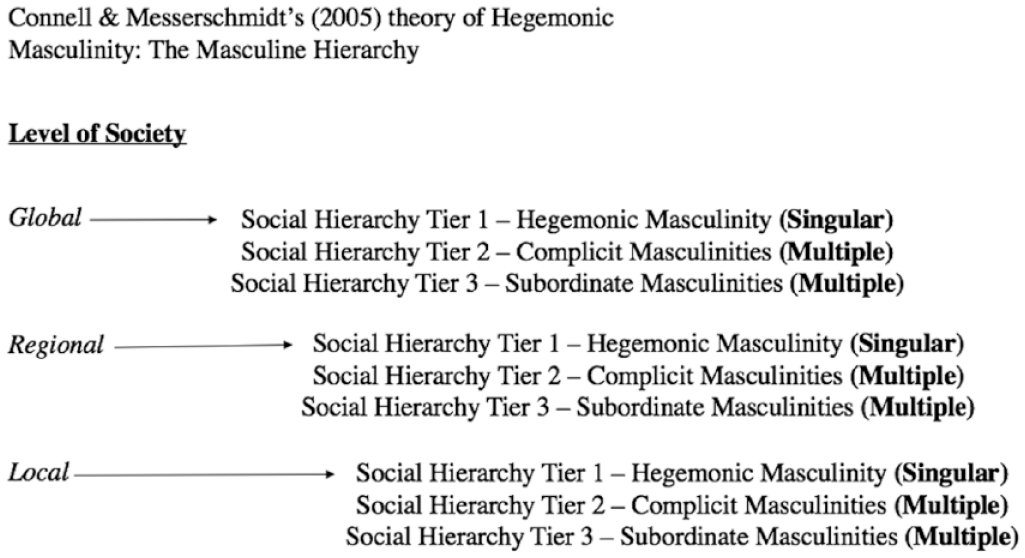
R.W Connell’s Theory of Hegemonic Masculinity: The Masculine Hierarchy.
Despite the prevalence at which HM theory is applied to make sense of masculine interactions, the theory has been critiqued. For example, Coles (2009) highlights the reductive nature of HM theory, positing that local environments where a single HM is present are rare. Inverse to the “manhood acts” perspective; propagating singular masculinity as culturally dominant (i.e., most revered) may diminish men’s widely-ranged lived experience of shifting masculine negotiations to a singular ruling stereotype. As Connell’s descriptors of men’s “hegemonic” performances of masculinity are largely negative descriptors, this label may unfairly—but readily—become attached to men whose masculinities incorporate contextual components of negative performances—yet are not “hegemonic.” Likewise, negative male behaviors may incorrectly be upheld as evidence for hegemony, especially in contexts where men themselves are not questioned on the motivations of their practices and linkages to self-defined ideals of masculinity. Such thinking is present in some existing studies (Ely and Meyerson 2010; Filteau 2014), yet resisted in others (Eastman 2012; Ezzell 2012). Other scholars have focused on the dichotomic “dynamic yet static” attributes of HM (Howson 2006; Moller 2007; Wetherell and Edley 2009). Discourse suggests that while Connell maintains the dynamic nature of HM, how this identity is located and defined through behavioral examples aligns more closely with a fixed and stable character type that recurrently performs in predictable ways aligned with HM descriptors (e.g., prioritizing skilled bodily activity, confrontation, dominance, conflict and aggression, and pro-risk behaviors). This is inverse to “manhood acts” discourses emphasizing fluidity in men’s construction and negotiation processes for masculine configurations, as dependent on contextual performances and identity renegotiations (Schrock and Schwalbe 2009; Sumerau 2012).
On Point Delta, two distinct cultures of masculinity shared co-local dominance. Both dominant cultures conceptualized their masculinities in different ways; defining what it means to be an oilman through disparate conceptions. While safety was enacted as a collective cultural norm within both cultures, the performance of safety was not reflective of a singular “positive safety masculinity.” Findings depart from the singular dominant masculine perspective in some existing studies (Abrahamsson and Johansson 2006; Barrett 1996; Hinojosa 2010). Alternatively, some scholars focus on reformations of HM, suggesting dominant masculinity is changeable but remains singular. For example, Ely and Meyerson (2010) suggested “doing gender” in the oilfield represented a singular identity largely intertwined with risk-taking and traditional hypermasculinity, before undergoing rapid reformulation—following enforced safety policy changes—to represent a single ruling safety-focused identity. Comparable perspectives are shared in other oilfield studies (Filteau 2014, 2015). Converse to these positions, masculine reformations on Point Delta cannot be accurately described as a “clean” recombination of collective institutional identity from a previously accepted “risky” HM toward a single safety-focused “non-hegemonic” dominant masculinity. Nor is it possible to collapse the diverse masculinities on Point Delta into single overarching masculinity that can be described as holding dominance within the oilfield. While such descriptions depict a “neat” classification well-fitting with Connell’s HM theory, oilmen themselves demonstrated the past hegemonic “Tiger” masculinity ultimately fragmented into a set of new, and different local masculinities in the wake of Piper Alpha, technical oilfield advances, and ever-increasing safety pressures. Further, as opposed to safety pressures causing active resistance and lending stability to the existing “oilman identity” (Collinson 1999), or encouraging rapid reformulation of one dominant masculinity to another (Ely and Meyerson 2010), oilmen gradually constructed their own definitions of oilfield identity and gravitated into distinct masculine cultural groups. Importantly, none of the masculine cultures on Point Delta share hallmarks with Connell’s theoretical depictions of HM (Connell 2005). Oilmen belonging to the three positive cultures self-identified as performing safety behaviors but fulfilling different and distinctly separated notions of masculinities. The same is true of the third culture of “risky masculinities.” The risk performances of these oilmen were employed to resist the dominance and support of the three other cultures, and to affirm the “risky masculinity” motif of this minority group.
Connell contends HM is ever-present, in some form or another in all social spaces (Connell 2005; Connell and Messerschmidt 2005). Connell’s earlier publications suggest a literal translation of Gramsci’s (1971) hegemonic notions of macro-societal dominance within specific cultural circles, as applied to the shared dominance of largely normative masculinity through ideologically repressive means (Carrigan, Connell, and Lee 1985; Connell 1994, 1995). Over time this argument has grown to define western HM as primarily attached to displays of strength, courage, competitiveness, physical domination, aggression, and emotional stoicism (Connell 2005). Notions exist as natural enactments of ideologically “time honored” dominant masculine behaviors, propagated by an embedded societal gender divide that manifests through a range of performed patriarchal processes (Connell 2005; Messerschmidt 2018).
Connell suggests HM is present at each level of society and only one, singular notion may be contextually and locally dominant. This prevents the two codominant local-level masculinities on Point Delta from being considered hegemonic, each developing from distinctly different sensemaking and understandings of identity, as explained by oilmen themselves. These dominant identities are also divorced from any common hegemonic descriptors. The complicit notion of respect-based masculinities holds no identifiers with either Gramsci or Connell’s notions of hegemony and therefore retains its label as a complicit, supporting identity for the two dominant notions. The risky, and most marginalized notion of oilfield masculinity may exhibit some markers of Connell’s hegemonic concepts—that is, performances of behaviors Connell recurrently employs to define HM (Connell 2005). However, this identity is subordinated offshore and carries no characteristics that define this identity as culturally hegemonic (Connell 2005, 2009). Developed using these findings, Figure 6 presents a model of oilmen’s multiple cultural masculinities, as represented on the Point Delta oilfield platform:
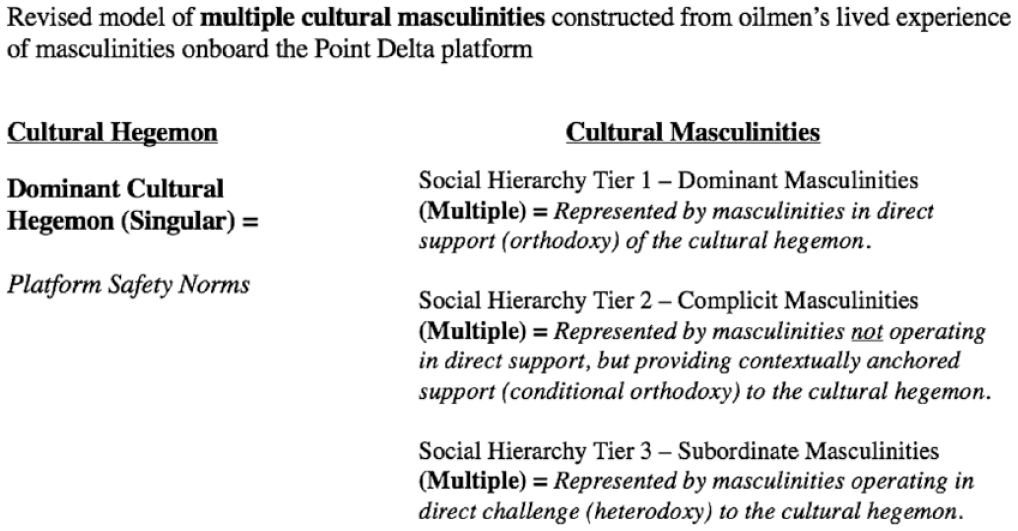
Revised Model of Multiple Cultural Masculinities.
Figure 6 presents a reconceptualization of the term hegemony. To account for the inability of HM theory to fit findings, the model splits Connell’s notion of local HM into the parallel concepts of Cultural Hegemony (on the left) and Cultural Masculinities (on the right). The concept of Cultural Hegemony depicts the most locally subscribed notions and practices that oilmen used to inform, make sense of, enact and uphold their masculine identities on Point Delta. This hegemon construct is represented by Point Delta’s safety norms. Oilmen conceptualized safety norms as the ruling and dominant “hegemonic” motif of the oilfield. Multiple Cultural Masculinities (on the right) depict a modified model of Connell’s original local-level masculine hierarchy. Masculinities in immediate orthodoxy (subscription and support) to safety notions, while representing two fundamentally different cultures of masculinity, operated as the multiple, parallel, and complementary dominant masculinities that “ruled” the oilfield. These masculinities were locally revered, upheld, and subscribed to, and most oilmen strove to attain these identities. Masculinities lending contextual, complicit support to these dominant masculinities (i.e., respect-based masculinities), are positioned at the mid-level of this model. Lastly, masculinities operating in direct heterodoxy (challenge) to the two parallel dominant masculinities represent the subordinate tier of the cultural masculinities hierarchy. This model allows for multiple dominant cultures of masculinity to exist in parallel as the most subscribed and revered notions of identity on Point Delta, yet without defining these—or any—of the masculine cultures on Point Delta as singular or hegemonic.
Conclusion
Much research on institutional masculinities in high-risk, male-dominated workplaces uses R.W. Connell’s theory of HM as a lens to inform, interpret and develop findings. While HM theory is highly popular and useful, blanket applications may obscure multiple masculinities, their complexities, interactions, and configurations in workplaces assumed to naturally be governed by a stereotypical and singular “hegemonic” masculinity. Emerging research in the “manhood acts” tradition dislocates the static nature applied to the hegemonic descriptor in some masculinities research, realigning this with the concept of fluid and dynamic masculine identity negotiations. Despite this, no existing research in this cannon explores men’s identity negotiations and interactions in high-risk workspaces. This study focused uniquely on the oft-stereotyped locale of a UKNS drilling platform. On Point Delta, four distinct cultures of masculinity existed. Two shared mutual local-cultural dominance by setting a new standard for safety behaviors as normative masculine performances. One culture was complicit as a supporting identity structure, and one culture resisted the dominance of the two codominant and one complicit culture, resulting in this cultures’ subordination. While all three “positive” masculinities performed comparable safety behaviors, they nevertheless comprised unique cultural masculine identities that cannot be grouped into a singular hegemonic or non-hegemonic “safety masculinity.” This is a distinct position that departs from some existing industrial research in the HM tradition. The identity construction processes revealed by oilmen during ethnography marked each culture as distinct and different. Findings suggest that contemporary masculinities, even in the seemingly insular locale of an isolated, male-dominated, and dangerous drilling platform, are too numerous in their properties and diversities to be constrained into a narrow theoretical framework that accounts for only one locally dominant identity.
Future research within both HM-theorizing and “manhood acts” discourses may make use of the theorizing presented in this research. Importantly—in some workplaces—multiple cultural masculinities can exist and share contextual parallel dominance via connections with a local concept of hegemony that is divorced—yet interacts with—a hierarchy of local masculinities. This approach avoids unfairly categorizing men into narrow “hegemonic,” “non-hegemonic,” “dominant,” or “non-dominant” identity descriptors, which if men are asked, observed, and suitably studied, they may themselves reject in favor of recounting more nuanced and complex understandings of gendered belonging. While some “manhood acts” scholarship depicts identities concurrently resisting—and supporting—“hegemonic masculinity,” the theorizing in this study furthers this line of thought by providing a pathway to clarify negotiating processes, via combining Connell’s hierarchical structuring with the freedom and fluidity of the dynamic multiple-masculinities perspective. Frustratingly, some existing scholarship appears to see researchers eschew directly asking men about their masculinities and what it means to be a man. Some scholars attribute masculine identities, identity typing, and interactions only upon return from the field of study—having only asked men about behaviors and workplace trends: not their masculinities and masculine understandings. This research resists this trend, and instead, has focused on telling the story of oilmen’s masculinities on Point Delta; their transitions, presentations, and interactions through the voices of oilmen themselves, as they recount their own understandings of oilman identity, labor, and masculinities. I suggest future scholars consider this “open and embedded” position of sociological storytelling to enhance the quality, authenticity, and sociological relevance when conducting future men and masculinities research on the same or similar topic.
Footnotes
Acknowledgements
I most sincerely thank all the onshore and offshore oilmen who took part in this research. None of this research would have been possible without your support and participation.
Declaration of Conflicting Interests
The author declared no potential conflicts of interest with respect to the research, authorship, and/or publication of this article.
Funding
The author disclosed receipt of the following financial support for the research, authorship, and/or publication of this article: Primary research was conducted as part of my ESRC (Economic and Social Research Council) funded doctoral research at Aberdeen University, Scotland. ESRC grant number: 1800896. My PhD was awarded in November 2019.
