




Abstract
This article is based on ethnographic fieldwork, focusing on the processes and practices of cuddle parties. Data was collected from a combination of participant-observation, interviews, and diaries aimed to understand and interpret this unique form of intimate interaction. By disentangling bodily disciplines and dramaturgical (self-)presentations, this study explores how and to what extent cuddle party participants embody safe and nonsexual touch experiences in forms of “playful” interaction rituals. Alongside the chance for participants to explore bodies, with permission, this study concludes that cuddle parties are experiential, bounded playgrounds where both intimacy and touch are (re)created in the context of loosened normative, relational, and sexual constraints.
It all started in New York in 2004 when two relationship coaches launched their first formal cuddle party. Now, with cuddle facilitators all over the globe, the idea of cuddle parties has percolated in Western countries. A cuddle “facilitator” invites and hosts people, normally strangers, who gather in a room and spend two or more hours experiencing intimacy. A cuddle party is however more than a bunch of people lying close to each other and wrapping their arms around their bodies. This article makes it clear that it is not only the art of cuddling that attracts people to this social gathering.
At its core, a cuddle party delineates a zone within which participants have the opportunity to place and step out of personal and social constraints. Such zooning provides a space for platonic and relatively consensual touch in a nonthreatening, shared, and affirming environment that fosters better communication for participants when articulating their wants and needs. I have set foot in public places to cuddle and explored how cuddle party participants create intimate encounters with the purpose of experiencing touch: how and to what extent cuddle party participants embody safe and nonsexual touch experiences.
In this article, I draw from my ethnographic fieldwork, including written narratives of participants, to show the ways in which touch experiences figure in the definition and acknowledgment of space and boundaries. The ability to hold one’s space and know its boundaries are, I argue, central to how people reflexively engage with their own embodied state and that of others as it has the power to demarcate the “territories of the self” (Goffman 1971). In the interaction context of cuddle parties, this involves issues of regulating and performing social bodies (Crossley 2005; Foucault 1977; Goffman 1971) in such a way as to facilitate authentic requests and responses.
Space and Boundaries
A key issue that helps understand the meaning of cuddle parties is the significance of space in relation to the body and touch. While there are existing theories of the body and the sensation of touch (Crossley 2005; Scott and Morgan 1993; Shilling 2003; Synnott 1993; Turner 2008), they tell us little about the role of touch in locating, partitioning, and preserving personal space. In this section, I draw inspiration from the work of Erving Goffman and Georg Simmel, which I argue embody a veritable treasure trove of theoretical approaches to spaces of touch. As I demonstrate later in the article, the playful forms of interaction rituals performed at cuddle parties bring the spaces of touch to life and yet endow the concept of space and boundaries with a new meaning.
In Relations in Public, Goffman places the self in concepts of “preserves” and “markers” that shape spatial claims and form the nexus of relations to others. These concepts, to hijack Goffman (1971, 29), do not necessarily have to be spatial since it is also “useful to focus on situational and egocentric territoriality.” In interpreting Goffman’s “territorialities,” we must thus consider, and deal with what is somehow central to the subjective sense that the individual has concerning his selfhood, his ego, the part of himself with which he identifies his positive feelings. [. . .] An apparently self-determined, active deciding as to how one’s preserves will be used allows these preserves to provide the bases of a ritual idiom. (Goffman 1971, 60)
The point here is that self-determination is crucial to one’s sense of “territorialities,” which must be preserved, protected, and defended. Yet, we must not only be wary against intrusions or violations of our territories but also be cautious not to trespass those of others. The mutual efforts to preserve one’s territories underlines Georg Simmel’s approaches to localize forms of social interaction in space. For Simmel (1908), space is in itself of no effect (wirkungslose Form) rather are the “reciprocal effects” of physical proximity and physical distance what give space a specific function in human interaction. Such notion of space gives room to a process in which people both define their own territory and are influenced by the closeness of the territory of others.
Boundaries or “markers” particularly allow us to “announce a territorial claim” and control who is allowed in and who is to be kept out (Goffman 1971, 41). Similarly, Simmel speaks of “social boundaries” through which we achieve “clarity and security” in reciprocal relationships (Simmel, Frisby, and Featherstone 1997, 144). Boundaries are, as Goffman (1971, 42–43) claimed, “especially delicate in connection with the territorial functioning of the body.” He continuous that the body is not only a preserve but also a central marker of various preserves-personal space, stall, turn, and personal effects. This becomes especially evident when the preserve in question is claimed not merely for the possessor of the body but for a multi-person party of which the possessor is only one member.
What Goffman tells us about the body as a “central marker” clearly intersects with Sanford Lyman’s and Marvin Scott’s conception of “body territories:” The body is “the most private and inviolate of territories belonging to the individual” that is protected by “the rights to view and touch the body” (1967, 241). Drawing upon the ideas of territorialities allows me to situate the intersecting concepts of body space and touch within the “multi-person” place of cuddle parties.
Cuddle parties emphasize personal space and boundaries within a range of performative rituals that contextualize the sensation of touch. The participants use their body as a “central marker” to make claim to their personal space; its “boundary marker” that determines who may or may not touch it. In other words, cuddle party participants have to follow strict rules in order to enter the body territory of others and, by following them, can only lay hands on other bodies “if you can,” that is, with permission. Here, the meaning of touch in interaction is mirrored in discussions of connection, boundaries, and consent—to which I will now turn.
Touch through Boundaries
Touch is culturally laden with normative tensions and sexual anticipations and thus needs to be contextualized, regulated, and confined (Classen 2012; Harvey 2003). What is a normal touch in one country/culture may be unheard of in another. Even the kind of touch that feels wonderful to you may be unwanted or unsatisfying to someone else. Or vice versa, you endure unpleasant touch experiences just because you want to please the other person. Indeed, “tactility in our culture is radically ambiguous, decisively cleaved into acceptable and unacceptable, appropriate and inappropriate” (Paterson 2016, 162). However, under normal circumstances, pleasant nurturing and affectionate touch firms up social bonds while simultaneously influences feelings of well-being, physical, emotional and intellectual development, and health (Beßler et al. 2020; Field 2010, 2019).
Sometimes it is enough just to hold someone tight to grasp the notion that touch experiences create connection both physically and symbolically. In a broad sense, many individuals can even be touched by listening to music, by a vulnerable verbal share, or by a sunset. Similarly, many individuals can be touched by eye gazing, hugging, and physical connection, articulating the variety and variability of touching experiences (Paterson and Dodge 2016). “Touch makes our bodies more-than-one,” as Kinnunen and Kolehmainen (2019, 34) notably stated, “one cannot touch without being touched.”
Tania Kinnunen’s and Marjo Kolehmainen’s (2019, 49) touch biographies underline the relational nature of physically intimate experiences in showing how “touch works in and between bodies through affects.” For most of the biographical writers, touch experiences shaped a repertoire of affective ties to the self and others, including accounts of healing and transformation as well as narratives of trauma and immobilization. Such (un)just effects of “affective dramas” (Waskul and Vannini 2013, 207–8) foreground the consent to touch in creating connection and boundaries.
Although a cuddle party might become clearer through the relational, emotional, and therapeutic aspects of touch (Field 2019; Paterson 2016), it is the consent to touch in accessing and awakening people’s wants, thereby defining limits. Betty Martin argues that “people often confuse consent with permission” and therefore agree to something someone else wants (Martin 2021, 368). Consent entails, however, much more than a permission or an agreement obtained from someone or something. Martin suggests that we need to be clearer about our own wants, boundaries, and limits as well as accurate in verbalizing those in order to arrive at consent together.
The language of consent puts a different emphasis on touch, rather than just accepting or enduring the affective qualities of tactile experiences (Goffman 1956; Kinnunen and Kolehmainen 2019), it instead foregrounds its modality for arriving at consensual understandings of what constitutes an agreed “touch system” (Goffman 1956, 488). The consent to touch is, I argue, central to how people feel empowered to make decisions about their bodies and personal space. By approaching cuddle parties within this consent framework, I show the ways people develop to jointly agree around a set of shared norms and values based on using touch.
This article does not concern itself directly with the role and sensual experiences of touch, touch aversion, or touch deprivation for people who may engage in this service as a form of therapy. Rather, I seek to showcase the impressive performance of intimate bodies demarcating their personal spaces in terms of their wants and the “de-sexualization” of touch that emerges in this circumstance. Precisely because cuddle party participants negotiate their wants in relation to touch, there is a question about the extent to which we may conclude that this activity is a merely platonic grouping of consenting adults by which touch is experienced as nonsexual sense. It is this that I turn to now.
Cuddle Party: The Bounded Space of Nonsexual Touch
A “de-sexualization” of touch becomes more fully fleshed out in what Waskul and Vannini (2013) called the “performative body.” In trying to explain why people are inclined to uphold interaction order in potentially sexually laden situations, Waskul and Vannini (2013, 203) suggest “rites of allegiance” to describe the upkeep on civilized, performative actions. Rites of allegiance involve actions of ritualized teamwork enacted, for instance, by a gynecologist and a patient. Both, doctor and patient, give a mutual impression (Goffman 1959) of normative decency, which serves to desexualize the bodies’ erogenous zones, preventing potential threats to the private “territories of the self” (Goffman 1971, 115).
Following Waskul’s and Vannini’s idea, we can see various forms of viable strategies through which the body contact between the participants in delicate social worlds (Unruh 1979) remains nonsexual. Comparable studies of swimming pools (Scott 2010), nude beaches (Douglas, Rasmussen, and Flanagan 1977), saunas (Edelsward 1991), or massages (Purcell 2013) have pointed to ways in which people claim their personal space and draw physical and verbal boundaries around their bodies to protect themselves and others from potential (sexual) intrusion. Through her ethnographic work in swimming pools into how the swimmers’ bodies are performatively regulated, Susie Scott (2010, 163) showed the dramaturgical strategies swimmers follow to “create a civilized (desexualized) reading of the body.” Likewise, Carrie Purcell explored how “masseurs developed physical and verbal strategies to maintain the health-oriented and non-sexual status of massage” (2013, 185). While observing and participating in nude beaches Jack Douglas and his colleagues delved into the politics of nudity. Although the nudists in their study viewed the beach as a natural place where no sex was going on, Douglas and his colleagues revealed subtle forms of sexual conduct that were “not simply ‘open to plain view’ but took place in ‘some degree of concealment’” (Douglas et al. 1977, 106).
In the case of cuddle parties, the “ingredients of a sexual event” (Gagnon and Simon 2011, 13) may equally be present, but remain nonsexual; simply put, clothing stays on. The process of desexualization takes vivid form when both hosts and participants aim to make intimate forms of touch, such as cuddling, as orderly as possible through their “scripted” actions and self-controlled behavior. Much like swimming pools or nude beaches, we can theorize a cuddle party as being equally a regulated, ritualized, and bounded space: a willingly agreed nonsexual “interactional territory” that is available to be used within its clearly defined limits (Lyman and Scott 1967).
Once the space is defined and the boundaries are set, forms of nonsexual touch can happen safely and naturally. I want to hold on this concept, as I discuss throughout the article some situations, which either maintain or disrupt the interaction order of nonsexual touch. Having foreground the necessity and rationale for attending to spaces, boundaries, and desexualized touch, the article moves on to introduce the study and outlines the methodological approach.
Methods
This study is an ethnography of the interaction order (Goffman 1983) of cuddle parties. As a participant I personally took part and attended cuddle parties hosted in Vienna and Graz. In Austria, these gatherings only began a few years ago and are still relatively unknown to the general public. I used a grounded and emergent approach to understand and interpret what was happening at these events and how people physically interact with each other. In order to reach a sufficient level of understanding I fully involved myself in all activities that comprise a cuddle party. In truth, because people usually go to cuddle parties to physically engage themselves with others, I could not merely observe, and that would have rendered me deviant within these environments (Simmel 1964).
In doing this kind of research, one must be prepared to be both a “stranger and a friend” among the people I studied (Jarvie 1969, 505). However, I encountered ethical dilemmas in simultaneously observing participants and joining their activities. Because it is morally questionable to blend into the cuddle community without letting the participants know about the true intentions of my attendance, I told the participants about my research interest in attending cuddle parties during the welcome circle.
In addition to the participant observation data, this research also collected data from interviews with cuddle party hosts. Interview questions related to issues, problems, and concerns pertaining to organizing and conducting cuddle parties. Beyond the information provided by the interviews, I invited participants in cuddle parties and hosts to produce written narratives of their experiences. Narrators were gathered through regular contact with the hosts of the cuddle parties, purposive sampling after each cuddle party, snowballing, and through participant invitations in newsletters, on Facebook, and on the website hosted by cuddle party facilitators (Cuddle Party 2020). The website and Facebook enabled easy sharing of information about the study and provided additional material.
All party guests who were interested in the research were asked to keep a diary and were invited to reflect upon their intimate experiences and consequences after each cuddle party they hosted or attended. In order to facilitate the diarists’ sharing of information, I provided the participants a digital platform to enter their narratives. All participants were asked to choose a nickname and to always use this nickname when writing their diary entries. By doing so they were guaranteed anonymity in relation to the information provided. In all, 12 participants supplied a total of 17 narratives.
The diaries were designed to encourage description of experiences after each cuddle party, giving participants the opportunity to express their thoughts in a written narrative. They contained eight initial demographic questions and seven free text questions. Prompt questions asked the participants for their views and reflections on a variety of issues related to their positive and negative experiences, their motives, feelings, difficulties, and how they went about any challenges. Some of the entries were merely descriptive, but others shared reflexive and very intimate sentiments, providing detailed accounts of their interactions with other participants and allowing me to tease out the underlying relational dynamics among the participants.
Data collection and analysis occurred simultaneously (Corbin and Strauss 2015). Data obtained from the field notes, transcribed interviews, and the narratives were analyzed by coding and constant comparative methods. The three coding phases (initial, focused, and theoretical), suggested by Charmaz (2014), were used to define what was happening in the data and to grapple with what it meant. During the initial coding phase I analyzed fragments of data—words and lines. For instance, I coded data pieces with codes like “dealing with insecurity” or “experiencing pivotal moments of self-realization.” Early on, these codes helped me to identify how the participants act, think, and feel while involved in the processes and practices of cuddle parties. I kept on interacting with the data, selecting codes that made the most analytical sense to categorize the participants’ words incisively and completely.
Let’s Get the Party Started
A cuddle party is exactly what the name suggests. People gather in a room, to interact with each other and experience physical closeness over the course of a couple of hours. The cuddle facilitators usually schedule the parties in the evening or afternoon and host it in a private living room or a rented space. The cuddle parties I attended were hosted in a yoga studio. The rooms were beautifully adorned in order to help participants to feel comfortable—lots of soft cushions, carpets, futon mattresses, and warm blankets. Scented candles and relaxing music accompanied the physical environment to help create a cozy atmosphere. Bright shining ceiling lamps provided a clear light, which contributed to a mood that was more cheerful than romantic or sexy.
The rooms were generally spacious, making it possible to divide them into three areas: the “frontstage,” on which the party takes place (Figures 1 and 2); the “backstage,” where the participants greeted and met each other, drank, ate snacks, and changed into more comfortable clothing (Figure 3); and the “comfort zone,” a small touch-free area where someone can back off and move away from all the interactive intimacies (Figure 4). The parties I attended included 10–15 people: usually more men than women, 25–65 years of age, all Caucasian, of different physical sizes and shapes, wearing comfortable, casual clothes. Some of the guests brought their own blankets and pillows.

Frontstage of Vienna Cuddle Party.
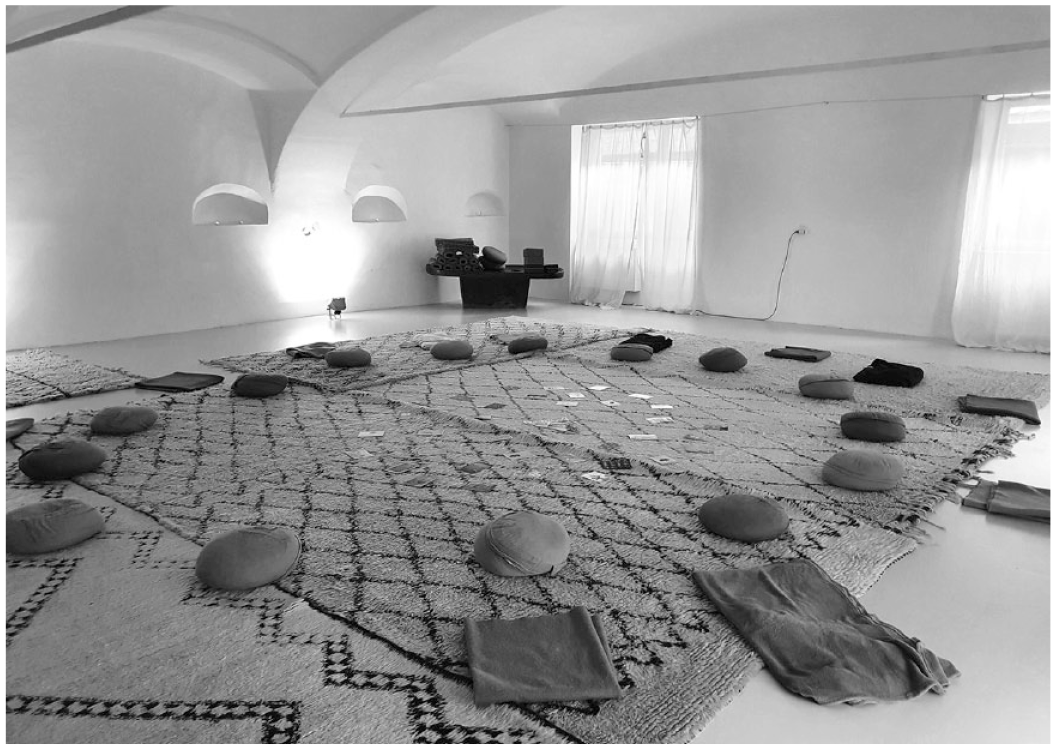
Frontstage of Graz Cuddle Party.
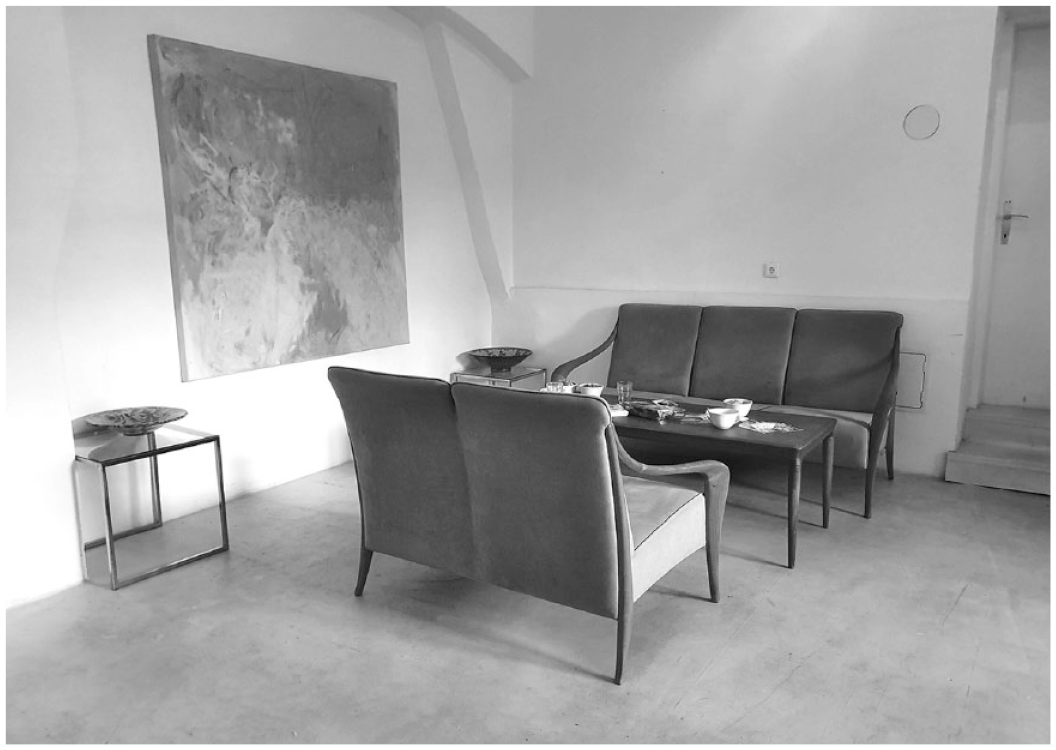
Backstage of Graz Cuddle Party.

Comfort Zone of Graz Cuddle Party.
Initially, all guests gather for a “welcome circle” where they introduce themselves one by one. At this point, not only are the rules of behavior set but also informal exchange develops and becomes a key vehicle for creating and opening the bounded space of touch. The rules include the following: touch is given and received with nonsexual intent, mutual consent, all participants must remain clothed throughout the entire event, and touching of primary erogenous zones is prohibited. The “welcome circle” has an important role in the creation of symbolic ties to people outside close and intimate relations, bringing unfamiliar people into an inner circle of intimacy. The strangeness of the other becomes thereby mingled with an element of acquaintanceship, cushioned by the cozy atmosphere.
The need for mutual respect for each other’s (bodily) territory is emphasized through a focus on the practice of boundaries and consent. Then ritualistic bonding games help members to “work on their Yes’s and No’s,” thereby empowering them to set boundaries, which encourage more respectful touch. As Su, a 39-year-old cuddle party hostess, explained to participants: Let’s start with working on your “Yes’s and No’s.” Sometimes a good first step is to assume “no” first. Imagine something that you truly don’t want to do. Then walk through the room and say “no” whole-heartedly. Be honest and sincere about your feelings. [. . .] Now imagine that you aren’t quite sure of doing something. Keep saying “no” but with uncertainty. [. . .] Finally, imagine something that you truly want to do. Walk through the room and say “yes” whole-heartedly. [. . .] Keep on walking and ask questions to each other. Figure out if your answer is really a “yes” or a “no.” (field notes, cuddle party Graz, February 15th, 2020)
These ritualistic playful methods allow people to socialize, get settled, and practice consent to a degree that still protects the “territory of the self” (Goffman 1971, 115, 1989). All participants learn to manage and perform their bodies defensively (to protect themselves from intrusion), protectively (to respect others), and freely (to display affection). These activities can be understood as a ritualistic process that creates mutual, cooperative concern, and a collective agreement on refusing and accepting offers of physical contact without emotionally hurting or forcing someone to touch (Martin 2021).
In Simmel’s terms (1971), these are the patterned forms of sociation that characterize reciprocal interaction, involving or based on mutual consent. Touch can then be collectively enjoyed as an entangled play of consent and refusal. Among the participants of cuddle parties, conventions of tact and self-awareness place definite limits on any forms of harm through practice in formulating choices and boundaries. Consensus is the focal point of cuddle parties.
Human Connections Start with a Friendly Touch
After working playfully on their “Yes’s and No’s,” all participants were invited to indulge in the pleasure of experiencing touch. In the context of the cuddle parties I attended, this meant diving into groups of three and laying hands on one participant who could choose to sit or lie down on a mattress. This person had to be blindfolded and, therefore, did not know which two other participants were gently touching his or her body. All participants had to remain quiet, except those being touched, who could say where they would permit touch. This form of touch experience fostered full embodiment, unifying the participants in a moment of negotiated touch. However, being literally left in the hands of others reduces the body to an object. Even I felt vulnerable lying on a cozy mattress, blindfold, and feeling four strong hands softly stroking my entire body.
With human embodiments, the body is always both an object and a subject (Synnott 1993; Waskul and Vannini 2006). In the words of Waskul and Vannini (2006, 3), embodiment in the context of cuddle parties “refers quite precisely to the process by which the object-body is actively experienced, produced, sustained, and/or transformed as a subject-body.” As such, participants of cuddle parties act and interact with their body and the bodies of others as an object in order to achieve the experience of the body as a subject. By being blindfolded, the participants put themselves in the hands of others and reduce the self to the body for the purposes of reciprocating intense feelings of intimacy. This performative body, defined by Waskul and Vannini (2013, 199) as the “body [that] is literally real(ized) and made meaningful” through interaction ritual, serves an individual as well as social function simultaneously.
Although being completely exposed to this novel experience might have made some participants uncomfortable, for the majority, being touched while being blindfolded was a pleasant experience. For example, in the words of one woman whose aching knee I massaged carefully, “Although it feels a bit awkward, not knowing who is touching me, I’d like to thank you. It releases from the pain, it feels great!” Some other participants just wanted to nestle into another body, moaning quietly and savoring the moment. The sharing of kindness and affection that the participants experienced seemed to intensify the emotional value they attributed to the body massage. For example, Sandro, a 34-year-old male participant, stated, “I had to deal with an excess of insecurity coupled with great tension before I could finally create trust, relax, and enjoy the kindness and affection.” Or, as simply stated by another female participant, “I was shy and insecure at the beginning, but gathered courage in order to enjoy the touching moments and finally feel secure.”
These participants claim ineffable value to the experience of receiving touch from strangers, while simultaneously trying to “deal with an excess of insecurity.” The struggle with insecurity seems to be reminiscent of what Lyng (1990) coined as “edgework.” Overall, the defining experience of edgework is based on the voluntary risk-taker who skillfully tries to handle and control precarious situations as they approach to their limits of body and mind. The “edge,” in this sense, places the space-holder on the border between control and non-control, between security and insecurity, between boundary making and boundary breaking. As Lyng (1990, 860) notes, “[. . .] the individual typically feels a significant degree of fear during the initial, anticipatory phases of the experience.” By focusing on the emotionally dynamic experience of being touched while being blindfolded, we can see how the participants of cuddle parties face this fear amid an insecure situation, but to the extent of still being able to skillfully control the situation while holding their personal spaces.
This skillful control is illustrated clearly by Marie, a 28-year-old female participant, who was quick to express her displeasure with the way a person touched her: “If someone wants to stroke me, massage me or whatever, in a way I don’t like it, this person has to stop it immediately or change it.” Another blindfolded male participant who I gave a quick massage said with a smile, “It feels good being touched almost everywhere, except for my belly. It tickles.” Or as the previous participant stated that she had to gather “courage in order to enjoy the touching moments.” Such aspects of gathering courage and quickly expressing someone’s dislikes add to the edgework a sense of confidence. According to Lyng (1990, 860) the edgeworker, once “having survived the challenge,” describes the confrontation with the edge as self-actualizing, self-determining, and transcendental. Receiving touch while being blindfolded may transfigure the body in such a way as to make a feeling of transcendence, in the sense of kindness and trust, possible.
Above all, the massage that ensues while being blindfolded is intended to build trust among the participants. “The purpose of the massage is to learn to trust each other implicitly,” explains Andrea a cuddle party hostess. Andrea further elaborates, “It is trust to the extent that participants can believe and feel that touch is safe and negotiated.” This sense of safety assumes a strict restraint from touching erogenous zones. The mutual faithfulness (Simmel 1964), or consent to touch which feels safe, ultimately depends on three elements: first, the desexualization of touch; second, the ability to verbalize inner sensual experiences, such as desire, feelings, pleasure, or discomfort; and third, the responsibility for one’s own personal space, its boundaries, and limits.
Desexualized Touch, Sensual Expression, and Responsibility
As we move to the final stage of cuddle parties, the “free-style” cuddling, the desexualization of touch becomes more evident. After experiencing and working on communication and boundary skills through games, such as blindfolded touch, the hosts open up the stage for nonsexual cuddling, spooning, massaging, nuzzling, or just hanging out. The participants can practice what they have learned and are free to ask anyone they wish to cuddle with. As I observed in my field notes: There fell a deep silence in the room. Only the sound of breathing and moaning bodies can be heard. I am lying on a mattress finding myself in a trio: a man in his forties with glasses, a bald man possibly in his late fifties and myself. Both men initially stroke my arms. The bald man started to stroke my face and the other one closed up on me. I feel stiff—mentally and physically. I notice that the man with the glasses lying next to me is fully aroused. Glancing up, I see that the others are all nuzzling each other in close embrace. A woman with short brown hair snuggles up to another woman. Their eyes are closed in delicious delight. The bald man turns away from me and begins spooning with two men lying next to him. Now, the man with the glasses embraces my whole body. (field notes, cuddle party Vienna, February 2nd, 2020)
This vignette, reconstructed from notes taken after my field work at a cuddle party hosted in Vienna, illustrates the final part of a cuddle party—free-range cuddling. We see bodies being close to each other regardless of whether they snuggled up to a man or a woman. We see a man being in a state of physical arousal but with no intention to go further. We see people experiencing and enjoying being touched and freely touching other bodies. Taken together, we can observe processes of sensual embodiment by which the body is actively experienced and made meaningful (Jackson and Scott 2010).
A cuddle party is a supportive and safe place to voice one’s emotions, practice the skill of decoding sensations while being touched, and reflexively engage with feelings. All participants have the permission to freely express their emotions without embarrassment or any consequences. When observed, one of the ways participants gave voice to their enjoyment and release stress was by giggling, signing, moaning, or making other noises.
The noisy performance shows the ways in which representations of “sensory embodiment” enter interaction (Jackson and Scott 2010, 148). Similar to the performance of orgasm (Chadwick and van Anders 2017; Jackson and Scott 2007), body sounds made at cuddle parties, such as moaning, giggling, squeaking, grunting and whimpering, signal an internal embodied feeling to others and help to make sense of another’s and one’s own perceived sensations. This performative function of noises may be what makes holding another body close for comfort not only a physical but also an emotionally touching experience. Albeit that with all the touching, the moaning, squeaking, grunting, and whimpering, the setting remains rather nonsexual.
As shown in the literature on asexuality (Scott and Dawson 2015), the cuddle party can clearly indicate the importance of physical closeness even when there is no desire for sex at all. Though the nature of touch is itself a source of intimate affection and physical closeness, the underlying organization is socially desexualized—“normalized”—and it is into this frame cuddle parties have to fit. Like people who practice “civil inattention” (Goffman 1963) toward the nearly half naked bodies of others (Douglas et al. 1977; Scott 2010), cuddle party participants manage themselves and control their sexual arousal and any desire to go further. Put differently, this form of “performative regulation” (Scott 2010) demonstrates how quickly bodies can be made to stop feeling inherently sexual.
That does not mean that sexual feelings do not arise, but the general agreement is that the participants are not going to act on those feelings. Cuddle party hostess Su acknowledges that “subtle forms of sexual acting are of high danger in cuddle parties because of being intimately close to one body. I always calm my participants and emphasize sexual arousal as something natural.” Instead of acting as a deterrent of sexual behavior, Su further stated, “it’s the way you act on your feelings. Try to stay calm and manage it by adjusting cuddle positions.” Paradoxically, this sex positive space allows touch to become sexually discharged and quite ordinary, if treated with such indifference.
A shared definition and adjustment to the setting as safe and nonsexual is important to maintaining the symbolic aspects of cuddle parties: an emphasis on emotional expression and personal commitment. The host/hostess makes it very clear that all emotions are equally welcome, creating a welcoming and congenial atmosphere. Charged with keeping order and policing the intimate interaction, the presence of the hosts is both functional and symbolic. Although each host has his or her own way of organizing a cuddle party, they provide a common set of regulations to govern the performance of intimate bodies by leading the “welcome circle” and teaching conscious touch, communication, and boundary skills. In particular, the host creates the landscape for the cuddle party. “He or she builds the playground and the first thing is to put a fence around it to see where the playground begins and where it ends,” as Adam, a 67-year-old cuddle party facilitator, explained, “then he or she puts the equipment in it [. . .] We create this kind of structure and we do that with our words in a cuddle party; giving the outline, the fences; it is not a sex party.”
It is essential for the desexualization of the atmosphere that one host is always visible within the cuddle “scenery” (Goffman 1959, 1983). This permanent visibility exerts a steady gaze of surveillance over the scene and in so doing induces in the participants a state of conscious self-regulation. With a panoptic gaze the host monitors the “location of bodies in space, [. . .] dealing with a multiplicity of individuals onto whom a task or a particular form of behavior must be imposed” (Foucault 1977, 205). Each participant is aware of the host’s subtle presence, so all of them avoid encroaching on the territory of others and can feel safe. What renders the environment safe are not primarily the rules but the way the facilitator makes him or herself familiar with the group and watches over the intensities of feeling by keeping an eye on participants who look sad, who look confused, or who look overwhelmed.
Intimate encounters with strangers at a cuddle party can typically bring about contradictory emotions: sincerity, joy, and tenderness but also anxiety, shame, awkwardness, and associated instances of annoyance and skepticism. This emotional interplay entails important forms of performative and sensory embodiment (Jackson and Scott 2010, 148; Waskul and Vannini 2013), whereby one does not only monitor bodily deportment but also manage and reflexively make sense of feelings. As a participant in a cuddle party, I experienced an ambiguous scenario by myself in which I was “lying close to the man with the glasses and feeling that he’s being aroused.” I was struggling with projecting a socially expected persona, while simultaneously being afraid of being misperceived: I kept on cuddling with him, albeit reluctantly. I couldn’t let go of this uncomfortable feeling, so I tried not to show it to him. I thought about how to leave him without hurting his feelings. But I couldn’t do this, so I kept on cuddling for his sake. (field notes, cuddle party Vienna, February 2nd, 2020)
Katharina, a 30-year-old female participant, equally reflected on her experiences with another participant while at the same time experiencing discomfort and uneasiness: Although I didn’t feel quite the same as he did, we cuddled for about one and a half hours. But it wasn’t quite pleasant for me. It felt like I don’t want to be touched right now. I couldn’t really let go. I was lazy or simply too shy to tell him. Didn’t know how to get away from him nicely without hurting his feelings. So, I kept on cuddling with him.
What makes the experience recognizable as unpleasant was first the participant’s sensory perception, and second, the strained interaction. Being “lazy or simply too shy to tell him” and thus remaining quiet becomes a form of deceit or resentment when it comes to masking the potential disruption of interaction order.
Similar ideas are explored in accounts of secrecy (Smart 2011), as a form of information that is intentionally withheld and hidden from others, indicating the desire to maintain relationships. Compared to secrets, this form of silence is distinct in that cuddle party participants misleadingly engage in a “false performance” as a result of the vulnerability associated with disclosure and a clear expression of one’s feelings. “An ambiguity thus results,” as Goffman (1971, 207) might conclude, “but this derives not from some lack of consensus, failure of communication, or breakdown in social organization, but from competent participation in the relationship game.”
A participation in the cuddle game underlines the importance to sincerely express body needs (“I don’t want to be touched right now”). This creates a routine to truly enact and voice oneself. In her study on deception, Susie Scott (2012) concluded that actions that purposefully hide the truth can somehow be beneficial to intimate relationships, but can also become oppressive and destructive. Unlike the benefits we may gain from purposefully hiding the truth, “false performances” and practices of silence acted out by participants at cuddle parties lead to grudging actions and feelings unwillingly embodied. Thus, the consensual social construction of touch is not always that genuine or static.
That is why “everyone is responsible for him or herself,” as a 26-year-old male participant indicated, “and of course, it can also be frustrating, dissatisfying, annoying.” At cuddle parties, touch experiences may be either pleasantly fulfilling or dissatisfying and annoying, depending upon individual expectations and expressions. Beneath the façade of negotiated nonsexual touch are “wanting” creatures and being able to be comfortable with saying and hearing “no” is a very important skill to learn.
Participants at cuddle parties not only strive to deal with a bundle of emotions, embody and voice their feelings and desires but also need to reflect on the embodied actions of others (Jackson and Scott 2010; Mead 1934). Thus, participants govern their own bodies and are responsible for themselves by embodying their true wants to each other while simultaneously being part in a reflexive interplay with the desires of others. Touch seems just to be a component of the interpersonal intimacy, charged by positive and negative emotions that are achieved through getting closer to the bodily territories of others.
Want to Break Free
Cuddle parties fulfil the need for touch by bringing the bodies of strangers together in close proximity, but there is something special about the way in which these social gatherings conflate space and boundaries. The sense of touch seemingly moves participants in ways that will get them closer to affinity and connection. As Andrea stated: It’s about making friends. A cuddle party embodies friendship. You meet with complete strangers, all have prejudices, concerns, doubts, and so on. But being together with them for several hours, getting closer, makes people loose boundaries, break barriers, and bridges a gap between them.
In this sense, participants of cuddle parties learn not only how to set boundaries but also how to break through them—“to break free from sexual expectations,” as a 41-year-old male participant stated, and goes on to say “I enjoy cuddling without demonstrating sexual prowess, just let go of all your sorrows.”
Some other participants described how regulated nonsexual touch was used as a mode through which having physical body contact was experienced as comforting without any sexual commitment: We were having a nice little chat right from the beginning. During the time designated for cuddling, I felt a little overlooked. That’s when he approached me and asked if he could lie down next to me. At this moment I didn’t know that is was him. Not until we got closer to each other, did I recognize his face. We became friends and ended up having a lovely conversation. The cuddling was very comforting without any sexual commitment. After being single for a long time it felt good to be in close contact with someone. Just cuddling with her, getting to know her better without any sexual expectations.
“Just cuddling” with someone not only frees participants from obligations to perform well, and to show sexual prowess (Jackson and Scott 2004, 2007), but was sometimes just another way of doing friendship and getting to know someone better. The narratives above are engaging, for they offer an account of how the participants became friends with other guests at a cuddle party after cuddling with them without sexual expectations.
Group dynamics can vividly change before and after the cuddle party. At one party, for instance, several newcomers began the evening sitting stiffly on a huge, L-shaped couch making languid small-talk. This distance from a sense of closeness was reminiscent of that of the stranger (Simmel 1964). Being complete strangers to each other, they were part of a group and yet remained distant from each other. By the time everyone participated in the activities and was embraced by collective joviality; however, they felt closer to each other. Much like the social benefits of a Finnish sauna (Edelsward 1991, 197), the interaction rituals at cuddle parties facilitate “the transition from impersonal relations to social relations, from public behaviour to friendship behaviour.” For the time being in a cuddle party, the participants loose constraints in such a way as that bridged the gap between distance and closeness.
Observing men’s and women’s bodies getting closer and closer to each other may literally illustrate the loss of boundaries between the participants, but simultaneously may challenge the desexualization of intimate bodies. Unlike orgies or swinger clubs, where the participation is undeniably and obviously about sex, the interaction at cuddle parties can be enticing and erotically charged in a much subtler manner: Cuddling with him felt completely different, but in a very positive, almost enticing, interesting way. He then asked me out for dinner, after cuddling about 20 minutes. He asked me whether I fancy being his private masseur after the party.
Participants softly touch, gently fondle, quietly moan, and thereby (un)intentionally feel up each other’s bodies, giving cuddle parties a delicate sexual overtone—but with the added twist of being safe and non-suggestive. Cuddle parties are thus a facilitator of deeply emotional touch experiences (Hochschild 1979) without sex or uproarious behavior ever being present. It is, however, “not unusual to find someone with whom you would like to go further,” as Andrea remembered, “once there were participants who fondled each other too extensively.” In such a case, the host/ess politely asks them to change position or to continue nonregulated cuddling somewhere else after the party. That said, disciplined bodies (Foucault 1977; Frank 2001) are necessary to maintain the sense that a cuddle party is nonsexual.
Paradoxically, the desexualization at cuddle parties can be thought of as the doing of “omnivore” intimacy (Ryan and Jethá 2010). This is implicated in gender performances. The majority of male and female participants at cuddle parties may seek intimacy by redefining the meaning of cuddling as nonsexual and non-gendered, so that they can engage in cuddle groups with both sexes more comfortably. During the free-range cuddling, when the party started getting very intimate, men and women laid down and nestled their bodies in other bodies, forming “puppy piles” on a big futon mattress. Piles of women cheerfully curling around each other and men calmly spooning with other men and women. “It’s fascinating and surprisingly great to be touched by a man,” a heterosexual male participant noticed, “I didn’t know how sensitive a man can be.” Through fondling, holding, spooning with same-sex people, gender binaries fuse to create new forms of intimacy and sexual identities (Butler 2011).
The freedom to embody sexless physical intimacy enables men and women to become equal to each other and cuddle in the gender and body diversity at cuddle parties. As Andrea explained: My guests usually perceive cuddling as an act of relaxation, well-being, emotional expression, rather than as sexual fluidity. We are all the same. My guests become equal to each other for they share the same interest—they just want to experience touch.
Clearly participants at cuddle parties are not the same in the sense that they all look and behave in the same way. Hijacking from Andrea’s words, “we are all the same,” magnifies the emphasis on sharing the same interest—experiencing touch. A cuddle party opens up a safe, exploratory room for “just” meeting and interacting with people by taking out the sexual nature.
“I’ve had people of all ethnicities, and body types, and abilities, attending cuddle parties,” as Adam described, “what I notice mostly was that there was a sense of curiosity.” The interest—or “sense of curiosity”—in interacting with different people is crucial to understanding what kind of meaning the participant as an individual is bringing to touch. As the narrative of a transsexual person indicated, “I want to find out whether the other person feels like cuddling with a man or a woman when I lie close to someone.” Or Heid, a 59-year-old male participant, “just wanted to cuddle” and “did not care about any attributes, be it a man, woman, young, old.”
As Jackson and Scott (2010, 148) would say, the ability to feel comfortable “requires a reflexive engagement with our own embodied state,” asking oneself whether it would feel different to touch another body that is of different race, gender, age, shape, or height. That is to say, participants at cuddle parties “practice in, on and through their bodies” (Turner 2008, 207). This practice of decoding sensations (being touched) and noticing internal states (genuine “yes” or “no”) puts an element of agency in the freedom to explore bodies and touch with permission.
Conclusion
Drawing upon ethnographically informed research in cuddle parties, this article has aimed to bring these social gatherings under a sociological lens. Placing the concept of territorialities (Goffman 1971; Lyman and Scott 1967; Simmel 1971) in dialogue with the consent to touch opened up a novel way of thinking about the body, space and boundaries. I emphasized the ways in which the experiences of nonsexual touch are embodied in “performative body” rituals that are shaped by spatial and verbal boundary markers. It is precisely out of the processes in which cuddle party participants give meaning to their bodily territories and negotiate their wants in relation to touch that feelings of safety and trust can emerge. In these effervescent experiences the cuddling with strangers can happen quite naturally.
The study underlines Goffman’s territorialities and Simmel’s concept of space on the most sensual of levels, showing that touch experiences at cuddle parties are bounded within a sphere of “collective effervescence” that can be inhabited as embodied synchrony (Durkheim 1995). Participants support this interactional synchrony through ritual doing; by adjusting their wants, body sensations, and responses to arrive at consent together and be “in sync” with those around them. In this form of (self-)reflected body engagement (Mead 1934) participants create their personal space “in a manner in which they express themselves in interaction with similarly expressive others” (Brissett and Edgley 1990, 3). The inherent feelings of safety, sameness, comfort, and connection induced by these experiences, empower the participants to regain their voices, to approach to their own edges (Lyng 1990), to freely explore nonsexual touch with permission, and even to break barriers and transcend their limits to experience it.
As a result of this form of synchrony, Durkheim might suggest that the participants “believe they have been swept up into a world entirely different from the one they have before their eyes” (1995, 228). Significantly, a cuddle party, I argue, can be seen as inhabiting a separate world, an interim bounded space—or playground, if you like—where participants can escape from unpleasant tactile experiences and return to the nurturing kindness of touch that is freed from the chains of normative, relational, and sexual constraints. Cuddle parties may challenge thus our thinking about heteronormativity (Warner 2011) and “normalcy” (Davis 1995).
In the words of Giddens (1992, 27), “the breaking of these connections [. . .]” can be “a phenomenon with truly radical implication” on the meaning of the body, intimacy, and touch. But even so, as extraordinary, transformative and liberating a cuddle party might be in playfully seeking to (re)create the routine practices of touch, it ultimately reinstates an orderly and “civilized” etiquette of touch. As with any body comportment, rituals, and interactions (Goffman 1971), cuddle parties rely for their operation not so much on what touch means but rather on dramaturgical strategies, comprising rule-following, disciplined, and performative bodies that respect the territory of the self and others.
Potential for Further Research
This article is based on a small-scale exploratory study in a particular cultural context. It has made an important intervention into a newly emerging activity, but further sociological analysis is needed to fully understand the relationship between social and cultural understandings of intimacy and touch in different social and cultural contexts, and for individuals with differing social positions and experiences, and the embodied interactions played out in cuddle parties. In particular more detailed analysis of gender and sexuality in the regulation and creation of intimate experiences at cuddle parties is essential to further understanding. For people among the asexuality spectrum, for instance, the meaning of cuddle parties could be quite different from those who regard themselves as gay, straight, or bisexual. A study of desexualized touch is particularly well suited to an exploration of commonalities and differences in the performance of gender, race, and body size, and how these elements affect social interaction. Above all, the situation created by COVID-19 will make any sort of cuddling with strangers very problematic for quite some time, it would however be interesting to explore the effects of the cancellation of cuddle parties, amid the coronavirus outbreak, and more particularly whether they proliferate once touching is once again sanctioned.
Footnotes
Acknowledgements
I am particularly grateful to Dennis D. Waskul and Sue Scott for their generous ideas and suggestions on earlier drafts. For their helpful comments and suggestions, I thank the anonymous reviewers. Special thanks also to the facilitators and participants of cuddle parties who shared their stories and experiences.
Declaration of Conflicting Interests
The author declared no potential conflicts of interest with respect to the research, authorship, and/or publication of this article.
Funding
The author received no financial support for the research, authorship, and/or publication of this article.
