




Abstract
In this article, I discuss how street art has become an ally of urban policies molded by the creative city paradigm in marginalized neighborhoods of Lisbon (Portugal). Based on a dense ethnography of a peripheral neighborhood of this Southern European city, I follow the trail left by how public power uses the commodification of street art as an instrument for urban regeneration, touristification, and management of inequalities. The different meanings and interests around this policy are examined in street art festivals and tours, focused on the participation of young people as local guides. This urban policy has changed the negative public image of the neighborhood, with street art being combined with a multicultural experience commodified in guided tours for tourists. However, by ignoring the opinions of the residents on the interventions, this policy follows a top-down approach in which street art aesthetics operate as a device of subjugation and maintenance of the subaltern, beautifying processes of exclusion.
Good Morning, Quinta do Mocho
Six miles from Lisbon’s city center, Quinta do Mocho is a working-class social housing neighborhood in the suburban city of Loures, in the northern zone of Greater Lisbon. The vast majority of its 3,000 inhabitants are immigrants (and their descendants) from countries that were former Portuguese colonies in Africa: Angola, Guinea-Bissau, São Tomé and Príncipe, and Cape Verde. Since its construction in the early 2000s, the neighborhood has experienced serious problems related to the poor quality of the built environment, high rates of urban poverty among its residents, and a growing process of urban marginalization and racialized stigmatization. 1 In fact, Quinta do Mocho was habitually abandoned by both the local and national administration until its transformation into one of the largest open-air street art galleries in Europe in 2014, when the area began to attract tourists from Portugal and abroad. According to Loures City Council, roughly 1,500 people visited the neighborhood in 2016 as part of the walking guided tours on the street art painted on some of the neighborhood’s building façades. Between 2017 and 2019, the neighborhood was visited every year by around 3,000 Lisbon residents as well as other national and international tourists. This growth of people participating in the guided walking tours around Quinta do Mocho’s street art was absolutely unimaginable when the urban policy began in September 2014. Prior to this date, Lisbon residents viewed Quinta do Mocho as a “no-go area,” proscribed as an area of transgression and crime. Yet in our current pandemic times, it features in TripAdvisor as a place of interest to visit in Greater Lisbon: “Lisbon/Quinta do Mocho—Visit the largest open-air street art gallery in Europe” (TripAdvisor 2021). As this article will show, it may be seen as one of the most contemporary and interesting examples of street art touristification that the multicultural neighborhoods of Greater Lisbon have experienced in recent years. Focusing on the participation of Quinta do Mocho’s young people as local guides, I examine how public power uses the commodification of street art as an instrument for urban regeneration, touristification, and management of inequalities. In particular, two main strategies are identified: street art as urban policy to support new processes of place branding and an image of excellence of governance (Zukin 1995); and as “power technology” (Foucault 1977, 116), appeasing conflicts, anaesthetizing critical stances, and controlling the use of public space.
The “street-artification” of the neighborhood, to use the term coined by Baudry (2017), underwent two phases. The first one occurred in the urban art festival “O bairro i o mundo,” organized by the Ibisco theatre association with Loures City Council, and had a “bottom-up approach.” Its focus was to “change the image of territories marked by stigma” through multicultural activities and participation of the population. 2 The second phase took place in the Public Art Gallery (Galeria de Arte Pública; GAP hereinafter) but with a “top-down approach.” Presented as a social inclusion project, GAP’s goals also aimed to fight against prejudice and stigmas about the neighborhood. Street art became the main regeneration action in the neighborhood, to the detriment of other artistic expressions and the participation of residents. Taking advantage of the street art’s high-profile, this urban policy met the rising demand of tourists and visitors who were attracted to “off-the-beaten-track tourism,” to far-off, exotic and unreachable places that have remained “untouched” by the presence of tourists (Gravari-Barbas and Delaplace 2015). In fact, an increasing number of tourists increasingly feel attracted to “alternative public spaces” (Aik-Soon Ng 2020; Richards 2011), “creative urban quarters” (Pappalepore, Maitland, and Smith 2010), also termed “ethnic neighbourhoods” (Chapuis and Jacquot, 2014; Collins and Jordan 2009; Shaw, Bagwell, and Karmowska 2004), banlieues tourism (Gravari-Barbas 2017), or slum tourism (Durr and Jaffe 2012; Freire-Medeiros 2009). In this sense, street art emerges as a fundamental part of the city’s landscape and identity, being used as a driver of urban change and regeneration to engender new reputations of previously stigmatized places.
The repositioning of street art as a strategic commodity for urban development has been highlighted by various researchers, who identified the effects of artification and institutionalization of this artistic expression (Bengtsen 2014; Heinich and Shapiro 2012; Klein 2018), and its use to meet the precepts of the creative city (Andron 2018; McAuliffe 2012; Miles 2012; Schacter 2014). With the deindustrialization of most Western cities and the growth of the service sector, the “creative cities” model started to supplant “urban engineering” in the last three decades as a way to add value, create innovations and increase urban quality in the city (Florida 2002; Landry 2000). The emergence of this “urban entrepreneurialism” (Harvey 1989) in the 1980s United States—and that later spread across the globe—has involved the growing relevance of art and culture and, more recently, leisure, entertainment, and tourism as main drivers for urban regeneration and economic boosting both in the central areas of the postindustrial city (Gibson and Stevenson 2004; Zukin 1995) as well as in its outskirts (Frenzel 2014; Gregory, 2016). Interestingly, while the “creative turn” of the inner city enables attract new investments, creative and high-skilled professionals, visitors, and tourists (Florida 2002), the recent development of both creativity-related and tourism-oriented strategies in suburban working-class areas emerge as main drivers to enhance a “distinctive and positive image [of formerly stigmatized neighborhoods]” (Guinard and Margier 2018, 14). As Anastasia Loukaitou-Sideris and Konstantina Soureli (2012, 52) argued that “this reorientation of urban tourism towards a celebration of cultural diversity and cross-cultural understanding seems to favour formerly neglected and marginalised ethnic communities.”
As this article will show, Quinta do Mocho’s metamorphosis could be explained through the interaction of two simultaneous processes, namely (i) the use of street art as both an institutional strategy of urban promotion, creating new images (and representations) about the city and its margins; and (ii) the use of street art as means of managing social inequalities, by silencing demands and concealing poverty. In addition to a touristic resource, street art can also act as an instrument of governance (Shore and Wright 2011) to control the free time of poor and racialized youth, following a strategy of self-government (Kwon 2013), in which young people are encouraged to be partners (an)aesthetic politics where their space for autonomous and emancipatory speech is reduced (Raposo and Aderaldo 2019). While much of the literature on street art and walking tours comes from tourism studies emphasizing the cooperative and social value of these activities (Aik-Soon Ng 2020; Klein 2018; Yan et al. 2019;), this article will highlight how the rise of street art tours in Quinta do Mocho also aims to transform the formerly dangerous (ethnic) neighborhood of Quinta do Mocho into a new socially, morally controlled cultural destination of the “tourist city.” In this regard, this text sheds light on how the institutional(ized) street art in Quinta do Mocho is based on a cultural rehabilitation that embellishes processes of exclusion, downplaying its population’s demands for real improvements in living conditions.
Ethnographic Immersion in Quinta do Mocho
Since the beginning of the 2000s, Lisbon has become one of the hottest cities for both Portuguese and international anthropologists. Dozens of works have been published about dramatic urban and social changes that have taken place in Lisbon over the past two decades (including in its social housing neighborhoods and shanty areas still existing in the outskirts of the city). However, Quinta do Mocho continues to remain a mysterious area, terra incognita to most of Lisbon’s citizens and scholars.
The reason that first led me to visit Quinta do Mocho was to focus on Spot, a social project supported by the Choices Program (Programa Escolhas), a public policy under the auspices of Portugal’s High Commissioner for Migration. It was at that project that I meet José and Rodrigo in 2015, responsible for Quinta do Mocho’s walking guided tours. With the support of Loures City Council, they were the ones leading the first guided tours, showing tourists some of the street art that at that time began to be painted on some building façades.
The initiative rapidly became a starting point of a profound metamorphosis of the neighborhood as a whole, and that made me to change the focus of my research, as I moved away from the Choices Program and joined José’s and Rodrigo’s tours. Almost immediately, the local guides and I were sharing our free time at their favorite sites in the neighborhood, sometimes together with their friends. But it was in February 2016 that I began to visit Quinta do Mocho regularly.
My ethnographic immersion in Quinta do Mocho was aimed at understanding the implementation of this urban policy by Loures City Council, and following the street art tours of the local guides, responsible for creative initiatives that were moving beyond the institutional perspective. Accordingly, my ethnographic fieldwork conducted by accompanying walking guided tours of street art in Quinta do Mocho gave me access to a very rich situational context where I was not only able to see (i) the symbolic interpretation of the artworks made by the neighborhood’s youngsters who act as guides but (ii) also the public image of Quinta do Mocho that was institutionally desired to be publicly spread through the GAP organization. On the other hand, (iii) I was able to observe the domestication and co-optation processes that use the institutional(ized) street art as a means of managing social inequalities.
The fact that the tours are held every month on set days and times, generally Saturday mornings, was also helpful because I was able to find the street art guides without making arrangements with them beforehand. I made an effort to make a careful participant observation of those tours, making audio recordings, taking photographs, and making field notes, experiences that would be further explored in the following days based on my field diary. 3 The conversations with guides during and, most of all, after the tours were invaluable. These informal meetings enabled controversial topics to be discussed and elicited critiques of GAP itself. From that immersion in the field, two visions of the urban policy stood out: one “official,” performed in presentations about the area’s artworks, and the other “informal,” based on questions from tourists or in the relaxed setting of a conversation. In fact, I sought a view “from close-up and within” (Magnani 2002) of the effects of GAP with local guides and residents, which led me to learn about their experiences and worldviews. This does not mean uncritically reproducing the “native” viewpoint but transforming that experience of otherness into new knowledge. This opinion is shared by Michel Agier (2011), for whom the rationales of “making the city,” observed ethnographically based on citizens’ concrete experiences and their movements throughout the metropolis, express his proposed anthropology of the city.
The ethnography research in Quinta do Mocho entailed 64 field visits up to January 2019, and 16 semi-structured interviews. Almost all the interviews took place at Quinta do Mocho, some of them at the young people’s homes and others at quiet places in the area. The in-depth, semi-structured interviews with the two main local guides were important for getting to know their biographical journeys, the complexities of the neighborhood and GAP, as well as the disputes regarding this innovative urban policy. In addition, I interviewed another 14 people including other street art guides, community leaders and workers at nongovernmental organizations (NGOs), artists and/or Quinta do Mocho residents, along with representatives of Loures City Council.
Last but not least, the fact that my young interlocutors live in a situation of vulnerability, poverty or long-term unemployment raised ethical questions for me about how I could describe my observations without harming them. Therefore, I did not use information that could cause problems for the people involved, guaranteeing the right to anonymity whenever necessary. As in the guides’ case this was not possible—although I use fake names for them, they will always be recognizable—I increased the ethical precautions, sharing (and discussing) the text with them before submitting it for publication.
Reinventing a “No-Go” Neighborhood as a Place of Culture
Combating territorial stigma and fostering community participation were the key goals of the “O Bairro i o Mundo” festival in 2014, whose slogan was “showing the neighborhood to the world and bringing the world to the neighborhood,” through varied artistic expressions, such as music, theatre, dance, street art, etc. That festival was the turning point of the symbolic reconversion of Quinta do Mocho into a space of art and culture, when the neighborhood’s artistic groups performed onstage and the first six murals were painted. The following year, this project would be transformed into the GAP, with the number of artistic murals growing exponentially, becoming the preeminent strategy for intervention in the neighborhood. GAP’s visibility led the local authorities to expand street art to the entire municipality and organize Loures Public Art Festival (LAP) in 2016. Surfing on LAP, GAP continued to receive artistic works and became the main attraction of this festival.
Having been the topic of innumerable feature stories on account of its visual landscape, Quinta do Mocho stopped being identified as synonymous with criminality due to the media discourse and was converted into a tourist attraction with regular street art tours. A google search on news associated with Quinta do Mocho before and after the first artistic interventions, reveals how the perception of insecurity dropped after the touristification of the area. The terms that most appeared in the online media were no longer related to juvenile delinquency (dead, young, shooting, house, stabbed, dawn) to become those that represent the neighborhood as a street art hotspot: art, gallery, street art, world, public, Lisbon. 4 This change was almost immediate, as testified by the high volume of newspaper and magazine articles: “Urban art to recover Quinta do Mocho’s image” (Silva 2014), “Quinta do Mocho is an art gallery” (Riso 2015). Many other feature stories were published, boosting a process of “discursive renovation” (Raposo 2018, 127) in which street art was perceived as the solution for problems of juvenile delinquency and marginalization.
The symbolic valorization of Quinta do Mocho embodies a success for this public policy, as the neighborhood is no longer exclusively associated with violence in the media. Currently with more than 110 artworks decorating the façades of its social housing buildings, Quinta do Mocho is integrated in the country’s tourism circuits, drawing a range of people from street art enthusiasts to those seeking authentic experiences in multicultural territories (Raposo 2019). Its portfolio includes a broad diversity of major artworks, some signed by renowned Portuguese (Vhils, Odeith and Bordalo II) and international (Hopare, Utopia and Vinie) artists.
The visibility of this street art project is largely due to the local guides, responsible for the enchanting tour dynamics that have attracted a growing number of tourists to Quinta do Mocho (Figure 1).
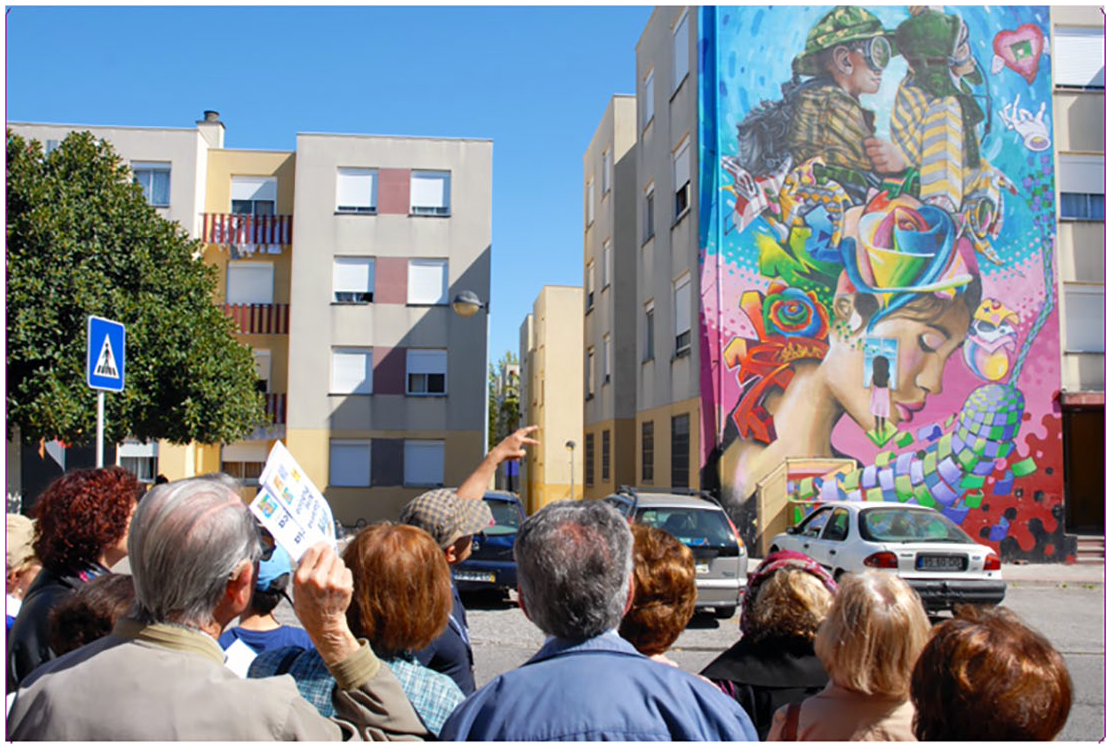
Street at tourism in Quinta do Mocho.
Neighborhood residents, José and Rodrigo were the two main “faces” of the street art tours during the period of my research. Invited to shoulder responsibilities in a project presented as aimed at social inclusion and enhancement of the neighborhood’s value, they became collaborators of this public policy. The involvement of “native” guides became essential for the viability of this public policy, as they knew how to explain the potential benefits to the residents, facilitating their acceptance. 5
Born in São Tomé and Príncipe, José, 30 years old, came to Portugal aged 16, and went to Quinta do Mocho when the resettlement process was still in progress. Part of the rappers’ group “Império Suburbano” (Suburban Empire) and identified as a community leader, José was the chairman and founding member of the “Associação Jovens Estrelas do Bairro” (Young Stars of the Neighborhood Association), and also organized numerous cultural activities, mainly linked to hip-hop. José’s ability to move smoothly between the city and its margins, articulating strategies of visibility unscathed by stigmatizing categories make him a supreme mediator, a feature that was noticed by the local authorities. He was close to graduating in chemical engineering when he was invited to be the local authority’s partner in GAP, and considered this project to be an opportunity to turn the tables on stigma: It’s transforming, it’s being important, it’s inspiring. This neighborhood needed something like this to change, it was an opportunity (. . .). Because there were a lot of people who hid behind a mask, who were ashamed to go to school and say they were from Quinta do Mocho, ashamed to look for a job because they knew they wouldn’t get it due to being from Quinta do Mocho. That stigma was really strong. (. . .). The bottom line is that a transformation is taking place from a negative mark to a positive mark. [Interview]
The upgrading of the neighborhood’s symbolic value was also the most applauded aspect by Rodrigo, 37 years old, in relation to this public policy. Born in Angola, he came to Portugal with his mother when he was four to escape from the civil war, having been raised by his grandmother in the city of Porto. It was his desire to be closer to his mother that took him to Quinta do Mocho, where he lived during the period 2001–2004 and from 2012 up to date. Rodrigo’s passion for graffiti was determinant in his involvement in GAP, which was enriched with his personal knowledge of the secrets of this urban art. With incomplete secondary education and more than 10 years of experience at call centers, that further enhanced his skills as an interpreter and good speaker, including in English, Rodrigo saw an opportunity in GAP to foster the neighborhood as a place of culture: I have always felt at ease and I like dealing with the public, but I’m not a salesperson, I’m a promoter. And it’s extremely gratifying to promote my neighborhood. It’s very gratifying to change peoples’ mindset, it’s very gratifying to start a tour and see that those people who stayed well behind looking wary, a bit fearful, half-way through those same people are right at the front. Seeing those mistrustful faces enter and half-way through or at the end they tell me that it’s one of the best things they have ever seen, not just the neighborhood, but the way we present ourselves. [Interview]
Doing something they enjoyed for the benefit of the neighborhood encouraged José and Rodrigo to become Loures local authority street art guides. However, this collaboration also implied availability for voluntary (and unpaid) work, which they began to object to in view of the economic difficulties they faced. The multiplication of artworks not accompanied by structured action of social inclusion and public investment also dampened the guides’ initial enthusiasm.
The tensions and disputes of that period, 2016 to 2019, are followed through a dense ethnography on this public policy, whose mechanisms of social control, subjugation, and maintenance of the subaltern are upheld by the creative city paradigm. These are the processes that shall be analyzed below, focused on the disputes between the local guides and Loures City Council around this street art project.
“There’s a Poor Neighborhood and an Urban Art Festival, but There’s No Social Project”
At the beginning of the fieldwork, in 2016, I witnessed the first moments of LAP at Quinta do Mocho. I was returning to the neighborhood on a sunny day in June when I noticed an enormous painting of a washerwoman with colorful clothes on her head. Next to the crane used for the painting was the writer Rafael (aka Vira Lata), a 25-year-old Brazilian who went to Quinta do Mocho at the Festival invitation. He had heard about the event through social networks, paid for his airline ticket from Brazil out of his own pocket, as Loures City Council support was limited to accommodation, meals, spray paints and other painting material. He considered that coming to Portugal was an excellent opportunity, as he would explain the following: I have been meaning to take my murals outside Brazil for some time, doing art abroad. . .. And through a search I did on Google and Facebook, I arrived at the festival’s organization. (. . .) Previously, according to what I learnt during conversations with the production [team], they used to bring in the artists separately: first two would come, a week later another would come. And now this festival has acquired a new format, creating an event in the city, a cultural event that will spill outside Quinta do Mocho (and the social housing neighborhoods) to invade the entire city of Loures. [Interview]
It was upon researching about Portuguese popular culture, back in Brazil, that Vira Lata decided to paint the washerwoman (Figure 2), approved by the festival’s organization, after sending the mock-up. We were talking about these topics when José joined us. After listening carefully to Vira Lata’s explanation about the motives of the painting, José stressed that the washerwoman could also be understood as a reference to the rural lifestyle, one of the symbols of the municipality of Loures. 6
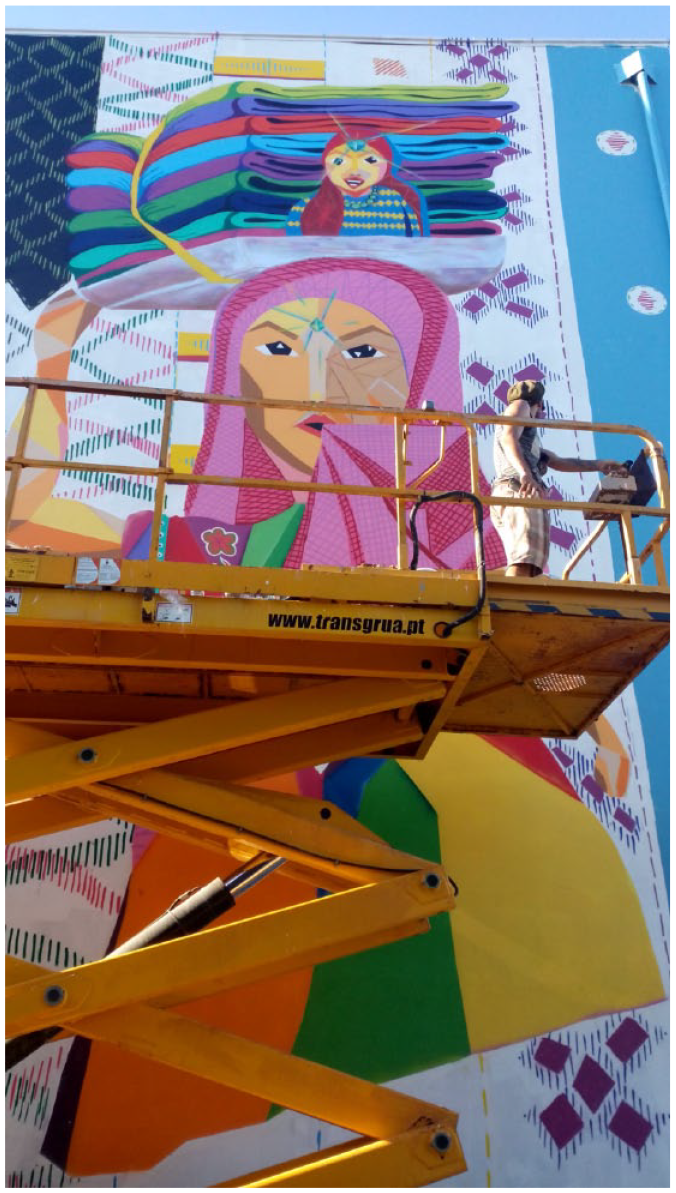
Vira Lata painting the washerwoman.
I said goodbye to José and Vira Lata and went off to see some of the artistic interventions that were being done in the neighborhood. After crossing Quinta do Mocho’s central square I spotted two murals with female figures. While the first, by the French artist Hopare, was still undecipherable due to being at an initial stage, the second portrayed a black woman holding a spear, with a snake and an owl. Created by the Catalan artist Aleix, 37 years old, it was a painting reminiscent of Greek mythology, entitled Goddess Athena. Plans had been laid for a total of 104 artistic interventions to be produced in the municipality of Loures during that week.
I returned to Quinta do Mocho a few days later to interview Vira Lata and Aleix. The latter was putting the last touches on his painting when a group of 10 tourists appeared accompanied by José and Rodrigo. Aleix explained that his figure was the black version of the Goddess Athena, representing wisdom, war, and art: I wanted a mythological portrayal of a warrior woman who was not an aesthetic ideal of the 21st century. I though Athena in an African version would be suitable, a sort of icon of the universal woman. [Field diary]
A professional illustrator, Aleix started to paint murals influenced by graffiti and graphic novels. Before being invited by the local authority to be a LAP artist, he participated in the first edition of the “O bairro i o Mundo” festival held in 2013 at Quinta da Fonte, a social housing neighborhood close to where we were. In contrast to what he said was happening at LAP, at Quinta da Fonte festival there had been an intense relationship between the artists and residents: street art murals were created by the neighborhood’s youngsters, as well as theatre, music, and dance performances. At LAP, he sensed a lack of dialogue with the residents, a lack of “social work”: As an urban art festival, I think it’s great because I have never seen a festival with 104 artists, so many murals, so many people from so many countries all in the same place. But this seems to be more of a “political medal” than true social work. This has been my feeling since the beginning. It sounds really good to say that no-one wanted to come to this neighborhood before, and that now there are masses of murals and lots of people wanting to come and visit, right! That’s very good, isn’t it?! But. . .. The residents of this place have not developed any relationship with the murals, no-one even asked them if they wanted something painted in particular or something else. (. . .) I am definitely not going to see these murals every day, the people who will though are the residents, right?! At the very least, they should have been asked what they would like to have. [Interview]
The interview had finished when a city councilor passed alongside us accompanied by RTP1 television channel journalists who were filming murals and artists, one whom fixed up an interview with Aleix. Later, he told me that the journalist had asked him if it was the first time he participated in a project of social nature, commenting: I asked myself what “social nature?” I mean, there’s a poor neighborhood and an Urban Art Festival, but there’s no social project. It’s just a festival. [Field diary]
It was late afternoon when various artists and guides gathered together outside a café to relax and share experiences. I asked José if there would be a street art tour next Saturday. He said he did not know, as Loures City Council had not told him anything yet and he complained about the fact that they had not been informed about the LAP programming, emphasizing the importance of the guides: They need us for the guided tour. How are they going to ensure the visitors’ well-being without counting on our support? The City Council needs us just as much as we need them. (. . .) They even trembled when they saw us stir up today’s visit. [Field diary]
Held every last Saturday of the month, the street art tours were planned by the local authorities. However, that afternoon’s tour was organized independently by the guides, which would have created apprehension among LAP’s senior managers. Aware of their importance, the guides rehearsed possible autonomy in response to the devaluation of their work. From the very first street art tours in 2015, they had worked as volunteers in the project, accepting this condition because they believed they were doing something for the benefit of the neighborhood. But as the PAL gained new works, the contradictions brought about by unpaid work were further exacerbated. This situation became problematic with the increased economic pressure experienced by José and Rodrigo due to having become unemployed. Combined with the rhetoric of voluntary work as an instrument for the “neighborhood’s regeneration” was the requirement that the guided tours should be free of charge for the tourists, based on the argument that GAP was a social project of the municipality of Loures. The solution for the dissatisfaction of the guides was to encourage them to become self-sufficient through entrepreneurism. Attracted by this discourse, José and Rodrigo created merchandise products—magnets, pins, and t-shirts adorned with the mural paintings—to be sold to the tourists, as a way of gaining income. However, the proceeds of the sales proved to be insufficient to offer them economic sustainability.
Following José’s heart-to-heart, I went off to see Vira Lata. The residents of the building that he was painting were socializing, seated on chairs taken from home, a usual practice in a neighborhood in which street sociabilities play a crucial role in everyday life. I took the opportunity to ask them what they thought about that mural, with one lady having answered: I live in this building and I would like to have been contacted about the image placed on the wall. I don’t identify with the drawing that’s being made; I would have preferred an African woman. [Field diary]
Another man said he liked Vira Lata’s painting, but it would be preferable for the residents to have some influence on the artworks carried out. Despite the criticisms, those present admitted being in favor of the street art murals, because, as they explained, “the neighborhood is no longer besmirched.” Nonetheless, this reversal of stigma did not conceal the dissatisfaction of being disenfranchised of their right to have an opinion in the choice of the images decorating the façades of their own homes. Many of them discovered that their buildings were to be painted on the actual day it happened, when the artist was already starting the work. The lack of involvement of the local population in the construction of the imagery of each work is highly revealing of the secondary role assigned to the residents in that urban policy.
“We’re Not a Ghetto Anymore”: Street Art Tour at Quinta do Mocho
I returned to the neighborhood in the following weeks to participate in the scheduled street art tours. The meeting point was Casa da Cultura, a municipal facility, close to the neighborhood, where the guides welcomed the tourists and gave an outline of the history of Quinta do Mocho. Civil servants of Loures City Council and political representatives were usually present at that introductory moment, sometimes taking the floor to extol GAP’s success. In one of my first tours, a city councilor said the following: This work [GAP] alone is already of great worth as it is embodied in 51 murals, but what we really want to stress is the neighborhood’s change in terms of its attitude, in the actual physical structure, in the cleanliness that the actual residents also require and participate in. In control, in self-control, of when little boys do naughty things, and they are not just left to it. The pride that we need has in fact been restored to the neighborhood. [Field diary]
Each tour lasted three and a half hours on average and started along the avenue named after one of the greatest leaders of the struggle for freedom of the former Portuguese colonies in Africa: Amílcar Cabral. His image comprises the first mural of this avenue, presented by Rodrigo: This is the first work we are going to see on the tour. The artist’s name is António Alves, one of Portugal’s greatest muralists. Before the Revolution of 1974, he was known for the political messages he marked on walls. This artwork represents Amílcar Cabral, one of the Africans who fought for the independence not only of Guinea Bissau, but of all countries of the African continent. [Audio recording]
The guide’s speeches about the murals sought to be in harmony with the social and historical context of the residents, in addition to highlighting the alleged process of “regeneration” that the neighborhood was undergoing. The work created by the artist Nomen, in which a Black woman removes a white mask (Figure 3), was associated by the guides with the fact that the residents concealed their residential address due to the territorial stigma to which they were exposed on a daily basis: Two or three years ago, you wouldn’t come here. Not because you’d be mugged, but because the media told you not to go. Everything’s changed now, we’re not a ghetto anymore. And what we are trying to do is to change mentalities, not just yours who come from outside, but also among us, those who live inside. [Rodrigo—Field diary]
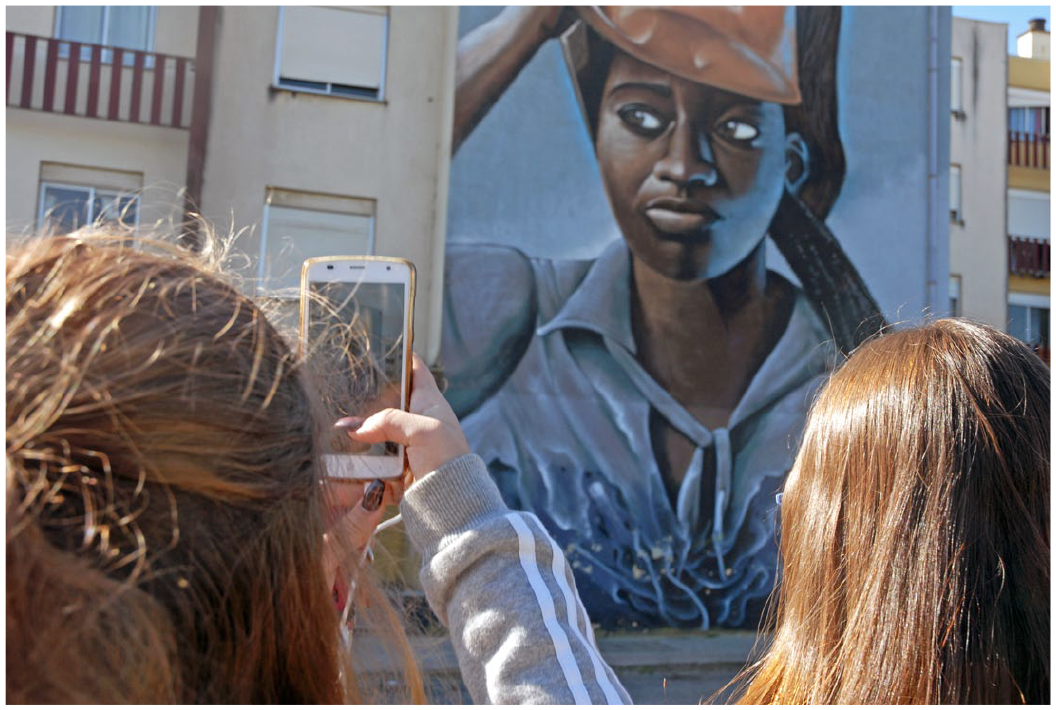
The whyte mask.
Speeches that Quinta do Mocho in the years before the GAP was marked by territorial stigma, juvenile delinquency and the abandonment of public power were common. In contrast to this negative image, street art tours celebrating the new era that Quinta do Mocho was living, promoted new imaginary of the territory and its inhabitants. The local guides’ discourse praised not only the cultural shift of the neighborhood—in terms of musical, artistic and multicultural achievements—but the supposed “change of mentality” of the residents, whose greater community responsibility and resilience in the face of adversity would have been encouraged by this urban policy.
In our journey through the neighborhood, the symbolic meanings of the artworks were unraveled by the guides, interspersed with analogies of the residents’ daily life. Here, the Mocho guides fostered an “informal curatorship” (Andron 2018) via the multicultural experience, telling stories that often contradicted stereotypes.
This was the case of the Bob Marley mural, understood by the guide Bento as a “breath of fresh air” against the discrimination experienced by many youngsters who wear dreadlocks and identify with Rastafarian culture: Many neighborhood youngsters have dreadlocks and face discrimination because of that, when it’s actually peace and concern with society that are at the very heart of this style. [Field diary]
The transformation of one of Quinta do Mocho’s buildings into a cardboard box (for dispatch) is reminiscent of the way that immigrants are “dropped” in neglected areas of the city. With the African continent drawn and the word “Africa” highlighted, work overalls are seen next to a housekeeping apron, symbols of the most common work pursued by the neighborhood’s men (civil construction) and women (cleaning). The lack of recognition of the immigrants’ role in Portuguese society was evident in José’s discourse during a tour: We know that many of the good things about Portugal, from Vasco da Gama Bridge to Expo [World Exhibition of 1998] were made thanks to masses of immigration, lots of hard work, right?! And that was also important. Hence, the name of the artwork is “Worker Ghetto Box,” symbolizing Africa and representing the role of the immigrants in Portugal. [Audio recording]
Regarding the mural created by the writer “Risca com o que há” (Scratch out/mark with what’s there), portraying a woman covered by a scarf with pencils and cans of spray on her back symbolizing weapons (Figure 4), Rodrigo makes the following comment in reference to the stigma of living in a neighborhood associated with the imagery of juvenile delinquency: Here in the neighborhood, we also had to hide, in the same way that writers had to do tags so as not to be recognized. [Field diary]
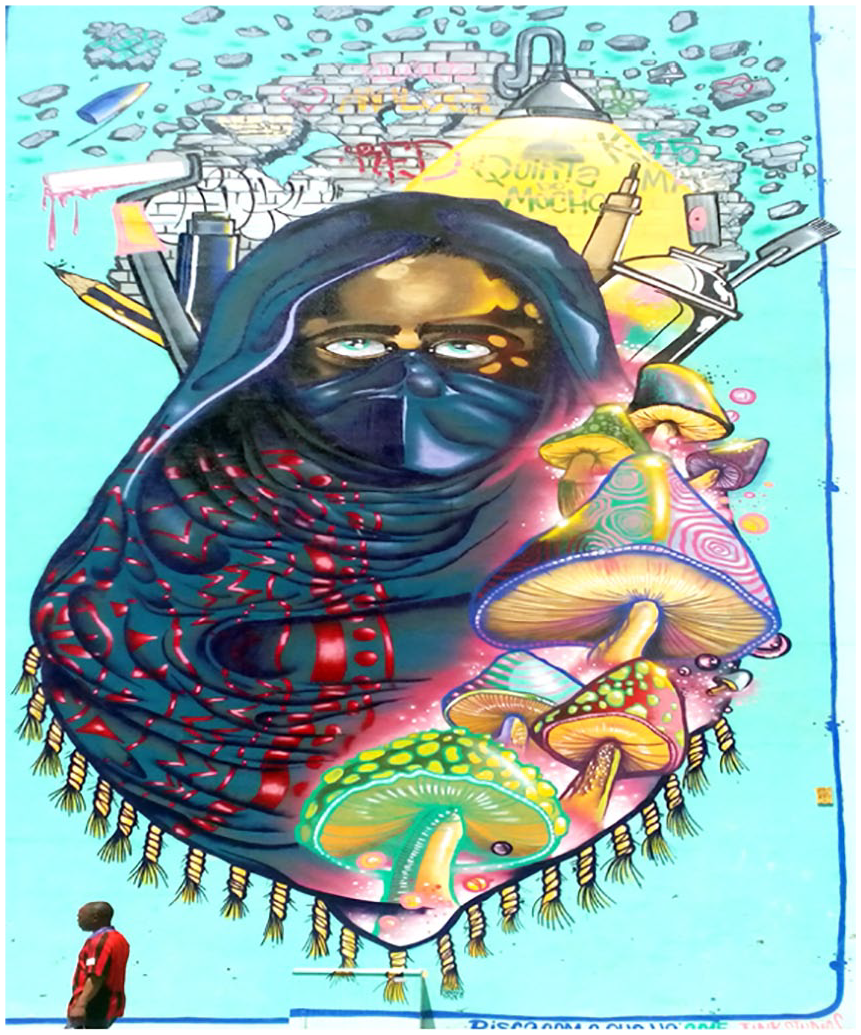
Mural by the writer “Risca com o que há”.
At the end of one of the tours, Rodrigo promised the visitors a surprise. We walked along to an alley where numerous works decorated the walls, with tributes paid to the neighborhood and its residents. This alley was also the place where the youngsters held their renowned parties in the first decade of 2000, driving dynamics of musical effervescence that served as a “school” to many neighborhood DJs who are nowadays recognized internationally.
7
The brawls between the youngsters and the incidents with the police are part of the memory of this space, recalled as follows by Bento: There were so many times I saw the “blues” here [policemen], dozens of them, ordering us to put our hands up against these walls, bad memories. [Field diary]
Not charging for the street art tour they conducted, the guides sold magnets and buttons with the images of the neighborhood artworks, raising about 40 euros. After he had said goodbye to the tourists, José expressed his disappointment with the lack of alternatives offered by Loures City Council for the sustainability of the tours. He suspected that his efforts to breathe life into GAP were being used by the local authority representatives to extract political benefits: I’m not stupid, and I know that we’re being used by Loures City Council to drive a project that has electoral ends. But I’ve learnt along the way that we need to take the right steps so as not to fall. (. . .) Why doesn’t the Council hire one of us on a part-time basis? It doesn’t even have to be me, but one of the other guides, that would really boost not only the project, but the life of some of them. [Field diary]
By becoming local guides, rendering free services to a project presented as “good practices,” 8 the local authority was actually reinforcing the context of job insecurity in which they lived. The guides were required to be available, committed, and timely in the street art tours and, at the same time entrepreneurism was encouraged as a means of employability, but there was insufficient solidarity to ensure the profitability of the sale of products to the tourists.
The contradictions of this urban policy were further deepened from José and Rodrigo’s viewpoint after their attempt to transform one of the neighborhood’s vacant shops into a space dedicated to street art came to nothing. According to the project proposal sent to Loures City Council, this space would qualify for the reception and sale of merchandising products to the tourists, which was usually done informally in the public space. The proposal of them was rejected by the local authority with the justification that they needed to incorporate a formal association, which was not possible due to bureaucratic difficulties.
Managing Social Inequalities in the Creative Outskirts
I continued to keep a close track on the street art tours at Quinta do Mocho in 2017, which became more frequent with the greater visibility of this urban policy and the approaching local authority elections. The neighborhood was at the heart of the electoral dispute in Loures, and role of street art as an instrument for social inclusion was very often highlighted by the public powers. This perspective was addressed by the municipal councilor Bernardino Soares, in a televised debate between the candidates: What we did at Quinta do Mocho was indeed a very successful program aimed at social integration in the first place, and later went much beyond that, because nowadays it’s an enormous cultural asset at a European and worldwide level. We receive visits there every week, travel agencies take tourists from cruise ships to go and visit Quinta do Mocho. And the neighborhood has been transformed. [TVi24, “Programa A Caminho das Autárquicas—Loures” (On the Way to Local Elections program), July 19, 2017]
GAP emerged in the discourse of the public power representatives as a policy of a social nature fostering inclusion, as well as resource for inverting stigmas, urban regeneration, and community strengthening. The connections stimulated by the incoming wave of tourists under this public policy added symbolic value to the neighborhood, helping to (re)configure the image of Loures as a modern, creative, and cosmopolitan city. 9 By attracting “more visitors than most museums,” 10 Quinta do Mocho portrayed the new role that art and culture were performing as drivers of urban development, at a time when the creative city model was becoming a unavoidable reference in local governance (Andron 2018; Klein 2018; Schacter 2014; Castellano and Raposo 2020). In this process, street art murals contributed to affirm a new place branding, a city marketing strategy that benefited from the strong media exposure of this artistic expression to produce an image of distinction and excellence of governance (Zukin 1995). It is in this context that street art was transformed into public policy in Loures, a valuable commodity to be used by public powers to enhance territorial value, foster tourism, engage in political-electoral disputes, or even as a resource to resolve social problems.
Aware of the effects of the elections on the street art tours, the local guides suspected that their efforts to boost GAP were being used by the local authority to raise votes and prestige. Being more critical in relation to this project, they began to question its real benefits to the neighborhood while becoming imbued with a heightened sense of the discontent felt by the residents in relation to the urban policy. At this same time, the local guides did not see any prospect of changing their precarious position through Loures City Council. The following notes in my field diary are emblematic of the guides’ dissatisfaction at that time:
It’s been two years now of working for free for Loures City Council. At the beginning that was fine, as it was a project that would bring good things to the neighborhood. But after two years in this situation. . .. I’m not stupid, mate! We end up being in a really insecure situation, spending our days counting our pennies. Not them [local authority civil servants], no, they go home at the end of the month with a wage in their pocket. [Field diary]
People have started to understand that the graffiti and the tours are not wielding any benefit to the community. Many residents are losing their patience and we have already been pressured to stop doing the tours. [Field diary]
Faced with the multiplication of artistic murals on the façades of their buildings, the residents’ ongoing claims remained unanswered: repair of leaks in their apartments, combat of mosquito infestations, renovation of leisure areas, regular cleaning, etc. As stated by a 28-year-old resident: I’m speaking for myself and I’m fed up with graffiti. We have masses of graffiti, but the mosquitoes that we spoke about in the last community meeting are still there. The mosquitoes are much more important for my health than the graffiti. The children’s playgrounds are still in a state of disrepair (. . .). They’re going to win the elections again with that demagogy that they have improved this neighborhood enormously, when they haven’t improved anything. It was an aesthetic makeover of the neighborhood; it just looks nice for the tourists who come here. [Interview]
Although GAP was presented by the local authority as a first step to bring public investment into the neighborhood, the multiplication of artworks has done nothing to change the extremely poor living conditions of its inhabitants, who continue to coexist with serious infrastructural problems. Four years after the first artistic murals, they have merely beautified processes of exclusion, integrated in a public policy with a strong component of art washing (Schacter 2014). While the aerosol paintings were “pleasant” art to be seen from the tourists’ viewpoint, for many residents the artworks masked their deplorable living conditions, being nothing but an aesthetic makeover of the neighborhood. This is because these artworks were not accompanied by actions to improve the conditions of their housing, public space or transport. Neither were they part of a broader artistic project aimed at mobilizing the inhabitants’ cultural productions. Reproducing a top-down approach, GAP never included the residents in the process of intervention in their homes, based on the immateriality of the street artworks, which depoliticized their demands for better living conditions.
Aware of the increased criticisms of this public policy in the mid of an electoral year, Loures City Council gave in to some of the residents’ claims: ramps for disabled persons and doors at building entrances were installed, the cleaning services began to operate more regularly, and a bus line started to run through the neighborhood. The organization of community meetings was also reinvigorated. At these meetings, the residents were able to make demands and call for improvements of structural order that went beyond the sphere of the artworks. As José explained, “The fact that the Council was forced to hold community meetings was the greatest victory of the street art.” But even so, various habitability problems persist, many derived from the lack of maintenance of the buildings and public space, exacerbated by the poor quality of the constructions.
Aimed at containing the discontent of the guides and keeping them active during such a decisive period for that administration, the local authority promised them financial support in mid-2017. The guides awaited their payment for more than six months, during which there was exponential growth in the number of tours: just in the month of July there were 21 tours. Finally, they were told that the support would only be given after the local elections of October, and it actually only happened in March 2018, when most of the guides were no longer collaborating with Loures City Council. 11 These successive postponements fast-tracked the process of empowerment of the local guides, who started to organize street art tours independently from the local authority, charging the tourists a small fee. They created the “Guias do Mocho—Bairro de Arte Pública” (Mocho Guides—Public Art Neighborhood) page on social networks, created partnerships with tourism companies and enlarged the range of merchandise for tourists (key rings, book markers, mugs), affirming themselves as preferred mediators in the exchange of information between the residents, the tourists, and public power. 12
Without the presence of Loures City Council civil servants or politicians in their tours, the guides’ discourse became more critical about the urban policy. Keenly aware that the opinion of the neighborhood’s visitors was an effective means of exerting political pressure, the guides never concealed the poor living conditions that continued to afflict the residents. This is the case of the abandonment to which Quinta do Mocho’s children’s playgrounds were relegated, a topic addressed as follows by the guide Marta in a tour held during the third edition of LAP: That entrance there is a childcare center, and that entrance there is another one. The children of these childcare centers come here to play. And I always say: I hope it’s not going to be necessary for someone to get hurt really badly for them [Loures City Council] to do something about it. See that slide over there, can you see the iron lifted out of that frame? You are witnessing the birth of eight new beautiful artworks in the neighborhood this week, I adore the artworks. But I would adore to have a children’s playground in decent conditions. This is not pretty [she points at the decrepit playground]. [Audio recording]
The local guides continued to run the street art tours of Loures City Council after they were hired, while at the same time doing their own tours. This relationship has not always been harmonious, reflecting the way that the interests around GAP were disputed. The painting created by the writer Styler in the LAP of 2018 highlights the precarious balance between the representatives of Loures City Council, the local guides and the residents, exposing the contradictions of an urban policy based on a model of (non)participation that ignores the opinions of those living in the neighborhood. This artist went to Quinta do Mocho, at the local authority’s invitation, to paint the rapper Eminem with a view to presenting his new style. That intervention replaced the previous mural painted by the same artist, in 2014, which had gained the affection of the residents: An Asian youngster with his arms wide open. Just as he started to cover the previous mural with blue paint, he was met with the residents’ vociferous anger, as witnessed by the guides. According to them, various residents said they liked the old mural, asking him to keep it. Implacable to the residents’ appeals, Styler continued to erase the image while refusing to reveal the painting he had in mind, merely saying: “you’re going to like it.” One of the residents of the building he was painting distrusted that attitude and asked him: “and what if we don’t like the new painting?” For Rodrigo, that question is a crucial issue to be discussed: why replace an artwork that the residents like? After the first strokes revealed that the rapper Eminem would be portrayed in the new mural, the outrage heightened further. The guide Marta recalled the case in these words: I saw children crying out against his erasure, I saw ladies with some difficulty in walking saying: “son come down here now because I need to talk to you.” I saw the whole neighborhood passing by saying: “why are they erasing this?” There wasn’t a single soul passing by who didn’t complain. And, of course, they perceived that he was erasing something that was important, because in their own way those people had appropriated that painting, it was already part of the life of those people. And he still erased it. (. . .). And Eminem was shocking for everybody, no-one liked it. Not even those who like rap liked seeing Eminem there. (. . .). So, this raised the question: “well, and what about us, we live here? How can we speak out? What can we choose?” I think it was Eminem and Styler who uncovered that issue. (. . .). It led to really understanding that the resident doesn’t have any voice. Never again could they claim that GAP is made for the resident because. . .. It’s not for the resident. It’s for the artist, it’s for the Council, it’s for the visitor, it’s for everyone except the resident. [Interview]
The destruction of an artwork with which the residents were emotionally engaged in favor of another that held little dialogue with the neighborhood made them feel disrespected: 13 some neighborhood youngsters insulted Styler and even scribbled on the mural before it was finished, an unprecedented event up to then. By ignoring the opinion of those who live at Quinta do Mocho, the artist deliberately chose to make that mural a showcase for self-promotion, a marketing strategy directed at digital audiences 14 in detriment of the community in which the artistic intervention was made. Just like the outdoor advertisements of a city center, the murals that embellished the façades of Quinta do Mocho became valuable commodities, a visually seductive cultural asset that served the interests of artists and politicians, but not those of the community.
The local guides publicized the residents’ discontent with Styler’s artwork on his Facebook page, with a post opening with the following comment: “they put an end to the piece of Paradise that we had in this hell.”
15
Pressurized by the local authority to delete the publication on the social network, the guides maintained their whistleblowing, considering the Eminem mural as the very portrayal of a public policy that reproduces mechanisms of silencing, imposition, and exclusion of those living in urban subalternity schemes. It was the guide Marta who best summed up the ambivalent feelings about an urban policy that denied them the right to influence the choice of the images that would compose the visual representations of the neighborhood in which they lived: Before all this, we were invisible, but now we are in a silent movie: they see us but they don’t hear us. And that’s the reality. Here at Quinta do Mocho it’s so blatantly obvious, anyone can feel it. When I say that they don’t hear us it’s because you can scream, you can wait, you can send e-mails, you can do what you want; they just don’t hear us. [Interview]
Some Concluding Remarks
My ethnographic immersion in Quinta do Mocho allows me to confirm the area as one of the hundreds of culture-led and creativity-led regeneration processes that have been carried out in many European and American cities over these past 30 years. As Greg Richards and Lénia Marques (2012, 1) state “creativity appears to have become positioned as a panacea for a wide range of problems.” However, here is worthy to bring up the key importance of art and culture (and its progressive institutionalization) in addressing processes of urban segregation, exclusion, and (youth) marginalization in multicultural outskirts neighborhoods of many worldwide largest cities such as Quinta de Mocho in Loures, Great Lisbon. In this sense, GAP is an urban policy that fights against territorial stigma through selling place strategies, combining a radical aesthetic with a multicultural experience commodified as an authentic and nontraditional guided tour. In this sense, Sabina Andron (2018) notes that street art has reached a substantial level of institutional endorsement as a proper urban creative practice, while other scholars argue that street art remains “as a micro-activity associated with small-scale cultural entrepreneurialism and activism” (O’Connor 2010, 42). But more interestingly, a growing critical approach to the role of “institutionalized” street art has proliferated over the past years. For example, Andrea Mubi Brighenti (2016, 123) notes that “under the hegemony of the creative city narrative, street art has been wielded into an urban development tool, targeting specific neighbourhoods and areas.”
The case of Quinta do Mocho and the development of the PAL into a new tourist attraction beyond the territory of the “tourist city” (that is to say, Lisbon city center) enables shedding light on the social relevance of cultural tourism in underprivileged and racialized outskirts in many worldwide cities that have been traditionally marginalized from economic and cultural development (Loukaitou-Sideris and Soureli 2012). Undoubtedly, the promotion of GAP may be seen as both newfound valorization of ethnic (sub)cultures and a new urban planning norm in marginalized neighborhoods of the tourist city (Guinard and Margier 2018, 18). Thus, through the institutional valorization of street art, local collectives contribute to legitimize a form of institutionalization of “the alternative” (Blanchard and Talamoni 2018). In the case of Quinta do Mocho, the institutionalization of street art aims at building an ideal of a “vibrant community” and a “desired” cultural and artistic atmosphere (Guinard and Margier 2018).
This ethnographic article has shown that the street-artification (Baudry 2017) of Quinta do Mocho should also be seen as an instrument of control of the neighborhood’s public space and a cunning device for social, cultural, political, and moral sanitation of the area. Thus, new murals become depoliticized through (an)aesthetics docile to the interests of an urban branding strategy of the “tourist city” divorced from those who inhabit the territory. GAP appears as a new lucrative asset to support new processes of place branding and economic boosting in unexplored terrains of the Touristy City, permitting the reinvention of the image of the “perilous” and ethnic outskirt territories.
In a wider sense, this article also sheds light on how Lisbon Street art is presented by the public powers as a solution to combat social problems carefully wrapped as social inclusion, a discourse that yields political returns but is rather ineffective in meeting the interests of the community. This process also reveals how the culture economy can be appropriated as an ideological power device to manage inequalities (Yúdice 2002), very often reproducing silencing and social subalternity mechanisms. However, this ethnographic article has shown that the residents da Quinta do Mocho are not passive subjects of that urban policy, and actively widen the cracks of opening opportunities to enhance the visibility of their claims and build new policies of representation to fight against the effects of stigmatization, urban segregation and structural racism. Although the GAP tries to anesthetize insurgent positions, its residents make unforeseen uses of the street that wield tourism to dispute a more democratic citizenship perspective (Raposo 2019). In this process, they create a counterstrategy to the urbanization processes taking place in their neighborhood.
In sum, institutional(ized) street art in Quinta do Mocho may also be seen as a commodified heritagization of social housing toward the creation of an ethnic cool neighborhood by reversing the paradigm of periphery as synonym of danger and “no-go area.” Undoubtedly, further studies are needed for in-depth exploring of street art as a process of anaesthetic management of social inequalities in racialized outskirts, whose symbolic production is aestheticized by the tourist and creative city.
Footnotes
Declaration of Conflicting Interests
The author declared no potential conflicts of interest with respect to the research, authorship, and/or publication of this article.
Funding
The author(s) disclosed receipt of the following financial support for the research, authorship, and/or publication of this article: This paper was published with the support of the Portuguese Government, thought the FCT funded project PTDC/SOC-SOC/28655/2017 and DL57/2016, Lei 57/2017.
