




Abstract
This study uses the concept of uncertainty in general, and specifically objective and subjective uncertainty, as a framework for understanding how a widow experiences grief and attempts to reestablish her sense of self. It investigates how widows understand, internalize, and act on objective and subjective uncertainty and the interplay between them. Objective uncertainty usually refers to more concrete situations or conditions, for example, health and finances, and there is more consensus regarding them, whereas subjective uncertainty is more individual and volatile, and refers to relationships or interpretation of the objective conditions. The researcher used a combination of participant observation and semistructured interviews. of widows from different socioeconomic classes and ethnic groups. The research revealed that uncertainty plays a large role in the widows’ attempt to live new “suddenly single” lives and that they experience both subjective and objective uncertainty, with subjective uncertainty playing a greater role. Further research is needed to understand the effect of different familial and societal “uncertainty avoidance cultures” on widows experiencing multi-ethnic or multinational identities either by descent of intercultural marriage.
Introduction
Widowhood is devastating! When a husband dies, it is like a grenade has detonated, and one is scattered into a thousand little pieces. The widow did not die, though sometimes she may wish that she would have. Now she has the arduous job of grieving and rebuilding a new self that is constructed from bits of her old self combined with the unknown with few guidelines to follow. Uncertainty pervades widows’ grieving and restructuring her “self’.” Women do not usually use the word uncertainty when they speak. Instead they say that they do not know what they are going to do. But even though they do not explicitly express uncertainty that does not mean it does not exist. Part of the ethnographer’s job is to take note of feelings and behavior that exist below an individual’s level of consciousness (Hammersley and Atkinson 2019).
This study grew out of my concern with the plight of widows in American society today combined with the anger and distress at the way I was treated by my husband’s colleagues after his death. I had participated in his professional and social academic life for more than 30 years, but I ceased to exist after his Commemoration of Life Ceremony planned by his department and me. This abandonment hurt deeply as I thought that I was an integral part of his professional community and I found this upsetting and demoralizing. Thus, I started on an investigative journey. Unfortunately, there was a dearth of academic literature on widowhood that could guide me (Lopata 1994, 1997, 2000, 2017). Lopata, to my knowledge is the only social scientist to study widowhood in a wide variety of circumstances. She used a feminist/sociological approach, with an emphasis on the study of social roles and gender stratification.
As a sociologist, as well as a widow, I was interested in understanding which factors influenced self-image, status, emotions, and everyday interactions of middle-aged and older widows. While I had plenty of social support from family and women friends, there was a gaping hole in my life. Did other widows feel the same way? Did other widows feel as much resentment as I did? Or was I an outlier? Were academic couples atypical? I did not know. I realized that being both a participant and a researcher was an advantage and a disadvantage. I had a deep knowledge of marriage and widowhood, but this was accompanied by a deep bias of which I constantly needed to be aware upon embarking on this research project.
Framework
This paper uses the concept of uncertainty in general and objective and subjective uncertainty specifically as a framework for this research (Spiekermann and Weiss 2016; Ülkümen, Fox and Malle 2016). I posit that these two kinds of uncertainty are complementary. Objective uncertainty refers more frequently to specific states or conditions. Subjective uncertainty refers more frequently to a proposed action, interaction, or relationship. Two areas of objective uncertainties are of specific concern for the widow—health and finances. Objective uncertainty is more stable than its subjective counterpart. External (objective) reasons for uncertainty lead to internal (subjective) evaluation of objectively uncertain situations. Furthermore, subjective uncertainty is fluid and can change despite there being no shift in the objective situation. A widow can go from one intended course of action to one that is diametrically opposite; for example, from confiding/not confiding feelings to a friend even if her information about the friend has not changed.
Uncertainty also plays a role in a widow’s adoption of a changed identity. This process may be fraught with misinterpretations as she attempts to reestablish herself in her social world. Re-establishing a new identity as an independent single woman cannot be achieved alone because a woman does not live in isolation; therefore, clues from others need to be observed and interpreted. From the outside, a widow’s return to a fully active member of society may seem straightforward, but it is a complex undertaking involving many fits and starts. When widows interact, they need information about the other party when starting new relationships and even when interacting with former friends and acquaintances to ameliorate their objective and subjective uncertainty (Berger and Calabrese 1975; Griffin 2012; West and Turner 2014).
Listed below are a few characteristics of both the widow and her community that relate to uncertainty:
General uncertainties and lack of congruence between widows’ and community norms (e.g., health, finances, relationships, religious groups, and work groups)
Lack of agreement about ambiguous or changing norms on bereavement and death within the community
Variability in expectations of widows’ behavior
Background
All throughout history, and even today, societies in many parts of the world treat widows poorly or harshly. In the past, Indian women were supposed to commit suttee being burned on a funeral pyre after their husbands died (Roye 2011). Even today, some are forced to leave their homes to live in poverty and beg for a living (Bhattacharyya and Singh 2017).
Widows in Victorian times were expected to wear black clothing and were prevented from engaging in social activities for a year (Loeffel-Atkins 2012). However, there is one major difference between these widows who followed traditional practices and the widows in this study (except for the very devout) that as onerous as their traditional lives might have been, the rules were clear, and they knew that if they broke them they would face social sanctions. These women experienced certainty. Social norms, however, change, and current widows may find norms ambiguous, which lead to uncertainty. Some research shows that even the certainty of an unpleasant outcome may have less deleterious effects on an individual’s well-being than living with uncertainty (Walton 2016).
Ambiguity breeds uncertainty. When gender norms shift, they remain in a state of flux. Older widows, raised in a different time, may not be certain which norms apply to them, and under what circumstances. Furthermore, social life in the United States is still based on couples. During the years when women in this study were reaching adulthood, some traditional members of the community still believed that the final stage of adulthood was achieved only when a man and woman married and had children (Fremstad 2012). Single women, on the other hand, were denigrated and called spinster and old maid (Nanik, Tairas, and Hendriani 2018). While gender roles have shifted in this area, the couple as an ideal still largely exists in society (Fremstad 2012). Will the widow feel liberated without a husband or will she feel left out and isolated? The widow may be uncertain how she feels about her new options and uncertain how she may be received by different actors in her friendships, work, and religious groups.
In this time of personal turmoil, social support is even more necessary than before the woman became a widow. This support comes primarily from family, friends, and religious institutions. Before their deaths, husbands had provided support and companionship as well (Douglas, Georgio, and Westbrook 2017; Ranby and Aiken 2016). Some widows have known their husbands since they were young. Thus, when a husband dies, he usually leaves a big gap in the support system. Support from family and friends becomes an urgent lifeline and sometimes this line frays, which generates a great deal of angst and uncertainty. Inadequate social support can have strong negative effects on grieving and recovering widows that often leads to greater subjective uncertainty. How will the widow compensate for the loss of social support? Will she join support groups with similar interests or experiences, or will she rely on her deeply felt religious and spiritual beliefs that also tend to protect against social isolation? For some widows, a strong dependence on God as a social support appears to help allay depression and anxiety (Maltby and Day 2020).
Uncertainty is a problem for the widow as is a lack of visibility, a complaint of many widows (Blades 2011). Widows are omnipresent, but they are rarely “seen”. Invisibility develops quickly, shortly after a short mourning period such as Shiva in the Jewish community or a Viewing in an Irish- Catholic community (McDermott 2013; Ochs 2017). But once becoming invisible, it is difficult to become visible again. When you are visible, you have a certain amount of standing and a voice. Being invisible means you have neither, and you feel uncertain as to whether, or when, you can regain either of them. The amount of uncertainty related to invisibility is also closely related to the extent of agreed social expectations within a community. If these vary due to differences in social values, then both objective and subjective uncertainty hinder the widow’s ability to find her niche as an esteemed single woman.
Social norms tend to be ambiguous during a time when social norms change at different rates. This can be more problematic for the widow than norms that have changed more drastically but have been generally accepted. Ambiguity breeds uncertainty. Few universal norms and social structures exist currently to help widows fathom the cultural nexus within which her loss is embedded, or ascertain the widow’s ability to navigate her newly configured social roles. Extensive research has been carried out about the mental and physical consequences of widowhood and grief (Holm, Berland, and Severinsson 2019; Holm and Severinsson 2012). Little is known, however, about the social and behavioral adjustments made by middle-aged and older widows, and the role uncertainty plays in these adjustments (Lindley 2013). Research about emotional uncertainty is prevalent in the medical field, for example, trauma, death, and dementia, but is meagre elsewhere (Carleton et al. 2019). A wife faced with widowhood experiences an overload of emotional uncertainty because she needs to deal with the uncertainty related to the course and timing of her husband’s illness and death as well as the uncertainty regarding her future widowhood. Lopata (1994, 1996, 2000, 2017) is the only social scientist, to my knowledge, to study widowhood in depth. She combined a feminist and sociological perspective in her study of gender stratification and gender roles of widows in their everyday lives.
Methods
When using a symbolic interaction approach, participant observation, and semi-structured and unstructured interviews are the primary ways to uncover patterned social realities and develop insights into the meanings of participants (Denzin, 2017). A critical ethnographic perspective adds another layer of depth. The reflexivity of the ethnographical approach is based on the idea that we, including the researcher, are actors in our social world and can reflect on our feelings, attitudes, and actions as objects to be studied (Hammersley and Atkins 2019; McQueeney and Lavelle 2017). To understand the inner life of a widow—her fears, doubts, aspirations, and how she expresses them in her new status of being single—both participant and analytic perspectives are needed. I enter the research project with this awareness. Though I have years of experience in qualitative research (Kenen 1982; Kenen, Arden-Jones, and Eeles 2003; Kenen et al. 2011), I am a novice in two areas–-being both a recent widow and a recent critical ethnographer.
Power between researcher and those being studied is always an issue, but it is particularly important to address when conducting ethnographic research (Hammersley and Atkinson, 2019). I never felt that I had any power; simply put, I am small in stature and I always look younger than my age. I have spent much of my life trying to prove that I had a brain as well as a body. Of course, the title “professor” has the potential of being a power laden status that can open a gulf between researcher and participants being studied. I tried to offset this by being low key, friendly, and upfront about being a widow. Before each interview, we chatted for a few minutes, sharing some of our feelings and experiences. If the widow became emotional, I reflected her feelings and spoke about my having the same feelings in a similar situation. These brief indications of solidarity usually calmed the participant.
The main differences that I discerned between my etic perspective and the emic perspective of the participant were related to my lifestyle. I listed my known biases (e.g., social status, health, financial well-being, race, education, and religion) and placed these above my computer station as a visual reminder of them instead of writing specific reflexivity notes simultaneously with field notes. One of the ways that I separated the etic from the emic was by working on this project in fits and starts. If I felt that I was beginning to become emotionally overwrought, I would withdraw from the project until I regained a sense of balance and distance. This is not to say that I could always judge these feelings accurately. Though reflexivity provides a more genuine portrayal of participants, an unacknowledged bias can still contaminate the portrait. Therefore, a continuous tension exists between reflexivity and bias (Hammersley and Atkinson 2019).
Another difficulty in conducting ethnographical research is that ideal sites for ethnographic investigation are not always available (Hammersley and Atkinson 2019). The researcher needs to maximize her prospects. In in my local geographic area, there was only one ongoing widows’ support group. I approached the organization sponsoring the group and was directed to the social worker running it. I explained that I was a widow who wanted to conduct research on widows. The social worker, as gate keeper, asked the group’s permission for me to attend and participate. The group was strongly protective of its privacy, and permission was given with the caveat that I did not quote anyone or write anything that could identify any of the participants. I agreed to this on ethical grounds as well as practical ones, not wanting to lose this opportunity (Jefferson 2015). I participated in this widows’ support group regularly for close to one and a half years. One major realization that I discovered was that I was indeed an outlier in this group because my married life, as a wife of a professor, as well as being a professor myself, was far different than most of the members. Yet despite these differences, I related strongly to their grief and uncertainty.
Sample Size and Characteristics
The widows in the support groups came from several local communities and met every other week in a large and cheerful meeting room in a township building. The social worker, who led the group, knew the group members well and asked them specifically about some problem that they had discussed at a previous meeting. The widows felt at ease with each other and spoke openly about their experiences with their husbands. Those who had lost their spouses recently frequently became teary, while those who had started to process some of their grief spoke more optimistically. The majority were widowed recently, but a number attended for years. The “old timers” said that they originally came for support and stayed because they liked the group. Each widow talked about whatever was on her mind at the time. At any given meeting four–five widows participated,
At his juncture, I needed to pursue a more diverse group of participants for several reasons: (a) the majority in the women’s group were white; (b) they were middle-class or professional and (c) they had some degree of higher education. I decided to conduct semi-structured interviews of widows from various social classes and ethnic backgrounds. I used a combination convenience and snowball sample, and I offered a payment of $20 for their time which they could keep, whether or not they decided to complete the interview. I selected ten white widows from an upper- middle socioeconomic background and ten from a mainly minority background to understand if, or how, the two socio-economic and ethnic groups differed in their reactions to their experiences as widows. I began with basic, open ended questions about what it was like for them before their husband died, immediately afterwards and presently. As the study progressed, I also added additional germane questions generated from previous interviews.
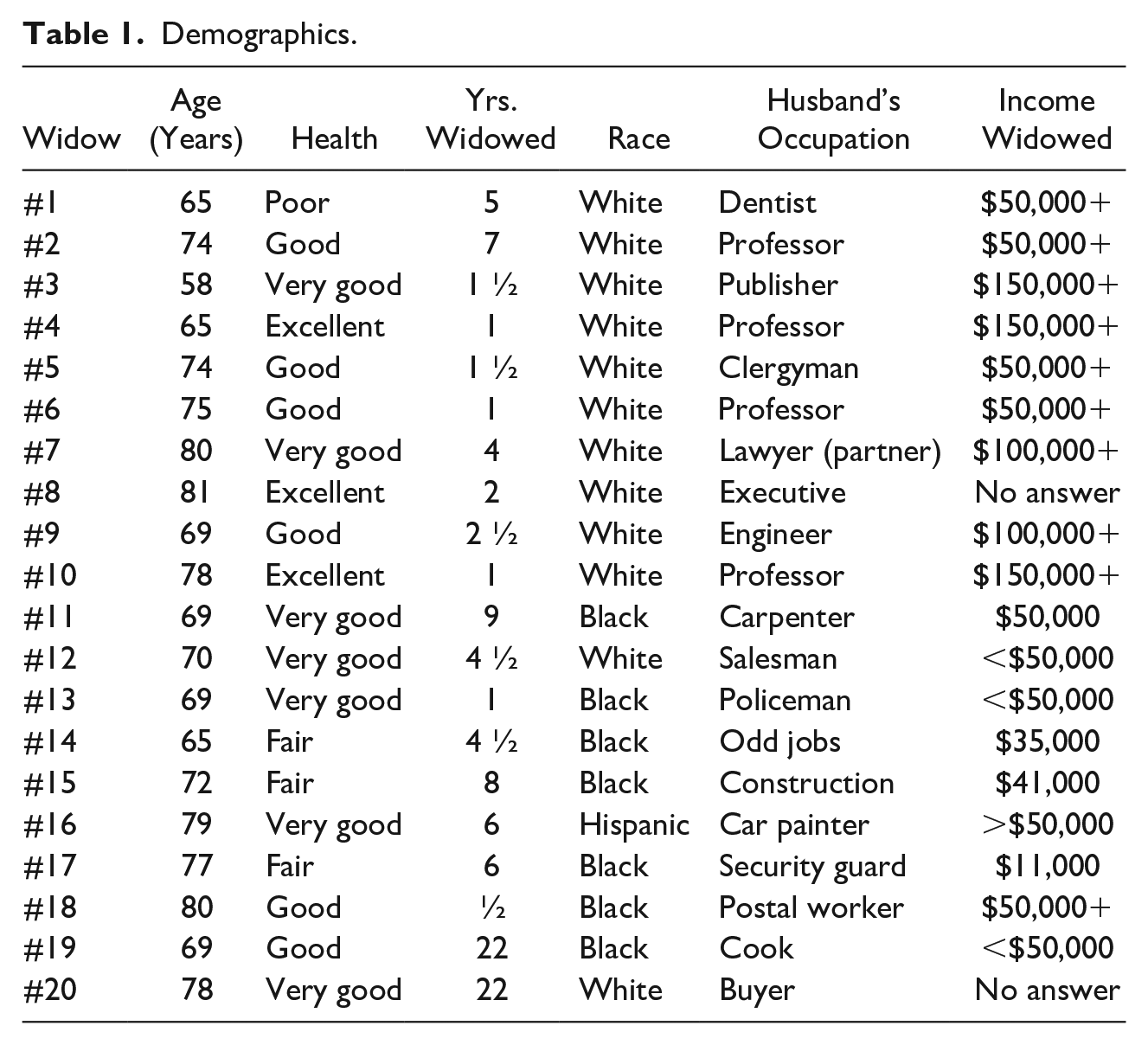
I had no trouble finding upper-middle income widows to interview. I interviewed friends and asked them to inquire whether other widows they knew would allow me to contact them. But I found it extremely difficult to gain entry to the lives of lower socio-economic widows. It took me over a year and I used multiple sources to gain entry—social workers and friends who found a cafeteria worker, a cleaning woman, a neighbor, and the mother of an office worker. The interviews were tape recorded and transcribed as soon after the interviews as possible. I asked the interviewees whether they wanted to see the draft. Only one widow was interested, and I provided it to her. Unfortunately, I could not check my finding with the support group because I promised not to involve the group in my research project. I did informally compare my findings with my widowed friends and found similar patterns. The demographics of the widows interviewed are shown in Table 1.
Demographics.
The interviews were mainly held in the homes of the participants. One was held in my home, two were held during off hours in a restaurant of their choice, and one was held in the widow’s workplace. A couple of the participants (#1 and #2) told me that they found the interview therapeutic. This was unexpected for both the widows and me. The widows felt good about telling their experience to someone outside their usual social circle. I told them that I was glad that they received this additional benefit. I felt gratified by this response because I believed that I was giving as well as receiving.
One of the participants organized women’s groups at her church in a minority neighborhood and invited me to attend a meeting. She told them that I was studying the problems that widows faced. (This is discussed later in the paper). The third, and least fruitful, aspect of my study consisted of informal participant observation in my everyday life with women in different life situations, for example, widowed, divorced, and married. The widows tended not to discuss their widowhood in social gatherings or at monthly meetings that they attended. This frustrated me, but I was caught between obtaining more information for my project or possibly antagonizing women whom I knew. I decided not to push to learn their stories, but in conversation, I would mention some experience from the participants in the study and wait until I received a reaction or comment.
The theme of uncertainty grew out of my experiences and those of the participants. I was originally concerned with specific aspects of the widows’ new lives and how they dealt with the changes. It was not until I was well into the research that I realized the importance of uncertainty as the dominant, underlying feature of their lives regarding their future. They expressed this by talking about their worries about money, insurance, housing, friends, family, future relationships, and decisions they needed to make.
A Deep Well of Grief
Grief is the signature of early widowhood, but it begins earlier for the women whose husbands were ill for a long time. Widows from both socioeconomic groups spoke a great deal about the time before their husbands’ deaths and had stories to tell about how difficult it was for them. Two widows talked extensively about bittersweet memories from the last couple of years. Their husbands lived with “medical conditions” that would eventually lead to their deaths. Their physicians told them that they only had a few more years to live, but also told them that unexpected setbacks could occur. This objective uncertainty colored their lives. One described how it became more difficult to travel to NYC for fear that he would become ill away from home. I related to this couple. The second widow told of her decision to resign from her professional job to spend more quality time with her husband before he died. Sometimes, for these two widows when their husbands were feeling good, these death sentences receded into the background. But when a crisis occurred, they had to make rapid medical decisions that led to subjective uncertainty,
Widows who were poor suffered from a demanding physical burden in addition to their emotional suffering. The husband of one woman was transferred to a big city hospital where he could get better care. She was not in good health, did not own a car, and had no money for a taxi. She had to go by bus, a roundtrip journey of more than two hours. Frequently, she had to make the trip alone because her son needed to work. She vividly recalled how exhausted she was and her body drooped when recalling the story. Another woman faced a combination of two jobs involving physical exertion; one at work, and one at home because her husband was bedridden. She was also emotionally spent because she had to leave her husband home alone with a bed pan while she earned enough money to pay the rent. When she was at work, she suffered from objective uncertainty as to how he was managing and subjective uncertainty about the dangers that could befall him.
Another widow I interviewed found her husband’s death almost unbearable and described what an incredible a loss it was. She recalled how his personality was affected by his illness and how upsetting this had been because he became a different person. He was no longer the man that she had married as a young woman and had lived with happily over a lifetime. They had always settled disagreements amicably, but now that he became argumentative, that was no longer possible. She suffered from anxiety that was partially due to objective uncertainty as to how long the disease would last and subjective uncertainty as to her reaction when he died because of his changed personality. Which personality would she remember most vividly? Despite his personality changes, she suffered an immediate, severe physical reaction to his death.
I have an analogy. You know it’s coming. It’s like seeing a light at the end of the tunnel, only the light is another train coming smack at you. . . . And I remember being absolutely numb after my husband passed away. Physically, I was unable to walk a straight line from one point to another. I literally staggered. It was an unbelievable physical experience. (#8)
In the early weeks after their husbands’ deaths, an overwhelming feeling of grief was the prominent characteristic of most widows in this study. Some had spent many years as caregivers watching the man they loved diminish steadily. This took a toll, and when the husband eventually died, it was as though a dam had burst. They had lived for a long time in a fog of uncertainty. How did they feel? How would they cope? Who would take their husband’s place as supporter “in chief”?
Several widows found it difficult to function immediately after their husbands died. They went through the motions of functioning, but they were operating far below capacity and were not aware of this at the time. One very well-educated woman had a long career combining paid employment and administrative volunteering. She spent most of her spare time caring for her incapacitated husband who had been very ill for many years. She had objective uncertainty about his changing medical condition and subjective uncertainty about the kinds of adjustments she needed to make when his functioning diminished. This couple had remained close throughout his long and debilitating illness. She keenly felt his loss when he died, though it was tempered because she no longer had to be alert to new uncertainties. Operating on auto pilot was probably a healing reaction to her mind and body’s overdrive reaction to the uncertainties in her life for so many years. She expressed some relief, tinged with guilt for feeling this way, but basically she experienced overwhelming grief.
I thought and felt I was being extremely pragmatic taking care of things. It was only later that I realized how much my children and his children had taken over the actual activities of the immediate days after his death. I think I was operating on autopilot a lot of the time. (#10)
Death is a subject that is avoided in American society, and at times people feel so uncomfortable that they cease interacting with someone who is dying, or the relatives of someone who has recently died (Kirshbaum et al. 2011). Transitions in social relationships often were extremely upsetting, but some widows could not fully address them because financial tasks needed to be addressed almost immediately. This was particularly urgent for those who were living close to the poverty line. These widows suffered from all the objective uncertainties resulting from poverty superimposed on subjective emotional and social subjective uncertainties as to possible scenarios.
Financial Issues and Angst
Most women did not take primary responsibility for their family’s finances when their husbands were alive. Widows had to deal with financial problems that caused a great deal of uncertainty about their economic futures. Both the lower and upper socioeconomic widows spoke about dealing with bureaucracies after their husbands’ deaths. Both worried about financial stability, but at different levels. A group of lower socioeconomic widows with whom I spoke at a church group complained about not being able to obtain social security payments, and governmental and health insurance. These women expressed frustration and anger. They believed that the government did not address their needs in terms of money, or provide information as to how to apply for their social security payments after their husband died. They kept adding their concerns to other widows’ woes and returning to their grievances about the social security system that they considered to be a black hole. This occurred even when I asked about other issues that concerned them. Most of the widows did not have the vaguest idea about what benefits were available, nor how to navigate the system because they never dealt with social security when their husbands were alive. They were concerned with many issues, for example, How do you apply for social security? Where do you go to get the payments? When do you get your money? How much money do you get? Where can you cash your check? These questions reflected objective uncertainty regarding the answers and subjective uncertainty about how the widows would address these answers.
The lower income widows who needed money badly were the hardest hit by their lack of financial awareness. They were living in what Portacalone (2015) calls precarious situations. Several were certain that the government, or their husband’s employer, would provide benefits to them as they did previously. They were regrettably wrong and their expectations went unfulfilled. They were also uncertain as to which federal, state, or local governmental agencies could help them. Friends and family members were also unable to help in many cases because they too were uncertain as to where to look for assistance. The questions raised by the lower income widows are an indicator of the huge amount of objective uncertainty these women experienced. This objective uncertainty was followed by subjective uncertainties regarding avenues of redress.
One working class widow told the group that she had expected to receive half of her husband’s social security in addition to her own. She spoke sadly about her daughter being extremely distressed about the loss of this income. Her daughter thought it very unfair that her father put in so much money, yet the government changed its rules and would no longer return a penny (not an accurate interpretation). She and her daughter had always thought that they would continue to receive the full benefit. They went from an erroneous certainty to an accurate, but upsetting, certainty. In their journey between these two certainties, they experienced objective uncertainty as to whether the new information was accurate and subjective uncertainty as to what they could do about it.
Sometimes, I think that even the government can make things easier like when they stopped giving the widows some of the spouses’ support. I felt that was the wrong thing to do, but you can’t fight the government. (#18)
Another widow told me that she was upset about losing her prescription plan and became agitated when she spoke about it. She was very distraught because she received her drug prescriptions through her husband’s medical plan that terminated at his death. Her facial expressions and tone of voice indicated this. Now, she could not afford the high payments for her prescriptions. She said that she did not know what to do or to whom to turn for help. She was experiencing a large amount of objective and subjective uncertainty.
The upper-middle-class widows also were upset about finances. For this group, however, it was comprehending and making pension and investment decisions for the first time in their lives that caused the uncertainty. One widow was undone by having to deal with money matters. She experienced exhaustion after many years of being a caretaker and felt that having to make these important decisions that she knew nothing about was close to putting her over the edge. She spoke very movingly about her frustration.
Financial uncertainty was at least a background uncertainty for almost all the widows and major objective and subjective uncertainties for those at the bottom of the socio-economic ladder. The widows whose loss left them in dire financial straits sometimes had to move to a less expensive dwelling, which led to increased anxiety and additional uncertainties as to what the future would bring. For the well-off widows, having to make financial decisions that formerly were in the domain of their husbands led to identity uncertainty. One widow went from feeling competent to being at her wits end. She remained with subjective uncertainty a year after her husbands’ death when I interviewed her. She said that she still was not sure whether she did the right thing.
Basically, it was like climbing a mountain to get through any part of this financial stuff. And pension plan [X] they sent me all this stuff. . .you know it’s very difficult to figure out just what they’re talking about. . . . They tell you what you should do but they don’t tell, you know, how to do it or the consequences of it and it’s just insane. You know, finally, I got something done and I hope it was the right thing. I’m still not sure.
Family: Comfort of last resort
Family and friends provide most of women’s support systems throughout their lives, so it is not surprising that they looked to these groups for support after bereavement—especially children and siblings. These close relationships eased their uncertainty (Aoun et al. 2018; Logan et al. 2018). One of the widows who was in ill health talked about how both her family and her dead husband’s family looked out for her, as she did not have any idea about financial matters. Families, in most cases, turned out to be more helpful than friends.
Family, mainly family. My two brothers. One is married, one is not. So, they’re always checking in on me. My husband’s family was also supportive of me. And I had to ask his cousin who was his accountant, “Please can you look at the papers and find out what I have to do? And he did. (#1)
One woman’s husband became delusional. When she agreed to the doctor administering a particularly painful test that he did not want, her husband claimed that she was trying to kill him. She found this emotional experience devastating, and these memories added another degree of complexity to her grieving.
It was the most horrible thing—because I think at that point he started blaming me for trying to kill him. And he kept looking at me with eyes filled with hate. . .he started screaming why? why? And he never really would look at me. . . . [nurse] She said that he doesn’t know what he is doing, but you know, he could say hello to my son and he could say something to him, but he couldn’t talk to me. Maybe he was overcome with emotions and maybe he hated my guts. (#6)
She experienced objective uncertainty regarding the outcome of the procedure and subjective uncertainty as to his feelings toward her afterward. I was shattered by her story and wondered whether she would ever come to terms with her decision. I commiserated with her and I said that I would have had a hard time if I had to make such a choice and my husband reacted so painfully. But grief is frequently entwined with unresolved issues from the marriage as indicated by several other participants and sometimes the widow needs help in processing this heavy burden (Martin, Mancini, and Bryant 2014). Those who could count on their close relations tended to become less overwhelmed by feelings of uncertainty than those who could not. This widow found solace in her sons. With her sons, she could express her true feelings and did not have to worry about how she presented herself. She felt guilty about causing her husband such pain, but she did not think that she had much choice.
The amount of support stepchildren provided varied greatly for both socioeconomic classes of widows. Stepchildren were sometimes very supportive and sometimes not supportive at all. Two widows and their stepchildren became closer. One of these widows found her own children and a formerly estranged stepdaughter to be most supportive of those in her social network. After the estrangement, this widow was quite uncertain as to whether close bonds could be reestablished. She tentatively evaluated the relationship (subjective uncertainty) trying to figure out whether re-establishing ties would make her feel better or worse. She proceeded slowly and was delighted that sharing concern with her stepdaughter about the husband/father’s devastating physical and mental deterioration caused them to form a bond based on genuine affection. This bond helped reduce anxiety and worry exacerbated by daily uncertainties during his upsetting downward spiral.
My kids, I guess. No one else really, I don’t think anyone was too supportive. His daughter and I found each other again and I’m still friendly with her till this day. She was supportive of me because she went through the same kind of loss I did. (#7)
On the other hand, another widow could not understand why her stepchildren were so mean to her. She had lived on the west coast for many years with her second husband, but her biological children were on the east coast. She left the west coast as soon as she could settle her affairs and returned to her home state on the east coast because she was so upset by the continuing hostility of her stepchildren. She went from becoming aware of her stepchildren’s attitude to being uncertain how long this negativity would last (objective uncertainty), to the subjective uncertainty of trying to determine and evaluate the situation. When she concluded that the hostility was ongoing, she was ready to take what she considered to be a minimal emotional risk in starting a completely new life.
Coupled friends: Up, up and away
Friends also play a vital role in a woman’s social support system (Aoun et al. 2018; Logan et al. 2018). For the upper-middle-class women, the desertion of friends was felt acutely. At the same time the women were grieving the loss of their husbands, many also faced the loss of coupled friends. One widow expressed her hurt very bluntly when she reflected on her new position vis -a -vis her friends. This was not clear at the beginning, and she went through a period of uncertainty until she came to her conclusion. She spoke about this experience very angrily. Her choice of words as well as her expression indicated how this memory still rankled.
You find out who your friends are. And when he died, I discovered that I have no friends. Because they are all there for a week, and after that they’re gone. (#9)
Another widow’s husband had been sick for many years, so they lost some of their coupled friends during this time when they could not socialize. The rest of them disappeared after his death. She expressed her bitter feelings openly and emphatically, not attempting to minimize its effect on her.
If your husband dies, generally your friends will, you know, have you for supper. A ceremonial supper. A goodbye supper. You’re not going to see them again. (#6)
One of the younger widows, a very successful career woman, who was married to an older man, keenly felt the loss of friends they had made as a couple and confided that the loss of these friends was one of the most disappointing aspects of trying to reestablish her life. She said that she did not talk about this loss to many people. She engaged in considerable emotion work, but this emotion work could take her just so far (Hochschild 1979). Thus, in times of loss when most aspects of the future are unclear, emotion work has its limits. Instead of emotion work, “subjective uncertainty work” might be more effective. Learning to tolerate uncertainty is required both at an individual and the societal level (Lindley 2013).
A small number of couples, usually old friends, continued to include new widows in their activities. Those widows who experienced this benefit did not suffer as much from insecurity, anxiety, and feelings of existential loss. The stability due to the predictability of their interactions provided a cushion for the widows to rely on when trying to expand their new single identity. One professional widow revealed that she expected to be treated as a third wheel. That thought made her feel some subjective uncertainty because being a third wheel has a negative connotation. She did not explicate on how she would have adjusted to that situation. But she was happy that she did not have to do so.
You know, I always expected to feel like a third wheel, but couples haven’t shied away from inviting me to do things and they never made me feel like a third wheel. (#10)
Transitioning: Coupled (Wife) to Uncoupled (Widow and Single)
For some widows, the transition from coupled to single was comparatively easy, and for others it was very difficult; it did not seem to be related to the depth and duration of the early grieving period. It appeared to be more related to the resiliency of the person, the extent of social support in the immediate community, social class, and previous closeness and dependence on her spouse.
One widow who lived far from her family was traumatized for months and remained in a low state of grief for a long time. I saw her fairly frequently at friends’ houses, at the theater, and at concerts. She dressed in dark clothes, had a somber expression on her face, and seldom smiled. Another widow, who said that she felt absolutely numb right after her husband’s death and couldn’t walk a straight line, appeared, at least on the surface, to have reestablished herself as a successful single a year later. She lived in a community that had many single women, both widowed and divorced. They formed an informal club and engaged in many different activities both within and outside their community. They shared not only tangible aspects of their lives but also similar uncertainties, which reduced the impact of these uncertainties. This widow was upbeat, charming, smiling, and spoke warmly about her new group of women friends. The only times that she became sad was when she talked about the last year of her husband’s life when his illness changed his personality. Theirs was a long and loving marriage that was blighted by his negative personality changes.
Another upper-middle-class widow attended several group activities by herself before her husband died. But after he died, she was hesitant about returning to them. She said that she felt different and did not quite understand why. This widow was suffering from identity uncertainty. She felt that she had suddenly turned into a totally new person. Until she could reconcile her old and new feelings of identity, she was incapable of moving forward. This widow expressed subjective uncertainty about how she herself felt. She spoke about the great deal of difficulty she had in thinking of herself as a widow. She hated the word widow and could not imagine what a widow was except for picturing a little old lady; a depicture that did not fit her. But she could not figure out who she was. It appeared that she was more upset by the nomenclature than widowhood itself and was uncertain when she would resolve her antipathy to the word and concept associated with “widow”.
[ widow] some little old woman somewhere, I don’t know I can’t grasp it, but it isn’t me. . . . It’s so weird, it’s like all of a sudden you’re this other and maybe that’s the issue you just become another person Right after he died, I didn’t do anything for a while. But then, I found it very difficult to walk into a group that I had always gone to myself. Just the idea that I was a wholly different person suddenly. It was a hard transition. It’s such a life altering change. It was like one day I was here and the next day I was there. In a way, I didn’t want anybody to say anything to me. I didn’t want anybody’s sympathy. (#5)
Social class also played a part. Only two of the poor minority women referred to their husbands as being their good or best friend as the upper-middle-class women frequently did. These widows who had financial worries found their emotional support in their church. They attended the same church sponsored, gender segregated groups that they did before their husbands had passed. In contrast, the marital bond and mutual interdependence played larger roles in the upper middle class.
The Church As a Village
Worry about the future was endemic among the widows in this sample, whether it was about coping with money issues, living alone, or keeping friendship ties. Having faith in God and being an intrinsic part of a church group helped allay anxiety-provoking feelings of uncertainty. Religious institutions played an important role in the lives of the poor, minority widows in this study. They offered a place of succor for widows from all socioeconomic groups, but were more encompassing in lower-socioeconomic communities.
This perspective, church as a village, was reinforced by the comments of several of the widows in the lower socioeconomic group. The church in their cases took the place of the village, which reduced the amount of uncertainty, enabling them to better meet their daily, practical needs. This support system combined with the spiritual belief in God at an existential level provided more succor than that experienced by the agnostic widows in the upper socioeconomic class. One widow, who had moved and joined a new church, expressed this clearly. She seemed particularly grateful for the outpouring of warmth and some financial aid because she did not have much money or supportive family aside from her children.
When I first joined that church, they [members of the church] treated me as if they had known me forever, and if you have needs, they are right there to help you. I consider them my family. They have what they call a helping hand and when your husband dies, they give you $35 or $50. They help you with whatever you need to do. When you get sick and end up in the hospital, they do the same thing. (#13)
The church as a village concept reduced loneliness and made everyday life easier. But a strong spiritual belief in God played an even stronger role. It converted uncertainty to certainty. If you believe, God will eventually take care of you and solve your problems. The concepts of emotion work, front stage and backstage presentation, or emotional risk-taking were irrelevant for these women (Goffman 1978; Hochschild 1979). These women, primarily from minority communities, expressed these feelings repeatedly. Deep attachment to God and regular participation in church activities were the strongest bulwarks against feelings of uncertainty among the widows in this sample. This trust in God was extremely strong in allaying anxiety and fear of the unknown.
One widow who lived on the edge of poverty expressed this very loud and clear. She was a strong believer and used her faith to lift her spirits. This religious widow maintained a rock, solid certainty in the face of circumstances where others might feel uncertainty.
I prayed to God a good portion of my life. When I get to the point that I’m feeling down in the dumps, when I get depressed, I ask the dear Lord to show me the way. A better way. Some people say they don’t have you, but they do have you. You just have to believe. He won’t do it right there. But he will do it. He’ll do it in his own time, but he will help you. He helped me. (#16)
The economically disadvantaged church parishioners, who had great faith in God and viewed the members of their church as brothers and sisters, did not dwell on the many uncertainties in their lives. They acknowledged the objective uncertainties, but did not seem to express subjective uncertainties. God took care of the objective uncertainties, so all that remained was the comfort of certainty. Their social context supported this because the widows’ social identity was tied up with church members who also believed in the ability of God to take care of them.
One widow who was literally destitute after her husband’s death and did not have enough to eat told me how she kept the faith and then found several bags of food on her doorstep. She did not know until years later which of her church “brothers or sisters” brought this gift. She basked in the love of her church family, and this came through the glow on her face when she talked about how much help they provided over the years without her ever asking. She was accepted as she was.
Social class also played a part in the supportive role a specific church played. One working-class couple had moved into a higher socioeconomic class community where she and her husband were offered jobs that included housing. At first, she was uncertain as to how she would be treated by the women in the church, but felt that if she was a helpful member of the group, she would be accepted. When she became certain that this would not happen, she expressed her bitterness about the way she was treated. The women asked her to help with church activities, but they did not invite her to any outside events. She concluded that the women were snobs, and because they knew she was working class and they were middle class, they would never consider her one of their own. She was so hurt by their attitude that she left the church. In this case, resolving uncertainty led to action.
Academia: A Village No :onger
A “village” is not always available to the non-religious upper-middle-class woman. For a few, academia had provided a village for wives of college professors who actively participated in their husbands’ activities. They hosted students and visiting faculty, and were members of the community and social friends with faculty couples for many years. In several cases, however, the village they had belonged to failed them after their husbands died. The certainty that supported their expectations fell apart and uncertainty took its place. The widows who lost their village did not realize that they were basing their assumption of lifelong inclusion on their interpretation of implicit norms. Because the norms were implicit and not codified, they were interpreted differently by members of the institution (e.g., whether, or not to remove faculty widows from departmental event lists). These policies or non-policies were seldom known. In an instant, expectations and interpersonal relationships shifted, leaving the widow unaware and ill-prepared in knowing how to act. Her expectations quickly turned into uncertainty.
One widow of a world-renowned professor talked movingly about how deeply hurt she was by the rejection from her husband’s long-term colleagues. The loss of friends who started out as the husband’s associates are frequently the first to wither (Lopata 1996)
Feelings of uncertainty were even deeper when expectations of continuing inclusion were destroyed. Based on her previous experience, she felt certain that she would be included. This certainty was destroyed, and now she is experiencing subjective uncertainty about her relations with her husband’s colleagues.
In the beginning, I was very surprised and it was painful. For many, many years, as I think many wives do, I was entertaining colleagues, I was taking care of some professional business when he was away, and then all of sudden I stop existing. I was cut completely This came as a surprise. I think that there is something about a widow that makes us invisible. Our presence is not acknowledged. (#2)
This widow’s story reflected my own experiences. In this case the emic and etic perspectives meshed.
Looking Ahead: Trying Out New Identities
As time went on, most of the widows realized that their self-image had not deteriorated and that they were becoming much more self-reliant. This was a theme that pervaded all the interviews and conversations, despite the ongoing grief that several of the widows experienced.
Yes, it made me realize that I could do more than I could ever do. My self-image changed in the sense that I feel much stronger and self-reliant than I did even though I missed having the second person that you can lean on. (#9)
I asked one widow, who had always been an independent professional woman, about changes in her self-image.
I’m finding out who I am again. I think that every relationship involves negotiation - a compromise. I think that is the very rare relationship that doesn’t. So, my husband and I compromised. But now I can do anything. If I want to go camping in a tent, I can. (#10)
This increased self-reliance and the understanding that they were more capable than they had previously thought gave widows the confidence to address the implicit norms and uncertainty in their “suddenly single” lives and gave them the space to present themselves in different ways. They were reducing their identity uncertainty.
Similarly, in Donnelly and Hinterlong’s study (2010), widows continued to be part of the community. They did volunteer work, attended courses, were part of the paid work force, spent time with their friends and family, and were active members of their churches.
So now I am volunteering at the elementary school my younger grandson attends. I have a lot of friends who are widows and it’s helpful to be around them. I’ve kept up with the things I was doing before. I’ve been to aerobic and yoga classes at the senior center and in grand pals a lot. And I baby sit and take my grandkids to school and pick them up twice a week. And I’m in a music group that meets every week or so. And I just started connecting and seeing more people. (#1)
These activities helped anchor widows to their social community. Despite civic and religious involvement, however, they remained mainly “uncoupled” and spent more time with single women—those widowed, divorced, or never married. They built a new support system.
I do still socialize around the same kind of people, the same activity in a way. On the other hand, I have met and interact with a new group of women who are all widows. (#5)
These involvements helped one of these widows even after a long and sometime harrowing journey, for example, her own illness and her mother’s illness and death. She experienced objective and subjective uncertainty in several areas of her life for several years. In the months after her husband/s death, she visited churches frequently—mainly to cry. She did not want to cry in front of her relatives. She experienced subjective uncertainty because she was not sure how they would take her frequent bouts of weeping. She was partially embarrassed that she could not control her expressions of grief better and was uncertain as to how long that would last.
Her husband developed cancer before one of their daughter’s wedding. He was supposed to walk her down the aisle and was determined to live long enough to do so. The widow was his chief chauffer and caretaker. She expressed (objective) uncertainty as to whether he would survive to achieve his goal and (subjective) uncertainty as to whether she was doing enough to help. He did walk his daughter down the aisle, and they made the wedding a joyous occasion as much as possible under the underlying dire circumstances.
Not one of the widows with whom I spoke was interested in remarrying. Frequently, it was because the loss was so great that they didn’t want to go through such pain again.
I knew I wasn’t going to be looking for another partner. That’s absolutely certain. I knew for sure that is something that is absolutely out of the question. #2 No, no. I would never want to go through the excruciating experience of losing someone again, ever. Ever! (#8)
One upper-middle-class widow repeatedly mentioned how terrible the loss of her husband was for the first several months and how this feeling lingered for several years. Another widow from a similar background was equally adamant about never remarrying. Both of these widows had known their husbands since their school days.
One of the widows from a minority group was familiar with spousal abuse in her community. She said that although her deceased husband was very kind, she didn’t consider remarrying because: You know what you got, but you don’t know what you’re ‘gonna get”. (#18)
She was not willing to take the physical and emotional risks of being abused. Another widow from a minority group was still working and relished making her own decisions, and did not want to take the emotional risk of losing her independence I don’t think I’d like to marry again. I take care of myself. I take care of my money and I don’t think a man would let me do what I do for myself. (#13)
For these two women, the uncertainty of the outcome of a new union was not worth the potential benefits of a permanent relationship. Their previous knowledge of women in their social milieu provided the basis for their objective uncertainty and their evaluation of the downsides of remarriage. While their widowed lives involved some uncertainty, for the most part, they had adjusted to their new lives. But for the widows in this study, the idea of remarriage was a “no brainer”.
The widows learned to adapt to their social context and to navigate their newly configured social roles. They felt more comfortable in situations where they were more certain to interact with like-minded people. In general, they adjusted to what was a simpler existence. They tended not to test the informal norms regarding social boundaries or venture into areas of greater perceived risk. Instead, they made new friends within the widowed community, engaged in activities where being single was not uncomfortable. and appreciated the coupled friends who still included them in their social activities. By joining a group with similar interests, identity uncertainty causing social anxiety may be relieved (Ajrouch et al. 2018; Carleton, Collimore, and Asmundson 2010; Grant and Hogg 2012). For the most part, widows in this study tended to segregate themselves in an environment that maximized certainty and stability. I had similar experiences.
Discussion
Social Context: Uncertainty and Ambiguous Norms
Uncertainty tends to be a brake on action because it causes anxiety, making it harder for a widow to formulate choices (Thomson 2019). Anxiety leaves the widow stuck where she is, usually in an unsatisfactory situation. A rough analogy to the role uncertainty plays in a widow’s life is the sequence of traffic lights. Uncertainty is the equivalent of a red light. Red means stop. The yellow light represents an in-between place, holding back when the light is about to turn red, and going forward when the light turns green. The green light represents certainty, giving the widow permission to move ahead cautiously as she would do when crossing the street. Reducing uncertainty is powerful—it moves people forward, while maintaining uncertainty helps preserve the status quo or regression. American society in the twenty-first century is undergoing rapid adjustments. When norms are fluid, it is difficult to develop a consensus on uniform ways of reintegrating widows into society. Mostly, widows discover the prevailing norms by trial and error when they venture out into their former social circles. Even within these social circles, norms differ; for example, some coupled friends include them, while others do not. Identity related uncertainty causes social anxiety (Carleton, Collimore, and Admundson 2010; Carleton et al. 2019; Grant and Hogg 2012).
When individuals interact, they need information about the other party to ameliorate their subjective uncertainty (Hofstede, Hofstede, and Minkov 2010). Widows now need this information even when interacting with former friends and acquaintances. Uncertainty Reduction Theory posits that individuals need to deal with both the cognitive uncertainty and behavioral certainty they experience in interpersonal settings (Berger and Calabrese 1975; Griffin 2012; West and Turner 2014). Cognitive uncertainty tends to be high and anxiety-provoking at the beginning of an interaction because the individual is not aware of the beliefs and attitudes of the other party. Behavior uncertainty refers to how much behavior can be predicted in a specific situation. But the Uncertainty Reduction Theory is too limited to be of much utility for the older widow because it only deals with one specific potential interaction and one specific ongoing interaction. Particularly in the early stages of widowhood, the widow is floating on, or being dragged under, a sea of uncertainty that encompasses most aspects of her life—financial, social, identity, family, friends, and church. Sometimes it may be difficult for her to sort these out.
This morass of uncertainty consists of objective and subjective intersecting components of uncertainty. For example, there may be objective uncertainty about the value of the widow’s financial portfolio, but superimposed on that is the subjective uncertainty about what decisions she needs to make. This results in an ongoing interaction between objective and subjective uncertainty. As the monetary value of the investment goes up and down, what the widow decides to do about these swings also shifts. Furthermore, there can be interactions between one aspect of uncertainty, for example, financial, and other aspects of uncertainty, for example, friendship. The widow may be uncertain whether she can still afford to take a trip with a friend. She may also be uncertain about whether she should tell her friend the financial reason behind this change because she is uncertain about how her friend would react. Thus, the subjective interplay in the widow’s mind is dynamic resulting in a feedback loop of tentative evaluations and decisions.
Cultures exert different pulls on widows and influence how they react to uncertainty (Tay et al. 2013). One widow experienced a good deal of uncertainty as to whether she should pursue a new relationship because of differences in their cultures and her parents’ reaction to American dating patterns. Objective uncertainty was not an issue as much as subjective uncertainty. Her dilemma was how to enter a relationship while simultaneously trying to limit it. She experienced subjective uncertainty about her relationship with her suitor as well as subjective uncertainty about her family’s’ possible reaction. She felt that these uncertainties constrained her options.
Hofstede et al. (2010) devised a scale of uncertainty avoidance for countries. Some countries have low uncertainty avoidance cultures and others have higher certainty avoidance cultures. This model looks at cultural predispositions on a national level. Depending on family background, the individual can be at the intersection of different cultural influences (Hofstede 2011). But is there an internal “tug of war” within widows who experience familial uncertainty avoidance cultures that differ from those of members of the town or country in which they live? For example, many Americans come from Italian backgrounds. Italy is considered by this scale to be a high uncertainty avoidance country, while the United States is evaluated as a low uncertainty avoidance country. How does a mixed cultural background in uncertainty avoidance influence the grieving process when reaction to uncertainty plays such a big part in a widow’s steps toward transitioning to her new life? The influence of low or high uncertainty avoidance cultures requires further study. Special attention needs to be placed on internalization of uncertainty avoidance as part of family culture as well as social culture because intermarriage in the United States between individuals from dissimilar ethnic and racial backgrounds is increasing (Raley, Sweeney, and Wondra 2015).
Intertwined with uncertainty in the social world is the difficulty in changing old patterns, especially when a woman has been a wife most of her life. The process of becoming a widow, or as many of the women preferred to say becoming a single person again, sometimes began when a husband became terminally ill and continued for years (van den Hoonaard 2001). Just as with other minority groups, widows need to renegotiate their identity in different situations, which produces a great deal of uncertainty. These new situations and roles require fresh reconstructions, but previous constructions related to their married lives are often held tenaciously. This is particularly challenging for a widow to renegotiate her identity in a new social milieu because it involves a transition from being part of a couple, a familiar status, to being a single woman, an unfamiliar one. Those who participated in multidimensional social activities during their marriages find it easier to build independent lives with the support of family, friends, neighbors, and community organizations (Lopata 1994, 2000).
The “suddenly single” needs to interpret others’ reactions and incorporate them in a re-presentation of self in a fluid social context (Cooley 1902; Goffman 1978; Turner and West 2010). Many individuals in current American society have difficulty in dealing with terminal illness or death and at times avoid contact with friends undergoing these life traumas (Kirshbaum et al. 2011). But which individuals find dealing with death very traumatic and which ones accept death as part of life’s trajectory? The recent widow does not know the answer to this question regarding her friends’ reactions to her new status. Society’s influence on an individual’s ability to tolerate death is a fruitful area for social science study. While psychologists have ascertained that poor coping skills can take a toll on an individual’s physical and mental health (Meier et al. 2013), we are just finding out that Americans’ ability to live with uncertainty has decreased over the end of the twentieth century and beginning of the twenty-first (Thomson 2019). How will this lessening of the ability to cope with uncertainty affect a future of grieving widows, when research suggests that their feelings of subjective uncertainty are likely to hinder their attempts to emerge from immobilizing grief?
The uncertainty–certainty continuum is a fact of social life. It is always there to some extent, and it is circumscribed by culture and norms (Hofstede et al. 2010). Feelings of uncertainty are dependent on the clarity of norms, and this research supports the call for sociologists to prioritize the study of norms (Azari and Smith 2012). Long-accepted norms such as the legacy of “twosomes” as an ideal remain particularly hurtful. A new, universal norm that equally values being single as well as partnered would go a long way in alleviating chronic uncertainty.
Footnotes
Acknowledgements
Thank you to Jill Hackett, Alice Lustig, Kathy Lynch, Beverly Rubman, and Helge Deaton who read the manuscript and provided valuable advice along the way; Special thanks to Allison Brynander for her expertise with Ref Works and Carol Friend who kept me organized and held me to the highest standards. Also, thanks to the anonymous reviewers who provided many helpful suggestions and to my students Genesis Artta, Grace Badaracco, and Renee Beauchamps, who helped transcribe and code; and to the widows who generously provided me with their stories.
The research was approved by the College of New Jersey Institutional Review Board
Declaration of Conflicting Interests
The author declared no potential conflicts of interest with respect to the research, authorship, and/or publication of this article.
Funding
The author received no financial support for the research, authorship, and/or publication of this article.
