




Abstract
This article immerses the reader into the world of garment mending in communal repair events in four cities— Helsinki, Auckland, Wellington, and Edinburgh—to explore mending as a locus of taste. It engages in the discussion on taste as a reflexive activity and a sensed effect that gradually reveals itself to the practitioners engaged in the practice of mending. Here the focus is on the role of the body and the interplay between the sensing body and materials, to show how everyday menders construct a taste for and toward their practice over time. As menders actively engage with and appropriate the given design of their garments, they defy mainstream wasteful fast-fashion practices and mobilize variations in dress practices while connecting with the matter that makes up their clothing . By engaging with the notion of taste in this way, the overall aim of this article is to clarify how everyday menders become able to form an alliance with their practice, ultimately converting mending into an object of passion.
The Mending Café
Holding onto the sheer fabric of a silvery-blue moonlight dress, Gale and Clarence were deep in conversation amidst the chattering of menders and the whirring of sewing machines. Like me, they too were examining the fate of a torn dress at the Remakery’s Thursday evening “Repair Surgery.”
1
Clarence, a neophyte mender and shop assistant at a local store in Edinburgh, had often passed by the Remakery and curiously glanced inside its windows to observe the menders but had never stepped in before. She shared her thoughts with me: It’s my first time here. I live in the neighbourhood and I’ve passed by. I’ve wanted to come, then I saw on Facebook they have free events on Thursday. I decided to give it a try and it’s worked well, I’ve been really welcomed {. . .} I brought a dress and the bottom of it, the hem, the thread had come away from it, and it came undone. The dress is a long shirt. And the colour looks a bit 70s, it needs to be fixed. Not too sure what to do myself.
With Gale, a skilled volunteer mender, by her side, Clarence placed her garment on the table and pressed it flat using one hand, however, as soon as she lifted her hand the fabric instantly crinkled up and slipped. Clarence repeated the same motion but this time she used both her hands, like a flat iron, to press down and tug the garment in the opposite directions. Yet the garment continued to spring back into rolls and bends. Slightly frustrated, she paused for a moment and then proceeded to carefully feel the material of the fabric. Aided by her haptic motions, Clarence soon began to gently fold up the hemline while simultaneously reaching for some pins from the pincushion (Figure 1). Once folded and pinned in place, the garment rested calmly on the table, and Clarence exhaled a sigh of relief. Now that the garment was ready to co-operate, Clarence tried it on (Figure 2). After several rounds of readjustments, stroking the fabric along the contours of her body, checking in the mirror, and seeking Gale’s opinion, Clarence was able to eventually readjust the hem to a length that “looked good” for a blouse. With this first step settled, the garment was ready to be re-hemmed.
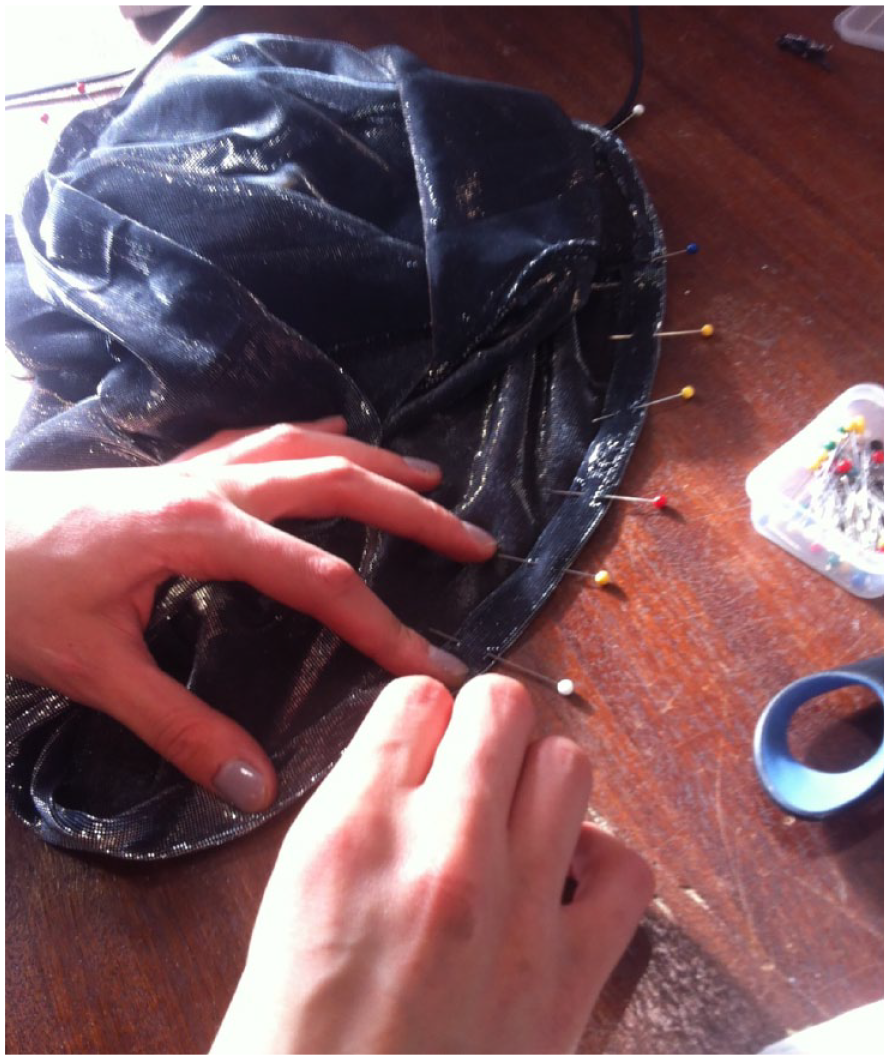
Clarence Pinning the Rolled Dress.
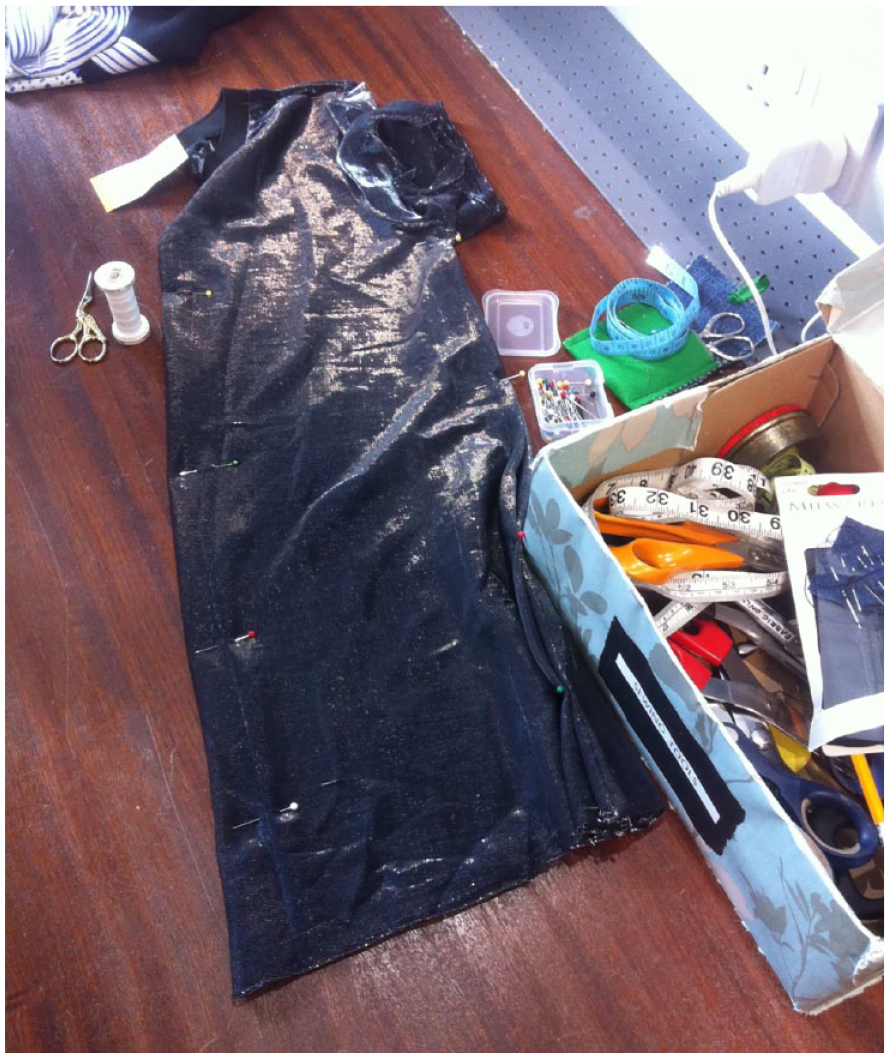
After Pinning, the Moonlight Dress Lay Still.
As Clarence made her way to the sewing machine, Gale gave her a small piece of “practice” fabric. Upon my inquiry Gale began explaining the initial procedures: I give them [first-time menders] a lot of practice without even threading it [the machine] so that they can understand the mechanism of the machine {. . .} we have what we call ‘practice sheets’ for that. The key is the speed of the foot control [on the machine] and your hand control is based on the speed of the foot control. That’s what we focus on for the first 15 to 20 minutes. And then after that, we get them to thread the machine and practise straight lines, then zig zags, so we take them through and that is the point. People who are new, this is where we can encourage them.
Once she had completed her practice exercises on the scrap fabric, Clarence placed the moonlight garment into the sewing machine and using straight stitches, started to repair her dress. Under the watchful guidance of Gale, Clarence began her induction into the world of mending and the community of menders!
Clothing frequently rips or tears. Garments respond instinctively and faithfully to make their damages visible to the naked eye of the wearer. Yet, experiencing these material bruises often brings feelings of dread or dismay to the surface. For some, attending to these imperfections, through acts of repair, offers a chance at redemption. Stitching back undone hems or broken buttons helps safeguard marginalized garments, skirting on the brink of irrevocable expulsion, by bringing them back into use. As menders engage in this humble yet metamorphic practice, various sensibilities that are both shaped by and themselves shape the object of practice become known. By engaging with the notion of taste, this article aims to explore how everyday menders become able to form an alliance with their practice, ultimately converting mending into an object of passion. This task is undertaken by drawing on the works of a growing number of scholars that have treated taste as a skill and a practice (see Wright 2018; Bentia 2014; Hennion 2007, 2004; Gherardi 2009). Moving beyond social class and status groups, these scholars’ engagements with the notion of taste as a sensory practice focus on the role of the body and its sensory responses to its sociomaterial environment. Wright (2018) states that taste here “acts as an indication of a shared mastery or competence and indeed of a shared history of training and recognition of that in others” (13). Unlike Bourdieu’s (1984) tasters, in this instance not knowing (or failing) does not run the risk of social exclusion in a community of tasters or menders.
Using this description of taste, I build on 3 years of my original multi-sited ethnographic work in communal garment mending events across four cities, namely, Helsinki, Auckland, Wellington, and Edinburgh, to investigate how menders become able to do taste in and through mending. In recent years, numerous Western countries have experienced a rapid growth in communal repair events (Charter and Keiller 2019). Since the inception of the Repair Café Foundation (RCF) in the Netherlands in 2012, a global “Fixer Movement” to encourage product longevity through open-access repair cafés has emerged (Charter and Keiller 2019). Participants at these events often come from various socio-economic backgrounds and bring with them a range of clothing to either learn how to mend or to have repaired by an experienced mender (Durrani 2018a). In addition to addressing textile waste, the diverse nature of these public spaces makes communal repair events crucial locations for understanding how taste is performed, maintained, and often negotiated and communicated in either a collective or individual manner around a practice.
The intention here is to use the concept of taste as a reflexive practice to understand how menders are able to assess the quality of mending and also actively form an attachment to their practice. In doing so, I seek further guidance from sensory ethnography to aid my immersion into the practice of mending. As I reflect upon my practice in relation to those of other menders and upon our collective and individual encounters with clothing that gets repaired, I highlight the elaborate procedures and processes that menders undertake to bring forth their practices. An exploration of these processes covers menders’ endless discussions on fabric choices, current, and future projects, shared bodily experiences with different techniques of stitching, pattern cutting, and threading needles. It enables a nuanced discussion on the identification of how various sociomaterial negotiations impact menders’ decisions on the right or wrong way of practicing. Examining these encounters and menders’ experiences in and through their sociomaterial surroundings enables us to better understand how menders appraise and refine the quality of their practice while also communicating it with others. In other words, we see non-professional menders reflexively and intelligibly doing taste in and through their practices.
Taste: When Intelligibility Meets Sensibility
Broadly speaking, taste, when understood through the influential Bourdieusian (1984) conceptualization, can be explained in terms of the mechanism by which class distinctions are created, maintained, and perpetuated in class-stratified societies. In this tradition, taste is seen as "something people have (or do not have) rather than something people do" (Bentia 2014, 175), the development of which remains dependent upon access to the cultural capital that various status groups share in modern consumer societies (Bourdieu 1984). The reach of any social group to cultural capital is then understood as being linked directly to wealth and the things in their possession become a manifestation of and representative of their taste. Tastes here are heavily guarded by those in positions of power and influence, socially determined, and become a matter of preferences or choices (Veblen 1899; Bourdieu 1984). However, an ongoing re-examination in recent sociological scholarship reveals taste as being understood through the senses or as a reflexive activity in which the emphasis is placed on “de- sociologising” people by focusing on what is done rather than only examining what gets said or what is liked (Wright 2018). In accordance with this, taste is being re-understood as a practice and viewed in terms of a form of sensory training or reflexive experiences felt by the human body. Scholars in this realm examine what gets done in practice and focus on the body and how, over time, it learns to manage its responses in relation to the material and social world (Hennion 2004, 131; Dumont 2014; Bentia 2014; Mann 2018; Arsel and Bean 2012; Gherardi 2009).
The theory of taste employed here relates to the larger framework of Practice Theory (PT). Discussion within this perspective steps away from dualistic notions on knowing and doing and brings an understanding of knowledge as created in the performance of any action (Gherardi 2009). Performativity and materiality are key concepts here. With performativity, PT scholars have emphasized the treatment of things or materials and humans as “performed relations” that are shaped in and through the enactment of a practice and not taken as “pre-formed substances” (see Orlikowski 2017; Durrani 2019). In other words, practice is seen as an ongoing enactment of knowledge in which humans and non-humans are conceptualized as bodies-of- knowledge and things-of-knowledge (or as matter). The notion of materiality is then central here. Gherardi notes that things need to be understood as “things-in-phenomena and not as things in-themselves” (Gherardi 2017, 41). To put it another way, reality or knowledge does not exist outside of matter or objects or human bodies. “Instead knowledge emerges through human/non-human engagements, is ongoing and practical, sensorial and corporeal knowledge are given equal precedence in the analysis of taste” 2 (Durrani 2019, 44, see Durrani 2019 for a detailed discussion on the said concepts).
This recent exploration of taste is deeply associated with sociologist Antoine Hennion’s (2004, 2007) work, which defines taste as an experience felt through the senses. In so doing, he proposes a shift in the sociologist logic of reasoning, from social determinism to the human body as matter and a source of knowledge. Such a deliberation moves away from class hierarchies and conflict to considering corporeal knowledge in the making of taste. Corporeal experiences are examined up close to understand how practitioners become able to measure the quality of any given practice and learn to develop a taste for a practice. Therefore: Taste is not an attribute, it is not a property (of a thing or of a person), it is an activity. You have to do something in order to listen to music, drink a wine, appreciate an object. Tastes are not given or determined, and their objects are not either; one has to make them appear together, through repeated experiments, progressively adjusted. (Hennion 2007, 101)
Hennoin’s development of a reflexive approach to taste focuses on three dimensions: passion, events, and sensing (Gomart and Hennion 1999; Hennion 2004). For Hennion (2004), taste is not a “passive social game” in which those tasting remain unaware of their doings. Instead, he sees practitioners as collectively engaging in practice, and through the deployment of various processes and protocols, they actively achieve passion for a given practice. In doing so, the effects created over time by being in practice are understood as situated and tied to their sociomaterial environments or events. These effects are then recognized in relation to the affectivity of the sociomateriality of practices. In other words, tastes are learned and can be taught through training the sensing body and its engagements with the social and material world. Such a deliberation aids the recognition of various ways of doing, which does not see practitioners as mindlessly reproducing existing ways of doing but as reflexively and continuously reforming them. It is within this space that the present work is situated.
Mirroring Hennion (2004, 2007), taste in this article is a matter of practice and not a feature innate to people or found inside objects. Instead, it gets mutually constructed over time through encounters of the practitioner’s body with materials in a situated manner. A relation of reciprocity emerges, with feedback coming through the object and the collective as practitioners engage in and continue to remain in practice. Over time, the practitioner’s body becomes skilled in sensing its “capacity to recognize what others recognize, and to share effects felt with other bodies” (Hennion 2004, 137). Practitioners are then both active and passive to the effect of the material, and these engagements allow them to relate better with their practice and communicate it to others (2004). Thus Hennion finds taste residing at the intersecting folds of sensibility and intelligibility. Within this realm, Hennion makes a bold shift away from Bourdieu’s tasters, who might conceal their not-knowing, to an examination of the shared effects and sensibilities that tasters experience.
A pragmatic approach to the construction of taste, in which the dichotomies of “thinking” and “doing” are equally overcome, is taken here. Thus, taste serves as an analytical framework to bring focus and give relevance to the practices of amateurs or non-professionals who are not bound by the duty of a profession, but engage and continue to remain in practice due to a common passion for it. In such a way, Hennion (2004, 2007) highlights the collective dimension of taste without ignoring the individual’s training, the negotiations between the individual’s body and the materials, and the framework of normativity as provided by the collective. As these negotiations continue, practitioners are informed in practice while they also reform their practice. Moreover, through the subsequent discernments, an appreciation that can be described as an attachment to the practice emerges. Therefore, as is discussed later, through continual feedback loops, methods of practicing are also constantly refined as practitioners become increasingly involved in the practice.
In using taste as a skill or a reflexive activity, we can begin to understand practices as flat, whereby practitioners are keen on sharing, opening up, and articulating their knowledge through their performances. An exploration of how enacting taste in such a way in the practice of mending moves away from treating taste as a marker of perpetual class conflicts and social policing toward seeing it as sensory responses of the body, shared understandings, and skilled learning. In other words, through its performative, material and corporeal aspects, taste is understood as relational. Doing so enables identifying the modalities of taste present in the heterogeneity and dynamic practices of menders and their varying attachments to mending. The upcoming sections further elaborate on these aspects.
Methodology
To illustrate and untangle the tapestries of mending, I show how drawing on the notion of taste as a reflexive practice in culmination with doing ethnography through the senses (Stoller 1989) resulted in a detailed analysis of the complexities laden within mending. The ethnographic fieldwork was set in a total of 18 communal repair events over three years (January 2016–June 2018) in four cities in Finland (Helsinki), New Zealand (Auckland and Wellington), and the UK (Edinburgh). The accumulated data formed as a part of my doctoral research and consisted of 67 in-depth semi- and unstructured interviews and conversations with participants and organizers of mending events, web research, field notes as informed through my observations and participation, 567 pictures, and 15 short video clips.
As my engagements with various senses became known in and through my research, four analytical doings unfolded. These doings, or sensed research practices, can best be understood as: observing, talking, sensing, and reflecting. I summarize them below (for a detailed discussion on each of these phases, see also Durrani 2019).
During the initial stages of my field visits, I mainly relied on the sense of sight. This meant making observations and taking a “spectator’s” view of the practice. Therefore, I made extensive notes on how others were mending, what type of clothing they brought with them, how long they stayed at the mending event, how the interior was decorated and whether menders repaired their garments in a visible or invisible manner. Yet, as my visits to the mending events became more frequent, I began to realize that my practice of merely observing my informants not only made them feel “observed,” but made me unable to truly capture a sense of the practice I wished to understand. Considering this, I decided to bring my own garments with me to the subsequent mending events in which I participated across all three sites.
Mending my garments in others’ company was accompanied by various conversations and brought about the talking phase of my research. I realized that the action of working on the holes and rips in my garments acted as the gatekeeper I sought. These continued engagements with other menders and the contours of my garments further resulted in an understanding of mending through sensing it. I began identifying elements I had not previously considered. This meant understanding and recognizing that my sense of touch and surrounding sounds greatly influenced my experience and appreciation of the practice. Stoller (1989) notes that while the sense of sight is of significance to ethnographers, other senses such as sight, smell, and/or touch are equally valuable. Becoming attuned to the language of mending as sensed through my haptic and sonic encounters meant paying closer attention to my own bodily movements. This also meant taking into consideration the responses my body made to the resistance or give of the clothing. I began taking note of how I was training my tongue to work together with my teeth when preparing for threading needles, sensing what fabric I was working with through the feel and texture of the garments and how the sounds and velocity of the sewing machines impacted my practice. Thus, training and attuning to these sensibilities resulted in shaping understandings and reflexively reflecting on how mending was experienced in communal spaces.
I soon began contemplating how the interplay between menders’ bodies and materials and other menders impacted the practice of tasting. This resulted in me also taking note of how menders approached various objects (such as needles, sewing machines, scissors, threads, and garments), what variations or similarities existed in how the practices were performed through their bodies, how the various styles of mending impacted its performance, what role the sewing machines’ sounds played in the practice and how the menders spoke of their practices. Cross-referencing these observations with my own experiences of mending my garments resulted in the creation of the following additional themes: sight, sounds, touch, invisible mends, visible mends, sewing machine, hand-mending, use of descriptive sensuous words, ethics, and quality.
Keeping the themes mentioned above in mind, I revisited the data I had collected from all three sites. I began re-analyzing my notes, the pictures, videos, and transcriptions from a total of 67 interviews. In addition, I relistened to the audio recordings. However, this time, I began analyzing through deep listening. This exercise required me to repeatedly play back the conversations I had had with menders, pay attention to the background sounds of sewing machines and other menders, and reflexively relive my experiences (see Revsbæk and Tanggaard 2015). Findings from re-analyzing the data collectively resulted in clustering it under the above-mentioned thematic categories. Doing so enabled me to identify the common themes running through all three sites; such as the role of the collective in developing the techniques of a practice, individual training of the senses informing the practice, the particulars of touching materials, material feedback, and how it imprints on the body, the body’s receptiveness and response to material objects, the bodily movement in the ways of mending, the sounds in the communal spaces and the use of words to reflect the aesthetics/ethics sensed through practice, such as “good,”“bad,”“beautiful,”“pretty,”“ugly,”“smooth,” or “rough.”
Identification and analysis of these elements enabled a deeper understanding of the heterogeneous nature of mending and the variations in the modalities of the taste that were present among the various menders. By continuously dialoguing between the literature and my primary research, I was able to classify both the more pronounced and subtle aspects of the practice. This then enabled me to see how menders related to their practice and coped with demanding or new aspects of the practice, and I was able to observe whether or not they connected with their practice. The following sections, using thick descriptions, illustrate the above-mentioned themes emerging from the data, and the findings disseminated through three ethnographic vignettes that expose and explore these dimensions of taste.
Elucidating Results: Ethnographic Snapshots
Though mending is practiced (individually) in domestic settings, my immersion in communal mending spaces proved crucial for understanding the performative, material, and corporeal dimensions of taste. The repair events that formed part of my fieldwork in all three sites consisted of free-of-charge events organized by local community centers, recycling centers, social enterprises, and/or craft activists (see Durrani 2018a, 2018b, 2019). In contrast to the pop-up events in Helsinki, in which the organizers were professional fashion or textile designers, the repair events held in Auckland, Wellington, and Edinburgh were organized by non-professional textile or fashion designers. Here the events were held regularly, at the same location each time, and had experienced volunteer menders to help the participating menders with no fashion/textile background at all (Durrani 2018a, 2018b, 2019) 3 .The organizers who formed part of my research collectively shared and were fuelled by the desire to reduce textile waste in the context of their respective locations through engaging the public in acts of repair. Taking inspiration from the practices of the RCF in the Netherlands, these organizers also arranged repair events in public spaces such as libraries, cafés, and recycling centers that were always equipped with sewing machines, tables, chairs, various fabrics, buttons, ribbons, needles, scissors, measuring tapes and other haberdasheries. In addition, all the events were held during the evening, mostly on the weekend, for 3–6 hours. Participants of these events included people aged as young as 19 to as old as 80. Both males and females participated, with females forming the majority. They were from all walks of life, from photographers to shop assistants, with varying skill levels and no professional background in crafts, sewing, and textile/fashion design (see Appendix 1). Whereas Hennion (2004) referred to non-professionals as “amateurs,” in my research, all those with no professional training in fashion and textile design/crafts, I termed and referred to as vernacular menders (for a detailed description of the vernacular menders, repair organizers and an in-depth discussion on motivations for hosting and participating in the repair events I researched, see my earlier publications Durrani 2018a, 2018b, 2019).
This section presents three complementary ethnographic vignettes that also serve as snapshots that reflect the sociomaterial, discursive, relational, and performative nature of taste as it was made and maintained through vernacular mending. With the first snapshot, I elaborate on how normative frameworks of a practice are performed and continuously negotiated in the making of taste. The second snapshot reveals how within these negotiations, a variation in corporeally experiencing mending emerged. Various corporeal experiences of mending not only inform the practices of menders but also reveal differences in the development of the menders’ taste for mending. The final snapshot reveals how, by being in the practice, mending ethics often merge with the aesthetics of the practice, which in turn refine its quality, over time resulting in attachments sense-ably achieved in practice.
Tips and Tricks: Negotiations Through the Rhythms of the Thread
On a typical Thursday repair event at the Remakery in Edinburgh, as I worked intently on tying the knot beneath the broken belt loops of my silk trousers, I found myself unusually at odds with my garment. Fighting against how the material wilfully kept slipping through the grips of my fingers, my gaze momentarily shifted. Seated to my right, I saw Carl, an avid mender and experimenter, sharing tips and little tricks with Jake, a first-time mender, on how “best” to reinforce his denim to strengthen it and make it more durable. In his tutoring he said: Place a tight knot on the inside of the fabric. Some people are very sensitive so it could be a
Carl then handed Jake a box full of scrap denim patches and pieces, suggesting a few for him to use. However, Jake continued to rustle through the pile, searching for the best fit and selected the one that precisely matched his jeans’ color. Upon his discovery, Jake jubilantly shared: “I’m very basic, I’ll tell you, I own seven pairs of the same jeans. I own 15 t-shirts of the same colour and I wear them every day!”
After finding the fabric that worked for him, Jake began handmending the hole in the in-seam of his jeans and patched the frayed fabric between the inner thighs. As Jake worked on this, with frequent consultations with Carl, he began wording his doings: I got them [the jeans] from Primark. I’ve had them for about a year. The stitching in the in-seam area came away and there was a lot of wear between the thighs {. . .} I certainly wouldn’t have thought to put a patch on the hole; I would’ve thought to close the gap up, like stitches to a wound as opposed to adding extra fabric. So first I found a piece of fabric that matched the jeans and then I cut out a section of that fabric to fit the shape of the damaged fabric. And then sketched out the shape of the damaged area and used that to cut the fabric down to size. Then I threaded the needle and began slowly stitching around the patch in order to secure it to the trousers. I thought I could throw out this pair and get another but then I thought I might as well learn how to fix. Because learning will translate to other things as well, like I have a jacket whose button keepsfalling off because I haven’t been sewing it well enough, but now I can!
I soon reverted to my trousers, and with Jake’s observations in my mind, I too began feeling through the rhythms of the threaded needle (Figure 3). As my fingers followed the folds and angles, the fabric made in response to the insertions of the needle, my hands guided me on how to work with my silk trousers effectively. In that moment of silence, my body had become the sensor!
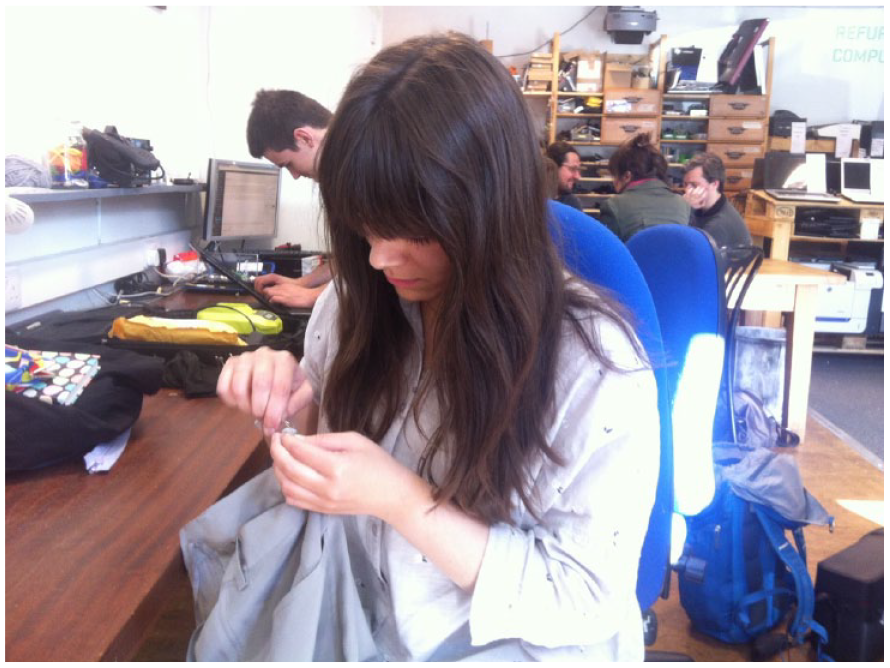
Attuning to the Shapes of the Muted Silk Belt Loops.
Tips and tricks are often shared in these vernacular spaces, and it is here that appraisals are made, garments appropriated and the novice mender slowly and steadily learns through their performance. While experts like Carl may give guidance to Jake and others, vernacular menders also find their way to mend what best fits their existing wardrobes (Figure 4). Through these struggles to find either the exact color of scrap denim or the perfect length for a dress, vernaculars negotiate both with the materials at hand and the frame of normativity (as outlined by Carl or Gale) in search of their own path. Therefore, like an expert mender, the novice mender keeps discovering new ways of mending through the body’s performance of the practice. With every discovery of doing mends, new challenges appear, and the menders’ bodies keep training themselves and cope accordingly. Comparisons continue to get made while constructing taste toward the common “object of passion,”that is mending (Hennion 2004).
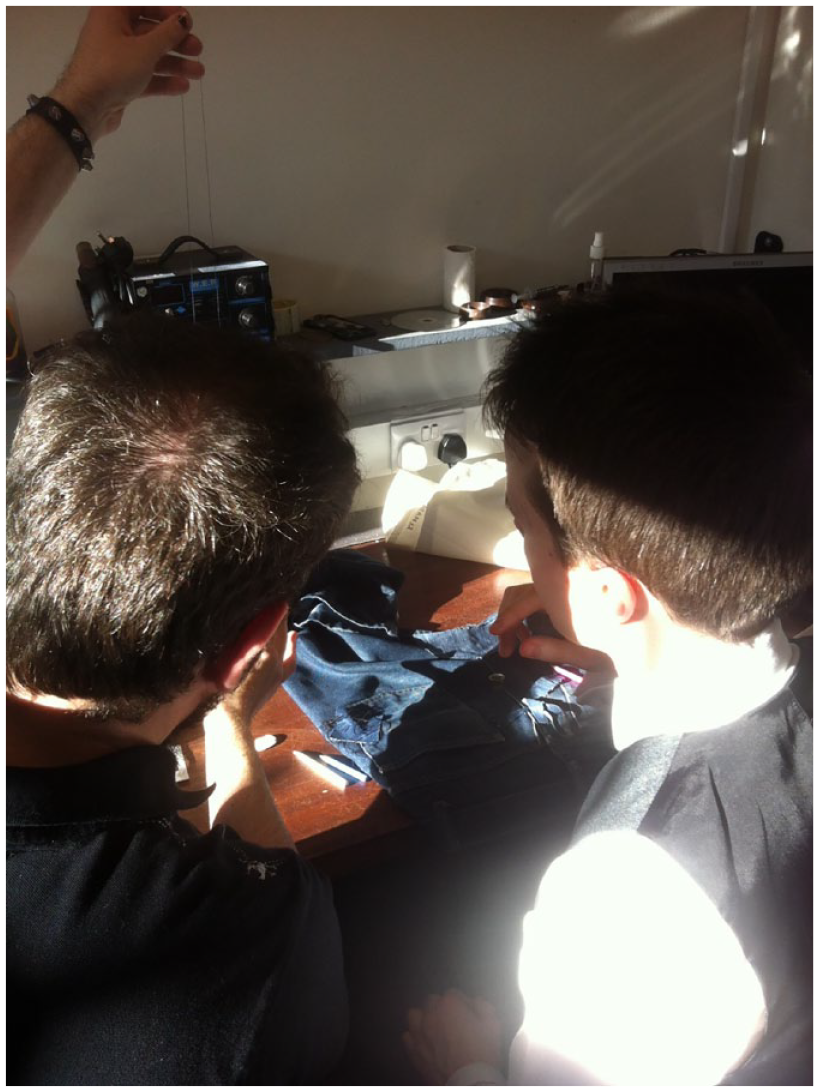
Sharing Tips and Tricks on the “best” Ways to Mend.
Menders develop creative solutions to problematic garment breakdowns by performing ways of mending that direct their practices further. It is a safe space for experimentation, challenging the garments’ limits, reconstructing, redesigning, and repurposing already designed clothing through repair. Some may even come to only have the “work done” and leave thereafter, but most sit, talk reflect and sense through their mends. Collectively they construct significance for, give relevance to, and constantly reframe the practice of mending and their garments. According to Hennion, “taste is a most efficient ‘group maker’” (Hennion 2004, 6), meaning an activity achieved through a collective that provides a quality framework and validates the practice, makes it relevant and gives guidance, and in doing so provides a starting point for a first-timer like Clarence, Jake or myself, to begin and assist in giving words to the practice. This does not mean that it is an imposing structure; instead, by turning to the more expert menders, the beginner receives sociomaterial referents. Taste, then, becomes mutually constructed over time and is “a collective, emergent discursive process that constantly refines practices, and which is done by saying and which is said by doing” (Gherardi 2009, 536).
The collective nature of taste enables making visible the interplay that occurs between the individual, the material, and the social, and the lines between what a professional and a vernacular mender can do often become blurred. Menders frequently spend hours discussing the latest books on mending, types of threads or qualities of fabrics to use, while also discussing the importance of extending garment use at these events. Thus, space is provided for the practice to unfold organically; suggestions are shared, sewing equipment is fixed, and French-knot stitches are used to mend holes instead of simple running stitches. We begin to see feelings of belonging being shared through the ongoing discussions and doings of the collective mending practices. It is in these in-between moments that taste is collectively and sense-ably shared in varying modalities. In regularity, as opposed to one-off mending, menders develop a repertoire of experiences and find a common language through which to share their knowledge (see also Durrani 2018a). In the midst of collectively working through their hands, sitting in the company of more refined menders, learning together about what a “good” mend is, or what “works” and what does not become known.
A normative structure that often acts as a quality control framework emerges in and through these ongoing practices of menders. Although this normative structure might be reliant on the collective, it is relatively porous and fluid, as we see constant negotiations between the individual, the garments, and the collective unfold. As shown, vernacular menders do not blindly follow the rules, nor do the rules become imposed by strictly following the dominating styles of mending. Instead, menders find their way reflexively in the space between the fabric and the finger. Relentless negotiations, conversations, and new pathways are dynamically molded and merged through the individual and collective mingled within the entangled sociomateriality of their practices.
Story of One Recruit, her Jeans, and the Sewing Machine
The human body is central to any practice. As humans, Gherardi (2009) notes, we are bodies, and we have bodies. Through the complex interplay between the material environments and the human, the body senses, copes, responds mutually and reflexively produces ways of doing. Thus, knowing how to do something is not solely the possession of the brain, nor is taste innate to humans or placed within an object (Hennion 2004). With this supposition, we see taste as a skill that is developed over time. It is co-created, informed, maintained, and often refined through these entanglements between humans with materials, and the body trains to sense and discern the quality of a practice (Hennion 2004).
Moreover, the corporeal experiences of working with machines and mending tool kits, whether pleasant or unpleasant, connect the menders’ bodies to the materials and the practice. Abbots (2018) also highlights the centrality of using tools in the construction of taste. He states that the continuous use of tools, together with the slow and extensive manual labor that comes with such use, further contributes to the development of taste for and toward any given practice. Materials and menders do not merely face one another; they are entwined together in practice. What emerges from this entangled relation is a garment containing several raw materials, tools, and the essence of the mender. How this enmeshment of menders with various materials, tools, and raw materials mutually helps inform ways of doing mending is captured and explored through the following snapshot.
On 17 January 2017, I participated in a mending event arranged by the social enterprise REMAKE in Helsinki. Inside their atelier were three small, interconnected rooms; each room set up differently. The main room had a square wooden table placed at its center, upon which lay several needles, buttons, scissors, and other haberdasheries, to assist in the mending. All the hand menders were seated around this table talking and mending. In the remaining two rooms were industrial and domestic sewing machines for those who wished to use them. Each machine had a chair placed adjacent to it, and fabric bolts stood upright in the corner of the room.
Nestled within the roaring sounds of the machines was Pirjo, a producer and resident of Helsinki. She had brought a pair of blue denim jeans worn out in the in-seam area due to friction caused by use over time. In an attempt to find a piece that matched her current jeans, Pirjo began her mending expedition by going through the piles of scrap fabric available to her. Rummaging her way through the fabrics, she saw, touched, felt, and weighed to assess the fabric density through her hands. Eventually, she picked the piece that best matched her jeans. Pirjo then began consulting Petra, the head seamstress at REMAKE, on the different ways in which she could fix her jeans. The consultation started with turning the pair of jeans inside out to assess the level of damage and the quality of the fabric. Petra took the jeans in her hands and grazed the surface of the jeans. While examining the broken area, she swiftly followed the direction of the frayed fibers with her eyes and hand simultaneously. Within seconds of her touch, Petra suggested that Pirjo ought to use a sewing machine to fix them.
Pirjo had never really used a machine. Once seated, she placed her foot on the foot pedal and began feeling the machine’s cold corners and surfaces while following where the thread went, wondering how to turn the machine on and operate it. As Pirjo started to use the machine, she found it increasingly challenging to combine foot and hand control. Struggling to work together with the machine, while trying to learn how to read the direction of the fibers of her jeans, her body moved in various ways to accommodate the jeans entangled in the machine. Jumpstarting her way into the process, while trying to pivot the garment around, her struggles with the sewing machine became more visible and audible. Tensely shifting her body up and over, Pirjo constantly moved in relation to the shape of the garment as the sewing machine whirred in abrupt stop-start bursts while she handled the fabric. Trying to find a way that did not cause breakage of either the thread or the needle while getting smooth lines on the jeans with no angled edges proved challenging for first-time mender Pirjo.
As she worked with the machine, her bodily postures continued to change; at some point, she leaned in and crouched over the machine (refer to Figure 5). Seeing this struggle, Petra responded by gently placing her hand on Pirjo’s back to ease and straighten her posture. Upon Petra’s suggestion of keeping an arm’s length from the machine to work at the same height as it, Pirjo sat up straight. After spending some concentrated hours with the sewing machine, Pirjo became able to manage her body and breathe to become in tandem with the movement of the machine. Using a zigzag stitch to repair the holes in the in-seam, Pirjo renewed and revamped her jeans. Once finished, she began reflecting on her experience:
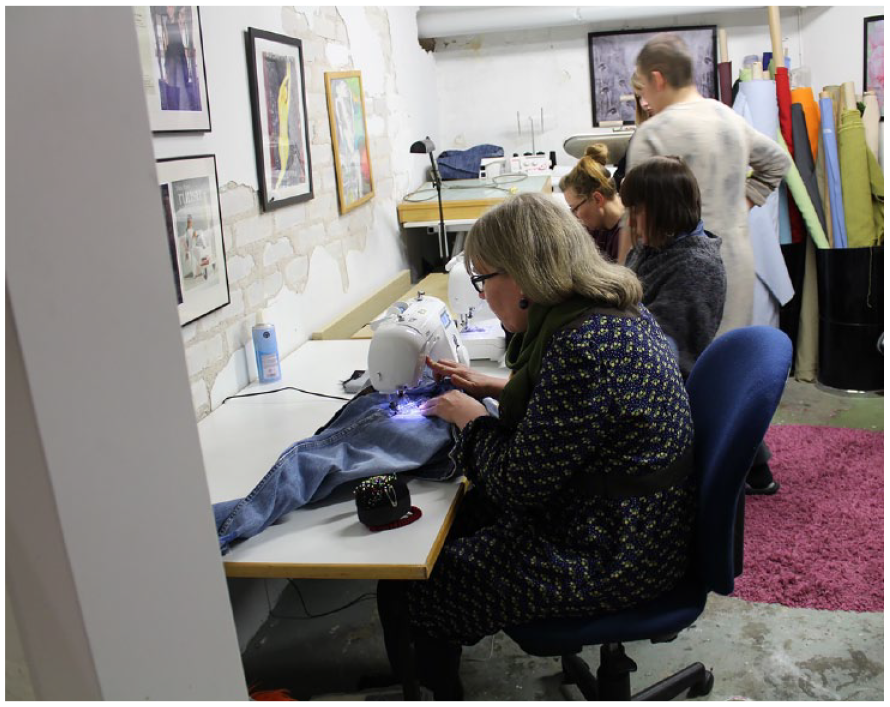
Pirjo’s Body Hunched and Crouched over the Sewing Machine.
I think at first it was a bit challenging and took a lot of courage to start and I just kept thinking how long it took. But Petra told me to remember to breathe and loosen my arms and keep my posture. Because I was like this [making a crouched-up posture] and at the end it was really exciting to see it turn into a finished product. It was great. I will also recommend it to my friends. This is a type of skill one should really learn, it’s very useful.
Like Pirjo, several vernacular menders negotiated through their bodies and responded to the sewing machines’ sounds, speed, and power. Whereas a beginner’s body struggles to find comfort in working in this space, those with more experience can better balance their bodies, sit upright and over time learn to become attuned to the rhythms of the machine (refer to Figures 5–7). As the body opens up to sensing the machine, it recognizes how the machine imprints itself on the body and reacts accordingly (Hennion 2004). By repeating the practice, the roughness often observed in newcomers’ bodies becomes less visible over time. These variations in bodily movements further reflect the modalities present in the practice and the subsequent development of the taste for it (Figures 5 and 6).
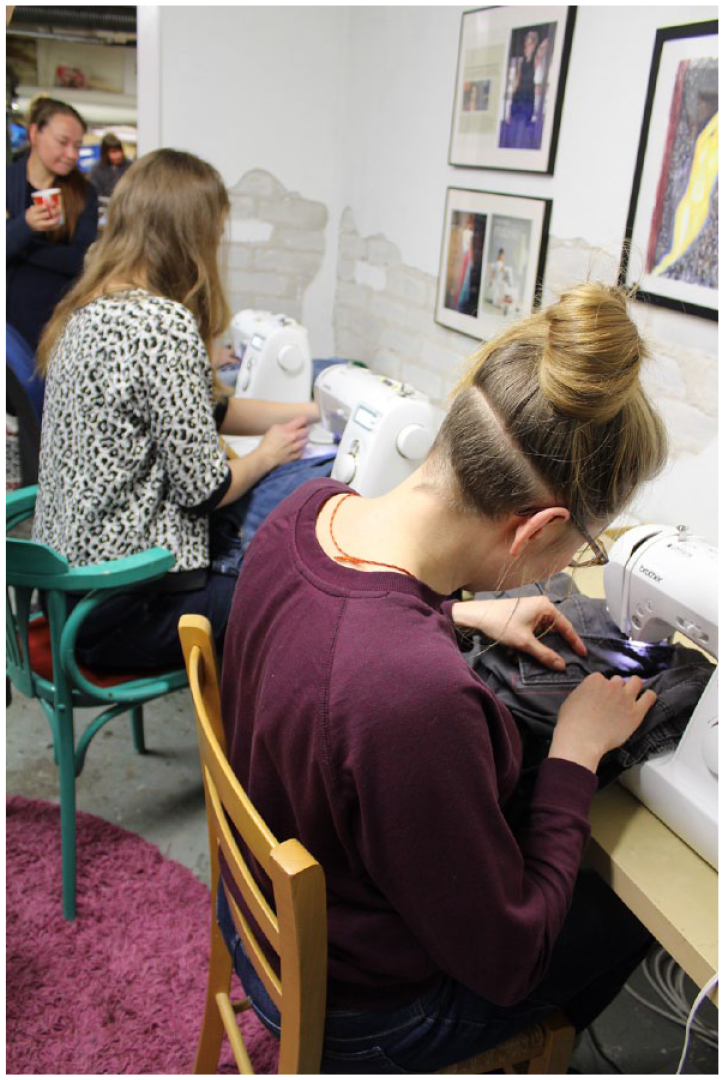
Experienced Menders’ Bodies Easy and Relaxed with Backs Straight.
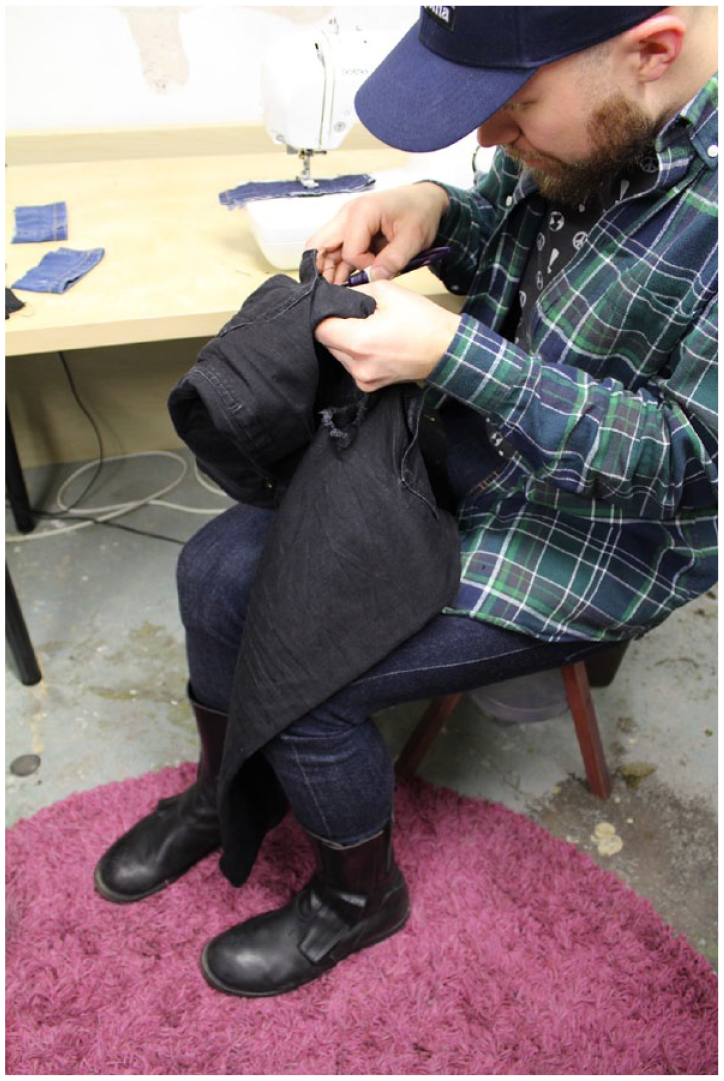
Tension in the Body of a Beginner Working on his Mends.
Moreover, materials also change roles in the process of mending. Things like thread and scrap fabric act as band-aids and raw materials that get swallowed into the garment and aid in fixing and adding quality. The sewing machines and needles act as devices mutually working to co-carry the practice forward and help actualize it. These various materials collectively and mutually work together with humans to give the garment a makeover that changes its physical attributes while also cosmetically improving it. The garment’s physical life is increased, its symbolic life redefined, and its aesthetic life reshaped. Furthermore, all these things or things-of-knowledge (Gherardi 2017) co-creatively play a significant role in actively acting on the human and creating an informative sensorial corporeal experience.
These corporeal experiences thus aid in building the ability to judge. Whether the judgment is in favor of or against the life of an object is not always known. However, through the third and final snapshot, I will dig deeper into how this material feedback furthers menders’ ability to assess what is the ugly, pretty, good, or bad of a practice resulting in refining, enhancing appreciation for, and achieving attachment as it becomes sensed in practice.
From Assessment to Attachment: Refining Stitches with a Cardigan
I like mending by hand and doing all kinds of stitches – you make a sort of connection. It’s lovely when we arrange events to sit around with others and do that [mend]. Your hands are busy, you get into a zone and you talk the whole time. And you feel like this is something we should be doing together. It’s a real joy and a creative thing and this cardigan has gone beyond that, they will probably bury me in this cardigan! (Caroline, August 2017, field work in Auckland, New Zealand)
A reciprocal relationship forms over time through the continuous entanglements of the menders’ bodies with the materials. As menders begin sensing and recognizing material feedback, they learn to discern and respond accordingly. In this way, “taste depends on feedback from the tasted object, from what it does and causes to do” (Hennion 2004,7). In each repetitive movement of mending lies both a history of doing and room for dynamicity. New elements are discovered with every piercing of the needle, and new effects are created through the grain of the yarn, the sounds in the event spaces, and the bodies of the menders, all of which assist in the practice, carrying it forward and sustaining it over time. In the following snapshot, we see how these tasted objects constantly reform and refine the practice of mending while impacting the garments’ use.
In late August 2017, while doing fieldwork in Auckland, New Zealand, I met Caroline, a freelance author and editor for a local magazine. She often participated in the mending events held by the Gribblehirst Community Hub in the city. An avid re-doer, Caroline had been working on the mends of her moth-green woolen cardigan for over 10 years. The cardigan came into her possession 10 years ago as she was making her way out of her flat. In a rush to leave, she quickly grabbed the cardigan, originally belonging to her husband, from the bottom of her cupboard and pulled it on. Upon first discovering holes in it, she began sifting through the woolen and tapestry yarns she had in her home. Playing around with the color scheme, she used primary colors and a combination of chain and lazy daisy stitches to visibly embroider paisleys over the holes. The cardigan became a project that she had been working on for 10 years. With every new hole came a mend in the shape of a new motif, a cable, or a bubble that may have started as, for example, a heart but did not end up as such. As she explains: It’s kind of my life really, now. I’m looking at it – I can already see more holes. I love the little, tiny, unexpected secrets. And now I put in things that only I know about, that surprise me and are my secret. So, this is my early paisley and later paisley [she laughs at the change that has occurred]. And then I got really into Boro mending that is all in these running stitches and seed stitch. I started adding colour and that started four years ago and is still ongoing. I think I mended an elbow, it started from there, then a button fell off there and I did that there. I wear it at work and sometimes on the weekend to go out {. . .} If I mended it now, I would probably just do the seed stitch and monochromatic.
The combination of the colors of the threads, various blogs she occasionally consulted, and what other menders were doing over time enabled Caroline to recognize through her sensing body where the fabric stressed to different types of stitch and how to create visual balance with different colors of yarns, thus altering her ways accordingly (refer to Figures 8–10). Starting with lazy daisy, she moved on to seed stitches and, most recently, to Japanese-inspired Boro mending, changing, and refining her ways of mending to mask holes. She mixed embroidery with mending through her mends, which allowed her to add functionality and flexibility to her cardigan. Moreover, her ways of mending became increasingly sophisticated, and as she became dexterous in one way of doing, she recognized other aspects of her doings that still needed fine-tuning. She even reflected upon how her history with mending had altered over time:
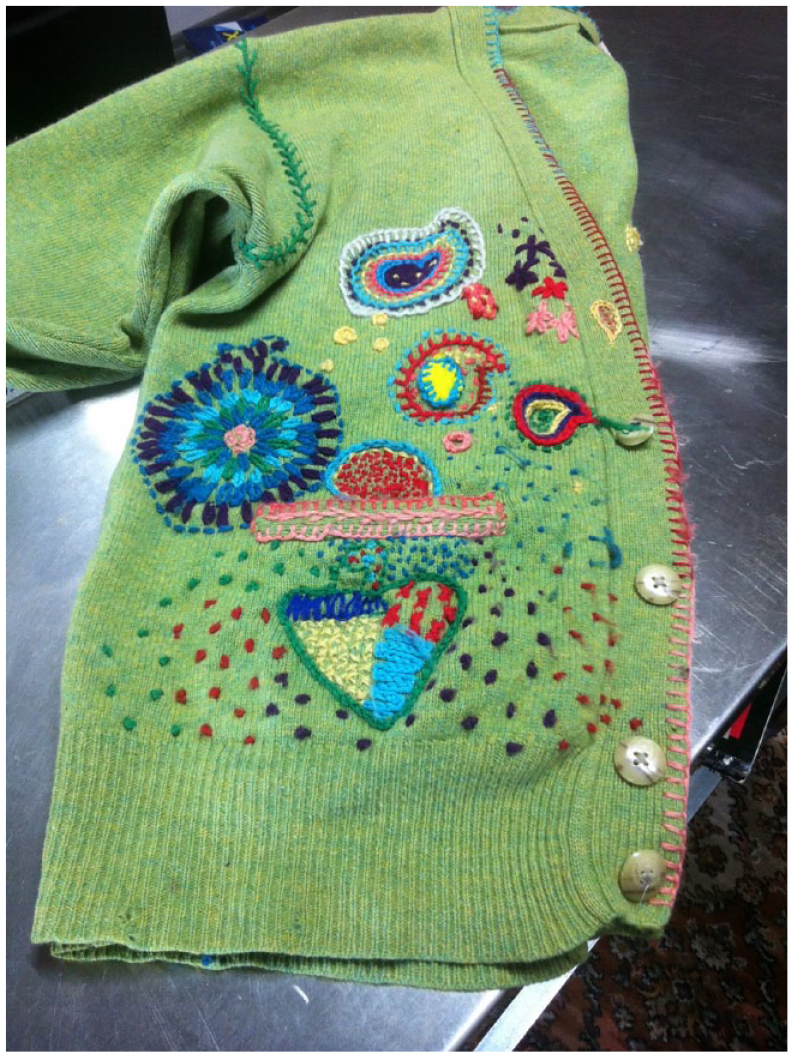
Caroline’s Cardigan.
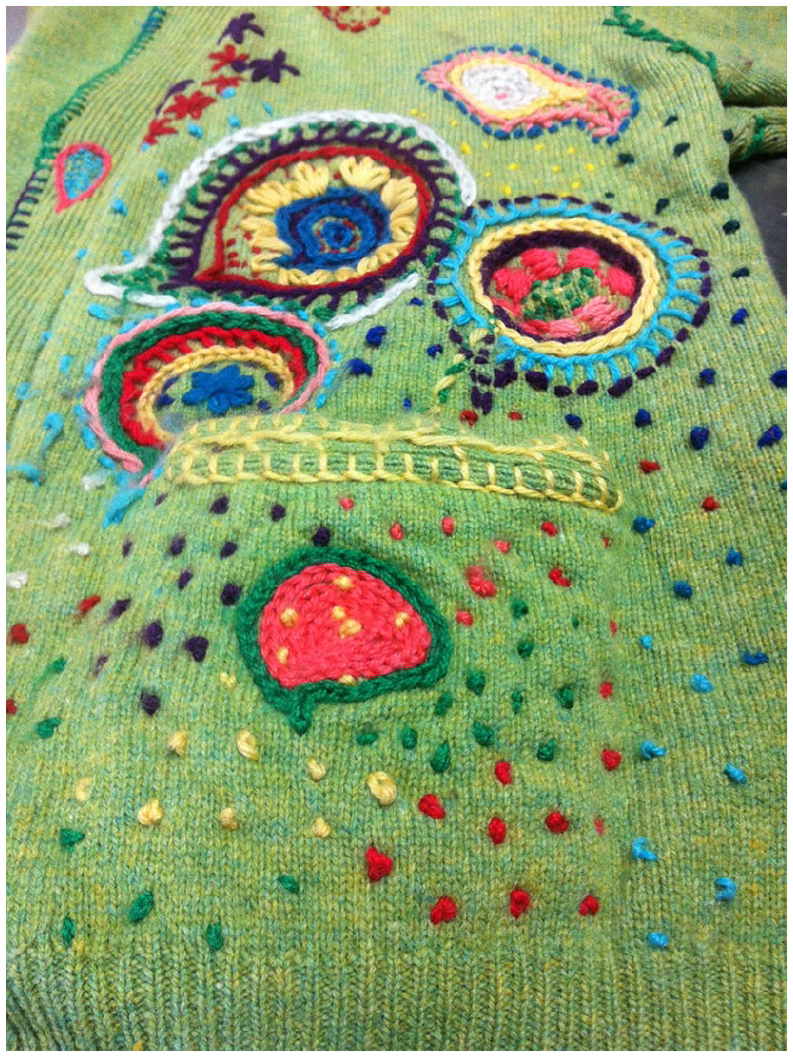
Roughly Mended Paisley and Bubbles.
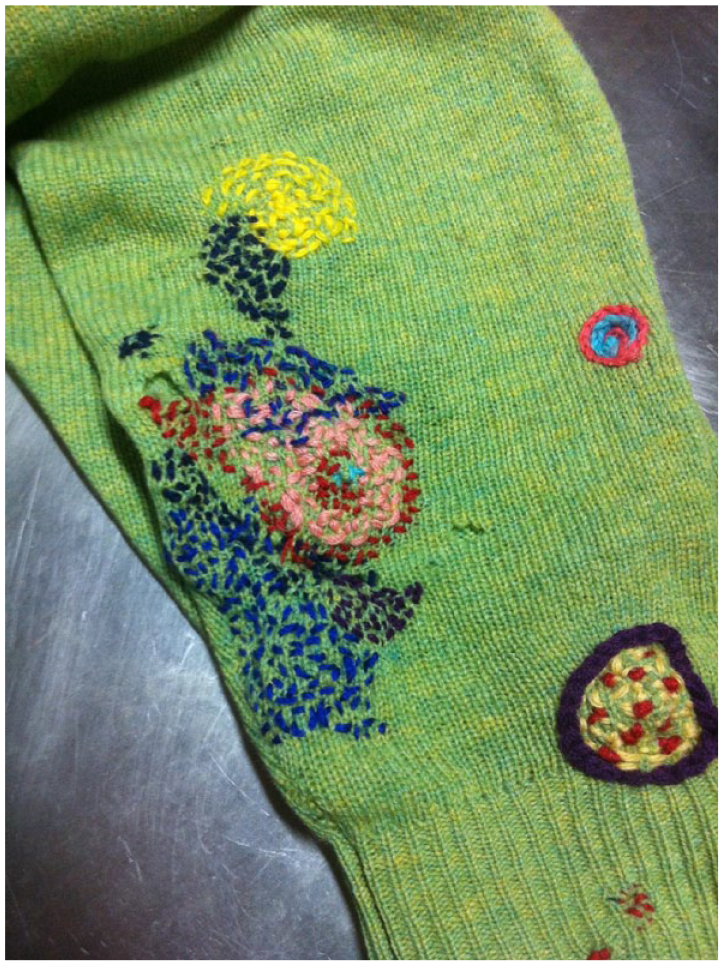
Refined Boro-Inspired Visibly Mended Stitching Over Time.
The thing I welcome now, in the last couple of years, has been visible mending, because when I was taught, it was all about no one being able to tell that it had been mended and you stranded the thread from somewhere inside the seam so no one could see where you darned the sock or patched the jumper{. . .} Invisible mending is still challenging for me {. . .} I’m not a very good finisher – look at the cross, it’s pretty rough, but I love it {. . .} Sometimes I’m annoyed at myself for being sloppy, I’m not a ripper-outer, I’ll keep going with what I have started and learn from that{. . .} The thing I haven’t learned to do is patching and I was talking to Sally [another volunteer vernacular mender] about this. I’m going to have to start doing it now because the wool is practically invisible.
To be able to listen to the language of the practice is the very effect of taste that is produced, and learned from its performances. Over time, Caroline’s mending, like her cardigan, has continuously informed her body, reformed her garment, and refined her practice. Her body became attuned to the object and began to recognize the feedback it got from the materials and learned how to respond to it. “Sensitivity to differences of quality is not given from the outset;” instead, it gets made over time and is continuously refined (Hennion 2004, 8). Therefore, taste is not a “social game;” it is learned, performed, and reformed through time. Like that of other menders, Caroline’s taste for the practice developed through a “sustained tactile relationship” of using the garments through time (Sampson 2018, 342). Once the sense-ability develops, the body quickly learns to grasp the connections made with the object and the practice. Therefore, though Caroline is quick to identify which yarn works with what type of stitches, newcomers like Pirjo or Caroline might linger a little longer in their decision-making. Yet, common to all are the enactments of the sensed effect created through the entanglement with the sociomateriality of mending practices. That is the grip of the practice, the attachment to the practice, the effect of participation in a practice, the reflexive strength of taste discovered through repeated work, through trial and error, through negotiating relationships with the body and the materials, all of which keep the practice going. Exploring these aspects result in continually refining the ways of doing mending, and we experience a continuous movement from rough to refined ways of mending.
Reframing Mending
Seemingly ordinary and mundane, mending is anything but a monolithic practice. Touted for its ability to extend the usage-time of garments, the practice of mending has recently gained attention as a lever for addressing unsustainable garment use practices. Although mending certainly provides a gateway between the old and the new, the broken and the fixed, the wasted and the restored, the practice is much more nuanced. However, earlier scholarship has remained limited within the domains of understanding perspectives on domestic mending (refer to Gwilt 2014, 2015; Norum 2013; Lapolla and Sanders 2015; McLaren and McLauchlan 2015) instead of exploring the practices of communal mending. This has led to under-researching the performative and sensory elements of the practice with an oversimplified depiction of mending as a mere functional tool for addressing sustainability.
To address this gap in research, the current article studied communal garment mending in four cities to understand what these spaces can tell us about the performative, corporeal, material, and relational aspects of taste to address the gap in the extant research. Examining the heterogeneous practices of these menders over 3 years revealed how people in their daily lives actively engage with and appropriate garments, and in time, reflexively learn to create a taste for their practice. In such a way, this study stands in parallel to the more widely understood treatment of taste as only the privilege of the elite upper class or the “star” designer capable of defining “good” taste in dress that “the masses” merely imitate (Simmel 1997). In such a supposition, a trickle-down effect of taste and the manifestation of designer dictates are showcased through the purchases of the latest fashion collections by the commons or users. However, following this line of logic, the performativity, material interdependencies, and corporeal experiences mingled within the complexities of the taste made through vernacular practices remain hidden and ignored. For this reason, this article moved toward and engaged in the discussion on taste as a reflexive activity.
The focus was on the moments when the practice was performed, informed, and reformed through the sensing body while continuously being sustained in the making of taste. We saw that during the process of working intimately with materials and other menders, an active relationship was formed by training the senses, creating an attachment toward the practice of mending, and an attunement to the materiality of the garments being mended was identified. Through repetition and constant redoing, the menders reflexively performed, continuously reformed, and experientially refined their practice. As the skills of the vernacular menders developed, they learned to control and add to the quality of the practice. In other words, the more they practiced mending, the more they were able to move from being a reluctant novice (Durrani 2018b) who was learning the ropes to become refined and able to quickly assess through their senses whether a mend was good, bad, ugly, or beautiful. As part of this illustration, taste became more about the practice of tasting that underwent periods of experimentation and learning through trial and error, and often failure, which was not concealed but shared.
Through these engagements, menders then became able to identify variations in material qualities, created communal bonds and formed understandings of how to better care for their garments (Durrani 2018a). Moreover, the time spent and invested in fixing garments further allowed a deeper understanding and appreciation of the power of mending to take root. As shown, the activities of the menders further indicated the creation and emergence of new practices of wearing mended garments with pride instead of shame. A celebration of their skills and repaired garments emerged. In such a way, vernacular menders challenge the socio-economic connotations of poverty and drudgery attached to mending (see Holroyd 2016) and create alternative ways of wearing garments by redesigning and reusing them through acts of repair. In echoing the vociferous space vernacular menders have taken, this article has revealed how everyday users actively bring forth alternative modes of using garments and partake in fashioning taste. As the vernacular menders appropriated their garments in creative ways, the fluid nature of clothing design was revealed, thus creating and re-ordering existing social orders and bringing a new outlook to the role of non-professionals or users or vernaculars as makers of taste and co-authors of their dress.
Furthermore, the status of the material is also transformed and re-ordered as it is mended. From being at the edge of disposal, it systematically becomes precious and wanted again. Once fixed, the garments are renewed, and the menders develop an attachment toward the practice (or person-practice attachment;see also Durrani 2019) that helped achieve this. While some might be more attached to mending than others, common to all is the active achievement of passion or appreciation for the practice that results from being in practice. Thus, the non-static heterogeneous nature of existing vernacular mending exemplifies how the qualities of taste are made in and through their practices and often vary, as do the intensities of attachments toward their practice. These attachments then help shape taste, which in itself is the glue that holds the practices of menders together.
In taking a reflexive approach to understanding taste, this article has explored the ways in which practitioners perform, become informed, and reform their practices by being in practice. It shifts the understanding of taste as a model for asserting “distinctions” to one that enables inclusion and reformation. Doing so further enabled identifying how social and material orders are continuously (re)created and revealed rich sites for investigating how vernacular spaces challenge wasteful fast-fashion practices.
Footnotes
Appendix
Details of Vernacular Menders (Participants of Workshop).
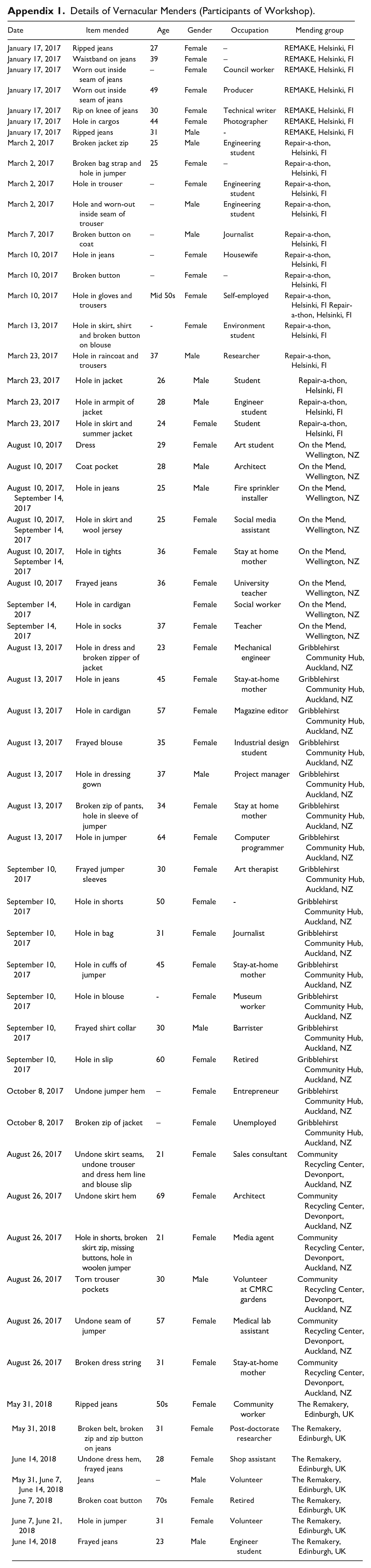
| Date | Item mended | Age | Gender | Occupation | Mending group |
|---|---|---|---|---|---|
| January 17, 2017 | Ripped jeans | 27 | Female | – | REMAKE, Helsinki, FI |
| January 17, 2017 | Waistband on jeans | 39 | Female | – | REMAKE, Helsinki, FI |
| January 17, 2017 | Worn out inside seam of jeans | – | Female | Council worker | REMAKE, Helsinki, FI |
| January 17, 2017 | Worn out inside seam of jeans | 49 | Female | Producer | REMAKE, Helsinki, FI |
| January 17, 2017 | Rip on knee of jeans | 30 | Female | Technical writer | REMAKE, Helsinki, FI |
| January 17, 2017 | Hole in cargos | 44 | Female | Photographer | REMAKE, Helsinki, FI |
| January 17, 2017 | Ripped jeans | 31 | Male | - | REMAKE, Helsinki, FI |
| March 2, 2017 | Broken jacket zip | 25 | Male | Engineering student | Repair-a-thon, Helsinki, FI |
| March 2, 2017 | Broken bag strap and hole in jumper | 25 | Female | – | Repair-a-thon, Helsinki, FI |
| March 2, 2017 | Hole in trouser | – | Female | Engineering student | Repair-a-thon, Helsinki, FI |
| March 2, 2017 | Hole and worn-out inside seam of trouser | – | Male | Engineering student | Repair-a-thon, Helsinki, FI |
| March 7, 2017 | Broken button on coat | – | Male | Journalist | Repair-a-thon, Helsinki, FI |
| March 10, 2017 | Hole in jeans | – | Female | Housewife | Repair-a-thon, Helsinki, FI |
| March 10, 2017 | Broken button | – | Female | – | Repair-a-thon, Helsinki, FI |
| March 10, 2017 | Hole in gloves and trousers | Mid 50s | Female | Self-employed | Repair-a-thon, Helsinki, FI Repair-a-thon, Helsinki, FI |
| March 13, 2017 | Hole in skirt, shirt and broken button on blouse | - | Female | Environment student | Repair-a-thon, Helsinki, FI |
| March 23, 2017 | Hole in raincoat and trousers | 37 | Male | Researcher | Repair-a-thon, Helsinki, FI |
| March 23, 2017 | Hole in jacket | 26 | Male | Student | Repair-a-thon, Helsinki, FI |
| March 23, 2017 | Hole in armpit of jacket | 28 | Male | Engineer student | Repair-a-thon, Helsinki, FI |
| March 23, 2017 | Hole in skirt and summer jacket | 24 | Female | Student | Repair-a-thon, Helsinki, FI |
| August 10, 2017 | Dress | 29 | Female | Art student | On the Mend, Wellington, NZ |
| August 10, 2017 | Coat pocket | 28 | Male | Architect | On the Mend, Wellington, NZ |
| August 10, 2017, September 14, 2017 | Hole in jeans | 25 | Male | Fire sprinkler installer | On the Mend, Wellington, NZ |
| August 10, 2017, September 14, 2017 | Hole in skirt and wool jersey | 25 | Female | Social media assistant | On the Mend, Wellington, NZ |
| August 10, 2017, September 14, 2017 | Hole in tights | 36 | Female | Stay at home mother | On the Mend, Wellington, NZ |
| August 10, 2017 | Frayed jeans | 36 | Female | University teacher | On the Mend, Wellington, NZ |
| September 14, 2017 | Hole in cardigan | Female | Social worker | On the Mend, Wellington, NZ | |
| September 14, 2017 | Hole in socks | 37 | Female | Teacher | On the Mend, Wellington, NZ |
| August 13, 2017 | Hole in dress and broken zipper of jacket | 23 | Female | Mechanical engineer | Gribblehirst Community Hub, Auckland, NZ |
| August 13, 2017 | Hole in jeans | 45 | Female | Stay-at-home mother | Gribblehirst Community Hub, Auckland, NZ |
| August 13, 2017 | Hole in cardigan | 57 | Female | Magazine editor | Gribblehirst Community Hub, Auckland, NZ |
| August 13, 2017 | Frayed blouse | 35 | Female | Industrial design student | Gribblehirst Community Hub, Auckland, NZ |
| August 13, 2017 | Hole in dressing gown | 37 | Male | Project manager | Gribblehirst Community Hub, Auckland, NZ |
| August 13, 2017 | Broken zip of pants, hole in sleeve of jumper | 34 | Female | Stay at home mother | Gribblehirst Community Hub, Auckland, NZ |
| August 13, 2017 | Hole in jumper | 64 | Female | Computer programmer | Gribblehirst Community Hub, Auckland, NZ |
| September 10, 2017 | Frayed jumper sleeves | 30 | Female | Art therapist | Gribblehirst Community Hub, Auckland, NZ |
| September 10, 2017 | Hole in shorts | 50 | Female | - | Gribblehirst Community Hub, Auckland, NZ |
| September 10, 2017 | Hole in bag | 31 | Female | Journalist | Gribblehirst Community Hub, Auckland, NZ |
| September 10, 2017 | Hole in cuffs of jumper | 45 | Female | Stay-at-home mother | Gribblehirst Community Hub, Auckland, NZ |
| September 10, 2017 | Hole in blouse | - | Female | Museum worker | Gribblehirst Community Hub, Auckland, NZ |
| September 10, 2017 | Frayed shirt collar | 30 | Male | Barrister | Gribblehirst Community Hub, Auckland, NZ |
| September 10, 2017 | Hole in slip | 60 | Female | Retired | Gribblehirst Community Hub, Auckland, NZ |
| October 8, 2017 | Undone jumper hem | – | Female | Entrepreneur | Gribblehirst Community Hub, Auckland, NZ |
| October 8, 2017 | Broken zip of jacket | – | Female | Unemployed | Gribblehirst Community Hub, Auckland, NZ |
| August 26, 2017 | Undone skirt seams, undone trouser and dress hem line and blouse slip | 21 | Female | Sales consultant | Community Recycling Center, Devonport, Auckland, NZ |
| August 26, 2017 | Undone skirt hem | 69 | Female | Architect | Community Recycling Center, Devonport, Auckland, NZ |
| August 26, 2017 | Hole in shorts, broken skirt zip, missing buttons, hole in woolen jumper | 21 | Female | Media agent | Community Recycling Center, Devonport, Auckland, NZ |
| August 26, 2017 | Torn trouser pockets | 30 | Male | Volunteer at CMRC gardens | Community Recycling Center, Devonport, Auckland, NZ |
| August 26, 2017 | Undone seam of jumper | 57 | Female | Medical lab assistant | Community Recycling Center, Devonport, Auckland, NZ |
| August 26, 2017 | Broken dress string | 31 | Female | Stay-at-home mother | Community Recycling Center, Devonport, Auckland, NZ |
| May 31, 2018 | Ripped jeans | 50s | Female | Community worker | The Remakery, Edinburgh, UK |
| May 31, 2018 | Broken belt, broken zip and zip button on jeans | 31 | Female | Post-doctorate researcher | The Remakery, Edinburgh, UK |
| June 14, 2018 | Undone dress hem, frayed jeans | 28 | Female | Shop assistant | The Remakery, Edinburgh, UK |
| May 31, June 7, June 14, 2018 | Jeans | – | Male | Volunteer | The Remakery, Edinburgh, UK |
| June 7, 2018 | Broken coat button | 70s | Female | Retired | The Remakery, Edinburgh, UK |
| June 7, June 21, 2018 | Hole in jumper | 31 | Female | Volunteer | The Remakery, Edinburgh, UK |
| June 14, 2018 | Frayed jeans | 23 | Male | Engineer student | The Remakery, Edinburgh, UK |
Declaration of Conflicting Interests
The author declared no potential conflicts of interest with respect to the research, authorship, and/or publication of this article.
Funding
The author disclosed receipt of the following financial support for the research, authorship, and/or publication of this article:Aalto University funded this research.
