




Abstract
While packaging-free stores are in the uptake, single-use packaging remains a constitutive element in self-service supermarkets. Portraying packaging as an actor in workplace practices, the article provides novel explanations for the supermarkets’ struggle to reduce packaging. The ethnographic analysis shows that food packaging is crucial for the functioning of supermarkets. This is in contrast to engineering or marketing perspectives on packaging functions that often don’t take practical demands and habitual peculiarities of everyday work practices into consideration. Framed as a code of practice, packaging guides the daily management of food in three crucial ways. First, packaging is a multifunctional medium to present products to customers. Second, packaging is an indicator and transmitter to assess product quantities and qualities in the internal logistics of supermarkets. Third, packaging enables the management and reproduction of representative supermarket qualities like freshness and fullness. As a consequence, and in order to be successful, strategies for the reduction of packaging waste have to better acknowledge the diversity of roles packaging is playing within the framework of workplace practices. Planners of innovation processes need to consider the expertise of workers, the agency of packaging, the situational distribution of action, and the cultural framings of supermarkets.
Keywords
Introduction
With plastic pollution developing into a central environmental challenge and with the subsequent rise of the zero-waste movement, the masses of packaging waste that are created by the food system have met with much opposition and have been more and more criticized during the last few years. Single-use plastic packaging for consumer products became a symbol for the pointless waste of resources, which characterizes an excessive consumption culture (Hawkins 2012). Therefore, producers and food retailers are requested by consumers, politics, and the general public to fundamentally reduce their packaging waste. In spite of this growing critique, the actual transformation of packaging-related practices is still in its nascent stage. So far, changes are mainly restricted to incremental reductions, pilot projects, and packaging-free niches, while mainstream supermarkets still rely on mass amounts of single-use packaging (Gustavo et al. 2018). Although supermarket chains (are forced to) acknowledge the importance of the issue, it seems that they are struggling to comply with the rising demand for packaging reduction.
Why is it so hard for supermarkets to reduce packaging? What are its irreplaceable functions? Up till now, functions of food packaging are often explained from an engineering (Emblem 2012; Marsh and Bugusu 2007) or marketing (Draskovic 2007; Rundh 2016) point of view. Packaging has to protect and preserve the product to avoid food waste, and it has to inform and attract consumers. With this article, I want to tell a different story about the role of packaging in supermarkets. A story that is based on ethnographic observations of packaging as an actor that structures and guides the everyday work practices of shop assistants. As nearly all packaging has to pass through some of the hands of supermarket employees, its handleability is central for daily practice. I will discuss how packaging determines the handling of food in various ways: as a tangible and displayable container, as an indicator and transmitter of knowledge, and as a means to highlight the qualities of the supermarket. Providing a sociological analysis of the relationship between sales personnel and packaging, the article contrasts techno-centric perspectives on packaging functions (e.g., containment, protection, and preservation; Risch 2009), and marketing perspectives that focus on consumer-related functions (e.g., convenience, product information, and promotion) while neglecting work practices (Wagner 2015). Based on ethnographic studies in an Austrian franchise supermarket and a German packaging-free store, I will discuss different functions of packaging as a code of practice 1 for work at supermarkets. In this context, I deal with the following research questions: What are central packaging functions for working procedures in the supermarket? How is the normality of packaging in food supply entangled with work practices in the supermarket? What practical constraints in work processes entail the necessity and particular shape of packaging? While sustainable consumption practices, as well as political negotiations about plastic waste, have become a central topic of sustainability research, work practices are mostly overlooked in discussions on the constraints of plastic reduction. Looking at the close interaction of packaging and people within the workflow at the supermarket helps to carve out constraints and possibilities for packaging reduction. Moreover, the focus on manageability supports attempts to integrate employees as crucial actors in the sustainable transformation of supply chains (Süßbauer and Schäfer 2018). The article pleads for a resumption of workplace studies and ethnographic observations of technology- and business-based sustainability issues. An inside view on operational procedures of a supermarket—as a concrete representation of a globalized, differentiated, and efficient marketplace for food—reveals challenges of packaging reduction in the current food supply system (Sattlegger et al. 2020). These challenges manifest in attempts to upscale and mainstream zero-waste stores (e.g., bigger stores/more stores), and in transformative efforts to reduce packaging within supermarkets or by food manufacturers. The examples in my analysis illustrate how packaging and workplace practices are interwoven in the assemblage of a “well-managed” supermarket.
Theoretical Background: Packaging as a Sociological Issue
Packaging plays an ambivalent role regarding wastage and the sustainability of food supply. On the one hand, it contributes to food preservation and the reduction of food loss (Wikström et al. 2019), but on the other hand, its extensive use is a major source of waste and therefore an ecological threat in itself (Dixon-Hardy, Darron and Curran 2009). In order to act effectively and consider both aspects, the ecological assessment of packaging must include its relation to food waste. Importantly, the interrelation between food waste and packaging is mediated by not only the technological characteristics of packaging but also by the social organization of food supply (Williams and Wikström 2011). While I recognize the importance of discussing technological improvements for more sustainable packaging, I plead for a focus on “social practices” (Shove, Pantzar, and Watson 2012) as a potential field for sustainable transformations in packaging use. For understanding practice-related sustainability potentials, we have to better understand the social functions that are inscribed in packaging use (Sattlegger et al. 2020).
In sociological studies on sustainability, packaging appears as a research topic for two reasons. First, the emergence of plastic pollution as an environmental problem raised questions about the causes of the increasing packaging consumption. This was driven by scientific reports on microplastics contamination and marine litter (Kramm and Völker 2017). Second, theoretical debates about a new materialism, respectively a material turn, in social sciences have generated a growing interest in the sociological study of physical objects (Scheffer 2017). In this context, some researchers started to study packaging as part of social practices. Hagberg (2016) provides a historical exploration of shopping bags and the transformation of their use in the development of modern supermarkets. He discusses the development of shopping bags and their relation to the way in which shopping practices have changed. The spread of plastic bags indicates a change in the range of products and shows a transformation of transport practices. Wagner (2013) studied packaging as a material actor in organic shops. She carved out four main roles of packaging: the repetitive package, the unobtrusive package, the unfamiliar package, and the returnable package. Furthermore, Wagner (2015) took a closer look at the social semiotics of packaging and their role in sustainability marketing. She explored the role of graphic design, icons, symbols, and barcodes for the “greening” of products. Cochoy and Grandclement-Chaffy (2005) reveal how packaging transformed the relation between consumers and products by changing methods and criteria for examining and assessing products. The visual quality of packaging complements the physical sensations of products by adding chemical, scientific, and cultural dimensions. Finally, Hawkins (2018) shows that the expansion of self-service consumption generated consumer dispositions that expected packaging. She concludes that the practice of “serving yourself” is strongly connected to the materiality of packaging.
All of these researchers studied packaging with regard to practices of consumption. There is a lack of research on the role of packaging as part of the organization and everyday conduct of work practices and logistics within the supermarket. Although supermarkets are widely recognized as dominant actors in the organization of food supply, they have mainly been studied as sites of consumption, while their internal organization and the way they function have rarely been focused upon by sociological research (Oosterveer 2012). Given the growing importance of markets and logistics as an intermediate sphere of supply chains and the rise of supermarkets as the most powerful actors in food systems (Marvin and Medd 2004), taking a look at supermarkets and how they use packaging is crucial for improving waste reduction strategies. This is true for attempts to reduce packaging within supermarket-based supply chains as well as for the establishment of packaging-free alternatives to mainstream supermarkets. There is a need to study the entanglement of packaging with the organization and performance of work practices that are fundamental for enabling food supply. Hawkins (2018) takes this perspective into consideration when she shows how the biological decline of food is regulated via packaging. She demonstrates how packaging controls the freshness of natural food, making it calculable and compatible with standardized markets. Her historical explanations and descriptions of the emergence and mainstreaming of plastic food packaging in Australia provide insight into the way the concept of “shelf life” made plastic packaging central to the regulation and calculation of food markets. However, as Hawkins’ work is based on the historical promotion of plastic packaging in newspapers, it does not provide detailed descriptions of the practical implications of these transformations. Her data are rooted in historical texts and therefore miss the practical perspective of employees who are handling packaging in their daily work.
In the literature on packaging, there is still a lack of direct observations concerning processes and practices of packaging use. Phillips’ (2016) research on plastic devices in alternative food networks is a rare example. She sheds light on the role of packaging as a market device that facilitates the circulation, distribution, and commodification of food. Furthermore, she shows how the contestation of plastic facilitates practices of exclusion, reuse, or substitution of plastic packaging. My goal is to expand this scope of research by focusing on the role of packaging as part of specific workplace practices in conventional supermarkets. Understanding the normality of packaging in supermarkets as a result of specific developments is crucial for creating alternatives. Therefore, it is useful to discuss conventional supermarkets and packaging-free stores 2 in relation to each other.
Concerning the inclusion of the workers’ perspectives, the dissertation of Schwartz (2011) on supermarket employees in the United States is perceptive. Schwartz shows how employees are essential for what she calls “producing consumption.” She rejects the claim of supermarket work as low skilled by showing how employees in the supermarket need the ability to learn and manage complex processes and practices. Shop assistants have to manage boredom while completing repetitive tasks correctly, and they have to work effectively in a public setting characterized by demanding consumer relations (ibid.). While Schwartz highlights the social dimension of working in the supermarket, she does not focus on material devices as part of these work practices. What is still lacking is a deeper discussion on the interrelation of products, packaging, and work practices. How is the normality of packaging entangled with work practices in the supermarket? My ethnographic analysis of packaging as a code of practice in workplace practices at the supermarket is an attempt to fill this gap. It connects Hawkins’ idea of a new normality of supermarkets governed by packaging to the empirical observations of everyday work practices of supermarket staff. Thus, my research approach is inspired by workplace studies and their investigations of technologies-in-use (Bergmann 2006; Knoblauch and Heath 1999; Suchman 2005). Starting off with specific situations in defined spaces, workplace studies investigate work practices in their sequential accomplishment and in relation to material spaces, infrastructures, and objects. Technologies (e.g., packaging) determine practices and interactions, and gain meaning for human actors through their situational use. For the understanding of technologies, this means focusing on situations in which these technologies are handled (Knoblauch and Heath 1999). In summary, sociological studies have underlined packaging as a relevant actor in sustainable consumption practices and political debates on sustainable consumption. Research shows that packaging is more than just a protective cover and advertisement space; it is a multifunctional means and part of various discourses and practices. While consumption practices and the political regulation of plastic packaging have been in the focus for some time, this does not apply to the interrelation of packaging and work practices.
Empirical Approach: A Supermarket Ethnography
Following the approach of workplace studies, I conducted an ethnographic investigation of packaging as a technology that is “constituted through and inseparable from the specifically situated practices of [its] use” (Suchman et al. 1999: 399). Therefore, I did not focus on packaging as single object, but on packaging as part of “an array of partial, heterogeneous devices brought together into coherent assemblages on particular occasions of work” (ibid.). For this, it was important to become familiar with working in the supermarket, so I participated as a researching supermarket assistant in an Austrian franchise supermarket for one month in 2017. Figure 1 provides an anonymized overview of relevant places and persons that were part of my research. To provide anonymity and protect my research participants, I anonymized names and situations in the account of my observations.
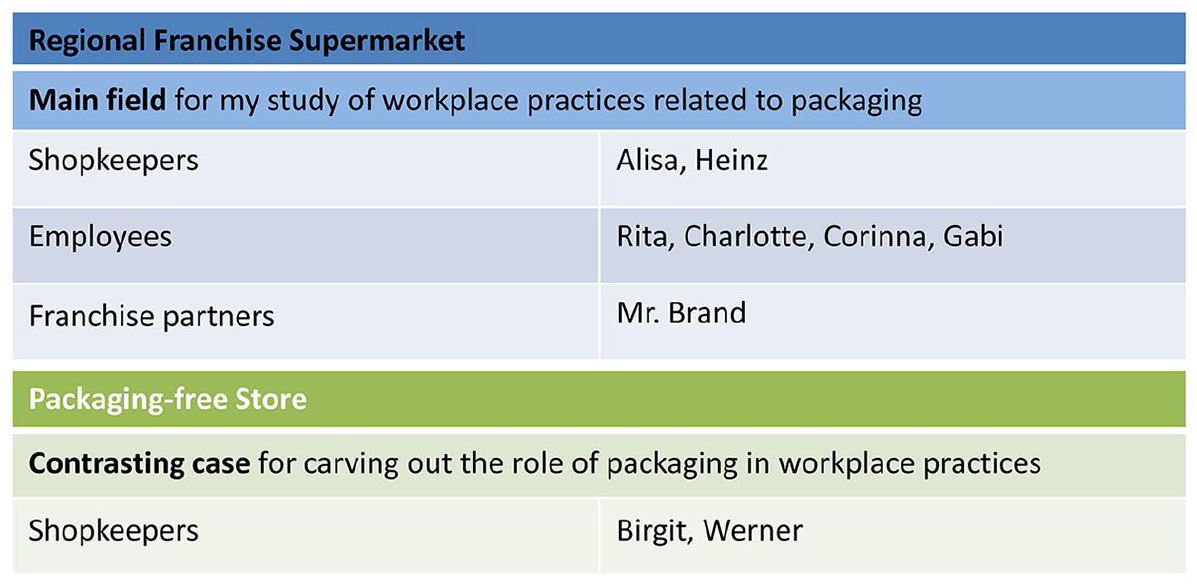
Overview of mentioned sites and persons.
There were several reasons for my decision to choose a rather small franchise supermarket in the Austrian countryside as central field site. As an independent business, such a company has more freedom to enable ethnographic research and offers a wider scope for managerial decisions regarding packaging issues. Additionally, the chosen supermarket was a straightforward option for gaining access to the field due to personal contacts to the supermarket owners, who were interested in ideas of plastic reduction and sustainability improvements. The intrinsic motivation to move towards more sustainability and the (at least in theory) relatively high entrepreneurial autonomy of the shop owners allowed to identify insistence and practical constraints that stand in the way of reducing packaging waste. Following the approach of workplace studies, I focused on the observation of specific interactions between things and people to investigate how packaging and shop assistants interact in accomplishing meaningful supermarket work. To put my further analysis into a better context, here are some important characteristics of the field. While Austria is a leading country for organic food production and consumption (Willer, Schaack, and Lernoud 2017), it is slightly below the average of the European Union regarding the generation of packaging waste (Eurostat 2017). Supermarkets dominate the Austrian food market, and three big company groups—REWE-Group, Spar-Group, and Hofer—are controlling two-thirds of total sales (Regiodata 2017). The supermarket under study is a family-driven business managed by Alisa and Heinz for nearly 30 years. During my stay, the supermarket had about ten employees, all of whom were women who were mostly working part-time. Some employees had been working in that same supermarket for decades; others were apprentices or were doing their work as a vacation job. I acted openly as a researcher, and the official introduction and invitation by the shop owners made it easy to gain field access. By engaging in the daily tasks of the shop assistants, I became part of the social group and their interactions. The communication between employees reflected the intimacy of small municipalities in which all people are somehow connected to each other. This atmosphere differs significantly to the situation that Schwartz (2011) describes for the huge US supermarket she was investigating. I had some chats about my research topics with other shop assistants, but I was mostly accepted and treated as a colleague rather than as a researcher. Apart from my active (observing) participation as a shop assistant, I also applied some additional research methods that demarked our different roles more clearly. This included rather passive observations of work practices, as well as interviews with central actors, including the supermarket owners and several shop assistants. I supplemented my research in the local franchise store with subsequent ethnographic observations at the associated supermarket warehouse and during the delivery of goods from the warehouse to the supermarket. This way, I was involved in operations and relations concerning the exterior realm of the supermarket. Finally, and this was conceptualized as an analytical contrast regarding packaging functions, I participated for one week in the daily work of a packaging-free store in Germany. Birgit and Werner, a couple who were similar in age to Alisa and Heinz but were newcomers in the retailer business, led this store. I chose the store because it is one of the pioneers of packaging-free stores that have recently opened in Germany as a reaction to the immense amounts of packaging waste that is generated by traditional food retailers. As a typical packaging-free store, it is much smaller than the investigated supermarket. Birgit and Werner did most of the work themselves, relying on part-time assistants only during peak hours. I want to point out that the aim of my study is not to compare these stores, but to highlight the specifics of packaging in the respective succession of work processes (Suchman et al. 1999). Accordingly, I present the observations in the packaging-free as directly related to the findings in the studied supermarket. This procedure reflects an ethnographic approach, which is characterized by an iterative process, including overlapping phases of participant observation, theoretical work, and the interpretative analysis of field notes and interviews (Lengersdorf 2015: 188).
Importantly, an ethnographic approach focusing on workplace practices has specific strengths and limitations. A workplace perspective cannot replace research that focus on the technical, cultural, economic, or political conditions of sustainable business transformation; instead, it supplements such approaches by underlining the importance of the situational constellation of things-in-use for the reproduction of order and change. When talking about the work relations of people, I am trying to adopt a serious and responsible approach that comprises being aware of certain limitations when it comes to assessing the perspectives of others.
Therefore, I tried to share my thoughts and findings with the shop owners and shop assistants straight on the spot and as a follow-up. I want to stress that my reflections in this article are based on personal experiences gained during my research stay at the specific supermarket mentioned. 3 The relatively small and independent Austrian supermarket in my study has different preconditions for the reduction of plastic packaging than large supermarket chains. It would be interesting to conduct a comparative study in a big urban chain store where the social and practical organization of work practices differs fundamentally. Some packaging functions that are highly relevant for the owners of a small supermarket probably have a different significance in such megastores. An example could be the navigation of spatial product arrangements or the use of discount stickers. Furthermore, some field-specific opportunities for the reduction of packaging—as for instance variations in the assortment by experimenting with local and unpacked products—are likely more difficult to put into practice in bigger chain stores. The highly experienced long-term shop assistants who were working in the studied supermarket possess different competences in dealing with unpacked food and assessing its freshness than untrained part-time shop assistants. Nonetheless, I am convinced that my findings regarding the role of packaging as part of work practices bear interesting insights, which are worth being discussed on a more general level. Notwithstanding the peculiarities of the study, many of the observed practices are shared around self-service supermarkets in Austria, central Europe, and beyond. In the following sections, I am presenting these insights, discussing packaging as a code of practice for daily work in the supermarket.
Findings: Packaging as a Code of Practice for Handling Products
What are central packaging functions for working procedures in the supermarket? How is the normality of packaging use in food supply entangled with work practices in the supermarket? What practical constraints in work processes entail the necessity and particular shape of packaging? The following analysis of packaging as a code of practice in workplace practices is an attempt to shed light on these questions. In order to understand the role of packaging in food supply, I tried to identify certain packaging functions that go beyond the scope of mere technical approaches. The term code of practice points out the ability of packaging to frame the course of practices by guiding, predicting, and restricting human actions. In the following, I discuss packaging as a code of practice in three areas in which key objectives of the work processes are concerned: (a) packaging as a medium to present products to customers, (b) packaging as an indicator and transmitter to assess product quantities (e.g., stock and flow evaluation) and qualities (e.g., freshness), and (c) packaging as an actor in the representation of a high-quality supermarket with a fresh and extensive product selection. All of these practical complexes reproduce and preconfigure the functioning of the market situation by making food manageable (Çalışkan and Callon 2010). For an overview on these different practical complexes and the role of packaging contained in them, see Figure 2.
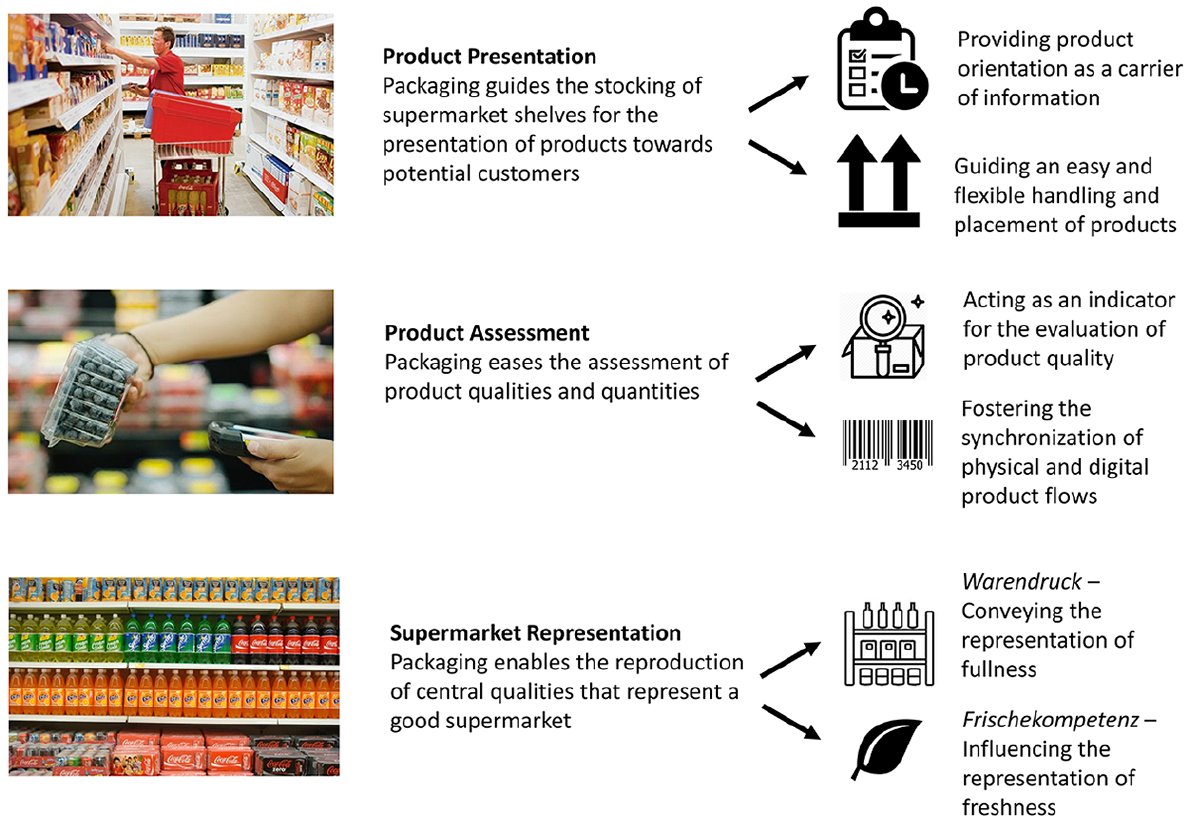
Overview of packaging functions in workplace practices at the supermarket.
Packaging as Medium of Product Presentation
In modern self-service supermarkets, presenting products to customers means arranging packages in shelves. In the course of my participant observation, I frequently conducted this central task of shop assistants. Processing deliveries, package by package, trolley by trolley is a recurrent task. At first sight, product presentation is simply about employees putting packages on shelves. At closer inspection, packaging appears to be a central actor in the everyday organization of product presentation in supermarkets. The material characteristics of packaging and their connection to the infrastructure of the supermarket support the practice of stocking the shelves in several ways. In the practices of shelving, packaging acts as a medium that carries information and as an object that facilitates a simple and flexible handling via its material properties.
Packaging provides product orientation as a carrier of information
Packaging plays an important role for the orientation of shop assistants stocking the shelves. As an “intermediating artefact” (Latour 2001), packaging tells them what product has to be placed on which shelf and in which order—this is revealed by brand, product name, variety, product number, and best-before date. Packaging relieves the shop assistants from the knowledge of products and supports the capacity to differentiate, providing orientation among an immense number of products and brands. The product variety of a self-service supermarket is dependent on this distinctive capacity of packaging to communicate certain information to employees and customers.
While the information on packaging provides clear guidance for distinction, fresh produce has a different way to convey information. Identifying unpackaged vegetables or cheese is different from reading or scanning information on a package. Accordingly, dealing with fresh produce requires different competencies for orientation and different forms of knowledge. The presentation and promotion of unpacked products depends on the situational competence and work of the local shop assistants. Without the visual information conveyed by packaging, product characteristics have to be actively generated and continuously adapted through a sensory approach. Hence, employees need knowledge of the specific characteristics of products to stay competent, keep an overview, avoid mixing up products, and answer consumer inquiries. The following example from the packaging-free store illustrates the complexities in dealing with unpacked and fresh foods: Birgit shows me how to program new products (or price changes) into the cash register. She explains that it is important to enter the product names and characteristics as precisely as possible and to provide the same information on the bulk container and in the cash register so that it is comprehensible and findable for all employees: “With cheese, for example, we also add the brand so that it is as easy as possible for non-experts on cheese to identify the different varieties.” 4
Packaging guides handling and placement of products via its material properties
Packaging guides the practice of shelving not only via the provision of information. Packages are touched when products are handled, so their form and materiality are highly relevant for how products are shelved. Packaging indicates or even implies necessities in terms of how products are handled and sorted onto the shelves: almost every packaging has a top, a bottom, a front, and a backside; cartons stack differently from glasses, tubes, and bags. Some products even come in secondary packaging that acts as a final product dispenser after being opened. While not all packages correspond to the ideal of a rectangular, stackable box, most food packaging fosters an easy and safe handling of products. In management terms, packaging is essential for the constitution of shelf-stable foods (Trockensortiment). Additionally, packaging facilitates customer relations, as it is designed in accordance with marketing aims. Shop assistants place packaged products on the shelf in anticipation of customers taking them out again. This means that they place packaged products in the designated place to make them traceable and distinguishable from other products. As the packaging includes all relevant marketing information except for the product prices, the spatial boundaries for placing packaged products on the shelf are flexible to a certain degree. The boundaries between product areas are relationally negotiated between packages and shop assistants. This “relational space” (Martin and Secor 2014) emerges in the practice of shelving as the following episode from my field notes illustrates: The shelf structure, the arrangement of the price tags on the shelf and the products already on the shelf provide a material framework for the allocation of shelf space to products. By filling shelves with Rita, but also influenced by my competence as a customer, I quickly get a routine sense of security and ability to act in defining this boundary. I develop a feeling of competence and the ability to judge how much improvisation is appropriate; whether it is worth extending the spatial demarcations or not. In packaging-free stores, the structure of bulk bins is less flexible when it comes to the use of storage space, as they are standardized containers with a given volume. While these stores do have bins in different sizes, their arrangement is more stable and fixed than in a normal supermarket. Generally, the handling and placing of unpacked food is more product specific and rich in prerequisites. Sensitive fruits (e.g., peaches) have to be handled with special care to keep them intact, and the possibility of stacking them is limited if they are unpacked; packed in plastic trays, their handling is easier and faster. Packaging supports shop assistants and consumers by generating practicable units and providing a protective cover. While prepacked cheese is simple to handle even for newbies, cutting cheese in the dairy department affords product-specific competences. This became apparent for instance after a food inspection in the supermarket, when Alisa instructively asked her apprentice Corinna if she worked cleanly when cutting the cheese: “I hope you’ve done a good job! Or we are in trouble; for example, if you cut the hard cheese with the same knife as the blue cheese.” For dry goods sold in bulk at packaging-free stores, the handling again requires different competences. For example, filling rice from heavy 25-kg sacks into bulk bins without spilling needs a specific technique and is quite laborious.
Packaging as Indicator and Transmitter in Product Assessment
In the previous section, I described the role of packaging as an element in practices of product presentation towards customers. However, packaging is equally important for sustaining the internal logistics of the supermarket. As an element of product assessment, it is essential in the reproduction of order and functionality. In her historical survey, Hawkins (2018) shows how biological processes of food (rancidity, mold, discoloration, and anaerobic bacteria) were portrayed as central market problems and points of regulation in the 1980s. She discusses how the spreading of plastic packaging was involved in governing and regulating the life of food by making it calculable as “shelf life.” My ethnographic field study makes this connection between packaging and the regulation of products tangible. A central affordance of supermarket staff is the appreciation of the freshness and intactness of products. Such assessment practices in the supermarket not only reflect product quality but also have quantitative dimensions. The modern self-service supermarket is characterized by a high variety of stacked and packaged goods that have to be managed efficiently and profitably in their stocks and flows. Product assessment practices are embedded into a general way of controlling and standardizing uncertainties and inefficiencies in the supermarket. Packaging and its ability to indicate, measure, and record errors of quality and quantity is a crucial element of controlling the employees’ job performance (e.g., piece-rate and error quote) and correctness (e.g., expired products). However, in the following, I will focus my analysis on the role of packaging in the assessment of products and not so much on other forms of assessment or evaluation.
Packaging acts as an indicator for the evaluation of product quality
In addition to institutionalized practices of systematically checking the shelf life (expiry date printed on packaging) of products, employees who are refilling shelves routinely check the integrity of packaging, which indicates the integrity of the products. The following episode from my work as a shop assistant made this indicator-function particularly apparent for me: While moving the boxes filled with chilled milk products, a small accident startled me. The boxes fell against each other so that, for a moment, I was afraid I had crushed a yoghurt cup with the heavy plastic box. When I lifted the box, I checked the packaging for its integrity and I was immediately reassured that it was not broken. The packaging very clearly indicated the integrity of the product. I immediately knew that a dent in the yoghurt cup is ok, but a crack definitely not.
For the supermarket employees, it is easier to recognize that a plastic foil is broken than to detect small bruises on an apple and deciding if it is still fresh enough to be sold. When the packaging is broken, products count as rejects, regardless of the condition of the food itself. Damaged packages have to be marked or sorted out to keep the shop up to standards, as I experienced myself: When I opened the cardboard box, a package of rusk fell down and the outer package got a crack. I asked Alisa what to do with the damaged package. She explained that I had to reduce the price and that I was to go to Charlotte at the cash desk so that she could give me a 25% discount sticker. Then I was to place it in the basket for reduced articles. A discount sticker on the packaging, as well as its replacement from the regular shelf into the sales basket, marks and communicates the defect as seen and thus makes it acceptable.
Evaluating the product quality of fruits and vegetables requires different competencies than for shelf-stable foods, particularly a better knowledge of the biological processes of the different products. Where no packaging can provide information on the expiry date and other product characteristics, the employees need to be aware of product specifications and handling affordances. Hence, evaluation practices are linked to experiences in sensing product qualities and being familiar with consumer preferences. In the packaging-free store of Birgit and Werner, the assortment of fresh, sensitive, and short-life products was rather small to avoid food waste. In the fresh food section of the conventional supermarket, the risk of presenting inaccurate products led to the credo of a rather generous sorting out of potentially old, moldy, rotten, unsellable fruits and vegetables. In anticipation of consumer preferences, employees threw away products they still defined as eatable: “My heart is bleeding, I don’t like to throw away food, but customers take only the beautiful ones” (Gabi). Thus, omitting packaging without changing practices potentially increases the level of food waste. This entails the risk of exceeding ecological gains of packaging reduction by the ecological burden of food losses (Williams and Wikström 2011). These observations indicate that providing a wider selection of unpacked fresh food affords different time scales of storage, higher employee skills in product handling and practical knowledge of different produce, as well as a change in the meaning of quality, freshness, and durability.
Packaging supports the synchronization of physical and digital product flows
Logistics in the supermarket are organized in relation to packaging units, which define the handling of goods. Each stage in the supply chain uses different packaging units inspired by the extent of product flows (Pålsson and Hellström 2015). The grouping of food with the help of packaging ensures that complex products are bundled into manageable goods. This refers to practices of physically handling products (aggregating or disaggregating objects for certain practices) and to practices of digitally handling products with the SAP software 5 (assigning a unique number to a packaging unit). The synchronization of physical stocks and their digital representation is essential for supermarket logistics and employees invest a lot of effort into linking the physical stock and flow of products to the digital processes of stock evaluation by using lists, numbers, and scanning. As a hybrid technology, packaging is compatible with digital technologies like scanning and numbering, while it simultaneously enables transportation and storage of the physical product. Packaging and labels define manageable units and make it possible to record or read the status and position of products. For example, changing the status of a product from ordered to stored involves the physical movement of the pallet from the truck to the assigned storage space in the warehouse, as well as changing its digital status in the SAP system by scanning the label that is put on the pallet. Packaging displays the status of a product via its location (e.g., warehouse, supermarket storage room, supermarket shelf, special offer basket, and shopping cart), its type (e.g., primary or secondary packaging and transport packaging), printed or tagged information (e.g., expiration date and discount sticker), its condition (e.g., damaged and intact) and its connection to numbers and digital data (e.g., via barcodes). For packaged, shelf-stable foods, statistical data on product turnovers and calculated stock levels provide useful guidance for product management. Employees notice mistakes if different signals of the packaging do not fit together, and when they sort out packaged products, they scan the labels to adapt the stock level in the SAP system.
For unpacked products, the synchronization of physical and digital stock affords time-consuming weighing and the manual input of information, which was not cost-effective for the supermarket under study. Therefore, the statistical recording of stocks regarding fresh foods was deficient, causing different requirements for supermarket managers and assistants. Here, Alisa was much more dependent on her experience, feeling for, and knowledge of stocks and flows. This additional effort limited the scope and variety of unpacked products in the supermarket. In the packaging-free store, the general degree of standardization and automatization was much lower. Stock evaluation and management caused the need for a permanent personal survey of stockpiles, inducing process-related orderings. An open question for upscaling such stores is how these processes can be managed in order to allow for the growth and expansion of product varieties without raising food waste.
Packaging as an Actor in the Representation of a Good Supermarket
In order to gain an understanding of product presentation and assessment practices, one must not only consider their single performances. On the contrary, their meaning and relevance in the supermarket are closely linked to their repetitive character, driven by the dynamic interplay of supply and demand. The aim of storing products is not a perfect arrangement down to the last detail, but an overall picture, which conveys the impression of being processed and cared for. Putting products on the shelf does not only mean presenting individual products; it is also part of presenting the supermarket in general. Similarly, the assessment of product qualities and quantities is happening in order to reproduce the perception of a well-managed supermarket that is attractive to customers. To explain the collectivity of these practices, I will resort to management terms that are specific to the field: Warendruck (product pressure) and Frischekompetenz (freshness expertise) are terms that represent normative aims of product presentation and assessment that make up a well-managed supermarket. Both share a relational quality, referring to consumers as the audience for selling products, but also to other supermarkets as potential competitors. Moreover, they share the idea of a spatial-material order of representation, implying the placement of material qualities in specific places to take effect. I will describe how packaging facilitates practices in line with these two aims and how they preconfigure potentials and barriers for packaging reduction. Because both terms are native field terms regularly used by my research partners, I will not translate them, but use the original German terms.
Warendruck: Packaging conveys the representation of fullness
Packaging gives employees a flexible reference for the spatial arrangements of products on the shelf. In combination with the uniform shelves and the exchangeable labels, packaging provides the opportunity to increase the utilization of space while keeping the shelf wall presentable. For the effect of Warendruck to be successful, the shelf has to appear full and in order (Wagner 2013). Warendruck refers to the collective material agency of products in general and packaging in particular to push consumers to buy them. Its reproduction requires constant readjustment. When shop assistants sort products into shelves, they arrange the packages with the front facing forward in a seamless row. Some carton packs offer the possibility of being stored lying and standing; they have two or even three alternative front sides, which allow for being stored differently depending on the space conditions on the shelf. Either way, you put them on the shelf; they still look neat and show a presentable front side with all the important information. Alisa the shop owner reflects the importance of a well-managed shelf: “One must see that this shelf is already done.” When conducting the practice of facing products on the shelf, I was surprised how much invisible reproductive work lies behind the presentation of shelves that “looks done.” After some days of work, I saw the shelves with completely different eyes: when walking through the aisles, I automatically looked for inconsistencies and pushed the misplaced products to the right position, always aiming to form a straight and gapless front. Importantly, facing the shelves is not left over to employees passing by, but it is also actively commanded. Shop assistants work through the storage room, matching spare products with free spaces in the supermarket shelves. The representation of a good supermarket is mediated in a constant coordination between shop assistants (shifting packages), shelves (indicating gaps), and packages (filling gaps). In that interplay of people and things, Warendruck is not just generated via accuracy and order, but also by an intentional breach of order. When I helped Alisa set up the presentation of the weekly special offer, I encountered the different logics of product arrangements: Alisa told me to put the barbecue sauces in the baskets that are reserved for the weekly promotional products. As I learned from stocking the shelves, I started to sort the packages lined up: I separated the different varieties of ketchup, mustard, and barbecue sauce and put them in the baskets, all standing upright. When Alisa passed by, she told me that I should not sort them in rows, but pour them in the baskets randomly and mixed. Packaging flexibly facilitates different strategies of sustaining Warendruck. In contrast to the full shelves that represent infinite availability, the baskets for promotional products are filled randomly to indicate a spontaneous short-term availability. For certain products, packaging provides technological solutions for an autonomous reproduction of Warendruck. An example are specific display packagings that are designed to automatically push the products to the front as soon as the item in the first row is taken out.
In the packaging-free store, I observed different ways of representing fullness and order. Here, Warendruck was ensured by the technology of bulk bins. These containers are designed to look full, even if they are half empty. The task of pushing products to the edge of the shelf is taken over by the functionality of the container. Additionally, the perception and valuation of gaps or free spaces in the packaging-free store is different to standardized supermarket shelves. The arrangement of products follows a different logic, dominated by qualities like individuality, intimacy, and product quality. The importance of such cultural differences has to be recognized in attempts for sustainable transformations.
Frischekompetenz: Packaging Influences the Representation of Freshness
The importance of the visual presentation of products in the representation of a good supermarket also implies a certain quality of products. Supermarkets represent Frischekompetenz (freshness expertise) by providing and arranging fresh products for customers. For Alisa, unpacked and raw foods act as symbols of freshness. This causes an ambivalence regarding the increasing use of packaging for products like fruits, vegetables, meat, or cheese. On the one hand, packaging lessens the requirements and skills needed to ensure fresh products, making their assessment and controlling more efficient. On the other hand, packaging signifies a limitation of freshness. The following conversation between Alisa and a franchise partner from the supermarket chain reveals the importance of Frischekompetenz for representing the supermarket: Alisa and Mr. Brand are drinking coffee in the tea kitchen. I enter the room and show them the floor plan of the supermarket that Alisa’s husband Heinz just copied for me. Alisa looks up and says: “Great, and now you show us where to put the fruits and vegetables!” When I ask her why they want to change their position, she explains that they just talked about ideas of how to place vegetables and fruit more prominently in the shop. Mr. Brand adds: “Dry goods are always the same - people come for fruits and vegetables—or they don’t come because of bad experiences with fruits and vegetables. As a shop owner, you need Frischekompetenz, this is the area where you can stand out.” In Alisa’s market, the fruits and vegetables are located in a corner at the backside of the shop. Both agree that this is not the best place to attract attention. Alisa: “Nowadays, almost all supermarkets place fruits and vegetables directly at the entrance—precisely because these fresh products are so central. In our case, this is not possible because of the shop architecture, particularly due to the sunlight in the entrance area which would cause problems for freshness, especially in summer.” The episode shows that Frischekompetenz is not simply about the assortment and quality of products, but also about their placement and orchestration in the supermarket. For Alisa, a good supermarket assistant is valued as someone who is good in handling fresh food: “It helps a lot to know from home about gardening and cooking—this feeling for food and nature is often missing today. It becomes more and more difficult to find good shop assistants. Actually, we need housewives; it is a housewife’s job.” Despite the reproduction of gender stereotypes, Alisa’s reference to housewives as the ideal typical shop assistants refers to the entanglement of commercial and practical skills that define the reproduction of Frischekompetenz. The reference to housekeeping is evidence that these skills are not easy to learn, but were developed by long-time experience.
Especially when dealing with unpacked food of limited durability and with high expectations for freshness, avoiding food waste is a challenging task that depends on the interrelations between different social and biological factors that define durability and the sales rate of products. The relevance of Frischekompetenz is a potential starting point when it comes to reducing the use of packaging. In the course of the zero-waste movement, it is imaginable that future supermarkets have a prominently placed corner for different types of bulk foods in their shops to represent zero-waste competence as pioneers of waste avoidance. Hence, a greater importance of waste avoidance would allow new strategies for dealing with less than perfect fruits and vegetables (e.g. discounting, processing or marking products; reducing product range and compulsory availability).
Conclusion: The Constraints and Opportunities of Packaging Reduction
This article started with the quest for barriers that hinder packaging reduction in the supermarket. I argued that current explanations of packaging functions that focus on techno-centric or consumer-driven factors miss aspects that are bound to the everyday work practices in supermarkets. In the analysis of such practices, I showed how packaging guides the handling of products in the supermarket in various ways. Packaging provides not only a technical protection or advertising space for producers (Phillips 2016), but is an important element for upholding the functioning of the supermarket as a marketplace (practices of product presentation), logistical organization (practices of product assessment) and business (supermarket representation). Consequently, packaging is an important element in the “market framings” 6 that characterize the neoliberal economy (Çalışkan and Callon 2010). It acts as a code of practice in diverse practices of making food manageable. In consequence of the close interrelation of markets, shop assistants, and packaging in these practices, systematic packaging reduction is not feasible by the decisions of individual shopkeepers, supermarket employees, or consumers. My ethnographic narrations provide concrete examples for the entanglement of human actions in the stock and flow of packages. Packaging provides flexibility and structures work in the supermarket in various ways. First, packaging facilitates practices of product presentation via the provision of product information and material properties. Second, packaging guides the assessment of products: on the one hand, via clear and standardized indicators for intactness and shelf life; on the other hand, via standardized commodity units that allow the synchronization of product flows, statistical data, and practical work tasks. Third, packaging is involved in representing a well-managed supermarket with a full (Warendruck) and fresh (Frischekompetenz) assortment of food. Acknowledging these diverse packaging functions is crucial for sustainable transformations of packaging use in food supply practices. Given the specific characteristics of my study, more research is needed on work-related packaging functions in different shop types and supply chains. Constraints and opportunities for transformation become manifest in concrete constellations of packaging-in-use. Instead of abstract blaming or calls for more sustainable behavior of supermarkets, transformative attempts have to take the daily interlinkage of shop assistants, packages, and markets seriously. This involves a closer look at four issues that are often overlooked when focusing on consumers, politicians, engineers or corporate managers as agents for change: the expertise of employees, the materiality of packaging, the distribution of agency, and socio-cultural market framings.
In short, I plead for widening the scope when looking at packaging functions and transformative potentials. Considering the expertise of employees, the agency of packaging, the situational distribution of agency, and the socio-cultural framings of supermarkets highlight barriers and opportunities for packaging reduction. Transformative attempts need to experiment with respect to these different elements and their interrelations. Asking employees for packaging reduction potentials, testing packaging innovations in use, and experimenting with packaging-free shops or food cooperatives that act outside of neoliberal markets can all be part of a distributed process of transformation that acknowledges the dynamics of social practices (Shove et al. 2012). A central barrier for more wide-ranging attempts towards packaging reduction are constricted problem approaches that merely focus on consumer demands, legislative rules and technical functions. Investigating innovation processes and their everyday implementation at the workplace (and not only as technological or managerial interventions) can be an important sociological contribution for widening the approach in order to make room for a more-realistic assessment of packaging functions and waste reduction potentials.
Footnotes
Acknowledgements
This article is part of my dissertation project in the interdisciplinary junior research group PlastX. I want to thank my supervisors Brigit Blättel-Mink and Thomas Scheffer and my colleagues Johanna Kramm, Carolin Völker, Tobias Haider, Heide Kerber, and Lisa Zimmermann for their feedback and advice. The comments of anonymous reviewers and journal editors were also very helpful in revising the article.
Declaration of Conflicting Interests
The author(s) declared no potential conflicts of interest with respect to the research, authorship, and/or publication of this article.
Funding
The author(s) disclosed receipt of the following financial support for the research, authorship, and/or publication of this article: This work is funded by the German Federal Ministry for Education and Research BMBF (01001603A-C).
