




Abstract
We analyze the relations between ethnographic data and theory through an examination of materiality in research practices, arguing that data production is a form of material theorizing. This entails reviewing and (re-)applying practice-theoretical discussions on materiality to questions of ethnography, and moving from understanding theory primarily as ideas to observing theorizing in all steps of research practice. We introduce “pocketing” as a heuristic concept to analyze how and when ethnographic data materializes: the concept defines data’s materiality relationally, through the affective and temporal dimensions of practice. It is discussed using two examples: in a study on everyday architectural experience where ethnographic data materialized as bodies affected by architecture; and in a study on digital cooperation where research data’s materialization was distributed over time according to the use of a company database. By conceptualizing data’s materiality as practice-bound, “pocketing” facilitates understanding the links between data and theory in ethnographic data production.
Introduction
On their sites of research, ethnographers regularly produce something, or rather some things, to take with them: field notes and drawings, and audio or video recordings, as well as impressions, memories, or new physical skills. As part of research practices, such things can become data. In this paper we analyze initial moments of data production, asking how ethnographic data materializes (already) in the field. Our practice-oriented analysis contributes to a better understanding of how emerging data is part of ethnographic theorizing. Discussing the relation between ethnographic method and theory reveals particular challenges concerning on-site data collection, because the way ethnographers translate what they observe in the field into ethnographic knowledge is often implicit and practice-bound. Focusing on data’s materiality, we want to explore the potential of applying practice theory in a reflection on the relations between method, data and theory in ethnographic research.
To explore how data materializes on site, we introduce the heuristic concept of “pocketing.” We suggest that its—intuitive, yet provocative—image of “extracting” research data as something solid or immutable from the field for later use is a useful frame for our analysis. It helps us to highlight the practical production and material constitution of data in epistemic practices, while at the same time considering data’s role in these practices critically. 1 Simply put, taking notes or pictures etc. in the field to take home is—of course—never pre-theoretical (nor “just extracting”), but it already involves some form of understanding about what is being observed. Thus, when we write about “pocketing” research data, we want to detail what materializes how in the field, and in what way the materialization of data is related to practice. The concept of “pocketing” shows that the materialization of data—as a product of a material theorizing—is structured by the affective and temporal orders of practice on site.
In the first part of the paper, we discuss how practice theory helps to describe the link between ethnographic data production and theorizing. We do so by praxeologizing our own research: from this perspective, data, method, and theory are all practice-bound—and can be observed through their materializations in practice. This implies a strong concept of practices, claiming that practices organize social events materially, temporally, and affectively. This means that theorizing, too, is observable through what ethnographers do and say as well as what they record: as material practices of categorizing and ordering. As participants of practices, ethnographers, by means of their bodies and (research) artefacts, make intelligible and relevant how they understand what they observe in situated actions. We are interested in the co-constitution of bodies, things, and ideas in practice: materialities—including research data—appear empirically as products of practice.
In the second part of the paper, we apply and detail these arguments by asking how ethnographic data materialized on site in our own research. To show that the affect and temporality of the practices in the field structured the process of materialization, we reflect on data production in two ethnographic case studies: the first case compares different work practices regarding architectural experience; the second focuses on cooperative practices in digital visual design for post-production for film and television. Each case study posed a distinct challenge for “pocketing”: How can ethnographers take an experience of a building with them, and how can digital data (bases) turn into research data for studying cooperation?
Ethnographic Data and Practice Theory
Ethnography can be analyzed as a “bundle of practices”: an ordered set of activities, people, things, and ideas (Schatzki 2016, 31). “Praxeologising” (Schmidt 2017, 143) ethnography opens up new perspectives on different demands and problems of research. It decentralizes the human part in sociality and sees research practices as composed of human researchers and their non-human tools, in interaction with things, rules, and participants in the research field. This argument has special impact when applied to ethnographic theorizing (cf. Schmidt 2017), which is traditionally considered a cognitive process. We take this empirical “test” of practice theory one step further by looking at practices of theorizing in the field that are often messy due to ethnographic immersion in the field.
In this section, we make two major arguments: first, we argue that practices and their materialities are co-constitutive and highlight the affective and temporal structure of their relations. Second, we examine the consequences of this relation for ethnography and suggest understanding data production as material theorizing in the field. Based on these deliberations, we use the concept of “pocketing” to analyze emerging data as a particular kind of materialization, produced by and dependent on ethnographers’ doings and sayings in the field.
A Practice-theoretical Perspective on Materiality
The question of materiality has gained momentum in the social and cultural sciences beyond practice theory in recent decades. While there is still debate on its consequences for different forms of social research (Kissmann and van Loon 2019; van Dyke 2015), many authors agree that materiality cannot be discussed independently from theories of knowledge. The sociological debate on materiality has moved beyond a mere consideration of the participation of non-humans, put forth prominently by Latour and Woolgar (1986). For instance, Schmidt (2019, 147) formulates a new key question for the sociology of social order: “In what units and entities does the relevant social phenomenon assemble?” This entails asking to what extent and under what conditions research phenomena emerge and manifest materially and how their materiality is made intelligible. Thus, questions of materiality should be answered with reference to empirical research. This insight is linked to defining the material dimension of things relationally by being sensually perceptible (Barad 2003, 34), which follows a broad understanding of the term material. Consequently, different things entail different sensory experiences and so might “the same things” in different contexts. Thus, the programmatic goal of this “New Materialism” (Barad 2003; for an extensive discussion see Coole and Frost 2010) is “to emphasize the incompleteness of the material [and] to understand the material as a zone of intense becoming” (Folkers 2013, 30, own translation).
In this context, eminent scholars of practice theory claim that the “zone of becoming” is always bound to social practices (Schmidt 2019, 140). 2 While most practice theoretical approaches agree on the plurality of materiality and its social effects, they differ on how things emerge. For the sake of analyzing the materiality of ethnographic data, we consider “relational materialism” (Gherardi 2017, 39) to be a suitable position: in this view, “[r]eality is defined as things-in-phenomena and not as things-in-themselves” (Gherardi 2017, 41). This approach highlights the following three arguments in particular:
Practices are observable as material events
All elements of a certain practice—people, artifacts, ideas, norms, emotions, and memories—materialize in localized practices. This means they become observable: this does not only refer to the visibility of practices, but more broadly to their intelligibility. As Schatzki explains, people always perform bodily what makes sense to them, and thus “practical intelligibility” (Schatzki 2001, 55) can be observed in any noticeable output of a situation. Focusing on how these outputs connect different situations, Scheffer (2004, 368) defines materialities, relationally, as “out of reach for direct interaction [. . .] They appear and work as ‘material’ for the focal setting [. . .] due to their different mode and rhythm of becoming: the drafting of texts, the compiling of files, or the training of bodies.”
Practices organize social events temporally
Although their temporal unfolding is always empirically unique and localized, practices can be defined through their reoccurring structure: Schatzki (2010) speaks of “indeterminate teleological events”. Through their repetition, practices support social processes of ordering, stabilization and reproduction (Gherardi 2017, 39; Reckwitz 2002), e.g. as an “institutional rhythm” (Buch and Stjerne 2018). When understanding materiality and temporality relationally (Sørensen 2007, 10), we see that materialities are produced in time—and also produce time. Thus, different materialities can be distinguished further by looking at their temporal entanglements in practice.
Practices organize sensory experience, affects and motivation
Human beings participate in practices permanently (even when they think, sleep, or are otherwise silent). In doing so, they are both participant and performer, indicating a shared implicit knowledge that is bodily habitualized. Gherardi (2017, 44) discusses this as “embodiment.” Similarly, we understand “the body” not in a dualistic opposition to its surroundings; rather the surroundings take part in the constitution of a body, including its capacities to sense, as a relational process. Affordances and affects “only ever exist in relation to certain practical accomplishments” (Schmidt 2019, 143). Affects motivate participants to take part in practices (Reckwitz 2017, 120) in which they (unconsciously) follow a “teleoaffective structure” (Schatzki 2001, 58) embedded in every practice and restored in each of its “observances.”
Ethnographic Data Production as “Pocketing”
While practice theory (in general) is open to different methodological approaches, reconstructing the materiality of practices requires specific methodological lenses (Schäfer, Daniel, and Hillebrandt 2015, 10). Ethnography holds great potential in this regard (Gherardi 2019, 201). It relies on the observability of practices based on their material constitution as well as the presence, physical sensing, and participation of the researcher in the local unfolding of practices (Schmidt and Volbers 2011). We now address the materiality of ethnographic data production from a practice-theoretical perspective.
Ethnographic theorizing
The concept of “pocketing” highlights ethnographic data production as a form of theorizing. We argue for a “low-threshold” definition of theory by looking at practices of theorizing. From a practice-theoretical perspective, theorizing in general refers to all activities of specialized categorizing, following, generalizing, and ordering made intelligible and relevant in practice (Schmidt 2017, 259). Such “reflexive, analytical and theoretical activities” (ibid. 141) are, according to Schmidt, “features of practices” that are observable (and not “just” cognitive processes). In this view, methods of data production are part of sociological theorizing, which has been described as a longer practical process of “trial-and-error” (Swedberg 2016, 6) during research. Similarly, Hillebrandt (2016, 72) understands theories as emerging. This means that ethnographers’ actions are also theoretically informed in the field: both on a general level, as ethnographers focus on the observable unfolding of social reality, and by the particular research question, as they have defined a site of research and decided on who/what to observe, when, and where—and how to document it.
From this perspective, theorizing is material. Theorizing is observable in practice through the activities and materials with which the ethnographers make their categorizations observable and relevant. This includes different data practices and data types, such as field notes or recordings, as well as memories and experiences, sometimes referred to as “soft data” (Campbell 1998; Pool 2017, 283). “Hardening” ethnographic experience into data is possible because data has fluid boundaries (Benzecry 2017, 32). As we now show in detail, the concept of “pocketing” makes this kind of ethnographic theorizing on site traceable and analyzable in terms of affective and temporal dimensions.
Affect and temporality in ethnographic data production
Because of their inevitable presence in a given research setting, the bodies of ethnographers have been acknowledged in ethnographic data production. Ethnography is a bodily endeavor and it is embedded locally: the ethnographer operates in a modus of “sensory immediacy” within the field, including its built environment (or other things) (Breidenstein et al. 2013, 33, own translation). As Hopwood argues, the detailed perception of the material dimension of the field is central to data production, for example, to “document the materiality of the walls” (Hopwood 2015, 60). Ethnographic descriptions become thick because of the ethnographers’ “duty to see [. . .] hear [. . .], taste, smell, touch, and feel.” (Hopwood 2013, 229). With the concept of “body geometries” Hopwood underlines how fieldwork reproduces its own relation to material arrangements on site, like walls, and therefore how research practice performs the ethnographer’s body, moving and perceiving in multiple layers. In this context, the researcher’s body has been problematized in terms of their subjectivity (Coffey 1999) or positionality, for example, as a marker of the ethnographer’s “cultural or personal background” (Sedlačko 2017, 56). For the ethnographer, sensing and experiencing emotions can be a bodily sign of something materializing, which is linked to the teleoaffective structure of practice. Hence, we suggest exploring these affects, including how they relate to the ethnographer’s own cultural or personal background, as given in any research process and use ethnography’s ability to generate data from it: by reflecting the sensory immediacy of the ethnographer in the field (or their bodily-physical memory of the events later; e.g. Gray 2016, 506). Affect—including different types of emotions, atmospheres, and moods (Reckwitz 2017)—ought to be taken seriously as one “locus of ethnographic knowledge” (Feldman and Mandache 2019, 229). Similarly, Deener (2017) suggests using ambiguity experienced in the field as an approach to sociological theorizing on site. An ethnography working with the concept of relational materialism allows zooming in on the process of data production, as material theorizing is structured by the affect of the researcher in the field.
The concept of “pocketing” also helps to analyze time as an observable dimension of practice, which structures data production. Whether relating to anthropological traditions like the Manchester School’s questions on social change (Evens and Handelman 2008) or to sociological thought on situated interaction and performance (Knoblauch 2005), ethnography aims to register how social reality unfolds over time: “we are all processualists now” (Glaeser 2005, 38). As ethnographers participate in the practices they research, their research practices might affect the temporal order they observe: time is a product of ethnography, too. For instance, Ayaß (2020, 11) indicates that there are problems in observing the practice of waiting: “The observed situations, as a general rule, began and ended with my own waiting (on occasions, I would extend my presence artificially; but this repeatedly made my observer status questionable).” With regards to theorizing, it has been discussed widely how ethnographic understanding grows over time (also: “piling” data; Dirksen, Huizing, and Smit 2010, 1046), and how to define ethnographic cases temporally (e.g. as an “extended case,” Burawoy 1998). Particularly conversation analysis foregrounds the possibilities of certain kinds of data (audio and video recordings) to capture the temporal sequence in which social practices unfold in detail (Knoblauch et al. 2012). 3 These discussions consider data’s materiality with respect to how particular technologies document practices, including the question of what a temporal order requires from data’s particular materiality and how data use shapes the presence and participation of the researcher in the field (Mohn et al. 2019). Recently the trans-sequential organization of “data careers” throughout ethnography has also been analyzed as a contingent product of research practices (Meier zu Verl 2018). Our heuristic concept of “pocketing” adds to this line of research: because “pocketing” is concerned with the processual materialization of data in the field (data’s becoming rather than its being), it takes into account both the influence of the temporality of particular practices on data, as well as how data production contributes to the production of time on site.
As part of a given practice, the ethnographer’s bodily experience cannot be considered primarily subjective, nor is the time in which data materializes primarily an objective attribute of practices: with the concept of “pocketing,” we analyze affect and time as observable and as structuring dimensions of material theorizing.
Analysis: “Pocketing” Data in Two Case Studies
How does ethnographic data on architectural experiences or digital cooperation materialize? On the basis of two case studies, we show, first, how the researcher’s affective and bodily understanding of the practices on site is key to “pocketing” architectural experiences; and second, how tracing practices temporally facilitates “pocketing” digital cooperation. The case studies are based on short and sometimes repeated ethnographic visits to different work places (varying from a couple of days to two weeks). In her study, Christine Neubert asks questions about everyday knowledge of architecture. By comparing five different work places visited between 2013 and 2015 (an art museum, a factory hall, an art studio, a library, and a laboratory), she systematizes architectural experience in everyday life (Neubert 2018). Ronja Trischler is interested in sociotechnical cooperation in visual, digital post-production for film and television. She visited seven companies in the United Kingdom and Germany between 2013 and 2017.
“Pocketing” Architectural Experience
In the following, we focus on the bodily-affective dimension of “pocketing.” Using examples of experiencing architecture in an art museum, a factory hall, and a library, we outline a bodily-affective directionality of ethnographic data production on site. By showing different ways of bodily-affective participation in the field, it becomes apparent that the materialization of data in this case study proceeded through the ethnographer’s body, that is, her affect and movement. 4
Walking in the museum
In this section, we reconstruct how data emerged from the ethnographer’s own bodily activity. We demonstrate how the ethnographer’s walking with art museum attendants became central to “pocketing” their everyday architectural experiences. In the museum, the ethnographer walked with the attendants to get involved in the telos and affective structure of the observed practice of attending. This practice consisted in walking in a special way:
5
I talk to an attendant at the entrance, and she simply walks off. I go with her. Upon arriving at the entrance again, we simply walk, while talking further. We ignore the two other attendants who stand there and also talk, but walk through, in between them. We repeat that. Altogether, we walk three rounds. (2015-03-24)
As documented in the field note, a basic ethnographic research practice like walking (with someone) became walking like the attendants. The activity of the attendants—which was coded as the practice “doing rounds” unfolded by continuously walking in pairs and talking passionately, generally without paying visible notice to other colleagues, the art works, or the local architecture. The repeated “simply” as a symbolic reflection in the field note shows the ethnographer’s surprise about her own bodily understanding of the everyday practice (and so: an architectural experience) through materialization in terms of a specialized way of walking. There was no time to stop at the entrance or for looking around the building like a common visitor would do. To participate in “doing rounds” as a focused walking practice is data generated within the researcher’s bodily presence, and activity, because she is part of this central, bodily dimension of experiencing architecture. In Merleau-Ponty’s words, “[b]y considering the body in movement, we can see better how it inhabits space (and, moreover, time) because movement is not limited to submitting passively to space and time, it actively assumes them, it takes them up in their basic significance” (2005 [1945], 117). “Pocketing” architectural experience, which means understanding the field in practice—on site and with data—happened bodily by moving in a certain way through the building.
Seeing in the library
With a second example, we illustrate how the ethnographer’s experience can manifest bodily over time. This bodily dimension of “pocketing” concerns the experience of architecture via the ethnographer’s own eyes, which suffered from dryness after having been exposed to the field. As the researcher herself had been working in the library as a research assistant for several months before her research project on architectural experience started, data was already generated through the ethnographer’s eyes prior to “pocketing” this particular perception within the frame of architectural experience. In this case, material theorizing became apparent after the dry eyes had been treated, as a consequence of being physically present in the field. Due to a longer period of time participating in desk-based library work, the ethnographer noticed a loss of vision: she had to make more of an effort—blinking and squinting—to read on the computer screen. The ophthalmologist she consulted noticed a severe dryness of the retina and prescribed eye drops. In the same week, in the first interviews with the library staff, the topic of “bad air” within the building became frequent: Interviewees told her about feelings of “having bad air” or indeed of “having no air,” by which they meant extremely bad air. The air quality appeared to be an experience through which employees reflected on the location of their mainly desk-based work. Against this background, it was possible for the researcher to understand her dry eyes as an ethnographer in a “new” way and to “extract” the loss of vision ex post as part of the architectural experience in terms of air quality in her everyday working life. She had already experienced “with” the field before she was able to recognize this experience as data for her study on architectural experiences. The bodily-sensory materialization of library work is made intelligible through ethnographic research practice. The perceived dryness of the ethnographer’s eyes due to the bad air could be seen as an early stage of ethnographic understanding. Therefore, “pocketing” was not accidentally disturbed by subjective perception, but was pushed by the ethnographer’s bodily irritation from dry eyes during research.
Taking a break in the factory
The perspective of data production as a materialization facilitates a reflection of the “affective structure” (Reckwitz 2017, 119) of the bodily ethnographic practices. Therefore, the following example is concerned with the affective dimension of “pocketing.” Visiting a factory hall, the ethnographer spent most of her time at the machines, observing and talking to workers, insofar as the activities and noise levels in the hall permitted. Noise, or, respectively, the acoustic character of the hall, turned out to be a dominant way of experiencing the built environment in everyday life (in general and especially in the factory). With regards to the factory hall, the ethnographer affectively registered the welcome perception of no such noise during lunch break. Sitting with the workers in the canteen (situated inside the factory hall), she noticed the pleasant absence of loud noise: all the machines had stopped. On site, she documented in her field notes:
For a while we just keep silent and look out of the window onto the square in front of the hall. It is pleasantly quiet here [. . .]. The window is open, you can hear birds. (2014-06-18)
The ethnographer participated in the bodily-affective order of the break, indicated by sitting down, absorbing the silence, watching, and listening. Accordingly, the attention of ethnographic research practice coincided with that of the field: ethnography and the field took a break. However, this applied only to a limited extent to the ethnographer. The motivation to understand what was going on in terms of the acoustic experience of the factory hall called on (the body of) the researcher to perceive and to note down. Through getting involved in the silence and being affected by it, the ethnographer paid attention to the difference between break and working practice. The affects in the workers’ break functioned as a sensory hint for her as a researcher to register the local, acoustic perception as architectural experience. Thus, theorizing the everyday architectural experience in the factory hall also depended on affectively sensing practical needs. Ethnographic theorizing proved to be interwoven with the affective setting of the break and the canteen as its suitable, built environment. In order to “pocket” everyday architectural experience, the “given” of one’s own on-site affects was a key to the materiality in the field.
“Pocketing” Digital Cooperation
Using a study on digital cooperation in the production of “visual effects” (VFX) for film and television, we now show how temporal orders of practice influence the way research data materializes on site. We use this case to discuss the temporal dimension of “pocketing,” because the organization of time became crucial in analyzing digital cooperation in VFX companies. Particularly in each company, a VFX database facilitated “a temporal division of labour” (Scheffer 2004, 388) by materializing cooperation over time. Databases have been discussed as part of informational infrastructures (Karasti and Blomberg 2018) or coherent “socio-technical artifacts” (Burns and Wark 2020, 607). In ethnographic observation, the materiality of the VFX database became visible relationally as part of different cooperative practices (e.g. assigning tasks, updating drafts, and supervising work progresses). We analyze its simultaneous use as a repository and as a communication device to discuss how these cooperative uses affected ethnographic data. Thinking of data production on site in terms of the relations between time and materialization helped understanding the particularities of digital cooperation.
Browsing the Database
“Pocketing” digital cooperation in visual post-production companies for film and television relied on the ethnographer browsing their databases. Generally, her research data on the use of a VFX database materialized and grew constantly during her research in a company, 6 and with it her understanding of its cooperative functions. She continuously accumulated data because in each company she visited, the database was used regularly by everyone as collective repositories in the VFX companies. Storing and sorting digital data in the database—as cooperative practices—shaped how research data materialized. Team members saved work progresses by updating the database entries, for example, adding new design elements like 3D-models or “comps” (image composites) that were then listed by date and “version number” in the database (see Table 1). Thereby they made their work permanently accessible to colleagues. The storage also allowed consistent ethnographic access: again and again, the ethnographer watched and documented employees open and browse its entries; and also browsed it herself when (and if) possible. Like the employees, she could always return to the database during her stay with a company, for example to look up previous “versions” of a VFX design. Ethnographic data on the database materialized continuously—just like the database was used on a daily basis for the cooperation, growing (almost) each day (see “date created”, table 1). “Pocketing” on site, meaning understanding digital cooperation in practice through research data, was structured by the temporal dimension of the database practices.
Anonymized Database Entry on “Versions” (Excerpt) of Digital Composites (“Comp”) for a Visual Effects Shot (2016-11-08; 10:31am).
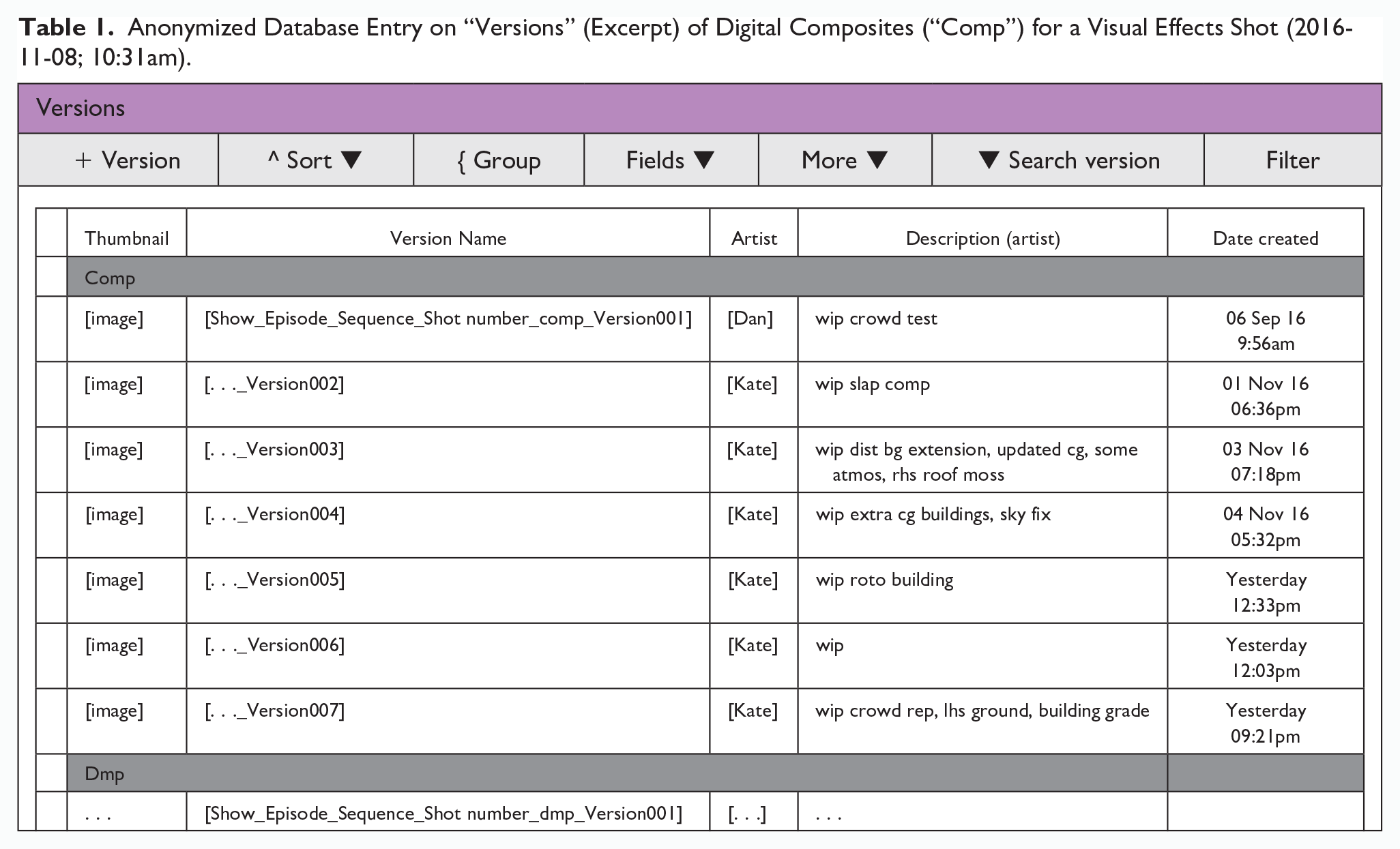
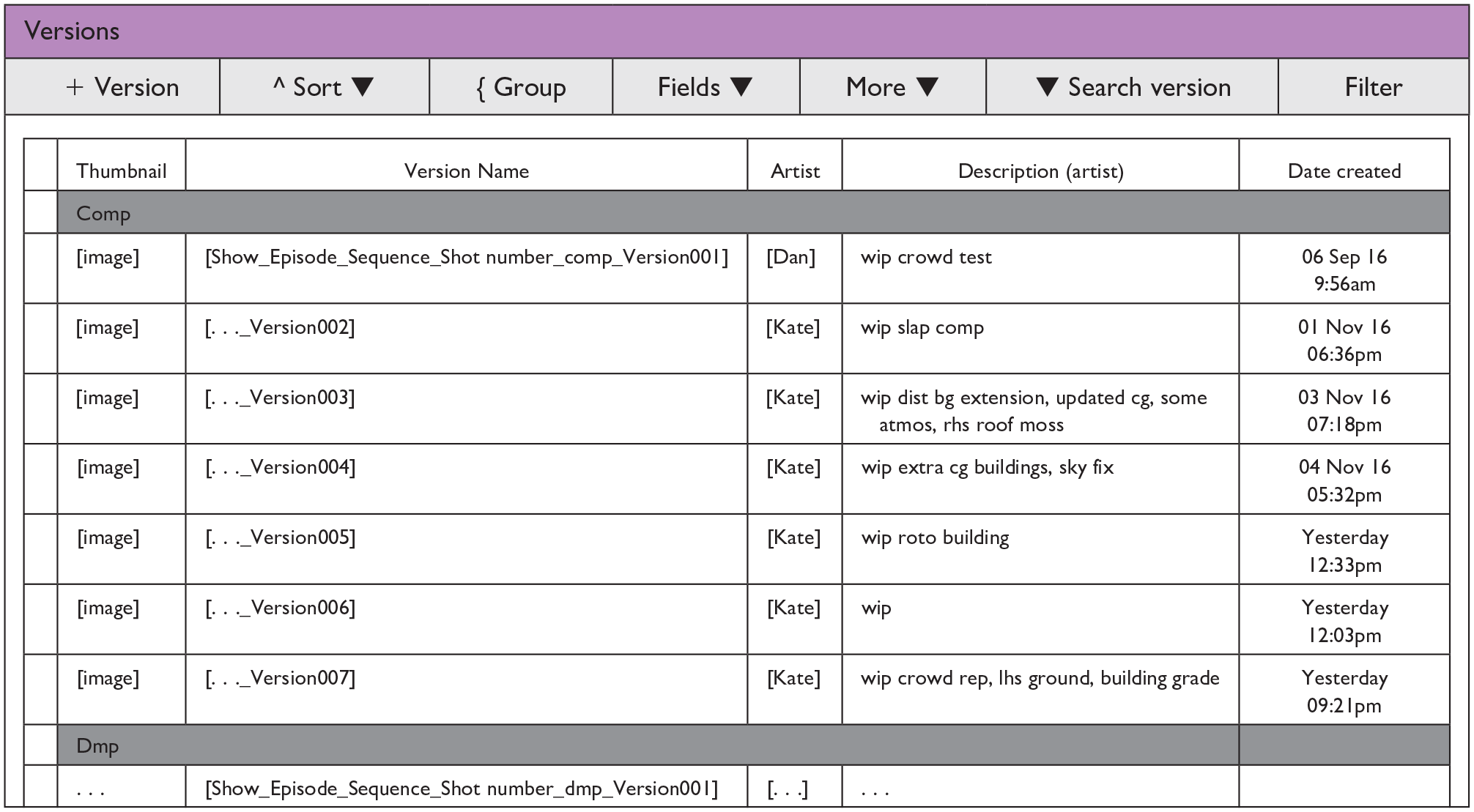
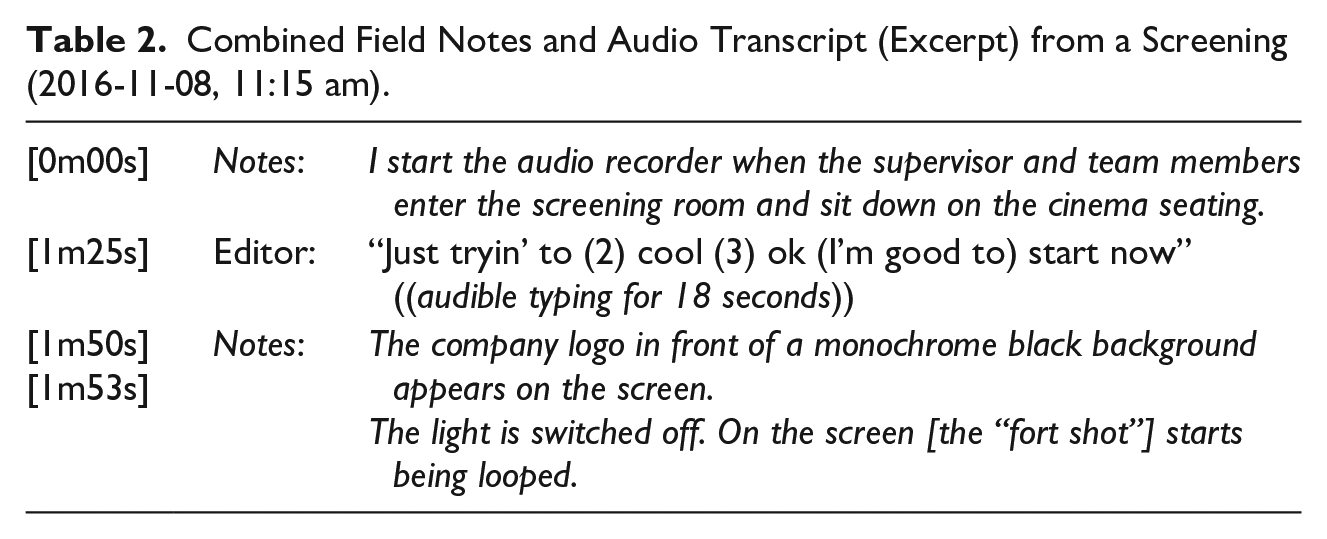
In this continuous materialization of research data, it became clear that storing—as a cooperative practice had a distinct temporal dimension. It implied continuous work: not only with respect to the maintenance of the servers and operating system that the database ran on but also to sorting, labeling, and linking data entries. This cooperative practice was reflected in the ethnographic data, too: observing temporally distributed database practices produced temporally distributed research data, materializing on different pages of journals and in numerous files that had to be organized by the ethnographer. By sorting visual effects as “versions,” using naming conventions (see column “version name,” Table 1) or adding “descriptions,” employees made their specialized uses “accountable” (Garfinkel 1967) for others in the database. Not the standardized database functions, but their repetitive specialized use throughout projects formed the cooperative practice of sorting. Sociotechnical accounts in the database like abbreviated technical terms as “descriptions” (“cg” for computer generated or “crowd rep” for crowd replication, Table 1) made different local uses of its entries easier, and thus facilitated cooperation (like other shared repositories, Star and Griesemer 1989). This can be illustrated further with another example. In one company, the “version number” helped “VFX editors” find new versions in the database to be shown in daily screenings: this preparation materialized in the one-and-a-half minutes of ethnographic recording (1m25s, Table 2) before the editor was “good to start” at the beginning of a screening; subsequently, the results of this work became visible on screen (1m53s). The editor’s work was facilitated not by talking to present colleagues, but by intelligible database entries: although not exactly “broken data”, they were certainly “contingent on other processes of development around it” (Pink et al. 2018, 1). Such cooperative accounts on which “version” was relevant when and for what purpose materialized in different research data: linking different on-site observations, cooperative accounts helped “pocketing” digital cooperation. Ultimately, the ethnographer even adopted aspects of the cooperative practices of storing and sorting in her own organization of research data. For example, in her computer files, she listed the screenshot that Table 1 is based on under the keyword “fort shot” (Table 2), indicating the connection between the data from the screening (Table 2) and the VFX database.
Combined Field Notes and Audio Transcript (Excerpt) from a Screening (2016-11-08, 11:15 am).
Logging in to the database
As the VFX database was used not only for storing but also as a (real-time) communication device within the companies, it also mattered—for “pocketing” digital cooperation—when it was accessed to import or export data ethnographically. The sequential, more fleeting temporality of this second kind of cooperative database-use also manifested in the research data: it facilitates an account of the chronology of particular moments in which data materialized.
Using the database, employees’ local workstations connected to a “cooperative now” of shared work projects. This digital connection affected the sequential unfolding of work practices—and the ethnographic theorizing on site. During the ethnographer’s visits, only three of seven companies allowed direct, unsupervised research access to their database—via an account, a password, and a desktop computer connected to the server. Company seniors explained the restrictions with the reason that a login allowed for direct and sometimes permanent changes to the database. Thus, logging in meant (potentially) becoming part of the informational reality of the screen-based “synthetical situations” (Knorr Cetina 2009) in the companies: the ethnographer watched employees check the database regularly, in order to receive information on their new tasks—importing data—or to upload their work—exporting data. In its everyday use, the database was treated as a display of the current state of cooperative affairs. It provided temporal orientation concerning the “practical question par excellence: ‘What to do next?’” (Garfinkel 1967, 12). For example, the ethnographer watched a project supervisor wait for an employee’s task to show up as “completed” in the database so that he could send it out to clients. The ethnographer noted down that the supervisor opened and examined the file when it was ready, and then asked an employee to fix one last problem with the visual effects they were working on. It was observable locally how the database became relevant for cooperative communication: the temporal urgency of the “cooperative now” manifested in waiting for the sign “completed,” which functioned as a hint for “pocketing” the temporal dimension of cooperative communication.
Conclusion
Praxeologizing ethnography, we have argued for an understanding of ethnographic data production as material theorizing, which can be observed in different research activities, tools, and bodies. With our heuristic concept of “pocketing,” we asked how and when ethnographic data materialized in practice: we framed data’s materiality relationally by analyzing the bodily-affective and temporal structures of practices in the field. By way of these practical entanglements, we suggested, data’s relations to practice come to show. We illustrated how ethnographic data materialized as bodies affected by experiencing architecture, for example, while doing rounds in the museum; or as field notes and data files distributed according to the temporal cooperative use of a database for storing work, as well as for real-time-communication in digital cooperation.
By using the concept of “pocketing” to look at data production as material theorizing, we dealt with an ambivalence that ethnographers know all too well: producing data implies “extracting” something from the field, while knowing that this “something” is in process of materialization while the researcher is in the process of understanding “what is going on”. The ethnographic research objects we used to discuss “pocketing”—everyday architectural experience and digital cooperation—are neither easy to discover in the field nor could their perceptible dimensions be clearly defined in advance. Yet both can be observed in acquired skills, large and small movements (walking and filtering database entries), and in knowing how (Polanyi 1966; Shove, Pantzar, and Watson 2012) to perform the duties of a museum attendant or to use a specialized database. In order to understand architectural experience on site, the ethnographer walked, sat, and listened—and registered changes in her own body (e.g. new skills, dry eyes) as materializations structured by the observed practices. Focusing on everyday architectural experiences, “pocketing” took place in the researcher’s body and affect. Similarly, in order to understand digital cooperation, observing when data materialized became relevant. Research data on the digital database materialized over time—repeatedly and in sequences—with reference to the specialized cooperative use of the database in the field (e.g. storing and communicating). Thus, the way research data was distributed materially was a consequence of practices of digital cooperation. Time also influenced the materialization of data on architectural experience—as did affect for digital cooperation—and the relations between time and affect could be further explored. Yet, our examples show clearly how ethnographic data materializes in relation to specific temporal and bodily-affective structures of practices in the field. Hence, with the concept of “pocketing,” we specified material theorizing in ethnography: the relations between data, method, and theory can be described with reference to their particular bodily-affective and temporal structures.
To conclude, we suggest that this practice-theoretical perspective on data production is increasing reflexivity in ethnography. First, by analyzing practical entanglements and claiming that data’s materializations depend on the practices they are part of, the fragility of data’s materiality comes to show: the ethnographer’s dry eyes needed to be treated medically, and distributed research data needed to be sorted and organized to make sense of it. Thus, a practice-theoretical perspective is useful for an appreciation of the shifting shapes of data in the research process beyond data production in the field: data’s varying role(s) and potentials for theorizing can be analyzed, and also the different ways ethnographers continuously take care of their data. Second, the concept of “pocketing” shows how, already in the field, “the researcher tells a particular story from among those that are possible” (Sedlačko 2017, 56): researchers do so in practice, and thus also materially. Sociological knowledge, from a practice-theoretical perspective, belongs neither to the world of empirical evidence, nor to that of theory: theory, methods, and data are all part of all practices throughout the research process, yet linked differently. Thus, for reflexive research, “pocketing” constitutes a novel, insightful view on ethnographic data production.
Footnotes
Authors’ Note
The manuscript is a contribution to a special issue of JCE “Practices of Ethnographic Research”, guest edited by Andrea Ploder and Julian Hamann.
Declaration of Conflicting Interests
The author(s) declared no potential conflicts of interest with respect to the research, authorship, and/or publication of this article.
Funding
The author(s) received no financial support for the research, authorship, and/or publication of this article.
