




Abstract
Background:
Breastfeeding is essential for infant nutrition, survival, and development. Identifying factors associated with breastfeeding success is important for improving early postpartum care and breastfeeding support in hospital settings.
Purpose:
This study aimed to identify determinants of successful breastfeeding among postpartum mothers in a private hospital in Yogyakarta, Indonesia.
Methods:
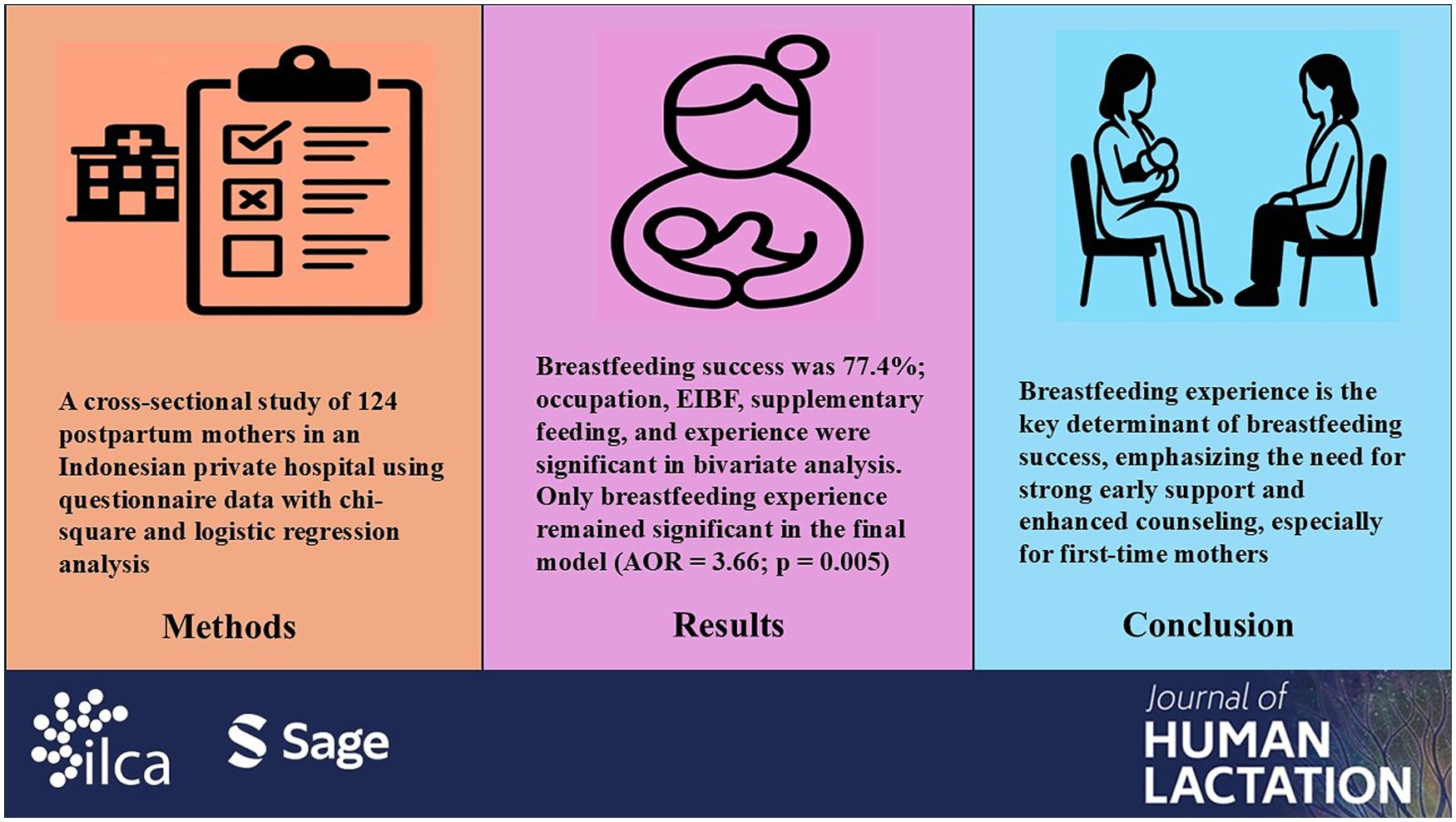
A cross-sectional study was conducted among 124 postpartum mothers who had delivered vaginally and had healthy infants. Participants were recruited using convenience sampling. Data were collected using a structured questionnaire during the postpartum hospital stay. Variables included maternal education, occupation, knowledge, early initiation of breastfeeding (EIBF), supplementary feeding, rooming-in, breastfeeding frequency, breastfeeding experience, health worker support, and family support. Data were analyzed using univariate analysis, Pearson’s chi-square test for bivariate analysis, and binary logistic regression for multivariable analysis. Multivariable analysis results were presented as adjusted odds ratios (AORs) with 95% confidence intervals (CIs), with p < 0.05 considered statistically significant.
Results:
Bivariate analysis showed that maternal occupation (p = 0.040), EIBF (p = 0.024), supplementary feeding (p = 0.017), and breastfeeding experience (p = 0.002) were significantly associated with breastfeeding success. In multivariable analysis, only breastfeeding experience remained significantly associated with breastfeeding success. Mothers with previous breastfeeding experience were 3.66 times more likely to achieve breastfeeding success than those without prior experience (AOR = 3.66; 95% CI [1.47, 9.12]; p = 0.005).
Conclusion:
Breastfeeding experience emerged as the most consistent factor associated with breastfeeding success. Early postpartum breastfeeding support, especially for first-time mothers, should be strengthened to improve breastfeeding success.
Get full access to this article
View all access options for this article.