Background: Breastfeeding self-efficacy, as well as breastfeeding intention, are two modifiable factors that influence rates of breastfeeding initiation. Maternal breastfeeding confidence is a crucial factor influencing breastfeeding duration. Prenatal women with low confidence are more likely to discontinue breastfeeding in the 1st week postpartum, compared to women with higher self-confidence. Prenatal breastfeeding self-efficacy can be measured with the valid Prenatal Rating of Preparation to Breastfeed (PREP to BF) scale but is only available in English and Turkish for clinical and research use (Evcili & Demirel, 2020; McKinley et al., 2019).
Aims: The aims of this current study were (1) to translate the current PREP to BF scale to Spanish and retest its psychometric properties; (2) to determine internal consistency and reliability; and (3) to assess correlation between prenatal breastfeeding self-efficacy and breastfeeding intention among a pregnant sample of native Spanish speakers.
Narrative: The 39 items on the original PREP to BF scale, in addition to the demographic items and 3-item breastfeeding intention scale (61 items total) were translated into Spanish utilizing a professional translation service. A panel of four native Spanish speakers from Honduras, Columbia, and Peru reviewed the scale. Members of the panel came to an agreement on the convergence of dialectal differences that would best reflect each item’s meaning. The scale was back translated to English utilizing a professional translation service to ensure no meaning was lost in the translation process (
Flaherty et al., 1988
). Spanish-speaking pregnant women (n = 272), 18–43 years of age were recruited through targeted Facebook advertisements. Most participants were in Puerto Rico (97.9%; n = 266) with the remaining six participants in Florida (n = 2), Delaware (n = 1), Missouri (n = 1), Ohio (n = 1), and North Carolina (n = 1).
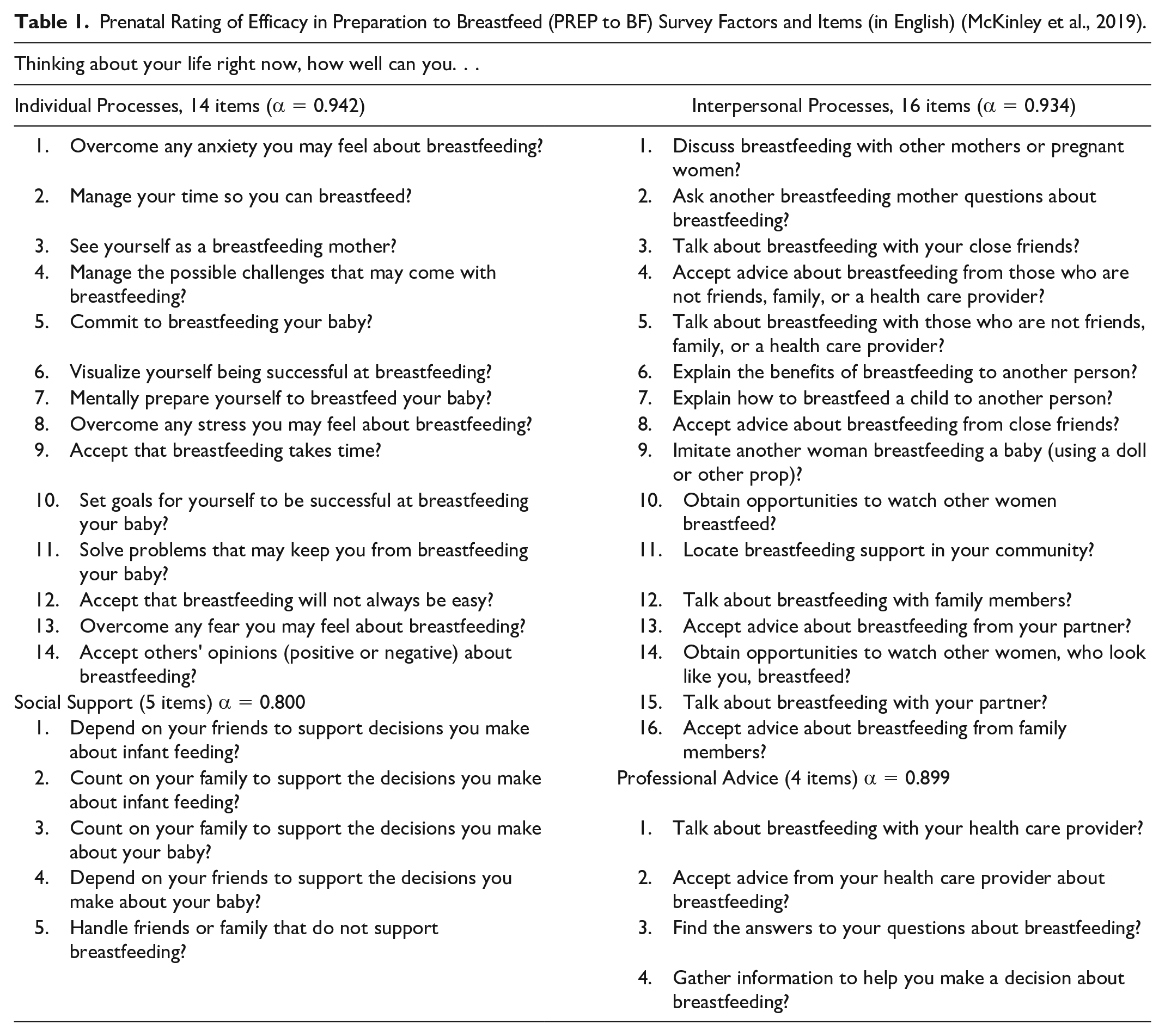
Results: A higher percentage of the women were Hispanic (96.1%, n = 261), identified as white (53.6%, n = 146), unmarried (56.0%, n = 152), and indicated that they were breastfed as children (49.2%, n = 134). In all, 58% (n = 158) of the participants held a bachelor’s degree or higher, while 32.8% (n = 89) had completed some college education. The study confirmed the Spanish version to be valid (α = 0.951) and reliable (λ6 = 0.976) to measure prenatal breastfeeding self-efficacy while retaining the original 39 items (Table 1). Higher PREP to BF score was significantly associated with stronger breastfeeding intention (p < 0.001). Over 99% indicated plans to incorporate breastmilk into their feeding method, either exclusively (80%) or in combination (19.5%). Black women had significantly higher breastfeeding intention (p = 0.03), but white women had significantly higher mean self-efficacy score (p = 0.04).
Conclusions: The PREP to BF Scale in Spanish is a valid and reliable measure of breastfeeding self-efficacy during the prenatal period. Both clinicians and researchers may use the instrument to measure a prenatal person’s self-efficacy and reveal areas that may need to be addressed, such as goal-setting skills or overcoming barriers before giving birth to ensure they commit to their decision to initiate breastfeeding. Results from this study suggest that PREP to BF has the potential to continue to be translated and tested in more languages to increase use and reach. This translated tool will enable more clinicians and researchers to measure the constructs of prenatal breastfeeding self-efficacy in more diverse populations in the United States and across Central America.