




Abstract

Interviews are one of the most common qualitative data collection methods—for good reason. They tend to be a familiar, efficient, and a relatively inexpensive way to explore subjective experiences and attitudes (Perakyla & Ruusuvuori, 2011). However, like any data collection method, interviews have limitations. They are subject to recall and social desirability bias and are often constrained by the dominant cultural discourse and limitations of language. In addition, interviews can feel (and be) extractive, particularly for sensitive topics and when the research team does not give adequate forethought into how data will be used and how participants and their communities will be involved in those decisions (Knott et al., 2022). Quality of interview data is also necessarily influenced by the background, interview skills, and experience of the interviewer, who is a co-creator of data along with the interview participant. To lessen the impact of these limitations and improve interview data quality and ultimately the value of the study, I outline some considerations researchers can consider in planning, conducting, and reflecting on interviews.
Planning Interviews
To conduct effective interviews, time and thought is required at the planning stage. Depending on the research question, different types of interview styles, such as cognitive, narrative, and ethnographic interviewing might be used. Here, I describe global considerations for interviewing, although researchers should be mindful of adjusting their interview methods for specific typologies.
There are multiple decisions to be made at the planning stage, including who will conduct the interviews, what interview tools will be used, how the interview will be structured, whether supplementary data collection methods will be used in addition to interviews, what techniques or strategies will be used during the interview to reduce interviewer–interviewee power differentials and foster open, authentic, and rich dialogue, and how reciprocity will be cultivated with participants. Frustratingly, there are rarely straightforward answers to many of these decisions; instead, the research team needs to carefully consider context and the voices of the group(s) that are the focus of and affected by the research.
One of the most important considerations is who will conduct the interviews. Arguments have been offered both ways for “insider” versus “outsider” interviewers. While this dichotomy is somewhat reductionist, it is useful to consider what culture, history, or other characteristics might be important for the interviewer to share with the group under study. Matching by age, sex, community membership, race/ethnicity, and profession may be important, for example. In many cases, insiders who share certain characteristics with the population being studied may be considered more trustworthy, reducing researcher-to-participant power imbalances. As a result, participants may disclose more and speak more authentically than they would to an outsider. Insiders may also understand the topic, nuances, and subtext of the interview more fully, increasing interview efficiency, depth, and participant engagement. Conversely, insiders may be so embedded in the culture that they assume shared meaning where it may not exist, and may fail to fully examine cultural assumptions and narratives (Small & McCrory Calarco, 2022). Overall, it is my experience that interviews tend to yield richer data when insiders conduct interviews, and limitations arising from any unexamined assumptions are addressed in post interview reflection with the research team.
Certain interview mediums and tools might be leveraged to encourage thoughtful participant reflection and disclosure. For example, visual elicitation through photographs or art (Glegg, 2019; Prosser, 2011), mind mapping, participant diary reflection (Bartlett, 2012), Photovoice, and think aloud techniques (Patton, 2002), have the capacity to enhance data triangulation and reduce the researcher-to-participant power differential by participant co-direction of the research process. Phone or video-call (e.g., Zoom) interviews, rather than in-person interviews, provide a semblance of physical and emotional distance and may be preferred for sensitive topics (Mealer & Jones, 2014). Much has been written on development and use of interview guides, including question structure and ordering, use or prompts, and adaptation based on ongoing interview themes. Some researchers will share a copy of the guide with participants ahead of the interview. This has the advantage of allowing participants more time to reflect on the topic of study, but may also constrain ideas that might arise spontaneously in conversation (Doody & Noonan, 2013).
Interviewer reflexivity is important at all stages of the interview process to maximize rigor and, in the case of very sensitive topics, protect both the interviewee and interviewer from harm. Researchers need an awareness of how their life experiences influence their questions and responses, and a plan to keep their natural biases in check. At the study outset, researchers can plan for post-interview debriefs, reviews of audio or transcripts, and journaling and fieldnote-taking as detailed in the Post Interview section below. Researchers should also have a plan for how referrals to support services can be facilitated and under what circumstances referrals might be made.
Another important and often overlooked part of interview planning is to what degree participants might be included as co-owners of their data, and what benefits they might derive from the research. Coverage of travel expenses and monetary compensation might be considered the minimum for a participant’s time and effort. In some cases, however, these might be considered coercive, exacerbate power dynamics, or contribute to a “stylized” interview wherein participants repeat what they believe researchers want to hear rather than their authentic feelings and experiences (Cook & Nunkoosing, 2008). Researchers should also consider what might be meaningful to participants beyond cash gifts. Are participants interested in being involved in interpretation of findings and being recognized as co-authors or acknowledged by name in publications? Would it be possible for participants to review their transcript to redact or add additional thoughts (Mealer & Jones, 2014)? Can researchers share findings at community events important to the study population? Could participants be involved as consultants/co-investigators or community advisors on subsequent research? Inclusion of participants as co-owners of the data can contribute to richer, more authentic data that is useful to the communities studied.
During the Interview
One of the most important tasks of the interviewer is creating a safe and welcoming space for participants to share their authentic experiences. Developing proficiency takes practice, but is also influenced by external factors, like distractions, privacy, and the participants’ baseline ability to reflect meaningfully and communicate their thoughts. Listening and response skills are paramount for interviewers and can be honed through practice in mock interviews and even everyday conversations. For many, our natural inclination is to avoid discomfort, through filling silences after a question is posed, proceeding through an interview guide regardless of what topics were already addressed, jumping in to talk about our own experiences, and contradicting or moderating a socially undesirable response, for example. These tendencies can lead to superficial interviews, as participants pick up on subtle cues and censor themselves. At times, participants are overly succinct because a topic is perceived as too invasive, personal, or their response would paint them in an undesirable light. In these cases, it is sometimes helpful to depersonalize the discussion and ask participants to imagine describing the phenomena to somebody who has never heard of it or experienced it. Another way to encourage elaboration and create a safe space for sharing potentially provocative or socially undesirable perceptions or behaviors is the use of illustrative extremes (Patton, 2002). That is, an interviewer can ask a question and follow-up with the most extreme views they have encountered in a way that normalizes these responses and makes participants comfortable sharing if their experience lies somewhere between those extremes (i.e., “With regard to becoming a new mother, some people have told me their first thought was that it was the biggest mistake of their lives, others have said they felt guilty that they had an easy time and experienced instant joy when their friends and family struggled. What were your feelings?”). On the opposite end of the spectrum, participants may be quite talkative and tangential in their responses. To keep interviews on track in these cases, it is important to keep the interview purpose in mind, avoid follow-up on non-central points, and steer the conversation back to the primary questions during brief pauses (Lareau, 2021).
Extra care and consideration are needed for sensitive topics. Interviewers need to be attuned to verbal and non-verbal signs of distress and have a plan in place for how they will proceed in these circumstances. At the start of the interview, it can be helpful to outline the nature of questions that may be posed for participants and what options are on the table if they become too uncomfortable to continue (moving on from a particular topic, stopping interview). It is also helpful to normalize expression of emotions, including crying, and certain phrases may help in these instances, such as “please continue” or “take all the time you need” (Mealer & Jones, 2014). On the contrary, “why”-type questions may have a dampening effect, leading to defensiveness. Starting interviews with less sensitive questions may help ease both participants and the interviewer into emotionally fraught topics.
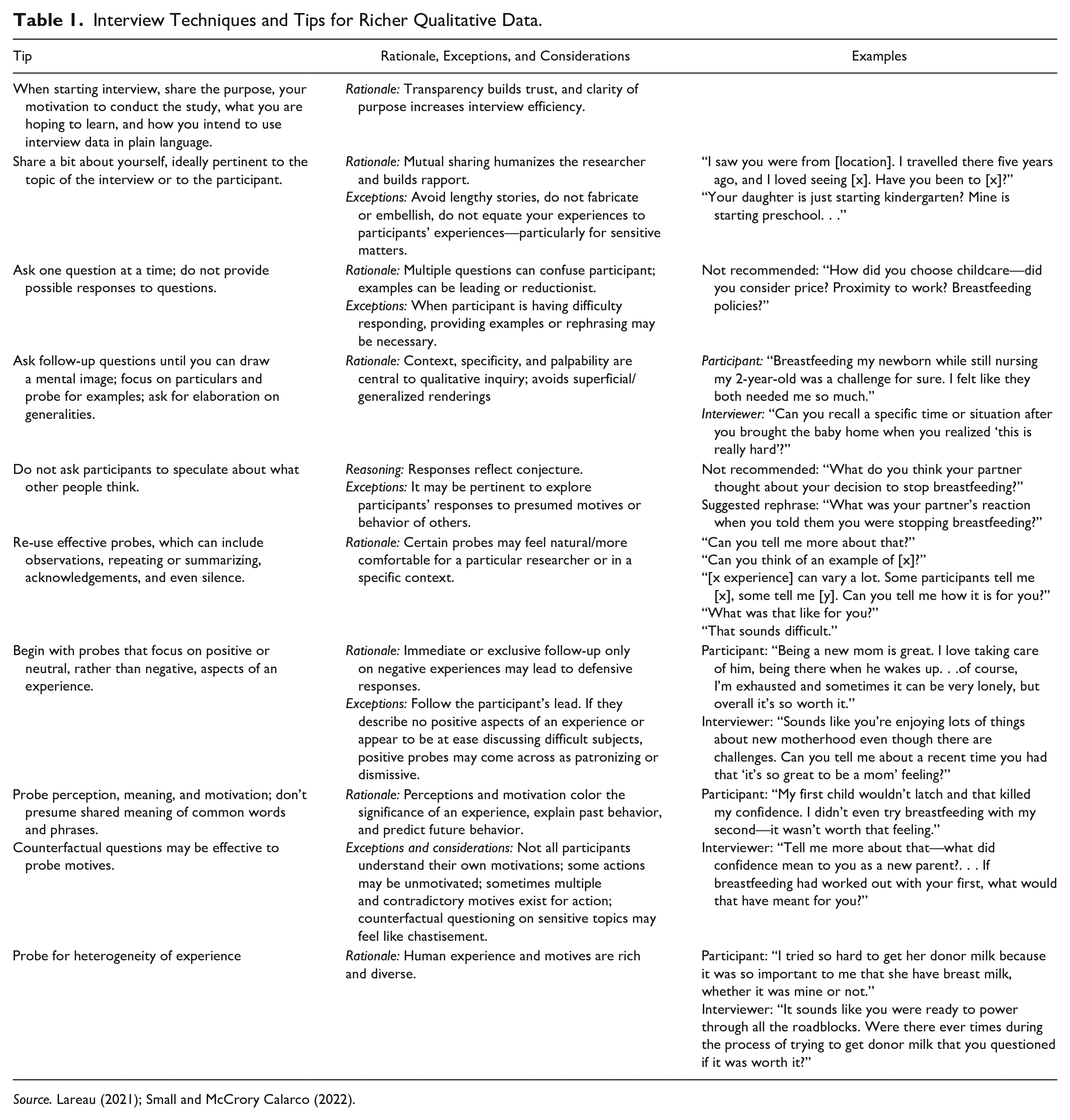
A final consideration is incorporation of constant comparison in interviews. Glaser and Strauss (1967) and later Corbin and Strauss (2008) described constant comparison as an interplay between data collection and data analysis in conducting grounded theory, although it has been applied to qualitative research outside of grounded theory, as well. Using constant comparison, interviewers adjust their questions to establish convergence and divergence/heterogeneity in dimensions of an experience among participants. In its purest form, constant comparison relies on concurrent data collection and analysis, although a semblance of constant comparison may be achieved through reviewing transcripts, fieldnotes, or memos before upcoming interviews to inform the present interview. Table 1 includes examples of effective interview techniques drawn from experienced research teams and individuals (Lareau, 2021; Small & McCrory Calarco, 2022).
Interview Techniques and Tips for Richer Qualitative Data.
Post Interview
When scheduling interviews, it is important to allot sufficient time for the critical work that occurs after they are over. Fieldnotes and/or memos describing the conditions of the interview, non-verbal communication, and interviewer emotional reactions and reflections provides an audit trail and information that can be readily accessed to inform the conduct of subsequent interviews and adds important context during the analysis process (Knott et al., 2022; Mealer & Jones, 2014).
Particularly with a team of interviewers and/or novice interviewers, it is helpful to schedule time for debriefing and reviewing interview audio recordings. This provides an opportunity for the team to process their own feelings and experiences, discuss evolving theoretical and sampling decisions, decide on adaptations to the interview guide, and offer each other constructive feedback on interview conduct (Doody & Noonan, 2013). Even without a team, it is useful for individual researchers to review their own interview audio and transcripts to improve interview skills, determine whether follow-up is needed with a particular interview participant, and to note points to address in subsequent interviews.
Conclusion
Qualitative interviewing is a learned technique that can be improved over time, with practice and reflection, and consideration of techniques that have worked well for other qualitative researchers. Conducting better qualitative interviews is not limited to what is said during the interview, but also involves careful planning and processing before and after the interview.
Footnotes
Author Contributions
Jill Demirci conceptualized, wrote, and approved the final version of this manuscript.
Disclosures and Conflicts of Interest
The author declared the following potential conflicts of interest with respect to the research, authorship, and/or publication of this article: JD was an Associate Editor for JHL at the time this article was written.
Funding
The author received no financial support for the research, authorship, and/or publication of this article.
