Background: Expectant fathers’ knowledge and attitude towards breastfeeding/chestfeeding were identified as important factors associated with their involvement in the breastfeeding process and supporting mothers, subsequently influencing breastfeeding initiation and duration in their infants. It is important to identify these gaps to improve the methods and quality of information given during breastfeeding education to this population.
Aims/Purpose: This study assessed the levels of knowledge and attitudes of expectant fathers towards breastfeeding, and their association with the participants’ sociodemographic profiles.
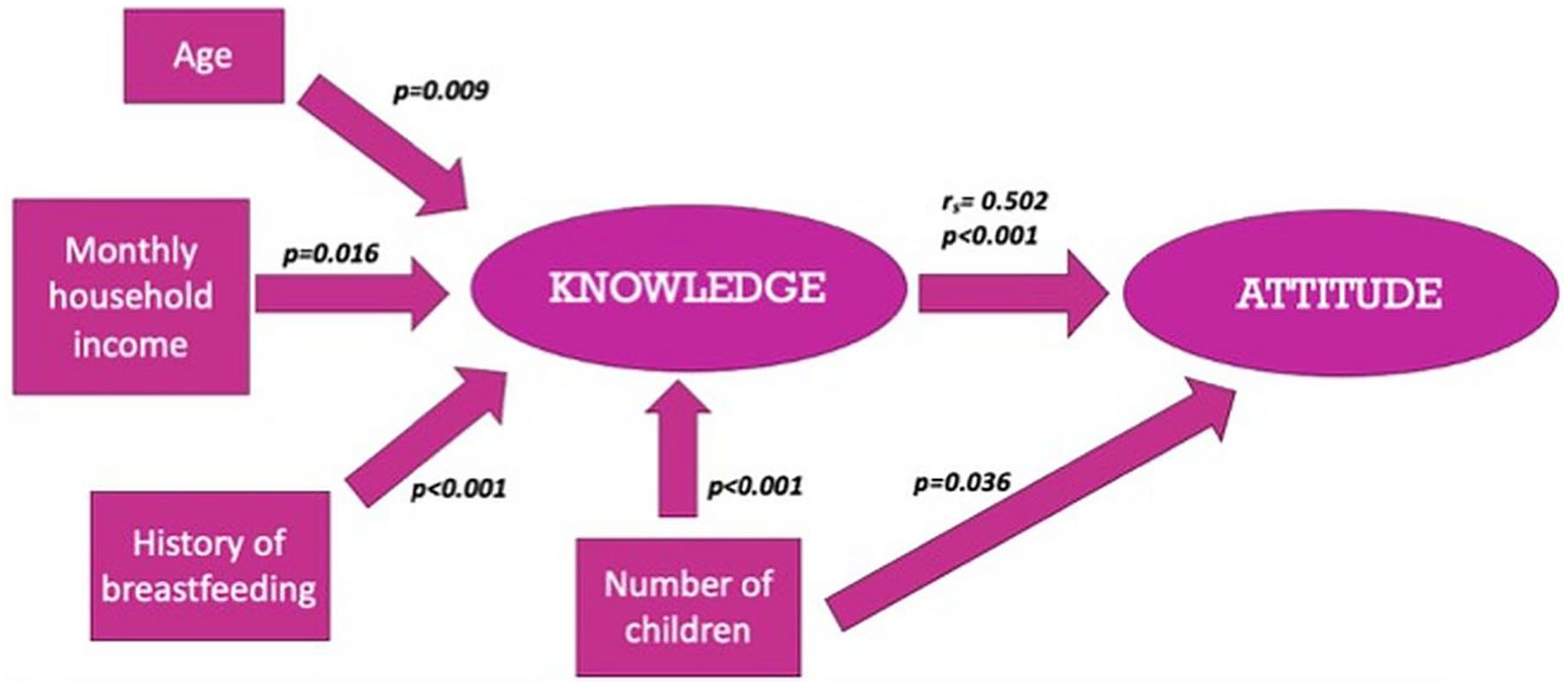
Narrative: A cross-sectional study was done among expectant fathers of women attending antenatal care at an urban Maternal and Child Health Clinic, in Seberang Perai Utara, Penang, West Malaysia. Data collection took place from November to December 2021, during the Movement Control Order of Covid-19 pandemic. Males 18 years of age or over, who lived with their wives and understood either Malay or English, were included in this study. Due to the Covid-19 pandemic, expectant fathers were not allowed entry into the clinic. The clinic documented 230 new patients for antenatal bookings. It was estimated that only 25% of expectant fathers attended the antenatal follow-up with their wives, thus the population was calculated to be 58. Using Krejcie and Morgan’s table to determine the sample size for a given population, the final sample size calculated, including an additional 50% dropout rate, was 78. An online link containing the questionnaire was given to the expectant fathers and, if they consented, they answered a self-administered online questionnaire, which included their sociodemographic profile and the validated Knowledge and Attitude Breastfeeding Questionnaire (KA-BFQ). The KA-BFQ has two sections. The first section contains 47 items assessing their knowledge on breastfeeding, evaluating 10 domains of knowledge with three options “true,” “unsure,” and “false.” The second section consists of 23 items, assessing the attitude towards breastfeeding with the choices of answer using a 5-point Likert scale ranging from “strongly disagree” to “strongly agree.” A total of 66 participants responded; however, only 83.3% (n = 55) completed the questionnaire. Most were Malays and Muslims, and half were first-time expectant fathers (50.9%; n = 28). The median total score for breastfeeding knowledge was 29 (interquartile range = 12) and the mean score for breastfeeding attitude was 82.98 (SD = 9.625). Only 50.9% (n = 28) of participants demonstrated good knowledge on breastfeeding, and 54.5% (n = 30) of participants showed good attitude towards breastfeeding. Age (p = 0.009), monthly household income (p = 0.016), number of children (p < 0.001), and history of breastfeeding (p < 0.001) were significantly associated with knowledge level. Only the number of children was associated with the level of attitude towards breastfeeding (p = 0.030). There was a statistically significant moderate positive correlation between the levels of knowledge and attitudes (rs = 0.502, p < 0.001).
Conclusion: The levels of knowledge and attitudes among expectant fathers in Malaysia towards breastfeeding are still low. Fathers with greater levels of knowledge have a more positive attitude towards breastfeeding. A comprehensive strategy—including empowering a holistic breastfeeding educational program for expectant fathers—should be implemented to enhance knowledge and attitude in supporting their wives to improve breastfeeding outcomes.
The Association Between Sociodemographic Factors and Knowledge and Attitudes Towards Breastfeeding.