




Abstract
Some people appear to specifically search for bad news, or to prefer negatively valenced information more generally. While preferred intake of negative information may serve to confirm one’s existing negative expectations, it may also contribute to negative affect and neuroticism. Conversely, other people may prefer information that allows learning rather than confirming existing expectations and individual differences in such preferences may be linked to trait openness/intellect. To assess associations between information preferences, negative expectations, neuroticism, and openness/intellect, two studies (N = 300 and N = 161) were conducted. Participants completed a negative expectation questionnaire and rated whether they would like to read the corresponding articles of 48 presented news-headlines. Headlines were construed to suggest that the valence of the corresponding article would either be negative, positive, or neutral and were presented in negative-neutral or positive-neutral pairs. Ratings were provided on 24 bipolar (Study 1) or 48 unipolar (Study 2) items. In line with assumptions, rating-intercorrelations support the existence of general tendencies to prefer negative versus neutral (and positive vs. neutral) news across different topics. Across studies, the tendency to prefer negative versus neutral news was correlated with both generalized negative expectations and neuroticism. Moreover, negative expectations mediated the relationship between neuroticism and preferring negative news, suggesting that negative information preferences may serve to confirm negative expectations in high neuroticism. In contrast, openness/intellect was linked to higher preferences for any news (Study 2) but particularly headlines that indicated high information gain. These findings provide insights into information preferences and mechanisms for stabilizing expectations in personality.
Plain Language Summary
Some individuals tend to seek out bad news or prefer negative information in general. This preference might confirm their already negative expectations and contribute to negative feelings and neuroticism. On the other hand, some individuals are more interested in information that helps them learn new things, and this might be connected to their level of the personality trait openness/intellect. To explore these relationships, two studies were conducted with N = 300 and N = 161 participants. The participants answered questions about their negative expectations and indicated 24 times whether they would want to read an article with a title indicating neutral, negative, or positive content when they were presented with newspaper articles on different topics. The results showed that some people generally preferred negative news over neutral news regardless of the particular topic. Some individuals also preferred neutral over negative or positive news. People who preferred negative news were more likely to have negative expectations and higher levels of neuroticism. In fact, negative expectations partly explained the link between neuroticism and a preference for negative news, suggesting that people high in neuroticism may search for negative news in order to confirm their negative expectations. In contrast, people who scored high in openness/intellect were more likely to show interest in all types of news, especially headlines that promised a lot of new information. These findings help us understand why people have different information preferences and how these preferences relate to expectations and personality.
Background
Our world is characterized by the possibility to obtain at almost any time, all different kinds of information (Lawrence, 2012). Information, in turn, guides our expectations, which can be defined as probabilistic beliefs about the future (Panitz et al., 2021; Roese & Sherman, 2007). 1 Expectations fundamentally not only guide our behavior (Rotter, 1954; Tolman, 1951) but also perception (De Lange et al., 2018; Friston, 2009; Von Helmholtz, 1867), emotion (Barlow, 1988; Beck, 1987; Rief & Joormann, 2019), and desire (Bandura, 2001; Lewin et al., 1944; Wigfield, 1994), which basically characterize our personality (John & Srivastava, 1999). By shaping expectations, the information we take in shapes our personality and our personality, in turn, shapes the information we process (Jach et al., 2022; Kelly & Sharot, 2021).
Neuroticism and negative expectations
Expectations and information processing play particular roles in neuroticism. Neuroticism is one of the most important personality traits that captures covariation of items assessing negative affect in terms of anxiety, depression, irritability, anger, frustration, hostility, or more generally, volatility and withdrawal (Caspi et al., 2005; Costa & McCrae, 1992; DeYoung et al., 2007; Eysenck, 1944; Ormel et al., 2013; Sauer-Zavala & Barlow, 2021). Similar traits have been identified in all major personality trait models with different names such as Neuroticism-Anxiety (Zuckerman et al., 1991), Anxiety (Gray & McNaughton, 2000), Harm Avoidance (Cloninger, 1986), Dispositional Negativity (Shackman et al., 2016), Negative Affect (Al-Dajani et al., 2016; Watson et al., 1988), or Negative Emotionality (Tellegen & Waller, 2008). Neuroticism is a broad trait that is highly relevant across almost all domains of human life and high levels relate to lower levels of life satisfaction, educational attainment, and occupational success and higher risk for mental disorders, relationship dissatisfaction and divorce, loneliness, and many more (Barlow et al., 2014; Ormel et al., 2013; Shackman et al., 2016). Perhaps the most cardinal feature of this group of traits is the frequent and strong experience of negative affect (Brandt & Mueller, 2022; Shackman et al., 2016; Watson et al., 1988).
If expectations strongly influence human experience, affect, and behavior, variations in expectations presumably cause variations in experience, affect, and behavior. Furthermore, individuals with strong negatively valenced expectations (i.e., strong beliefs that negatively valenced events may occur in the future) would presumably experience negative affect often, which may manifest in high levels of neuroticism.
This assumption is supported by moderate to high correlations between neuroticism and other neuroticism-related traits with questionnaires that assess the frequency of worrying (Roelofs et al., 2008; Weiss & Deary, 2020), hopelessness (Iliceto & Fino, 2015; Velting, 1999), and the subjective probability for negative future events (MacLeod et al., 1996). Additionally, there is substantial literature on the association between depression and anxiety disorders and negatively distorted future expectations (e.g., Andersen et al., 1992; Miranda & Mennin, 2007).
Interindividual differences in the preference for valenced information
Negatively valenced expectations may be acquired and stabilized, among other pathways, by taking in negatively valenced information. Because we largely decide ourselves, which information we consume, generalized preferences for negatively valenced information may motivate individuals to search, select, and process negatively valenced information, which may then create and stabilize negative expectations and negative affect. A potential motivation for an individual to seek negative information may be that it confirms existing expectations and thereby reduces uncertainty (Kruglanski et al., 2020; Panitz et al., 2021; Proulx & Inzlicht, 2012; Roese & Sherman, 2007; Swann et al., 1992). Importantly, the deliberate selection of information based on its putative valence is generally possible in real life because information on most matters does not pop up instantaneously but rather unfolds gradually during information intake. For example, based on whether the title of a newspaper article hints at negative information that is provided in the article, an individual may prefer to receive or not receive further information, that is, to read or not read the article. Accordingly, interindividual differences in the general preference for negatively valenced information may become relevant throughout this sequential process as soon as the first bits of information become available. Whether such biases in preference for information with negative valence exist and generalize across different domains of information, however, is an empirical question that has not yet been addressed to our knowledge.
Neuroticism and information preferences
While there is rich literature on how neuroticism (Ormel et al., 2013) and associated disorders (LeMoult & Gotlib, 2019; Ouimet et al., 2009) relate to biased (reactive) processing of negatively valenced information, only few prior studies have investigated links between neuroticism and (proactive) preferences for negatively valenced information (Jach et al., 2022; Kelly & Sharot, 2021; Swann et al., 1992). However, at least three broad hypotheses could be formulated on how neuroticism is linked to preferences for negatively valenced information, which we will outline below and refer to as the negative information approach hypothesis, the negative information avoidance hypothesis, and the uncertainty reduction hypothesis.
The negative information approach hypothesis is derived from the aforementioned assumptions that neuroticism is characterized by generalized negative expectations and that negative expectations are acquired and stabilized when negatively valenced information is processed. From Social Psychology and other disciplines, there is rich literature showing how humans are often motivated to protect their beliefs and expectations, which may be facilitated by searching information that is consistent with their expectations (Kruglanski et al., 2020; Proulx & Inzlicht, 2012; Roese & Sherman, 2007), a strategy that has been termed assimilation and is opposed to (unbiased) exploration (Panitz et al., 2021). From this perspective, it would be hypothesized that individuals with high neuroticism prefer negatively valent information in order to confirm their generalized negative expectations. They may search for bad news, consistent with their world view, even if this may increase negative expectations and negative affect in the long run. Although it may appear somewhat counterintuitive to approach information that leads to negative affect, research on morbid curiosity, for example, does suggest that there are situations when individuals prefer negative over neutral information (Oosterwijk, 2017). Furthermore, it has been found that dysphoric individuals may search for negative evaluations of themselves, presumably as an attempt to confirm existing self-views (Swann et al., 1992).
The negative information avoidance hypothesis can be indirectly derived from work by Kelly and Sharot (Kelly & Sharot, 2021), who formulated three different motives why individuals are motivated to search information: cognitive utility, instrumental utility, and hedonic utility. They found that a general psychopathology factor (which would presumably capture substantial variance in neuroticism) (Barlow et al., 2014) was associated with a tendency to not select information based on cognitive utility. Instead, highly neurotic individuals may select information based on hedonic aspects which reflects preferring “information when they expect good news [as opposed to] bad news”(Sharot & Sunstein, 2020) (p. 14, Sharot ). From this perspective, the hypothesis could be derived that highly neurotic individuals, less driven by cognitive utility of information, particularly select information based on its capacity to enhance pleasant and/or reduce unpleasant states and thus avoid negatively valenced information even more than less neurotic individuals. This hypothesis would be consistent with general avoidance accounts of neuroticism and anxiety (LeDoux et al., 2017; Mowrer, 1947; Wong et al., 2023). Note, however, that a direct link between hedonic utility and neuroticism or a general psychopathology factor has not yet been reported and that the valence of information has not yet been assessed or manipulated in studies on neuroticism and information selection (Kelly & Sharot, 2021)
The uncertainty reduction hypothesis is based on the well-established finding that neuroticism is closely linked to intolerance for uncertainty (Berenbaum et al., 2008; Hirsh & Inzlicht, 2008) and the assumption that neuroticism would hence be particularly linked to increased information search in situations, where the lack of information induces negative emotions like anxiety (Jach et al., 2022). Information search would thus serve the primary purpose to reduce negative emotions evoked by the unknown in highly neurotic individuals. Several studies tested correlations between neuroticism and information seeking in reward outcome tasks where uncertainty was created by temporarily not informing participants whether they had received a reward or not. The overall result pattern in these studies was somewhat inconclusive, however (Bennett et al., 2021; Jach et al., 2022; Jach & Smillie, 2019).
Taken together, there are at least three hypotheses linking neuroticism to information search while there is yet little empirical support for a link between neuroticism and information search. Moreover, prior studies on the topic have not considered the valence of the information and/or investigated whether neuroticism is characterized by a specific preference for negatively valenced information. Yet, valenced information may be particularly relevant for neuroticism in light of its presumed association with negative expectations and negative affect in general. If neuroticism was indeed linked to a preference for negatively valenced information, highly neurotic individuals would likely seek, find, and process more negative information in their everyday lives, which would reinforce negative expectations and intensify negative affect in those individuals.
Openness/intellect and information preferences
Another trait that is particularly relevant in the context of information search is openness/intellect (DeYoung, 2013; 2015b). The two aspects of this broad trait, openness and intellect, presumably reflect exploration through reasoning and learning and exploration through sensation and perception, respectively. According to DeYoung (2015), it is cognitive exploration more generally, which causes all traits within the openness/intellect domain to cohere. Consistent with the assumed link between openness/intellect and exploration, Jach et al. found a robust link between openness and information seeking in trivia tasks (Jach et al., 2022).
However, while information seeking is related to exploration, it is not the same, given that information seeking can be both, exploratory or confirmatory (Kruglanski et al., 2020). Exploration is often contrasted with exploitation in the context of reinforcement learning, animal foraging, visual search among others (Hills et al., 2015; Sutton & Barto, 2018), or, as stated above, with assimilation in the context of expectation change versus confirmation (Panitz et al., 2021). Given that there is an exploration-assimilation trade-off and openness/intellect is presumably linked to exploration, it would be assumed that individuals high in openness/intellect search for more information (Jach et al., 2022).
In contrast to neuroticism, which is explicitly linked to negative affect, openness/intellect has not been conceptually associated with specific dimensions of affect. Hence, with regard to the valence of information, it would be assumed that openness/intellect is related to a preference for unbiased information in general—regardless of whether the alternative would be positively biased or negatively biased information. Furthermore, if the information is abstract/propositional rather than sensational or perceptual, one would expect particularly the intellect domain to be related to a preference for unbiased information.
Research questions and current study
Based on the above reasoning, the following research questions can be derived. First, if personality traits like neuroticism are systematically linked to a tendency to prefer negatively valenced information, it would have to be assessed whether such tendencies to prefer specific information based on their valence exist in the first place. If this was the case, preferring negative (vs. neutral) information in one domain should systematically correlate with preferring negative information in another domain, or, more generally, preferring negative information should be correlated across different domains. Moreover, it would have to be assessed whether such a tendency for negative versus neutral information is distinct from a general tendency to prefer any kind of valenced (i.e., negative OR positive) over neutral information. Second, while neuroticism is closely linked to worrying and neuroticism-related traits have been linked to the subjective probability for specific negative future events, a direct link between neuroticism and broad negative expectations across different domains has yet to be shown. Third, if neuroticism is linked to negatively biased information search in an assimilative attempt to confirm negative expectations, negative expectations would have to be correlated with negatively biased information search in the first place. The fourth research question is the central question of this study and is derived from the aforementioned negative information approach hypothesis: Is neuroticism correlated with a general tendency to prefer negatively valenced over neutral information? Finally, we assumed that openness/intellect should be associated with an increased preference for information that appears unbiased with regard to its valence.
Research Questions and Hypotheses.
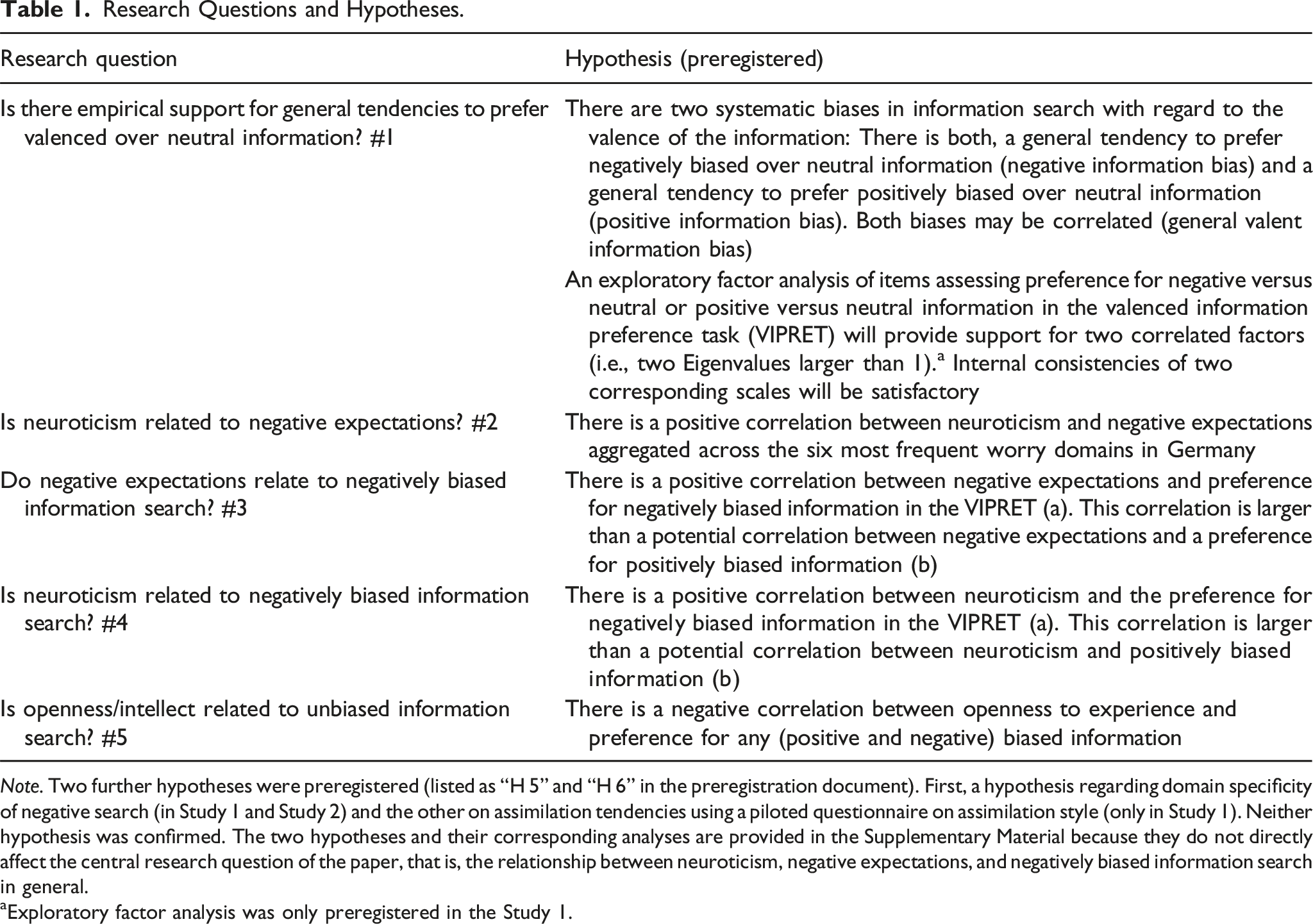
Note. Two further hypotheses were preregistered (listed as “H 5” and “H 6” in the preregistration document). First, a hypothesis regarding domain specificity of negative search (in Study 1 and Study 2) and the other on assimilation tendencies using a piloted questionnaire on assimilation style (only in Study 1). Neither hypothesis was confirmed. The two hypotheses and their corresponding analyses are provided in the Supplementary Material because they do not directly affect the central research question of the paper, that is, the relationship between neuroticism, negative expectations, and negatively biased information search in general.
aExploratory factor analysis was only preregistered in the Study 1.
Study 1
Methods
Power analysis
The optimal sample size was derived from both, general recommendations for factor analyses (hypothesis 1) and power analyses for the hypothesized correlations (hypotheses 2–5). For hypotheses 2–5, we assumed small to medium sized correlations of │ρ│ = .2. To detect such correlations with a power of .8 and nominal alpha of .05 the software G*Power, Faul et al. (2009) indicated a sample of at least n = 153. With regard to the factor analyses (hypothesis 1), a sample size of n = 300 has been recommended (Comrey & Lee, 2013). We therefore aimed at a sample size of n > 300.
Participants
Participants were recruited by means of university-wide mailing lists and personal contacts and could win one of five 50 € gift certificates when completing the study. Between July and August 2022, a total of N = 411 participants started and N = 310 completed the study.
Participants were excluded if they completed the valenced information preference task (VIPRET; see below) too quickly to have appropriately processed the material before indicating their information preferences. Specifically, participants were excluded if they completed the VIPRET, which consists of a total of 522 words, within less than 104 seconds, reflecting the estimated average reading only time for 522 words of non-fictive text (300 words/minute; [Brysbaert, 2019]). This exclusion of participants deviates from the preregistration, where it was stated that participants would be excluded if their completion time would fall outside the +/− 1.5 interquartile range. However, with that preregistered exclusion criterion, due to the distribution of completion times in our study, only participants with too long response times would have been excluded. Given that slow participation is less of a problem than unreasonably fast completion, the exclusion criterion was changed. Note, however, that with both criteria a total of 10, although different, participants would have been excluded and none of the main results was affected by this deviation from preregistration. Thus, the final sample consisted of N = 300 participants (mean age 33.84 years, SD = 13.02; 201 identified as female, 96 as male, and 3 as gender diverse).
Procedure
Data was collected as an online study on SoSci Survey (Leiner, 2019). Participants provided informed consent, answered sociodemographic questions (age, gender, and occupation), and completed a subset of the Big Five Aspect scales [DeYoung et al., 2007], see below), the valenced information preference task (VIPRET, see below), and a six-item scale to assess generalized negative expectations (GNEX, see below). The study was approved by the local ethics committee of the Department of Psychology at University of Marburg.
Materials
The big five aspect scales (BFAS)
To assess individual differences in neuroticism and openness/intellect, participants completed the respective scales of the German translation (Mussel & Paelecke, 2018) of the Big Five Aspect scales (DeYoung et al., 2007). Participants only answered items on neuroticism and openness/intellect, resulting in a total of 40 items. In the present sample, internal consistencies were Cronbach´s alpha = .79, .86, and .89 for volatility, withdrawal, and the global neuroticism scale and Cronbach´s alpha = .79, .72, and .80 for the intellect, openness, and global openness/intellect scale, respectively.
The generalized negative expectations scale (GNEX)
We generated a brief scale to assess generalized negative expectations (GNEX scale). To this end, we analytically identified six domains by considering (1) general worry domains reported in the worry-literature (Diefenbach et al., 2001), (2) worry domains that had been assessed in a German representative sample in 2005 (Rammstedt, 2007), and (3) the most recent worry-topics as assessed with a major annual survey from the German R + V insurance termed “die Ängste der Deutschen,” that was conducted in 2021 and assessed 22 relevant topics. We thereby identified economy, health, occupation, environment, security, and politics as the main areas that individuals living in Germany were worried about during the early 2020s. Based on these domains, the following six items were generated (original items in German): I expect that my health will worsen during the next years; I expect the economic situation in Germany to decline in the near future; I expect that within the next decades, there will be a marked degradation of the environment; I expect that my job situation will get worse on the long run; I expect that the political situation as a whole will deteriorate within the next years; I expect that the security in our country will decline sooner or later. All items had to be answered on a 7-point-Likert scale from does not apply at all to applies entirely. In the current study, the GNEX scale showed an acceptable internal consistency (Cronbach´s alpha = .66) and item-total correlations (corrected for item overlap and scale reliability) of .3 < rcor < .72, supporting the assumption that interindividual differences exist in a general tendency to have negative expectations across the most typical current worry domains (for further item statistics, see Supplementary Material).
Bipolar valenced information preference task (bipolar VIPRET)
The bipolar VIPRET consists of headline pairs, suggesting articles that are similar with regard to the topic but differ with regard to valence. The participant’s task is to indicate comparatively for each headline pair on a bipolar 6-point-Likert scale how much they would prefer reading one article over the other.
To assess the negative information bias, pairs were created with one headline suggesting “bad news,” while the other being neutral with regard to the article’s valence. Analogously, to assess the positive information bias, pairs were composed of one title indicating “good news” while the other title was neutral regarding the articles valence.
To test if the construed news headlines indeed differed with regard to the expected valence of the corresponding article and/or other dimensions, we conducted a Content Validation Study in a separate sample (N = 156; see Supplementary Material) and assessed whether the valenced news headlines differ from the neutral headlines in terms of valence, information’s comprehensibility, or potential information gain. In brief, it was confirmed that headlines construed to anticipate negative content were indeed rated as more negative than headlines construed to anticipate neutral content, whereas headlines construed to anticipate positive content were rated as more positive than headlines construed to anticipate neutral content. In addition, participants rated the articles associated with neutral headlines to presumably provide more information gain and more complex / less easily comprehensible information than articles of negative or positive headlines.
Statistical analyses, preregistration, and data availability
As shown in Table 1, we focused on 5 main hypotheses. As a prerequisite for the validity of the correlation analysis between traits, expectations, and valenced information preference, we tested the internal consistency, factorial structure (see Study 1 results), and the content validity (see Supplementary Material) of the VIPRET, as it is a newly developed measure.
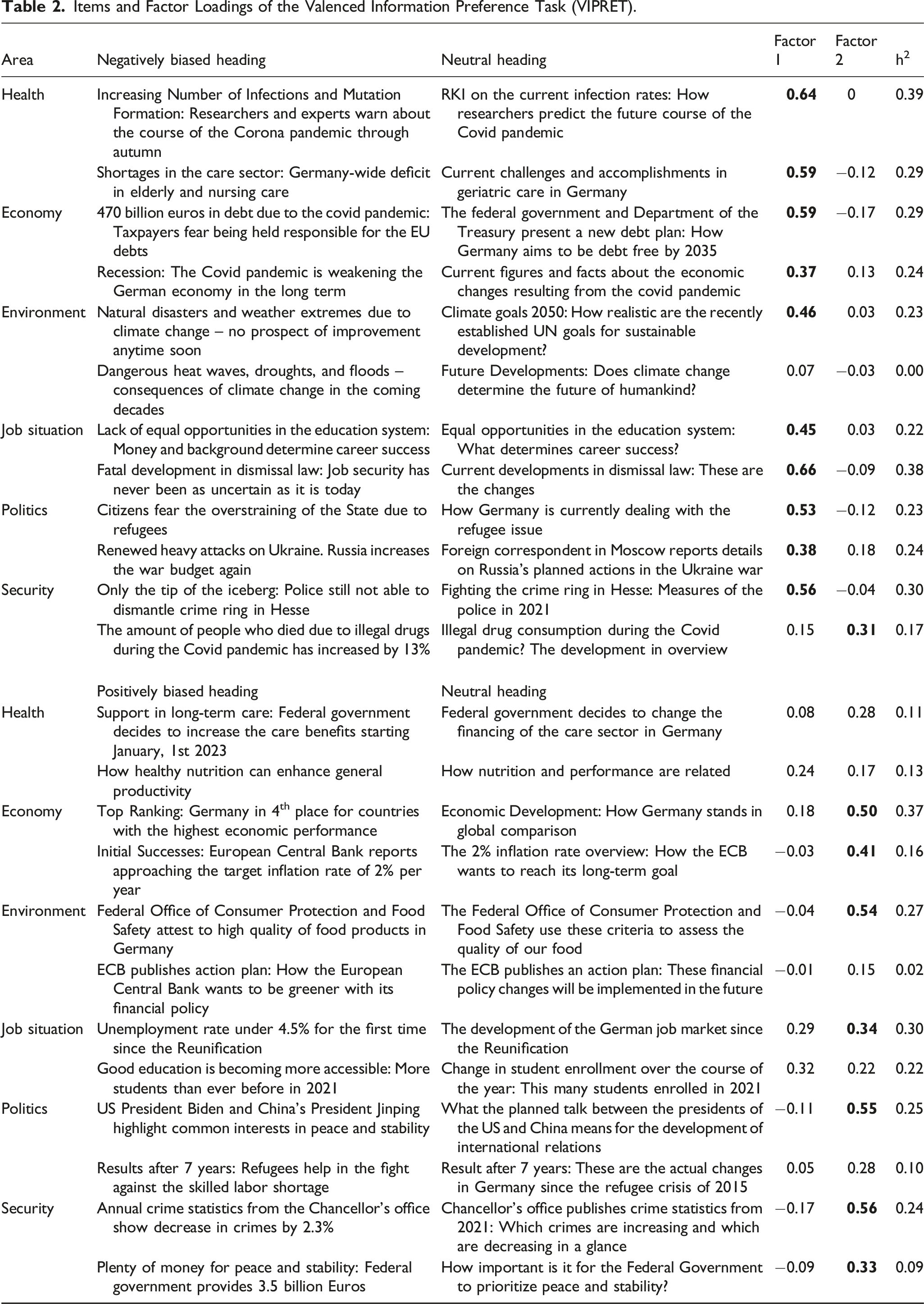
For that, we ran an exploratory factor analysis using Minimum Residuals (MINRES) and promax rotation to test whether there are two systematic biases in information search with regard to the valence of the information (negative information bias and positive information bias) (first preregistered hypothesis). Furthermore, we preregistered the Eigenvalues >1 criterion and hypothesized that two factors would have Eigenvalues larger than 1, with the 12 negative-neutral items showing highest loadings on factor 1, and the 12 positive-neutral items showing highest loadings on factor 2. Additionally, we tested the assumed two-factor structure using a confirmatory factor analysis and expected at least acceptable internal consistencies (Cronbach´s alpha >.6) in order to justify aggregation of negative-neutral and positive-neutral preference ratings.
All other hypotheses were tested using Pearson correlations with alpha-level set to α = .05. Given that five individual null hypotheses were tested and none of the individual tests constitute a family, we follow the recommendations to make no adjustments for multiple testing (Rubin, 2021). Comparisons of correlated correlation coefficients were performed using the approach of Meng et al. (1992). The approach uses Fisher’s Z transformation to statistically compare two correlated correlation coefficients, accounting for their dependency within the same dataset.
Items and Factor Loadings of the Valenced Information Preference Task (VIPRET).
All analyses were conducted in R (R Core Team & Team, 2021). With the exception of the final mediation analyses, all hypotheses, operationalizations, and tests were preregistered.
Study 1: (https://doi.org/10.17605/OSF.IO/DBM86). Two further hypotheses are not central to the current manuscript and are therefore reported in the Supplementary Material. The original material (German version of GNEX and VEPRIT) and all data, along with a codebook and the data analysis scripts, are made available at https://osf.io/g2xth/.
Results
Information search biases (preregistered hypothesis 1)
Correlation Matrix of Main Variables Used in Study 1 and Study 2.
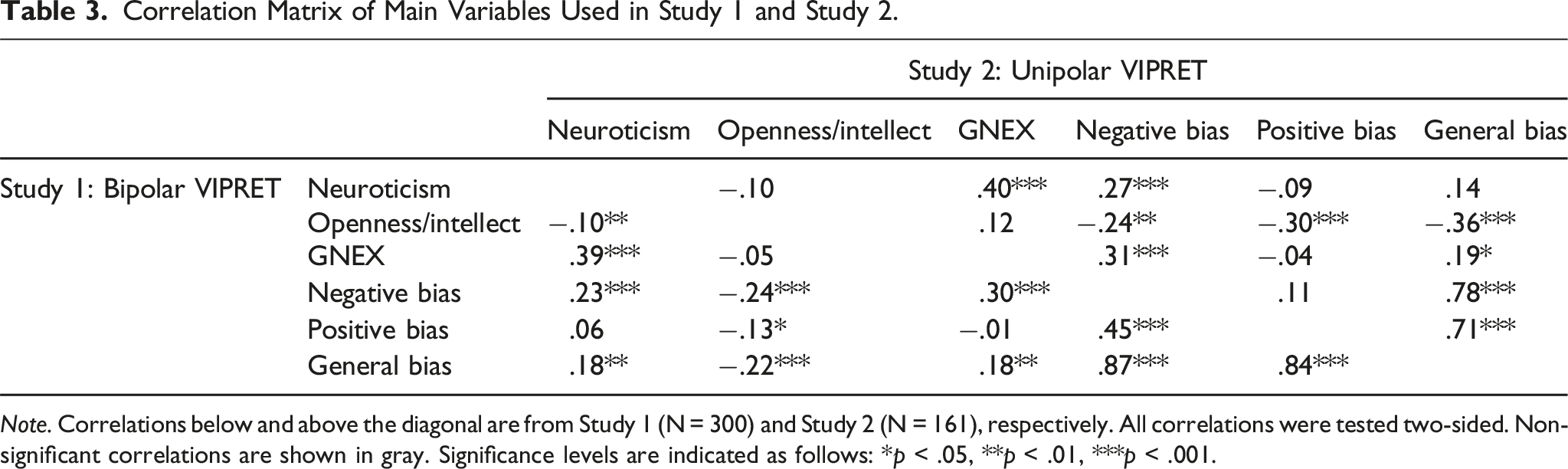
Note. Correlations below and above the diagonal are from Study 1 (N = 300) and Study 2 (N = 161), respectively. All correlations were tested two-sided. Non-significant correlations are shown in gray. Significance levels are indicated as follows: *p < .05, **p < .01, ***p < .001.
In addition to the EFA, a (non-preregistered) CFA of the 24 items was performed with the 12 negative versus neutral items representing one factor and the 12 positive versus neutral items a second one. The RMSEA and SRMR met standard fit requirements: RMSEA = .052 (90% confidence interval .044–.059); CFI = .811; TLI = 0.792; SRMR = .064; and Chi 2 = 451.993 (df = 251; p <. 001). All factor loadings were in the expected direction, although two items from the negative versus neutral and five items from the positive versus neutral factors showed loadings below .3. 2
Taken together, results from the CFA and EFA are largely consistent with the hypothesis that interindividual differences exist in the preference for negative versus neutral and for positive versus neutral information and that these preferences emerge across at least six important domains of life. CFA and EFA results further suggest that the tendencies to prefer negative versus neutral and positive versus neutral information are correlated, presumably reflecting a more general tendency to prefer valence specific versus valence neutral information content.
Based on these results, we computed a general negative bias score by averaging preference ratings across the 12 negative-neutral pairs (Cronbach´s alpha = .76) and a positive bias score by averaging preference ratings across the 12 positive-neutral pairs (Cronbach´s alpha = .68) and a general bias score (Cronbach´s alpha = .80) by averaging preference ratings across all 24 positive/negative-neutral pairs. These scores were used to test hypotheses 3, 4, 6, and 7 (see below).
Negative expectations and neuroticism (preregistered hypothesis 2)
An overview of all tested correlations can be found in Table 3. Expectedly, the GNEX score significantly correlated with neuroticism (r = .39, p < .001, ρ = .50 after correction for attenuation) and both neuroticism aspects (rwithdrawal, NegExp: r = .33; rvolatility, NegExp = .37). At the item level, neuroticism significantly correlated with negative expectations in each domain (health: r = .23, p < .001; economy: r = .22, p < .001; environment: r = .25, p < .001; job: r = .26, p < .001; politics: r = .23, p < .001; security: r = .24, p < .001). As expected, openness was not significantly correlated with the GNEX score (r = .05, p = .39) nor with expectations in specific domains (−.1 < r < 0; ps > .05).
Information search biases and negative expectations (preregistered hypothesis 3)
Consistent with our preregistered hypothesis 3a, the negative bias score correlated significantly with the GNEX score (r = .30; p < .001; ρ = .42 after correction for attenuation), indicating that individuals with high levels of negative expectations prefer to read newspaper articles with presumably negatively valent content. As expected, the correlation of the GNEX score and the positive bias was not significant (r = .01, p = .84) and significantly smaller than the correlation between the GNEX score and the negative bias (rpositivebias, negativebias = .45; z = 4.84, p < .001).
Information search biases and neuroticism (preregistered hypotheses 4a and 4b)
In line with hypothesis 4, neuroticism was correlated with the negative bias score (r = .23; p < .001; ρ = .28 after correction for attenuation). As shown in Figure 1, individuals with higher levels of neuroticism (and more generalized negative expectations) thus preferred reading newspaper articles presumably reporting bad news. Conversely, neuroticism was not correlated with the positive bias score (r = .06; p = .3) and this correlation was significantly smaller than the correlation between neuroticism and the negative bias score (rpositivebias, negativebias = .45; z = 2.83, p = .005), suggesting that neuroticism is not linked to a general tendency to prefer valence specific versus valence neutral content but rather to a general preference for negative information. Notably, item-level analyses further indicated that the correlation magnitude between individual VIPRET items and neuroticism scaled as a function of an item having different valence ratings for the two headline options (rather than having different information gain or information comprehensibility ratings) as assessed in an independent dataset (see Content Validation Study in Supplemental Material). Scatterplots showing a positive correlation between neuroticism scores and the preference for negative versus unbiased information in the valenced information preference task (VIPRET) in Study 1 (r = .23) and Study 2 (r = .27). The intensity of the color (green Study 1 and red Study 2) further indicates the generalized negative expectation scale (GNEX) score such that higher color intensities indicate stronger generalized negative expectations.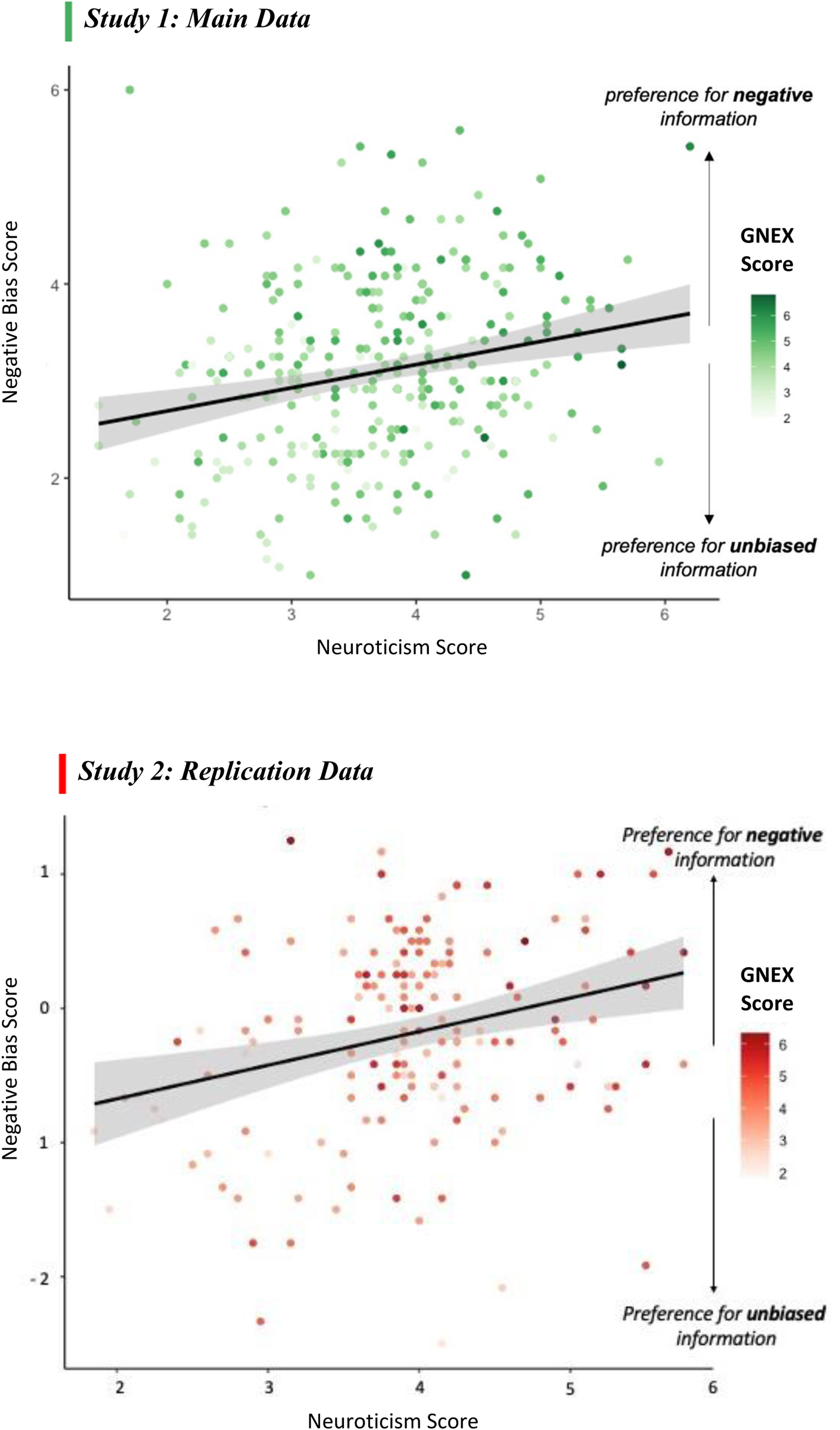
Information search, negative expectations, and neuroticism (non-preregistered mediation analysis)
An additional, non-preregistered mediation analysis to follow-up on the pattern of correlations revealed that the effect of neuroticism on the negative bias score was partially mediated via the negative expectation score. As Figure 2 illustrates, the regression coefficient between neuroticism and negatively biased information search and the regression coefficient between Generalized Negative Expectations and negatively biased information search was significant. The indirect effect was (.39)*(.25) = .10. We tested the significance of this indirect effect using bootstrapping procedures. Unstandardized indirect effects were computed for each of 1000 bootstrapped samples, and the 95% confidence interval was computed by determining the indirect effects at the 2.5th and 97.5th percentiles. The bootstrapped unstandardized indirect effect was .10, and the 95% confidence interval ranged from .05 to .15 and was statistically significant using the p-value criteria (p < .001). Mediation models for Study 1 (top) and Study 2 (bottom). In both studies, the effect of neuroticism on negatively biased information search was partially mediated via Generalized Negative Expectations Regression significance levels are indicated as follows: *p < .05, **p < .01, ***p < .001.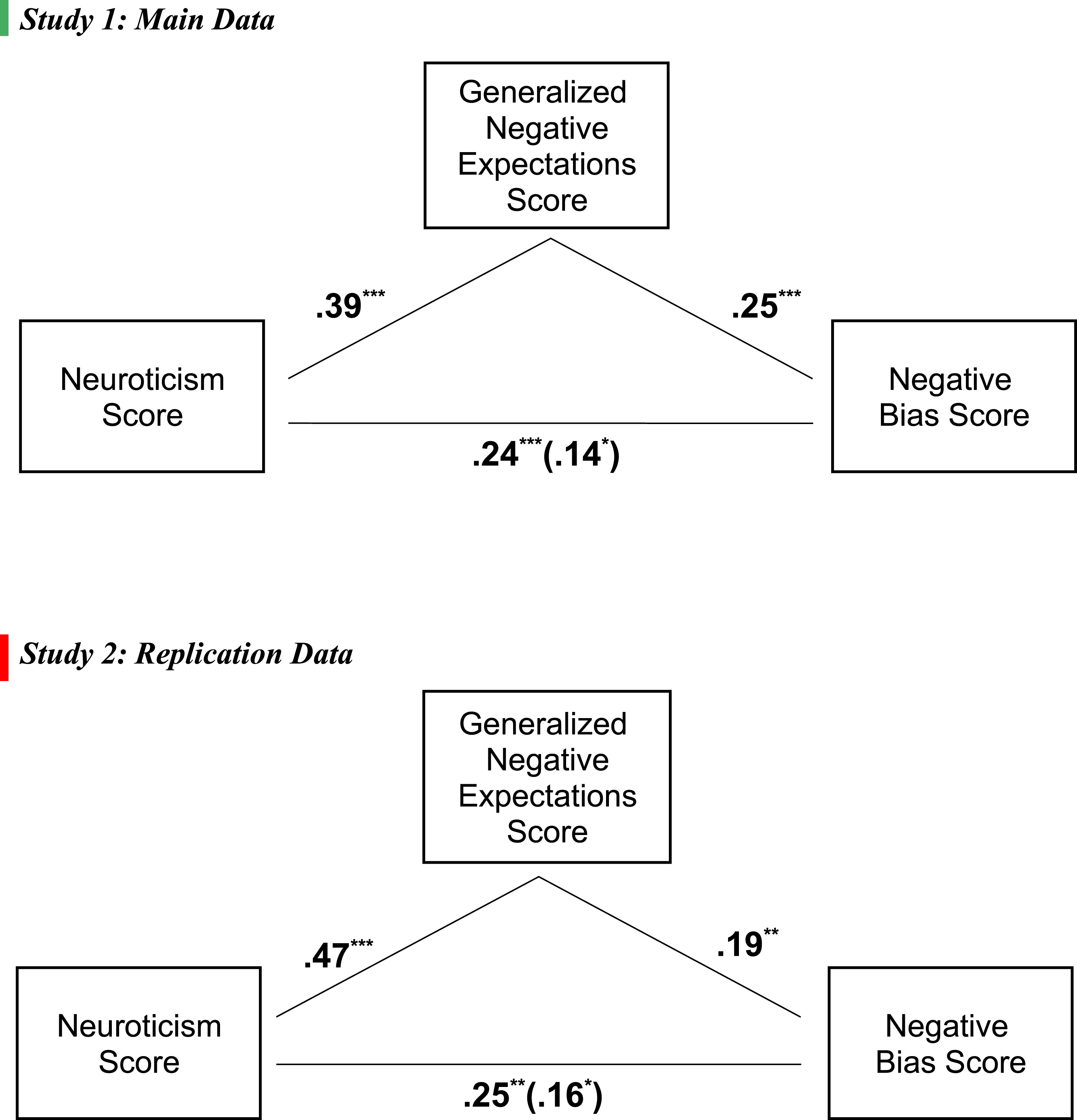
Information search and openness (preregistered hypothesis 5)
Finally, we tested whether openness/intellect was correlated with a preference for information that is not biased with regard to valence (preregistered hypothesis 7). As hypothesized, openness/intellect was negatively correlated with the negative (r = −.24, p < .001), the positive (r = −.13, p < .03), and the general bias scores (r = −.22 p < .001, r = −.28 after correction for attenuation). At the aspect level (not preregistered), intellect showed a correlation of r = −.25 (p < .001; ρ = .35 after correction for attenuation) while openness showed a correlation of r = −.12, (p < .05). The difference of correlation coefficients was statistically significant (rOpenness, Intellect = .33; z = 1.98, p = .048).
As demonstrated in the Content Validation Study (see Supplementary Material), item-level analyses indicated that the negative correlations between openness/intellect and both negative and positive information biases were predominantly driven by the relatively higher potential information gain expected from the neutral versus valenced articles, rather than the valence of the articles. To a lesser extent, they were also influenced by the expected comprehensibility of the neutral articles.
Interim discussion: Study 1
The bipolar format of the VIPRET used in Study 1—with negatively or positively valenced news headlines on one end of the rating scale and valence-neutral news headlines on the other—yields bias scores which may be driven by both, a preference for (or aversion of) valenced information or a preference for (or aversion of) unvalenced information. In the case of our findings on neuroticism, this is less of an issue, since neuroticism was specifically associated with the negative bias score, suggesting that it is a specific preference for negatively valenced information that is associated with neuroticism. For openness/intellect, however, the interpretation of the negative correlation with both the positive bias and the negative bias is more ambiguous. It may reflect that individuals with high openness/intellect show (1) a general preference for information offered by the neutral headlines or (2) a general aversion of information that is offered by the valenced headlines. Moreover, the bipolar format, where one has to decide between two different sources of information, does not allow to assess whether openness/intellect is linked to (3) a generally heightened information interest, which would be a useful measure, given that information gain (not valence) is presumably the main driver of the correlations observed for openness/intellect.
To resolve this issue and to conceptually replicate our findings from Study 1, we conducted a second study with a unipolar variant of the VIPRET.
Study 2
In Study 2 we examined whether the key findings of Study 1 would replicate using a unipolar variant of the VIPRET, while maintaining consistency in all other aspects.
Methods
Participants and procedure
As we used the VIPRET items from Study 1 with only minor changes (see Supplementary Material for all items) without attempting to run another factor analysis, the optimal sample size was derived assuming small to medium-sized correlations of │ρ│ = .2 for hypotheses 1–5. With a set power of .8 and nominal alpha of .05 G*Power, Faul et al. (2009) indicated a sample of at least n = 153.
Between May and June 2024, a total of N = 237 participants started and N = 167 completed Study 2. We used the same recruiting devices as in Study 1. With the same logic as in Study 1, participants were excluded (N = 6) if they completed the unipolar 561-word VIPRET in less than 113 seconds. The final sample consisted of N = 161 participants (mean age 24.18 years, SD = 4.77; 122 identified as female, 38 as male, and 1 as gender diverse). The procedure, materials, statistical analyses, and thresholds were identical to Study 1, except for the adjusted VIPRET format (see below) and that no exploratory factor analysis was preregistered or conducted in Study 2. Study 2 was preregistered (https://doi.org/10.17605/OSF.IO/U32DJ). Data and analysis scripts are available together with the Study 1 data.
Unipolar valenced information preference task (unipolar VIPRET)
The unipolar VIPRET format consisted of the same headlines as those in Study 1, with only minor adjustments to fit the context of the 2024 data collection, mostly changes to dates and minimal content modifications in some items (see Table 5 in the Supplementary Material for all VIPRET items used in Study 2). However, participants independently indicated for each of the 48 headlines (12 negative with 12 corresponding neutral headlines, and 12 positive with 12 corresponding neutral headlines) how motivated they would be to read the news articles based on the presented headlines on a unipolar 6-point Likert scale ranging from “1” to “6.” The news headlines were presented sequentially in content-matching pairs.
Information bias scores were computed by subtracting the interest rating for each neutral news item from the corresponding negative news item and averaging the 12 resulting difference values (negative bias score) and by subtracting the rating for each neutral item from the corresponding positive item and averaging these differences across the 12 items (positive bias score). The general bias score was computed as the mean of all 24 difference values (negative minus neutral items + positive items minus neutral items) (see Table 5 in the Supplementary Material for item-total correlations of all difference items).
The internal consistencies for the negative (Cronbach´s alpha = .70), positive (Cronbach´s alpha = .68), and the neutral (Cronbach´s alpha = .70) bias scores were somewhat smaller than for the bipolar VIPRET, which is not surprising given that difference scores were used. Nevertheless, the values can be considered good and again support the existence of general preferences for positive, negative, or generally valenced information (see hypothesis 1 of Study 1). The correlation between the positive and the negative bias was r = .11.
To assess the association of openness/intellect and a general preference for information (see interim discussion), we averaged the raw interest ratings (rather than the difference values) for positive, negative, and neutral news items separately and across all 48 items. The internal consistencies for the negative (Cronbach´s alpha = .89, 12 items), positive (Cronbach´s alpha = .89, 12 items), neutral (Cronbach´s alpha = .93, 24 items), and general (Cronbach´s alpha = .96, 48 items) information preference scores were high.
Results
As in Study 1, the GNEX scale showed acceptable internal consistency (Cronbach’s alpha = .73). Again, the averaged GNEX score was significantly correlated with neuroticism (r = .40, p < .001, ρ = .50 after correction for attenuation) but not with openness/intellect (r = .12, p = .12) and the correlation did not differ at the aspect level of neuroticism (rwithdrawal, NegExp: r = .40; rvolatility, NegExp = .34; rvolatility, withdrawal = .71; z = 1.08, p = .28; Meng et al., 1992).
Importantly, the GNEX score correlated significantly with the negative bias score (r = .31; p < .001; ρ = .44 after correction for attenuation) but not with the positive bias score (r = −.04, p = .58) derived from the unipolar VIPRET items, thereby conceptually replicating our Study 1 findings on hypothesis 3 with the bipolar VIPRET format. As in study 1, the difference of correlations was statistically significant (rpositivebias; negativebias = .11; z = 3.35, p < .001).
With regard to hypothesis 4, neuroticism was again positively correlated with the negative (r = .27; p < .001; ρ = .35 after correction for attenuation) but not with the positive bias score (r = −.09; p = .24) and the difference between correlations was significant (rpositivebias; negativebias = .11; z = 3.40, p < .002).
Furthermore, when we performed the same mediation analysis as in Study 1, we replicated the result pattern (Figure 2) with a bootstrapped unstandardized indirect effect of .09 (Study 2: .10). The 95% confidence interval ranged from .02 to .16. The indirect effect was also statistically significant, using the p-value criteria (p = .008).
Concerning hypothesis 5, openness/intellect correlated negatively with the negative (r = −.24, p < .001), the positive (r = −.30, p < .001), and the general bias scores (r = −.36, p < .001) derived from the unipolar VIPRET, thereby conceptually replicating our Study 1 findings on openness/intellect. Furthermore, the unipolar VIPRET allowed us to more specifically assess whether these negative correlations between openness/intellect and bias scores were rather due to a heightened preference for neutral or a reduced preference for valenced news in individuals with high openness/intellect (see interim discussion). Consistent with the first interpretation, openness/intellect was positively correlated with higher absolute interest ratings for all kinds of news headlines, although the correlations were higher for neutral (r = .45, p < .001) as opposed to positive (r = .20, p = .011) and negative (r = .26, p < .001) headlines. Of relevance, when this general interest in news (i.e., the average preference rating across all 48 items) was partialled, the correlation between openness/intellect and the general bias remained unchanged (rO/I,general bias
General discussion
The aim of the current investigation was to examine whether general preferences for negative news or negatively valenced information exist and whether they are related to neuroticism and generalized negative expectations. To this end, we developed a bipolar and a unipolar variant of a valenced information preference task (VIPRET) and a brief generalized negative expectation scale (GNEX) and assessed whether there is evidence supporting the existence of a general tendency to hold negative expectations across broad life domains, as well as a general preference for either positive or negative information. In addition, we used the VIPRET to assess associations between information preferences and trait openness/intellect. Across two studies (N = 300 and N = 161), the factorial structure and/or internal consistency of the VIPRET indicated that individuals do consistently differ in their preferences for negatively or positively as opposed to neutrally valenced information (1). We further showed that neuroticism correlates with self-rated negative expectations across six domains of life (2), that these negative expectations relate to a preference for negative news (3), and that this negative information preference also relates to neuroticism (4). Additional mediation analyses further clarified this pattern by showing that negative expectations partially mediate the relationship between neuroticism and information search. Finally, we found that openness/intellect correlates with a generally heightened interest in news and, additionally, with a specific preference for neutral versus valenced headlines of the VIPRET (5). In the following sections, we will discuss each of our five research questions.
Valence-related information preferences exist and can be measured with the VIPRET
To assess valence-related information preferences, two different variants of the VIPRET were used in studies 1 and 2. In Study 1, bias scores were directly derived from ratings on bipolar scales that assessed the relative preference to read articles linked to negative (or positive) versus neutral headlines. In Study 2, biases were measured by subtracting the unipolar preference rating for neutral headlines from the unipolar preference rating for negative (or positive) headlines.
In both studies, the negative and positive bias scores were moderately correlated and showed satisfactory internal consistencies. Moreover, factor analyses of the 24 VIPRET items in Study 1 were largely consistent with two correlated factors, which captured substantial amounts of variance of either the negative-neutral or the positive-neutral items. Together, these results support the VIPRET as a promising instrument to assess negative, positive, and generally valenced (positive and negative) versus valence neutral information preferences and suggest that the bias scores reflect sufficiently homogeneous measures with acceptable internal consistency.
The relatively high internal consistency observed in both, the unipolar and bipolar variant of the VIPRET, presumably resulted from having carefully construed content-similar pairs, that differed mainly with regard to valence, reducing (unwanted) variance due to interindividual differences in interest for specific topics. This interpretation is supported by findings from the Content Validation Study (see Supplementary Material), showing that the positive and negative items differed from the neutral items mostly in valence, and only to a lesser extent in the comprehensibility of the information or the potential information gain provided.
These results suggest that there do exist valence specific preferences with regard to information. Thus, some individuals appear to prefer getting negatively valenced as opposed to neutral news, regardless of the specific topic. Similarly, some individuals prefer getting positively valenced information across a broad range of topics.
Negative expectations are a cardinal feature of neuroticism yet they are distinct from it
With the GNEX we created a short instrument to assess the strength of generalized negative expectations in the domains economy, health, occupation, environment, security, and politics. These items inquire whether individuals expect negative developments in these domains, hence assessing generalized rather than situation-specific expectations (Rief et al., 2015). Furthermore, the GNEX items do not ask for the emotional response, engagement with or controllability of these negative expectations, akin to worrying (Borkovec et al., 1983; Meyer et al., 1990; Mueller et al., 2010), but rather the degree to which one simply has these expectations. In spite of the heterogeneity of the topics, the internal consistency for the six items was acceptable in both studies, suggesting that having generalized negative expectations in a specific domain is not simply a function of the socio-political situation but also a function of the person.
In both studies, the GNEX score correlated with neuroticism. After correction for attenuation, the GNEX score and neuroticism showed a correlation of ρ = .51 in Study 1 and ρ = .50 in Study 2. While this correlation between neuroticism and GNEX is substantial, it still supports the discriminant validity of the GNEX as only about a quarter of the variance in GNEX can be explained by neuroticism and vice versa. These correlations extend previous findings on negative expectations in other neuroticism-related traits and depression or anxiety disorders (Andersen et al., 1992; MacLeod et al., 1996; Miranda & Mennin, 2007).
The negative expectation score was equally related to the withdrawal and the volatility aspect of neuroticism in both studies, indicating that negative expectations cut across different aspects of neuroticism. While the volatility aspect refers to active defense to avoid or eliminate threats and relates to anger, the withdrawal aspect reflects anxiety, depression, and passive avoidance (DeYoung, 2015a). Prior studies have shown that the cognitive-emotional engagement with negative expectations (i.e., worrying) is particularly related to the anxiety aspect of neuroticism (Beck et al., 1995; Muris et al., 2005). The present findings suggest that the existence of negative expectations per se (without the cognitive-emotional engagement) is a central feature of neuroticism in general which may contribute to the coherence of its aspects. The aspects may then further specify to which degree one responds to negative expectations with active defense (volatility) and/or passive avoidance (withdrawal).
Negative expectations relate to the preference for negative information
The GNEX score was significantly correlated with a preference for negatively valenced versus neutral but not positively valenced versus neutral information in the VIPRET across both studies. This suggests that individuals who expect that, across different domains of life, matters get worse, also prefer to read newspaper articles where the heading already suggests that, across different domains of life, matters get worse.
Different mechanisms may cause this correlation: Individuals with a preference for negatively valenced information may consume such information more often and, consequently, build up knowledge structures and expectations that are consistent with the processed information. Alternatively, humans are often motivated to maintain their expectations (Kruglanski et al., 2020; Panitz et al., 2021; Proulx & Inzlicht, 2012; Roese & Sherman, 2007), for example, by searching information that confirms rather than violates existing expectations (Panitz et al., 2021). This motivation may also exist for negatively valenced expectations, motivating individuals to prefer and select information that essentially confirms unpleasant cognitions (Swann et al., 1992). In real life, both mechanisms may operate together, such that individuals with generalized negative expectations search for confirmatory information, which then further strengthens their negative expectations. As the current correlative design does not inform about causation, future longitudinal studies may provide valuable insights into the relative weight of these two potential mechanisms.
Neuroticism relates to the preference for negative information
As hypothesized, the neuroticism score correlated with the preference for negatively valenced information in both studies. Individuals who describe themselves as anxious, irritable, or easily upset thus tend to prefer information that may give rise to these very emotions. At first sight, this pattern may appear at odds with avoidance accounts of anxiety, such as the two-factor theory (Mowrer, 1947) or more recent accounts (LeDoux et al., 2017; Wong et al., 2023), all of which assume that anxious individuals avoid anxiety-evoking material as this causes unpleasant negative affect. The current findings suggest that with regard to news information, neurotic individuals appear to not avoid but rather approach stimuli that may cause negative affect. As hinted at in the introduction, we believe, however, that this finding can indeed be integrated with behavioral avoidance accounts of anxiety: the successful avoidance of threat requires that threats are detected first. Individuals with high neuroticism may sense that approaching negatively valent information may help them to avoid negative consequences in the long run or be prepared for the worst. In this regard, seeking negatively valenced information may be considered a strategy for coping with threat, similar to attentional biases for negative material (Peckham et al., 2010), negative interpretational biases (Würtz et al., 2022), or negative cognitive biases more generally (Chan et al., 2007; Ormel et al., 2013), which have been linked to neuroticism-related traits and mental disorders. Unlike these previously investigated cognitive biases, which can be considered reactive as they affect the processing of stimuli that are already present, a biased preference for negative information would be more proactive as it influences to consumption of negatively valenced material in the future. The present findings suggest that this proactive bias may have to be integrated into the neurotic cascade (Suls & Martin, 2005): individuals with high neuroticism prefer and select more negatively valenced information, then respond to this information more strongly, and finally have more difficulties regulating their emotions after encountering negatively valenced information.
In both studies, the correlation between neuroticism and the preference for negative information was partially mediated by negative expectations. Highly neurotic individuals may search negative information in order to confirm their negative expectations. While the stabilization of negative expectations would presumably lead to increased anxiety, anger, and other types of negative affect in the long run, the confirmation of existing expectations may also reduce feelings of uncertainty, which are experienced as especially aversive in individuals with high levels of neuroticism (Berenbaum et al., 2008; Hirsh & Inzlicht, 2008) and may be a potential converging point to uncertainty reduction accounts of information search in neuroticism (Jach et al., 2022).
Openness/intellect is linked to unbiased information search
Across both studies, openness/intellect was negatively correlated with a preference for negative versus neutral, positive versus neutral, and valenced versus neutral news information. Study 2 further demonstrated that openness/intellect is also associated with a generally heightened interest in news information of any kind. Importantly, however, the preference for neutral news information remained even after controlling for this general interest. This specific connection between openness/intellect and a preference for neutral news headlines was primarily driven by the anticipated information gain from articles with neutral headlines compared to valenced news articles, not by the valence of the article itself, as confirmed by the Content Validation Study (see https://journals.sagepub.com/doi/suppl/10.1177/08902070251316614, Supplementary Material).
Taken together, these findings imply that openness/intellect is related to a general interest in news with the primary goal of gaining new information. This aligns well with previous research linking openness/intellect to variety seeking, curiosity and general mental abilities (Connelly et al., 2014; Stanek & Ones, 2023) and, more closely related, to information seeking in trivia tasks (Jach et al., 2022). From another perspective, the present findings also suggest that individuals who are low in openness/intellect prefer to get information that is predictable, with less opportunities to gain new information: news where the headline already indicates what an article will present.
Implications
The present findings have a number of implications with regard to theory, practice, and future research. First of all, the current results show that general valence-related information preferences may play an important role in neuroticism and are of potential relevance for understanding and treating related disorders like mood and anxiety disorders. While reactive cognitive biases are well documented in neuroticism and related disorders (LeMoult & Gotlib, 2019; Ormel et al., 2013), future work on information processing biases should also focus on biases that may occur, before information is fully unfolded.
Second, the current findings show a high correlation between negatively valenced general expectations and neuroticism. This indicates the need for an expectation or prediction-centered model of neuroticism that takes into account proactive and reactive mechanisms of stabilizing negatively valenced expectations and expectancies in neuroticism. In light of the current rising of predictive coding and Bayesian brain accounts in Psychology and Neuroscience (Friston, 2009), such models are slowly emerging (Safron & DeYoung, 2021; Van den Bergh et al., 2021). The present findings indicate that they should be specified further with regard to the valence of expectations.
Third, the findings as a whole are consistent with the assumption that a vicious circle of negative expectations and negatively biased information search may stabilize negative affect in highly neurotic individuals. If future experimental and longitudinal studies support such a model, it may be particularly helpful for understanding and treating mental disorders associated with high neuroticism.
Fourth, the findings suggest that individuals are motivated to search information that is consistent with their expectations in terms of valence. While existing models on how expectations are stabilized have incorporated such “assimilative” strategies, the empirical evidence has been relatively scarce. The current findings thus contribute to the perspective that existing expectations may not only be shielded against modification by means of reactive confirmation biases like perceptual-interpretational biases (Chan et al., 2007; Würtz et al., 2022) or immunization after expectation violations (Kube & Rozenkrantz, 2021; Rief & Joormann, 2019) but also by a priori preferences for certain types of information.
Finally, the present findings show that reliable information preferences are linked to two major personality traits: neuroticism and openness/intellect. Under the assumption that information preferences drive information search and information intake in a world characterized by vast amounts of information to choose from, these information preferences may contribute to the stabilization of major personality differences (Wagner et al., 2020).
Limitations
The limitations of the studies should be acknowledged. First of all, both studies were conducted online. The fact that the environment cannot be controlled threatens the internal validity of many online experiments, especially those that assess reaction times or basic cognitive processes. At the same time, however, assessing information preferences in an online experiment increases the ecological validity of the current study, as the majority of information seeking and intake does nowadays occur online. While we excluded participants with unlikely fast completion times, there may have been participants who did not carefully respond to the VIPRET, GNEX, or personality questionnaires. As such behavior would reduce rather than enhance internal consistencies or correlations between measures, the reported current effect sizes may actually underestimate the true correlations.
Second, it is important to recognize that while the VIPRET shows promise as a preliminary measure, it is not yet fully validated. We examined its factorial structure in Study 1, assessed its internal consistency in both Study 1 and Study 2, and conducted a separate Content Validation Study. However, some items did not perform as expected, highlighting the need for further validation. This includes establishing key psychometric properties such as test–retest reliability, convergent validity, discriminant validity, and other essential measures of validity.
Third, on a related note, as content-based expectations are inherently contextual, the items of the VIPRET were also situated in place and time. The headings that participants had to select from were all relevant to Germans in the early 2020s. Similarly, the GNEX was based on the most recent worry topics in Germany. Because the measures we used were aggregations across items, they mainly captured the covariance of individual items, reflecting the general tendency across domains rather than the actual (time and place specific) content of individual items. Therefore, the generalizability of the current findings should not be threatened by the selection of items. However, as demonstrated in Study 2, the VIPRET items need to be slightly adjusted to reflect the socio-political situation over a longer period of time. If the VIPRET is to be used in countries other than Germany, adaptations would have to be made as well.
Finally, while the VIPRET assesses information preferences, it does not assess actual information search or information intake. By assessing decision-making with regard to valenced information that is actually provided or by assessing eye-movement and EEG, future studies should also collect behavioral and physiological measures of actual information search and test how these measures relate to information intake, neuroticism, and negative expectations.
Conclusions
In conclusion, the present study supports the assumption that valence specific information preferences exist and generalize across central domains. Preferences for negatively valent information are linked to neuroticism, and this link is partially mediated by negative expectations. Future work should investigate whether this mediation may reflect a vicious circle where highly neurotic individuals particularly seek information that confirms their negative expectations, thereby further increasing their view of the world as a negative and dangerous place. Furthermore, the present findings show that openness/intellect is characterized by a generally heightened interest in information and a specific preference for information that promises the acquisition of new knowledge. Future work should investigate how the preference for negative information relates to actually seeking and receiving negative information, as this could further clarify the possible role of information seeking in stabilizing negative expectations in neuroticism and related traits.
Supplemental Material
Supplemental Material - Bad news first—Neuroticism, negative expectations, and preference for negative information
Supplemental Material for Bad news first—Neuroticism, negative expectations, and preference for negative information by Anton Fischer and Erik M. Mueller in European Journal of Personality
Footnotes
Acknowledgments
We thank Tabea Schneider for her involvement in preparation and data collection of Study 1 as part of her master's thesis.
Declaration of Conflicting Interests
The author(s) declared no potential conflicts of interest with respect to the research, authorship, and/or publication of this article.
Funding
The author(s) disclosed receipt of the following financial support for the research, authorship, and/or publication of this article: This work was supported by the Deutsche Forschungsgemeinschaft (grant numbers 290878970-RTG 2271 and 422744262-TRR289).
Open Science Statement
The preregistrations of both studies are available at https://doi.org/10.17605/OSF.IO/DBM86 and https://doi.org/10.17605/OSF.IO/U32DJ. Study materials, data, and analysis scripts used for this article can be accessed at  .
.
Supplemental Material
Supplemental material for this article is available online.
Notes
References
Supplementary Material
Please find the following supplemental material available below.
For Open Access articles published under a Creative Commons License, all supplemental material carries the same license as the article it is associated with.
For non-Open Access articles published, all supplemental material carries a non-exclusive license, and permission requests for re-use of supplemental material or any part of supplemental material shall be sent directly to the copyright owner as specified in the copyright notice associated with the article.
