




Abstract
Major life events can impact people’s well-being or personality traits. Traditionally, life events have been examined by considering if they have occurred or not. However, this assumes that the effect of a life event is similar for all participants. Therefore, it has been suggested to consider the subjective perception of life events. Yet, as with many self-reports in psychological research, self-reports on the subjective experience of life events can be biased. To gain a better understanding of life event perception, we therefore examined the convergence of self- and informant-reports of major life events and potential moderators of this convergence. In a dyadic study design, N = 562 participants provided self- and informant-reports of major life event perception. Results from multilevel regression analyses showed that self- and informant-perception profiles converge (B = 0.599, p < .001), even after controlling for normativeness (distinctive convergence: B = 0.442, p < .001). Moreover, talking about the event—but not informant’s presence at the event—was linked to higher overall and distinctive convergence. Additionally, informant’s experience with the event and perceived closeness between participants was associated with higher overall convergence. Results indicate that informant-reports could provide new insights into the nature of major life event perception.
Plain Language Summary
Understanding major life events: Your perception and how it's seen by others
Throughout their life, people experience a variety of different major life events, such as entering a new relationship or retiring from their jobs. These events can influence people’s well-being or their personality. Researchers argue that people experience major life events differently and that subjective perception should play a role when studying the impact of major life events. However, asking people about their subjective perception of their major life events (i.e., self-reports) may not always capture the complete picture. Therefore, the present study examines what we can learn from assessing not only self-reports but also informant-reports (i.e., asking people how they think that a close person experienced a specific event) about subjective perceptions of major life events. A sample of 562 participants was recruited, who provided self- and informant-reports on the perception of major life events. In line with predictions, participants’ perceptions of major life events and the informant-reports of their study partners were consistent. Moreover, participants who talked more about the experience of the major life event were more similar in their self- and informant-reports. In contrast, the mere presence of the informant at their study partner's event was not related to higher alignment between self- and informant-report. The results support the idea that informant-reports can enhance the understanding of the subjective perception of major life events.
Keywords
Introduction
Major life events can have a substantial effect on a person’s life and relevant outcomes. Life events, such as a separation or starting a new job, can impact subjective well-being (Lucas, 2007; Luhmann et al., 2012; McCullough et al., 2000), increase the likelihood of mental disorders (e.g., depression: Fonseca et al., 2020; Kendler et al., 2010; Maciejewski et al., 2001; Monroe et al., 2014; or borderline personality order: Stepp et al., 2016), and may even lead to change in personality traits (Asselmann & Specht, 2020; Bleidorn et al., 2018; Lüdtke et al., 2011; Neyer & Lehnart, 2007; Specht et al., 2011). However, the effects of life events seem to differ across studies and people. One possible explanation for such heterogenous effects of major life events are inter-individual differences in the subjective perception of major life events (Luhmann et al., 2021). Not every life event is experienced in the same way for every person. For instance, a separation might feel like a fundamental loss for one partner, whereas the other partner may perceive the separation as liberating and positive. To assess these individual differences in life event perception, self-report measures can and have been used (Haehner, Rakhshani, et al., 2023; Luhmann et al., 2021). These early attempts have been promising, but they have not yet provided a definite answer to the rather inconsistent research on life events in personality psychology (Bühler et al., 2023; Haehner et al., 2023). For self-reports to be useful, they need to accurately reflect the individual’s perception of the event. Yet, as with any self-report, self-reports of perceived event characteristics can be biased and inaccurate (e.g., Paulhus & Vazire, 2007). To address some of the limitations of self-reports, informant-reports of a person’s perception can be obtained. Although informant-reports are subject to limitations of their own, they may reveal aspects of the major life event perception that are not present in self-reports. Moreover, combining self- and informant-reports will allow to address new research questions: The convergence of self- and informant-perception of major life events can in itself be an informative new characteristic of major life events, that might allow predicting important outcomes related to the major life event. Combining self-reports with informant-reports of major life event perception can therefore help to better understand the nature of life events and how their subjective experience may translate into long-lasting effects.
Different approaches to study major life events
Major life events can be defined as “events that are clearly timed, disrupt one’s everyday routine, and are perceived as personally significant and memorable by those who experienced them” (Luhmann et al., 2021, p. 2). Traditionally, life events have been assessed with checklists. These checklists provide a limited number of major life events to assess major life events (Dohrenwend, 2006). To gauge the overall impact of the events on a person’s life, the total number of events ticked on the checklist is used (e.g., Assari & Lankarani, 2016; Weinreich Petersen et al., 2022). This approach implies that all events from the list have the same impact on each person. However, this approach neglects that different individuals very likely experience the same major life event differently (Dohrenwend, 2006; Luhmann et al., 2021; Wrzus et al., 2023), which may lead to varying impact of the same major life event. Furthermore, life events that matter for the individual but that are not included on the list will be overlooked entirely. Assessing the subjective perception of major life events can help to overcome some of the limitations of previous research (Luhmann et al., 2021). Instead of providing participants with a list of potentially relevant life events, participants are asked about their perception of these or other important events. Specifically, Luhmann et al. (2021) proposed to assess the subjective perception of nine dimensional characteristics: valence, impact, predictability, challenge, emotional significance, change in world views, social status changes, external control, and extraordinariness. Inter-individual differences in personality change could therefore be explained by inter-individual differences in life event perception. Initial research supports the relevance of perceived characteristics of major life events when examining change in relevant outcome variables (e.g., Luhmann et al., 2021; Schwaba et al., 2023).
Self- and informant-reports of major life events
Prior studies that examined the perception of major life events relied on self-reports (Eckley et al., 2023; Fassbender et al., 2022; Haehner, Bleidorn, et al., 2024; Haehner et al., 2022; Haehner, Pfeifer, et al., 2023; Haehner, Schaefer, et al., 2024; Luhmann et al., 2021; Rakhshani et al., 2022; Schwaba et al., 2023). Across these studies, participants reported how they perceived an experienced major life event themselves. Self-reports provide a valuable method to assess thoughts and feelings because the self-rater is supposed to have direct access to all relevant information (Paulhus & Vazire, 2007; Vazire, 2010). For instance, if someone experiences a difficult separation, this person might have feelings of sadness or grief, which the person might not necessarily share with other people. With respect to the perception of major life events, the person who experienced the event has arguably the best knowledge about the event.
However, having privileged access to certain information does not guarantee rating this information accurately. A similar argument has been made with respect to person perception, where self-reports reflect not necessarily the most accurate picture of a person’s personality traits (McDonald, 2008; Paulhus & Vazire, 2007). Regarding major life events, participants may not like to admit how much an event has influenced their life or may even be in denial about the importance of a tragic life event. Research demonstrated that self-reports may suffer from various biases including (1) self-serving biases (e.g., Campbell & Sedikides, 1999; Miller & Ross, 1975), (2) socially desirable responding (e.g., Edwards, 1953; Holden & Passey, 2010), (3) response styles (e.g., Baird et al., 2016; Jackson & Messick, 1958), or (4) other momentary influences that occur during the measurement process. Specifically, situation characteristics, which are similar to the assessment of event characteristics, are related to momentary affect (Horstmann et al., 2021). If the same variables influence the assessment of relevant outcomes (e.g., self-reported well-being and personality traits), then the association between life event perception ratings and outcomes can be inflated. It is reasonable that an individual’s perception of a major life event is confounded with their well-being (Haehner, Kritzler, et al., 2024; Luhmann et al., 2021).
Informant-reports may address some of these limitations regarding self-reported event perception. Assessing informant-reports can prevent the circularity principle where participants rate their own major life events (see Rauthmann et al., 2015 for a similar argument on situation perception). However, research indicates that informant-raters may share certain biases, such as socially desirable responding, with the self-rater (Leising et al., 2015; Stachowski & Kulas, 2021). Moreover, Leising et al. (2010) found that informants tend to rate individuals they liked more favorably. Notably, it has been argued that informant-reports lack privileged access to information on the target’s event perception. Unless informants have been present at the rated event, their ratings can be based only on the information they have received from the self-rater. The value of informant-reports, therefore, relies on characteristics of both the target (Human & Biesanz, 2013), the informant (Funder, 2012), as well as potential biases affecting both types of reports (e.g., Stachowski & Kulas, 2021).
Importantly, self- and informant-raters may differ in their type or level of bias (Kenny, 2004). These differences between raters result in differences in their ratings, which may lead to differences in the level of convergence between different pairs of self- and informant-raters (i.e., dyads). As long as the self- and the informant-rater are not consistently influenced by the same bias, the convergence of self- and informant reports should differ across dyads. These differences in the level of convergence can therefore be informative.
Convergence between self- and informant-reports
The convergence of self- and informant-report refers to the degree of overlap between the information provided by the self-rater and the information provided by the informant-rater. For instance, self- and informant-reports of a separation converge if a person perceived their separation as predictable and an informant-rater also thinks that this person perceived the separation as predictable. Examining the convergence of self- and informant-reported event perception itself can advance research on major life events. First, high convergence of self- and informant-reported event perception would suggest that perceived event characteristics can be assessed independently from the individual experiencing the event. Second, investigating if the convergence of self- and informant-reports is influenced by other variables allows a better understanding of the perception of major life events.
In examining the convergence of two profiles (e.g., self- and informant-reports), Furr (2008) argues that normativeness in perception may inflate this convergence. Normativeness is defined as the correlation between an individual’s profile and the average profile of their reference group (Furr, 2008). In the context of event perception, normativeness indicates how a person’s profile regarding the perception of a specific major life event (e.g., perceiving their separation as emotionally significant and impactful) reflects the average perception profile of major life events across people (e.g., major life events generally being perceived as emotionally significant and impactful). Thus, the convergence of self- and informant-reported event perception profiles may reflect normative as well as non-normative or distinctive aspects (i.e., how the person’s perception of the specific major life event deviates from the average perception profile of how people experience major life events). This distinction between normative and distinctive aspects has contributed to advancements in the understanding of person and situation perception (e.g., Rauthmann & Sherman, 2017; Wessels et al., 2020) and may enhance comprehension of the mechanisms underlying the convergence of major life event perceptions. For instance, if the convergence between self- and informant-perception profiles of major life events is high but solely reflects normative aspects, one could argue that informant-reports of major life event perception only contain normative ratings—which would question their usefulness for life event research.
Moderators of the convergence of self- and informant-report
In addition to normativeness, other variables or moderators may influence the convergence of self- and informant-reports. Brunswick’s (1956) lens model suggests that convergence occurs when self- and informant-rater use the same cues (e.g., the self-rater cries a lot after their separation) to make inferences about the self-rater’s event perception (e.g., the self-rater perceived the separation as emotionally impactful).
Examining potential moderators may help to explain differences in the convergence of self- and informant-reports across people or constructs. In numerous studies, researchers found that the level of acquaintanceship moderates the convergence of self- and informant-report (e.g., Biesanz et al., 2007; Connolly et al., 2007; de Vries et al., 2008; Funder & Colvin, 1988; Schneider et al., 2010). Across these studies, the convergence of self- and informant-report was specifically high for persons with high levels of acquaintanceship. Additionally, Allik et al. (2016) found that closeness between self- and informant-rater, rather than the length of acquaintanceship in years, moderated their convergence.
Additionally, the visibility or observability of perceived characteristics of major life events might moderate the convergence of self- and informant-report. Arguing within the lens model (Brunswik, 1956), the informant-rater must have the chance to observe the cues of the self-rater. If a person does not display certain cues to an informant (e.g., the self-rater only cries after their separation when being alone), the self-rater has greater access to information compared to the informant, which can lead to lower convergence of self- and informant-report. Consistently, researchers found that greater visibility of personality traits was associated with higher levels of convergence (Funder & Dobroth, 1987; John & Robins, 1993; Kenny & West, 2010).
However, a person can also provide the informant-rater with non-observable cues (e.g., crying alone) by telling the informant-rater that they are feeling sad because of their separation and that they cried yesterday. Consequently, this verbal exchange about an event between self- and informant-rater can serve as a moderator for the convergence of their reports (Schneider & Schimmack, 2009). If an individual reveals their inner thoughts or feelings to an informant, these aspects should be easier to rate for the informant.
In the context of event perception, additional variables that moderate the convergence of self- and informant-reports are conceivable. More specifically, it might play a crucial role whether the informant-rater was present at the self-rater’s event (e.g., because they could observe the behavior of the self-rater during the event). Furthermore, it might be relevant if the informant-rater has first-hand experience with the self-rater’s event or a similar event. Informant-raters have an additional source of information if they experienced the event themselves before. This information can be normative (= consistent with the average perception of major life events) or distinctive (= inconsistent with the average perception of major life events). If informant-raters have no experience with the event or a similar event, they cannot refer to personal distinctive information and might rely primarily on normative information to rate the event perception.
Aim of the present study
The present study aims to better understand the perception of major life events through investigating the convergence of self- and informant-report. Therefore, event perception of the same major life event was first assessed by a self-rater and subsequently by a close informant. The following research questions were investigated: (1) Do self- and informant-ratings of major life event perception converge, and if so, what is the level of convergence? (2) Which moderators are associated with a higher convergence of self- and informant-perception of major life events? To answer these questions, the present study employs a profile-centered approach, focusing not on individual perceived event characteristics, but on the simultaneous examination of self- and informant-perception profiles of a major life event across multiple characteristics.
The first two hypotheses address the first research question of whether self- and informant-perceptions of major life events converge. When the same construct is measured from different sources, these measurements should overlap. Thus, some aspects of event perception should be accessible to both self- and informant-raters—resulting in a positive association of self- and informant-report (Hypothesis 1a). However, as the raw profile correlations can be inflated by normativeness (Furr, 2008), Hypothesis 1b examines the convergence while controlling for normativeness in the perception of major life events (i.e., based on distinctive scores).
Higher overall event perception ratings in the self-report are associated with higher overall event perception ratings in the informant-report (significant and positive regression coefficient).
Higher distinctive event perception ratings in the self-report are associated with higher distinctive event perception ratings in the informant-report (significant and positive regression coefficient).
The following four hypotheses (Hypothesis 2a–2d) refer to the second research question and intend to test moderators of the convergence of self- and informant-perception of major life events. For all moderators (i.e., perceived closeness, informant’s presence at the event, informant’s experience with the event, and verbal exchange about the event), we expected a higher convergence of self- and informant-report with higher levels of the respective moderator.
Higher levels of perceived closeness between self- and informant-rater are associated with a higher convergence of self- and informant-reported event perception (significant and positive interaction effect of perceived closeness).
The informant’s presence at their study partner’s event is associated with a higher convergence of self- and informant-reported event perception (significant and positive interaction effect of informant’s presence).
1
The informant’s own experience with their study partner’s event is associated with a higher convergence of self- and informant-reported event perception (significant and positive interaction effect of informant’s experience).
1
Verbal exchange about the event between self- and informant-rater is associated with a higher convergence of self- and informant-reported event perception (significant and positive interaction effect of verbal exchange).
1
As suggested by the reviewers, we additionally tested the following three moderators, which were pre-registered separately before conducting the respective analyses:
Higher levels of time (temporal distance from the event’s occurrence) are associated with a higher convergence of self- and informant-reported event perception (significant and positive interaction effect of time).
Higher levels of social desirability are associated with a higher convergence of self- and informant-reported event perception (significant and positive interaction effect of social desirability).
Higher levels of observability are associated with a higher convergence of self- and informant-reported event perception (significant and positive interaction effect of observability).
Methods
Pre-registration
Hypotheses (1a, 1b, 2a), measured variables, and analysis plan were pre-registered on the 13th of September 2021 on the Open Science Framework (OSF). Data collection started on the 9th of August 2021. Data have not been analyzed or otherwise examined before the pre-registration except for a random sample of n = 5 participants that were used to prepare the R code for the analysis plan. The pre-registration (encompassing the study design, study materials, hypotheses, and analysis plan), along with a document describing deviations from the initial pre-registration, a pre-registration for the analyses suggested within the revision, the data, R scripts, and HTML documents containing the detailed results can be downloaded from https://osf.io/bmna6/.
Power analysis and determination of sample size
As no prior study exists on the convergence of self- and informant-ratings of major life event perception, a power analysis was not conducted. However, based on other studies that have examined the convergence of self- and informant-reports for other constructs (e.g., Lenhausen et al., 2021), we have decided to collect at least N = 550 participants (after exclusions). The final sample includes N = 562 participants.
Procedure
The study was conducted online via the platform formr.org (Arslan et al., 2020). First, an invitation including a general link for study registration was shared across various social networks (i.e., Facebook, Xing, LinkedIn, Instagram, and Kleinanzeigen), personal contacts, and university mailing lists. Participant recruitment and data collection were performed in German.
Data was collected from dyads of participants, who both filled out the same surveys and provided self- and informant-ratings (see Figure 1). One participant of each dyad registered and started the study. After clicking on a general registration link, participants received information about the purpose of the study, requirements, procedure, and compensation. Participants could complete the initial registration by providing informed consent and their e-mail address. After registration, participants could start the study with a personalized link that was displayed in the browser window and additionally sent to them via e-mail. Participants received an e-mail reminder if they did not click on their personalized link within 24 hours. In the following survey, participants answered demographic questions as well as self-report questionnaires about their personality traits. Subsequently, participants were instructed to choose a major life event that they had experienced within the last three months (if not available: within the last six months) and to briefly describe this event. Next, participants rated how they perceived this event. Afterward, participants were requested to choose a study partner and provide their study partner’s e-mail. The study partner could be any close person (e.g., romantic partner or best friend) who knows that the participant’s major life event has occurred and who is willing to participate in the study. Participants wishing to alter their selection of a study partner could contact the study administration in order to do so. Next, participants answered questions concerning the relationship with their selected study partner. Dyadic study design. Note. The first study partner nominated the second study partner. Both study partners of each dyad first provided self-ratings about their personality traits and the perception of a major life event and subsequently informant-ratings about their study partner’s perception of a major life event. In contrast to the first study partner, the second study partner completed both self- and informant-reports in a single block, as the first study partner had already selected a major life event to be presented to the second study partner (see points 1. to 4. for the temporal sequence across both study partners).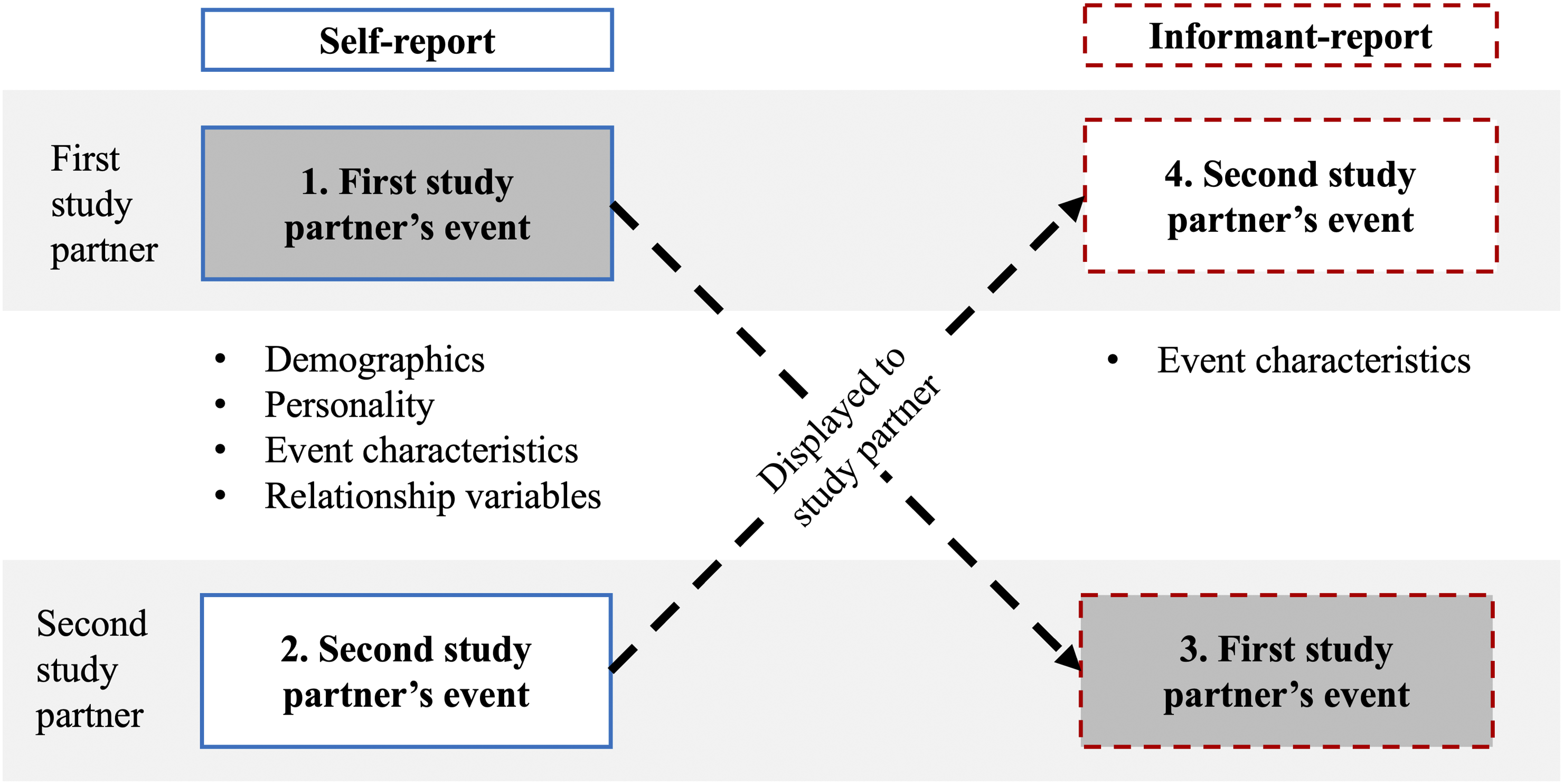
Subsequently, the second study partner was notified via e-mail that they were nominated to participate in the study. They completed the same questionnaires as the first study partner, including registration, self-report questionnaires on their personality traits and a self-chosen major life event, and a survey concerning their relationship. The second study partner was then shown the first study partner’s open-answer description of the major life event (e.g., “birth of the second daughter”) and rated how they thought that the first study partner perceived this event (informant-report). Finally, the second study partner could receive compensation, either 6 Euro or course credits as a psychology student. Additionally, the second study partner could obtain personalized feedback about their ratings of personality traits and major life event perception. If the second study partner did not react to the study invitation, the first study partner received up to two e-mail reminders.
As soon as the second study partner completed their survey, the first study partner was informed via e-mail that they could complete their part of the study (i.e., providing informant-reports about their study partner’s event perception). Finally, the first study partner received compensation for study participation and feedback if requested. In case the first study partner did not react to the e-mail within two days, they received one last e-mail reminder to complete the study.
Sample
Participants had to agree to the study conditions and be at least 18 years old to take part in the study. To ensure the quality of the assessed data, participants were excluded if they (1) did not complete the survey, (2) did not have any variance across the items of a questionnaire (as it is very unlikely that this answer pattern occurred by chance or reflects true responding), or (3) if they already participated in the study. As a dyadic design was applied for the present study, pairwise deletion was performed if one of the study partners did not fulfill the inclusion criteria. A total of n = 62 participants were excluded, for example, because the same person participated as their own study partner, or they did not have any variance on the event characteristic items (see Table A2 in the Appendix). After applying the exclusion criteria, the final sample comprised N = 562 participants nested within 281 dyads. In the final sample, 64.53% of the participants were female, 34.22% male, 0.89% non-binary, and 0.36% did not want to specify their gender. Age ranged from 18 to 73 years (M = 28.73, SD = 9.75). Furthermore, 46.70% of the participants were currently enrolled in university and 30.12% were fully employed (see Table A1 in the Appendix for further details). The relationship duration of the study partners ranged from one to 64 years (M = 12.13, SD = 10.84).
Measures
Perceived event characteristics
First, participants rated how they perceived a self-chosen major life event on the German 18-item version of the Event Characteristic Questionnaire (ECQ) by Luhmann and colleagues (2021). Second, participants rated how their study partner perceived their major life event. The original ECQ items were adjusted for the informant-report (e.g., “Das Ereignis war stressig.” [The event was stressful.] was adapted to “Das Ereignis war stressig für X.” [The event was stressful for X.], “X” was replaced by the study partner’s name). All ECQ items were rated on a 5-point rating scale ranging from 1 = “strongly disagree” to 5 = “strongly agree”. Items were recoded if necessary, and scale scores for event characteristics were calculated based on two items. The nine event characteristics that were assessed with the ECQ include challenge, emotional significance, external control, extraordinariness, impact, predictability, social status change, valence, and change in world views. Higher scale scores reflected higher levels of the respective event characteristics.
Perceived closeness
To assess perceived closeness between self- and informant-rater, the Inclusion of the Other into the Self (IOS) scale by Aron and colleagues (1992) was used. Participants could choose one of 7 pictures, each showing a pair of circles with varying overlap. For picture 1, the circles did not overlap, reflecting very low relationship closeness. In contrast, the circles in picture 7 showed high overlap, reflecting high relationship closeness (see Figure A1 in the Appendix for a picture of the item). The picture or number the respective participant chose equaled the scale score for relationship closeness. Higher scale scores reflected higher levels of perceived closeness.
Informant’s presence at the event
Participants reported whether they were present at their study partner’s event on one dichotomous item (“Waren Sie bei dem Ereignis von X anwesend / vor Ort?” [Were you present / on site at the event of X?]). Answers were made on a dichotomous scale with 0 = “no” and 1 = “yes.”
Informant’s experience with the event
Furthermore, participants indicated for the event that they rated as informant-rater if they had experienced the same or a similar event. Experience with the event was assessed with one item (“Haben Sie das Ereignis von X oder ein ähnliches Ereignis einmal selbst in Ihrem Leben erlebt?” [Have you experienced the event of X or a similar event once in your life yourself?]). Answers were made on a dichotomous scale with 0 = “no” and 1 = “yes.”
Verbal exchange about the event
Participants rated verbal exchange about their study partner’s event with their study partner on one item (“X hat mir häufig von diesem Ereignis erzählt.” [X has often told me about the event.], “X” was replaced by the study partner’s name). Responses were made on a 5-point rating scale ranging from 1 = “strongly disagree” to 5 = “strongly agree”. Higher scale scores reflected higher levels of verbal exchange.
Data analysis
Descriptive analysis
All data preparation and data analyses were performed using the open-source software RStudio (2024.09.1 + 394) and R (version 4.4.2; R Core Team, 2022), respectively. First, descriptive statistics, including mean and standard deviation, were computed with the psych package (Revelle, 2023). Furthermore, the internal consistencies (Cronbach’s
Convergence of self- and informant-report
The present study applied a dyadic study design. Therefore, participants were nested in groups of two. An ID variable (running number) was created to code ratings originating from the same group or dyad. Additionally, each participant acted as self- and as an informant-rater. Consequently, each group contributed four sets of data (two self-reports and two informant-reports). Another ID variable was created to code self- and informant-ratings that refer to the same event. The convergence of self- and informant-perceptions of major life events was examined at the profile level (i.e., the 18 self-reported items of a participant were regressed on the 18 informant-reported items of the respective study partner, considering the nested data structure). The model equations along with an explanation of the parameters can be found in the Appendix (see section model equations).
To test the overall association between self- and informant-perception of major life events (Hypothesis 1a), a multilevel model with the self-reported event perception profile as the criterion and the informant-reported event perception profile as the predictor was calculated with the lme4 (Bates et al., 2015) and the lmerTest package (Kuznetsova et al., 2017). More specifically, the raw ECQ items in the self-report were regressed on the raw ECQ items in the informant-report. Furthermore, model tests (likelihood ratio tests) were conducted (random intercept-only multilevel regression model vs. multilevel regression model with random slope) to select the appropriate multilevel model. In cases where a model did not converge, the number of iterations was increased. If the model did not converge with an increased number of iterations, the next simpler model was chosen (e.g., a random intercept-only model instead of a model with random intercept and slope). Additionally, we examined in an exploratory manner the convergence of self- and informant-perception separately for the nine perceived event characteristics (e.g., the self-reported scale score of impact was regressed on the informant-reported scale score of impact). We applied a Bonferroni-adjusted alpha level of p = .005 (0.05/9) for the analyses conducted separately for the perceived event characteristics.
However, the overall association of event perception profiles is potentially inflated by normativeness (normativeness problem; Furr, 2008). Consequently, the distinctive profiles were calculated for the self- and informant-rater by grand-mean centering each individual rating (Furr, 2008). For instance, the mean of item 1 in the self-report was subtracted from each individual rating of item 1 in the self-report. The same steps that were conducted to test the overall association (Hypothesis 1a) were repeated with the distinctive self- and informant-profiles to test the distinctive association of self- and informant-perception of major life events (Hypothesis 1b).
Moderator analyses
First, all moderator variables (i.e., perceived closeness, informant’s presence at the event, informant’s experience with the event, and verbal exchange) were included separately into the multilevel model in which the self-reported profile was regressed on the informant-reported profile. The moderator verbal exchange (level 1 predictor) was grand-mean-centered across all participants. For the moderator perceived closeness, individual scores were grand-mean-centered, and the average score within each dyad (level 2 predictor) was used for further analyses. The dichotomous moderators (i.e., informant’s presence at the event, informant’s experience with the event) were not centered. The interaction effect between the respective moderator and the informant-report on the self-report was tested for significance. Finally, the interaction effects were investigated in a joint model including all moderator variables and their interactions. A significant and positive interaction effect indicates that a higher level of the respective moderator is associated with a higher convergence of self- and informant-reported event perception profiles. The moderator analyses were first conducted with the overall profiles and then the analyses were repeated for the distinctive profiles.
Further analyses
Within the revision process, additional analyses were suggested by the reviewers, which were all pre-registered: Since the expected correlation between self- and informant-profile is not zero (Cronbach & Gleser, 1953; Ozer & Gjerde, 1989), we compared the resulting regression coefficient with the regression coefficients of randomly matched self- and informant-profiles of event perception. More specifically, we compared the regression coefficient to the 95th percentile of the regression coefficients stemming from the same multilevel regression analysis based on randomly matched self- and informant-profiles across 1000 iterations. Additionally, we conducted combined regression analyses for normative and distinctive profiles (i.e., a regression of the raw self-reported profile on the normative event perception profile and the distinctive informant-report profile), similar to Wessels et al. (2020). Moreover, we estimated normativeness across perceivers (i.e., the item-average across self- and informant-reports) to estimate the distinctive profiles—initially, we estimated normativeness separately for self- and informant-reports. Furthermore, we tested three additional moderators: time since the event, social desirability, and observability of event perception items. Ratings for social desirability and observability of event perception items (Luhmann et al., 2021) were obtained from a separate sample of N = 103 participants. Participants rated social desirability (i.e., the extent to which an event described with the respective statement is positive or negative) on a 10-point rating scale ranging from 1 = “very negative” to 10 = “very positive”. Observability (i.e., how easy it would be to judge whether another person perceived an event as described in the statement) on a 10-point rating scale ranging from 1 = “very difficult to judge”to 10 = “very easy to judge”. Furthermore, we sampled one event per dyad across 1000 iterations (to avoid the nested data structure of two events nested within one dyad) to estimate the correlation between self- and informant-perception and its relation to the moderators. Finally, we estimated the D indices by Cronbach and Gleser (1953) (again we sampled one event per dyad across 1000 iterations) and compared them to the D indices of randomly matched dyads to investigate if the convergence in terms of elevation, scatter, and shape of event perception profiles is higher than one would expect by chance (see Wright & Jackson, 2024 for a similar approach).
Results
Means, standard deviations, and correlations between the analyzed variables, as well as internal consistencies for the nine self- and informant-reported event characteristics, are presented in the Appendix (Table A4–Table A7). Additionally, Table A3 shows the categories of major life events that participants reported in the present study. Due to failed model convergence of the more complex models with two nesting variables (one ID variable for the dyad and one ID variable for the event), we applied simpler models that contain only one nesting variable controlling for the dyad. In line with Hypothesis 1a (convergence of overall profiles, including normative as well as distinctive event perception), self-reported event perception profiles were significantly and positively associated with informant-reported event perception profiles (B = 0.599 [0.577; 0.621], p < .001) 2 . The regression coefficient of the overall convergence (B = 0.599) was larger than the 95th percentile (B = 0.304) of the regression coefficients stemming from a multilevel analysis of randomly matched self- and informant-reports of event perception. Additionally, we randomly sampled (1000 iterations) one from two events per dyad (i.e., 281 events from 281 dyads) and estimated the average correlation (r = .652, SD = .014).
Consistent with Hypothesis 1b, self- and informant-reported event perception were significantly and positively associated with each other when it was controlled for normativeness in event perception profiles (i.e., distinctive profiles, B = 0.442 [0.415; 0.469], p < .001). The detailed results of the multilevel regressions with the self-reported event perception profile as the criterion and the informant-reported event perception as a predictor are reported in Table A8 in the Appendix or the OSF. Moreover, distinctive self- and informant-perception profiles were significantly and positively associated with B =0.437 [0.410; 0.465], p < .001, when normativeness was estimated across perceivers (i.e., across self- and informant-rater) instead of within perceivers. Additionally, the regression analyses showed that the overall self-report as a criterion can be predicted by the normative event perception profile (B = 0.948 [0.918; 0.978], p < .001) as well as the distinctive informant-profile (B = 0.440 [0.417; 0.463], p < .001).
In addition, we exploratively investigated the convergence of self- and informant-perception for the nine perceived event characteristics separately. Multilevel models only converged for external control and extraordinariness. Therefore, we conducted simple regression analyses with cluster-robust standard errors for the remaining perceived characteristics (see Table A10 in the Appendix). Self- and informant-reported event characteristics were significantly and positively related for all of the nine characteristics with regression coefficients ranging from B = 0.178 [0.108; 0.247], p < .001 for external control to B = 0.822 [0.776; 0.868], p < .001 for valence.
Moderator analyses
Moderators of the convergence of self- and informant-reported major life event perception.
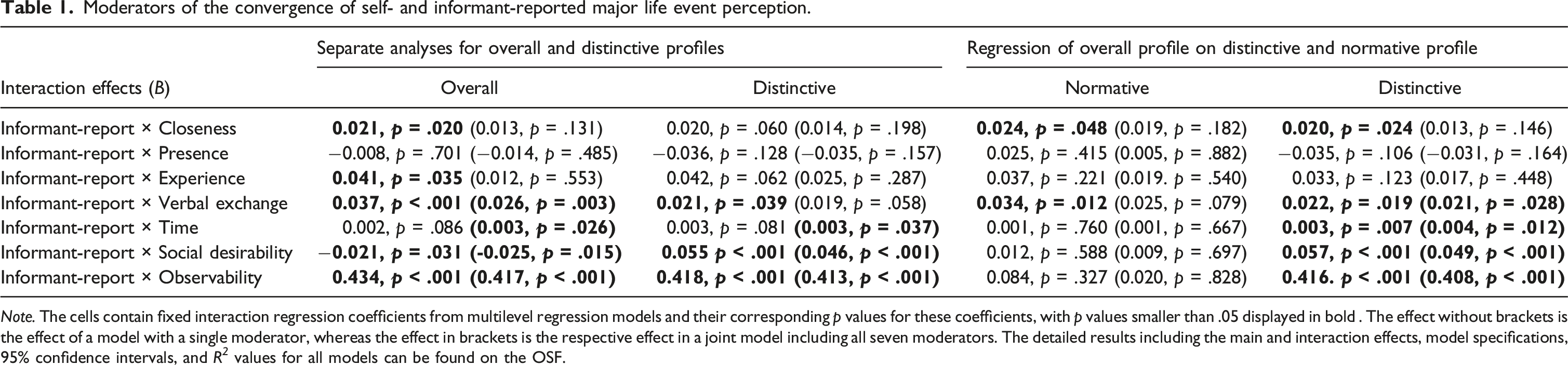
Note. The cells contain fixed interaction regression coefficients from multilevel regression models and their corresponding p values for these coefficients, with p values smaller than .05 displayed in bold . The effect without brackets is the effect of a model with a single moderator, whereas the effect in brackets is the respective effect in a joint model including all seven moderators. The detailed results including the main and interaction effects, model specifications, 95% confidence intervals, and R 2 values for all models can be found on the OSF.
Hypothesis 2a was partially confirmed: The interaction effect of perceived closeness was significant and positive for the overall profiles (B = 0.021 [0.003; 0.038], p = .020) but not the distinctive profiles (B = 0.020 [-0.001; 0.042], p = .060). However, the interaction effect of closeness and the distinctive informant-report was significant and positive in a regression of the overall self-report on the normative and distinctive informant-profiles simultaneously (B = 0.020 [0.003; 0.038], p = .024). In the joint models including all seven moderators, the interaction effect of perceived closeness was not significant (see Table 1).
Contrary to Hypothesis 2b, the interaction effect of the moderator informant’s presence at their study partner’s event was neither significant for the overall profiles (B = −0.008 [−0.047; 0.031], p = .701) nor the distinctive profiles (B = −0.036 [−0.083; 0.010], p = .128). Partially in line with Hypothesis 2c, the interaction effect of the moderator informant’s experience with their study partner’s event was significant and positive for the overall profiles (B = 0.041 [0.003; 0.079], p = .035), but not the distinctive profiles (B = 0.042 [−0.002; 0.087], p = .062). However, the interaction effect of experience and the overall informant-report was not significant in a joint model including all seven moderators (B = 0.012 [−0.027; 0.050], p = .553).
Hypothesis 2d was largely confirmed: The interaction effect of the moderator verbal exchange about the event was significant and positive for the overall profiles (B = 0.037 [0.020; 0.054], p < .001), and for the distinctive profiles (B = 0.021 [0.001; 0.040], p = .039). Regarding the joint model with all seven moderators, the interaction effect of verbal exchange was significant for the overall (B = 0.026 [0.009; 0.042], p = .003) but not the distinctive profiles (B = 0.019 [−0.001; 0.040], p = .058). However, in a regression of the overall self-report on the normative and distinctive informant-profile including all seven moderators, the interaction effect of verbal exchange (B = 0.021 [0.002; 0.040], p = .028) was significant. Figure 2 summarizes the results of the moderator analyses. Findings: Moderators of the convergence of self- and informant-report. Note. The figure shows the convergence of a self-reported and an informant-reported event perception profile, which includes normative (white area) and distinctive aspects (light grey area). Four moderators (i.e., perceived closeness, informant’s presence at the event, informant’s own experience with the event, and verbal exchange about the event) were tested. B is the unstandardized regression coefficient from a multilevel regression. A solid arrow indicates a significant and positive effect of the respective moderator on the convergence, whereas a dashed arrow indicates that the effect was not significant. *p < .05; **p < .01; n. s. = not significant.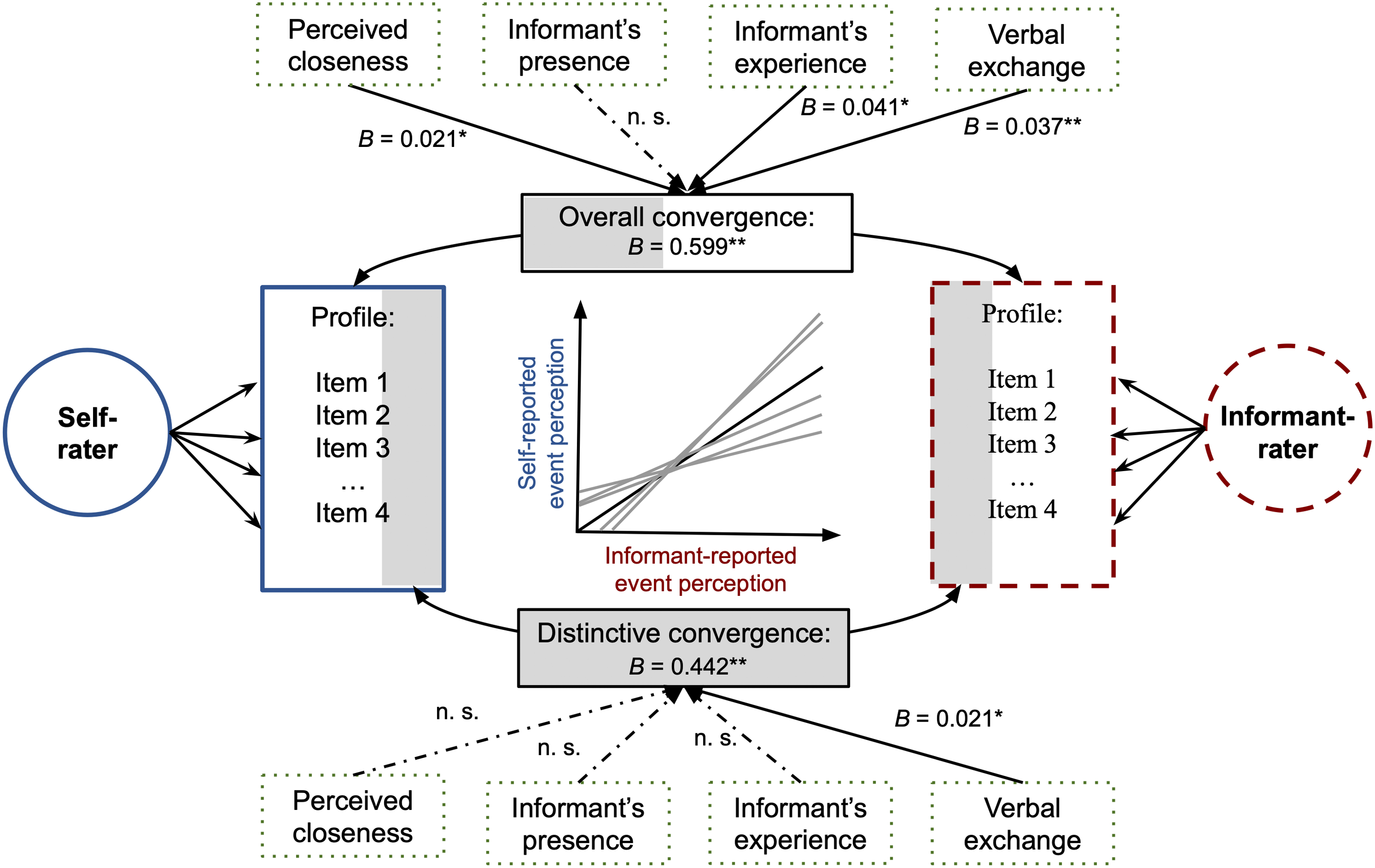
Hypothesis 2e was largely not confirmed. The interaction effect of time was neither significant for the overall profiles (B = 0.002 [−0.000; 0.005], p = .086) nor the distinctive profiles (B = 0.003 [−0.000; 0.006], p = .081). However, in a regression of the overall self-report on the normative and distinctive informant-report, the interaction effect of time and the distinctive informant-report was significant and positive (B = 0.003 [0.001; 0.006], p = .007).
Hypothesis 2f was partially confirmed: Contrary to Hypothesis 2f, the interaction effect of social desirability was significant and negative for the overall profiles (B = −0.021 [−0.040; −0.002], p = .031). In line with Hypothesis 2f, the interaction effect of social desirability was significant and positive for the distinctive profiles (B = 0.055 [0.034; 0.076], p < .001).
In line with Hypothesis 2g, the interaction effect of observability was significant and positive for the overall profiles (B = 0.434 [0.383; 0.485], p < .001) and the distinctive profiles (B = 0.418 [0.367; 0.468], p < .001). Tables A11 and A12 in the Appendix contain the main and interaction effects of the four initial moderators. The detailed results for all models can be found on the OSF.
Discussion
The aim of the present study was to examine whether self- and informant-perception of major life events converge and, if so, to gain a better understanding of the processes driving this convergence by investigating potential moderators (i.e., perceived closeness, informant’s presence at the event, informant’s experience with the event, and verbal exchange about the event, as well as time since the event, social desirability, and observability). In a pre-registered dyadic online study, both participants of each dyad rated how they perceived their own major life event (self-report) as well as how they thought that their study partner perceived their major life event (informant-report). The study employed multilevel regression models to investigate the level of convergence of self- and informant-reported perception profiles and moderators of this convergence. First, concerning the overall agreement of self- and informant-reports, results showed a significant and positive association between self- and informant-perception of major life events. The convergence between self- and informant-report remained substantial after controlling for normativeness in event perception (distinctive profiles). Second, concerning the moderators of convergence of self- and informant-report profiles, verbal exchange and observability of perceived event characteristics were linked to higher overall and distinctive convergence of self- and informant-perception profiles. Conversely, informant’s presence was not associated with higher overall or distinctive convergence. Regarding the remaining moderators, the influence of the moderator differed for normative and distinctive profiles or was inconsistent across the tested models. Thus, the present study indicates that informant-reports adequately capture the subjective perception of major life events (for normative and distinctive aspects) and explores potential mechanisms, such as verbal exchange, that may explain differences in the levels of convergence.
Convergence of self- and informant-reports
Overall profiles
Self- and informant-perception profiles of major life events converged. Importantly, this convergence was approximately twice as high as the convergence of randomly matched self- and informant-reports of event perception—indicating a meaningful convergence above chance, which is unlikely to be only driven by method artefacts. Compared to other constructs, the convergence of self- and informant-perception of major life events was notably high (B = 0.60 [0.58, 0.62], p < .001). This convergence was higher than the convergence reported by Leikas and Lönnqvist (2023) for self- and informant-reported situation perception (average B = 0.31 across situation features). Similar to the present study, participants in the study of Leikas and Lönnqvist (2023) rated their subjective perception on a 5-point scale and informant-raters were primarily familiar others. Additionally, we estimated an average correlation coefficient 3 of r = .65 (SD = .01), indicating a large effect size (Cohen, 1988) for the convergence of major life event perception. This level of convergence was higher than that reported for subjective well-being (r = .42, friends and family as informant-raters; Schneider & Schimmack, 2009) or personality traits (r = .37 across traits for studies with peers or close others as informant-raters; Connolly et al., 2007).
Perceived event characteristics
In an exploratory manner, we investigated the convergence of self- and informant-perception separately for the nine perceived event characteristics to examine if this convergence is driven by specific event characteristics. Results indicated that perceived event characteristics differ in their level of convergence, which was relatively high for the perceived event characteristics valence, predictability, and challenge—whereas convergence was rather low for external control, emotional significance, and extraordinariness. One reason for the lower convergence in some perceived event characteristics may be their varying degrees of observability. Past research suggests that highly observable personality traits, such as extraversion, show higher convergence across raters compared to less observable personality traits such as neuroticism (e.g., Funder & Dobroth, 1987; Kenny & West, 2010). Similar to neuroticism, the emotional impact an event has for the individual may be hard to observe for another person unless the individual who experienced the event discloses their emotions. Making emotions accessible to others includes, for example, mimicry or verbal exchange (Funder, 1980; Luhmann et al., 2016). Changes in attitudes might therefore be hard to observe and must be communicated by the individual to make them accessible to other people. However, the convergence for change in world views was not particularly low compared to the other event characteristics. Valence showed the highest level of convergence, likely due to its strong normative component. For instance, most people would describe the death of a loved one as a negative event, whereas a graduation is described as rather positive. This idea aligns with the finding by Kritzler and colleagues (2021), who reported that the perceived event characteristic valence shows the smallest standard deviation (SD = 0.56; aggregated across ten typical major life events)—indicating that people perceive the valence of these events rather similarly.
Despite varying levels of convergence among the perceived event characteristics, all characteristics showed a significant and positive association between self- and informant-report. These findings provide initial evidence that an individual’s event perception can also be assessed with informant-reports—even at the level of individual perceived event characteristics.
Distinctive profiles
The convergence of self- and informant-perception profiles can reflect both unique agreement and normativeness (normativeness problem; Furr, 2008). To examine whether the convergence can be attributed solely to a normative, shared idea of major life events (e.g., major life events are perceived as emotionally relevant), we also investigated the convergence of the distinctive profiles. As expected, the distinctive convergence was smaller than the overall convergence, but significant and positive. This finding indicates that the convergence is not merely due to normativeness but reflects unique agreement for the specific major life event perception. In other words, informants were able to rate the subjective perception of a major life event for their study partners beyond normativeness. The results strengthen the argument that the subjective, idiographic perception of major life events can be assessed and is potentially useful (e.g., Buecker et al., 2021; Denissen et al., 2019; Haehner et al., 2022; Haehner, Rakhshani, et al., 2023; Jayawickreme et al., 2021; Luhmann et al., 2021). People vary in their subjective perception of major life events and those deviations from the normative event perception converge with informant-reports. Assessing the subjective perception from multiple sources, such as self- and informant-raters, can help to differentiate between variance related to the individual (including their affect or personality) and variance related to the event itself (see Rauthmann et al., 2015 for a similar argument on situations). Moreover, the additional regression analyses revealed that self-reported event perception can be predicted by normative and distinctive aspects simultaneously. It could be argued that for inter-individual changes in relevant variables, such as personality traits or well-being, it is not the normative perception of a life event, but the distinctive perception of the event that is of importance.
Moderators of the convergence of self- and informant-report
The convergence of self- and informant reports of life event characteristics—normative and distinct—was positive and significant. Yet, the convergence was not perfect and differed between dyads: Some dyads showed higher convergence than others. To better understand the mechanisms underlying the convergence of self- and informant-perception of major life events, we tested four potential moderators of the convergence (i.e., perceived closeness, informant’s presence at the event, informant’s experience with the event, and verbal exchange about the event—see Figure 2).
In line with predictions, reporting higher closeness was associated with a higher overall convergence of self- and informant-perception profiles of major life events. This finding is in line with prior research investigating the convergence of self- and informant-report, such as personality traits (Allik et al., 2016; Connolly et al., 2007; de Vries et al., 2008; Funder & Colvin, 1988) or life satisfaction (Schneider et al., 2010). However, simultaneously considering verbal exchange about the event in the analysis rendered the effect of closeness on the convergence of self- and informant-report non-significant. This finding could mean that closeness leads to higher convergence because inidividuals who are close talk more about the experiences that matter to them. Regarding the distinctive convergence, the effects of perceived closeness were positive though not statistically significant with the pre-registered alpha level of p = .05. Notably, perceived closeness was related to higher distinctive convergence in a model that was suggested by a reviewer, which included both normative and distinctive profiles. Overall, these findings indicate that self- and informant-profiles of event perception tend to align more when individuals report being closer to each other.
In line with our predictions, verbal exchange was related to higher overall and distinctive convergence. This result could indicate that people talk about the normative (e.g., “My break-up had an impact on my life.”) as well as distinctive aspects of event perception (e.g., “My break-up was not emotional at all.”) with their close others, leading to higher convergence of their reports. Except in the separate analysis for the distinctive profiles, the effect of verbal exchange was robust when considering the remaining seven moderators simultaneously.
Contrary to our predictions, being present at the major life event of a close person was not linked to higher convergence in either overall or distinctive profiles. Following the argumentation of Brunswik’s lens model, being present at the major life event of a person should provide more information about the event and lead to a higher convergence (Brunswik, 1956; Funder, 1995). However, the informant-rater may not observe or interpret the relevant cues in the same way as the target. Moreover, the effects of major life events may unfold over time (e.g., Dugan et al., 2023) in contexts where the informant-rater is not present.
Partially in line with our expectations, informants’ experience with the rated event or a similar one was related to higher overall but not distinctive convergence. While this finding suggests that informants’ experience could provide more insights into the event, higher distinctive convergence may only occur when both self- and informant-raters share similar unique or non-normative experiences regarding this event (e.g., self- and informant-rater both experienced their break-up as positive). However, the effect of informant’s experience on the overall convergence was not robust in the model that included all moderators. It is possible that the information obtained by the informant through their own experience of the major life event—that is linked to a higher convergence—is already contained in one of the other moderators, such as verbal exchange.
We also examined three additional moderators suggested by the reviewers. First, the moderator time passed since the event was not related to higher overall or distinctive convergence. However, time passed since the event was linked to higher distinctive convergence when considering normative and distinctive profiles simultaneously. Participants were instructed to select a major life event experienced within the last three months. It is possible that self- and informant-perception would converge more consistently across longer time periods when the consequences of the life event had become more evident. Second, and unexpectedly, rating event characteristics as less socially desirable (i.e., more negative) was related to higher overall convergence. When examining the distinctive or unique profiles of event perception, the convergence was higher for more socially desirable or positive aspects of event perception. Together these findings could indicate that people tend to share their normative negative aspects of event perception with others (e.g., that they perceived their divorce as challenging) while they may express more positive aspects of event perception when their perception does not conform with the norm, leading to higher distinctive convergence for positive aspects. However, these explanations are mostly speculative and deserve further scrutiny in future studies. Third, overall and distinctive convergence was positively related to the observability of event perception items. This finding aligns with previous research indicating that observable characteristics show higher levels of convergence (Funder & Dobroth, 1987; John & Robins, 1993; Kenny & West, 2010).
Limitations and future studies
Lastly, several potential limitations should be considered. First perceptions of major life events were assessed retrospectively, as participants were instructed to select events from the past 3–6 months. Individuals may adjust their perceptions of major life events over time. For instance, a break-up initially perceived as negative might be perceived as more positive after starting a new relationship. Moreover, it is possible that the retrospective assessment might have strengthened the normative aspects of events (Robinson & Clore, 2002). However, Haehner et al. (2022) found that the perception of major life events is relatively stable over the course of a year, suggesting that the changes in the retrospective assessment in this study—at least for the self-reports—are minimal.
Second, the results were rather inconsistent for some moderators, such as perceived closeness between participants. As interaction effects require substantial statistical power, it could be that we were not able to detect the effect of perceived closeness in all analyses of the current study. The low number of the lower level units (two events per dyad) and the small magnitude of the interaction effects likely made it more difficult to detect interaction effects (Mathieu et al., 2012).
Third, the approach used to estimate the normativeness of perceived characteristics of major life events by using the item average in the present sample has some limitations: We controlled for a general, event-unspecific normativeness in the perception of major life events. However, normativeness may differ from event to event: The normative perception of a wedding is completely different from the normative perception of a funeral (Kritzler et al., 2021). However, the limited sample sizes per event category did not allow for an examination of event-specific normativeness. Similarly, the social desirability of event perception items was assessed for major life events in general. However, in the context of major life event perception, it may be beneficial to consider social desirability of items with regard to specific major life events. Likewise, the socially desirable perception of a funeral may differ markedly from the socially desirable perception of a wedding. Future studies should consider estimating normativeness and social desirability for specific major life events. A promising approach to achieving representative samples could involve combining sampling (like e.g., Haehner, Kritzler, & Luhmann, 2024) with the creation of a collaborative open database for the perception of different major life events.
Additionally, participants nominated informant-raters themselves, which likely led to high levels of perceived closeness (M = 4.99, SD = 1.46 on a scale ranging from 1 to 7) between self- and informant-raters as well as high levels of verbal exchange about events. Similarly, Leising et al. (2013) observed higher liking between participants and their self-nominated targets, a factor that might overlap with perceived closeness and that could potentially explain variance in the convergence. While this enhances external validity by studying meaningful relationships, it limits the possibility to study the entire range of the moderators, such as the convergence in the absence of verbal exchange about the event. Notably, an analysis of a subsample with low levels of verbal exchange about the event yielded similar results compared to the overall study findings (see 03_Further_Analyses on the OSF). Furthermore, the differentiation between knowing and liking might further advance the understanding of the effect of closeness on the convergence of major life events (see Wessels et al., 2021). Yet, future studies should investigate the convergence regarding major life event perception with more heterogenous study partners—also including study partners with lower levels of closeness, such as colleagues or even strangers, who could base their judgments only on normativeness.
The present study demonstrated that major life event perception can be assessed not only trough self-reports but also through informant-reports. Informant-reports of close others tend to contain similar information compared to self-reports. Future research should investigate whether informant-reports can explain unique variance in relevant outcome variables, such as well-being or personality trait change, as the effects of self-reported event characteristics are rather small (e.g., Fassbender et al., 2022; Haehner, Bleidorn, et al., 2024; Haehner, Rakhshani, et al., 2023). This approach could advance understanding of major life events by collecting further evidence if the effects of perceived event characteristics are indeed relatively small or if combined methods better capture these effects. Moreover, the simultaneous assessment of self- and informant-reports allows for the investigation of novel research questions on the dyadic level (Vazire, 2006), such as if higher convergence of self- and informant-report is associated with higher relationship satisfaction in romantic couples or friendships. These results also show that the person who experienced the event is not necessarily the only or the most qualified person to judge their perception of the event.
Conclusion
Is the perception of major life events accessible to informant-raters and if so, which processes can explain the inter-dyad differences in the convergence? The present study demonstrated that informant-reports provide an additional method to assess the subjective perception of major life events. Convergence of self- and informant-report was found for the overall as well as the distinctive profiles (controlled for normativeness)—on the level of the profile (across all nine event characteristics) and the level of separate event characteristics (e.g., impact). Moreover, the present study identified potential mechanisms associated with higher convergence, such as verbal exchange. In contrast, other investigated variables, such as the presence of the informant at the event, were not related to higher convergence. Future research on event perception may benefit from considering not only the overall, but also distinctive or unique aspects of event perception. Additionally, assessing event perceptions from various sources, such as informant-raters, may help to overcome some of the limitations of self-reported event perception. Furthermore, the integration of informant-reports could allow researchers to address novel research questions on the dyadic level. To summarize, informant-reports provide an additional source for assessing the perception of major life events and might help to uncover the inconsistent effects of major life events in the literature.
Supplemental Material
Supplemental Material - Do you understand what I experienced? Self- and informant-perception of major life events
Supplemental Material for Do you understand what I experienced? Self- and informant-perception of major life events by Karla Fliedner and Kai T. Horstmann in European Journal of Personality.
Footnotes
Acknowledgments
We thank Matthias Ziegler for helpful suggestions regarding the analysis. We also thank Sophie C. Bauditz, Lilly F. Buck, and Anabel Büchner for their valuable comments regarding earlier versions of this manuscript.
Declaration of conflicting interests
The author(s) declared no potential conflicts of interest with respect to the research, authorship, and/or publication of this article.
Funding
The author(s) received no financial support for the research, authorship, and/or publication of this article.
Open science statement
The preregistration (encompassing the study design, study materials, hypotheses, and analysis plan), along with a document describing deviations from the initial pre-registration, a pre-registration for the analyses suggested within the revision, the data, R scripts, and HTML documents containing the detailed results can be downloaded from  .
.
Supplemental Material
Supplemental material for this article is available online.
Notes
References
Supplementary Material
Please find the following supplemental material available below.
For Open Access articles published under a Creative Commons License, all supplemental material carries the same license as the article it is associated with.
For non-Open Access articles published, all supplemental material carries a non-exclusive license, and permission requests for re-use of supplemental material or any part of supplemental material shall be sent directly to the copyright owner as specified in the copyright notice associated with the article.
