




Abstract
Young adulthood is characterized by major life transitions that may trigger identity development, yet little is known about the specific change trajectories and individual and transitional factors that drive identity change during the transition to work. First, we examined mean-level changes and individual differences in exploration and commitment processes. Second, we linked the subjective impact of the transition and narrative agency and self-event connections of a previous turning point to individual differences in exploration and commitment processes. We assessed identity formation across 5 waves spaced across 2 years in 298 Dutch young adults aged 24.6 years (SD = 2.5). We found mean-level decreases in ruminative exploration. Individuals differed significantly in change in commitment making and exploration in depth, which was not predicted by the subjective impact of the transition or self-event connections. Initial levels of narrative agency were positively associated with initial levels of commitment making and exploration in depth. Results indicate that young adults ruminate less about their future plans as the transition to working life proceeds. Moreover, narrative agency in a previous turning point is associated with how young adults make commitments and explore career choices before making the university-to-work transition.
Plain language summary
Young adulthood is a period filled with major life transitions, such as moving out of the parental home and finding work after graduation. These transitions often spark questions related to identity, such as “Who am I?” and “Who do I want to become?”. Exploration of and commitment to choices is a way to formulate an answer to these questions. The current study focus on exploration and commitment processes during the transition from university to working life. Specifically, we investigated whether individual differences in these processes are linked to perceptions of the transition's impact and individual characteristics of previous turning point narratives. We followed 298 Dutch young adults who expected to graduate, measuring changes in exploration and commitment to future plans at five measurement moments over a period of two years. The results showed that young adults on average became less worried about their future plans. The study also discovered individual differences in identity processes. Specifically, some young adults showed more changes in their commitment making to or in-depth exploration of future plans than others. These differences were not related to how impactful the transition was perceived. However, narratives of a previous turning point that displayed high levels of agency were related to higher levels of commitment to future plans and in depth exploration of these plans at the start of the transition. Overall, the findings suggest that young adults become less preoccupied with uncertainty regarding future plans during the transition to working life. Additionally, how young adults handled important events in their past seems important for how they initiate the navigation of the university-to-work transition.
Keywords
Introduction
Young adulthood is characterized by multiple life transitions in several life domains (Hutteman et al., 2014). During ages 18 and 25 years, many young adults move out of the parental home, have their first serious romantic relationships, and enter the workforce. These life transitions challenge young adults to further develop their identity and may exacerbate individual differences therein (Erikson, 1968). Life transitions bring new experiences that need to be integrated into one’s view of the self, which could lead to fluctuations and uncertainties in identity development (Erikson, 1968; Eriksson et al., 2020; Kroger, 2007; Pals, 1999). The transition from university-to-work might be especially important for identity development, as (future) occupation is one of the most important areas for young adults to define themselves (Bilsker et al., 1988; Kroger, 1986).
Identity formation has predominantly been operationalized as exploration and commitment processes (i.e., the evaluation of different identity alternatives across various life domains and investment of psychological resources in these choices and their maintenance, respectively) (e.g., Luyckx, Goossens, & Soenens, 2006), or as life stories that focus on how people make meaning out of past experiences (McAdams, 2001). Research on exploration and commitment processes shows mixed results, indicating that some young individuals increase in adaptive exploration and commitment processes, whereas others decrease or demonstrate stability (Den Boer et al., 2021; Luyckx, Schwartz, Goossens, et al., 2008; Mannerström et al., 2019; Meeus, 2016; Meeus et al., 2010). A reason for these mixed findings could be that changes in exploration and commitment do not follow a normative trajectory, but rather, that there is a high degree of individual variability in such changes. Explaining these individual differences in exploration and commitment may contribute to a deeper comprehension of the causal processes underlying identity development (Bolger et al., 2019).
The goal of the present study is to examine contextual and individual sources of individual variability in identity change in young adulthood. First, the perceived impact of the transition to working life might be linked to individual differences as only events that are considered to be self-relevant are theorized to influence identity development (Erikson, 1968; Pasupathi et al., 2007). Nevertheless, to our knowledge the role of the perceived impact of transitions has not been examined in relation to identity development. Second, life narratives may help gain insight into individual differences in exploration and commitment processes, as life narratives reveal how individuals make sense of the self and their experiences. They provide knowledge on how individuals formed past commitments and which commitments were relevant at what moment in time (McLean, 2008). Empirical studies examining the interplay between these different identity approaches are scarce, probably because they stem from different research traditions that tend to be studied in different literatures. Past work has therefore called for more empirical research on their association in order to identify ways in which these two approaches complement each other (e.g., McAdams & Pals, 2006; McLean, 2008; McLean & Pasupathi, 2012). This study aims to contribute to filling this research gap.
In the current study, we examined mean-level changes and individual differences in exploration and commitment processes. We linked the perceived impact of the transition, and narrative agency and self-event connections of a previous turning point to individual differences in exploration and commitment processes.
Identity development and individual differences during the university-to-work transition in the Netherlands
Erikson (1968) viewed identity formation as a lifelong process, in which adolescence and young adulthood are considered key developmental periods. He suggested that identity formation is triggered by physical changes during puberty, cognitive development, and societal opportunities and expectations. The transition to working life represents such a societal opportunity and expectation. Graduation and becoming financially independent are a part of societal expectations in western countries (Arnett, 2000). The societal pressure that comes with the university-to-work transition and experiences during the transition might trigger young adults to become more engaged in processes to (re)define themselves (e.g., “Do I see myself working in a corporate environment or a non-profit organization?”).
Empirical research indicates that various contextual factors influence the transition to working life and that these factors can vary across different cultural settings (e.g., Schoon & Bynner, 2019). The current study has been conducted in the Netherlands, which is a Western European country with a stable economy and a selective educational system. In the Dutch educational system, adolescents around the age of 12 select a secondary school track based on their abilities, interest, and career goals. Admission to a specific track is determined by performances at the end of primary school. Young adults who successfully complete the pre-university secondary school track typically continue their studies at a research university, which offers four- or five-year programs, intended to include a Master’s program. In contrast, those who complete the senior general secondary school track usually proceed to a university of applied sciences and are only accepted to a research university after completion of additional schooling. In 2019, 15% of the Dutch population had a degree obtained at a research university (CBS, 2020). The current study focuses on young adults that make the transition to working life after they received a Master’s degree from a research university. This group of young adults have a good position on the favorable Dutch job market, as in 2021 there were more open vacancies than unemployed people (CBS, 2021). This transition context means for the young adults in the current study that they had the opportunity to evaluate different career options and could choose the option that fitted best with who they are and who they want to become. These conditions might have been beneficial for the development of firm commitments within the career domain.
Identity development is often studied with exploration and commitment processes that originate in the work of Marcia (1966). Luyckx, Goossens, Soenens, et al. (2006) have presented a contemporary model of identity formation which has refined the basic distinction between Marcia’s (1966) exploration and commitment processes. The commitment process is divided into two adaptive identity processes: Commitment making (i.e., the process of making actual choices) and identification with commitment (i.e., the degree of identification with those choices). The exploration process is divided into two adaptive dimensions: Exploration in breadth (i.e., examining different alternatives) and exploration in depth (i.e., in-depth evaluation of one’s existing commitments and choices), as well as one maladaptive dimension, termed ruminative exploration (Luyckx, Schwartz, Berzonsky, et al., 2008). Following this model, increases in adaptive exploration and commitment processes and decreases in maladaptive exploration are expected in young individuals (Luyckx, Goossens, Soenens, et al., 2006; Luyckx, Schwartz, Berzonsky, et al., 2008).
Empirical research on these dimensions has predominantly been conducted in adolescence. A review of longitudinal studies during adolescence provided evidence for increases in commitment and adaptive exploration processes, but also for identity stability (Meeus, 2016; Meeus et al., 2010). Longitudinal evidence for identity development in young adulthood is less consistent and comprehensive than for adolescents. For example, one study found mean-level increases in adaptive exploration and commitment processes (Luyckx, Schwartz, Goossens, et al., 2008), another study found decreases in adaptive exploration and commitment processes and stability in maladaptive exploration (i.e., ruminative exploration) (Mannerström et al., 2019), and another study demonstrated identity stability in all dimensions (Den Boer et al., 2021). These results suggest that there is no clear mean-level change, but substantial individual differences in identity development in young adulthood. Possibly, these individual differences in change trajectories cancel each other out, resulting in the mixed findings of previous research. That is, leverage of individuals who change in opposite directions of each other might lead to average stability (Borghuis et al., 2017). Rather than viewing this heterogeneity as an undesirable error, it holds great potential for gaining a deeper comprehension of the causal processes underlying change (Bolger et al., 2019).
Is the perceived transition impact linked to individual differences in exploration and commitment processes?
Two of the previously mentioned longitudinal studies in young adulthood attempted to explain this heterogeneity with the occurrence of the transition into working life (Den Boer et al., 2021; Mannerström et al., 2019). These studies show that the experience of the transition could not explain exploration and commitment processes (Den Boer et al., 2021) or showed results that are in contrast to expectations (i.e., decreases in exploration in depth) (Mannerström et al., 2019). These mixed initial findings for identity development during the transition to working life are in line with extensive research on personality development during life transitions. A recent systematic review and meta-analysis by Bühler et al. (2023) showed relatively small effects of life events on personality change and suggests that future research should look beyond the occurrence of life events, and focus on the individual context surrounding life events. Similarly, a theoretical review on self-esteem research highlights the need to focus on individual differences of life events to understand the variability in self-esteem development (Reitz, 2022).
Perceived event characteristics (e.g., valence, impact, and predictability) indeed explain individual differences in personality trait change (Schwaba et al., 2023), by using a questionnaire that was developed to capture the idiosyncratic nature of life events (Haehner et al., 2023; Luhmann et al., 2020; Rakhshani et al., 2022). De Vries et al. (2021) found a similar result in a longitudinal study in young adults who graduated or moved away from the parental home, as the perceived valence of this event explained individual differences in personality trait change. However, the perceived valence of the university-to-work transition did not explain individual differences in the link between pride and self-esteem using the same dataset as the current study (Diwan et al., 2023).
Perceived event characteristics have not yet been linked to identity exploration and commitment processes during the transition to working life. However, particularly the perceived impact of the work transition might shape identity processes. A meta-analysis has shown that perceived impact of negative events was significantly correlated with depressive symptoms (Haehner et al., 2024). Perceived impact is likely to be particularly relevant for identity processes, as identity development is theorized to be only influenced by events that are perceived to be self-relevant (Erikson, 1968; Pasupathi et al., 2007). Events that are not considered to be impactful are unlikely to be integrated into someone’s life story and, therefore, may not influence identity processes. We studied if perceived impact of the transition is linked to exploration and commitment processes across the transition to working life. We expected that a higher perceived impact of the transition would be linked to stronger changes in exploration and commitment processes, and weaker perceived impact to identity stability.
Are narrative agency and self-event connections linked to individual differences in exploration and commitment processes?
A promising way to explain individual differences in exploration and commitment processes is to combine this line of identity research with research that focuses on narrative identity (McLean, 2008). These two approaches in identity research are rarely studied together (McAdams & Pals, 2006; McLean, 2008; McLean & Pasupathi, 2012). The current study therefore provides an opportunity to investigate how these two approaches can complement each other.
The narrative approach conceptualizes identity formation through the process of narrating self-relevant life events. This story incorporates the reconstructed past, the perceived present and the imagined future into a coherent identity (McAdams, 2001) and thus reveals how individuals make sense of the self and their experiences. However, the life story may not only be summative but may also serve a formative function in predicting future behavior, as people rely on memories of previous events to guide their future actions (Pillemer, 2003). During a life transition, people might, therefore, rely on experiences and interpretations from previous self-relevant moments to navigate new challenges. Characteristics of life stories might explain individual differences in commitments and/or exploration processes during the university-to-work transition. In the current study, we investigate narrative agency and self-event connections as key narrative characteristics of a previous turning point to predict individual differences in exploration and commitment processes.
Narrative agency
Agency is a characteristic of narratives placed within the motivational narrative theme (Adler et al., 2017). Agency concerns the degree to which the narrative indicates that the person feels that they can initiate changes on their own, achieve a degree of control, and influence others or their life circumstances. Individuals who narrate agentic stories tend to experience more autonomy in their choices. Agency is therefore assumed to be linked to the ability to make satisfying life commitments (Van Doeselaar et al., 2020) and is suggested to influence the quality of exploration processes (Schwartz et al., 2005). Hence, individuals high on agency are thought to explore life choices in an organized and directed pattern, which helps them to make deliberate choices and satisfying commitments.
Empirical evidence for the relation between narrative agency and exploration and commitment processes is limited. A study in Sweden, which included adults aged 25 to 29 with and without postsecondary education, reported that individuals who maintained strong explorations and commitments often showed an increase in agentic life stories compared to individuals who had strong commitments but lacked exploration or individuals who lacked both exploration and commitment (Carlsson et al., 2015, 2016). In these studies, exploration and commitment processes predicted changes in the levels of agency in life stories, but evidence for the reverse has also been found. In particular, Van Doeselaar et al. (2020) demonstrated in Dutch adolescents from all secondary school tracks that narratives of a previous turning point high on agency predicted increases in identification with commitment and increases in adaptive exploration processes among adolescents. In a study utilizing the same data set as the present study, Van Doeselaar and Reitz (2022) used narrative agency to predict self-esteem and life satisfaction change during the transition to working life and found no effects on trait change. However, it is important to note that narrative agency and the processes of exploration and commitment are conceptually more complementary than agency and self-esteem (McLean & Pasupathi, 2012).
Narrative self-event connections
Self-event connections are another characteristic of narrative identity that may contribute to individual differences in exploration and commitment processes. Self-event connections are defined as explicit relations between a significant life event and one’s sense of self constructed within a particular narrative (Pasupathi et al., 2007). Self-event connections are associated with greater well-being (McLean et al., 2010) and adaptive identity development (Van Doeselaar et al., 2020).
Making self-event connections is assumed to be related to commitment strength. Making self-event connections is important for autobiographical reasoning which facilitates the process of making commitments (McLean & Pasupathi, 2012). Thus, making self-event connections might be associated with concurrently strong commitments but also with increases in commitment strength over time. Furthermore, making self-event connections may be seen as a form of identity exploration, as people can use autobiographical reasoning to explore possible identities (McLean & Pasupathi, 2012). Consequently, people who make more self-event connections might be more involved in adaptive exploration processes (i.e., exploration in breadth and exploration in depth). However, individuals who struggle with making self-event connections might be more involved in ruminative exploration.
Empirical evidence for these associations is mixed and comes mainly from cross-sectional studies. Van Doeselaar et al. (2020) found that self-event connections were associated with higher levels of adaptive exploration and commitment processes, while another study found that self-event connections were associated with more ruminative exploration and less commitment in university students (Glavan et al., 2020). Another study did not report any associations between self-event connections and exploration and commitment processes in a sample of university students (McLean et al., 2014). The limited longitudinal evidence is similarly mixed. One study in adolescence showed that individual differences in exploration or commitment processes could not be explained by whether someone made self-event connections or not (Van Doeselaar et al., 2020), whereas self-event connections were a process through which individuals maintained strong commitments and explorations in young adulthood (Carlsson et al., 2015).
In general, the studies mentioned report small effect sizes between narrative characteristics (i.e., agency and self-event connections) and exploration and commitment processes. This suggests that both approaches capture different but related aspects of identity formation in adolescence (McLean et al., 2014; McLean & Pratt, 2006; Van Doeselaar et al., 2020). The study by Van Doeselaar et al. (2020) linked narrative agency and self-event connections to exploration and commitment processes in a similar way as our study, but in a sample of adolescents. It is possible that these approaches are more strongly related in young adulthood, as identity becomes more integrated after adolescence (van Hoof & Raaijmakers, 2002). Specifically, life narratives tend to evolve and become more complex as the lifespan progresses (Reese et al., 2011). It could therefore be that narratives give more insight in individual heterogeneity in exploration and commitment processes during young adulthood. Thus, we focused our study on narrative agency and self-events connections, allowing us to replicate the study by Van Doeselaar et al. (2020) by using the same narrative characteristics, and extend their work to a young adult population.
The current study
Our first aim was to examine mean-level changes and individual differences in changes in exploration and commitment processes across 2 years during the transition from university-to-work. We expected (H1a-d) increases or stability in adaptive exploration and commitment processes, and (H1e) decreases or stability in ruminative exploration during the study period. We anticipated (H2a) significant individual differences in the change trajectories in all identity dimensions during the 2-year study period.
Our second aim was to link the subjective impact of the transition, and narrative agency and self-event connections of a previous turning point to individual differences in exploration and commitment processes. We expected that (H3a) individuals who experienced the transition in working life as more impactful would show stronger increases in adaptive exploration and commitment processes, and stronger decreases in ruminative exploration, whereas individuals who experienced this transition as less impactful were anticipated to demonstrate identity stability. We expected that narratives (H4a) with high levels of agency and (H4b) containing self-event connections would predict stronger increases in adaptive exploration and commitment processes. Moreover, we explored whether agency and self-event connections would also predict individual differences in ruminative exploration, expecting that higher levels of agency and the presence of self-event connections would predict decreases in ruminative exploration.
Method
Participants
Descriptive statistics of the transition from university-to-work (N = 298).
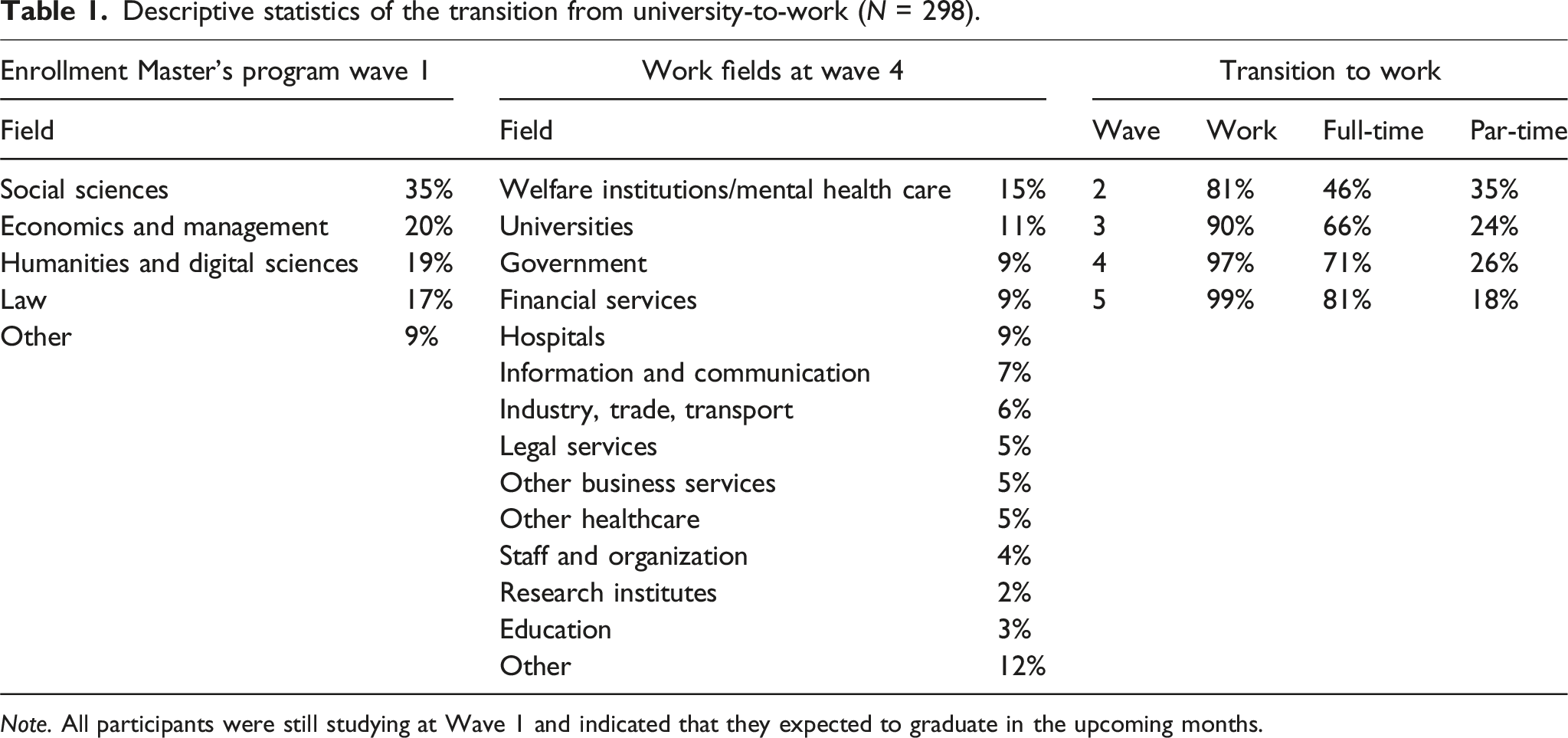
Note. All participants were still studying at Wave 1 and indicated that they expected to graduate in the upcoming months.
Procedure
Dutch-speaking Master students were invited to participate via different communication channels of the participating universities (i.e., email, website, newspapers, career service centers, and social media). They could obtain information and sign up for the study via the projects’ website (https://www.tilburguniversity.edu/gradlife). Each wave contained an online questionnaire that was administrated via a smartphone app (Ethica; https://ethicadata.com/). Participants received financial compensation for the questionnaires (7–€9 in Waves 1–4, €17 in Wave 5) and could win an additional 10–€15 in Waves 1–4. Participants received a personal report based on overall personality traits (i.e., not on study variables) after Wave 1 and newsletters (e.g., with insights into the groups’ university-to-work transition) after each measurement wave. Participants also received a personal report on their personality traits based on all measurement waves at the end of the project. Participants received reminders to fill out the questionnaires via text messages.
Measures
Exploration and commitment processes
Exploration and commitment processes were measured in the domain of future plans with the Dimensions of Identity Development Scale (DIDS) (Luyckx, Schwartz, Berzonsky, et al., 2008). This instrument measures 5 identity dimensions (i.e., commitment making, exploration in breadth, ruminative exploration, identification with commitment, and exploration in depth). Response options ranged from 1 (strongly disagree) to 5 (strongly agree) (e.g., items see the codebook of project GradLife, https://osf.io/fwak9/). In the current project the DIDS had an additional open question compared to the original version of the DIDS, which asked participants which topic(s) they had on their mind when answering the questions about their future plans. In the current study, Cronbach’s alphas across all identity dimensions and measurement waves ranged from .69 to .95, and were thus good to excellent.
Narrative agency and self-event connections
In the online questionnaire at Wave 1, participants were asked to describe a turning point in their self-understanding in a prompt formulated based on the work of McAdams (2007) and McLean et al. (2010). Participants were asked to identify a particular episode in their life story in which they experienced an important change in how they understand themselves. They were asked to describe what happened, when it happened, who was involved, what they were thinking and feeling, why the experience was significant, and what it could say about them and their personality (for the full prompt see the codebook of project GradLife, https://osf.io/fwak9/). The same narrative turning point prompt has been shown to elicit stories that vary in agency (Van Doeselaar et al., 2020) and elicit self-event connections (McLean et al., 2010). There was no word limit for the narratives and length ranged from 16 to 595 words with an average narrative length of 169 words (SD = 94). Agency and self-event connections were coded by two separate teams of three trained coders. Coders were blind for the other data of the participants and coded independently from each other. Discrepancies were discussed each time after coding a maximum of 40 narratives to reach consensus and to prevent coder drift (Syed & Nelson, 2015).
Agency was already coded for the study by Van Doeselaar and Reitz (2022), with agency coders being trained with turning point narratives from a different dataset (Van Doeselaar et al., 2020). Self-event connections were coded specifically for the current study and coders were trained with the first 40 turning points narratives of project GradLife.
Agency was coded on a 5-point scale according to the coding manual by (Adler et al., 2008). The narrative received the value 0 if the participant reported to be completely powerless, at the mercy of circumstances. A value of 1 was assigned to the narrative if the participant is somewhat at the mercy of circumstances. The value 2 was assigned to the narrative if the participant reported agentic and non-agentic elements or lacked information on agency. The value 3 was assigned to the narrative if the participant is somewhat agentic. The value 4 was assigned to the narrative if the participant is completely agentic, able to affect their own life. Values 0 and 1 were only coded when the participant was negatively affected by circumstances. If the narrative described a change in agency, the final stage was coded. The final code was the average of the codes from three coders. The distribution of the final agency codes was 3% for value 0, 11% for value 1, 30% for value 2, 38% for value 3, and 19% for value 4. The Fleiss’ κ of .48 (p < .001) indicated that the coding of agency was reliable (Landis & Koch, 1977). See supplementary material (Appendix A) for a more detailed description of the interrater reliability analyses.
Self-event connections were coded using an adaptation of the coding manual by McLean, Lilgendahl, and Le (https://osf.io/2n6ab). We coded whether the participants made an explicit connection between aspects of an event and parts of the self that endured beyond the experience. A self-event connection can reflect change (i.e., the connection refers to some kind of change in the self or the connection reveals a part of the self that has always been there, but the participant did not know about), which was coded with the value 1. A self-event connection can also reflect stability (i.e., a connection explains a pre-existing part of the self that was always there or reinforces a previously known aspect of the self), which was coded with the value 2 (see supplementary material Table S2). A turning point narrative could also not contain any self-event connections (value of 0). Participants made no self-event connections (13%), one self-event connection (71%) or two self-event connections (16%). The final codes per narrative were the codes on which the three coders reached consensus. For the analyses, we made a change connection variable (i.e., the participant made zero, one or two change connections), a stability connection variable (i.e., the participant made zero, one or two stability connections), and a general self-event connection variable (i.e., the participant made zero, one or two self-event connections including both a change and stability connection). The Fleiss’ κ based on the narratives that were not part of the training phase was 0.76 (p < .001), indicating that the coding of self-event connections was reliable (Landis & Koch, 1977). See supplementary material Table S2 for an illustration of turning point narratives and each of the coding systems.
Subjective impact of the transition
The subjective impact of the transition to work was measured with the Event Characteristic Questionnaire (ECQ) (Luhmann et al., 2020). The impact item was used in this study, which had participants indicate to what extent the statement: “The event had a strong impact on my life” was applicable to the period after they left university and started looking for or started a job. Response options ranged from 1 (not applicable) to 5 (completely applicable). Participant received this question if they indicated to not be a student anymore on Wave 2–5. The average score was used if participants responded to this question in multiple waves.
Analytic strategy
Before running the analyses, we tested whether the missing data were Missing Completely at Random using Little's (1988) Missing Completely at Random (MCAR) test. The MCAR test indicated that data were missing completely at random (χ2 = 3354.69, df = 3252, p = .102), which justifies our use of Full Information Maximum Likelihood (FIML) estimation in Mplus 8 for all our models (Muthén & Muthén, 2017). We also conducted confirmatory factor analyses for the scores of the DIDS to confirm the factor structure. Table S3 (Appendix A) in the supplementary material show the results and confirmed that for the DIDS, a 5-factor model was the best solution. We also investigated whether the scores on the DIDS were invariant over time. Tables S4 and S5 (Appendix A) in the supplementary material show the results and indicate that the DIDS scores were metric and scalar invariant over time.
For the first aim we ran unconditional Latent Growth Curve (LGC) models in Mplus 8 (Muthén & Muthén, 2017) to examine how identity developed on group-level during the study period (H1a-e). For each construct, we first estimated an intercept-only model (Model 1a) with fixed variance around the intercept and tested if freeing the variance around the intercept improved model fit (Model 1b). We then tested whether adding a linear slope (Model 2a) and subsequentially a quadratic slope (Model 3a) would improve model fit. We added these growth parameters first with a fixed variance and additionally tested whether freeing the variance would improve model fit (Model 2b for linear slope and Model 3b for quadratic slope). The slope loadings were 0, 1, 2, 3, and 6 for Wave 1 to 5, respectively (i.e., the time gap between Wave 4 and Wave 5 was one year compared to 4 months between the other waves). We used the Bayesian information criterion (BIC) and the Akaike information criterion (AIC) to identify the best-fitting change models, with lower BIC and AIC values indicating a better fit to the data. If the BIC and AIC led to different solutions, we used Chi-square tests to choose the best model. In addition, we evaluated the overall model fit using the comparative fit index (CFI >.90) and Root Mean Square Error of Approximation (RMSEA <.08; (Hu & Bentler, 1999)). Next, we tested whether the slope variance was significant, as a confirmation of substantial individual differences in identity development during the transition into working life (H2a).
For the second aim, we tested whether the impact scale of the Event Characteristic Questionnaire (ECQ) could explain individual differences in conditional Latent Growth Curve Models of each of the DIDS dimensions (H3a), by including the impact scale as a predictor of the slopes and the intercepts. Next, we examined whether narrative agency and self-event connections would predict individual differences in the conditional Latent Growth Curve Models of the adaptive DIDS dimensions (H4a&b). The transition impact was included in these analyses as a control variable and we ran a separate model for each narrative characteristic. We also did this for the maladaptive DIDS dimension (i.e., ruminative exploration) as an exploratory analysis. We used the same analytic strategy as for hypothesis H3a. Figure 1 shows an example of a Conditional Latent Growth Curve Model with the transition impact and self-event connection/agency predicting the intercept and slope of commitment making. To adjust for false discovery rate, we used a p-value of .01 for all analyses. The preregistration of hypotheses and the analysis plan, code, and data is available on the OSF (https://osf.io/w7xdn and https://osf.io/gmutd/). A Conditional Latent Growth Curve Model with transition impact and self-event connection/agency predicting the intercept and the slope of commitment making.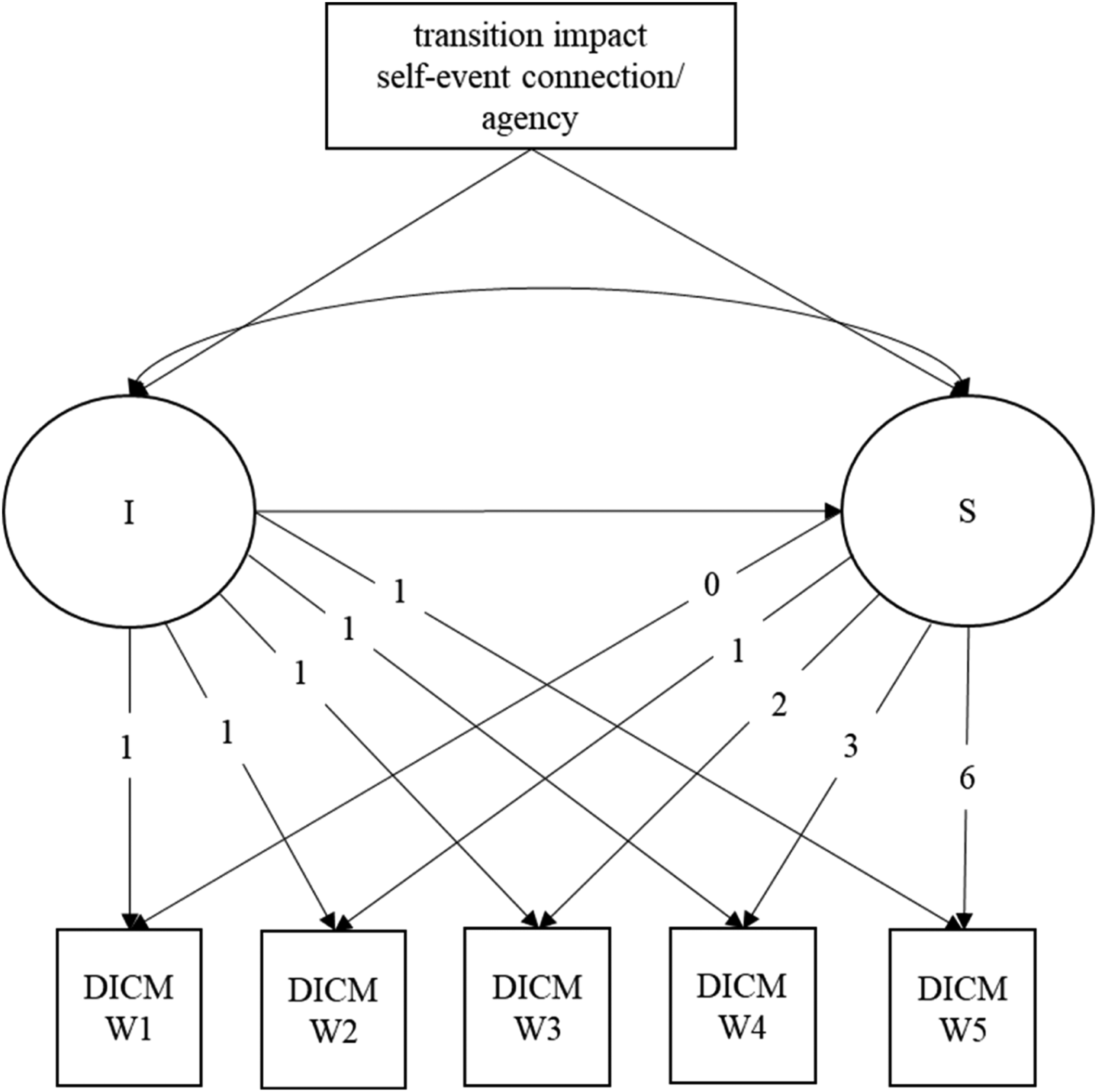
Exploratively, we tested whether splitting up the overarching concept of self-event connection into change connections and stability connections altered the findings. We also tested whether excluding the participants who did not provide a turning point narrative (N = 28), and if controlling for the length of narratives (i.e., number of words) would alter the findings.
Results
Means, standard deviations, and correlations with confidence intervals at W1 (N = 298).
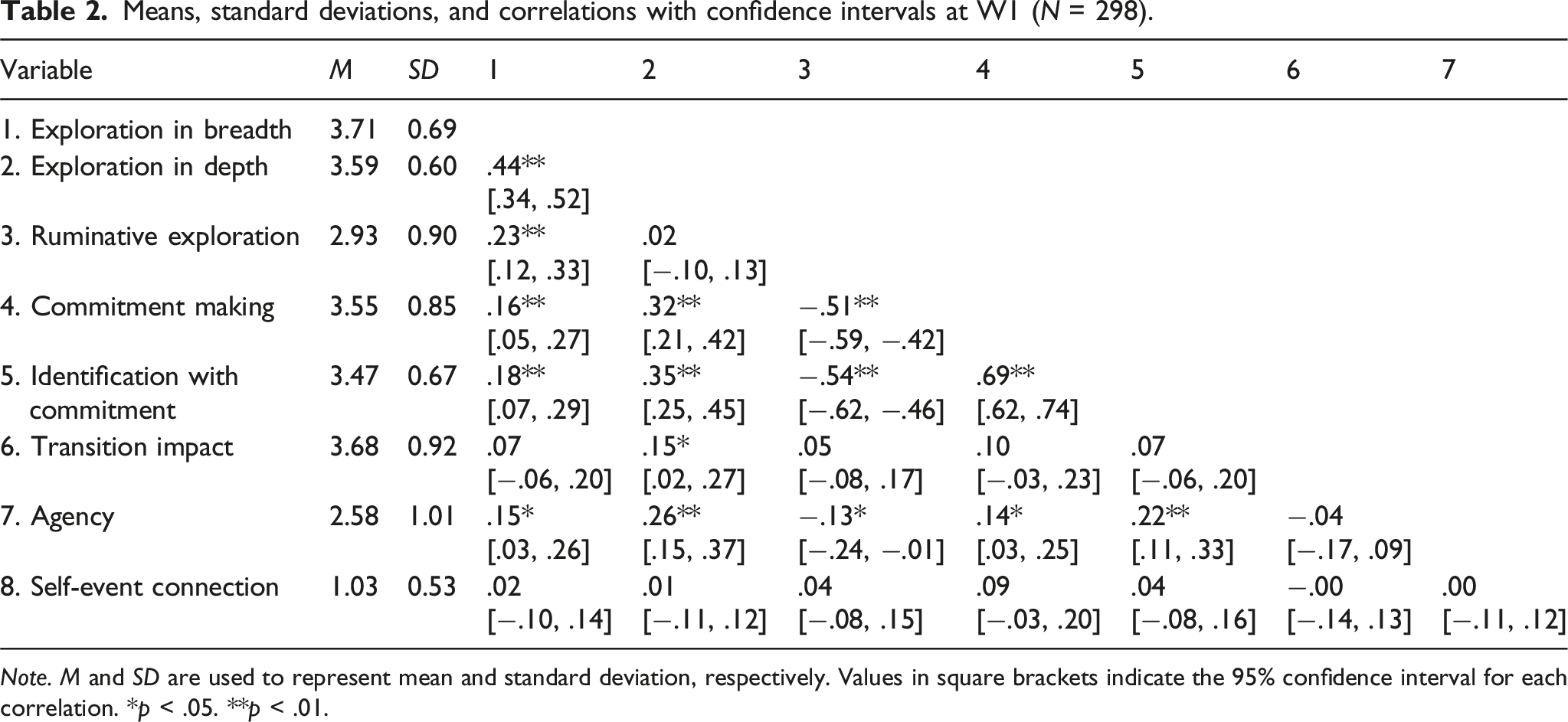
Note. M and SD are used to represent mean and standard deviation, respectively. Values in square brackets indicate the 95% confidence interval for each correlation. *p < .05. **p < .01.
The open question of the DIDS revealed which topics participants had in mind when answering the question about their future plans. Participants on average had 2.2 (SD = 1.1) topics in mind. Most of the participants (91.5%) indicated topics within the career domain. Many participants indicated to think of topics within the romantic relationship domain (43.7%) or about their housing situation (43.3%). Some participants indicated to think of topics relating to friendships (7.8%) or family (4.4%). Participants also indicated that they answered the questions of the DIDS while thinking of traveling (7.2%), their hobbies (6.8%), their financial situation (5.1%), and politics (1.0%). The participants also mentioned topics that could not be classified in any of these categories (12.3%), often because they were relatively vague, such as “my future” or “my development.”
Mean-level changes and individual differences in exploration and commitment processes
Parameter estimates of the best-fitting latent growth models (N = 298).
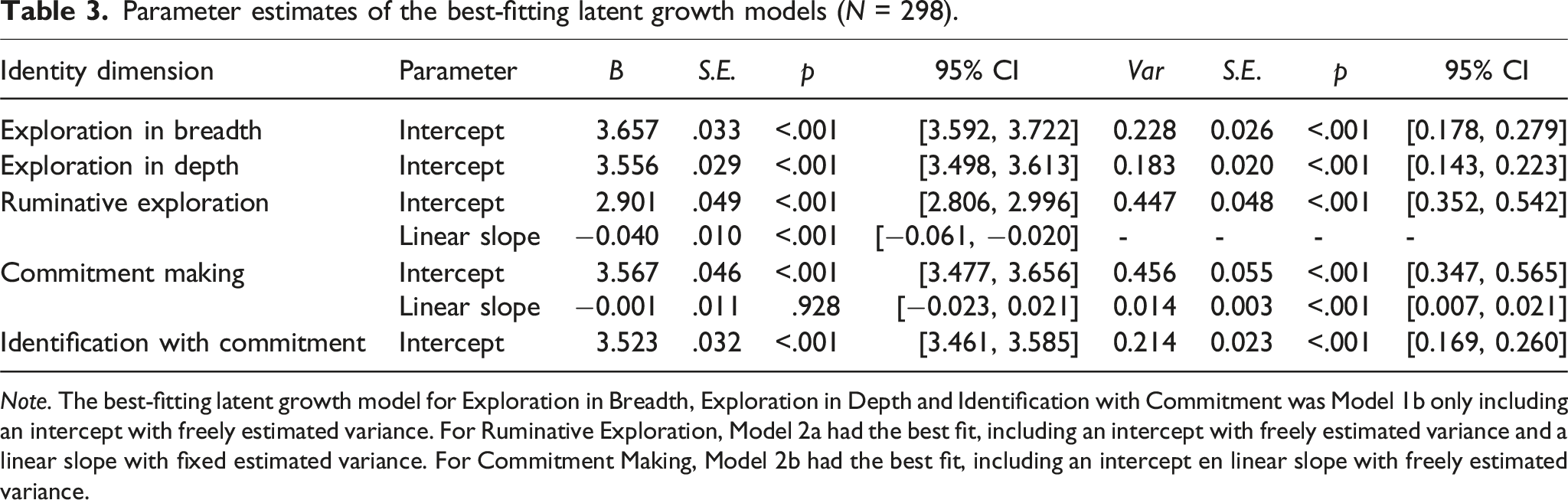
Note. The best-fitting latent growth model for Exploration in Breadth, Exploration in Depth and Identification with Commitment was Model 1b only including an intercept with freely estimated variance. For Ruminative Exploration, Model 2a had the best fit, including an intercept with freely estimated variance and a linear slope with fixed estimated variance. For Commitment Making, Model 2b had the best fit, including an intercept en linear slope with freely estimated variance.
As discussed above, the BIC and Chi-square tests indicated that there were limited individual differences in identity change in all dimensions except for commitment making. The models including individual differences in change (i.e., Model 2b and Model 3a) had a slightly better fit based on the AIC fit indices for exploration in depth and ruminative exploration (Appendix B; Table S6) and showed the same mean-level conclusions as the models with fixed variance parameters (Appendix B; Table S7). However, only the model including individual differences in change (Model 2b) for exploration in depth revealed significant individual differences around the linear slope. Therefore, we decided to test for both commitment making and exploration in depth whether the subjective impact of the transition, narrative agency, and narrative self-event connections would predict individual differences in identity change.
Subjective transition impact, narrative agency, and self-event connections linked to individual differences in exploration and commitment processes
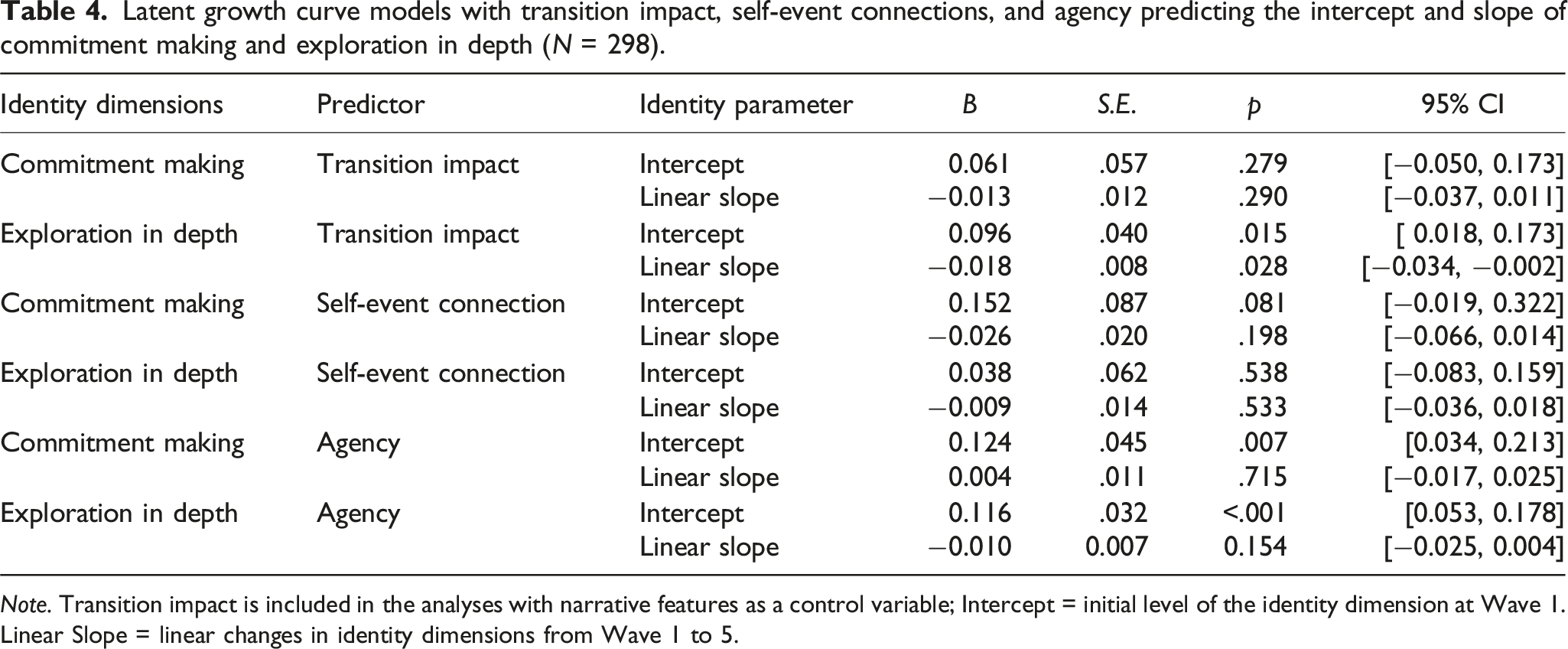
Latent growth curve models with transition impact, self-event connections, and agency predicting the intercept and slope of commitment making and exploration in depth (N = 298).
Note. Transition impact is included in the analyses with narrative features as a control variable; Intercept = initial level of the identity dimension at Wave 1. Linear Slope = linear changes in identity dimensions from Wave 1 to 5.
Table 4 also shows the results of the conditional growth curve models including self-event connections or agency measured at Wave 1 as predictors of the intercept and linear slope of commitment making and exploration in depth in addition to the subjective impact of the transition. The results indicate that both self-event connections and agency did not predict individual differences in the slope of commitment making (self-event connections: B = −0.026, p = .198, agency: B = 0.004, p = .715) and exploration in depth (self-event connections: B = −0.009, p = .533, agency: B = −0.010, p = .154). However, agency was significantly positively related to the initial levels of commitment making (B = 0.124, p = .007) and exploration in depth (B = 0.116, p < .001), indicating that people who narrated in a more agentic way had higher initial levels on these identity dimensions at the same timepoint.
We also explored whether splitting the self-event connections up into a change connection and a stability connection would predict more individual differences in commitment making and exploration in depth. The results of this analysis are shown in Table S9 (Appendix B) of the supplementary material and demonstrate similar nonsignificant results as with the overarching construct of self-event connections. Similarly, adding narrative length as a control variable or running the analyses without the individuals who did not provide a turning point narrative did not change the results (Appendix B; Table S10 and S11).
Discussion
The current study examined exploration and commitment processes during the transition from university-to-working life and the link with transitional and individual factors. First, we examined the change trajectories and individual differences of exploration and commitment processes. The results revealed significant mean-level decreases of ruminative exploration and stability in the other identity dimensions across the transition to working life. We found significant individual differences for commitment making and exploration in depth. Second, we linked the perceived impact of the transition, and narrative agency and self-event connections of a previous turning point to individual differences in exploration and commitment processes. The results revealed that perceived impact of the transition was not associated with initial levels and changes of exploration and commitment. However, higher initial higher levels of narrative agency were linked to higher initial levels of exploration in depth and commitment making.
Mean-level decreases in ruminative exploration and stability in adaptive exploration and commitment dimensions
We found decreases in ruminative exploration over time, indicating that on average, young adults became less involved in repetitive thinking and worrying about their future plans across the university-to-work transition. This finding was in line with our expectations that facing the transition to working life is triggering young adults to make their future plans concrete, which would lead to decreases in ruminative exploration (Luyckx, Schwartz, Berzonsky, et al., 2008). As young adults approach the conclusion of their studies, it is likely that they think repetitively about what comes next in their lives. The results of our open question revealed that decisions regarding career often intertwined with other life aspects, such as romantic relationships and considerations related to where and how one wants to live. This interconnection adds layers of complexity to the decision-making process. Thus, it is not surprising that the young adults show relative high levels of ruminative exploration before the transition, but that these decrease once young adults found jobs. Possibly, the decrease in ruminative exploration might be one source of the small increase in self-esteem during the university-to-work transition that was found in another study (Reitz et al., 2020). Together, these findings might point into the direction of an overall process towards improved adjustment across the two years of the transition.
Mean-level stability was found for the adaptive exploration and commitment dimensions. These findings are partially in line with our expectations, as we hypothesized to find either identity stability based on previous mixed findings (e.g., Den Boer et al., 2021; Mannerström et al., 2019; Meeus, 2016), or increases in the adaptive exploration and commitment processes based on the model of identity formation by Luyckx and colleagues (Luyckx, Goossens, Soenens, et al., 2006; Luyckx, Schwartz, Berzonsky, et al., 2008). Our findings replicate existing empirical research in adolescence that demonstrates identity stability in adaptive identity processes (Meeus, 2016; Meeus et al., 2010). The observed stability could possibly be elucidated by the model’s assumption of a circular individual difference process for the adaptive identity dimensions. Consequently, mean-level changes in one adaptive dimension are contingent upon mean-level changes in another adaptive identity dimension. For example, after a period of considering different jobs (i.e., period of high levels of exploration in breadth), one might accept a job, resulting in increases in commitment making and decreases in exploration in breadth. Conversely, another individual might be triggered by the transition to actually consider different jobs, thus showing increases in exploration in breadth and decreases in commitment making. This could result in a situation where individuals change in opposite directions, potentially leading to average stability. Empirical research indeed shows that within persons, commitment making is negatively associated with exploration in breadth (Waterman, 2015). Moreover, moving back and forth between identity formation processes (i.e., exploration in breadth and commitment making) and identity evaluation processes (i.e., exploration in depth and identification with commitment) is considered adaptive for making good choices that fit with oneself. The idiosyncratic nature of identity development makes it essential to measure identity development on both the between-person level (i.e., mean-level changes) and the within-person level (i.e., dynamics). Previous research has predominantly focused on the between-person level, but future research should also focus on interindividual processes of identity development (Branje, 2022), which will give insight into this circular individual process and explain how identity development takes place within individuals over time (Becht et al., 2017).
Individual differences in commitment making and exploration in depth
Our results demonstrated significant individual differences in exploration in depth and commitment making, although we anticipated individual differences in all identity dimensions. This finding indicates that identity development of the young adults in the current study was quite homogeneous, in contrast to previous research on longitudinal identity development in young adults (Den Boer et al., 2021; Luyckx, Schwartz, Goossens, et al., 2008; Mannerström et al., 2019). An explanation for the lack of individual differences could lie in the uniform and favorable nature of the university-to-work transition in the Dutch context. The participants in our study were all Master students in The Netherlands who were expecting to graduate in the upcoming months during a historical time where there were more vacancies than unemployed people (CBS, 2021). Our study showed a little variation in the timing of the transition to working life, as 80% of the sample had transitioned at Wave 2 already, and 99% had transitioned within two years, reflecting the favorable labor market conditions for job beginners in the Netherlands. In contrast, in the study by Mannerström et al. (2019) in Finland, slightly above 50% of job beginners stated to work within 5 years. Their study took place in a historical time with poor employment prospects, whereas this was not the case for our study. The Finnish study aligns with research on identity development during the university-to-work transition in the Georgia, a country with high unemployment rates (Skhirtladze et al., 2022). That study identified four distinct identity developmental trajectories, demonstrating that individuals construct their identities in different ways during this transition in the context of Georgia compared to the Netherlands. The study by Den Boer et al. (2021), similar to the current study, was conducted in the Dutch context and examined a similar sample (i.e., students who obtained a Master degree at a scientific university and transitioned to working life), finding significant individual differences in all identity dimensions. However, the historical context was different, as data collection of this study occurred between 2014–2018, during the aftermath of the Great Regression of 2008. This financial crisis affected employment opportunities in the Netherlands dramatically, with only 14 job vacancies per 100 unemployed individuals at the start of 2014 (CBS, 2024). The employment opportunities improved during the study period of Den Boer et al. (2021) into 60 vacancies per 100 unemployed people at the end of 2018 (CBS, 2024). The comparison of the different contexts suggests that identity development during the transition to working life is shaped by employment opportunities. It could be that better employment opportunities may lead to more uniform identity development, as this context allows young adults to commit to career options that really fit with who they are. Future research should study how contextual factors, such as employment opportunities, influence identity development during the transition to work. Qualitative analyses could provide insight into contextual factors that might have been overlooked so far.
An alternative explanation could come from our measure that might not be sensitive enough to pick up small changes in exploration and commitment processes. Indeed, an item response theory analysis of the DIDS measure revealed that the precision of the items is relatively low (Johnson et al., 2022). Thus, it could be that the lack of measurement precision is the reason why individual differences and development in exploration and commitment processes are less easily picked up. New instruments with a higher precision providing more information on the item-level and subscale-level might be needed to pick up small changes (Johnson et al., 2022).
Transition impact does not predict individual differences in exploration and commitment processes
We examined whether the perceived impact of the transition could predict individual differences in commitment making and exploration in depth, but our results showed that these individual difference could not significantly be predicted. Noteworthy, the transition impact did tentatively predict individual differences in the initial levels and changes of exploration in depth at the less conservative p-value threshold of .05. This suggests that the perceived transition impact might be associated with initial levels and changes of in-depth exploration; however, the effect size seems to be small. A small effect size for perceived event characteristics and identity development is in line with previous research on the association between perception of life events and personality trait changes (Haehner et al., 2023), and the association between the perception of life events and changes in prosociality and empathy (Fassbender et al., 2022). In contrast, a study utilizing the same dataset as the present study found that the perceived valence of the university-to-work transition did not explain individual differences in the link between pride and self-esteem (Diwan et al., 2023). Replication studies with more power to detect small effects sizes are needed to test whether perceived transition impact can predict individual differences in exploration and commitment processes.
Alternatively, a more complex measure of the impact of the transition may give additional insight into the association between event perceptions and exploration and commitment processes (Haehner et al., 2023). In the present study, the impact of the transition was measured with one item and captured a general sense of the impact, but it did not give a description of the content of the transition and why the transition was experienced as impactful. Such detailed descriptions of the transition could be obtained with a narrative identity approach where participants are asked to speak or write about the transition experience (McAdams, 2007; McLean et al., 2010). This approach would be additional to the approach in the current study, as our participants described a life event that happened before the transition.
Narrative agency is associated with initial levels of commitment making and exploration in depth
Finally, we investigated whether narrative characteristics agency and self-event connections drawn from a turning point event before the transition could predict individual differences in exploration and commitment processes during the transition to working life. Our results show that narrative agency of a previous turning point was related to individual differences in initial levels of both commitment making and exploration in depth. This suggests that individuals who demonstrated higher levels of agency in a story of a previous turning point also had higher initial levels of commitment making and exploration in depth before the transition to working life. These results corroborate the findings of the cross-sectional part of the study by Van Doeselaar et al. (2020) on agency, commitments, and exploration in adolescents and work by Van Doeselaar and Reitz (2022) on narrative agency, self-esteem, and life satisfaction. Together, this suggests that higher levels of narrative agency in previous turning points are related to higher levels of psychological functioning at the moment of writing the narratives.
In line with theoretical assumptions (McLean & Pasupathi, 2012) and empirical results (McLean & Pratt, 2006; Van Doeselaar et al., 2020), we hypothesized that making self-event connections would be associated with initial levels of adaptive exploration and commitment. Our results did not confirm this hypothesis and are, therefore, actually in line with the mixed empirical findings that have been found in the past for this association. We assumed that the more complex and richer narratives of young adults would facilitate a stronger association between narrative characteristics and commitment and explorations processes than was found among adolescents. Our results did not support this notion, suggesting that narrative complexity may not offer an explanation for the mixed empirical findings in past work.
An explanation could come from the nature of self-event connections made. Self-event connections can have a positive or negative valence, with positive self-event connections being associated with higher well-being and negative self-event connections with lower well-being (Graci et al., 2018; Lilgendahl & McAdams, 2011). It could be that differentiating based on the valence of the self-event connection would bring more insight into the association of self-event connections with exploration and commitment processes. It is for example likely that if someone connected a previous turning point to positive self-growth, this would be related to higher initial levels of adaptive exploration and commitment processes. Conversely, if a previous turning point is connected to negative evaluation of the self, this may be related to higher initial levels of ruminative exploration. Future studies should, therefore, also focus on the valence of self-event connections.
In addition to initial levels, we also expected that self-event connections and agency from a previous turning point would be linked to individual differences in exploration and commitment changes during the transition to working life. Our results showed that agency and self-event connections were not related to changes in exploration and commitment processes. This is only partly in line with the longitudinal study by Van Doeselaar et al. (2020) in a sample of adolescents, as they demonstrated predictive effects for agency, but not for self-event connections, on changes in exploration and commitment processes. Therefore, our study replicated the nonsignificant links between exploration and commitment processes in a sample of young adults, but not the significant link between agency and exploration and commitment processes. Together, this suggests that the effect of narrative agency from a previous turning point on changes in exploration and commitment during a subsequent life event might be small. This effect might be small due to the differing time perspective of the instruments used to measure both identity approaches. The DIDS measures current exploration and commitment processes of not defined future plans (Luyckx, Schwartz, Berzonsky, et al., 2008), while narrative prompts are grounded in a time-specific event drawn from one’s autobiographical memory (McAdams, 2007). This different time perspective in measurement might explain the small association between these identity approaches.
Alternatively and simultaneously, exploration and commitment processes during the transition might impact how people will later tell their story about the transition. Relative changes in narrative characteristics could also be related to relative changes in exploration and commitment processes (i.e., change in tandem), which the studies by Carlsson et al. (2015, 2016) found evidence for. Past work has sometimes concluded that the exploration and commitment processes approach and the narrative identity approach are two different but related aspects of identity formation based on the small and inconsistent relationship of narrative characteristics with exploration and commitment processes (McLean et al., 2014; McLean & Pratt, 2006; Van Doeselaar et al., 2020). Although this might be true, the above suggests that more attention should go to alternative connections between the two approaches, which might offer more insight in heterogeneity in exploration and commitment processes during life events.
Strengths and limitations
The present study has a number of strengths. We used a longitudinal design which made it possible to examine whether associations between narrative identity could predict the development of exploration and commitment over time. We used two different methods (i.e., self-report questionnaire and coded narrative data) to study identity development during the university-to-work transition, which reduces the chance that associations were the result of shared measurement error. Finally, we had preregistered hypotheses and analyses, checked for measurement invariance, and adjusted for multiple testing. Nevertheless, the study has several limitations that need to be acknowledged. First, we examined the characteristics of a single life narrative. Prior research has demonstrated significant individual differences in narrative characteristics based on the narrative prompt (McLean et al., 2016), which makes the selection of an appropriate narrative prompt crucial. Turning point prompts were considered suitable for the present study, due to their ability to elicit self-event connections (McLean et al., 2010). However, to enhance reliability and perhaps establish more associations with exploration and commitment processes, it would be advisable to evaluate agency and self-event connections across multiple narratives or conduct a comprehensive life story interview (McAdams, 2007), to reduce situational influences on story telling.
Second, at best the results of our study may be generalized to Dutch students who transition from university to work because the construction of narrative identity may differ across cultures (e.g., Reese et al., 2014; Skhirtladze et al., 2022). Furthermore, the association between the two identity approaches could vary in different cultural contexts. Moreover, as described above, the transition to work may be more or less uniform across different countries and historical times, depending on the educational system, economic situation, and other contextual factors (Negru-Subtirica, 2024). Studies from other countries (with more or less favorable labor market conditions that the Netherlands at the time of our study) and/or including students from other educational levels are needed to examine the generalizability of our findings.
Third, the data collection of the current study took place during the COVID-19 pandemic. The pandemic may have presented unique challenges for young individuals in terms of exploration and commitment of future plans despite the good employment opportunities in the Netherlands during the pandemic. For example, the COVID-19 pandemic may have made it more difficult for young adults to explore different future plans and make commitments via real-life interactions. Therefore, replication in other time periods is needed.
Conclusion
Overall, our study demonstrated mean-level decreases in ruminative exploration and stability in adaptive exploration and commitment dimensions during the transition. On average, young adults seemed to worry less as they progressed in their transition to working life. We demonstrated individual differences in commitment making and exploration in depth. Our results suggest that the university-to-work transition in the Dutch context might trigger relative uniform identity processes in a historical context with good employment opportunities. Individual differences in the initial level and changes in exploration in depth seemed to be somewhat linked to the perceived transition impact. Future studies should replicate this finding and include a detailed description of the relevant life event, as this would provide richer information on why and how this life event was perceived as impactful. Finally, agency in a turning point narrative was positively associated with the initial levels of exploration in depth and commitment making, offering valuable insights into the association of the two identity approaches. While narrative agency is connected to exploration in depth and commitment making at a given time, this link does not hold longitudinally. Future research aiming to fill the gap surrounding this association should explore additional ways in which exploration and commitment processes are linked to narrative identity (e.g., by focusing on narratives of the transition or on tandem change). Additionally, examining adaptive exploration and commitment processes at the intra-individual level, alongside mean-level changes, might give more insight into the idiosyncratic nature of identity formation. The study materials, data, and analysis scripts used for this article can be accessed at https://osf.io/gmutd/.
Supplemental Material
Supplemental Material - Shaping who we are: Linking narratives to identity processes during the university-to-work transition
Supplemental Material for Shaping who we are: Linking narratives to identity processes during the university-to-work transition by Liselotte Den Boer, Elisabeth L De Moor, and Anne K Reitz in European Journal of Personality
Footnotes
Declaration of conflicting interests
The author(s) declared no potential conflicts of interest with respect to the research, authorship, and/or publication of this article.
Funding
The author(s) disclosed receipt of the following financial support for the research, authorship, and/or publication of this article: This work was supported by the HORIZON EUROPE Marie Sklodowska-Curie Actions; 846839, awarded to Anne K. Reitz.
Open science statement
The preregistration of hypotheses and the analysis plan, code, and data is available on the OSF (https://osf.io/w7xdn and https://osf.io/gmutd/). The research materials can also be found on the OSF ( ).
).
Supplemental material
Supplemental material for this article is available online.
References
Supplementary Material
Please find the following supplemental material available below.
For Open Access articles published under a Creative Commons License, all supplemental material carries the same license as the article it is associated with.
For non-Open Access articles published, all supplemental material carries a non-exclusive license, and permission requests for re-use of supplemental material or any part of supplemental material shall be sent directly to the copyright owner as specified in the copyright notice associated with the article.
