




Abstract
This study explored narcissistic states using a hierarchical, trifurcated structure, examining state variability and trait-state associations of agentic extraversion, self-centered antagonism, and narcissistic neuroticism. The primary objective was to investigate whether the structural composition of narcissism, well-established in trait data, could be replicated in state data. We examined this structure at both between- and within-person levels in state data, including situation-specific structures of narcissism. The study used data from an experimental study where participants (N = 189) met in groups of up to four people weekly over six weeks. Multilevel confirmatory factor analyses revealed that the narcissism structure was largely the same at both levels. However, within-person compositions of narcissism differed across affiliative versus controversial situations. In affiliative contexts, grandiosity manifested exclusively through agentic extraversion, with no expression through self-centered antagonism. In controversial settings, agentic extraversion and narcissistic neuroticism exhibited a slight negative association, contrasting the positive association observed across all group meetings. Our results show that narcissistic states exhibited less variability compared to the Big Five and rarely varied above their corresponding trait levels. This research contributes to a refined understanding of narcissism, highlighting the interplay between trait tendencies and situational factors in shaping narcissistic state expressions.
Plain language summary
Interest in narcissism has grown recently. Traditionally, most research has focused on narcissism as a stable personality trait, meaning how it generally affects a person’s behavior. However, researchers are now exploring “narcissism states,” which examine how people display narcissistic traits in specific situations and whether these expressions can change. We conducted an online study where small groups of people met weekly for six weeks. Our main goal was to see if the structure of narcissism looks the same in the moment (state) as it does over time (trait). Precisely, we examined a model that has different domains of narcissism: grandiosity and vulnerability, which then branch out into domains like how entitled and authoritative someone is (agentic extraversion), how manipulative and unempathetic they might be (self-centered antagonism) and how self-conscious they are (narcissistic neuroticism). We also looked at how much these different sides of narcissism change over time and how their long-term level relates to their momentary level. Our findings suggest that the way narcissism is structured remains mostly consistent in both momentary situations and long-term traits. However, the relationship between vulnerability and grandiosity does not explain the other aspects of narcissism (lower-order domains) in the same way when we look at short-term expressions compared to long-term traits. Moreover, when comparing different situations (affiliative vs controversial), the narcissism structure is slightly different at the momentary level. Additionally, narcissism tends to be less variable than other personality traits over time, often remaining lower than typical trait levels. We discuss the implications of these findings and suggest areas for future research.
Over the last decade, narcissism—broadly defined as a personality trait marked by an inflated positive self-view, a sense of entitlement, and frequent efforts to validate and enhance self-esteem (e.g., Campbell & Foster, 2007; Morf et al., 2017)—has received considerable research attention. Findings suggest a complex nomological network, including many real-life consequences of narcissism (e.g., Back, 2018; Crowe et al., 2019; Krizan & Herlache, 2018; Miller et al., 2016, 2017). Recent research on trait narcissism extends the traditional unidimensional view, emphasizing the construct’s hierarchical, multidimensional nature (Ackerman et al., 2019; Back et al., 2013; Cain et al., 2008; Crowe et al., 2019; Krizan & Herlache, 2018; Miller et al., 2016; Morf & Rhodewalt, 2001; Wright & Edershile, 2018). The hierarchical conceptualization splits narcissism into two higher-order domains: grandiosity and vulnerability. These domains further subdivide into a trifurcated structure at the lower order. One domain reflects the shared antagonistic aspects of grandiosity and vulnerability, while the other two domains distinctly capture their related yet separate agentic and neurotic aspects.
Considerable progress has been made in understanding trait narcissism. However, despite recent efforts in personality research proposing investigating and integrating between- and within-person approaches to personality (e.g., Baumert et al., 2017), much less is known about narcissism at the state level (e.g., Edershile & Wright, 2022; Miller et al., 2022). Some studies have started to bridge this gap. These studies focused on the relation between narcissistic traits and narcissism-relevant states, such as self-esteem (Bosson et al., 2008; Du et al., 2024; Geukes et al., 2017; Heyde & Vergauwe et al., 2023; Kroencke et al., 2023; Mota et al., 2022; Scharbert et al., 2024), and others examined narcissistic states as momentary grandiosity and vulnerability (Edershile et al., 2019; Edershile & Wright, 2021a, 2021b, Giacomin & Jordan, 2016a, 2016; Heyde et al., 2023).
The later studies explored the established narcissism trait domains at the state level. However, Molenaar (2004) showed that within-person dynamics do not always mirror between-person associations. A recent study by Rogoza & Krammer et al. (2024) explored the structural composition of narcissistic states, focusing separately on the two higher-order and three lower-order domains. Their findings suggest that narcissistic states—at either hierarchical level—mirror the organization observed at the trait level.
The present study seeks to extend the work of Rogoza & Krammer et al. (2024) by examining whether the hierarchical model of narcissism—comprising two higher-order and three lower-order domains—equally applies to state-level expressions. Our primary objective is to explore whether momentary manifestations of narcissism at the state level align with the established trait structure. We aim to examine the structural composition of narcissism at the state level across multiple situational contexts, providing a comprehensive view of how narcissistic states manifest in general (i.e., across multiple situations).
Narcissism trait conceptualization
Though traditionally distinct, theoretical conceptualizations of narcissism from personality science, clinical psychology, and psychiatry have been meaningfully integrated in recent years (see Cain et al., 2008). These efforts suggest that narcissism can be differentiated into at least two domains—grandiosity and vulnerability—with partially overlapping nomological networks (Cain et al., 2008; Miller et al., 2011; Pincus et al., 2009; Pincus & Lukowitsky, 2010). Grandiosity is characterized by high self-esteem, overconfidence, sociability, assertiveness, and exhibitionism. In contrast, vulnerability typically involves lower and contingent self-esteem, shame-proneness, social withdrawal, and emotional instability (Back et al., 2013; Crowe et al., 2019; Krizan & Herlache, 2018; Miller & Campbell, 2008; Miller et al., 2011). At the trait level, grandiosity and vulnerability are positively associated (e.g., r = .42; Crowe et al., 2019), reflecting commonalities between the two domains. In particular, vulnerability and grandiosity share interpersonally antagonistic attributes, such as egotism and entitlement (Back et al., 2013; Krizan & Herlache, 2018; Miller & Campbell, 2008; Miller et al., 2011).
Further elaborating the idea of conceptually overlapping yet distinct narcissistic domains, recent literature suggests a hierarchical narcissism structure with three lower-order domains (e.g., Crowe et al., 2019; Krizan & Herlache, 2018; Miller et al., 2016). This framework elucidates the shared characteristics and distinctions between grandiosity and vulnerability. Employing a bass-ackward approach 1 , Crowe et al. (2019) identified a three-domain structure, branching off grandiosity and vulnerability, referred to as Trifurcated Model of Narcissism (TMN). The TMN identifies a central antagonism domain and two peripheral domains that distinguish narcissism into agentic extraversion and narcissistic neuroticism. Similarly, the Narcissistic Spectrum Model (Krizan & Herlache, 2018) divides narcissism into three domains: entitled self-importance at the center, along with reactivity and boldness at the peripheries. The primary distinction between the TMN and the Narcissistic Spectrum Model lies in their core aspect. In essence, the entitlement domain in the Narcissistic Spectrum Model can be understood as a narrower component of the antagonism domain in the TMN (Crowe et al., 2019). Despite this minor distinction and differing terminologies, the models largely overlap conceptually (cf. Wright & Edershile, 2018). An additional model that can be incorporated into these conceptualizations but focuses on grandiosity differentiates between narcissistic rivalry and admiration (Back, 2018; Back et al., 2013). Rivalry can be seen as a form of narcissistic self-defense closely associated with self-centered antagonism. In contrast, admiration represents narcissistic self-promotion, essentially equating to agentic extraversion. The current study utilizes the terminology of the TMN, one representative of the hierarchical three-dimensional conceptualization of narcissism.
Within the TMN, self-centered antagonism is characterized by entitlement, arrogance, exploitativeness, and a lack of empathy. In contrast, agentic extraversion is associated with assertiveness, leadership, self-esteem, and a behavioral preference for activation and approach. Lastly, narcissistic neuroticism is linked to lower and dependent self-esteem, negative emotionality or emotional dysregulation, a desire for admiration, and other self-conscious emotions, such as shame (e.g., Crowe et al., 2019; Krizan & Herlache, 2018; Miller, 2016). Positioned hierarchically beneath the two-domain model, the TMN domains reflect either one or both higher-order domains. According to Crowe et al. (2019), agentic extraversion is loaded by grandiosity (α = .96), while narcissistic neuroticism is loaded by vulnerability (α = .93). Self-centered antagonism, however, is influenced by both domains (grandiosity α = .68; vulnerability α = .69) and thus, serves as a crucial link between the two.
This structural relation is also evident in the correlations among the TMN domains. Crowe et al. (2019) reported more substantial associations between self-centered antagonism and narcissistic neuroticism (r = .39) and agentic extraversion (r = .50) than the latter two domains have with each other (r = .28). Again, these results highlight the central role of self-centered antagonism and suggest that the other two domains occupy more peripheral positions within the structure of narcissism. This trait structure seems well-established. However, it remains unclear whether the same relations can be observed at the state level.
A dynamic approach to personality: Integrating states and Traits
Researchers are increasingly advocating a dynamic approach to personality (e.g., Sosnowska et al., 2021), conceptualizing personality as stable dispositional traits with states that can vary from moment to moment (Baumert et al., 2017; Jayawickreme et al., 2021). Personality traits can be defined as “an individual’s characteristic pattern of thought, emotion, and behavior, together with the psychological mechanisms hidden or not—behind those patterns” (Funder, 1997, p. 2). Personality states have the same content domain as their corresponding traits. However, they refer to how a person is in a given moment rather than how that person is in general (e.g., Fleeson, 2001).
This view is substantiated by the Whole Trait Theory (Fleeson, 2012; Fleeson & Jayawickreme, 2015), which provides a comprehensive framework for understanding personality traits incorporating a descriptive and explanatory side. The descriptive side views traits as density distributions of states, reflecting the variability of individual states over time. Meanwhile, the explanatory side focuses on the psychological mechanisms that give rise to these dispositional traits. The theory integrates both trait and state approaches, proposing that personality is not a set of fixed characteristics but rather a dynamic system where individual states vary around a central tendency, referred to as the trait level. This conceptualization of traits will guide the present study. Consequently, we will investigate the structural composition of narcissism at both the within-person and between-person levels, using narcissistic state reports.
Narcissism at the state level: Variability and trait relations
Empirical studies examining personality at the state level have demonstrated their variability from moment to moment. This phenomenon has been observed in personality domains like the Big Five and associated constructs, such as self-esteem and interests (Donnellan et al., 2012; Fleeson, 2001; Horstmann et al., 2021; Roemer et al., 2021; Sherman & Rauthmann et al., 2015). Moreover, in line with the suggestions by Whole Trait Theory, the Big Five personality states have been proposed to form a distribution around their corresponding trait, demonstrating state manifestations below and above the trait level (e.g., Fleeson & Jayawickreme, 2015).
Intraindividual variability in narcissistic states
Few studies examined narcissistic state variability. Some have investigated narcissism variability by associating trait grandiosity with variability in self-esteem states (Geukes et al., 2017). Other studies explicitly examined grandiosity and vulnerability states, associating them with other state variables, such as stress or well-being (Giacomin & Jordan, 2016a, 2016). For instance, Giacomin and Jordan (2016b) explored daily variability in grandiosity and vulnerability, demonstrating substantial intraindividual variability, which was systematically linked to subjective well-being. Another example comes from the study by Mota et al. (2022), who examined intraindividual variability in rivalry and admiration, associating it with perceived status success. These studies mainly focused on external correlates of variability in narcissistic states.
Examining the variability of narcissistic states more directly, studies showed that intraclass correlations (ICCs) ranged between .47 and .64 for vulnerability and between .51 and .74 for grandiosity states (Edershile et al., 2019; Edershile & Wright, 2021a; Heyde & Wille et al., 2023; Maaß et al., 2018). Notably, prior research findings question the utility of examining narcissism variability without considering the more refined theoretical model (Rogoza & Zajenkowski et al., 2024). Examining more homogeneous narcissistic domains, Heyde & Wille et al. (2023) reported ICCs for the grandiosity facets of admiration and rivalry. They reported an ICC of .60 for admiration and .66 for rivalry. Despite Rogoza & Krammer et al. (2024) not explicitly providing ICCs for narcissistic domain states, their supplemental materials disclose ICCs for the three lower-order domains, as assessed by the super-short form of the Five-Factor Narcissism Inventory (FFNI-SSF). The ICCs for agentic extraversion items ranged from .81 to .84; for self-centered antagonism, the ICCs fell between .72 and .78; and for narcissistic neuroticism items, ICCs ranged from .65 to .78. 2 To conclude, all studies substantiate that narcissistic states exhibit momentary variability.
Still, narcissistic state variability seems to be less pronounced than variability in other personality domains. To compare, ICCs for the Big Five typically yield smaller values, ranging between .20 and .40 (e.g., Horstmann et al., 2021; Sherman & Rauthmann et al., 2015). Another example comes from interest states, whose ICCs are higher (around .50 to .70; Roemer et al., 2021). Yet, regardless of the absolute ICC value, all studies found substantial and meaningful within-person variance for narcissistic domains. Hence, examining narcissism from a state perspective—recognizing both person and situational influences on narcissistic expressions—seems fruitful.
Focusing on the three lower-order domains, the current study aims to examine variability in narcissistic states within a standardized longitudinal context. This approach offers a unique perspective compared to previous daily diary or experience sampling studies. While those methods capture a wide range of situations and allow for natural variability, their lack of standardization makes it challenging to assess situational influences accurately. Conversely, experimental studies provide greater environmental control and enhance inter-individual comparability, albeit at the cost of reduced situational diversity. Notably, Edershile et al. (2023) combined both approaches and found that individuals exhibit similar levels and variability in their grandiosity and vulnerability states across naturalistic settings and a single experimental session. Building on these findings, we will examine ICCs in the three lower-order domains—agentic extraversion, self-centered antagonism, and narcissistic neuroticism—in a longitudinal, experimental design. Our investigation will not only focus on the extent of narcissism variability but also explore how these state distributions assemble around the trait level—as assessed by a dispositional measurement. This controlled, longitudinal approach aims to provide a more fine-grained understanding of narcissistic state variability.
Correlations between narcissistic traits and aggregated states
Previous research indicates that trait grandiosity and vulnerability scores have medium- to large-sized associations with their corresponding average state scores (Edershile & Wright, 2021; Giacomin & Jordan, 2016a, 2016; Maaß et al., 2018). Using data from a daily diary, Giacomin & Jordan, 2016a report a correlation of r = .79 between narcissistic traits (primarily grandiosity) and the corresponding daily state average. Making use of an experience sampling design, Edershile and Wright (2021a) observed r = .39 [90% CI: .33; .44] for the correlation between the grandiosity trait and the mean aggregated state, and r = .31 [90% CI: .24; .37] for vulnerability. These estimates align with findings by Maaß et al. (2018), who also reported a correlation of r = .35 [90% CI: .23, .45] between narcissistic traits and aggregated state scores derived from experience sampling data.
While the prior studies examined the trait-aggregated state relations in the two higher-order domains, a recent study by Rogoza & Krammer et al. (2024) explored the relations between narcissistic states and traits in the three lower-order domains (i.e., TMN). Across various samples and measurement instruments examined in naturalistic settings (i.e., daily diary or experience sampling), the correlations between the agentic extraversion trait and states ranged from r = .23 to r = .81. Similarly, the correlations between the narcissistic neuroticism trait and corresponding states varied between r = .21 and r = .76. For the self-centered antagonism trait and states, the authors report an association of r = .53. Notably, these associations did not involve aggregated states.
The current study aims to extend the understanding of trait-aggregated state relations to the three lower-order domains within an experimental setting (i.e., standardized online group environments). By employing a standardized setup, we aim to improve the clarity and interpretability of our results.
Correlations between trait and state variability in narcissism
Whole Trait Theory suggests a relation between the trait and the distribution of states (Fleeson & Jayawickreme, 2015). This bears the question of whether, next to the trait-aggregated state relation, the trait also relates to the variability of the state distribution. Edershile and Wright (2021a) examined relations between trait grandiosity and vulnerability and the variability of their corresponding states in an experience sampling design. They found no relation between grandiosity and its state variability. However, they identified a moderate positive correlation (r = .20) between trait vulnerability and the variability in its corresponding state. Again, we aim to extend these findings to the trifurcated structure (i.e., the three lower-order domains) and a standardized context.
Structural composition of narcissism at the state level
Whole Trait Theory (Fleeson, 2001; Fleeson & Jayawickreme, 2015) mostly focuses on how a single domain state can be aggregated to provide insights into the corresponding trait. Consequently, we can assume that the between-person structural composition of narcissism should be observable from state data only.
However, Whole Trait Theory does not address the correspondence between the interrelations of two or more constructs at the between-person and matching within-person level. Implicitly, it is often assumed that the personality state structures should mirror trait structures (e.g., Fleeson & Jayawickreme, 2015). This is also reflected in the prior narcissism investigations, which examined identical state-level narcissistic domains that have been established at the trait level (Edershile et al., 2019; Edershile & Wright, 2021a, 2021b, Giacomin & Jordan, 2016a, 2016; Heyde et al., 2023).
More explicitly, this assumption can be derived from the TESSERA framework. TESSERA highlights the connection between long-term personality trait development and recurring short-term variability (Wrzus & Roberts, 2017). Notably, TESSERA proposes that personality domains manifested in similar situations are more likely to show correlated changes than those encountering different or conflicting situations. In other words, if two constructs are prone to manifest in the same situations, this suggests a connection in their development. It can be inferred that state co-occurrence ultimately results in covariance at the trait level. As such, TESSERA serves as a valuable guide to investigate the correspondence between the established narcissism trait structure and the narcissism structure that needs to be explored at the state level.
Few studies examined state-level associations between narcissistic domains that are at the same hierarchical level, such as vulnerability and grandiosity. The associations reported range from small- (r = .10; Edershile et al., 2019) to large-size associations (r = .64; Edershile & Wright, 2021b), likely influenced by different measurement tools and situational factors that naturalistic settings cannot control for. Rogoza & Krammer et al. (2024) also investigated the two-domain and three-domain structures of narcissism using state-level data collected in naturalistic settings. Their findings indicated that narcissistic states consistently reflect a structure analogous to that observed at the trait level across the examined situations. However, while they explored both hierarchical levels of the narcissism model, they analyzed the two orders separately.
The present study builds on previous research by moving beyond the isolated investigation of two- and three-factor models of narcissism. We aim to provide a more comprehensive understanding of narcissism’s hierarchical structure by testing its full structural composition at the state level. Specifically, we seek to clarify how the two higher-order domains of narcissism branch into the three lower-order domains. Unlike the previous naturalistic approaches, data was collected in an experimental setting, minimizing confounds because of uncontrolled situational elements (i.e., different situation contact between individuals; Rauthmann, 2021; Balliet & Van Lange, 2013; Robinson, 2007).
Structural composition across different situational contexts
The TESSERA framework offers a robust theoretical basis for investigating the narcissistic state structure across a wide range of situations. However, the structural composition of narcissistic states may vary depending on the specific situation. Prior studies on narcissistic state relations are limited in their ability to address this issue due to uncontrolled situational factors in daily diary or experience sampling designs. In contrast, the controlled experimental setting of the present study enables us to draw nomothetic conclusions about the structure of narcissistic states in different situations.
Evidence from Big Five research suggests that the structural composition of personality domains can differ between the trait and state levels. Specifically, Ringwald et al. (2022) demonstrated that, while the trait-level structure of extraversion includes facets such as boldness, talkativeness, assertiveness, and excitability, not all of these facets manifest at the state level. Specifically, in their study boldness and talkativeness remained indicators of state-level extraversion, but assertiveness and excitability did not. Consequently, momentary expressions of extraversion may not consistently involve all the facets that comprise the trait-level construct, as, for instance, different situations may not afford opportunities for certain manifestations. However, their naturalistic design prevents examining such a hypothesis.
The current study seeks to extend this line of inquiry to narcissism by examining whether its structural composition at the state level mirrors that of the trait level in different situations. For instance, at the trait level grandiosity is made up of agentic extraversion and partially self-centered antagonism. Yet these two aspects of grandiosity may not consistently co-occur at the state level. In competitive situations, grandiosity might predominantly manifest through antagonistic behaviors, while in more affiliative social situations, it could be expressed through agentic behaviors without antagonism. By employing standardized experimental conditions, this study allows for the examination of how the structural composition of narcissistic states varies across different situations, enabling us to draw nomothetic conclusions regarding these variations.
Research objectives and key questions
The current study aims to gain a better understanding of narcissistic states, focusing on the structural relations of narcissistic domains as they play out in online group interactions. We aim to generalize and extend findings on variability and trait-state relations using a standardized setting. We will investigate the variability within the three lower-order narcissistic domains (RQ1. How much intraindividual variation exists in narcissistic domain states in standardized social situations?), the correspondences between aggregated narcissistic states and traits (RQ2a. How strong is the relation between trait narcissistic domain scores and the corresponding aggregated narcissism state scores?), as well as the relations between narcissism’s state-level variability and the corresponding traits (RQ2b. How strong is the relation between trait narcissistic domain scores and the variability in the corresponding narcissism state scores?). Moreover, we will examine the structural composition of narcissism at the state and trait level using state data (RQ3a. Can the assumed hierarchical narcissism structure be found at the state and trait level when modeling state data only? RQ3b. Are the domain relations magnitude comparable across both the state and trait level?). Specifically, while we are interested in examining this structure across all assessment points, we will explore whether the narcissism structure remains consistent across affiliative and controversial situations (RQ4: Does the structure of narcissism differ between affiliative and controversial contexts?).
Experimental design: Standardized online group interactions
The current study uses data from an experimental, longitudinal study. Over the course of six weeks, participants met once a week in groups of three to four via Zoom. The groups were randomized so that participants did not know one another before the onset of the study. The meetings lasted approximately one hour each and comprised pre-defined topics. During the initial three meetings, participants engaged in affiliative tasks, such as posing predetermined questions to foster closeness (e.g., “Who would you like to have dinner with?”). Conversely, the last three meetings involved tasks that had a higher likelihood of generating controversy, such as assigning positive and negative adjectives to group members, thus aiming for less affiliative interactions. 3 As such, participants were engaged in activities mirroring the natural introduction process, from self-introductions and cooperative activities to political debates and group decision games.
Intraindividual variability in narcissistic states
Based on the observed ICCs for various narcissistic domains, we anticipate finding ICCs that align with previous studies (Crowe et al., 2018; Edershile et al., 2019; Edershile & Wright, 2021a; Heyde & Wille et al., 2023; Maaß et al., 2018; Rogoza, Krammer et al., 2024). Specifically, for agentic extraversion, we expect to find ICCs that fall within the moderate to high range, consistent with earlier findings on grandiosity and admiration. Similarly, for narcissistic neuroticism, we expect ICCs to be comparable to the moderate to high range previously documented for vulnerability. For self-centered antagonism, we predict ICCs similar to those reported for this domain and rivalry, likely falling within the high range. Importantly, in line with prior research, we expect to observe less within-person variability in narcissistic states compared to the Big Five domains, which typically yield lower ICCs. Lastly, we extend previous research by examining whether the observed variability in narcissistic domains occurs around, above, or below the corresponding trait score—as assessed by a one-time dispositional measurement. This investigation will offer valuable insights into the interplay of narcissistic traits and states, and their manifestation within individuals over time.
Correspondence between narcissistic traits and states
We expect to find medium-size associations in the trait-aggregated state relations within the three lower-order narcissistic domains, comparable to previous findings in the two higher-order domains (Edershile & Wright, 2021a; Maaß et al., 2018). Moreover, we anticipate that the relations between trait and state variability will exhibit a similar magnitude as reported by Edershile and Wright (2021a), characterized by small effect sizes, across all three lower-order domains of narcissism.
Hierarchical structure of narcissism: Trait- and state-level analysis
In line with Whole Trait Theory, we will use the same state data to derive narcissism structures at the within- and between-person level (e.g., Wright et al., 2015). At the between-person level, we anticipate deriving similar associations as previously reported from trait data (Crowe et al., 2019). Specifically, we expect medium-sized associations between grandiosity and vulnerability. Moreover, we expect to find medium-sized associations between self-centered antagonism and narcissistic neuroticism, as well as agentic extraversion, while the latter two domains should have slightly smaller associations. Moreover, at the between-person level, we anticipate agentic extraversion to reflect grandiosity and narcissistic neuroticism to reflect vulnerability, with large-sized loadings. Self-centered antagonism is expected to exhibit medium- to large-sized loadings with both higher-order domains. In line with previous research (Edershile et al., 2019; Edershile & Wright, 2021b; Rogoza & Zajenkowski et al., 2024) and the suggestion of the TESSERA framework, we anticipate similar patterns at the state level when modeling the structure across all measurement points.
Narcissism structure: affiliative versus controversial situations
The experimental research design enables us to examine the nomothetic narcissism structure across two different standardized situations. Consequently, we will examine the between- and within-person narcissism structure in affiliative and zero-acquaintance situations and more controversial, acquainted situations. This analysis will be exploratory, as suggested by an anonymous reviewer.
Methods
The current study used data from a larger project funded by the German Research Foundation (ZI 1792/9-1). The general setup of the study followed the design by Paulhus (1998). Participants met in groups of up to four people weekly and discussed pre-defined topics for a total of six consecutive online meetings. Beyond the variables included in the current study, other constructs were assessed, including other antagonistic personality traits (i.e., Psychopathy and Machiavellianism), situation perception, and interpersonal perceptions, such as behavioral perceptions, likeability, similarity, and authority. 4 These variables will not be included here as our focus is on the manifestation of narcissistic domains at the trait and state level.
Participants
A total of 385 participants provided trait data. State data was collected for 220 people. As pre-registered, data from participants who (i) had more than 25% missing responses, (ii) had no variance across all narcissism questionnaires at one measurement point, or (iii) participated in less than four group meetings (i.e., 12 assessment points) was excluded. Furthermore, we excluded single reports if they had more than 20% missing values. After applying our pre-registered exclusion criteria, we included a total of 189 participants 5 (72.49% female, 26.46% male, and 1.06% identifying as other) in the final dataset. These participants contributed to a total of 3,131 measurement occasions (M assessment points = 16.57, SD assessment points = 1.92). The average age of the final sample was 24.48 years (SD = 3.88).
Participants were recruited through two different channels. Firstly, the experiment was advertised on Facebook and different department websites of the University. Additionally, we used an email list comprising individuals who had expressed interest in participating in psychological research, to directly email participants. Second, potential participants were approached on the University campus by research assistants distributing flyers advertising the experiment. To be included in the study, participants had to be between 18 and 35 years old. This age range was chosen as it was assumed that people closer in age are more likely to develop or be motivated to build friendships (of relevance to the bigger project). Some additional inclusion criteria were applied: German language level had to be at least C1 to enable participants to speak fluently and to discuss more difficult topics with their group members. Participants were not allowed to know each other in advance of the study. Participants received monetary compensation for their participation in the study. The ethics committee of the Deutsche Gesellschaft für Psychologie (MZ 012017_amd_052015_2) approved all procedures.
Procedure
The study follows an experimental longitudinal design. For this, we followed the design by Paulhus (1998). However, in contrast to this prior work, all meetings were held online. During a first session, recruited participants were asked to complete a larger test battery, including trait measures of narcissism. They were then assigned to a group depending on their availabilities and fulfilling the condition that they did not know any other group members prior to the first meeting. As outlined in the introduction, they met weekly for a total of six group meetings. The sessions were designed in such a way that people were engaged in more affiliative conversation topics and tasks in the first three sessions. In contrast, the last three sessions entailed more controversial tasks to potentially elicit discussions. Narcissistic state measurements were taken before, in the middle of, and after the group sessions. All meetings were recorded.
Materials
The codebook containing all measures and items necessary for the replication of the study can be found on the Open Science Framework (OSF; https://osf.io/axvhp/). Currently, the data is available on request only, as further papers using the data are pending. As soon as they are published, the data will be available in this project folder. To test the assumed hierarchical structure, all state items had to be allocated to agentic extraversion, self-centered antagonism, or narcissistic neuroticism. The detailed classification of scales and their items to narcissistic domains was not pre-registered. However, we based this assignment on the findings by Crowe et al. (2019). 6 To measure agentic extraversion, we used the short version of the Five-Factor Narcissism Inventory (FFNI-SF; Sherman & Rauthmann et al., 2015; Sherman et al., 2015) subscales of acclaim-seeking, authoritativeness, exhibitionism, grandiose fantasies, indifference, manipulativeness, as well as the admiration subscale of the Narcissistic Admiration and Rivalry Questionnaire - Short Scale (NARQ-S; Leckelt et al., 2018). Despite originally being constructed to assess grandiosity, we also made use of the Narcissistic Grandiosity Scale (NGS; Crowe et al., 2016) as an indicator for agentic extraversion, as well as the exploitative and self-sacrificing self-enhancement 7 subscales of the Pathological Narcissism Inventory (PNI-54; Pincus et al., 2009). To measure self-centered antagonism, we used the FFNI-SF subscales of arrogance, entitlement, exploitativeness, lack of empathy, thrill-seeking, and the NARQ-S rivalry subscale. Finally, to measure narcissistic neuroticism, we made use of the FFNI-SF subscales of distrust, need for admiration, reactive anger, and shame. In addition, we used the remaining PNI-54 subscales and the Narcissistic Vulnerability Scale 8 (NVS; Crowe et al., 2018) as indicators of narcissistic neuroticism.
Trait measures
Descriptive statistics and correlations for trait measures.
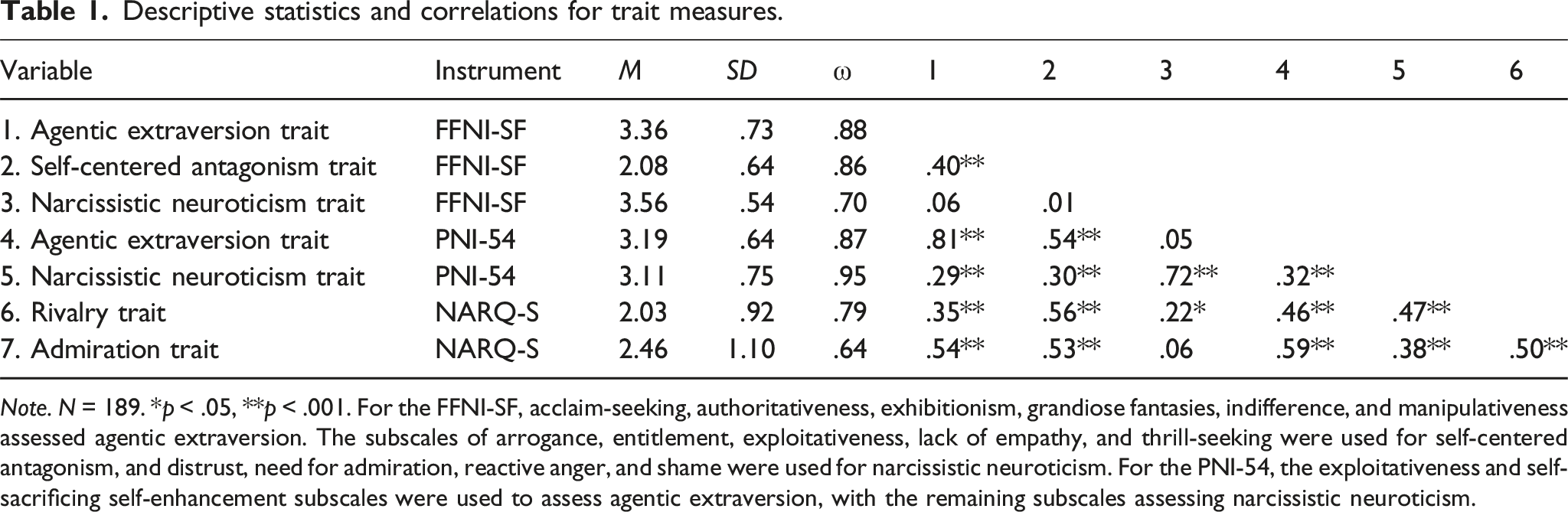
Note. N = 189. *p < .05, **p < .001. For the FFNI-SF, acclaim-seeking, authoritativeness, exhibitionism, grandiose fantasies, indifference, and manipulativeness assessed agentic extraversion. The subscales of arrogance, entitlement, exploitativeness, lack of empathy, and thrill-seeking were used for self-centered antagonism, and distrust, need for admiration, reactive anger, and shame were used for narcissistic neuroticism. For the PNI-54, the exploitativeness and self-sacrificing self-enhancement subscales were used to assess agentic extraversion, with the remaining subscales assessing narcissistic neuroticism.
Descriptive statistics for aggregated and non-aggregated state measures.
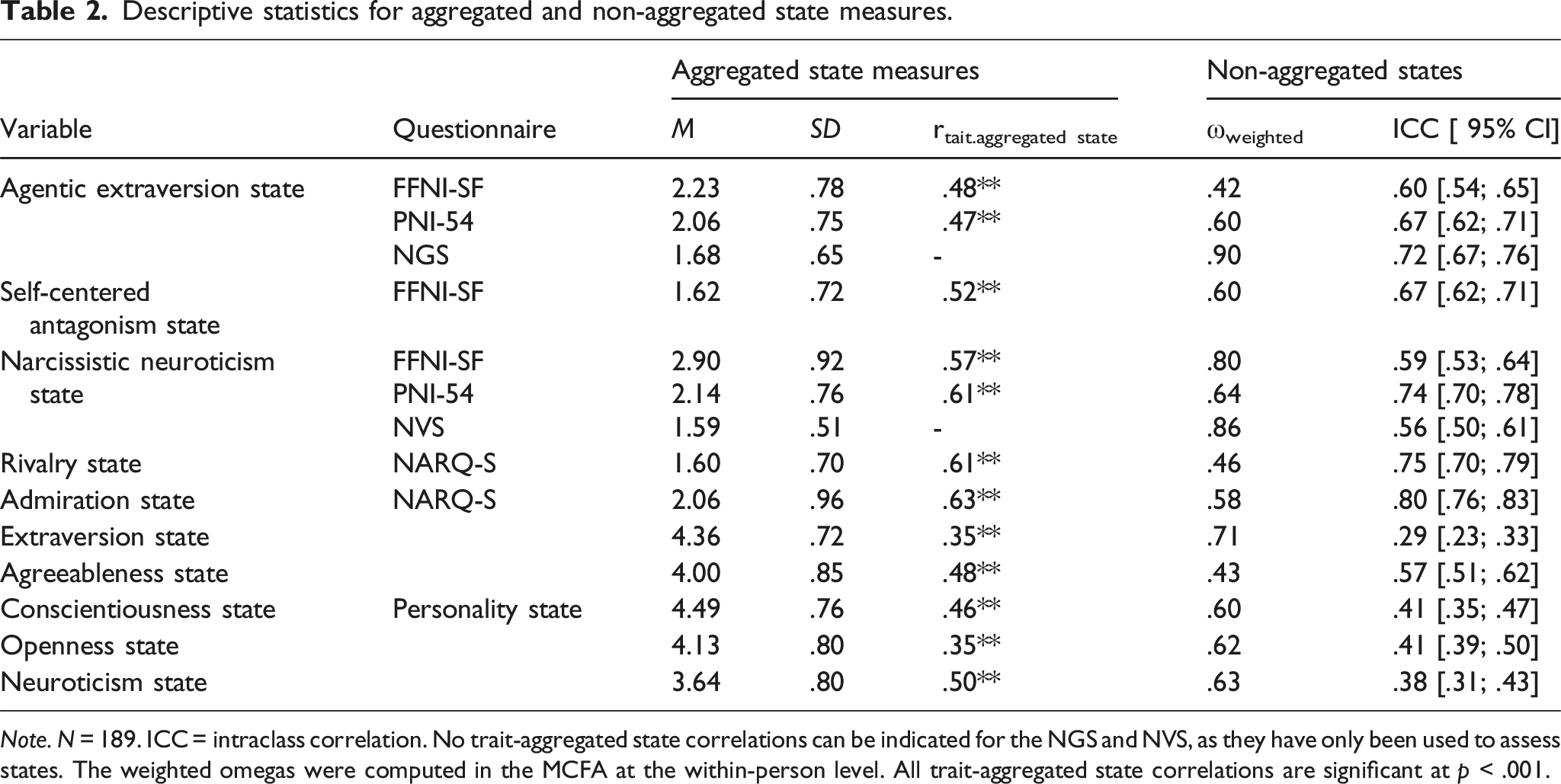
Note. N = 189. ICC = intraclass correlation. No trait-aggregated state correlations can be indicated for the NGS and NVS, as they have only been used to assess states. The weighted omegas were computed in the MCFA at the within-person level. All trait-aggregated state correlations are significant at p < .001.
Five-Factor Narcissism Inventory - short version (FFNI-SF; Sherman & Rauthmann et al., 2015; German translation by Wehner et al., 2021)
The FFNI-SF is a self-report measure, which has a total of 62 items across 15 subscales. The FFNI is an appropriate measure to assess the trifurcated structure of narcissism (Crowe et al., 2019; Miller et al., 2016). Participants rated the extent to which they agreed to different statements on a six-point rating scale, with the end-point designations “strongly disagree” (1) and “strongly agree” (6). Items included were, for example, “I only associate with people of my caliber” and “I often fantasize about someday being famous.” The internal consistency estimates of the fifteen-facet subscale scores ranged from ω = .62 for reactive anger and arrogance to ω = .91 for exploitativeness.
Pathological Narcissism Inventory (PNI-54; Pincus et al., 2009; German version by Morf et al., 2017)
The PNI is a self-report measure assessing seven dimensions of Pathological Narcissism (Pincus et al., 2009). The scale includes a total of seven subscales to assess vulnerability and grandiosity. Crowe et al. (2019) identified the exploitativeness and self-sacrificing self-enhancement subscales to be indicative of agentic extraversion, whereas all the other subscales assess narcissistic neuroticism. We used the PNI subscales in accordance with these findings. Participants rated the extent to which they agreed with different statements on a six-point rating scale, with the end-point designations “not at all like me” (1) and “very much like me” (6). Items included were, for example, “I sometimes need important others in my life to reassure me of my self-worth” and “I can make anyone believe anything I want them to.” The internal consistencies of the seven-facet subscale scores were estimated to range between ω = .76 for self-sacrificing self-enhancement and ω = .90 for contingent self-esteem.
Narcissistic Admiration and Rivalry Questionnaire - Short Scale (NARQ-S; Leckelt et al., 2018)
The NARQ-S is a six-item assessment tool that differentiates between the admiration and rivalry dimensions of narcissism (Back et al., 2013). The NARQ-S has one subscale per dimension, with three items each, reflecting narcissism’s affective-motivational, cognitive, and behavioral processes. The scale captures the agentic and antagonistic aspects of narcissism for which it was constructed (Crowe et al., 2019). The current study included rivalry to define self-centered antagonism, while admiration assessed agentic extraversion in the TMN. Participants rated the extent to which they agreed with different statements on a six-point rating scale, with the end-point designations “not agree at all” (1) and “agree completely” (6). Items included were, for example, “I deserve to be seen as a great personality” and “Most people are somehow losers.” For each participant, a narcissistic domain score was calculated, by averaging the items per person in each facet subscale (i.e., the admiration subscale was used to assess the agentic extraversion domain, and the rivalry subscale was used to assess the domain of self-centered antagonism). The estimated internal consistency of the rivalry subscale scores was ω = .64 and of the admiration subscale score ω = .79.
Big Five Inventory (BFI-2; Soto & John, 2017; German version by Danner et al., 2019)
The BFI-2 is a 60-item personality inventory to assess the Big Five: Extraversion, Agreeableness, Conscientiousness, Open Mindedness and Neuroticism. The inventory assesses a total of 15 personality sub-domains, which are assigned to the five personality domains. Participants rated the extent to which they agreed with different statements on a five-point rating scale, with the end-point designations “disagree strongly (1) and “agree strongly” (6). Items included were, for example, “I am full of energy” and “I am complex, a deep thinker.” The internal consistencies of the different domain scale scores were estimated to range between ω = .75 for agreeableness and ω = .90 for neuroticism.
State measurements
We employed a planned missingness design for state assessments to reduce burden but ensure content coverage (Silvia et al., 2014). Narcissistic trait measurements were adapted to measure narcissism at the state level using all six items from the NARQ-S and a total of 18 items from the FFNI-SF and PNI-54 (nine out of the initial 62 and nine out of the initial 54 items, respectively). To this purpose, participants were asked to complete the items as follows: “Please provide your answer that best corresponds to your agreement or disagreement AT THE MOMENT.” Two anchor items per narcissistic domain were presented at each measurement occasion. The third item per domain was chosen randomly from the remaining items. Anchor items were chosen based on their centrality and loading (Crowe et al., 2019), as well as their theoretical importance for the narcissistic domain. Random items were selected from the remaining items assessing the domain of interest. Due to a technical error, the random item was not always chosen among the remaining items of the same domain. This issue results in an unbalanced number of items per narcissistic domain. Rogoza & Krammer et al. (2024) validated abbreviated versions of the FFNI-SF and PNI-54, specifically the FFNI-SSF (Packer West et al., 2021) and Super-Brief Pathological Narcissism Inventory (SB-PNI; Schoenleber et al., 2015), in state-level data. Our data collection and pre-registration preceded the publication of their study, resulting in only a partial overlap between our items and those validated in their research. Nevertheless, the results provided by Rogoza & Krammer et al. (2024) provide support for the operationalization chosen in the current study.
Narcissistic Grandiosity Scale (NGS; Crowe et al., 2016)
The questionnaire was translated into German using back-translations by two individuals. Any discrepancies were resolved with the assistance of one of the authors of this paper. The NGS is a 16-item adjective-based narcissism scale. The questionnaire has a unidimensional structure and only assesses agentic extraversion (Crowe et al., 2016; Rogoza & Krammer et al., 2024). The measure has been shown to perform well psychometrically at the state and trait level, emphasizing its usefulness for momentary assessment (Edershile et al., 2019; Rogoza & Krammer et al., 2024). Participants rated the extent to which they related to different adjectives at this moment in time on a seven-point rating scale, with the end-point designations “disagree strongly” (1) and “agree strongly” (6). Adjectives included were, for example, authoritative, unrivaled, brilliant, and extraordinary.
Narcissistic Vulnerability Scale (NVS; Crowe et al., 2018)
The questionnaire was translated into German using back-translations, as described for the NGS. The Narcissistic Vulnerability Scale is an 11-item adjective-based narcissism scale. In line with a recent study by Rogoza & Krammer et al. (2024), we used the scale to examine narcissistic neuroticism. The NVS has been validated for momentary assessment, indicating that the measure performs well psychometrically at the state and trait level (Edershile et al., 2019). Participants were presented with the adjectives with the instructions to rate the extent to which the term described themselves at this moment on a seven-point rating scale, with the end-point designations “disagree strongly” (1) and “agree strongly” (6). Adjectives included were, for example, fragile, self-absorbed, irritable, and vengeful.
Big Five personality state scale (Ringwald et al., 2022)
The Big Five personality state scale is a 10-item daily Big Five questionnaire, with two items per domain. The questionnaire was developed to assess personality states in intensive longitudinal studies. Participants were presented with a rating scale that had one adjective at each end-point. They were asked to rate the extent to which the term described themselves at this moment on a seven-point rating scale. For example, talkative describes extremely well (1), both describe equally well (4), and silent describes extremely well (7). Upper-end adjectives included were, for example, energetic, tense, trustful, and curious.
Data preparation and analyses
The analyses outlined in this section were pre-registered and all deviations from the pre-registration are made explicit in a supplemental document in the OSF. 9 Statistical analyses were conducted in R (v.4.2.2; R Core Team, 2022) with the packages tidyverse (v. 1.3.2; Wickham et al., 2019), lme4 (v. 1.1.32; Bates et al., 2014), lavaan (v. 0.6.15; Rosseel, 2012), and bootnet (v.1.5; Epskamp et al., 2018). The R code and supplemental material are made available via OSF (https://osf.io/axvhp/).
Data pre-processing and preliminary analyses
For the ICC, we computed multilevel linear models for comparability with prior research. The ICC was calculated by dividing the between-person variance by the total variance.
Multilevel confirmatory factor analysis (MCFA)
To test the narcissism structure, multilevel confirmatory factor analysis (MCFA) was used. MCFA accounts for the nesting of the measurement occasions (level 1) within participants (level 2). Latent factors were identified by fixing the loading of the first indicator to one, except for the hierarchical fitting where indicators were latent variables. Additionally, when a latent factor only had two indicators, both were fixed to one. We did not person-mean center the variables, as Ryu (2015) indicated that centering has little influence on the model parameters in MCFA, particularly for the covariance structure. To account for non-normality, the models were estimated using robust maximum likelihood (MLR) estimation. Moreover, the use of MLR is deemed superior in cases where latent variable modeling involves ordinal response variable data (Bandalos, 2014; Li, 2016).
Model specification and estimation
In the first step, we fitted individual MCFA models for each instrument (i.e., FFNI-SF, PNI, NARQ-S, NGS, and NVS) and their corresponding domains at the state (within-person) and trait (between-person) level. Following, we fitted three measurement models, one for each of the lower-order narcissistic domains (i.e., agentic extraversion, self-centered antagonism, and narcissistic neuroticism). Next, we fitted models for the TMN conceptualization of narcissism, to examine the correlations between the domains at the state and trait level. Moreover, we fitted the hierarchical models of narcissism at both levels of analysis. Following the suggestion of an anonymous reviewer, we proceeded to conduct separate analyses for the three affiliative and the three controversial situations. Specifically, two models were examined for the first three sessions, and two additional models were scrutinized for the last three sessions. The models for the questionnaires were fitted with the single items, and all other models were fitted with the questionnaire means as indicators for the latent variables. Each model was fitted separately for the state and trait level. As pointed out by Ryu & West (2009) this is relevant in MCFA because the sample sizes differ considerably between levels. This was accomplished by specifying the model at one level while saturating the model (i.e., estimating all possible variances and covariances freely) at the other level.
Model evaluation
To evaluate the goodness of fit of the partially saturated models, we followed Ryu & West (2009) and estimated the level-specific CFI, RMSEA, and SRMR. We defined an acceptable model fit in terms of standard cut-offs for single-level factor analysis (CFI >.95, RMSEA <.06 SRMR <.08; Hu & Bentler, 1999) in our pre-registration.
Deviations from pre-registration
Next to the research questions addressed in this paper, we initially pre-registered our intention to explore the role of situation perception. However, to maintain the focus of this publication, we have chosen to defer the analysis of situation perception to a separate paper. Furthermore, our approach to examining the relations between the two- and three-factor models of narcissism—specifically, between grandiose and vulnerability and the TMN domains—was pre-registered with slight variations. Initially, we chose to view these two models as distinct conceptualizations, given their separate assessments. However, in theory, they represent an intertwined hierarchical structure. Consequently, our modeling approach deviated from the pre-registered plan. Instead of fitting separate models for grandiosity and vulnerability, we analyzed hierarchical models encompassing both narcissism conceptualization levels. Finally, RQ2b emerged from the suggestion of an anonymous reviewer and therefore stands as the sole research question that was not pre-registered.
Results
Descriptive statistics
Descriptive statistics for trait and aggregated state scores can be found in Tables 1 and 2. The aggregated state scores are computed by averaging individuals’ state scores across all assessment points.
RQ1: Intraindividual variation in narcissistic domain states
First, we investigated the narcissistic state variability. For comparability with prior research, we examined the ICCs making use of a multilevel model approach. We computed ICCs for every domain and questionnaire mean score, as well as for the individual items. 10 Results for ICCs can be found in Table 2. For narcissistic domains, the variance is more determined by differences between-persons than within-persons. For the Big Five states, reported here for comparison reasons, the opposite holds true. Confidence intervals for the narcissism ICCs do not always overlap, yet differences seem negligible as no lower bound CI lies below .5, supporting the conclusion that most variance is observed at the between-person level in this context. This is in line with our expectations and supports the notion that prior findings can be generalized to a video-based online social situation.
As an illustration of the within-person variability and how it varies across participants, we display the momentary reported scores for agentic extraversion and narcissistic neuroticism for a random subset of participants in Figure 1. Individual variability of momentary agentic extraversion and narcissistic neuroticism from a randomly drawn subset. Note. The narcissistic domains displayed were assessed by the FFNI-SF.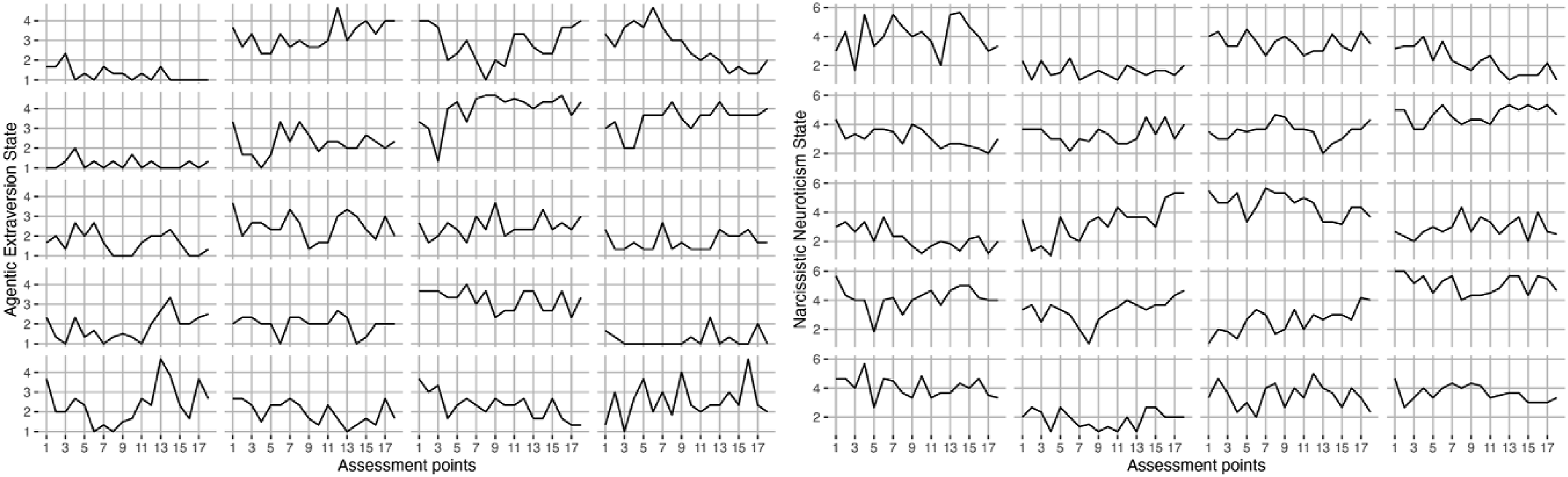
RQ2a: Trait-aggregated state relations
Correlations between domain traits and corresponding aggregated states can be found in Table 2.
11
These correlations are higher for narcissism (mean r = .58
12
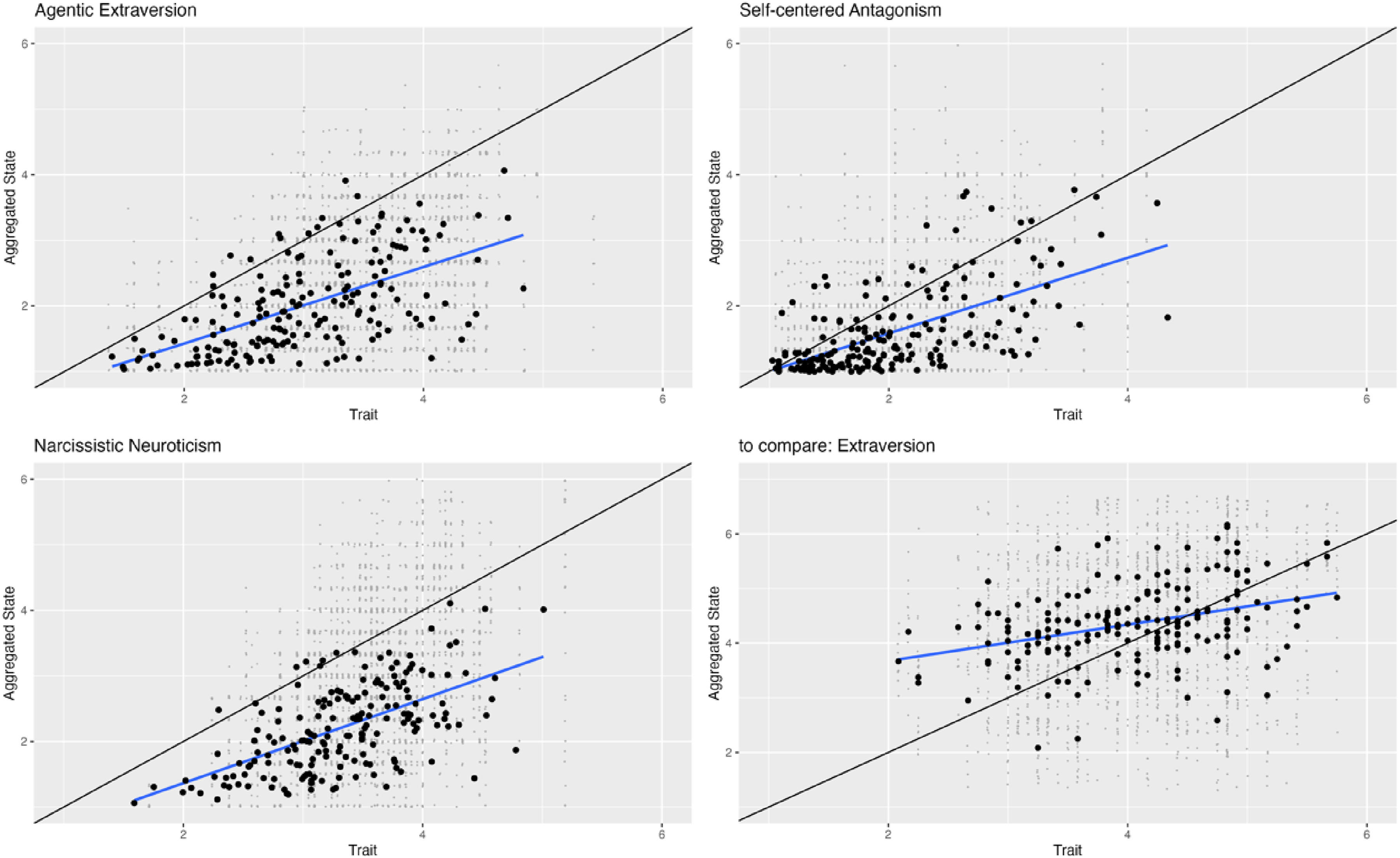
) than for the Big Five (mean r = .43). This relation for trait-aggregated states for narcissism aligns with our expectations. The relations between traits, aggregated states, and non-aggregated states are graphically displayed in Figure 2. The plots show that aggregated narcissistic states, and most, but not all, of the individual state ratings, vary below their corresponding trait levels. On the contrary, when it comes to extraversion—a dimension of the Big Five personality traits—a different pattern emerges: the aggregated states appear to vary both below and above their corresponding trait level. The same trend holds true for the remaining Big Five personality traits. Correlations between traits and corresponding aggregated states. Note. Bold black dots indicate person-aggregated states, and thin gray dots indicate single, single non-aggregated state reports. All narcissism measurements were assessed on a six-point scale; hence, we could plot the graphs making use of all the instruments assessing the displayed domain on the trait and state level. For the Big Five, the trait measures were on a six-point scale, while the state measures were on a seven-point scale. For the graphical representation, the state scale was transformed from a seven-point scale to a six-point scale by merging the lower-end ratings together.
13
RQ2b: Relation between narcissistic trait and state variability
For research question two, we examined the associations between narcissistic domain traits and their variability in state expressions, utilizing individual standard deviations to assess variability. Our analysis revealed significant Pearson’s correlations: r = .50 for agentic extraversion, r = .49 for self-centered antagonism, and r = .53 for narcissistic neuroticism (all p < .001). These correlations suggest that individuals with higher trait scores tend to exhibit greater variability in state expressions across these domains. These findings closely mirror the trait-aggregated state correlations, mentioned above. Furthermore, partial correlations, controlling for aggregated state narcissism, showed reduced but significant associations, indicating a relation between trait scores and state variability independent of the average state level: r = .25 for agentic extraversion, r = .14 for self-centered antagonism, and r = .25 for narcissistic neuroticism (all p < .001). This analysis highlights a correlation between traits and the range of state manifestations, separate from their average levels.
RQ3: Within- and between-person narcissism structure in state data
Model fits of the hierarchical multilevel confirmatory factor analyses.
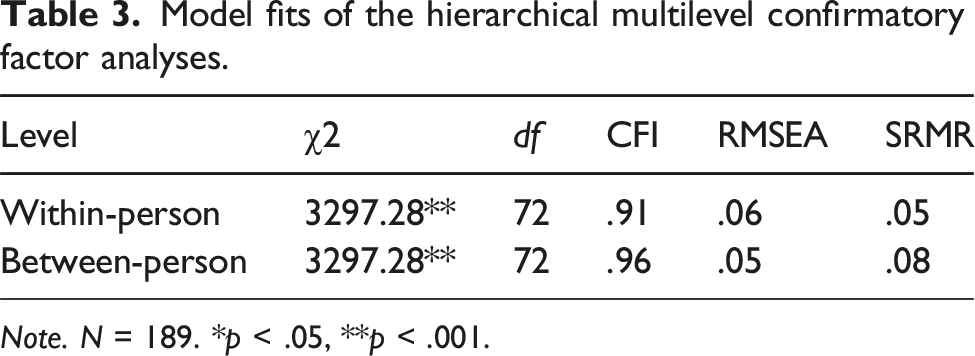
Note. N = 189. *p < .05, **p < .001.
Correlations between the TMN domains at the state and trait level.
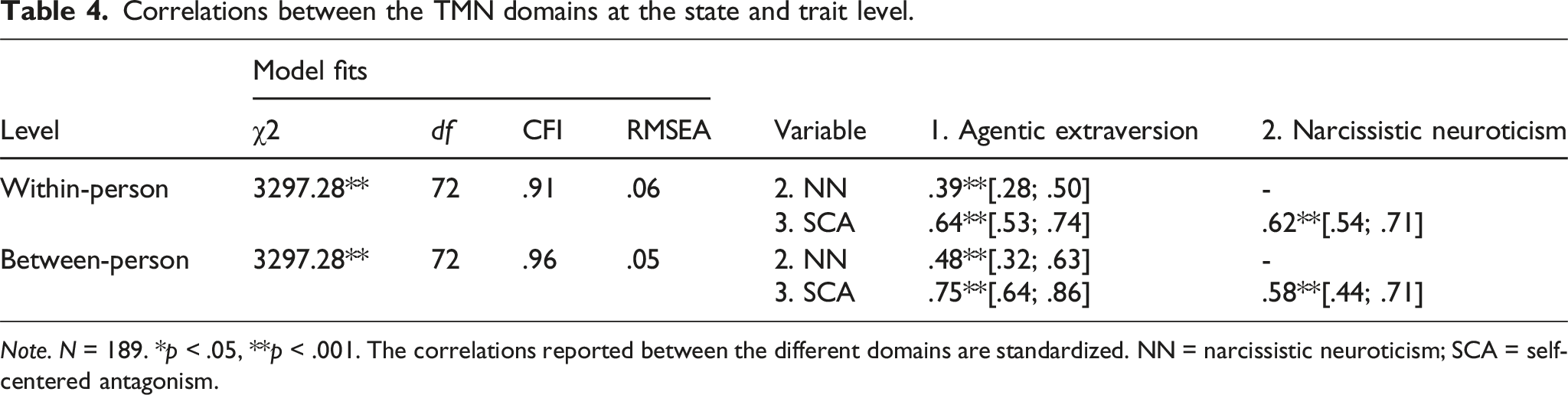
Note. N = 189. *p < .05, **p < .001. The correlations reported between the different domains are standardized. NN = narcissistic neuroticism; SCA = self-centered antagonism.
Further, we compared the relations among and across the two-domain and three-domain structures of narcissism. Figure 3 shows the correlations between grandiosity and vulnerability, as well as the TMN domain loadings on these two domains at the trait and state level. At the trait level, the association between vulnerability and grandiosity is moderate with r = .52. Across the higher- and lower-order narcissistic domains, the associations found at the trait level are as follows: Narcissistic neuroticism appears to reflect vulnerability with a loading of a = .94. Similarly, agentic extraversion reflects grandiosity (a = .97). Although self-centered antagonism seems to be more related to grandiosity (a = .69), it also is influenced by vulnerability (a = .34). At the state level, we made similar observations. The association between vulnerability and grandiosity is moderate with r = .57. Again, narcissistic neuroticism branches off from vulnerability with a = .97. In addition, agentic extraversion seems to largely reflect grandiosity with a = .71, however, this loading is less pronounced than at the trait level. Still, confidence intervals overlap. Similarly, to our findings at the trait level, self-centered antagonism seems to be more related to grandiosity (a = .79), than to vulnerability (a = .19). Notably, although the associations at the trait level were all significant, the association between vulnerability and self-centered antagonism at the state level was not. However, as before, the confidence intervals for the trait and state level loading overlap. Besides the freely estimated models, we made attempts to integrate a state model that imposed Level 2 estimates. In this process, we encountered several Heywood cases, which we resolved by adjusting the residuals of all three TMN domains to (1 - reliability estimate) * variance (Bollen, 1989). The outcome revealed a significant decline in model fit, with a CFI of .24, RMSEA of .21, and SRMR of .37. This indicates that the interrelations between the domains at these two analytical levels are not strictly identical. Hierarchical structure of narcissism at the trait (top) and state level (bottom). Note. N = 189. *p < .05, **p < .001. The graph shows standardized point estimates, confidence intervals, and p-values.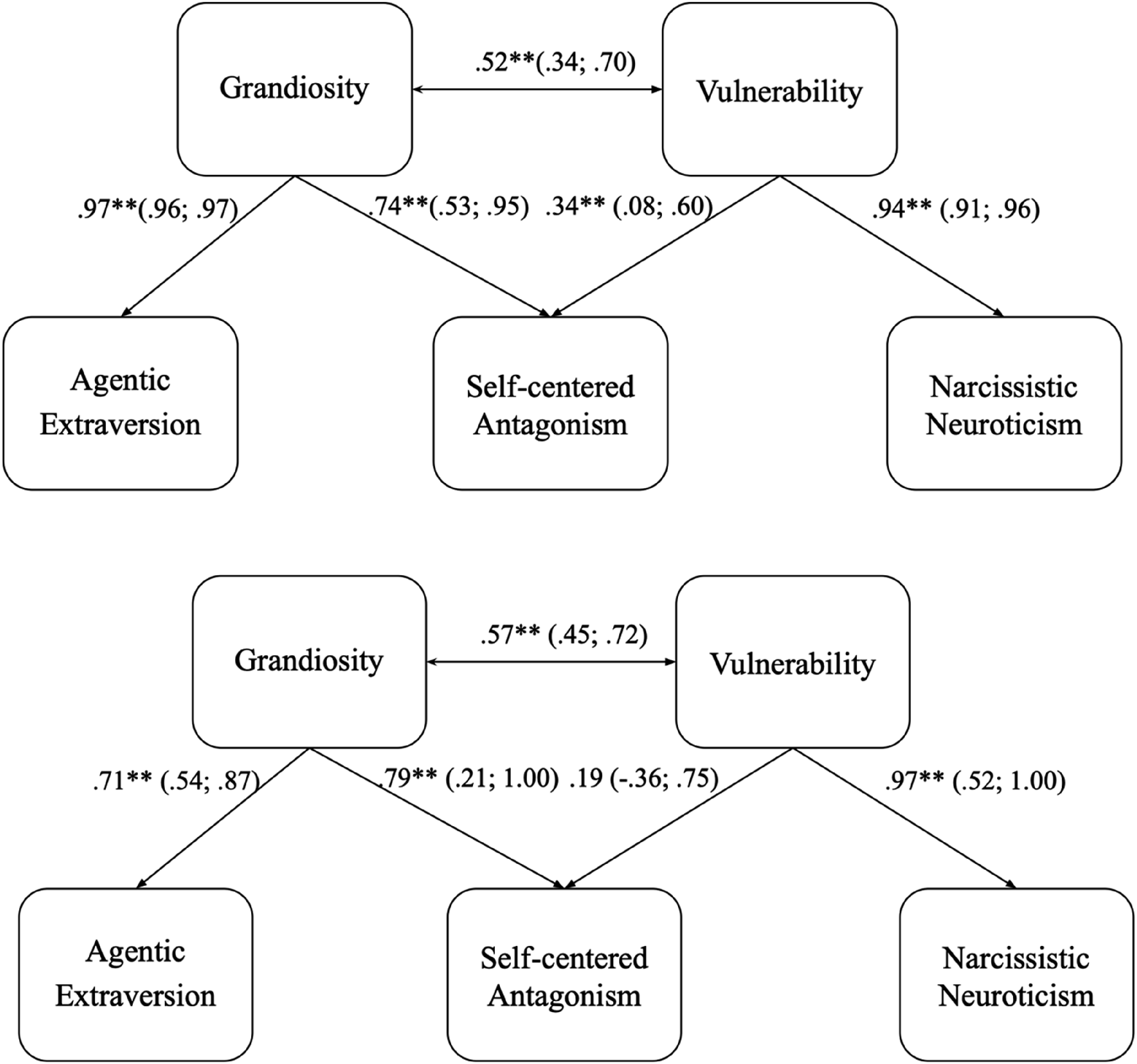
In addition, we examined the correlations among the three lower-order domains at both the trait and state levels. The correlations can be found in Table 4. At the trait level, self-centered antagonism is similarly associated with agentic extraversion and narcissistic neuroticism. Though the point estimate indicates a slightly higher association with agentic extraversion (r = .75 compared to r = .58), the confidence intervals between the two associations suggest no significant difference. When it comes to agentic extraversion, our results indicate that the domain has a stronger association with self-centered antagonism (r = .75) than with narcissistic neuroticism (r = .48), with no overlapping confidence intervals. At the state level, similar observations can be made. Self-centered antagonism is almost identically associated with agentic extraversion (r = .64) and narcissistic neuroticism (r = .62). Again, our findings indicate that agentic extraversion has a stronger association with self-centered antagonism (r = .64) than with narcissistic neuroticism (r = .39), with no overlapping confidence intervals. At both the trait and state level, self-centered antagonism plays a central role within the TMN conceptualization.
RQ4: Structural composition of narcissism per condition
Correlations among the TMN domains at the state and trait level in affliative vs controverisal group sessions.
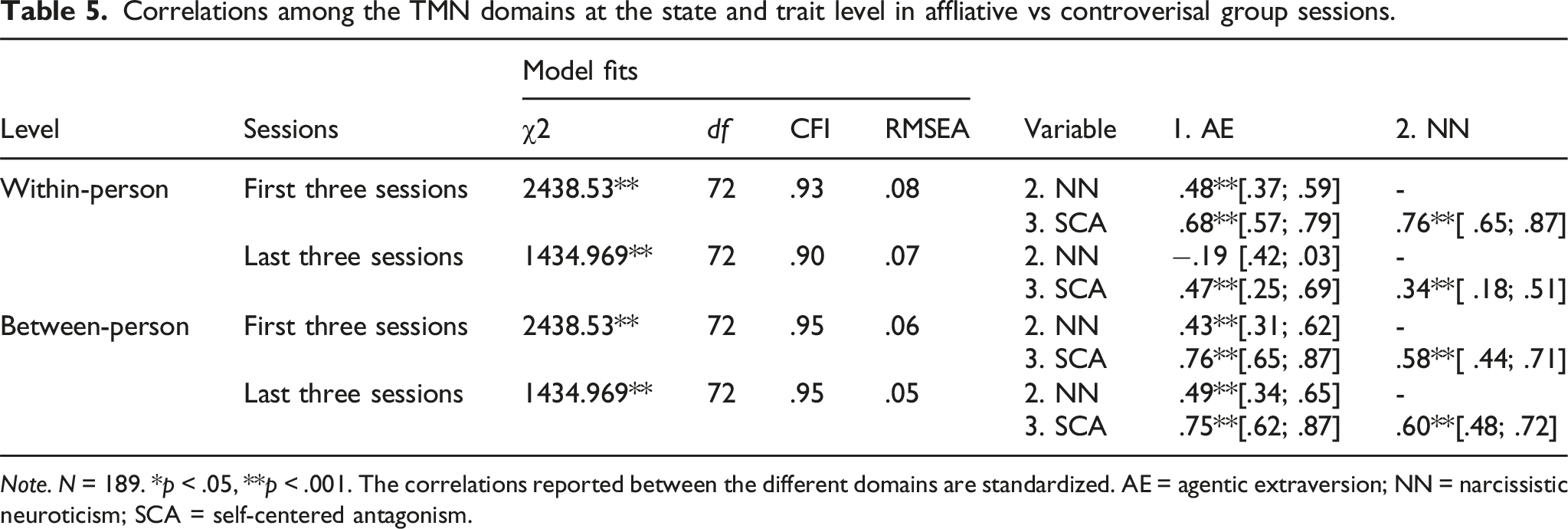
Note. N = 189. *p < .05, **p < .001. The correlations reported between the different domains are standardized. AE = agentic extraversion; NN = narcissistic neuroticism; SCA = self-centered antagonism.
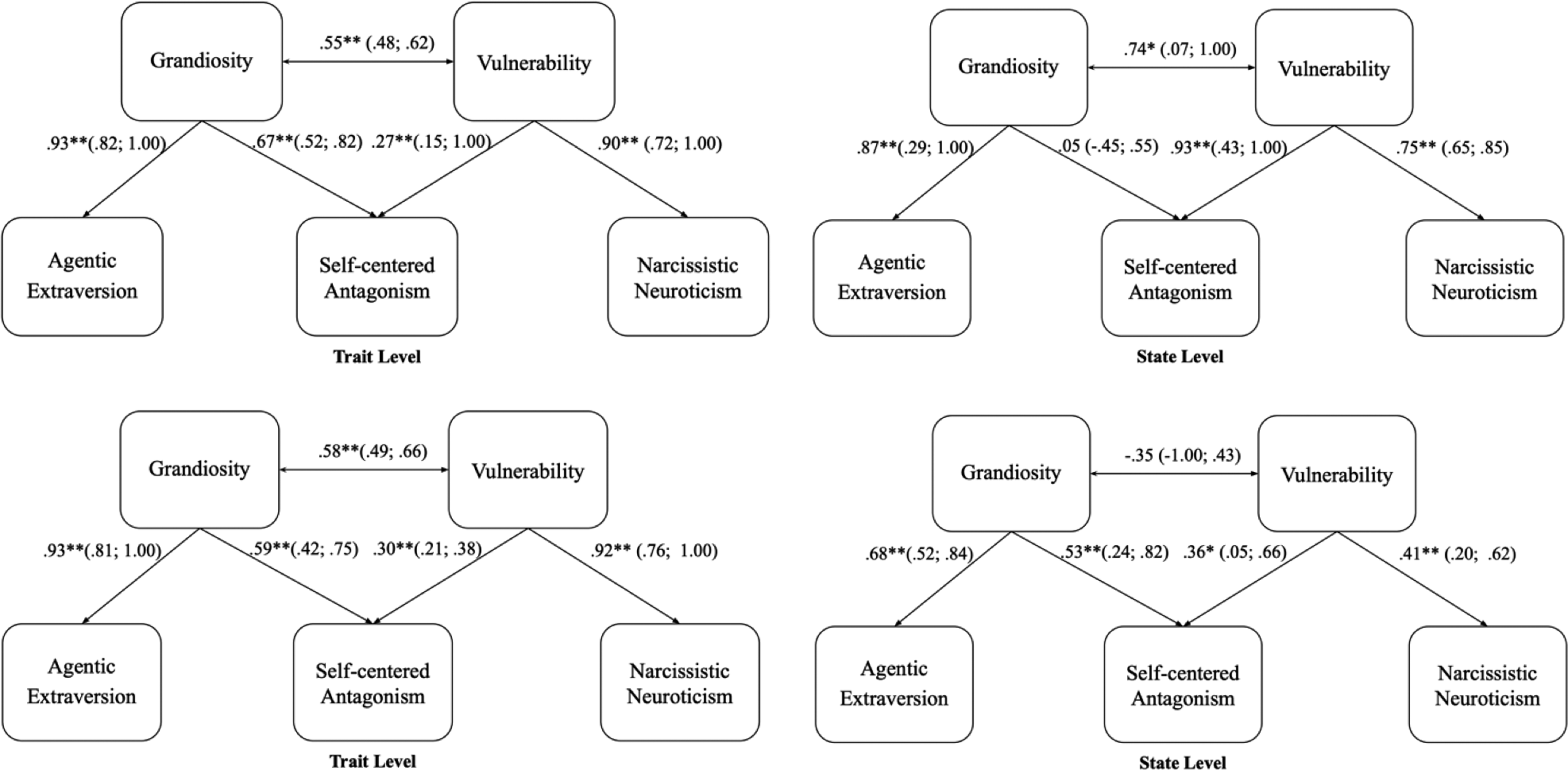
Hierarchical structure of narcissism in affiliative (top) versus controversial (bottom) three group sessions. Note. N = 189. *p < .05, **p < .001. The graph shows standardized point estimates, confidence intervals, and p-values. On the left side the between-person models and on the right side the within-person models are presented.
The results of the hierarchical models (as previously reported in Table 3 across all sessions) can be summarized as follows: For the first three sessions at the within-person level, the model exhibited a χ2 statistic of 2438.53 (p < .001), a CFI of .93, and an RMSEA of .06. Similarly, at the between-person level, the model yielded a χ2 statistic of 2438.53 (p < .001), a CFI of .95, and an RMSEA of .06. In contrast, for the last three sessions at the within-person level, the model yielded a χ2 statistic of 1434.97 (p < .001), a CFI of .87, and an RMSEA of .09. At the between-person level, the model resulted in a χ2 statistic of 1434.97 (p < .001), a CFI of .95, and an RMSEA of .05.
Discussion
The present study examined narcissism state manifestations in online social group interactions: their level of variability, their relation to the corresponding trait, and their structural composition. Drawing from recent research, we conceptualized narcissism hierarchically, with grandiosity and vulnerability branching off into agentic extraversion, self-centered antagonism, and narcissistic neuroticism. In line with our expectations and previous findings, our results, derived from data obtained in standardized situations, show that narcissistic states vary less than the Big Five. Moreover, the trait level often seemed to act as an upper boundary for the average state manifestations. Lastly, we found moderate trait-aggregated state relations and moderate associations between trait and state variability. These findings are in line with our expectations. They show that narcissism variability and trait-state relations reported from ESM data can be generalized to standardized social interactions.
Following Whole Trait Theory (Fleeson, 2001; Fleeson & Jayawickreme, 2015), we employed state ratings to specify and test a multilevel confirmatory factor analysis, enabling us to examine whether the presumed hierarchical structural composition of narcissism emerges from state data. The findings showed that the higher- and lower-order domain structures are discernible in state data, at both the within- and between-person levels. Moreover, it can be concluded that the hierarchical structure of narcissism—with the lower-order domains branching off the higher-order domains—is also predominantly evident in state data. The findings from the situation-specific analyses revealed slightly different results. While the structural composition of narcissism at the between-person largely mirrored the structure across all sessions, the narcissism state structure across affiliative versus controversial situations differed. Specifically, in affiliative situations, grandiosity manifested exclusively through agentic extraversion, with no expression through self-centered antagonism. Moreover, in controversial situations, agentic extraversion and narcissistic neuroticism exhibited a slight negative association, contrasting the positive association observed across all group meetings.
In sum, at least in the situational context of our study, the narcissism structure at the within- and between-person level largely overlapped, however in more specific situational contexts the state-level structures diverged from the trait-level structure in theoretically reasonable ways.
Intraindividual variability in narcissistic states
For our first research question, we examined within-person variability in the three lower-order narcissistic domains. In line with recent approaches in personality research (Horstmann et al., 2021; Sherman & Rauthmann et al., 2015), our findings indicate meaningful and substantial variability in narcissistic states. More specifically, 20%–44% of narcissistic state variance could be explained by within-person differences. These findings replicate results on the within-person variance in grandiosity and vulnerability, as well as the TMN domains (Crowe et al., 2018; Edershile et al., 2019, 2023; Edershile & Wright, 2021a; Maaß et al., 2018; Rogoza & Krammer et al., 2024). Notably, we could generalize these findings to a standardized longitudinal context. Following, even subtle variations in situations within a standardized environment relate to discernible changes in narcissistic domain states. This finding suggests that habitual settings, despite their consistency, afford diverse expressions of narcissism. That is, variability in narcissistic states is not contingent upon drastic changes in situations but rather can manifest within repetitive (i.e., online meetings with the same interaction partners) or routine contexts, highlighting the momentary and variable nature of narcissism.
Still, the observed within-person variance is lower than the variability in the Big Five. Our results indicate that for the Big Five, 43%–71% of state variance is at the within-person level, which aligns with previous findings (e.g., Horstmann et al., 2021). This replication of previous ESM findings demonstrates no general reduction in the variation of personality states in our data, making it unlikely to solely be attributable to the standardized situation. An interesting observation is that agreeableness, the Big Five dimension that shows negative associations with all three narcississitic domains (Crowe et al., 2019), exhibits the highest ICC of all Big Five dimensions. Our findings corroborate the concept that narcissistic domains exhibit momentary manifestations with substantial within-person variability. However, this variability is less pronounced compared to the Big Five personality dimensions.
Narcissistic trait-state relations
For research question two, we examined the narcissistic trait-state relations. In line with our expectations, our analyses revealed moderate trait-aggregated state relations and moderate associations between trait and state variability for all three lower-order domains. These findings illustrate the versatile role of narcissistic traits, influencing both consistent state manifestations, as reflected in aggregated states, and the variation in those manifestations. Notably, the correlations suggested that the mechanisms linking trait narcissism to variability are, at least partially, different from those affecting the average manifestations, and the other way around.
The goal Focus of narcissistic state manifestations
Narcissism, particularly in its grandiose manifestations, is primarily characterized by two key motivational goals: the pursuit of a grandiose self-image, associated with agentic extraversion, and its protection, linked to self-centered antagonism (Back et al., 2013; Grapsas et al., 2020; Morf & Rhodewalt, 2001). While vulnerable aspects of narcissism—narcissistic neuroticism—also focus on self-protection, they are more oriented toward safeguarding fragile self-esteem. Consequently, the underlying goal of narcissistic behavior consistently centers on maintaining self-worth, whether through actively pursuing a grandiose self-view or avoiding potential loss of status or esteem. This self-worth-focused goal may be relevant across various situations, particularly for individuals who prioritize it. According to narcissism theories, these individuals typically have higher narcissism scores. In contrast, individuals with lower narcissism scores may not prioritize these goals, regardless of the situation, and consequently seldom experience states aimed at their achievement. This avoidance may be partly influenced by the predominantly negative connotations associated with narcissistic traits (e.g., Carlson et al., 2011). A potential explanation for both the reduced variation in narcissistic states (compared to the Big Five) and the trait level boundary for state expressions may be the goal-focused (i.e., instrumental) nature of narcissism.
Given the heterogeneity of narcissism, we propose the following reasons for the different narcissistic domains: Agentic extraversion primarily drives narcissistic behaviors aimed at achieving a grandiose self-image (Back, 2018). The persistent need for self-promotion and enhancement may explain the reduced within-person variability in agentic extraversion. Maaß and Ziegler (2017) support this, showing that individuals high in grandiose narcissism promote themselves favorably across various situations. Similarly, self-centered antagonism involves protective states to fend off criticism and protect the grandiose self-image (Back, 2018). Once more, there may be a consistent baseline established to maintain this grandiose self-image, resulting in reduced variability within this domain. Despite the contrasting correlates observed in narcissistic neuroticism (Crowe et al., 2019; Krizan & Herlache, 2018; Miller et al., 2016), it is similarly driven by a self-worth-focused goal as the other two domains. This shared underlying motivation centered on self-worth, albeit manifested through safeguarding fragile self-esteem, may similarly account for the reduced variation observed in narcissistic states across different forms of narcissism. After all, narcissism’s momentary manifestations appear to be instrumental and contingent on individual differences in the importance attributed to narcissism-related goals, as evidenced in the trait level boundaries.
Trait-level boundaries in narcissistic state manifestations
Our results show that narcissistic state manifestations are largely constrained by their corresponding trait level—as assessed by a one-time dispositional measurement. More precisely, the aggregated states typically fall below the respective trait level. This pattern contrasts the ideas of the Whole Trait Theory (e.g., Fleeson, 2001) and previous findings on the Big Five, which have been shown to vary around their respective trait level. The momentary manifestations of the Big Five are shaped by an interplay of trait levels (representing functional goals) and situations (Horstmann et al., 2021). For instance, individuals tend to display extraverted states when they aim to achieve extraversion-related objectives, such as making new friends, and exhibit more introverted states when these goals are not relevant (McCabe & Fleeson, 2012). Thus, extraverted states manifestations (i.e., situational goals) are contingent on the individual’s traits and the immediate situation.
In contrast, narcissistic states seem to have a more consistent goal focus, with manifestations above the trait level rarely occurring. A similar “ceiling effect” has been observed in other constructs, such as vocational interests (Roemer et al., 2021, 2023). This effect has been interpreted using the instrumentality hypothesis, which posits that the trait exerts a more substantial influence on momentary manifestation than the situation. For interests, this means that the situational specifics rarely override an individual’s inherent lack of interest in a particular activity. This aligns with our suggestion that for narcissism, the self-worth goal—whether or not it is important to the individual—plays a more crucial role in determining states than the specific situation. In other words, the situational context seldom overrides the significance dictated by the trait.
In summary, while the importance of narcissistic goals may vary between individuals, narcissistic manifestations are likely more consistent within individuals over time compared to Big Five expressions. Further, we propose that the extent of narcissistic state manifestations is limited by the importance attributed to these goals which is reflected in the trait level. These findings suggest distinct psychological processes underlying the manifestations of narcissism and the Big Five traits.
Situational constraints on narcissistic state variability
The variability in narcissistic states evidences an interactional process between person and situation. We prioritize explaining the limited variability—compared to the Big Five—and the trait-level boundary by the goal-focused nature of narcissism. Especially, as the observed variability aligns with findings from previous daily diary or ESM studies. Still, it is important to acknowledge and address the potential role of the situational aspects of our study as an alternative explanation for these findings.
First, the study’s setup among newly acquainted individuals may have restricted the manifestation of certain narcissistic states. Specifically, the situational context of our study was confined to online group sessions where participants progressively acquainted themselves with each other. It can be assumed that among those participants the emotional investment was comparatively low (Edershile et al., 2023). The reduced emotional engagement might have affected the manifestation of antagonism, potentially resulting in less frequent expressionsof combative behaviors, such as criticizing others (Kroencke et al., 2023).
Second, the limited situation selection may also have resulted in restricted narcissistic state manifestations. The Status Pursuit in Narcissism Model (i.e., SPIN model; Grapsas et al., 2020) states that a pivotal aspect of attaining narcissistic goals is situation selection. In brief, this model suggests that people with high narcissism levels tend to prefer public and hierarchical environments and prioritize relationships that boost their status. In the current study, selecting one’s situation was confined to the participants’ sign-up process. Although the situations were tailored to afford narcissistic states (e.g., by creating a social context in which one can shine; Paulhus et al., 1998), the participants control over situation contact (Rauthmann, 2021) was limited.
Hierarchical structure of narcissism: Trait and state perspectives
To answer our third research question, we examined the hierarchical structure of narcissism, considering its trait and state manifestations. In line with Whole Trait Theory (Fleeson & Jayawickreme, 2015), we examined state and trait level structures using state data. As mentioned above, based on theoretical frameworks, like the TESSERA model (Wrzus & Roberts, 2017), correlations at the trait level might reflect co-manifestation in situations. If this were true, we would expect a similar structural composition of narcissism at the trait and state level.
Replicating two- and three-domain narcissism structures
Initially, we examined the interconnections between the two higher-order (i.e., grandiosity and vulnerability) and the three lower-order domains separately. Our findings showed moderate associations between grandiosity and vulnerability, evident at both trait and state levels. This mostly aligns with previously reported associations (e.g., Crowe et al., 2019; Edershile & Wright, 2021b). Within the TMN domains, we also replicated earlier findings confirming our expectations (e.g., Crowe et al., 2019; Rogoza & Zajenkowski et al., 2024). Our results highlight the central positioning of self-centered antagonism, which exhibited moderately high associations with narcissistic neuroticism and agentic extraversion at both trait and state levels. At the state level, the bivariate associations were very balanced. At the trait level, self-centered antagonism displayed a stronger association with agentic extraversion compared to narcissistic neuroticism, albeit with overlapping confidence intervals. In summary, in line with the suggestions by Rogoza & Krammer et al. (2024), our findings support the applicability of the two- and three-domain structure in comprehending narcissism at both trait and state levels.
Examining the complete hierarchical narcissism model
In the second step, we examined the hierarchical structural composition of narcissism. Specifically, we explored how the three lower-order domains split off the two higher-order domains. Our findings largely corroborated prior findings on trait narcissism (e.g., Crowe et al., 2019). That is, in both the within- and between-person models, narcissistic neuroticism reflected vulnerability, while agentic extraversion reflected grandiosity. However, the emergence of self-centered antagonism appeared to be different than previously reported in trait data (Crowe et al., 2019). Specifically, our findings indicate self-centered antagonism to be more associated with grandiosity than vulnerability. Thus, in our social interactions, vulnerability appears to primarily manifest through narcissistic neuroticism rather than self-centered antagonism.
Although this latter finding does not align with our expectations based on the ideas derived from the TESSERA framework (Wrzus & Roberts, 2017), prior research has indicated that within multidimensional constructs, the loading patterns of lower-order domains can vary across the trait and state levels. For example, research on the extraversion dimension showed that while extraversion substantially loaded its sub-domain assertiveness at the trait level (a = .62), this loading was considerably lower at the state level (a = .26; Ringwald et al., 2022). This finding suggested differences in the manifestation of extraversion at the state versus trait level. Specifically, while extraversion might be manifested through assertiveness in general, not all situations seem to afford the manifestation of extraversion through this domain.
A parallel argument can be made for narcissism. While trait data suggest that vulnerability generally manifests through both self-centered antagonism and narcissistic neuroticism, our state data revealed that these manifestations may not always occur simultaneously in the same situations. For instance, an individual with a high vulnerability trait might express antagonism through combative behaviors (e.g., criticizing others) in one context, and display narcissistic neurotcisism through avoidant behaviors (e.g., being reserved) in another (Kroencke et al., 2023). However, this dual manifestation of vulnerability may unfold across various situations over time, but not necessarily concurrently.
Narcissism structure: Affiliative versus controversial situations
Despite our study not capturing a large variety of situations, it offers a unique opportunity to examine the narcissism structure across two distinct experimental conditions. Thus, addressing our fourth research question, we expanded our analysis beyond a general narcissism structure to investigate how the narcissism structure manifests in affiliative versus controversial situations. This comparative approach allowed us to examine narcissistic manifestations across varying social situations.
At the between-person level, our models demonstrated a stable pattern across both conditions, underscoring the robust overarching dispositional structure of narcissism. However, some differences emerged at the within-person level.
In the initial, affiliative situations, grandiosity and self-centered antagonism did not show a significant relation. In other words, it seems that in our affiliative condition, grandiosity solely manifested through agentic extraversion and not through self-centered antagonism. Although this finding contradicts our initial expectations and the general structure reported above, it supports the ideas of the dual-pathway model (Back, 2018). Back (2018) suggests that grandiosity initially (in zero- and short-term acquaintances) manifests as agentic extraversion, rather than antagonism, enhancing social popularity among those with higher agentic extraversion levels. This idea has received empirical support (e.g., Leckelt et al., 2018).
In the more controversial situations, our findings showed that the three lower-order domains—agentic extraversion, self-centered antagonism, and narcissistic neuroticism—split off from the two higher-order domains as expected. However, we could observe a slightly negative association between grandiosity and vulnerability. This negative association extended to the lower-order relation between narcissistic neuroticism and agentic extraversion. We interpret this finding as follows: At the trait level vulnerability and grandiosity share some overlapping features (i.e., antagonism). Moreover, in non-controversial situations, individuals may balance grandiose and vulnerable manifestations seamlessly. In contrast, controversial situations might force individuals to prioritize one set of manifestations over another, resulting in the lack of co-occurrence between these domains. This hypothesis revisits the ideas introduced in the preceding paragraph, suggesting that individuals may not always be capable, nor would need to (i.e., to reach narcissistic goals) experience all narcissistic domains simultaneously. Additionally, the later findings resemble the results by Edershile et al. (2019), who reported a state-level association of r = .10 between vulnerability and grandiosity in ESM data. They noted that momentary grandiosity is often linked to warmth and dominance, aiming to elevate status, while momentary vulnerability is associated with coldness and negative affectivity, potentially leading to withdrawal or conflict-avoidance behaviors.
Limitations and directions for future research
Our study has several strengths, such as being pre-registered, collecting data in standardized social interactions, and combining multiple measurement instruments to assess narcissism. However, we must also address certain limitations.
Primarily, some aspects may constrain the generalizability of the results. For instance, we have a sample with a restricted age range, yet narcissism changes over the lifespan (e.g., Weidmann et al., 2022; Wetzel et al., 2020). Furthermore, despite the known gender differences in narcissism (Grijalva et al., 2015; Weidmann et al., 2022), there was an imbalance in gender representation, with a larger number of women compared to men. Additionally, as emphasized multiple times, the findings need be interpreted in light of the specific situational context. Following, there is the need for replications with a larger and more balanced sample in terms of gender and age range, as well as across a wider range of situations.
Another limitation of this work is the potential imprecision in interpreting intraclass correlations. ICCs weigh the proportion of within-person variance relative to between-person variance, making them particularly sensitive to the composition of the sample. This sampling effect could potentially obscure a clear understanding of the true stability of narcissism. Importantly, our findings align with previous research showing less variability in narcissistic states than in the Big Five. Moreover, the presented graphs (in Figure 2) serve as a visual re-examination of state variability across the narcissism spectrum. Consequently, the observed ICCs do not appear artifacts of our specific sample composition but seem to reflect genuine patterns of limited state variability across the narcissism continuum.
Finally, our study employs a “measurement stack” approach (Buelow & Brunell, 2018; Crowe et al., 2019; Miller, 2017; Schneider et al., 2023; Weiss et al., 2019) to capture the full spectrum of narcissism, conceptualized as a dimensional construct without a definitive clinical threshold. This approach integrates diverse strands of literature, advocating for a unified perspective in the field. The inclusion of the Pathological Narcissism Inventory (PNI) may be considered controversial by some. However, it is important to note that the PNI has been validated for use in general populations, demonstrating stable factor structure and high reliability (Pincus et al., 2009; Wright et al., 2010). From the Narcissism Spectrum Model perspective, the PNI provides a comprehensive assessment of narcissistic vulnerability, albeit with limited coverage of entitlement and grandiosity (Krizan & Herlache, 2018).
Moreover, while the “measurement stack” method is effective for capturing the triarchic structure of narcissism it also limits comparability with studies like Rogoza & Krammer et al. (2024), which use singular instruments to assess narcissism. Further, we adapted trait-level measures for state-level assessments, which poses a challenge. Trait items are generally more abstract, whereas state items tend to be more concrete. While the NGS (Crowe et al., 2016) and NVS (Crowe et al., 2018) are validated state measures that capture this concreteness, not all of our narcissism state items followed this approach. In contrast, the Big Five state-level items were more concrete. This discrepancy in the level of concreteness between the narcissism and Big Five state assessments may have influenced our comparisons, with some of the observed differences in state variability potentially stemming, at least in part, from methodological artifacts.
To address this, future research should focus on measuring narcissistic states more concretely. Specifically, given that current state assessments often emphasize emotional states (e.g., NVS and NGS), we recommend broadening the scope of future assessments to include interpersonal dynamics, such as momentary perceptions of status or relationships, as well as cognitive elements (Wilt & Revelle, 2015), such as real-time self-perceptions and thought patterns. This approach would offer a more balanced and comprehensive understanding of narcissistic states.
Conclusion
This study investigated narcissistic states, conceptualized as a hierarchical three-domain construct. Our findings reveal substantial and meaningful variations in narcissistic domain states within a standardized longitudinal online group setting, largely replicating patterns observed in daily diary and ESM research. These variabilities confirm that narcissism can vary over time and across similar situations, albeit more subtly compared to other personality states, suggesting a more goal-focused nature of narcissism. Our data indicates that trait narcissism sets an upper boundary for state expressions, with momentary manifestations typically deviating below this level. Regarding narcissism structure, we successfully replicated previously established relations among higher-order domains (grandiosity and vulnerability) and lower-order domains (agentic extraversion, self-centered antagonism, and narcissistic neuroticism) using state-level data. However, at least in the context of our study, we observed a nuanced hierarchical structure. Notably, vulnerability predominantly loaded onto narcissistic neuroticism rather than self-centered antagonism in the social context of our study. Additionally, the structural composition of narcissistic states differed depending on the experimental condition.
In conclusion, this study provides a foundational framework for understanding the hierarchical structure of narcissism in state-level expressions. Our findings reveal an intricate interplay between trait tendencies and situations in shaping narcissistic manifestations. While narcissism domains show less variabibility than the Big Five, reflecting a strong trait-level influence, their structural composition at the state level remains sensitive to situation cues. Notably, the relations between narcissism domains vary across affiliative vs controversial situations, suggesting a dynamic, transactional nature of narcissism.
Supplemental Material
Supplemental Material - Relations among the trifurcated narcissistic domains at trait and state level: Two of a kind?
Supplemental Material for Relations among the trifurcated narcissistic domains at trait and state level: Two of a kind? by Sophie C Bauditz, Aidan GC Wright, Ursula Hess, and Matthias Ziegler in European Journal of Personality.
Footnotes
Author contributions
Declaration of conflicting interests
The author(s) declared no potential conflicts of interest with respect to the research, authorship, and/or publication of this article.
Funding
The author(s) disclosed receipt of the following financial support for the research, authorship, and/or publication of this article: This study draws on data from a larger project financed by the German Research Foundation (ZI 1792/9-1).
Open science statement

Supplemental material
Supplemental material for this article is available online.
Notes
References
Supplementary Material
Please find the following supplemental material available below.
For Open Access articles published under a Creative Commons License, all supplemental material carries the same license as the article it is associated with.
For non-Open Access articles published, all supplemental material carries a non-exclusive license, and permission requests for re-use of supplemental material or any part of supplemental material shall be sent directly to the copyright owner as specified in the copyright notice associated with the article.
